
I’ve seen over seventy films from 2023 (and there are still more I want to see!), and these are my top ten. My top eleven through twenty will be released this weekend in a separate post. Many are international, and what year to classify them as can be hazy; I go by the date on which the film was released in the US, which is when I have access to it.
If the film is streaming for free with a subscription service, I’ve noted that at the bottom of the entry. Otherwise, most are available for digital rental (Google Play is my preferred vendor), and a few are still in theaters. You might also see if your local library has any on DVD, as that’s how I watched several of these.
Please be aware that the following films have either PG-13 or R ratings, for various reasons. I don’t have a personal policy of “no x” or “no y” in the movies I watch, but if you do, please consult the MPAA rating descriptors or a more detailed content advisory before deciding whether to view the film.
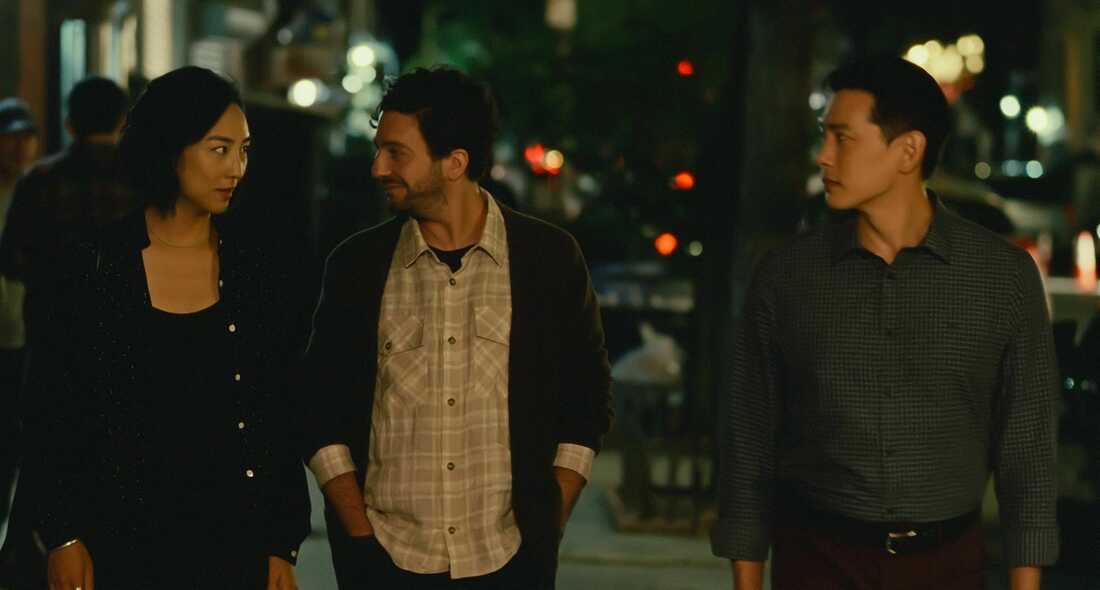
1. Past Lives, dir. Celine Song. Kind, gentle, and empathetic, this semiautobiographical indie drama by debut director Celine Song follows Na Young, or Nora (Greta Lee), over the course of twenty-four years, from her young adolescence in South Korea to her emigration to Canada and then the US. Act 1 introduces us to Nora’s childhood sweetheart, Hae Sung (Teo Yoo), whom she reconnects with virtually twelve years later in act 2, shortly before meeting and befriending a white American man named Arthur (John Magaro) at a writers’ retreat. After another twelve years of not interacting, Nora and Hae Sung find each other again in act 3 at age thirty-six, when the single Hae Sung visits Nora, who’s now married to Arthur, in New York.
What I love about this film is how it subverts all the tropes associated with the romantic triangle. The characters aren’t possessive, conniving, or competitive. There are no heroes or villains here. The film is about bonds of love and culture, and especially about what trust, support, constancy, maturity, and love look like in a marriage. In an interview on the DVD special features, Song says Past Lives is at its core a love story between Nora and Arthur. It’s also a story of navigating a bicultural identity—living between two worlds, mourning the piece of oneself that’s lost with the adoption of a new home country, and integrating elements of one’s “past life” into one’s new life, continuing to be shaped by both.
The opening scene and closing scene are perfect. Song’s skill as a storyteller, honed over her years as a successful playwright, really shines through in her screenplay.
2. The Zone of Interest, dir. Jonathan Glazer. This chilling Holocaust drama centers on a Nazi family living their dream life in the literal backyard of the Auschwitz concentration and death camp. Rudolf Höss (Christian Friedel)—who is an actual historical figure—is the commandant of the camp; having risen through the ranks, he seeks to provide his wife, Hedwig (Sandra Hüller), and their five children a comfortable and idyllic life. It’s a risky choice to tell this story from a German perspective, but Glazer and the two lead actors more than succeed. We never actually set foot inside the camp; most of the scenes happen within the confines of the villa or at the nearby river where the family goes on outings. Nor do we directly see any of the horrors; we see merely hints, like smoke rising from a crematorium chimney in the background. But even more, we hear these intimations: a train pulling into the station, a tussle, a chase, a barking dog, a gunshot, screaming. All of this happens just over the wall, while Hedwig tends to her flower garden or her son plays with toys in his bedroom. (Props to the sound designer, Johnnie Burn.)
What is so disturbing about the film is the banality of evil that it reveals. Rudolf isn’t the type of villain who sneers or snarls or has violent outbursts. He brings his kids kayaking and reads them bedtime stories; he sips coffee with his wife. He could be us. “I wanted to show that these were crimes committed by Mr. and Mrs. Smith at No. 26,” Glazer said. Sanitization is one of the themes explored—lots of scrubbing.
3. Four Daughters, dir. Kaouther Ben Hania. Blending documentary and fiction, this film tells the true story of a Tunisian Muslim mother—Olfa Hamrouni—and her four daughters, the elder two of whom became radicalized by ISIS as teenagers and ran away to Libya to engage in jihad. In 2016 Kaouther Ben Hania saw media segments of Olfa calling out local authorities for their indifference and inaction and knew she wanted to make a film about the disappearance, to understand how a tragedy like this can happen in a family. She originally wanted to do a straight documentary but soon realized it would be more powerful, and more feasible, to have Olfa and her younger daughters, Eya and Tayssir Chikhaoui (born in 2003 and 2005), reenact their memories onscreen. Because daughters Ghofrane and Rahma Chikhaoui are still absent, actors Ichrak Matar and Nour Karoui were hired to portray them, and actor Hind Sabri stepped into the mother role for the scenes that took too high an emotional toll on Olfa.
This method of storytelling better reveals the story’s complex layers, as the three women are both inside and outside the scenes. They’re telling the past, but they’re also questioning it. They’re reflecting on their motivations as they discuss their memories with each other and Ben Hania—many of them traumatic, but others warm or simply ordinary, as when they talk about their first periods! Olfa, the mother, is a particularly complex character, as she is fiercely protective of her daughters but also perpetuates on them some of the patriarchal oppression that she herself suffered. The film is about motherhood, sisterhood, zealotry, rebellion, and violence, and it has left a searing impression on me.
4. Anatomy of a Fall, dir. Justine Triet. In this courtroom drama set in the French Alps, Sandra (Sandra Hüller) is suspected of her husband Samuel’s (Samuel Theis) murder. As the police investigate and the prosecution launches its interrogations, they uncover details about Sandra and Samuel’s conflicted relationship, and the couple’s visually impaired eleven-year-old son, Daniel (Milo Machado Graner), is forced to testify. Hüller’s performance is riveting—she gets my vote for Best Actress of the Year.
5. Saint Omer, dir. Alice Diop. Another French courtroom drama, this one based on the real-life story of Fabienne Kabou. Laurence Coly (Guslagie Malanda), a Senegalese immigrant to France, is on trial in Saint-Omer for the murder of her fifteen-month-old daughter, Lili, an action she blames on sorcery. Intrigued by the case as potential source material for the novel she’s working on, Rama (Kayije Kagame), pregnant, travels from Paris to attend the trial. But when Laurence’s motives prove inscrutable and mental illness is put on the table, Rama begins to worry about her own ability to mother. The testimony dredges up emotions for Rama surrounding her troubled relationship with her mother—also a Senegalese immigrant, who appears, from the flashback sequences, to suffer from depression—and sharpens her sense of cultural alienation. Rama is an analogue for the filmmaker, Alice Diop, who, as a documentarian and expectant mother at the time, attended the Kabou trial, and it forced her to face her own difficult truths.
Streaming on Hulu.
6. Dream Scenario, dir. Kristoffer Borgli. Paul Matthews (Nicolas Cage) is an evolutionary biologist teaching at a small-town college and living a quiet life with his wife and two daughters, when out of nowhere, he starts appearing in the dreams of strangers around the world and becomes instantly famous. An absurd comedy with elements of horror, Dream Scenario satirizes the fickle nature of celebrity in today’s internet age, in which even the most unremarkable people can become an overnight sensation, and the adoration of fans can turn to hatred at the drop of a hat. I was laughing out loud a lot at this one—and cringing too!
7. Fremont, dir. Babak Jalali. Donya (Anaita Wali Zada) is a young Afghan immigrant working at a fortune cookie factory in the Bay Area of California. Formerly a translator for the US Army in Afghanistan, she is ostracized by many of her fellow Afghans as a traitor, and she struggles with loneliness. But the film has an uplifting tone; it’s about survival, hope, and connection. The first full-length feature by the Iranian British filmmaker Babak Jalali, it is in English, Dari, and Cantonese.
Streaming on MUBI.
8. Monster, dir. Kore-eda Hirokazu. When her eleven-year-old son, Minato (Soya Kurokawa), starts behaving strangely and she hears that a teacher hit him, Saori (Sakura Ando) demands answers from the school. The story is told in three parts, each from a different narrative perspective: first the mom’s, then the teacher’s, then the boy’s. The truth gradually emerges with each shift, and a stormy finale brings things to a close.
9. Plan 75, dir. Chie Hayakawa. In a near future, the Japanese government launches a voluntary but coercive program encouraging the nation’s elderly citizens to terminate their lives in order to nobly reduce the burden on society. Having been forced to retire from her job as a hotel maid after one of her coworker peers slips in a hotel shower, Michi (Chieko Baishô) is considering signing up. The film focuses on her but also develops side stories for two Plan 75 employees: a Filipino migrant whose daughter back home needs an operation, and a man whose estranged uncle becomes a client.
10. Killers of the Flower Moon, dir. Martin Scorsese. Based on the best-selling nonfiction book by David Grann about the serial murder of members of Osage Nation in the 1920s, Scorsese’s Killers of the Flower Moon depicts the criminal ugliness of white greed and laments a grave historical injustice. When the Osage discover oil on the reservation they’ve been displaced to in Oklahoma, they become very wealthy, and white men from the outside move in to try to steal that wealth. The white crime boss and master of deception William Hale (Robert De Niro)—the movie uses all the real names—has ingratiated himself with the Osage over decades and has secretly been carrying out a plan to gain control of Osage headrights by killing off inheritors.
The movie focuses on Hale’s nephew Ernest Burkhart (Leonardo DiCaprio), a simpleton whom Hale compels to marry the young Osage woman Mollie Kyle (Lily Gladstone) and further manipulates to manipulate others. The movie suggests that the love been Ernest and Mollie is genuine but complicated, and I didn’t quite grasp what bound them together (was it just physical attraction?) or how much either of them knew about what was going on (was Ernest really that naive? did Mollie never suspect him or his uncle of foul play earlier on?). But I was engrossed for the full three-and-a-half-hour runtime, all the way to the gutsy final scene of the radio play and the beautiful, defiant coda.
Streaming on Apple TV+.

 Art & Theology