
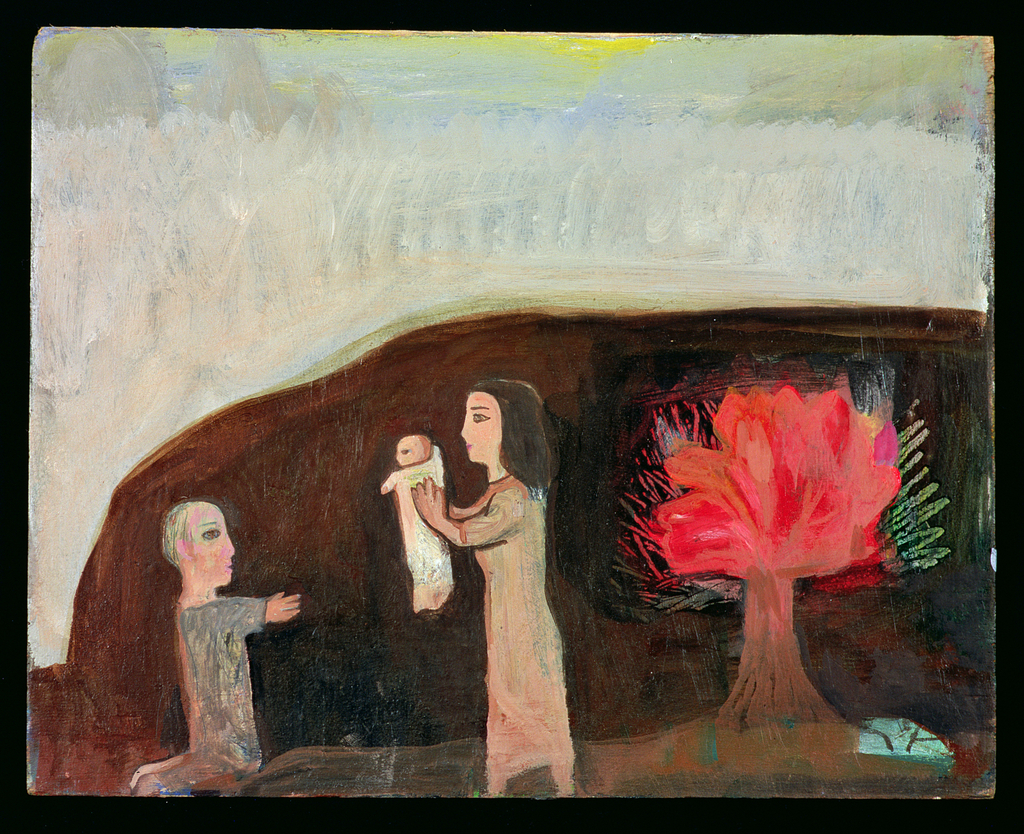
LOOK: Nativity by Ivan Večenaj

Ivan Večenaj (1920–2013) was a self-taught artist from Croatia, a representative of the Hlebine school of naive painting. He loved nature and folk culture—many of his paintings depict local village life or biblical scenes set in Croatia’s rural countryside. His works are in the collections of the Croatian Museum of Naïve Art in Zagreb and the Vatican Museums, among others. There is also a museum dedicated to his work: the Galerija Ivan Večenaj (Ivan Večenaj Gallery) in his home village of Gola in the Prekodravlje region.
Večenaj’s 1970 Nativity sets Jesus’s birth in Gola. Mary bounces the boy Jesus on her knee under a makeshift shelter roofed with a purple blanket that resembles a mountain. Emerging from the snowy ground behind them is a red cross, a crown of thorns hanging from the center and blood dripping from a wedged nail on both terminals onto a barren tree and Mary’s cloak. But this sign of death is counterbalanced with signs of life—flowers, wheat, and a grapevine sprouting up around the two, references to the Eucharist and to the blossoming of salvation.
The scene emphasizes Jesus’s humble birth into a peasant family—the artist, too, had a peasant background—and foreshadows his atoning death.
LISTEN: “Ar gyfer heddiw’r bore” (For the sake of this very morning), aka “Faban Bach” (A Little Baby) | Words by David Hughes, early nineteenth century | Tune: MENTRA GWEN, traditional Welsh | Performed by Parti Fronheulog, 1967
Ar gyfer heddiw’r bore’n faban bach, faban bach,
y ganwyd gwreiddyn Iesse’n faban bach;
y Cadarn ddaeth o Bosra,
y Deddfwr gynt ar Seina,
yr Iawn gaed ar Galfaria’n faban bach, faban bach,
yn sugno bron Maria’n faban bach.Caed bywiol ddŵfr Eseciel ar lin Mair, ar lin Mair,
a gwir Feseia Daniel ar lin Mair;
Caed bachgen doeth Eseia,
’r addewid roed i Adda,
yr Alffa a’r Omega ar lin Mair, ar lin Mair;
mewn côr ym Meth’lem Jiwda, ar lin Mair.Diosgodd Crist o’i goron, o’i wirfodd, o’i wirfodd,
er mwyn coroni Seion, o’i wirfodd;
i blygu’i ben dihalog
o dan y goron ddreiniog
i ddioddef dirmyg llidiog, o’i wirfodd, o’i wirfodd,
er codi pen yr euog, o’i wirfodd.Am hyn, bechadur, brysia, fel yr wyt, fel yr wyt,
i ’mofyn am dy Noddfa, fel yr wyt
i ti’r agorwyd ffynnon
a ylch dy glwyfau duon
fel eira gwyn yn Salmon, fel yr wyt, fel yr wyt,
gan hynny, tyrd yn brydlon, fel yr wyt.English translation by Richard B. Gillion, 2008:
For the sake of this very morning, as a little baby, a little baby
Was born the root of Jesse, as a little baby;
The Strong one who came from Bosra,
The Lawmaker of old on Sinai,
The Redemption to be had on Calvary, as a little baby, a little baby,
Suckling the breast of Mary, as a little baby.The life-giving water of Ezekiel is found on Mary’s knee, on Mary’s knee,
And the true Messiah of Daniel on Mary’s knee;
Here is the wise boy-child of Isaiah,
The promise made to Adam,
The Alpha and Omega on Mary’s knee, on Mary’s knee;
In the stall in Bethlehem of Judah, on Mary’s knee.Christ took off his crown, of his freewill, of his freewill,
In order to crown Zion, of his freewill;
To bow his undefiled head
Under the thorny crown,
To suffer enraged derision, of his freewill, of his freewill,
To raise the head of the guilty, of his freewill.Therefore, sinner, hurry, as thou art, as thou art,
To ask for his sanctuary, as thou art;
For thee the well was opened
Which washes thy wounds
Like the snow on Salmon, as thou art, as thou art.
For that, come promptly, as thou art.
With roots dating back to the pre-Reformation era, the plygain service is a Welsh Christmas tradition in which Christians gather at church from 3 a.m. to 6 a.m. on Christmas morning for community-led carol singing. One of the popular carols that’s sung is “Ar gyfer heddiw’r bore,” its text by the Welsh poet David Hughes (ca. 1794–1862), known by his bardic name of Eos Iâl. It’s twelve stanzas in all, which start with the Nativity and then move through various stages of Christ’s passion, from Gethsemane to Pilate’s hall to Golgotha to the garden of the tomb, commemorating the incarnation, the atonement, and Christ’s ascension and intercession for sinners.
The recording here is by Parti Fronheulog, a folk trio of brothers from southeast Denbighshire, Wales—Tom Williams (lead), Osmond Williams (tenor), and Ted Williams (bass)—who were active in the 1960s. They sing stanzas 1, 2, 5 and 12.
 Art & Theology