Each item in a roundup represents hours of combing through and evaluating other possibilities to feature, to find that one I deem will be of most value to readers of Art & Theology. None of these spots are ever bought or coerced, but rather represent sincere recommendations on my part. If you appreciate the resources I curate, would you consider making a donation to make this continued work possible? Or buying me a book from my Amazon wish list (to support my research)? Regardless, I really appreciate you being here!
+++
SONGS:
>> Ambai Praise Medley: This summer Palmer Keen, an American ethnomusicologist based in Yogyakarta who runs the online repository Aural Archipelago, visited the Christian village of Kawipi in the Ambai Islands of Papua, Indonesia, to learn more about songgeri, a worship music tradition indigenous to that area. When he arrived, the villagers formed a welcome party to greet him at the church steps with much music making! That is what this clip is from:
Palmer writes,
Songgeri is a gospel string band tradition from the Ambai archipelago of Papua. The Ambai people, fervent Pentecostals since mass conversion in the mid-20th century, have taken the string band format popular across Melanesia . . . and embraced it as a vehicle for a unique gospel sound unlike anything else in Indonesia.
The name songgeri itself means “joy” in the Ambai language, and every bit of the music is designed to channel a particularly Pentecostal religious ecstasy: handmade lutes (four-string “ukulele” and five string “gitar”) stick to just three easy chords, while giant double bass-like stembas are turned towards the players and plucked with both hands and hand-carved wooden picks to get a thunderous sound. Musicians play a non-stop medley of “praise and worship” verses sung in Ambai and Indonesian—in one piece, “Nemunu Doana Kamia Wowong,” for example, they sing: “His house is built on coral / The gates of heaven are open / He awaits us!”
For more on the history, form, and instruments of songgeri, including additional videos, see Palmer’s recent blog post. (Shout-out to Sam Connour for alerting me to this fantastic music!)
>> “Campfire Coritos,” performed by Israel and New Breed: This corito [previously] medley features the songs “Con mis manos y mi vida” (With My Hands and My Life), “Alabaré” (Oh, Come and Sing), “Te alabarán oh Jehová” (They Will Praise You, O Jehovah), “Quién como tú” (Who Is Like You?), “Hay poder” (There Is Power), and “Ven, ven, ven, Espíritu Divino” (Come, Come, Come, Holy Spirit). The first female soloist is Israel Houghton’s wife, Adrienne Bailon-Houghton, and the second female soloist (with dark hair) is Adrienne’s sister, Claudette Bailon.
And here’s another corito medley sung by the same group:
+++
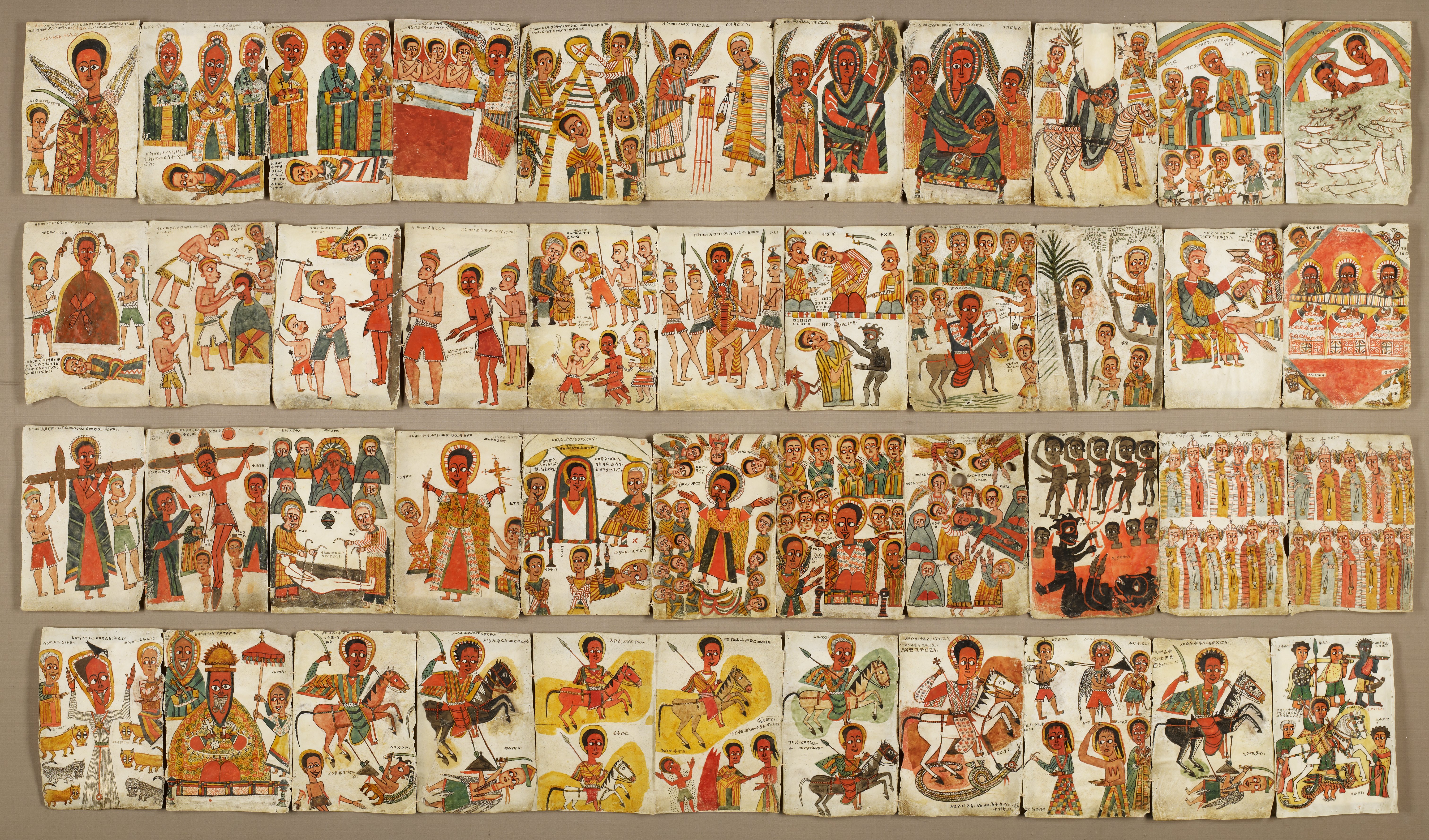
ART: 44 Plates from a Christian illuminated album, Ethiopia: When I was at the Minneapolis Institute of Art a few years ago, I saw on display three paintings on vellum from seventeenth-century Ethiopia, in the First Gondarene style, featuring Ethiopian saints and Bible stories. They are from a set of forty-four pages that were at one time sewn together and used as a prayerbook. The inscriptions are in Ge‘ez, an ancient language that originated in northern Ethiopia and is now only used in religious ceremonies.
Ethiopian saints and scenes from the Hebrew scriptures and the Christian Bible, from a disbound album, Ethiopia, late 17th century. Collection of the Minneapolis Institute of Art, Minneapolis, Minnesota.
Learn more about this illuminated album through ArtStories, an interactive multimedia feature on MIA’s website that allows for in-depth exploration of select objects from the museum’s collection. On the “More” tab is a video on “Connecting with World Religions,” a photo of each individual page with accompanying descriptions, and a behind-the-scenes video with Ethiopian manuscript cataloger Getatchew Haile.
PODCAST EPISODES: The first season of the podcast Visually Sacred: Conversations on the Power of Images, hosted by Arthur Aghajanian, wrapped this summer, altogether featuring conversations with thirteen luminaries in the field of religion and the arts. These were two of my favorite episodes:
>> “William Dyrness: Protestant Aesthetics, Modernism, and Theopoetics”: Theologian William Dyrness from Fuller Theological Seminary discusses the importance of art to spirituality, and the history and theology of images in Protestantism versus Catholicism. He also shares how Christianity influenced many canonical modern artists, and introduces theopoetics, a Christian movement that seeks to broaden our understanding of orthodoxy by bridging art forms and connecting art to daily life.
>> “Natalie Carnes: Iconoclasm, Beauty, and Aesthetics”: Theologian Natalie Carnes [previously], a professor at Baylor University, discusses iconoclasm, particularly the controversy around public monuments; the ambivalence of images as mediators of the Divine (giving us access and blocking access); suffering and beauty; feminist theology; and Christian asceticism as a form of abundance.
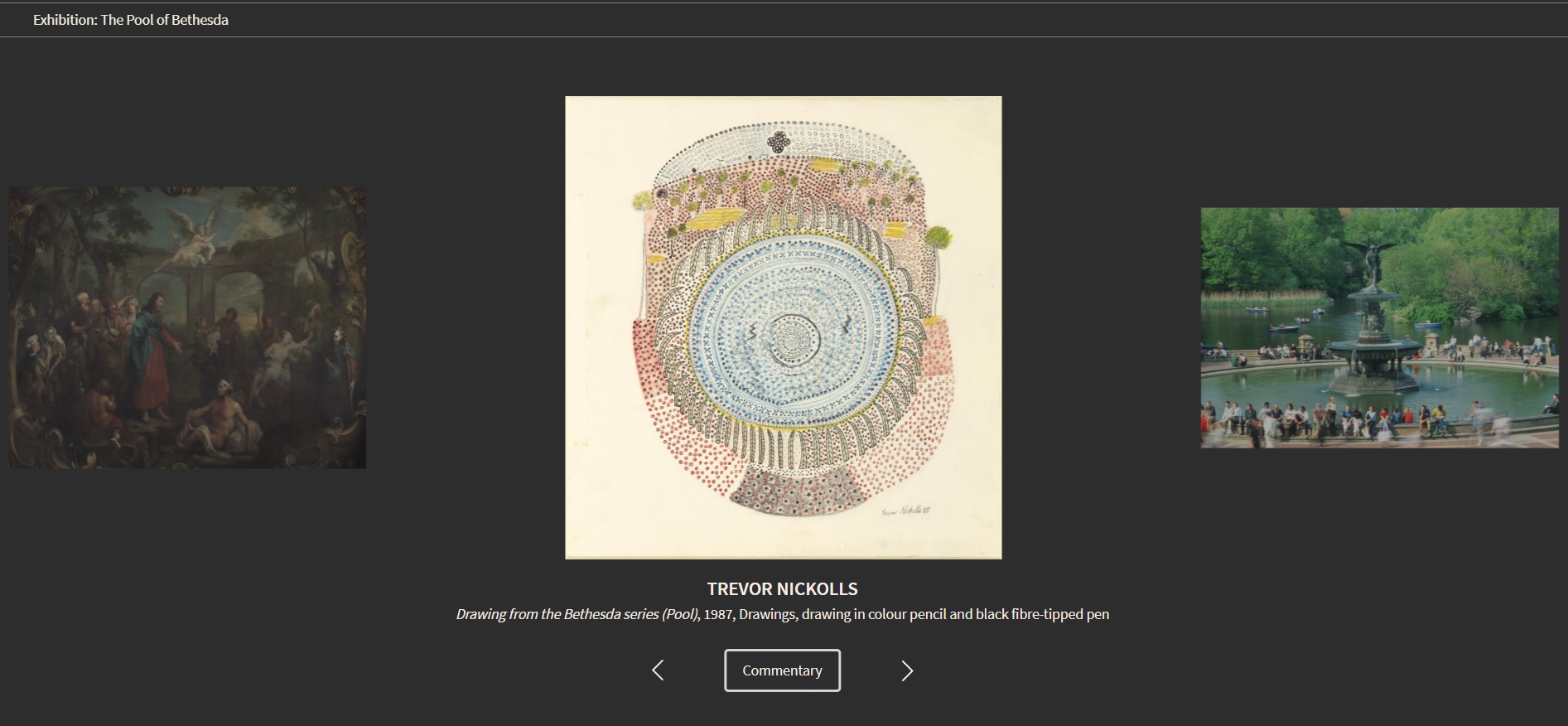
VISUAL COMMENTARIES: “The Pool of Bethesda” by Naomi Billingsley: In a recent contribution to the online Visual Commentary on Scripture [previously], Naomi Billingsley has compiled and written about three artworks based on John 5:1–18, a story in which Jesus heals a paralyzed man at a reservoir in Jerusalem. A source of hydration, cleansing, and tranquility, the pool of Bethesda, Billingsley says, is a symbol that transcends individual religious traditions.
She discusses William Hogarth’s painting of the subject for a hospital, showing sick patients receiving care; a “Dreamtime” drawing from Aboriginal Australian artist Trevor Nickolls’s Bethesda series, created during his recovery from a major car accident; and The Angel of the Waters fountain in Bethesda Terrace in Manhattan’s Central Park, designed by Emma Stebbins in 1842 to celebrate an aqueduct that brought clean water to New York City and improved public health (and which you may recognize as the site where John the Baptist baptizes disciples in the opening sequence of the movie Godspell).
+++
ARGENTINE TANGO HYMN: “Tenemos Esperanza” (We Have Hope): This hymn text was written in 1979 by Federico Pagura (1923–2016), a Methodist bishop and human rights champion from Argentina, and set to tango music by Homero Perera (1939–2019) of Uruguay. Argentinian pastor Federico “Fede” Apecena, who lives in Georgia in the US, recently introduced the song to his friend Josh Davis, who heads the multicultural worship ministry Proskuneo, and the two banged out this awesome video performance. “The song is a record of all that Jesus came to do and to be,” Apecena explains at the end of the video. [HT: Global Christian Worship]
+++
OBITUARY: Ernesto Cardenal (1925–2020), poet and priest who mixed religion and politics in his commitment to social justice in Nicaragua, dies at 95: A Catholic priest, poet, and political revolutionary from Nicaragua, Ernesto Cardenal was a controversial figure. He supported the Sandinista insurrection against the dictatorial Somoza regime in the seventies and, when the Sandinista government (which claimed to integrate Marxist and Christian ideals) came to power, served as its minister of culture from 1979 to 1987. He viewed this post as an extension of his priestly office and, refusing to quit it at Pope John Paul II’s behest, was forthwith suspended from the priesthood in 1984. (Pope Francis absolved him of canonical censure in February 2019, permitting him to administer the sacraments once again.)
Cardenal’s most enduring achievement was his 1966 founding of a religious community among the peasant farmers and fishermen of the Solentiname archipelago in Lake Nicaragua. He saw to the construction of a small wooden church, where he led collaborative Masses: instead of giving a homily on the week’s assigned Gospel reading, he opened up dialogues about it with his parishioners, relishing their insights. Transcripts of these conversations were published in four volumes as El Evangelio en Solentiname (The Gospel in Solentiname) between 1975 and 1977, with English translations appearing in 1976–82—a classic work of liberation theology.
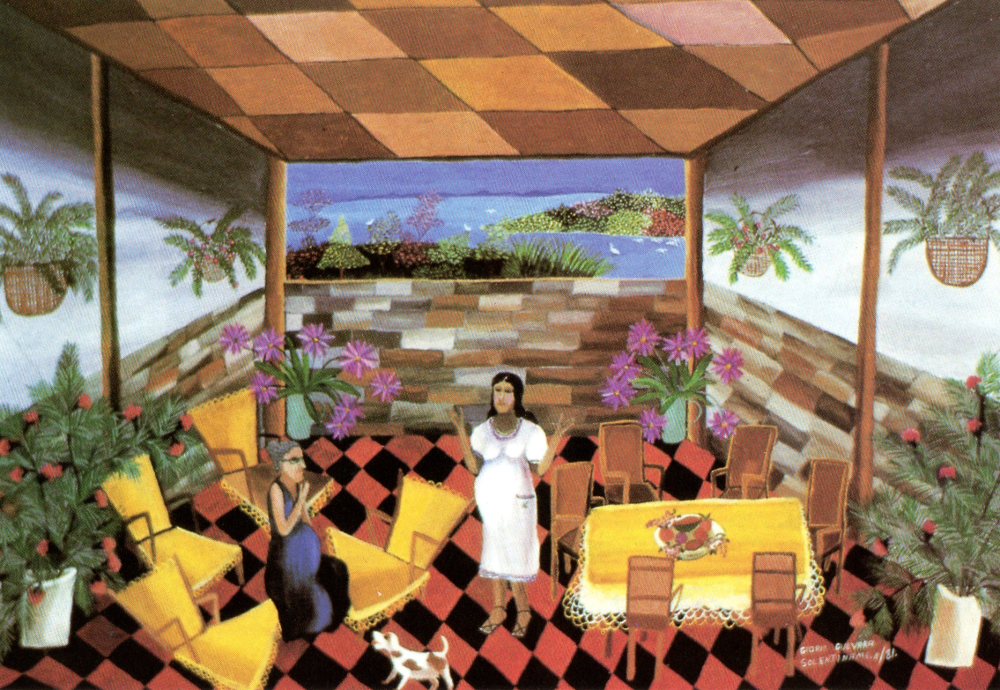
Besides cultivating the islanders’ interest in the Bible, Cardenal also took notice of their creative talents. He brought in artists to lead workshops, which led to the development of a primitivist art school that achieved international recognition for its paintings, many of them depicting Jesus’s birth, ministry, and passion taking place in Solentiname, in and around the familiar thatched-roof buildings, blue waters, and lush vegetation. In 1984 Orbis Books editors Philip and Sally Scharper combined several such images with a heavily abridged version of The Gospel in Solentiname and published it as The Gospel in Art by the Peasants of Solentiname, a slim, full-color hardcover that I highly recommend.
Gloria Guevara (Nicaraguan, 1954–), The Visitation, 1981 [source: The Gospel in Art by the Peasants of Solentiname]“It was the Gospel which radicalized us politically,” Cardenal said. “The peasants began to understand the core of the Gospel message: the announcement of the kingdom of God, that is, the establishment on this earth of a just society, without exploiters or exploited.” Afraid of the dangerous ideas taking root in Solentiname, Somoza’s National Guard razed the settlement to the ground in 1977, and Cardenal was forced to flee to Costa Rica. He gave his blessing to his community’s decision to join the Sandinistas, the people’s army, to attempt an overthrow of Somoza, a victory they achieved in 1979. The surviving peasants returned to Solentiname to rebuild, and their practice of art and faith continues to thrive to the present day.
Cardenal is also known as a poet. I’ve read only one volume of his poetry, in English translation: Apocalypse: And Other Poems (New Directions, 1977). I didn’t connect well with a lot of it, but it does have a few gems, like “Prayer for Marilyn Monroe,” “The Cosmos Is His Sanctuary (Psalm 150),” and “Behind the Monastery,” reprinted here in full:
Behind the monastery, down the road,
there is a cemetery of worn-out things
where lie smashed china, rusty metal,
cracked pipes and twisted bits of wire,
empty cigarette packs, sawdust,
corrugated iron, old plastic, tires beyond repair:
all waiting for the Resurrection, like ourselves.
(translated from the Spanish by Robert Pring-Mill)
+++
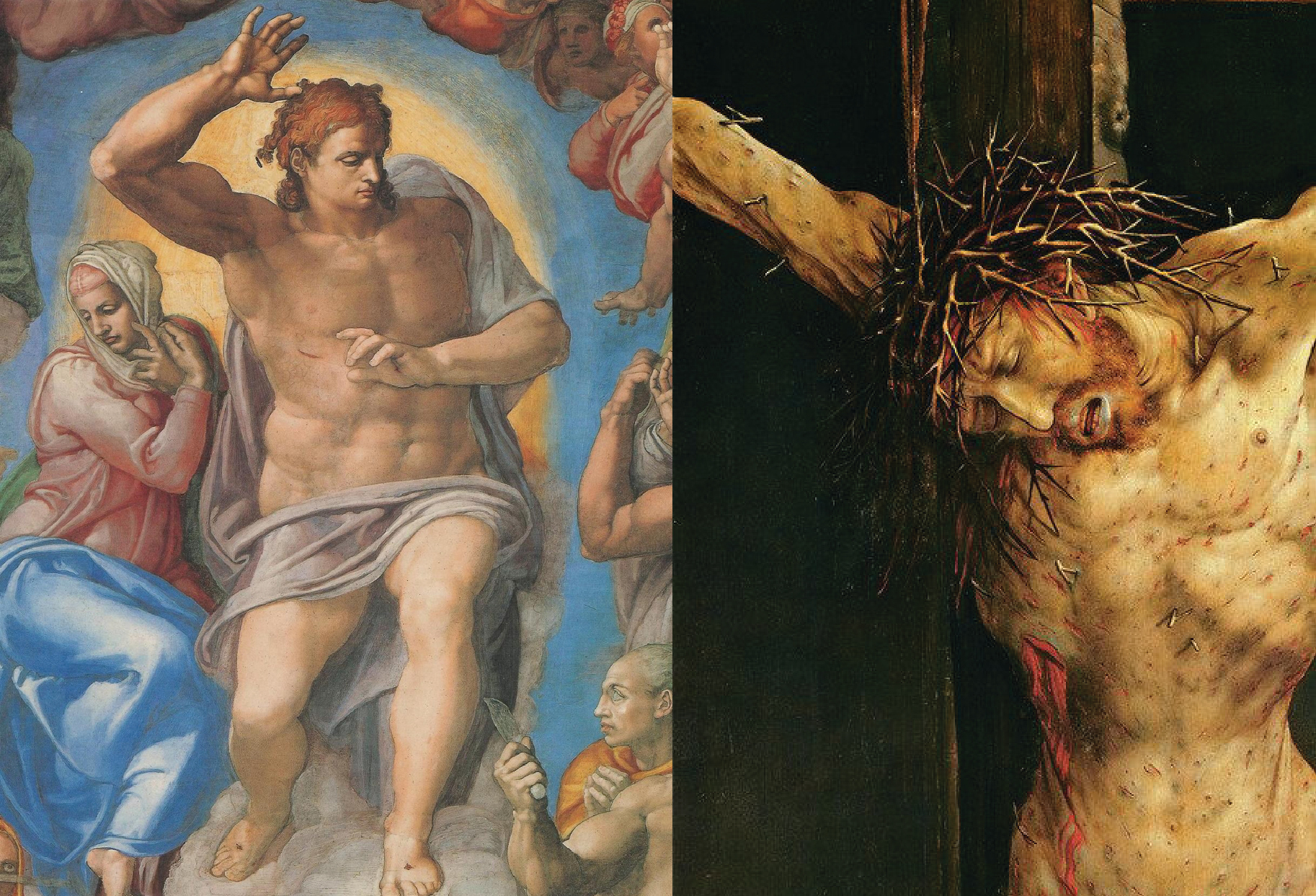
LECTURE: “On Beauty” by Natalie Carnes: “Beauty has been leveraged in ways that wound us, with legacies of misogyny, class hatred, and racial injustice,” says Dr. Natalie Carnes, associate professor of theology at Baylor University. “And yet I want to suggest that beauty tends those same wounds, and can be found in those same wounds, for beauty is a name for God.”
In this half-hour talk given November 1, 2017, at Dallas Theological Seminary as part of school’s Arts Week, Carnes examines the paradox, expressed in the church’s art and theology across history, that God is both beautiful and not beautiful. In his suffering, Carnes says—his entering the ravaged and scarred places of our humanity—God does not renounce his beauty but reveals it.
The divine presence in grotesque suffering is not a departure from the divine life but characteristic of it. And that movement into the grotesque is not antagonistic to beauty but the revelation of it. God’s faithfulness goes by way of intimacy with not-God, and beauty by way of the grotesque. The beauty that rejects suffering is false, and the one who follows the call of beauty faithfully will find herself in the scarred places of the world. Beauty, after all, is a name for God, and God does not abandon divinity in identifying with the suffering and afflicted but expresses through such identification the very marker of divine life.
This is not to say that suffering, affliction, or poverty is beautiful. Beauty is distinct from the mode of its arriving. Poverty and suffering can be important sites of beauty, even as they are not themselves beautiful, because they mediate the beauty of the God who is charity. . . .
PLAYLIST: “Spiritual Cosmonaut,” compiled by Latifah Alattas: Last month singer-songwriter and music producer Latifah Alattas [previously] curated a short Spotify playlist of “Spiritual songs that stir my soul. Melodies that tap into mystery. Sounds that open me up to the wonder and peace of God.” It’s great!
Alattas is the frontwoman of the band Page CXVI [previously], which has just returned from a six-year hiatus. I’m so moved by their recently released rendition of “Great Is Thy Faithfulness,” with piano, synthesizer, and pedal steel guitar. Alattas has made the song more communal, subbing out all first-person singular pronouns for first-person plural, even rewording whole lines, like the last two of the chorus, which become “Amidst the pain of this world you grieve with us—unfailing faithfulness, dwelling so near.” Or the final line of the final verse, which she changed from “Blessings all mine, with ten thousand beside!” to “Blessings for all, Christ within us resides.”
People who are attached to singing the song a certain way might object to such lyrical revisions, but I see them, along with the creative musical liberties she takes, as helping to bring out the themes that are already there. Alattas helped me to hear this classic hymn with new ears.
+++
FILM: The Two Popes (2019), dir. Fernando Meirelles: I recently watched this Oscar-nominated biographical drama and enjoyed it more than I thought I would! I wasn’t expecting the respect it gives to its subjects and to Christianity. Its title refers to the fact that, for the first time in six hundred years, the Roman Catholic Church has one reigning pope and one retired pope, the “pope emeritus.” (When Benedict announced his resignation in 2013, it shocked the world, as it’s expected that, if chosen, you serve in that role until death.)
The movie is primarily about the relationship between the traditionalist Pope Benedict XVI (born Joseph Ratzinger) and the progressive Pope Francis (born Jorge Bergoglio), which starts out antagonistically but buds into a friendship of sorts. It’s dialogue-heavy (it was adapted from a stage play), but in the most interesting way, as the two engage in “a series of philosophical and dogmatic discussions and disagreements about the nature of faith and forgiveness, and the direction of a church struggling to maintain relevance in the modern world” [source].
But it’s not just about the church’s struggle or the burdens of high office; it’s also about personal faith as a struggle—how to discern one’s calling in life, how to hear God’s voice and deal with his silence, and how to forgive oneself for one’s own tragic silences (in Benedict’s case, regarding the sex abuse perpetrated by clergy; in Francis’s, regarding the Dirty War in his home country of Argentina in the late seventies and early eighties, while he was serving as priest).
Francis’s backstory, of which I knew nothing beforehand, is told in flashbacks. (The fiancée is fictional, though the real Francis has admitted to having romantic crushes as a teenager and even as a seminarian.) The portrayal of both men, by Anthony Hopkins as Benedict and Jonathan Pryce as Francis, is very humanizing (not initially for Benedict, but his character gets there)—and not just because of the glimpse it provides into Francis’s life prior to the cloth, but also, in part, because of little nods it gives to their interests beyond the church, like Francis’s love of soccer and tango dancing, and Benedict’s piano playing and Fanta drinking. And because it shows their personal fallibility, their regret over past misdeeds.
It should be noted that the meeting of the two men at the papal summer residence of Castel Gandolfo prior to Benedict’s resignation is invented, as are many of their lengthy dialogues, which are nonetheless inspired by speeches, letters, and other writings of theirs, brought into conversation with one another by playwright and screenwriter Anthony McCarten.
“The Perils and Peculiarities of Visually Depicting the Trinity” Speakers: Dr. Ben Quash, Professor of Christianity and the Arts at King’s College London; Dr. Scott Nethersole, Senior Lecturer in Italian Renaissance Art at the Courtauld Institute of Art Date: February 21, 2018 Location: Courtauld Institute of Art, Somerset House, Strand, London Organizer: Department of Theology and Religious Studies at King’s College and the Courtauld Institute of Art Cost: Free Description: Nethersole will discuss Botticelli’s Trinity Altarpiece, with special attention paid to its unsettling disjunctions of scale and space—a theological decision on the part of the artist. Then Quash “will examine some of the larger theological problems that are raised by trinitarian visual imagery, and look at . . . some of the successes and failures of various artistic experiments, including one or two very recent ones.” Q&A and informal reception to follow.
Sandro Botticelli (Italian, ca. 1445–1510), Holy Trinity with Mary Magdalene, John the Baptist, and Tobias and the Angel, 1491–93. Tempera on panel, 215 × 192 cm. Courtauld Gallery, London.
“Religion in Museum Education” (conference) Speakers: Dr. Caroline Widmer, Dr. Anna Chiara Cimoli, et al. (see link for full list) Date: February 23, 2018 Location: Lorenzo de’ Medici Institute, Florence Organizer: Forum on Museums and Religion, an initiative of the Lorenzo de’ Medici Institute’s Museum Studies MA program Cost: Free Description: This one-day conference will bring together museum educators and religious authorities to discuss how secular museums housing religious objects might develop educational programming that highlights sacred functions without risking the impression of a religious agenda. Lecture topics include “Understanding Religion through Art,” “Sharing the Sacred with Schools,” “Teaching from Paintings with Religious Subject Matter,” “Churches as Living Museums,” and more, and case studies will come from the British Museum, the Uffizi in Florence, Museum Rietberg in Zurich, the National Museum for the History of Immigration in Paris, and the Shoah Memorial and Pinateca di Brera in Milan. The conference will conclude with a roundtable discussion.
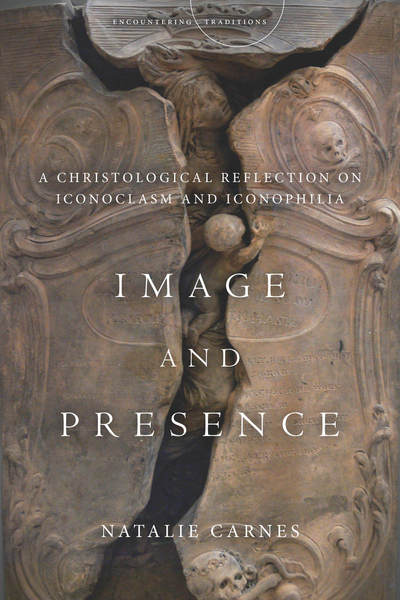
“The New Iconoclasm: A Christological Reflection on Making and Breaking Images” Speaker: Dr. Natalie Carnes, Associate Professor of Theology at Baylor University Date: February 28, 2018 Location: Alumni Memorial Common Room, Duke Divinity School, Durham, North Carolina, USA Organizer:Duke Initiatives in Theology and the Arts (DITA) Cost: Free Description: Carnes’s lecture will draw on the content of her new book from Stanford University Press, Image and Presence: A Christological Reflection on Iconoclasm and Iconophilia. “Christians of many epochs—glutted with images, shocked by them—have resorted to the iconoclast’s hammer or its successor, the authoritarianism of empty space. Natalie Carnes proposes a better way to live through our senses” (Mark D. Jordan, Harvard University). “A major contribution to the discussion of image as and in theology” (Judith Wolfe, University of St. Andrews).
“‘In the manner of smoke’: Leonardo, Art, and Faith” (5-hour mini-course) Lecturer: Rev. Iain Lane, Tutor in Christian Doctrine and the Visual Arts Date: March 3, 2018 Location: Holywell Lodge, St. Albans, Hertfordshire, England Organizer: St. Albans Cathedral Cost: £25 Description: “Leonardo da Vinci produced some of the most compelling images in the history of Christian art. . . . This study day explores each of Leonardo’s surviving, overtly Christian works in detail, exploring their meaning and setting them in context. The picture which is revealed is of an artist of profound religious sensibility rooted in both scientific rationality and a deep awareness of the human condition: a man who embodied a unity of vision which has arguably been lost in our own age.”
Leonardo da Vinci (Italian, 1452–1519), Annunciation, ca. 1472. Oil on panel, 98 × 217 cm. Uffizi Gallery, Florence.
“Swords into Ploughshares: The Ambivalent Role of the Arts and Religion in Building Peace” Lecturer: Dr. Jolyon Mitchell, Professor of Communication, Arts, and Religion at the University of Edinburgh Date: March 7, 2018 Location: Sarum College, Salisbury, England Organizer: Centre for Theology, Imagination, and Culture at Sarum College Cost: Free (advance booking required) Description: This lecture will explore the role of different media arts in both inciting violence and promoting peace, drawing on examples from countries such as Israel-Palestine, Mozambique, Rwanda, and the UK.
“Scandal and Glory: The Cross in the Bible and Poetry” Speakers: Paula Gooder, Director of Mission, Learning, and Development in the Birmingham Diocese; Mark Oakley, Canon Chancellor of St. Paul’s Cathedral Date: March 13, 2018 Location: St. Paul’s Cathedral, London Organizer: St. Paul’s Cathedral (Adult Learning initiative) Cost: Free Description: “Is Christ on the cross our brother in suffering or our King in triumph? Jesus’ death is at the heart of Christianity, but the four Gospel accounts are very different and the cross has been seen as both the throne of God’s glory and the place of ultimate desolation and defeat. In addition we have 2,000 years of interpretations, paintings, poems, theologies, and liturgies that add to the complexity, and sometimes to the confusion. . . . Paula Gooder and Mark Oakley will look at different aspects of the cross through the Gospels and poetry, exploring some of what we might learn from it not only of sin and reconciliation, but also of new life, love, freedom, and creation made new.” Q&A to follow.
“Art and the Apocalypse: The Book of Revelation and Visual Exegesis” Speakers: Dr. Natasha O’Hear, Lecturer in Theology and Visual Art at ITIA, University of St. Andrews, Scotland; Dr. Anthony O’Hear, Professor of Philosophy at the University of Buckingham Date: March 16, 2018 Location: The Gallery, 70 Cowcross Street, London Organizer:Art and Christianity Cost: £12 Description: Drawing on their recent award-winning book Picturing the Apocalypse: The Book of Revelation in the Arts over Two Millennia, the O’Hears will explore the visual history of the book of Revelation as well as the notion of the artist as biblical exegete. The focus will be on the Four Horsemen of the Apocalypse (Rev. 6) and the Rider on the White Horse (Rev. 19).
“Women Artists and the Modern Church in Britain” Lecturer: Dr. Ayla Lepine, Visiting Fellow in Art History at the University of Essex Date: April 4, 2018 Location: The Gallery, 70 Cowcross Street, London Organizer:Art and Christianity Cost: £14.21 Description: “From the turn of the twentieth century to the present, women have produced diverse and complex works of art for and in response to the Church. This talk explores the relationship between Christian sacred spaces, from vast and well-known cathedrals to rural chapels, and women artists in a period in which feminism, culture, and Christianity engaged in new dialogues.” Artists include Winifred Knights, Elizabeth Frink, Enid Chadwick, and Tracey Emin.
Tracey Emin (British, 1963–), For You, 2008. Neon. Liverpool Cathedral, England.
+++
Many of these events I found out about through the weekly Arts and the Sacred at King’s (ASK) e-bulletin compiled by Dr. Chloë Reddaway. If you would like to be added to the ASK listserv or announce a relevant event through it, contact her at chloe.1.reddaway@kcl.ac.uk.
Note: The two book cover images on this webpage are Amazon affiliate links, meaning that Art & Theology will earn a small commission on any purchase that originates here.

#/media/File:Botticelli_Trinity.jpg)
#/media/File:Leonardo_da_Vinci_-_Annunciazione_-_Google_Art_Project.jpg)


 Art & Theology