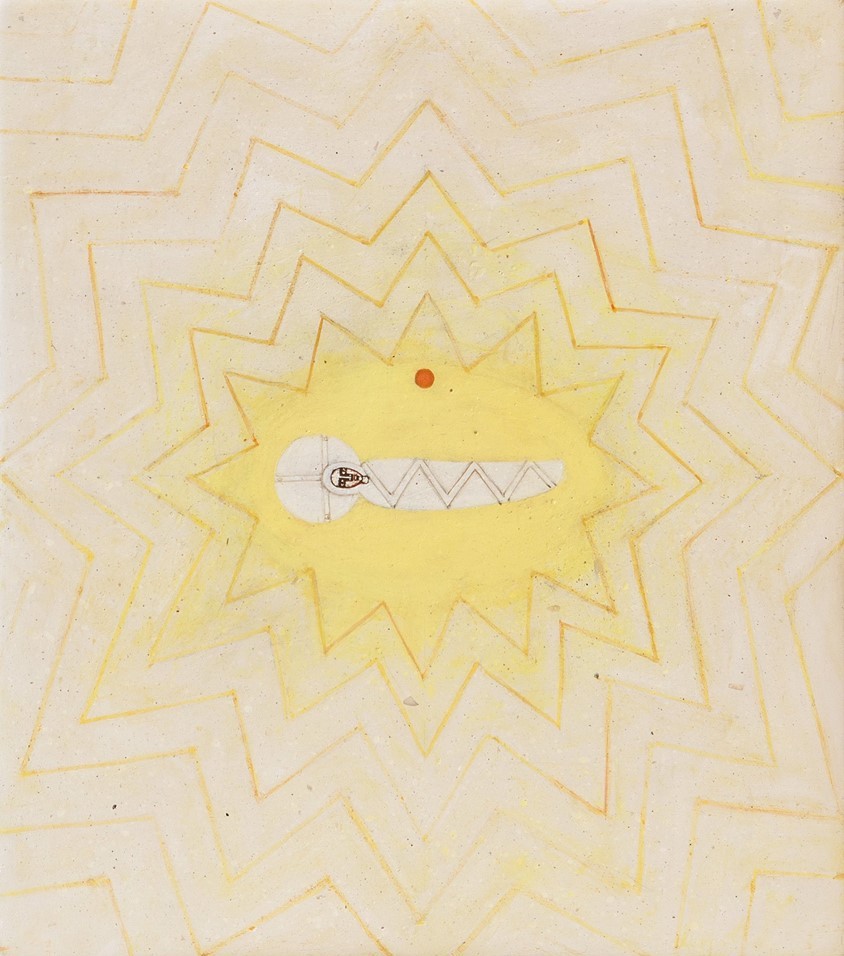
Natalya Rusetska (Ukrainian, 1984–), Nativity, 2016. Tempera on gessoed wood, 17.5 × 15.5 cm.
Gravity’s maker, spinner of spheres and spiraling matter,
made into weight, to sweat. His own feet vulnerable,
drawn flat and close against the punishing ground.

Star-strayed infant, wrapped in weight, heavy heaven.
In the hollow of the years, long and narrow as a well,
he waits suspended, bucket-drawn, clapper in a bell.

Ringing and ringing in the heatfolds of gravity, lines and lines
of weight leaning us into each other, caught up, tumbled
open-face roses in a blue bolt of thorn-pricked cloth.

God made known, fleshly God, Godlight bodied, bleeding
out into wood, over stone. God from God, telluric God,
shadowcast God, lightstricken God, bloodwritten. The pull

electric of low, deep center. God flesh, corpus God, Verbum
corpse, light-riven. Inscribed, blooded, God-heft falling death-
bitten into weighted rising, made and given; the miracle of leaven.
LeighAnna Schesser is a Catholic writer from south-central Kansas whose poetry collections include Struck Dumb with Singing (2020) and Heartland (2016).
(This post is optimized for viewing in a web browser on a computer screen.)
Pelican in Her Piety, 1880–81. Mosaic, Palatine Chapel, Aachen, Germany.
The pelican was one of the most popular animal symbols for Christ in the Middle Ages, appearing widely in art and literature. The association was first made in the Physiologus, a Late Antique Greek compilation of moralized animal lore written (probably around the year 200) in Alexandria and intended for Christian edification. Its anonymous author says the mother pelican is such “an exceeding lover of its young” that, to revive them from death, she pierces her breast with her beak and spills her blood over them.
The church sometimes refers to this allegorical bird as the vulning pelican (from the Latin vulnerō, “to wound”), or the Pelican in Her Piety.
The Christological parallel is obvious: Jesus submitted to being pierced with nails and spear on the cross, his heart’s blood spilt, in order to give life to his children. But the Physiologus cites a more obscure biblical passage: “ὡμοιώθην πελεκᾶνι ἐρημικῷ” (Ps. 101:7a LXX). In the Latin Vulgate, that’s “Similis factus sum pelicano solitudinis,” and in English, “I am like a pelican of the wilderness” (Ps. 102:6a KJV). The Physiologus author puts these words of the psalmist, which express a sense of isolation, into the mouth of Christ, lonely in his messianic ministry and in his passion.
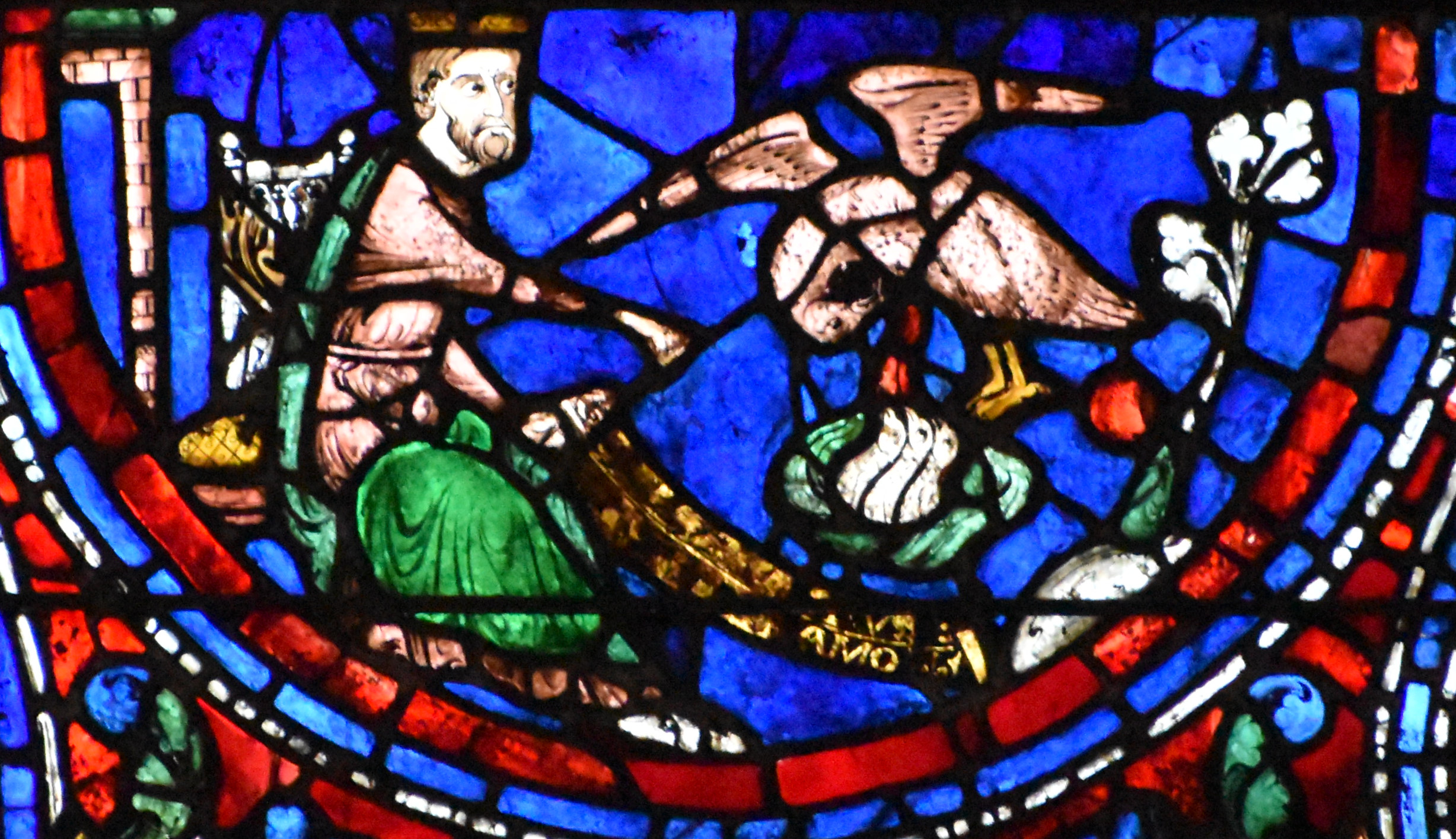
Detail from the 13th-century Redemption Window at Chartres Cathedral in France, showing a pelican (a figure of Christ) feeding her young with her own blood as King David looks on, holding a scroll with the inscription “Similis factus sum pellicamo,” from Psalm 102:6. Photo: Adrian Barlow. There are similar glass panels at Rouen and Le Mans.
Not all parts of the pelican legend recounted in the Physiologus map easily onto Christ’s love for his church. The chicks are dead because they kept striking their parents in the face, and their parents, striking back, killed them. The parents feel bad, and it’s after three days of mourning that mama bird breaks herself open to bring back her little ones.
In his commentary on Psalm 102, Augustine writes, “Let us not pass over what is said, or even read, of this bird, that is, the pelican.” Standing over her dead chicks, “the mother wounds herself deeply, and pours forth her blood over her young, bathed in which they recover life. This may be true, it may be false: yet if it be true, see how it agrees with him, who gave us life by his blood. It agrees with him in that the mother’s flesh recalls to life her young with her blood; it agrees well. For he calls himself a hen brooding over her young. If, then, it be so truly, this bird does closely resemble the flesh of Christ, by whose blood we have been called to life.”
Augustine then goes on to explain how the mother’s killing her young relates to God metaphorically killing our old self so that he can then raise us up to new life in Christ; he likens conversion to death and rebirth. Medieval theologians loved to stretch allegories to the extreme!
A more streamlined version of the pelican legend that got passed down omits the filicide, focusing simply on the bird’s animating sacrifice—on how her shed blood raises the dead to life. And after the Feast of Corpus Christi was established in 1311, a variant emerged that said the pelican feeds her young with her blood when no other food would satisfy, a picture that resonated with the increased attention on the Eucharist in the Latin West.
The Physiologus, which contains the earliest known appearance of the pelican legend, was translated from Greek into Latin sometime between the fourth and early sixth centuries, and from there into Ethiopic, Armenian, Syriac, and a multitude of European and Middle Eastern vernaculars. By the end of the twelfth century its legends were absorbed into the bestiary, a genre of popular nature-book in keeping with the encyclopedic taste of the High Middle Ages.
In Art
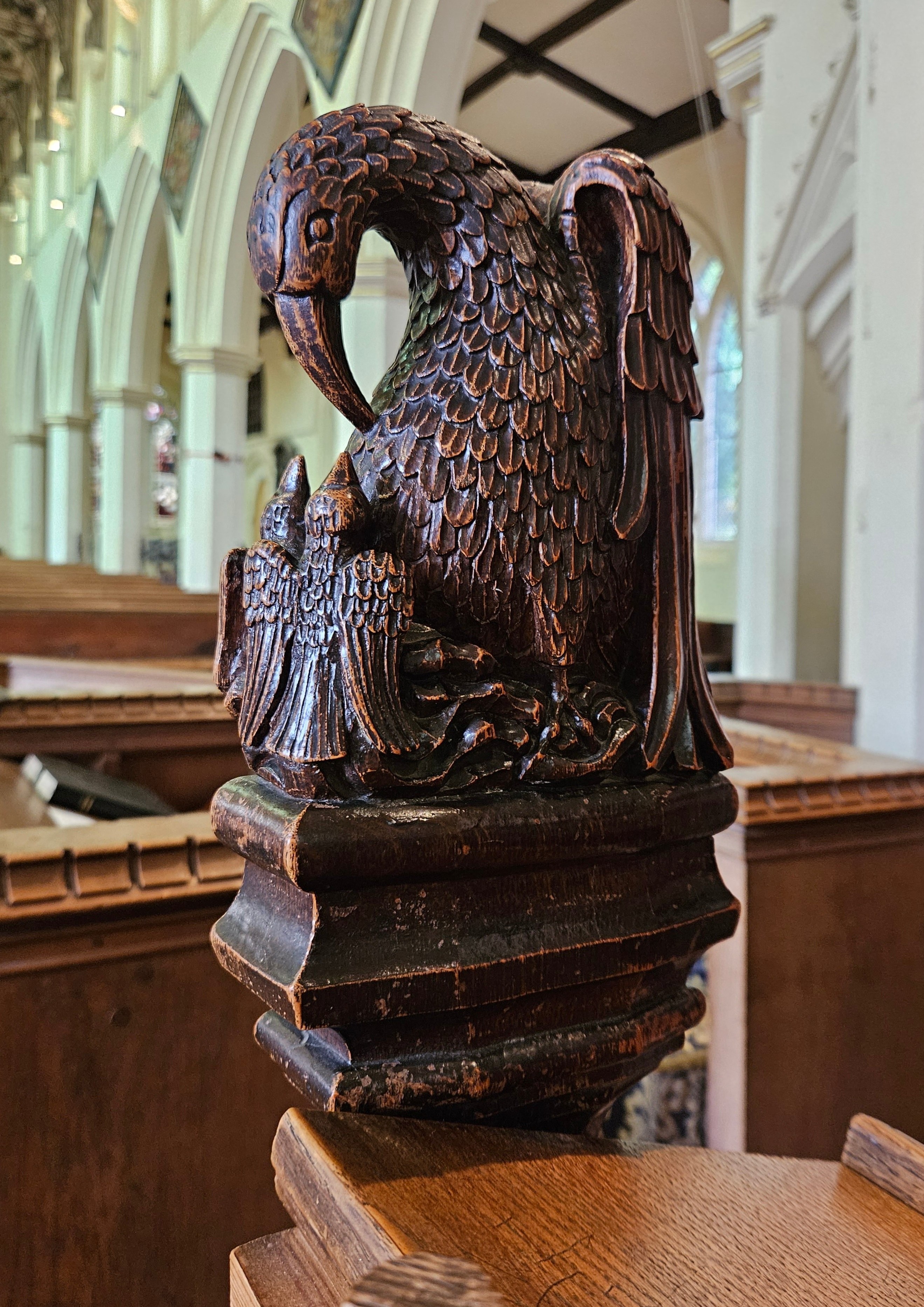
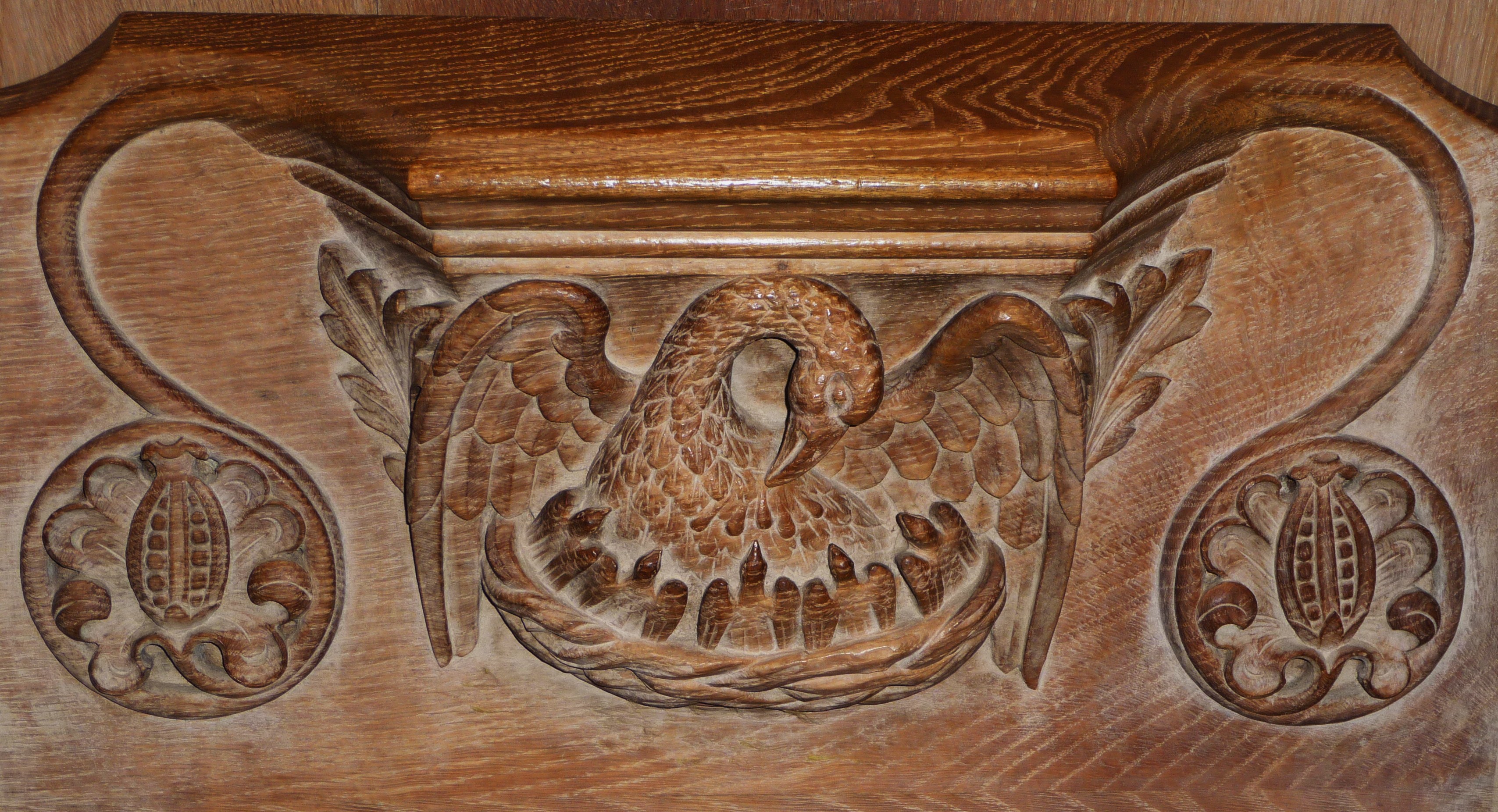
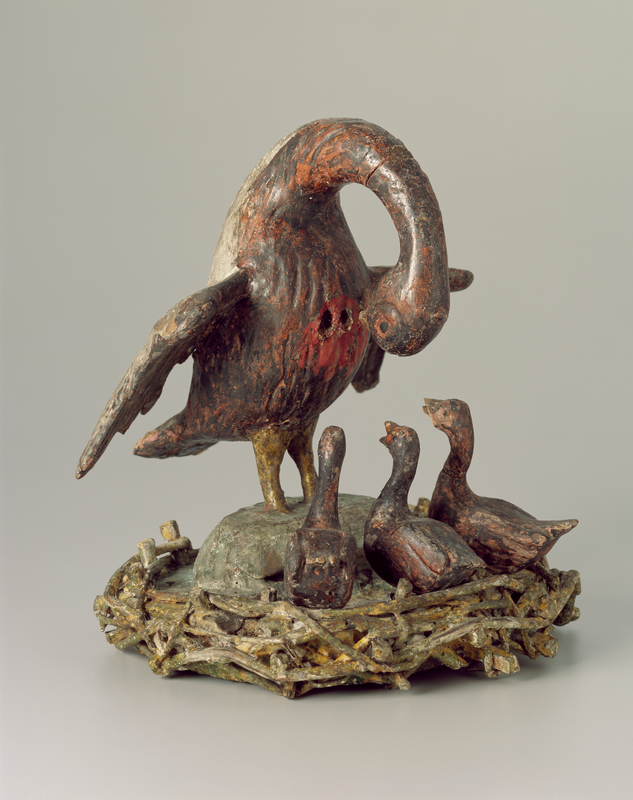
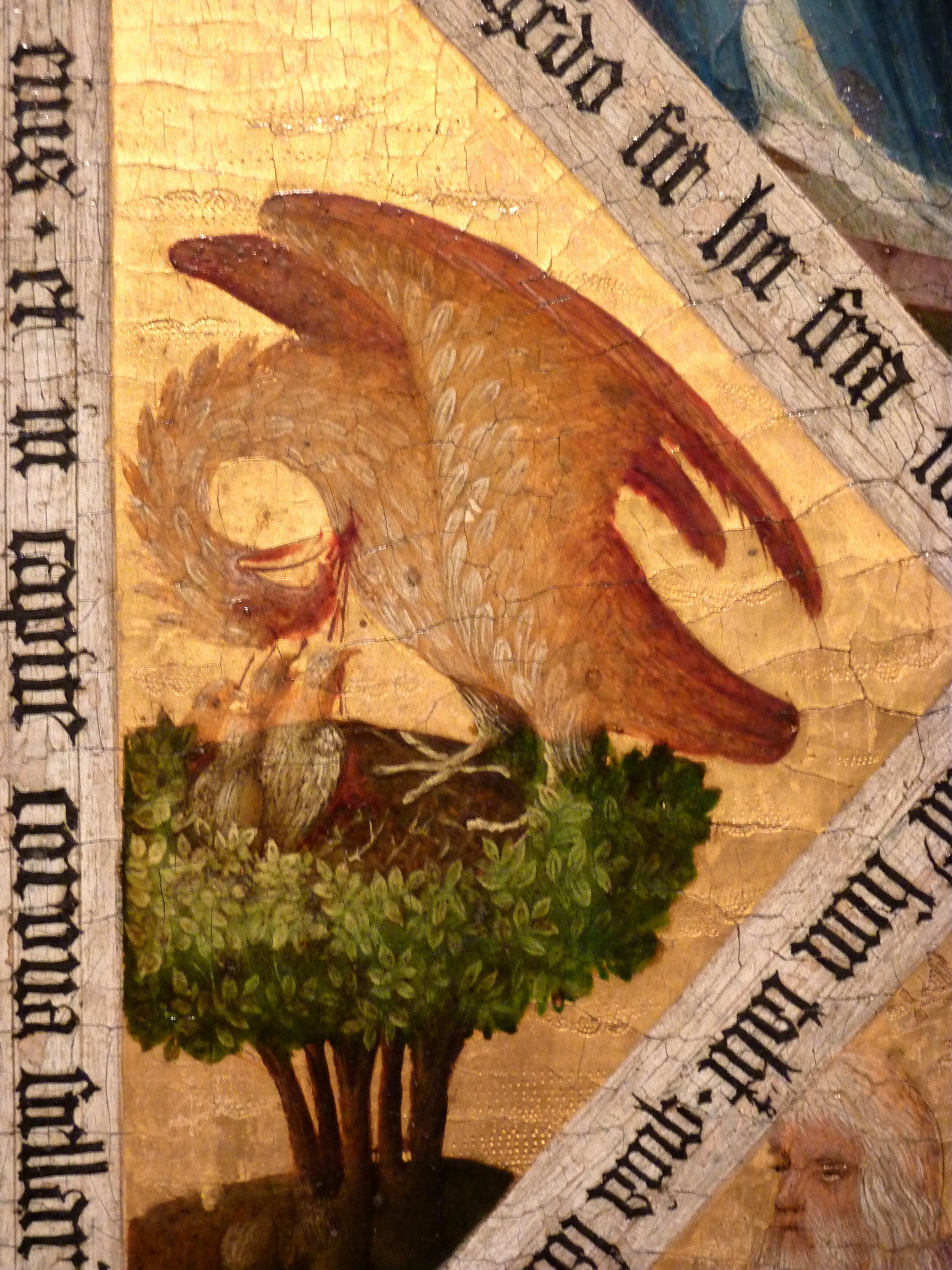
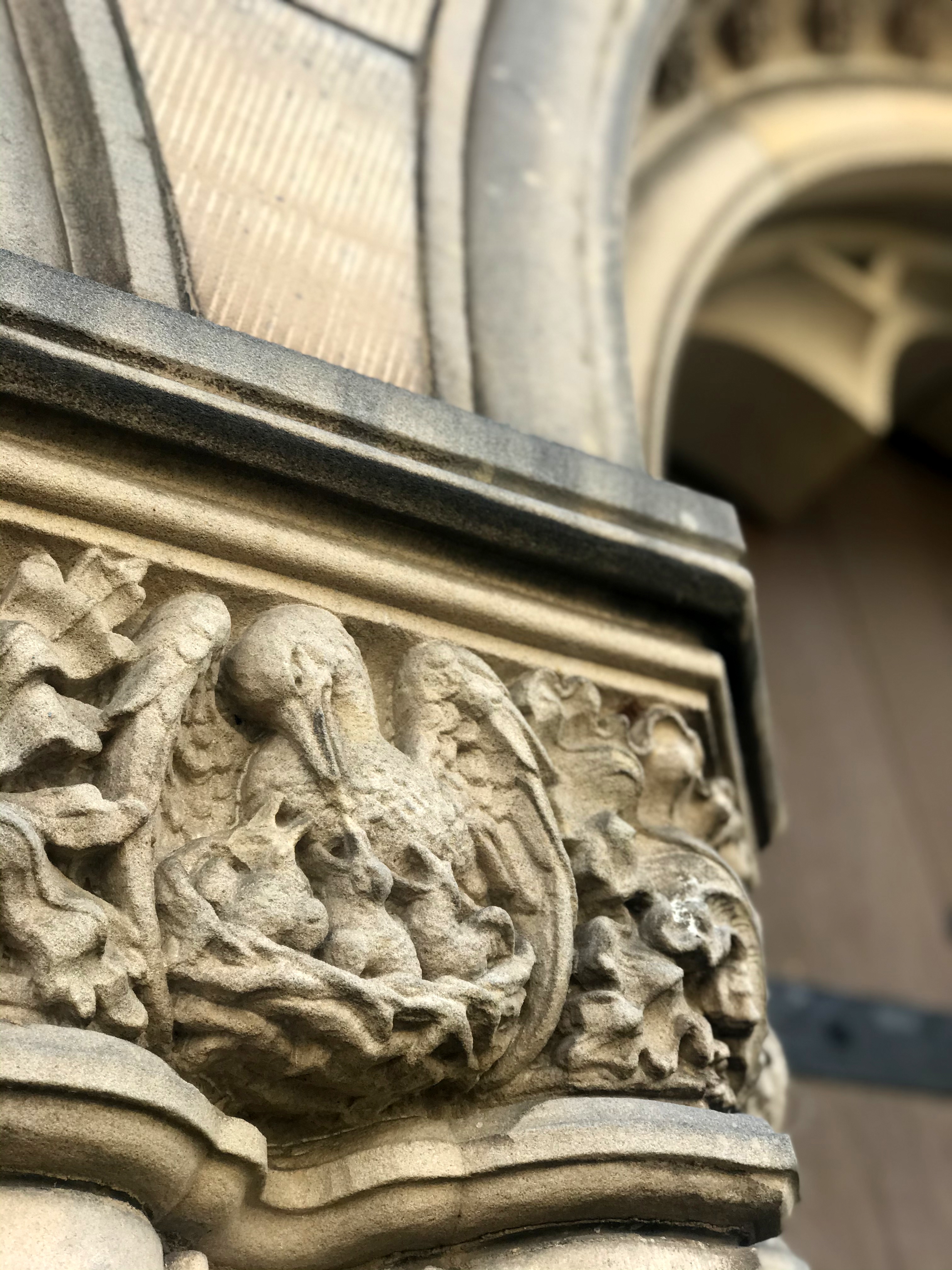
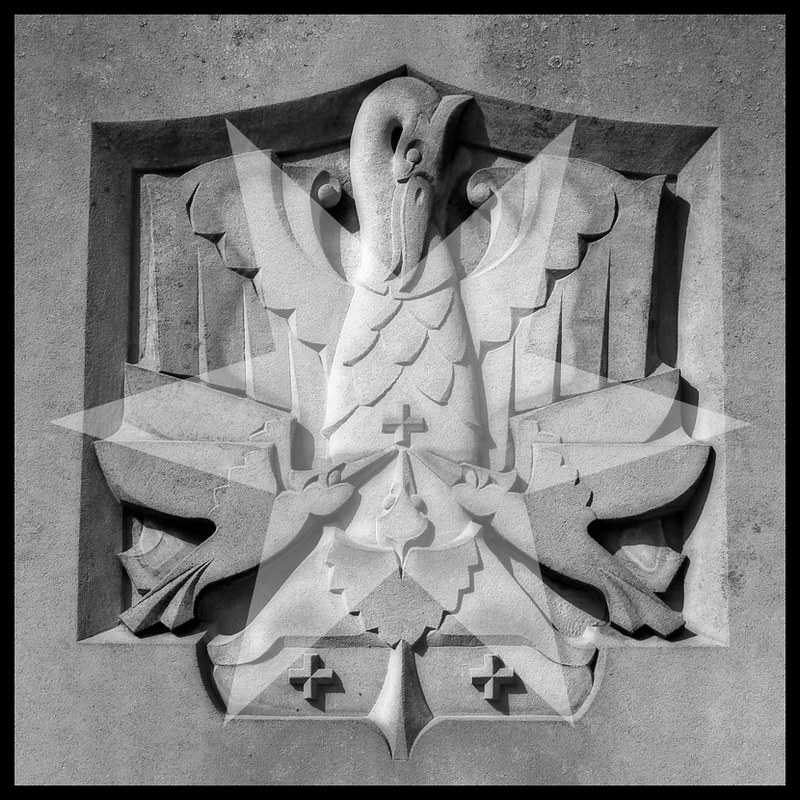
The vulning pelican has appeared in all kinds of visual media from late antiquity through the medieval and premodern eras and on into the twentieth and twenty-first centuries, including illuminated prayerbooks, missals, bestiaries (as in the tiled gallery below; hover to view captions, or click to enter carousel); panel paintings, frescoes; mosaics; stained glass windows; tapestries; lecterns, roof bosses, bench ends, misericords, corbels; and a range of liturgical objects and vestments.
From a miscellany containing an illustrated copy of Hugh of Fouilloy’s De avibus, Italy, late 13th or early 14th century. Biblioteca Statale di Cremona, MS 199, fol. 11v. https://bestiary.ca/beasts/beastgallery244.htm
From an illuminated copy of Der Naturen Bloeme (The Flower of Nature) by Jacob van Maerlant, Flanders, ca. 1350. The Hague, Koninklijke Bibliotheek, KA 16, fol. 96vb. https://manuscripts.kb.nl/show/images/KA+16/page/26
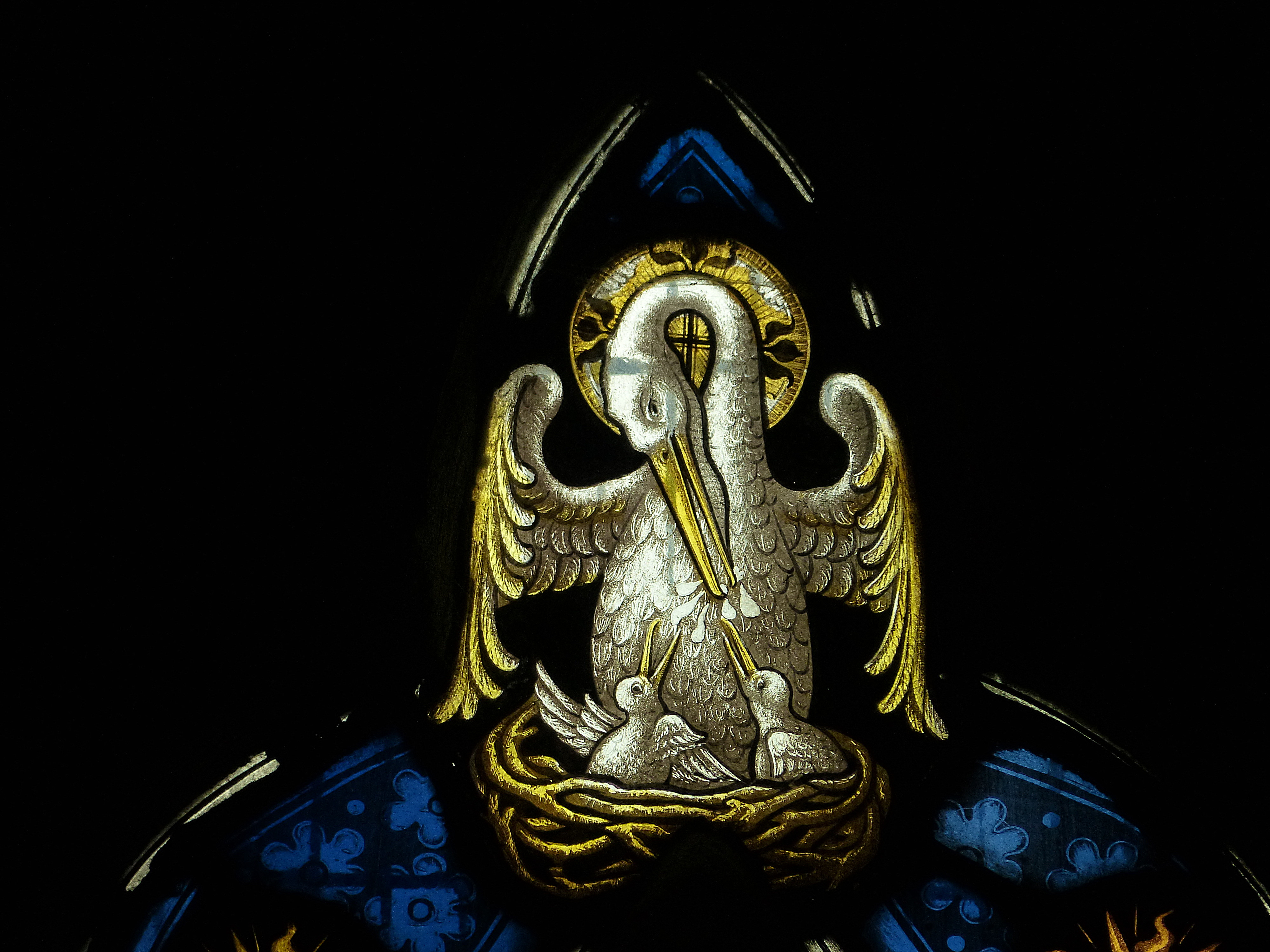
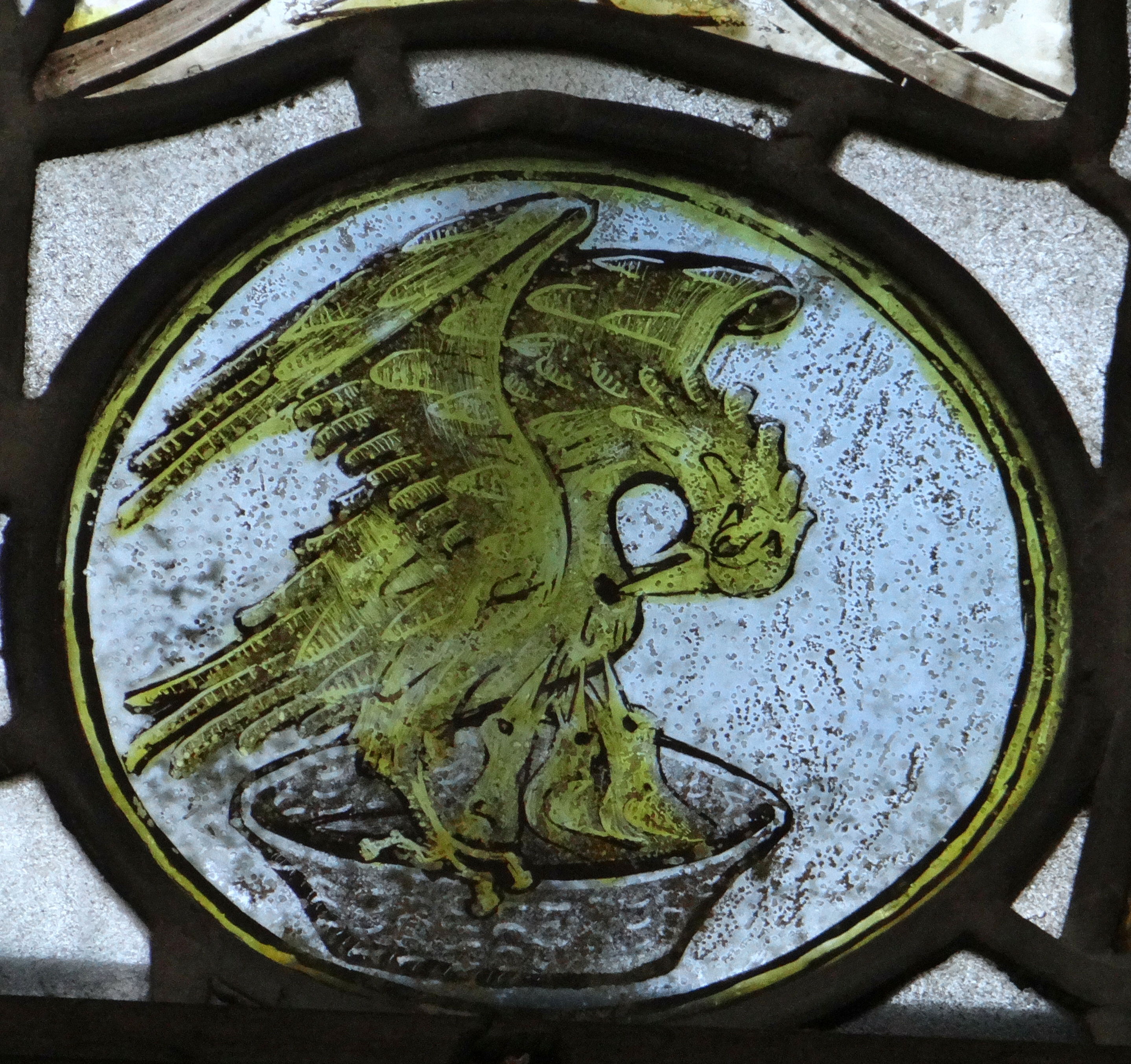
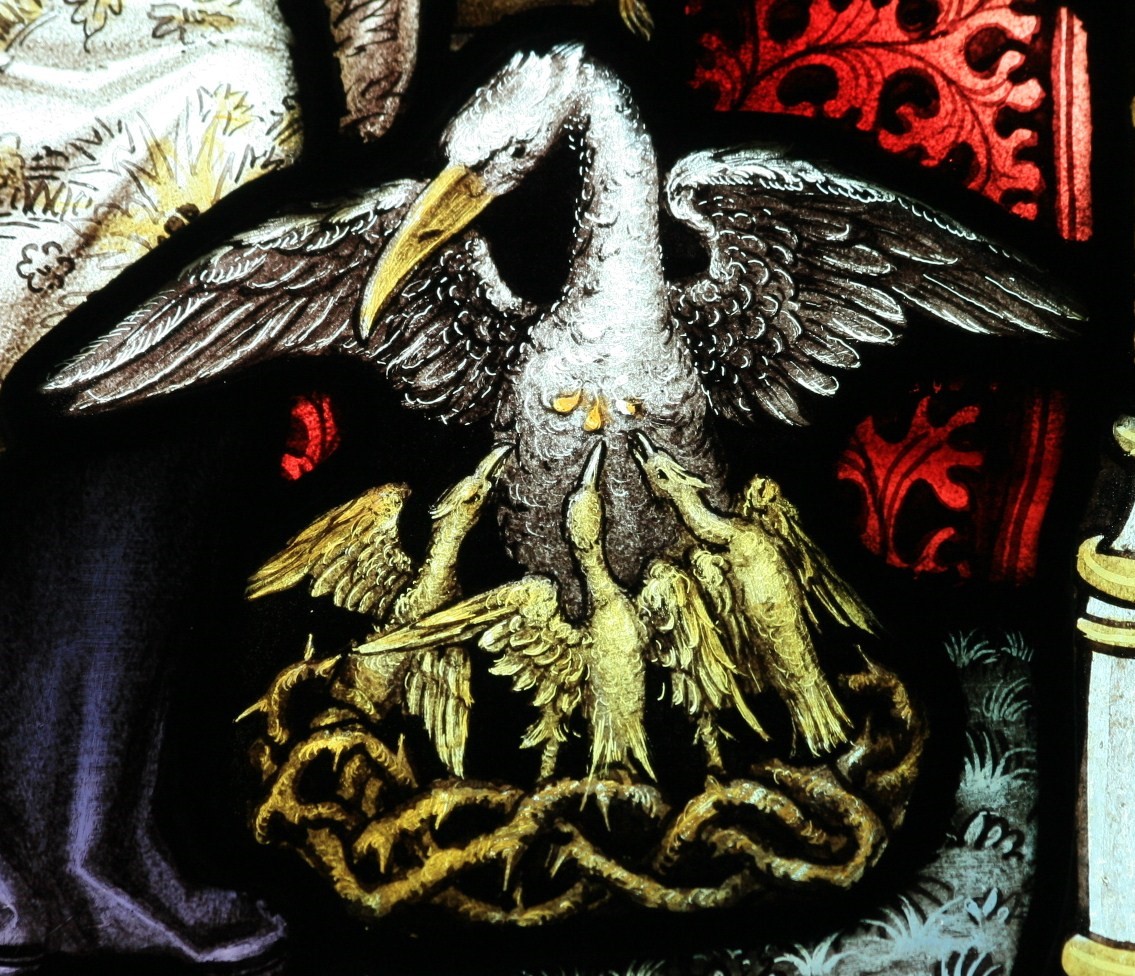
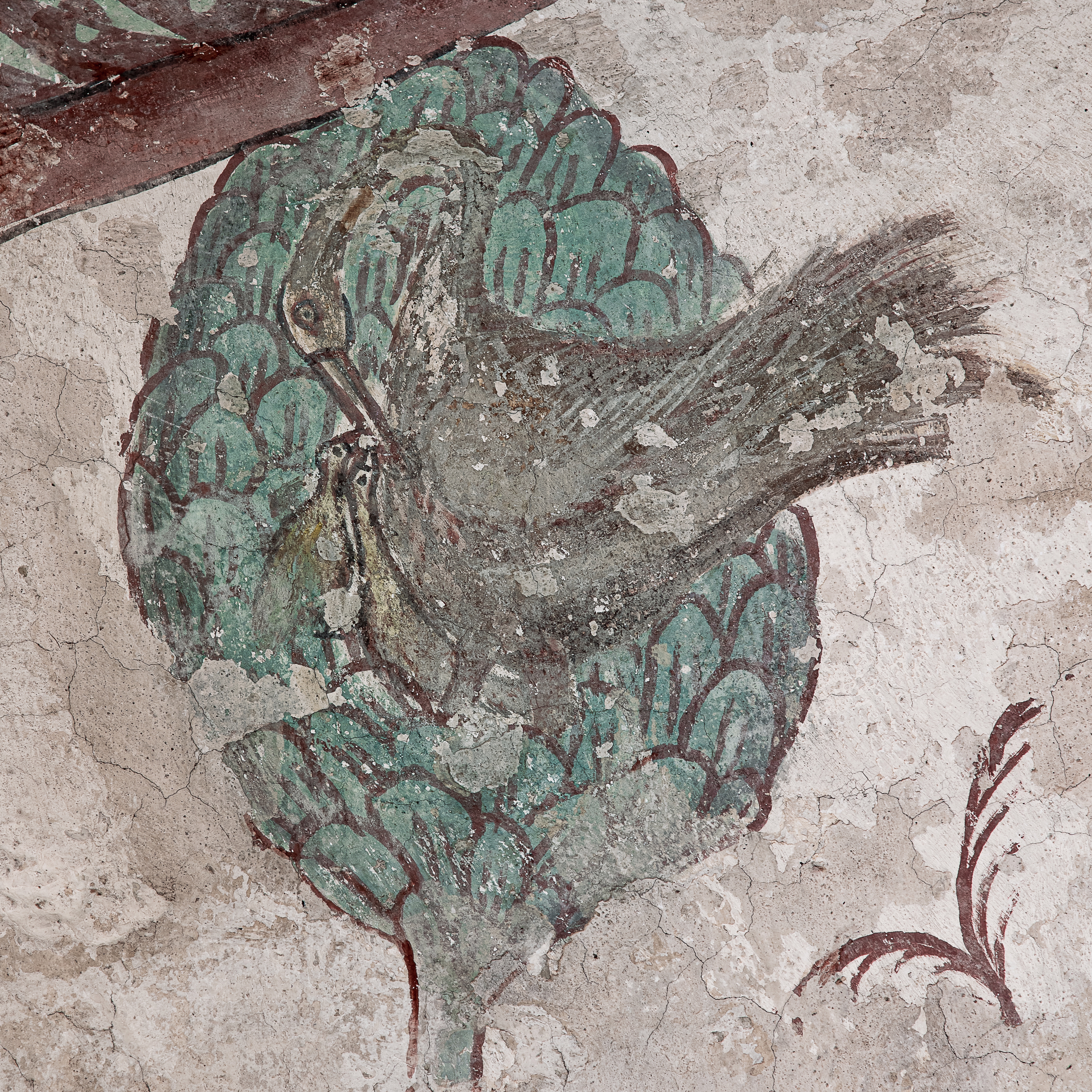
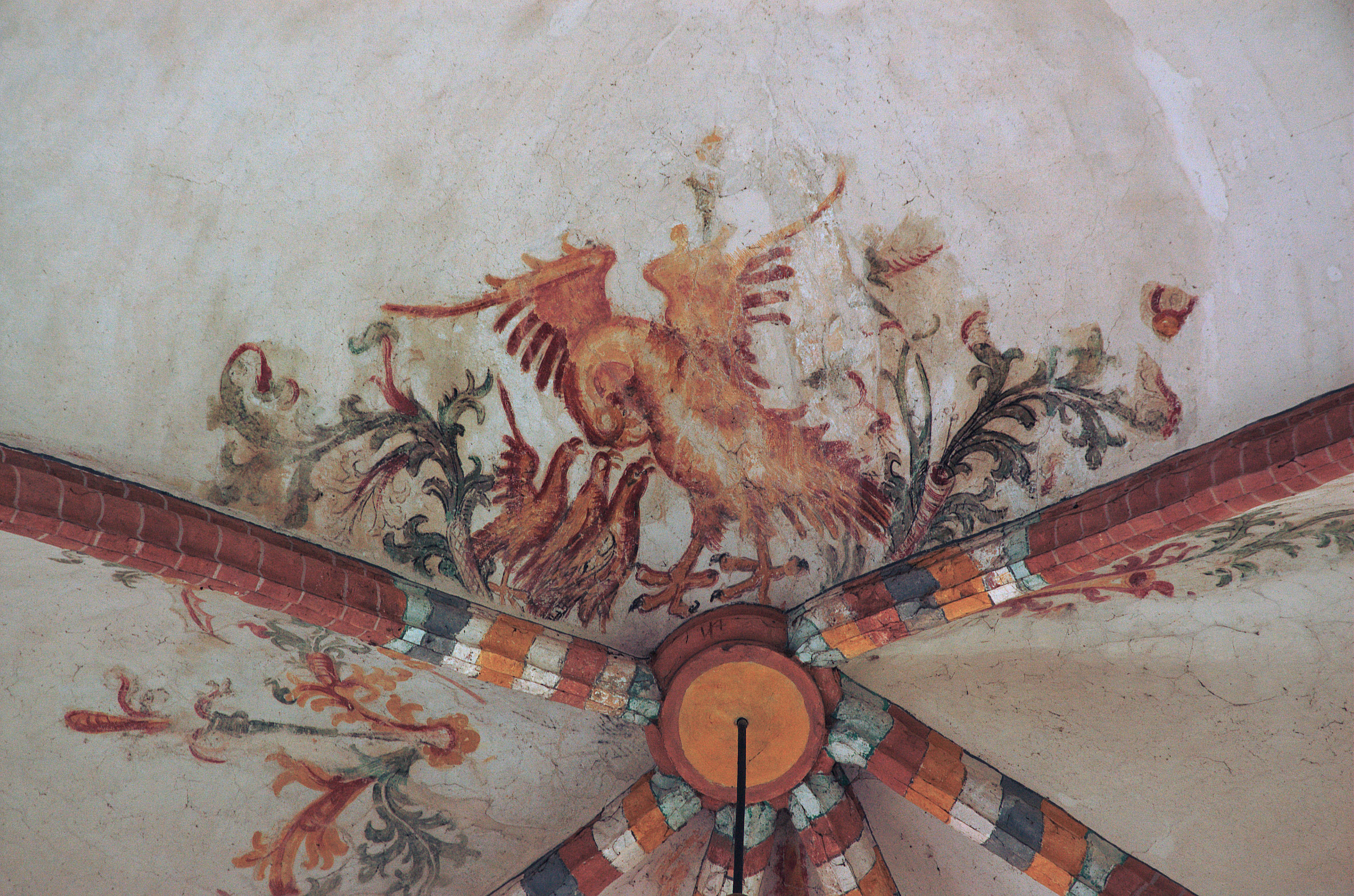
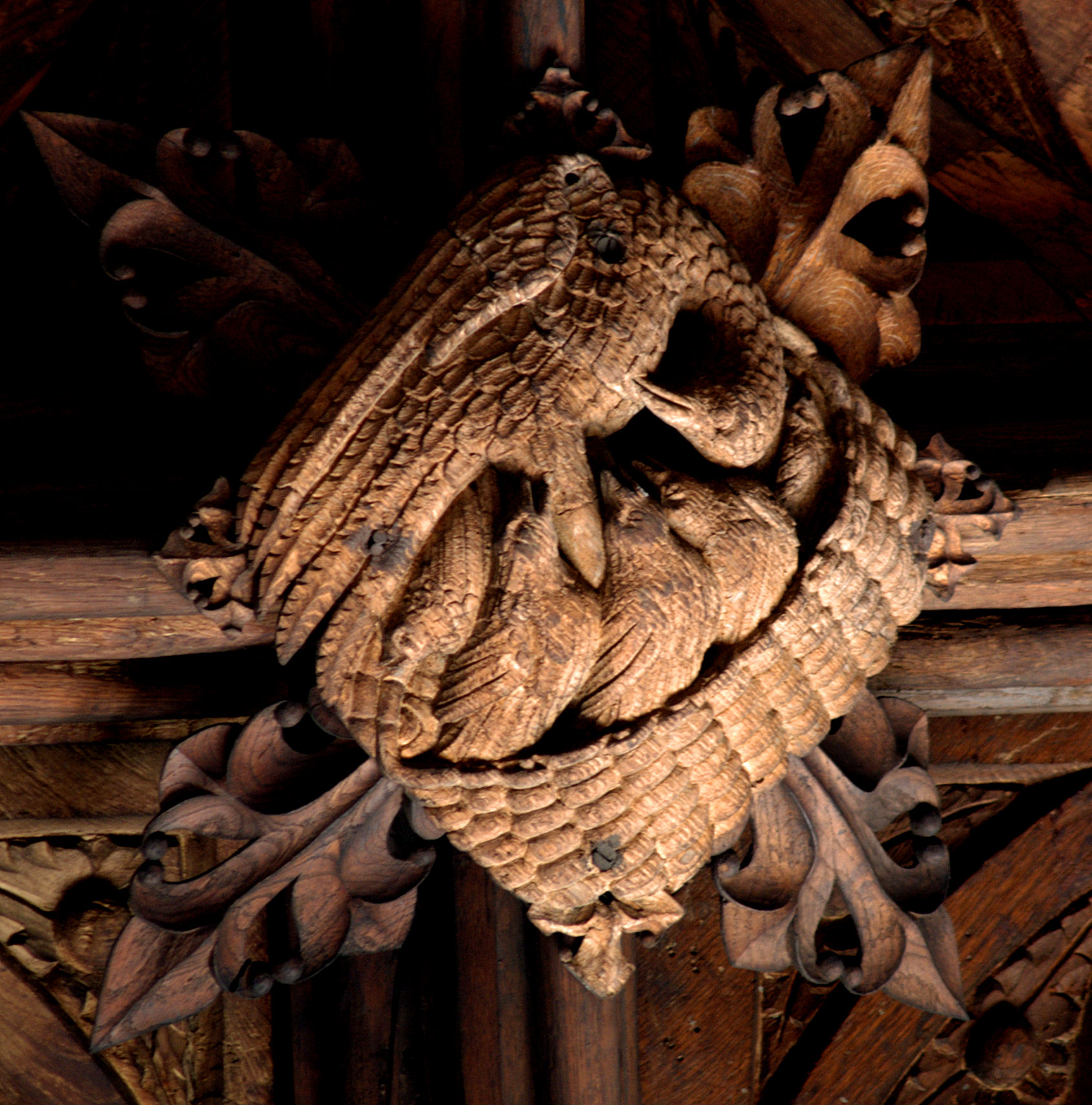
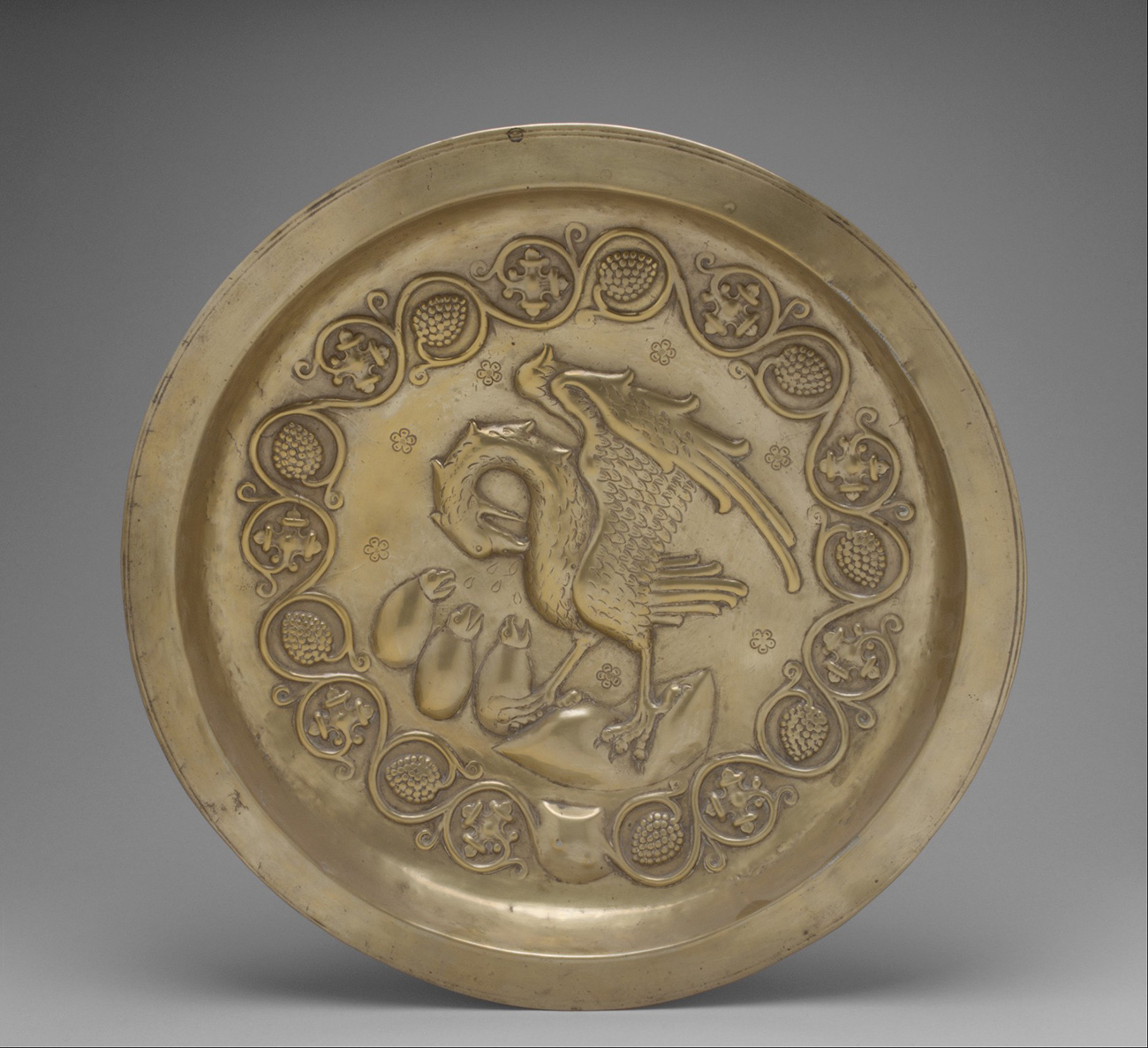
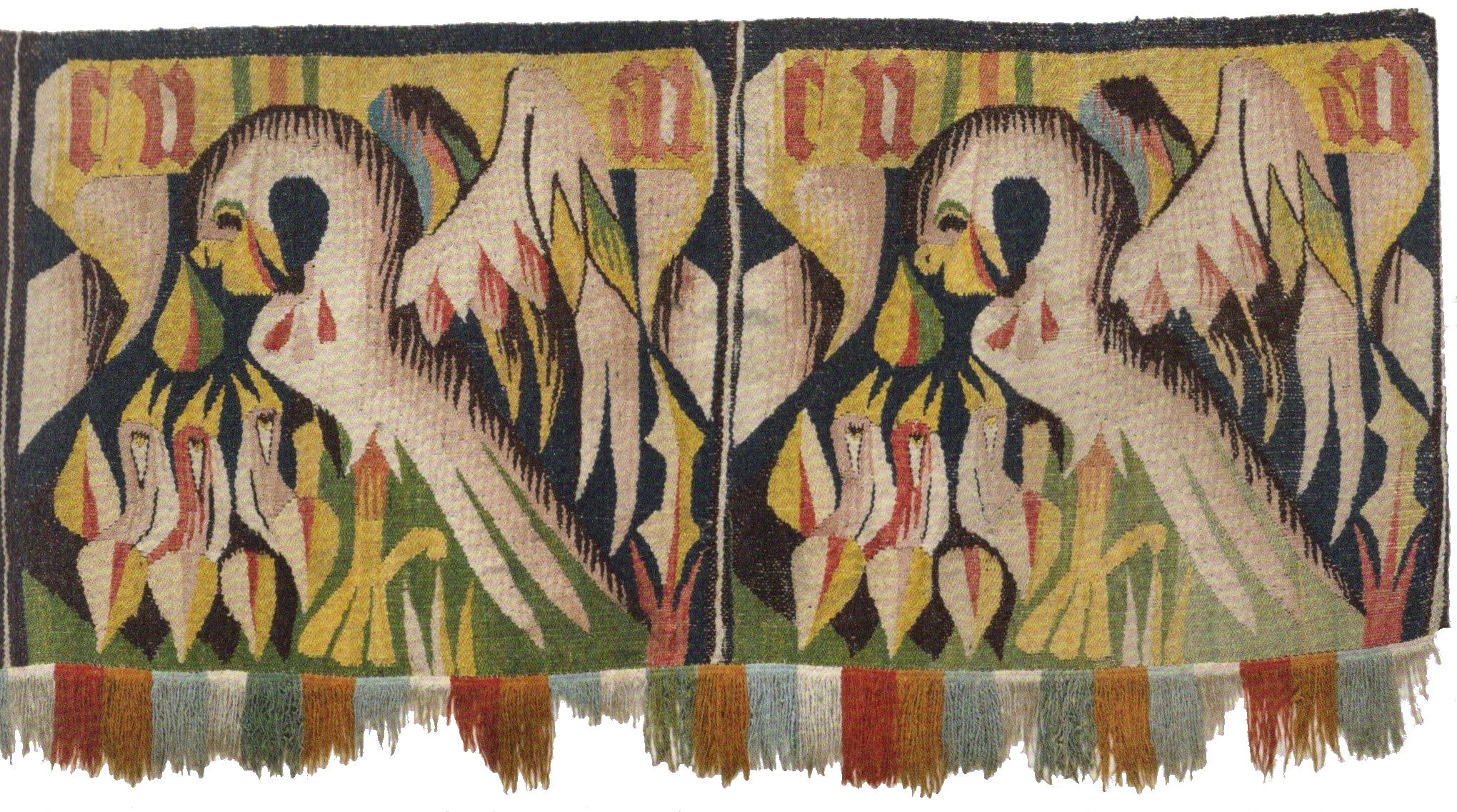
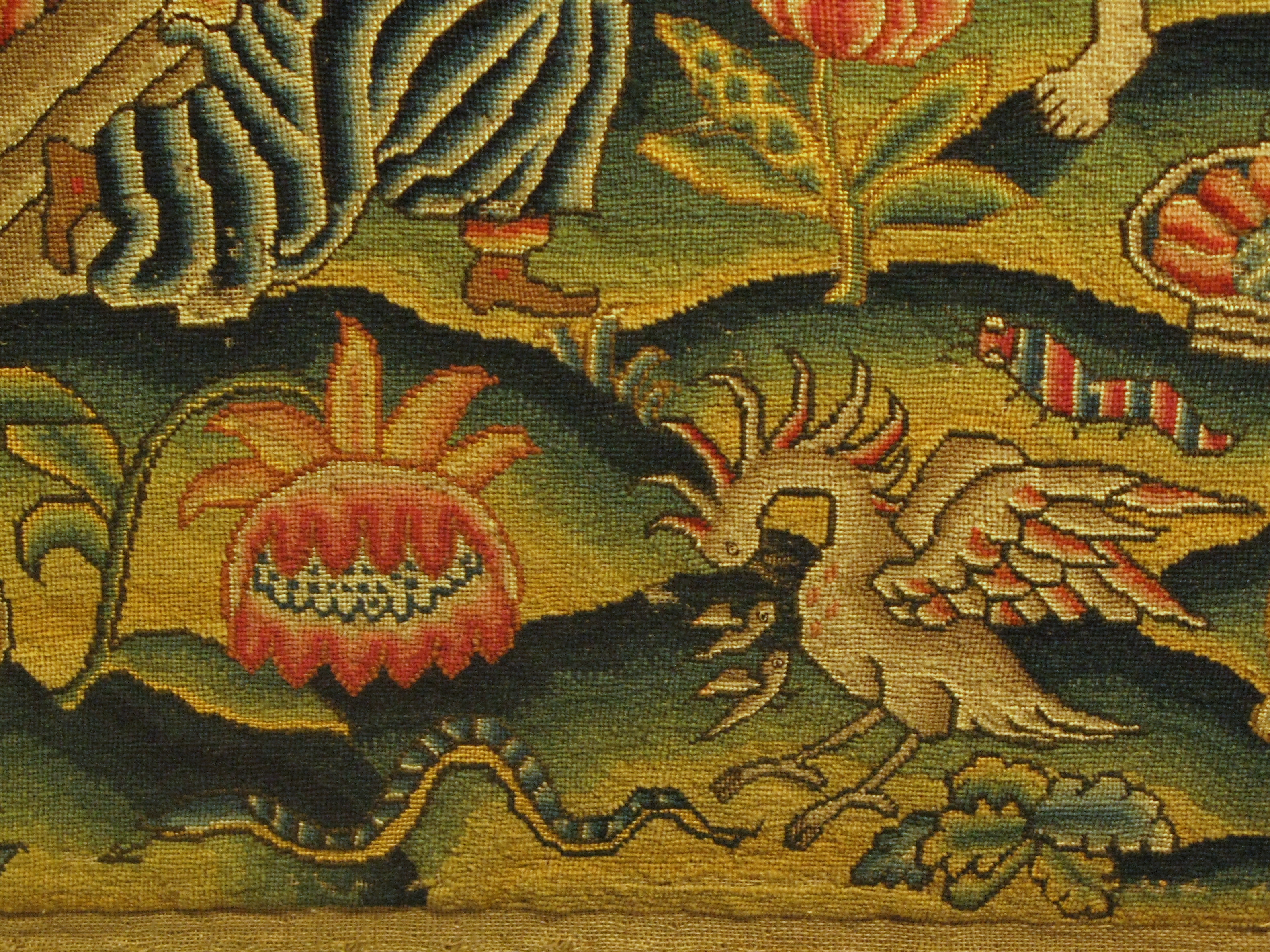
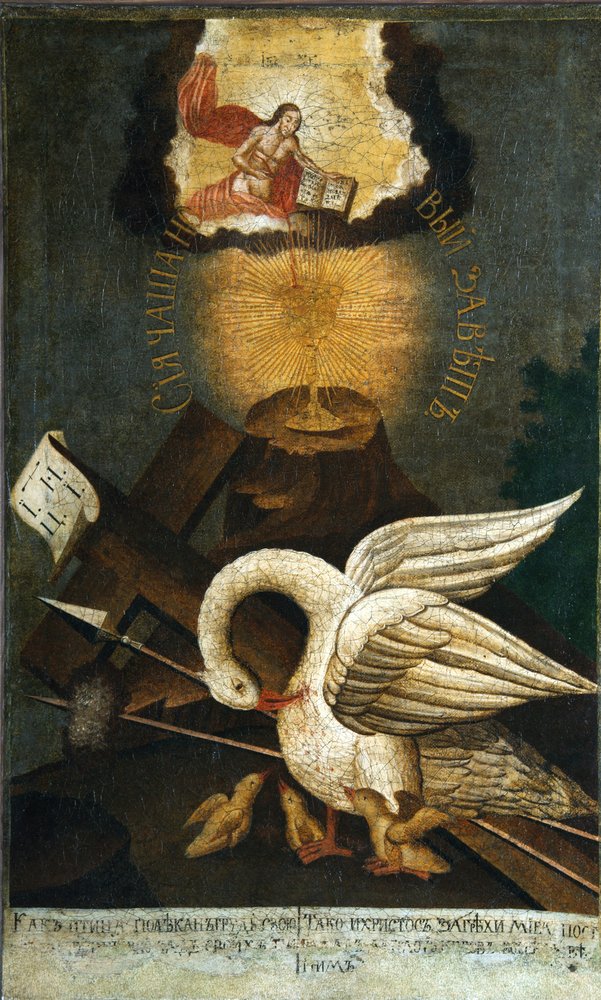
Pelican in Her Piety, 1331–32. Stained glass, Lady Chapel, St Michael and All Angels, Felton, Northumberland, England. Photo: Ann Chapman.Pelicanin Her Piety, 15th century. Stained glass, All Saints Church, Oaksey, England. Photo: Rex Harris.Pelican in Her Piety, All Saints Church, Bishop Burton, East Riding of Yorkshire, EnglandPelican in Her Piety, 1476. Fresco, Bollerup Church, Sweden. Photo: Stig Alenas.Painted choir vault, 15th century, Mariakerk (St. Mary’s Church), ‘t Zandt, Groningen, Netherlands. Photo: Ana Sudani.Oak wood roof boss, ca. 1470–80, St Mary the Virgin, Shrewsbury, Shropshire, England. Photo: Ana Sudani.Bench end by Henry Ringham, 19th century, St Margaret, Ipswich, Suffolk, England. Photo: Simon Knott.Carved oak misericord from Sheffield Cathedral, England, 1920Sculpture with Pelicans, Switzerland, 16th century. Painted linden and willow wood, 29.5 × 27 × 26 cm. Landesmuseum (Swiss National Museum), Zurich, LM-3972.Triptych with the Virgin and Child (detail), Cologne or Lower Rhine, ca. 1425–30. Tempera and gold leaf on oak wood. LVR-LandesMuseum Bonn, Germany. [view full triptych]Plate with the Pelican in Her Piety, Dinant or Malines, Netherlands, 15th century. Brass, diameter 19 7/8 in. Metropolitan Museum of Art, New York. It’s unknown whether this plate was used domestically or liturgically (i.e., for the Eucharist).Tapestry with a Pelican Feeding Her Young (detail), Germany (Lüne Abbey), ca. 1500. Linen and wool, 65 × 233 cm. Kloster Lüne Museum für sakrale Textilkunst, Lüneburg, Germany, Inv. LUEKO Ha 010.05. Source: Book of Beasts: The Bestiary in the Medieval World, cat. 41bCushion cover (detail), England, ca. 1640–70. Wool and silk embroidery on linen, 55.9 × 107.5 cm. Victoria and Albert Museum, London. The primary scenes are the Hospitality of Abraham and the Sacrifice of Isaac. [view full cushion]Pelican in Her Piety, Russia, early 19th centuryPelican in Her Piety, 1907–9. Relief carving from the exterior of Holy Trinity Church, St Andrews, Scotland. Photo: Joy Marie Clarkson.Pelican of Mercy, 1956. Stone relief carving, exterior of Blessed Sacrament Catholic Church, Sioux City, Iowa.
The bird doesn’t always look like an actual pelican, though. It could be that some of the artists had never seen one, although the Dalmatian pelican, which has the long bill and the expandable throat pouch that we most associate with the genus, had been widespread across Europe since ancient times. More likely, the imaginative rendering of the pelican in Christian art derives from the account of the bird in book 12 (“De animalibus”) of the widely influential compendium Etymologies by the Spanish archbishop Isidore of Seville, written around 623, which repeats the popular legend and adds that the pelican lives in Egypt. An exotic bird therefore required exotic treatment.
Neither does the behavior the Physiologus ascribes to pelicans have any basis in natural fact. It’s possible the legend arose from the observation that the pelican sometimes bends its beak into its chest, which may look like it’s piercing it, and that some pelicans have a reddish tinge on their breast plumage and/or a red tip on their beak. However, zoological accuracy was not the point; the point was to convey theological truth.
In The Bestiary of Christ, Louis Charbonneau-Lassay says the pelican first started appearing as a Christian symbol on clay oil lamps in ancient Carthage (present-day Tunisia), citing “L. Delattre, Carthage,Symboles eucharistiques, p. 91”—the French archaeologist Alfred Louis Delattre (1850–1932). But I’ve not been able to track down the cited text or find any such examples. If you can point me to photographs, please do!
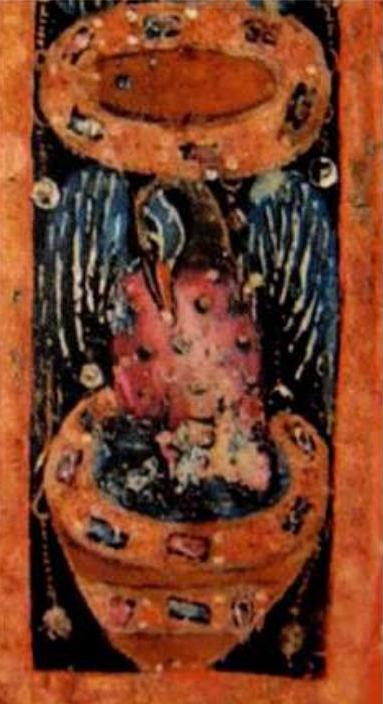
In the “Ējmiacin [Etchmiadzin] Codex” entry in The Eerdmans Encyclopedia of Early Christian Art and Archaeology, Paul Corbey Finney identifies the border illustrations in that Armenian Gospel book’s Baptism of Christ miniature from ca. 600 as depicting a pink-bodied pelican spreading its blue wings and pecking its breast while standing in a bejeweled chalice. The figure is repeated ten times.
Pelican detail from The Baptism of Christ in the Codex Etchmiadzin, an Armenian Gospel book. Yerevan, Mesrop Mashtots Institute of Ancient Manuscripts (Matenadaran), Cod. 2374, fol. 229v. The image is dated to ca. 600, but it was added to a 10th-century manuscript.
Finney mentions that a vulning pelican also appears in the Rabbula Gospels from sixth-century Syria. I think he’s referring to the bird at the top of the canon tables on folio 5a, which also shows the prophets Joel and Hosea and the Wedding at Cana. The iconography is far less obvious here.
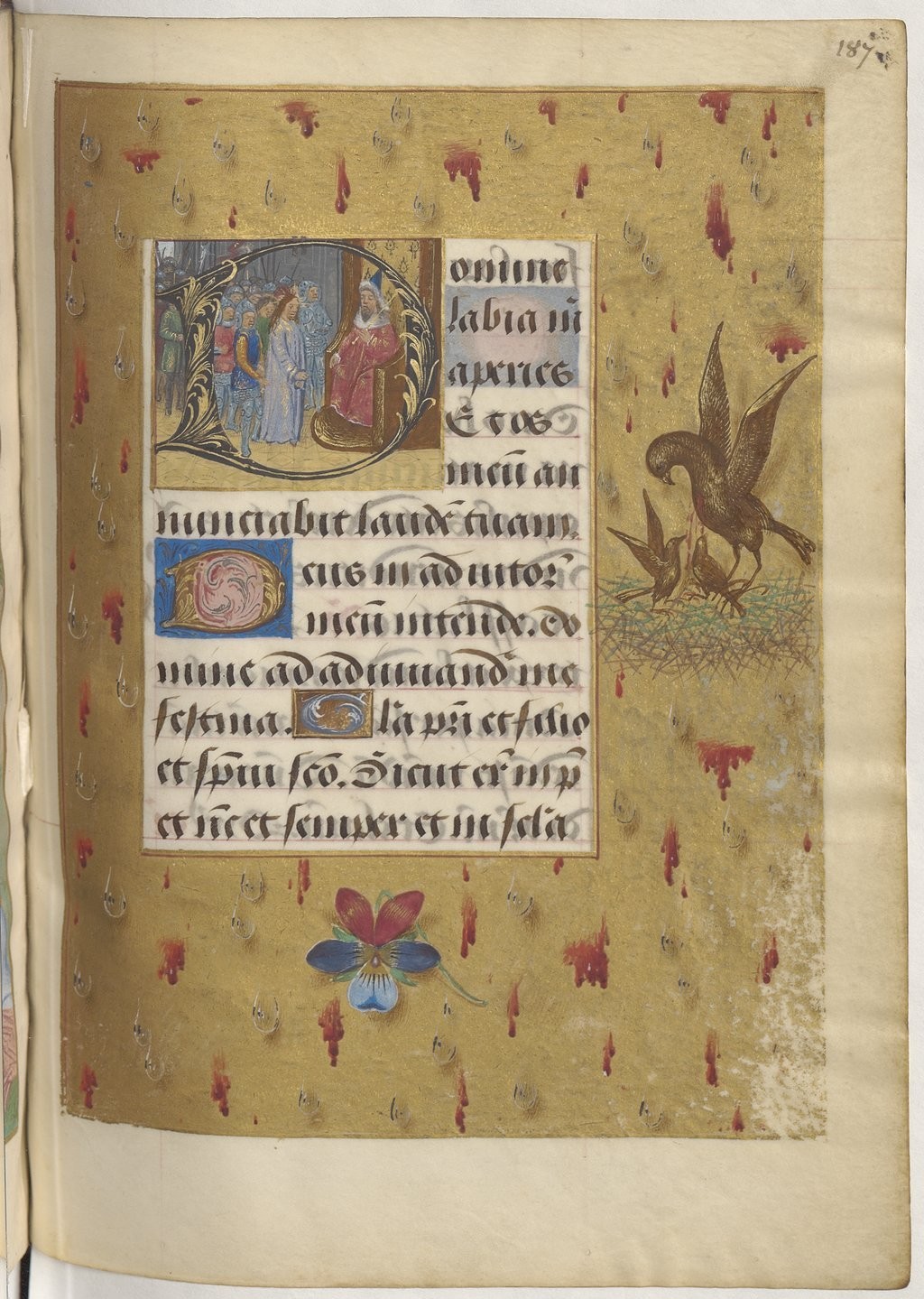
One illuminated manuscript page I love that makes use of the pelican symbol comes from the late Flemish Boussu Hours, a prayerbook made for Isabelle de Lalaing, probably after the death of her husband Pierre de Hennin, lord of Boussu.
Master of Antoine Rolin (Flemish, active 1490–1520), Le pélican, symbole du Christ (Pelican, symbol of Christ), from the Boussu Hours, Cambrai, France, ca. 1490–95. Paris, Bibliothèque de l’Arsenal, Ms 1185 réserve, fol. 187r.
Appearing opposite a full-page miniature of Christ in Gethsemane, folio 187r opens the Hours of the Passion prayer cycle:
V: Domine labia mea aperies. R: Et os meum annunciabit laudem tuam. V: Deus in adiutorium meum intende. R: Domine ad adiuvandum me festina. Gloria Patri, et Filio: et Spiritui sancto. Sicut erat in principio, et nunc, et semper: et in saecula saeculorum.
English translation:
V: O Lord, open my lips, R: And my mouth shall declare thy praise. V: Incline unto my aid, O God. R: O Lord, make haste to help me. Glory be to the Father, and to the Son, and to the Holy Ghost, as it was in the beginning, is now, and ever shall be: world without end.
The historiated initial “D” shows Christ before Pilate, and in the margin a pelican exudes her lifeblood into the mouths of her two chicks, a scene set against a gold background likewise dripping with blood—as well as sweat and tears. It’s “almost as if the gold margin were an expanded microcosm of the bird’s broken breast,” writes Katharine Davidson Bekker in her essay “Those Who Weep: Tears, Eyes, and Blood in the Boussu Hours.” Bekker further notes that “the pansy flower in the margin, the name of which references the French penser (‘to think’), . . . encourages the reader to think deeply about the images on the page.”
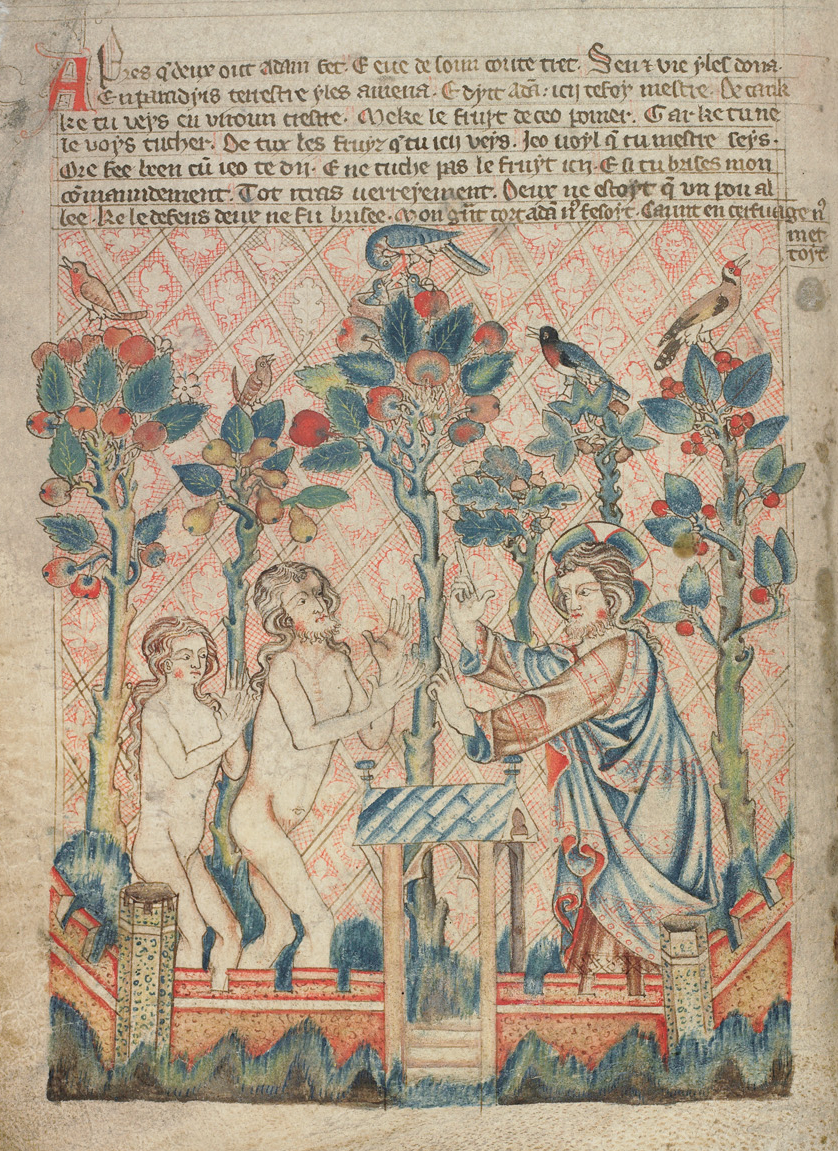
Another remarkable appearance of the pelican in medieval manuscript illumination is in the Holkham Bible Picture Book from fourteenth-century England—remarkable because it appears not in a passion cycle, as was typical, but in a creation cycle!
The Tree of Knowledge, from the Holkham Bible Picture Book, southeastern England, ca. 1327–35. British Library, Add MS 47682, fol. 3v.
In the garden of Eden, God the Creator, portrayed here as Christ, instructs Adam and Eve that they may freely eat of any tree except the tree of the knowledge of good and evil, which he points to with one hand and with the other wags his finger in a forbidding manner. Various birds perch atop the adjacent trees, but at the apex of this fateful one at the center is the vulning pelican, foreshadowing the sacrifice of Christ that will be required for humanity to reenter Paradise after the fall.
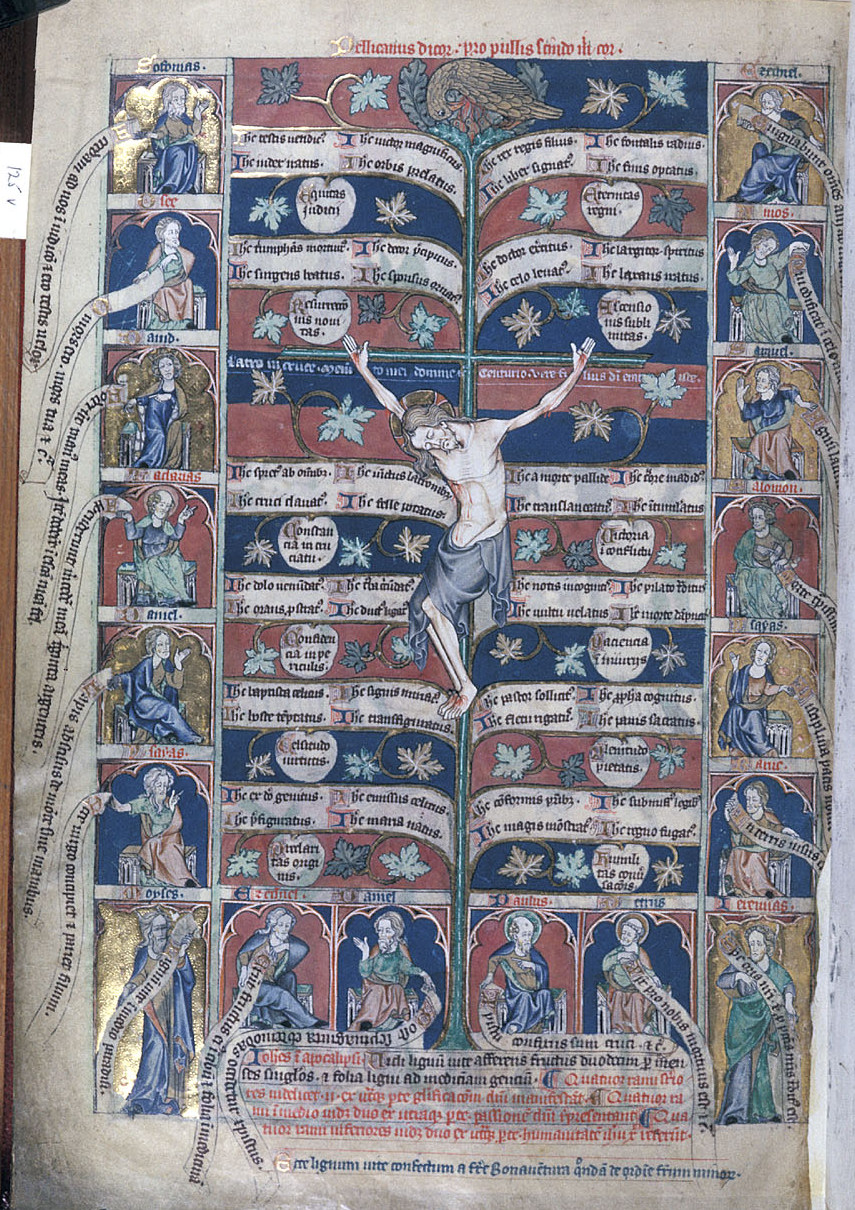
Compare this image to the diagrammatic one on folio 125v of the De Lisle Psalter, which was inspired by Bonaventure’s meditational treatise the Lignum vitae. It shows a pelican nesting atop the tree of life on which Christ is crucified, wounding herself to feed her offspring with her blood:
Tree of Life, from the De Lisle Psalter, England, 1310–39. London, British Library, Arundel MS 83, fol. 125v.
The Latin inscription above it in red reads, Pellicanus dicor, pro pullis scindo mihi cor (“I am called a pelican, because I tear open my heart for my chicks”). The twelve branches contain texts relating to Christ’s humanity, passion, and glorification, while the surrounding panels contain Old Testament witnesses.
The Crucifixion is the narrative context in which the vulning pelican most often appears in art, reinforcing the notion of Christ’s self-emptying sacrifice. It was especially popular in proto- and early Renaissance panel paintings from Italy—which the gallery below reflects, in addition to featuring a few other examples from France, Greece, and Armenia.
Fra Angelico, Christ on the Cross, the Virgin, Saint John the Evangelist, and Cardinal Torquemada (detail), ca. 1453–54. Harvard Art Museums / Fogg Museum, Cambridge, Massachusetts. Photo: Victoria Emily Jones [view full painting]
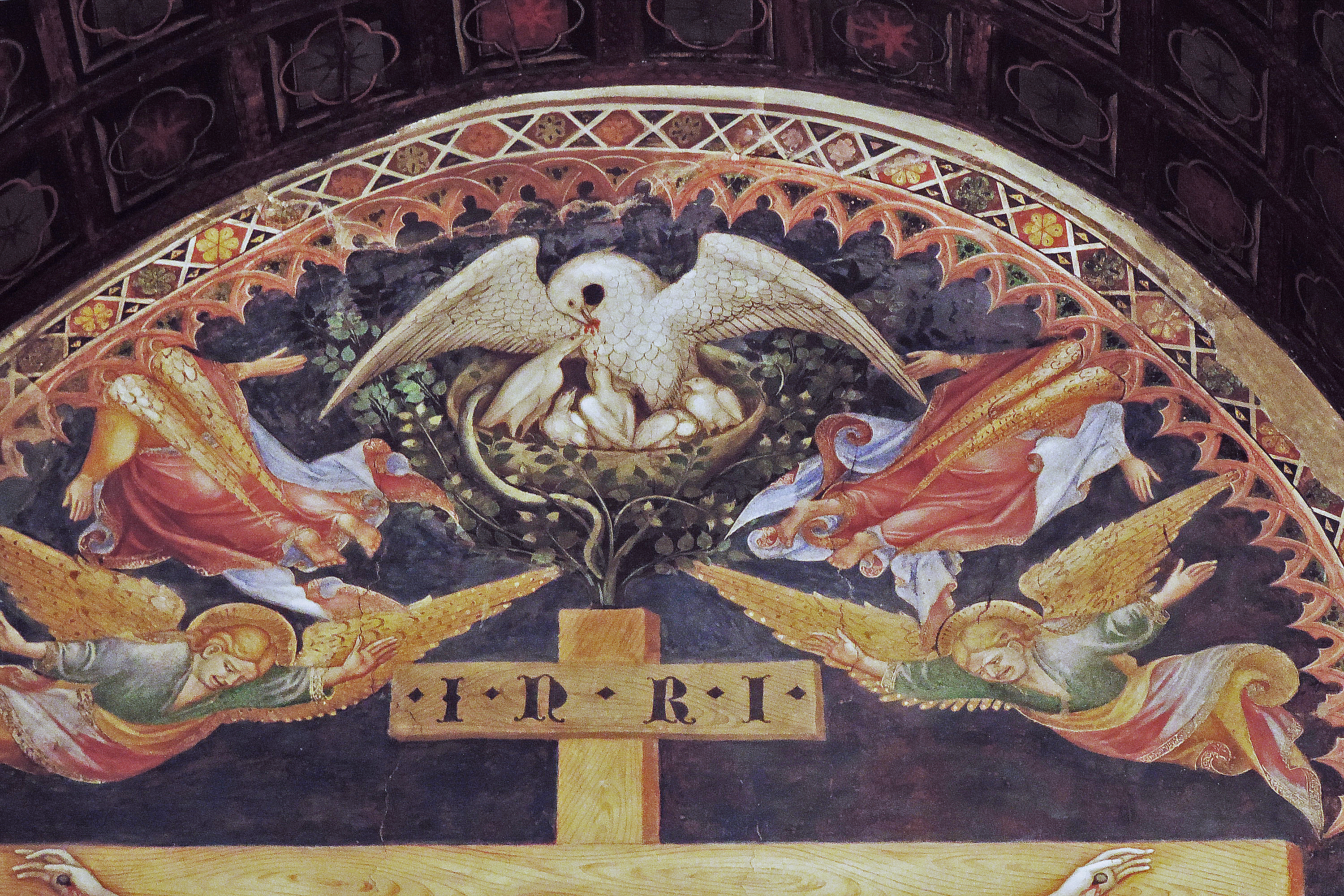
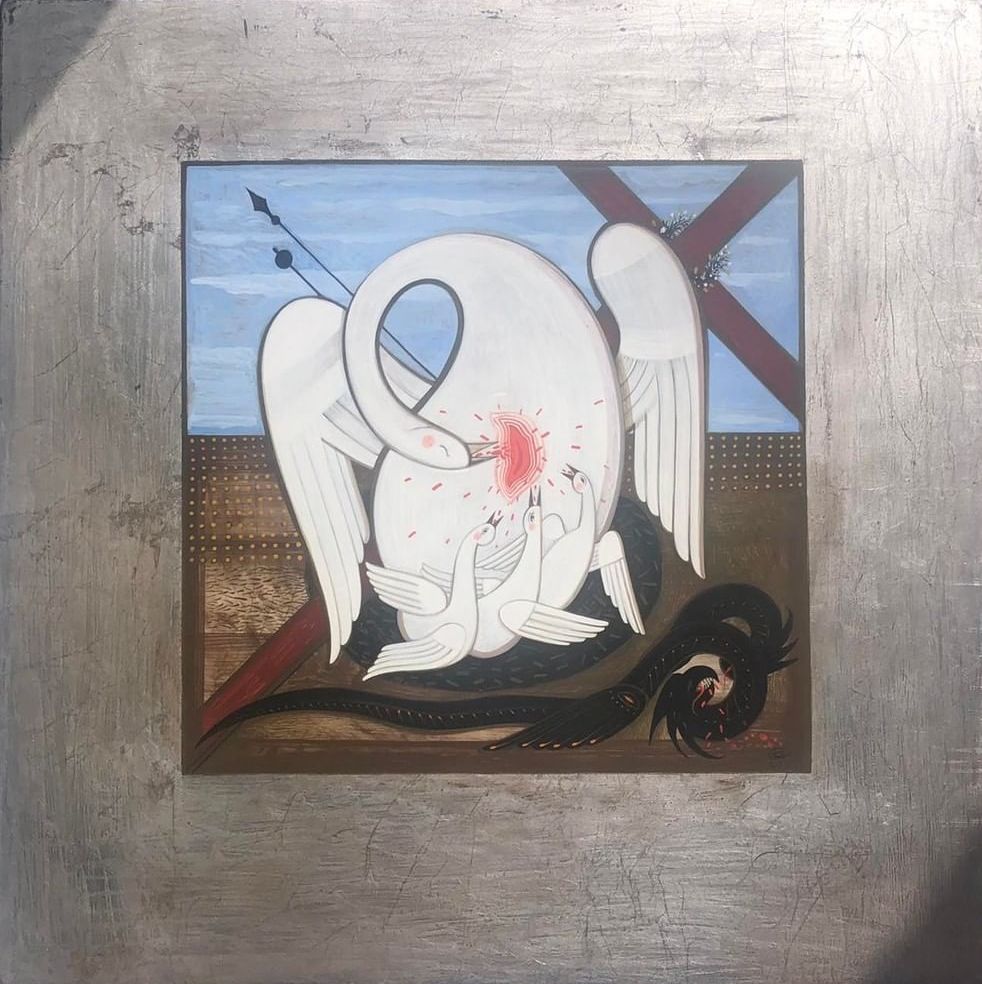
In the Simone di Filippo Benvenuti example above (third row, left), notice the little winged dragon fleeing the pelicans’ nest as the mother pelican undoes the harm he has inflicted. A similar detail can be found in the Crucifixion fresco from the altar wall of the Oratory of St. John the Baptist in Urbino, which shows a snake slithering away from the perishing chicks, who are brought back to life by their intervening mother:
Lorenzo Salimbeni (Italian, 1374–ca. 1418) and Jacopo Salimbeni (Italian, ca. 1370/80–after 1426), Crucifixion (detail), ca. 1416. Fresco, Oratorio di San Giovanni Battista (Oratory of St. John the Baptist), Urbino, Italy.
The snake motif references a version of the pelican legend found in De natura rerum (On the Nature of Things) by the Flemish Dominican friar Thomas of Cantimpré (ca. 1200–1272) and the slightly later De animalibus (On Animals) by the German Dominican friar Albertus Magnus (ca. 1200–1280). According to these two works, when the mother pelican leaves her nest to find food for her fledglings, she returns to find them dead from the bite of an ambushing snake. She then tears her own flesh to revive them with her blood, which is full of healing properties.
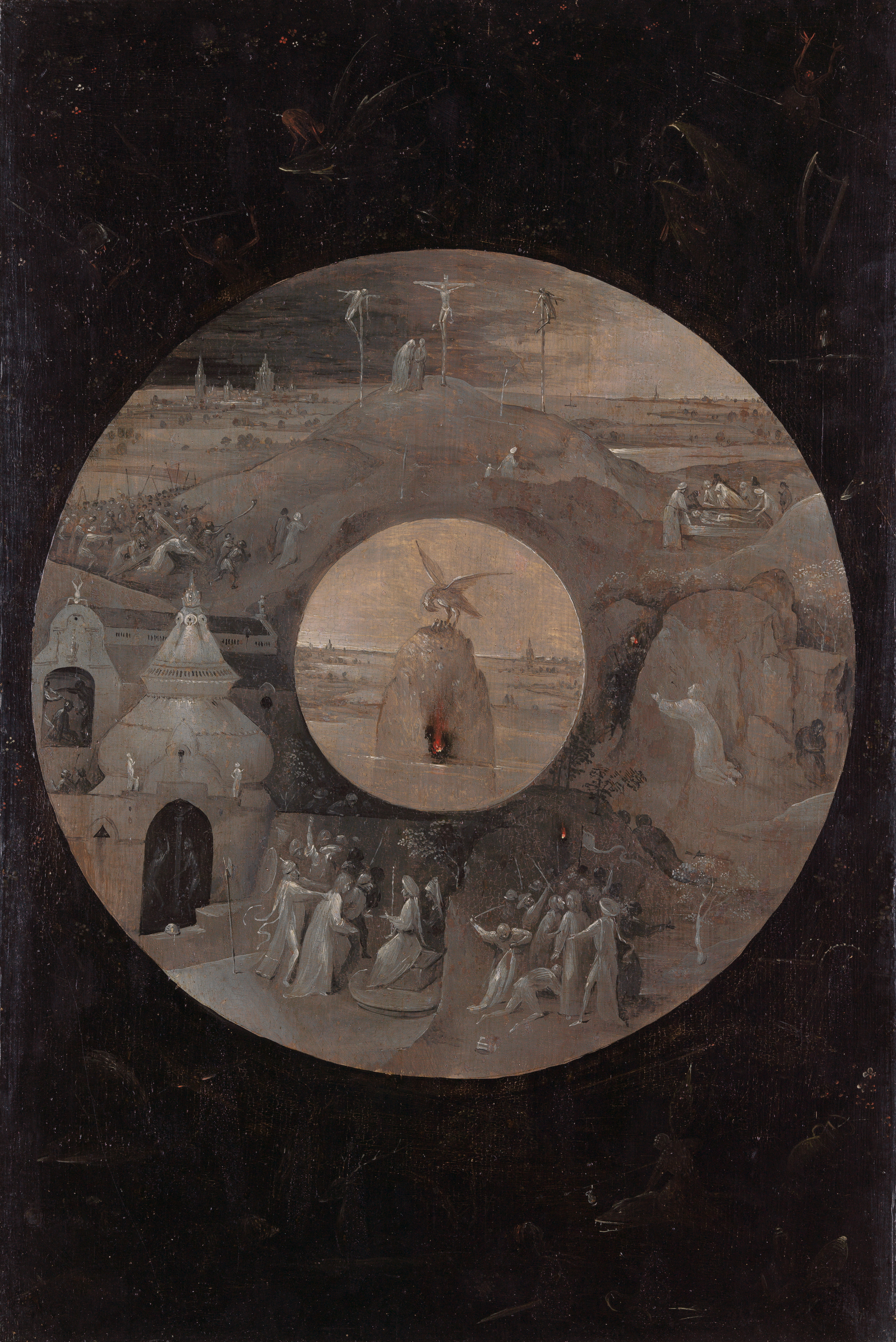
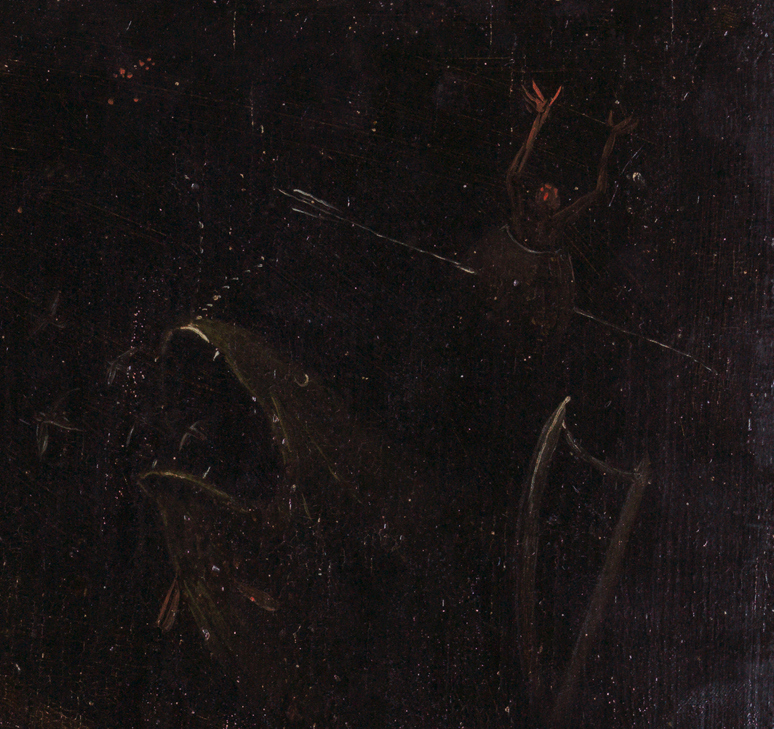
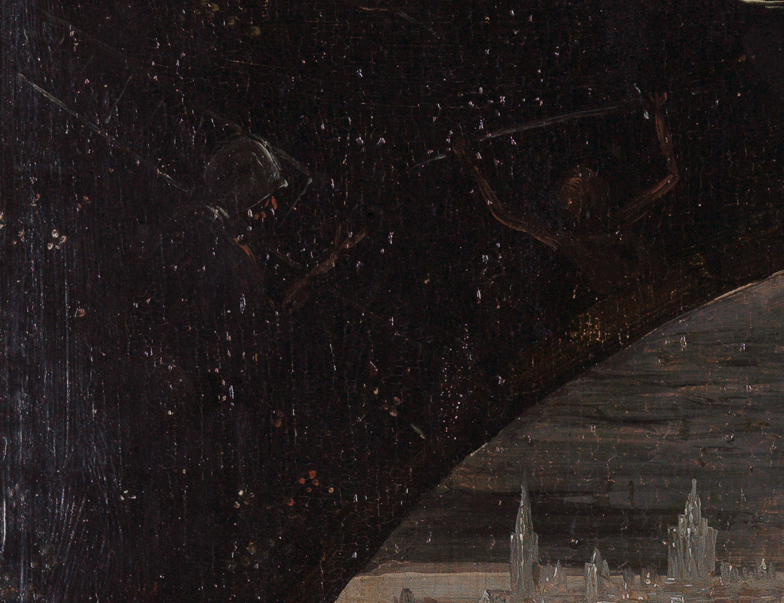
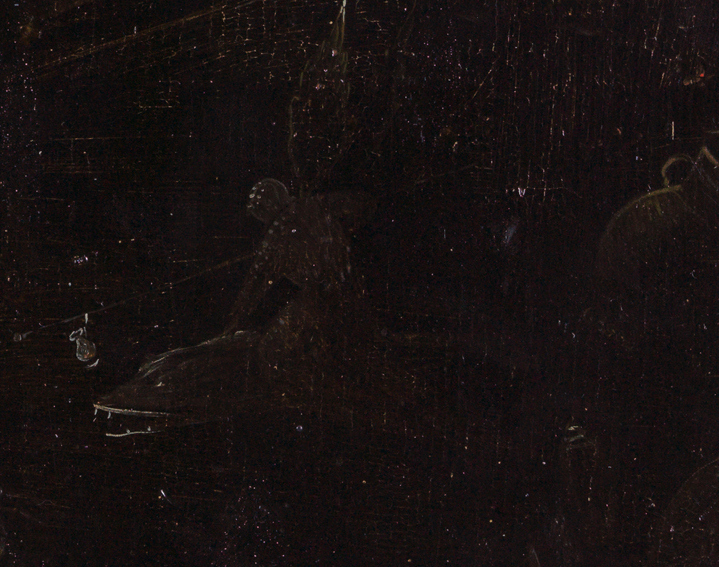
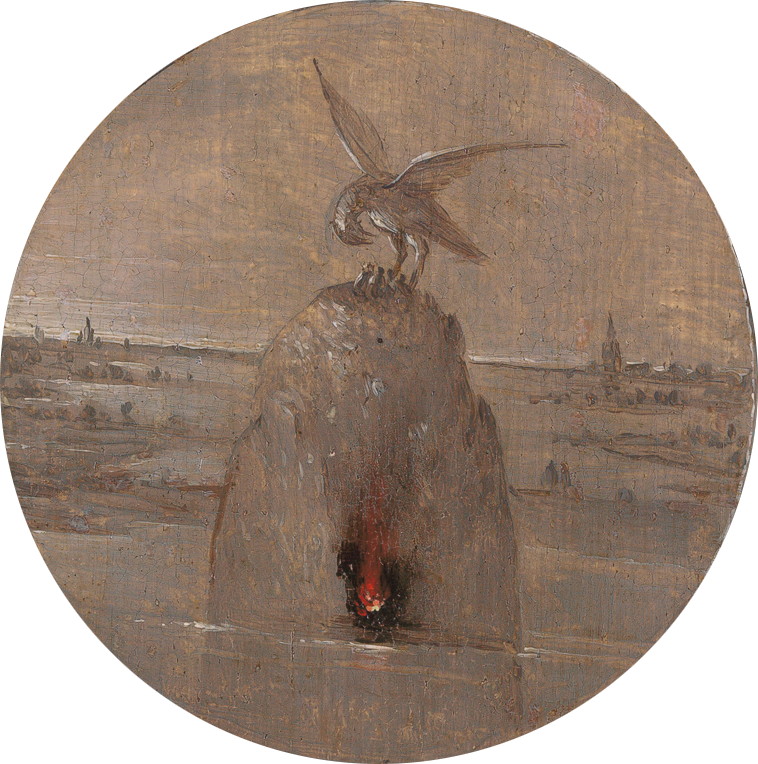
One of the most unique visual treatments of the vulning pelican that I found is a painting by the Dutch Renaissance artist Hieronymus Bosch. Rendered in grisaille (gray monochrome), his pelican appears in the center of a ring depicting scenes from the passion of Christ. It’s painted on the reverse of a panel that shows John the Evangelist in exile on Patmos, penning the book of Revelation.
Hieronymus Bosch (Netherlandish, ca. 1450–1516), Scenes from the Passion of Christ (reverse of John on Patmos), ca. 1500. Oil on panel in grisaille, 62.8 × 43.2 cm. Staatliche Museen zu Berlin, Gemäldegalerie.
Staged around mountain crags, the passion cycle begins on the right with Jesus praying in Gethsemane and continues clockwise with the Arrest of Christ, Christ before Pilate, the Flagellation, the Crowning with Thorns, the Carrying of the Cross, the Crucifixion, and the Entombment.
Outside this ring of scenes is a darkness populated by shadowy demons:
But the inner disc, the focal point of the composition, contains the promise of redemption. Emerging from the still waters of a vast postdiluvian landscape is a hillock with a hollow that houses a burning fire. On the summit, a large mother bird spreads her protective wings over her brood, inclining her head toward her chest—an iconography we recognize as the vulning pelican, symbolic of the deep, saving love God embodied on the cross.
As we view this painting, we progress from the outer darkness with its infernal powers, to the growing light actualized by the events of Maundy Thursday and Good Friday, and finally to the brilliant center with its red flame—which, other than two dim, flickering torches in Gethsemane, contains the sole bit of color in the whole painting. Images of the Sacred Heart of Jesus, which would gain prominence in the seventeenth century, feature a flame, representing Christ’s ardent love burning bright. And that’s what we have here.
Red is also the color of blood. I’m reminded of Robert Southwell’s poem “Christ’s Bloody Sweat,” which combines imagery of the pelican and the self-immolating but ultimately indestructible phoenix, marveling at “how bleedeth burning love.” (I’ll explore a few more poems about the pelican in the next section.)
As John writes in the wonderful prologue to his Gospel, “The light shines in the darkness, and the darkness did not overtake it” (John 1:5).
In Bosch’s painting, the Christbrand bursts, like the pelican’s split side. The flame of redemption is lit, like a lighthouse, calling us home into the love of God.
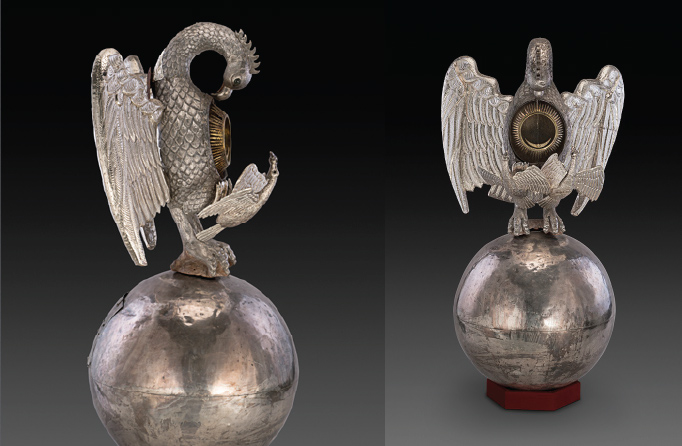
Another especially compelling art object that draws on the pelican legend is a silver-plated tabernacle monstrance from Portuguese Goa in southwestern India.
Tabernacle monstrance made in Goa, India, 17th century. Silver on wood, glass, 142 × 72 cm, globe 66 cm. Museum of Christian Art, Convent of Santa Monica, Old Goa, India.
In the Roman Catholic Church, a tabernacle is a container in which the consecrated hosts (small unleavened wafers of bread) of the Eucharist are stored as part of the “reserved sacrament” rite, and a monstrance is a vessel that displays the consecrated host on the altar and in procession. This object combines both into one—the spherical base serving as the tabernacle, with access gained through an opening at the back, and the bird’s breast bearing a transparent aperture surrounded by a golden sunburst halo, through which the host can be viewed. The body of Christ, broken for you.
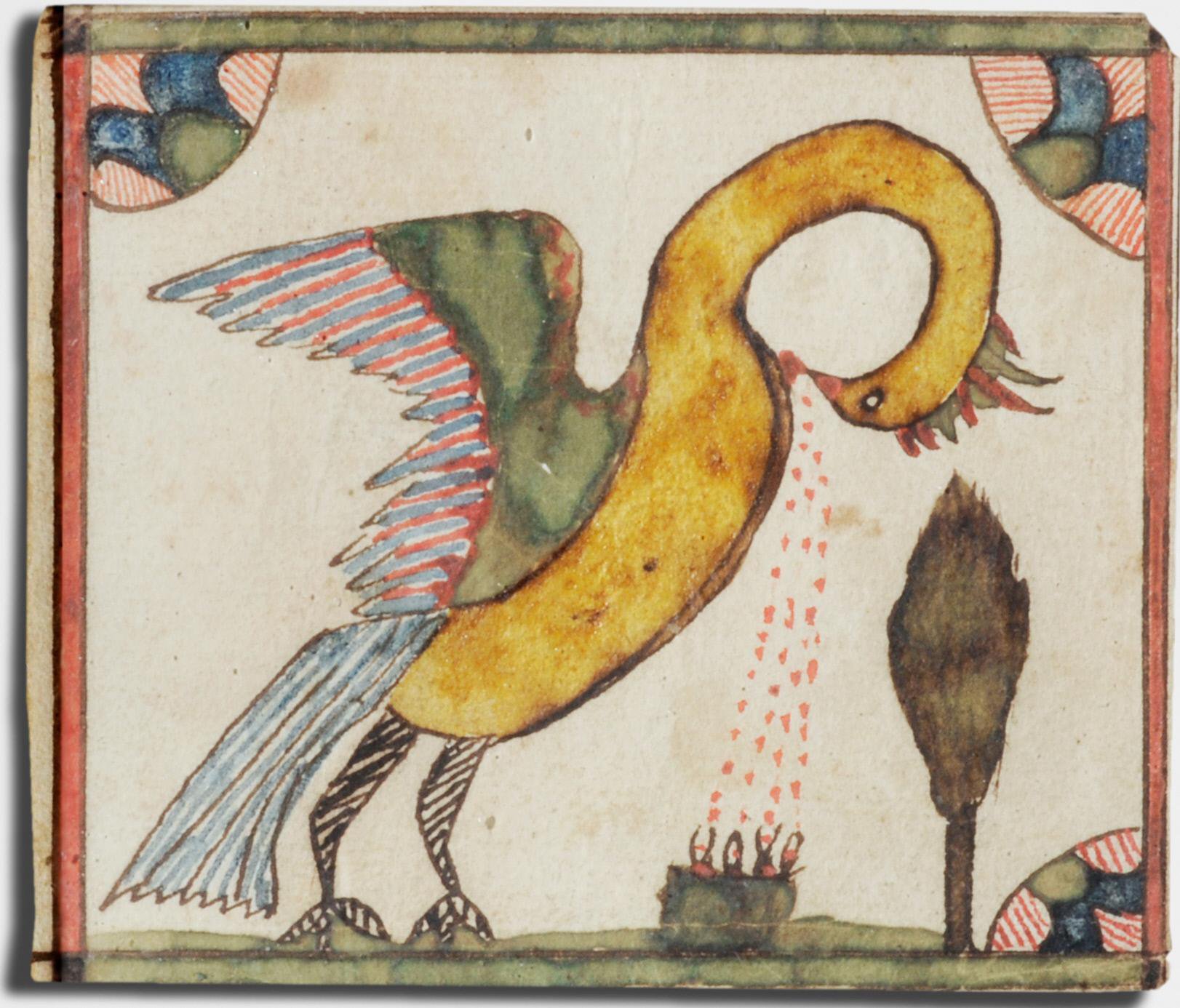
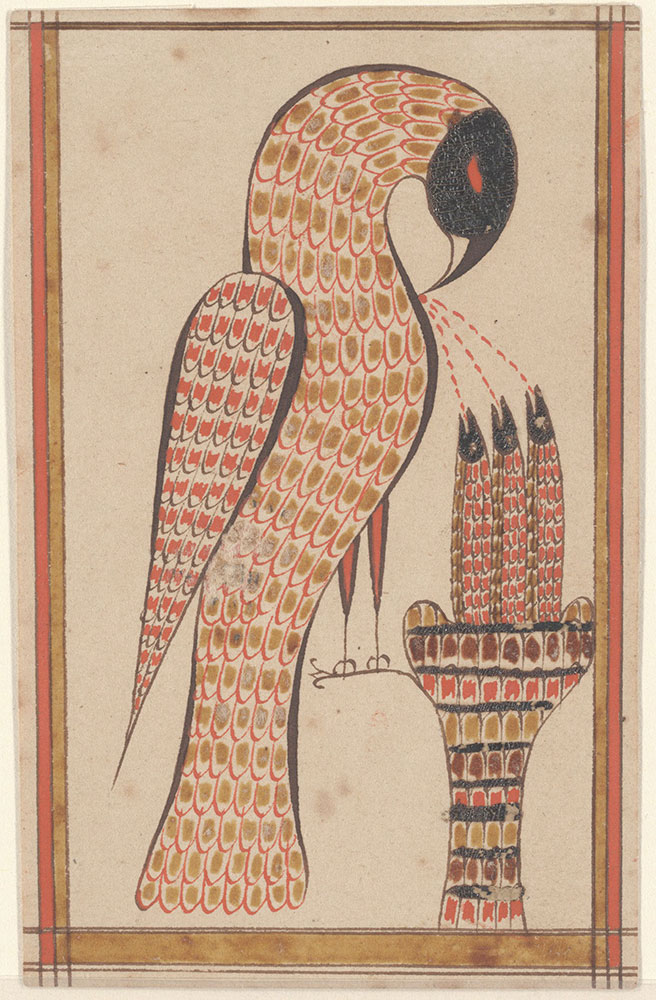
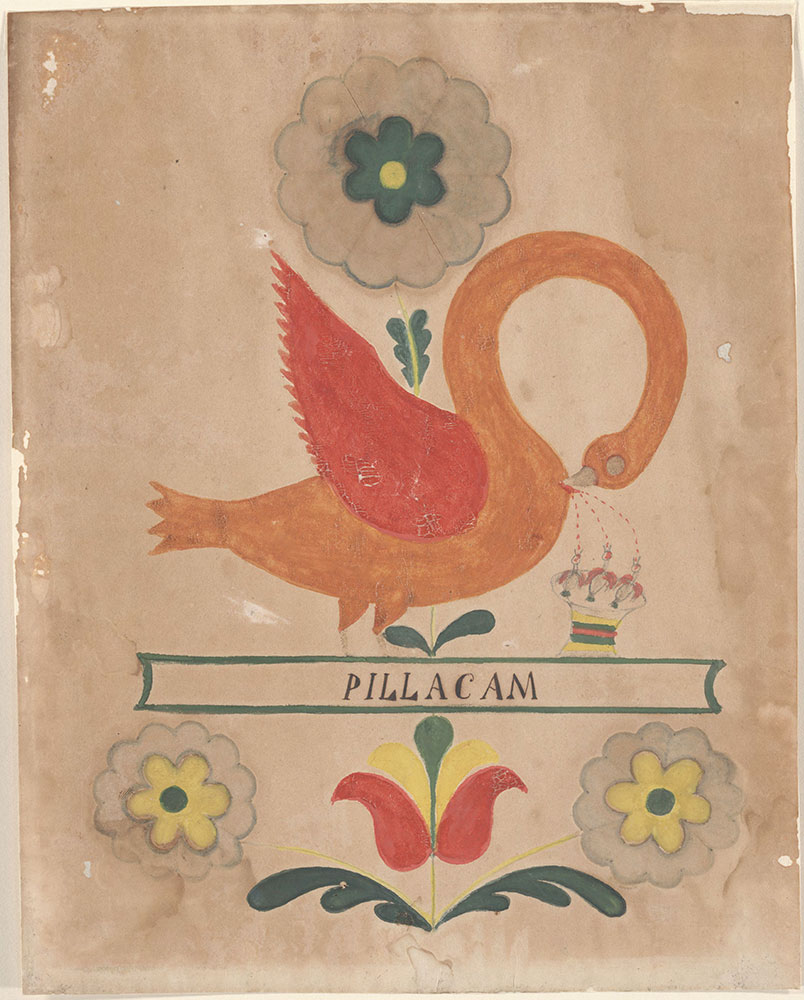
In researching this essay, I found that the pelican is a subject that recurs (so charmingly!) in the folk art of eighteenth- and nineteenth-century Pennsylvania Germans:
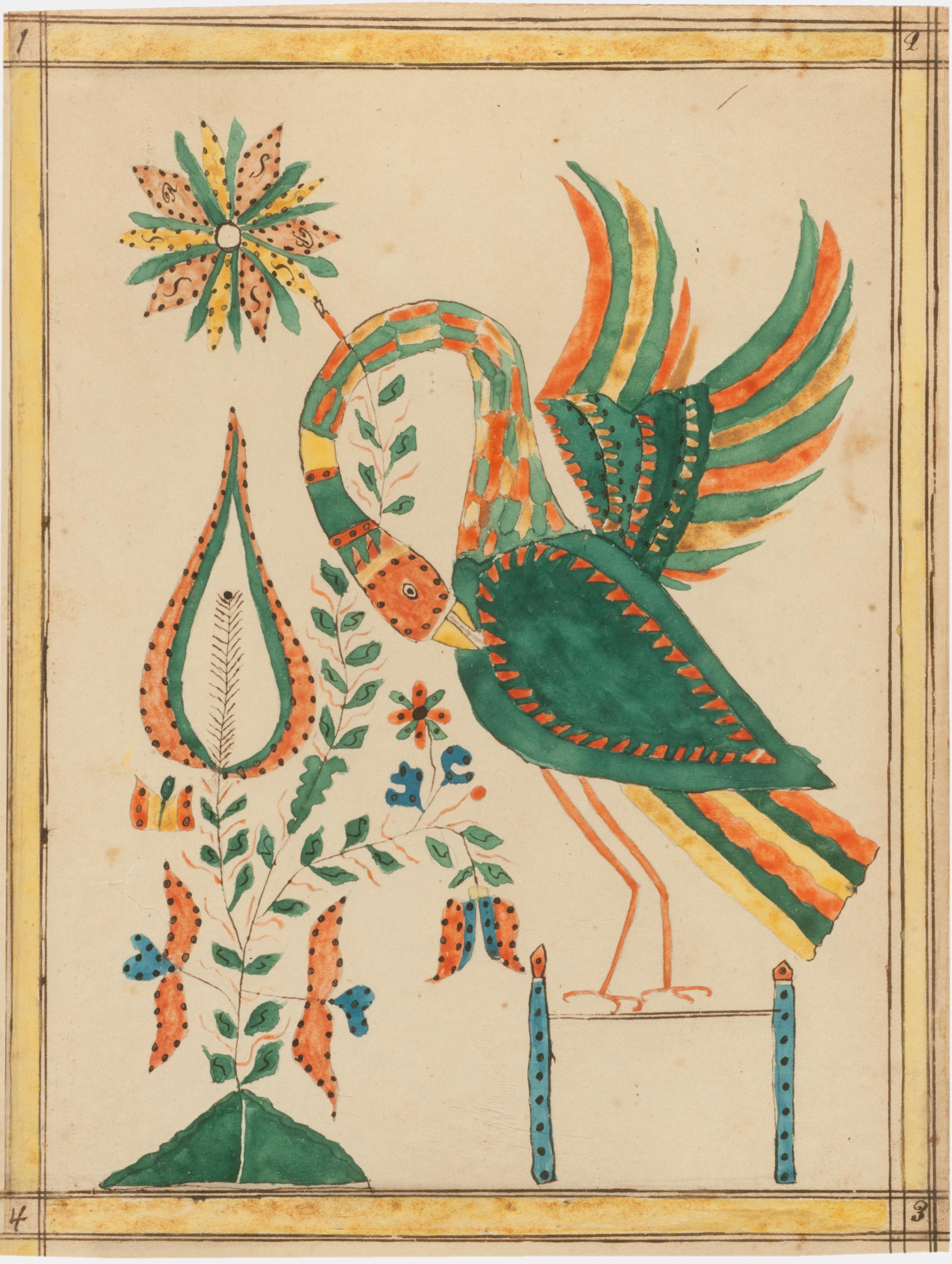
A Pelican in Its Piety, Bucks County or Montgomery County, Pennsylvania, ca. 1800. Watercolor and ink on laid paper, 8.9 × 8.3 cm. Promised gift of Joan and Victor Johnson to the Philadelphia Museum of Art.David Kulp (American, 1777–1834), Pelican in Its Piety, Bucks County, Pennsylvania, ca. 1810. Watercolor and ink on wove paper, 18.6 × 12.2 cm. Free Library of Philadelphia.Pelican, Pennsylvania, ca. 1850. Watercolor and ink on wove paper, 31.6 × 25.4 cm. Free Library of Philadelphia.A Pelican in Its Piety, Pennsylvania, ca. 1825. Watercolor and ink on wove paper, 24.1 × 19.1 cm. Promised gift of Joan and Victor Johnson to the Philadelphia Museum of Art.
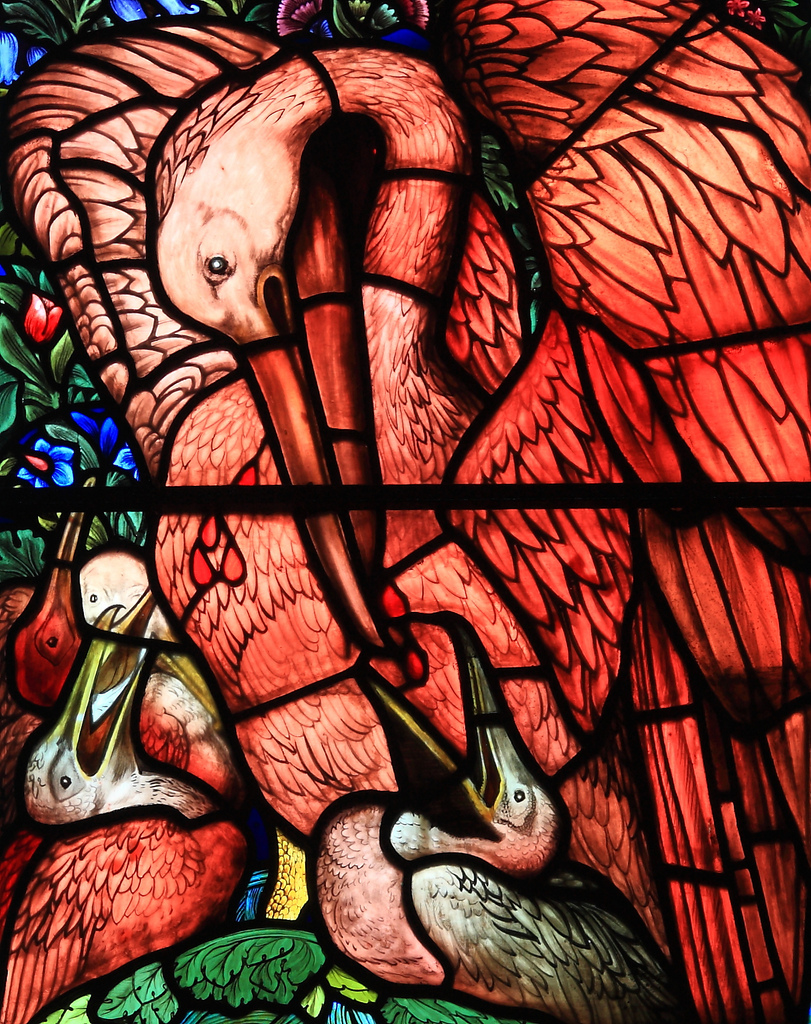
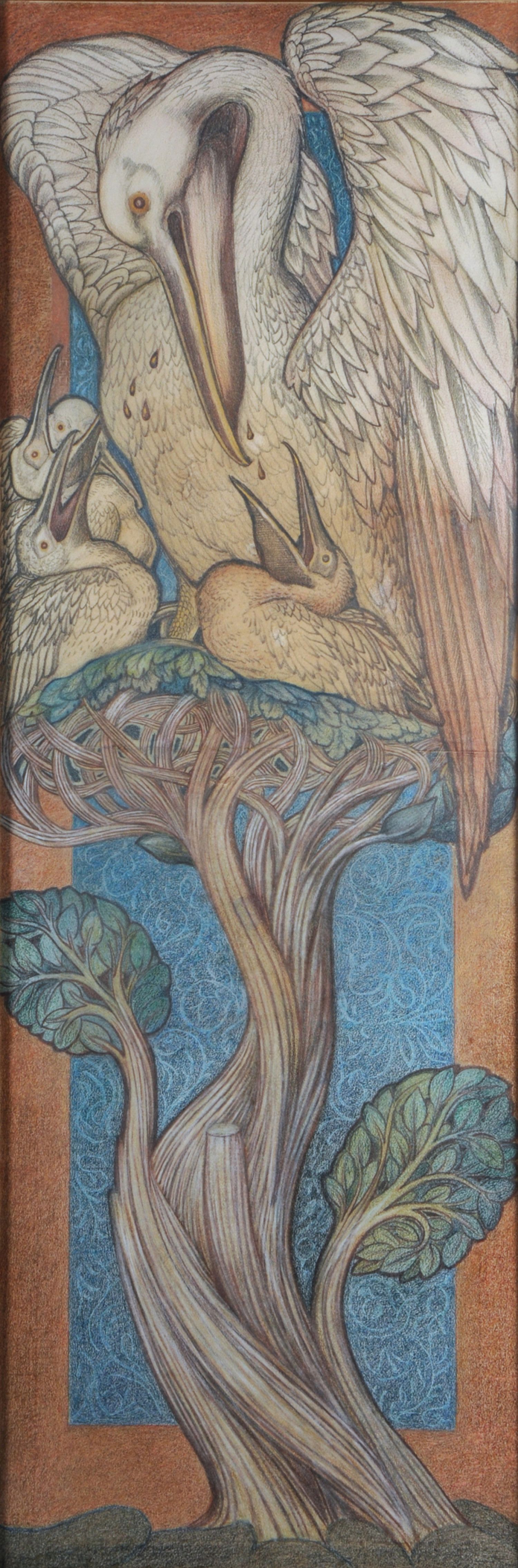
From the Victorian era, I’m especially fond of the stained glass pelican design by the Pre-Raphaelite artist Edward Burne-Jones, fabricated by Morris & Co. to serve as part of the East Window of St Martin’s Church, Brampton, in Cumbria. Burne-Jones drew his design in 1880, and after the window was completed the following year, he returned to the drawing out of personal fondness, embellishing it with colored chalks, and gold for the blood drops, thus developing it into a more substantial work.
Edward Burne-Jones (British, 1833–1898) and Morris & Co., Pelican on Nest (detail), 1880. East Window, St Martin, Brampton, Cumbria, England. Photo: Dave Webster. [view full window]Edward Burne-Jones (British, 1833–1898), Pelican in Her Piety, 1880–81. Pencil, colored chalk, and gold on paper, 172.7 × 57.3 cm. William Morris Gallery, London.
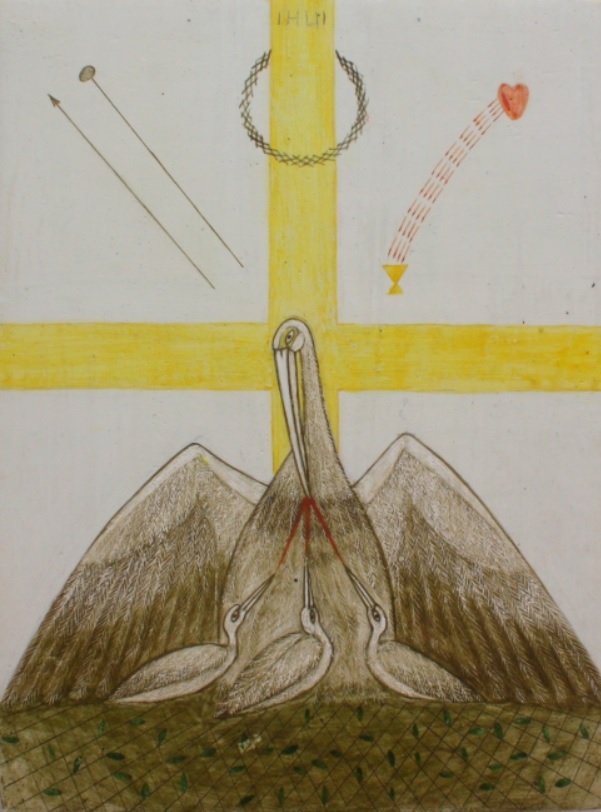
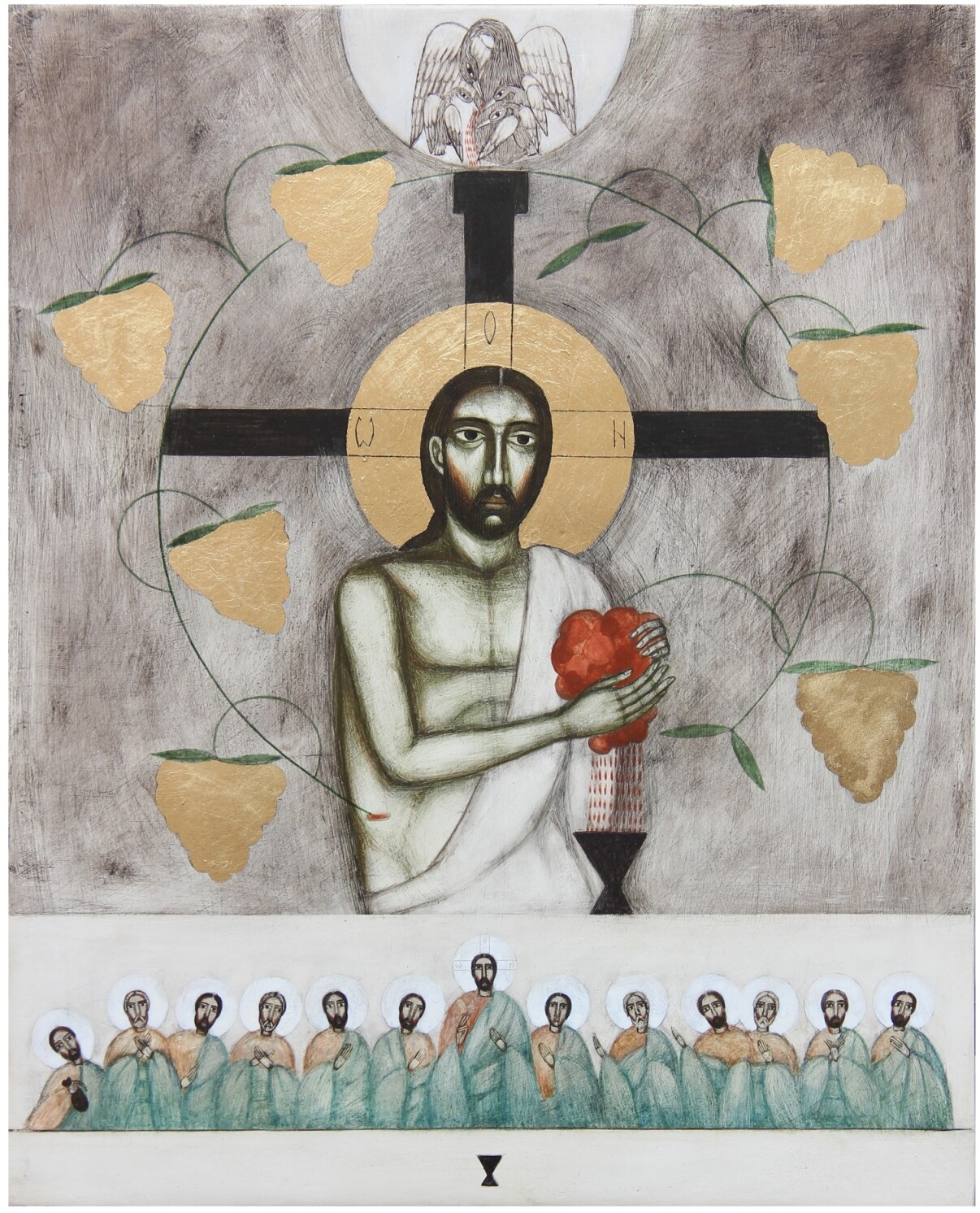
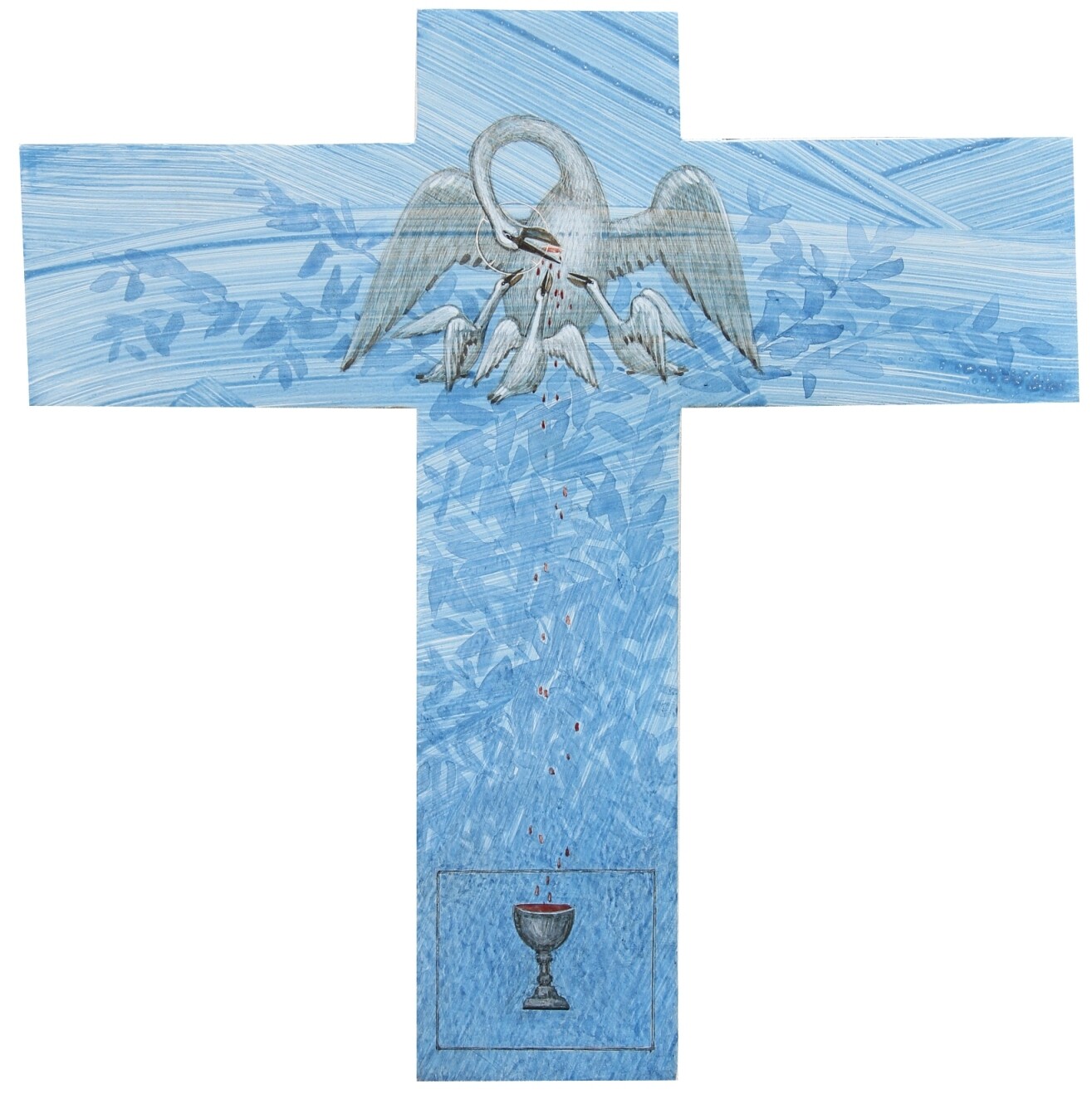
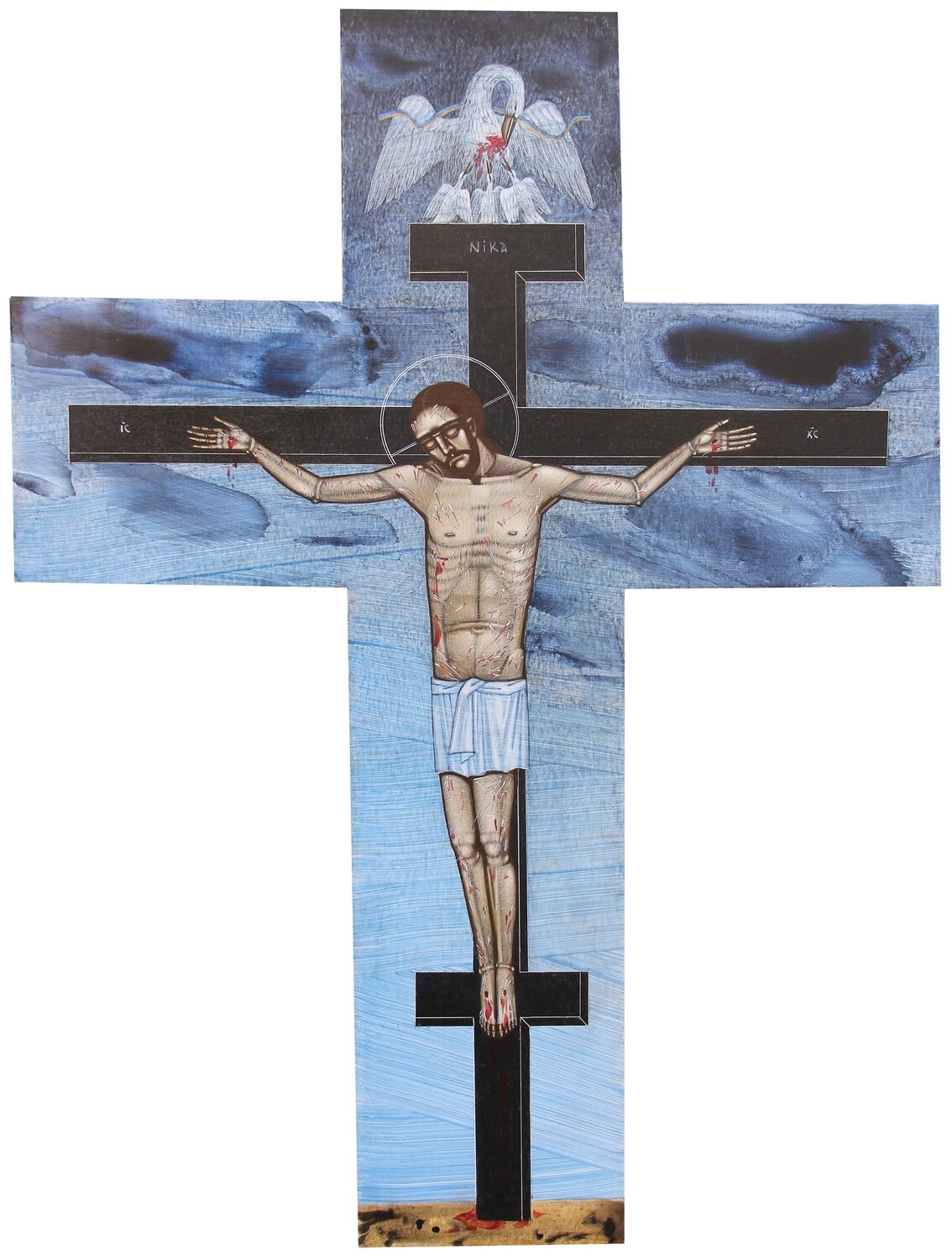
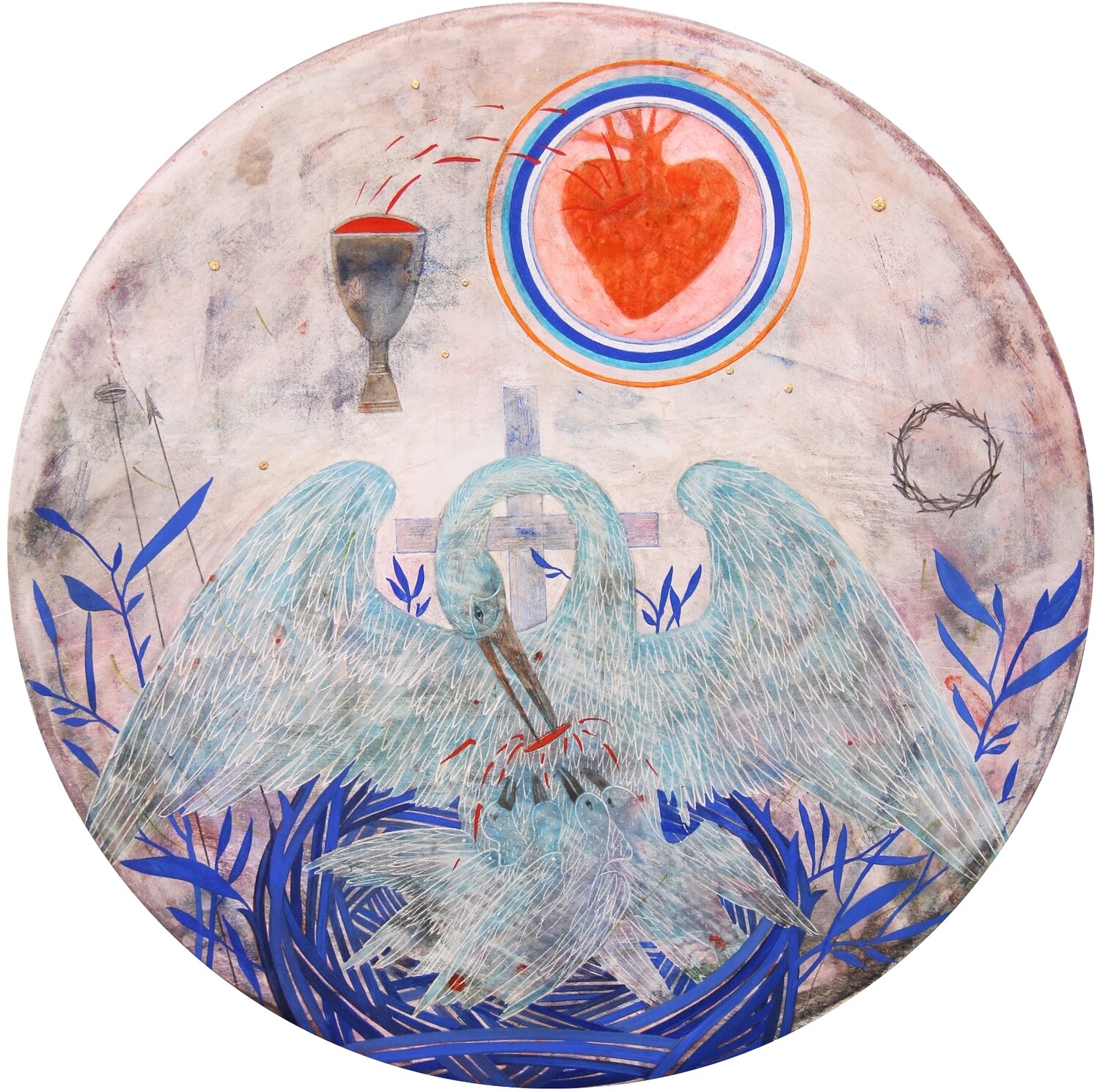
Contemporary artists have also turned to the subject of the vulning pelican, especially the Ukrainian Catholic women iconographers of Lviv:
Natalya Rusetska (Ukrainian, 1984–), Pelican, 2017. Egg tempera on gessoed wood, 19 × 15 cm.Natalya Rusetska (Ukrainian, 1984–), Jesus the Grapevine and the Last Supper, 2021. Egg tempera on gessoed wood, 30 × 24 cm.Kateryna Kuziv (Ukrainian, 1993–), Pelican, 2021. Egg tempera on gessoed wood, 30 × 30 cm.Kateryna Kuziv (Ukrainian, 1993–), Crucifixion, 2022. Egg tempera on gessoed wood, 65 × 49 cm.Ulyana Tomkevych (Ukrainian, 1981–), Pelican, 2021. Egg tempera on gessoed wood, diameter 30 cm.Olya Kravchenko (Ukrainian, 1985–), Sacrifice and Victory, 2022. Tempera and silver leaf on gessoed wood, 40 × 40 cm.
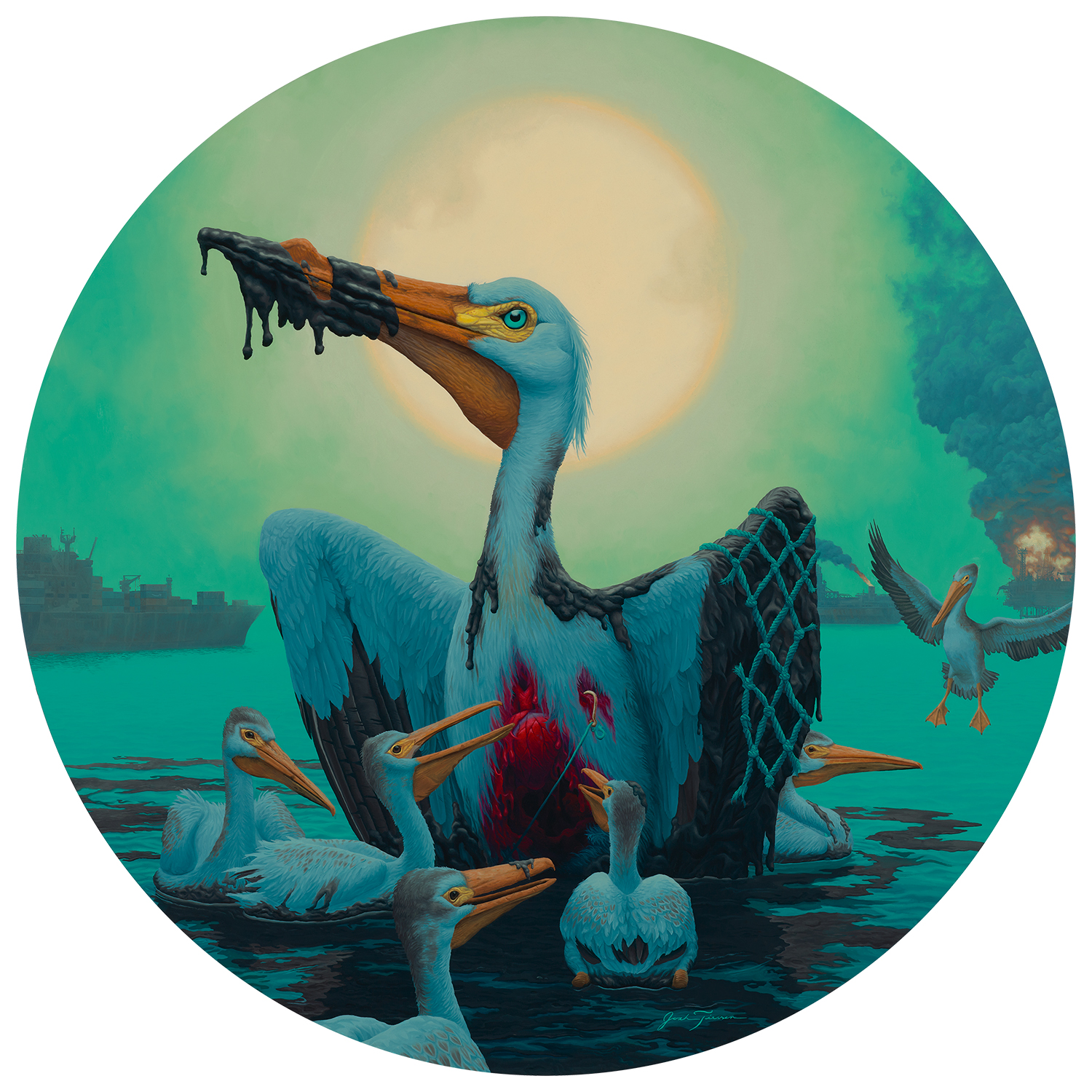
Addendum, 4/8/25: Shortly after publishing this, a reader reminded me of Josh Tiessen’s painting All Creatures Lament from his Vanitas and Viriditas series, which shows an American white pelican protecting her chicks in the face of another oil spill and the accumulation of fishing-related plastic waste. Tiessen, an artist of faith, directs the symbolism of the pelican toward a call for wildlife conservation. (I previously featured Tiessen’s work here.)
Josh Tiessen (Canadian, 1995–), All Creatures Lament, 2023. Oil on braced Baltic birch, diameter 26 inches.
In Poetry and Song
Probably the most universally famous poetic treatment of the pelican as an emblem of Christ is the eucharistic hymn “Adoro te devote” (Hidden God, Devoutly I Adore Thee). Written around 1260 by Thomas Aquinas, it is one of the most beautiful medieval poems in Latin. Aquinas did not originally write it for the liturgy, but it was added to the Roman Missal in 1570 and since then has been used in the Catholic Mass. The penultimate stanza reads:
Pie pelicane, Jesu Domine,
Me immundum munda tuo sanguine,
Cujus una stilla salvum facere
Totum mundum quit ab omni scelere.
Like what tender tales tell of the Pelican,
Bathe me, Jesus Lord, in what thy bosom ran—
Blood that but one drop of has the pow’r to win
All the world forgiveness of its world of sin.

Trans. Gerard Manley Hopkins
Here’s a great video of the hymn put out by the Fundación Canto Católico, set to a Benedictine plainsong melody from the thirteenth century, as has become standard. Our pelican passage appears at the 4:10 mark. The subtitles are in Spanish, but you can turn on CC for English.
(If, like me, you’re wondering what in the world the video’s images are from, an explanatory note in the YouTube comments section explains: they are from the Cuasimodo festival in Chile, celebrated the second Sunday of Easter. The festival has nothing to do with Victor Hugo’s famous hunchback but rather is about bringing Communion to the sick and elderly who were unable to leave their residences to participate in the sacrament during Holy Week. [The Spanish Cuasimodo comes from the Latin Quasimodo, from the incipit of the day’s introit based on 1 Peter 2:2: “Quasi modo géniti infántes . . . ,” or “As newborn babes . . .”] Traditionally for this task, priests were escorted by horsemen, who showed them the route and protected them from assaults.)
The vulning pelican also appears in the liturgy of the Eastern Orthodox Church, whose members sing at Matins on Good Friday evening, “Like a pelican wounding her breast, Thou, O Word, hast made Thy mortal children to live, for Thou hast shed upon them life-giving streams.”
Dante Alighieri, the great medieval Italian writer, calls Christ “nostro Pelicano” (our Pelican) in canto 25 of his Paradiso, the third book in his Divine Comedy trilogy of extended narrative poems.
The Christ-pelican appears, too, in English poetry from the late Middle Ages onward. One Middle English poem found in a prayerbook from ca. 1460 reads:
The pellicane his bloode dothe blede
Therwith his birdis for to fede.
It figureth that God with his bloode
Us fede hanging on the rode,
Whane he us brought oute of hell
In joy and blis with him to dwel,
And be oure fader and oure fode,
And we his childerne meke and good.

[Bodleian Library MS Douce 1, fol. 57r]
The pelican his blood doth bleed,
Therewith his birdies for to feed.
It figures God, who, with his blood,
Fed us hanging on the rood,
By which he brought us out of hell,
In joy and bliss with him to dwell,
To be our father and our food,
And we his children meek and good.
Our Pelican, by bleeding thus, Fulfill’d the law, and cured us.
Look here, and mark (her sickly birds to feed) How freely this kind Pelican doth bleed. See how (when other salves could not be found) To cure their sorrows, she herself doth wound; And when this holy emblem thou shalt see, Lift up thy soul to him, who died for thee.
For this our hieroglyphic would express That Pelican which, in the wilderness Of this vast world, was left (as all alone) Our miserable nature to bemoan; And in whose eyes the tears of pity stood, When he beheld his own unthankful brood His favors and his mercies then condemn, When with his wings he would have brooded them, And sought their endless peace to have confirm’d, Though to procure his ruin, they were arm’d.
To be their food, himself he freely gave; His heart was pierc’d, that he their souls might save, Because they disobey’d the sacred will, He did the law of righteousness fulfill; And to that end (though guiltless he had been) Was offered for our universal sin.
Let me, oh God! forever fix mine eyes Upon the merit of that sacrifice: Let me retain a due commemoration Of those dear mercies, and that bloody passion, Which here is meant; and by true faith, still feed Upon the drops this Pelican did bleed; Yea, let me firm unto thy law abide, And ever love that flock for which he died.
I already mentioned, in relation to Bosch’s pelican painting above, “Christ’s Bloody Sweat” by the English Catholic martyr Robert Southwell.
More recently, the Anglican priest Matt Simpkins, who performs music under the name Rev Simpkins, wrote a song titled “Pelican,” which he released on his album Big Sea (2020). Gritty and impassioned, here’s a live performance at Colchester Arts Centre:
Pelican feeds the hungry and needy I kneel before her My throat like an open grave
Food cannot fill me Water dilutes me Nothing contents me Pelican, pity me
She tears her breast, her children to refresh By her I am blessed, led to life from living death
Though death entreats me Her life flows sweetly Given so freely Given in flesh and blood
She tears her breast, her children to refresh By her I am blessed, led to life from living death
Pelican feeds me Loves me completely Though I’m unworthy She gives so graciously
She tears her breast, her children to refresh By her I am blessed, led to life from living death
She crowns the whole earth, the heavens and seas The Pelican tears her breast for me
She’s queen of what was and what is to be The Pelican tears her breast for me
She gives of herself in infinity The Pelican tears her breast for me
She’s compassion and love, she’s strength and glory The Pelican tears her breast for me
I love it when contemporary artists engage with historical Christological symbols, whether from the animal world or elsewhere, tapping into a creative wisdom the saints of ages past have bequeathed to us but that is too often dismissed in favor of literalism or wordy, intellectual articulations of doctrine.
I wholeheartedly support the endeavor of academic theology, but it must be remembered that for centuries, the church has developed her theology not just through discursive prose but also through liturgy, verse, and visual art. While many modern Christians may discount medieval allegories of Christ as naive, backward, too fanciful, or too obscure, I want to suggest that there’s value in learning (at least some of) them and even incorporating them into new material, to explore how they might come alive in new contexts.
By studying the pelican of ancient lore, for example, as it has been adapted in Christian art and literature, I’ve grown in my appreciation for the mother-love of God, who, to restore me to life and to nourish me—his child, his dependent—allowed his sacred flesh to be torn, so that I might know the power in the blood.
This essay took many hours to research and write and came to fruition only after several years spent collecting enough Pelican images to reach a critical mass. If you have the inclination and means to support more essays like this, I’d really appreciate a donation!
BLOG POST: “An open letter to pastors (A non-mom speaks about Mother’s Day)” by Amy Young: There’s disagreement among church leaders on whether Hallmark holidays, such as Mother’s Day, should be recognized during a worship service, and if so, how. Having mothers stand (while women who are not mothers in the conventional sense remain seated) can be very othering and bring up feelings of sadness or shame. It’s also a day when people are thinking about their own mothers, which can evoke a complex range of emotions.
Amy Young believes there is a way to honor mothers in church without alienating others, as well as to acknowledge the breadth of experiences associated with mothering. She has drafted a pastoral address that I find so wise and compassionate. Some women are estranged from their children. Some have experienced miscarriage or abortion. Some have had failed adoptions, or failed IVF treatments. Some placed a child for adoption. Some have been surrogate mothers. Some are foster mothers, or are the primary guardian of a relative’s child. Some are spiritual moms. Some women want to be mothers but have no partner or have had trouble conceiving. Some were abused by their mothers. Some have lost mothers. Some never met their mother. Young puts her arms around all these people who are potentially in the pews on Mother’s Day, making room for the complexity of the day—which does include celebration!
+++
VIDEO: “United with Beauty: The Psalms, the Arts, and the Human Experience” by Mallory Johnson: Mallory Johnson graduated last weekend with a bachelor’s in music and worship (concentration: voice) from Samford University in Birmingham, Alabama. (In the fall she will be starting an MDiv program at Beeson Divinity School.) All the seniors in the Samford School of the Arts are required to complete a capstone project tailored to their individual interests and career goals. As Johnson’s interests center on theology, history, and the arts, she created a twenty-minute video rooted in the Psalms that integrates music, poetry, short excerpts of fiction, visual art, and quotes from van Gogh, Tchaikovsky, Goethe, Luther, and others, resulting in a contemplative multimedia experience.
I resonate so much with Johnson’s approach of bringing together works from different artistic disciplines to interpret one another and to invite the viewer into worship. Her curation is stellar! To cite just one example, the contemporary choral work Stars by Ēriks Ešenvalds plays as we see, among other images, an Aboriginal dot painting of the constellations Orion and Canis and a nighttime landscape by realist painter Józef Chełmoński. Another: John Adams’s double piano composition “Hallelujah Junction” is brought into conversation with Psalm 150 and a painting by Jewish artist Richard Bee of David dancing before the ark.
Józef Chełmoński (Polish, 1849–1914), Starry Night, 1888. Oil on canvas, 22 13/16 × 28 3/4 in. (58 × 73 cm). National Museum in Kraków, Poland.
The video opens with the theme of awe and wonder—expanses of sky and sea and field; the beauty and vastness of God mirrored in the natural world—and then moves to lament—of the prospering of the wicked; of exhaustion, anxiety, and other forms of mental or spiritual anguish and their causes; of personal sin—and finally ends with an assurance of grace and with exultation. Johnson shows how the longings of modern people overlap with those of the biblical psalmists. Here’s her description:
In his famous work titled Confessions, St. Augustine writes this: “Yet to praise you, God, is the desire of every human.” Is this true? What does this look like?
During my time at Samford, I have felt my heart and mind overflow with love for the arts. As a Christian, they have played a devotional role in my life. I find such joy in seeing connections between music, art, and literature that may seem unrelated on the surface. I believe that all humans have a longing for the goodness of God and we find “echoes” of Him everywhere, and most beautifully in artistic expression.
I wanted to show others how I understand the world as a Christian artist. This project is a journey through the Psalms, using art to reinforce the idea that the Psalms capture the full universal human experience. Across time and space, we have all felt the same things and we have all had the same deep longing for “something higher.”
I hope you can allow this project to wash over you. Make time to watch it alone or with someone you love, distraction-free. Turn the lights out, light a candle, watch it on a big screen with the volume up loud. Be cozy under a blanket with a cup of coffee, or grab a journal and write down anything that sticks out to you! It is my earnest desire that you will be moved by the artistic expression of humanity, and that you may realize that God has always been the goodness you most deeply desire.
+++
SONGS:
>> “Broken Healers” by Elise Massa: Singer-songwriter Elise Massa is the assistant director of music and worship arts at Church of the Ascension in Pittsburgh. A meditation on Christ as Wounded Healer, this song from her 2014 album of demos, We Are All Rough Drafts, was inspired by an Eastertide sermon.
Here’s the final stanza (the full lyrics are at the Bandcamp link):
Broken healers are we all In a living world, decayed With broken speech we stutter, “Glory” As broken fingers mend what’s frayed Holy Spirit, come, anoint us As you anointed Christ the King Who wore the crown of the oppressed Who bears the scars of suffering
>>“Agnus Dei” by Michael W. Smith, performed by the Ukrainian Easter Choir: This is one of the few CCM songs I listened to as a young teen (Third Day’s version from a WOW CD!) that I’m still really fond of. In this video that premiered April 17, an eighty-person choir conducted by Sergiy Yakobchuk was assembled from multiple churches in Ukraine to perform for an Easter service in Lviv organized by the Billy Graham Evangelistic Association. Michael W. Smith’s “Agnus Dei” is one of three songs they sang, in both English and Ukrainian. The name of the soloist is not given. Many of the vocalists in the choir have been displaced from their homes by the current war with Russia. One of them says, “With the war, celebrating the Resurrection means for us now life above death, good above evil.”
+++
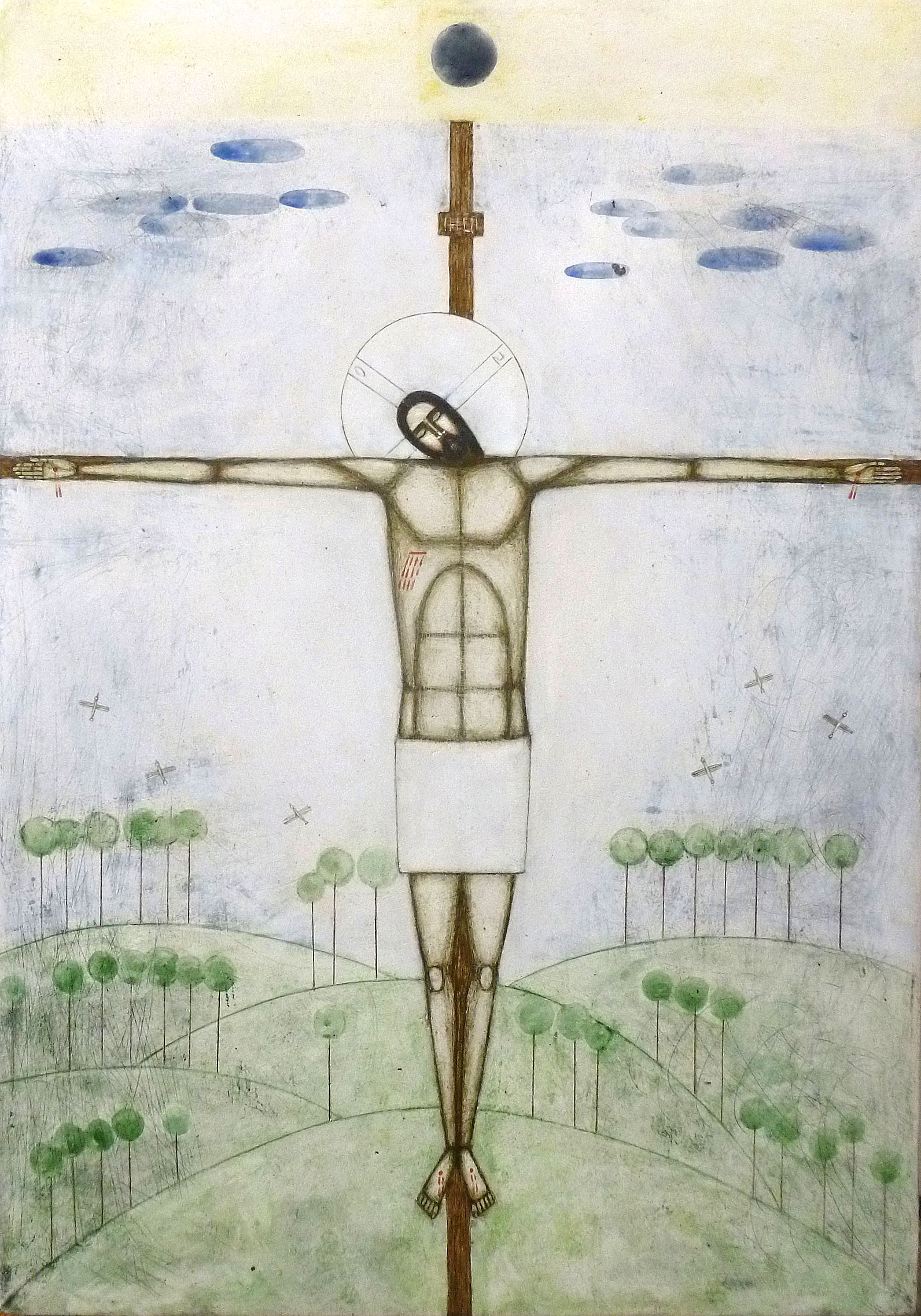
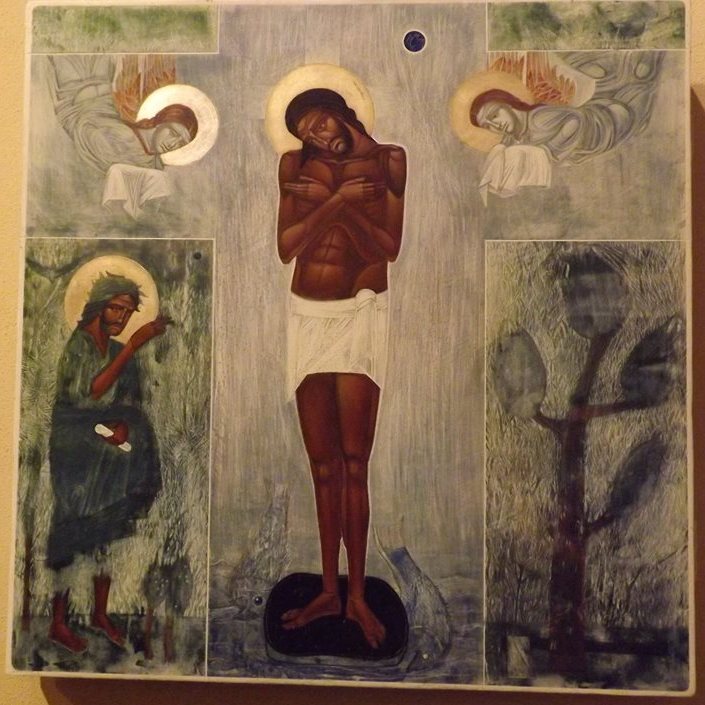
PRAYER EXERCISE: “Visio Divina: A 20-Minute Guided Prayer Reflection for the Crisis in Ukraine”:Visio divina, Latin for “divine seeing,” is a spiritual practice of engaging prayerfully with an image, usually an artwork—allowing the visual to invite you into communion with God. On March 17 Vivianne David led a virtual visio divina exercise with Natalya Rusetska’s Crucifixion, hosted by Renovaré. I caught up with the video afterward and found it a very meaningful experience. As the painting is by a Ukrainian artist and represents Christ’s passion, the war in Ukraine is a natural connection point.
I appreciate David’s wise guidance, which includes these reminders:
Stay with the image, regardless of whether or not you “feel” something happening right away. There is something beautiful about faithfully waiting with that space, having dedicated it to God as a time of prayer.
Notice what draws your attention, what invites you into the image—let that become a space for conversation with Christ.
Notice what sort of emotions arise as you stay with the image. How does it awaken desire? Let these emotions lead you back to continued dialogue with God.
This kind of quiet, focused looking with an openness to encounter is something I encourage on the blog. Any of David’s three tips above I would also suggest for any art image I post—a corrective to hasty scrolling habits. Stick around for the last four minutes of the video to see dozens and dozens of impressions from participants, which may reveal new aspects of the painting to you.
[Transliterated Greek] Símeron kremátai epí xýlou, o en ýdasi tín gín kremásas. Stéfanon ex akanthón peritíthetai, o tón Angélon Vasiléfs. Psevdí porfýran periválletai, o perivállon tón ouranón en nefélais. Rápisma katedéxato, o en Iordáni eleftherósas tón Adám. Ílois prosilóthi, o Nymfíos tís Ekklisías. Lónchi ekentíthi, o Yiós tís Parthénou. Proskynoúmén sou tá Páthi Christé. Proskynoúmén sou tá Páthi Christé. Proskynoúmén sou tá Páthi Christé. Deíxon imín, kaí tín éndoxón sou Anástasin.
[English translation] Today he who hung the earth upon the waters is hung on the tree. The King of the angels is decked with a crown of thorns. He who wraps the heavens in clouds is wrapped in the purple of mockery. He who freed Adam in the Jordan is slapped on the face. The Bridegroom of the church is affixed to the cross with nails. The Son of the virgin is pierced by a spear. We worship thy passion, O Christ. We worship thy passion, O Christ. We worship thy passion, O Christ. Show us also thy glorious resurrection.
This is the fifteenth antiphon (short hymn) from the Matins service of Great and Holy Friday (as the day is called in the Orthodox tradition), celebrated on Thursday evening.
>> Arranged by Fr. Seraphim Dedes, chanted by Paul Barnes, 2019:
Paul Barnes is both a pianist and a Greek Orthodox chanter. Here he chants the “Simeron Kremate,” starting out in Greek and then using the following English translation:
Today he who suspended the earth on the waters is suspended on a cross. (×3) The King of the angels wears a crown of thorns. He who wraps the sky in clouds is wrapped in a fake purple robe. He who freed Adam in the Jordan accepts to be slapped. The Bridegroom of the church is fixed with nails to the cross. The Son of the virgin is pierced with a spear. We worship your passion, O Christ. (×3) Show us also your glorious resurrection.
Seven of his piano majors from the Glenn Korff School of Music provide the ison (drone note).
>> Simeron Kremate, a solo keyboard work by Victoria Bond based on the Greek Orthodox chant, performed by Paul Barnes, 2019:
Paul Barnes and composer Victoria Bond are longtime collaborators. He introduced her to the “Simeron Kremate” chant, and she built a piano composition around its five-note melody. Struck by its similar melodic contour, she incorporated the Jewish Passover chant “Tal” (Dew), a prayer that life-sustaining dew would water the land. This prayer is traditionally chanted on the first morning of Passover (which is tomorrow; the festival begins this evening). Bond, who is Jewish, notes the thematic resonance between the two chants as well: (in my own words) the one a request for fruitfulness and refreshment, the other a lament for the death of the One whose death bears fruit and brings life. She describes the musical elements of the composition as follows:
The work opens with the traditional apichima of the plagal of the second mode which aurally establishes the musical atmosphere of the mode. Victoria follows this with a Jewish style cantillation (based on the cantillation of the great cantor Yosele Rosenblatt) which leads to the first statement of the “Simeron” chant. These opening notes are then developed in multiple ways before the intimate entry of the “Tal” melody. The work concludes with a ‘tranquillo’ passage of rare beauty ingeniously combining both themes. The work ends tentatively and unresolved as the opening notes of the chant dissipate into eternity.
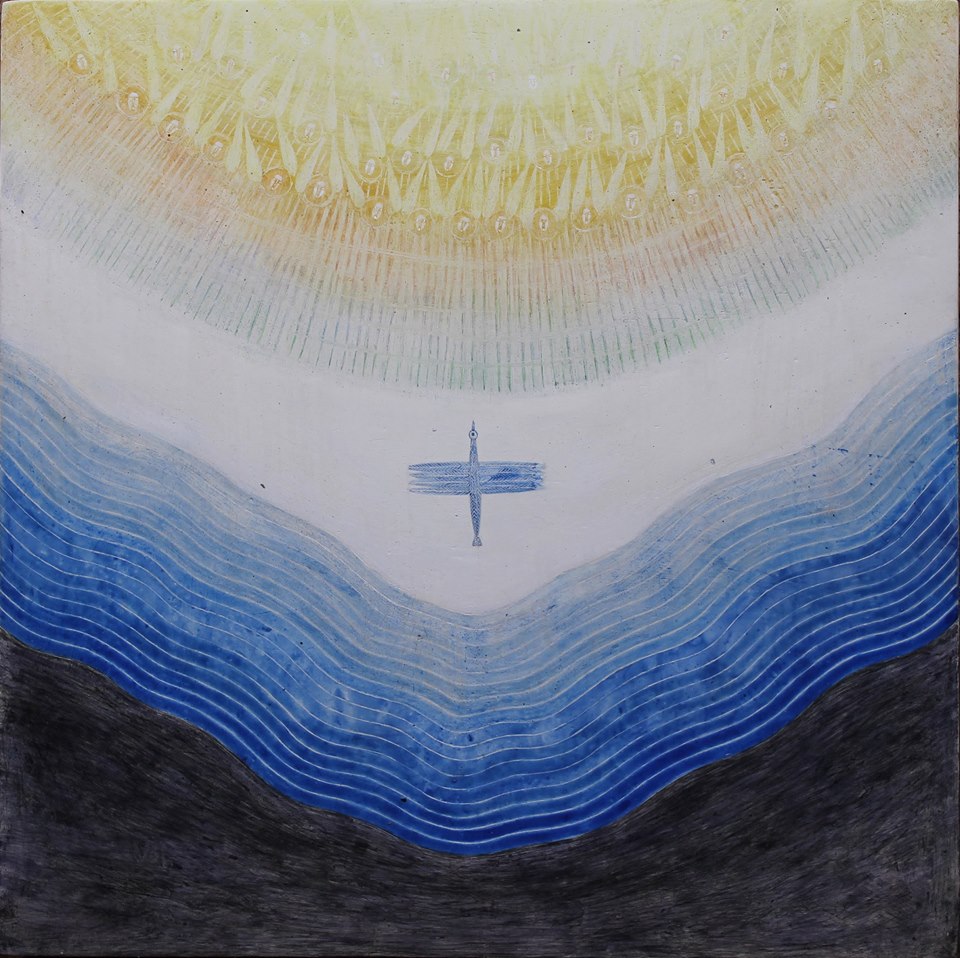
Natalya Rusetska (Ukrainian, 1984–), First Day of Creation, 2017. Egg tempera on gessoed wood board, 30 × 30 cm.
LISTEN: “Let There Be” by Michael and Lisa Gungor, on Ghosts Upon the Earth (2011)
Darkness hovering Grasping everything it sees Void, empty Absent life and absent dream
Let there be Let there be Let there be Let there be
Angels toil and crack open scrolls of ancient dreams Countless worlds of his Brilliant stars and breath and stream
Let there be Let there be Let there be Let there be Let there be Let there be Let there be light
Let there be light Where there is darkness Let there be light Where there is nothing Let there be light
The opening track on Gungor’s Ghosts Upon the Earth, “Let There Be” narrates God’s creation of the universe. What starts out as ethereal becomes increasingly more solid as the floating notes on piano and guitar coalesce into chords and meld with the cellos. Represented by a small choir, the Triune community voices its fiat: “Let there be . . .” A synthesized xylophone and tremolos from the strings suggest lively activity—“angels toil”—as the cosmos begins to take shape. In the second refrain the voices crescendo to a thunderous climax, a drum beating loud and steady as if laying down a foundation.
While this song is most fundamentally about the Genesis 1 creation story, it can also be read in light of John’s Gospel prologue, where he describes Jesus as light coming into the world, and similarly, Luke’s Annunciation narrative, where “ancient dreams” put down in prophetic scrolls are fulfilled in the conception of Christ in Mary’s womb, initiating a new epoch.
The Advent season begins in darkness. Taking stock of this darkness, we ask for God’s light to break in once again—into our hearts and lives, our communities, our world.
In the beginning the Spirit hovered over the void and breathed life into it. Millennia later the Spirit hovered over a virgin’s empty womb and did it again, making the Word flesh. And into our present lack, into our chaos, the Spirit still is coming, re-creating, so that Christ, the light, might be born in us.
Here’s a recent cover of “Let There Be” by IAMSON, which he combines with another Gungor song, “Crags and Clay”:
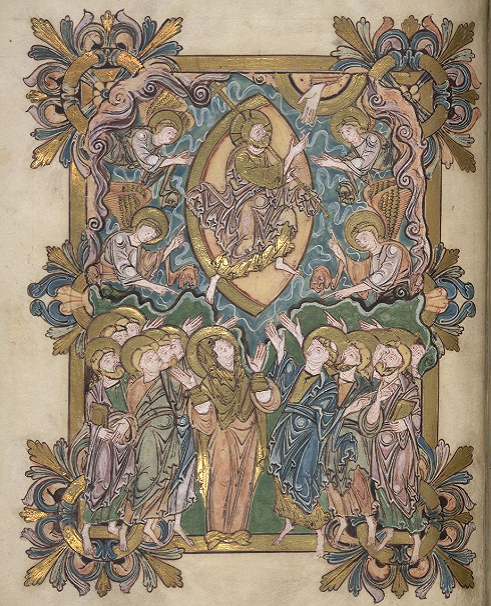
ANGLO-SAXON ASCENSION POEM: Excerpts from “Christ II” by Cynewulf, probably ninth century, translated from Old English by Eleanor Parker: Dr. Eleanor Parker lectures on medieval literature at Oxford University and runs the excellent blog A Clerk at Oxford, where she often shares her translations of Anglo-Saxon poetry, with commentary. The poem she shares here reflects on Christ’s ascension—the disciples’ grief, the angels’ joy. To me the most remarkable section is the one that, indirectly referencing a sermon of Gregory the Great, describes Christ “leaping” up to heaven, taking an active bound toward his homeland, a movement read in light of Song of Solomon 2:8: “Behold, he comes, leaping over the mountains, bounding over the hills.” This leap is one of six he took: from heaven (1) into Mary’s womb, (2) into a manger, (3) onto the cross, (4) into the tomb, (5) into hell, and finally, (6) back into heaven. “Prince’s play”! Parker pairs the poem with an exquisite, near-contemporary manuscript illumination, also from England; there’s also a lot of resonance between the poem and the Ascension image I published Tuesday by Bagong Kussudiardja, which shows a more balletic ascent.
The Ascension, from the Benedictional of St. Æthelwold (BL Additional MS. 49598), f. 64v, England, 963–984 CE. British Library, London.
+++
UNDERWATER DANCE:“AMA,” a short film by Julie Gautier: This wonderfully expressive silent film shows French free diver and underwater artist Julie Gautier dancing in a single breath for several minutes inside the world’s deepest swimming pool, Y-40 Deep Joy in Montegrotto Terme, Padua, Italy, to a minimalist piano piece. The final shot shows Gautier slowly rising to the water’s surface while releasing a giant air bubble, her pose evocative of the crucified Christ (and her upward movement an Ascension of sorts!). Titled “Ama” (Japanese for “sea woman,” the name given to Japan’s pearl divers), the film is “dedicated to all the women of the world,” Gautier says. The choreography is by Ophélie Longuet.
Gautier and her husband, Guillaume Néry, a free-diving champion, own the underwater filmmaking company Les Films Engloutis. Their most well-known project has been a music video featuring Beyoncé, codirected by Gautier and starring Néry.
+++
KICKSTARTER CAMPAIGN:Help Andy Squyres finance his next album: Andy Squyres is a super-talented singer-songwriter whose lyrics don’t stay in the shallows but, rather, dive into the depths of the faith experience. They are also supremely hope-filled. Below is a video of Squyres performing “Labor in Vain” at a house concert; the song is from his last album, Cherry Blossoms, which I reviewed here. Click on the boldface link above to hear Squyres discuss his new album project and to donate toward it.
+++
ICON PAINTING COMPETITION: The Interparliamentary Assembly of Orthodoxy (IAO) is hosting an international icon painting competition on the subject of Christ’s Resurrection. “Our purpose is to explore and bring to the foreground the numerous stylistic trends in existence today, enabling the visualization of a creative dialogue with tradition and, at the same time, the personal artistic expressions of artists who reframe tradition without, however, digressing from the doctrinal framework of Christian icon painting set by the 7th Ecumenical Council.” The submission window is closed—there are sixty-three great entries!—and now it’s time to cast your vote. Five winners will be selected to receive cash prizes, the topmost being €3,000, and other honors. Popular votes will be taken into account by the twelve jury members, among whom are esteemed iconographers George Kordis from Greece and Todor Mitrovic from Serbia.
Dimosthenis Avramidis (Greek, 1965–), Christ’s Descent into Hades, 2017. Egg tempera on wood, 91.5 × 61.5 cm.
+++
ESSAY: “On the Border of East and West: Searching for Icons in Lviv” by John A. Kohan: The latest issue of Image journal features a wonderful essay on the Lviv school of iconography (represented in entries #4, #10, and #20 of the above contest), a movement by young Ukrainian Greek Catholic artists to contemporize the Byzantine visual tradition. Written by John A. Kohan, an avid religious art collector and former Time bureau chief in Moscow (1988–1996), it discusses the political history of the city; the role of Metropolitan Andrey Sheptytsky (r. 1901–1944) in preserving and supporting art for future generations; the opening of the Iconart gallery in 2010 to nurture and promote the new style; the broad training these icon makers receive at the Lviv National Academy of Arts; and the uneven reception by others in the denomination (especially official church bodies), who tend to prefer their sacred art in the Radruzh School style or as contemporary Catholic kitsch. Kohan writes from his firsthand experiences meeting the artists and visiting their studios, churches, and exhibition spaces. The essay is available to subscribers only; click here to subscribe.
Natalya Rusetska (Ukrainian, 1984–), Crucifixion, 2017. Egg tempera on gessoed wood, 11 3/4 × 8 1/4 in.
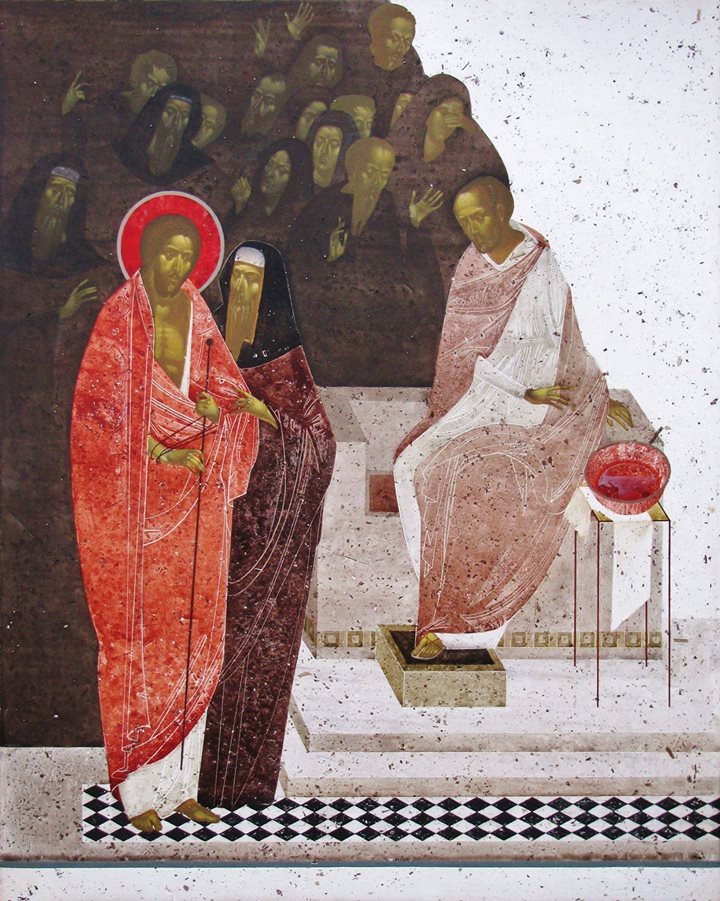
Ivanka Demchuk (Ukrainian, 1990–), Christ before Pilate, 2017. Mixed media on gessoed wood, 19 3/4 × 15 3/4 in.
I’m enthralled by the contemporary icons being produced in Lviv—I saw a bunch from Kohan’s collection last summer, and I featured some in a Baptism of Christ roundup earlier this year. The best way to keep abreast of the output from the Lviv school is to follow Iconart on Facebook, and for an even wider breadth of innovative eastern European icons, follow Międzynarodowe Warsztaty Ikonopisów w Nowicy (International Iconography Workshop in Nowica, Poland).
+++
MET GALA + EXHIBITION: “Heavenly Bodies: Fashion and the Catholic Imagination,” May 10–October 8, 2018, Metropolitan Museum of Art, New York City: The largest exhibition ever mounted by the Met’s Costume Institute, “Heavenly Bodies” features both religious vestments from the Vatican and runway fashions by famous designers inspired by Catholicism. AFashionista reviewer who attended a preview reports on the integrated displays:
A reliquary arm of Saint Valentine is displayed alongside a breastplate and crown of thorns from Alexander McQueen’s Givenchy days; sacred music serves as the auditory backdrop for a Rodarte collection that features a dress inspired by Bernini’s famous sculpture Ecstasy of Saint Teresa. Rows of mannequins wearing Dolce & Gabbana, Moschino and Raf Simons show the ways that the silhouettes of the cassock and nun’s habit have been explored on the runway time and again. There are even vestments by the likes of Yves Saint Laurent and Riccardo Tisci that were expressly designed to dress statues of the Virgin Mary in chapels in Italy and France.
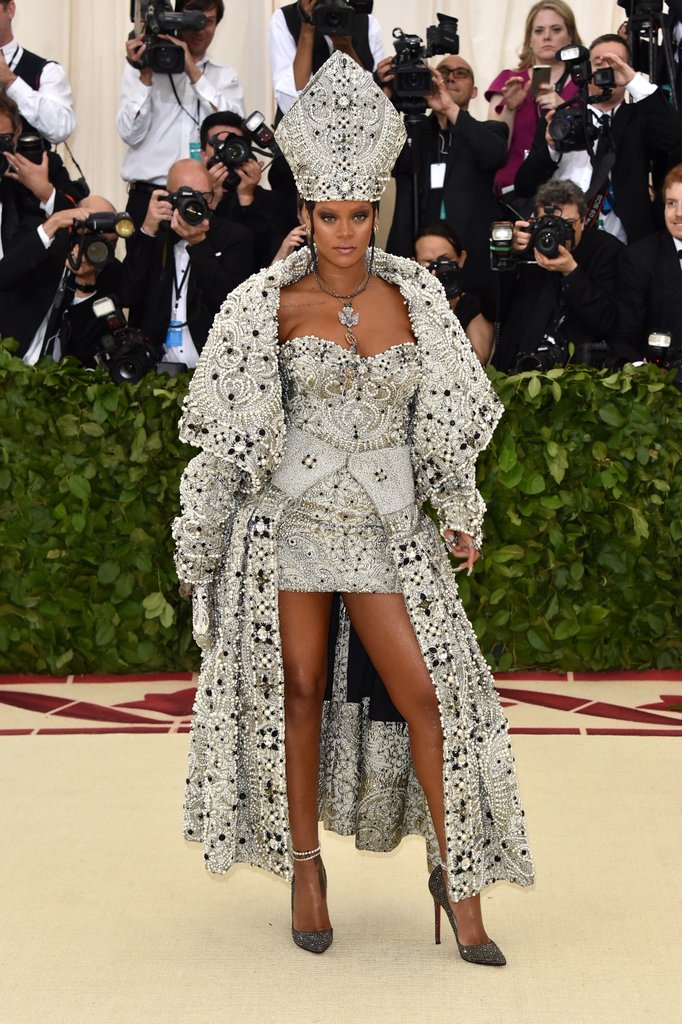
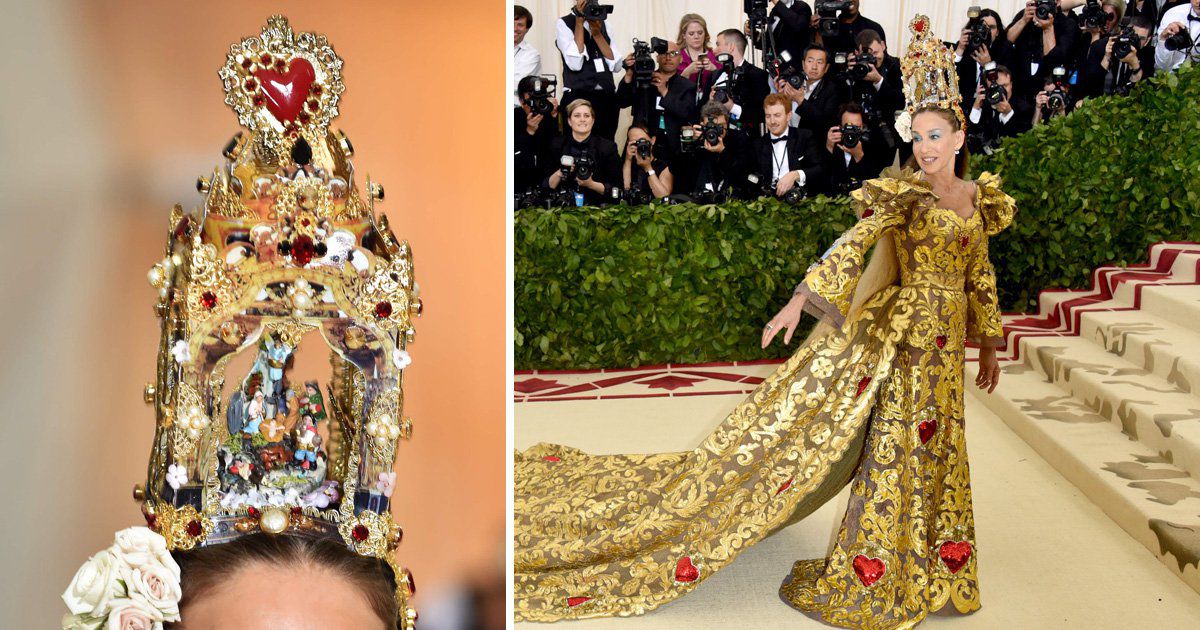
Each year since 1948, the opening of the Costume Institute’s spring exhibition has been celebrated with a huge fundraising gala attended by celebrities who dress to the theme; this year’s took place May 7. There were lots of crosses and haloes, but also some more particularized outfits. Ariana Grande’s gown was inspired by Michelangelo’s Last Judgment; Gigi Hadid’s, by stained glass. Selena Gomez carried a Coach handbag embroidered with Proverbs 31:30b: “A woman who fears the Lord is a woman who shall be praised.” The most brazenly dressed was Rihanna, who wore a gem-encrusted bishop’s miter (not a papal tiara, as has been commonly reported). Another standout headpiece was Sarah Jessica Parker’s, which featured a Neapolitan Nativity scene set inside a mini baldachin. (The making of elaborate presepi, or Christmas crèches, is a longstanding tradition in Naples, reaching its height during the eighteenth century.)
The white Margiela minidress, cape, and headpiece Rihanna wore to Monday’s Met gala were inspired by Catholic pontifical vestments. Photo: John Shearer/Getty.
Sarah Jessica Parker wore a regal gold, long-trained Dolce & Gabbana gown, but the pièce de résistance of her ensemble was the Nativity headpiece.
Lana Del Rey went as Our Lady of Sorrows, wearing an immaculate-heart chest plate pierced through with seven daggers; it was comical to hear religiously illiterate reporters trying to interpret the symbolism, saying things like the daggers are a “reminder to repent your sins or suffer damnation!” (Wrong. The swords symbolize the Virgin’s seven sorrows, beginning with Simeon’s prophecy.)
Today, January 6, is the feast of Epiphany (“manifestation,” “revelation,” “shining forth”)—also referred to as Theophany (“revelation of God”), or the Feast of Lights. While the Western church commemorates the visit of the Magi on this day, focusing on God’s revelation to the world through the birth of Christ, the Eastern church commemorates Jesus’s baptism, focusing on the Father and Spirit’s affirmation of the Son’s divinity at the beginning of his public ministry. Matthew 3:13–17 gives us the account:
Then Jesus came from Galilee to the Jordan to John, to be baptized by him. John would have prevented him, saying, “I need to be baptized by you, and do you come to me?” But Jesus answered him, “Let it be so now, for thus it is fitting for us to fulfill all righteousness.” Then he consented. And when Jesus was baptized, immediately he went up from the water, and behold, the heavens were opened to him, and he saw the Spirit of God descending like a dove and coming to rest on him; and behold, a voice from heaven said, “This is my beloved Son, with whom I am well pleased.”
Below is a selection of contemporary Theophany icons from Ukraine, Russia, Poland, Greece, and Romania. All but one of them bear a semicircle at the top, which signifies the “opening of the heavens” and the voice of God reaching down; in Ioan and Camelia Popa’s, God’s hand is even visible. (Representation of the Father is forbidden by tradition, though a hand is generally acceptable because the Bible itself uses anthropomorphic expressions like “God’s hand” and “God’s mighty arm.”) A dove descends from this aperture, a literalization of the Gospel writers’ simile.
On the shores of the Jordan stand one or more angels at the service of their Lord. Their hands are covered by their own cloaks as a sign of reverence—or in some representations, they hold garments to drape over Christ when he emerges from the water. (Early icons of Jesus’s baptism show him completely naked, emphasizing his self-emptying; now, however, it’s more common to see him in a loincloth.)
In Lyuba Yatskiv’s and the Popas’ icons—the most traditional of this bunch—there is an allegorical figure in the river by Christ’s feet, pouring out water from a jug. This man is a personification of the Jordan River, which miraculously dried up, temporarily, to allow the ancient Israelites to cross over into the Promised Land (Joshua 3:15–17). Some icons, though none pictured here, include a second allegorical figure, (Red) Sea, who is turning away, parting (see Psalm 114:3).
In George Kordis’s icon, instead of Jordan at Christ’s feet, there’s a serpent being crushed, a reference to Psalm 74:13: “You divided the sea by your might; you broke the heads of the sea monsters on the waters.” Visually, this recalls the Eastern church’s Resurrection icon, which depicts Christ breaking down the doors of hell, flattening Satan.
Back to Yatskiv and Popa. In these two there is an axe lying next to a tree, alluding to the sermon by John the Baptist that immediately preceded this episode, in which he proclaimed, “Even now the axe is laid to the root of the trees. Every tree therefore that does not bear good fruit is cut down and thrown into the fire” (Matthew 3:10).
Epiphany calls us to worshipfully behold the shining forth of Jesus as messiah and as the second person of the Trinity. To orient yourself to the Orthodox celebration of today’s feast, here are two liturgical hymns, the Troparion and the Kontakion, that will be sung congregationally:
When Thou, O Lord, wast baptized in the Jordan, worship of the Trinity wast made manifest; for the voice of the Father bore witness to Thee, calling Thee His beloved Son. And the Spirit in the form of a dove confirmed the truth of His word. O Christ our God, Who hath appeared and enlightened the world, glory to Thee.
. . .
On this day Thou hast appeared unto the whole world, and Thy light, O Sovereign Lord, is signed on us who sing Thy praise and chant with knowledge: Thou hast now come, Thou hast appeared, O Thou Light unappproachable.
They offer a perfect lens through which to view the following icons.
Jerzy Nowosielski (Polish, 1923–2011), The Baptism of Jesus Christ in the Jordan, 1964. Oil on canvas, 100 × 80 cm.
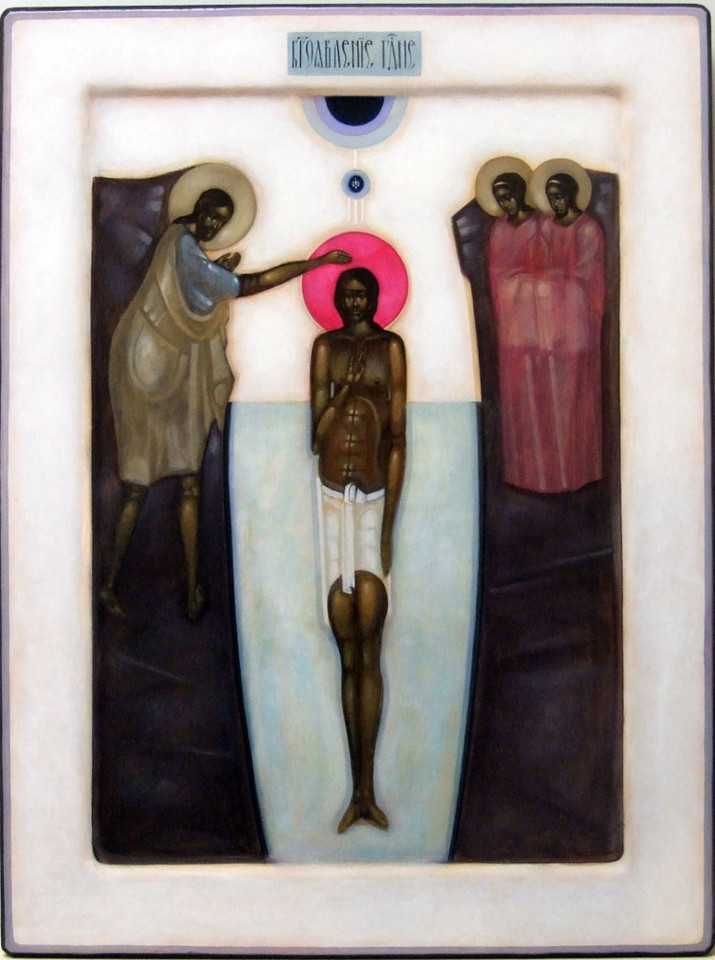
Greta Leśko (Polish, 1979–), Baptism of Christ. Oil on board, 40 × 30 cm. Private collection.
Greta Leśko (Polish, 1979–), Baptism of Christ, 2014. Oil on board, 40 × 40 cm.
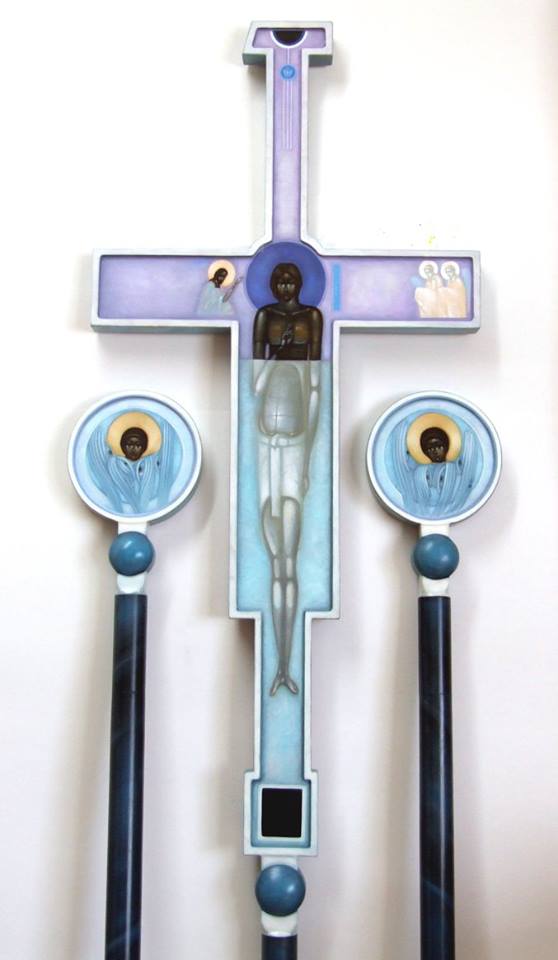
Two-sided processional cross and ripidions by Greta Leśko (Polish, 1979–), 2011. Mixed media on wood. Cross: 90 cm tall (without shaft); ripidions: 13 cm diameter. Church of the Exaltation of the Holy Cross in Górowo Iławeckie, Warmian-Masurian Voivodeship, Poland. (See reverse)
Icon by Lyuba Yatskiv (Ukrainian, 1977–)
Icon by Ulyana Tomkevych (Ukrainian, 1981–)
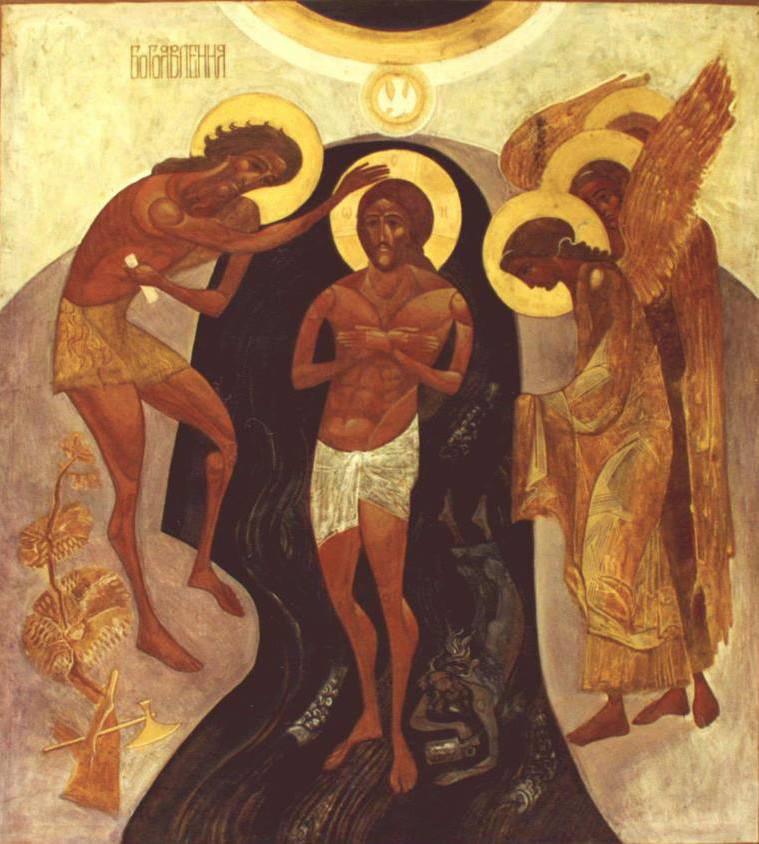
Ivanka Demchuk (Ukrainian, 1990–), Baptism of Christ, 2015. Mixed media on canvas and wood, 30 × 40 cm.












 Art & Theology