
Christmas, Day 9: Pretty Little Baby

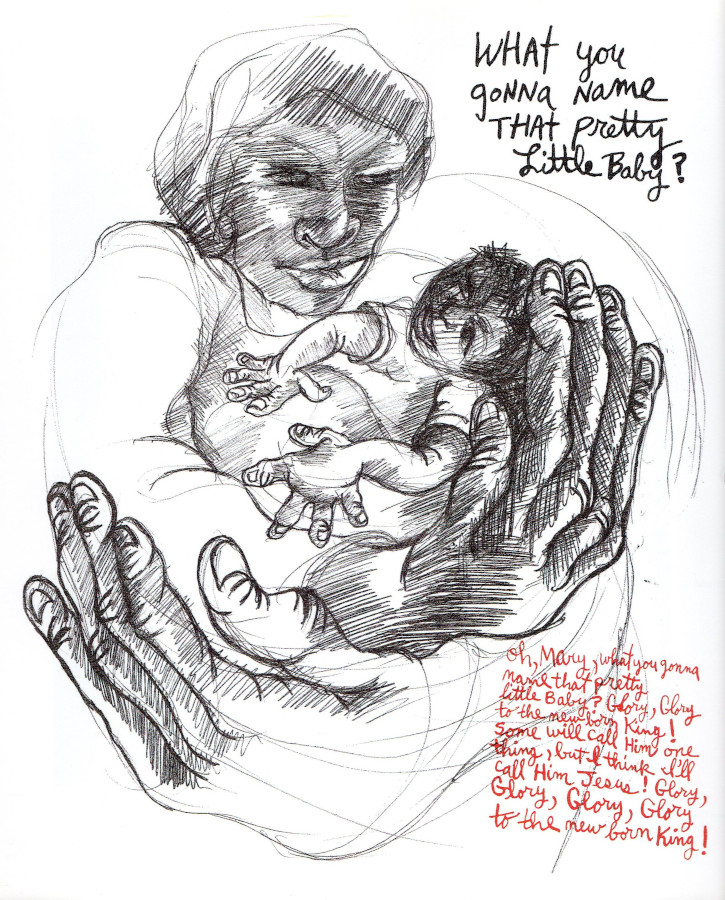
LOOK: What You Gonna Name That Pretty Little Baby? by Aminah Brenda Lynn Robinson
Robinson, Aminah_Mother and Child_reduced
Aminah Brenda Lynn Robinson (American, 1940–2015), What You Gonna Name That Pretty Little Baby?, 1992. Pen and ink on typewriter paper. © Aminah Brenda Lynn Robinson Trust.

Aminah Brenda Lynn Robinson (1940–2015) was an artist working in multiple media whose work celebrates Black history and culture. She was a lifelong resident of Columbus, Ohio, and bequeathed her art, writings, home, and personal property to the Columbus Museum of Art, who established the Aminah Robinson Legacy Project in 2020.

The drawing above is one of twenty-six from Robinson’s excellent book The Teachings: Drawn from African-American Spirituals (Harcourt Brace Jovanovich, 1992). These drawings, she writes in the introduction, “have grown from the stories and songs that were given to me by my family and my early teachers, and I offer them here to the children of today’s troubled world and the children of tomorrow. They carry a message of dignity, knowledge, and wisdom . . . speak of survival, of freedom and determination, of love and faith, of justice and of hope . . .”

The artist’s estate is represented in the US by Fort Gansevoort in New York, which is currently showing Aminah Brenda Lynn Robinson: Character Studies through January 25.

Another exhibition of her work, Aminah Robinson: Journeys Home, a Visual Memoir, will be touring nationally for the next few years: to the Springfield Museum of Art in Ohio (February 1–July 13, 2025), the Newark Museum of Art in New Jersey (October 16, 2025–March 1, 2026), the Mobile Museum of Art in Alabama (March 26, 2026–January 9, 2027), and two remaining venues to be announced. This is a major exhibition that brings together Robinson’s drawings, prints, paintings, textiles, collages, homemade books, dolls, “hogmawg” sculptures (made of a mixture of mud, clay, twigs, leaves, lime, animal grease, and glue), and “RagGonNon” pieces (monumental swaths of fabric encrusted with buttons, beads, and other found objects) to create a portrait of her life.

LISTEN: “Mary, What You Gonna Name That Pretty Little Baby?,” African American spiritual | Arranged by Alex Bradford, 1961 | Performed by Princess Stewart and Marion Williams on Black Nativity: Gospel on Broadway! (Original Broadway Cast), 1962

Mary, Mary, what you gonna name that pretty little baby?
Mmm, mmm, pretty little baby
Glory be to the newborn King

Some call him one thing, I think I’ll call him Jesus
Mmm, mmm, sweet Jesus
Mmm, mmm, (ain’t he sweet?) sweet Jesus
Glory be to the newborn King

Some call him Jesus, I think I’ll call him Wonderful
Mmm, mmm, wonderful
Mmm, mmm, he’s so wonderful
Glory be to the newborn King

Some call him Wonderful, I think I’ll call him Emmanuel
Mmm, mmm, King Emmanuel
Mmm, mmm, (ain’t he the king?) Emmanuel
Glory be to the newborn King

Some call him Emmanuel, I’m gonna call him the Prince of Peace
Mmm, mmm, Prince of Peace
Glory be to the newborn King

Some call him Prince of Peace, I’m gonna call him Jesus
Mmm, mmm, sweet Jesus
Mmm, mmm, (ain’t he sweet?) sweet Jesus
Glory be to the newborn King

Mary, Mary, what you gonna name that pretty little baby?
Mmm, mmm, pretty little baby
Glory be to the newborn King

This Christmas spiritual, a dialogue between an unnamed visitor and the new mother Mary, has been recorded by many artists. I think I like the original cast recording from the Langston Hughes musical Black Nativity best, featuring soloist Princess Stewart on the first verse and Marion Williams on the remaining six, backed by the Stars of Faith.

But here’s a handful of other versions I like. Because the song was passed down orally, it has taken on different lyrical variations and accrued new verses. Some reference the wise men.

>> “The Virgin Mary Had One Son” by the Staple Singers, arr. Roebuck “Pops” Staples, on The 25th Day of December (1962):

>> “The Virgin Mary Had One Son” by Josh Garrels, on The Light Came Down (2016):

>> “What ’Cha Gonna Call the Pretty Little Baby” by the National Lutheran Choir, dir. David M. Cherwien, arr. Ronald L. Stevens, on Christ Is Born (2016):

>> “Glory to the Newborn King” by Chicago a Cappella, dir. Jonathan Miller, arr. Robert Leigh Morris, on Holidays a Cappella Live (2002):

>> “Virgin Mary Had One Son” by Joan Baez and Bob Gibson, live at the 1959 Newport Folk Festival (see also “Virgin Mary,” a bonus track on the 2001 Vanguard reissue of Baez’s 1966 album Noël):

Easter, Day 8: Stay with Us

Now on that same day two of them [to whom the women had reported the empty tomb] were going to a village called Emmaus, about seven miles from Jerusalem, and talking with each other about all these things that had happened. While they were talking and discussing, Jesus himself came near and went with them. . . .  As they came near the village to which they were going, he walked ahead as if he were going on. But they urged him strongly, saying, “Stay with us, because it is almost evening and the day is now nearly over.” So he went in to stay with them.

—Luke 24:13–15, 28–29

LOOK: Road to Emmaus by Duccio

Duccio_Road to Emmaus
Duccio (Italian, ca. 1255/60–ca. 1319), Road to Emmaus, 1308–11. Tempera on wood, 51 × 57 cm. Museo dell’Opera del Duomo, Siena.

In his Road to Emmaus painting, the Sienese master Duccio portrays Jesus as a typical medieval pilgrim, wearing a woolen cloak, a satchel, and a wide-brimmed hat and holding a walking stick. This artistic choice was probably made in part to explain why his two traveling companions, Cleopas and an unnamed other, do not recognize him until later. Those two had been in Jerusalem for Passover and thus heard of the prophet Jesus’s being put to death and, just that morning, an angel supposedly appearing to a group of women saying he had risen. It was a wild week. Weary now from their seven-mile journey, they gesture toward the village of Emmaus. “Let’s get some food,” they suggest.

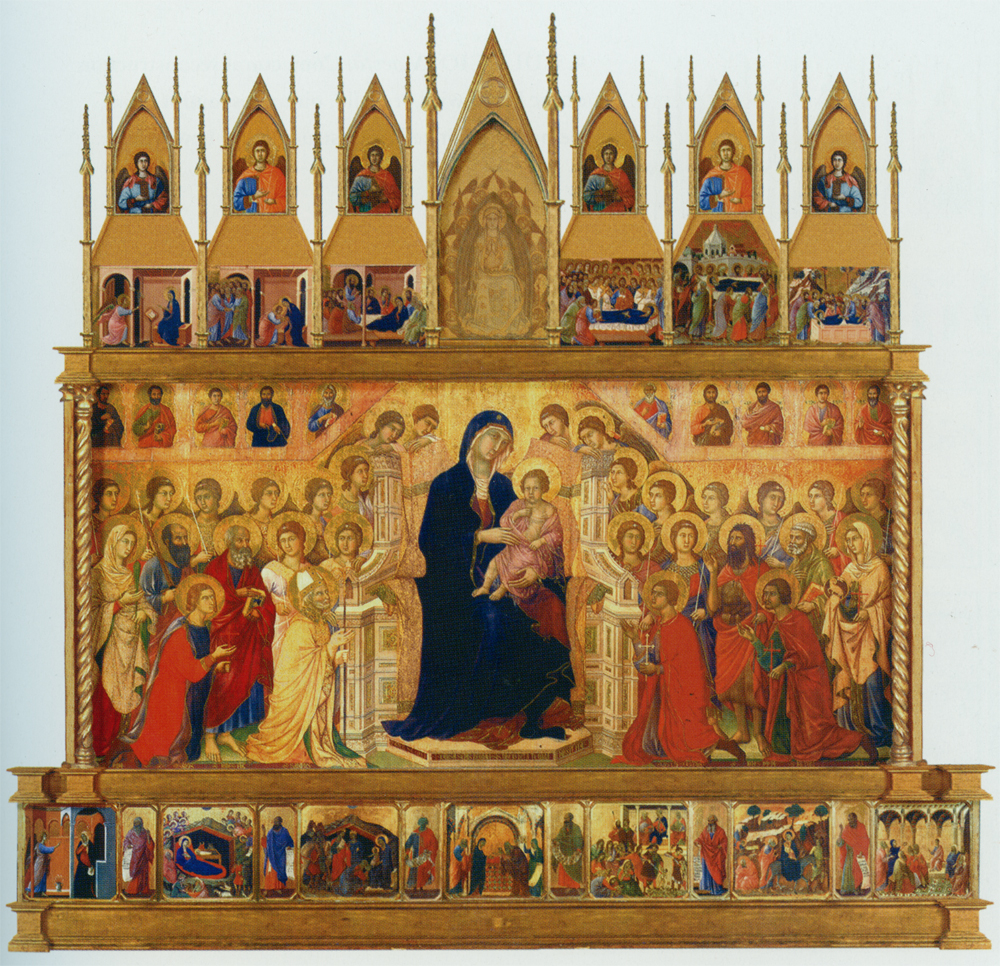
This panel is part of an enormous polyptych (multipaneled altarpiece) that originally stood at the high altar of Siena Cathedral in Italy. It’s called the Maestà (“Majesty”) altarpiece, after the primary panel of the enthroned Madonna and Child with saints and angels, and it’s one of the most significant artworks of the fourteenth century. Unfortunately, it was cut up in the eighteenth century and individual panels sold for private purchase. Therefore, several panels are now lost, and the rest are dispersed internationally across twelve museum collections, though many are held at the Museo dell’Opera Metropolitana in Siena.

The following two images are conjectural digital reconstructions that place the surviving paintings into the probable framework, based on documentary evidence. The front of the altarpiece contained fourteen scenes from the life of the Virgin Mary, and the back contained twenty-six scenes from the life of Christ. The Road to Emmaus is the last in the narrative sequence on the back (see arrow).

Maesta Altarpiece (front)
Conjectural digital reconstruction of the front of Duccio’s Maestà altarpiece, 1308–11. Tempera and gold on wood, height 16 1/2 ft. Source: Italian Art Society.

Maesta Altarpiece (back, Emmaus)
Conjectural digital reconstruction of the back of Duccio’s Maestà altarpiece, with an arrow pointing to the Road to Emmaus

LISTEN: “Stay with Us” (Bli hos oss), op. 87, no. 3 by Egil Hovland, 1978 | Performed by the National Lutheran Choir, dir. David Cherwien, 2018 [HT]

Stay with us, Lord Jesus, stay with us.
Stay with us; it soon is evening.
Stay with us, Lord Jesus, stay with us.
It soon is evening and night is falling.

Jesus Christ, the world’s true light!
Shine so the darkness cannot overcome it!
Stay with us, Lord Jesus, it soon is evening.
Stay with us, Lord Jesus, for night is falling.
Let your light pierce the darkness
And fill your church with its glory.

“Bli hos oss,” or “Stay with Us” in English, is the third of six choral pieces that comprise opus 87 of the Norwegian composer Egil Hovland (1924–2013). The main part of the text is based on Luke 24:29, where two pilgrims to Jerusalem are traveling back home after the feast of Passover in the company of, unbeknownst to them at the time, the risen Christ. When they reach the village of Emmaus, it’s time to turn in for the evening, and the two invite their fellow traveler to dine and lodge with them. (The text is ambiguous as to whether they live there or are merely stopping overnight at an inn or the home of a friend to rest.) He accepts. And it is at the dinner table there that Jesus reveals to them who he is.  

This song is used in many churches for Vespers (evening worship) services during Eastertide. It invokes Christ’s presence, asking him to be with us through the night and to shine his light into places of spiritual or emotional darkness.

As we continue our journey through the liturgical year, may Christ be glorified in our hearts, in our homes and neighborhoods, in his church, and in the wider world, granting us the illumination, the awed recognition and joy, that he granted the two pilgrims who supped with him at Emmaus after his resurrection.