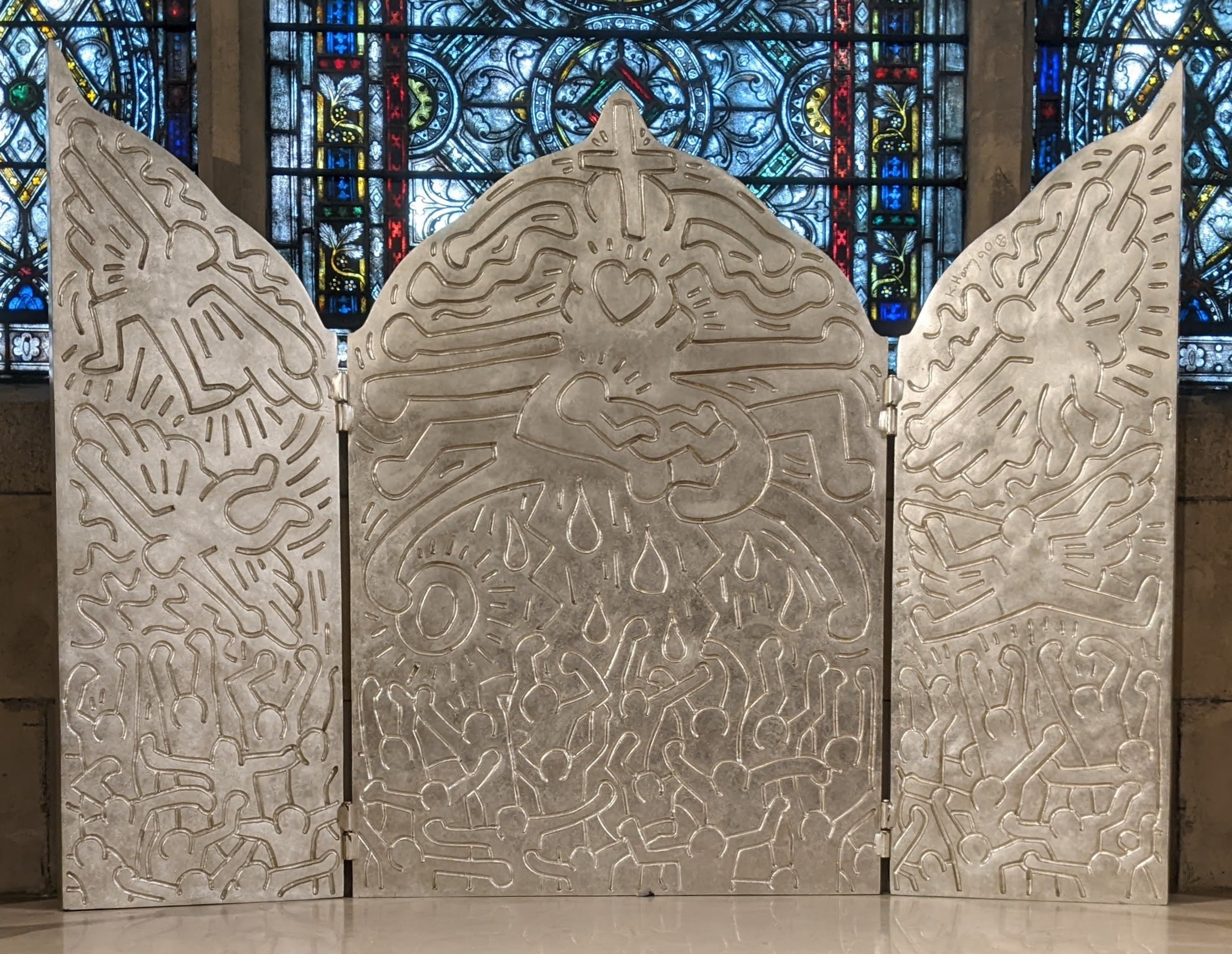
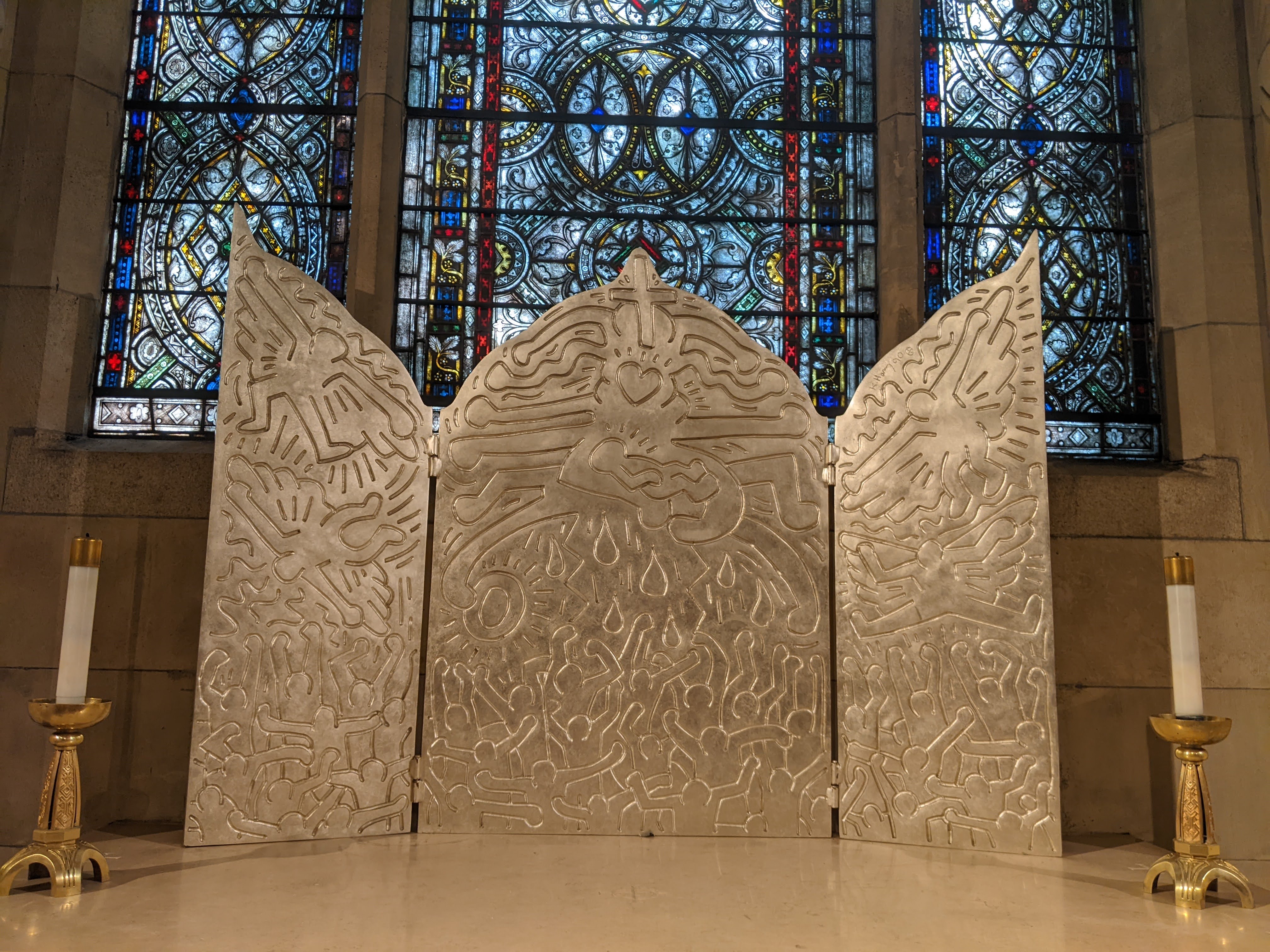
Keith Haring (American, 1958–1990), The Life of Christ, 1990. Bronze altarpiece with white gold leaf patina, 81 × 60 × 2 in. Edition of 9. Chapel of St. Columba, Cathedral of St. John the Divine, New York. All photos by Victoria Emily Jones.
Keith Haring [previously] was a popular artist and activist on the New York scene during the 1980s. Inspired by graffiti art, he started his career by filling empty poster spaces with chalk drawings in the city’s subway stations. He wanted to make art accessible to everyone and believed that it “should be something that liberates the soul, provokes the imagination, and encourages people to go further.”
His style is characterized by bold black outlines, vibrant colors, a sense of rhythm, and simple iconic figures like the Barking Dog and Radiant Baby, which recur again and again in his oeuvre.
Sadly, Haring’s career was cut short by AIDS, which he died of on February 16, 1990, at age thirty-one. The last work he completed, just weeks before his death, was a Life of Christ altarpiece, a work that conveys eternal love and loss, divine suffering and hope. Without any preliminary sketches, he cut the design into clay using a loop knife. It was posthumously cast in bronze and covered in a white gold patina, an edition of nine.
The first edition is housed in the Cathedral of St. John the Divine in New York, the world’s fourth-largest church by area, where Haring’s memorial service was held.
Chapel of St. Columba, Cathedral of St. John the Divine, New York, designed by the architectural firm Heins & LaFarge, dedicated 1911. The stained glass windows are by Wilbur Burnham of Boston and Clayton & Bell of London, and the altarpiece, a later addition, is by Keith Haring.
Pulsating, cosmic, and somehow both mournful and joyous, the altarpiece is a triptych, meaning it has three panels. The central panel shows, at the top, a cross, below which is a multiarmed figure holding a baby. The top figure I interpret as God the Father, his arms all-embracing. Below him, at torso level, I discern a second figure (though the head is not clearly defined), who must be Mary, a shining heart over her face. Nestled in her arms is, irrefutably, her infant son Jesus.
Another possible reading is that this is the Trinity—Father, Spirit, and Son—united in an act of self-giving.
The surplus of arms (I count thirteen, plus the baby’s two) reminds me of the Thousand-Armed Avalokiteśvara in Buddhism; a bodhisattva associated with limitless compassion, his arms represent his extending aid, his reaching out to touch, heal, and uplift. One of the arms here stretches down to bestow a halo on humankind, which in Christianity symbolizes the grace/light of God.
Below this primary grouping is a crowd of people who appear to me to be dancing and celebrating, lifting their arms to receive the blessings that flow forth from the holy child. (Or are they clamoring, turning away, resisting? Without facial features and fingers, it’s hard to tell!) Drops of Jesus’s blood fall over all, bringing redemption.
On the two side panels, angels careen down from the heavens, surfing, leaping, tumbling, one screeching to a halt.
Haring’s Life of Christ combines, as have many artworks before it, Jesus’s birth and death, collapsing his time on earth, his ministry of salvation, into a single image of incarnation and atonement. Mary holds him as a newborn, but she also holds him as a lifeless adult after his crucifixion—a traditional representation known as the Pietà. Many artists have given Mary a sad twinge in her eye at the nativity, suggesting a premonition of loss.
Haring’s figures are faceless, so we can’t look there for emotional clues, but Mary’s body language suggests both a desire to keep and protect her son, and a willingness to give him up for the greater good.
I wonder whether, when Haring incised the sacred blood drops, he was not only thinking of the “power in the blood” that Christians sing about in reference to Jesus’s redemptive sacrifice—and all the weight that bodily fluid as Christian symbol carries—but also lamenting the HIV infecting his own bloodstream, ravaging his body and stigmatizing him, and that had already killed many of his friends and his partner.
Haring’s friend Sam Havadtoy, who was present at the altar’s creation, reports that when Haring finished the piece, he stepped back and, gazing at it, said, “Man, this is really heavy.”
I think the prominence of blood must have been at least partly influenced by the destructiveness of the AIDS epidemic and the artist’s meditation on his mortality, perhaps even hope for transcendence through death. And if so, then the Radiant Baby, who, the artist’s title would lead us to assume, is Jesus, could also double as the soul of an AIDS victim being taken back up to God.
While I hesitate to ascribe prayers or intentions to others that they have not clearly voiced, I can’t help but think that this last artwork of Haring’s, executed in the final throes of his illness, its subject returning him to the Christianity of his youth, to a story that once captivated him, was in one sense a plea for (physical and spiritual?) cleansing, for deliverance.
LISTEN: “We Sing Glory” by Fred Hammond, on Fred Hammond Christmas . . . : Just Remember (2001)
Little baby boy, sent as God among us For your plan to free all humanity We sing glory to your name Sing glory to your name
Tiny fragile heart Pumped your blood to save us For you’ve come to be a sin offering Singing glory to the Lamb Sing glory to the Lamb
Singing glory to the one Who saved the whole world Born to die but you live again And take all our sins away
Little hands and feet Made for nail and hammer For the pain and grief you suffered for me I sing glory to the Lamb Oh, glory to the Lamb
Tiny arms and legs Broad, strong, and sturdy You carry the key to our victory We sing glory to your name We sing glory to your name
We sing glory to the Child Who will save the whole world Born to die and then live again To take all our sins away
Glory, glory to the one Who was born to save the whole world You died but you’ll rise again So Jesus, we praise your name
Hark the herald angels sing Glory to the newborn King Peace on earth and mercy mild God and sinner reconciled Thank you, Jesus
Hark the herald angels sing Glory to the newborn King Peace on earth and mercy mild God has come to save us Yes, he has
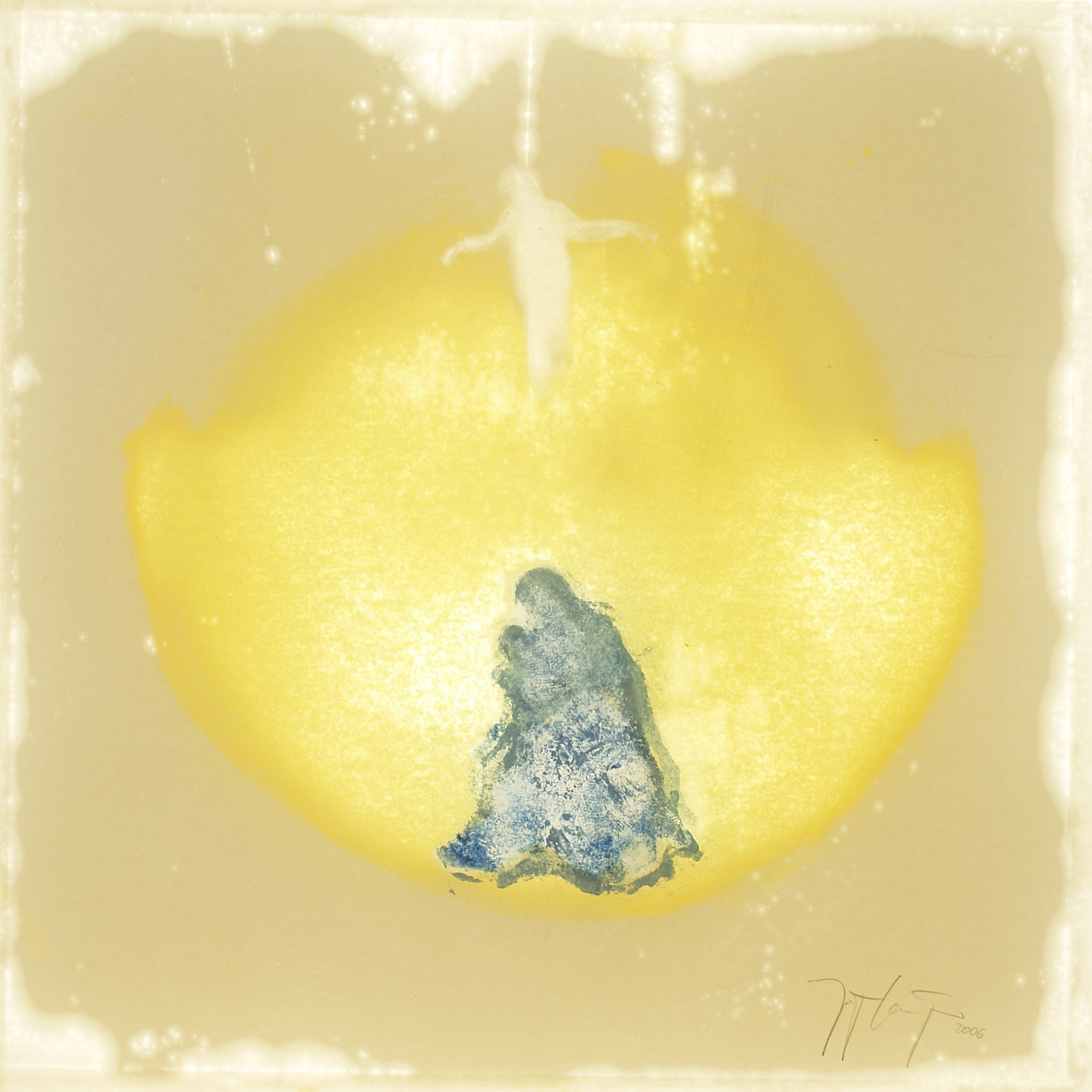
Jörg Länger (German, 1964–), Chr. Geb., 2006. Linocut, wax, oil, and graphite pencil on paper, 33 × 33 cm, cast with resin between two Optiwhite sheets of glass, 38 × 38 cm.
The contemporary German artist Jörg Länger creates extraordinary mixed-media works, many of which are in dialogue with Christian art history. In addition to earning an advanced degree in art, Länger has also done university coursework in theology and philosophy, so it’s no wonder his pieces demonstrate a keen theological awareness and spiritual sensibility.
After some fifteen years of working in photography, installation art, performance art, and conceptual art, in 1998 Länger shifted gears to focus on drawing, painting, and printmaking. He developed a series, still ongoing, that he calls “Protagonisten aus 23.000 Jahren Kulturgeschichte” (Protagonists from 23,000 Years of Cultural History), in which he takes figures from prehistoric petroglyphs and bas-reliefs, ancient Greek vases, medieval manuscripts, European Renaissance paintings, and contemporary art, simplifies them, and puts them into a new pictorial context. He copies the figure’s outline onto a linoleum block, inks and prints it to produce a sort of silhouette, and builds out from there using oil paint, pastels, wax, and/or gold leaf, while still retaining a minimalist aesthetic.
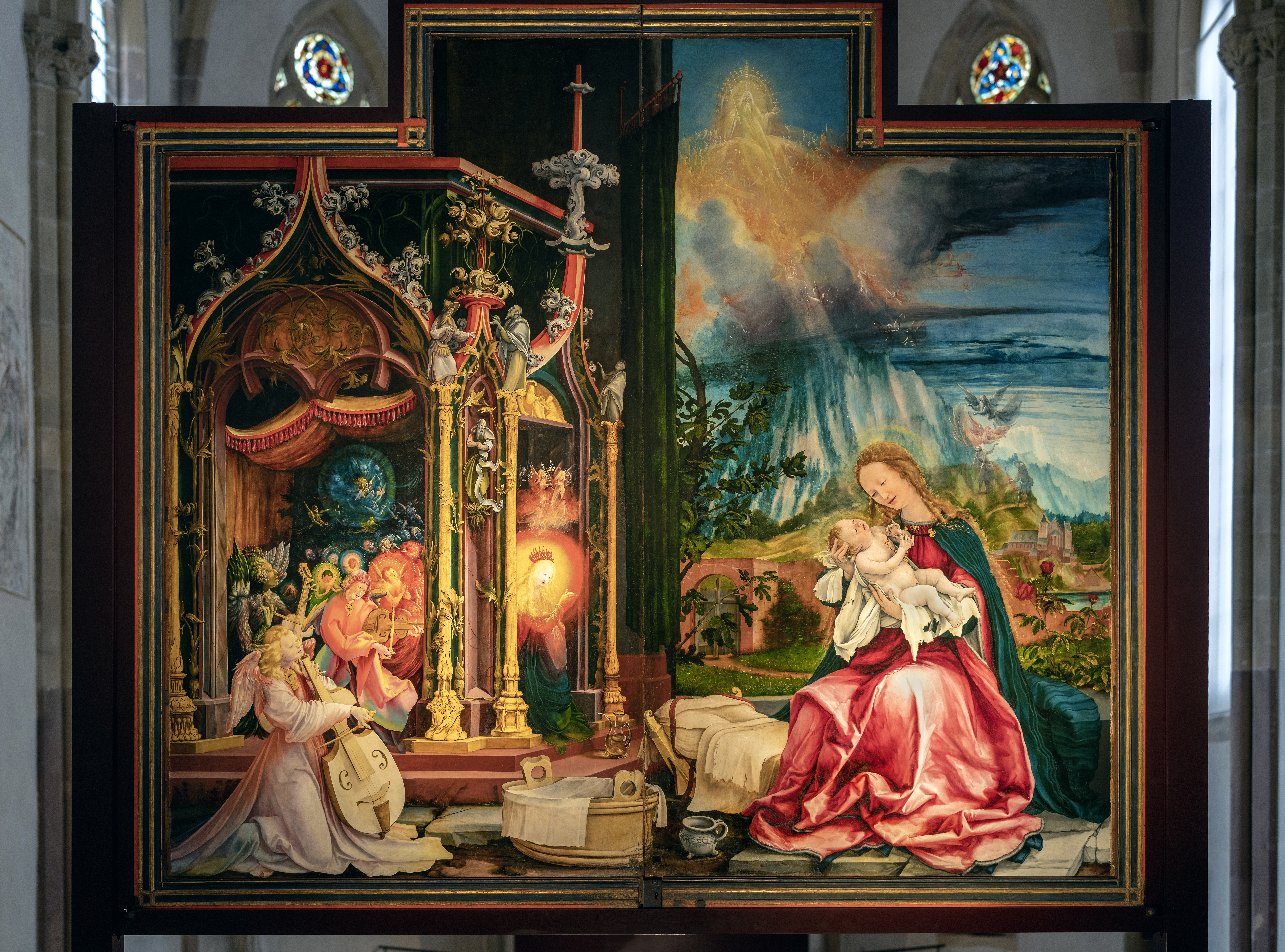
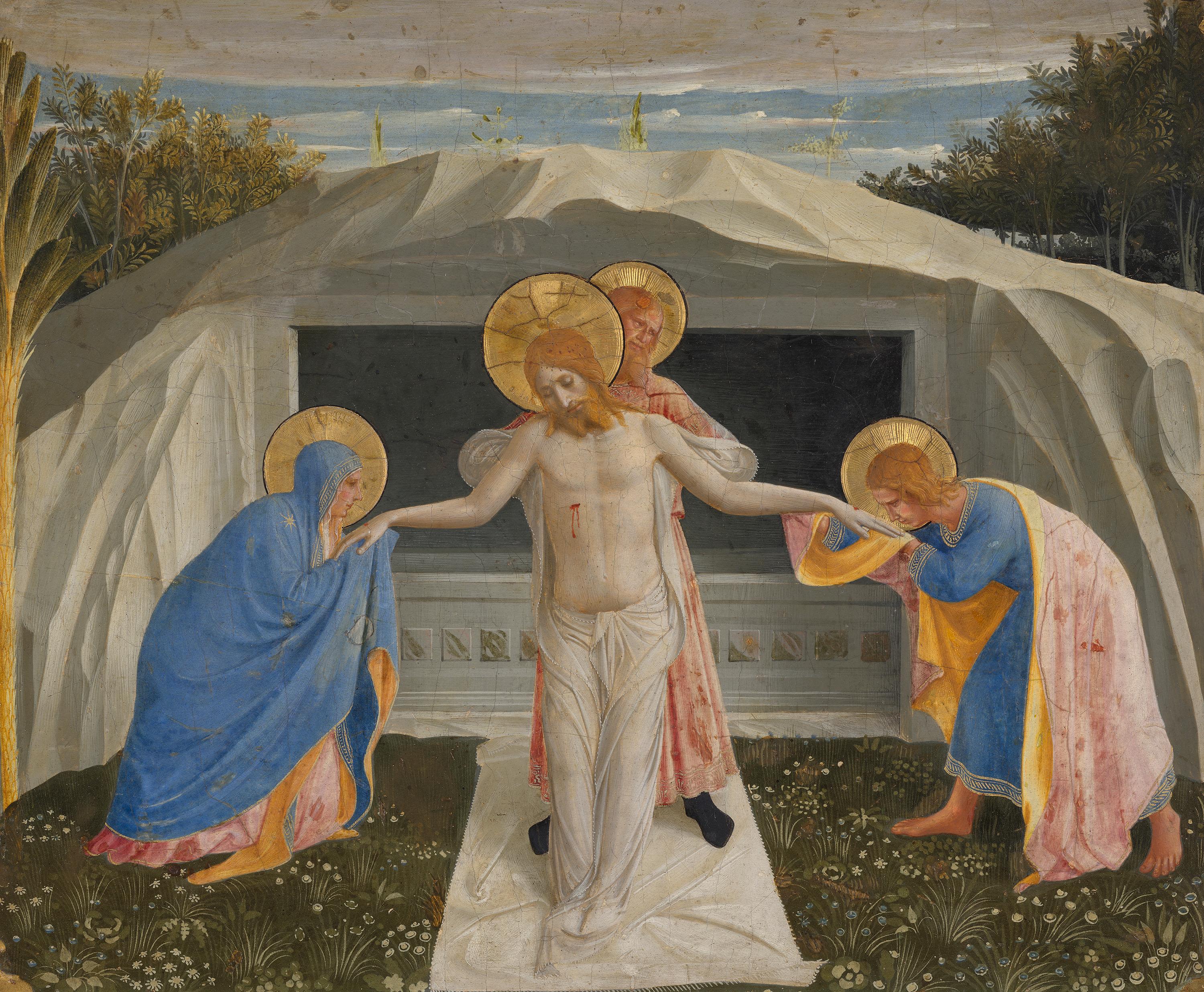
In his 2006 piece Chr. Geb. (short for Geburt Christi, “Birth of Christ”), the silhouetted figures are taken from Matthias Grünewald’s Isenheim Altarpiece and Fra Angelico’s Entombment of Christ.
Matthais Grünewald (German, ca. 1475/80–1528), The Nativity, central panel (first open view) of the Isenheim Altarpiece, 1515. Oil on wood, 269 × 307 cm. Unterlinden Museum, Colmar, France. Photo: Steven Zucker.Fra Angelico (Italian, ca. 1400–1455), Entombment of Christ, 1438–40. Tempera on wood, 37.9 × 46.6 cm. Alte Pinakothek, Munich.
With the shadowy blue central pair of Mother and Child, the ghostly impression of Christ’s crucified body (being dragged into a tomb in the scene it’s excised from), the expanding puddle of gold that holds together both birth and death, and the light that presses in from the edges, the work has a mystical feel. It shows the Eternal One entering time, born of a woman, to live and die and rise and so bring humanity back to God and back to their truest selves.
LISTEN: “O Vis Aeternitatis” by Hildegard of Bingen, ca. 1140–60 | Performed by Azam Ali, 2020
V. O vis aeternitatis que omnia ordinasti in corde tuo, per Verbum tuum omnia creata sunt sicut voluisti, et ipsum Verbum tuum induit carnem in formatione illa que educta est de Adam.
R. Et sic indumenta ipsius a maximo dolore abstersa sunt.
V. O quam magna est benignitas Salvatoris, qui omnia liberavit per incarnationem suam, quam divinitas exspiravit sine vinculo peccati.
R. Et sic indumenta ipsius a maximo dolore abstersa sunt.
V. Gloria Patri et Filio et Spiritui sancto.
R. Et sic indumenta ipsius a maximo dolore abstersa sunt.
V. O power within Eternity: All things you held in order in your heart, and through your Word were all created according to your will. And then your very Word was clothed within that form of flesh from Adam born.
R. And so his garments were washed and cleansed from greatest suffering.
V. How great the Savior’s goodness is! For he has freed all things by his own Incarnation, which divinity breathed forth unchained by any sin.
R. And so his garments were washed and cleansed by greatest suffering.
V. Glory be to the Father and to the Son and to the Holy Spirit.
R. And so his garments were washed and cleansed by greatest suffering.
Hildegard of Bingen [previously] was a twelfth-century German nun and polymath who wrote works on theology, medicine, and natural history; hymns, antiphons, and a drama for the liturgy (all with original music); and one of the largest bodies of letters to survive from the Middle Ages. In 1136 she was unanimously elected to lead her Benedictine community as abbess, which she did until her death in 1179.
“O vis aeternitatis” is the first entry in Hildegard’s Symphonia armonie celestium revelationum (Symphony of the Harmony of Celestial Revelations), a compilation of her liturgical songs that she made during her lifetime. It is labeled a “Responsory to the Creator.” “The responsory, one of several compositional forms Hildegard used,” explains medievalist Nathaniel M. Campbell, “is a series of solo verses [marked V] alternating with choral responses [marked R] sung at the first office of the day, vigils (matins), in the monastic liturgy.” It’s basically a call-and-response song.
This responsory, Campbell continues, “contemplate[s] the Incarnation . . . as the pivotal moment in which creation reached its perfect and predestined trajectory.” He notes how the refrain meditates on the cleansing of Adam’s flesh both from suffering and by (Christ’s) suffering. God put on our humanity and redeemed it.
Here’s how the medievalist Barbara Newman translates the responsory on page 99 of the critical edition of the Symphonia published by Cornell University Press:
Strength of the everlasting! In your heart you invented order. Then you spoke the word and all that you ordered was, just as you wished.
And your word put on vestments woven of flesh cut from a woman born of Adam to bleach the agony out of his clothes.
The Savior is grand and kind! From the breath of God he took flesh unfettered (for sin was not in it) to set everything free and bleach the agony out of his clothes.
Glorify the Father, the Spirit, and the Son.
He bleached the agony out of his clothes.
In the video above, “O vis aeternitatis” is performed by Azam Ali, an internationally acclaimed singer, producer, and composer who was born in Iran and raised in India and is now based in Los Angeles. She writes in the video’s YouTube description that Hildegard is part of the canon of universal spirituality and mysticism and that she is attracted to her cosmology, especially her articulation of the ancient philosophical concept of “the music of the spheres.”
In addition to her solo work, Ali is part of the musical group Niyaz, who blend medieval Sufi poetry and ancient Middle Eastern folk songs with modern electronic and trance music.
Joseph Stella (American, 1877–1946), Nativity, 1919–20. Oil pastel and oil on paper, 37 × 19 5/16 in. (94 × 49.1 cm). Whitney Museum of American Art, New York. Photo: Victoria Emily Jones. [object record]
Julian’s room. Christmas Day; early morn.
JULIAN. The light comes feebly, slowly, to the world On this one day that blesses all the year, Just as it comes on any other day: A feeble child He came, yet not the less Brought godlike childhood to the aged earth, Where nothing now is common anymore. All things hitherto proclaimed God: The wide-spread air; the luminous mist that hid The far horizon of the fading sea; The low persistent music evermore Flung down upon the sands, and at the base Of the great rocks that hold it as a cup . . . . . . . . . . . . . . . . . . . . . . . . . . . . . . . . . . . . . . . . . But men heard not, they knew not God in these[.] . . . . . . . . . . . . . . . . . . . . . . . . . . . . . . . . . . . . . . . . . . . . . But when He came in poverty, and low, A real man to half-unreal men, A man whose human thoughts were all divine, The head and upturned face of humankind— Then God shone forth from all the lowly earth, And men began to read their Maker there. Now the Divine descends, pervading all. Earth is no more a banishment from heaven, But a lone field among the distant hills, Well ploughed and sown, whence corn is gathered home. Now, now we feel the holy mystery That permeates all being: all is God’s; And my poor life is terribly sublime. Where’er I look, I am alone in God, As this round world is wrapt in folding space; Behind, before, begin and end in Him: So all beginnings and all ends are hid; And He is hid in me, and I in Him. . . . . . . . . . . . . . . . . . . . . . . . . . . . . . . . . O centre of all forms! O concord’s home! O world alive in one condensèd world! O face of Him, in whose heart lay concealed The fountain thought of all this kingdom of heaven! Lord, Thou art infinite, and I am Thine! I sought my God; I pressed importunate; I spoke to Him, I cried, and in my heart It seemed He answered me. I said, “O, take Me nigh to Thee, Thou mighty life of life! I faint, I die; I am a child alone ’Mid the wild storm, the brooding desert night.” “Go thou, poor child, to Him who once, like thee, Trod the highways and deserts of the world.” “Thou sendest me then, wretched, from Thy sight! Thou wilt not have me—I am not worth Thy care!” “I send thee not away; child, think not so; From the cloud resting on the mountain peak, I call to guide thee in the path by which Thou mayst come soonest home unto my heart. I, I am leading thee. Think not of Him As He were one and I were one; in Him Thou wilt find me, for He and I are one. Learn thou to worship at his lowly shrine, And see that God dwelleth in lowliness.”
This passage is excerpted from part 3, scene 10 of Within and Without: A Dramatic Poem by George MacDonald, a verse play that, in 1855, was the author’s first published work.
George MacDonald (1824–1905) was a prolific Scottish writer across the genres of adult and children’s fantasy, realistic fiction, theology, poetry, and literary essay. He was the founding father of modern fantasy literature (Phantastes, The Princess and the Goblin, At the Back of the North Wind, and Lilith and his best-known works), a mentor to fellow writer Lewis Carroll (he was a catalyst to Carroll’s publishing Alice’s Adventures in Wonderland), and a great influence on C. S. Lewis (who cites his writings as instrumental in his conversion to Christianity). MacDonald served for a few years as a Congregational minister, but his preaching about God’s universal love and the ultimate salvation of all (apokatastasis) rubbed against the staunchly Calvinist grain of his time and place; after resigning his pastoral post in Arundel, England, he continued preaching without pay as a layman, as well as weaving his theological views into his fiction.
In today’s Christmas devotional, there’s a convergence of three Native cultures of Turtle Island (North America): Jemez, Dakelh, and Kwakwaka’wakw.
LOOK: Jemez Nativity by Maxine Toya
Maxine Toya (Jemez Pueblo, 1948–), Jemez Nativity, 2014. Polychrome pottery figures, red micaceous slip, tallest figure 8 1/2 inches high. Photo: Blair Clark, courtesy of Susan’s Christmas Shop, Santa Fe.
A granddaughter of Persingula Gachupin and a daughter of Marie Romero (both eminent Jemez Pueblo potters), Maxine Toya grew up assisting her family with pottery chores and painting. She began making her own pottery in 1974 and is one of the most renowned living potters from Jemez Pueblo, a census-designated place in Sandoval County, New Mexico. She has won numerous awards at the prestigious Santa Fe Indian Market, which every August brings together a thousand-plus Indigenous artists from more than two hundred tribal nations to exhibit and sell their work.
I learned about this artist from the wonderful book Nativities of the Southwest by Susan Topp Weber, the owner and operator of Susan’s Christmas Shop in Santa Fe. The book compiles dozens of nativities made with local clays and other materials by Pueblo Indians, Navajo Indians, and Spanish and Anglo artists of New Mexico and Arizona. Maxine Toya’s nativity appears on page 47. Weber writes,
Maxine’s donkey in this nativity has a blanket painted with a fringe similar to the one made by her mother, Marie [see page 46]. . . . She sometimes combines her figures into groups. Her standing figures all have closed eyes. The carefully painted detail distinguishes this nativity, as well as the sweet little Pueblo drummer boy with his drumstick raised in the air. The angel’s wings have a lovely feather design.
You can watch Maxine Toya give a pottery demonstration with her daughter Domnique Toya, also a potter, in this 2022 video from the Museum of Indian Arts and Culture. (I cued it up to Maxine’s first section.)
Cheryl Bear (DMin, The King’s University) is an award-winning singer-songwriter, speaker, and workshop leader from Nadleh Whut’en First Nation in central British Columbia, whose work explores the intersection of Christian faith and First Nations cultures. She is a founding board member of NAIITS: An Indigenous Learning Community (formerly the North American Institute for Indigenous Theological Studies), an organization that addresses biblical, theological, and ethical issues from Indigenous perspectives. She travels throughout North America telling the Great Story of Jesus both within and outside Indigenous communities, bringing to bear her Indigenous worldview and values.
Bear’s song “Welcome Our Creator” is from her sophomore album, The Good Road. It opens with a drumbeat and then her singing a series of vocables (small nonlexical “words” without semantic meaning). “The song is played to the drum beat of my people,” the Dakelh (Carrier), she writes in the liner notes. “I use the words ‘Gilakas’la Gikumi’ from the Kwakwaka’wakw Nation,” which translate to “Welcome our Creator.”
The song’s title on the CD sleeve and in online metadata does not have a comma, suggesting that the phrase, if interpreted in relation to Christmas, is an exhortation to give Jesus welcome, to gladly and hospitably receive him. But it could also be sung as a greeting to the incarnate God himself: “Welcome, our Creator!”
Outside the Christmas context, the song might be sung during an assembly as an acknowledgment of Creator’s presence.
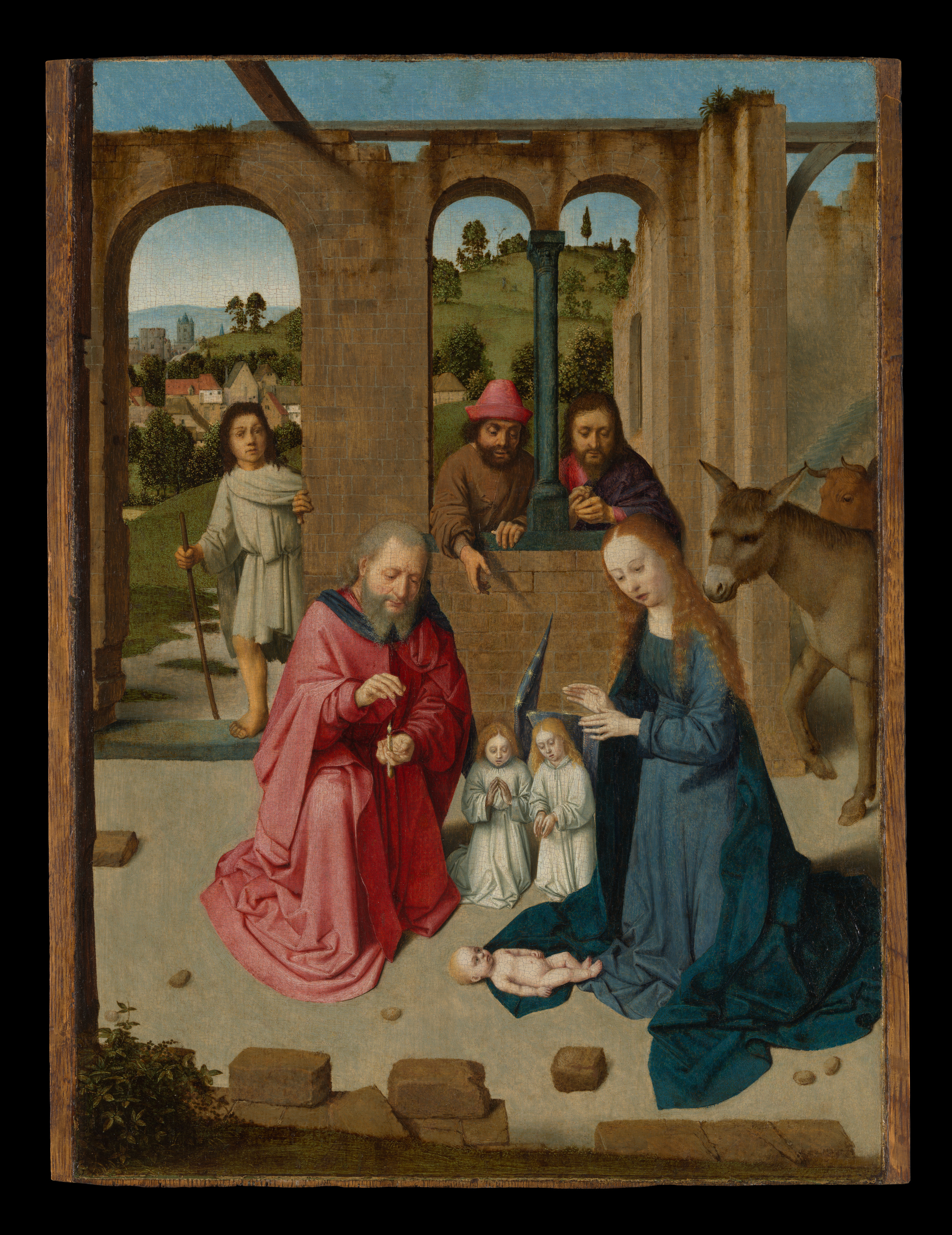
Gerard David (Netherlandish, ca. 1455–1523), The Nativity, early 1480s. Oil on wood, 18 3/4 × 13 1/2 in. (47.6 × 34.3 cm). Metropolitan Museum of Art, New York.
LISTEN: “Where Is This Stupendous Stranger” | Words by Christopher Smart, 1765 | Music by Linda L. Hanson, 2012 | Performed by Fire (women’s a cappella chamber ensemble), 2020
Where is this stupendous Stranger? Prophets, shepherds, kings, advise! Lead me to my Master’s manger, Show me where my Savior lies.
O most mighty, O most holy, Far beyond the seraph’s thought, Are you then so mean and lowly As unheeded prophets taught?
O the magnitude of meekness, Worth from worth immortal sprung! O the strength of infant weakness, If eternal is so young!
God all-bounteous, all-creative, Whom no ills from good dissuade, You have come to be a native Of the very world you made.
The four verses of this Christmas hymn are excerpted from a nine-stanza poem by Christopher Smart [previously] published in Hymns and Spiritual Songs for the Fasts and Festivals of the Church of England (London, 1765). The poem was recovered in the twentieth century and since then has received multiple new musical settings—by composers such as I-to Loh, Charles Heaton, Conrad Susa, Joan A. Fyock, Leo Nestor, Alec Wyton, Thomas Gibbs Jr., Scott M. Hyslop, and Jacques Cohen—as well as pairings with older tunes.
My favorite setting of the text is by Linda L. Hanson, the founding director of Fire, a women’s a cappella chamber ensemble in Charlottesville, Virginia. The group performs the hymn in the video above, which Fire member Mary Welby von Thelen spliced together from thirteen solitary recordings during the COVID-19 pandemic. Hanson is in the top row, the third from the left.
The alliterative opening line of the hymn asks where the “stupendous Stranger” can be found—the divine one sent from heaven. Stupendous isn’t an adjective we use often. It means “causing astonishment or wonder: awesome, marvelous.” The poetic speaker begs the prophets, shepherds, and magi to divulge the location of the Christ child so that he can go and worship him.
The next two stanzas marvel at the paradoxes of the Incarnation—how Christ is “mighty” and “holy,” beyond the comprehension of even the angels, and yet “mean” (humble) and “lowly,” lying here in the dirt before us, visible, tangible, vulnerable, no longer far above us but in our very midst. What “magnitude of meekness,” what “strength of infant weakness.” The eternal one is born in time.
The omnibenevolent Creator has deigned to become part of his creation. No potential ill that he will suffer as a result—and he will suffer many and grievous ills, culminating in death by crucifixion—can deter him from making his beloved earth his home.
Hanson has generously allowed me to share the sheet music of “Where Is This Stupendous Stranger,” and says the hymn can be freely used by local church congregations. Anything outside that context will require her permission.
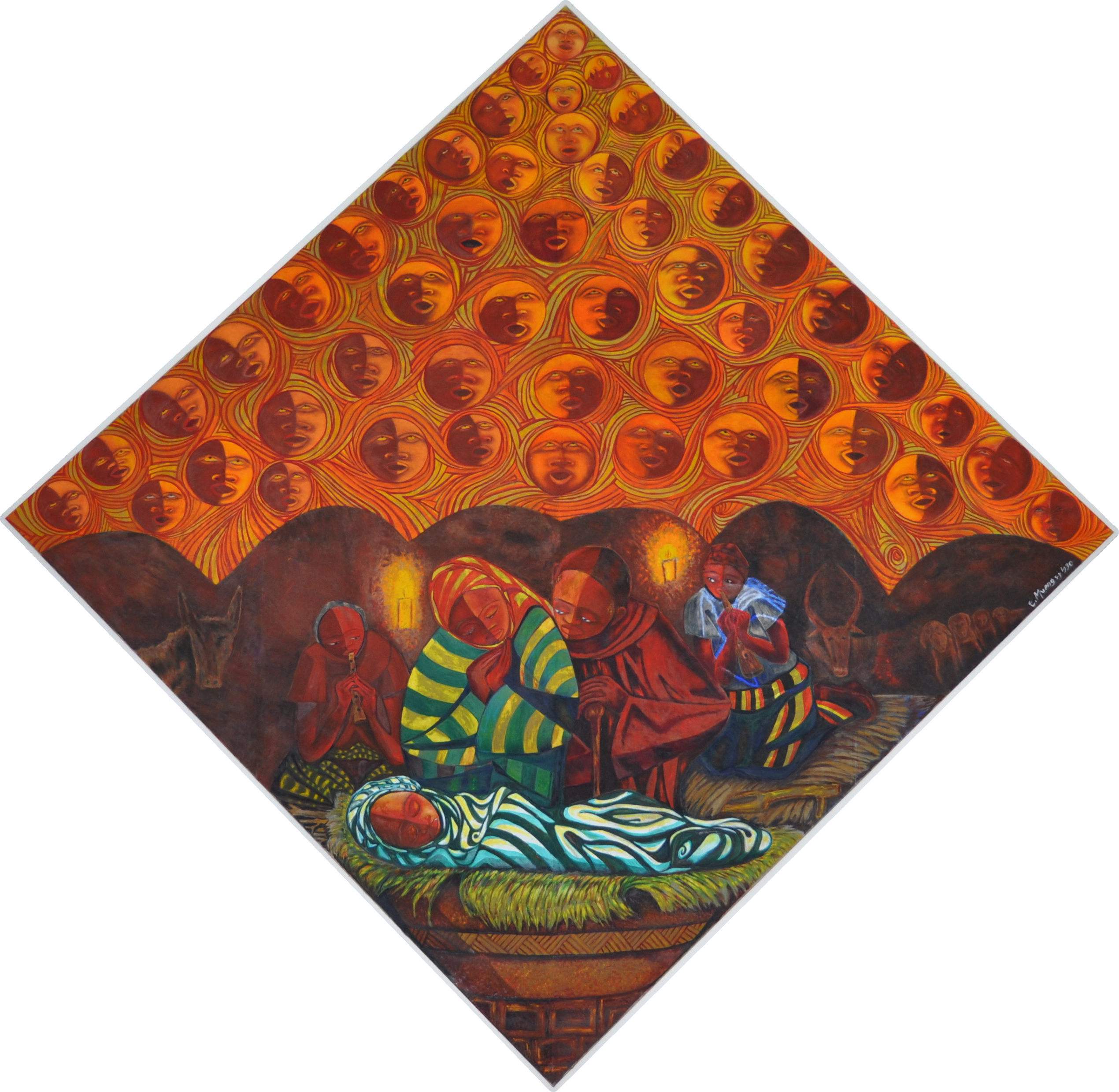
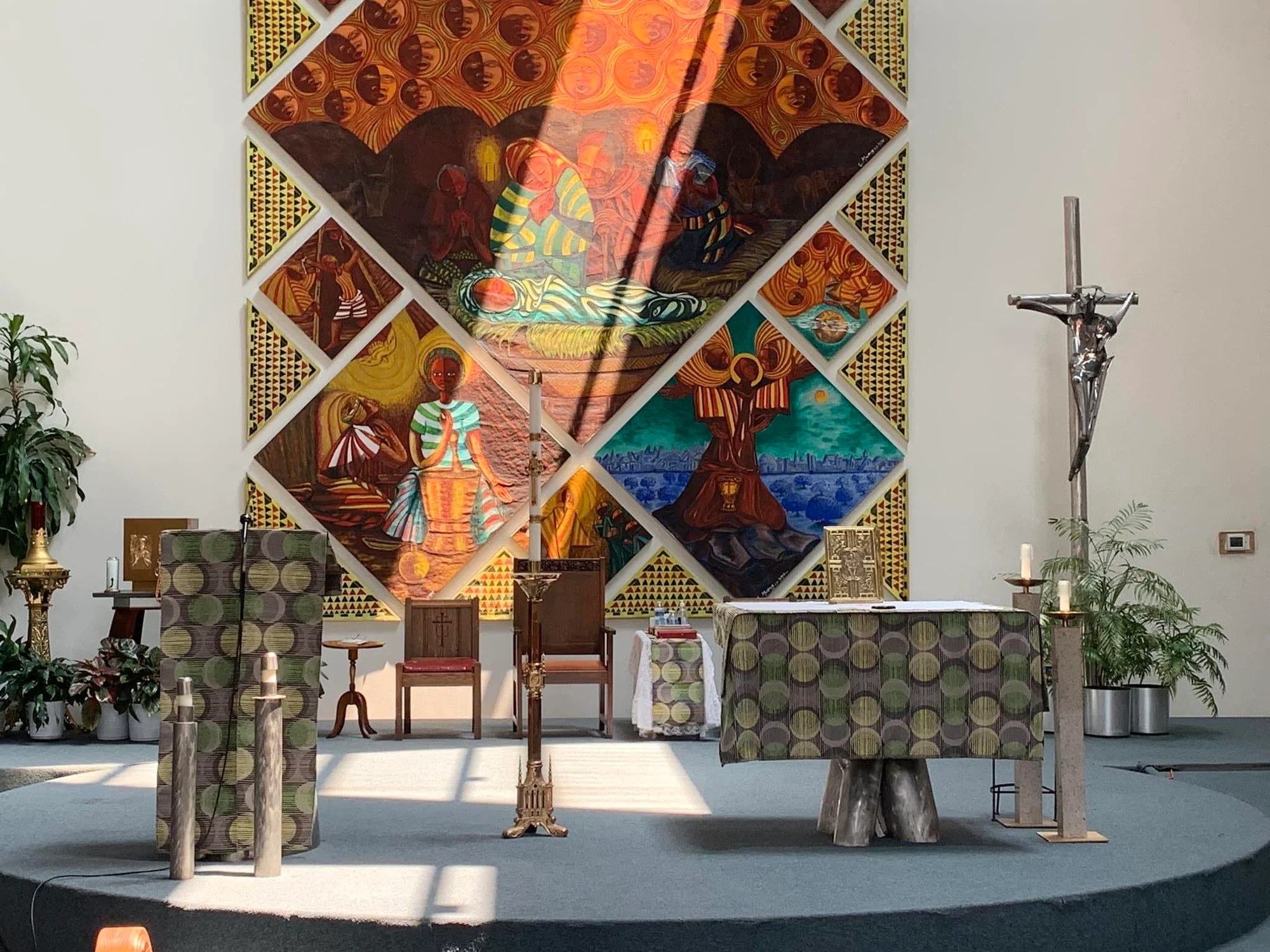
Fr. Engelbert Mveng, SJ (Cameroonian, 1930–1995), The Birth of Jesus, 1990. Central scene of mural at Our Lady of Africa Catholic Church, Chicago. All photos courtesy of the church.
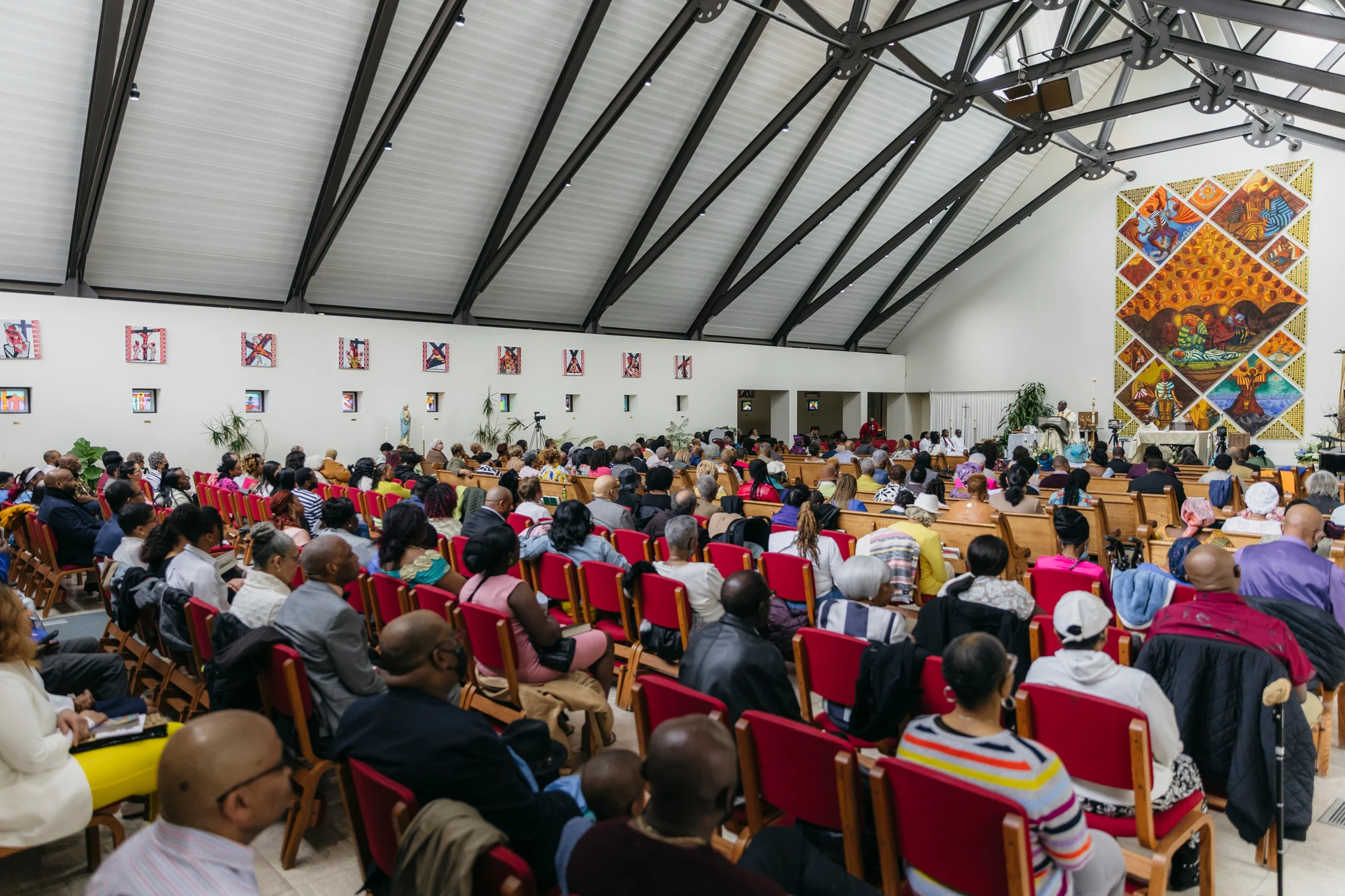
When Holy Angels Catholic Church on the south side of Chicago was rebuilt following a 1986 fire, the historic church commissioned the Cameroonian Jesuit priest, artist, and historian Engelbert Mveng (1930–1995) to paint a mural for behind the altar. He chose to represent moments of angelic intervention in biblical history. (See a close-up of the full mural here.)
The mural’s focal point is a Nativity scene, set in a hilly African landscape that’s pulsing with joy. The infant Jesus lies asleep on a grassy bed, adored by his parents and flanked by candles, pipers, and some curious animal onlookers. Caught up in the sky’s vibrant swirls are forty-nine disembodied angel heads, singing their Gloria.
In July 2021, Holy Angels merged with the faith communities of Corpus Christi, St. Ambrose, St. Anselm of Canterbury, and St. Elizabeth of Hungary in the Bronzeville/Kenwood area of Chicago to become Our Lady of Africa Parish, housed at the former Holy Angels church. The altar mural remains installed on the east end, a key visual feature of the worship space.
LISTEN: “He Came Down,” traditional Cameroonian carol | Transcribed and arranged by John L. Bell of the Iona Community, 1986 | Arranged and performed by Marty Haugen on Welcome the Child, 1992 [sheet music]
He came down that we may have life He came down that we may have life He came down that we may have life Hallelujah, forevermore!
MMK is an alternative folk band from France consisting of Noémie Kessler (lead vocals), Sophie Chaussier, Antoine Garnier, Jérémy Haessig, Cédric Kessler, and Jonathan Lubrez. On November 23, 2016, they released the album Oh My Goodness! Noël Live, comprising pop versions of ten classic Christmas songs, all but one of them in French. All ten performances are available on YouTube; I’ve listed them below in the order they appear on the LP, and have also compiled them into a YouTube playlist, but for audio only, you can listen on Spotify. My favorites are #2, #3, and #7.
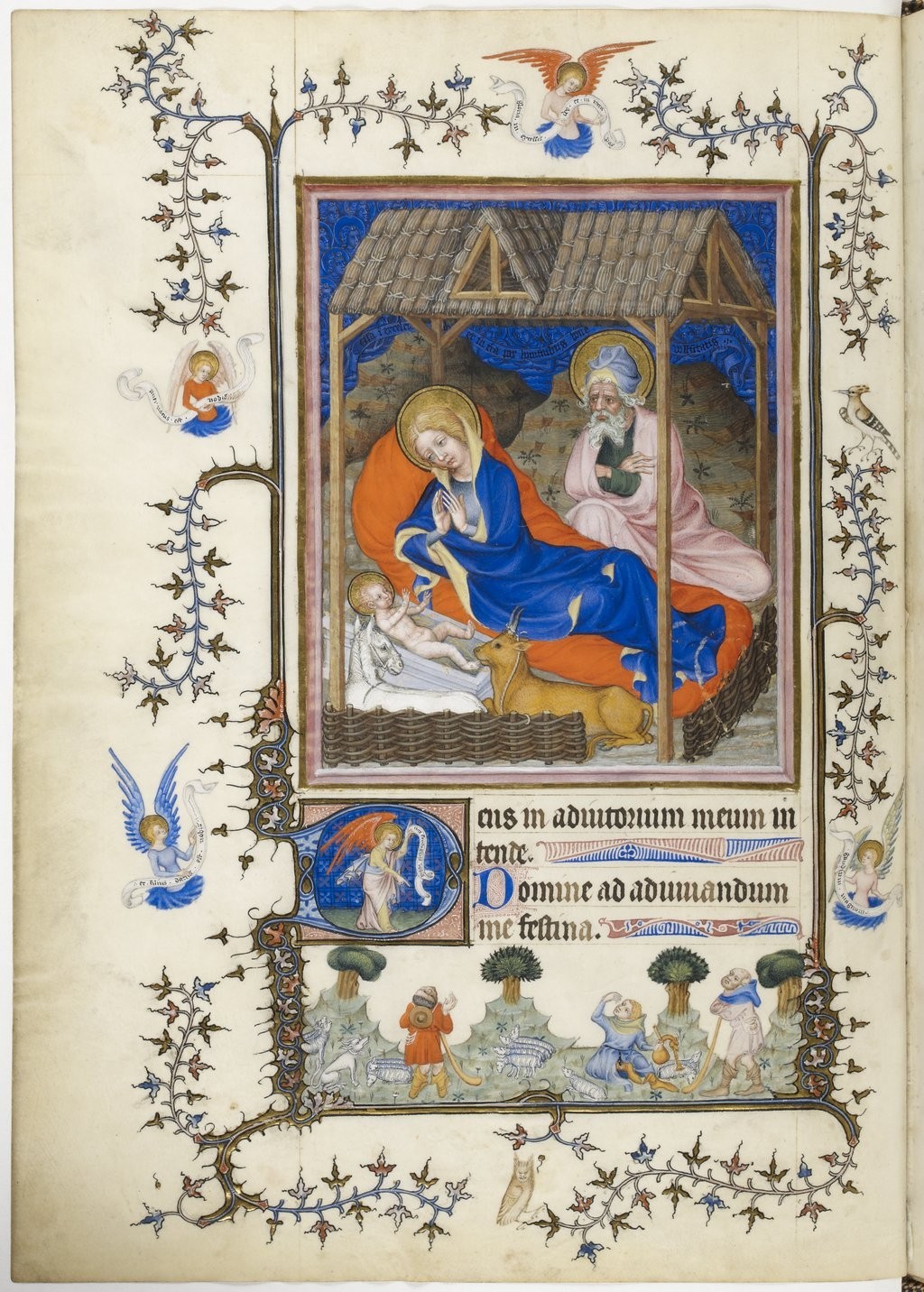
The Nativity, from the Très Belles Heures de Notre-Dame du Duc de Berry, ca. 1380. Paris, Bibliothèque nationale, Ms. nouv. acq. lat. 3093, fol. 41v.
1. “Ô Peuple Fidèle” (O Come, All Ye Faithful): The origin of this carol is unknown, but it first appeared in England, with Latin lyrics, in the eighteenth century. Some scholars attribute it to Cistercian monks of either Germany, Portugal, or Spain.
2. “Vive le vent” (Long Live the Wind): This secular Christmas carol is sung to the same tune as “Jingle Bells,” but the words—written by Francis Blanche in 1948—are completely different. The song delights in wintry weather and hearth fires, evergreens and feasting.
Sur le long chemin Tout blanc de neige blanche Un vieux monsieur s’avance Avec sa canne dans la main. Et tout là-haut le vent Qui siffle dans les branches Lui souffle la romance Qu’il chantait petit enfant, oh!
Refrain: Vive le vent, vive le vent, Vive le vent d’hiver, Qui s’en va sifflant, soufflant Dans les grands sapins verts, oh! Vive le temps, vive le temps, Vive le temps d’hiver, Boules de neige et Jour de l’An Et Bonne Année grand-mère!
Et le vieux monsieur Descend vers le village, C’est l’heure où tout est sage Et l’ombre danse au coin du feu. Mais dans chaque maison Il flotte un air de fête Partout la table est prête Et l’on entend la même chanson, oh!
Chevalet: Vive le vent, vive le vent Vive le vent d’hiver Qui rapporte aux vieux enfants Leurs souvenirs d’hier, oh!
Along the long road All white from the white snow Walks an old man With his cane in his hand. And the wind way up there Which whistles in the branches Blows the romantic tune on him That he sang as a young child, oh!
Refrain: Long live the wind, long live the wind, Long live the winter wind, Which goes whistling, blowing Through the tall green Christmas trees, oh! Long live the season, long live the season, Long live the holiday season— Snowballs and New Year’s Day And happy New Year, Grandma!
And the old man Goes down toward the village; It’s the time when everyone is good And the shadow dances near the fire. But in each house There floats a festive air; Everywhere the table is set, And you hear the same song, oh!
Bridge: Long live the wind, long live the wind, Long live the winter wind, Which brings to old kids Their memories of yesterday, oh!
3. “Les anges dans nos campagnes” (Angels We Have Heard on High): The English carol “Angels We Have Heard on High” is a paraphrase by the Anglo-Irish Catholic bishop James Chadwick of a carol that originally appeared in French in 1842.
4. “Douce nuit” (Silent Night): “Silent Night” was originally written in German in 1816 by the Austrian Catholic priest Joseph Mohr and was set to music by the schoolteacher and organist Franz Xaver Gruber in 1818.
5. “Aujourd’hui le roi des cieux” (Today the King of Heaven—i.e., The First Noel): This is the French version of “The First Noel,” an early modern carol of Cornish origin. The word “Noel,” used as a refrain, comes from the Old French “Nouel,” meaning Christmas.
6. “Minuit, Chrétiens,” aka “Cantique de Noël” (O Holy Night): The song that English speakers know as “O Holy Night” was originally written in French by the poet and wine merchant Placide Cappeau in 1847, with music by the opera composer Adolphe Adam. It’s surprising to me that such powerful Christian worship lyrics could be written by an avowed atheist, as Cappeau was! (A parish priest in Roquemaure had hired him because he was a great writer—the priest wanted a new poem for Midnight Mass—and Cappeau took the commission presumably because he needed the money.)
7. “D’où viens tu, bergère?” (Where Are You Coming From, Shepherdess?): This French Canadian ballad is from the sixteenth century. It’s a dialogue between a shepherd girl who has just seen the Christ child and a curious interlocutor, who prompts her to describe everything she witnessed. MMK sings three of the seven traditional verses.
D’où viens-tu bergère, d’ou viens-tu? —Je viens de l’étable de m’y promener, J’ai vu un miracle ce soir arriver.
Qu’as-tu vu bergère, Qu’as-tu vu? —J’ai vu dans la crèche un petit enfant Sur la paille fraîche mis bien tendrement.
Rien de plus bergère, Rien de plus? —Des anges de gloire descendus du ciel Chantaient les louanges du Père éternel.
ENGLISH TRANSLATION:
Where are you coming from, shepherdess? Where are you coming from? —I’m coming from the stable, where I was walking. I saw a miracle occur this evening.
What did you see, shepherdess? What did you see? —I saw in the manger a little child Tenderly laid on the cool straw.
Nothing more, shepherdess, nothing more? —The angels of glory came down from the sky, Singing the praises of the eternal Father.
8. “Entre le bœuf et l’âne gris” (Between the Ox and the Gray Donkey): With its text originating in the thirteenth century, this is the oldest French carol that’s still sung today. It describes how Jesus sleeps amid domestic animals and shepherds, in his mother’s arms. The refrain translates to “A thousand divine angels, a thousand seraphim, fly around this great God of love.” I recognize the striking minor-key tune, written in the nineteenth century by François-Auguste Gevaert, from Bifrost Arts’ “Joy, Joy!”
9. “Oh viens bientôt Emmanuel” (O Come, O Come, Emmanuel): Translated from the Latin, this hymn of longing has graced the lips of Christians since the eighth or ninth century.
10. “Go Tell It on the Mountain”: Coming from the Black church tradition in the United States, this is the only song on the live album that MMK sings in a language other than French. Such exuberance!
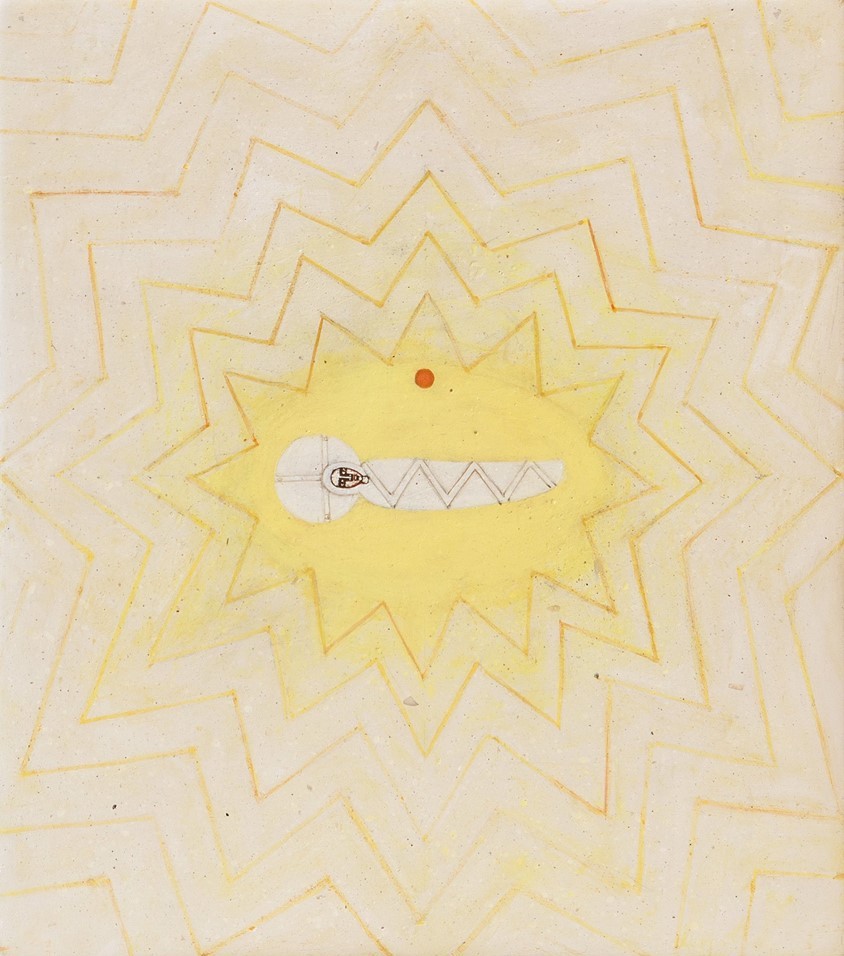
Natalya Rusetska (Ukrainian, 1984–), Nativity, 2016. Tempera on gessoed wood, 17.5 × 15.5 cm.
Gravity’s maker, spinner of spheres and spiraling matter, made into weight, to sweat. His own feet vulnerable, drawn flat and close against the punishing ground.
Star-strayed infant, wrapped in weight, heavy heaven. In the hollow of the years, long and narrow as a well, he waits suspended, bucket-drawn, clapper in a bell.
Ringing and ringing in the heatfolds of gravity, lines and lines of weight leaning us into each other, caught up, tumbled open-face roses in a blue bolt of thorn-pricked cloth.
God made known, fleshly God, Godlight bodied, bleeding out into wood, over stone. God from God, telluric God, shadowcast God, lightstricken God, bloodwritten. The pull
electric of low, deep center. God flesh, corpus God, Verbum corpse, light-riven. Inscribed, blooded, God-heft falling death- bitten into weighted rising, made and given; the miracle of leaven.
LeighAnna Schesser is a Catholic writer from south-central Kansas whose poetry collections include Struck Dumb with Singing (2020) and Heartland (2016).
“One of poetry’s great gifts is to slow us down,” writes Peggy Rosenthal in Praying the Gospels through Poetry. “We’re used to racing ahead as we read, whether it’s a newspaper or an email memo or even an essay: language in these forms propels us forward, urging us to grab up its main points. But poetry doesn’t press ahead so much as hold us still—in the wonder of words crafted to open into another dimension.”
Below are twenty-five poems to “hold us still” this holiday season.
I’ve collected hundreds of Advent and Christmas poems over the past decade, but for this feature one of the selection criteria was that the poem must be freely available online. I chose the number twenty-five because that is standard in most Advent calendars—tools for counting down the days to Christmas. This way, you can choose, if you wish, to bookmark this page and read just one poem a day from December 1 to 25, each one a little treat.
The order progresses, in general, from Advent longing and anticipation to Christmas joy and wonder to post-nativity moments like the presentation in the temple and the visit of the magi.
1. “Advent Madrigal” by Lisa Russ Spaar: I’m not sure I understand this poem, but I like it. A madrigal is a part-song, and this is a song of waiting in simultaneous belief and doubt, of being irresistibly attracted to God’s story while also skeptical of aspects. The speaker compares the moon to a flashlight that a theater usher shines down the aisle to escort folks to their seats. What does it mean that “the treetops sough // & seize with” escape? Escape from what? And that the earth has been purloined? I don’t know, but the final couplet really lands for me—about how in the dark night of our not-knowing, we make our Advent wreaths, decking them with evergreens, their round shape an O of lament and awe before the yet-to-be-seen.
Source: University of Virginia Office of Engagement
2. “Prayer” by John Frederick Nims: The first in a sequence of five poems, “Prayer” expresses a sense of emptiness and desire, beckoning an unnamed one whom I read as Christ to come and fill. “Come to us, conceiver, / You who are all things, held and holder. / . . . / Come, infinite answer to our infinite want.”
3. “how he is coming then” by Lucille Clifton: This poem is part of a sequence on the life of Mary; it appears between “mary’s dream” (on the Annunciation) and “holy night” (on Mary’s ecstatic birthing experience). In answer to the title, Clifton gives three similes.
4. “Advent 2” by Anna A. Friedrich: This poem is the second in a series of Advent villanelles commissioned by the poet’s church in Boston last year to converse with one or more of the lectionary readings for each week of the season. Malachi 3:1–4 is the primary touchstone here, a formidable prophetic passage that compares God in the day of his coming to a blazing fire that refines metal. Stanza 3 references the fiery repentance-preaching of John the Baptist from Luke 3:1–6, and then Friedrich draws in another, unexpected “fire” text: Daniel 3, in which three young Hebrew men are thrown into a furnace by a Babylonian king for their refusal to worship his gods but are preserved from harm when a mysterious fourth person appears with them in the flames. Friedrich connects this story to the promise that the earth and its inhabitants will not be wholly consumed in the fire of God’s judgment—only the impurities, the dross, will be destroyed, so that all may be restored to their truest selves. Hence why, in Friedrich’s words, “We pray for His fire. We trust this flame.”
5.“Desert Blossoming” by Amit Majmudar: A reflection on the messianic promise of Isaiah 35:1–2, this poem celebrates how, through the deserts of Israel, Jesus “scattered his verses on the secretly gravid ground,” causing the wilderness to blossom. Majmudar mentions red, the color of fire (an image he connects to the light of faith), rhyming it with “bled.” Although he uses this final word in the sense of spreading into or through—oases bleeding into one another as dry land becomes water—one can’t help but think of Jesus’s sacrificial death, his blood extraordinarily fertile, producing life.
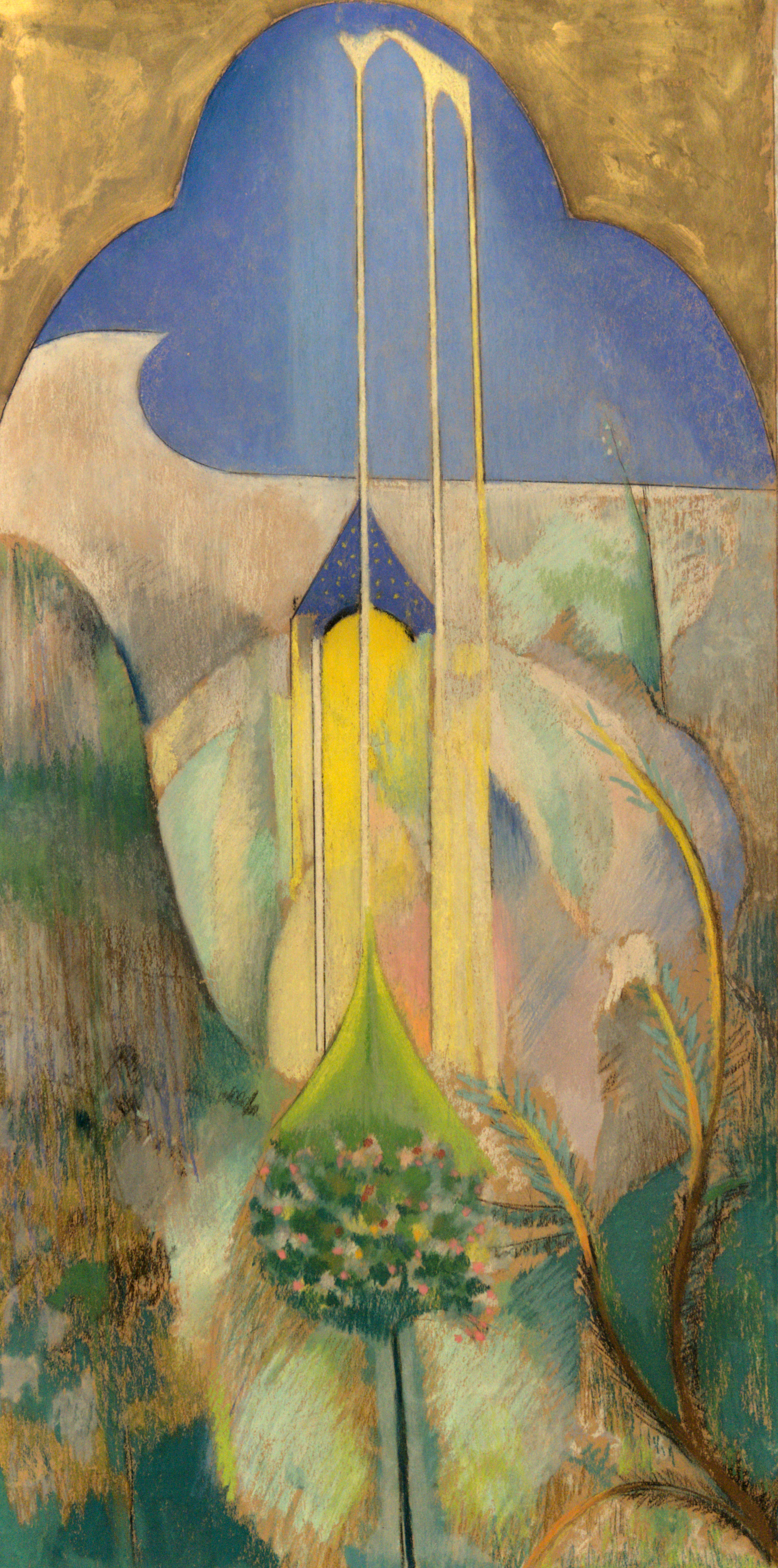
Joseph Stella (American, 1877–1946), Tree, Cactus, Moon, ca. 1928. Gouache on paper, 104.1 × 68.6 cm. Reynolda House Museum of American Art, Winston-Salem, North Carolina.
6.“Name One Thing New”by Seth Wieck: This six-line poem takes the Teacher of Ecclesiastes to task, responding to his cynical claim that “there is nothing new under the sun” (Eccles. 1:9) with a counterexample.
7.“For My Mother at Advent” by Brian Volck: The poet recalls a simple Advent tradition his mother established in his childhood and reflects on her spiritual legacy, her lifetime of Christ-inspired kindnesses that continue to pillow him. How might we soften the hardness of the world for others?
8. “Advent” by Suzanne Underwood Rhodes: This stunning poem makes unlikely intertextual connections, bringing Matthew 19:24 (one of Jesus’s hard sayings regarding wealth) to bear on John 1. Its unique angle on the Incarnation and its evocative imagery have inspired an experimental jazz composition and several paintings.
9. “An Hymn to Humanity” by Phillis Wheatley: “Lo! for this dark terrestrial ball / Forsakes his azure-pavèd hall / A prince of heav’nly birth!” So begins this poem on the Incarnation by Phillis Wheatley (ca. 1753–1784), the first African American to publish a book of poetry. In stanzas 2 and 3, God the Father dispatches the Son to establish his throne on earth, “enlarg[ing] the close contracted mind, / And fill[ing] it with thy fire.” The “languid muse” in stanza 5 refers to Wheatley herself, whereas the “celestial nine” are the ancient Greek inspirational goddesses of literature, science, and the arts. The “smiling Graces” is another classical reference.
Michael Wolgemut (German, 1434–1519), The Father sending the Son into the world, 1491. Hand-colored woodcut from the Schatzbehalter (published by Anton Koberger, Nuremberg), 43.7 × 27.5 cm. British Museum, London.
10. “In My Hand” by Sarah Robsdottir: Mary remembers the moment she conceived Jesus, one ordinary day when sitting down to a bowl of lentil stew.
Source: Aleteia, April 9, 2018
11. “The Risk of Birth, Christmas, 1973”by Madeleine L’Engle: Best known for her children’s novel A Wrinkle in Time, Madeleine L’Engle was also a poet. Here she compares our era to the one in which Jesus was born—both are characterized by violence and hate, and yet Jesus, the embodiment of divine love, willingly entered the peril.
12. “On Another’s Sorrow” by William Blake: Through the Incarnation, God lovingly, humanly, entered the world of human woe to experience it firsthand. “He doth give His joy to all,” Blake writes: “He becomes an infant small, / He becomes a man of woe, / He doth feel the sorrow too.” I featured this poem about Emmanuel, God-with-us, in a musical setting by singer-songwriter David Benjamin Blower in 2023 but was surprised that Blower omitted Blake’s final stanza, whose closing couplet I find striking, as it conveys Jesus’s continued identification with and compassion for humanity, how he moans alongside us in our suffering. For a different musical interpretation, also in an acoustic indie folk mode, see the one by Portland-based artist Michael Blake, from his 2021 album Songs of Innocence and Experience:
Source: Songs of Innocence and Experience (London, 1794). Public Domain.
13.“Missing the Goat”by Lorna Goodison: An immigrant from Kingston, Jamaica, to Toronto, Ontario, Goodison writes of the heightened feeling of exile but also of creative adaptations during the holidays as she tries to carry out the food traditions of her native country on a foreign soil where some of the ingredients are in more limited supply. For the sorrel wine, traditionally made with roselle (Hibiscus sabdariffa) petals, tropically grown, she has to make do with redbuds. And the local shops have run out of goat meat—“the host of yardies” (people of Jamaican origin) who’ve moved to the area have already bought it all up—so “we’ll feast then on curried some-other-flesh.” Despite the differences from home, Christmas is still Christmas, and she raises her “hybridized wassail cup” to her new place, her new neighbors (many of them, like her, also recent arrivals from the Caribbean), and the creation of new rituals in multicultural Toronto.
Source: Controlling the Silver (University of Illinois Press, 2010); compiled in Collected Poems (Carcanet, 2017)
14. “Word Made Flesh”by Kathleen Raine: Awarded the CBE (Commander of the Order of the British Empire) for her significant contributions to literature and culture, Raine has been described as a mystical and visionary poet. Here is her revoicing of John 1. What a powerful last two lines!
15.“Nativity”by Barbara Crooker: In the heavy dark, in the windy cold, “love is born in the world again” every December when we retell the story of Christ’s birth.
Gary Kuehn (American, 1939–), Straw Pillow, 1963. Straw, plaster. Ludwig Museum, Cologne, Germany, Inv. ML/SK 5185. Photo: Victoria Emily Jones.
16. “First Miracle”by A. E. Stallings: The first miracle Jesus performed, according to the Gospel of John, was turning water into wine. Stallings reflects on an earlier miracle performed by his mother’s body, and all birth-giving mothers’: turning nutrients from her blood into milk.
17.“What Sweeter Music Can We Bring” (or “A Christmas Carol, sung to the King in the Presence at Whitehall”)by Robert Herrick: “The Darling of the world is come”! Originally written as a song for soloists (each number corresponds to a different singer) and chorus, this poem reverses the typical seasonal imagery of Christmas, remarking how, at Jesus’s birth, “chilling Winter’s morn / Smile[s] like a field beset with corn” and “all the patient ground [is turned] to flowers.” The original music by Henry Lawes is lost, but many contemporary composers have written settings of the text, most famously John Rutter.
Source: Hesperides: Or, Works Both Human and Divine (London, 1648). Public Domain.
18.“Sharon’s Christmas Prayer”by John Shea: A five-year-old recounts the Christmas story, and when she reaches the clincher, she can’t hold back her glee.
19.“God”by D. A. Cooper: Riffing on Williams Carlos Williams’s “The Red Wheelbarrow,” this spare poem attends to the birth and death of the incarnate God, upon which so much depends.
Source: Reformed Journal, September 3, 2024
Katarzyna Malinowska (Polish, 1989–), Juxtapose (diptych), 2021. Digital painting, 20 × 30 cm.
20. “Lullaby after Christmas”by Vassar Miller: The speaker wishes sweet sleep for the newborn Christ child, wishes to keep him innocent of his fate for as long as possible—for “even God has right to / Peace before His pain.” Consisting of four sestets whose second, fourth, and sixth lines rhyme, the poem has a sing-songy quality that is jarring for the juxtaposition of words like “soft,” “warm,” and “tinkling” with the likes of “blood,” “gore,” and “die.”
21. “Journey of the Magi”by T. S. Eliot: Eliot wrote this poem shortly after his conversion to Christianity in 1927. Opening with a passage from a Christmas sermon by the seventeenth-century Anglican bishop Lancelot Andrewes, it is from the perspective of one of the magi, who made a long, toilsome journey in search of the meaning of a mysterious guiding star. After the magi’s encounter with the Christ child, they would never be the same; their paganism would no longer satisfy. The poem is about the transformative impact Christ has on those with humility enough to see him for who he is (having followed the light of revelation) and to worship him accordingly. And that transformation is in some ways painful, as it involves giving up some of the things one once held dear.
“Were we led all that way for / Birth or Death?” the magus asks. Jesus’s wasn’t the only birth they witnessed; they, too, were (re)born in Bethlehem. But spiritual rebirth is also a sort of death—the magi died to their old selves and false loves and loyalties. Thus, when they returned to Babylon, they felt like strangers in a strange land. They were now citizens of a different kingdom, and filled with a longing for its consummation.
Source: Journey of the Magi (Ariel Poems) (Faber & Gwyer, 1927). Public Domain.
Jörg Länger (German, 1964–), The Three Kings, 2013. Linocut and gesso on aluminum dibond, 38 × 38 cm. The linocut is after a 12th-century illumination from the St Albans Psalter, held at the Dombibliothek, Hildesheim, Germany.
22. “Twelfth Night”by Sally Thomas: (Scroll to second poem.) As the Christmas season draws to a close, holly berries shrivel and drop, the “candles drown themselves in waxen lakes,” “the tree’s a staring corpse,” and a spider has built a web across the mantel nativity. Thomas uses the passing of the season to reflect more broadly on the passing of time and our own dustiness and desiccation—and by contrast, the unchangeability of God.
23. Untitled poemby S. E. Reid: Most reflections on the New Year are full of enthusiastic goal-setting and go-getting, but Reid, gardening in her greenhouse in the crisp cold of January, describes a “fall[ing] backwards,” “dropping into the dark,” “shivering,” herself a seed, latent in the soil, trusting God that growth will come.
24. “Anna the Prophetess” by Tania Runyan: Forty days after Jesus’s birth, Maryand Joseph presented him in the Jerusalem temple. Runyan imagines this event from the perspective of Anna, a woman who was widowed young and thenceforth lived at the temple into old age, devoted to prayer, fasting, praise, and prophecy.
25. “The Work of Christmas”by Howard Thurman: Drawing on Jesus’s mission statement in Luke 4, the great African American theologian and civil rights leader Howard Thurman urges us to continue the work of Christmas—finding, healing, feeding, etc.—throughout the year. Listen to the simple yet vigorous choral setting by Elizabeth Alexander.