ART SERIES: Pallay: Andean Weaving of Liturgy and Design by Daniela Améstegui: Daniela Améstegui is a graphic designer from Cochabamba, Bolivia, who holds a master’s degree in theological studies from Regent College in Vancouver, with a specialization in Christianity and the arts. Her work “revolves around exploring faith, social justice, and Christian contextualization through design” and “reflects her commitment to using design as a tool for expressing and exploring theological concepts,” she says. She currently lives in Langley, British Columbia, with her husband and two young children, working as a freelancer.
Améstegui’s final Integrative Project in the Arts and Theology for her master’s program was Pallay: Andean Weaving of Liturgy and Design, a series of seven digital illustrations, one for each of the major seasons/feasts of the liturgical year: Advent, Christmas, Epiphany, Lent, Easter, Pentecost, and Ordinary Time. The designs are inspired by Andean textile art and culture. You can view the full series at the link above from Regent College’s Dal Schindell Gallery, where the works were first exhibited in early 2022, but also listen to this wonderful online talk Améstegui gave about Pallay in 2020 for INFEMIT’s Stott-Bediako Forum, where she discusses not only her motivation and influences but also the content of each specific piece:
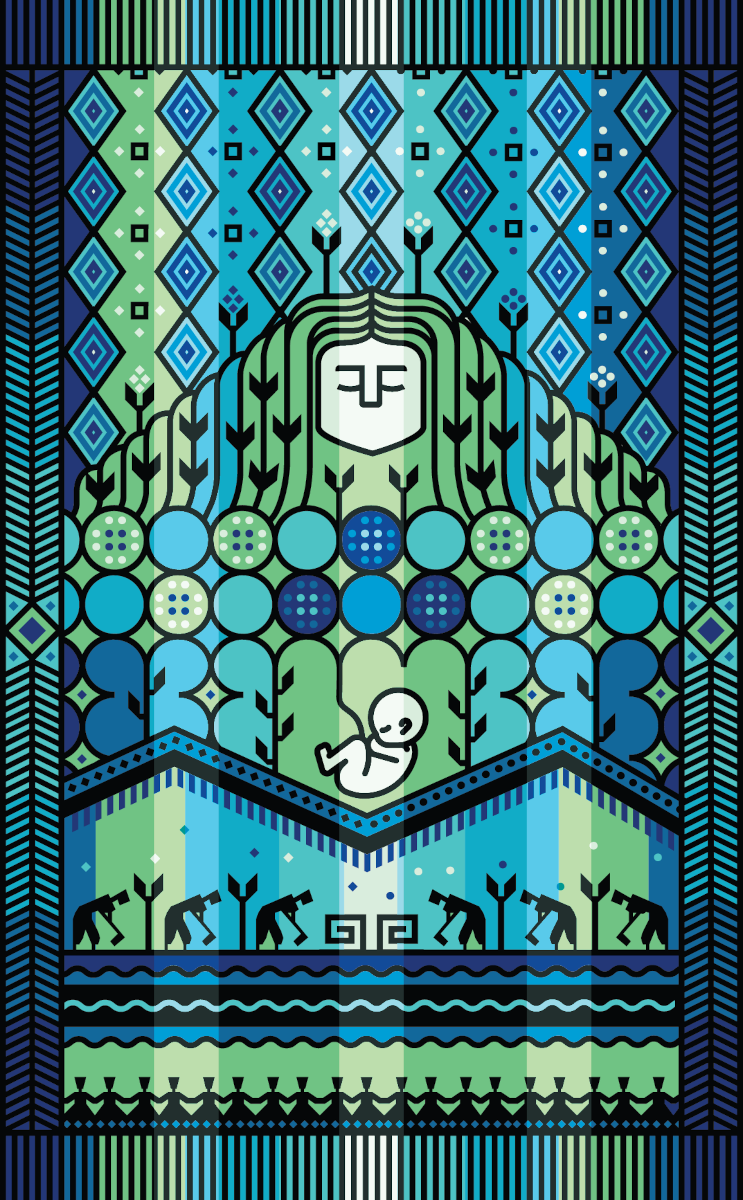
Whereas those of us in the northern hemisphere associate Advent with cold, darkness, and the onset of winter, in the southern hemisphere Advent falls in early summer, a time when the earth is most fertile and farmers plant their seeds. In her Advent design, Améstegui connects Mary carrying the seed of new life within her with Pachamama (Mother Earth).
Daniela Améstegui (Bolivian, 1990–), Adviento (Advent), 2019–20, from the digital illustration series Pallay: Andean Weaving of Liturgy and Design. Used with permission.
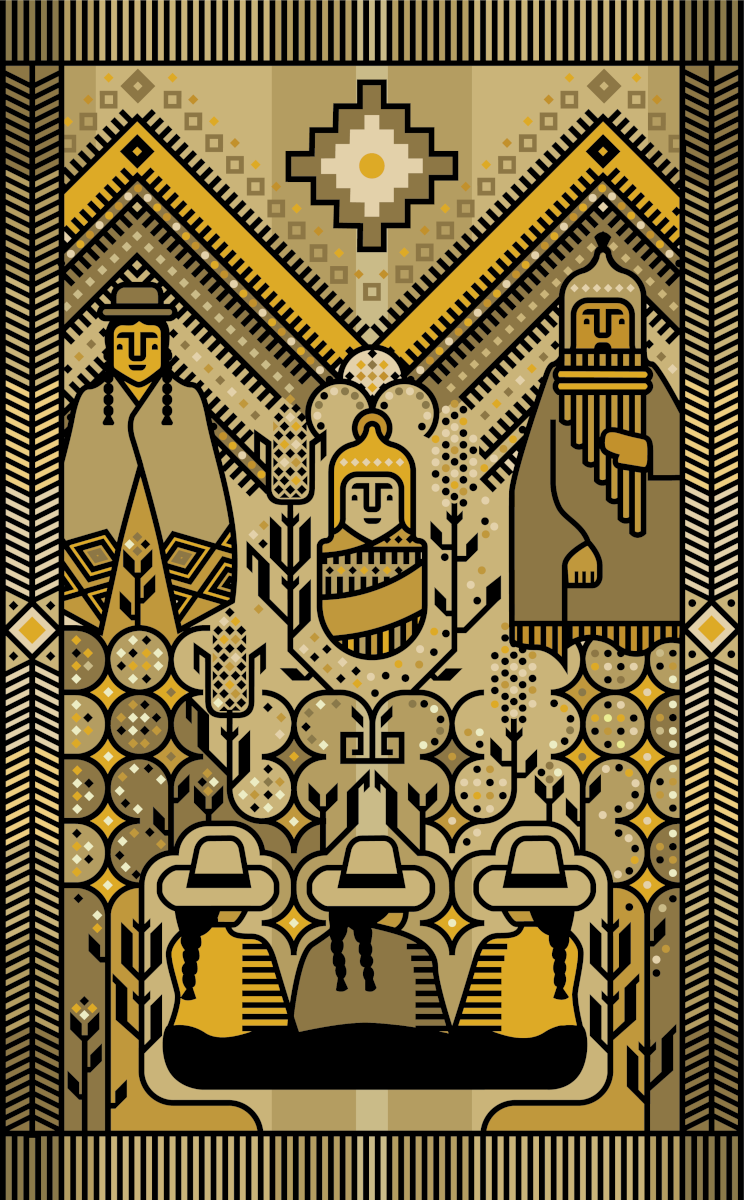
In Bolivia, Christmas takes place during a season of harvest, so in her Christmas design, Améstegui places Jesus in the center between crops of corn and quinoa, the two main agricultural foods cultivated in the country. Mary wears braids and a bowler hat and Joseph plays the zampoña (Andean panflute), and at the bottom three cholitas, Indigenous women from the Bolivian countryside, gather reverently to greet the Christ child.
Daniela Améstegui (Bolivian, 1990–), Navidad (Christmas), 2019–20, from the digital illustration series Pallay: Andean Weaving of Liturgy and Design. Used with permission.
Améstegui does not have a website just yet but tells me she plans to launch one in 2025. If you would like to purchase one or more of her Pallay pieces, you can contact her at daniela@amestegui.com.
Thank you to blog reader Nicole J. for alerting me to this striking series!
+++
VIDEO COLLECTION: Casa del Catequista (CADECA) chapel paintings: As chance would have it, the same week I learned about Daniela Améstegui’s work, a different blog reader, Mark M., emailed me a link to some videos his Langham Partnership colleague Paul Windsor took during a recent trip to Bolivia. They record the many paintings, most by the late Quechua artist Severino Blanco [previously], inside the chapel of CADECA in Cochabamba, a place where men and women are trained as Christian leaders who then go out to serve their rural communities. They portray scenes from the Old and New Testaments, the parables of Jesus, and Latin American church history, including a remarkable liberation theology–inspired Resurrection, in which Jesus breaks down the doors of death and hell, holding high a cacique’s staff and leading the people of Bolivia into their future. Here’s a 360-degree view captured by Windsor, but visit the boldface link to see additional videos that narrow in on particular portions.
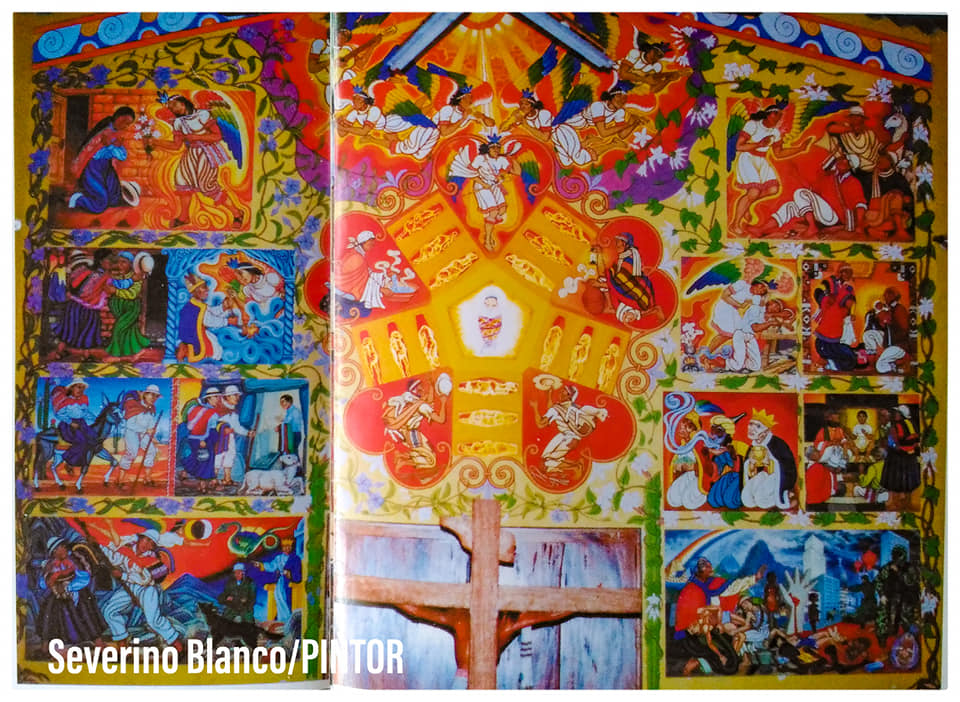
Severino Blanco (Quechua [Bolivian], 1951–2020), Infancy of Christ painting cycle, 1985. Chapel of the Casa del Catequista (CADECA), Cochabamba, Bolivia.
On the west end of the chapel (where people enter the space) is an Infancy of Christ cycle—reproduced here from a scan of a pamphlet, it appears. In the center is a Nativity, the Christ child painted over a pane of glass through which natural light comes gleaming in (see a closer view). The oblong shapes radiating out from the center are also glass, onto which the artist has (I think) etched lambs in various stages of prostration. On the sides, two villagers come with hot water and towels, and at the bottom two shepherds kneel before the Savior, removing their hats as a sign of respect. At the top, a host of angels with rainbow-colored wings and indigenous instruments sing Christ’s praises.
To the left of the Nativity are six scenes: (1) The Annunciation to Mary, (2) The Visitation, (3) The Annunciation to Zechariah, (4) The Journey to Bethlehem, (5) No Room at the Inn, and (6) The Flight to Egypt. To the right are (7) The Annunciation to the Shepherds, (8) The Annunciation to Joseph, (9) The Presentation in the Temple, (10) The Adoration of the Magi, (11) Jesus with the Scholars in the Temple, and (12) The Massacre of the Innocents.
+++
SONGS:
>> “Admirable Consejero” (Wonderful Counselor) by Santiago Benavides:Santiago Benavides is a Colombian singer-songwriter living in Toronto. On his Facebook page he describes his musical style as “trova-pop-bossa-carranga worship.” This song he wrote is a setting of Isaiah 9:2, 6–7 in Spanish. In the video, he’s the guitarist with the red-tinted glasses.
>> “The Word Became Flesh” by John Millea: John Millea is “a storyteller with a guitar,” singing in the tradition of Americana, folk, and gospel “about life and all of its joys, sorrows, and struggles.” He’s one of the artists I support through Patreon. This was the first song of his I encountered, and it’s one of my favorites, engaging with John 1:1–3, 14 in a wholly unique way!
In contrast to everyone and everything else in the universe, Millea explains, God had no beginning point, and all that is can in some way be traced back to him, the first link in a massive chain of cause and effect. So here Millea playfully traces his guitar all the way back to God—from the store he bought it at in Illinois, to the factory in Pennsylvania they ordered it from, to the mill in Washington that supplied the wood, to the Alaskan forests whence the tree was logged, and so on and so forth, imagining many thousands of years of fallen and dispersed tree seeds that traversed seas and continents, with an ultimate source in a tree planted in Eden by the Word of God.
When he hits on Eden, he starts moving forward again, through the story of creation, fall, and redemption in Christ, the divine beginningless One who graciously and mysteriously entered human history, born of a woman named Mary.
>> “Mary Had a Baby”: Arranged by Roland Carter, this African American spiritual is performed by the Nathaniel Dett Chorale, featuring the amazing mezzo-soprano Melissa Davis. It’s from their 2003 album An Indigo Christmas, the tracks taken from two live concerts given at the Church of St. George the Martyr in Toronto.
>> “Що то за предиво” (Shcho to za predyvo) (Behold a Miracle): This Ukrainian folk carol is performed by Trioda (Тріода), a musical group consisting of Andrii Gambal, Volodymyr Rybak, and Pavel Chervinskyi.
What is this awe-inspiring miracle? There is great news on earth! That the Virgin Mary gave birth to a son. And upon birthing him, she declared, “Jesus—my son!”
And the aging Joseph stands nearby in awe Of Mary having given birth to a son. And he prepares the swaddling for Jesus Christ. And Mary swaddles him, and scoops him to her heart— The pure Virgin Mary!
Below are two performances of this Advent song. The first is by a man and woman from the Parroquía Divino Niño Jesús in Morelia, Mexico, and the second is by the choir Tallo De Amor, from Mexico City:
Toda la tierra espera al Salvador y el surco abierto, la obra del Señor; es el mundo que lucha por la libertad, reclama justicia y busca la verdad.
Dice el profeta al pueblo de Israel: “De madre virgen ya viene Emmanuel,” será “Dios con nosotros,” semilla será, con él la esperanza al mundo volverá.
Montes y valles habrá que preparar; nuevos caminos temenos que trazar. él está ya muy cerca, venidlo a encontrar, y todas las puertas abrid de par en par.
En una cueva Jesús apareció, pero en el mundo está presente hoy. Vive en nuestros hermanos, con ellos está; y vuelve de nuevo a darnos libertad.
ENGLISH TRANSLATION:
All earth is waiting to see the Promised One, and the open furrows, the sowing of the Lord. All the world, bound and struggling, seeks true liberty; it cries out for justice and searches for the truth.
Thus says the prophet to those of Israel: “A virgin mother will bear Emmanuel,” for his name is “God with us,” our brother shall be, with him hope will blossom once more within our hearts.
Mountains and valleys will have to be made plain; open new highways, new highways for the Lord. He is now coming closer, so come all and see, and open the doorways as wide as wide can be.
In the lowly stable the Promised One appeared, yet, feel his presence throughout the earth today, for he lives in all Christians and is with us now; again, with his coming he brings us liberty.
Trans. Gertrude C. Suppe
Alberto Taulé (1932–2007) from Barcelona, Spain, was a Roman Catholic priest and a composer of liturgical music who “believed that every parish should have a dynamic, evolving repertoire”—that “quality music and the regular introduction of new songs are vital to a parish’s spiritual health,” as his Catholic Online obituary reads. Working in the wake of the Second Vatican Council (1962–65), which sanctioned the use of vernacular languages and musical styles in the Mass, Taulé wrote new worship songs that could be grafted into the preexisting liturgical structure, used during the entrance procession, the offertory, the Eucharist, or the closing.
In Spanish-speaking church communities around the world, “Toda la Tierra” is sometimes used as the entrance song for one of the four Advent Sundays. Since the United Methodist Church commissioned an English translation from Gertrude C. Suppe and added the song (with bilingual lyrics) to its hymnal in 1989, it has become more widely known in English-speaking communities as well.
The Evangelical Lutheran Church in America published a different English translation by Madeleine Forell Marshall in the 2006 edition of its hymnal, Evangelical Lutheran Worship; hers preserves the aabb rhyme scheme of the original Spanish and begins with the line “All earth is hopeful, the Savior comes at last!”
The Spanish verb esperar means both “to wait” and “to hope” and is thus especially fitting to describe the action of the church during Advent.
This is the third installment of my annual “25 Poems for Christmas” series. Included too, on the front end, are poems for Advent, the four-week season of preparation, hope, and expectation leading up to Christmas.
1. “Advent (III)” by W. H. Auden, from For the Time Being: Voiced by the Chorus, who cry out from “a dreadful wood / Of conscious evil,” this is the third section of part 1 of Auden’s book-length Christmas poem in nine parts, For the Time Being—“the only direct treatment of sacred subjects I shall ever attempt,” he said. He wrote the poem in 1941–42. He had originally conceived it as the libretto of an oratorio that Benjamin Britten would write the music for, but the text turned out to be too complex, and Britten abandoned the project. The final two lines of this section set us up for the seemingly impossible feat of divine incarnation: “Nothing can save us that is possible: / We who must die demand a miracle.”
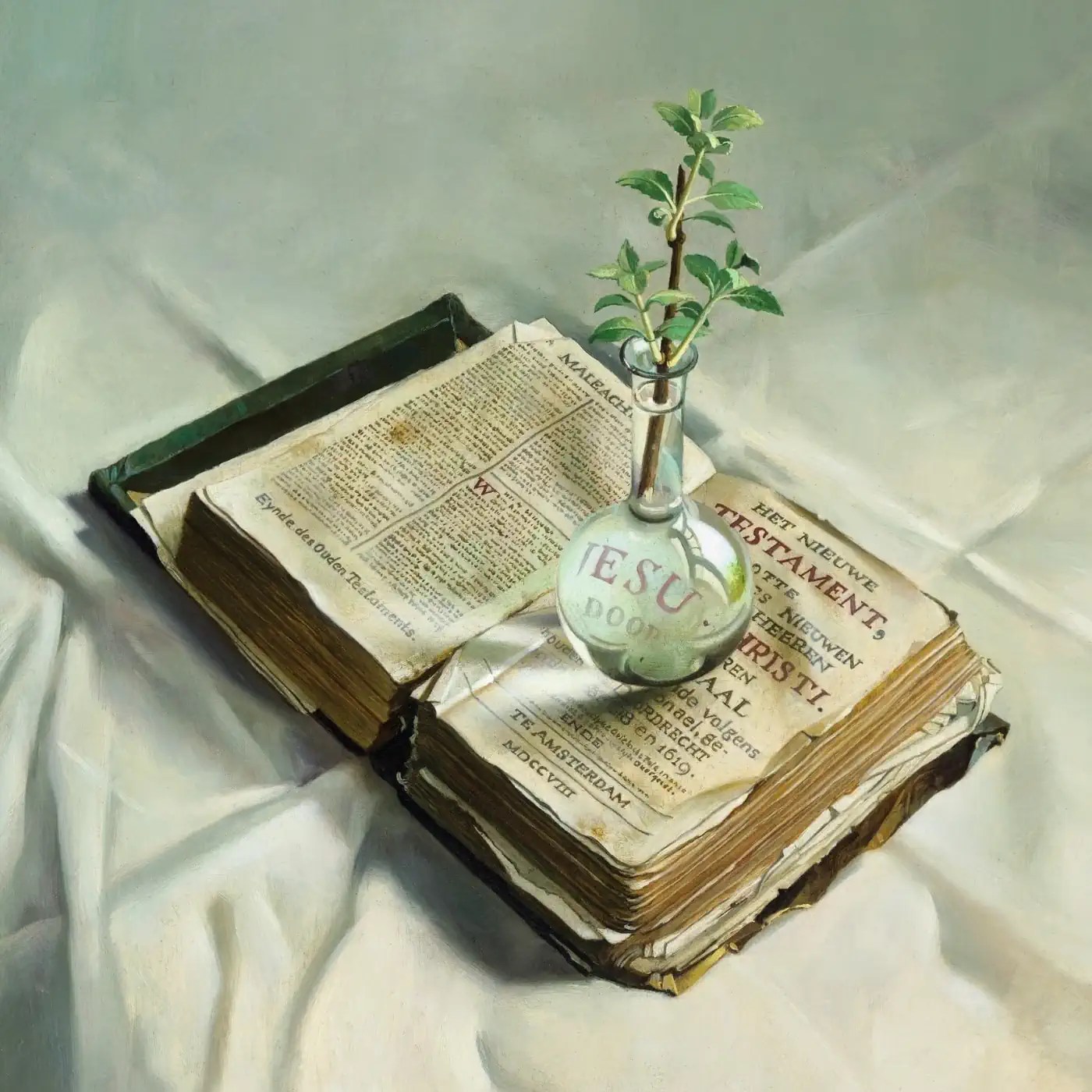
3. “O Orient Light” by James Ryman: Loosely influenced by the O Antiphons (a set of short chants used in medieval Advent liturgies), this Middle English lyric is by the fifteenth-century Franciscan friar James Ryman of Canterbury; it’s one of 166 sacred poems he published in a 1492 collection. Each stanza consists of one rhyme repeated six times, and the Latin refrain translates to “O Christ, king of the nations, / O life of the living.” The fourth stanza is a standout, connecting the salvation wrought by Christ to the healing properties of plants: “O Jesse root, most sweet and sote, / In rind and root most full of bote, / To us be bote, bound hand and foot, / O vita viventium.”
Source: Cambridge University Library, MS Ee. 1.12; compiled in The Early English Carols, ed. Richard Leighton Greene, 2nd ed., revised and enlarged (The Clarendon Press, 1977). Public Domain.
Henk Helmantel (Dutch, 1945–), Nieuw Leven II (New Life II), 1999 (after the 1972 original that was stolen). Oil on canvas, 27 × 24 cm.
4.“Merger Poem”by Judy Chicago: “Merger Poem” is an aspiration that artist Judy Chicago wrote to accompany her 1979 monumental artwork The Dinner Party, a celebration of the richness of women’s heritage, expressed as place settings around a table, that is housed at the Brooklyn Museum. Her vision in the poem is not theistic, at least not explicitly so, but she uses the language of “Eden,” and her descriptions evoke passages from Isaiah about a future harmony, a merging of heaven and earth, in which justice and equity are achieved at last—not to mention the strong eschatological tones that feasting has in Christianity. Each line begins with “And then,” cumulatively generating a longing in the reader for “then” to arrive.
5.“truth”by Gwendolyn Brooks: “And if sun comes / How shall we greet him?” the speaker asks at the opening of this poem. The sun here represents truth, revelation, illumination, which we may seek with weeping and prayer but which can be dreadful when it actually comes. It’s often more comfortable to stay asleep in the dark than to confront the stark brightness of day. But oh, what we miss when we do! Gwendolyn Brooks uses the pronoun “him” for the sun, and it’s easy to read the poem Christologically: you can read it in the sense of any of Christ’s three comings—as a baby in Bethlehem, in personal, inner ways (he reveals himself, and seeks entrance, to human hearts), or as a king and judge at the end of time. Did you catch the reference to Revelation 3:20?
Source: Annie Allen (Harper & Row, 1949); compiled in Blacks (Third World Press, 1987)
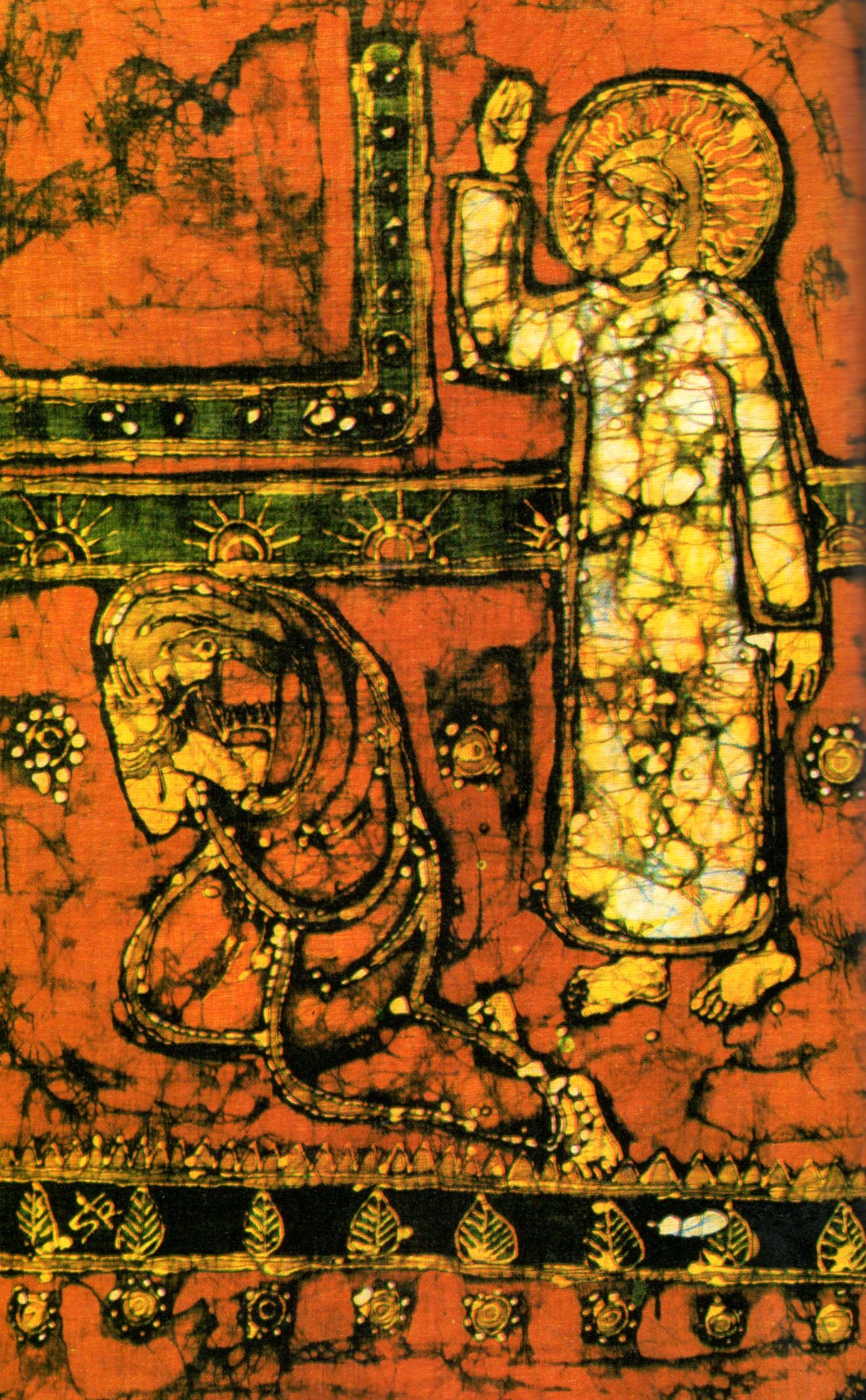
P. Solomon Raj (Indian, 1921–2019), Waiting for My Lord, batik, published in Living Flame and Springing Fountain (ISPCK, 1993)
6. “Advent” by Mary Jo Salter: In this poem a mother and daughter are building a gingerbread house when a wintry gust tears a shutter on their actual house off its hinges, the shock of the thud causing, inside, a gingerbread wall to split. I think “house,” here, could be a metaphor for a faith structure; a house of belief. Shutters are doing a lot of work in the text: one falls off in a storm, and the daughter’s Advent calendar consists of twenty-five shutters, one opened each day until Christmas to reveal a Bible verse or narrative scene.
I’m not quite sure how to interpret the poem overall, but it seems to be addressing themes of (in)stability, brokenness and repair, the desire to believe versus the impulse to shut out belief, openness (“The house cannot be closed”), (dis)enchantment, the mother-child bond, and safety and danger (the Christmas story, like faith itself, characterized by both). I can’t decide if the “blank” in the final tercet sounds hopeful or bleak: does it connote possibility or lack? And is the mother suggesting in the final line (a repurposing of the final line from stanza 15) that what’s most real to her is not Mary and the baby Jesus but herself and her own child, right there in that moment?—or is she finding a point of kinship with Mother Mary in the love she feels for her offspring?
7. “Nativity”by Li-Young Lee: “What is the world?” asks a little boy in the darkness; and again as an adult. A poem of spiritual questing, Li-Young Lee’s “Nativity” deals with existential questions, ending with a tercet that evokes Isaac Watts’s famous carol line “Let every heart prepare him room.” Within us we must make a manger, a “safe place,” to receive the wild God.
8.“Nazareth” by Drew Jackson: Ancient Nazareth, where Jesus grew up, was an insignificant village that many believed no good could come out of (see John 1:46). This poem by public theologian Drew Jackson accentuates Jesus’s origins there, his identity as a “southsider” (Nazareth is in southern Galilee). Today some urban neighborhoods on the “South Side” are disparaged, their residents dismissed as poor and lacking education and potential. God chose to incarnate in a rural neighborhood with a similar reputation, not simply dropping in and then leaving but, as the second person of the Trinity, being formed and nurtured in that environment. “Nazareth” is from Jackson’s debut poetry collection, in which he works his way through the first eight chapters of Luke’s Gospel, drawing out the theme of liberation and making contemporary connections.
9. “The Visitation”by Calvin B. LeCompte Jr.: The poet imagines the fields that Mary passes on her way to her cousin Elizabeth’s house joining in the Magnificat, praising the Savior in her womb.
10.“My Darling” by Alexandra Barylski: Mary and Joseph are cuddling in bed as she reflects on the divine interventions that brought and kept them together. The poem references the legend, originating in the second-century Protoevangelium of James and repeated in the seventh-century Gospel of Pseudo-Matthew, that Joseph was chosen to wed Mary when from his staff, submitted to the high priest along with those of other single men, there miraculously emerged a dove. Mary expresses appreciation for Joseph’s “visionary love,” patience, and courage in their relationship, his spiritual leadership and support.
Source: Reformed Journal, May 11, 2021
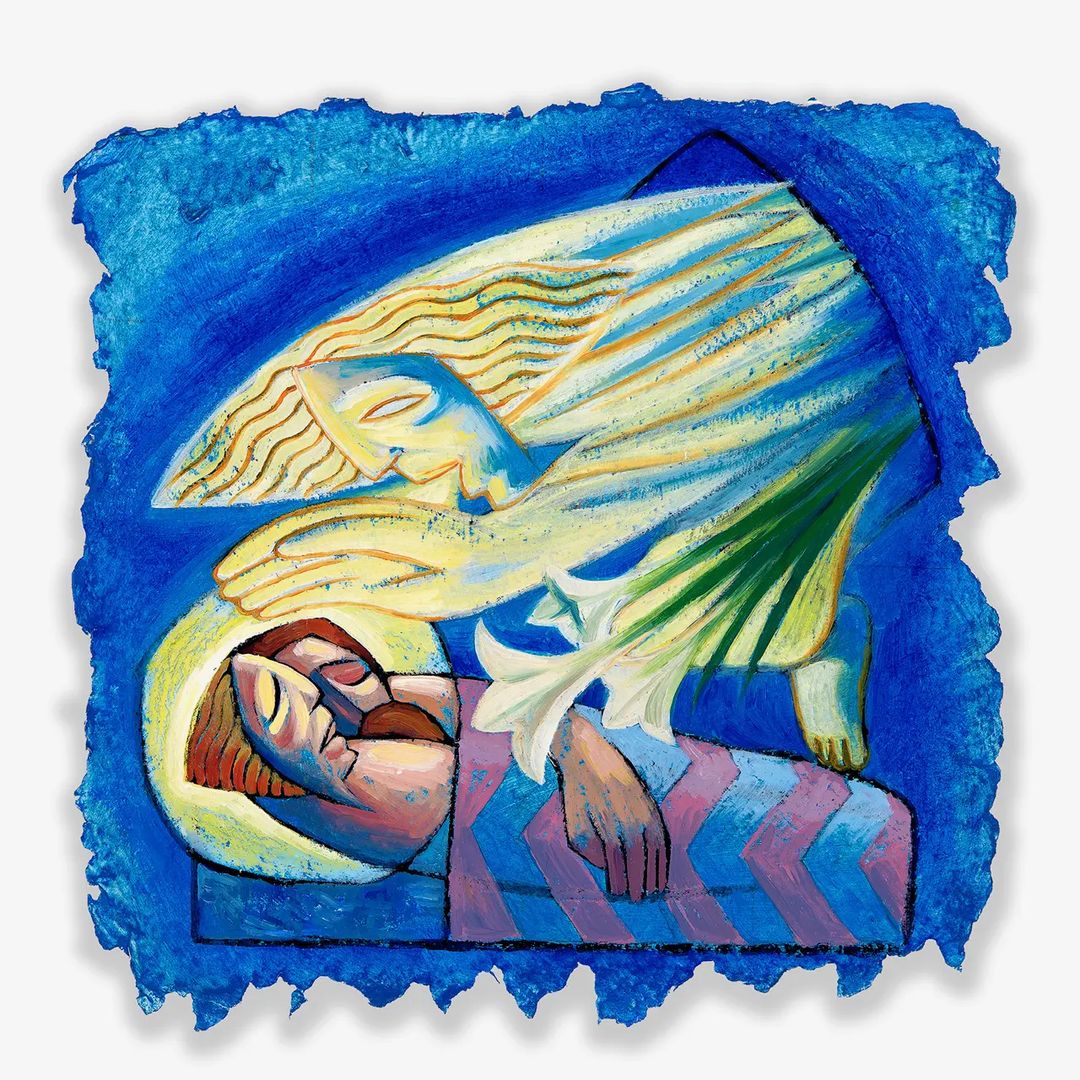
Nicholas Mynheer (British, 1958–), Annunciation, 2017. Oil on handmade paper, 20 × 20 cm.
11. “A Blessing for the New Baby” by Luci Shaw: The speakers of this poem give a lovely benediction over Christ—preincarnate and then embryonic in the first stanza, then out of the womb in the second and third.
12.“Love’s Delights” by Meister Eckhart, rendered by Jon M. Sweeney and Mark S. Burrows: The medieval German mystic Meister Eckhart didn’t write poetry, but many of his sermons have a poetic quality to them, so contemporary poet Mark S. Burrows and writer Jon M. Sweeney, working from an English translation of the Middle High German by Frank Tobin, reworked select excerpts into verse. Adapted from a sermon Meister Eckhart preached on Isaiah 60:1, this poem meditates on the downward movement of love that raises up.
13. “Word Become Flesh” by Seth Wieck: Pregnancy, childbirth, and nursing take a toll on the body. Voiced by Mary, this poem highlights the bodily realities of Jesus’s first coming—Mary swollen, bruised, cracked, and bleeding. She was wounded for our transgressions, in the sense that she endured kicks to the ribs, postpartum hemorrhoids, etc., in order to bring forth our Savior, and by these wounds, because they gave life to Jesus, our healing was made possible. The last sentence is a zinger. Mary gives (physical) birth to Jesus, and he gives (spiritual) birth to her.
14.“Prince of Peace” by Brian Volck: The poet provides his own introduction to this poem on his website: “Octavian Augustus, first emperor of Rome, was known by many titles, including Divi Filius (Son of God) and Princeps Pacis (Prince of Peace). An inscription in Asia Minor states that Augustus’s birth ‘has been for the whole world the beginning of the gospel (εύαγγέλιον) concerning him.’ How strange, then, to use the same names for a contemporaneous but obscure Palestinian Jew, whose understanding of peace, politics, and power was so radically different. How strange to have so long diluted the scandal of the gospel (good news) with accommodations to an Augustan vision of a peace built on the use or threat of lethal violence. Here’s a Christmas poem calling attention to that contrast in a conscious act against forgetting.”
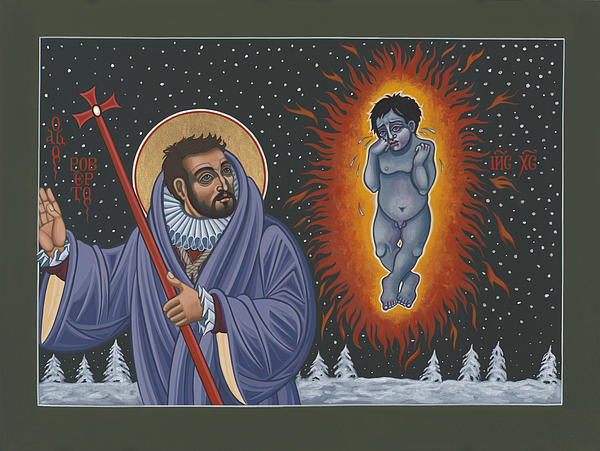
15.“The Burning Babe” by Robert Southwell: Consisting of sixteen lines in iambic heptameter, this poem by the Jesuit martyr-saint Robert Southwell [previously] relates a mystical vision of the Christ child, who appears to the narrator on a cold winter’s night, enflamed and hovering in midair. The poem develops the metaphor of the love of Christ as a fiery furnace that both warms and purifies.
Source: St Peter’s Complaint, and Other Poems (London, 1595). Public Domain.
William Hart McNichols (American, 1949–), Holy Poet-Martyr St. Robert Southwell and the Burning Babe, 2015. Acrylic on wood. [purchase reproduction]
16.“Advent 1966” by Denise Levertov: This poem is shocking in its horror. Written in 1966, it picks up Southwell’s image of the Burning Babe and transposes it to the napalmed villages of Vietnam, where children were being physically (not symbolically or ethereally, as in Southwell’s poem) set on fire by chemical weapons deployed by the US military. Denise Levertov [previously], who was an antiwar activist as well as a poet, uses repetition to strong effect, conveying a sense of the seemingly relentless carnage (the war produced an estimated two million civilian casualties, more than half the total number). Though addressing a specific historical event, this elegy for the innocent provokes us to consider where similar atrocities are happening today.
Source: To Stay Alive (New Directions, 1971); compiled in Making Peace, ed. Peggy Rosenthal (New Directions, 2006)
17.“Christmas Eve”by Christina Rossetti: The Victorian poet Christina Rossetti [previously] opens this lyric with two paradoxes that characterize Christmas—bright darkness and chilly warmth—referencing the general mood of cheer and comfort that coexists with the bleak English midwinter. Why this mirth? Because “Christmas bringeth Jesus, / Brought for us so low.” Jesus was brought down from heaven in the Incarnation, but he would be brought lower still: his spirits sunken in Gethsemane, his body buried in a grave. The second stanza evokes a wedding: dressed in a bridal gown of gauzy snow, earth receives her heavenly Bridegroom.
Source: Time Flies: A Reading Diary (London, 1885); compiled in The Complete Poems (Penguin, 2001). Public Domain.
18. “Hill Christmas” by R. S. Thomas: In a poor rural Welsh village, parishioners make their way across snowy fields, weather-beaten, on Christmas to feed their bodies and souls with a snow-white bread loaf and crimson wine. In the celebration of the Eucharist, they hear love cry “in their heart’s manger.” Then they return to the day’s chores. I think the last line refers to a wayside crucifix.
Source: Laboratories of the Spirit (Macmillan, 1975); compiled in Collected Poems, 1945–1990 (Dent, 1993)
19.“back in the day” by Carl Winderl: In a practice known as “settinglambs on,” when a baby lamb dies in birth, sheep farmers will often take a live lamb (an orphan, or a twin or triplet from another ewe) and cover it in the skin of the deceased one so that, when the grieving mother smells the familiar scent of her deceased offspring, she accepts the lamb as her own. In Carl Winderl’s poem, Mother Mary reflects on that practice and has a premonition of a dead lamb.
Source: Christian Century, December 27, 2023
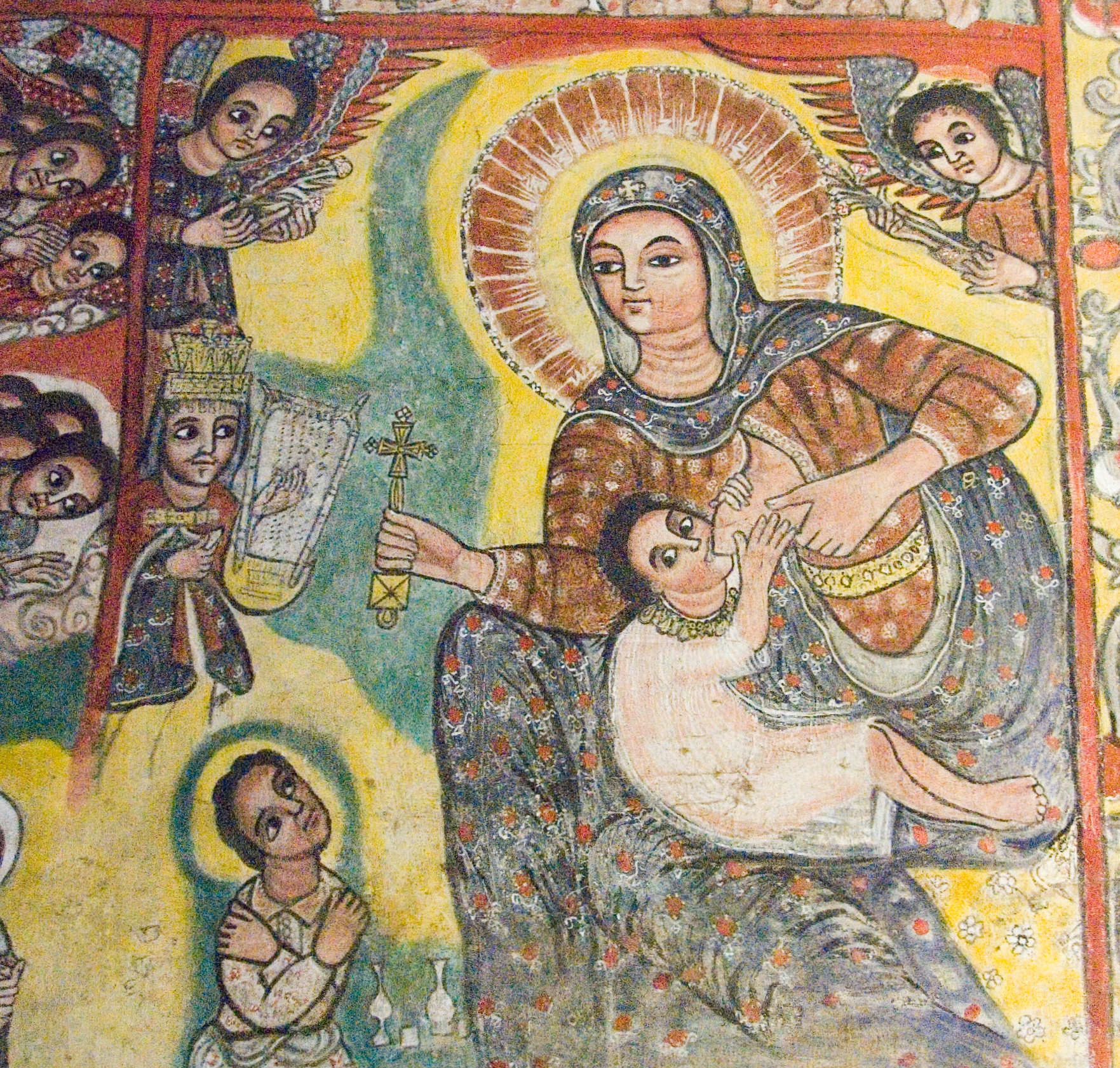
20.“Hymn 4 on the Nativity of Christ” by Ephrem the Syrian: St. Ephrem, a church father from the fourth century, wrote his theology in verse and is one of the most significant Early Christian hymnists. His Nativity hymns are my favorite; I’m particularly struck in Hymn IV by his meditation on how the Christ who suckles at Mary’s breast also gives suck to the whole world. “He is the Living Breast of living breath,” as Kathleen E. McVey translates the Syriac.
Source: Ephrem the Syrian: Hymns, trans. Kathleen E. McVey (Classics of Western Spirituality) (Paulist Press, 1989)
Maria lactans, late 18th century. Fresco, Church of Narga Selassie, Dek Island, Lake Tana, Ethiopia. Photo: Alan Davey.
21. “Nativity” by Scott Cairns: This is the first in a pair of ekphrastic poems called “Two Icons,” in which the poet, who is Greek Orthodox, describes an icon from his home prayer corner. The first three stanzas engage in constructive wordplay: Jesus is wrapped in swaddling bands by his mother, and she is rapt—enraptured, wholly absorbed—by him. She holds him in her gaze and in her hands, and is beholden to him. Icons are about just that: beholding Christ and the sacred mysteries and deepening our affection for the One who holds us in affection. In Nativity icons our gaze is directed to “the core / where all the journeys meet, appalling crux and hallowed cave and womb,” where we are beckoned, like the magi, to bow before the incarnate God.
22.“Star of the Nativity” by Joseph Brodsky: The Nobel Prize–winning Russian poet Joseph Brodsky was born into a Jewish family, but he was captivated by the story of Jesus’s birth and wrote many poems about it. The final stanza of this one gives us the unique perspective of the Star of Bethlehem, looking down—the Father’s beaming pride.
Source: Nativity Poems (Farrar, Straus and Giroux, 2001)
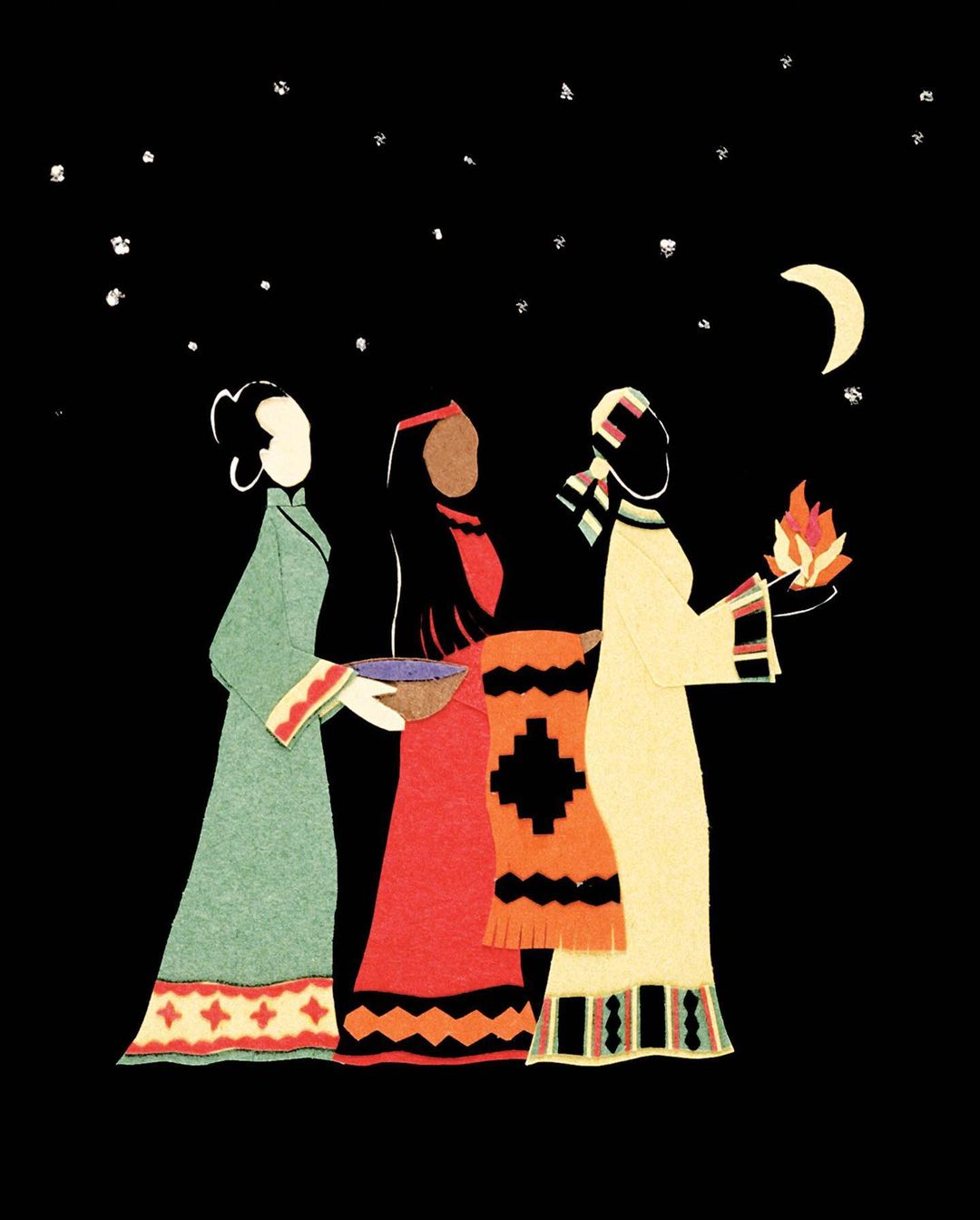
23. “Wise Women Also Came” by Jan Richardson: The Gospel of Matthew tells us that when Jesus was born, wise men came from the east to worship him. But wise women came too, Jan Richardson surmises. They came during Mary’s labor—midwives assisting with the birth. They came with lamps, fresh water, and blankets.
Jan Richardson (American, 1967–), Wise Women Also Came, 1995. Collage. [purchase reproduction]
24.“Green River Christmas” by John Shea: Theologian and storyteller John Shea reflects on how, after experiencing something scary or unpleasant (like getting a shot or a teeth cleaning), mothers often give their child a treat. Christmas is a kind of supreme treat after the penitential season of Advent, during which we confronted the state of our spiritual health and remedied any shortfalls. Think, too, of the liturgy of (somber) confession and (sweet) pardon every Sunday at church, a prelude to the feast of bread and wine. At the Lord’s Table, we are fed—the gifts of God for the people of God. The Eucharist is the subtext of the final stanza, where Shea describes the presentation of Jesus in the temple forty days after his birth. There he is received by “the long-starved arms / of Simeon and Anna.” They had hungered for salvation, endured a long period of waiting; now they are filled.
25.“Taking Down the Tree” by Jane Kenyon: “Tick, tick, the desiccated needles drop.” This poem is about the passing of time—the death of another year—and the glumness that often sets in after the holidays are over, but it’s also about the storage of memories. In many households, Christmas ornaments are a multigenerational collection of memories. As with hanging them on the tree, taking them off and packing them away is a ritual that may prompt us to revisit certain past experiences or periods in our life. After we unplug the stringed lights and wrap up the baubles for safekeeping, then what? How will we inhabit the twelve months until next Christmas?
All photos in this post, except for the last one (of the processional icon), are my own.
(Note: WordPress seems to have disabled the feature that allows you to expand an image upon clicking, but if you’re reading on a computer, you can right-click an image and open it in a new tab to view it in full resolution; if you’re reading on a phone, you can pinch to zoom.)
Located in the Horn of Africa and with access to the Red Sea, Nile River, Mediterranean Sea, and Indian Ocean, Ethiopia stands at the nexus of historical travel, trade, and pilgrimage routes that brought it into contact with surrounding cultures and influenced its artistic development. Coptic Egypt, Nubia, South Arabia, Byzantium, Armenia, Italy, India, and the greater African continent were among those influencers. But Ethiopia not only absorbed influences; it transmitted them too.
A major art exhibition is centering Ethiopia’s artistic traditions in a global context. For Ethiopia at the Crossroads at the Walters Art Museum in Baltimore (running through March 3), curator Christine Sciacca has brought together more than 220 objects from the Walters’ own extraordinary Ethiopian art collection and private and institutional lenders both domestic and international. Icons, wall paintings, processional crosses and hand crosses, illuminated Gospel books and psalters, sensuls (chain manuscripts), healing scrolls, and more are on display throughout the galleries, whose walls have been painted bright green, yellow, and red—the colors of the Ethiopian flag. To round off the exhibition, guest curator Tsedaye Makonnen, an Ethiopian American multidisciplinary artist, was tasked with curating a few works from contemporary artists of the Ethiopian diaspora.
The majority of objects are Christian, made for liturgical or private devotional use. Ethiopia is one of the world’s oldest Christian nations: in the early fourth century, persuaded by a missionary from Syria, King Ezana of Aksum embraced Christianity, and it has been the dominant religion of Ethiopia ever since. But the exhibition does also include some Islamic and Jewish objects.
One of the first works you’ll encounter is a mural that would have originally been mounted on the outer wall of an Ethiopian Orthodox church sanctuary (mäqdäs), portraying the Nativity, the Presentation of Christ in the Temple, and the Adoration of the Magi.
Nativity, Presentation of Christ in the Temple, and Adoration of the Magi, Ethiopia, 18th century. Glue tempera on overlapping canvas pieces mounted to a new stretched canvas, 49 3/16 × 66 15/16 in. (124.9 × 170 cm). Walters Art Museum, Baltimore. [object record]
Remarkably, at the Nativity, there is a feast taking place, and Jesus is feeding his mother with what looks like a Communion wafer! As the theologian Lester Ruth has said, “The sound from most baby beds is a cry to be fed. But the cry from the manger is an offer to feed on his body born into this world.”
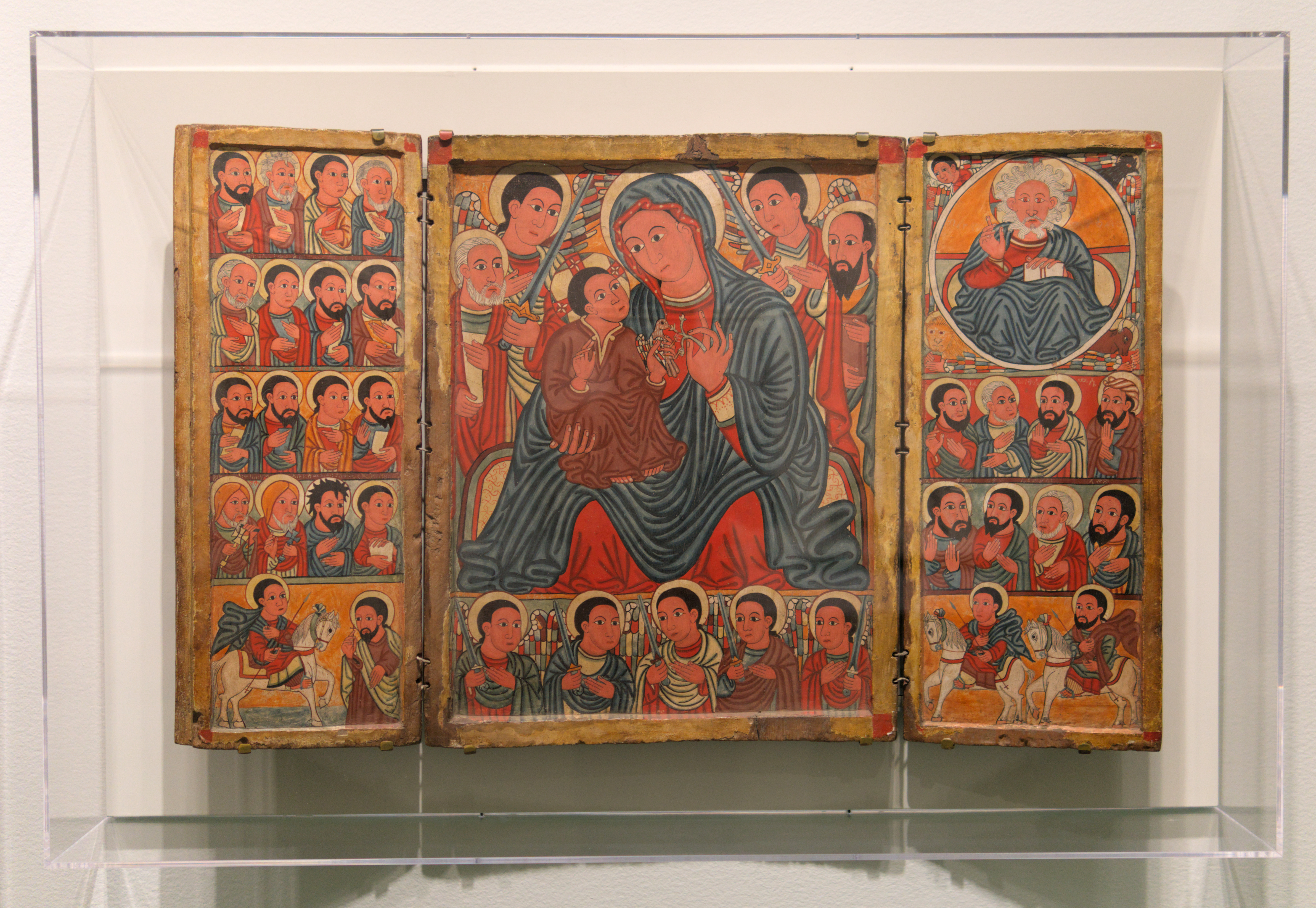
One of history’s most famous Ethiopian painters is Fre Seyon, who worked at the court of Emperor Zara Yaqob (r. 1434–1468) and was of the first generation of Ethiopian artists who painted icons on wood panels. He was also a monk. He likely introduced one of the characteristic features of Ethiopian icons of the Virgin and Child: the archangels Michael and Gabriel flanking them with drawn swords, acting as a kind of honor guard.
Fre Seyon (Ethiopian, active 1445–1480), Triptych Icon with the Virgin Mary and Christ Child Flanked by Archangels and Saints (center), Twelve Apostles and Saints (left), and Prophets and Saints (right), mid- to late 15th century. Tempera on gesso-primed wood. Institute of Ethiopian Studies, Addis Ababa University, acc. no. IESMus4186.
My two favorite details of this triptych by Fre Seyon are (on the right wing) the image of the Ancient of Days surrounded by the tetramorph, his wild gray locks being blown about, and in the center, the bird that Christ holds, its feet grasping at a three-branched twig. On a literal level, the bird is a plaything for the boy that charmingly emphasizes his humanity (in the late Middle Ages, at least in Europe—I’m not sure about in Ethiopia—it was common for young children to keep tame birds as pets). On another level, the bird may be symbolic. In traditional Western art, Jesus sometimes holds a goldfinch, a bird with distinctive red markings that’s fond of eating thistle seeds and gathering thistle down and thus came to be read as a prefiguration of Christ’s thorny, blood-spilt passion. I’m not sure whether Fre Seyon intended a symbolic significance for this bird.
Here’s another triptych from the exhibition, this one from a century and a half later:
Triptych Icon with the Virgin Mary and Christ Child Flanked by Archangels, Scenes from the Life of Christ, Saint George, and Saints Honorius, Täklä Haymanot, and Ewostatewos, Ethiopia (Tigray), early 17th century. Glue tempera on panel, 16 3/4 × 22 5/16 in. (42.5 × 56.7 cm). Walters Art Museum, Baltimore. [object record]
The composition of the Virgin and Child is based on prints of a painted icon from Santa Maria Maggiore in Rome brought to Ethiopia by Portuguese Jesuit missionaries—but it innovates. As the wall text notes, “Mary’s cloak stretch[es] out in either direction to embrace the scene of Christ Teaching the Apostles below. Umbrella-like, Mary appears as both the protector and personification of the church.”
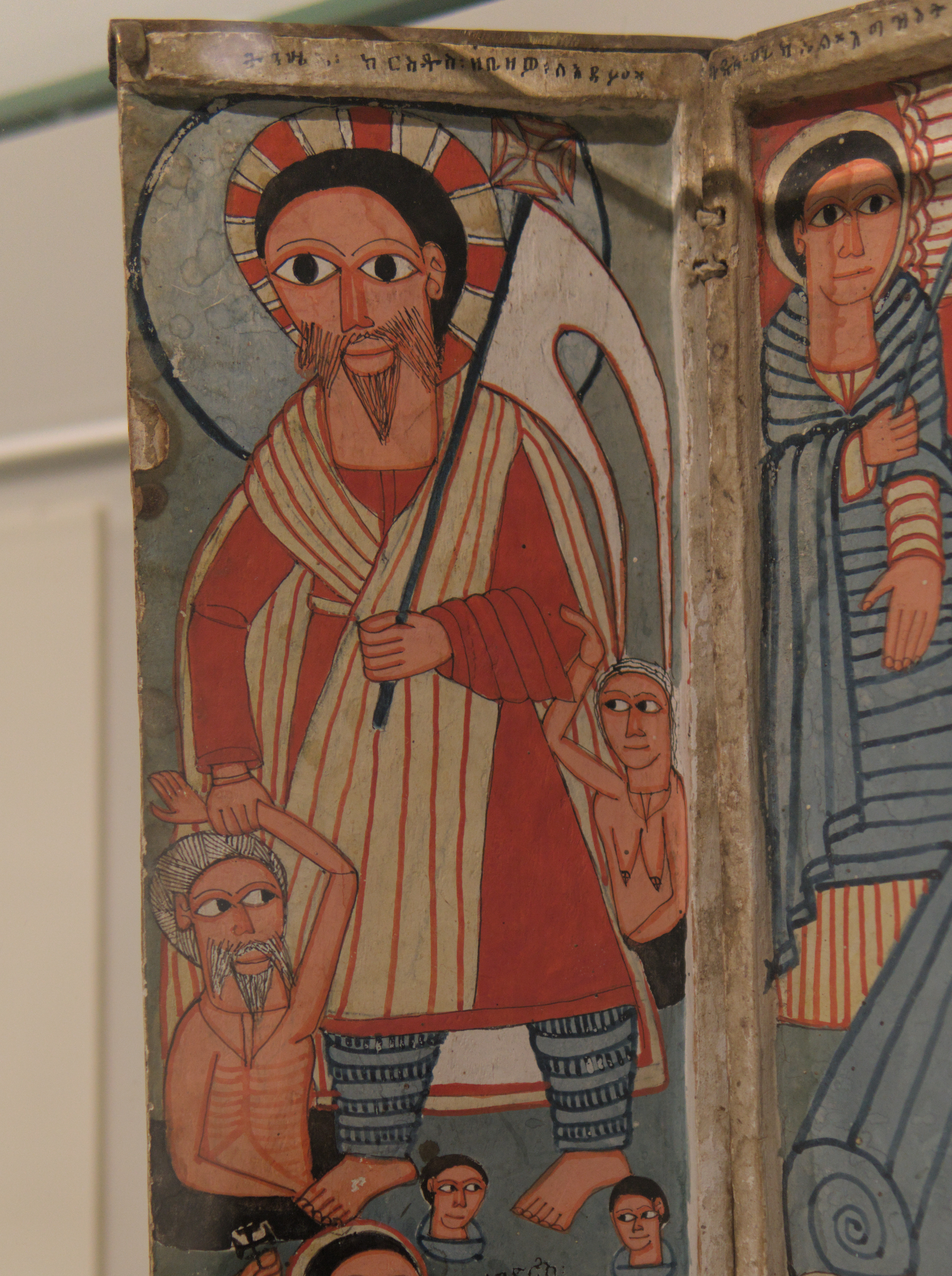
On the right wing, angels hold up chalices to collect the blood that flows from Jesus’s wounds on the cross, while below that, Joseph of Arimathea and Nicodemus carry Jesus’s wrapped corpse to the tomb. On the left wing is one of my favorite traditional religious scenes: the Harrowing of Hell, or Christ’s Descent into Limbo, in which, on Holy Saturday, Jesus enters the realm of his dead to take back those whom Death has held captive, first of which are our foreparents Adam and Eve. Below that scene is an image of the dragon-slaying Saint George, a late third-century figure from the Levant or Cappadocia who is the patron saint of Ethiopia.
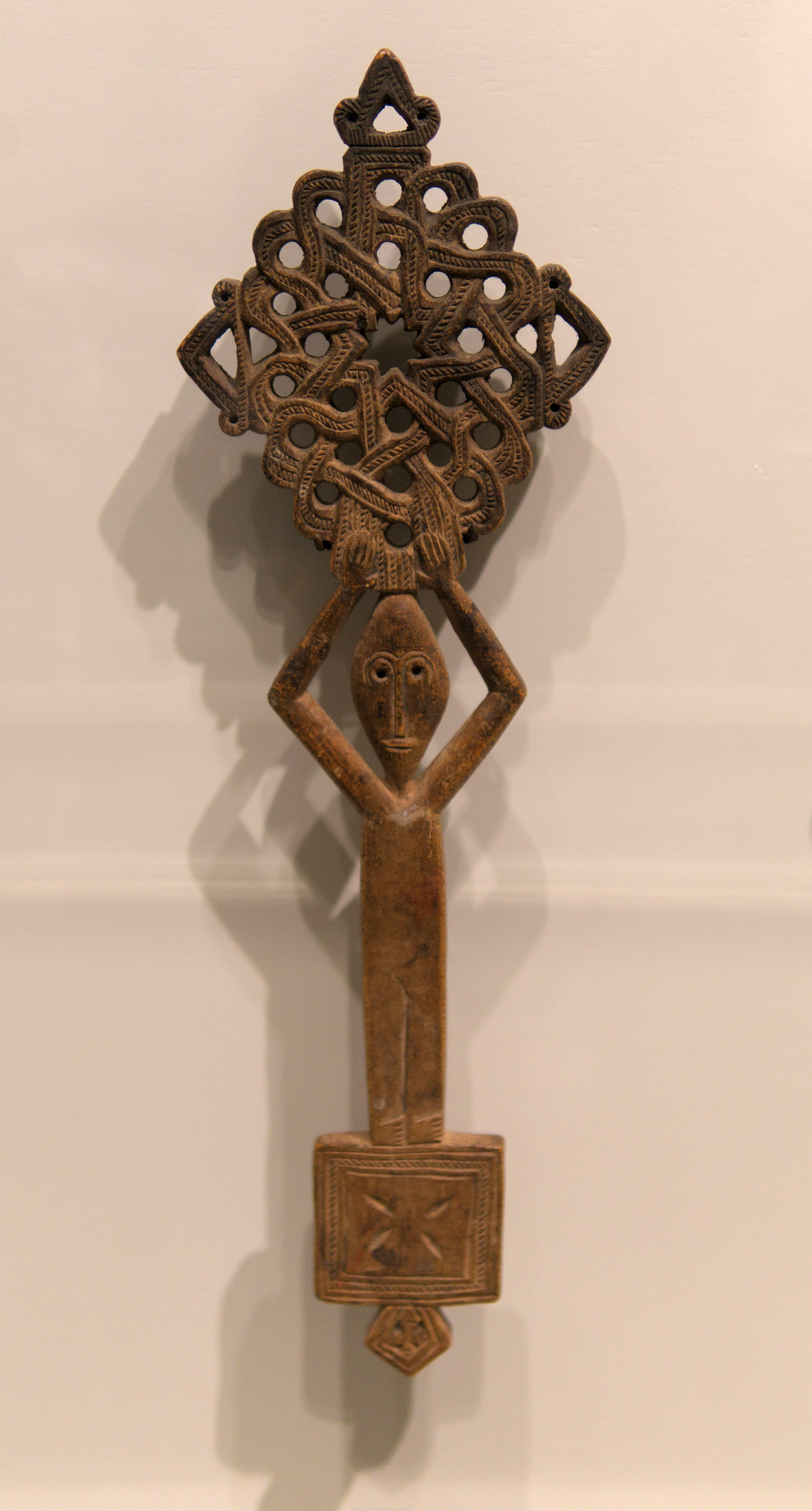
At the bottom center is a scene of Christ teaching the twelve apostles, plus two Ethiopian saints. They all hold hand crosses, like those carried by Ethiopian priests and monks.
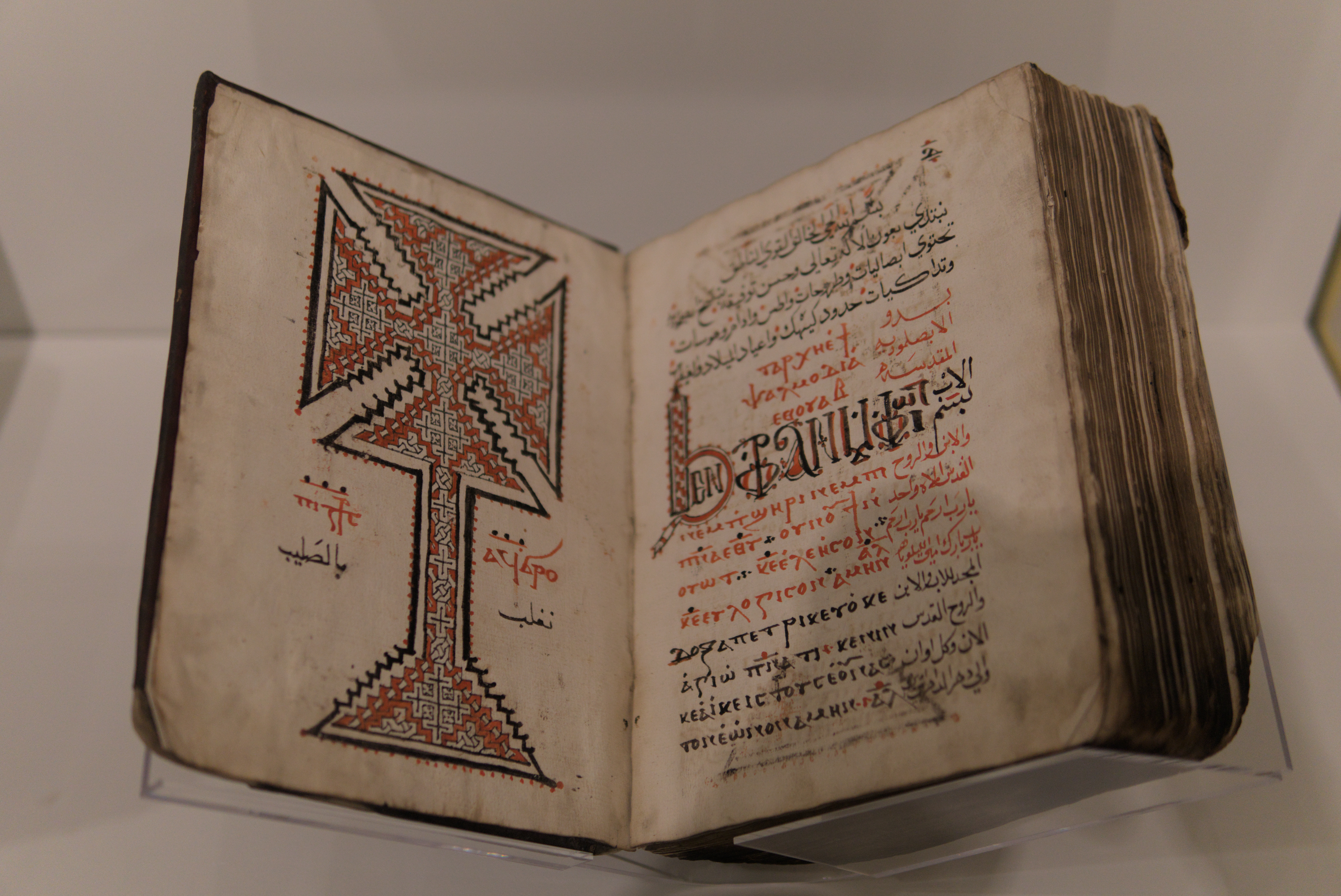
Hand Cross with Figure, Ethiopia, probably 18th–19th century. Wood, 13 3/8 × 4 3/16 × 9/16 in. (34 x 10.7 × 1.4 cm). Walters Art Museum, Baltimore. [object record]Coptic-Arabic Book of Prayer, Egypt, 18th century. Tempera and ink on parchment, 11 3/4 × 9 in. (29.8 × 22.8 cm). Melikian Collection. [object record]
One of the hallmarks of the exhibition is its multisensory nature: attendees are immersed not only in the sights of Ethiopia but also in the sounds and smells. Scratch-and-sniff cards invite people to take a whiff of frankincense, which would have filled the censer on display. Or to smell berbere, a hot spice blend that would have been stored in the woven baskets nearby.
This olfactory element was produced by the Institute for Digital Archaeology, which, as part of its efforts to record and preserve ephemeral culture, has launched an ambitious program to preserve the heritage of smells. “The aim is to provide the technical means for documenting the aromas of today for the benefit of future generations – and to find new methods and opportunities for experiencing the odors of the past.”
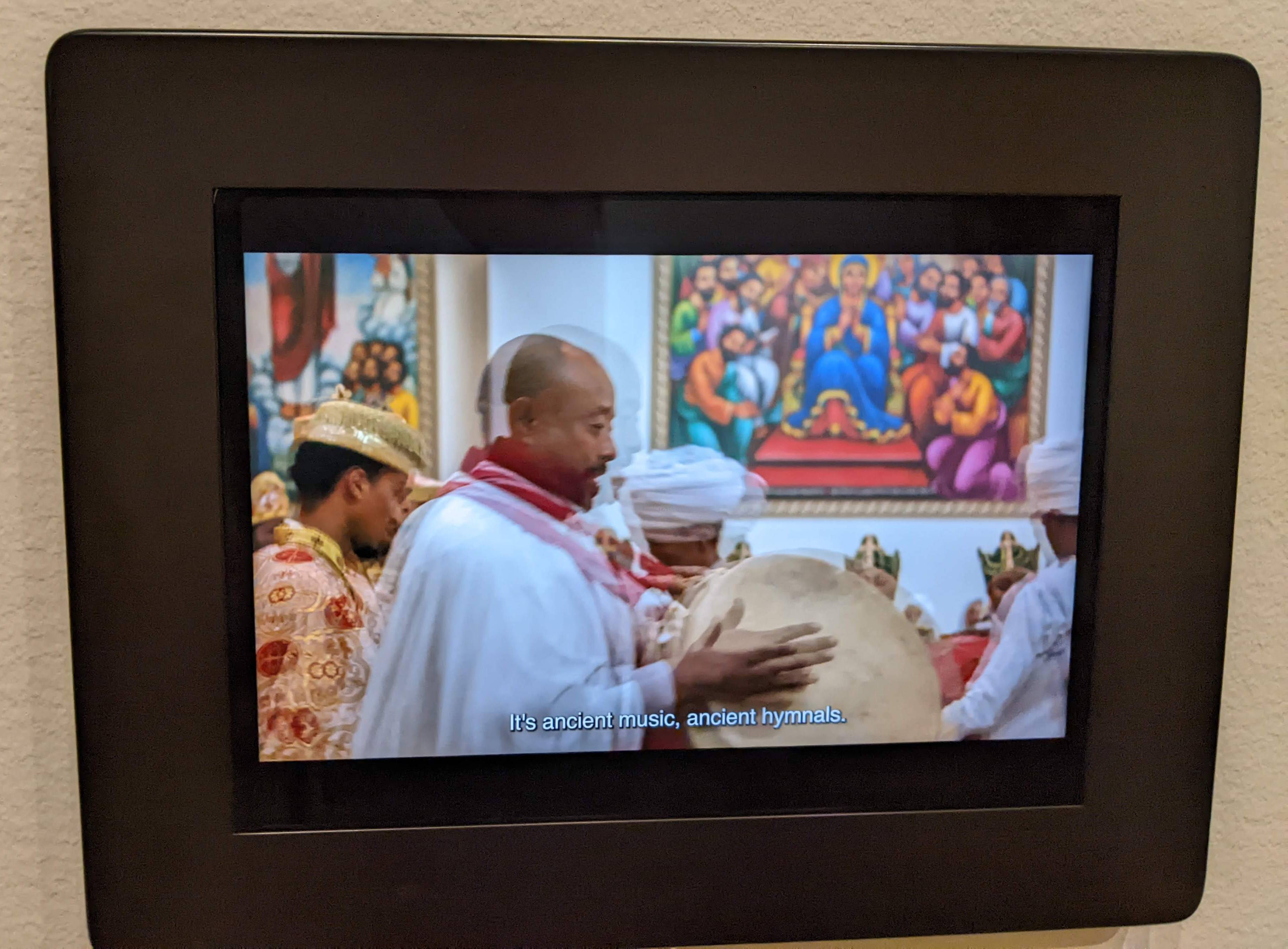
Also in the exhibition there are screens where you can watch videos of Ethiopian Orthodox worship, including music and liturgies, where you will see some of the objects in use. You can also listen to interviews with members of the local Ethiopian diaspora community. (The Washington metropolitan area has the largest Ethiopian population outside Ethiopia.)
Further contextualizing the objects and enhancing the sense of place, pasted onto the wall is a blow-up photograph of a Christian holy-day celebration wending through the streets. This serves as a backdrop to two physical artifacts present in the room: a qämis (dress) and a debab (umbrella).
The inscriptions on many of the Ethiopian icons and manuscript illuminations, which identify the figures and scenes, are in Ge‘ez (aka classical Ethiopic), an ancient South Semitic language that originated over two thousand years ago in what is now northern Ethiopia and Eritrea. It’s no longer spoken in daily life, but it is still used as the language of the Ethiopian Orthodox Church and taught to boys in Sunday school. I really wish I could read it, as it would be a great help in interpreting the Ethiopian images I come across in my studies!
Contrary to what some may assume, Ethiopians in the medieval era were not an isolated people. They traveled—to Rome, to Jerusalem, and so forth. Evidence of Holy Land pilgrimage is suggested by an early fourteenth-century Gospel book that includes the domed Church of the Holy Sepulcher as the backdrop for Christ’s resurrection:
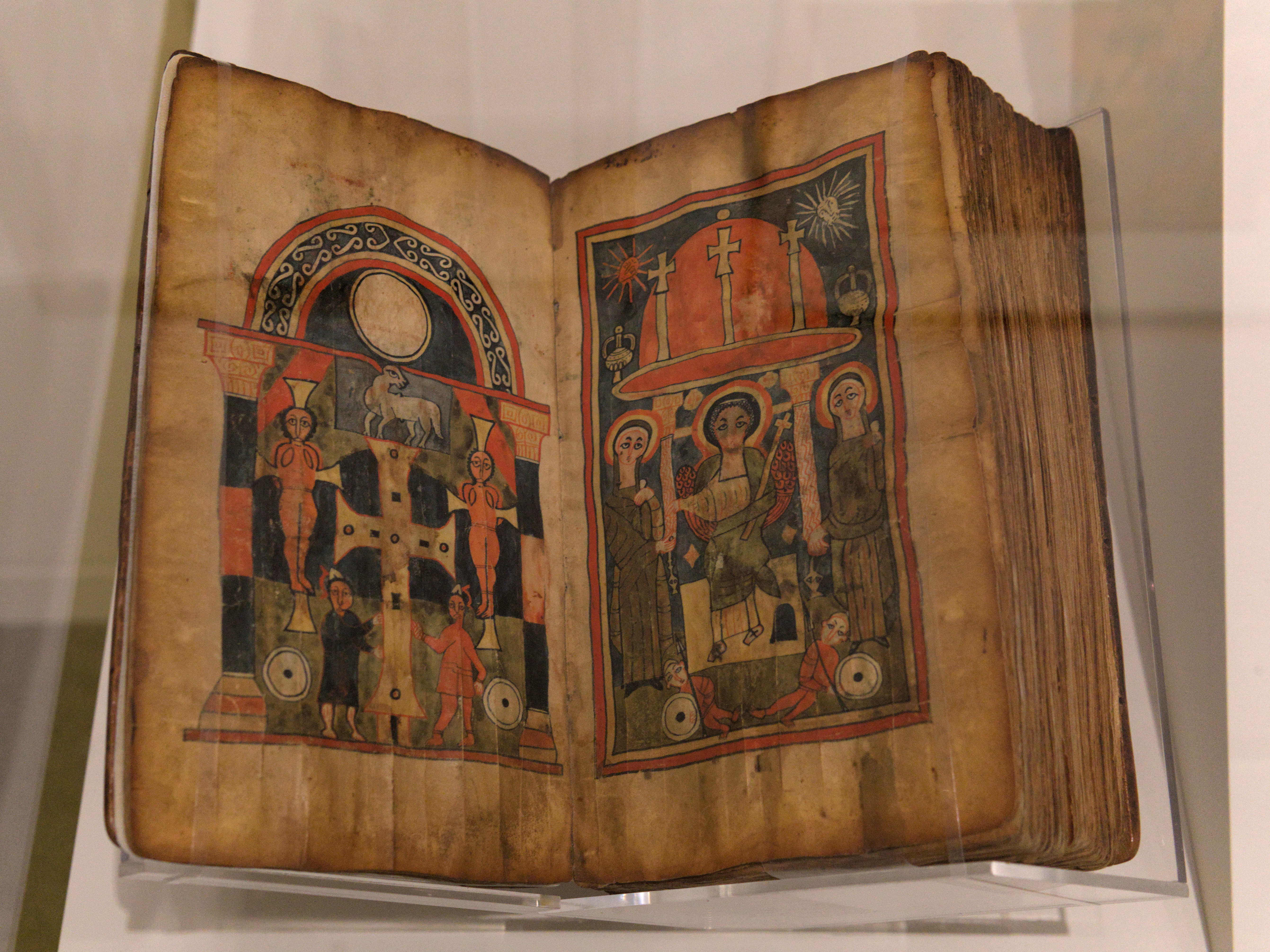
Gospel Book with the Crucifixion and Christ’s Resurrection, Ethiopia (Tigray), early 14th century. Ink and paint on parchment, 10 1/2 × 6 11/16 in. (26.7 × 17 cm). Walters Art Museum, Baltimore, W.8.36, fols. 6v–7r. [object record]
This is an extraordinary book, one of the oldest surviving Ethiopian manuscripts and the oldest in North America. Ethiopian artists weren’t yet depicting Jesus on the cross, so to represent the Crucifixion, this artist has painted a living lamb surmounting a bejeweled cross, with the two thieves crucified on either side.
Also from the fourteenth century, a manuscript opened to a page spread of Christ’s Entry into Jerusalem:
Christ’s Entry into Jerusalem, folios added from an earlier Gospel book to a Ta’ammera Maryam manuscript, Ethiopia, 14th century. Tempera and ink on parchment. Private collection.
I like how the scene extends across both pages, creating a sense of forward progression, and the two onlookers above the city gate.
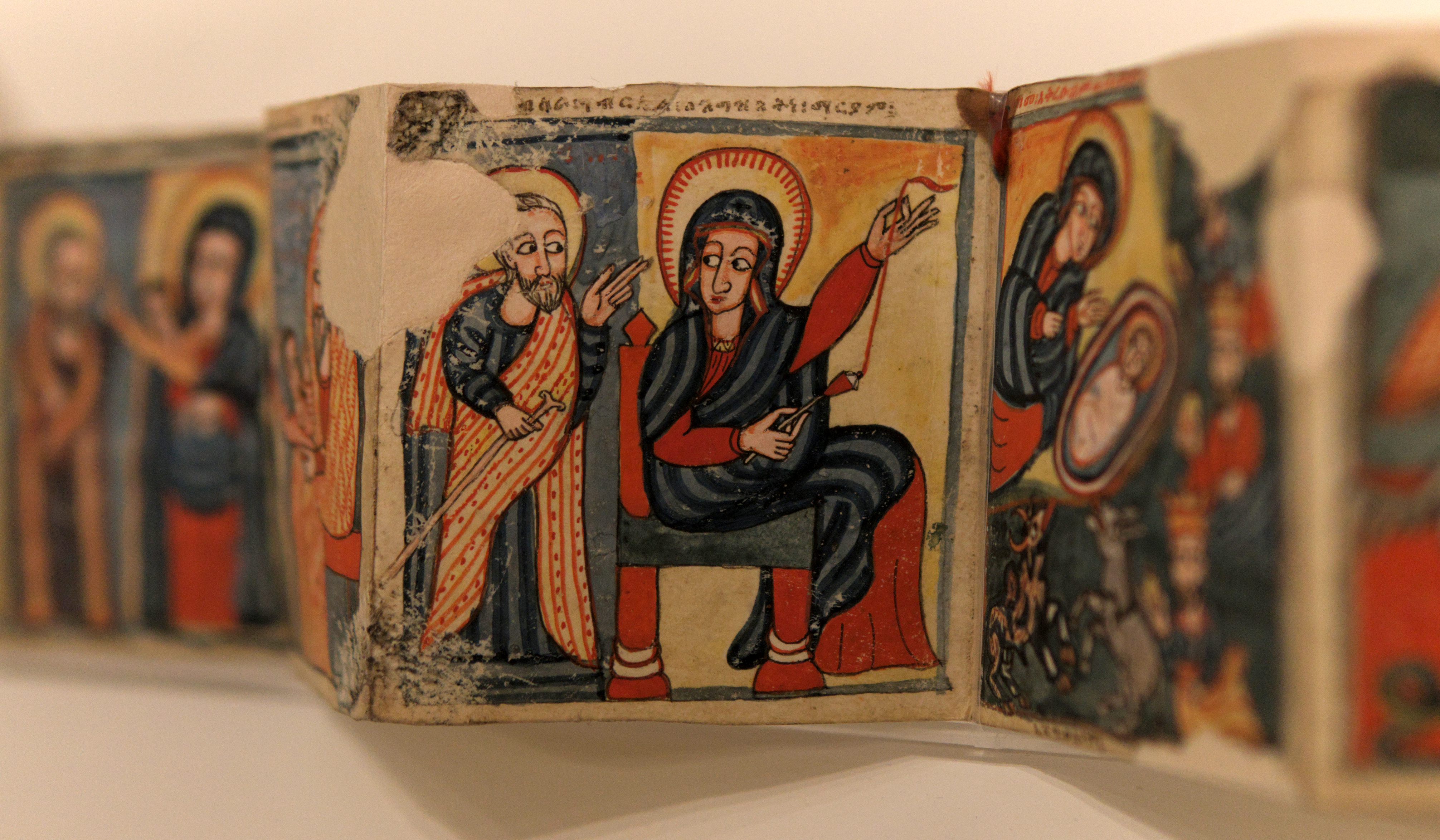
One of my favorite objects from the exhibition is a sensul from Gondar depicting ten scenes from the life of Mary. A sensul is an Ethiopian chain manuscript, in this case pocket-size, created out of a single folded strip of parchment attached to heavy hide boards at each end, which creates a small book when folded shut. Here’s a detail showing the Annunciation:
Annunciation, from a Gondarine sensul (chained manuscript), Ethiopia (Gondar), late 17th century. Ink and paint on parchment, each panel 3 5/8 × 3 1/8 in. (9.2 × 9 cm). Walters Art Museum, Baltimore. [object record] [GIF]
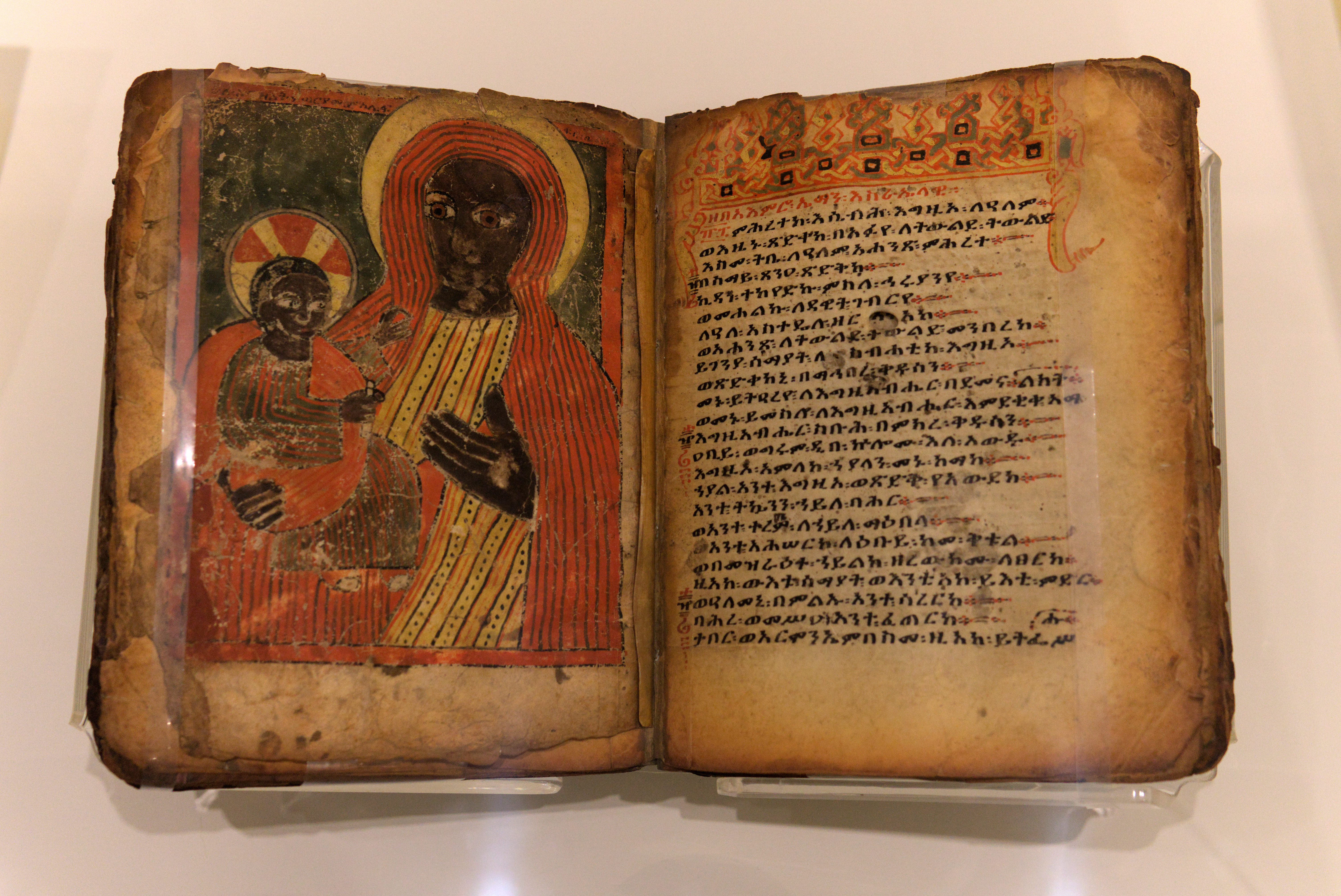
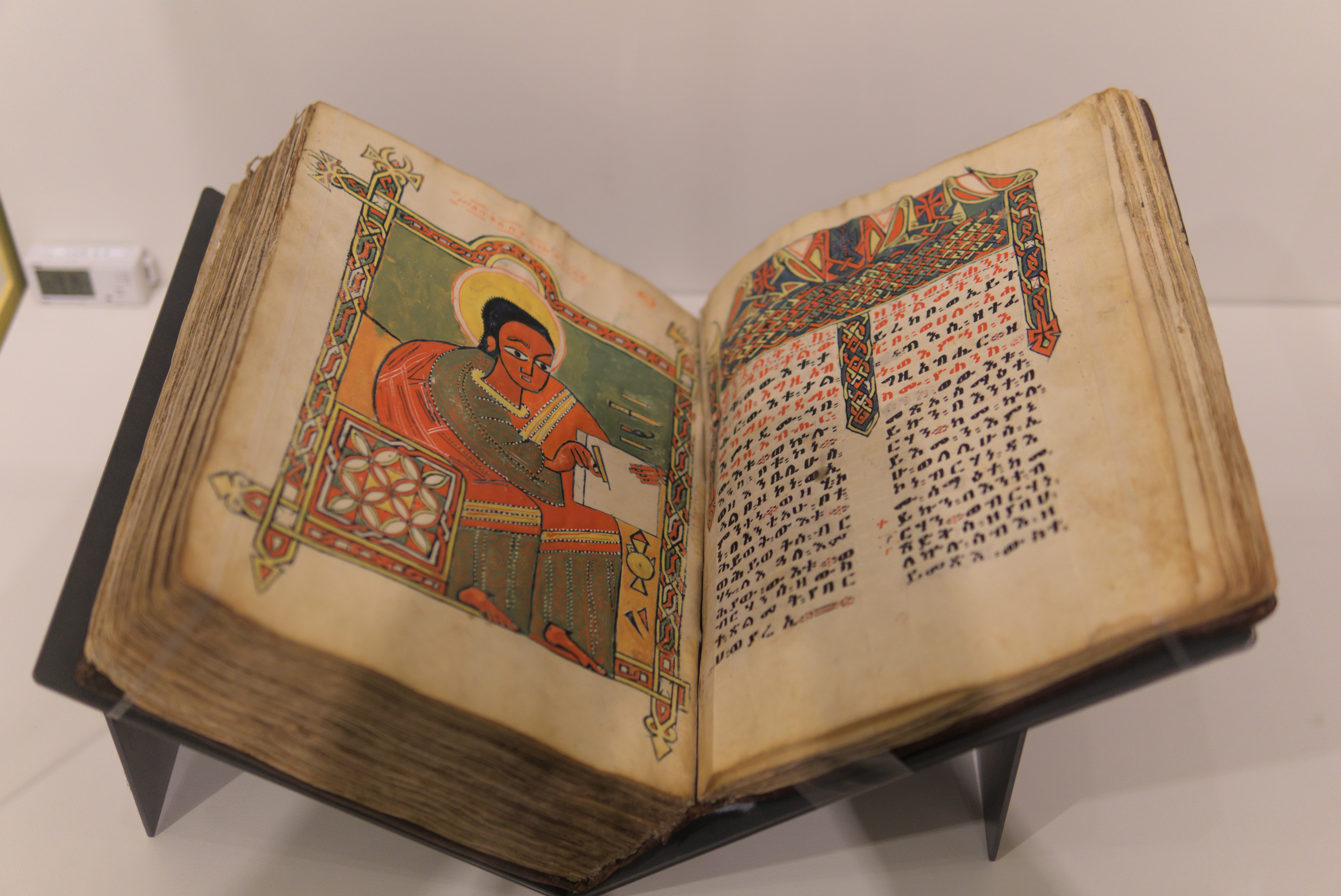
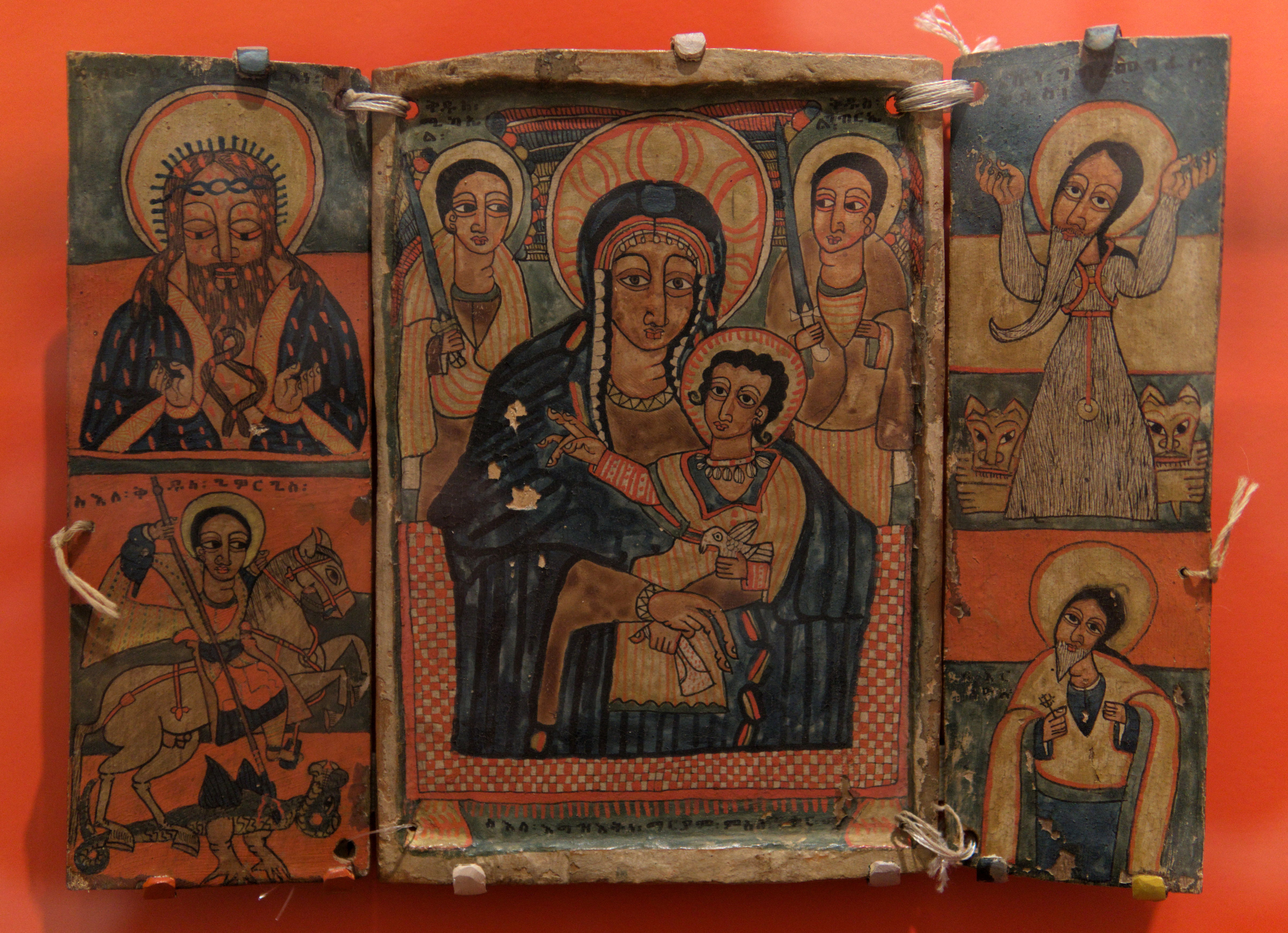
It’s a common misconception that Ethiopians have always depicted biblical figures as dark-skinned to reflect the local population. Such treatment didn’t become normative until the eighteenth century, although some earlier artists did choose black complexions for holy persons:
Virgin and Child, from a Psalter with the Wəddase Maryam (Praise of Mary) and Mähalǝyä Näbiyyat (Canticles of the Prophets), Ethiopia, 15th century. Ink and pigments on parchment with wooden boards, open: 8 7/8 × 6 11/16 × 3 15/16 in. (22.5 × 17 × 10 cm). Toledo Museum of Art, Ohio. [object record]The Opening of the Gospel of John, from a Gospel book, Ethiopia, ca. 1504–5. Tempera on parchment, 13 9/16 × 10 7/16 in. (34.5 × 26.5 cm). J. Paul Getty Museum, Los Angeles, Ms. 102, fols. 215v–216r. [object record]Triptych Icon with the Virgin Mary and Christ Child Flanked by Archangels (center), the Kwer‘atä re’esu (Man of Sorrows) and Saint George (left), and Saint Gäbrä Mänfäs Qeddus and Abba Arsanyos (right), Ethiopia (Gondar), late 17th–early 18th century. Tempera on gesso-primed wood. Institute of Ethiopian Studies, Addis Ababa University, acc. no. IESMus3492.
In the triptych shown above, not only is the infant Jesus depicted as Black, but he also wears a necklace made of cowrie shells, which are traditionally given to Ethiopian children for protection!
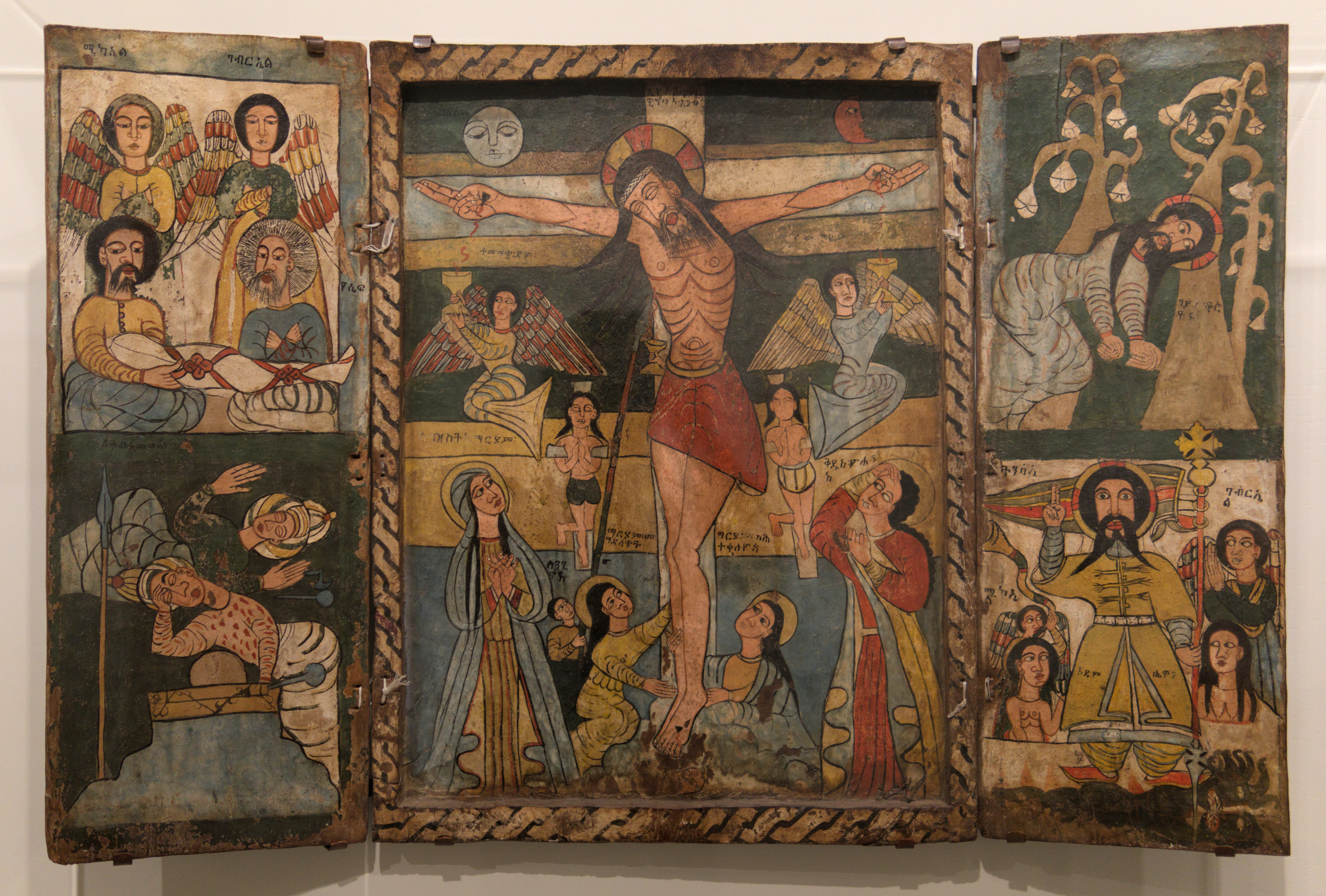
My favorite artwork from the exhibition is probably this triptych:
Triptych Icon with the Crucifixion (center), Entombment and Guards at the Tomb (left), and Temptation in the Wilderness and the Resurrection of Christ (right), Ethiopia, late 16th century. Tempera on gesso-primed wood. Institute of Ethiopian Studies, Addis Ababa University, acc. no. IESMus4126.
Its central panel depicts the Crucifixion, Christ’s head bowed in death and his fingers gesturing blessing, even as his palms are nailed. At the top, the sun and the moon mourn his passing. As we saw before, angels catch the blood that drips from his body (notice the cute little hand sticking out from behind his torso!). At the base, the two larger-scale figures are the Virgin Mary and St. John, while next to Mary on a smaller scale is Longinus, the centurion who pierces Christ’s side with a spear.
The left wing shows the Entombment of Christ, with two guards, wearing pointed turbans, sleeping at their post. The right wing shows a scene that the label identifies as “Temptation in the Wilderness” (presumably a translation of the inscription on the tree) but that looks to me more like an Agony in the Garden. Below that is the Resurrection, with Christ holding a victory banner, standing atop Hades. An angel blows a shofar and the dead rise up out of their graves, following Christ, the firstfruits of the resurrection (1 Cor. 15:20–22). Christ wears a short-sleeved, knee-length jacket with frog closures, and bunched sleeves and trousers, both of which reflect clothing from regions east of Africa.
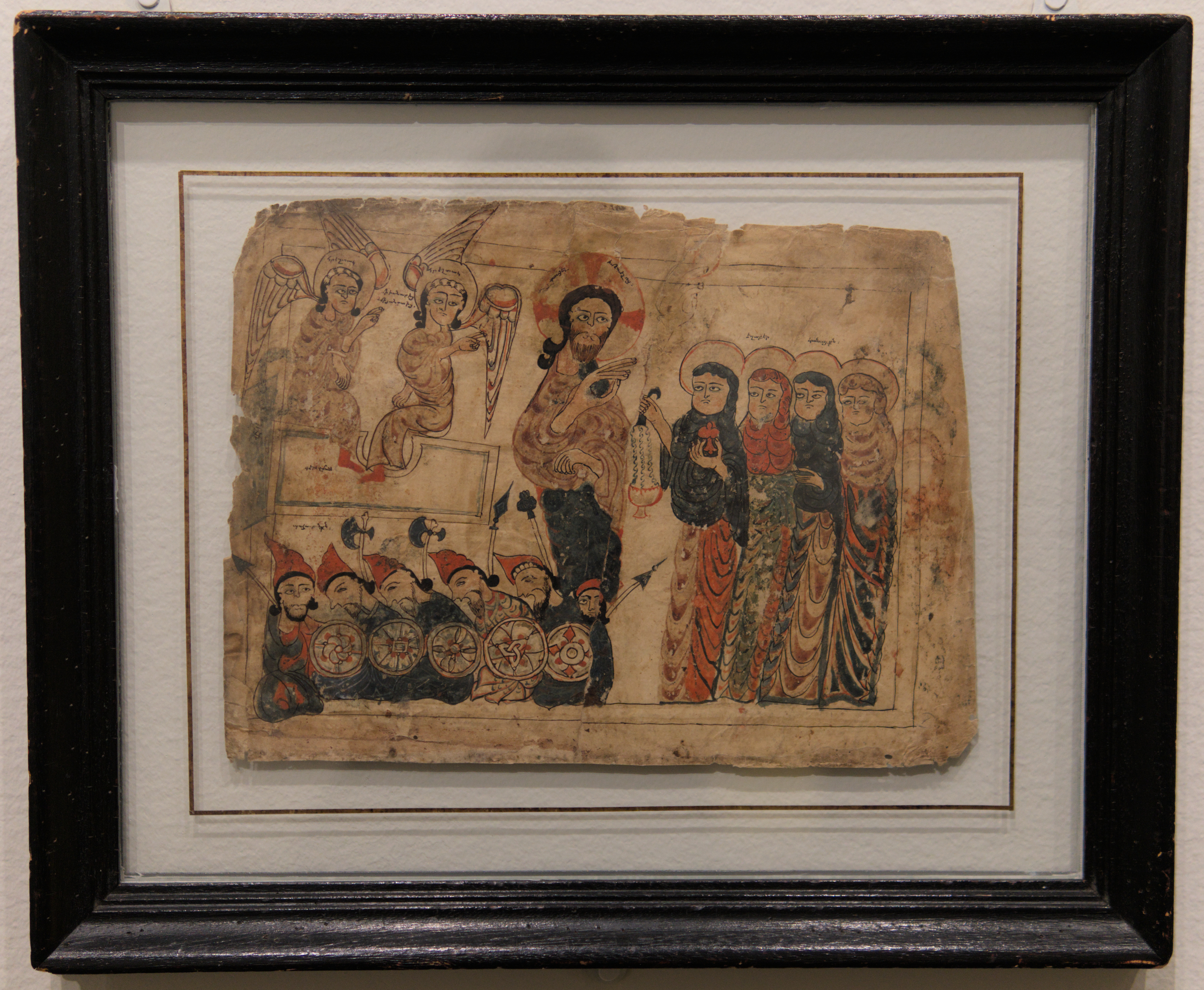
The wall text notes the fine, wavy lines used to render the figures’ draperies, perhaps influenced by Armenian artists from the Lake Van region.
Yovsian of Vaspurakan (Armenian), Leaf from a Gospel book with the Resurrection of Christ and Visit of the Women to the Tomb of Christ, ca. 1350. Tempera on cotton paper. Private collection.
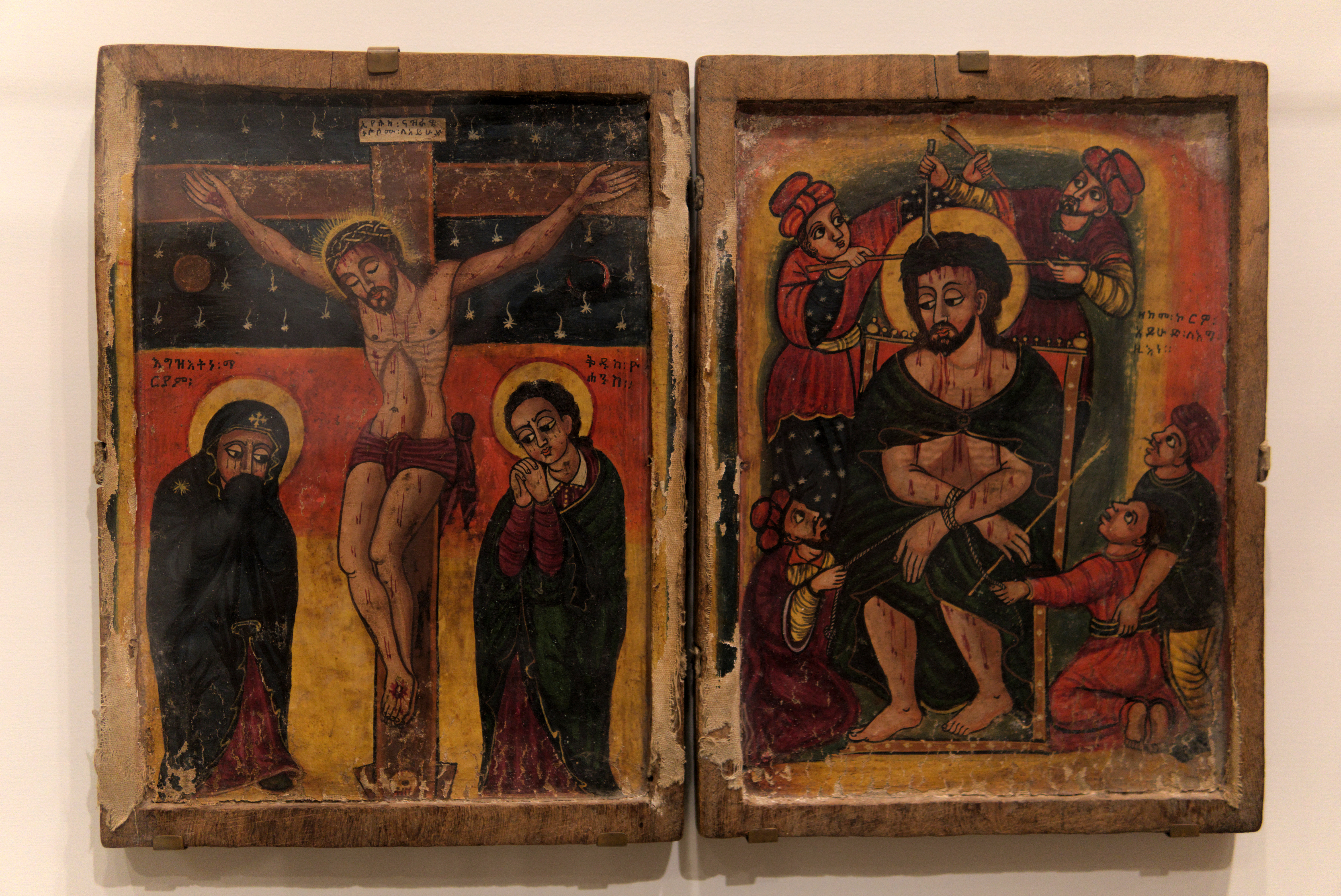
Here’s another Crucifixion, this one painted in what’s called the Second Gondarine style, characterized by smoothly modeled figures, often with darker skin tones, and wide horizontal bands of red, yellow, and green filling the background:
Diptych Icon with the Crucifixion (left) and the Mocking of Christ (right), Ethiopia, late 17th–early 18th century. Wood, polychrome, 13 1/2 × 9 7/8 in. (34.3 × 25.1 cm). Virginia Museum of Fine Arts, Richmond. [object record]
The squiggles behind Christ at the top left may simply be a decorative motif, but to me they look like falling stars, an apocalyptic sign, and as if the sky is weeping.
The right panel of the diptych shows Christ being cruelly fitted with a crown of thorns.
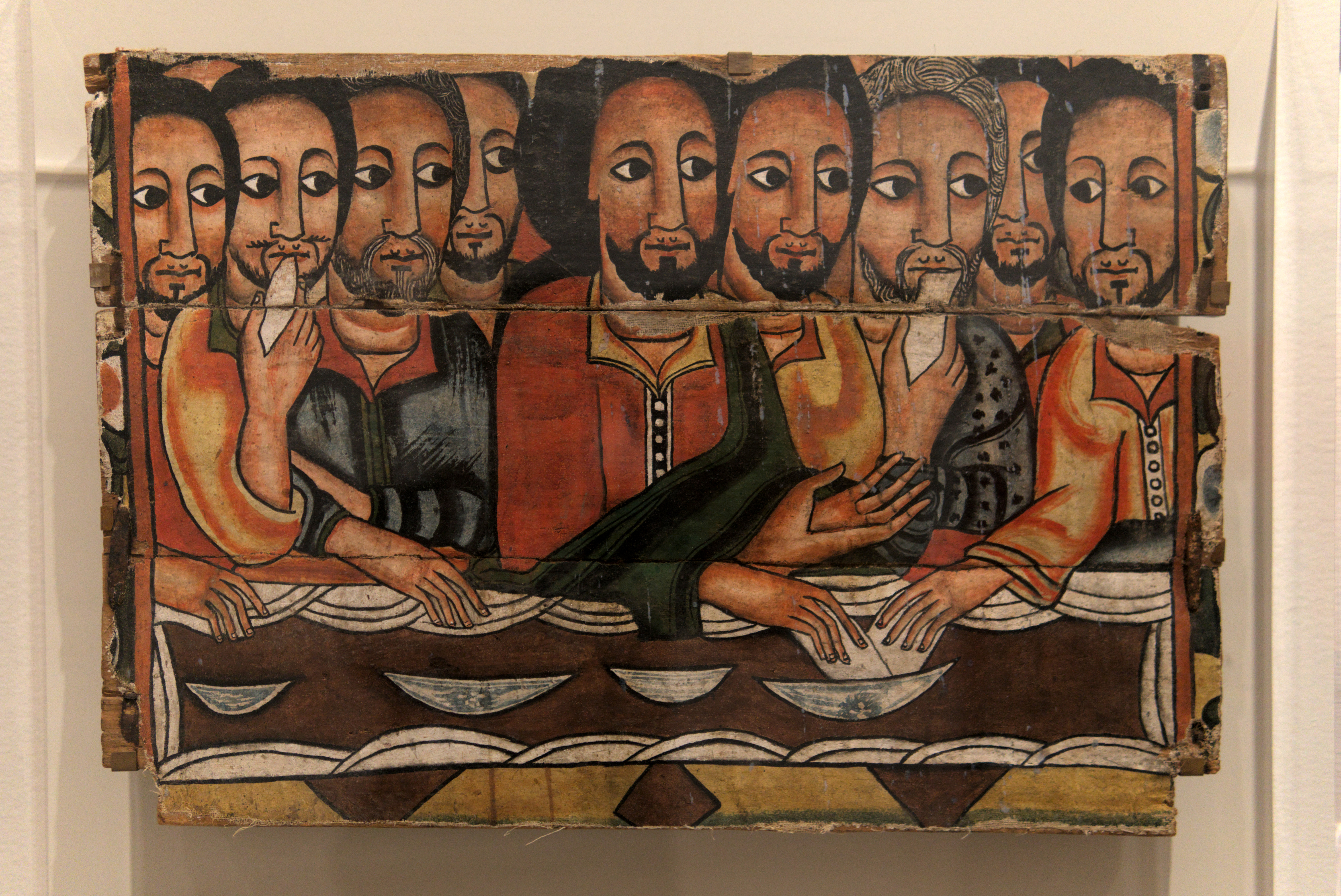
Two other passion images I want to share are a Last Supper wall painting and an Entombment from a disbound album.
Last Supper, Ethiopia, 18th century. Tempera on linen, mounted on panel, 16 3/4 × 24 in. (42.6 × 61 cm). Virginia Museum of Fine Arts, Richmond. [object record]Album Leaf with the Entombment of Christ, Ethiopia (Sawa?), late 17th century. Pigments on vellum. Minneapolis Institute of Art, 2009.39.3y. [object record]
In the Last Supper, Jesus and Judas both dip their bread (injera!) into the same bowl and exchange a knowing glance.
In the Entombment, Jesus, wrapped in white linen, is lowered into the ground, mourned by several of his women followers. The portrayal of his mother Mary’s weeping, her hands covering her eyes and her face stained with tears, is particularly poignant. This leaf is from a set of forty-four, now matted separately but originally arranged in series and likely painted on several long sheets of parchment that were sewn together and folded accordion-style to form a sensul.
One of the most extraordinary objects on display is a rare folding processional icon that adopts the form of a fan, from the late fifteenth century:
Folding Processional Icon in the Shape of a Fan, Ethiopia, late 15th century (Stephanite). Ink and paint on parchment, thread, extended: 24 1/4 × 154 1/8 × 4 3/4 in. (61.6 × 391.4 × 12 cm). Walters Art Museum, Baltimore. Photo courtesy of the museum. [object record]
Thirty-eight identically sized figures span the surface of this elongated parchment: the early Christian martyrs Julitta (Juliet) and Cyricus, St. George, St. John the Baptist, the archangel Michael, the Virgin Mary, the archangel Raphael, St. Paul, the Ethiopian artist-priest Afnin, and unidentified Old Testament patriarchs and prophets. There would have been a wooden handle attached to either end that, when pulled together, created a double handle for a giant wheel to be displayed during liturgical processions and church services (see here). As the museum website notes, “The Virgin Mary, whose hands are raised in a gesture of prayer, is then at the top of the wheel. By depicting Mary in the company of saints and angels, the icon powerfully evokes the celestial community of the church.”
This is just a sampling of all the wonderful art objects that are a part of the Ethiopia at the Crossroadsexhibition. I’ll share more photos on Instagram (@art_and_theology) in the coming weeks.
I strongly encourage you to go see this! I think it would be enjoyable for children as well, especially Christian children, who will be able to identify many of the painted stories. For Christians, it’s an opportunity to connect with our artistic heritage and with African church history. If you can’t catch the exhibition at the Walters in Baltimore before it closes March 3, it will be traveling to the Peabody Essex Museum in Salem, Massachusetts (April 13–July 7, 2024), and the Toledo Museum of Art in Ohio (August 17–November 10, 2024).
ANNOUNCEMENT: Vatican to hold Stations of the Cross art contest: Artists from across the globe are encouraged to participate in the Vatican-sponsored contest for fourteen new Stations of the Cross paintings. The winner will be announced September 30, 2024, awarded €120,000 (about $131,000), given a year to complete the commission, and then have their set of paintings exhibited in St. Peter’s Basilica during Lent 2026. The first step is to fill out an online application, which will become available January 8, with a deadline of January 31. Learn more at the link. (Update: The registration link is now live at https://contest.viacrucis2026.va/en/registration.)
+++
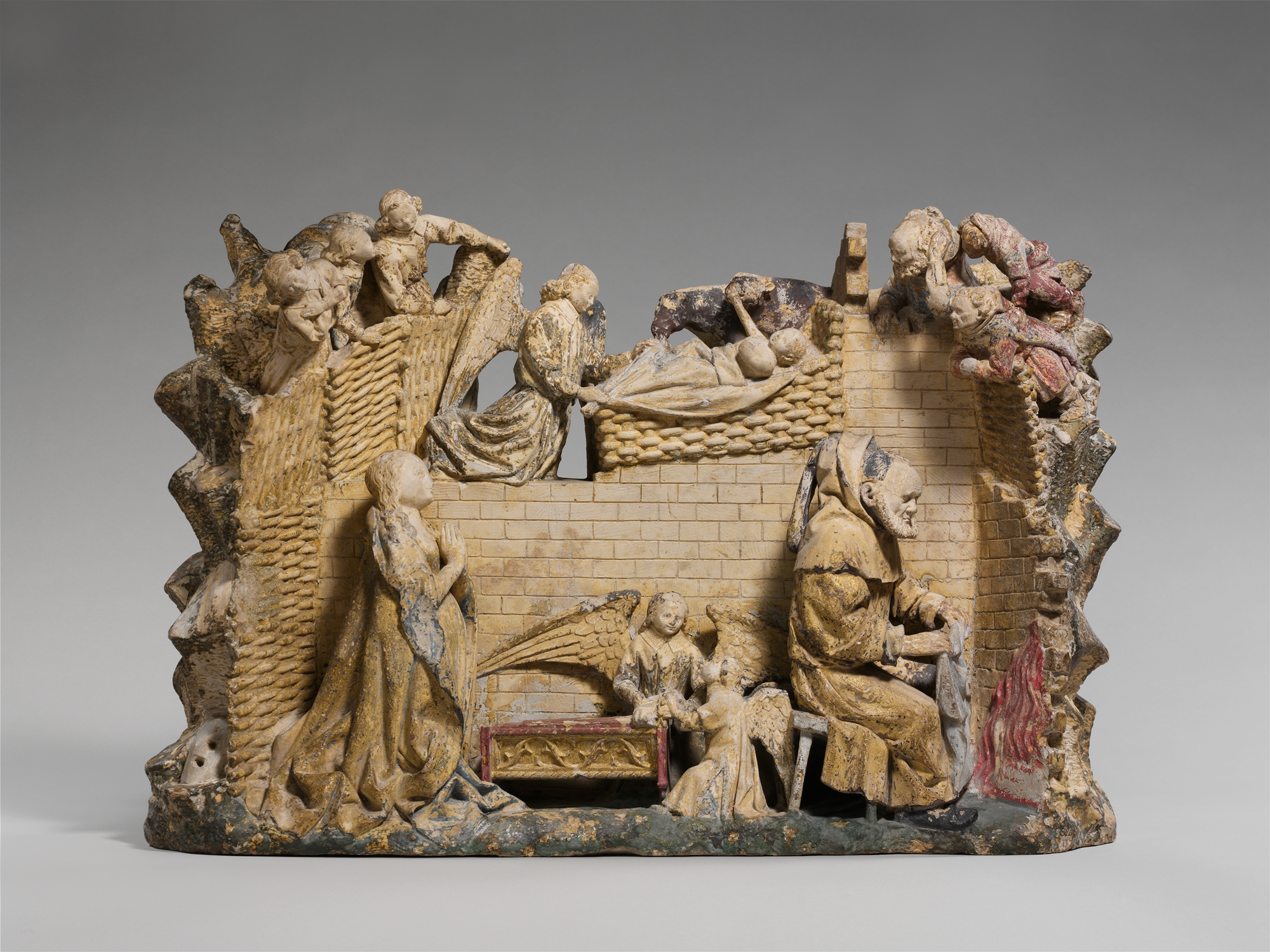
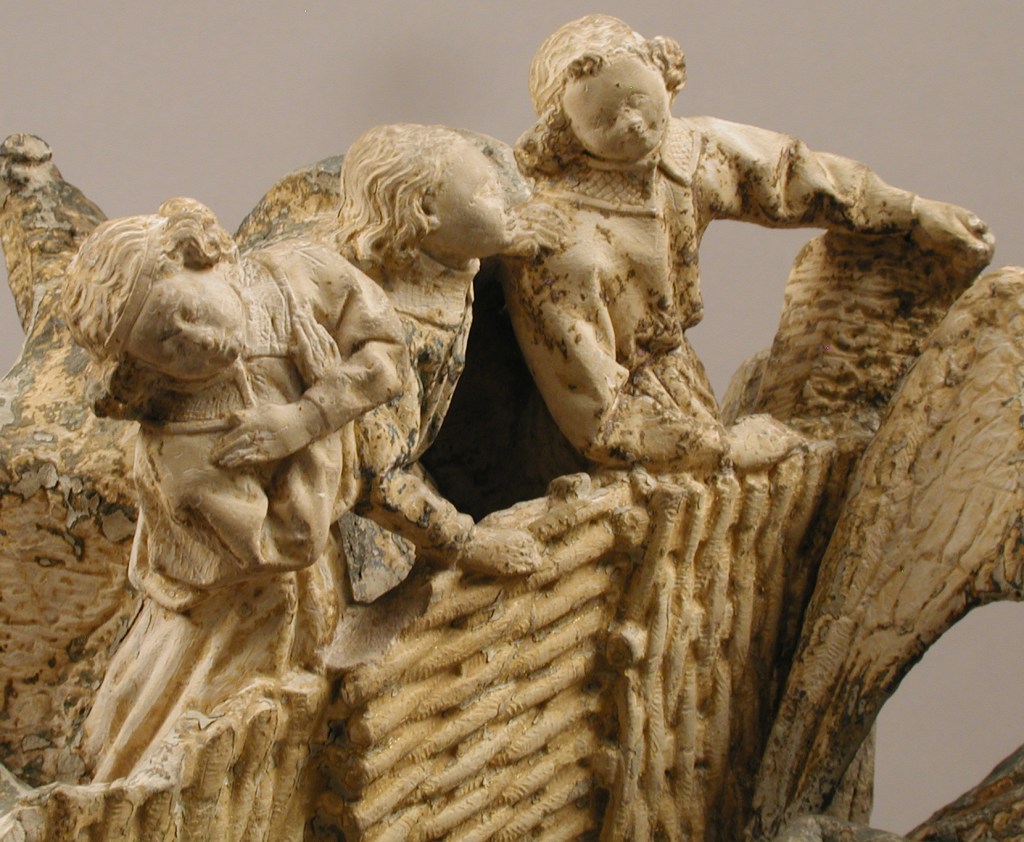
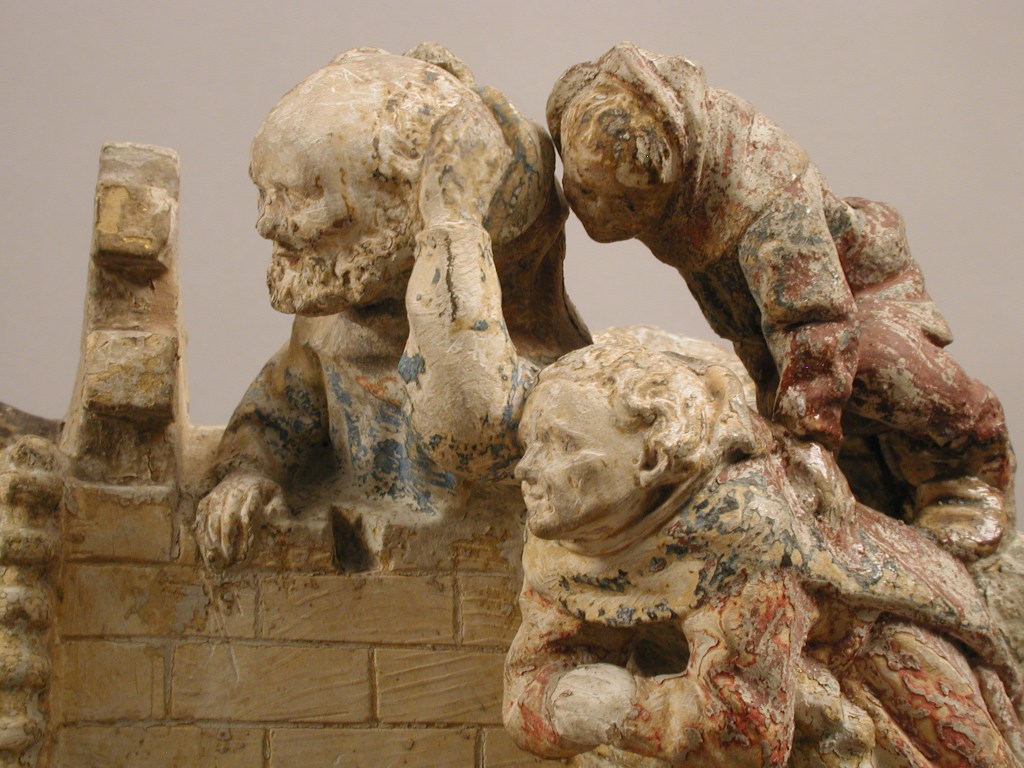
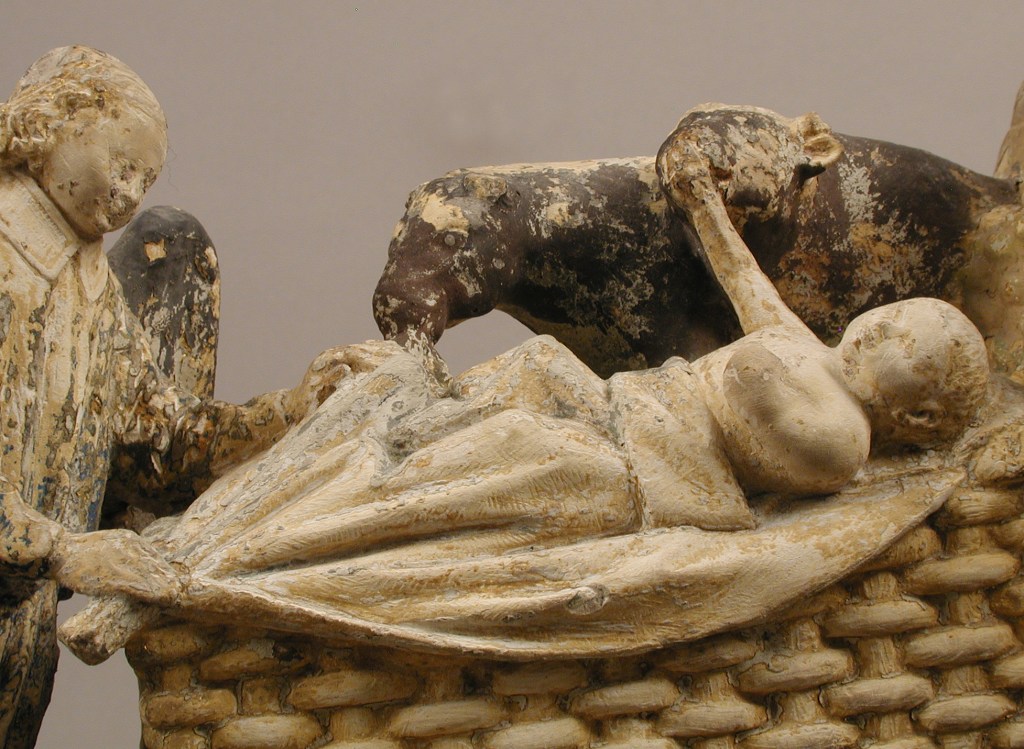
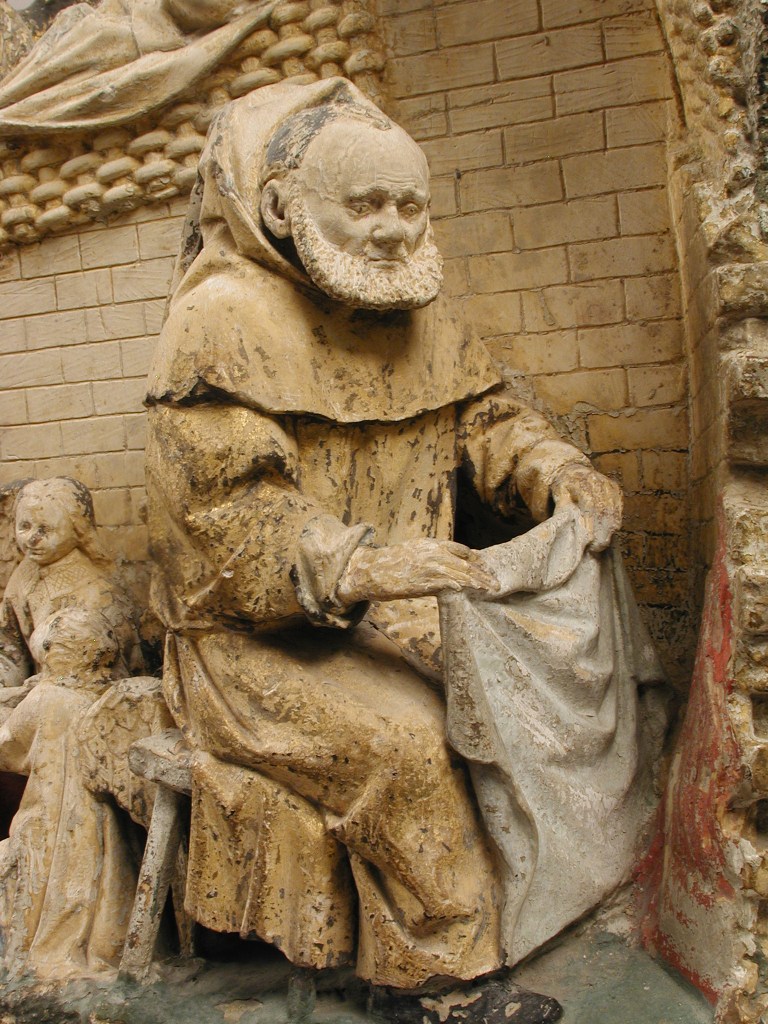
ART OBJECT: Burgundian Crèche, ca. 1450: In researching depictions of Joseph at the Nativity, I came across this charming little limestone-carved crèche from fifteenth-century Burgundy, France, acquired by the Metropolitan Museum of Art. Set inside a dilapidated brick interior patched with wattled matting, the scene portrays the infant Christ lying in a wattled manger that rests on a crumbling wall ledge. Such an unusual composition! I’m not sure why the infant is placed so precariously and at a height when there’s a carved cradle available on the ground, where angels kindly fluff his pillow, but I suppose it was to avoid overcrowding and for visual balance.
Circle of Antoine Le Moiturier (French, 1425–1495), Nativity, Burgundy, France, ca. 1450. Limestone with later paint and gilding, 17 3/4 × 25 7/8 × 7 1/4 in. (45.1 × 65.7 × 18.4 cm). Metropolitan Museum of Art, New York.
A donkey licks Christ’s feet while an ox licks his hand, which he appears to delight in, as he lifts his arm for better access. To the left and right of him are a trio of angels and shepherds, respectively, excitedly leaning in from outside to get a better look. Mary gazes up at her son in adoration while Joseph dutifully tends to a parental chore: drying one of Jesus’s freshly washed linens at the fire. (Dad doing laundry—huzzah!)
ART COMMENTARY: On The Adoration of the Magi by Domenico Veneziano: From the Visual Commentary on Scripture comes this 2022 video, one in a series filmed on-site at the Gemäldegalerie in Berlin. Theologian Ben Quash and art historian Jennifer Sliwka discuss an early Italian Renaissance tondo depicting the Adoration of the Magi.
+++
SONGS:
>> “Rejoice with Exceeding Great Joy”: Written by Lanny Wolfe in 1978 and performed by Reggie Smith, Charlotte Ritchie, and Ladye Love Smith at Bill and Gloria Gaither’s Homecoming Christmas 2006:
>> “Star of Bethlehem”: Written by Noel Dexter, arranged by C. S. (Cedron) Walters, and performed by the Jamaica Youth Chorale at their 2019 Christmas concert. Noel Dexter (1938–2019) was a Jamaican composer, choir director, and music educator, and this is probably his best-known work. It’s set to a Nyabinghi rhythm.
When the star of Bethlehem arise, hallelujah When the star of Bethlehem arise, hallelujah When the star of Bethlehem arise Come show me where the young child born!
There were wise men coming from the east, hallelujah There were wise men coming from the east, hallelujah There were wise men coming from the east Come show me where the young child born!
They brought gold, frankincense, and myrrh . . .
Not a man can save my soul . . . But Jesus! Show me where the young child born!
+++
VIDEO:“#NatZooZen: Giant Pandas Mei Xiang and Tian Tian in the Snow”: This Smithsonian’s National Zoo cam footage from January 2021 shows two giant pandas at play, sliding down a snowy hill! So adorable. Tian Tian and Mei Xiang arrived at the National Zoo in 2000 and in 2020 produced a cub, Xiao Qi Ji. All three pandas returned to Beijing in November, having been lent to the US by China as part of a cooperative research program whose contract has expired.
Ulyana Tomkevych (Ukrainian, 1981–), The Birth of Christ, 2016. Egg tempera on gessoed wood, 11 1/2 × 12 in. Sacred Art Pilgrim Collection of John A. Kohan. Photo: Victoria Emily Jones, at East Meets West: Women Icon Makers of Western Ukraine, St. Christopher’s Episcopal Church, Chatham, Massachusetts, 2017.
Frosty yet warm, this icon by Ulyana Tomkevych of Ukraine is one of my favorite Nativity paintings. It shows Mary embracing her swaddled newborn, Jesus, amid a bleak midwinter. She reclines across a red blanket of flowers inspired by Ukrainian embroidery patterns, which hovers mystically above a line of barren trees, suggesting that Christ’s birth has ushered in a new springtime.
The wisps of white against the cool green-grays at the bottom suggest snowdrifts, whereas the faint rose tints at the top imply a suffusing warmth. The silver semicircle at the top, with its emanating beams, represents the mystery and presence of God breaking into the world.
Following Greek Orthodox tradition, Christ’s halo is inscribed with the Greek letters ώ Ό Ν (omega, omicron, nu), spelling “He who is” (see Exod. 3:14). Tomkevych is a member of the Ukrainian Greek Catholic Church, which is in communion with the Holy See but follows the Byzantine Rite.
LISTEN: “Balulalow” | Original German words by Martin Luther, 1535 (title: “Vom Himmel hoch da komm ich her”) | Translated into Scots by James, John, and Robert Wedderburn, 1567 | Music by Peter Warlock, from his Three Carols suite, 1923 | Performed by Sting on If on a Winter’s Night, 2009 [see full credits]
O my deare hert, young Jesu sweit, Prepare thy creddil in my spreit And I sall rock thee in my hert, And never mair from thee depert.
But I sall praise thee evermore With sangis sweit unto thy gloir. The knees of my hert sall I bow, And sing that richt Balulalow.
Literal English translation:
O my dear heart, young Jesus sweet, Prepare thy cradle in my spirit And I shall rock thee in my heart, And nevermore from thee depart.
But I shall praise thee evermore With songs sweet unto thy glory. The knees of my heart shall I bow, And sing that true Balulalow.
English translation, from the German, by Catherine Winkworth:
Ah! dearest Jesus, holy Child, Make thee a bed, soft, undefiled Within my heart, that it may be A quiet chamber kept for Thee.
My heart for very joy doth leap; My lips no more can silence keep. I too must sing with joyful tongue That sweetest ancient cradle song.
These two stanzas in Middle Scots are an extract from the longer “Ane Sang of the Birth of Christ,” also known by its first line, “I come from heuin to tell,” from the Ane Compendious Buik of Godly and Spirituall Sangis (1567). In this part of the hymn, the speaker asks Jesus to be at home in their heart and receive their sweet songs. Mary is the model for this reception, love, and adoration of the Christ child—she who cradled him, praised him, sang to him, and held him close.
The word balulalow is derived from the Scottish word for “lullaby.”
For all fifteen stanzas in Scots, see here, and for Catherine Winkworth’s full English translation, here. The hymn actually originated in German from the pen of Martin Luther, who titled it “Vom Himmel hoch da komm ich her” (From Heaven Above to Earth I Come). It spread to the Netherlands and the British Isles in the 1560s.
In his recording, the cross-genre English musician Sting uses neither the German folk tune that Luther paired with the text upon its first publication, nor the melody Luther composed for it in 1539. Instead Sting uses the 1923 setting written by the English composer Peter Warlock for his Three Carols suite.
In Sting’s rendition, which he arranged in collaboration with Robert Sadin, the female backing vocals evoke a wintry wind and a snare drum creates a forward momentum, while a cello supports Sting’s languid singing. The tone is tender and haunting.
This post is part of a daily Christmas series that goes through January 6. View all the posts here, and the accompanying Spotify playlist here.
LOOK: Nativity icon from St. Catherine’s Monastery
The Nativity of Christ, Egypt, 7th century(?). Encaustic on wood. Holy Monastery of St. Catherine, Sinai, Egypt. Photo courtesy of the Michigan-Princeton-Alexandria Expeditions to Mount Sinai.
This Coptic icon of the Nativity bears all the traditional elements of Nativity icons. It shows Mary reclining in a cave next to her newborn son, Jesus, who lies in a manger, being affectionately licked by an ox and ass. Why those two animals? Because the church fathers read Isaiah 1:3 into the scene, which says, “The ox knows its owner and the donkey its master’s crib.”
The starry semicircle at the top represents the heavens. A thick beam of light descends from it onto Christ, confirming his divine paternity. On either side, from behind the grassy hills, angels rejoice, bringing glad tidings of the birth.
From the right, three magi approach with their gifts (unusually, their horses are placed apart from them in the bottom left), and in the center, a shepherd plays a pipe while his flock frolics on the grass.
In the bottom left, Joseph sits dejectedly with his head in his hands. He is being assailed once again by doubt as to Jesus’s true paternity. Could Mary’s outrageous story really be true? Or was she sexually unfaithful? In some Nativity icons Satan appears to Joseph in the guise of an old man to tempt him to distrust Mary and to doubt Jesus’s divinity. Anyone would be a fool to believe it, he taunts. It’s possible that the man with the pointed red cap at the far right of this icon is meant to be the devil on his way to Joseph, but if so, it would be an odd compositional choice. Anyway, in Nativity icons, Joseph stands for all skeptics, for those who struggle to accept that which is beyond reason, especially the incarnation of God.
Next to Joseph, two midwives bathe Jesus in a basin. (Jesus appears twice in the composition. He’s identified by the cross-shape in his halo.)
There’s just something wonderful about the classic Nativity icon. When you look at this, you’ve got Joseph in the corner. . . . And then you have this dome that is overarching the scene. That is, speaking in Charles Taylor’s terms, that’s the “immanent frame”—that’s the cosmos as we know it. And it’s shattered! By what? By the light that comes from outside. In other words, the Kantian universe has been pierced and God has revealed himself and said, “This is how I choose to come into the world.”
And there you have the Virgin Mary, and she almost looks seed-like when you look at these icons. She’s on her side because, thank you very much, she just gave birth. And there’s Christ. And the donkey and the ox are there, symbolizing both Jew and Gentile. In other words, the book of Romans in one shot. Boom. Right there.
Then you’ve got the magi sometimes off in the distance, to symbolize all corners of the earth, to symbolize most in particular the Assyrian Church of the East, the expansion of Christianity all the way to the Pacific Ocean by like the fifth century, folks. Gotta remember that! These are the Christians whom we have lost contact with. The global reality of Christianity is communicated by these icons.
And then, of course, you’ve got the shepherds to symbolize, we might even say, all classes incorporated into this faith—not just across the globe, but across socioeconomic status. All of it is communicated just by meditating upon it.
And then you have this cavern—not some sweet little stable, but a cavern, a cave. And folks, it’s the cave of your own psyche as well. It’s a depth-psychology dimension of the Christian tradition. A Nativity icon is what God wants to do in your soul. This is intended to be a spiritual experience.
The dating of the particular icon pictured above has been debated. It is circulating in many places online with an attribution of “seventh century,” perhaps in part because of its use of encaustic (a common medium for earlier icons). But Father Akakios at St. Catherine’s Monastery at Mount Sinai, the institution that owns and houses the icon, told me that’s probably too early, that it’s more likely a later icon that incorporates earlier elements.
From the Sinai Digital Archive, it appears that Kurt Weitzmann, an art historian from Princeton University who had the icon photographed on one of his four research expeditions to Sinai in the late 1950s and early ’60s, proposes the sixteenth or seventeenth century as its likely time of creation. Cathy Pense Garcia, head of Visual Resources Collections at the University of Michigan (which manages the Sinai Digital Archive jointly with Princeton), was unable to confirm an approximate date and said that more scholarly research is needed.
It’s such a wonderful icon! I hope to see some academic writing about it in the future, as my research turned up next to nothing.
Today the Virgin cometh unto a cave to give birth to the Word who was born before all ages, begotten in a manner that defies description. Rejoice, therefore, O universe, if thou should hear and glorify with the angels and the shepherds. Glorify him who by his own will has become a newborn babe and who is our God before all ages.
(Η Παρθένος σήμερον, τον προαιώνιον Λόγον, εν σπηλαίω έρχεται, αποτεκείν απορρήτως. Χόρευε, η οικουμένη ακουτισθείσα, δόξασον, μετά Αγγέλων και των ποιμένων, βουληθέντα εποφθήναι, Παιδίον νέον, τον προ αιώνων Θεόν.)
Judith Tutin (Irish, 1979–), Nativity, 2011. Oil on canvas, 60 × 40 cm. Private collection of Fr. Jim Doyle, Wexford, Ireland. Photo courtesy of the artist.
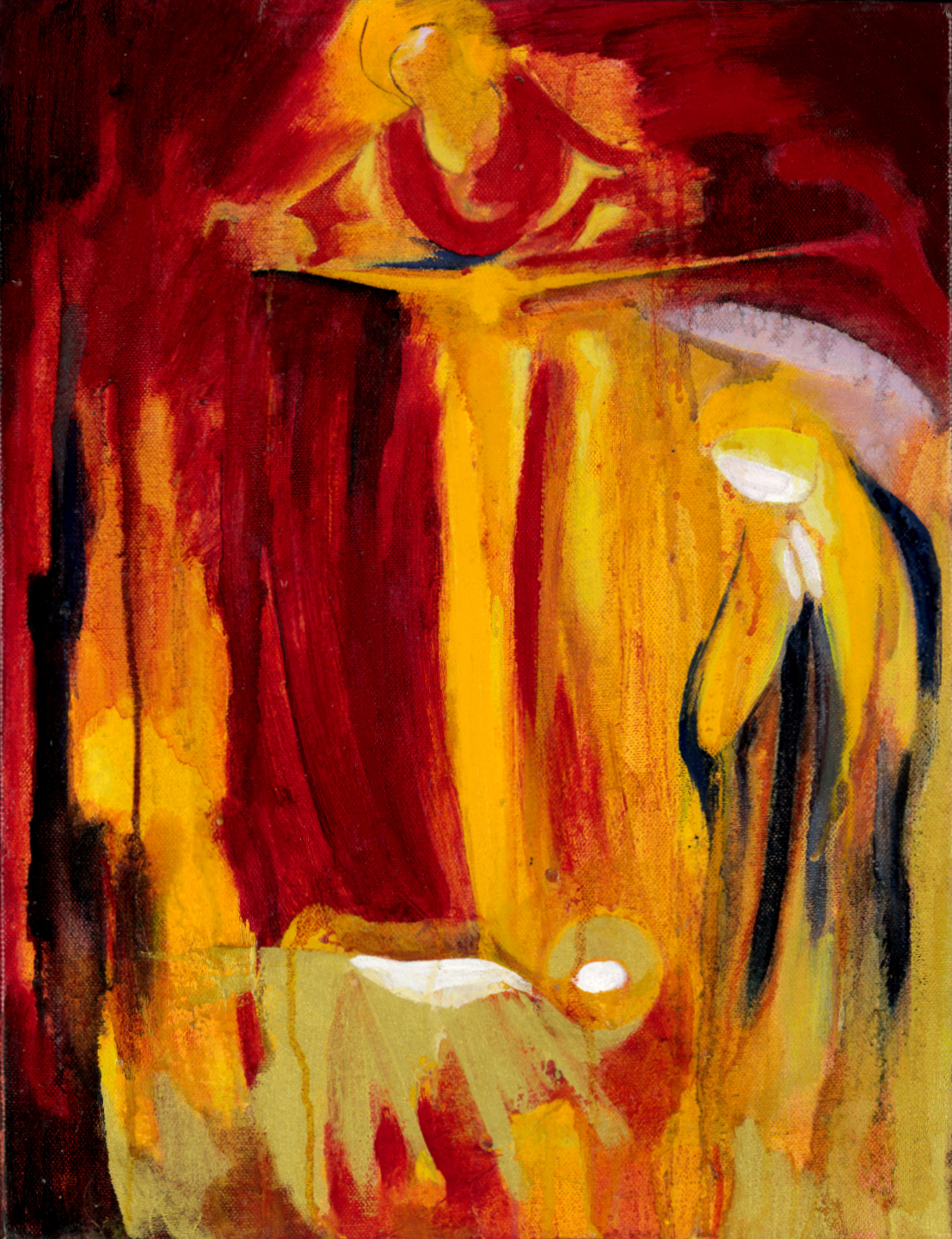
In this semiabstract Nativity painting by Judith Tutin, Mary and Joseph adore the newborn Christ child as God the Father looks down from above, holding in his arms a portent: the traces of a cross. One might also see, overlapping the intimation of a crossbar, the outstretched wings of the Holy Spirit as dove, hovering over the earthly scene below.
This central triad of Father, (crucified) Son, and Spirit evokes the Gnadenstuhl, or “Throne of Mercy,” an iconography of the Trinity that emerged in twelfth-century Europe. Tutin innovates on this type by showing, at the base of the cross, the Son in his infancy, thus drawing together the doctrines of the incarnation and the atonement.
Applied in broad, loose brushstrokes, the deep crimsons and golds further underscore the themes of blood and glory.
LISTEN: “A Stable Lamp Is Lighted” | Words by Richard Wilbur, 1958 | Music by Jennifer Wyatt, 2002 | Performed by Ardyth & Jennifer on WinterFire, 2002
A stable-lamp is lighted Whose glow shall wake the sky; The stars shall bend their voices, And every stone shall cry. And every stone shall cry, And straw like gold shall shine; A barn shall harbor heaven, A stall become a shrine.
This child through David’s city Shall ride in triumph by; The palm shall strew its branches, And every stone shall cry. And every stone shall cry, Though heavy, dull, and dumb, And lie within the roadway To pave his kingdom come.
Yet he shall be forsaken, And yielded up to die; The sky shall groan and darken, And every stone shall cry. And every stone shall cry For stony hearts of men: God’s blood upon the spear-head, God’s love refused again.
But now, as at the ending, The low is lifted high; The stars shall bend their voices, And every stone shall cry. And every stone shall cry, In praises of the Child By whose descent among us The worlds are reconciled.
Richard Wilbur (1921–2017) [previously] was a major American poet, serving as the nation’s second poet laureate and winning two Pulitzer Prizes and a National Medal of Arts. He was a champion of formalist poetry, working within the constraints of meter and rhyme.
He wrote this text to be sung at a December 7, 1958, candlelight service in the Memorial Chapel of Wesleyan University in Middletown, Connecticut, where he was a professor in the English Department. It premiered with a choral setting by Richard Winslow, director of the university’s choral society. Wilbur also sent out the text in his family Christmas cards that year.
A few years later, it was published in his collection Advice to a Prophet (1961) as “A Christmas Hymn,” with Luke 19:39–40 as an epigraph: “And some of the Pharisees from among the multitude said unto him, Master, rebuke thy disciples. And he answered and said unto them, I tell you that, if these should hold their peace, the stones would immediately cry out.” This passage takes place upon Jesus’s entry into Jerusalem the week of his death. People were lauding him as a king who came in the name of the Lord, which the Pharisees considered blasphemous. When they demand that Jesus repudiate such ridiculous claims, he instead validates them, replying that even the inanimate stones know his kingship and would shout, “Hosanna!” if human voices failed to.
The hymn stretches from Christmas to Palm Sunday to Good Friday, then circles back to Christmas, covering the span of Christ’s life.
“Not many other major poets in the past seventy years have written Christmas hymns, classic, straightforward Nativity celebrations with no irony to them, and which work beautifully in a traditional church service,” notes Bruce Michelson in Wilbur’s Poetry: Music in a Scattering Time. Wilbur is an example of a modern poet who was very accomplished at his craft and respected by the establishment as well as being a person of Christian faith.
“A Stable Lamp Is Lighted” appears in a few dozen hymnals. The standard tune for it is ANDÚJAR by David Hurd from 1983, but I prefer the one by Ardyth & Jennifer, Celtic harp and vocal duo Ardyth Robinson and Jennifer Wyatt, based in Shad Bay, Nova Scotia.
This post is part of a daily Christmas series that goes through January 6. View all the posts here, and the accompanying Spotify playlist here.
Salvador Dalí (Spanish, 1904–1989), The Angel, 1947. Ink and watercolor on paper, 12 3/4 × 10 1/4 in. Hallmark Art Collection, Kansas City, Missouri.
In 1947, Hallmark commissioned the famous modern artist Salvador Dalí to create a small set of original paintings for its Gallery Artists line of Christmas cards to hit the market in 1948. The Angel is one of them. Painted in his typical surrealist style, it shows a headless angel playing a lute, the snowy mountains in the background mimicking wings. At the bottom right, the newborn Christ lies naked on the ground, cushioned by straw and adored by his mother. On the left a shepherd sits on a tree stump, also playing a lute, its soundboard blending into the landscape in the background. At the warmth of their song, the snow begins to melt away.
LISTEN: “Celestial Hearts,” traditional Yorkshire carol | Arranged and performed by Kate Rusby on Holly Head (2019)
Come, let us all rejoice To see this happy morn We’ll tune our hearts and raise our voice We’ll tune our hearts and raise our voice Tune our hearts and raise our voice Upon this Christmas morn Upon this Christmas morn
Go, humble swain, said he To David’s city fly A promised infant born today A promised infant born today A promised infant born today Does in a manger lie Does in a manger lie
Now angels all on high Sing heav’nly peace on earth Goodwill to men and angels’ joy Goodwill to men and angels’ joy Goodwill to men and angels’ joy Resound across the earth Resound across the earth
With looks and hearts serene Go see the babe, your king A host of angels then was seen A host of angels then was seen A host of angels then was seen The shepherds heard them sing The shepherds heard them sing
From one of England’s most popular folk singers, Kate Rusby, comes a modern interpretation of the Yorkshire carol from Worrall and Oughtibridge known as “New Celestial” (Roud 17724). Rusby arranged this version with her husband and producer Damien O’Kane, adapting the traditional lyrics.
This post is part of a daily Christmas series that goes through January 6. View all the posts here, and the accompanying Spotify playlist here.















 Art & Theology