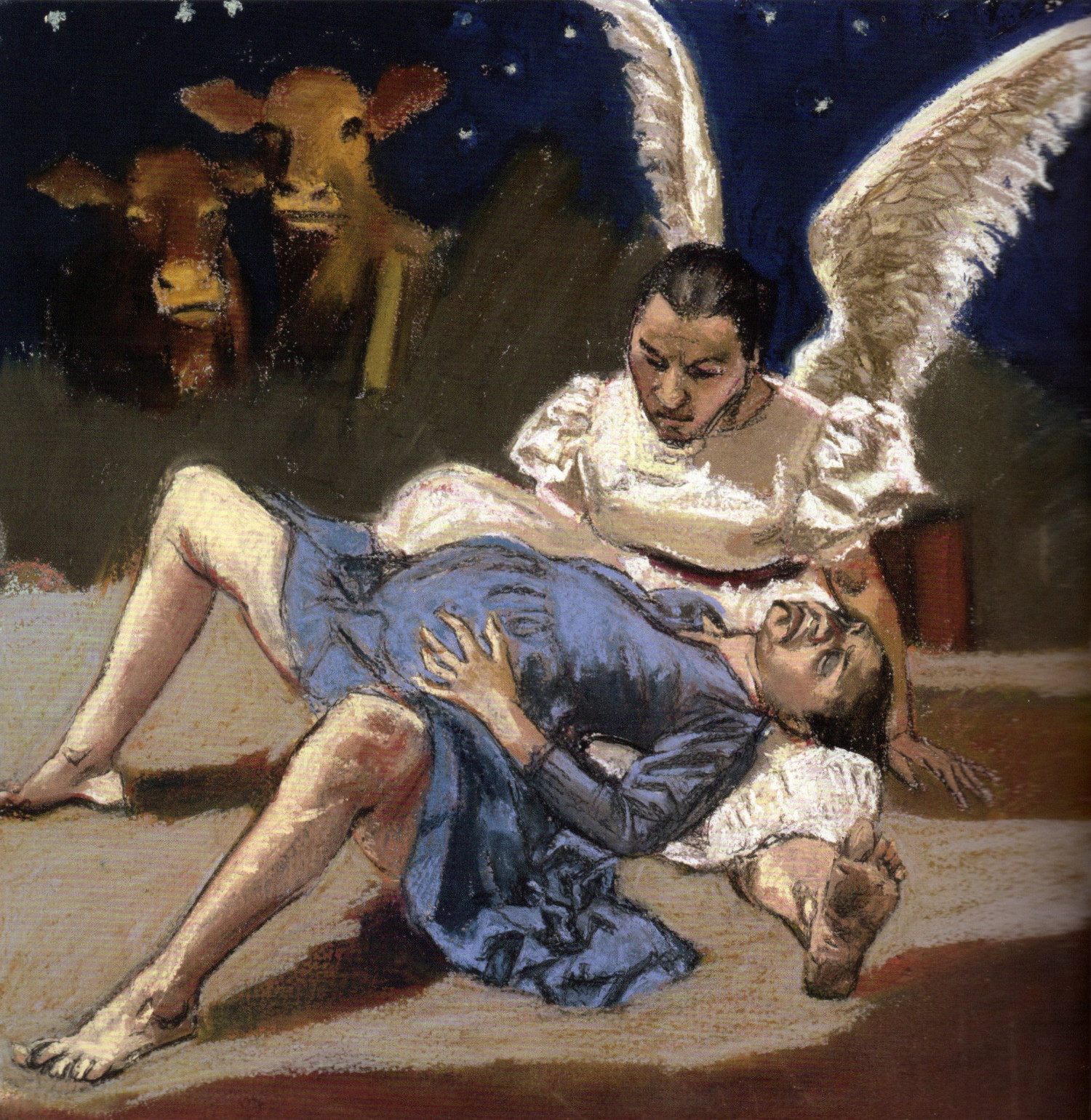
Paula Rego (Portuguese British, 1935–2022), The Nativity, 2002. Pastel on paper mounted on aluminum, 21 3/8 × 20 1/2 in. (54 × 52 cm). Palácio de Belém, Lisbon, Portugal. Source: Paula Rego: The Art of Story, p. 226.
It is time.
My body’s clock gongs
your salvation’s hour.
The water has left the pasture
and flowed toward the river’s mouth.
Follow or you will wither
in the desert that remains.
I will bleed for you
on this your first dark journey,
but in time, when life pushes you
headlong through black canyons,
the wounds will be your own.
May you learn early:
at the end light always shines.
It is here, child.
The time is come.
Breathe.
This poem was originally published in the Winter 1982/83 issue of Today’s Christian Woman and appears in the book Mary’s Journal: A Mother’s Storyby Evelyn Bence (Grand Rapids, MI: Zondervan, 1992). Used by permission of the author.(Thanks to Maureen E. Doallas, curator of the exhibition Mary, Mary, for introducing me to it!)
Evelyn Bence (born 1952) is a writer and editor living in Arlington, Virginia. She is the author of Room at My Table; Prayers for Girlfriends and Sisters and Me; Spiritual Moments with the Great Hymns; and the award-winning Mary’s Journal, a novel written in the voice of Jesus’s mother. She has served as religion editor at Doubleday, managing editor for Today’s Christian Woman, and senior editor at Prison Fellowship Ministries. Her personal essays, poems, and devotional reflections have appeared in various publications.
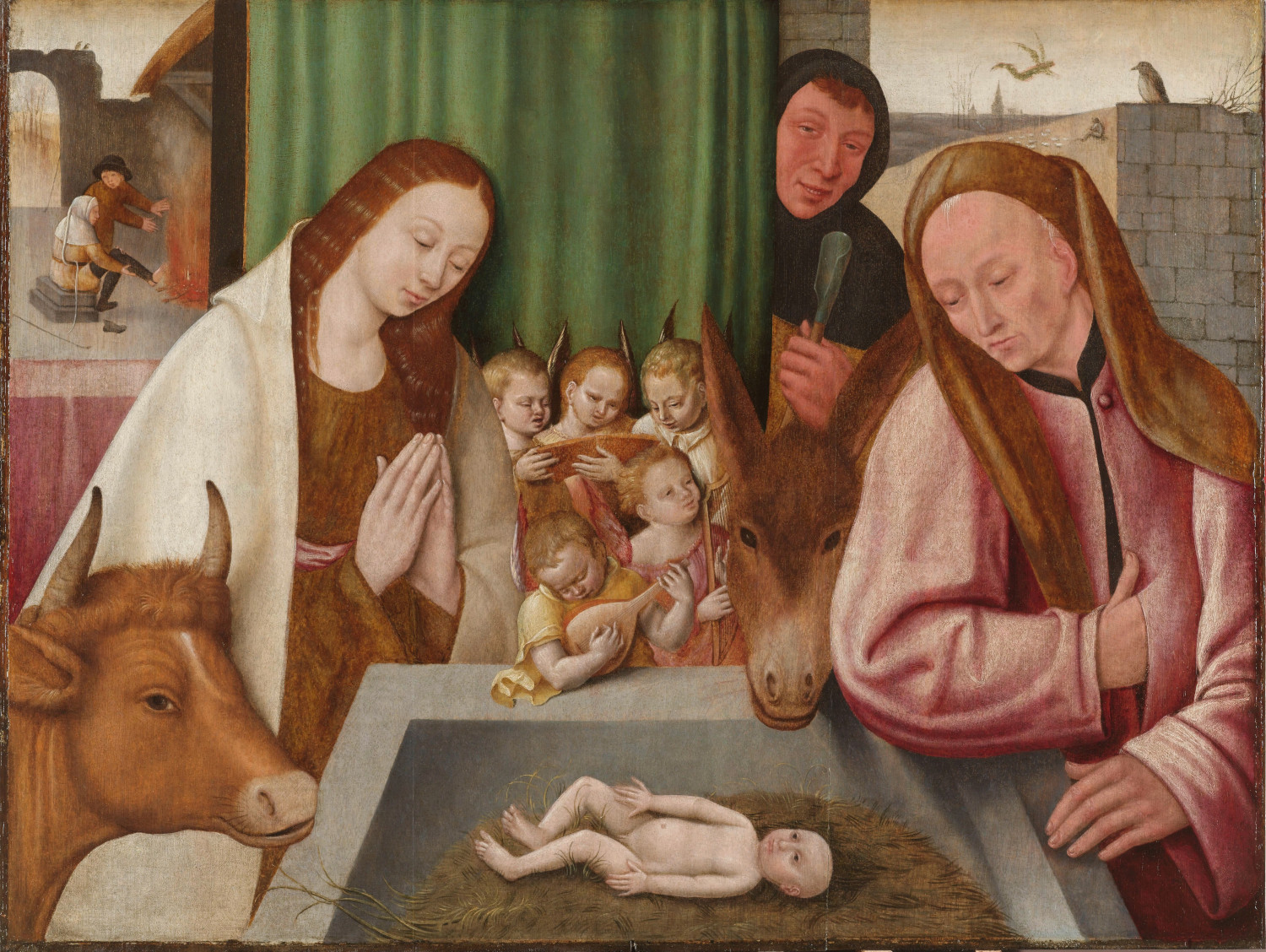
Unidentified artist (in the style of Hieronymus Bosch), Nativity, southern Netherlands, ca. 1550–1600. Oil on panel, 58 × 76 cm. Rijksmuseum, Amsterdam.
This painting in the style of Bosch shows Mary and Joseph adoring their newborn son, Jesus, who’s naked and bedded down in straw. A small angelic ensemble stands at the head of the manger with lute, harp, and songbook, softly serenading the family, while a shepherd sneaks a peek from behind a green curtain. It is as if we, the viewer, are standing opposite the shepherd on the other side of the manger, also looking down at the Christ child. Are we similarly rapt with wonder?
I love how the ox and the ass meet our gaze, acknowledge our presence!
I’m not sure of the significance of Joseph’s hand-in-jacket gesture (its association with stateliness wasn’t established until some two centuries later, from what I can tell), but it’s likely supposed to connote reverence or humility, as do Mary’s prayerful hands.
In the left background, two men warm their hands and feet outside by a fire, while at the right, an angel appears to another shepherd on a hillside, announcing the Messiah’s birth.
The lyrics of this song are loosely based on Ephrem the Syrian’s Nativity Hymn #2 from the fourth century. (All nineteen Nativity hymns by this early Christian poet-theologian are a treasure!)
Blessed is he Both hidden and seen Blessed is he Who left the height of majesty
You magnify all, come magnify me That I may tell about The glory of your birth Proclaim your grace to all the earth Holy One, Jesus, come!
Blessed is he Who gave us all Blessed is he Who gave us all that he has gained
O Father of all, your glorious day You gave not seraphim Nor sent the cherubim You gave your only Son instead Holy One, Jesus, come!
All glory to thee, entirely Glory to thee, from every tongue, entirely Your birth is enough For all of us
Great one became a child Pure one became defiled O Living One, laid in the tomb In you we are renewed Your washing washed us through Let us obtain life by your death Holy One, Jesus, come!
The Incarnation, the enfleshment of God in the person of Jesus, encompasses the God-man’s birth and death, as does this song. Salvation was wrought not through Jesus’s birth alone, or life alone, or death alone, or resurrection alone, but through all of it together.
At first I got tripped up on the line “Pure one became defiled,” because Jesus did not become defiled in the sense of succumbing to sin or moral corruption. However, in his ministry, he did touch lepers, bleeding women, and corpses, which, according to the Jewish purity laws at the time, would have made him ritually unclean. Looking back on these healings and raisings, Christians would say that rather than these people’s uncleanness transferring to him, his cleanness transferred to them. But the public perception was that he was defiling himself.
And then, of course, there’s 2 Corinthians 5:21: “For our sake God made the one who knew no sin to be sin, so that in him we might become the righteousness of God.” And Galatians 3:13: “Christ redeemed us from the curse of the law by becoming a curse for us—for it is written, ‘Cursed is everyone who hangs on a tree.’” What it means that Jesus “became sin” or “became a curse” has been the subject of much theological discussion! But suffice it to say that Jesus’s death on the cross involved not only physical debasement but also his bearing, in a metaphysical sense, the full weight of humanity’s transgressions.
Andy Bast is a singer-songwriter from Holland, Michigan. He is a musician and writer for the Christian collective Bellwether Arts and a regular contributor to Cardiphonia projects.
Andrew Gadd (British, 1968–), Bus Stop Nativity, 2008. Oil on canvas, 188 × 122 cm.
Painted by Royal Academy gold medal winner Andrew Gadd, Bus Stop Nativity depicts the Holy Family huddled together at night under a bus shelter, trying to stay warm. Some passersby look on with curiosity—two even kneel down on the snowy sidewalk—while others go about their business with total indifference.
This painting was commissioned by the Church Advertising Network in the UK, now ChurchAds.net, and displayed on posters at over one thousand bus stops in December 2008, printed with the text “Be Part of the Action. Church, 25-12.” (A gentle provocation to attend a Christmas service on December 25.)
Francis Goodwin, the chair of the Church Advertising Network, said, “We are very used to the Renaissance image of the Nativity. But what would it look like if it happened today? Where would it take place? We want to challenge people to make them reassess what the birth of Jesus means to them.”
Bus Stop Nativity identifies Jesus with today’s urban poor. He was born not in a comfortable palace with fine clothes and other material wealth and security, but in vulnerability and need, to working-class parents who were inconveniently out of town at the time of delivery, forced to make do with less-than-ideal accommodations. When it came time for Mary to present a purification offering in the temple forty days after giving birth, she couldn’t afford the requisite lamb, so she brought two turtledoves instead (a provision made in Lev. 12:8). Not only was Jesus not monied; he also spent his early years as a refugee in Egypt, a flight prompted by Herod’s direct threat on his life. With limited resources, his parents had to make a home for him away from home, not knowing for some time when it would be safe to return to Galilee.
That this was Jesus’s family background and experience—that he lived on the margins of society, not at its center—has always been a significant facet of the Incarnation, because it means that God knows bodily what it is to feel want and uncertainty and to be overlooked. When in his adulthood Jesus preached “Blessed are the poor,” he was affirming that God is with those of lower socioeconomic means. He is one of them.
LISTEN: “Hush Child (Get You Through This Silent Night)” from the movie Black Nativity(2013) | Written by Taura Latrice Stinson, Kasi Lemmons, and Taylor Gordon | Performed by Jennifer Hudson, Jacob Latimore, Luke James, and Grace Gibson
Silent night Holy night Poverty on the rise Wealthy reverend in designer clothes Homeless children with frostbitten toes Sleeping in the street Sleeping in the street
I ain’t tryna be philosophical But it’s not logical Some folks out here freezing, others chilling like it’s tropical
The indifference is mad crazy Like poverty’s contagious My hands are dirty, but I’m still worthy Step in my shoes and walk in some mercy
They say this is your punishment for such poor judgment But you must’ve lost your mind How you gon’ feed it when you barely eating? Get ready for the welfare line I ain’t tryna hear it You make the bed, lay in it But I’m way too strong for you to break my spirit
Is it me? Am I the cause of all my mother’s misery? This cloud of secrecy on my paternity Did my very birth destroy my whole family?
I’m just a sinner, I know who I am Just a beginner, I’m not yet a man Send me a signal, I’ll follow your light Just help me through this silent night
Hush child, it’ll be alright I’ll get you through this silent night Hush child, it’ll be alright I’ll get you through this silent night
This ain’t living I got a mouth to feed But I can’t make these ends meet Got an eviction notice But my Lord don’t hear my prayers I never been this scared The silence is too loud for me Life just ain’t fair
Is anyone out there? Does anyone care? Is anyone listening? Is anyone there? Just let me know that I’m a part of your plan That you’re watching over and know who I am
From where we are now How do we find our way? Alone in the darkness, scared With no place to stay
Hush child, it’ll be alright I’ll get you through this silent night Hush child, it’ll be alright I’ll get you through this silent night
Hush child, it’ll be alright We’ll do this together
Sleep in heavenly peace Sleep in heavenly peace
This song is a dream sequence from the 2013 film Black Nativity, directed by Kasi Lemmons (good soundtrack, cheesy movie). The two characters who initiate the song are Maria (Grace Gibson) and Jo-Jo (Luke James), a homeless couple in New York City expecting their first child, who are caroling door-to-door. Fifteen-year-old Langston (Jacob Latimore), who has been sent to live temporarily with his estranged grandfather while his mom, Naima (Jennifer Hudson), figures out how to make ends meet for the two of them back in Baltimore, interjects with a rap expressing his frustration with economic inequality and the struggle he has seen and lived.
The pregnant couple sings the refrain, “Hush child . . . ,” to each other and to their unborn child, and Naima sings it to Langston. But in between, all four address God in lament: God, are you there? God, why don’t you fix these inequities? I’m exhausted. Tired of being a have-not and always having to hustle, to no avail. When are you going to provide like you said you would? The night is “silent” because God is not answering, it seems. Still, the characters continue to pray their pain and grasp after hope.
Though Lemmons’s Black Nativity was marketed as being based on Langston Hughes’s 1961 musical of the same name, its only resemblance is that it is a Christmas-themed drama with Black sacred music (only two songs are held in common; most in the movie are contemporary gospel or original hip-hop/R&B). To listen to the original Broadway cast recording of *Hughes’s* Black Nativity on Spotify, click here.
LECTURE: “Light in Sacred Space: Light from the Cave” by Matthew J. Milliner and Alexei Lidov, December 19, 2019, Bridge Projects, Los Angeles: This double lecture about the role of light in Christian spirituality and theology was organized to coincide with the premiere of 10 Columns, an immersive light installation by Phillip K. Smith III that Bridge Projects commissioned for their inaugural exhibition.
While the Light & Space movement was born in Southern California in the 1960s, in many ways it participates in a much longer history of artists in dialogue with the phenomena of light. This presentation by two art historians, Matthew Milliner and Alexei Lidov, will begin with Milliner exploring the unexpected resonance of Phillip K. Smith III’s work with Byzantine and Gothic traditions. Lidov will then expand on these ideas with his scholarship in the Eastern Orthodox tradition and its long history of engaging light and mysticism. What kinds of insights might come when Light and Space artists, including Phillip K. Smith III, are put in conversation with ancient Orthodox Christian concepts of the nativity and uncreated light? [source]
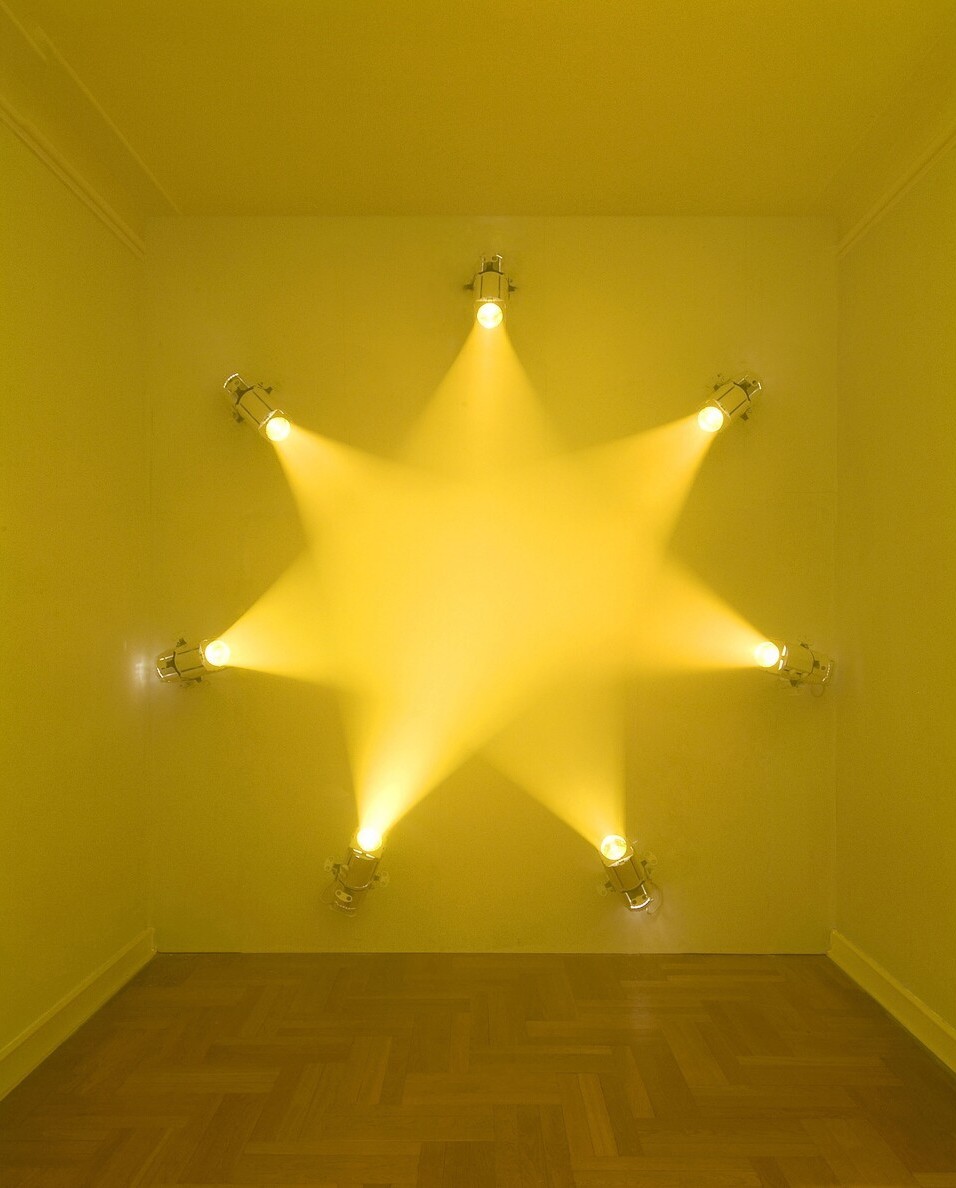
Milliner speaks for the first forty minutes, discussing Nativity and Transfiguration icons and their correlatives in the West and making, as always, fascinating connections between art of the past and present. For example, he overlays Olafur Eliasson’s Ephemeral Afterimage Star (2008) on Rublev’s Transfiguration icon (19:19), and Ann Veronica Janssens’s Yellow Rose on an Adoration of the Magi illumination from a fifteenth-century book of hours at the Getty (26:32). He also introduced me to a fascinating medieval manuscript illumination from Germany (which he in turn learned about through Solrunn Nes) that combines the light of Bethlehem and Tabor—two Gospel scenes in one. Don’t miss the quote by Gregory of Nazianzus.
Ann Veronica Janssens (Belgian, 1956–), Yellow Rose, 2007. Projectors, dichroic filters, and artificial mist, dimensions variable (min. 360 cm diameter, min. 250 cm depth). Museum Morsbroich, Leverkusen, Germany. Photo: Philippe De Gobert.The Nativity and the Transfiguration, from an Ottonian Gospel-book made in Cologne, 1025–50. Bamberg State Library, Msc.Bibl.94, fol. 155r.
Combining art history and theology (he has advanced degrees in both), Milliner’s talk is organized as follows:
Thessaloniki | Gregory Palamas (d. 1337)
Constantinople | Pseudo-Dionysius the Areopagite (d. ca. 500)
Paris | Abbot Suger (d. 1151)
Los Angeles | Phillip K. Smith III (b. 1972)
+++
ART VIDEOS:
>> “A 60-second introduction to ‘The Nativity at Night’”: One of my favorite Nativity paintings! By fifteenth-century Dutch artist Geertgen tot Sint Jans, a lay brother in the religious order of St. John. In this video from the National Gallery in London, a camera scans over the painting as an atmospheric soundscape plays and captions guide us in looking at the details.
Geertgen tot Sint Jans (Dutch, ca. 1455/65–ca. 1485/95), The Nativity at Night, ca. 1490. Oil on oak, 34 × 25.3 cm. National Gallery, London.
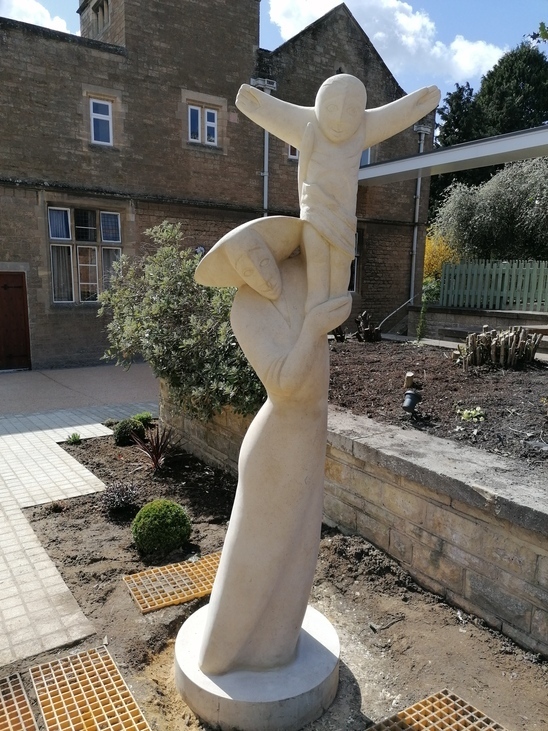
>> “Mother and Child Commission”: In this twelve-minute “making of” video, filmmaker Nick Clarke talks to artist Nicholas Mynheer over the first half of 2020, tracing his progress on the life-size Mother and Child sculpture that was commissioned by the Community of St Mary the Virgin, Wantage, an Anglican convent in Oxfordshire. I was struck by, from the looks of it, the physical demands of the sculpting process—the strength and endurance required to chip away daily at blocks of stone outside in winter, until they yield the shape you desire, then the logistics of attaching the blocks with steel, which weigh nearly a ton collectively, and disassembling, transporting, and reassembling them for installation. I was also interested to hear Mynheer discuss the expressive capabilities of English limestone—how you can convey emotional and sartorial subtleties, for example, through the precise angling of the chisel.
Nicholas Mynheer (British, 1958–), Mother and Child, 2020–21. English limestone, height 230 cm.
Mother and Child was installed in the outdoor reception area of St Mary’s on April 12, 2021; you can watch a video of the installation here. “In very, apparently, simplified form, there is so much tenderness, energy, and something new,” says Sister Stella, the sister in charge, about the sculpture. “Jesus isn’t going to be held back. Her son’s going to go places.”
>> “Corazón Pesebre” (Heart Manger) by Rescate: A follower of the blog introduced me to this Christmas song from Argentina, and I dig it! Released as a single in 2017, it’s about turning our hearts into a manger to receive Christ. Read the Spanish lyrics in the YouTube video description.
The song is by the highly popular Argentinian Christian rock band Rescate, active from 1987 to 2020. Their lead singer and main songwriter, Ulises Eyherabide, died of cancer in July.
>> “Hallelujah, What a Savior!” (Christmas Version), performed by Providence Church, Austin, Texas: In 2012 Austin Stone Worship songwriters Aaron Ivey, Halim Suh, and Matt Carter rewrote the lyrics to Philip P. Bliss’s classic “Hallelujah, What a Savior!” to make them more Christmas-centered and added a new refrain; their version was released that year on A Day of Glory (Songs for Christmas). Here the song is performed by another Austin worship team—Jordan Hurst, Jaleesa McCreary, and Brian Douglas Phillips from Providence Church—for a virtual worship service on November 29, 2020. Instead of using the Austin Stone refrain, they quote Leonard Cohen’s “Hallelujah” between verses.
William L. Hawkins (American, 1895–1990), Nativity Scene, 1987. Oil on canvas, 48 × 48 in. Newark Museum of Art, Newark, New Jersey.
1.“Remembering that it happened once”by Wendell Berry: For the last forty-plus years, Kentucky farmer Wendell Berry has been writing what he calls “Sabbath poems,” which emerge from his spiritual practice of walking outdoors on Sundays without any to-do’s. “I go free from the tasks and intentions of my workdays,” he says, “and so my mind becomes hospitable to unintended thoughts: to what I am very willing to call inspiration.” This Sabbath poem from 1986 explores how the sacred permeates the mundane and how Christ is, in a sense, always being born. For an SATB choral setting by Doug Brandt, see here.
Source: A Timbered Choir: The Sabbath Poems 1979–1997 (Washington, DC: Counterpoint, 1998); compiled in This Day: Collected and New Sabbath Poems (Washington, DC: Counterpoint, 2014)
2.“BC:AD” by U. A. Fanthorpe: Ursula Askham Fanthorpe (1929–2009), CBE, FRSL, was an English poet who is well loved by both critics and the general public. She was also a practicing Quaker. Each year she wrote a new Christmas poem to send to friends, of which “BC:AD” is the best known. It considers Jesus’s birth as the pivotal point in history, dividing time into epochs, into “before” and “after.” At this nativity, kairos invaded chronos—and we’re still singing about it millennia later.
3.“Making the House Ready for the Lord”by Mary Oliver: For many of us who succumb to cultural pressures, December is a time of rushing around, making sure the house is decorated like a magazine, the Christmas cards sent out, the cookies baked to perfection, the gifts individually selected and bought and wrapped. But in all this flurry of activity, are we missing “the better part” (Luke 10:42)? The speaker of this poem, Martha-like, is busy making preparations for Jesus, who’s coming to visit, but as she’s cleaning, outdoor critters keep popping in. At first she bemoans their presence—they’re not on the guest list!—but eventually she comes to accept, even welcome, them, surrendering her fussy desire for orderliness to a charitable embrace of whatever is. And on another level, this poem is about how all of creation longs for Christ (Rom. 8:19–22); the animals, too, want to see him, want to join the party.
5.“Second Advent”by Anya Krugovoy Silver: Memorializing a friend (Ishiuan Hargrove) who died of metastatic brain tumors, “Second Advent” unsettlingly combines stark hospital-room and anatomical language with language that is soft, gentle, lyrical. Recounting one of Ishiuan’s several neurosurgeries, the poet remarks how her head was nimbed by surgical lights and then swaddled in gauze. The title refers to Ishiuan’s waking up on the second Sunday of Advent, but also to the hope of Christ’s second coming, when pain, disease, and sorrow will be done away with. Anya Silver was herself a cancer patient, an experience she wrote much about in her four volumes of poetry, before dying of breast cancer in 2018.
Source: Second Bloom (Eugene, OR: Cascade Books, 2017)
6.“The Nativity”by Henry Vaughan: “Peace!” rang the angels’ song the night of Christ’s birth—and yet what irony, that he who came to bring peace was himself no beneficiary of it in this life, being born among animals in a borrowed stable, then made a refugee, then later disbelieved, betrayed, mocked, tortured, and crucified. The darkness that bred such unwelcome of the Son of God still persists—violence, ignorance. Referencing the Genesis 1 creation narrative as well as the journey of the magi, the poem ends with an invocation for God’s light to manifest once again, leading us to Christ.
Source: Thalia Redivina: The Pass-Times and Diversions of a Countrey-Muse (London: Robert Pawlet, 1678). Public Domain.
7. [little tree] by E. E. Cummings: One of E. E. Cummings’s earliest published poems (it came out in the January 1920 issue of The Dial), “little tree” was intended to appear as one of five “chansons innocentes” in Cummings’s first book of verse, Tulips and Chimneys, but his editor, Thomas Seltzer, cut it (along with sixty-five others!). In it a young child consoles a recently felled evergreen tree—enlisted for the holiday festivities—with promises of glory and love. Though it runs the danger of being read as twee, Cummings remained fond of the poem and even had it printed and sent it as his family Christmas card in 1960, two years before he died.
8. “Messiah (Christmas Portions)”by Mark Doty: The speaker of this poem is unexpectedly transported by a local community choir performance of Handel’s Messiah. He marvels at how these ordinary, flawed neighbors of his can produce such beauty with their collective voices. The last line is probably a reference to the accompagnato and air sung by the bass toward the end of the oratorio, taken from 1 Corinthians 15:51–54—about how we will all be changed in a moment at the last trump, and the corruptible will put on incorruption.
9. “What the Body Knows” by Jean Janzen: The anonymous scribes and illuminators of the Book of Kells spent countless hours copying and beautifying God’s word amid Viking raids. In this ekphrastic poem, Jean Janzen reflects on the Gospel-book’s five whimsically painted folios of Luke’s genealogy of Christ, commenting on the continual inbreaking of God into our world and the “wild safety” of God’s love.
10.“Confession”by Leila Chatti: The Tunisian American poet Leila Chatti was raised by a Muslim father and a Roman Catholic mother, and both religious traditions have shaped her faith and her writing. Islam and Christianity hold many sacred figures in common, including Mary (Maryam), whose conception and delivery of Jesus (Isa) are narrated in the Quran 19:16–34. Chatti confesses to being more compelled by the Islamic characterization of Mary as grunting and sweating in the pangs of labor (in contrast to Catholic teaching, which says her birthing experience was effortless, her contractions painless, though the Bible itself doesn’t specify). Chatti finds comfort in picturing Mary not as someone exempt from the effects of the fall and set apart on a pedestal of supreme virtue, but as one who suffered the same physical and emotional toll as other childbearing women—and who probably did have the occasional selfish thought, which, in moments of intensity and vulnerability, she deigned to vocalize!
11. “Two Carols”by Evelyn Underhill: An English Anglo-Catholic writer and mystic, Evelyn Underhill meditates in this double poem on how Christ set foot on the long, hard road we travel to be a balm for our wounds and those of the earth. The epigraph to part 1 is from the Latin Vulgate of Song of Solomon 2:12: “The flowers appear on the earth.” What follows are several Catholic titles for Mary: rose without thorn, queen, generatrix. The epigraph to part 2 is a quotation of Romans 8:22: “The whole creation groaneth and travaileth in pain together until now.” The refrain, Dominus tecum!, translates to “The Lord is with you!,” words spoken by the angel Gabriel to Mary and, by virtue of the Incarnation, to all humanity. The other Latin phrases translate to “He who is in the heavens,” “A King is born,” and “Let the kingdom come!” Adveniat regnum!
Source: Immanence: A Book of Verses (London: J. M. Dent, 1912). Public Domain.
12. “The Christmas Babe”by Fr. John Banister Tabb: Written by a Catholic priest from Virginia, this simple quatrain marvels at the paradox of God’s simultaneous largeness and smallness.
Source: Poems (London: John Lane, 1894). Public Domain.
13.“Snowflakes” by Jennifer Grotz: When the world is viewed through a sacramental lens, we recognize God in commonplace wonders like falling snow, and such things can be a sort of wordless prayer that we offer back to God through our enjoyment of them.
14. [The Savior must have been a docile Gentleman]by Emily Dickinson: In these two compact stanzas, Dickinson reflects on how kind Jesus was (an understatement!) to have made the far journey to Bethlehem, “a rugged billion Miles” from heaven, especially in the cold month of December, all “for little Fellowmen.” She refers to him as “docile”—obedient, submissive—harking to Philippians 2, to his yielding to the will of the Father in the Incarnation, taking on human limitations, suffering, and death for the life of the world.
15.[Wilt thou love God, as he thee? Then digest](Holy Sonnet No. 15) by John Donne: A self-address to the soul, this poem by the English poet-priest John Donne, first published in 1633, two years after this death, celebrates the Triune God’s salvific workings: we’re adopted by the Father, redeemed by the Son, indwelt and regenerated by the Spirit. The closing couplet, referencing the imago Dei, packs a wallop: “’Twas much, that man was made like God before, / But, that God should be made like man, much more.”
Source: Poems (London: M.F. [Miles Fletcher], 1633). Public Domain.
16. “The Little Towns of Bethlehem”by John Terpstra: All over Canada, Christ is being reborn this Christmas, in the sense that the Story has taken root, is retold, and continues to have impact. The speaker imagines the Christ child “wrapped in cast-off flannel” in a boxcar stopped on the tracks in Esther, Alberta, or feeding at his mother’s breast in a broken-down car on the shoulder of a road in Englehart, Ontario—actual sights that one might encounter today. Localizing the Story can help us to see it afresh, and to see the sacred humanity of families experiencing homelessness or other hardships.
17. “Song of the Shepherds” by Richard Bauckham: Richard Bauckham, FRSE, FBA, is best known as a biblical scholar—he’s one of today’s tops, in fact—but he also writes poetry! (I featured one of his poems last year.) In this poem, the shepherds on Bethlehem’s hillsides recall an ancient tale about the stars singing at the creation of the universe, which they thought merely a poetic embellishment, until they experienced something of the like for themselves: “a song of solar glory” eclipsing the lesser lights and exorcising the dark, creating the world anew. Unforgettable.
18. “Those Magi”by Kathleen O’Toole: What exactly were the magi seeking? What compelled them to leave their treasure behind in that cattle shed? Whence their strength to defy Herod? Besides musing on these questions, the poem also contains a passing metaphor that I found striking and new: cow breath as incense.
19. “Carol of the Brown King”by Langston Hughes: Tradition names one of the wise men who visited the Christ child “Balthazar” and says he’s from Africa. Langston Hughes, a preeminent poet of the Harlem Renaissance, exults that there was “one dark like me—part of His Nativity.” This poem is included in Hughes’s musical play Black Nativity and is one of six Nativity poems by Hughes that make up a children’s book illustrated by Ashley Bryan.
20. “Mosaic of the Nativity: Serbia, Winter, 1993”by Jane Kenyon: I couldn’t find the particular church mosaic program that Kenyon is writing about, but here’s my interpretation. Set inside a Serbian Orthodox church during the Bosnian War, this poem imagines a mosaic of Christ Pantocrator hovering in the dome, lamenting the violence that goes on beneath. Under the gaze of the I AM is another mosaic, portraying Jesus’s birth, but also, in a way, Mary’s, as she herself is being reborn in Christ, her mind increasingly shaped in accordance to his. Nativity icons often show Mary framed by a red blanket that she’s reclining on at the mouth of a cave, which Kenyon reads as embryonic.
21. “Breath” by Luci Shaw: This poem reflects on the contraction of the infinite God who breathed the universe into existence into a finite human being needing oxygen, who, as is foreshadowed at his birth, will finally ex-pire (“breathe out” his last) on a cross before entering his “next dark cave,” a prelude to resurrection.
22.“Mary’s Vision”from medieval Ireland: Mary foresees the future suffering of her infant son and dialogues with him about it in this poem translated from Middle Irish by Eleanor Hull (the same woman whose versification of a medieval Irish lorica, working from a translation by Mary Elizabeth Byrne, gave us the hymn “Be Thou My Vision”!).
Source: The Poem-Book of the Gael (London: Chatto & Windus, 1912). Public Domain.
23.“Joseph at the Nativity”by Tania Runyan: Staring at the “shriveled pod” that Mary just birthed, Joseph grapples with his complicated feelings—doubt, embarrassment, jealousy, helplessness, confusion, pride—and with figuring out what role he should play in the life of this child going forward.
24.“Waiting in Line After Christmas”by Sharron Singleton: (Scroll down to fourth poem) Rather than exchanges of refunded money for unwanted items, Singleton ponders what a mutually life-giving exchange of intangibles might look like.
25. “Burning the Old Year”by Naomi Shihab Nye: Through the act of forgetting, we must destroy the worthless trivialities of the year, and we must let that which is solid, that which matters—the “stones”—be revealed and remain.
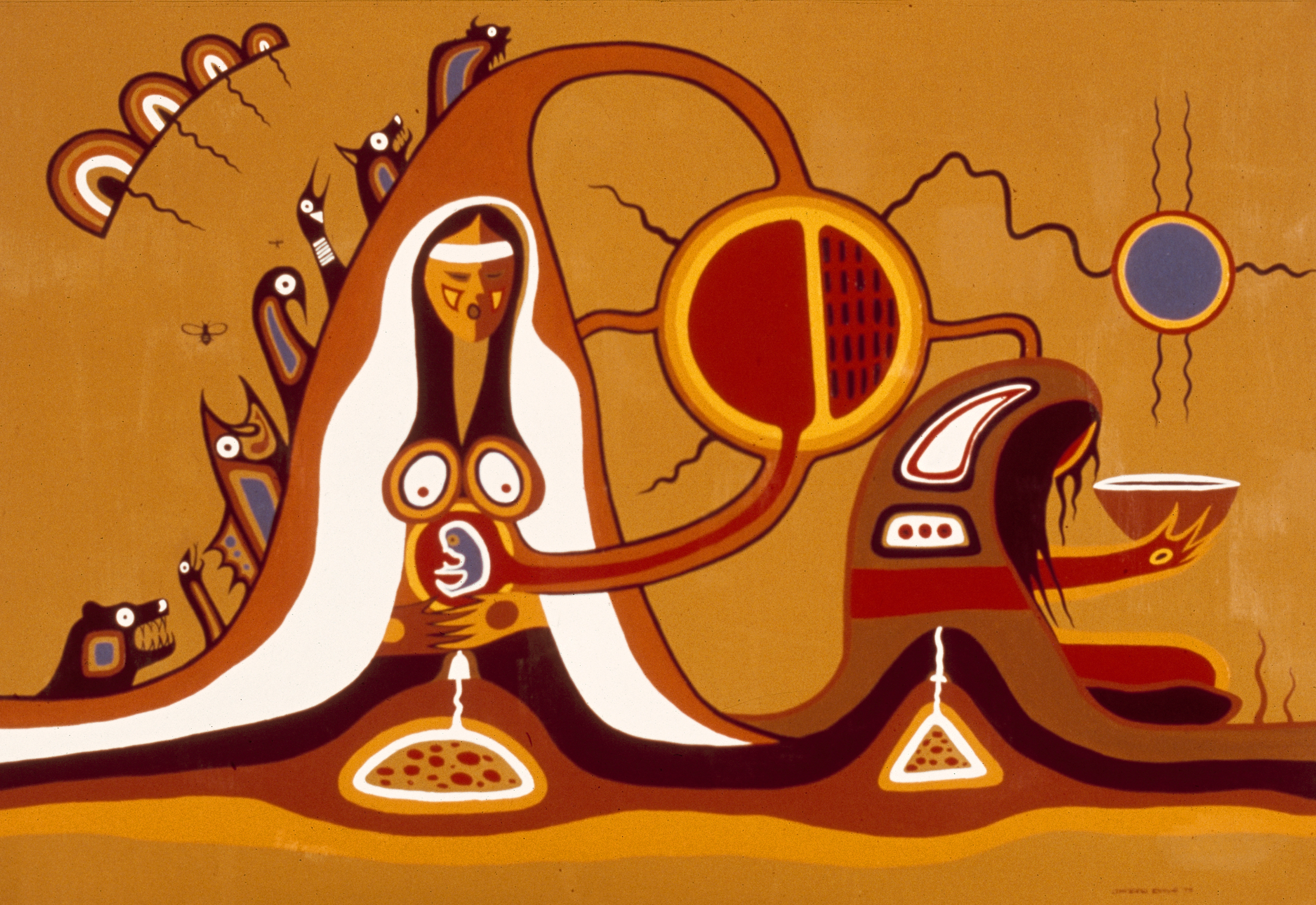
Jackson Beardy (1944–1984) was an Anishinaabe artist born on the Garden Hill Reserve in Manitoba. He belonged to the Woodland school of art [previously], adopting its distinctive style of Indigenous expression characterized by thick black outlines and vivid, compartmentalized color. His paintings draw on Ojibwe and Cree oral traditions and often express cosmological and spiritual concepts.
Beardy is one of twenty Canadian artists commissioned by the Canadian Conference of Catholic Bishops in 1975 to convey the Christian message using whatever idiom they wished. Beardy chose to portray the Virgin Mary pregnant with the Word, the sun’s fire pouring into her and yet she is not consumed. He provided the following artist’s statement:
It is my personal belief that a messenger from the Great Spirit came to earth in the form of His image after Him through a virgin birth in unrecorded history. Through this man, knowledge was passed on to man from the Great Spirit. Many of the teachings of this man have been kept by word of mouth through the ages by the elders of all tribes.
We see the virgin mother-to-be holding on to an embryo connected to the sun symbol (the Great Spirit) [center] who has deemed it necessary to send his messenger to his people. The mother is also connected to Mother Earth, who is nursing her [see the breast shape below]. She too is connected by a lifeline to the sun symbol. Around her are all the orders of creatures who come to see the messenger. He is born to explain their existence, [to restore] harmony between humanity and the elements, physically, mentally, and spiritually.
On the other side of the sun symbol we see an elder in prayer, ritually offering a bowl filled with sacred things. You can see the sun symbol is resting on his hunched frame, bearing him down with doubts, fear, depression, and all the ills of his time, his back to the very miracle he is praying for. It will take time for all to fully comprehend this phenomenon which has come to pass.
The four semicircles represent the elements of the air: snow, rain, tornadoes, heat. The moon [the blue circle] is painted above the elder. We regard the moon as our Grandmother who keeps vigil over all creatures during the night.
Though titled The Nativity, the painting is actually a prebirth scene, as Jesus is still in utero. Beardy shows the Christ child taking root in Mary’s womb (having been conceived by the power of the Great Spirit) and growing to full term as people and animals alike long for his arrival. They groan, they watch, they wrestle and seek. Creator Sets Free—as the First Nations Version of the New Testament translates the name Jesus—is almost here.
(Note: There’s a flipped version of this image floating around online. I confirmed with the CCCB that the file posted here, which I licensed directly from them, represents the correct orientation.)
Leaning into that Advent yearning, here is a performance of “O Come, O Come, Emmanuel” in Ojibwe—“Ondaas, Ondaas, Emaanooyen”—performed by E Halverson:
Now, I have a crowdsourcing request: I am searching for Advent or Christmas songs originally written in Indigenous Canadian or Native American languages, preferably by an Indigenous person. If you know of any, please let me know in the comments below, or in an email. Thanks!
>> “The Music of the Psalms in Church History” by W. David O. Taylor, Christ Church, Austin, Texas, October 1, 2022: “For two thousand years, Christians have found the Psalter to be an invaluable resource for worship and prayer. And, like the original psalmists, Christians have felt compelled and inspired to set the text of the psalms to music, of all sorts: from a cappella to choral, from folk to rock, from reggae to gospel, and more. In collaboration with local musicians, David Taylor, Associate Professor of Theology and Culture at Fuller Theological Seminary and author of Open and Unafraid: The Psalms as a Guide to Life, will explore how Christians in different periods of church history have sung the psalms within corporate worship,” spanning the apostolic, medieval, Renaissance, Reformation, modern, and contemporary eras.
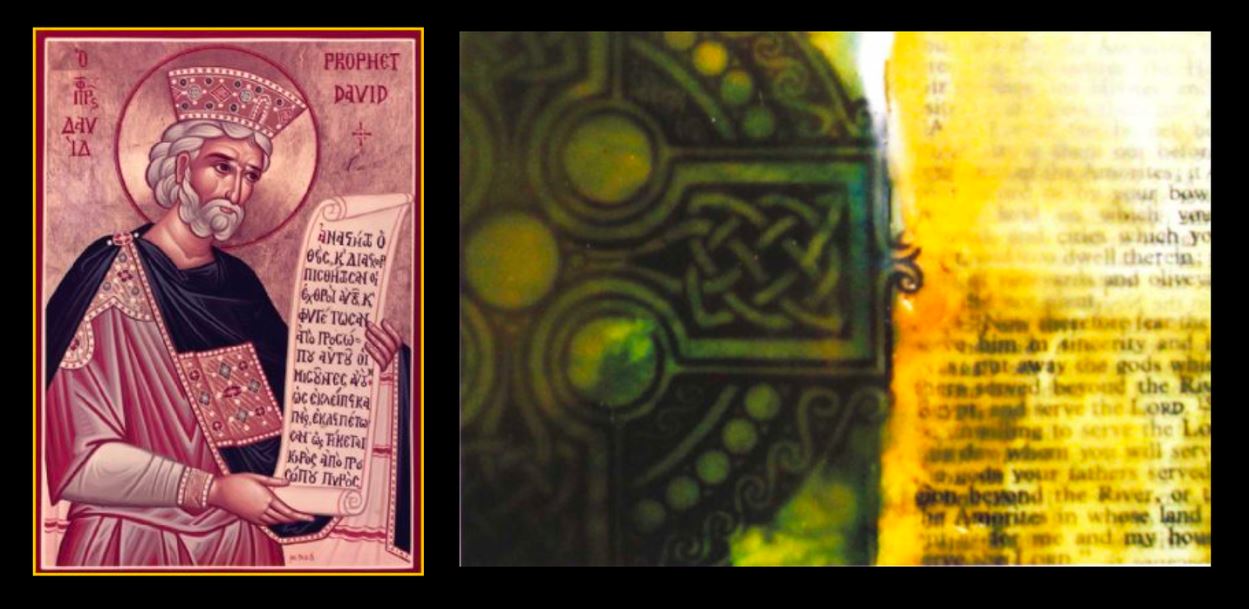
Left: Icon of the Holy Prophet-King David. Right: Celtic Cross with Bible Page, encaustic by Phaedra Jean Taylor.
A choir will perform several chants (Hebrew, Byzantine, Gregorian) and a motet, and then attendees will be led in a handful of Psalm-based songs, from a hymn of German origin to an African American spiritual to CCM classics. Along the way Taylor will provide historical context and trace a narrative.
Sponsored by the Brehm Center at Fuller Theological Seminary, the event is free, but registration is required and filling up; reserve your spot here. It will be recorded and eventually posted on the Fuller Studio YouTube channel (whether there will be a livestream is still TBD).
>> Baylor Symposium on Faith and Culture: Art Seeking Understanding, Baylor University, Waco, Texas, October 26–28, 2022: Every fall the Institute for Faith and Learning at Baylor University organizes a symposium around a given topic, and this year’s topic is the arts. Registration is still open! The standard cost is $250, or $125 for students. “The notion of art seeking understanding (ars quaerens intellectum) invites association with the notion of faith seeking understanding (fides quaerens intellectum). Just as faith is a gift of grace that grows toward deeper knowledge, so it seems that art is a gift whose practice leads to a deeper order of understanding. This seems true not only for the person who experiences art, but also the artist—whether musician, painter, sculptor, or poet. The 2022 Baylor Symposium on Faith and Culture invites contributions from across the disciplines (including scholars, artists, and other practitioners) as we explore together how art seeks understanding and thus contributes to human flourishing.”
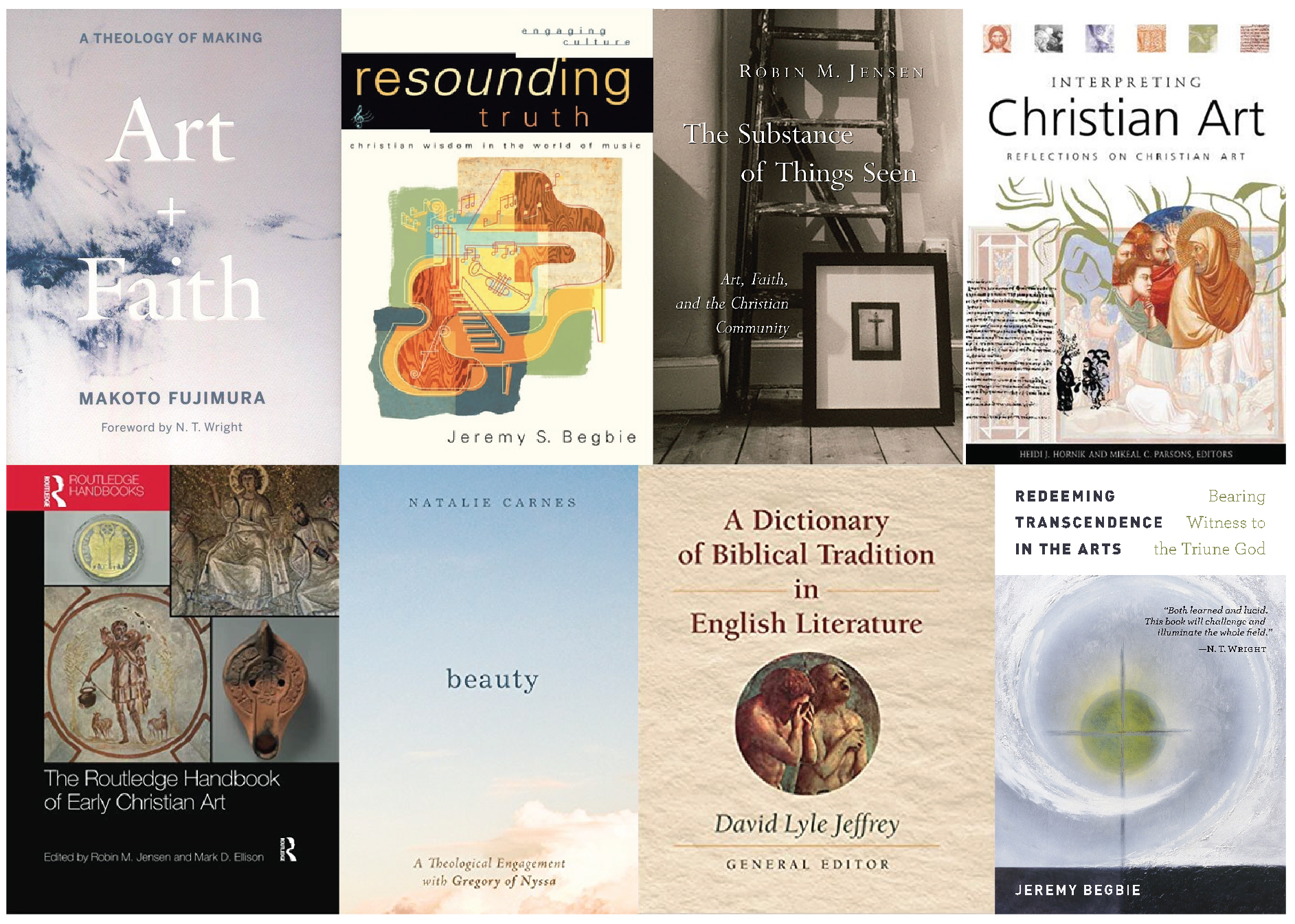
Their line-up of presenters includes several from within Baylor’s own distinguished ranks, such as composer and liturgist Carlos Colón, theologian Natalie Carnes, art historian Heidi J. Hornik, and literature scholar David Lyle Jeffrey, in addition to famous outside guests like theologian-pianist Jeremy Begbie, contemporary nihonga painter Makoto Fujimura, and Early Christian art historian Robin M. Jensen. See a full list by clicking on the boldface link above.
Just a fraction of the books authored by the eminent speakers at the upcoming Baylor symposium
The website does not provide a list of presentation titles, but among the topic suggestions on its call for proposals page are how art contributes to moral and spiritual perception, sensitivity, and/or character formation; the power of imagination; the relation of poetic art to the communication of moral truth; art therapy in pastoral counseling; how musical settings of biblical texts add value to those texts; and how to reconcile the making of religious art with the commandment in Exodus 20:4.
+++
SONG: “The Lord Is My Light” by Lillian Bouknight | Performed by the Notre Dame Folk Choir, dir. Emorja Roberson: “Very little is known about Lillian Bouknight (d. 1990), except that she was an African American from North Carolina, and a soloist and composer in the Pentecostal Holiness movement in the Aliquippam, PA, Community, also serving as a prayer warrior and on the Mother’s Board.” This setting of Psalm 27 that she composed appears in the African American Heritage Hymnal #160.
+++
VIDEO: “Theology through the Arts” by Jeremy Begbie: A pioneer of the field of theology and the arts, UK-born and US-based scholar Jeremy Begbie is the headliner for the Baylor symposium mentioned above. I met him briefly at a Duke conference a few years ago, and he’s such a delightful person, not to mention a phenomenal teacher who often dispenses wisdom from a piano bench. If you’re not familiar with his work, this fourteen-minute video is a great introduction to it. He’s all about demonstrating how instrumental music (his specialization is Western classical) can help unlock the truths of the Christian gospel. Here he talks about the given, the improvised, and the ministry of the Holy Spirit.
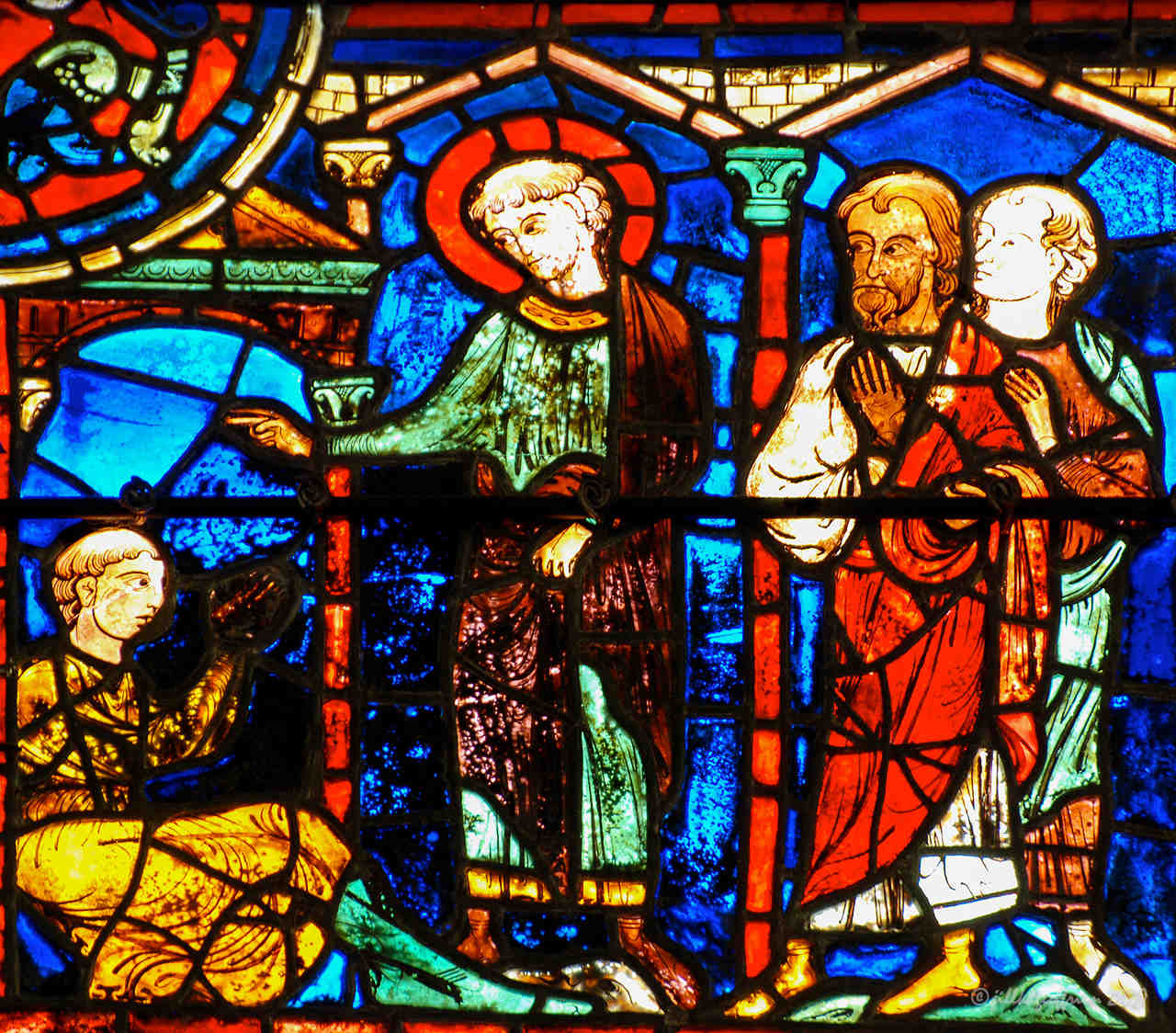
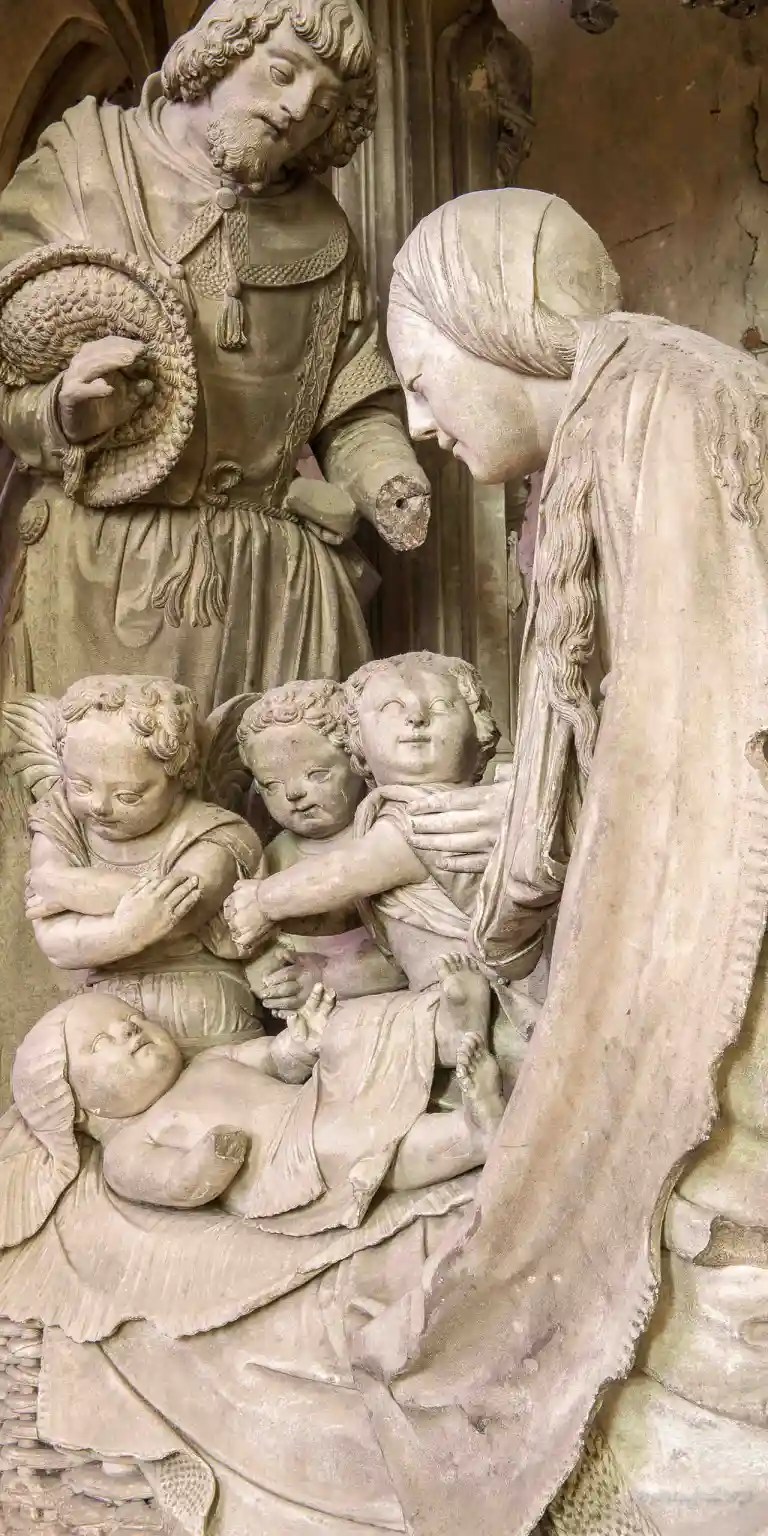
Geoffrion is also a professional photographer, and she shares many of her beautiful art photographs from Chartres on her blog, providing specific prompts for prayer and meditation based on the images. For example, in a post on the stained glass panel of Saint Martin bringing a man back to life, she writes, “Think of what is dead and needs resurrection in you, in those you love, in those who live within twenty-five miles of you, and in whatever country you call home. Then, take a very deep exhale and plead with God, ‘Bring resurrection!’” Or, reflecting on the sixteenth-century Nativity sculpture group attributed to Jehan Soulas, she invites us to “imitate one or more of the sets of eyes in the image . . . as you pray, ‘May I see with Your eyes, God. Teach me to see anew.’”
Saint Martin bringing a man back to life (with two onlookers), 1217–20, stained glass window panel in the south ambulatory at Chartres Cathedral, France. Photo: Jill Geoffrion.Jehan Soulas, Nativity, 1529, from the choir screen in Chartres Cathedral, France. Photo: Jill Geoffrion.
Geoffrion’s blog is a wonderful free resource for those looking to engage prayerfully with the art treasures of Chartres Cathedral. New content is typically posted in batches a few times a year, and the archive goes back to 2015. Sometimes Geoffrion digitally isolates certain details of the stained glass to aid in a more concentrated focus.
As I said when I featured the Tree of Jesse window several years ago, Chartres is high on my list of places to visit, for aesthetic, historical, and spiritual reasons. I hope to make it there sometime in the next five years.
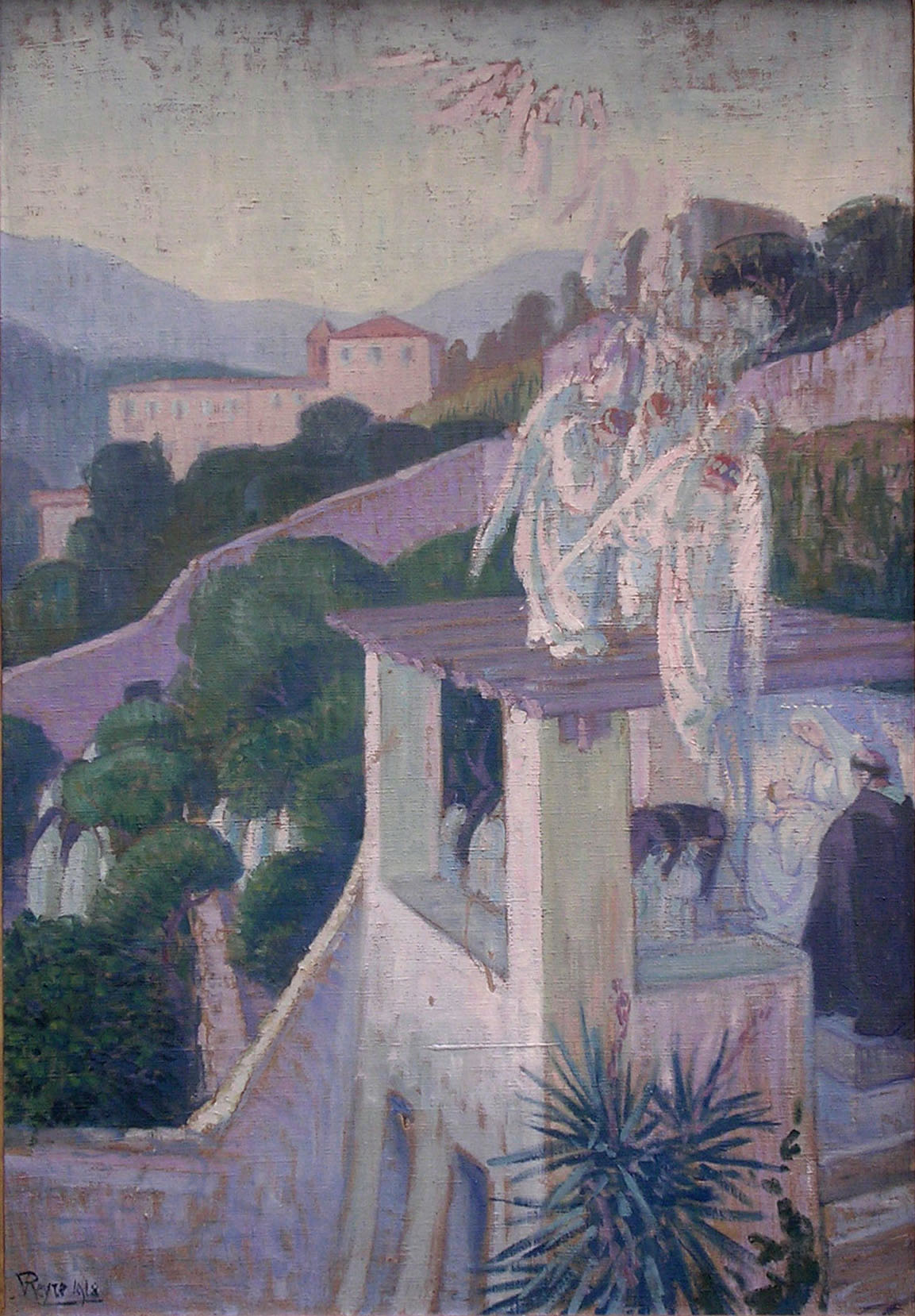
Valentine Reyre was a French artist who participated in the revival of religious art in the first half of the twentieth century. She was the cofounder, with Maurice Storez and Henri Charlier, of L’Arche, a group of Catholic artists and architects active from 1919 to 1934. She also participated in the Ateliers d’art sacré, a movement that sought to reconcile tradition and modernity, art and craft, in the decoration of church interiors, especially those devastated by World War I. Members of the Ateliers—the most famous of which were Maurice Denis and George Desvallières—rejected academism on the one hand and the avant-garde (e.g., futurism, cubism) on the other, seeking a third way forward for religious art.
Reyre’s Dominican Nativity is set outside a Dominican convent in the hills of France. The focal point is the Virgin Mary and the infant Jesus, clothed in white and seated under a small, open, roofed structure. It’s deliberately ambiguous as to whether these figures are meant to be present in the flesh in this space or are a statue; in other words, is this the holy birth transplanted to another time and place, occurring as if for the first time, or is it the birth memorialized? Either way, a procession of nuns winds through the tree-studded landscape to offer their worship and devotion to Christ, their shaping mirrored by the ribbon of angels that unfurls from distant sky to the foregrounded rooftop. The adult male figure at the right is probably Saint Dominic, the medieval Castilian priest who founded the Dominican order, as he is tonsured and wears a habit.
I love the intersection of time and eternity in this image—heaven breaking into the everyday. A community of sisters bows in prayer and re-members Christ’s Nativity.
LISTEN: Hymns and Sacred Songs, FS 83: No. 1. Förunderligt at sige | Words by Nikolai F. S. Grundtvig, 1845 (reworked from “Mit hierte altid vanker” [“My Heart Always Wanders”] by Hans Adolph Brorson, 1732) | Music by Carl Nielsen, 1919 | Performed by the Svanholm Singers, dir. Sofia Söderberg Eberhard, on December, 2010
Forunderligt at sige, Og sært at tænke paa, At Kongen til Guds Rige I Stalden fødes maa, At Himlens Lys og Ære, Det levende Guds Ord, Skal huusvild blandt os være, Som Armods Søn paa Jord!
Selv Spurven har sin Rede, Kan bygge der og boe; En Svale ei tør lede Om Nattely og Ro; De vilde Dyr i Hule Har hver sin egen Vraa: Skal sig min Frelser skjule I fremmed Stald paa Straa?
Nei, kom! jeg vil oplukke Mit Hjerte, Sjæl og Sind, Ja, bede, synge, sukke: Kom, Jesus, kom herind! Det er ei fremmed Bolig, Du den har dyrekiøbt! Her skal du hvile rolig, I Kiærligheden svøbt!
How wonderful to sing of, And strange to think at all, The sovereign of God’s kingdom Is born within a stall, All heaven’s light and honour, God’s living word, e’en he, On earth shall homeless wander, The son of poverty.
The sparrow, with her nesting, Can build herself a home; We find the swallow resting, At night she needn’t roam. The wild beasts abide in The burrows where they stay. Shall then my Saviour hide in An unknown stall on hay?
No, come, I’ll open to thee My heart, my soul, my mind. I’ll pray and sing and sue thee, “Come, Jesus, come inside!” For here thou art no stranger; This home thou dearly bought. Rest now within this manger In swaddling love has wrought.
Jenny Rebecca Rytting describes this Danish carol’s complex textual history, starting with its origins in an eighteenth-century carol by the Danish bishop and hymn-writer Hans Adolph Brorson. Brorson’s text has eleven verses; Nikolai F. S. Grundtvig cut it down to six in 1837, adapting these verses but following Brorson’s wording fairly closely. In 1845 Grundtvig made “extensive changes” to his initial reworking of the carol and published it in a booklet of his hymns. Much later, in 1939, the editors of Højskolesangbogen (The Folk High School Songbook) published Grundtvig’s text with only three verses (verses 1, 5, and 6 of his 1845 version). That’s the version that’s most often used today. Rytting has produced an English translation, posted above. For a translation of all six verses, albeit one that’s a bit clumsy, see here (scroll down to #50, “How wonderful to ponder”).
Carl Nielson, widely recognized as Denmark’s most prominent composer, wrote a musical setting for “Förunderligt at sige” in 1914 (in a letter to his wife at the time, he described it as “the most beautiful I have yet composed”), and it was first published in 1919. Cataloged as CNW 165, it is now considered the standard tune for the carol.
The text is inspired in part by Jesus’s words in Matthew 8:20: “Foxes have holes, and birds of the air have nests; but the Son of Man has nowhere to lay his head.” He was born in an out-of-town stable, lived as a stranger in Egypt, and spent years as an itinerant preacher, never staying for too long in any one place. The speaker invites the wandering Christ to take up permanent residence within her, as he has already bought her (Gal. 3:13; 1 Cor. 6:20). Her love, she says, will provide the swaddling, a cozy warmth.
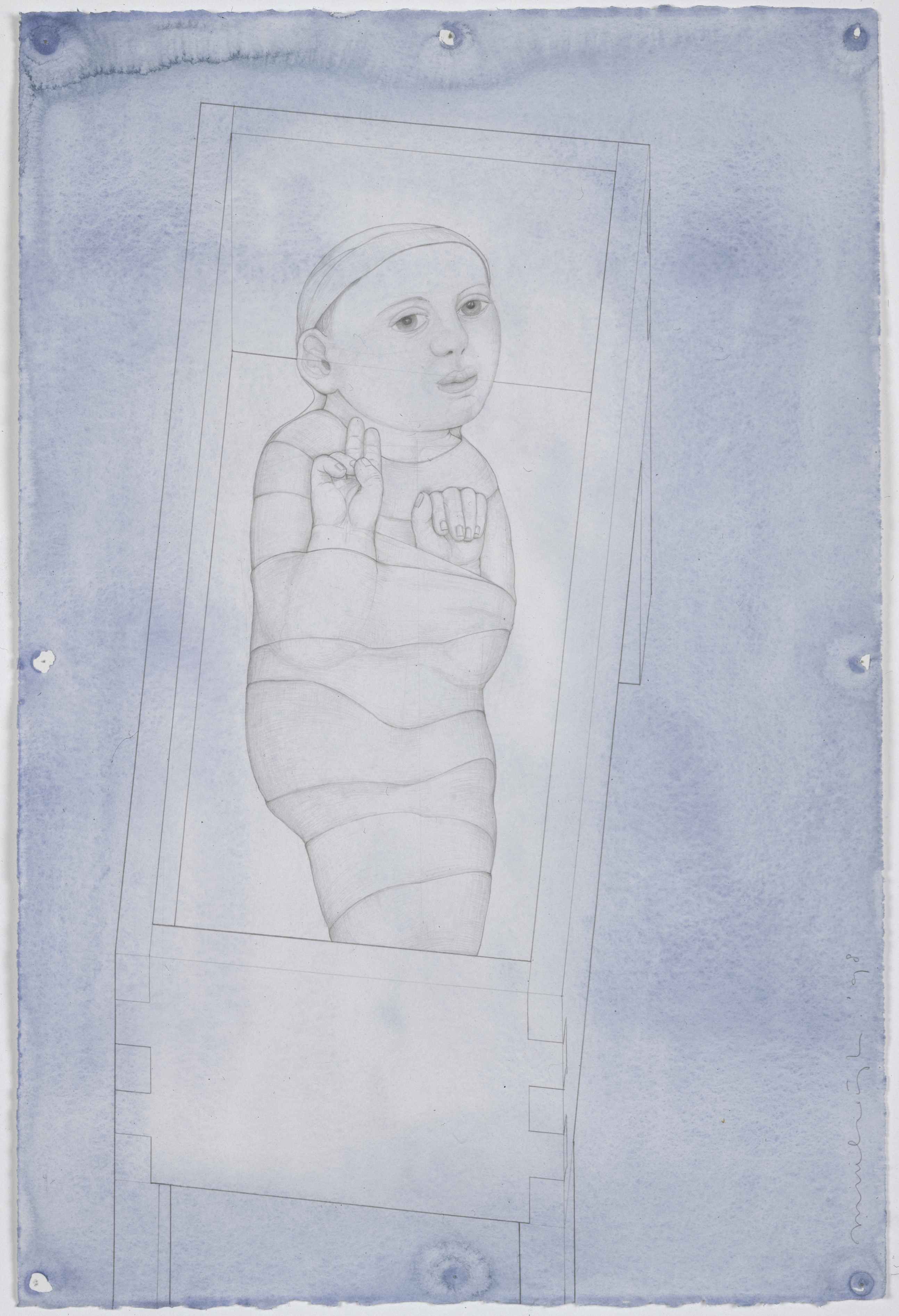
Janpeter Muilwijk (Dutch, 1960–), Kind in Bakje (Babe in a Manger), 1999. Watercolor and pencil on paper, 58 × 38 cm. Private collection, Netherlands.
LISTEN: “Dona Nobis Pacem (Give Us Peace) / Auld Lang Syne” | Arranged and performed by Yo-Yo Ma (cello) and Chris Botti (trumpet), on Songs of Joy & Peace (2008)
The three-word Latin prayer “Dona nobis pacem,” which translates to “Grant us peace,” is part of the Agnus Dei section of the Catholic mass. The traditional melody associated with it likely originated in the sixteenth century.
“Auld Lang Syne” (Old Long Since) uses a traditional Scots folk melody.
In this final track on Yo-Yo Ma and friends’ 2008 holiday album, Ma plays the “Dona Nobis Pacem” theme alone on cello and then is joined by trumpeter Chris Botti playing “Auld Lang Syne” as a countermelody. The two are cozily layered together in an expression of warm wishes for the new year.
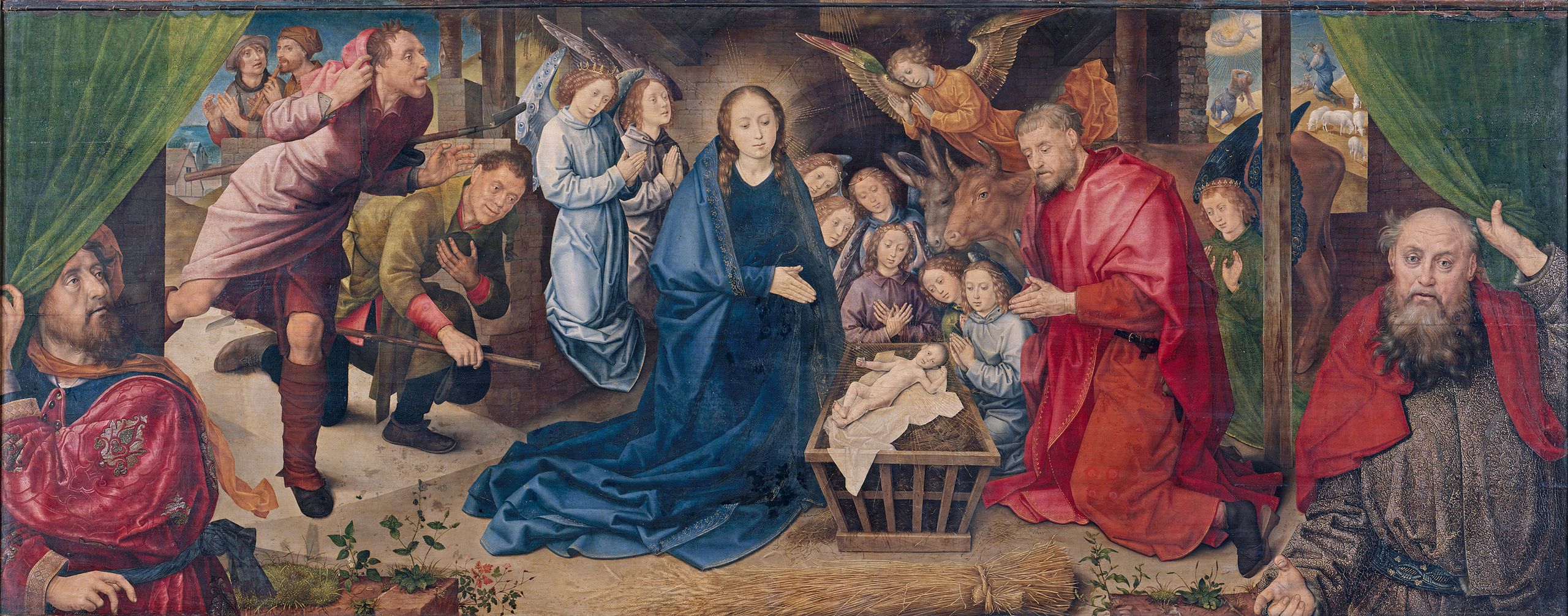
LOOK: Adoration of the Shepherds by Hugo van der Goes
Hugo van der Goes (Flemish, ca. 1440–1482), Adoration of the Shepherds, ca. 1480. Oil on oak wood, 99.9 × 248.6 cm. Gemäldegalerie, Berlin.
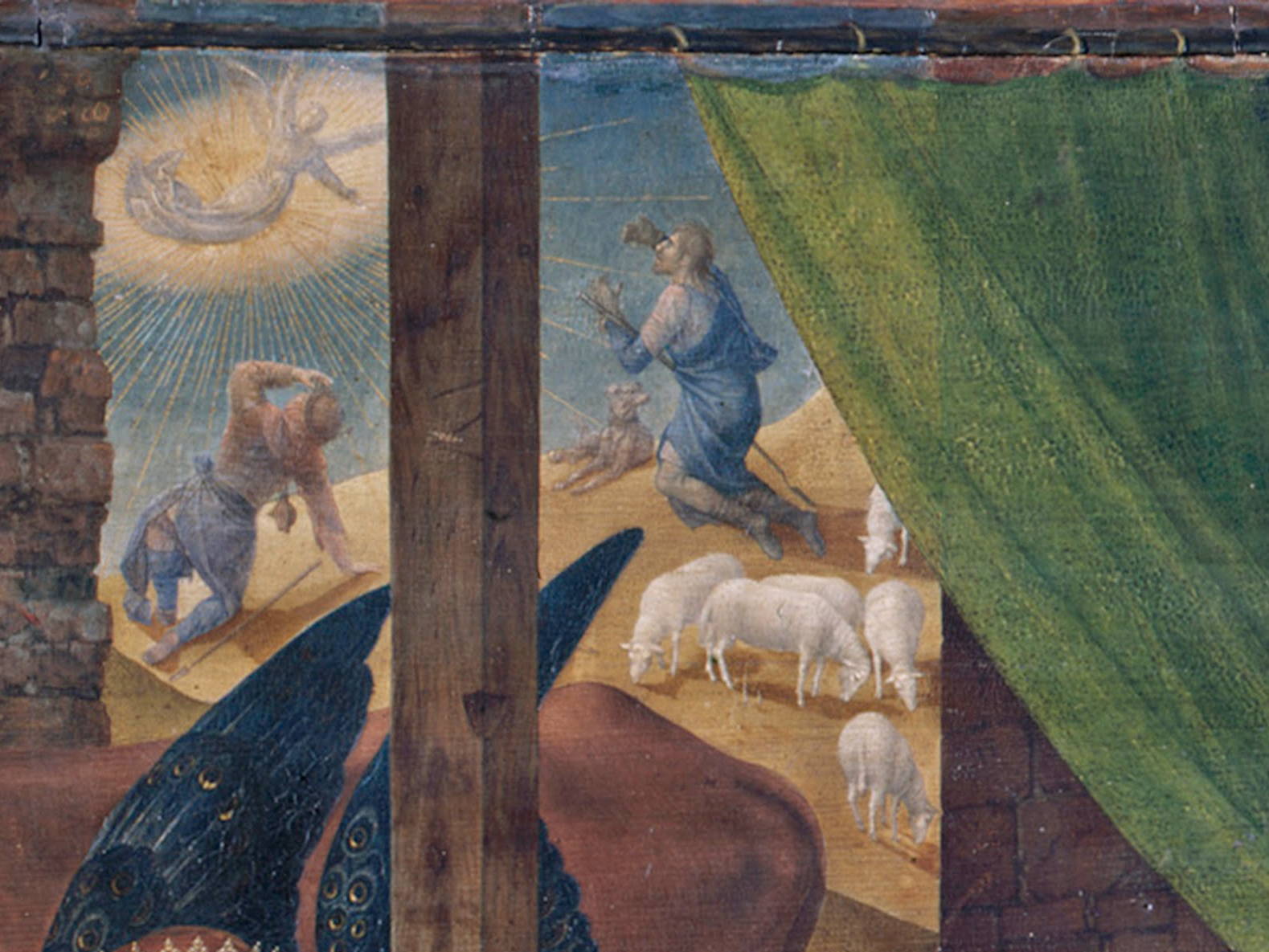
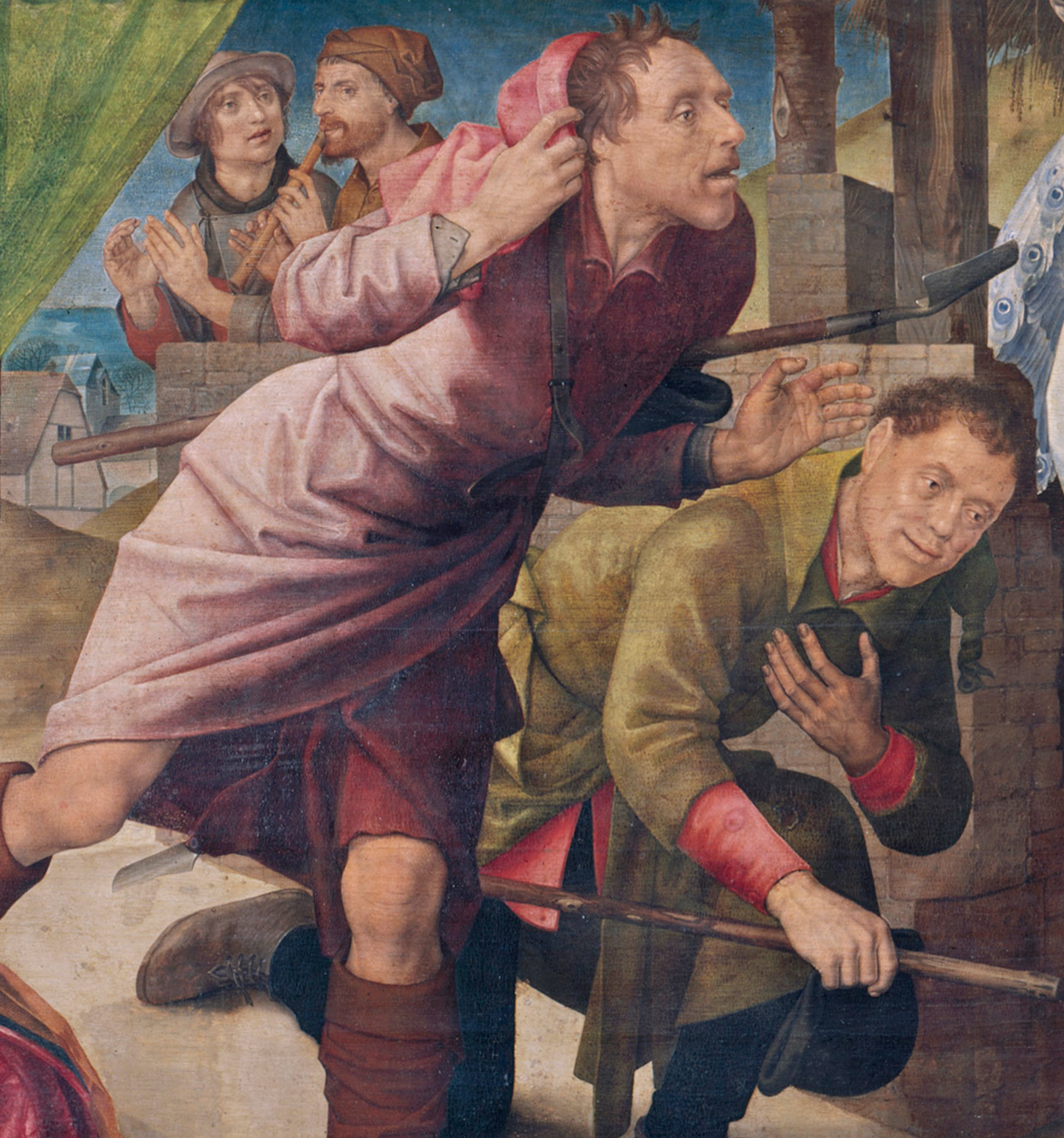
After the angel of the Lord announced the birth of the Messiah to a band of shepherds, “they went with haste” to the place where he lay (Luke 2:16). The Flemish artist Hugo van der Goes shows the shepherds’ hurried arrival at the manger. One of them gallops through the door panting, having run from the scene in the upper right corner, and another removes his hat and kneels. Two more stand behind them just outside the shed—one playing a recorder, the other in midclap.
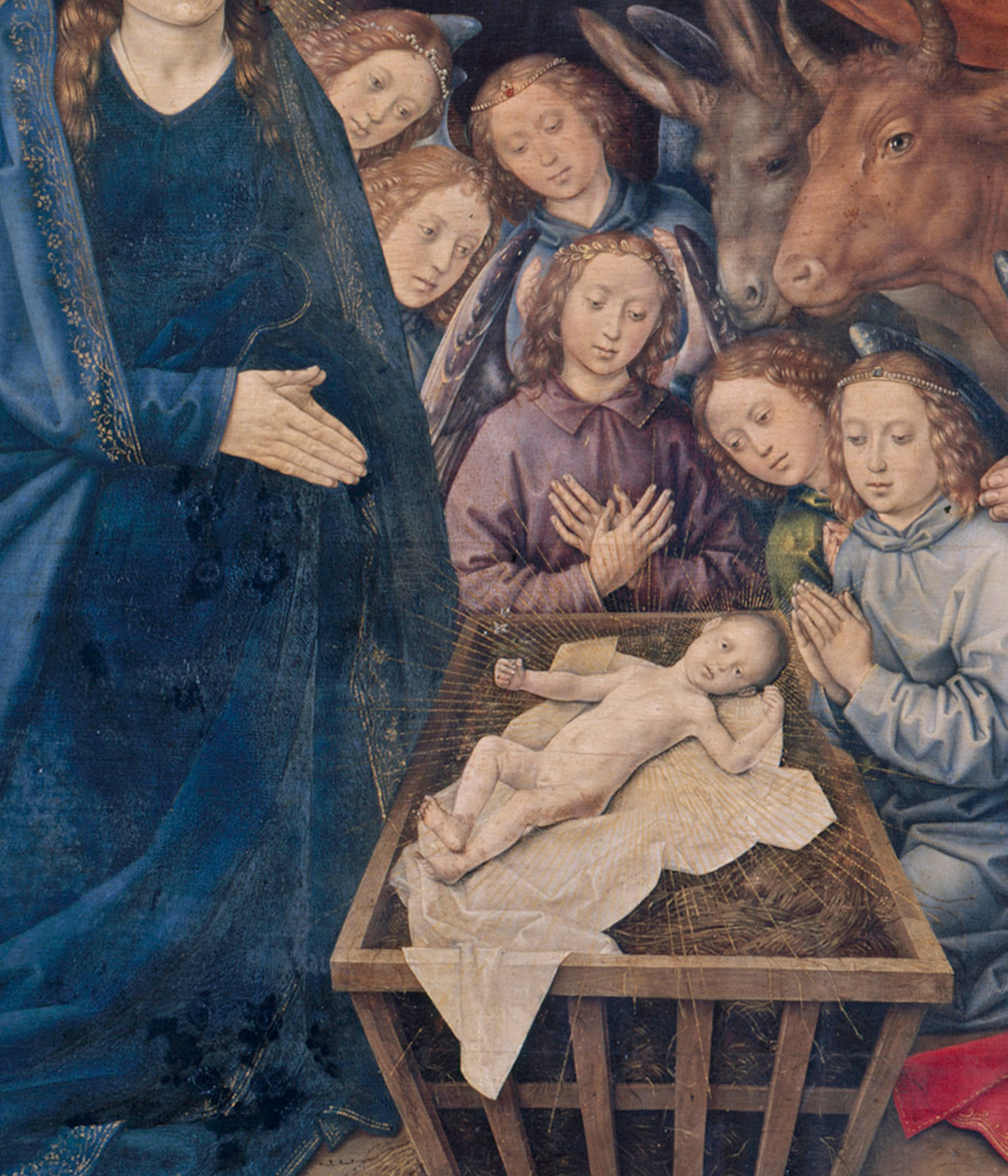
In the center of the composition, the Christ child squirms in his makeshift bed, surrounded by his parents, an ox and ass, and a coterie of angels. At the foot of the manger is a sheaf of wheat, an allusion to Jesus as “the living bread that came down from heaven” (John 6:51) and, by extension, to the Eucharist. This painting, after all, was originally made, most likely, to hang over an altar.
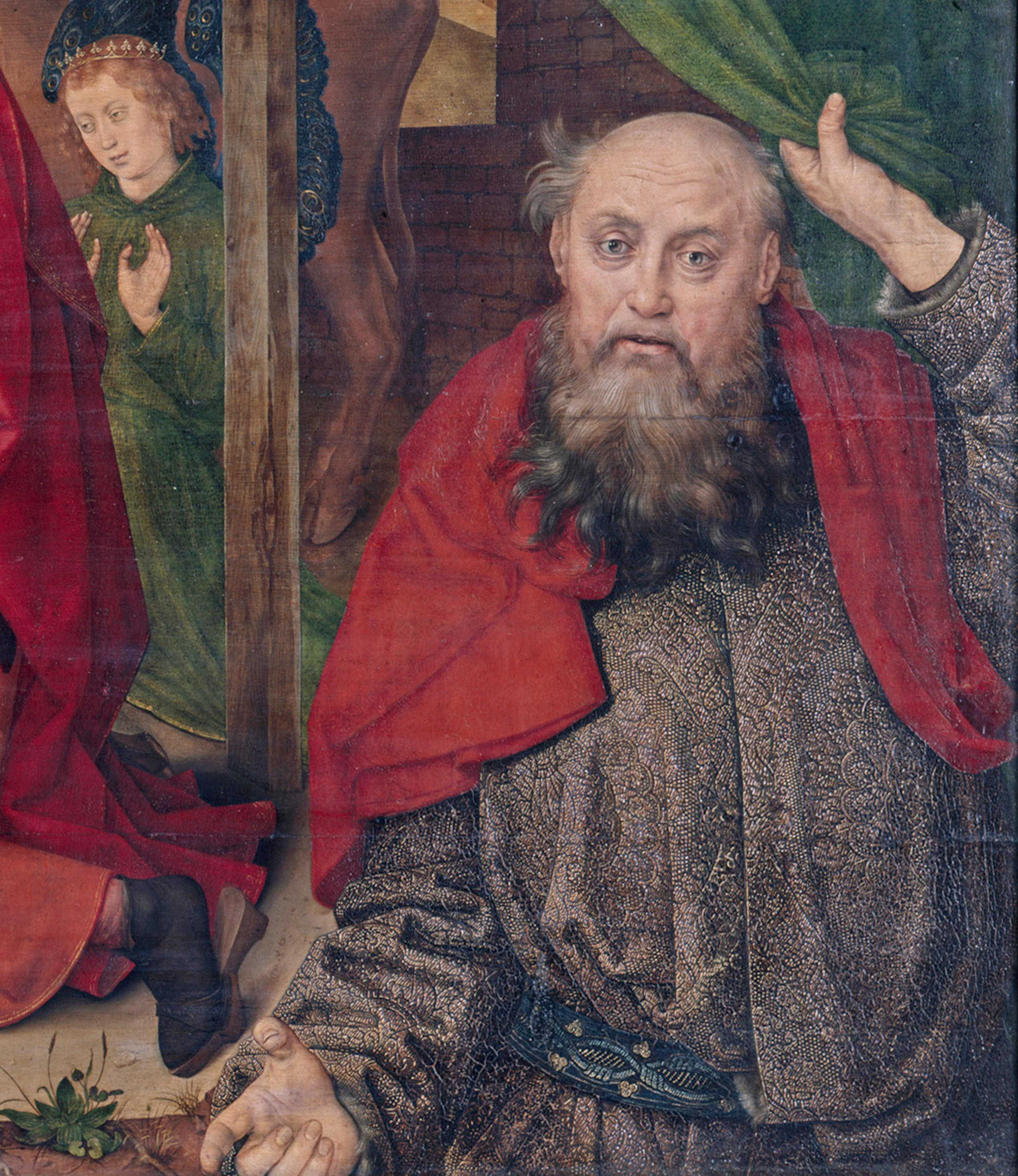
In the foreground two men draw open a set of curtains, revealing God made flesh. An actual wooden rod is attached to the panel and painted with rings, enhancing the illusion. Most scholars agree that the men represent Isaiah (left) and Jeremiah (right), Old Testament prophets who foretold Christ (see, e.g., Isa. 7:14; Jer. 23:5–6)—though John Moffitt suggests they are the apostles Mark and Paul, two New Testament personages who specifically associate themselves with a veil as a sign of divine manifestation. Either way, these figures act as intermediaries between the viewer and the depicted narrative, inviting us, like the shepherds, to bear witness to the wondrous mystery of the Incarnation and to respond in adoration.
This Adoration, sometimes referred to as van der Goes’s Berlin Nativity, is not the artist’s most famous painting on the subject. That would be the central panel of the Portinari Altarpiece, painted a few years earlier.
Where shepherds lately knelt and kept the angel’s word, I come in half-belief, a pilgrim strangely stirred; but there is room and welcome there for me, but there is room and welcome there for me.
In that unlikely place I find him as they said: sweet newborn babe, how frail! and in a manger bed, a still small voice to cry one day for me, a still small voice to cry one day for me.
How should I not have known Isaiah would be there, his prophecies fulfilled? With pounding heart I stare: a child, a son, the Prince of Peace for me, a child, a son, the Prince of Peace for me.
Can I, will I forget how Love was born, and burned its way into my heart, unasked, unforced, unearned, to die, to live, and not alone for me, to die, to live, and not alone for me?