Moveable Garden, a community art project organized by Sojourn Arts, 2021. Mixed media on panel.
Sojourn Arts is a ministry of Sojourn Midtown in Louisville, Kentucky. As one way for their community to engage the springtime theme of Easter, on Easter Sunday 2021, Tim Robertson led a riso printing project in the church’s art gallery between services, open to all. Participants selected and arranged live flowers on the glass copier of a risograph (a type of digital printing machine that uses a process similar to screen printing to create vibrant, textured prints), printed their designs onto colorful paper, cut them out, and collaboratively collaged them into a floral arrangement on a wood panel—a “moveable garden”! View more photos here.
LISTEN: “Christ Is Your Spring”|Words by Edward A. Washburn, 1863 | Music by Andy Bast, 2024 | Performed by Bellwether Arts, feat. Emily Hanrahan, 2024
Christ has arisen, And Death is no more! Lo! the white-robed ones Sit by the door. Dawn, golden morning, Scatter the night. Haste, you disciples glad, First with the light!
Break forth in singing, O the world newborn! Sing the great Eastertide, Christ’s holy morn. Sing him, young sunbeams Dancing in mirth; Sing, all you winds of God Coursing the earth!
Sing him, you laughing flow’rs Fresh from the sod; Sing him, wild, leaping streams, Praising your God! Break from your winter, Sad heart, and sing! Bud with your blossoms fair; Christ is your spring.
Sing alleluia!
Christ is your spring.
What a beautiful hymn text! Andy Bast found it in Jane Eliza (Coolidge) Chapman’sEaster Hymnscompilation, published in Boston in 1876. In the introduction to the hymnal, Chapman’s uncle J. I. T. (James Ivers Trecothick) Coolidge, an Episcopalian minister, delights in how
[Easter’s] sun shines with fuller radiance each year upon the world, whose night of darkness it broke on the Resurrection Morning. The anthems which greet its rising are caught and repeated by increasing millions of grateful hearts of every tongue, kindred, and people, until the wide earth is filled with their sounding praise. How sacred a privilege to have part in this mighty and triumphant symphony, how sad to be out of harmony with its sublime strains!
Written by Rev. Dr. Edward A. Washburn (and given a new tune by Bast), “Christ Is Your Spring” apostrophizes the whole newborn world, enjoining it to praise God. Sunbeams, winds, flowers, streams, the human heart—all are encompassed in God’s project of renewal and invited to sing each in their own way.
Emily Dickinson (1830–1886) of Amherst, Massachusetts, is one of America’s most celebrated poets. There are hundreds of musical settings, from various genres, of her poems. Here are ten I really like.
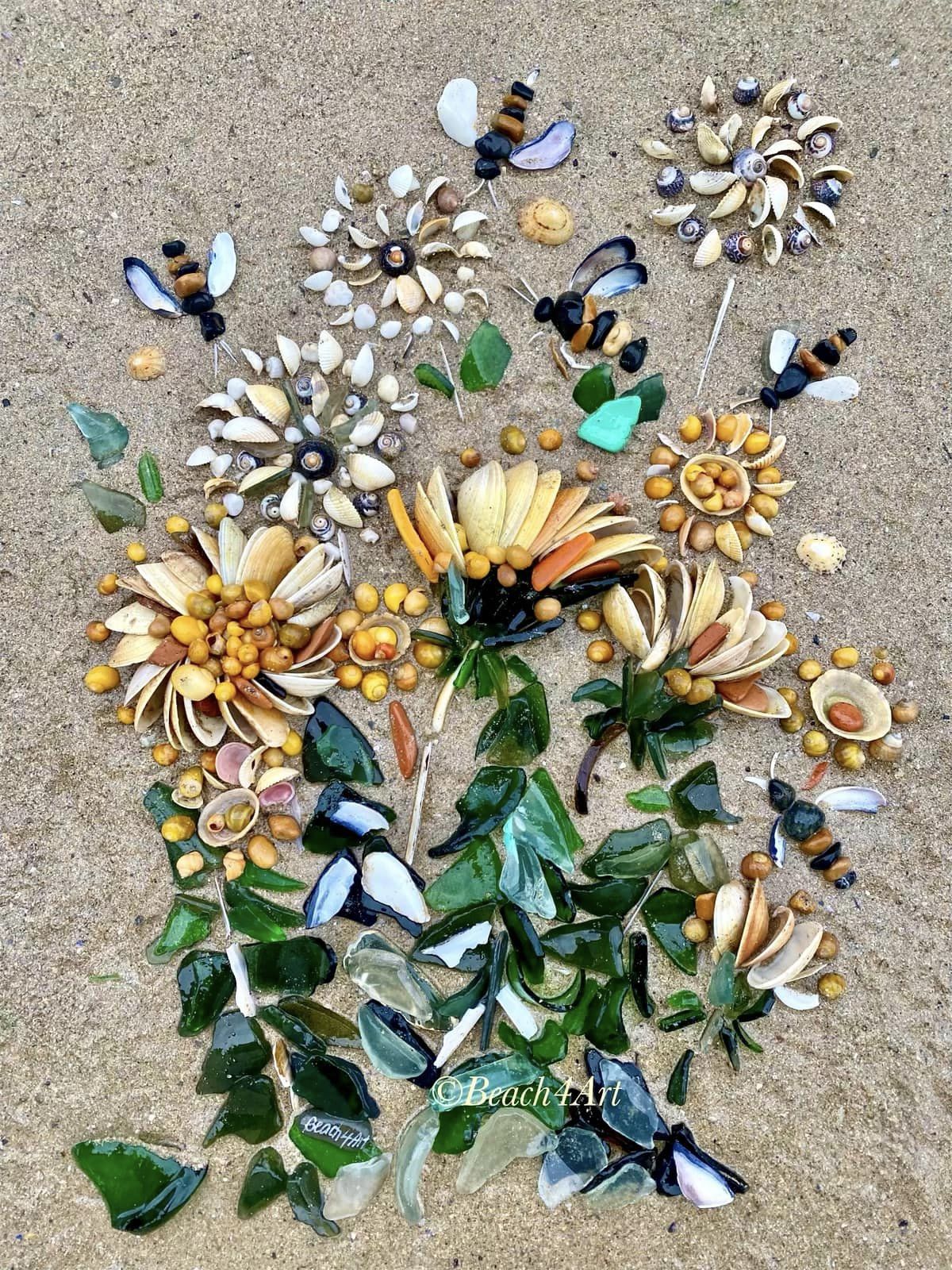
Created by Beach4Art, a family of four who assemble rocks and shells into images on the beaches of Devon, England
1. “I’m Nobody” by Emma Wallace: This is the first poem I ever read by Dickinson—in sixth grade. I was hooked, and I relished the assignment to memorize it and recite it to the class. The idea of being famous was apparently distasteful to Dickinson, and though she was a prolific writer of almost 1,800 poems, only ten were published during her lifetime, and those anonymously; some she sent in letters to friends, but most she kept private. She wrote this one in 1861, and it has contributed to her mystique. Singer-songwriter Emma Wallace turned it into a lovely, understated, minor-key waltz for The Thing with Feathers (2021), one of her several literary-themed albums.
I’m Nobody! Who are you? Are you – Nobody – too? Then there’s a pair of us! Don’t tell! they’d advertise* – you know!
How dreary – to be – Somebody! How public – like a Frog – To tell your name – the livelong June – To an admiring Bog!
* Dickinson often provided alternative words in the margins of her pages, which some editors have favored; “advertise” she marked as a possible substitute for “banish us.”
2.“I Shall Not Live in Vain” by Bard and Ceilidh (Mary Vanhoozer): Mary Vanhoozer’s debut album, Songs of Day and Night(2015), comprises original settings of classic poems by the likes of Emily Dickinson, Christina Rossetti, Henry Wadsworth Longfellow, and others. “Music has a unique ability to transform ordinary things into special things—the mundane into the extraordinary,” she writes. “This song cycle is all about exploring that further. Each song roughly represents an hour of the day. The CD begins at dawn and ends at dusk. As we travel through the day, we learn to perceive familiar objects and situations in a new light, infusing joy and a sense of mystery into the everyday experience.” For this track she is joined by her husband, Josh Rodriguez, on guitar. The text is a sort of purpose statement, committing to a life of love, kindness, and compassionate outreach.
If I can stop one Heart from breaking I shall not live in vain If I can ease one Life the Aching Or cool one Pain
Or help one fainting Robin Unto his Nest again I shall not live in vain.
3. “His Feet Are Shod with Gauze” by Emily Lau: The natural world, especially bees, was one of Dickinson’s favorite topics to write about. I think of her as a poet of summer. (Other great bee poems: “Bee! I’m expecting you!” and “Bees are Black, with Gilt Surcingles –.”) “His Feet are shod with Gauze –,” a panegyric, praises bees’ delicacy, might, and beauty. This musical setting is part of the suite Seven Dickinson Songs by composer and vocalist Emily Lau, which appears on her album Isle of Majesty (2019). Be sure to check out the other songs, including “I Can Wade Grief” and “I Never Saw a Moor,” in which Lau is joined by her chamber music ensemble, The Broken Consort.
His Feet are shod with Gauze – His Helmet, is of Gold, His Breast, a single Onyx With Chrysophras, inlaid –
His Labor is a Chant – His Idleness – a Tune – Oh, for a Bee’s experience Of Clovers, and of Noon!
4. “Some keep the Sabbath going to Church” by Michael McGuane: Dickinson was raised as a Congregationalist but never officially joined the church and by 1868 had stopped attending altogether. Her poems vary in tone toward Christianity, with some expressing devout sentiments and others irreverence. One thing that’s clear is that she often encountered God in nature. In this poem the fruit trees create a sanctuary for her and the birds serve as choir—an elevating, worshipful experience. Christians throughout history have spoken of how the “book of nature” complements the book of scripture, both revealing God’s truth. Here Dickinson acknowledges the same, emphasizing the goodness of creation, our enjoyment of which is sacred. On YouTube, the Americana musician Michael McGuane performs a guitar-picked, folk-rock tune he wrote for the poem.
Some keep the Sabbath going to Church – I keep it, staying at Home – With a Bobolink for a Chorister – And an Orchard, for a Dome –
Some keep the Sabbath in Surplice – I, just wear my Wings – And instead of tolling the Bell, for Church, Our little Sexton – sings.
God preaches, a noted Clergyman – And the sermon is never long, So instead of getting to Heaven, at last – I’m going, all along.
5. “Split the Lark” by Drum & Lace (Sofia degli Alessandri-Hultquist) and Ian Hultquist, feat. Ella Hunt: This pop music setting of “Split the Lark” was written by husband-and-wife composing duo Drum & Lace and Ian Hultquist for the Apple TV+ comedy-drama Dickinson (which I have mixed feelings about). It’s featured in season 2, episode 6, where it’s sung by Ella Hunt, the actress who plays Emily’s sister-in-law (and in the show, secret lover), Susan Huntington Gilbert Dickinson. Emily is attending an opera performance in Boston and imagines—in place of the soprano—Sue, singing her own words to her.
Split the Lark – and you’ll find the Music – Bulb after bulb, in Silver rolled – Scantily dealt to the Summer Morning Saved for your Ear, when Lutes be old –
Loose the Flood – you shall find it patent – Gush after Gush, reserved for you – Scarlet Experiment! Sceptic Thomas! Now, do you doubt that your Bird was true?
Containing echoes of William Wordsworth’s “We murder to dissect,” this poem derides empiricism as the sole method of arriving at truth. The addressee wants to better comprehend the lark’s song, to observe the internal apparatus that enables it to make such beautiful music. Go ahead, the speaker exasperatedly tells him: take up your scalpel and dissect the bird. You’ll unleash a flood of blood and guts (“bulb after bulb” could refer to globular anatomical structures—e.g., the aortic bulb, the jugular bulb—or organs, or to musical notes). But would such prying really bring you closer to knowing the lark? Your experiment will have only caused the song to stop. The poem references the apostle Thomas, who demanded physical proof of Christ’s resurrection (personally, I think he’s unfairly maligned for this; his probing does, in fact, lead him to a deeper level of knowledge).
Dickinson was very much a supporter of science, but she also recognized its limitations when it comes to explaining certain mysteries or trying to produce physical evidence of the invisible. On one level, this poem may describe Dickinson’s stance on poetry, which, once you start to pick it apart, can sometimes lose its magic. I’m all for poetic analysis, but there’s something to be said for simply letting the sounds and musicality of poetic verse wash over you without going at it with a scalpel.
6. “I Had No Time to Hate” by Gerda Blok-Wilson: Look what Dickinson can do with the cliché “Life is too short to be angry”! She had a dark wit, which you get a glimmer of here. The poem is structured in two stanzas, the first about hate, so we might expect the second to wax rhapsodic about the virtues of love. But instead we get a matter-of-fact admission that life is also too short to complete the work of love. However, because we must choose either hate or love, she chooses love—it’s for us to fill in why it’s the superior choice. I like the interplay of littleness and largeness, suggesting that even in small caring acts, there’s a substantiality and a sufficiency, no matter how imperfect our love may be. The following recording, from June 2021, is of the premiere performance of Gerda Blok-Wilson’s choral setting of “I had no time to Hate –” by the Vancouver Chamber Choir, directed by Kari Turunen.
I had no time to Hate – Because The Grave would hinder me – And Life was not so Ample I Could finish – Enmity –
Nor had I time to Love – But since Some Industry must be – The little Toil of Love – I thought Be large enough for Me –
7. “I felt a Funeral, in my Brain” by Andrew Bird, feat. Phoebe Bridgers: This is another Dickinson poem that made a strong impression on me when I read it in school—what a fabulous first line. Though some have interpreted the poem as Dickinson imagining her own funeral, I see the funeral as a metaphor—for, possibly, the loss of a cherished friendship, long-held belief, or hope or dream, any of which would take a heavy psychological toll, or for the temporary loss of sanity, a mental breakdown, due to some stressor. The mood is oppressive, and the speaker grows increasingly unraveled. The singer-songwriter, violinist, and whistler Andrew Bird set the poem to “a simple two-note melody,” he said, and, in collaboration with the Emily Dickinson Museum in Amherst, made a music video featuring Dickinson’s handwriting and footage of her lifelong home.
I felt a Funeral, in my Brain, And Mourners to and fro Kept treading – treading – till it seemed That Sense was breaking through –
And when they all were seated, A Service, like a Drum – Kept beating – beating – till I thought My mind was going numb –
And then I heard them lift a Box And creak across my Soul With those same Boots of Lead, again, Then Space – began to toll,
As all the Heavens were a Bell, And Being, but an Ear, And I, and Silence, some strange Race Wrecked, solitary, here –
And then a Plank in Reason, broke, And I dropped down, and down – And hit a World, at every plunge, And Finished knowing – then –
8. “Because I Could Not Stop for Death” by Susan McKeown: From the 2002 album Prophecy by Susan McKeown, a Grammy-winning musical artist from Ireland, this song takes as its lyrics one of Dickinson’s most famous poems, one that promotes a gentle, welcoming attitude toward death. It personifies Death as a kindly gentleman driving a carriage, transporting the speaker at a casual pace past the final traces of her mortal life and into eternity. (Note: Emma Wallace, from the first entry, also wrote a compelling setting!)
Because I could not stop for Death – He kindly stopped for me – The Carriage held but just Ourselves – And Immortality.
We slowly drove – He knew no haste And I had put away My labor and my leisure too, For His Civility –
We passed the School, where Children strove At Recess – in the Ring – We passed the Fields of Gazing Grain – We passed the Setting Sun –
Or rather – He passed Us – The Dews drew quivering and Chill – For only Gossamer, my Gown – My Tippet – only Tulle –
We paused before a House that seemed A Swelling of the Ground – The Roof was scarcely visible – The Cornice – in the Ground –
Since then – ’tis Centuries – and yet Feels shorter than the Day I first surmised the Horses’ Heads Were toward Eternity –
9. “Hope’s the Thing with Feathers” by Julie Lee: Another classic poem, this one about the warmth and persistence of hope. Julie Lee gives it an uplifting banjo tune.
“Hope” is the thing with feathers – That perches in the soul – And sings the tune without the words – And never stops – at all –
And sweetest – in the Gale – is heard – And sore must be the storm – That could abash the little Bird That kept so many warm –
I’ve heard it in the chillest land – And on the strangest Sea – Yet – never – in Extremity, It asked a crumb – of me.
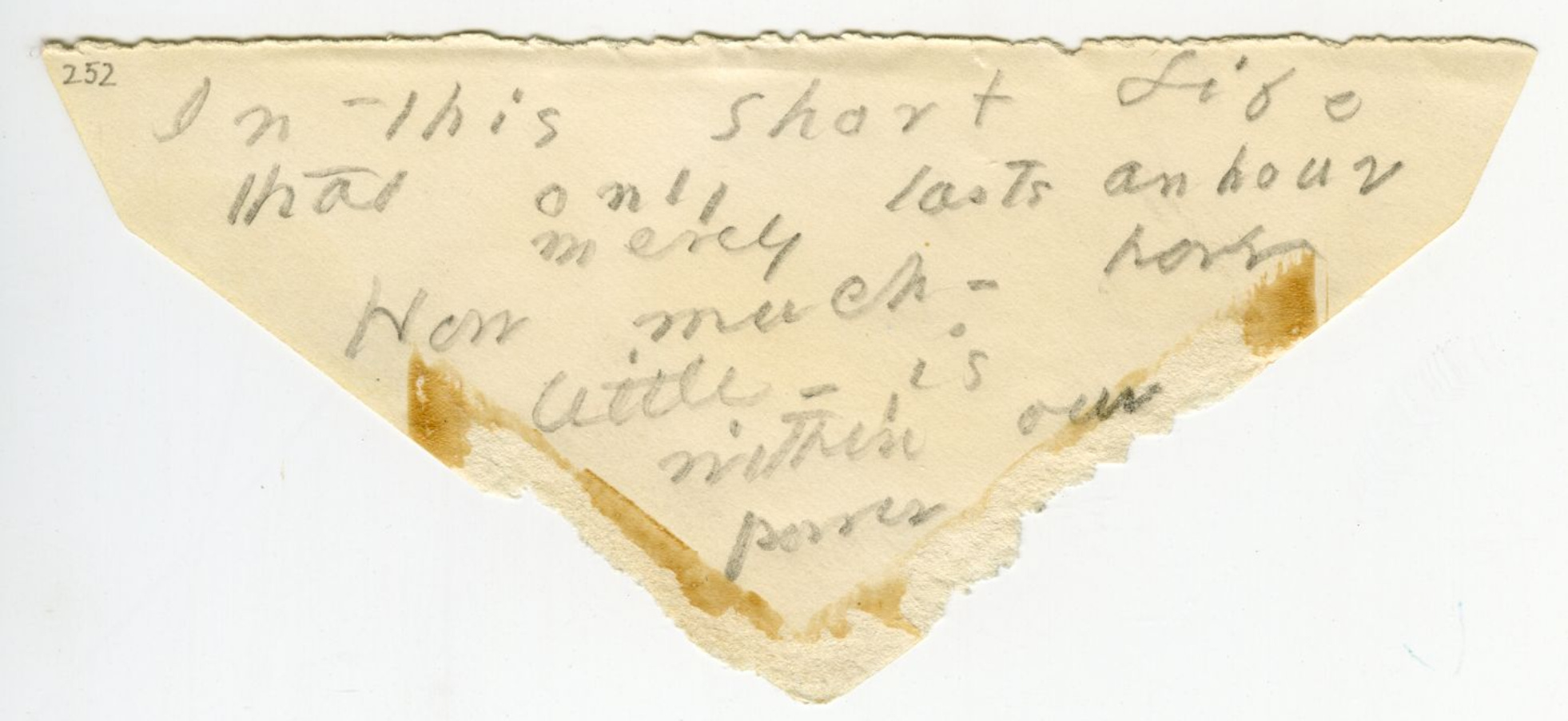
10. “In this short Life” by Scott Joiner: Dickinson wrote this compact poem of just two lines on an upcycled envelope flap, as she was wont to do, around 1873 and saved it. It expresses the paradox that we humans possess free will, a potent trait, and yet so many things are beyond our control. Composer Scott Joiner wrote a piece for voice and piano for this text, performed by Jessica Fishenfeld and Milena Gligić on the album Emily that released just this month (it features settings by Joiner of five poems by Dickinson and five by her near contemporary from across the pond, Emily Brontë). The tone is contemplative and resigned.
In this short Life that only lasts an hour How much – how little – is within our power
Envelope poem by Emily Dickinson, ca. 1873, from the Emily Dickinson Collection, Amherst College (Amherst Manuscript #252, Box 3, Folder 88)
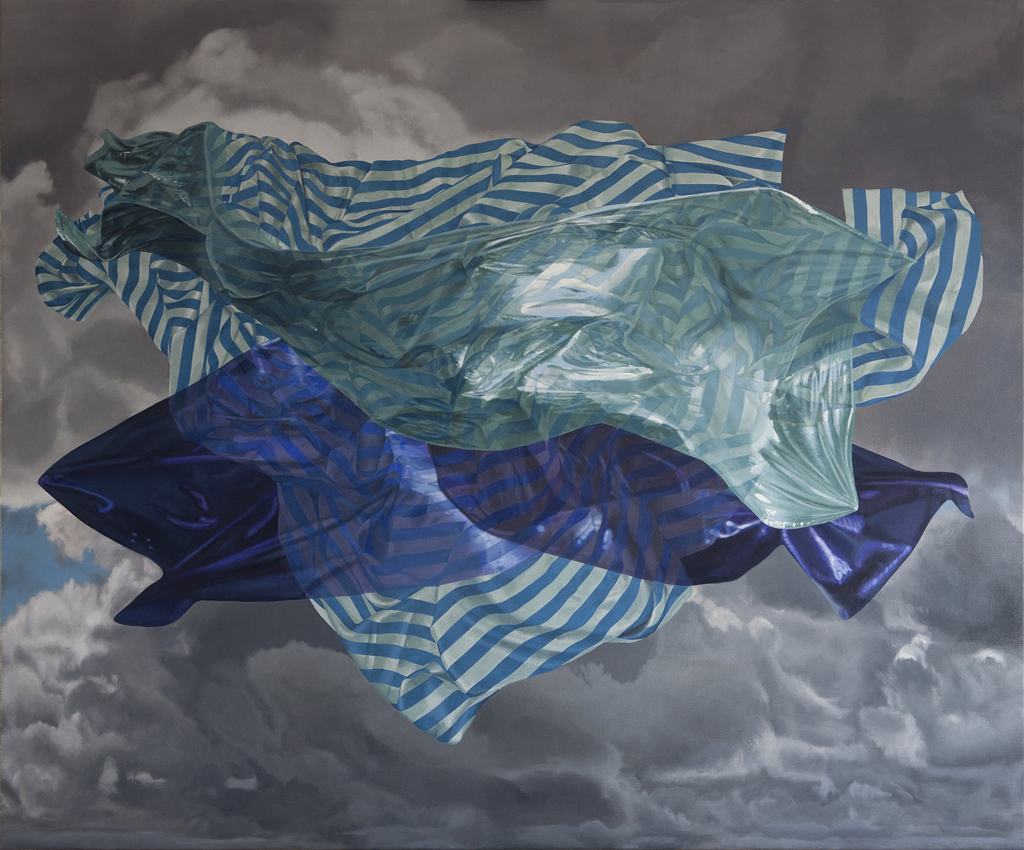
Hansa (Hans Versteeg) (Dutch, 1941–), Between Hope and Despair, 2015. Oil on canvas, 125 × 150 cm.
Everything is plundered, betrayed, sold,
Death’s great black wing scrapes the air,
Misery gnaws to the bone.
Why then do we not despair?

By day, from the surrounding woods,
cherries blow summer into town;
at night the deep transparent skies
glitter with new galaxies.

And the miraculous comes so close
to the ruined, dirty houses—
something not known to anyone at all,
but wild in our breast for centuries.
This poem was originally published in Russian (title: “Все разграблено”) in Anno Domini MCMMXI by Anna Akhmatova (Petrograd: Petropolis, 1922). The above translation by Stanley Kunitz, with Max Hayward, appears in Poems of Akhmatova (Boston: Mariner Books, 1997).
Akhmatova wrote “Everything Is Plundered” in June 1921, during a time of great social and political upheaval caused by the Russian Revolution (1917), which established Communism in the country, and the resultant Russian Civil War (1917–1922). Just two months later, her first husband, the father of her nine-year-old son, would be arrested and executed as a counterrevolutionary. Despite the death and destruction she was witnessing, she did not want to abandon hope. She grasps for a miracle, which is elusive but, she senses, near—will it land?
Like the poet, I too marvel at how such ugliness and beauty can coexist in the world. For Akhmatova, it’s in large part gifts from nature, such as the scent of cherry blossoms or the sparkle of a starry night sky, that prevent her from despairing, that rekindle in her that faith-flame. When humans make a terrible and violent mess of things, there’s still the persistence of seasons and the steadiness of sky. I consider such things graces from God, reminders of God’s deep-down, benevolent, outreaching presence.
Anna Akhmatova, the pen name of Anna Andreevna Gorenko (1889–1966), is one of the most significant Russian poets of the twentieth century. She was active as a writer during both the prerevolutionary and Soviet eras, though in the latter, her work was condemned and censored by Stalinist authorities, who viewed it as too pessimistic and rooted in bourgeois culture. Though many of her friends emigrated out of the country to escape oppression, she chose not to, believing that her poetry would die if she left her homeland; she wanted to stay and bear witness to the events around her, and to hold out hope for a better tomorrow. One of Akhmatova’s most famous poem cycles, Requiem, she wrote while her only child, Lev Gumilev, was detained in Kresty prison in 1938 along with hundreds of other victims of the Great Terror; he would spend the next two decades in forced-labor camps. It wasn’t until the late 1980s, after her death, that Akhmatova achieved full recognition for her literary accomplishments in her native Russia, when all her previously unpublishable works finally became accessible to the public.
Last summer my husband and I drove up to Chadds Ford, Pennsylvania, to see the Joseph Stella: Visionary Nature exhibition at the Brandywine Museum of Art, which ran June 17–September 24, 2023. (Before that it was shown at the Norton Museum of Art in West Palm Beach, Florida, and the High Museum of Art in Atlanta.) It was lovely! There’s an accompanying catalog still available.
Joseph Stella (1877–1946) was born in the mountain village of Muro Locano in southern Italy, near Naples, and immigrated to New York at age eighteen, becoming a US citizen in 1923. He traveled much throughout his life—between his native country and his adopted country, but also for extended stays in Morocco, Chad, Algeria, France, and Barbados. In Paris in 1911–12 he met many of the leading artists of the European avant-garde, including Matisse, Picasso, and Modigliani, and was exposed to the full range of developments in modern art—postimpressionism, Symbolism, fauvism, cubism, surrealism, futurism, dadaism.
Though Stella absorbed some of these influences, he never aligned with a single group or movement. Art historian Abram Lerner says Stella is difficult to pin down, describing him as “a multiple stylist of unusual scope and energy,” both a modernist and a traditionalist. [1] In terms of content, his oeuvre is divided fairly evenly between urban industrial subjects—his most famous paintings are probably those from his series on the Brooklyn Bridge—and joyful and abundant nature.
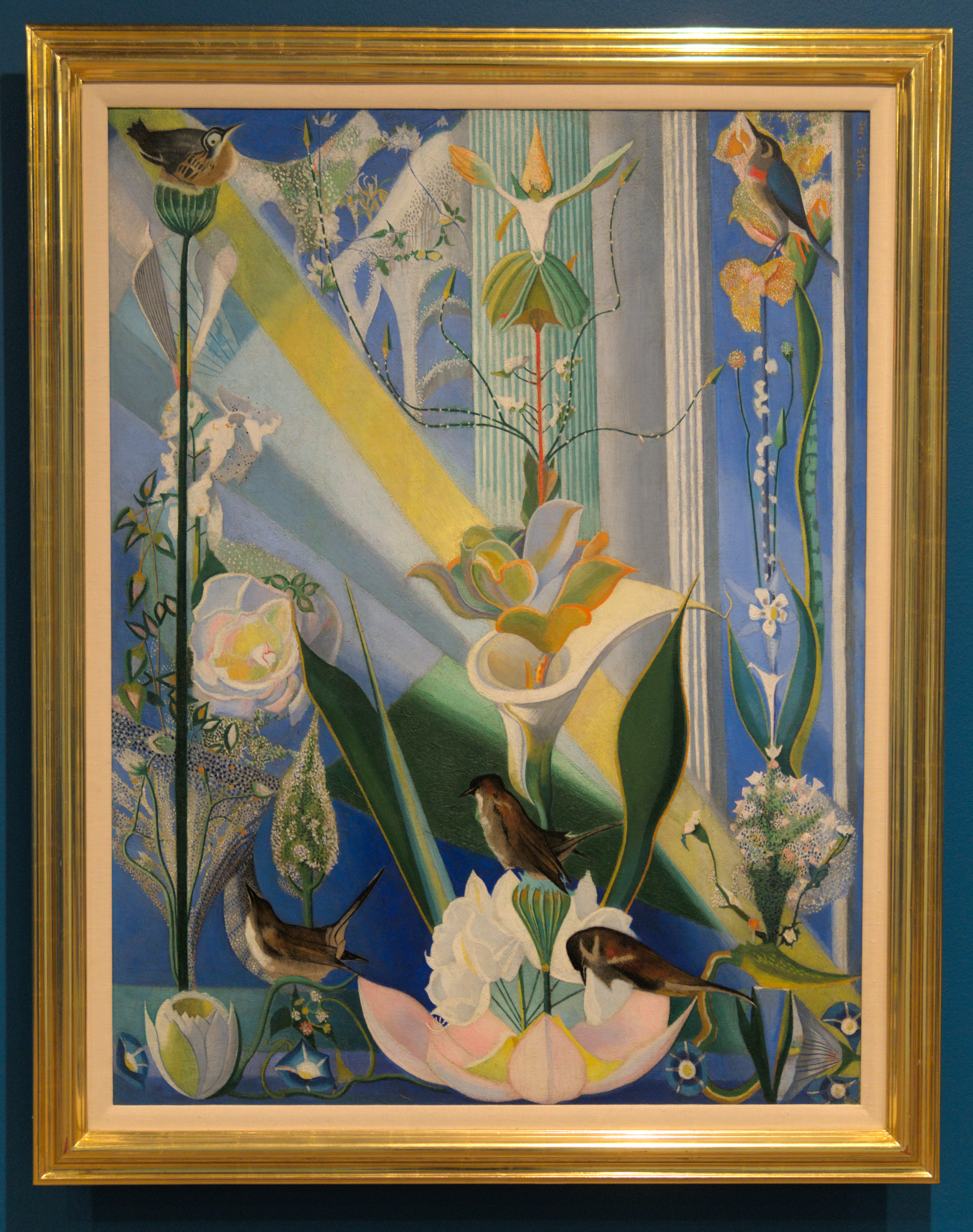
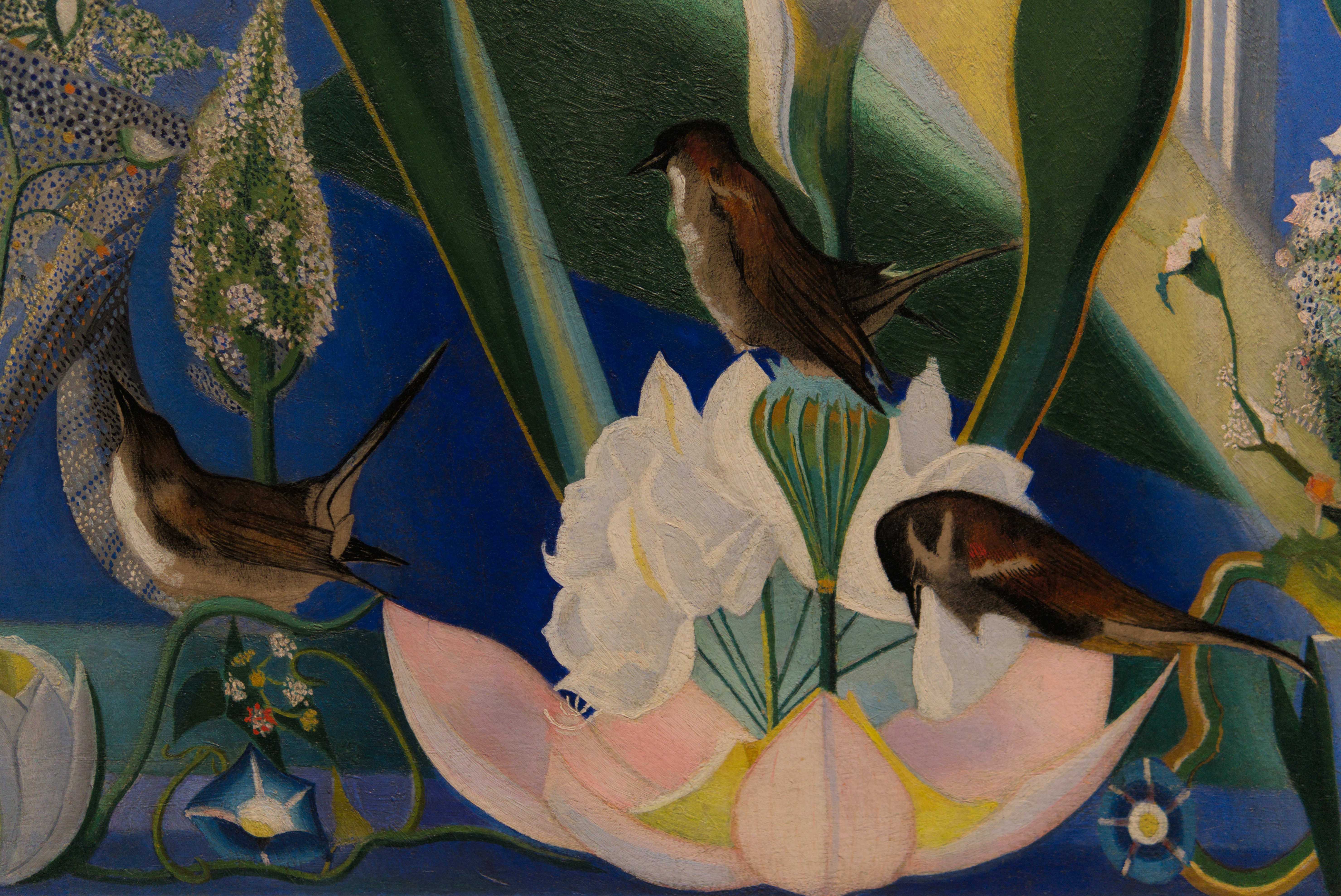
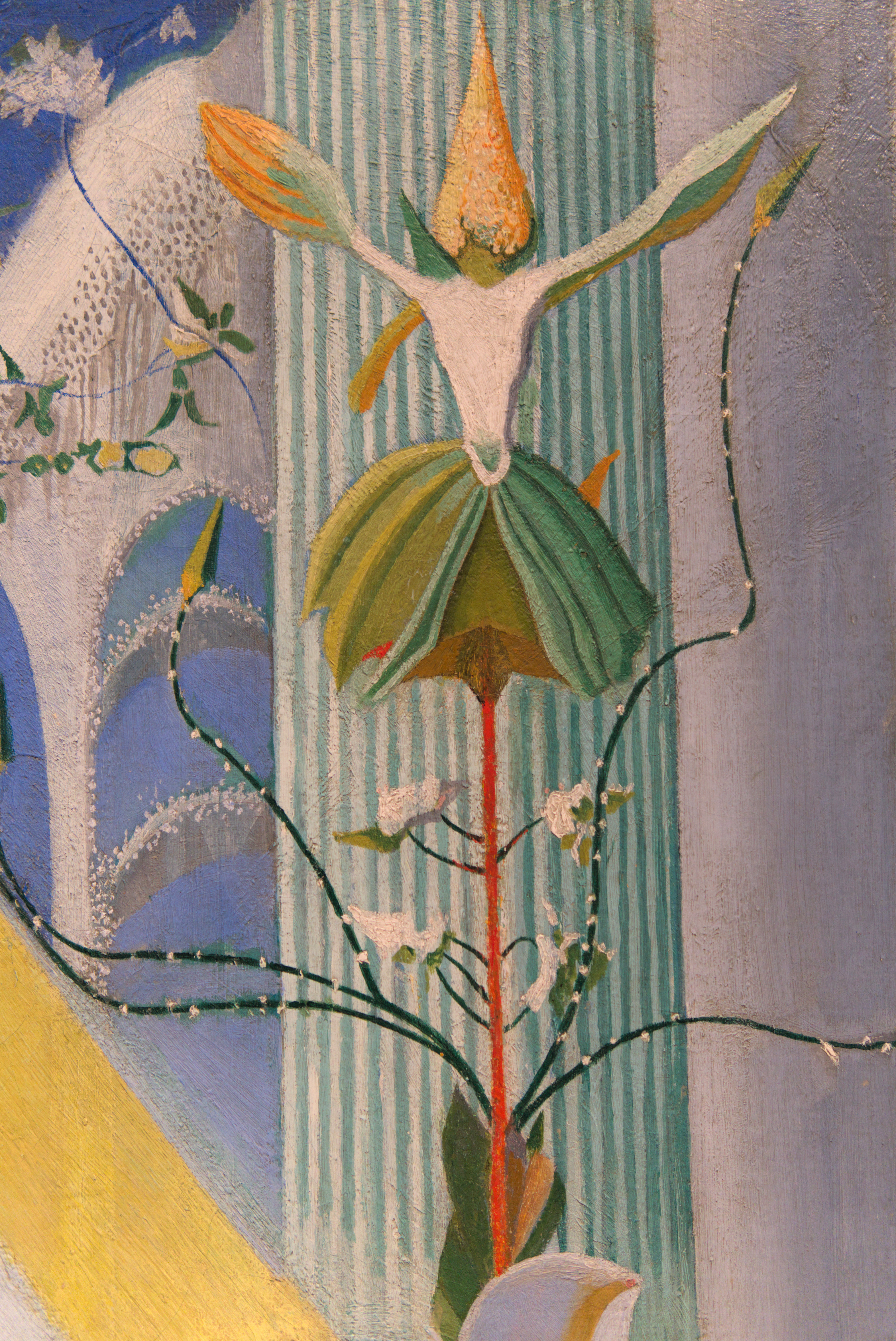
Joseph Stella: Visionary Nature, curated by Stephanie Heydt and Audrey Lewis, spotlights the latter. Many of Stella’s paintings feature birds and foliage hieratically positioned around a central axis, such as Dance of Spring (Song of the Birds).
Joseph Stella (Italian American, 1877–1946), Dance of Spring (Song of the Birds), 1924. Oil on canvas, 42 3/8 × 32 3/8 in. (107.6 × 82.2 cm). Kemper Museum of Contemporary Art, Kansas City, Missouri. Photo: Victoria Emily Jones. [object record]Dance of Spring (Song of the Birds) (detail)Dance of Spring (Song of the Birds) (detail)
“Here,” reads the wall text,
Stella assembles a classical temple of flora and fauna—in his own words, culled “from the elysian lyricism of the Italian spring.” Flowers rise from a pink lotus at the base of a central column, culminating in the curious combination of lupine and a longhorn steer’s head flower, a floral form that resembles a bull’s skull. Below perch three sparrows, the national bird of Italy and a favorite of Stella’s.
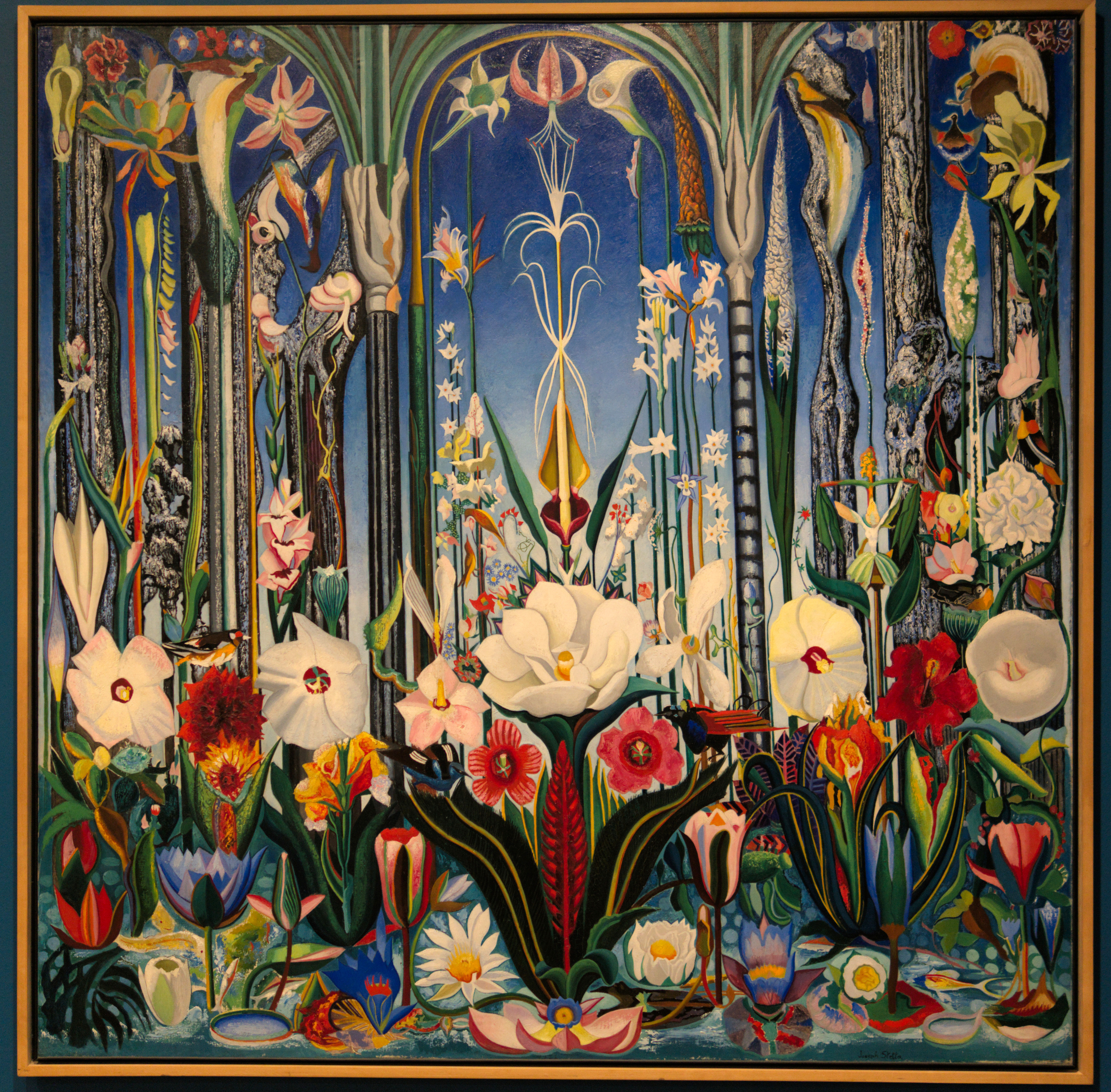
At over six square feet, Stella’s Flowers, Italy is an even more epic floral composition, a symphony of vitality and color.
Joseph Stella (Italian American, 1877–1946), Flowers, Italy, 1931. Oil on canvas, 74 3/4 × 74 3/4 in. (189.9 × 189.9 cm). Phoenix Art Museum, Arizona. Photo: Victoria Emily Jones.
From the wall text:
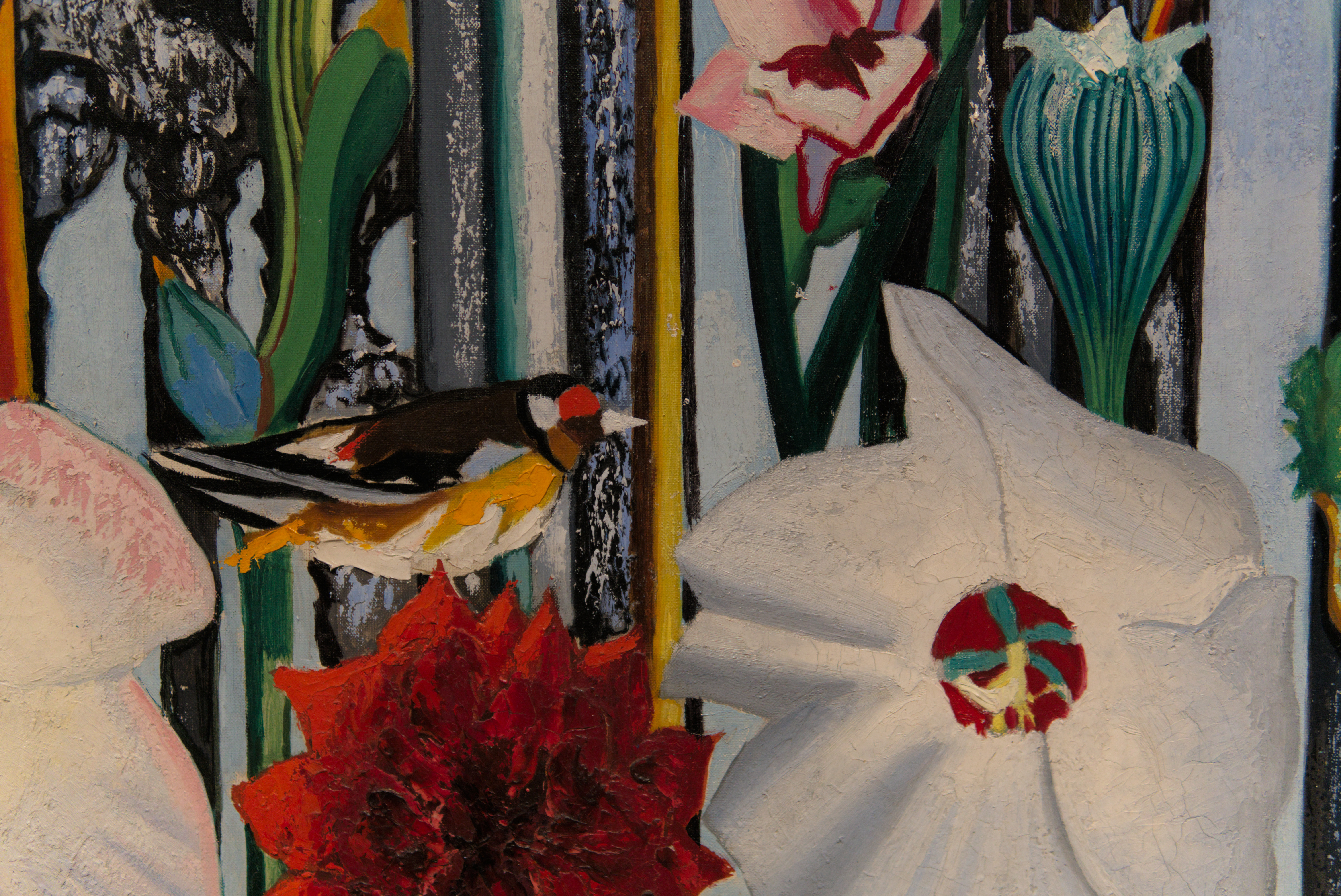
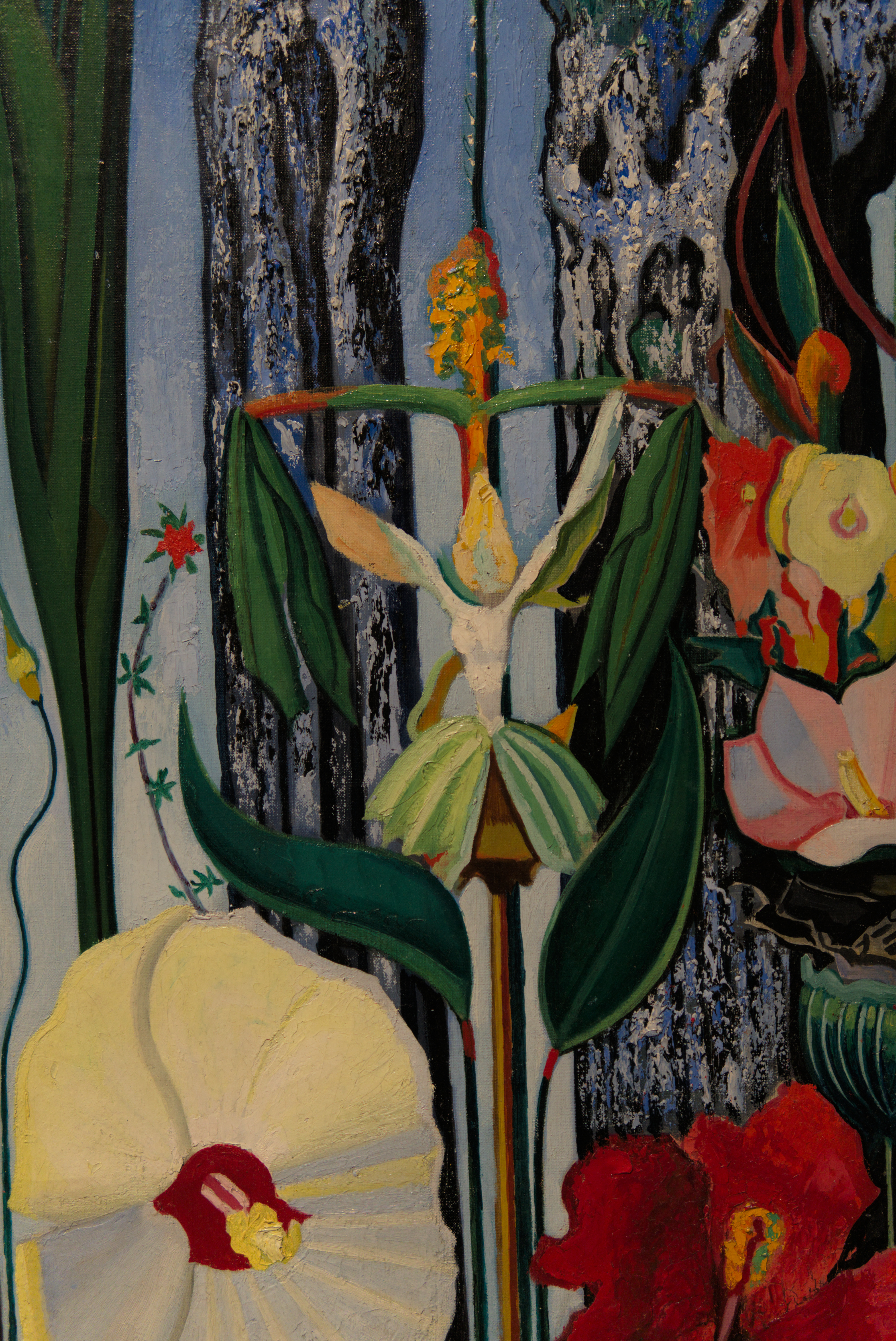
Order and symmetry are in constant tension with the spontaneity of organic ornamentation. The canvas overflows with colorful depictions of flowers and birds within a setting evoking Gothic architecture: pillars of gnarled tree trunks extend outward from the center, as if aisles of a cathedral. Lupine, gladiolas, and birds-of-paradise fill the vertical spaces with a spectrum of colors simulating stained glass windows. Like a congregation in the pews, a host of smaller flowers and plants are gathered below.
Flowers, Italy (detail)Flowers, Italy (detail)
Despite the title, the flowers depicted are not all native to Italy; Stella culled them from his world travels, and some are his own mystical inventions.
Stella sought to portray the voluptuousness and spirituality of his Italian homeland. He was raised in the Catholic faith, and although he didn’t practice as an adult, he remained proud of that heritage. Devotion to the Virgin Mary was a prominent aspect of his religious experience growing up, and in the 1920s he began painting a series of Madonnas, three of which were part of this exhibition.
Art historian Barbara Haskell identifies some of the artistic influences on these paintings:
The garlands of fruits and flowers that surrounded his Madonnas and their embroidered garments of lacy floral patterns recalled the work of the fifteenth-century Venetian Carlo Crivelli, while their impassive countenances, downcast eyes, and long, slim hands folded under translucent cloaks owed a debt to the Dugento masters Cimabue and Duccio. Yet Stella’s paintings were equally influenced by the flat, naive, and colorful images of the Madonna that proliferated in the popular devotional images and folk art of Southern Italy . . . in prayer sheets and books, scapulars, and ex-votos as well as in the profusion of silk and plastic flowers on altars and religious images. [2]
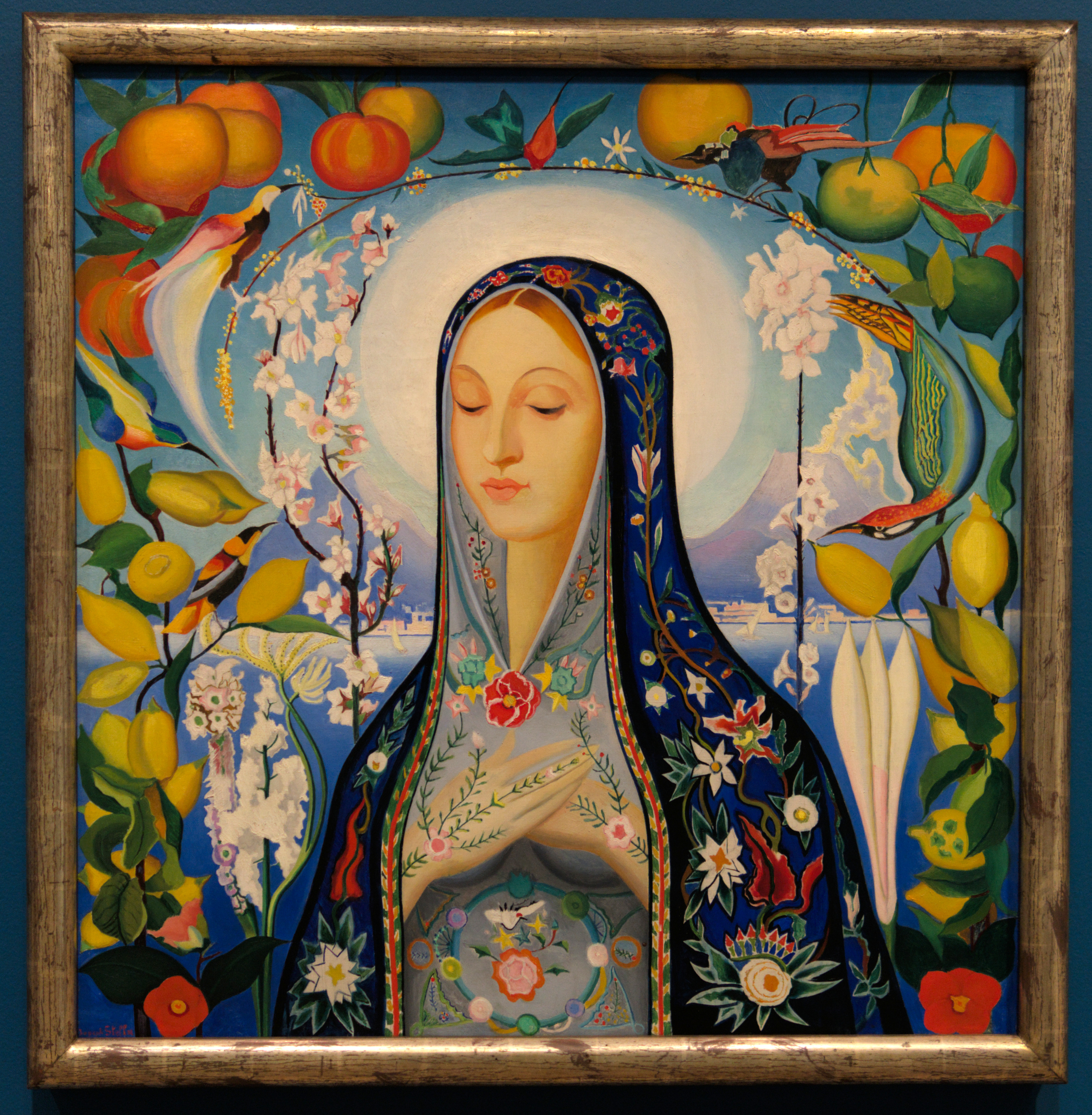
Joseph Stella (Italian American, 1877–1946), The Virgin, 1926. Oil on canvas, 39 11/16 × 38 3/4 in. (100.8 × 98.4 cm). Brooklyn Museum, New York. Photo: Victoria Emily Jones. [object record]
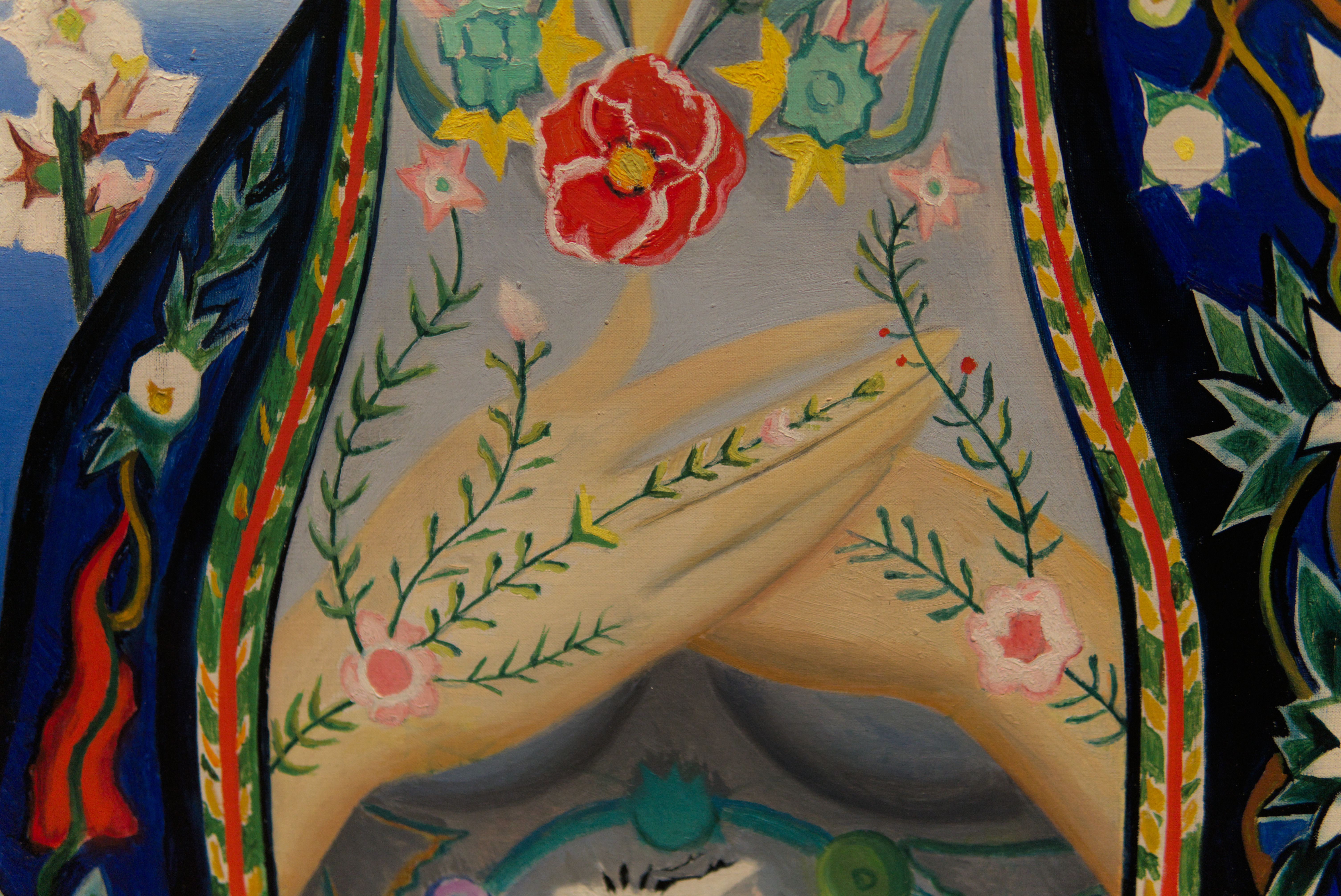
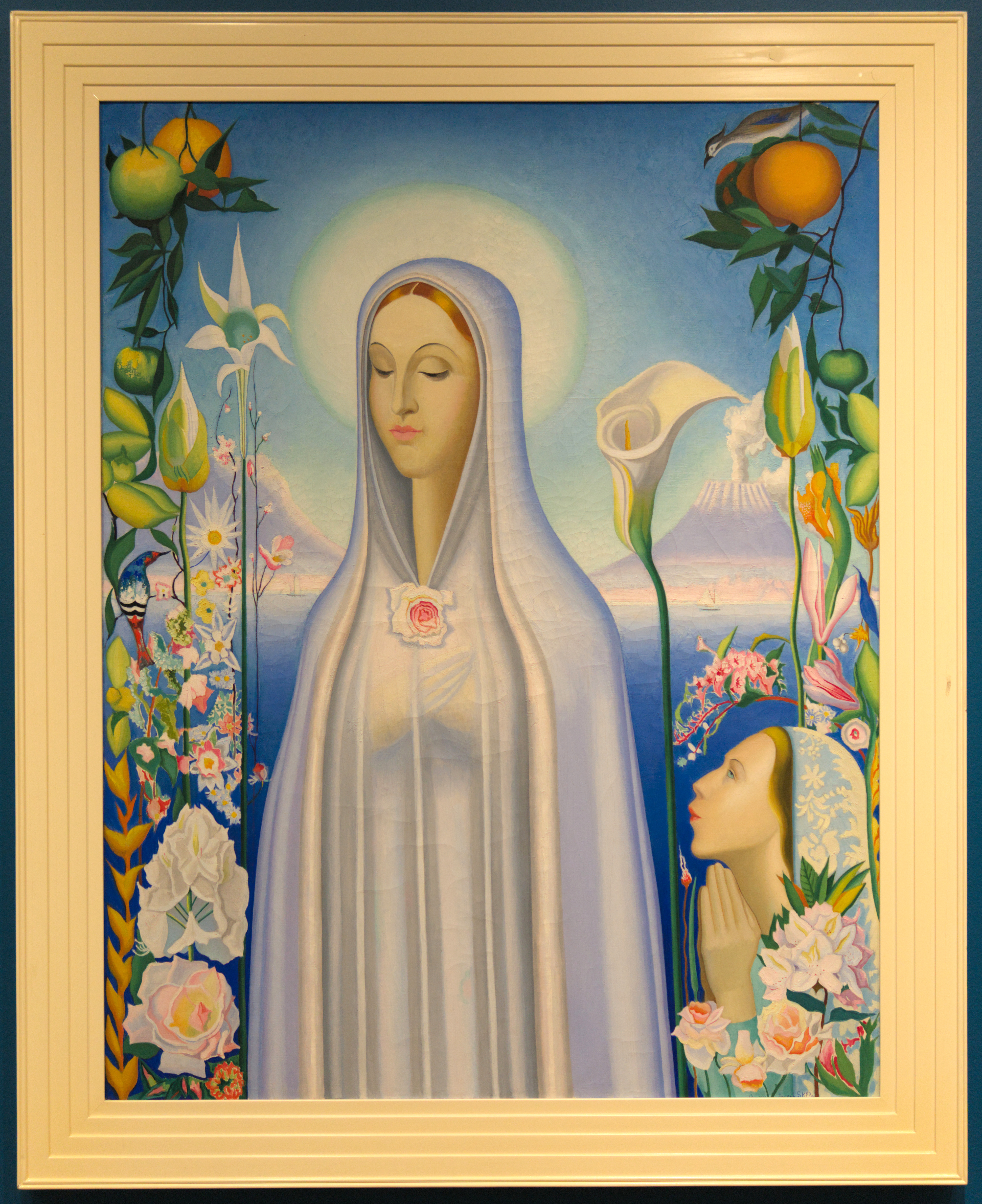
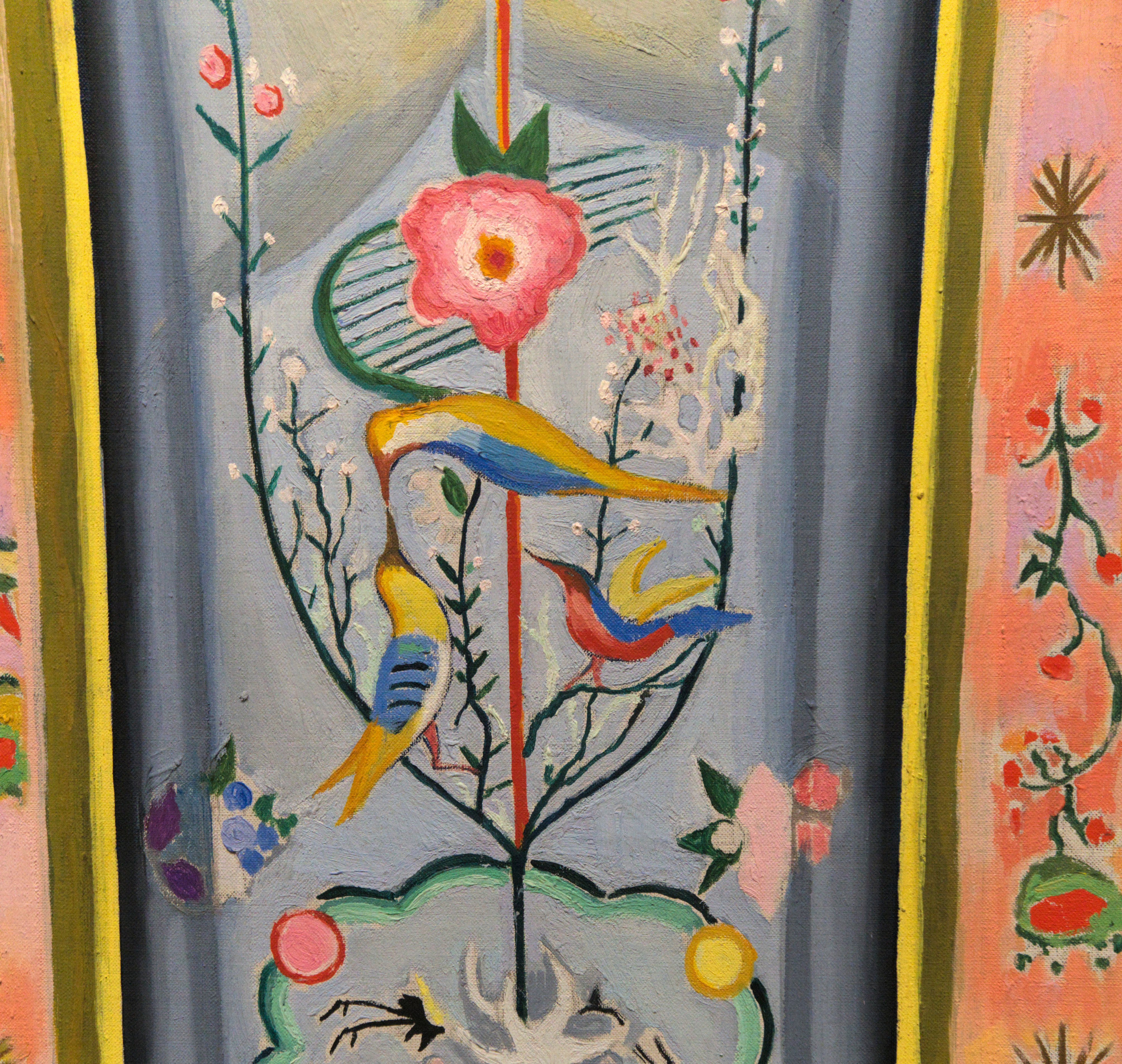
His 1926 Virgin from Brooklyn Museum is my favorite. It shows Mary enshrined among the fruits and flowers of the Mediterranean, with tendrils sweeping up and down her mantle and robe, adorning her neck like a necklace, sprouting out of her prayerful hands, and encircling the womb where she gestated Jesus. The Joseph Stella: Visionary Nature curators provided the following commentary in the wall text:
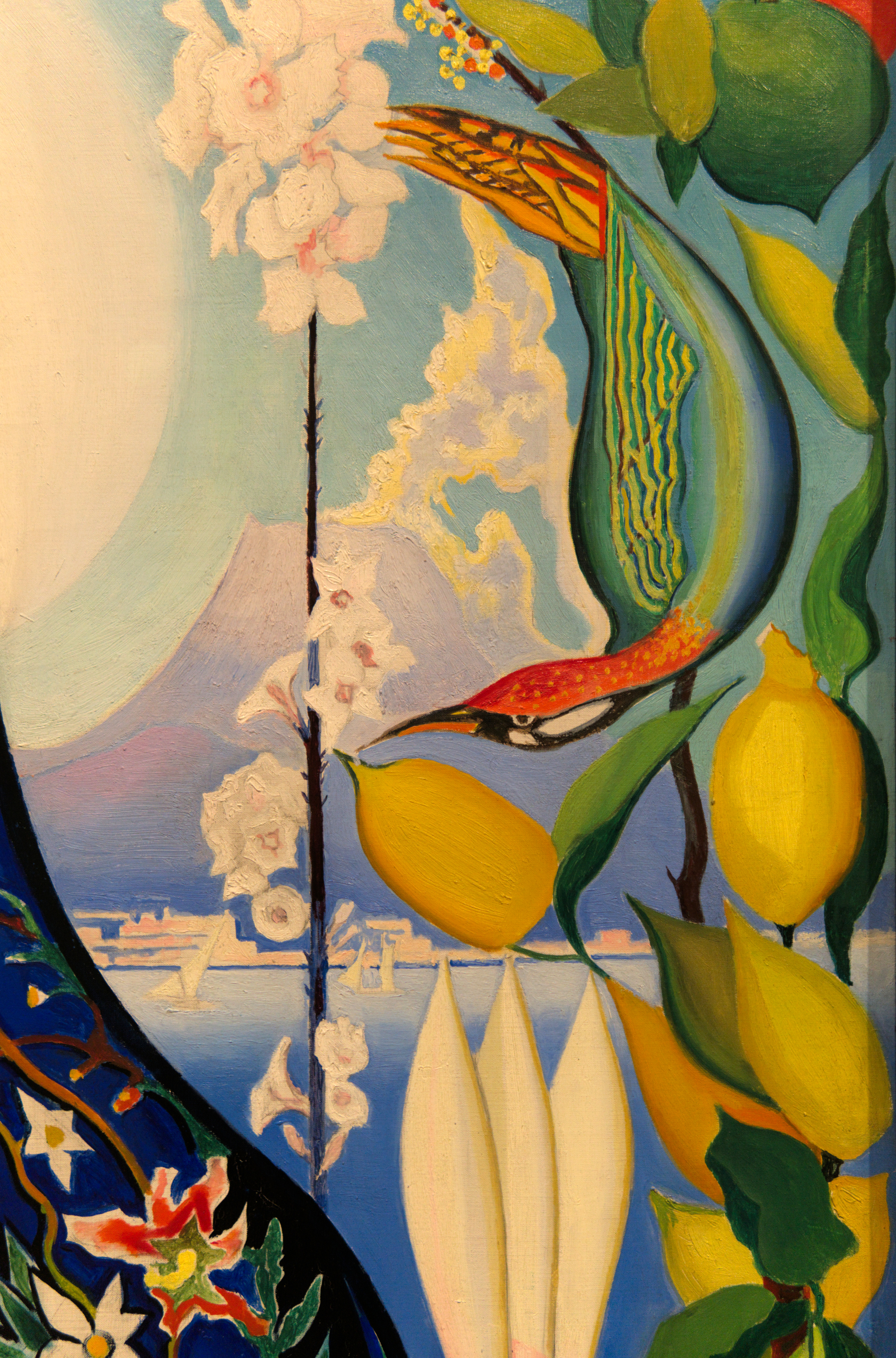
Eyes downcast and hands folded in a traditional Christian gesture of spiritual humility, Stella’s Madonna is set against the distinctive topography of Naples. Visible in the background is Mount Vesuvius, the smoldering volcano that erupted in AD 79 and a landmark of Southern Italy. The halo-like orb surrounding the Virgin’s head, seemingly nestled into the profiles of the mountains, transforms the modern Naples into a site of religiosity. Stella described “the Virgin praying [. . .] protected, on both sides, by almond blossoms, crowned above by the wreath of the deep and clear gold of the orange and lemon trees.”
Stella captures the wild beauty, the fecundity, the blossoming of Mary when the Holy Spirit plants his seed in her and she conceives God’s Word. Her acceptance of the divine call that the angel Gabriel relays to her produces life that redounds to all of humanity and indeed to the whole world. It’s why Mary’s cousin Elizabeth exclaims to her, “Blessed are you among women, and blessed is the fruit of your womb!” (Luke 1:42).
The Virgin (detail)The Virgin (detail)
There’s a long tradition in Christianity of describing Mary’s conception of Jesus as a flowering and of honoring her with flowers. I’m reminded especially of the twelfth-century mystic Hildegard of Bingen’s many hymns and antiphons that celebrate Mary in such terms.
Yes your flesh held joy like the grass when the dew falls, when heaven freshens its green: O mother of gladness, verdure of spring. [3]
Pierced by the light of God, Mary Virgin, drenched in the speech of God, your body bloomed, swelling with the breath of God. [4]
You glowing, most green, verdant sprout,
in the movement of the spirit, in the midst of wise and holy seekers, you bud forth into light.
Your time to blossom has come.
Balsam scented, in you the beautiful flower blossomed. [5]
The Brooklyn Virgin could be read as an Annunciation image, the Incarnation taking place inside this young woman who said yes to God. The sailboats on the sea, their movement reliant on the wind, may allude to the Holy Spirit who blew onto the scene in a major way in Luke 1 to move salvation history forward.
Joseph Stella (Italian American, 1877–1946), The Virgin (Virgin of the Rose and Lily), 1926. Oil on canvas, 57 1/2 × 44 3/4 in. (146.1 × 113.7 cm). Private collection, courtesy of Collisart, LLC, New York. Photo: Victoria Emily Jones. [object record]
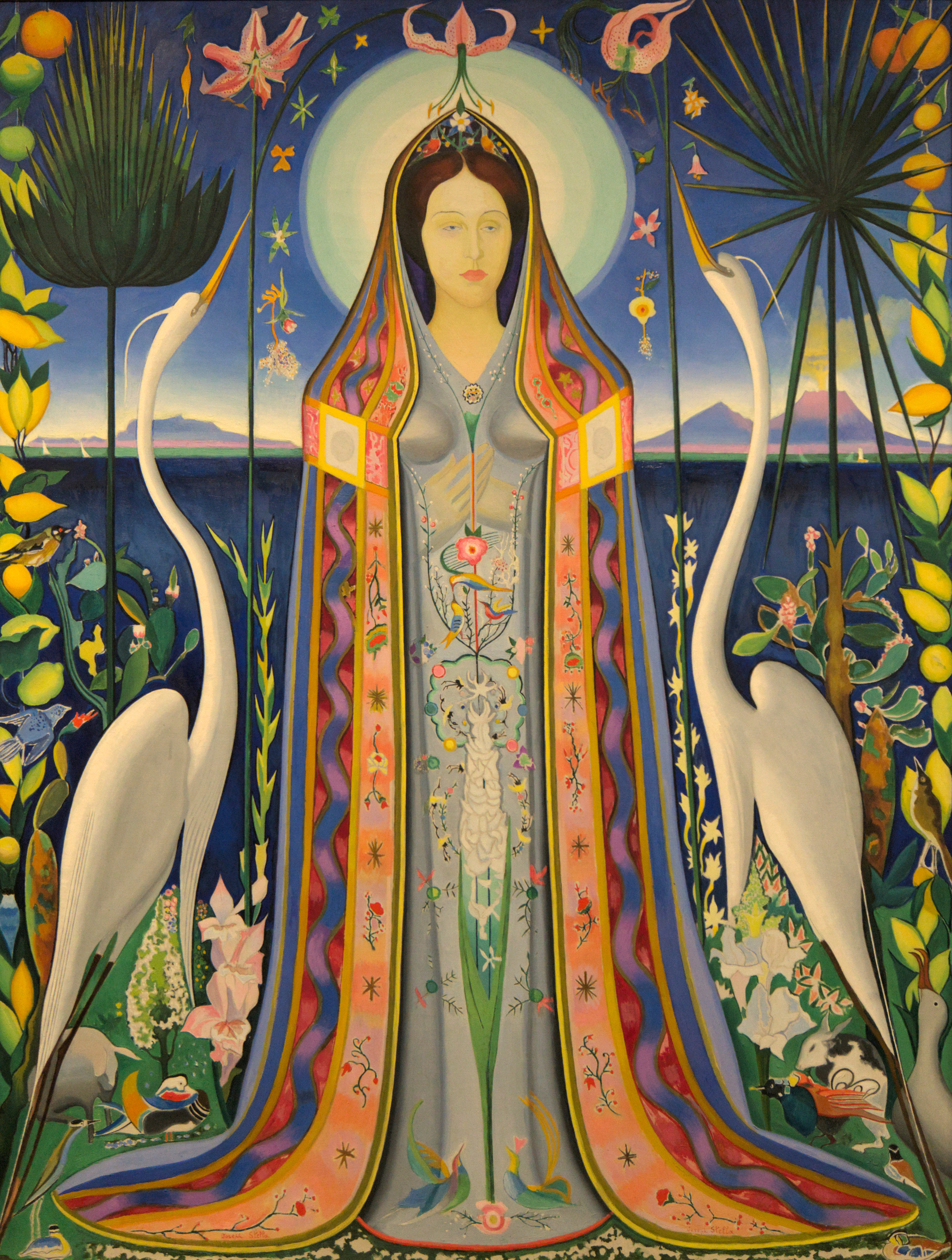
The reference to outdoor religious processions with painted wooden Madonnas in southern Italy is more pronounced in Stella’s Purissima, in which the Mary figure, nearly life-size, is very stiff, statuesque. Co-curator Stephanie Heydt from the High Museum of Art introduces the work in this three-and-a-half-minute video:
Joseph Stella (Italian American, 1877–1946), Purissima, 1927. Oil on canvas, 76 × 57 in. (193 × 144.8 cm). High Museum of Art, Atlanta, Georgia. Photo: Victoria Emily Jones. [object record]
“Mater Purissima” (Purest Mother), or “Virgo Purissima” (Purest Virgin), is one of Mary’s titles in Catholicism. The artist gave the following description of the painting:
Clear morning chanting of Spring.
BLUE intense cobalt of the sky—deep ultramarine of the Neapolitan sea, calm and clear as crystal—and alternating with zones of lighter blue, the mantle multicolored (an enormous lily blossom turned upside down).
SILVER quicksilver of spring water, quilted with the rose, green, and yellow of the gown—greenish silver, very bright—mystic DAWN-white—of the Halo.
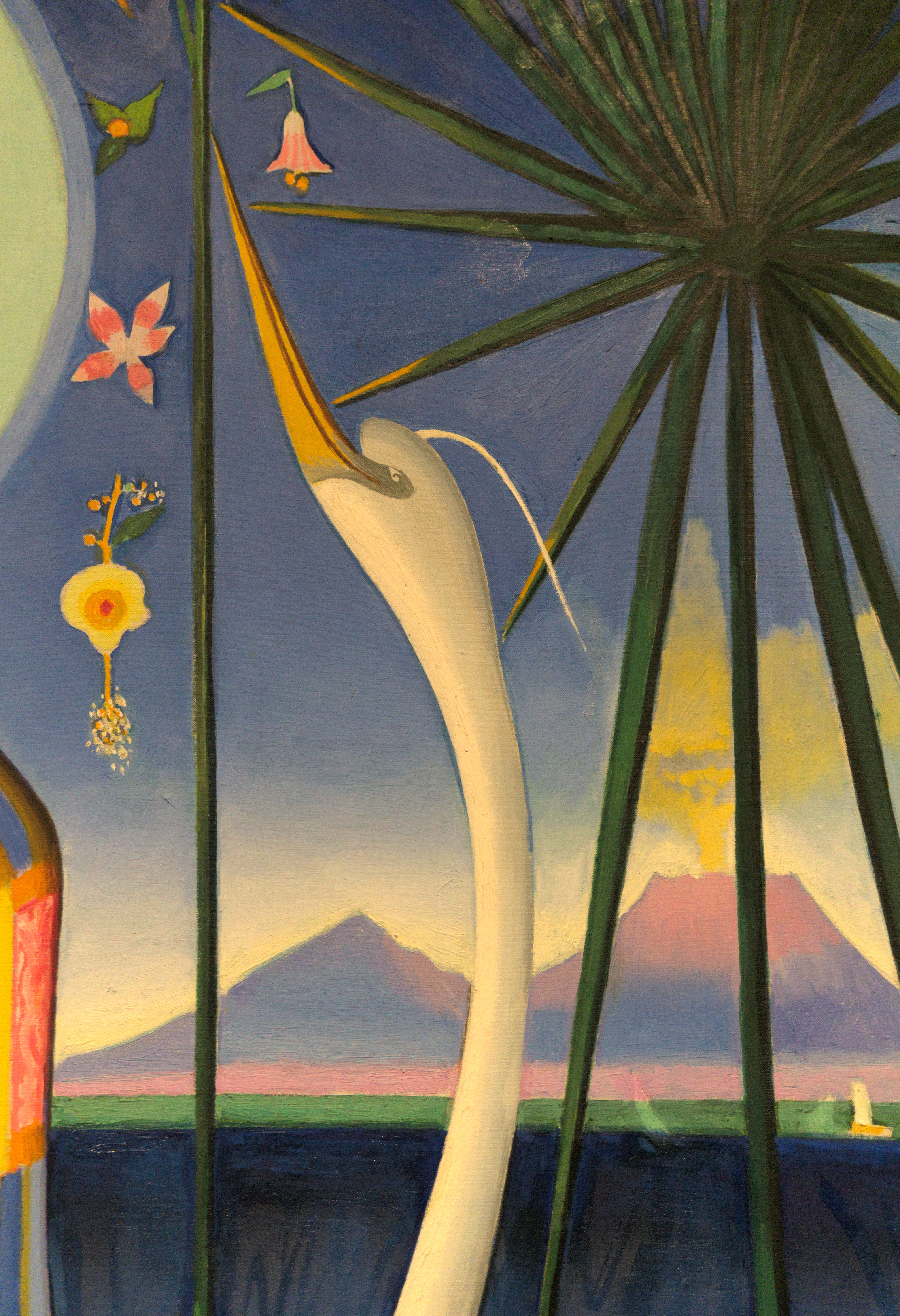
WHITE as snow for the two herons, whose gleaming white necks enclose, like a sacred shrine, the prayer of the VIRGIN.
YELLOW very light—for the edges of the mantle—to bring it out clearly with diamond purity, and reveal the hard firm modeling of the virginal breast. The lines of the mantle fall straight over the long hieratic folds of the gown, forming a frame—and the full, resonant yellow of unpeeled lemons at both sides of the painting like echoing notes of the propitious shrill laughter of SPRING.
VIOLET mixed with ultramarine for the zigzag motif in the panel along the edge of the mantle, and bright, fiery violet at the top of Vesuvius, near the white fountainhead of incense—light violet tinged with rose, for the distant Smile of Divine Capri.
GREEN soft, tender, like the new grass—intense green for the short pointed leaves that enclose the lemons—and a dark green, both sour and sweet, for the palms that fan out at the sides like mystic garlands.
PINK strong—rising to the flaming, pure vermilion borders—of the Rose, brilliant as a jewel, in contrast to the waxy pallor of the hands clasped in prayer—and infinitely subtle, delicately modulated rose for the small flowers that with the others of various colors weave of dreams and promises and splendid bridal gown of the “Purissima.” [6]
Like his Brooklyn Virgin, this painting is also set in the Bay of Naples, with Mount Vesuvius gently erupting in the right background, and the island of Capri rising up out of the sea on the left.
Purissima (detail)Purissima (detail)
Three pink lilies create a frame around the Purissima, their long stalks rising up on either side of her, with one flower bending down to crown her head with its filaments and anthers. She is attended not by angels but by herons, along with other critters at her feet. This is a Madonna both earthy and supernal.
Here are a few more photos from the exhibition:
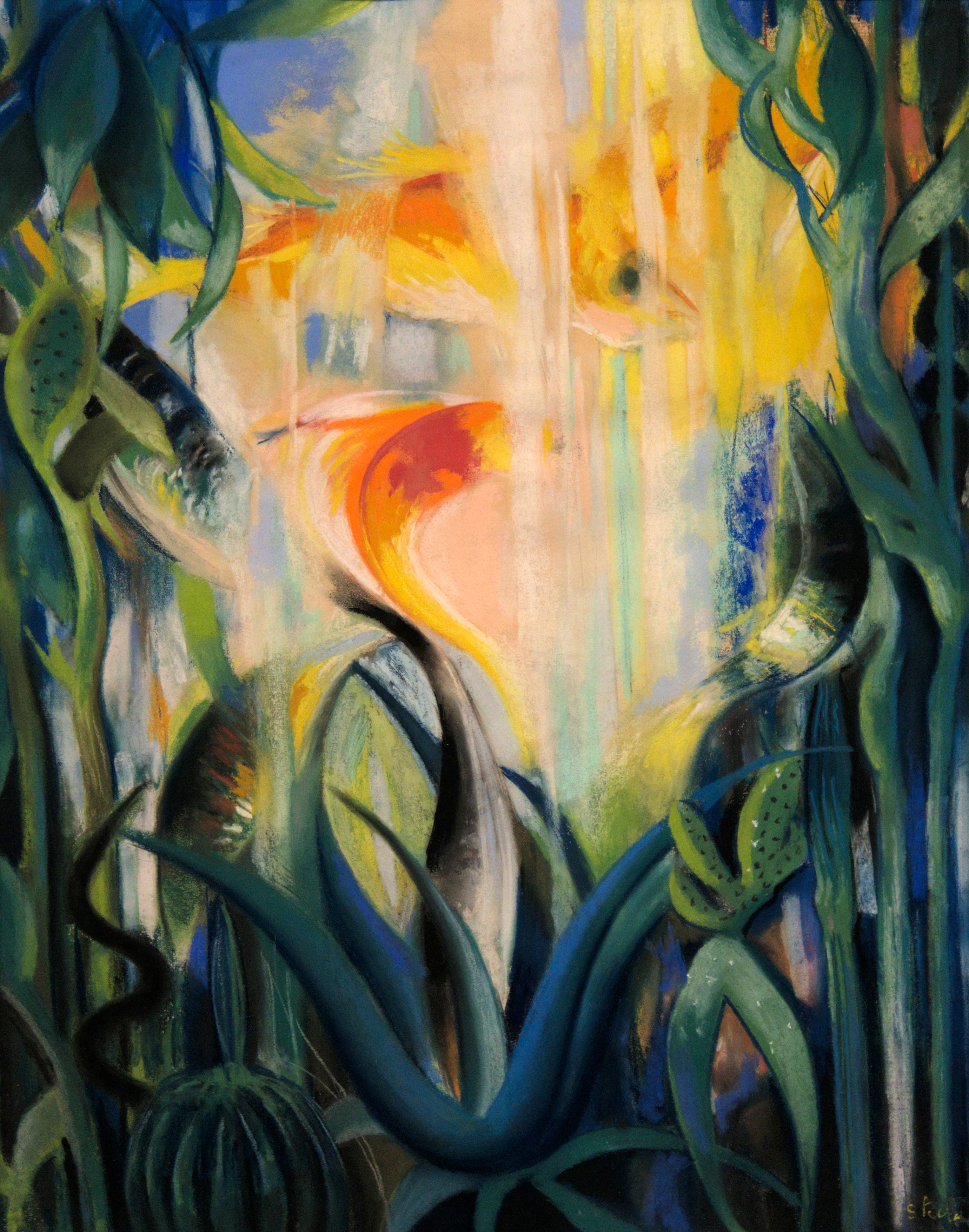
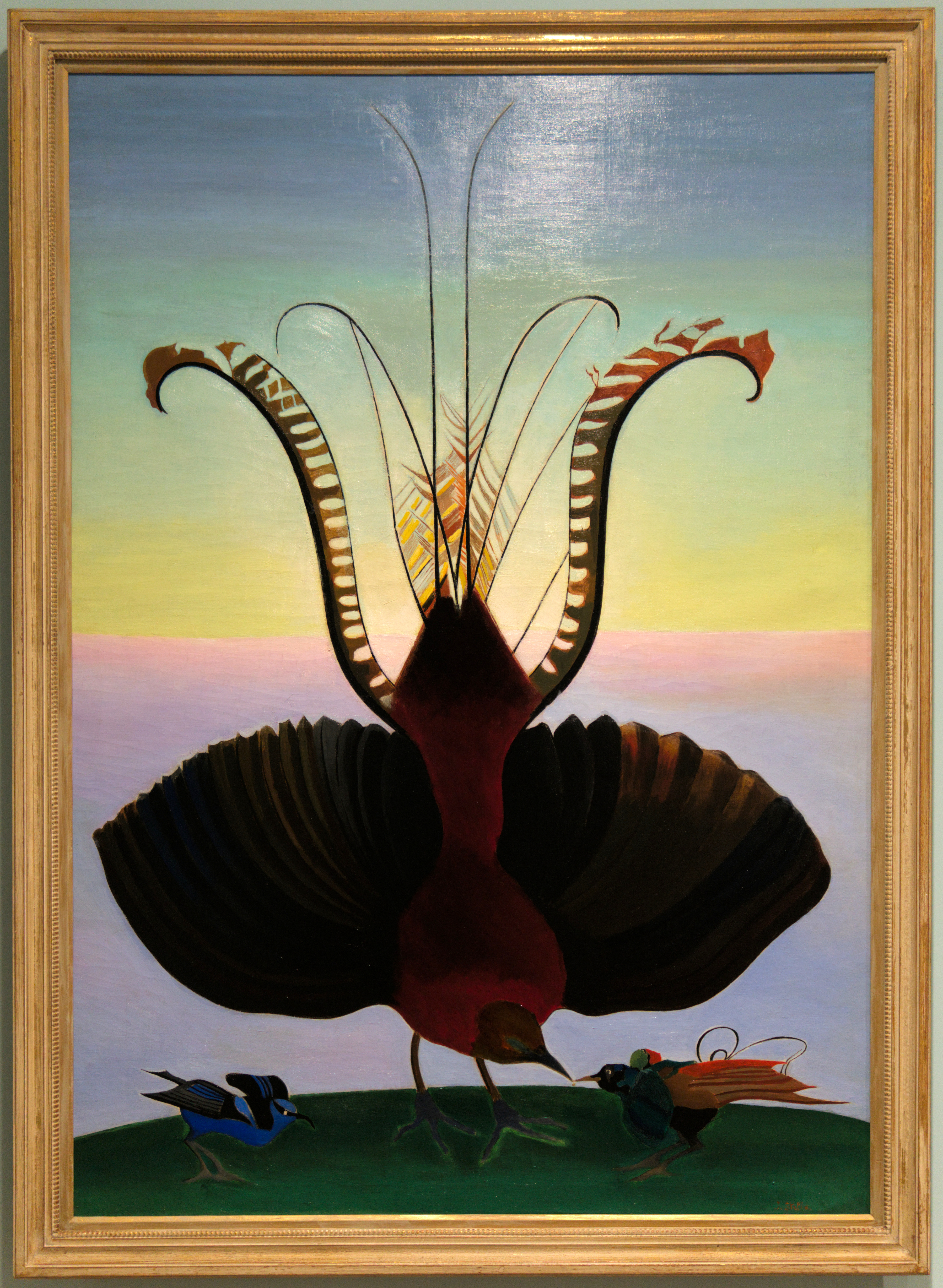
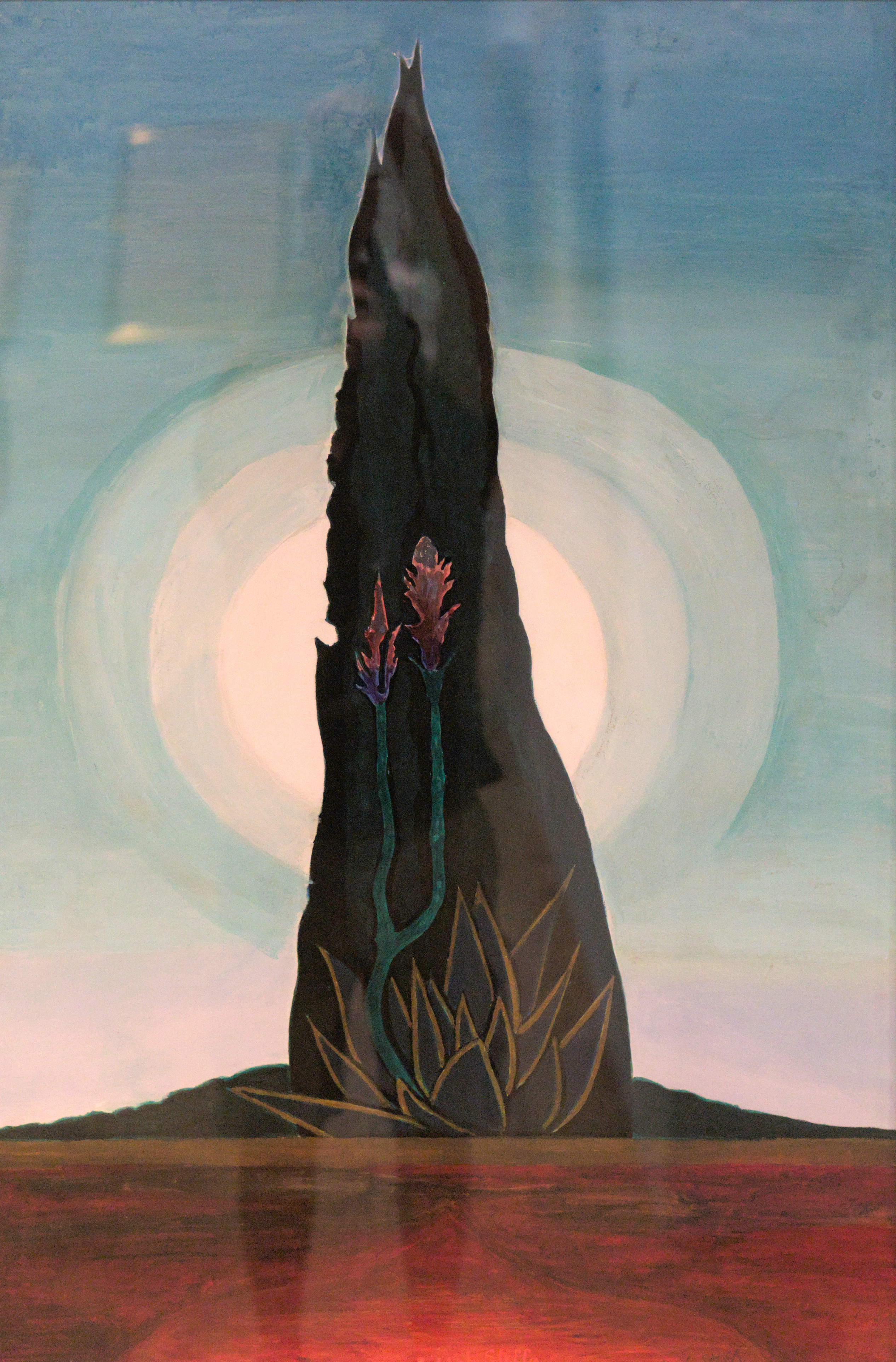
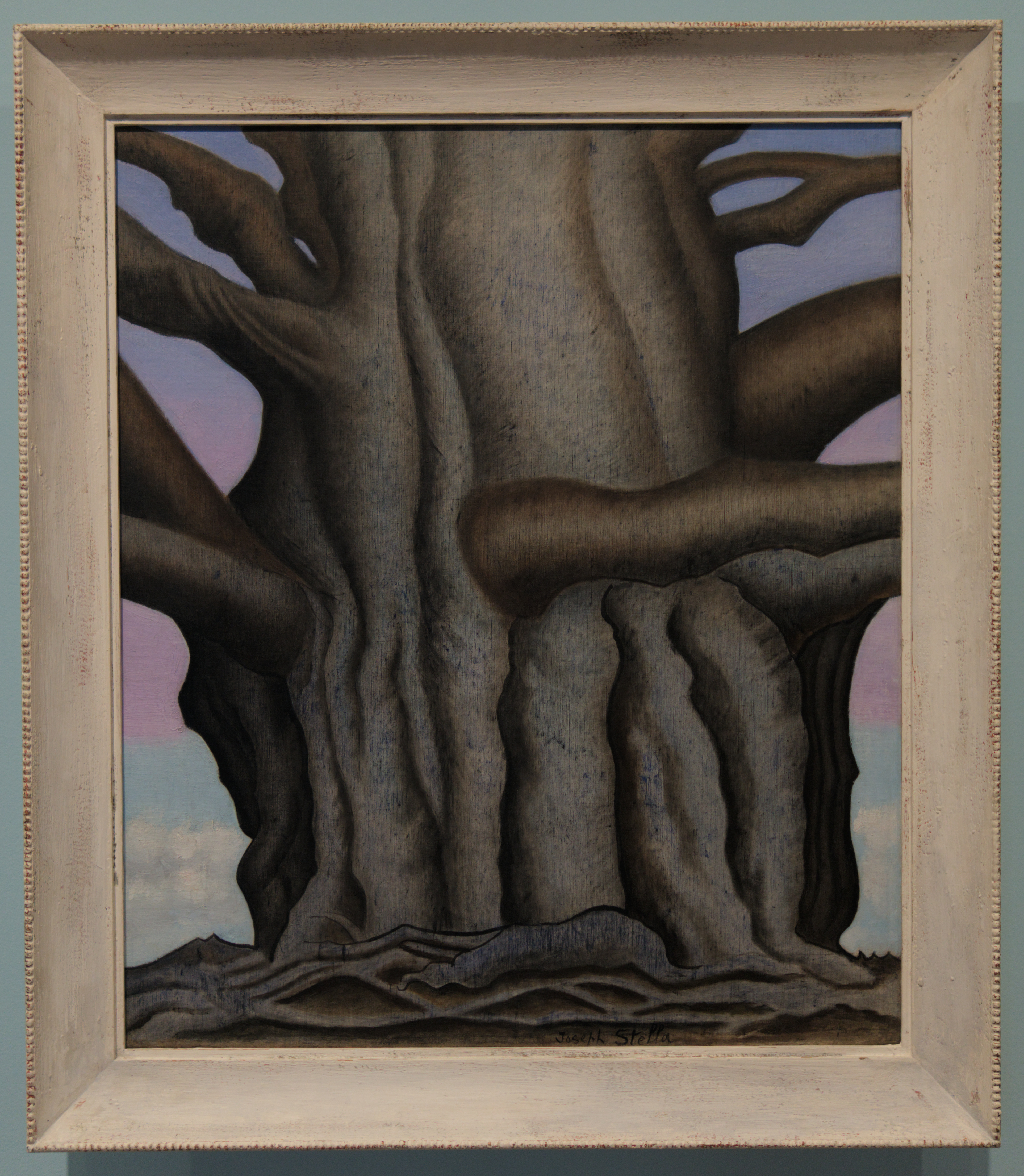
Joseph Stella (Italian American, 1877–1946), Aquatic Life (Goldfish), ca. 1919–22. Pastel on paper. American University Museum, Washington, DC. Photo: Victoria Emily Jones.Joseph Stella (Italian American, 1877–1946), Lyre Bird, ca. 1925. Oil on canvas, 54 × 30 1/8 in. (137.2 × 76.5 cm). Addison Gallery of American Art, Phillips Academy, Andover, Massachusetts. Photo: Victoria Emily Jones.Joseph Stella (Italian American, 1877–1946), Tree, Cactus, Moon, ca. 1928. Gouache on paper, 41 × 27 in. (104.1 × 68.6 cm). Reynolda House Museum of American Art, Winston Salem, North Carolina. Photo: Eric James Jones. [object record]Joseph Stella (Italian American, 1877–1946), Banyan Tree, ca. 1938. Oil on canvas, 36 1/2 × 31 1/2 in. (92.7 × 78.7 cm). Myron Kunin Collection of American Art, Minneapolis, Minnesota. Photo: Victoria Emily Jones.
1. Abram Lerner, foreword to Judith Zilczer, Joseph Stella: The Hirshhorn Museum and Sculpture Garden Collection (Washington, DC: Smithsonian Institution Press, 1983), 6.
2. Barbara Haskell, Joseph Stella (New York: Whitney Museum of American Art / Harry N. Abrams, 1994), 151.
3. From Hildegard of Bingen, “Hymn to the Virgin,” trans. Barbara Newman, in Symphonia: A Critical Edition of the “Symphonia armonie celestium revelationum” (Ithaca, NY: Cornell University Press, 1988, 1998), 123.
4. From Hildegard of Bingen, “Antiphon for the Virgin,” in Symphonia, 137.
5. FromHildegard of Bingen,“A Song to Mary,”rendered by Gabriele Uhlein, in Meditations with Hildegard of Bingen (Rochester, VT: Bear & Co., 1983), 119.
6. English translation from Irma B. Jaffe, Joseph Stella (Cambridge: Harvard University Press, 1970), 99–100. For the original Italian, see appendix 1, #29.
The heavens bespeak the glory of God.
The firmament ablaze, a text of his works.
Dawn whispers to sunset.
Dark to dark the word passes: glory glory.

All in a great silence,
no tongue’s clamor—
yet the web of the world trembles
conscious, as of great winds passing.

The bridegroom’s tent is raised,
a cry goes up: He comes! a radiant sun
rejoicing, presiding, his wedding day.
From end to end of the universe his progress.
No creature, no least being but catches fire from him.
This paraphrase of Psalm 19:1–6 by Daniel Berrigan is from Uncommon Prayer: A Book of Psalms(University of Michigan Press, 1978; Orbis, 1998).Used by permission of the Daniel Berrigan Literary Trust. www.danielberrigan.org
The first section of Psalm 19 is about how the natural world declares the glories of its Maker. The night sky, the psalmist describes, is like a tent that spreads its cover over the sun, parting open every morning to release it on the world. The sun is compared to a bright-eyed, handsome, and happy bridegroom emerging from his chamber, and to a vigorous runner who tracks a massive course.
I like to read Psalm 19:1–6 for Advent, especially the poet-priest Fr. Daniel Berrigan’s paraphrase of it, as his use of he/him/his pronouns instead of it/its draws out a Christological connection I hadn’t seen before in this text, made even more pronounced by the apocalyptic tone Berrigan adopts and the sense of excitement he conveys. The poem can, of course, be read as simply the glorious waking of a day, as the psalmist intended. But there’s another layer I want to explore: signs in the heavens, and the coming of Christ.
In the Christian tradition, Jesus is compared to both a sun and a bridegroom, and he, too, like the skies, “bespeak[s] the glory of God.” “Oriens”—Dawn or Dayspring—is one of the traditional titles of Christ, typically invoked in liturgies on December 21 as part of the O Antiphons cycle. From the Church of England’s Common Worship: “O Morning Star, splendor of light eternal and sun of righteousness: come and enlighten those who dwell in darkness and the shadow of death” (cf. Luke 1:78–79; John 8:12; Mal. 4:2). The coming of Jesus—in Bethlehem, in human hearts, and on the last day—illuminates and sets ablaze, revealing who God is and who we ourselves most truly are and exciting the world, flinging abroad the divine light.
As for the bridegroom, Jesus uses this metaphor for himself in his parable of the ten bridesmaids (Matt. 25), as God does in Isaiah 62:5, and indeed one of the major motifs in the book of Revelation is a wedding between Christ and his people. Christ will return to us, scripture suggests, like a husband coming to bring home his new bride.
One of the antiphons for First Vespers of Christmas, I’ve just learned, sung the evening of December 24, connects the bridegroom of Psalm 19 with Jesus. Cum ortus fuerit sol de caelo, the church chants, videbitis Regem regum procedentem a Patre, tanquam sponsum de thalamo suo. (“When the sun shall have risen in the heavens, ye shall see the King of kings coming from the Father, as a Bridegroom from his bride-chamber.”)
Tanja Butler (American, 1955–), Woman Clothed with the Sun, 2008. Acrylic paint, collaged painted paper, and cotton fabric on gessoed acid-free paper, 14 × 5 in. Collection of Victoria Emily Jones.
Artist Tanja Butler further extends Psalm 19’s fittingness for Advent by drawing the passage into conversation with Revelation 12:1–6. This section of John’s Apocalypse introduces us to “a woman clothed with the sun, with the moon under her feet, and on her head a crown of twelve stars”; she gives birth to a baby boy “who is to rule all the nations” but whom a great dragon seeks to devour. In most Christian interpretations, this Woman of the Apocalypse is associated with the Virgin Mary, and there’s a robust iconographic tradition in this vein.
Butler innovates on that tradition with her mixed-media work Woman Clothed with the Sun by showing the infant Jesus busting out of his mother’s womb like the strong athlete of Psalm 19:5. (Ready. Set. Go!) He has a race to run, a mission to fulfill. He is also shown as the sun that clothes his mother and that emerges from a dark (uterine) tent. He is the source and center point of the explosive rays of colorful light in the painting.
In an ArtWay profile, Butler describes her piece as follows:
Mary is represented with the unborn Christ, Light of the World, ready to “come forth from his pavilion, like a champion rejoicing to run his course” (Psalm 19:5). She holds a ladder, referencing both Jacob’s vision and the cross, the ladder of ascent between earth and heaven.
This is a cosmic birth necessitated by a cosmic struggle that will resolve in a cosmic victory: the reunion of God and humanity.
Daniel Joseph Berrigan, SJ, (1921–2016) was an American Jesuit priest, peace activist, award-winning poet, and professor of theology and biblical studies. Through his writings and public witness, he endorsed a consistent life ethic, opposing war, nuclear armament, abortion, capital punishment, and the causes of poverty in the name of Jesus Christ and his holy gospel. Fr. Berrigan, along with his brother Philip, was one of the Catonsville Nine, imprisoned in 1968 for destroying draft files in a protest against the Vietnam War. Later, he spent much of the eighties ministering to AIDS patients in New York City. He is the author of some fifty books.
Tanja Butler (born 1955) is a painter and liturgical artist based in the Albany, New York, area. Her subjects are devotional in character, and her sources of inspiration include Byzantine icons, medieval art, and folk art. Her work is included in the collections of the Vatican Museums, the Hammer Museum in Los Angeles, the Portland Museum of Art in Maine, and the Boston Public Library. “My aim is to develop imagery that has the simplicity and clarity of a child-like vision,” she says, “required, we’re told, if we are to see the kingdom of God.”
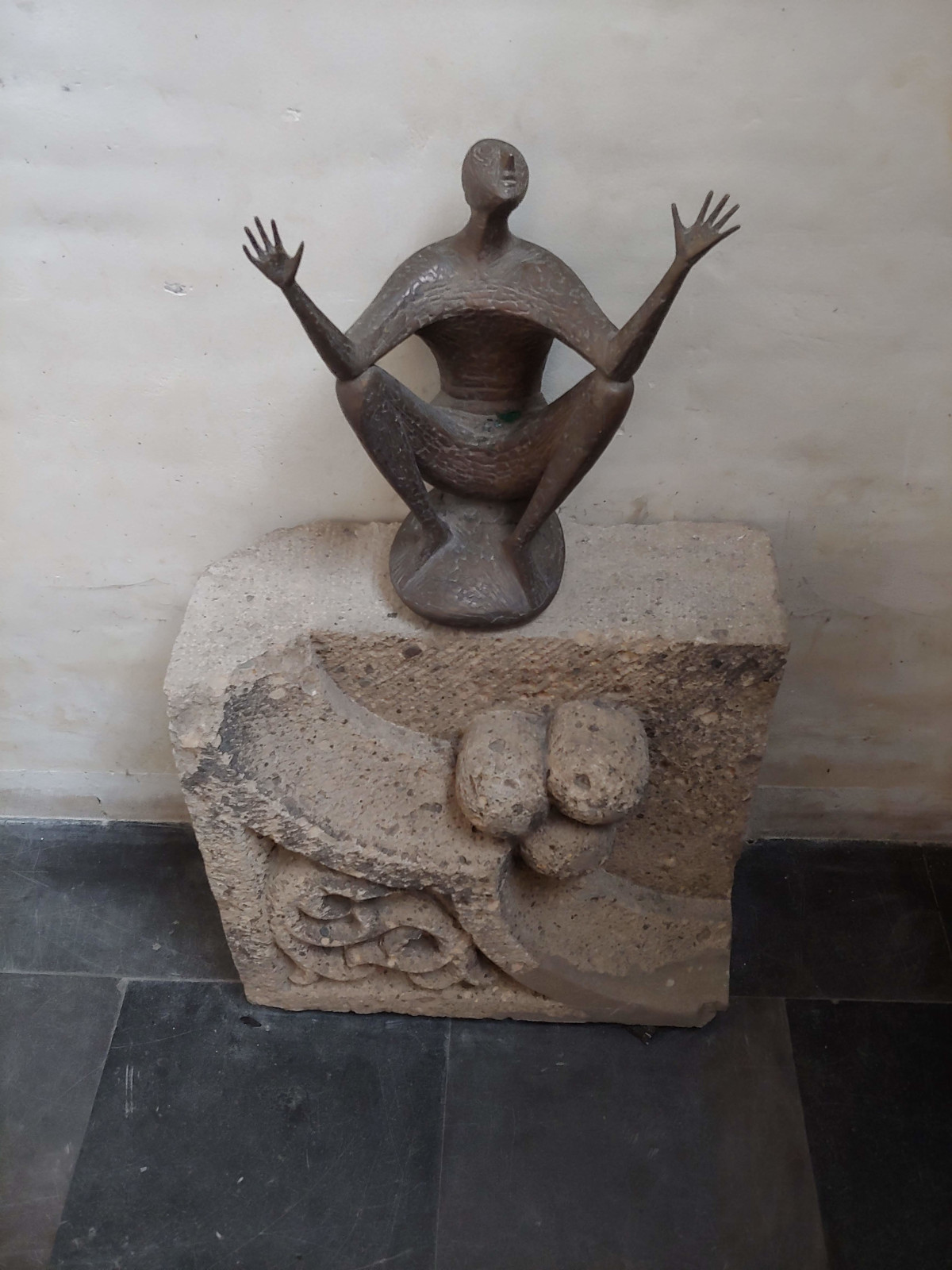
Unidentified sculpture at the Grote of Sint-Laurenskerk (Church of Saint Lawrence), Rotterdam, Netherlands. Photo: Victoria Emily Jones.
Would God I knew there were a God to thank
     When thanks rise in me, certain that my cries
Do not like blind men’s arrows pierce the skies
     Only to fall short of my quarry’s flank.
Why do I thirst, a desperate castaway
     Quaffing salt water, powerless to stop,
Sick lark locked in a cellar far from day,
     Lone climber of a peak that has no top?

To praise God is to bellow down a well
     From which rebounds one’s own dull booming voice,
          Yet the least leaf points to some One to thank.
The whorl embodied in the slightest shell,
     The firefly’s glimmer signify Rejoice!
          Though overhead, clouds cruise a sullen blank.
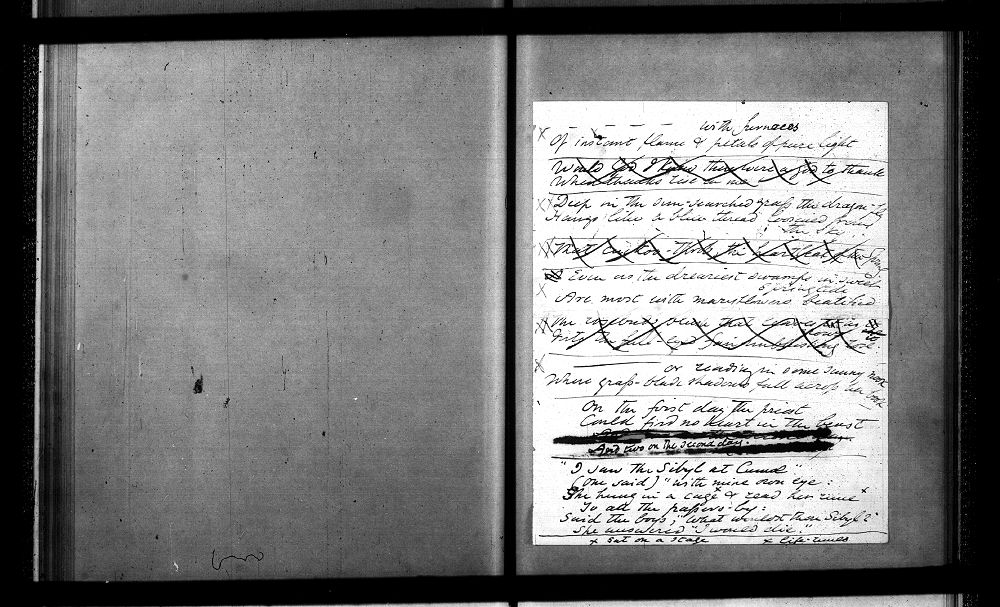
The first line and a half of this sonnet are a crossed-out fragment from one of the notebooks of the British poet and artist Dante Gabriel Rossetti (1828–1882), which he used to work out poetic ideas. This one never went anywhere. But Rossetti’s brother, William Michael Rossetti, saw something in it worthy of preservation; he salvaged it and other select scraps from his brother’s papers, publishing them posthumously in a “Versicles and Fragments” section of Rossetti’s collected works in 1901.
Page 16 of Sonnets and Fragments by Dante Gabriel Rossetti (Princeton/Troxell bound manuscript volume), 1848–81. The first deletion, by Rossetti’s hand, is “Would God I knew there were a god to thank / When thanks rise in me.” [object record]
The modern American poet X. J. Kennedy developed Rossetti’s fragment into a full poem that grapples with the silence of God and, despite such, the impulse to praise. The speaker is confounded by the contradiction that the world seems infused with God’s presence—the natural world points to a Creator—and yet God is unresponsive when the speaker initiates contact. The prayers he launches toward heaven like arrows appear not to reach their target. He’s experiencing spiritual aridity. He feels like a thirsty castaway whose only drink is salt water (why doesn’t God satiate as promised?); a bird trapped in a dark cellar; a mountain climber endlessly climbing, never catching sight of the vista.
The poem tugs back and forth between despondency and awe, between clench-fisted frustration and open-handed surrender. Each glorious tree leaf, the intricate design of conch shells, the whimsy of lightning bugs—these are gifts, but where’s the giver? Gratitude must be directed to someone, but whom does one thank for the wonders and small joys experienced in nature? Who or what is their source? Oh, how I wish I knew there were a God out there to thank, when thanks well up in me. The speaker wants to place his thanks somewhere, but when he places them in God, he receives no confirmation of receipt. There’s a disconnect between what nature testifies and what the speaker has suffered: the “sullen blank” of heaven.
Dante Gabriel Rossetti’s brother, William, wrote in 1895 that, unlike their devout sister Christina [previously], Dante was “a decided sceptic. He was never confirmed, professed no religious faith, and practised no regular religious observances; but he had sufficient sympathy with the abstract ideas and the venerable forms of Christianity to go occasionally to an Anglican church—very occasionally, and only as the inclination ruled him.” Starting in mid-adolescence, he rejected organized religion.
Kennedy, similarly, was raised in a religious household: his father was Catholic, his mother Methodist. And yet in his adulthood he has come to question and reject some of the tenets of orthodox Christianity. But still, he searches for God. “There is a clash in his poems between his skepticism or uneasy agnosticism and his unresolved longing for faith in God,” reads his bio on the Harvard Square Library website. Kennedy’s desire to believe but his inability to do so is expressed recurringly in his work—as in this poem, in which he, taking the baton from Rossetti, is very likely the speaker.
X. J. Kennedy (born 1929) is an American poet, translator, editor, and author of children’s literature and textbooks on English literature and poetry. Born Joseph Charles Kennedy in Dover, New Jersey, he adopted the nom de plume X. J. Kennedy in 1957 to avoid being mistaken for the better-known Joseph Kennedy, then US ambassador to England and father of future president John F. Kennedy. His award-winning poetry collections include Nude Descending a Staircase (1961) and Cross Ties (1985). He lives in Lexington, Massachusetts.
Cairn by James Brunt, Filey Beach, East Yorkshire, England, 2018
We alone can devalue gold
by not caring
if it falls or rises
in the marketplace.
Wherever there is gold
there is a chain, you know,
and if your chain
is gold
so much the worse
for you.

Feathers, shells
and sea-shaped stones
are all as rare.

This could be our revolution:
to love what is plentiful
as much as
what is scarce.
Alice Walker is an American novelist, short story writer, poet, and social activist. Born in 1944 in Eatonton, Georgia, the eighth and last child of sharecroppers, in 1982 she became the first African American woman to win the Pulitzer Prize for Fiction, which she was awarded for her novel The Color Purple. Over the span of her career, Walker has published numerous best-selling works of fiction, poetry collections, essays, and children’s books. She lives in Mendocino, California.
At first glance this poem may seem naive or flippant about economic realities. In the world we’ve created, money is a necessity. My country, the United States, has suffered two recessions in recent memory: in 2007–9, when the subprime mortgage crisis led to the collapse of the US housing bubble, and during the first two months of the COVID-19 pandemic in March and April 2020, when more than twenty-four million Americans lost their jobs. Lack of money can have disastrous effects.
But “We Alone” is not denigrating those who stress about not having a paycheck or not being able to afford basic provisions. Rather, it is critiquing a system that creates those conditions, a system in which money has been elevated to godlike status, and wealth is consolidated in the banking and corporate institutions headquartered on Wall Street, which engage in predatory activities that harm and debase. Capitalism is built on self-interest, profit, and acquisitiveness, and therefore it can easily breed greed, a voraciousness for more and more, which often comes at the expense of others.
Alice Walker has said elsewhere that “capitalism is a big problem, because with capitalism you’re just going to keep buying and selling things until there’s nothing else to buy and sell, which means gobbling up the planet.”[1] In her essay “All Praises to the Pause,” she writes,
Capitalism . . . cannot possibly sustain itself without gobbling up the world. That is what we see all around us. Women and children in Bangladesh, India, the Philippines, Haiti, Mexico, China and elsewhere in the world forced into starvation and slavery as they turn out the tennis balls and cheap sneakers for the affluent. Ancient trees leveled to make more housing while housing that could be saved and reused is torn down and communities heartlessly displaced. Mining of the earth for every saleable substance she has. Fouling of the waters that is her blood. Murdering innocents, whether people, animals or plants, in pursuit of oil.[2]
(Related reading: report from “Can Capitalism Be Ethical?,” a lecture by Dr. Rowan Williams, former archbishop of Canterbury, Murray Edwards College Cambridge, November 2, 2016)
My purpose here is not to argue for or against specific economic systems, nor is that the point of this poem. What Walker challenges in “We Alone” is the pervasive notion that people and things are worth only what the market says they are. Have you, too, bought in to that lie? Do you fail to value the things that are free and plentiful in life, like shells on the beach, or birdsong, or a refreshing rain? Ordinary gifts like that operate outside the laws of supply and demand and suggest the beautiful abundance of God’s economy.
On a few occasions the Bible uses the term “mammon” to refer to riches and their pernicious influence. Jesus preached against mammon in his Sermon on the Mount, famously warning the crowds, “You cannot serve both God and mammon” (Matt. 6:24). The church fathers personified mammon as an evil master who enslaves, and medieval Christian writers named it a demon. Walker, too, acknowledges how wealth can hold us captive, the word “chain” in her poem pulling double duty, referencing on the one hand a metal-link ornament holding a jewel or a watch, and on the other hand a shackle.
To not care about filling our coffers is a countercultural stance. To not be constantly checking the rise and fall of stock prices, or obsessing about our investment portfolio.
Those who overvalue material assets will miss out on the more satisfying riches that abound in the natural world, which don’t have to be worked for or taken from others to be enjoyed.
NOTES
1. Alice Walker, quoted in Fernanda Sayão, “Capitalism” (Rio de Janeiro: Animal Farm Research, 2012), 14.
2. Alice Walker, “All Praises to the Pause; The Universal Moment of Reflection,” commencement address, California Institute of Integral Studies, San Francisco, May 19, 2002, in We Are the Ones We Have Been Waiting For: Inner Light in a Time of Darkness (New York: The New Press, 2006), 77–78.
Last October I saw the wonderful retrospective exhibition Alma W. Thomas: Everything Is Beautiful at the Phillips Collection in Washington, DC, co-organized by the Chrysler Museum of Art in Norfolk, Virginia, and the Columbus Museum in Columbus, Georgia. Taking its title from the 1970 hit song by Ray Stevens (which was on the mixtape Thomas listened to while she painted), the exhibition shows that Thomas’s creativity extended beyond the studio to encompass interior design, costume design, fashion, puppetry, teaching, service, gardening, and more.
Alma Thomas (1891–1978) was an African American artist best known for her exuberant abstract paintings inspired by the hues, patterns, and movement of trees and flowers in and around her neighborhood in Northwest Washington, DC. Seeking relief from the racial violence in her native Georgia and better educational opportunities, she moved to Washington with her family at age fifteen and remained there for the rest of her life. In 1924 she became Howard University’s first fine arts graduate, and after that taught art for thirty-five years at Shaw Junior High School, leaving behind a celebrated legacy as an educator and a champion for Black youth. She was also an active member of St. Luke’s Episcopal Church, through which she founded the Sunday Afternoon Beauty Club, organizing field trips, lectures, and other activities to promote arts appreciation.
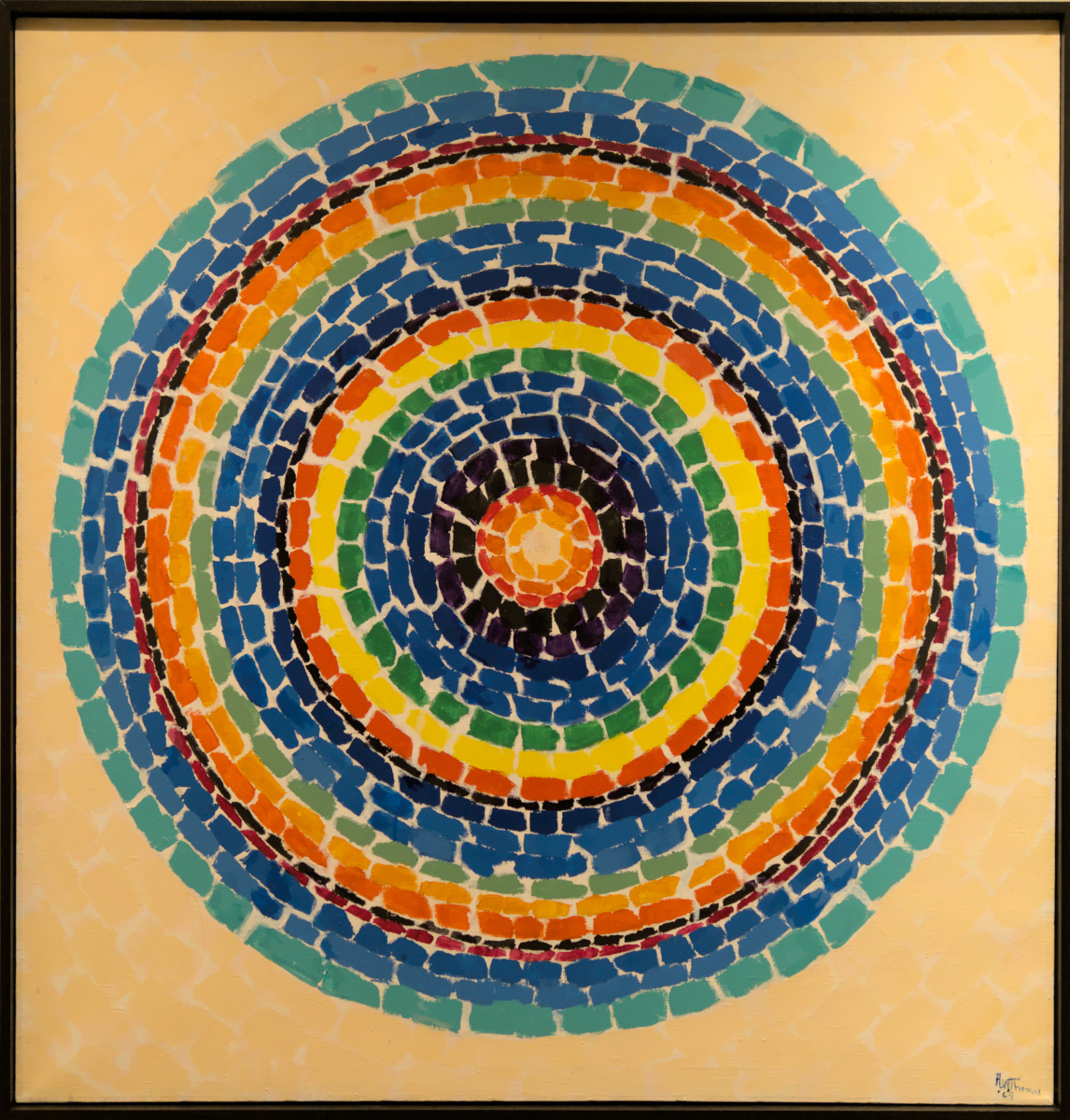
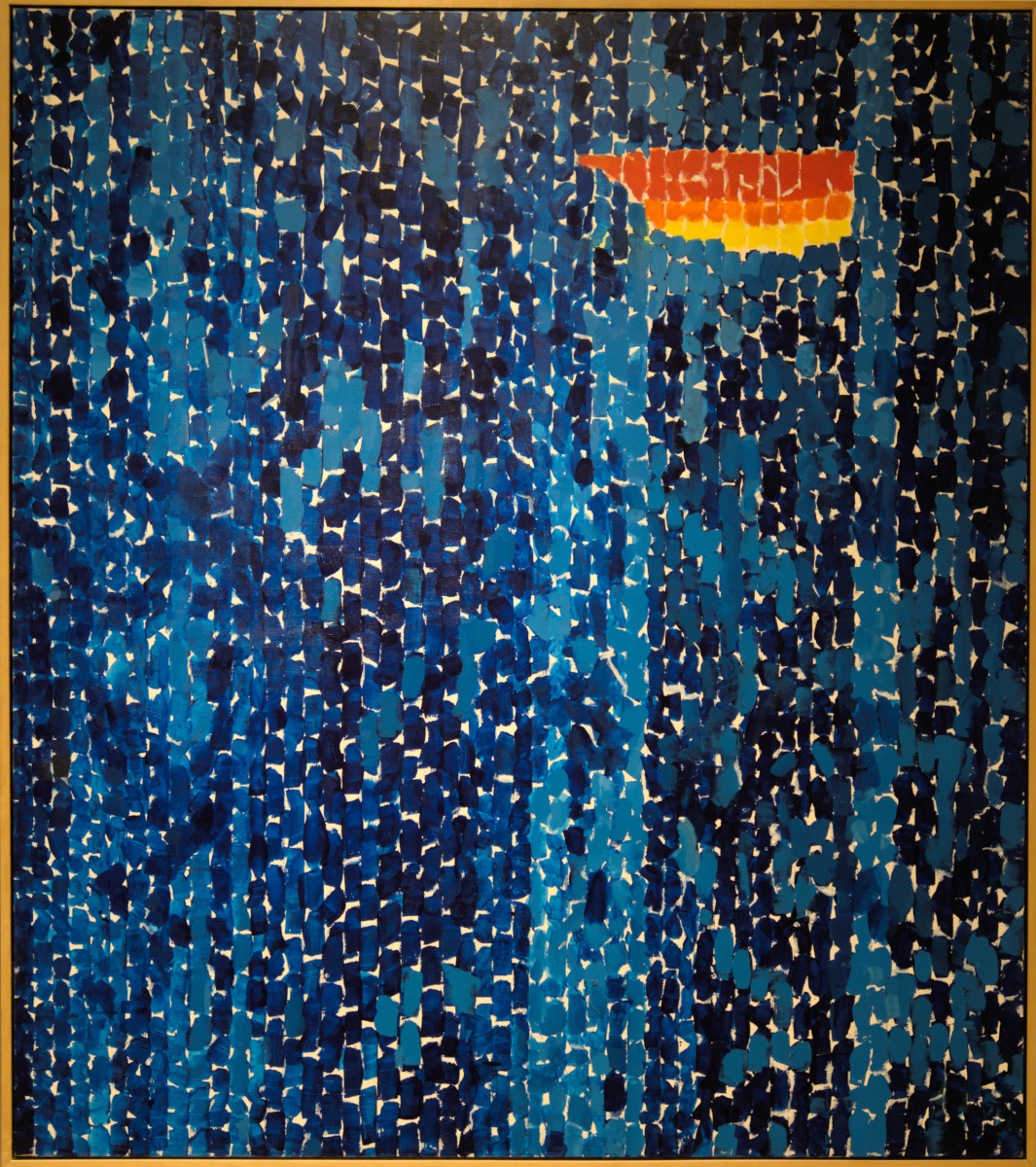
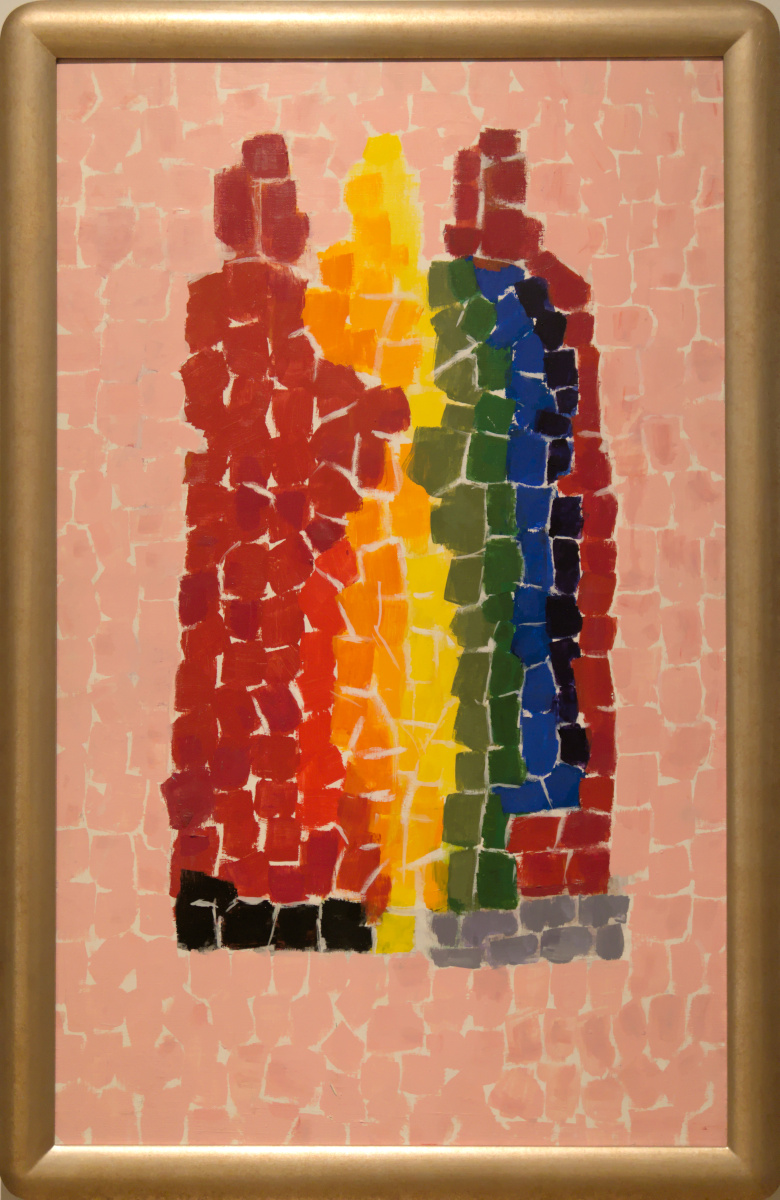
Though Thomas had been painting for decades, she didn’t develop her signature style—consisting of vibrant paint pats arranged in columns or concentric circles—until about 1965, after retiring from teaching; she called these irregular free blocks “Alma’s Stripes.” Her exploration of the power of simplified color and form in luminous, contemplative, nonobjective paintings means she is often classified as a Color Field painter, and she is particularly associated with the Washington Color School. At age eighty she had her first major exhibition, at the Whitney Museum of American Art in New York in 1972. She was the first Black woman to receive a solo show at this prestigious museum, and the show won her instant acclaim.
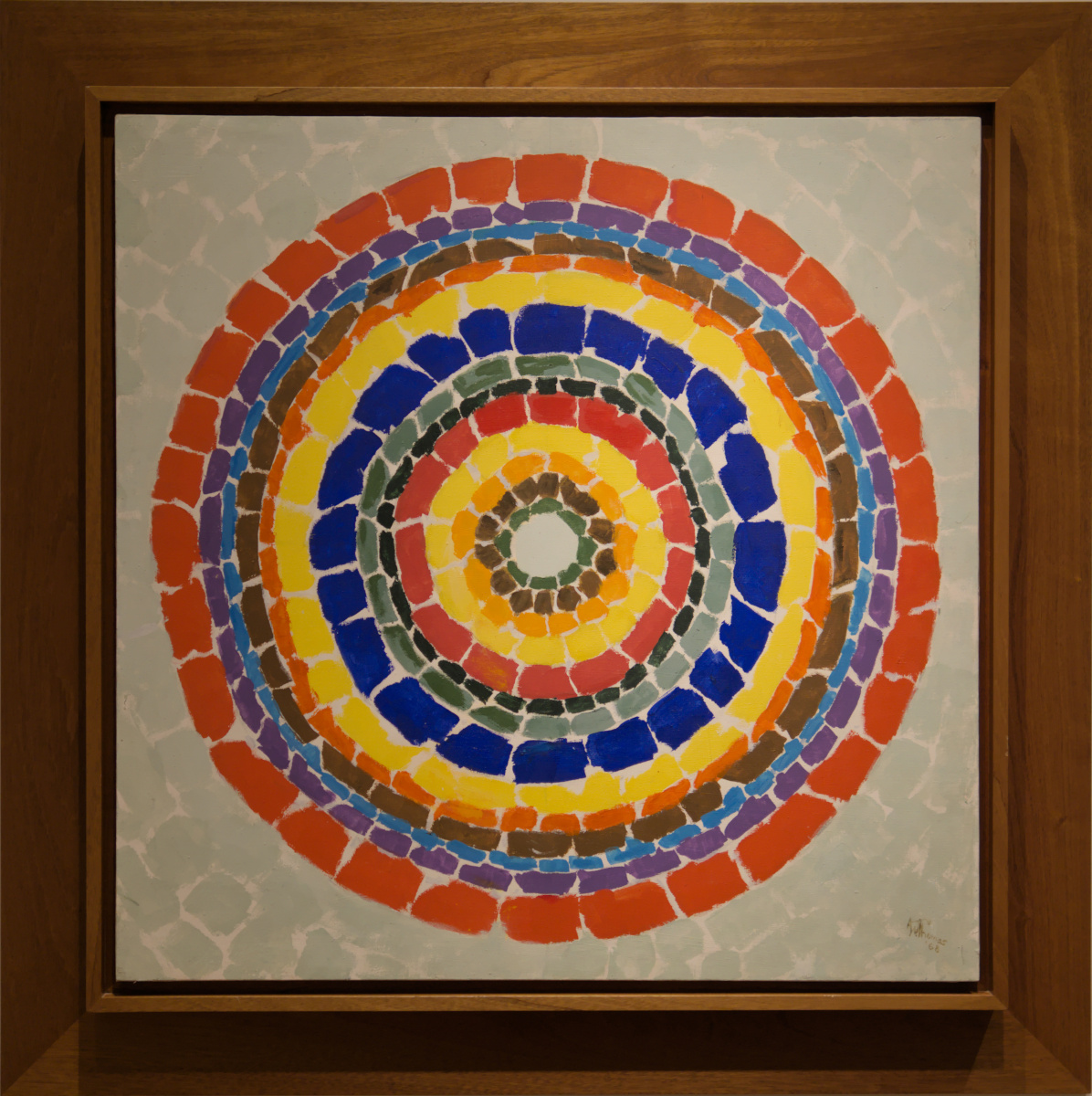
Alma W. Thomas (American, 1891–1978), A Joyful Scene of Spring, 1968. Acrylic on canvas, 36 1/4 × 36 1/4 in. Collection of the Love, Luck & Faith Foundation. Photo: Victoria Emily Jones. “Spring delivers her dynamic sermons to the world each year, drenching one’s soul with its extravaganza,” Thomas said (catalog, p. 167).
The natural world was an enduring source of inspiration for Thomas. She kept a flower garden in her backyard and frequented the green spaces of the nation’s capital. She described the holly tree visible through the bay window of her living room with great relish:
That tree, I love it. It’s the one who inspired me to do this sort of thing. The composition in the bay window reached me each morning—the colors, the wind who is their creative designer, the sunshine filtering through the leaves to add joy. The white comes through those leaves and gives me the white of the canvas. I’m fascinated by the way the white canvas dots around, and above, and through the color format. My strokes are free and irregular, some close together, others far apart, thus creating interesting patterns of canvas peeking around the strokes. [3]
Thomas saw nature as having a musicality, an idea underscored by many of the titles she gave her paintings, which pair terms from classical music especially—such as “symphony,” “sonata,” “concerto,” “rhapsody,” “étude”—with the names of trees or flowers. Nature sounds forth an array of notes, all in resplendent harmony with one another. And its compositions are new every morning!
Thomas’s rhythmic dabs of prismatic color express joy, celebration, and wonder at God’s creation and are reminiscent of those biblical psalms in which nature is said to praise God (e.g., Psalm 19:1–3; Psalm 65:12–13; Psalm 96:11–12; Psalm 98:4–8). Not only is nature animate; it sings and dances and claps its hands.
Many of Thomas’s paintings, whether of outwardly radiating rings or parallel rows, are meant to suggest an aerial view of flower beds or nurseries. “I began to think about what I would see if I were in an air-plane,” she said. “You streak through the clouds so fast you don’t know whether the flower below is a violet or what. You see only streaks of color.” [4]
Alma W. Thomas (American, 1891–1978), Breeze Rustling Through Fall Flowers, 1968. Acrylic on canvas, 57 7/8 × 50 in. The Phillips Collection, Washington, DC. Photo: Victoria Emily Jones.Alma W. Thomas (American, 1891–1978), Wind Dancing with Spring Flowers, 1969. Acrylic on canvas, 50 3/16 × 48 1/16 in. Hood Museum of Art, Dartmouth College, Hanover, New Hampshire. Photo: Victoria Emily Jones.Alma W. Thomas (American, 1891–1978), Red Roses Sonata, 1972. Acrylic on canvas, 60 × 54 in. Metropolitan Museum of Art, New York. Photo: Victoria Emily Jones.Alma W. Thomas (American, 1891–1978), Cumulus, 1972. Acrylic on canvas, 71 × 53 in. San Francisco Museum of Modern Art. Photo: Victoria Emily Jones.
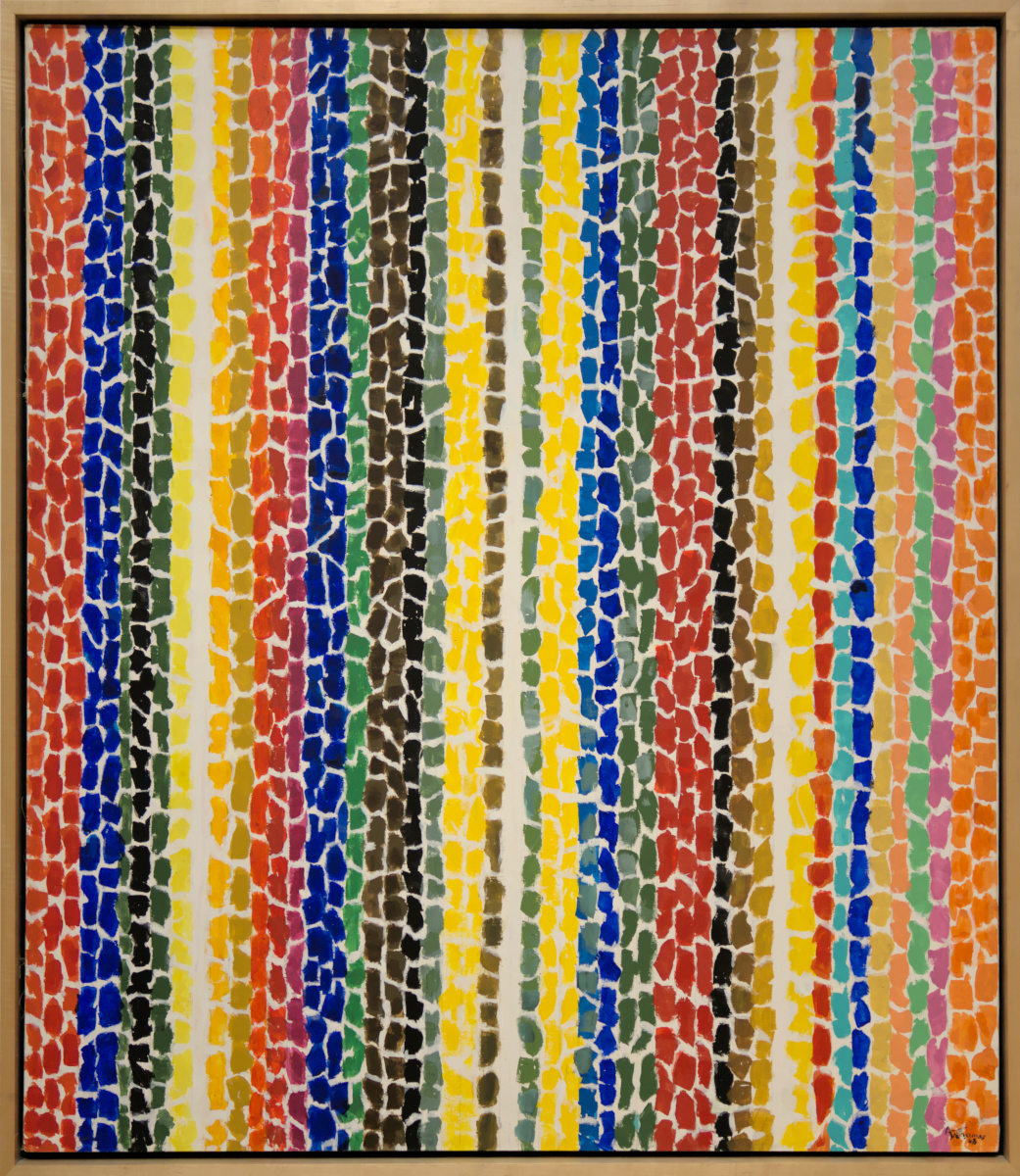
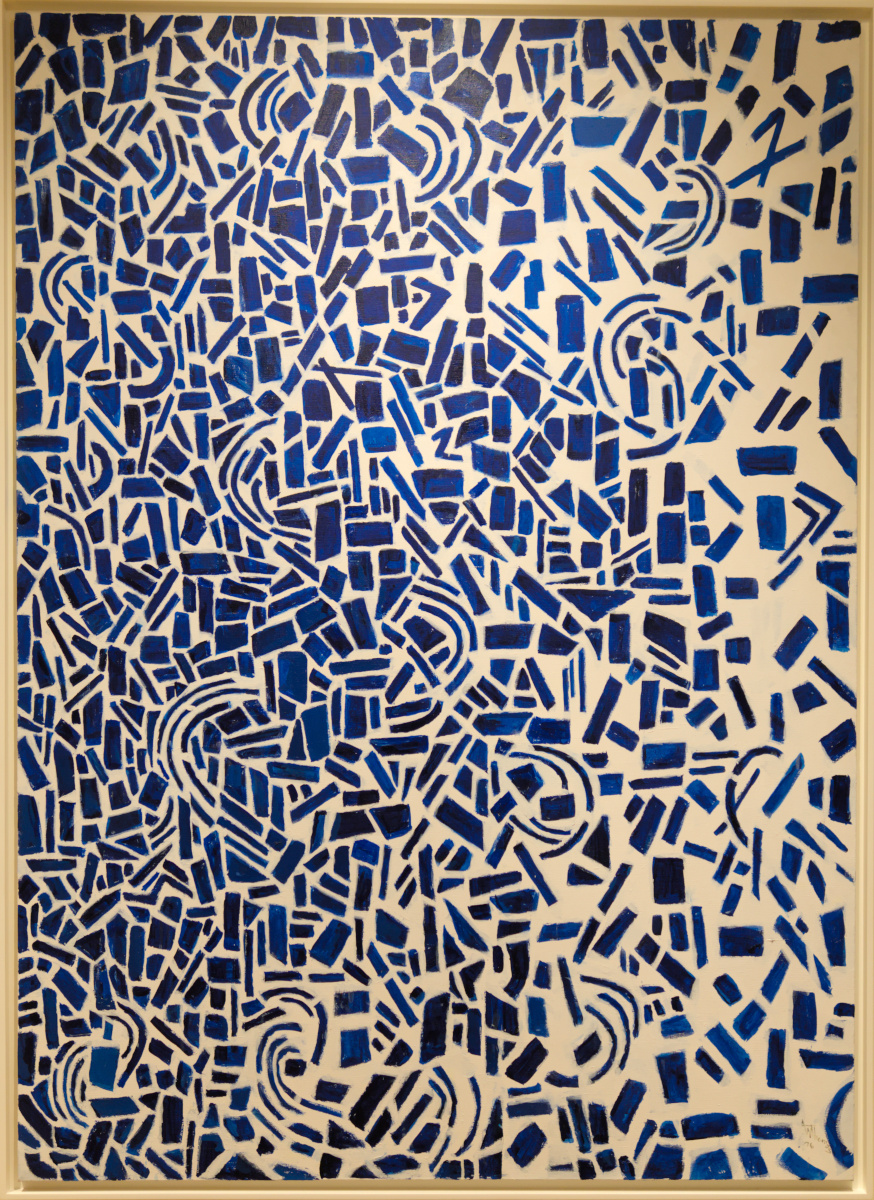
Eventually, Thomas’s vocabulary of vertically or circularly organized paint pats expanded to include “wedges, commas, and other glyphic shapes formed entirely by her brush and arranged in tessellated patterns” [5], which have the same vibratile quality. Grassy Melodic Chant visually references the path to her garden, which featured dark flagstones with off-white mortar borders.
Alma W. Thomas (American, 1891–1978), Grassy Melodic Chant, 1976. Acrylic on canvas, 46 × 36 in. Smithsonian American Art Museum, Washington, DC. Photo: Victoria Emily Jones.Alma W. Thomas (American, 1891–1978), Babbling Brook and Whistling Poplar Trees Symphony, 1976. Acrylic on canvas, 72 × 52 in. Michael Rosenfeld Gallery LLC, New York. Photo: Victoria Emily Jones. Thomas recalled in reference to this painting, “I would wade in the brook [near my childhood home] and when it rained you could hear music. I would fall on the grass and look at the poplar trees and the lovely yellow leaves would whistle” (catalog, p. 33).Alma W. Thomas (American, 1891–1978), Fiery Sunset, 1973. Acrylic on canvas, 41 1/4 × 41 1/4 in. Museum of Modern Art, New York. Photo: Victoria Emily Jones.Alma W. Thomas (American, 1891–1978), Falling Leaves, Love Wind Orchestra, 1977. Acrylic on canvas, 21 1/2 × 27 1/2 in. Private collection. Photo: Victoria Emily Jones.
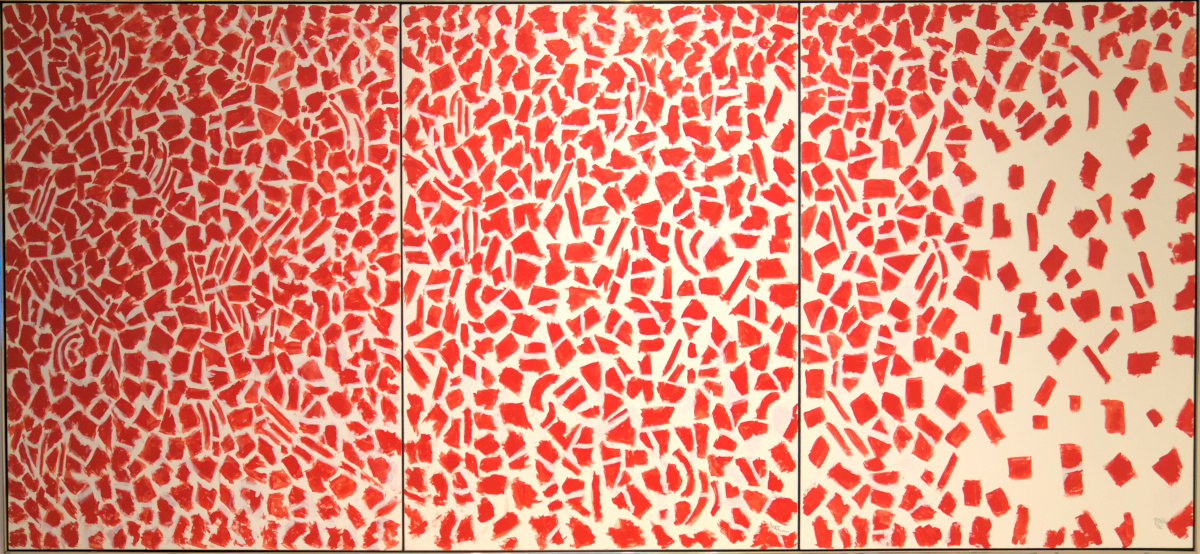
At over thirteen feet long, the monumental three-paneled Red Azaleas Singing and Dancing Rock and Roll Music (1976) is Thomas’s most ambitious painting and the touchstone of the exhibition. She painted it two years before her death, when she was suffering from painful arthritis, deteriorating vision, and the lasting repercussions of a broken hip. Though she had to adapt her technique to accommodate these ailments, her aesthetic vision is masterfully executed, and most people regard this as her magnum opus.
Alma W. Thomas (American, 1891–1978), Red Azaleas Singing and Dancing Rock and Roll Music, 1976. Acrylic on three canvases, 73 3/4 × 158 1/2 in. Smithsonian American Art Museum, Washington, DC. Photo: Victoria Emily Jones.
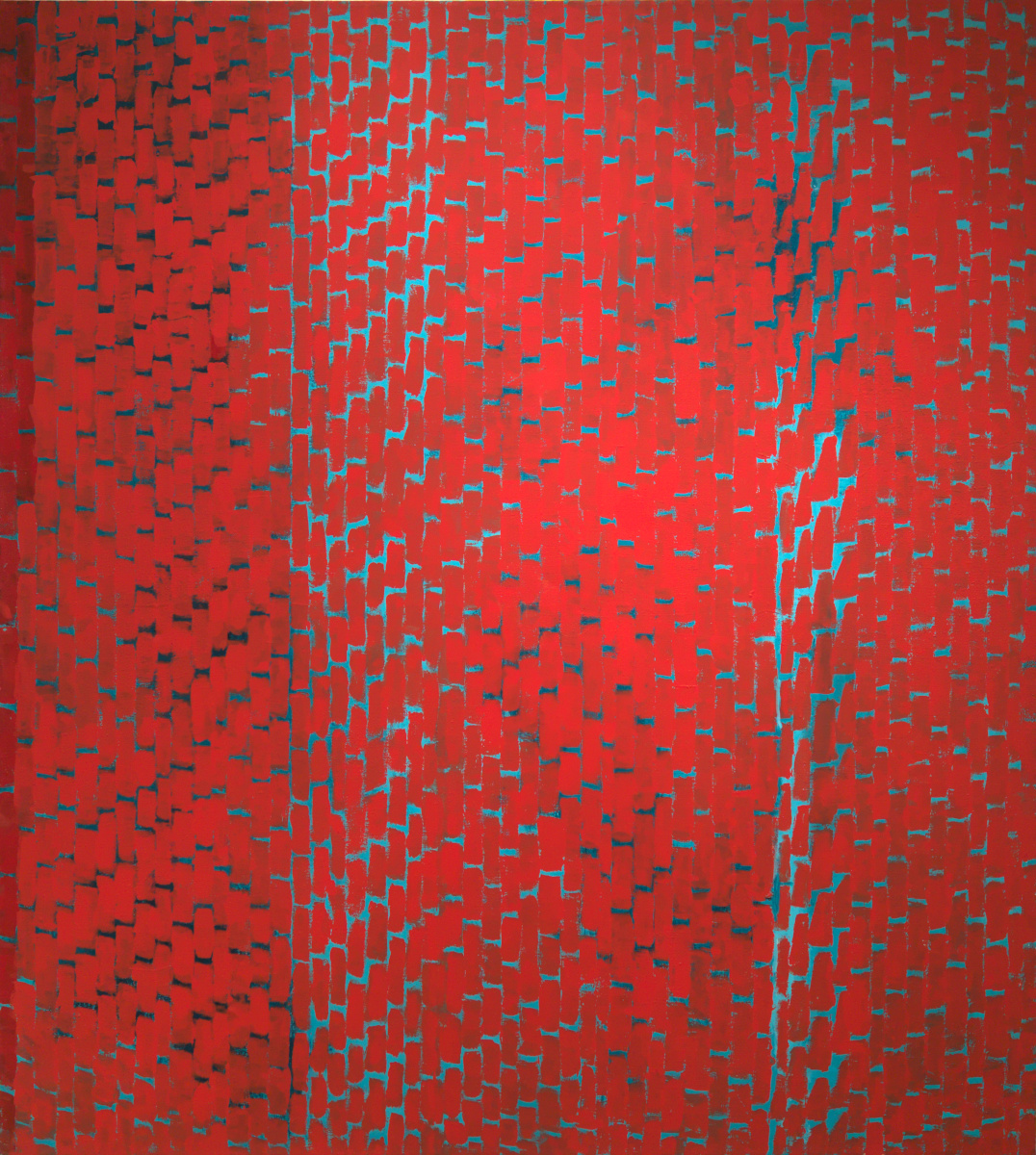
In addition to her enthusiasm for local, seasonal flora, Thomas was also really interested in space exploration. Like many Americans, she followed NASA’s lunar and Mars missions on the radio and television. She painted Mars Dust in 1971 as Mariner 9 circled the Red Planet, attempting to map its surface but being held up by a massive dust storm.
Alma W. Thomas (American, 1891–1978), Mars Dust, 1972. Acrylic on canvas, 69 1/4 × 57 1/8 in. Whitney Museum of American Art, New York. Photo: Victoria Emily Jones.Mars Dust, detail
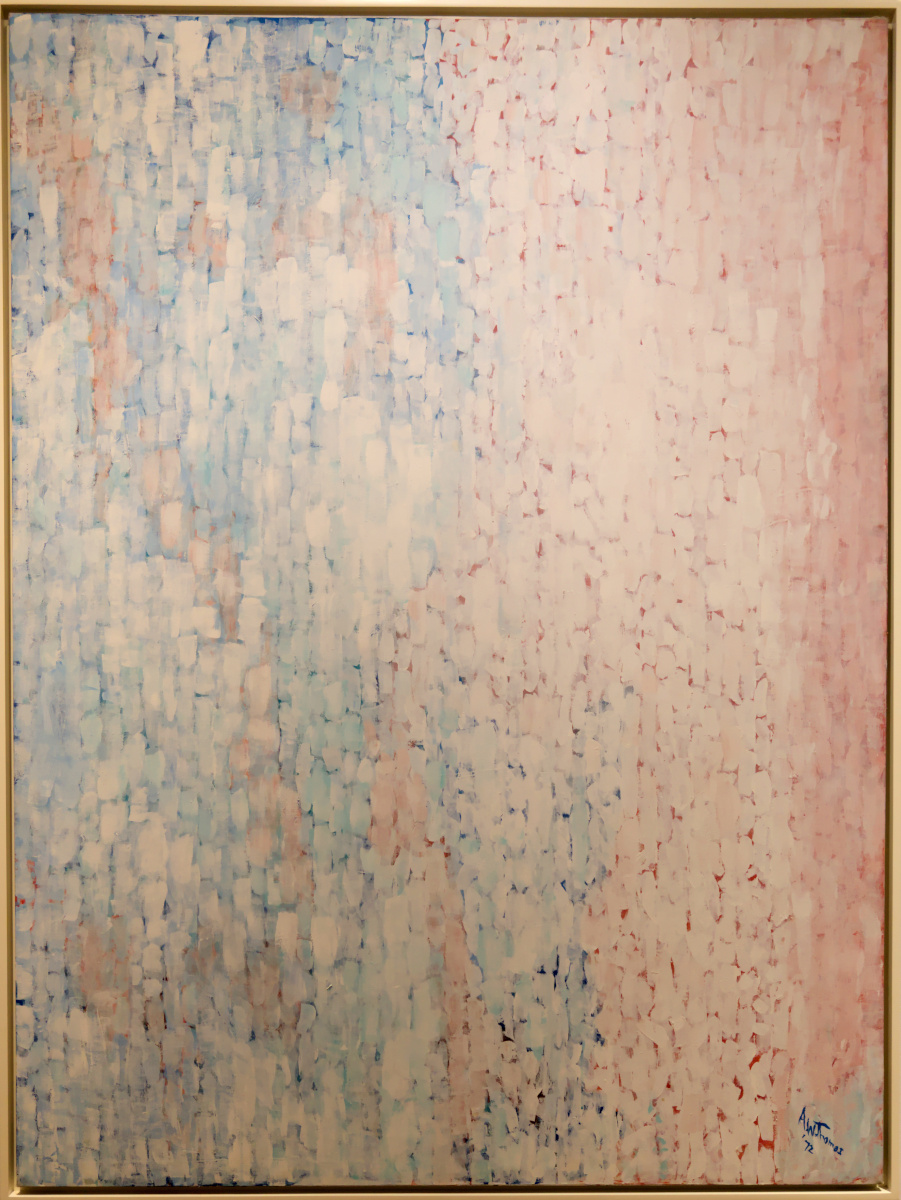
She also painted several works inspired by images taken of Earth during the Apollo 10 and 11 spaceflights, such as Snoopy Sees Earth Wrapped in Sunset (not pictured)—Snoopy being the name of the lunar module. Starry Night with Astronauts is the final work in her Space series.
Alma W. Thomas (American, 1891–1978), Starry Night and the Astronauts, 1972. Acrylic on canvas, 60 × 53 in. Art Institute of Chicago. Photo: Victoria Emily Jones.
Thomas’s choice to paint apolitical abstractions rather than taking the Black human figure as her subject was somewhat controversial. Members of the Black Arts Movement rigidly insisted that “Black artists should be making work that furthered the goals of Black liberation by speaking directly to their own communities rather than trying to fit into white aesthetic frameworks or addressing non-Black audiences. . . . In the process, they largely rejected visual abstraction because it was rooted in a European modernist tradition, one that had very little to do, they believed, with the lives and urgencies of Black folks.” [6]
Thomas disliked being pigeonholed as a “Black artist” and resisted the idea that responsible art must be oriented toward social activism. “We artists are put on God’s good earth to create,” she said. “Some of us may be black, but that’s not the important thing. The important thing is for us to create, to give form to what we have inside us. We can’t accept any barriers, any limitations of any kind, on what we create or how we do it.” [7] And elsewhere: “Through color, I have sought to concentrate on beauty and happiness, rather than on man’s inhumanity to man.” [8] In finding success as an abstractionist focused on beauty in nature and in technological innovation, she broke down barriers of what were considered (by both whites and Blacks) acceptable styles and subject matter for African American art.
This doesn’t mean Thomas was indifferent to Black progress. On the contrary, she was deeply involved in advancing racial uplift in her own community.
Thomas, far from retreating from the world, had always flung herself headlong into it. She devoted her life to advancing the lives of her Black students, peers, and neighbors—from her commitment to education (“Education is the strongest weapon we [African Americans] have,” she insisted); to her work to establish an art gallery that would collect the creations of Black people so as to begin to build an art historical archive; to her collaborations with civil rights organizations and publications; to her backyard garden, which she treated as a small offering of beauty in the midst of her gritty surroundings. [9]
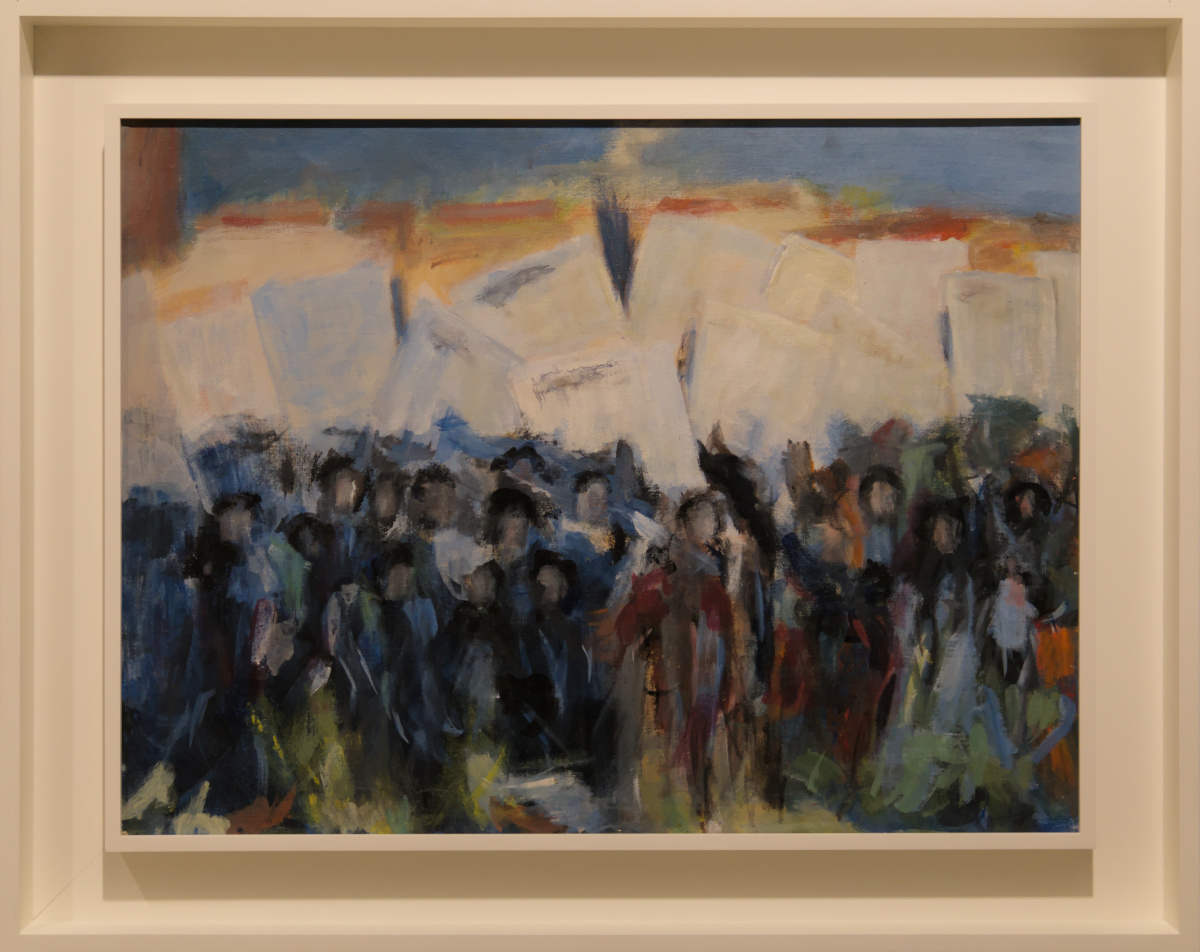
Her one political painting, for which she painted two preparatory sketches, is on the August 28, 1963, March on Washington for Jobs and Freedom, which she participated in.
Alma Thomas (American, 1891–1978), Sketch for March on Washington, ca. 1963. Acrylic on canvasboard, 20 × 24 in. The Columbus Museum, Columbus, Georgia. Photo: Victoria Emily Jones.
She also painted a few explicitly religious subjects, among them the Journey of the Magi and the Entombment of Christ.
Alma W. Thomas (American, 1891–1978), Three Wise Men, 1966. Acrylic on canvas, 36 1/2 × 23 1/2 in. Collection of the Harmon and Harriet Kelley Foundation for the Arts. Photo: Victoria Emily Jones.Alma W. Thomas (American, 1891–1978), They Laid Him in the Tomb, ca. 1958. Oil on canvas, 32 1/4 × 40 1/4 in. Collection of Paola Luptak. Photo: Victoria Emily Jones.
Alma W. Thomas: Everything Is Beautiful has left the Phillips but will be at the Frist Art Museum in Nashville from February 25 to June 5, 2022. From there it will visit the Columbus Museum in Columbus, Georgia (Thomas’s birthplace), from July 1 to September 25, 2022.
At the archived Phillips exhibition page, you can find video lectures and conversations and audio commentaries, plus you can take a 360-degree virtual tour of the exhibition. Washington-area readers: if you missed Everything Is Beautiful and want the chance to see Thomas’s work in person, mark your calendars for October 2023, when the Smithsonian American Art Museum will be exhibiting the more than two dozen Thomas paintings in its collection; the show is called Composing Color: Paintings by Alma Thomas.
There is plenty of material out there about Alma Thomas. A few other resources I’ll point you to are the Alma W. Thomas: Everything Is Beautiful catalog, of which the following video gives you a look inside:
The National Women’s History Museum also curated an interactive online exhibition about Thomas through Google Arts & Culture.
NOTES
1. Alma Thomas, quoted in Eleanor Munro, Originals: American Women Artists (New York: Simon and Schuster, 1979), 194.
2. This rhetorical question of Thomas’s is printed beneath her 1924 senior class photograph in The Bison, Howard University’s annual. Seth Feman and Jonathan Frederick Walz, eds., Alma W. Thomas: Everything Is Beautiful (New Haven, CT: Yale University Press, 2021), 78 (fig. 3).
3. Quoted in Andrea O. Cohen, “Alma Thomas,” DC Gazette, October 26–November 8, 1970.
4. Alma Thomas Papers, untitled statement, Biographical Accounts and Notes, c. 1950s–c . 1970s, box 1, folder 2, page 10.
5. Sydney Nikolaus, et al., “Composing Color: The Materials and Techniques of Alma Woodsey Thomas,” in Feman and Walz, 105.
6. Aruna D’Souza, “What Filters Through the Spaces Between,” in Feman and Walz, 61.
7. Quoted in Adolphus Ealey, “Remembering Alma,” in Merry A. Foresta, A Life in Art: Alma Thomas, 1891–1978 (Washington, DC: Smithsonian Institution Press for the National Museum of American Art, 1981), 12.
8. Quoted in David L. Shirey, “At 77, She’s Made It to the Whitney,” New York Times, May 4, 1972, 52.
The following four poets/pray-ers express awe and gratitude for God’s bountiful heart as conveyed through nature, a gift given freely to everyone—new every morning. Each attributes to God an exceeding liberality, even prodigality (wastefulness), in such daily bestowals, which, as the Brazilian Catholic archbishopHélder Pessoa Câmara (1909–1999) suggests below, ought to inform our own giving.
Jan Sluijters (Dutch, 1881–1957), October Sun, Laren, 1910. Oil on canvas, 48.3 × 52.7 cm. Frans Hals Museum, Haarlem, Netherlands. Photo: Victoria Emily Jones.
Untitled poem by Emily Dickinson
As if I asked a common Alms—
And in my wondering hand
A Stranger pressed a Kingdom,
And I, bewildered, stand—
As if I asked the Orient
Had it for me a Morn—
And it should lift its purple Dikes,
And shatter Me with Dawn!
Written in 1858; source: The Complete Poems of Emily Dickinson, ed. Thomas H. Johnson (Cambridge, MA: The Belknap Press of Harvard University Press, 1955)
+++
Untitled poem by George MacDonald
Gloriously wasteful, O my Lord, art thou!
Sunset faints after sunset into the night,
Splendorously dying from thy window-sill—
For ever. Sad our poverty doth bow
Before the riches of thy making might:
Sweep from thy space thy systems at thy will—
In thee the sun sets every sunset still.
Source: A Book of Strife in the Form of the Diary of an Old Soul (self-pub., 1880)
+++
“The Excesses of God”by Robinson Jeffers
Is it not by his high superfluousness we know
Our God? For to equal a need
Is natural, animal, mineral: but to fling
Rainbows over the rain
And beauty above the moon, and secret rainbows
On the domes of deep sea-shells,
And make the necessary embrace of breeding
Beautiful also as fire,
Not even the weeds to multiply without blossom
Nor the birds without music:
There is the great humaneness at the heart of things,
The extravagant kindness, the fountain
Humanity can understand, and would flow likewise
If power and desire were perch-mates.
Source: Be Angry at the Sun and Other Poems (New York: Random House, 1941)
+++
Untitled prayer by Hélder Pessoa Câmara, OFS
Lord,
isn’t your creation wasteful?
Fruits never equal
the seedlings’ abundance.
Springs scatter water.
The sun gives out
enormous light.
May your bounty teach me
greatness of heart.
May your magnificence
stop me being mean.
Seeing you a prodigal
and open-handed giver,
let me give unstintingly
like a king’s child,
like God’s own.
Source: The Hodder Book of Christian Prayers, compiled by Tony Castle (London: Hodder and Stoughton, 1986)
May is Mary’s month, and I
Muse at that and wonder why:
    Her feasts follow reason,
    Dated due to season—

Candlemas, Lady Day;
But the Lady Month, May,
    Why fasten that upon her,
    With a feasting in her honour?

Is it only its being brighter
Than the most are must delight her?
    Is it opportunest
    And flowers finds soonest?

Ask of her, the mighty mother:
Her reply puts this other
    Question: What is Spring?—
    Growth in every thing—

Flesh and fleece, fur and feather,
Grass and greenworld all together;
    Star-eyed strawberry-breasted
    Throstle above her nested

Cluster of bugle* blue eggs thin
Forms and warms the life within;
    And bird and blossom swell
    In sod or sheath or shell.

All things rising, all things sizing
Mary sees, sympathising
    With that world of good,
    Nature’s motherhood.

Their magnifying of each its kind
With delight calls to mind
    How she did in her stored
    Magnify the Lord.

Well but there was more than this:
Spring’s universal bliss
    Much, had much to say
    To offering Mary May.

When drop-of-blood-and-foam-dapple
Bloom lights the orchard-apple
    And thicket and thorp† are merry
    With silver-surfèd cherry

And azuring-over greybell makes
Wood banks and brakes‡ wash wet like lakes
    And magic cuckoocall
    Caps, clears, and clinches all—

This ecstasy all through mothering earth
Tells Mary her mirth till Christ’s birth
    To remember and exultation
    In God who was her salvation.
* Bugle, or bugleherb, is a blue-flowering plant in the mint family. † A group of houses standing together in the country; a hamlet; a village. ‡ Bracken ferns.
+++
In the Roman Catholic Church, May is dedicated to Mary, the mother of Jesus, and daily devotions to her are encouraged throughout the month. In many parishes, statues of Mary are crowned with flower garlands at this time.
Though I myself do not practice Marian devotion, I have an immense appreciation for her example of faith and for the role she played in salvation history, and I feel a kinship to her as a spiritual foremother. I also find myself drawn to poems and visual art that reflect on her pregnancy, on the Life growing inside her.
Written in 1878 by the Jesuit poet-priest Gerard Manley Hopkins, “The May Magnificat” muses on the fittingness of May as a designated period of celebration of Mary. In the yearly cycle of the Christian liturgical calendar, Candlemas, which celebrates the presentation of Jesus in the temple as an infant (and Mary’s postpartum purification), is logically dated to February 2, forty days after Christmas, per Leviticus 12:1–4. Lady Day, the feast of the Annunciation (the day on which Jesus was conceived), is celebrated March 25, nine months before Christmas. But why, Hopkins wonders, has the church set apart May in particular for Christians to honor Mary?
He determines it’s because in May, the natural world—at least in the northern hemisphere, where he, an Englishman, lived—is bursting into full bloom, reflecting Mary’s own fecundity, her body a superabundant source of life. In late spring there is a certain joyousness in the air, a “universal bliss,” an “ecstasy.” Mammals are gestating and/or giving birth, birds are incubating and hatching, groves and gardens are flowering, and earth seems to be swelling to a fullness. There is “[g]rowth in every thing.”
Hopkins delights in the wealth of spring, all its flora and fauna. He marvels how the azure of heaven is reflected on earth in the tangled nest of a song thrush, and how sunlight dapples the apple and cherry trees. Perhaps Mary learned gladness from such gladsome surroundings, he suggests. And not only that, but as mother, she shared an affinity with Nature, also a mother.
The month of May culminates, on the 31st, with the feast of the Visitation, which marks the pregnant Mary’s visit to her pregnant cousin Elizabeth. Upon their meeting Mary sang a praise song known as the Magnificat, Latin for “[My Soul] Magnifies [the Lord]” (see Luke 1:46–56). She makes large God’s name, celebrating his mercy, strength, and provision and the impending birth of her son, Israel’s Savior and the world’s.
+++
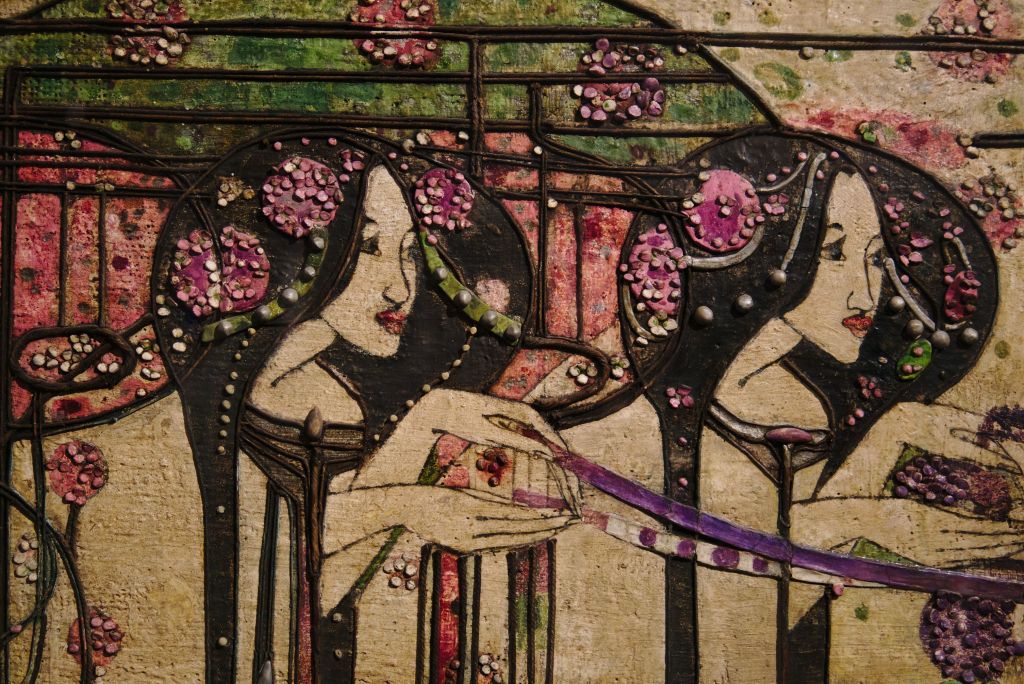
In October 2019 I had the privilege of seeing the internationally touring exhibition Designing the New: Charles Rennie Mackintosh and the Glasgow Style at the Walters Art Museum in Baltimore, whose highlight was a large-scale gesso frieze by Margaret Macdonald Mackintosh, Charles’s artistic collaborator and wife. It was displayed in a narrow hallway behind a plastic screen, so I couldn’t get a shot of the full piece, but here’s a photo provided by the CSG CIC Glasgow Museums Collection:
Margaret Macdonald Mackintosh (Scottish, 1864–1933), The May Queen, 1900. Gesso on burlap over wood frame, scrim, twine, glass beads, thread, tin leaf, papier-mâché, steel pins, 158.8 × 457 cm. Kelvingrove Art Gallery and Museum, Glasgow.
All other photos in this post are my own.
Emerging in the 1890s in the industrial heartland of Scotland, the “Glasgow Style” was the only Art Nouveau movement in Great Britain. “When applied to two-dimensional objects, such as book covers, textiles, posters, and stained glass, the Glasgow Style blended elongated and organic lines, personal symbolic languages, and favored motifs to create otherworldly stylized plant and human forms,” writes Alison Brown, curator of Designing the New. It was developed by a small group of young adult friends known as The Four: Charles Rennie Mackintosh, Margaret Macdonald, Frances Macdonald, and James Herbert McNair. (Charles and Margaret married in 1900, and Margaret’s sister Frances married James in 1899.)
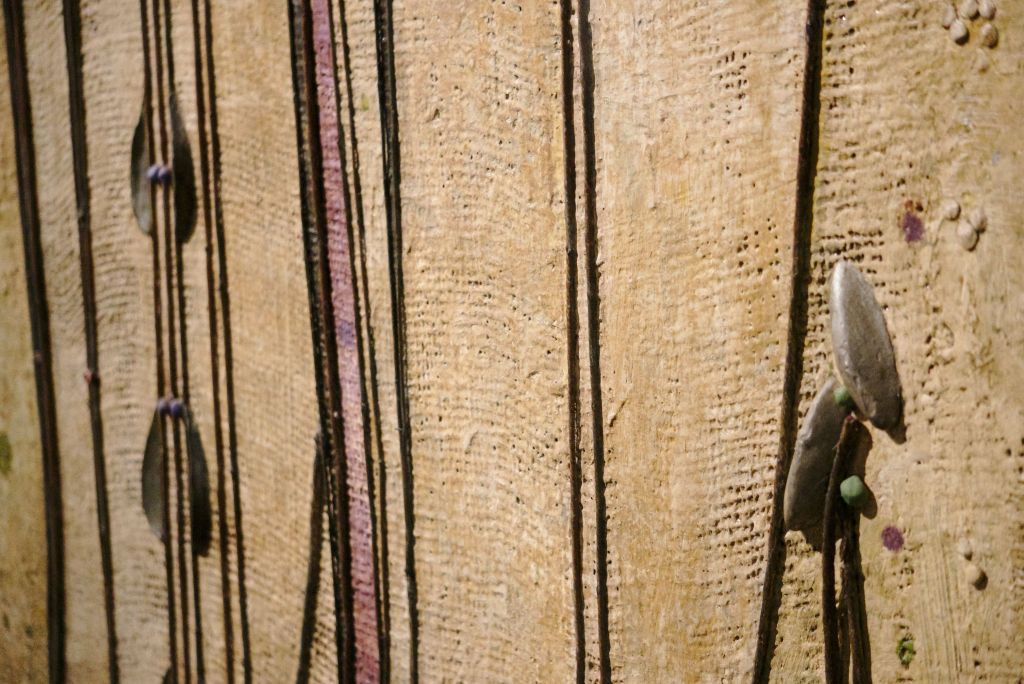
Margaret’s wide-ranging output included watercolors, graphics, metalwork, and textiles, but her specialization was gesso, a plaster-based medium, which she used to make decorative panels for furniture and interiors. The May Queen was commissioned from her at the turn of the century by Miss Catherine Cranston for one of her famous Ingram Street tea rooms in Glasgow, where it hung above a window in the Ladies’ Luncheon Room until 1971. (It is now preserved at the Kelvingrove Art Gallery and Museum.) Gloriously textured, it consists of rough burlap stretched over a wooden frame and covered in gesso, glass beads, metallic leaf, and molded paper. “Some of the modeled plaster shapes bear fingerprints, pinched and pressed into the panel’s surface. The outlines of the figures, trees, and plant forms are ‘drawn’ with brown painted string held fast with long steel pins,” Brown writes.
The crowning of a “May Queen,” a girl chosen to personify May Day and preside over its festivities, is a traditional springtime ritual in western Europe. (If you need a visual, think Florence Pugh’s character in Midsommar . . .) So the title of this artwork is most likely a reference to that. However, I get some serious Marian vibes from the central female figure, which are only reinforced when I view the work in light of the Catholic tradition of the “May crowning” of Mary.
And what a resonant pairing it makes with Hopkins’s “The May Magnificat”! It shows a woman in a strong frontal stance, dressed with flowers, haloed in green, supported by a throne-like backing, and enlarged, perhaps, with child. She’s attended by four maidservants or companions.
This could very well be read as Mary of Nazareth, crowned with beauty, blessed by God to bear his Son into the world.













 Art & Theology