
“The Fury of Sunrises” by Anne Sexton (poem)

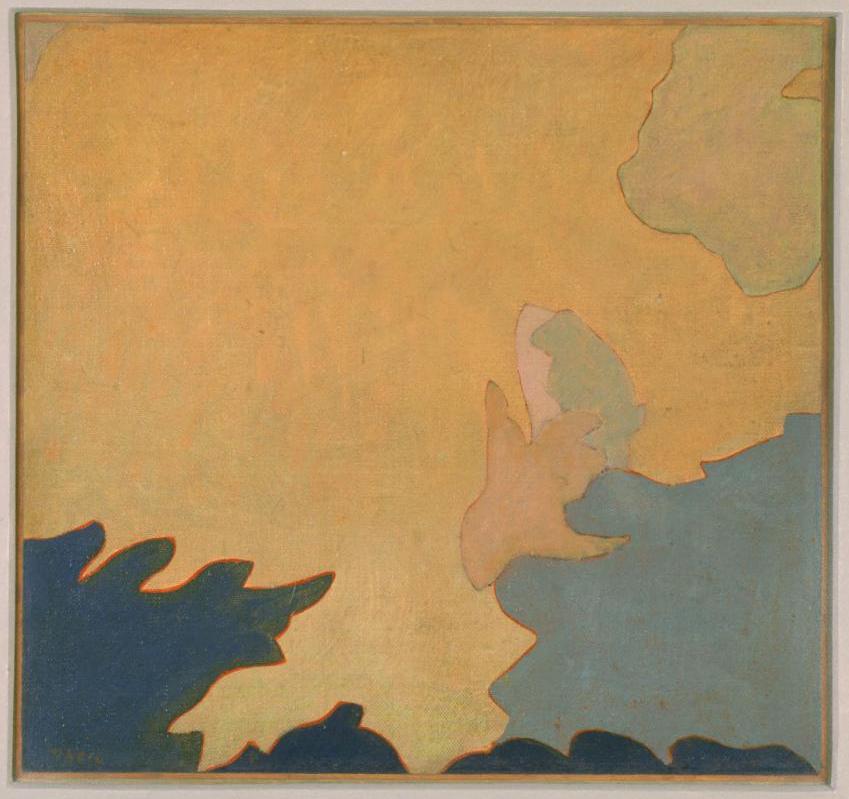
Tack, Augustus Vincent_Dawn
Augustus Vincent Tack (American, 1870–1949), Dawn, 1934–36. Oil on canvas mounted on hardboard, 23 3/4 × 24 3/4 in. (60.3 × 62.9 cm). Phillips Collection, Washington, DC.

Darkness
as black as your eyelid,
poketricks of stars,
the yellow mouth,
the smell of a stranger,
dawn coming up,
dark blue,
no stars,
the smell of a lover,
warmer now
as authentic as soap,
wave after wave
of lightness
and the birds in their chains
going mad with throat noises,
the birds in their tracks
yelling into their cheeks like clowns,
lighter, lighter,
the stars gone,
the trees appearing in their green hoods,
the house appearing across the way,
the road and its sad macadam,
the rock walls losing their cotton,
lighter, lighter,
letting the dog out and seeing
fog lift by her legs,
a gauze dance,
lighter, lighter,
yellow, blue at the tops of trees,
more God, more God everywhere,
lighter, lighter,
more world everywhere,
sheets bent back for people,
the strange heads of love
and breakfast,
that sacrament,
lighter, yellower,
like the yolk of eggs,
the flies gathering at the windowpane,
the dog inside whining for food
and the day commencing,
not to die, not to die,
as in the last day breaking,
a final day digesting itself,
lighter, lighter,
the endless colors,
the same old trees stepping toward me,
the rock unpacking its crevices,
breakfast like a dream,
and the whole day to live through,
steadfast, deep, interior.
After the death,
after the black of black,
this lightness—
not to die, not to die—
that God begot.

“The Fury of Sunrises” is the last of fifteen poems from Anne Sexton’s “The Furies” cycle, published in The Death Notebooks (Houghton Mifflin, 1974). Copyright is held by the Estate of Anne Sexton, represented by Sterling Lord Literistic.

Anne Sexton (1928–1974) was a Pulitzer Prize–winning confessional poet from New England who wrote in starkly personal terms about her psychiatric struggles (she suffered from bipolar disorder and died by suicide), sexuality, and other taboo subjects. Much of her poetry expresses a yearning for the ecstatic and sublime and explores religious questions, referencing God and faith—even though she characterized herself, in a 1968 BBC interview, as an atheist, albeit one who was “rather attracted to Catholicism.”

“Field Preaching” by Phoebe Cary (poem)

Greenwood, Phil_Blossom
Phil Greenwood (Welsh, 1943–), Blossom, 2003. Etching and aquatint, 67 × 59 cm. Edition of 150.

I have been out today in field and wood,
Listening to praises sweet and counsel good
Such as a little child had understood,
              That, in its tender youth,
Discerns the simple eloquence of truth.

The modest blossoms, crowding round my way,
Though they had nothing great or grand to say,
Gave out their fragrance to the wind all day;
              Because his loving breath,
With soft persistence, won them back from death.

And the right royal lily, putting on
Her robes, more rich than those of Solomon,
Opened her gorgeous missal in the sun,
              And thanked him soft and low,
Whose gracious, liberal hand had clothed her so.

When wearied, on the meadow-grass I sank,
So narrow was the rill from which I drank,
An infant might have stepped from bank to bank;
              And the tall rushes near,
Lapping together, hid its waters clear.

Yet to the ocean joyously it went,
And, rippling in the fulness of content,
Watered the pretty flowers that o’er it leant;
              For all the banks were spread
With delicate flowers that on its bounty fed.

The stately maize, a fair and goodly sight,
With serried spear-points bristling sharp and bright,
Shook out his yellow tresses, for delight,
              To all their tawny length,
Like Samson, glorying in his lusty strength.

And every little bird upon the tree,
Ruffling his plumage bright, for ecstasy,
Sang in the wild insanity of glee;
              And seemed, in the same lays,
Calling his mate and uttering songs of praise.

The golden grasshopper did chirp and sing;
The plain bee, busy with her housekeeping,
Kept humming cheerfully upon the wing,
              As if she understood
That, with contentment, labor was a good.

I saw each creature, in his own best place,
To the Creator lift a smiling face,
Praising continually his wondrous grace;
              As if the best of all
Life’s countless blessings was to live at all!

So with a book of sermons, plain and true,
Hid in my heart, where I might turn them through,
I went home softly, through the falling dew,
              Still listening, rapt and calm,
To Nature giving out her evening psalm.

This poem was originally published in Poems of Faith, Hope, and Love by Phoebe Cary (Hurd and Houghton, 1867) and is in the public domain.

Phoebe Cary (1824–1871) was an American poet whose verse focuses on themes of religion, nature, and feminism. She grew up on a farm near Cincinnati, Ohio, the sixth of nine children. She was particularly close with her older sister Alice, also a writer, with whom she copublished a volume of poetry in 1849 before going on to publish books of her own. Buoyed by the recognition they received from such luminaries as Edgar Allan Poe and John Greenleaf Whittier, in 1850 the two sisters moved to New York City together, where they contributed regularly to national periodicals and hosted a weekly Sunday evening salon attended by East Coast literati. Phoebe was active in the early days of the women’s rights movement, serving as an assistant editor for The Revolution, Susan B. Anthony’s suffrage newspaper. She died of hepatitis at age forty-six, just six months after Alice.

Nature as extravagant gift from God

The following four poets/pray-ers express awe and gratitude for God’s bountiful heart as conveyed through nature, a gift given freely to everyone—new every morning. Each attributes to God an exceeding liberality, even prodigality (wastefulness), in such daily bestowals, which, as the Brazilian Catholic archbishop Hélder Pessoa Câmara (1909–1999) suggests below, ought to inform our own giving.

Sluijters, Jan_October Sun, Laren
Jan Sluijters (Dutch, 1881–1957), October Sun, Laren, 1910. Oil on canvas, 48.3 × 52.7 cm. Frans Hals Museum, Haarlem, Netherlands. Photo: Victoria Emily Jones.

Untitled poem by Emily Dickinson

As if I asked a common Alms—
And in my wondering hand
A Stranger pressed a Kingdom,
And I, bewildered, stand—
As if I asked the Orient
Had it for me a Morn—
And it should lift its purple Dikes,
And shatter Me with Dawn!

Written in 1858; source: The Complete Poems of Emily Dickinson, ed. Thomas H. Johnson (Cambridge, MA: The Belknap Press of Harvard University Press, 1955)

+++

Untitled poem by George MacDonald

Gloriously wasteful, O my Lord, art thou!
Sunset faints after sunset into the night,
Splendorously dying from thy window-sill—
For ever. Sad our poverty doth bow
Before the riches of thy making might:
Sweep from thy space thy systems at thy will—
In thee the sun sets every sunset still.

Source: A Book of Strife in the Form of the Diary of an Old Soul (self-pub., 1880)

+++

“The Excesses of God” by Robinson Jeffers

Is it not by his high superfluousness we know
Our God? For to equal a need
Is natural, animal, mineral: but to fling
Rainbows over the rain
And beauty above the moon, and secret rainbows
On the domes of deep sea-shells,
And make the necessary embrace of breeding
Beautiful also as fire,
Not even the weeds to multiply without blossom
Nor the birds without music:
There is the great humaneness at the heart of things,
The extravagant kindness, the fountain
Humanity can understand, and would flow likewise
If power and desire were perch-mates.

Source: Be Angry at the Sun and Other Poems (New York: Random House, 1941)

+++

Untitled prayer by Hélder Pessoa Câmara, OFS

Lord,
isn’t your creation wasteful?
Fruits never equal
the seedlings’ abundance.
Springs scatter water.
The sun gives out
enormous light.
May your bounty teach me
greatness of heart.
May your magnificence
stop me being mean.
Seeing you a prodigal
and open-handed giver,
let me give unstintingly
like a king’s child,
like God’s own. 

Source: The Hodder Book of Christian Prayers, compiled by Tony Castle (London: Hodder and Stoughton, 1986)