LISTEN: “How Long, Dear Savior” (NORTHFIELD) | Words by Isaac Watts, 1707 | Music by Jeremiah Ingalls, 1805 | Performed by the Boston Camerata, dir. Anne Azéma, 2020
How long, dear Savior, O how long Shall this bright hour delay? Fly swifter round, ye wheels of time, And bring the promised day.
From the third heav’n where God resides, That holy, happy place, The new Jerusalem comes down Adorned with shining grace.
An American Christmas is one of the Boston Camerata’s most popular programs. “It features a generous selection of carols, New England anthems, Southern folk hymns, and religious ballads for the season from the early years of the American republic, and from a wide range of early tune books and manuscripts”—including the shape-note hymn “How Long, Dear Savior” from The Christian Harmony (Exeter, New Hampshire, 1805), an arrangement of a stanza from Isaac Watts’s “Lo! what a glorious sight appears” to the fuguing tune NORTHFIELD. The Boston Camerata adds a stanza from the same Watts hymn.
The Grace Doherty Library at Centre College in Danville, Kentucky, which owns a first edition of The Christian Harmony, provides biographical information about its compiler, Jeremiah Ingalls, to whom several of the tunes inside are attributed:
A native of Massachusetts who moved to Vermont around 1800, Jeremiah Ingalls (1764-1828) at various times worked as a farmer, cooper, and tavern keeper, in addition to serving as a choirmaster in the Congregational church, teaching singing school and composing music. Ingalls’ Christian Harmony contains many lively melodies, patterned after the secular songs and dances of the day. Such tunes were quite popular among the camp-meeting revival folk. In his hymn “Innocent Sounds,” Ingalls argues for the appropriateness of adopting these melodies for religious use.
The above performance of “How Long, Dear Savior” by the Boston Camerata was filmed at Boston’s historic Old North Church during the 2020 pandemic. To hear the song in a non-concert context, see this video taken at a Sacred Harp singing convention in Texas in 2011:
The “third heaven” refers to the dwelling place of God outside the universe. Beginning in the intertestamental period (ca. 420 BCE–ca. 30 CE), it was a common Jewish belief that God stacked the heavens in layers—as many as seven, but most typically three, sometimes delineated as: Earth’s atmosphere (the first heaven; i.e., the realm of the birds and clouds), interplanetary or interstellar space (the second heaven; i.e., the realm of the sun and stars), and God’s own abode, over and above what we can conceive (the third heaven). The term “third heaven” appears in Jewish apocalyptic and rabbinic texts such as the Testament of Levi 2, the Apocalypse of Moses 37:5, 2 Enoch 8:1, and 3 Baruch 4:7. The apostle Paul also uses it in 2 Corinthians 12:2–4 to describe one of his visionary experiences.
Jacques Richard Sassandra (French, 1932–), Le buisson ardent (The Burning Bush), late 1980s. Oil on canvas, 110 × 272 cm. Collection of the artist.
Last year when I was corresponding with the artist Sassandra about the New Jerusalem collage from his Apocalypse series, he sent me some photos of this painted triptych on the same subject. It’s called The Burning Bush. When open, it’s about nine feet across, and it shows Christ as the Good Shepherd standing in the river of life, which waters the roots of the tree of life, whose leafy branches extend all around. This is a depiction of the new heaven and new earth described in the book of Revelation, with angels posted at its twelve gates. (See Advent, Day 15.)
The image references other biblical passages as well. The lion and the lamb lying down together in peace—the lion having given up its carnivorous diet to eat straw instead of fellow creatures—is an allusion to the messianic kingdom prophesied in Isaiah 11. And the French inscription on the arch above Jesus and the bottom gatepost is the text of John 10:9: Je suis la porte. Si quelqu’un entre par moi il sera sauvé. (“I am the gate. If anyone enters by me, he will be saved.”) Jesus is the doorway through which we enter this glorious future.
Sassandra, Le buisson ardent (central panel)
It’s worth quoting the John passage in full, which rings loudly with the theme of sacrifice:
So again Jesus said to them, “Very truly, I tell you, I am the gate for the sheep. All who came before me are thieves and bandits, but the sheep did not listen to them. I am the gate. Whoever enters by me will be saved and will come in and go out and find pasture. The thief comes only to steal and kill and destroy. I came that they may have life and have it abundantly.
“I am the good shepherd. The good shepherd lays down his life for the sheep. The hired hand, who is not the shepherd and does not own the sheep, sees the wolf coming and leaves the sheep and runs away, and the wolf snatches them and scatters them. The hired hand runs away because a hired hand does not care for the sheep. I am the good shepherd. I know my own, and my own know me, just as the Father knows me, and I know the Father. And I lay down my life for the sheep. I have other sheep that do not belong to this fold. I must bring them also, and they will listen to my voice. So there will be one flock, one shepherd. For this reason the Father loves me, because I lay down my life in order to take it up again. No one takes it from me, but I lay it down of my own accord. I have power to lay it down, and I have power to take it up again. I have received this command from my Father.”
Two of the seven I AM statements that Jesus speaks in the Gospel of John are present here: “I AM the gate of the sheepfold,” “I AM the good shepherd.” The others are “I AM the bread of life,” “I AM the light of the world,” “I AM the resurrection and the life,” “I AM the way, the truth, and the life,” and “I AM the true vine.” Biblical scholars say that with these statements, Jesus was ascribing to himself the divine, if somewhat cryptic name that God disclosed to Moses in Exodus 3:14–15: I AM THAT I AM.
Sassandra, Le buisson ardent (closed)
Sassandra makes that connection in this triptych. When the wings are closed, the outer scene shows Moses before the burning bush, his shoes reverently removed, his arms raised in worship before the fiery Voice that calls him. Inscribed along the sides of these two exterior panels is Saint, saint, saint est le seigneur de l’univers! Toute la terre est pleine de sa gloire! (“Holy, holy, holy is the Lord of the universe! All the earth is full of his glory!”) (Isa. 6:3).
The artwork thus links Yahweh’s revelation to Moses as the great I AM with Christ’s apocalyptic appearing at the end of time. The wispy leaves on the tree of life on the interior panels appear as little flames, and Christ stands among them, the full revelation of God, who beckons us.
“Adonai” is one of the seven traditional O Antiphons, titles for Christ taken from the Old Testament and turned into short Advent refrains. It’s a Hebrew word that translates to “my Lord,” and it was used by the ancient Israelites to refer to God, as they regarded the divine name, I AM, as too sacred to be uttered. The “O Adonai” antiphon of Christian tradition recognizes that the God who spoke to Moses in the burning bush is the same God who speaks through Christ, and it entreats God to come deliver us from bondage, as he did the Israelites from Egypt:
O Adonai and ruler of the house of Israel, who appeared to Moses in the burning bush and gave him the Law on Sinai: come with an outstretched arm and redeem us.
Sassandra’s Burning Bush shows that deliverance—a landscape of liberation, where Christ, having given himself, holds us at rest in his arms and we are refreshed unceasingly by living water, and all creation sings God’s glory.
LISTEN: “All Glory Be to Christ” | Words by Dustin Kensrue, 2012 | Scottish folk melody, probably 17th century | Arranged and performed by The Petersens on Christmas with the Petersens, 2020
Should nothing of our efforts stand No legacy survive Unless the Lord does raise the house In vain its builders strive [Ps. 127:1] To you who boast tomorrow’s gain Tell me, what is your life? A mist that vanishes at dawn [James 4:13–14] All glory be to Christ!
Refrain: All glory be to Christ our king! All glory be to Christ! His rule and reign we’ll ever sing, All glory be to Christ!
His will be done, his kingdom come On earth as is above Who is himself our daily bread [Matt. 6:10–11] Praise him, the Lord of love Let living water satisfy The thirsty without price [Isa. 55:1; John 4:10; 7:37; Rev. 21:6] We’ll take a cup of kindness yet All glory be to Christ! [Refrain]
When on the day the great I Am [Exod. 3:14] The faithful and the true [Rev. 19:11] The Lamb who was for sinners slain [Rev. 5:6] Is making all things new [Rev. 21:5] Behold our God shall live with us And be our steadfast light [Rev. 22:5] And we shall e’er his people be All glory be to Christ! [Refrain]
This traditional folk melody from Scotland is one of the most recognizable in the world. It is most associated with Robert Burns’s Scots poem “Auld Lang Syne,” a staple of New Year’s Eve parties. As the old year passes, it’s common to pause and consider what passes away with it and what will last, and to cast a renewed vision for the new year.
In December 2011 the American singer-songwriter Dustin Kensrue [previously] was inspired to write new lyrics for the tune AULD LANG SYNE. “The idea is that—especially at the beginning of the new year—we would dedicate all our efforts to bringing glory to Jesus Christ,” he said, “to acknowledge that anything else would be of no value, and to celebrate our redemption in him.” Kensrue’s lyrics are full of biblical allusions, whose chapter-verse references I’ve cited in brackets above.
Kings Kaleidoscope recorded “All Glory Be to Christ,” sung by Chad Gardner, on their Christmas EP Joy Has Dawned (2012). The music video was filmed on a carousel at a fair, a metaphor for the passage of time. The years go round and round as our world revolves around the sun. When the ride stops, will we have ridden wisely and well?
Rather than feature the original recording, I’ve chosen to feature a more recent version by The Petersens, a family bluegrass band from Branson, Missouri, because I absolutely love how they have reharmonized it, including starting it in a minor key. Ellen Petersen Haygood sings lead, and harmonizing vocals are supplied by her siblings Matt Petersen and Katie Petersen and her mom, Karen Petersen.
And I saw the holy city, the new Jerusalem, coming down out of heaven from God, prepared as a bride adorned for her husband. And I heard a loud voice from the throne saying,
“See, the home of God is among mortals. He will dwell with them; they will be his peoples, and God himself will be with them; he will wipe every tear from their eyes. Death will be no more; mourning and crying and pain will be no more, for the first things have passed away.”
And the one who was seated on the throne said, “See, I am making all things new.”
—Revelation 21:2–5a
LOOK: The New Jerusalem by Sassandra
Jacques Richard Sassandra (French, 1932–), The New Jerusalem (Rev. 21:1–4a), 1970–80. Paper collage with AquaLac, 86 × 110 cm.
Jacques Richard, whose artist name is Sassandra, was born in 1932 to a French missionary family in Sassandra, Ivory Coast, where he spent his youth. Upon returning to France, he studied art, followed by theology, and soon became an art teacher in Paris public schools while also maintaining a studio art practice of drawing, painting, collaging, and woodblock printing.
It shows the hands of God lovingly lowering the heavenly city to earth—the two realms reunited at last. The cross is at the center, forming the trunk of the tree of life, and the Holy Spirit spreads her wings over all.
LISTEN: “New World Coming” by Barry Mann and Cynthia Weil, 1969 | Performed by Nina Simone on Here Comes the Sun, 1971
There’s a new world comin’ And it’s just around the bend There’s a new world comin’ (joy, joy, joy . . .) This one’s comin’ to an end
There’s a new voice callin’ And you can hear it if you try And it’s growing stronger With every day that passes by (yeah, yeah, yeah . . .)
There’s a brand-new mornin’ Rising clear and sweet and free There’s a new day dawning That belongs to you and me
Yes, a new world’s comin’ You know the one I’m talking about The one we’ve had visions of And it’s comin’ in peace, comin’ in joy Comin’ in peace, comin’ in joy Come in peace, come in joy Comin’ in love
And I saw another sign in heaven Great and marvelous Seven angels having the seven last plagues For in them is filled up the wrath of God And I saw, as it were, a sea of glass mingled with fire And them that had gotten the victory over the beast And over his image And over his mark And over the number of his name Stand on the sea of glass Having the harps of God all around them
There’s a new world comin’ And it’s just around the bend There’s a new world comin’ This one’s comin’ to an end
There’s a new voice callin’ And you could hear it if you would just give it a try And it’s growing stronger With every day that passes by
And there’s a brand-new mornin’ Rising clear and sweet and free There’s a new day dawning That belongs to you and me
Yes, a new world’s comin’ The one we’ve had visions of
Comin’ in peace, yeah Comin’ in joy, yeah Comin’ in peace now, yeah Comin’ in love now, yeah Comin’ in peace now, yeah Comin’ in joy now, yeah Comin’ in peace now, yeah Comin’ in love, yeah Comin’ in peace . . . Comin’ in joy . . . Comin’ in love (joy)
This song, as you may have noticed, includes a recitation of Revelation 15:1–2:
Then I saw another portent in heaven, great and amazing: seven angels with seven plagues, which are the last, for with them the wrath of God is ended.
And I saw what appeared to be a sea of glass mixed with fire, and those who had conquered the beast and its image and the number of its name, standing beside the sea of glass with harps of God in their hands. (NRSV)
After a cosmic battle between good and evil, peace, love, and joy come to roost.
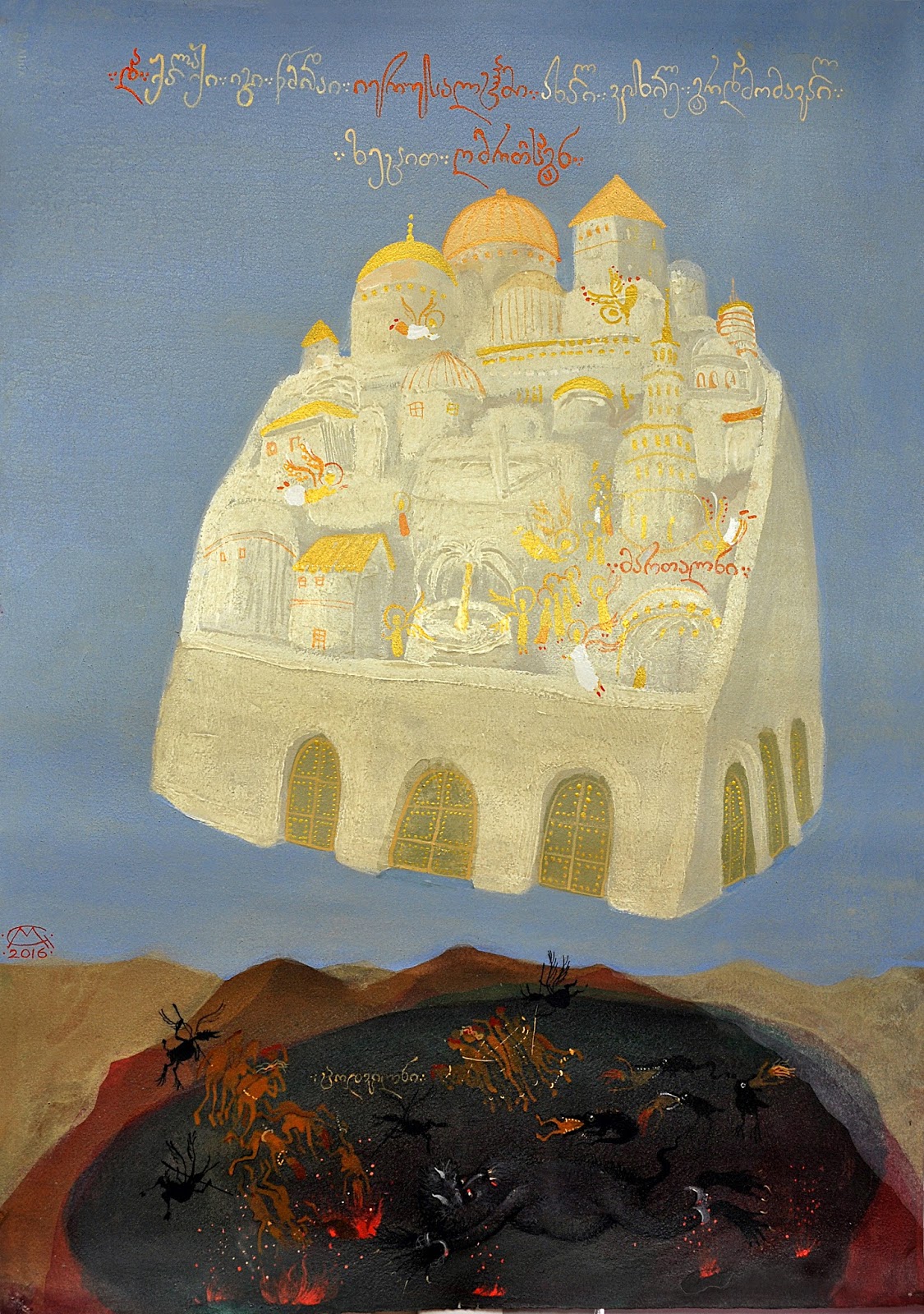
Gocha Kakabadze (Georgian, 1966–), Descent of the New Jerusalem, 2016. Gouache on paper.
On this mountain the LORD of hosts will make for all peoples
a feast of rich food, a feast of well-aged wines,
of rich food filled with marrow, of well-aged wines strained clear.
And he will destroy on this mountain
the shroud that is cast over all peoples,
the sheet that is spread over all nations;
he will swallow up death forever.
Then the Lord GOD will wipe away the tears from all faces,
and the disgrace of his people he will take away from all the earth,
for the LORD has spoken.
It will be said on that day,
Lo, this is our God; we have waited for him, so that he might save us.
This is the LORD for whom we have waited;
let us be glad and rejoice in his salvation.
—Isaiah 25:6–9 (NRSV)
+++
SONG: “When Your Kingdom Comes” by the Silver Pages, feat. Mona Reeves, on The Silver Pages: Part II (2015)
Christians are called to be “aching visionaries,” writes Nicholas Wolterstorff in the classic Lament for a Son—much like the Hebrew prophets, who by the Spirit’s enlightening were able to see through the pain of this present era into a future where all things are made new, where sorrow is undone and Love reigns. Blessed are those who cling to this vision, and who actively live into it here and now, not ignoring hurt but acknowledging its wrongness (that’s what lament is: to say, “This is not right”) and co-laboring with God to heal it. For this task we are equipped with God’s Spirit.
The Christian fixation on heaven is sometimes perceived by outsiders as escapist, as opioid. Claiming its promise does console, it’s true. It does give us power to push through pain and guards us against despair. But what it absolutely does not allow is retreat from reality. On the contrary, it helps us to inhabit reality more fully. Talk of heaven doesn’t numb us to the world—or at least it shouldn’t. It makes us hyperaware, especially of history’s path. History is going somewhere! It has a telos, and it has manifestly not arrived there yet. Until then, we ache. We labor. We hope. Rather than having an idling effect, seeing the goal actually motivates us to live presently in tighter line with God’s values, because we see how beautiful a world they usher in. We know that we cannot ourselves create the final fullness that Christ will institute when he returns, nor can we remove the pall of evil (again, that’s only within Christ’s power), but we can certainly live as citizens of God’s kingdom and thus practitioners of the gospel in all its transformative goodness.
Brothers Philip and Paul Zach (The Silver Pages) are aching visionaries who write songs and sing. “When Your Kingdom Comes,” performed with Mona Reeves, helps us to see with greater clarity the glorious future that’s in store for this earth. One day when we come home to it, it will be heaven. The New Jerusalem will descend, and we’ll be wed eternally to its king.
To download the album version of the song (which has more pronounced percussion) along with five other Silver Pages tracks, go to NoiseTrade. It’s free in exchange for your email address.
Update, 9/21/20: Paul Zach posted a solo acoustic version of the song on his Instagram today.
And here he is singing the song with his friend Patrick Bagaza from Rwanda, who translated the song into Swahili:
+++
[After the Ring is destroyed]
“Gandalf! I thought you were dead! But then I thought I was dead myself. Is everything sad going to come untrue? What’s happened to the world?”
“A great Shadow has departed,” said Gandalf, and then he laughed and the sound was like music, or like water in a parched land; and as he listened the thought came to Sam that he had not heard laughter, the pure sound of merriment, for days upon days without count.
—J. R. R. Tolkien, from The Return of the King
This post belongs to the weekly series Artful Devotion. If you can’t view the music player in your email or RSS reader, try opening the post in your browser.
To view all the Revised Common Lectionary scripture readings for Proper 23, cycle A, click here.
Then I saw a new heaven and a new earth, for the first heaven and the first earth had passed away, and the sea was no more. And I saw the holy city, new Jerusalem, coming down out of heaven from God, prepared as a bride adorned for her husband. And I heard a loud voice from the throne saying, “Behold, the dwelling place of God is with man. He will dwell with them, and they will be his people, and God himself will be with them as their God. He will wipe away every tear from their eyes, and death shall be no more, neither shall there be mourning, nor crying, nor pain anymore, for the former things have passed away.”
Andhe who was seated on the throne said, “Behold, Iam making all things new.” Also he said, “Write this down, for these words are trustworthy and true.” And he said to me, “It is done! I am the Alpha and the Omega, the beginning and the end. To the thirsty I will give from the spring of the water of life without payment.”
Jesus’s resurrection was the beginning of a new creation that starts with man. Paul mentions this in 2 Corinthians 5:17: “Therefore, if anyone is in Christ, he is a new creation. The old has passed away; behold, the new has come.” But whereas Paul is talking about individual renewal, the renewal that John envisions is all-encompassing, touching everything—“an external order in full correspondence with the new nature,” in the words of Alexander Maclaren.
Theologians disagree on whether the “new” in this Revelation passage indicates that the present heaven and earth will one day be destroyed and then newly created, or rather that heaven and earth will one day be utterly transformed, made new in nature or quality. I hold the latter view, and it appears that American artist James B. Janknegt does as well.
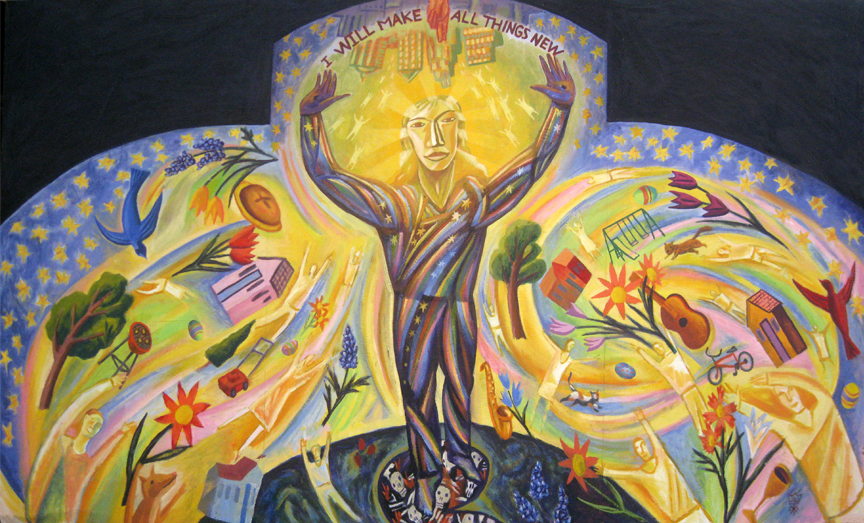
James B. Janknegt (American, 1953–), Make All Things New, 2005. Oil on canvas, 48 × 96 in.
Janknegt’s painting Make All Things New shows the risen Christ standing triumphantly over the pit of death and under the blessing hand of God, sweeping up the things of earth into a whirlpool of color. Birds, balls, and bicycles; musical instruments and charcoal grills; plants and houses, pets and people, mowers and swing sets—all are on their way to the New Jerusalem. Beauty, work, and play.
Also present in the cosmic swirl are a loaf of bread and a glass of wine, symbols of God’s broken body and spilt blood, the activators of the new covenant. These two objects are evidence on multiple levels that God does indeed transform: he transformed the shame of the cross into glory, and at the Communion table again and again he transforms common, earthly elements into means of grace.
I appreciate Janknegt’s portrayal (through the upside-down skyscrapers at the top of the painting) of heaven coming down to meet earth as it did in the beginning, a biblical truth that has far too often been misrepresented in Christian art, music, and teaching. The restoration of the union between heaven and earth is pretty much the Bible’s main theme—one that’s beautifully explained in The Bible Project’s video on heaven and earth in terms of overlap between two spaces. We won’t eventually leave one space to fly over to the other; instead, heaven and earth will become the same space.
This is a vision that we are called to live into now! As new creations, we orient ourselves around the risen Christ, and we practice resurrection wherever we go. This can mean anything from turning vacant lots into gardens to beating guns into farm tools (literally!) to building wells in villages without access to clean drinking water to fostering or adopting an abused child to supporting a friend through rehabilitation. Where there is death, we bring life.
Make All Things New is a picture of what God has started to do in the world and will one day accomplish completely, at which point we can say along with him in praise and celebration, “It is done!” In the meantime, let’s join him in his work.
This painting is available for sale on the artist’s website and is also offered as a print.



 Art & Theology