Those who had arrested Jesus took him to Caiaphas the high priest, where the scribes and the elders had gathered. . . .
Now the chief priests and the whole council were looking for false testimony against Jesus so that they might put him to death, but they found none, though many false witnesses came forward. At last two came forward and said, “This fellow said, ‘I am able to destroy the temple of God and to build it in three days.’”
The high priest stood up and said, “Have you no answer? What is it that they testify against you?”
But Jesus was silent. Then the high priest said to him, “I put you under oath before the living God, tell us if you are the Messiah, the Son of God.”
Jesus said to him, “You have said so. But I tell you,
From now on you will see the Son of Man seated at the right hand of Power and coming on the clouds of heaven.”
—Matthew 26:57–64
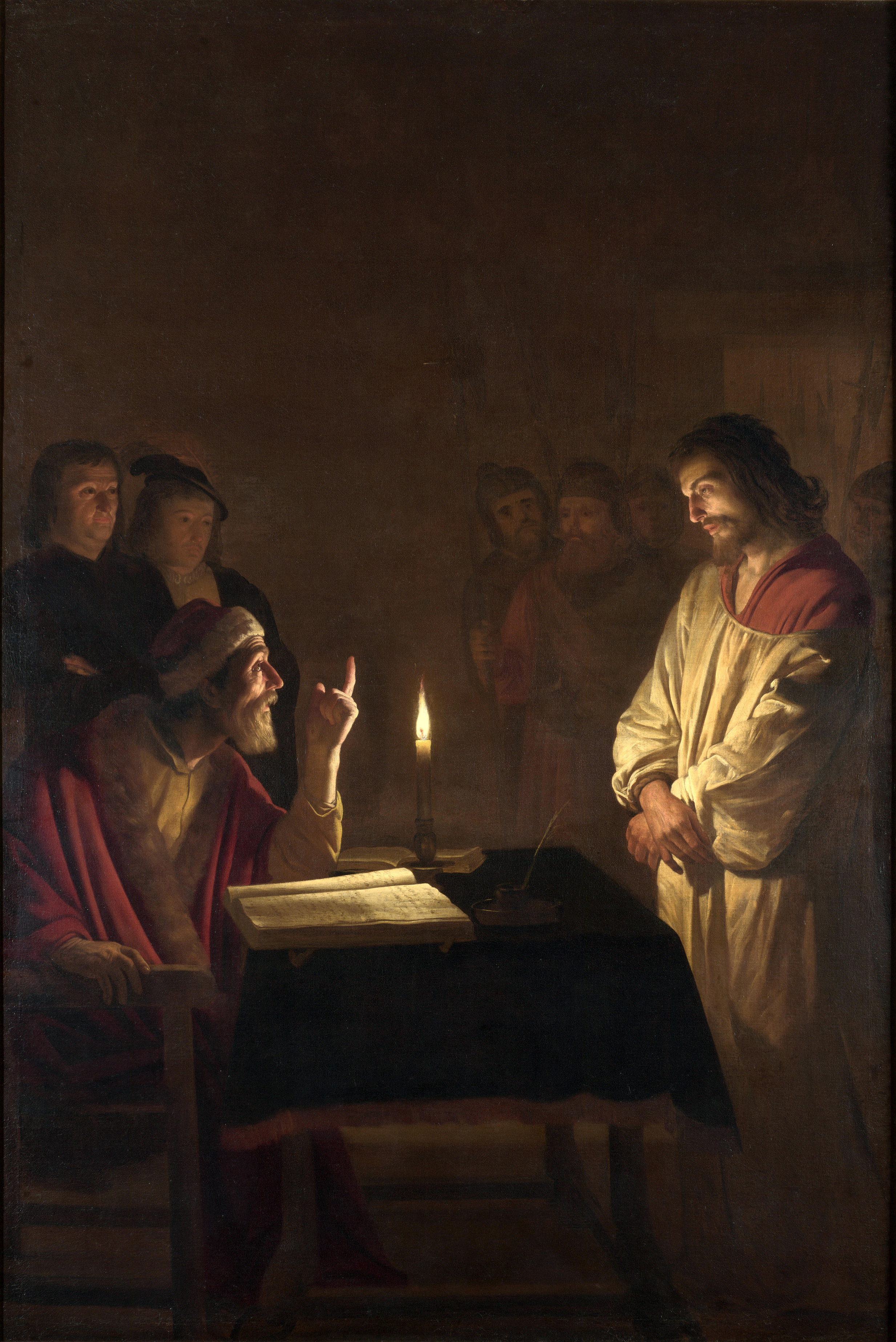
LOOK: Christ before the High Priest by Gerrit van Honthorst
Gerrit van Honthorst (Dutch, 1590–1656), Christ before the High Priest, ca. 1617. Oil on canvas, 272 × 183 cm. National Gallery, London.
Rev. Katherine Hedderly, associate vicar for ministry at St Martin-in-the-Fields, reflected on this painting as part of the online course “Inspired to Follow: Art and the Bible Story”:
Jesus places himself totally in the place of light and truth. But we see here, and will see again as we journey to the cross, that it is a lonely place. I wonder if we’re prepared to stand in the lonely place for the sake of the truth. . . .
Opposite Jesus in the painting we find Caiaphas, seated. And in front of Caiaphas, on the table, the books of the Mosaic Law are open. All the power of the religious authority is being brought to bear. Caiaphas has all the weight and authority in the scene, the two witnesses standing arms folded behind him in cowardly judgement. Caiaphas’s finger is very prominent. He is accusing, judgmental. . . .
Jesus’ silence condemns the judge and the witnesses; and by his silence he refuses to accept the authority of the trial. In the face of this onslaught from the religious hierarchy Jesus is the one with real authority.
LISTEN:“Sanhedrin” by Nicholas Andrew Barber, on Stations (2020)
When the day had come When the dreadful day had come All the people gathered round They were the powers that be
The priests, the scribes, and the elders Took their counsel, all eyes on this king Of a different kind Oh, he was a king of a different kind
They asked him plain and simple Oh, but their intentions were far more complicated Minds and hearts are so complicated Minds and hearts are so complicated
You are the Christ Oh, you are the Son of Man You are seated at the right hand of the power of God Over all the powers that be
You needed to say no more They’d heard enough They heard his words But not what he said
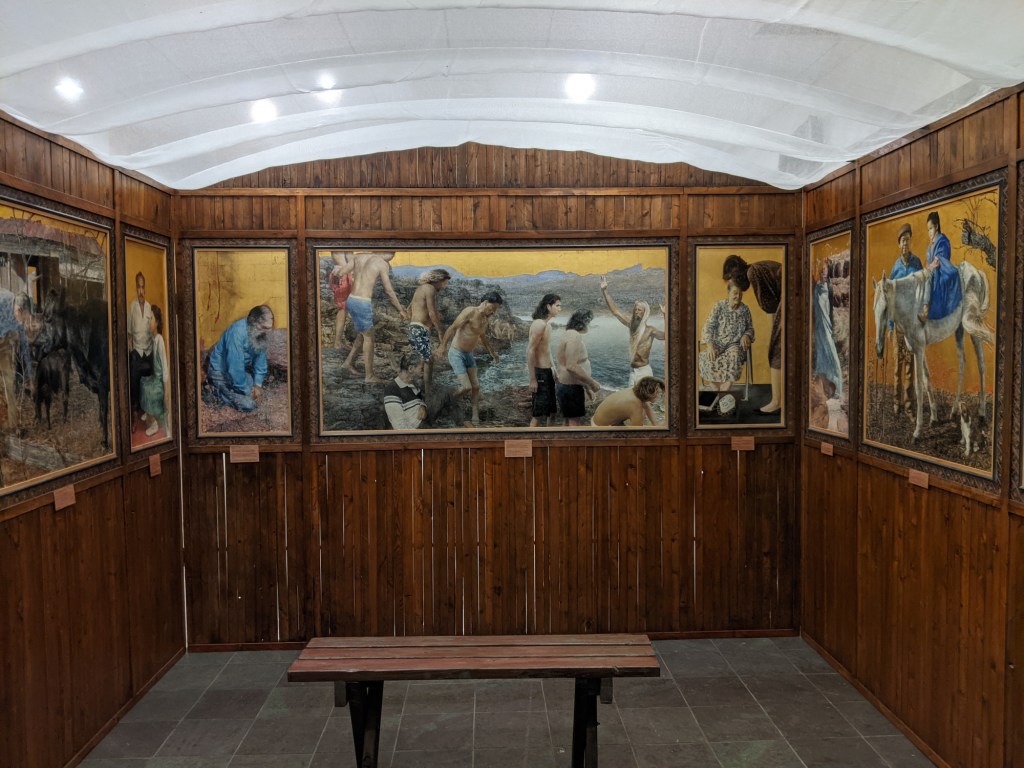
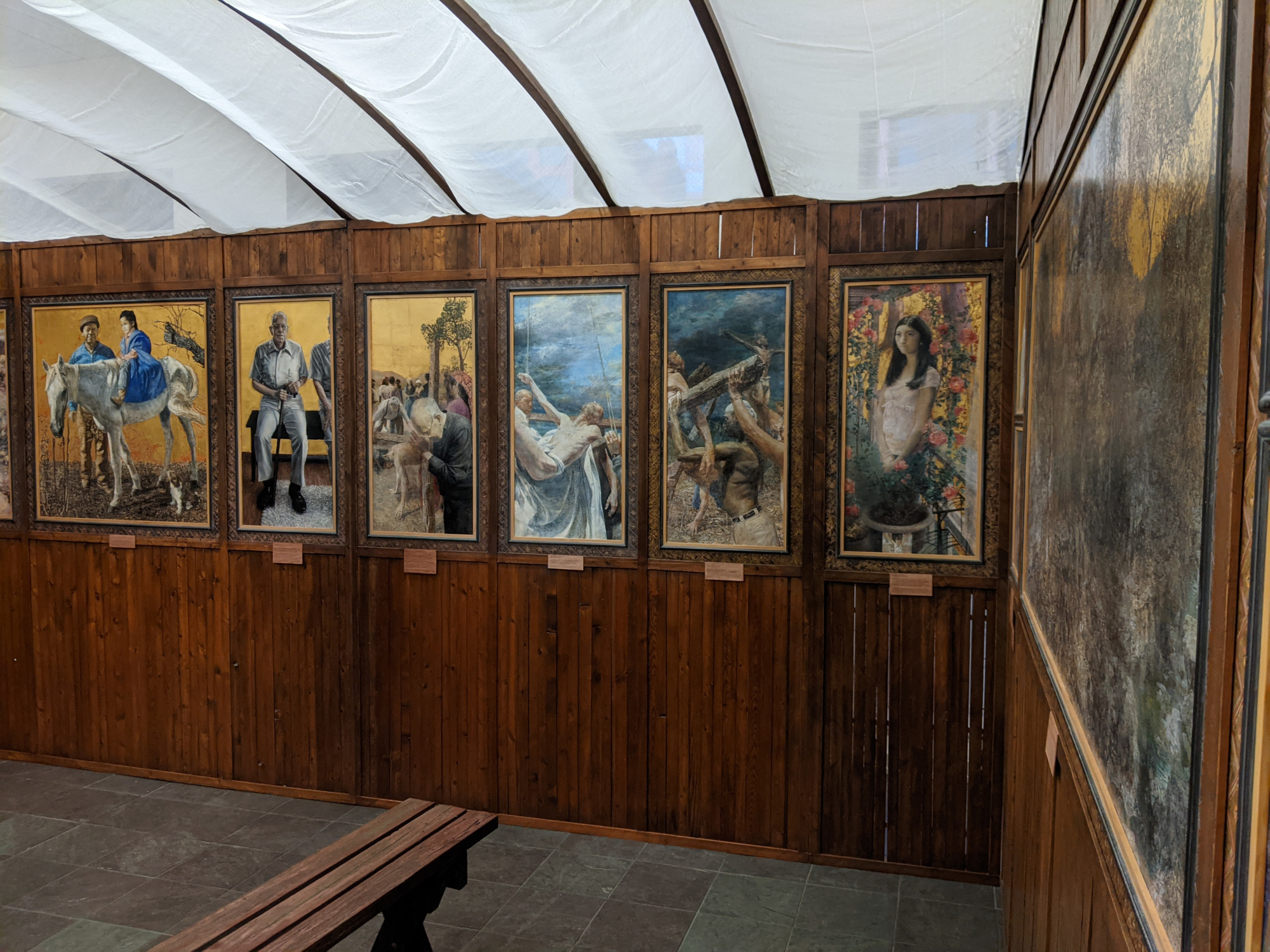
At the 2021 Christians in the Visual Arts (CIVA) conference in Austin, Texas, I got to experience local artist John Patrick Cobb’s Ikon Chapel, a traveling, custom-built wooden structure housing twenty of Cobb’s egg tempera paintings depicting his friends, family, and neighbors as saints and prophets in our modern world. The young and the elderly, farmers, water well drillers, artists, teachers, nurses, Holy Cross brothers, custodians, the unhoused, people with disability or mental illness—these are among those he honors in paint and gold leaf.
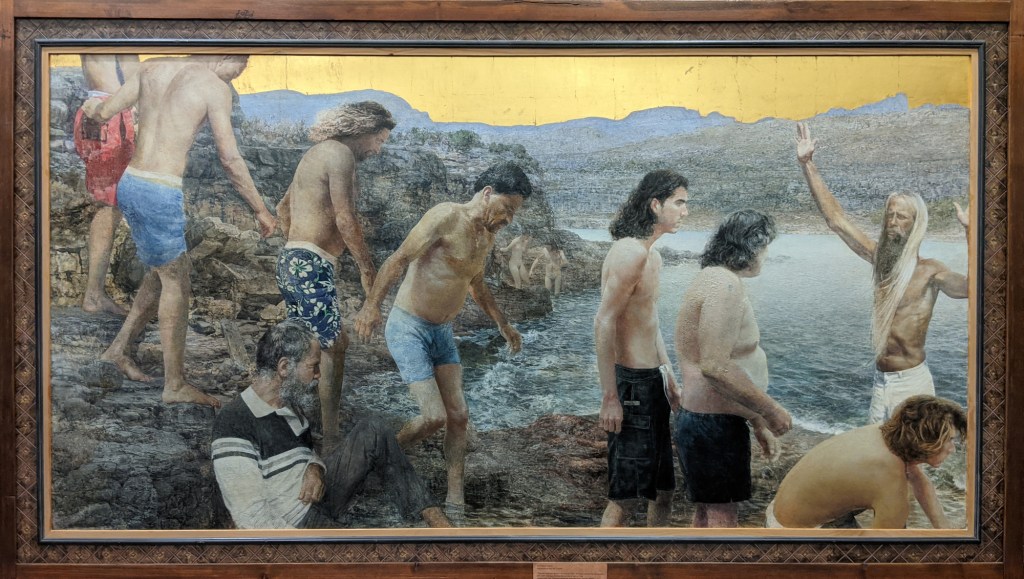
Ikon Chapel (detail) by John Patrick Cobb, as installed at the “Transcend” CIVA biennial conference, November 4–6, 2021, St. David’s Episcopal Church, Austin, Texas. Photo: Victoria Emily Jones.John Patrick Cobb (American, 1954–), Baptism by Water, 1999. Egg tempera and gold leaf on panel, 36 × 77 in. Photo: Victoria Emily Jones.
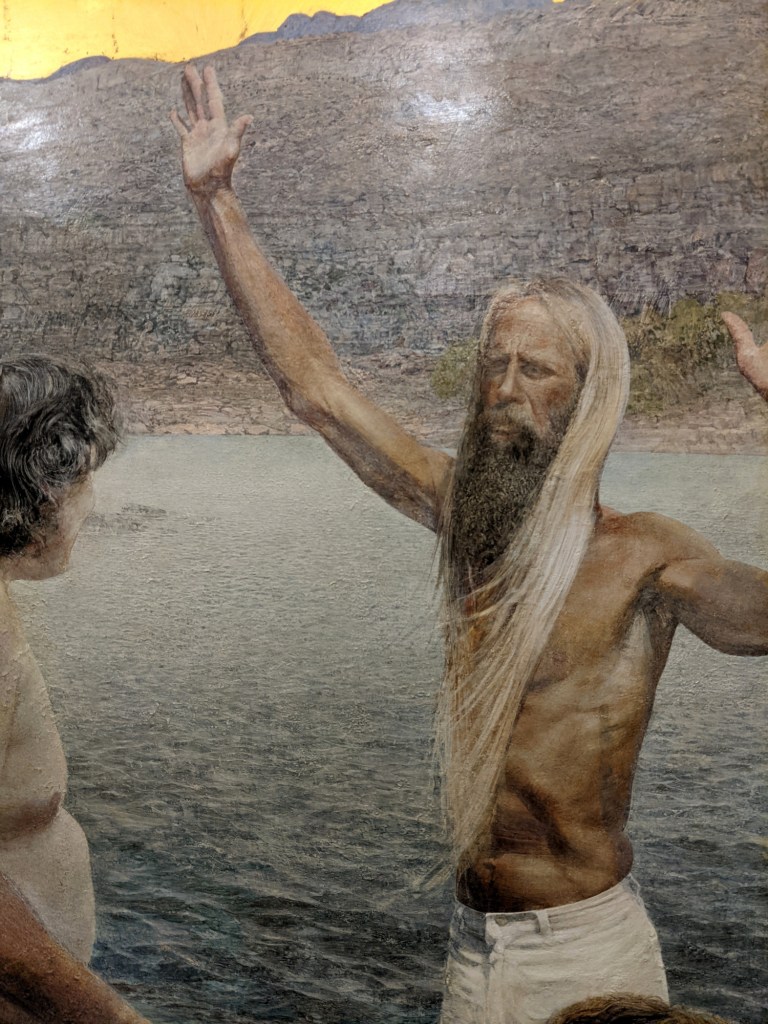
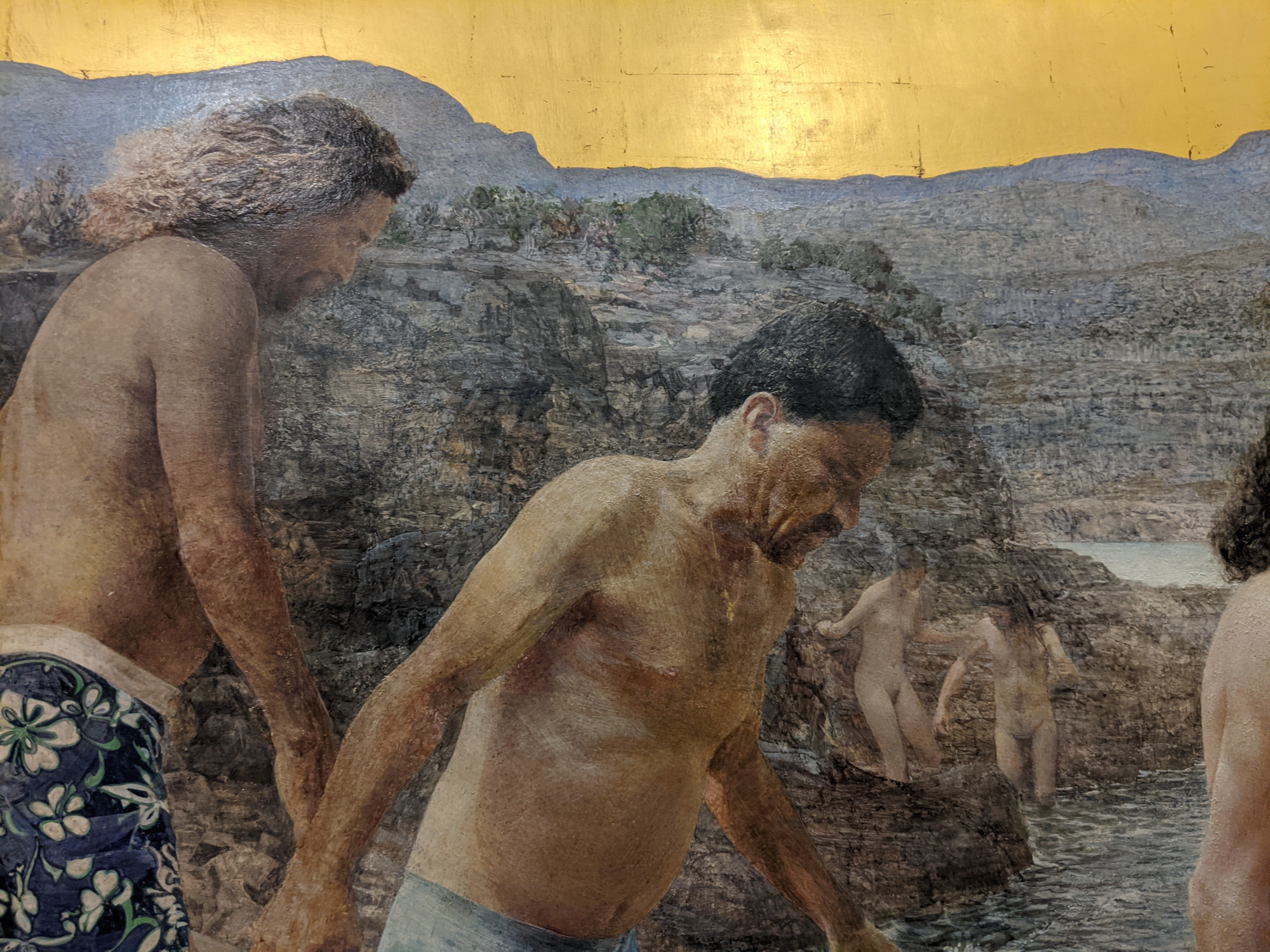
Baptism by Water is, along with its companion piece, Baptism by Fire, the largest painting in the series, at over six feet long. It is a lakeside scene portraying John the Baptist—the long-haired, bleach-blonde guy at the far right—calling folks to repentance. Several men climb down the rocky shoreline to enter the cleansing waters and be raised to new life. The models are all associated in real life with water—surfers, plumbers, fishermen. And this is a local setting: Hippie Hollow on Lake Travis in Central Texas, a famous nude swimming hole.
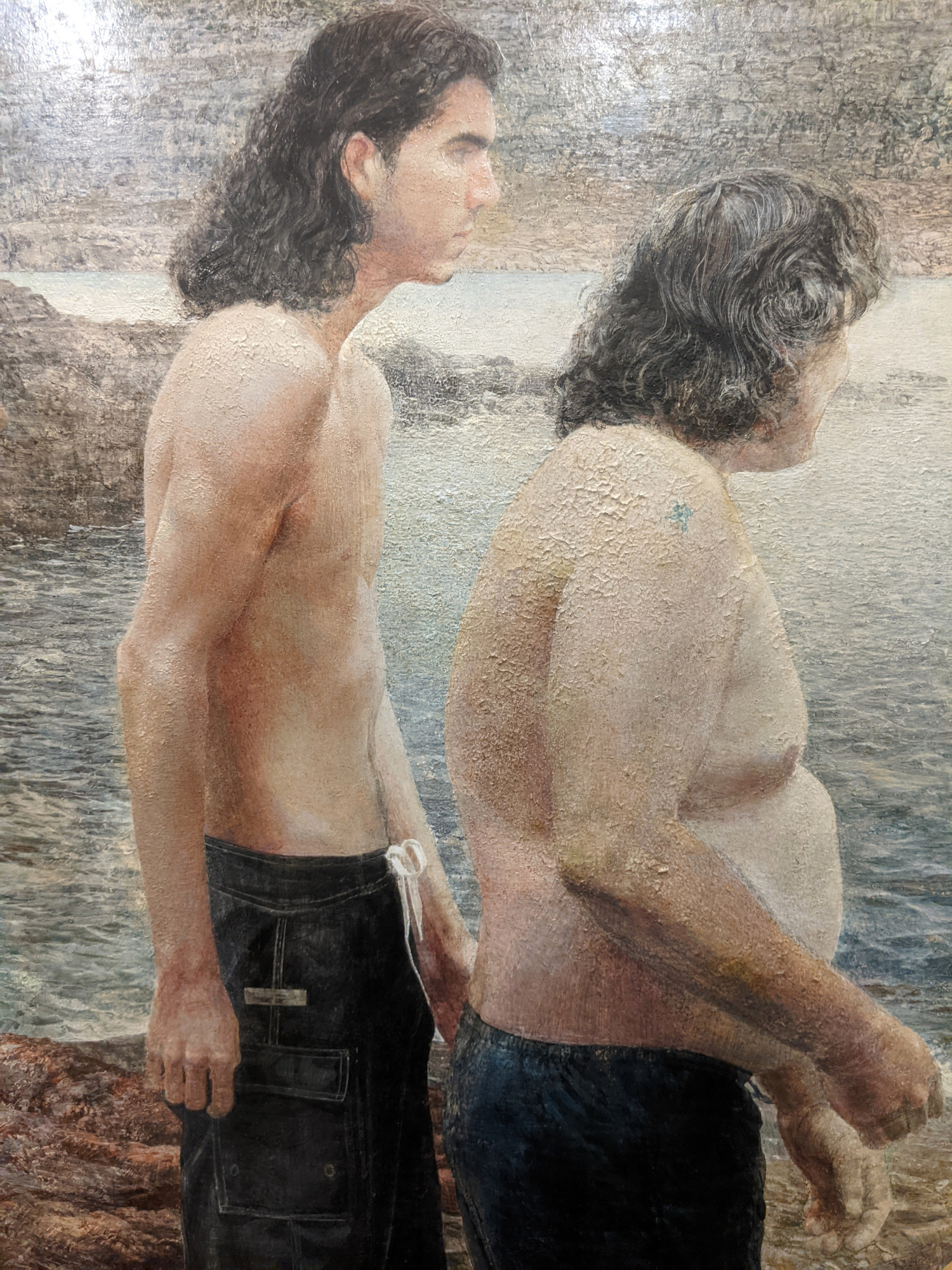
Jesus, says Cobb, is the young man with the black hair and black trunks. Cobb deliberately made him indistinguishable from the others to emphasize his full humanity. He looks beyond John the Baptist, perhaps mentally preparing for the solitary forty-day fast in the desert he’s about to embark on.
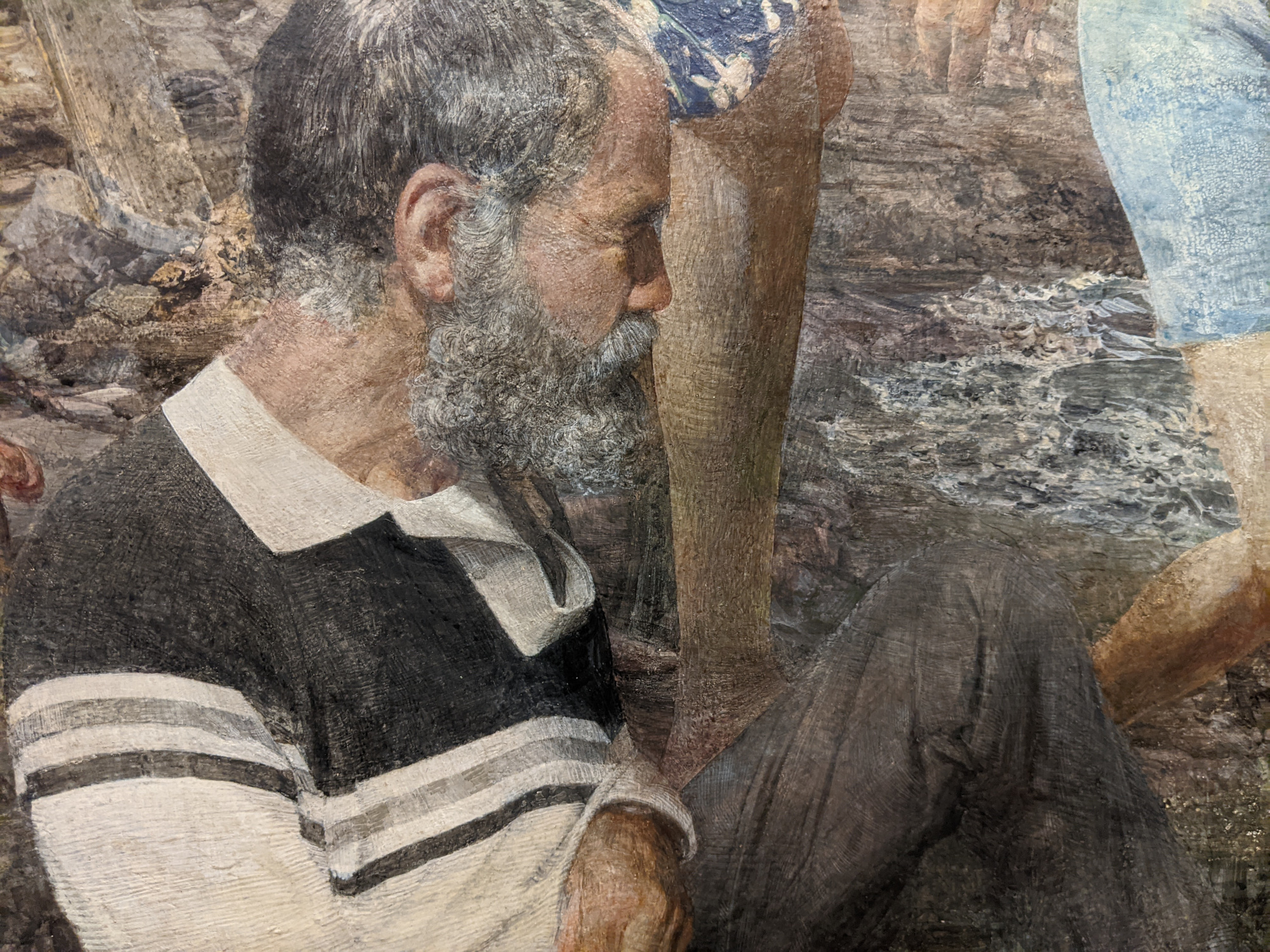
In the wall text in the Ikon Chapel, Cobb describes the seated, shirted man in the foreground as reminiscent of the Gerasene demoniac (Mark 5:1–20):
The figure in the near ground, clothed, was a man who lived in the nook of the sea wall in Galveston and slept in the nearby graveyard at 61st Street. On the worst winter days I would bring him a coffee, and finally asked him one day if I could include him in my painting. He would sometimes drink himself into a frenzy and yell and scream at the cars in horrific anger. His leg had been broken and had healed in a precarious angle. I felt as though if there were anyone who deserved the peace and the Holy Spirit, it would be him.
At the bottom right, one of the figures twists away, rejecting John’s call. The model’s name is Jonah, so Cobb wanted to use him as a Jonah figure, resisting (at least initially) the divine plan.
In the background Adam and Eve are skinny-dipping.
Detail, John the BaptistDetail, Jesus (left)Detail with Eve and Adam in backgroundDetail of a local unhoused man with a leg impairment and alcoholism, for whom the artist wishes God’s peace
I was fortunate enough to get to know Cobb a bit over lunch one day while I was in Austin, and then later at an outdoor gathering he and his wife, Tina, hosted on their property. At the time, he was preparing for an extended trip to Italy to restore some Renaissance frescoes in a village chapel.
To learn more about this remarkable body of work, see the book Chapel Ikons: Biblical Meditations on Living the Spiritual Life in the Modern World (Treaty Oak, 2020), which reproduces all twenty-five paintings in full color with detailed commentaries by William Y. Penn Jr. The postscript says that Cobb and Penn are looking for a permanent institutional home with resources to preserve the chapel ikons for public viewing and study and that if interested, you should contact wpenn@me.com.
Refrain: A voice cries out in the desert Come prepare the way of the Lord God is coming, make straight for him a highway Come prepare the way of the Lord
Every valley shall be exalted Every mountain shall be made low Then shall the Word of God be known All the earth shall proclaim The glory of the Lord [Refrain]
Go upon the highest mountain Zion, herald of good news Lift your voice, cry out with all your soul Jerusalem, proclaim Glad tidings in the Lord [Refrain]
Have no fear, O cities of Judah Here is your God See, the Lord is coming now with power Our God is here The mighty and the strong [Refrain]
Like a shepherd, he feeds his flock He gathers the lambs See, he carries them gently in his arms So tenderly With a mother’s love [Refrain]
This post is part of a daily Advent series from December 2 to 24, 2023 (with Christmas to follow through January 6, 2024). View all the posts here, and the accompanying Spotify playlist here. “A Voice Cries Out” is not on Spotify.
How did Jesus’s mother, Mary, come to find out that he had risen from the dead? Was she there when it happened, keeping vigil? Was she among the holy women at the tomb to whom the angel made the announcement, or did these women go to Mary to relay the news to her? Maybe an angel came to tell her personally? Or perhaps Jesus himself appeared to her, to tell and show, at the home where she was staying.
The Bible is silent as to Mary’s whereabouts between the time of Entombment and the events of Easter morning. Historically, there have been proponents of each of the above suppositions. But the one that has taken the strongest hold is the last one—that Jesus made direct personal contact with his mom after his resurrection, before appearing to anyone else. He wasn’t at the tomb when Mary Magdalene got there (unless, perhaps, he was lingering somewhere in the shadows). Where did he go in the early morning? Some scholars say he must have gone to console his mother.
The claim that Jesus appeared first to Mother Mary can be found as far back as Ambrose (340–397), who wrote in his De virginitate, “Therefore Mary saw the resurrection of the Lord: she saw it first and believed.”
Around 1300 the anonymous writer known as Pseudo-Bonaventure elaborated on this tradition in his highly influential Meditationes Vitae Christi (Meditations on the Life of Christ), providing a vivid and affecting narrative in which Mary, when the women depart for the tomb on Sunday morning, stays behind and prays for God to restore her son to her alive.
And with that, she so praying, sweet tears shedding, lo suddenly our Lord Jesus came and appeared to her, and in all white clothes, with a glad and lovely cheer, greeting her in these words: “Hail, holy mother.” And anon she turning said: “Art thou Jesus, my blessed son?” And therewith she kneeling down honored him; and he also kneeling beside her said: “My dear mother, I am. I have risen, and lo, I am with you.” And then both rising up kissed the other; and she with unspeakable joy clasped him, sadly, resting all upon him, and he gladly bare her up and sustained her. [as translated into Middle English by Nicholas Love in The Mirror of the Blessed Life of Jesus Christ, ca. 1400, with modernized spellings]
Pseudo-Bonaventure imagines a private, emotional reunion in a domestic interior. This episode was picked up by Ludolph of Saxony in his Vita Christi and by other writers, and it circulated throughout Europe. It made its way into the visual arts starting in the first half of the fourteenth century. The two most famous examples are the right wing of Rogier van der Weyden’s Miraflores Triptych and a woodcut from Albrecht Dürer’s Small Passion series.
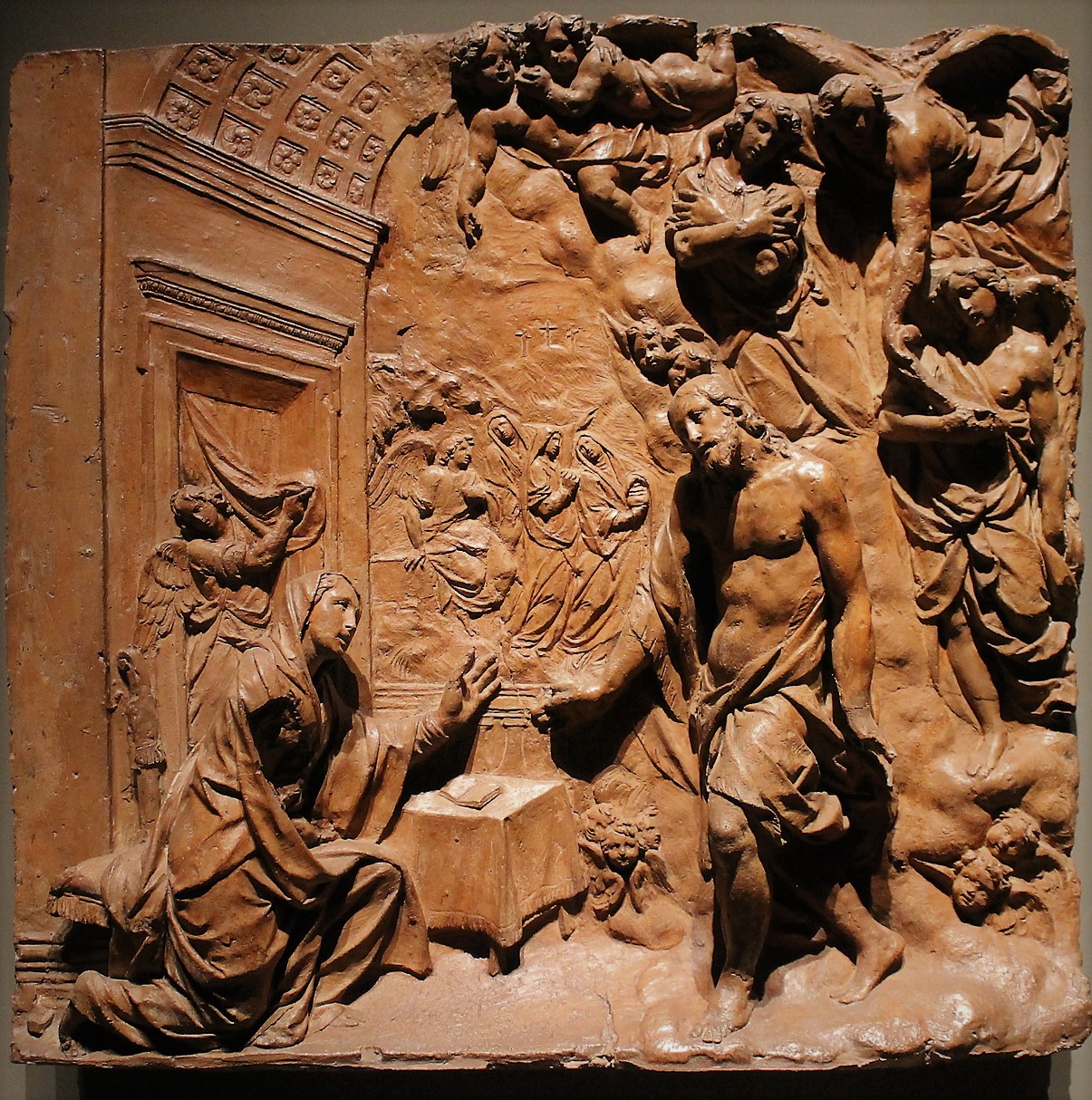
But I want to take a look at this Italian Baroque bas-relief by the minor artist Giovanni Pietro Lasagna.
LOOK: Christ Appearing to His Mother by Giovanni Pietro Lasagna
Giovanni Pietro Lasagna (Italian, d. 1658), Christ Appearing to His Mother, first quarter of 17th century. Terracotta.
I found this artwork in the blog article “Iconography of the Resurrection – Christ Appears to His Mother” by Margaret Duffy, which provides a fascinating compilation of images. Duffy cites its location as unknown, and I’ve not been able to find reference to it anywhere else. It was probably made in Milan, where the artist was active. An email inquiry I sent last month to the city’s Museo del Duomo, which has similar terracottas from the same period in its collection, has garnered no reply. It’s possible the work was made as a design for a marble sculpture.
Carved in low relief in the background, an angel sits on the edge of an empty sarcophagus and tells the three women with their ointment jars that Jesus is not here but is risen. Three untenanted crosses are visible in the distance on Mount Calvary, a shadow of Friday’s events.
In the foreground, sculpted in high relief, we see Mary at her prayer desk. She is interrupted by the triumphant entry of her risen son, attended by angels. Their arms reach out to embrace each other as her grief turns to joy.
To reinforce the news of resurrection, an angel who stands behind Mary peeks out from behind a curtained doorway and points to the concurrent scene that’s unfolding in the garden of Jesus’s burial.
I’m not certain of the identity of the figures behind Jesus. But in looking into it, I did find that there’s a legend, likely originating in fourteenth- or fifteenth-century Spain, that when Jesus appeared to his mother after the resurrection, he presented to her the redeemed of the Old Testament, whom he had just freed from Hades.* So it’s possible that the beardless young man at the upper left with his arms crossed over his chest is Adam, and that the figure at the right with one breast bared is Eve. And I think the man at the top right corner who’s touching them both is an angel.
Note the iconographic similarity to scenes of the Annunciation—Gabriel’s announcement to the young Mary that she had been chosen by God to bear his Son. This “emphasizes the parallelism between the heralding of the Incarnation by the Archangel, and Christ’s own announcement, to his mother, of the fulfillment of that Incarnation, that is, the Resurrection.”**
Be joyful, Mary, heav’nly queen Gaude, Maria! Your son who died was living seen Alleluia!
Laetare, O Maria O Maria
The son you bore by heaven’s grace Gaude, Maria! Did all our guilt and sin efface Alleluia!
Laetare, O Maria O Maria
The Lord has risen from the dead Gaude, Maria! He rose with might as he had said Alleluia!
Laetare, O Maria O Maria
This song has its roots in a medieval liturgical text that is still used as an antiphon (short hymn) in the Roman Catholic Church throughout the Easter season. Gaude means “rejoice”; laetare, “be glad.”
The lyrics could be in the voice of the women who went early to the tomb and are returning with the great news, or it could be that we the faithful are imaginatively addressing Mary across time, inserting ourselves into that story of the first Easter morning.
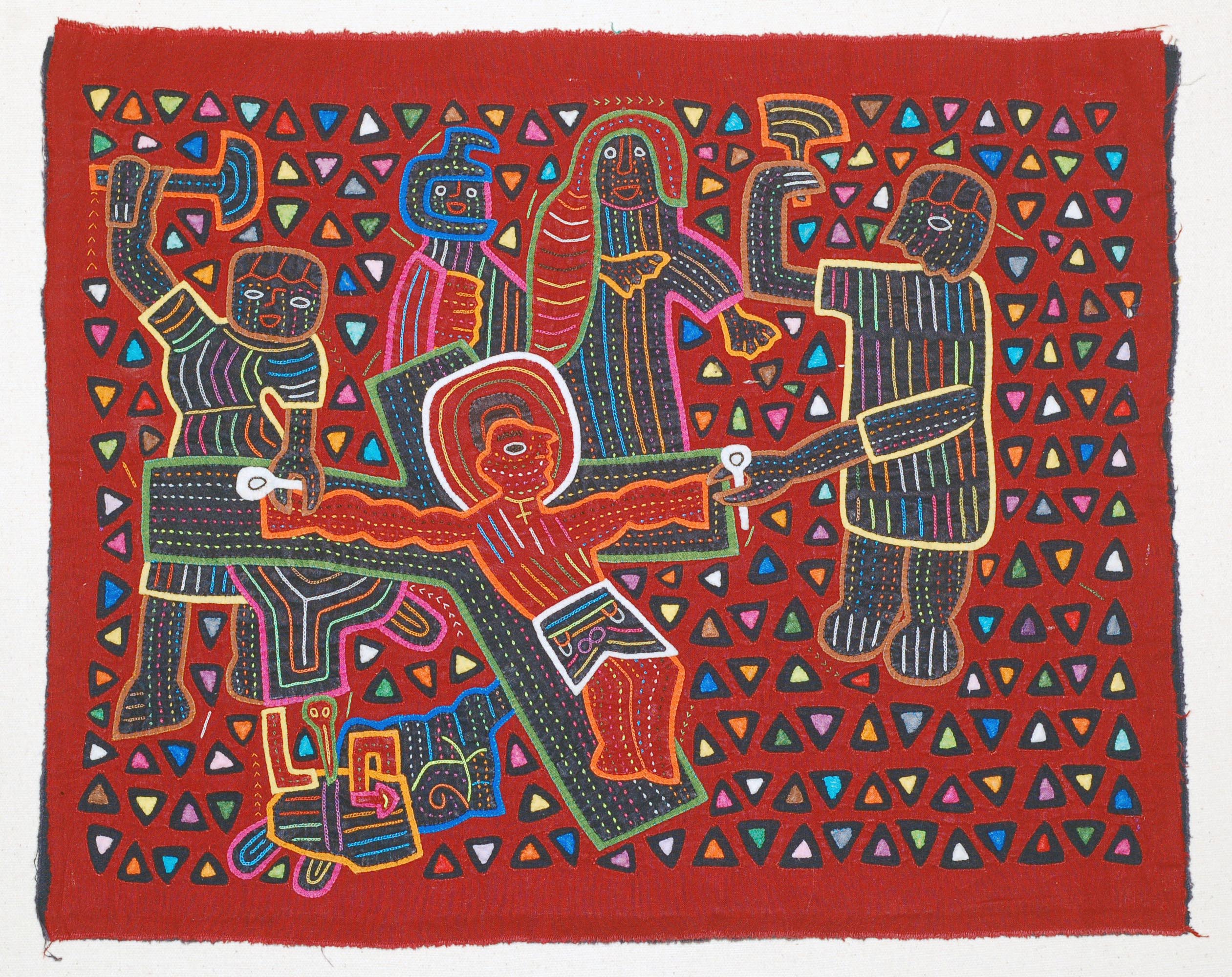
Christ Nailed to the Cross, mola (reverse appliqué panel) from the San Blas Islands, late 20th century. Bowden Collections.
The Kuna (also spelled Guna or Cuna) Indians live on the San Blas archipelago off the east coast of Panama, a cluster of some 378 islands in the Caribbean Sea. They are politically autonomous, and much of their traditional culture is intact.
Since the late nineteenth century, Kuna women have been making what are called molas, reverse appliqué panels made in pairs for the front and back of women’s blouses. As mola collector Jane Gruver describes, “several layers of cloth are stacked together and the design is made by cutting through the different layers of fabric to expose the desired color. Once the specific shape is achieved, the area is stitched around. Sometimes embroidery and applique are also used to add detail.” This colorful, wearable textile art is an integral part of Kuna culture.
The earliest molas featured geometric designs, which the Kunas translated from their customary body painting designs, but now a vast variety of representational subjects are common, including animals, plants, domestic scenes, political satire, dragons, mermaids, superheroes, spacecraft—and biblical stories!
The first Christian missionary to the San Blas Islands was Annie Coope, a single woman from the United States who arrived in the first decade of the 1900s and established a school on the island of Nirgana in 1913. A significant number of the Kuna embraced Christianity, such that there are now churches on thirty of the islands, as well as eighteen Kuna churches in and around Panama City, according to Wycliffe. A Kuna translation of the New Testament was published in 1995, at the behest of Kuna pastor Lino Smith Arango, and a Kuna Old Testament was completed in 2014.
The mola above shows two men hammering nails into Christ’s palms as two mourning figures—presumably John and Mary—stand behind. This piece is from the collection of Sandra and Bob Bowden in Chatham, Massachusetts, who are among today’s major collectors of modern biblical art. It is one of forty molas in the traveling exhibition Eden to Eternity: Molas from the San Blas Islands, available for rental for a nominal fee.

 Art & Theology