Roundup: New albums, historic Boston church to get new mural, new opera sets words of Mexican nun, and more

NEW ALBUMS:

>> The Divine Dark, vol. 1: This three-song EP was released December 15, 2024, on Re-Echo Records, a new label for music created by artists from Resurrection Philadelphia church. “The Divine Dark is an ongoing series of original arrangements and compositions for devotion, contemplation, and edification. The series takes its name from a phrase that emerged in the fifth century among Christian mystics to describe the ineffable unknowableness of God . . . in all his kindness, grace, and mystery.”

The first volume features new arrangements by Joshua Stamper [previously] of two seventeenth-century German hymns (both translated into English by Catherine Winkworth, and sung here by Sarah Long), plus one new hymn that Stamper wrote with his wife, Kory Stamper, whose refrain is taken from Psalm 127:4. The songs quietly explore the mysteries of salvation, the Eucharist, and God’s sovereignty as well as some of the paradoxes of God’s character, such as his being both storm and shelter (wild and thundering, but also safe and enfolding).

Volume 2 of The Divine Dark is likely to release later this year.

>> It Is Good to Be Here with You by Nick Chambers: Out today, the first full-length album by singer-songwriter Nick Chambers. These songs of spiritual seeking touch on sobriety, divine nearness, ambiguity and wonder, the pursuit of understanding or insight, the longing to be held and loved, and more. Chambers deftly weaves voices from scripture—the blind beggar Bartimaeus, who cried out to Christ for mercy; the sons of Korah, who thirsted for God like a deer thirsts for water; the apostle Paul, who experienced a frustrating tension between desire and action—with his own poetic voice, finding companionship with those ancient seekers who were transformed by their encounters God. There’s reference to the wrestling patriarch Jacob, the blazing bush-vision of Moses, Elijah in a wilderness cave, the mount of Transfiguration, the eighth day of creation. Besides biblical texts, the songs bear influences from writers Rainer Maria Rilke, Madeleine L’Engle, Gregory of Nyssa, and Esther de Waal.

The album features some co-writing contributions by Jon Guerra (“Hold Me”), Paul Zach (“A Sweeter Word,” “Always Already”), and Tyson Matthews (“It Is Good to Be Here with You”).

My favorite tracks: “To an Unknown God,” “Hear,” “Thanks Be to God.”

+++

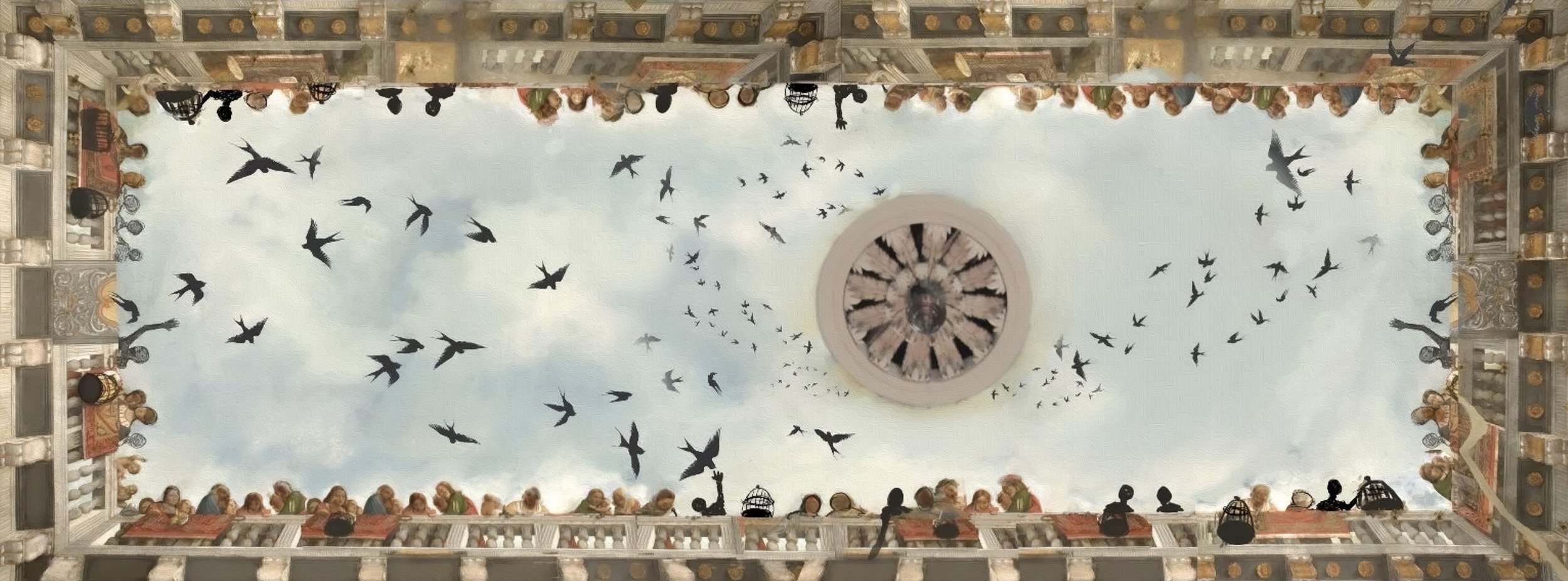
NEW ART COMMISSION: Memorial to Enslaved Persons by Harmonia Rosales, King’s Chapel, Boston: Harmonia Rosales, an Afro-Cuban artist born and raised in Chicago and living in Los Angeles, is at work on a three-part commission for the historic King’s Chapel at 58 Tremont Street in Boston, a church originally built in wood in 1686 and then rebuilt in stone in the 1750s. One of the oldest churches in the United States, it (and its adjacent burying ground) is one of the stops along the Freedom Trail, and it still has an active congregation.
Rosales, Harmonia_King's Chapel ceiling mural
Conceptual image of the mural by Harmonia Rosales that’s being installed this year on the ceiling of King’s Chapel in Boston, Massachusetts

Despite being in the North, King’s Chapel has links to the slave trade. Historical documents reveal that at least 219 persons, most of them of African descent but at least two of them Native American, were enslaved by ministers and members of the church throughout its history, and that even after slavery was abolished in Massachusetts in 1783, donations to the church continued to flow in from people whose wealth depended on Southern slave labor, such as textile magnates. You can read more details in Slavery and King’s Chapel, the thirty-two-page report published by King’s Chapel’s Ad Hoc Committee on Slavery in 2018.

Until at least the mid-nineteenth century, people of color, both enslaved and free, who attended King’s Chapel were relegated to the balcony seats. We know the names of 182 enslaved attendees from the church’s baptismal, marriage, and burial registers. “As a community of faith,” the church writes on its website, “we are working to recover, honor, and remember these long-overlooked members of our community. We hope to make their lives and their presence in early Boston visible in new and powerful ways as we tell a more complete version of our history for our congregation, our city, and the 4 million people who walk the Freedom Trail each year.”

In addition to setting up a “living fund” to “provide monetary support for programs and engagement centered around reparative justice and reconciliation in the community,” the church has hired artist Harmonia Rosales, in partnership with the MASS Design Group, to create a physical commemoration of this history, which has three components: a figurative sculpture in the church’s courtyard, a collection of bronze birds perched throughout the church’s exterior and grounds, and a trompe l’oeil ceiling mural in the sanctuary. The memorial will be unveiled later this year. Here are two videos about it:

>> “How a Freedom Trail landmark is reckoning with its ties to slavery,” GBH News, July 19, 2023: This news segment features interview clips of Cassandra Dumay and Jessie Sage O’Leary, Boston University journalism students who are inquiring further into King’s Chapel’s links to the colonial slave trade; Rev. Joy Fallon, senior minister at King’s Chapel; Marissa Cheifetz, director of the King’s Chapel History Program; and memorial committee member David Waters.

>> “VCS Creative Conversations: Ben Quash with Harmonia Rosales,” Visual Commentary on Scripture, February 27, 2025: Theologian and VCS director Ben Quash sits down with artist Harmonia Rosales inside King’s Chapel to discuss her latest commission for that space, plus her paintings Birth of Oshun, The Creation of God, Strangler Fig, and more. Raised in the Santería religious tradition, in her art Rosales draws Yoruba deities (the orishas) into play with Christian ones and centers Black women. Speaking of the VCS’s commitment to showcasing biblical engagement from diverse vantage points, Quash tells Rosales, “We’ve always said that these conversations should not just be about the Bible’s importance to Christians or Jews, but the Bible’s importance to those of other traditions, as something to bounce off, to use, sometimes to object to. And you are a wonderful example of how to do that in a way that’s constantly creative and generous.”

+++

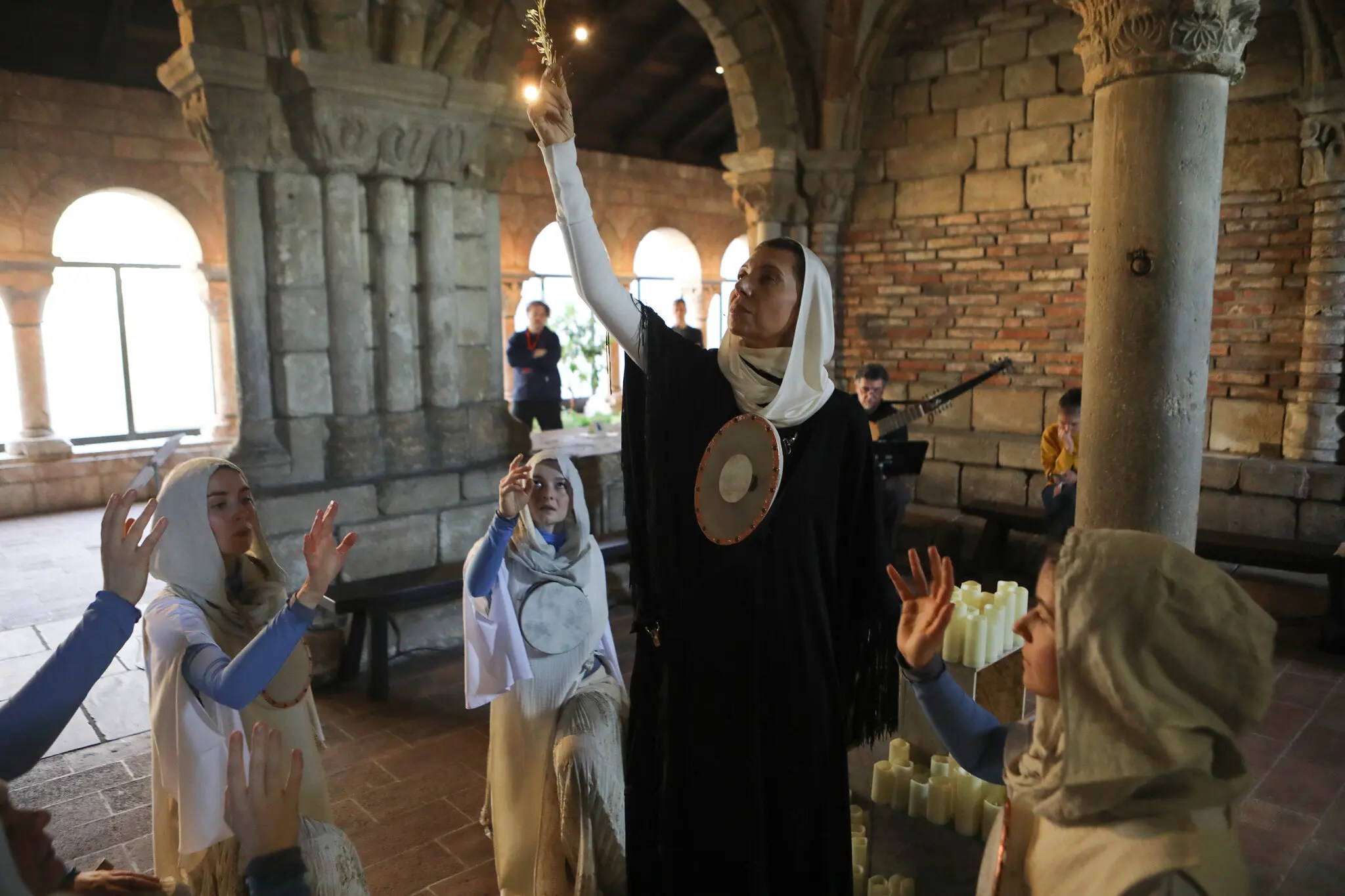
ARTICLE: “At the Cloisters, Sor Juana’s Words Ring Out in Song” by Elisabeth Vincentelli, The New York Times: Primero Sueño (First Dream) is a new opera by Magos Herrera and Paola Prestini that adapts to music the seventeenth-century mystical poem of the same title by the Mexican Catholic nun Sor Juana Inés de la Cruz, one of the greatest literary works of the Hispanic Baroque. Commissioned by the Metropolitan Museum of Art’s Department of Live Arts (MetLiveArts) and VisionIntoArt, it was conceived as a processional opera that meanders throughout the Met Cloisters, audience in tow—an appropriate choice, as the poem is about the soul’s journey. It premiered January 23, with Herrera playing Sor Juana, the nun in black, “sing[ing] in an earthy mezzo that complements the heavenly harmonies of the six nuns in white, performed by the German vocal ensemble Sjaella.” Accompaniment was provided by harps, hand percussion, theorbo, and Spanish guitar. Here’s a trailer (not filmed on location):
Primero Sueno performance
Magos Herrera, center, as Sor Juana in a rehearsal of the opera Primero Sueño at the Met Cloisters. Photo: Earl Wilson / The New York Times.

The Cloisters—a building designed to evoke a medieval European monastery and housing a sizeable portion of the Met’s medieval art collection—is one of my favorite spaces in all of New York. What a delight that Herrara, Prestini, and team utilized its halls and rooms as staging ground for this dramatic, musical reimagining of a historic sacred poem by a pioneering female Christian writer.

+++

INTERFAITH ART EXHIBITION: Cloud of Witnesses: Images of Faith and Divinity Today, St John’s Waterloo, London, March 4–April 27, 2025: A juried exhibition featuring the work of twenty-six artists from the UK, funded and supported by Art + Christianity; The God Who Speaks; St John’s Church, Waterloo; the Catholic Bishops’ Conference of England and Wales; Culham St Gabriel Trust; and Bible Society. Click here to view the exhibition catalog.

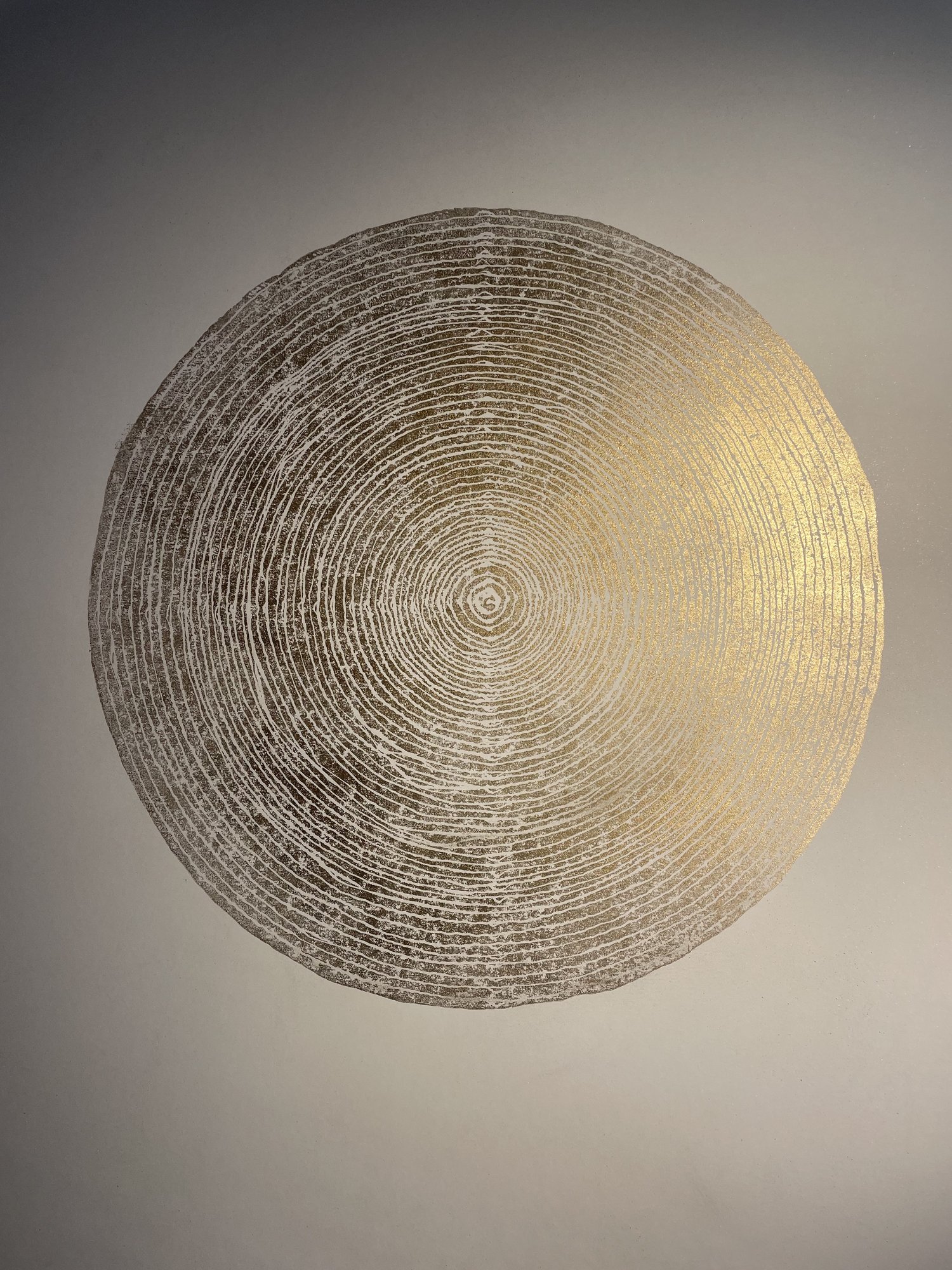
The image used for the cover of the exhibition catalog is Life 1, a linocut by Svetlana Atlavina consisting of fifty golden concentric circles that she said represent the vibrations of the heart—the sounds constantly being emitted from our cardiac valves, which mean we’re alive.
Atlavina, Svetlana_Life 1
Svetlana Atlavina, Life 1, 2024. Handmade linocut with gold ink on 300g white Somerset paper, 70 x 50 cm.

The work that I find most compelling is the eight-piece series of COME AND REST photographs by Kirsty Kerr.
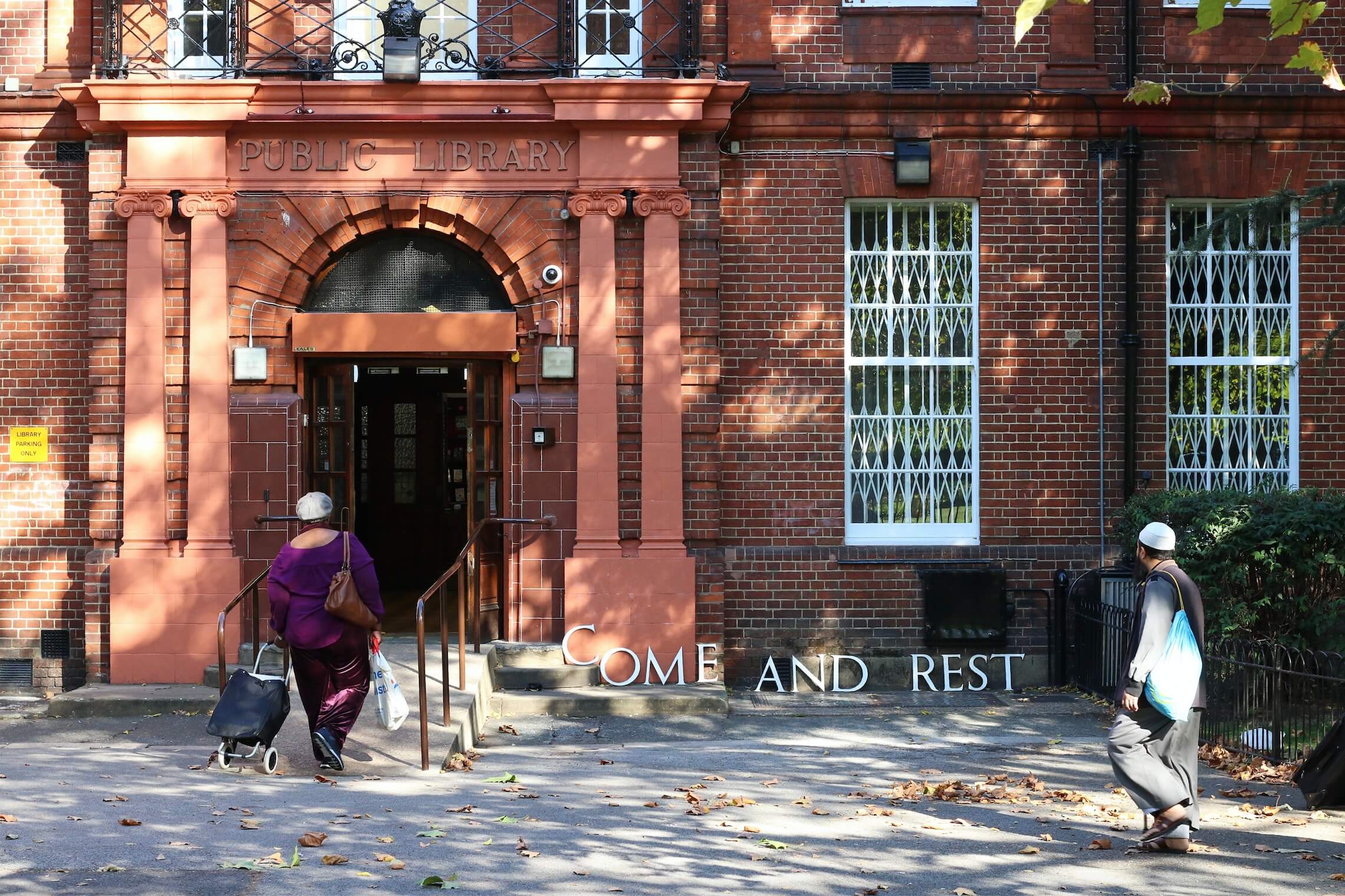
Come and Rest: Bethnal Green Library
Kirsty Kerr, COME AND REST: Bethnal Green Library, 2018. Photograph of a public intervention, from a series, 30.5 × 44 cm. Documentation by Will Alcock.

COME AND REST documents a series of public interventions informed by the demolition and rebuilding of Bethnal Green Mission Church. Taking letters from a scripture text that had hung on the old building (Jesus’ words: ‘Come to me and I will give you rest’), Kirsty spelt the phrase in Bethnal Green locations, recording the process with local filmmaker Will Alcock. The words were a gentle yet radical proclamation: of welcome, refuge, and quiet protest against loneliness and exhaustion often synonymous with city life. The act of spelling them out became a performed prayer, symbolic of the church’s continued presence and God’s enduring invitation.

Against the backdrop of this racially and religiously diverse neighbourhood, the words were both witnessed to and overlooked by passers-by of all faiths and none.

Kerr displayed Christ’s invitation in fields and basketball courts, on street corners and scaffolding and bandstand steps, outside subway stops and housing estates and libraries. View the full series here, using the right scroll arrow. I also enjoyed exploring the artist’s other projects on her website.

+++

EVENT: Taste of Heaven Intercultural Worship Festival, Coventry Cathedral, May 24, 2025: Organized by Intercultural Churches UK. “The Taste of Heaven Festival will be an exciting opportunity to celebrate the rich cultural diversity and creativity of the UK church through live performances, workshops, food and worship. The festival will take place in the iconic venue of Coventry Cathedral and its beautiful surrounding ruins. The day will trace our history of increasing diversity, by highlighting different cultural worship expressions from Celtic to Choral, South Asian and Caribbean, to more recent immigrant communities including Middle Eastern, African, and Hong Kong. It will culminate in a celebration of Intercultural Worship, demonstrating how churches can draw from different cultural streams in their corporate worship.” Tickets range from £10 to £25. Register here. [HT: Global Christian Worship]
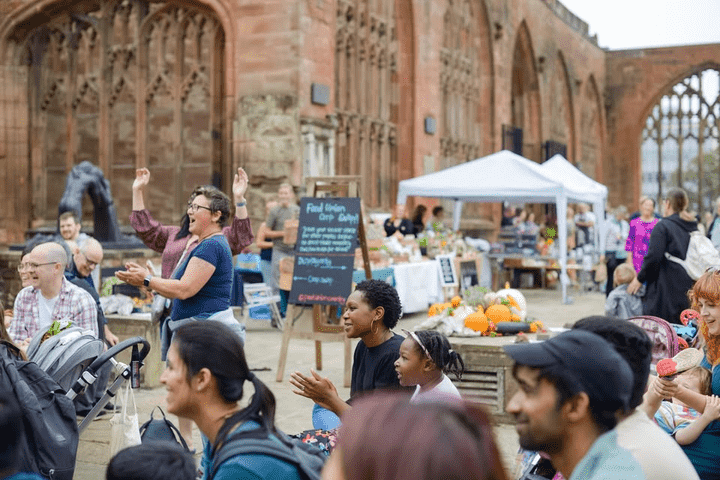
Intercultural Worship Festival

+++

SPOTIFY PLAYLIST: April 2025 (Art & Theology): The song selections on my short monthly playlists are somewhat random—a smorgasbord of what I’ve been listening to, a mix of brand-new releases and older faves—but for thematic playlists keyed to where we are in the liturgical calendar during April, see my Lent Playlist, Holy Week Playlist (I’m especially proud of this one!), and Eastertide Playlist.
Advent, Day 15: Among Us

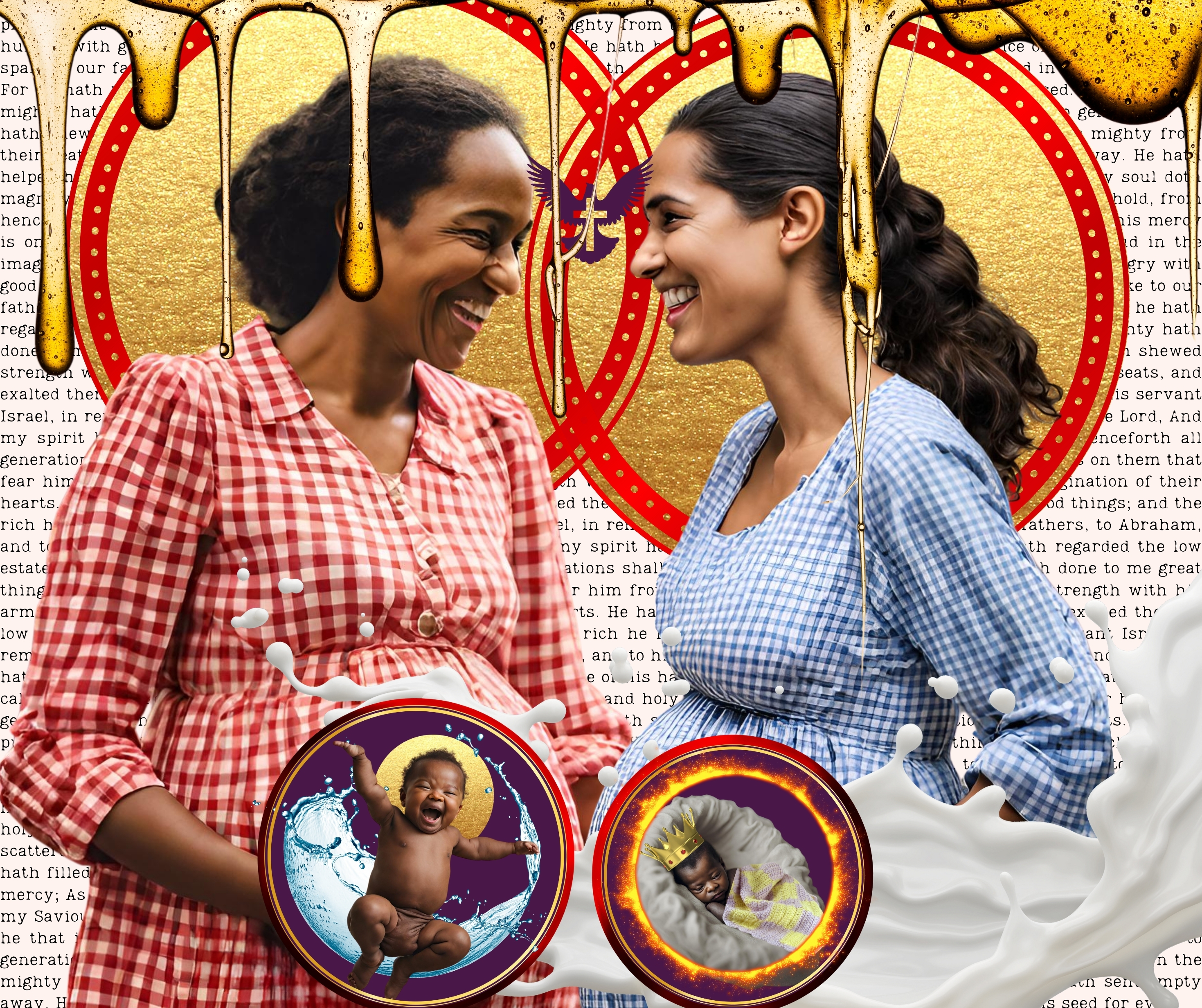
LOOK: Visitation by Beth Felker Jones

Jones, Beth Felker_Visitation
Beth Felker Jones (American, 1976–), Visitation, 2024. Digital collage with AI-generated elements.

Dr. Beth Felker Jones is a theologian who teaches at Northern Seminary near Chicago. This past year she has been making digital collages of biblical figures, especially women, with the assistance of AI technology. She shares them on her Substack, Church Blogmatics, and offers them for free with watermark or just $10 for a high-resolution, watermark-free download.

Her Visitation, she says, “imagines Mary’s visit to Elizabeth in Luke 1, flowing with milk and honey,” symbols of abundance and nourishment. (The promised land is often referred to in scripture using this poetic expression; see Exod. 3:8, Num. 14:8, Deut. 31:20, and Ezek. 20:15.) With the coming of a Savior, a great spiritual bounty awaits God’s people.

Luke the Evangelist describes Elizabeth as “filled with the Holy Spirit” (1:41). The Spirit is present in the center of this collage, silhouetted in purple, the color of Advent. His wings touch the women’s foreheads as if to bless or to join them together in celebration.

Luke also says that John the Baptist “leaped for joy” inside Elizabeth upon hearing Mary’s greeting (1:44), already recognizing that the one she bore was the Messiah. Jones shows this exultation of the in utero prophet. He splashes in the waters of his mama’s womb, as he will one day in the river Jordan, baptizing the repentant. Meanwhile, the great I AM, enfleshed as a preborn baby, sleeps inside a fiery ring in Mama Mary, crowned as king.

The words of Mary’s Magnificat form the backdrop of the scene.

LISTEN: “Among Us” by Nick Chambers, on Advent Songs by Incarnation Music (2023)

My soul will magnify
The Lord who looked on my
Lowliness with grace
My soul will magnify
My neighbor’s precious life
I see Christ in their face

Refrain:
God is among us
In human disguise
Born as one of us
To open our eyes

My soul will magnify
The Lord who took on my
Lowliness in flesh
My soul will magnify
My neighbor’s desperate cry
For in Christ they are blessed [Refrain]

Based on the Magnificat (Luke 1:46–55), “Among Us” by singer-songwriter Nick Chambers highlights how God’s becoming flesh helps us see the imago Dei (image of God) in our fellow humans. There’s an old Orthodox hymn that says, “Christ was born to raise the image that fell of old. Christ came to restore the beautiful image of God within humankind,” the image that had become obscured through sin.

With Mary, Elizabeth, and baby John, let us celebrate the Lord who brings salvation, raising up the lowly, restoring the broken, and reminding us of the dignity and belovedness of our embodied selves.

This is one of eighteen Visitation-themed songs on the Art & Theology Advent Playlist.

Roundup: “Word Made Fresh” book on poetry; cantata on Smart’s “Jubilate Agno”; and more

SPOTIFY PLAYLIST: July 2024 (Art & Theology): This month’s “mixtape” includes a worship song by Daniel P. Cariño from Baguio, the Philippines; a 1954 recording from the streets of New Orleans of the itinerant preacher, singer, and guitarist Elder David Ross; a piano-violin arrangement of “Amazing Grace” by Carlos Simon; a nineteenth-century American folk hymn; an excerpt from Mendelssohn’s oratorio Elijah; a Jesus bhajan in Hindi from Toronto; a one-word song by choral-pop composer Michael Engelhardt; a brand-new Porter’s Gate single; and more.

+++

NEW BOOKS:

New books: Diary of an Old Soul; Word Made Fresh

>> Diary of an Old Soul: Annotated Edition by George MacDonald, with introduction and notes by Timothy Larsen: At last, a keepsake edition of George MacDonald’s devotional poetry collection Diary of an Old Soul! Last week InterVarsity Press released a cloth-bound hardcover with ribbon bookmark, an introduction and sparing notes by the modern British religious history scholar Timothy Larsen, and, as MacDonald stipulated in the book’s first printing in 1880, a blank page facing each page of verse for readers to continue the conversation. C. S. Lewis gave a copy of Diary of an Old Soul to his future wife, Joy Davidman, as a Christmas gift in 1952, and it would make a wonderful Christmas gift still. For each day of the year MacDonald offers a seven-line poem that voices his spiritual longings, struggles, or joys; the Victorian tastemaker John Ruskin extolled the collection as proof that worthy religious poetry could still be written in the modern age. I highlighted my favorite selections from the book in a blog post last year, but on reading this new edition, new lines are standing out to me.

>> Word Made Fresh: An Invitation to Poetry for the Church by Abram Van Engen: Several Christians have told me they want to read more poetry and learn to better appreciate it but don’t know where to start. I usually recommend starting with an anthology, to get a taste of a wide range of styles and eras, and see if there are particular kinds they gravitate to. But now I’m thrilled I can recommend Abram Van Engen’s Word Made Fresh: An Invitation to Poetry for the Church, with a foreword by Shane McCrae. (Full disclosure: I was the copyeditor!) Endorsed by such luminaries as Christian Wiman and James K. A. Smith, the book is an excellent introduction to how and why to read poetry. Van Engen discusses sixty-two distinct poems, almost all of them reproduced in full, ranging from John Donne, Ben Jonson, and Frances Ellen Watkins Harper to Gwendolyn Brooks, Richard Wilbur, and Li-Young Lee and including, too, church hymns and biblical psalms, two forms of poetry with which Christian readers are likely already familiar. In part 1 he demonstrates six ways to read poetry: personally, for pleasure, inquisitively, like it’s a friend, considering form, and through erasure. In part 2 he answers the question “Why read poetry?”: to name creation, to tell the truth, to rejoice with those who rejoice, and to weep with those who weep. Van Engen insists that poetry is for everyone, and Word Made Fresh substantiates the claim.

Image journal is hosting an hour-long virtual book launch on Tuesday, July 9, which will feature readings with Van Engen and Image staff (register here), and for a limited time is also offering a free one-year subscription to Image to those who buy the book and provide proof of purchase (new subscribers only). You can read an excerpt from Word Made Fresh at Reformed Journal.

To access all the poems I’ve shared on this blog, see the “Poetry” tab at the top of the website: https://artandtheology.org/poetry/.

+++

PRINT INTERVIEW: “Through the Rent, Eternity Enters: A Conversation with Marilyn Nelson and Christian Wiman,” moderated by Abram Van Engen, Hedgehog Review: In December 2023, The Carver Project at Washington University in St. Louis brought together award-winning poets Marilyn Nelson and Christian Wiman for a discussion of poetry, faith, love, perception, ambition, humility, prayer, and grace, moderated by Abram Van Engen. Poets, I’ve noticed from attending conferences and reading or listening to interviews with them, tend to have an immense storehouse of wise quotes from other poets and thinkers at the ready, as this interview corroborates. There’s so much here to chew on!

+++

ESSAY: “Christianity and Poetry” by Dana Gioia, First Things: “This brief and inadequate historical survey,” writes poet and literary critic Dana Gioia, “is offered to demonstrate the powerful continuity of Christian poetry in English. Our literary canon is suffused with religious consciousness, which has expressed itself in ways beyond the imagination of theology and apologetics. Milton boasted that his Paradise Lost would ‘justify the ways of God to men,’ but his masterpiece was only one of countless poems that engaged, enlarged, and refined the spirituality of the English-speaking world. Christianity went so deeply into the collective soul of the culture that its impact continues even in our secular age.”

He proposes, “All that is necessary to revive Christian poetry is a change in attitude—a conviction that perfunctory and platitudinous language will not suffice, an awareness that the goal of liturgy, homily, and education is not to condescend but to enliven and elevate. We need to recognize the power of language and use it in ways that engage both the sense and the senses of believers.”

+++

CANTATA: Rejoice in the Lamb by Benjamin Britten, performed by VOCES8 and the VOCES8 Foundation Choir & Orchestra, dir. Barnaby Smith:Rejoice in the Lamb (Op. 30) is a cantata for four soloists, SATB choir and organ composed by Benjamin Britten in 1943 and uses text from the poem Jubilate Agno by Christopher Smart (1722–1771). The poem, written while Smart was in an asylum, depicts idiosyncratic praise and worship of God by different things including animals, letters of the alphabet and musical instruments. Britten was introduced to the poem by W. H. Auden whilst visiting the United States, selecting 48 lines of the poem to set to music with the assistance of Edward Sackville-West. The cantata was commissioned by the Reverend Walter Hussey for the celebration of the 50th anniversary of the consecration of St Matthew’s Church, Northampton. Critics praised the work for its uniqueness and creative handling of the text.” (Wikipedia)

I know this poem from its famous passage about Jeoffry the cat, in which Smart celebrates his cat’s relationship with God: “For I will consider my Cat Jeoffry. / For he is the servant of the Living God duly and daily serving him. / For at the first glance of the glory of God in the East he worships in his Way. / For this is done by wreathing his body seven times round with elegant quickness. / For then he leaps up to catch the musk, which is the blessing of God upon his prayer. . . .” See 3:52 of the video.

Britten’s seventeen-minute work is performed here using the orchestration by Imogen Holst (1907–1984), written at Britten’s request. The performance is available on VOCE8’s new album To Sing of Love, available on all streaming platforms. Follow along with the lyrics here. Read the full text of Christopher Smart’s poem here.

+++

SONG: “Wild Strawberries” by Nick Chambers: This song from 2020 expresses yearning to know the God whose beauty is revealed in nature and who is mysterious, “divinely robed in dark and radiant haze.” It’s based on a 1819 Swedish hymn by Johan Olaf Wallin that was quoted by the aging professor Isak Borg in Ingmar Bergman’s multi-award-winning film Wild Strawberries.

“In the gospel narratives,” Chambers writes, “the risen Jesus is always one step ahead, beckoning us further. We follow after tangible touches and traces he leaves behind—folded grave clothes and broken bread. He travels with us but isn’t always recognizable, still teaching his friends how to fish, readying breakfast on the beach. Wherever he appears and withdraws, the background becomes the foreground, inviting us to see and seek him everywhere. Resurrection cannot be confined; all creation is drawn into its trajectory.” Read more from Chambers in the YouTube video description.

Roundup: One-word poems, “Go to Hell” musical setting, and more

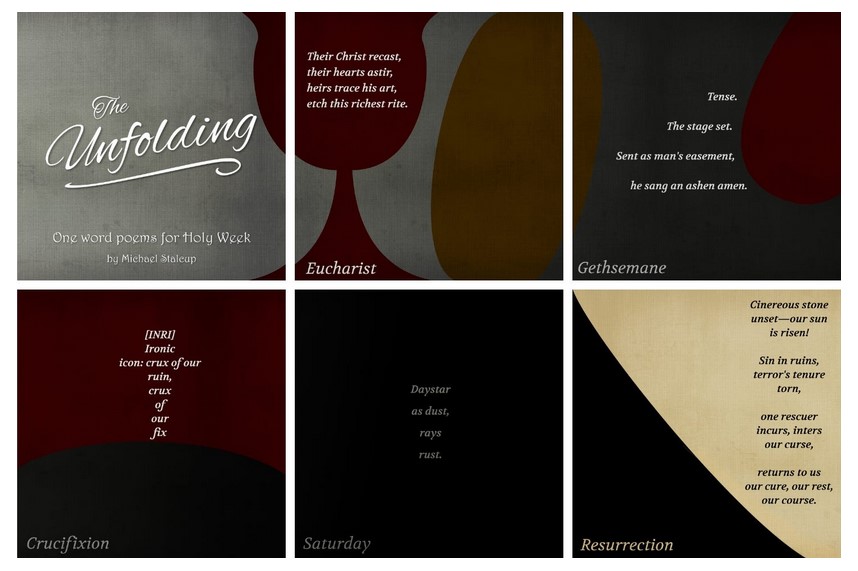
POEM SEQUENCE: “The Unfolding” by Michael Stalcup: Michael Stalcup has published a sequence of five short poems in Solum Journal that “tells the story of Jesus’ death and resurrection by unfolding five words that take us from Maundy Thursday through Easter Sunday,” he says. “I wrote these poems in a very unusual way, restricting myself to words that could be formed from the letters in each poem’s title. . . . This poetic form calls for creativity within intense limitations, which seems fitting for Holy Week—a time when Jesus crafted the most beautiful art this world has ever known within the constraints of his own suffering and death.” Stalcup has also presented them on Instagram (click on the image below).

The Unfolding by Michael Stalcup

+++

ARTICLE: “Don’t Rush Past Good Friday” by Brian Zahnd: Pastor and author Brian Zahnd cautions us not to shortchange the cross on the way to Easter, but rather to slow down and dwell there, beholding the crucified Christ.

+++

SONGS:

>> “Friday Morning” by Sydney Carter, performed by Timothy Renner: This Good Friday song by the English folk musician Sydney Bertram Carter (1915–2004) is difficult—one might even say blasphemous. That’s because it’s voiced from the perspective of the “bad” thief, who is spewing hatred and bitterness over his fate and blaming God for having created such a cruel world. But we’re aware of an irony in the refrain that the convicted man is not: “It’s God they ought to crucify / Instead of you and me, / I said to the carpenter / A-hanging on the tree.”

Read or listen to a reflection on “Friday Morning,” by Andrew Pratt, here.

>> “Go to Hell” by Nick Chambers: This song is a setting of a poem by Pádraig Ó Tuama from his collection Sorry for Your Troubles (Canterbury Press Norwich, 2013). The title is shocking, I know, but it’s derived from a line in the Apostles’ Creed, where we Christians profess that after Jesus died, he “descended into hell.” The singer-songwriter, Nick Chambers, writes in the YouTube video description: “In between Good Friday and Easter Sunday is possibly strangest day of the Christian year. On Holy Saturday, not only is Jesus, the God-Man, in the grave; traditions abound about his descent to the dead, his ‘harrowing of hell.’ What does it mean for the coming down of God-with-us not to end on earth but ‘under the earth,’ extending hope to the furthest regions of human pain and abandonment? Such a question deserves more poetry than explanation.”

“Go to hell” is a slang expression of scorn or rejection, to which Jesus was no stranger. As in the previous song, there’s an irony here, in telling Jesus to go to hell—because he did. Literally. Ó Tuama meditates on how Jesus shares in our vulnerabilities and yearnings and seeks to pull us out of the hells we’re in and redeem our stories.

Hear the poem read by the poet here, or at the end of the Stations of the Cross video below. “he is called to hell, this man / he is called to glory . . .”

+++

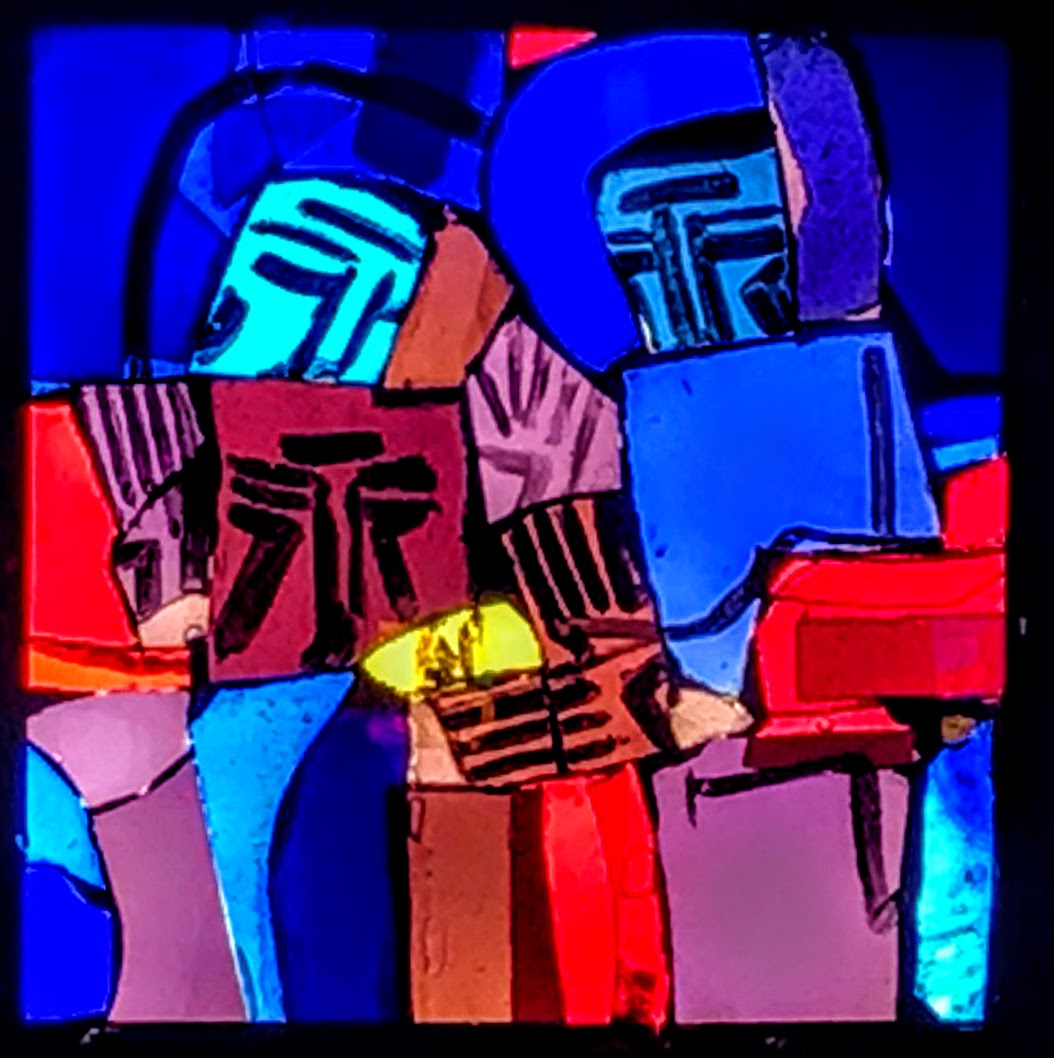
GUIDED MEDITATION: “Stations of the Cross, Good Friday, 2020” by Pádraig Ó Tuama: In 2020 the poet-theologian Pádraig Ó Tuama put together this twenty-minute video reflection for Good Friday structured around the Stations of the Cross, consisting of photos of art he’s taken and the praying of collects he’s written. (Several of the collects can be found in his book Daily Prayer with the Corrymeela Community from 2017.) The throughline is a set of stained-glass Stations by Sheila Corcoran at the Church of Our Lady Queen of Heaven at Dublin Airport; others are by Jong-Tae Choi, Gib Singleton, Sieger Köder, Richard P. Campbell, and Audrey Frank Anastasi.

Corcoran, Sheila_Veronica's Veil
Sheila Corcoran, Station 6: Veronica Wipes the Face of Jesus, ca. 1964. Stained glass, Church of Our Lady Queen of Heaven, Dublin Airport. Photo: Patrick Comerford.

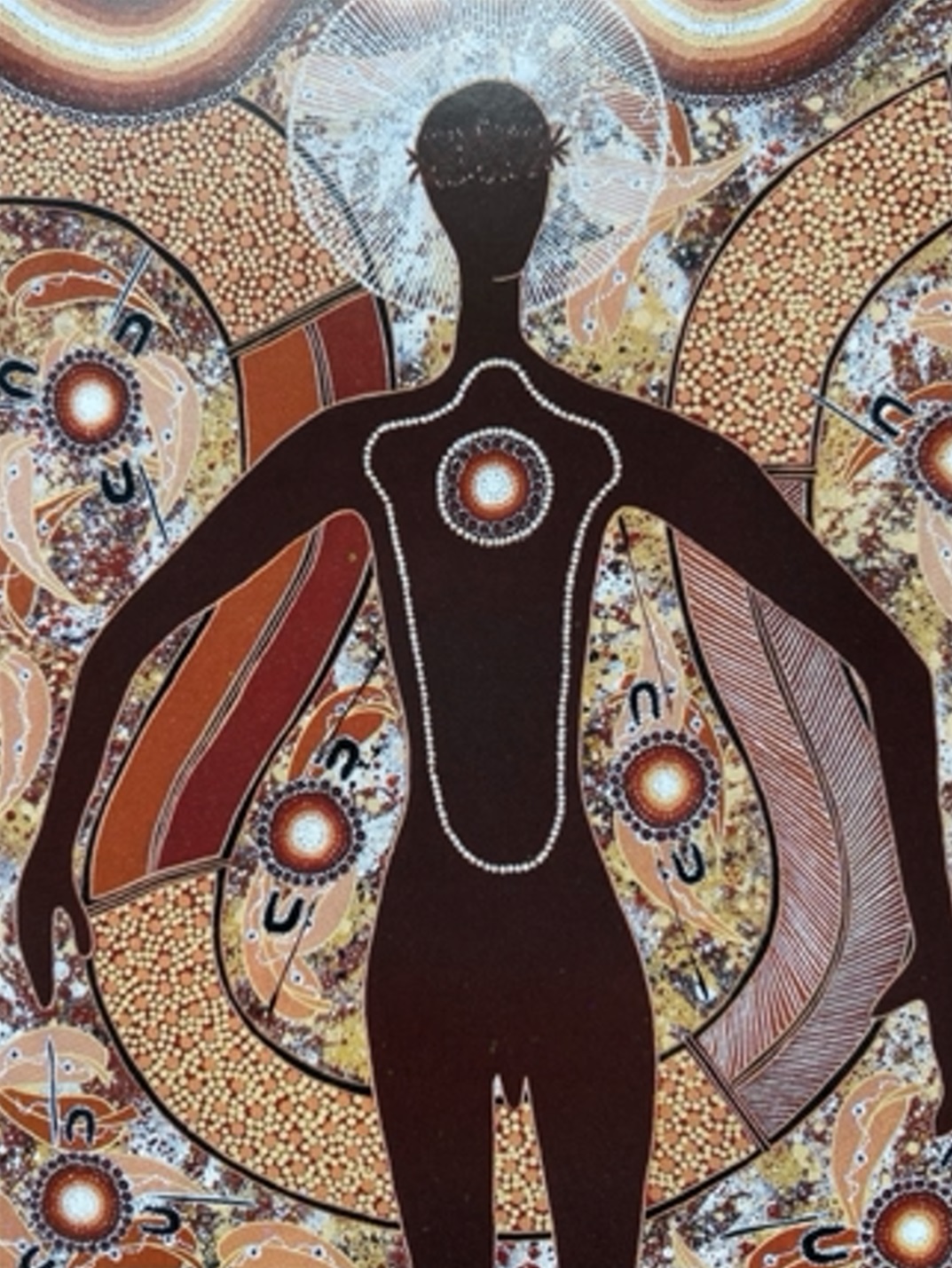
Campbell, Richard_Stripped
Richard P. Campbell (Dunghutti/Gumbaynggirr, 1958–), Station 10: Jesus is stripped of his garments, 2001. Reconciliation Church, La Perouse, Sydney, Australia.

But before stepping onto Jesus’s Via Dolorosa, Ó Tuama considers Judas, sharing a stained glass panel by Harry Clarke that illustrates a medieval legend about the Irish monastic saint Brendan the Navigator. According to the Navigatio Sancti Brendani Abbatis, on one of his voyages St. Brendan encountered Judas at sea, tied to an iceberg. He learned that an angel had taken pity on Judas in hell and given him a reprieve of one hour to cool himself from the flames of judgment. Ó Tuama then prays for those who, like Judas, are tormented by guilt and see no way out.

He closes with a reading of his poem “Go to Hell” (set to music in the previous roundup item).

+++

SONG: “For the Songless Hearts” by Jon Guerra: “There’s a lot of hubbub around Easter weekend in churches. And for good reason,” says singer-songwriter Jon Guerra. “But our hearts can’t always cooperate with the prescribed mood of the Easter season: ‘Celebrate! Be happy! Sing!’ Sometimes the last thing we are able to do is sing. Thankfully, Good Friday and Easter are not about mustering a mood. Good Friday and Easter are about remembering that there is One who meets us in our life and meets us in our death. He sings for us—and over us—when we can’t.”

That’s what “For the Songless Hearts” is about—a single released in 2017, and which Guerra sings with his wife, Valerie. In a Mockingbird blog post about it, Guerra admonishes, “Remember that before the tomb was empty, it was full. ‘When he was laid in the tomb, he laid right next to you.’” Jesus knew the depths of sorrow and the sting of death. We are not alone in such experiences.

Easter, Day 7: Creation Blooms Anew

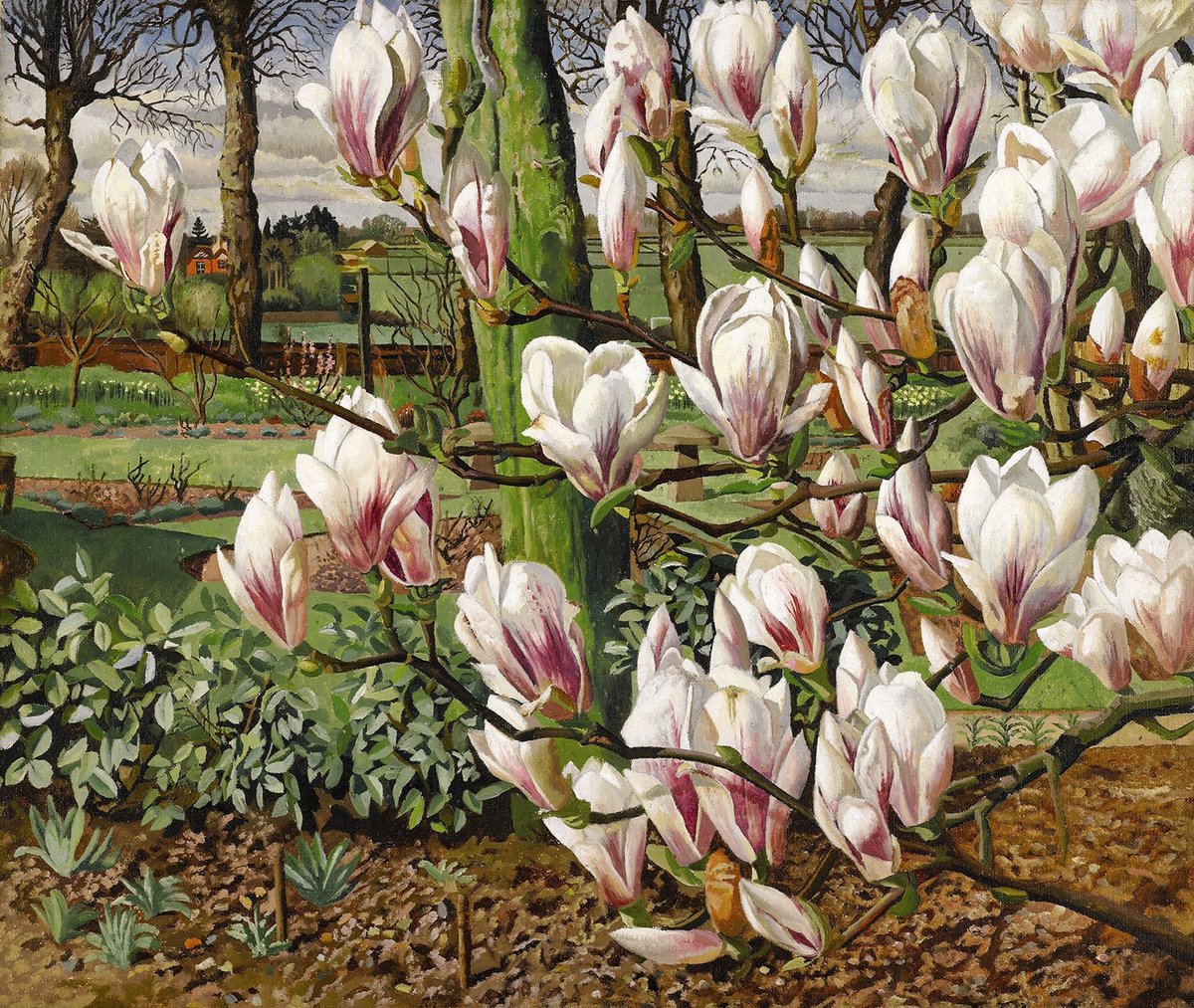
LOOK: Magnolias by Stanley Spencer

Spencer, Stanley_Magnolias
Stanley Spencer (British, 1891–1959), Magnolias, 1938. Oil on canvas, 22 × 26 in. (56 × 66 cm). Private collection.

LISTEN: “Creation Blooms Anew” by Nick Chambers, 2020

Again your Spirit sweeps,
a wind over the deep;
a new creation now arrives
to rouse us from our sleep.

The breath of heaven brings
the long-awaited spring
into the fields and seas and skies
and every barren thing.

Refrain:
Creation blooms anew
in fresh and joyful hue.
In Christ’s arising all things rise
to draw their breath from you.

Awaken by the sound
of forging swords into plows.
Come fill the Garden with your light,
and we will till the ground.

The earth is being cleared
for heaven to come near.
From every depth an eager sigh
is all that we can hear. [Refrain]

Nick Chambers [previously] is the worship pastor at Church of the Incarnation in Atlanta and a singer-songwriter whose debut album, Great Cloud, released last year. “Creation Blooms Anew” is not part of that LP, but he shared it on YouTube in 2020. It was inspired by a hymn of Adam of St. Victor, a major Latin-language poet from twelfth-century France:

Earth blooms afresh in joyous dyes;
In Christ’s arising all things rise;
A solemn joy o’er nature lies;
Alleluia!

Now peace the sea, the sky doth fill;
Heav’n’s breath wakes fair each vale and hill;
Spring pours through barren hearts and chill;
Alleluia!

Life wins from death the glorious prey;
The cherub’s sword is turned away,
And Eden’s paths are free today;
Alleluia!

Trans. A. M. E., 1884

Memories of his family’s first Easter in Atlanta in 2017 also influenced the song. “More than anything I remember the magnolia flowers,” Chambers said, “bright white and big as our baby’s head. The branches bent with the weight of them, swinging like bells welcoming us into a new home, a new season of life.”

Chambers reflects further on the image of flowering:

Norman Wirzba, in one of his many reflections on gardening, writes, “It is significant that the material context for creation and for redemption should be a garden, for it is precisely through gardening that we most experience ourselves as created beings, as beings tied to a magnificent creation and to God. . . . [The writer of Genesis 2] is clear that we become authentic and truly fulfill our vocation as we learn to care for the garden which is creation itself.” He continues, “Gardens have long been a place of spiritual nourishment, because it is here that we can sense the vivifying and gracious power of the creator at work in the creation. Without much help from us, and sometimes in spite of our worst efforts, we can plainly see that we are in the presence of a life- and death-wielding power that overcomes and envelops us all” (The Paradise of God, 117).

In the beginning, God creates humanity to till the ground in a garden. Christ suffers anguish and grief in a garden, then to be resurrected in a garden and even mistaken for its caretaker. The story comes to its endless ending in a garden—steady streams in the shade of trees thick with healing leaves. We live from this past into this future, ourselves like flowers nourished by soil and bending toward the sun. Here and now, Easter invites us into this vision, into the wild surprises of spring to be both gardeners and the garden itself.

Lent, Day 20

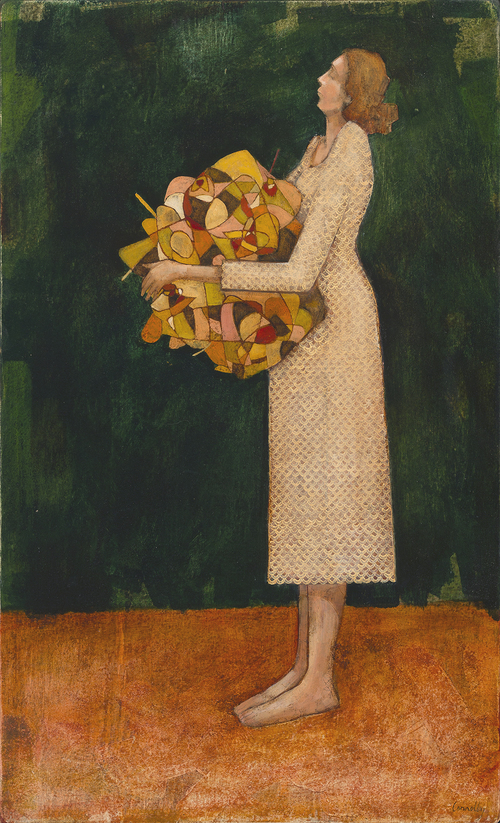
LOOK: Holding a Mystery by Caitlin Connolly

Connolly, Caitlin_Holding a Mystery
Caitlin Connolly (American, 1986–), Holding a Mystery, 2014. Oil on panel, 16 × 6 in.

Caitlin Connolly is an artist from Provo, Utah, whose paintings explore womanhood, sorrow, and faith. Her website, www.caitlinconnolly.com, contains an archive of original images dating back to 2013, many of which she sells as giclée prints from her online shop. She is featured in the first half of this episode of the BYUtv documentary series Artful.

The women in Connolly’s paintings are often shown holding something—the world, “holy things,” a book, a truth, a child, tears—or they might cup or cradle an absence that hurts. Here the figure carries a beautiful, tangled mass, a mystery, which is strangely both heavy and light. She doesn’t try to untangle it but simply hugs it close, resting.

LISTEN: “Lovely (Anselm of Canterbury)” by Nick Chambers, 2020 (to be released on an EP in 2022)

Lord my God, I don’t know how to start,
So I pray today that you would teach my heart
Where and how to find you, God, O where and how to search.
How can I know unless you show me first?

My God and my All, I’ve never seen you.
You created me, and you have made me new
And given me the good things in my hands and in my heart,
But still I don’t know who it is you are.

[Refrain] Let me seek you in all my desire,
Desire you in everything I seek.
Let it be by loving you I find you,
And when I finally find you, let it be lovely.

I come to you confessing gratefully.
It was in your image you created me
So that I may remember you and find the living course
On my way back to the loving source.

But that image is so worn and dim,
Darkened by the fault and by the smoke of sin,
That it can no longer do what you made it to do
Until it is refashioned and renewed.

[Refrain]

I’m not trying to ascend your heights;
My mind’s in no way capable of such a flight.
I do desire to know a little of your truth above
Which my heart already trusts and loves.

I seek to understand not so I can believe,
but I believe so I may understand.
And what is more, I do believe that unless I do believe,
I’ll never understand this mystery.

Originally from the Midwest, the Rev. Nick Chambers lives with his wife Katlyn and two sons in Atlanta, where he serves as the worship and formation pastor at Trinity Anglican Northside. His academic background is in philosophy and theology. “I love writing songs in, with, and for the church, and I’ve been doing it for years but only recently started seeking to share them beyond my local community,” he told me. He has contributed to two Porter’s Gate albums (Advent Songs and the forthcoming Climate Vigil Songs) and will be releasing his first solo EP later this year.

On Chambers’s YouTube channel you will find some of his original settings of psalms, prayers by Ephrem and Augustine and from the Book of Common Prayer, a poem by Pádraig Ó Tuama, and even a reworking of a Swedish hymn that he encountered through a few spoken lines from the Ingmar Bergman film Wild Strawberries!

“Lovely (Anselm of Canterbury)” is adapted from a prayer by the eleventh-century Burgundian-born monk, and later archbishop, named in the title. A doctor of the church, Anselm had a tremendous influence on the development of Christian theology and spirituality. The “combination of theological veracity and personal ardour is what most distinguishes Anselm’s writings from similar prayers, and makes him both traditional and revolutionary,” says Sister Benedicta Ward, a preeminent scholar and English translator of Anselm.

Anselm wrote the Proslogion (Lat. Proslogium, “Discourse”) in the 1070s while he was prior of the abbey of Notre Dame at Bec in Normandy. Chambers’s song is based on the passage that ends chapter 1:

Teach me to seek thee, and reveal thyself to me, when I seek thee, for I cannot seek thee, except thou teach me, nor find thee, except thou reveal thyself. Let me seek thee in longing, let me long for thee in seeking; let me find thee in love, and love thee in finding. Lord, I acknowledge and I thank thee that thou hast created me in this thine image, in order that I may be mindful of thee, may conceive of thee, and love thee; but that image has been so consumed and wasted away by vices, and obscured by the smoke of wrong‑doing, that it cannot achieve that for which it was made, except thou renew it, and create it anew. I do not endeavor, O Lord, to penetrate thy sublimity, for in no wise do I compare my understanding with that; but I long to understand in some degree thy truth, which my heart believes and loves. For I do not seek to understand that I may believe, but I believe in order to understand. For this also I believe—that unless I believed, I should not understand. (translated from the Latin by Sidney Norton Deane, 1903; emphasis mine)

In her 1973 translation of the Proslogion (pp. 243–44), Benedicta Ward sets this prayer in broken lines “in an attempt to convey the rhythm of Anselm’s complex rhymed prose, which is closer to our conception of poetry” and which aids a more meditative reading:

      Teach me to seek you,
   and as I seek you, show yourself to me,
   for I cannot seek you unless you show me how,
      and I will never find you
   unless you show yourself to me.
Let me seek you by desiring you,
   and desire you by seeking you;
   let me find you by loving you,
   and love you in finding you.

   I confess, Lord, with thanksgiving,
   that you have made me in your image,
so that I can remember you, think of you, and love you.
But that image is so worn and blotted out by faults,
   so darkened by the smoke of sin,
   that it cannot do that for which it was made,
   unless you renew and refashion it.
Lord, I am not trying to make my way to your height,
   for my understanding is in no way equal to that,
   but I do desire to understand a little of your truth
   which my heart already believes and loves.
I do not seek to understand so that I may believe,
   but I believe so that I may understand;
      and what is more,
I believe that unless I do believe I shall not understand.

I particularly love lines 8–9: “Let me find you by loving you, and love you in finding you.” Or, as Deane translates it, “Let me find thee in love and love thee in finding.” Chambers highlights these lines by making them, and the two that precede them, the refrain of his song: “Let me seek you in all my desire, / Desire you in everything I seek. / Let it be by loving you I find you, / And when I finally find you, let it be lovely.”

For Anselm, our desire for God must precede our understanding of God. We cannot know God except through love; those who pursue him without loving him will not find him. And it’s not as if our “finding” God ends the pursuit, as there is always more of God to discover. We catch small glimpses, and that’s invigorating. In this life we are never granted a full and complete vision of God but rather are always searching and often finding—and that search, undertaken with loving belief, is a delight.