
Advent, Day 1: Wait

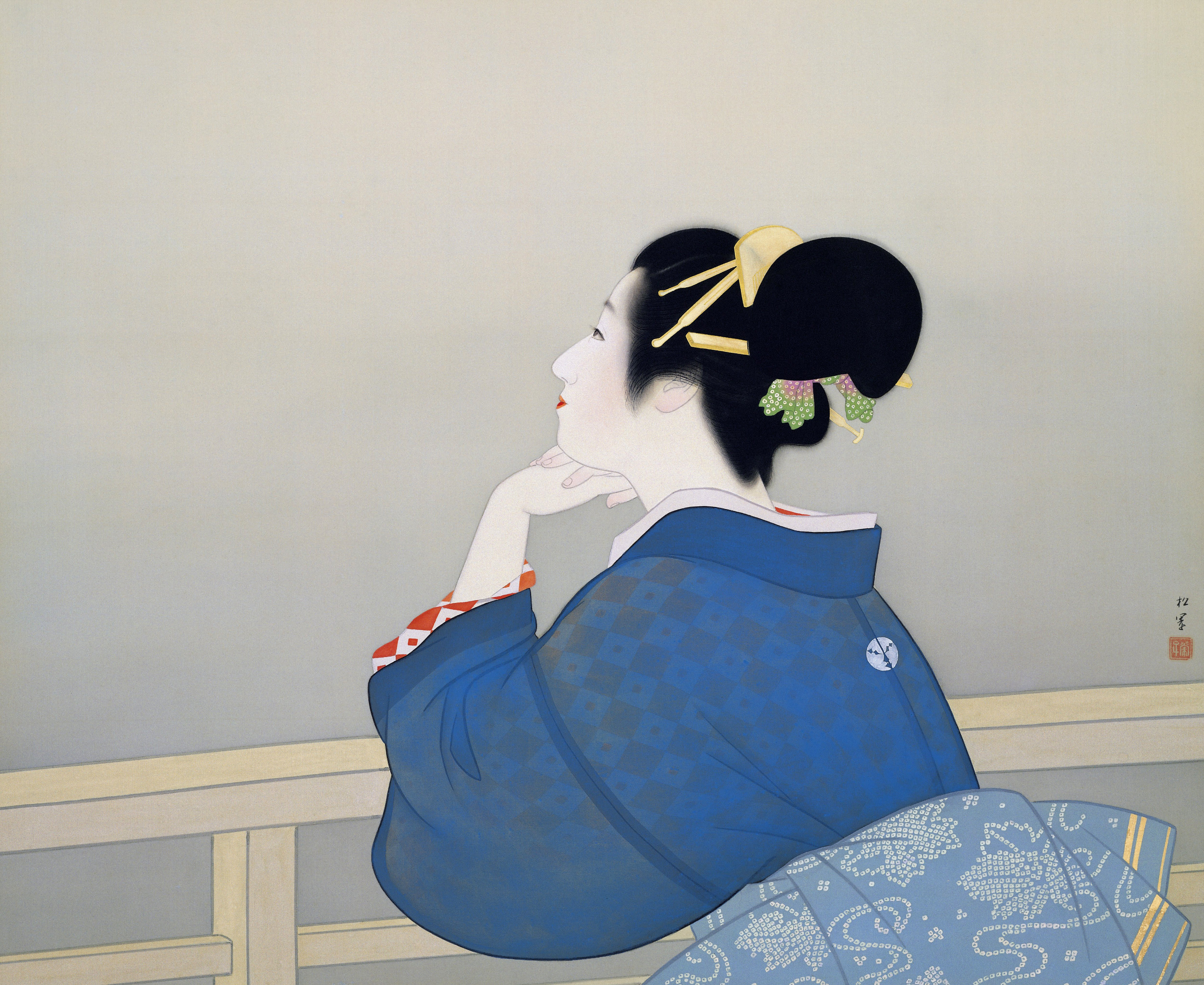
LOOK: Woman Waiting for the Moon to Rise by Uemura Shōen
Uemura Shoen_Woman Waiting for the Moon to Rise
Uemura Shōen (Japanese, 1875–1949), Woman Waiting for the Moon to Rise, 1944. Nihonga watercolor on silk, 73 × 86 cm. Adachi Museum of Art, Yasugi, Japan.

Uemura Shōen, the pseudonym of Uemura Tsune (1875–1949), was a Japanese artist active in the first half of the twentieth century, known primarily for her bijin-ga paintings of beautiful women in the nihonga style. A mold-breaking artist of exceptional skill, “she won international awards and accolades, defied social norms as a single mother of two, and dived into the world of professional painting at a time when women weren’t welcome.” In 1948 she became the first woman to be awarded Japan’s prestigious Order of Culture.

Uemura painted Woman Waiting for the Moon to Rise during World War II, showing a young woman leaning against a bridge railing on a foggy evening, her chin resting on her folded hands and her face looking ahead wistfully. Though the title tells us she’s waiting for the moon to rise, perhaps she’s also waiting for the war to end, for peace to be restored.

LISTEN: “Wait for the Lord” by Jacques Berthier of the Taizé Community, on Alleluia (1988)

Wait for the Lord, whose day is near.
Wait for the Lord: be strong, take heart!

The text of this simple chant comes mainly from Psalm 27:14: “Wait for the LORD; be strong, and let your heart take courage; wait for the LORD!” The chant was written as a responsorial refrain to the reading of another psalm, Psalm 37. As the hymnal Lift Up Your Hearts (2013) instructs congregations: sing the Taizé refrain; read Psalm 37:1–5, sing; read Psalm 37:6–9, sing; read Psalm 37:10–11, 39–40, sing. Like this:

Wait for the Lord, whose day is near.
Wait for the Lord: be strong, take heart!

Do not fret because of the wicked;
    do not be envious of wrongdoers,
for they will soon fade like the grass,
    and wither like the green herb.

Trust in the LORD, and do good;
    so you will live in the land, and enjoy security.
Take delight in the LORD,
    and he will give you the desires of your heart.

Commit your way to the LORD;
    trust in him, and he will act.

Wait for the Lord, whose day is near.
Wait for the Lord: be strong, take heart!

He will make your vindication shine like the light,
    and the justice of your cause like the noonday.

Be still before the LORD, and wait patiently for him;
    do not fret over those who prosper in their way,
    over those who carry out evil devices.

Refrain from anger, and forsake wrath.
    Do not fret—it leads only to evil.
For the wicked shall be cut off,
    but those who wait for the LORD shall inherit the land.

Wait for the Lord, whose day is near.
Wait for the Lord: be strong, take heart!

Yet a little while, and the wicked will be no more;
    though you look diligently for their place, they will not be there.
But the meek shall inherit the land,
    and delight themselves in abundant prosperity.

The salvation of the righteous is from the LORD;
    he is their refuge in the time of trouble.
The LORD helps them and rescues them;
    he rescues them from the wicked, and saves them,
    because they take refuge in him.

Wait for the Lord, whose day is near.
Wait for the Lord: be strong, take heart!

Psalm 37 encourages trust and patience in God, who will one day vindicate the righteous and put wickedness to bed.

“The Waterfall” by Henry Vaughan

Senju, Hiroshi_Waterfall
Hiroshi Senju (Japanese, 1958–), Waterfall, 2016. Acrylic and fluorescent pigments on Japanese mulberry paper, 51 × 64 in. Photo courtesy of Sundaram Tagore Gallery.

With what deep murmurs through time’s silent stealth
Doth thy transparent, cool, and wat’ry wealth
                  Here flowing fall,
                  And chide, and call,
As if his liquid, loose retinue stayed
Ling’ring, and were of this steep place afraid,
                  The common pass
                  Where, clear as glass,
                  All must descend
                  Not to an end,
But quick’ned by this deep and rocky grave,
Rise to a longer course more bright and brave.

      Dear stream! dear bank! where often I
      Have sat, and pleased my pensive eye;
      Why, since each drop of thy quick store
      Runs thither, whence it flowed before,
      Should poor souls fear a shade or night,
      Who came, sure, from a sea of light?
      Or, since those drops are all sent back
      So sure to Thee, that none doth lack,
      Why should frail flesh doubt any more
      That what God takes He’ll not restore?

      O useful element and clear!
      My sacred wash and cleanser here;
      My first consigner unto those
      Fountains of life, where the Lamb goes!
      What sublime truths and wholesome themes
      Lodge in thy mystical, deep streams!
      Such as dull man can never find
      Unless that Spirit lead his mind,
      Which first upon thy face did move,
      And hatched all with his quick’ning love.
      As this loud brook’s incessant fall
      In streaming rings restagnates all,
      Which reach by course the bank, and then
      Are no more seen: just so pass men.
      O my invisible estate,
      My glorious liberty, still late!
      Thou art the channel my soul seeks,
      Not this with cataracts and creeks.


In “The Waterfall” by Henry Vaughan (1621–1695), a stream’s sudden surge and plummet over a precipice followed by a calm, continued flow is a picture of the soul’s passage into eternity—the continuation of life after death.

The speaker addresses the stream and its retinue of waters, who “murmur” and “chide”—that is, make incessant noise (in the word’s archaic sense). The waters move with increasing momentum toward the brink and hesitate just before but then take the plunge. Briefly brought under, in their “deep and rocky grave” they are “quickened,” made alive once more, as they rise back up to the surface and course smoothly onward, no longer in a state of agitation. After a momentary crash, serenity.

Vaughan represents this action visually with an alternation of groups of long lines and short lines, which give the impression of water tumbling over ledges of rock. The lines then steady out into a uniform column, signifying the water’s becoming sedate.

“Why,” the speaker wonders, “since each drop of thy quick store / Runs thither, whence it flowed before, / Should poor souls fear a shade or night, / Who came, sure, from a sea of light?” Death is benevolent, merely a drop-off along the route and then reconstitution to the whole. Just as the stream that has fallen returns to the vast ocean from whence (via the cycle of evaporation, condensation, precipitation) it came, so, too, does the soul return to God, its origin.

In the final stanza the speaker muses on water as sacrament—baptism, he says, is our “first consigner unto those / Fountains of life, where the Lamb goes” (see Rev. 7:17; cf. Isa. 49:10). In other words, our baptism gives us over to God, to the New Eden. If baptism is our first consigner, then death is our final consigner, bringing us at last to the One to whom we belong.

The profound mystical truth hidden in something as natural as a waterfall is discerned only by those whom the Spirit reveals it to—that same Spirit who hovered over the waters at Creation (Gen. 1:2) “[a]nd hatched all with his quick’ning love.”

I write this in memory of my husband Eric’s grandfather, who died Sunday. I’m consoled by the image of him as a water droplet whose plunge does not mean a cessation of being but rather a flowing into God, into “glorious liberty.” When water plunges down, it sends ripples toward the bank, Vaughan writes, but then settles into stillness and is imperceptibly carried away to a destination out of view. So Grandpa Jones is now on “a longer course more bright and brave,” flowing toward “a sea of light.”