
Christmas, Day 12: Bright and Glorious

LOOK: Epiphany by John August Swanson

Swanson, John August_Epiphany
John August Swanson (American, 1938–2021), Epiphany, 1988. Serigraph, 38 × 12 in. Edition of 210. [for sale]

Tomorrow, January 6, is the feast of Epiphany, commemorating the visit of the magi to the infant Christ, an episode that represents God’s manifestation to the nations beyond Israel. Printmaker John August Swanson visualizes their journey in a starkly vertical composition that was conceived as the right wing of a triptych (three-paneled artwork), the other two panels depicting the Annunciation to the Shepherds and the Nativity. In subsequent years he added A Visit (depicting the Annunciation to Mary), Flight into Egypt, and Presentation in the Temple to the set.

Here’s what Swanson says about the piece:

Epiphany depicts the journey of the three Magi as they travel up a serpentine trail. One of the Wise Men is seated as he looks at a map of the constellations with his magnifying glass; his servant holds a lamp so that he can see. Another Magi searches with his telescope into the sky. They look up in search of their beautiful guiding star as angels surround and point to it. They have exotic birds, peacocks, and dogs among their animals. I have tried to capture the details of the many plants, bushes, and trees and to create a variety of colors of green.

I used many symbols within the tapestries draping the animals. These patterns depict the Lion of Judah, the lamp in the darkness, the rain falling on the parched ground, the key to the locked door, the crown and the heart, and the gates to the city.

This is part of a series of three images (triptych). They were inspired by the Mexican tradition that I am familiar with for Christmas. Families will each create a beautiful crèche (nacimiento) with many figures and animals, creating a whole environment with landscaping in miniature around the Nativity figurines.

His other inspirations for this set include the opera Amahl and the Night Visitors by Gian Carlo Menotti and the medieval stained glass windows in Chartres Cathedral.
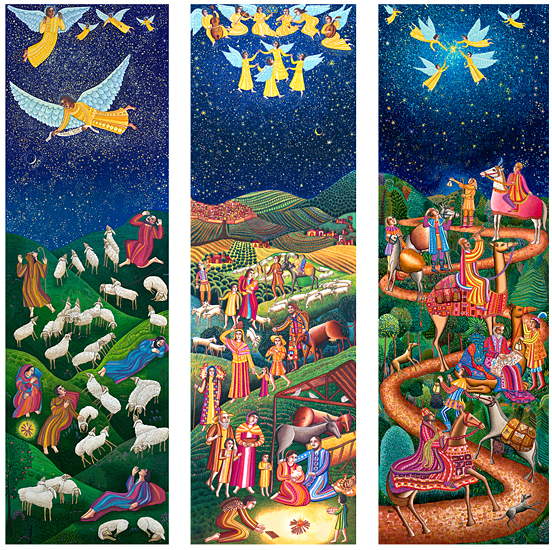
Swanson, John August_Advent Triptych
John August Swanson, Advent Triptych, 1985–88 [for sale as poster or card]

John August Swanson (1938–2021) [previously] was born in Los Angeles of a Mexican mother and Swedish father. His father died when he was young, and he was raised in a multigenerational Mexican Catholic home. He studied serigraphy under Corita Kent [previously], and it became his primary medium. A serigraph is a type of print in which each color is individually layered by applying ink through a silkscreen onto paper. Epiphany has forty-eight individual colors.  

LISTEN: “Bright and Glorious” | Original Danish text (“Deilig Er Den Himmel Blaa”) by Nikolai F. S. Grundtvig, 1810 | English translation by Jens Christian Aaberg, 1927; first stanza adapted by the editors of the Lutheran Service Book and Hymnal, 1958 | Music by Seth Thomas Crissman and Greg J. Yoder, 2017 | Performed by the Walking Roots Band on Hark! A Walking Roots Band Christmas, 2017

[Watch the group sing the first stanza.]

Bright and glorious is the sky
Radiant are the heavens high
Where the golden star is shining
All its rays to earth inclining
Leading to the newborn king

Him they found in Bethlehem
Yet he wore no diadem
They but saw a maiden lowly
With an infant pure and holy
Resting in her loving arms

Guided by the star, they found
Him whose praise the ages sound
We, too, have a star to guide us
That forever will provide us
With the light to find our Lord

As a star, God’s holy word
Leads us to our King and Lord
Brightly from its sacred pages
Shall this light throughout the ages
Shine upon our path of life

The Walking Roots Band (TWRB) is an acoustic folk/bluegrass-ish music group steeped in Anabaptist hymn-singing traditions and based in Harrisonburg, Virginia. Several of its members are the creative forces behind The Soil and The Seed Project, a liturgy and arts initiative that launched in 2021.

Here they’ve retuned an Epiphany hymn from Denmark, which compares the star that led the magi to Jesus to the Bible, God’s word, which serves as a guiding light for spiritual seekers, leading us to Christ himself. Its pages offer countless epiphanies—revelations of God’s glory, opportunities for divine encounter. Its wisdom and truth can illuminate our paths if we let it.
Christmas, Day 11

LOOK: Dominican Nativity by Valentine Reyre

Reyre, Valentine_Nativity
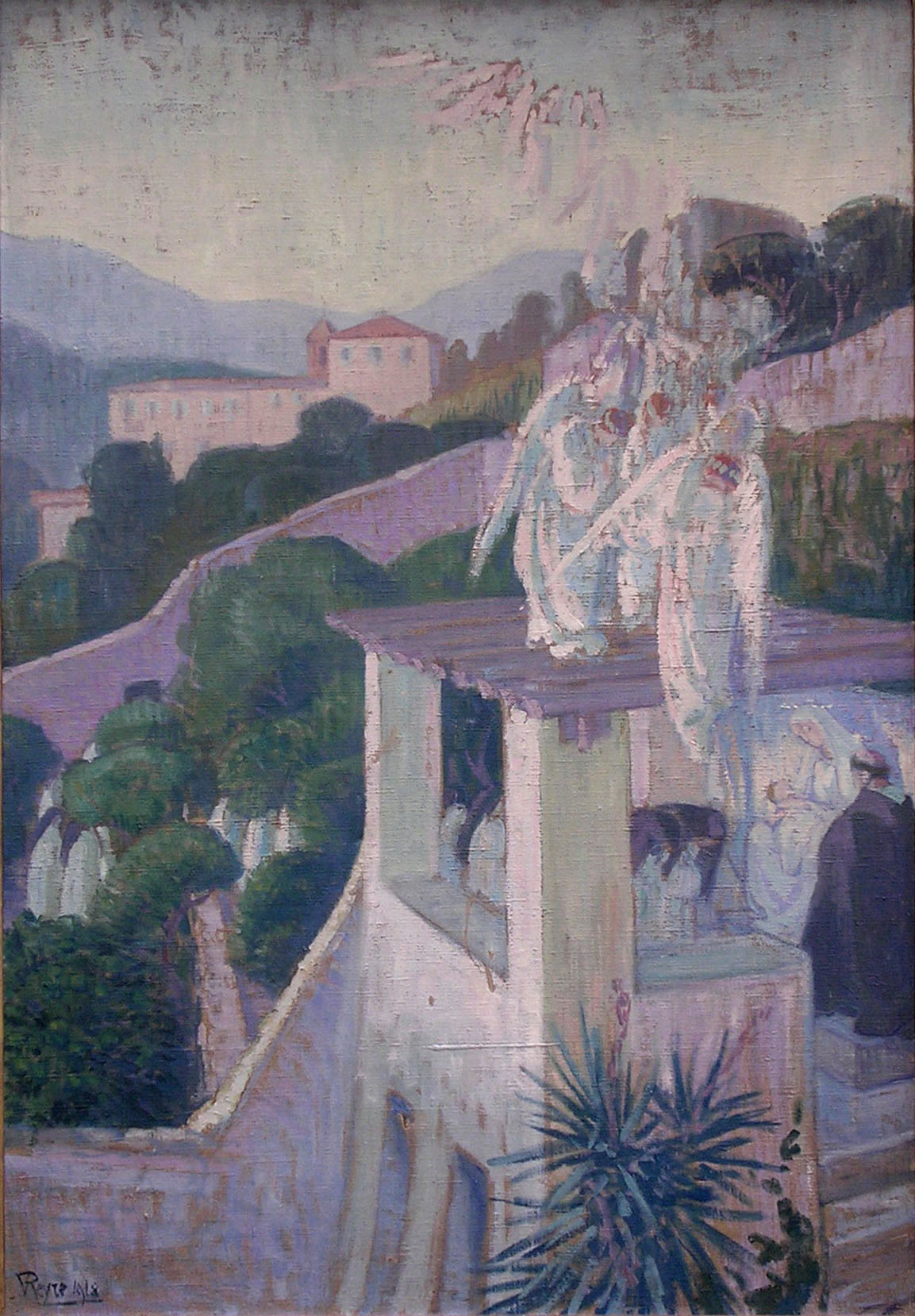
Valentine Reyre (French, 1889–1943), Nativité aux dominicaines (Dominican Nativity), 1918. Oil on canvas. Private collection. Photo: Michel Guérin.

Valentine Reyre was a French artist who participated in the revival of religious art in the first half of the twentieth century. She was the cofounder, with Maurice Storez and Henri Charlier, of L’Arche, a group of Catholic artists and architects active from 1919 to 1934. She also participated in the Ateliers d’art sacré, a movement that sought to reconcile tradition and modernity, art and craft, in the decoration of church interiors, especially those devastated by World War I. Members of the Ateliers—the most famous of which were Maurice Denis and George Desvallières—rejected academism on the one hand and the avant-garde (e.g., futurism, cubism) on the other, seeking a third way forward for religious art.

Reyre’s Dominican Nativity is set outside a Dominican convent in the hills of France. The focal point is the Virgin Mary and the infant Jesus, clothed in white and seated under a small, open, roofed structure. It’s deliberately ambiguous as to whether these figures are meant to be present in the flesh in this space or are a statue; in other words, is this the holy birth transplanted to another time and place, occurring as if for the first time, or is it the birth memorialized? Either way, a procession of nuns winds through the tree-studded landscape to offer their worship and devotion to Christ, their shaping mirrored by the ribbon of angels that unfurls from distant sky to the foregrounded rooftop. The adult male figure at the right is probably Saint Dominic, the medieval Castilian priest who founded the Dominican order, as he is tonsured and wears a habit.

I love the intersection of time and eternity in this image—heaven breaking into the everyday. A community of sisters bows in prayer and re-members Christ’s Nativity.

LISTEN: Hymns and Sacred Songs, FS 83: No. 1. Förunderligt at sige | Words by Nikolai F. S. Grundtvig, 1845 (reworked from “Mit hierte altid vanker” [“My Heart Always Wanders”] by Hans Adolph Brorson, 1732) | Music by Carl Nielsen, 1919 | Performed by the Svanholm Singers, dir. Sofia Söderberg Eberhard, on December, 2010

Forunderligt at sige,
Og sært at tænke paa,
At Kongen til Guds Rige
I Stalden fødes maa,
At Himlens Lys og Ære,
Det levende Guds Ord,
Skal huusvild blandt os være,
Som Armods Søn paa Jord!

Selv Spurven har sin Rede,
Kan bygge der og boe;
En Svale ei tør lede
Om Nattely og Ro;
De vilde Dyr i Hule
Har hver sin egen Vraa:
Skal sig min Frelser skjule
I fremmed Stald paa Straa?

Nei, kom! jeg vil oplukke
Mit Hjerte, Sjæl og Sind,
Ja, bede, synge, sukke:
Kom, Jesus, kom herind!
Det er ei fremmed Bolig,
Du den har dyrekiøbt!
Her skal du hvile rolig,
I Kiærligheden svøbt!

English translation by Jenny Rebecca Rytting, 2012:

How wonderful to sing of,
And strange to think at all,
The sovereign of God’s kingdom
Is born within a stall,
All heaven’s light and honour,
God’s living word, e’en he,
On earth shall homeless wander,
The son of poverty.

The sparrow, with her nesting,
Can build herself a home;
We find the swallow resting,
At night she needn’t roam.
The wild beasts abide in
The burrows where they stay.
Shall then my Saviour hide in
An unknown stall on hay?

No, come, I’ll open to thee
My heart, my soul, my mind.
I’ll pray and sing and sue thee,
“Come, Jesus, come inside!”
For here thou art no stranger;
This home thou dearly bought.
Rest now within this manger
In swaddling love has wrought.

Jenny Rebecca Rytting describes this Danish carol’s complex textual history, starting with its origins in an eighteenth-century carol by the Danish bishop and hymn-writer Hans Adolph Brorson. Brorson’s text has eleven verses; Nikolai F. S. Grundtvig cut it down to six in 1837, adapting these verses but following Brorson’s wording fairly closely. In 1845 Grundtvig made “extensive changes” to his initial reworking of the carol and published it in a booklet of his hymns. Much later, in 1939, the editors of Højskolesangbogen (The Folk High School Songbook) published Grundtvig’s text with only three verses (verses 1, 5, and 6 of his 1845 version). That’s the version that’s most often used today. Rytting has produced an English translation, posted above. For a translation of all six verses, albeit one that’s a bit clumsy, see here (scroll down to #50, “How wonderful to ponder”).

Carl Nielson, widely recognized as Denmark’s most prominent composer, wrote a musical setting for “Förunderligt at sige” in 1914 (in a letter to his wife at the time, he described it as “the most beautiful I have yet composed”), and it was first published in 1919. Cataloged as CNW 165, it is now considered the standard tune for the carol.

The text is inspired in part by Jesus’s words in Matthew 8:20: “Foxes have holes, and birds of the air have nests; but the Son of Man has nowhere to lay his head.” He was born in an out-of-town stable, lived as a stranger in Egypt, and spent years as an itinerant preacher, never staying for too long in any one place. The speaker invites the wandering Christ to take up permanent residence within her, as he has already bought her (Gal. 3:13; 1 Cor. 6:20). Her love, she says, will provide the swaddling, a cozy warmth.