Roundup: Armenian passion art, Messiaen and Richter for Good Friday, the paradox of Holy Saturday, and more

Holy Week starts this Sunday. Per usual, I’ll be publishing daily art and music pairings during that period (so, too, during the Easter Octave), but here is some additional art and music, and a theological reflection, for the occasion. You might also consider spending time with the Holy Week Playlist I curated on Spotify.

TENEBRAE SERVICE: Good Friday, April 2, 2021, Good Shepherd New York: Not all churches host a service on Good Friday, but for me, it is one of the most meaningful services of the year and helps make Easter all the more potent and celebratory. It wasn’t until 2011 that I attended my first Good Friday service—of the Tenebrae variety, Latin for “darkness,” meaning we started with multiple lit candles, and they were gradually extinguished throughout the evening, symbolizing the Light of the World dying out. If you’re curious about what such a service might look like, here’s a great example from 2021, from Good Shepherd New York. Filmed during the pandemic, it was a digital-only offering. As is typical, it combines song and scripture readings to tell the story of Christ’s death. Some Tenebrae services include a brief homily, but this one does not. I’ve included a list of time stamps to the songs below.

  • 1:15: “When I Survey the Wondrous Cross” by Isaac Watts and Lowell Mason
  • 6:26: “I Need Thee Every Hour” by Annie Hawks and Robert Lowry
  • 11:19: “The Reproaches” by Paul Zach [previously]
  • 17:06: “Shepherd Strong” by the Brilliance
  • 20:55: “Your Blood Ran Down” by Paul Baloche
  • 24:28: “How Deep the Father’s Love for Us” by Stuart Townend
  • 31:08: “Remember Me” by Paul Zach
  • 35:50: “Were You There?,” African American spiritual (with a watercolor by Soyoung L Kim, inscribed with Isaiah 53:11a: “Out of the anguish of his soul he shall see and be satisfied”)

+++

INSTRUMENTAL MUSIC FOR GOOD FRIDAY: The one Facebook group I belong to is Liturgy Fellowship; I joined when I was a worship planner and stick around because of the many great resources, especially musical ones and ideas for marking holy days as a congregation, that are shared by Christians across denominations. One post I made note of is from Andrew Kerhoulas, the associate pastor at Grace Mills River in Mills River, North Carolina. As a prelude for their 2023 Good Friday service, he said, Grace Mills River musicians played an excerpt from the fifth movement of Olivier Messiaen’s Quartet for the End of Time. Here’s the full movement, performed by cellist Bingxia Lu and pianist Jackie Tu:

“The piece is avant-garde and not a little abrasive to those with pop music sensibilities,” Kerhoulas wrote to the group. “But once you know that it was written in 1941 by a French prisoner of war while in a German prison and first performed for fellow prisoners, it takes on depths of meaning. So too the cross: It is grotesque and horrific, but it becomes meaningful and even beautiful when you know the occasion—the deeper story—in which Jesus gave up his life.”

The church concluded its Good Friday service with a string quintet postlude, “On the Nature of Daylight” by Max Richter, played to the dimming of lights. Again, the following performance is not from Grace Mills River, but rather by Louisa Fuller, Natalia Bonner, John Metcalfe, Chris Worsey, and Ian Burdge for the fifteenth anniversary edition of The Blue Notebooks album.

Some people think that music used in Christian worship as a focal piece (i.e., not in the background) needs to have words to be worshipful and productive. I strongly disagree. Instrumental music conveys beauty and sets a mood and, yes, even communicates—often that which is difficult to express verbally. I love Grace’s thoughtful inclusion of these two modern and contemporary pieces from the classical tradition in their community’s observance of Good Friday.

+++

ART COMPILATION: “Crucifixion: Armenian Illuminated Manuscripts” by Levon Ounanian: This compilation brings together thirty-one Armenian miniatures of Christ’s passion. (Miniatures are painted illustrations in a manuscript, so called not because they’re small, though they usually are, but because artists often sketched them using a red lead pigment called minium.) According to the author, of the 31,000 Armenian manuscripts currently listed around the world, about 6,000 of them contain miniatures, not to mention the many more that contain non-narrative decoration.
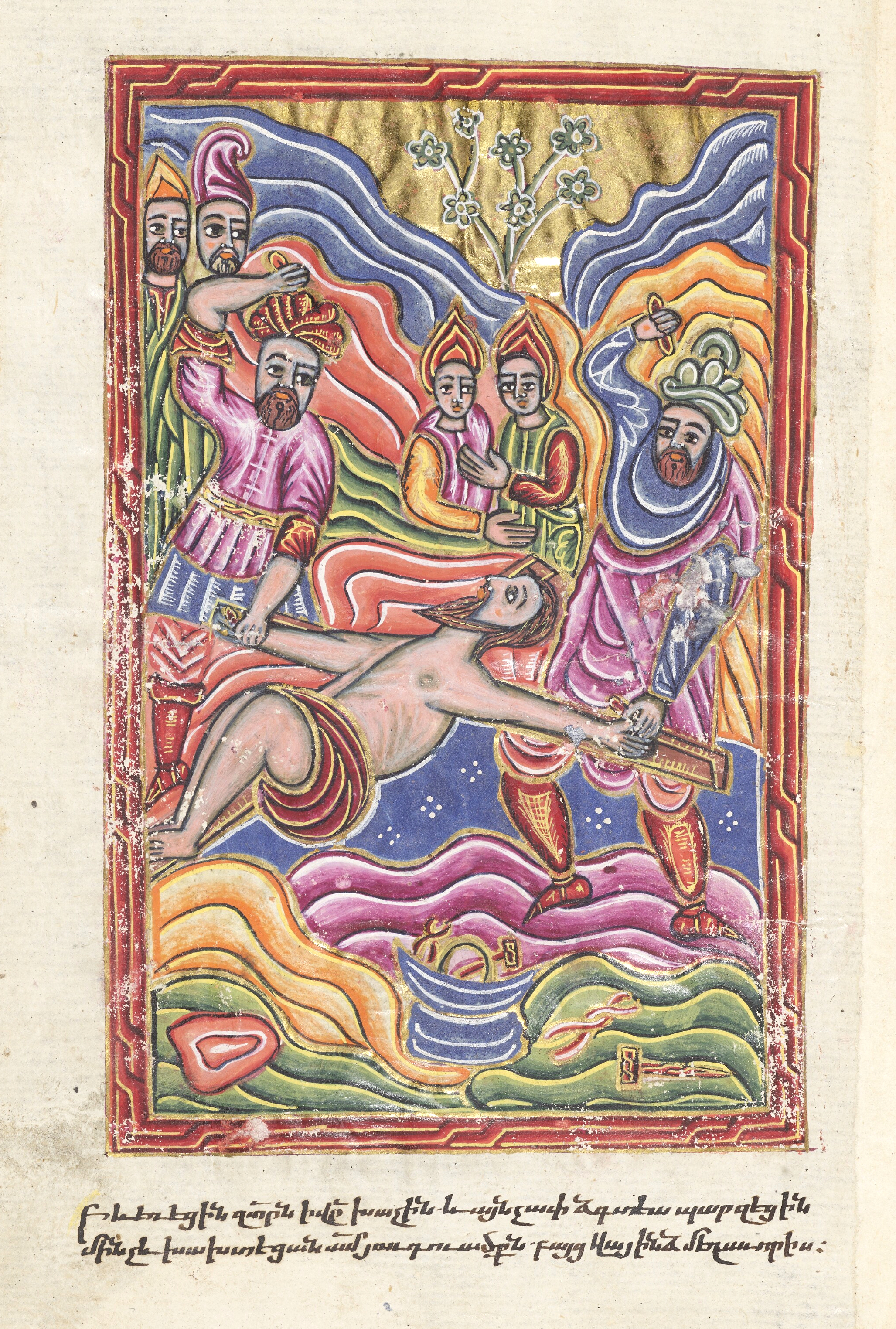
Khzanetsi, Mesrop_Christ nailed to the cross
Mesrop of Khizan (Armenian, active in Persia, ca. 1560–ca. 1652), The Nailing on the Cross, from an Armenian Gospel book, 1609. Oxford, Bodleian Library, MS. Arm. d.13, fol. 13v. Click to view the fully digitized manuscript.

+++

SONG: “Saare Paap” (सारे पाप) (All Sins), performed by James Bovas: In this video, James Bovas [previously] performs a Hindi version of a Malayam song about the Crucifixion. The Hindi lyrics and English translation were supplied to me by the Indian gospel media production company Sarah Creation.

सारे पाप और दाग ममटाकर, मुक्क्त देने के मलए
मुक्क्त दाता ने बहाया, खून अपना क्रूस से
खून के प्यासे भेडियों ने, आके घेरा यीशु को
मारे कोिे टोकी कीले, धारे ननकली ज़ख्मों से
मेरे मन तू याद कर ले, क्यों सहे दुुःख यीशु ने
तेरा खानतर जान देकर, दी ररहाई यीशु ने
श्राप सारे लेके मेरे, दे दी मुझको आमशषे
यीशु के पावन लहू से, भाग्य मेरे खुल गए

To remove all the stains and sin, and to give salvation
The Redeemer shed his blood on the cross
Bloodthirsty wolves surrounded Jesus
He was scourged, nailed, and a stream of blood issued forth from his wounds
O my soul, never forget why Jesus suffered!
He gave his life to set you free
He took all my curses and gave me all the blessings
By the holy blood of Jesus, my destiny changed forever

+++

ESSAY: “The Path from Death to Life” by Kurt Koch, Plough, March 30, 2024: A Catholic cardinal reflects on the dark side and the bright side of Holy Saturday. “As the day Jesus rested in the grave, Holy Saturday is the day of God’s concealment and silence in history,” Koch writes. “And yet, Holy Saturday also has a hopeful and joyful aspect. . . . [On this day] Jesus traveled to [Hades,] the place of greatest loneliness – a place completely bereft of any human relationships – and stirred the souls and limbs trapped by rigor mortis with the warming love of God. He transformed their grave into a place of new life.” This essay is anthologized in the revised and expanded edition of Bread and Wine: Readings for Lent and Easter (Plough, 2026).

Roundup: “O Children, Come”; the Christmas story through news photos; Messiaen and the Incarnation; art from Bethlehem; nativity musical soundtrack

SONG: “O Children, Come” by Keith and Kristyn Getty: The Gettys are an Irish married couple who are major contributors to the modern Christian hymn-writing movement. I really enjoyed singing this song of theirs at church last week (CCLI 7036340); it was my first time hearing it. The acoustic performance below is from the Gettys’ 2015 Christmas concert. They’ve also recorded it with Ladysmith Black Mambazo.

+++

PHOTO ESSAY: “Alternative Nativity”: Kezia M’Clelland works with children affected by conflict in the Middle East and raises public awareness through her blog, Kezia Here and There. In 2015 she compiled news photos that document the refugee crisis and set them to excerpts from St. Matthew’s account of Christ’s birth and the prologue to St. John’s Gospel—a very powerful pairing that gives impetus to our Advent cry, “Come, Lord Jesus!” This is not a generic mashup; each photo was carefully selected to amplify a corresponding scripture text.

Alternative nativity1
“About that time Caesar Augustus ordered a census to be taken throughout the Empire. This was the first census when Quirinius was governor of Syria. Everyone had to travel to his own ancestral hometown to be accounted for.” (Photo via Reuters. Displaced Yazidis escape across the Syrian border by foot, fleeing violence from the Islamic State militants who have taken over their home town of Sinjar.)

Alternative nativity2
“So Joseph went to Bethlehem. He took with him Mary, his fiancée, who was obviously pregnant by this time.” (Photo via Al Jazeera. A refugee father with his pregnant wife and daughter asks for permission to enter into Hungary near Roszke as the border fence with Serbia is closed by Hungarian police.)

For each subsequent Advent, M’Clelland has released something in a similar vein: the video “Hope Is on the Way” in 2016, and this year, “Light in the Darkness,” with verses of scripture, mainly from the Old Testament prophets, emblazoned across photos from today’s Middle East. “This year again these Advent pictures and words will speak of a hope that is now and not yet,” she writes. “I am grateful that Advent gives us the freedom to weep and to hope, to rejoice and to grieve, to wait for and to recognise the Christ who is already here among us.”

Marrying the Christmas story with contemporary photojournalism can teach us to “pray with the Bible in one hand and a newspaper in the other,” as the popular adage goes. As we see the world’s brokenness, it should intensify our fervor for Christ’s shalom and impel us to action.

+++

UPCOMING MUSIC & ART EVENT: “Messiaen and the Incarnation,” December 20, 8 p.m., St. Mary’s Addington, London: Next Wednesday evening, Dr. Edward Forman will be performing three movements each from the French avant-garde composer Olivier Messiaen’s organ suite La Nativité du Seigneur (The Nativity of the Lord) and piano suite Vingt regards sur l’Enfant-Jésus (Twenty Contemplations on the Infant Jesus). Messiaen was a committed Christian who sought to express theological truths in a fresh, modern idiom. Like much of his output, these two works reject the Western conventions of forward motion, development, and diatonic harmonic resolution, so they can be difficult for first-time hearers. But this complexity, this sense of the unexpected, is appropriate for the mystical content they seek to convey.

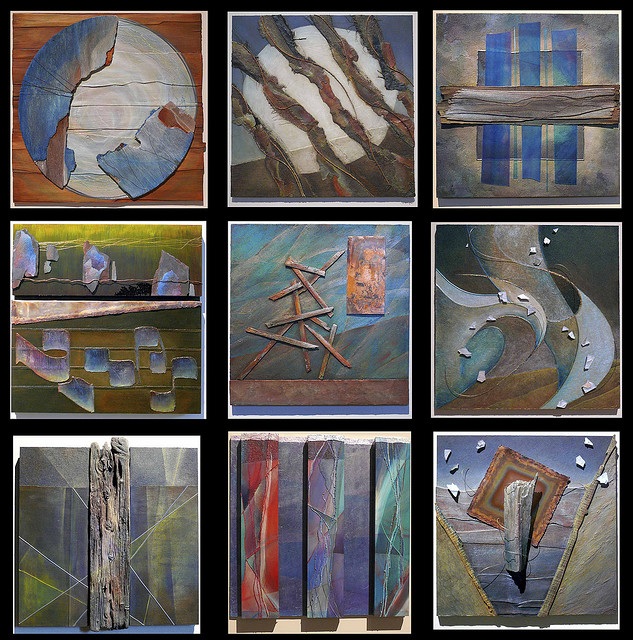
Inspired by the unique palette of sounds, textures, and rhythms of Nativité, British artist Sophie Hacker translated these into visual form. After deeply studying the music, in 2007 she created nine mixed-media panels in response—one for each movement—using slats of wood, nails, lead, wire, tree bark, and other found objects; you can see some of her process in the video below. These premiered at Winchester Cathedral in 2008. Then again in 2015 Hacker participated in another Messiaen-inspired artistic collaboration, under the direction of pianist Cordelia Williams, with poets Michael Symmons Roberts and Rowan Williams. This project is called “Between Heaven and the Clouds: Messiaen 2015.”

La Nativité du Seigneur by Sophie Hacker
Sophie Hacker (British), La Nativité du Seigneur (The Nativity of the Lord), 2007. Mixed media on nine canvases, 60 × 60 cm each. Photo: Mike J. Davis.

To guide us through the listening experience, St. Mary’s will be projecting Hacker’s artworks onto a screen during the playing, and interspersing it with poetic reflections on the theological themes—from the Bible, Messiaen, Roland Riem (Icons of the Incarnation), and other sources. “We think it is equally pointless to try to explain Messiaen’s music in words as to attempt a sensible account of what it means for God to become human,” writes Forman in the booklet that will be provided to attendees. “We hope that the visual effects, words and music will enhance each other in ways that are inspiring and provoking.”

Messiaen’s compositions are definitely more challenging than the standard Christmas music fare, so I am grateful that St. Mary’s has the boldness, vision, and talent to offer them to the public, and in the meaningful context (which you likely won’t get in the concert hall) of meditation on the mystery of the Incarnation.

+++

ARTIST PROFILE: Zaki Baboun: Zaki Baboun is a Palestinian Christian artist living in Beit Jala, a suburb of Bethlehem. He paints religious scenes in oils on olive wood, which you can browse and purchase here—either the originals or reproductions on Christmas cards.

The first video below contains a short, two-minute interview with Zaki and shows him painting The Journey of the Magi; the second shows him painting The Good Shepherd.

+++

ALBUM: The Unusual Tale of Mary and Joseph’s Baby by Waterdeep: I saw the world premiere of this nativity musical last summer in New York (read my review here), and it really helped shepherd my imagination into a deeper understanding of Mary and Joseph’s social and emotional realities. Now the album is out! The songs express the many ups and downs the Holy Couple likely underwent in their faith journeys to bring the Messiah into the world, with the theme of deliverance standing in highest relief. (Mary’s opening song, “I Want to Be Delivered,” is what spurs, much to her shock, the Annunciation, and the finale, “Walk Through the Sea on Dry Land,” draws everyone into a joyful reminiscence of God’s mighty hand in ages past, manifest in the present through the birth of the Christ child.) Comedy is provided through invented characters like Joseph’s friend Benjamin, the innkeeper and his wife, and a shepherd named Naphtali.

The Unusual Tale of Mary and Joseph's Baby album cover

The most poignant scene, for me—and hence probably my favorite song—is the “Magnificat.” The biblical account doesn’t tell us much about Mary’s state of mind at this point, so the writers imagine her coming to Elizabeth filled with fear, and Elizabeth building her up, preaching truth to her (and sharing her own story of shame), helping her move from doubt to confidence. Elizabeth’s song is what emboldens Mary to sing. Their “Magnificat” is later reprised by the full cast immediately following Christ’s birth, concluding part 1.

The new album is not an original cast recording; instead the songs were recorded by their writer, Don Chaffer, and his wife, Lori, and released under the Waterdeep moniker. Stream on Spotify; sample and purchase at Amazon or iTunes.