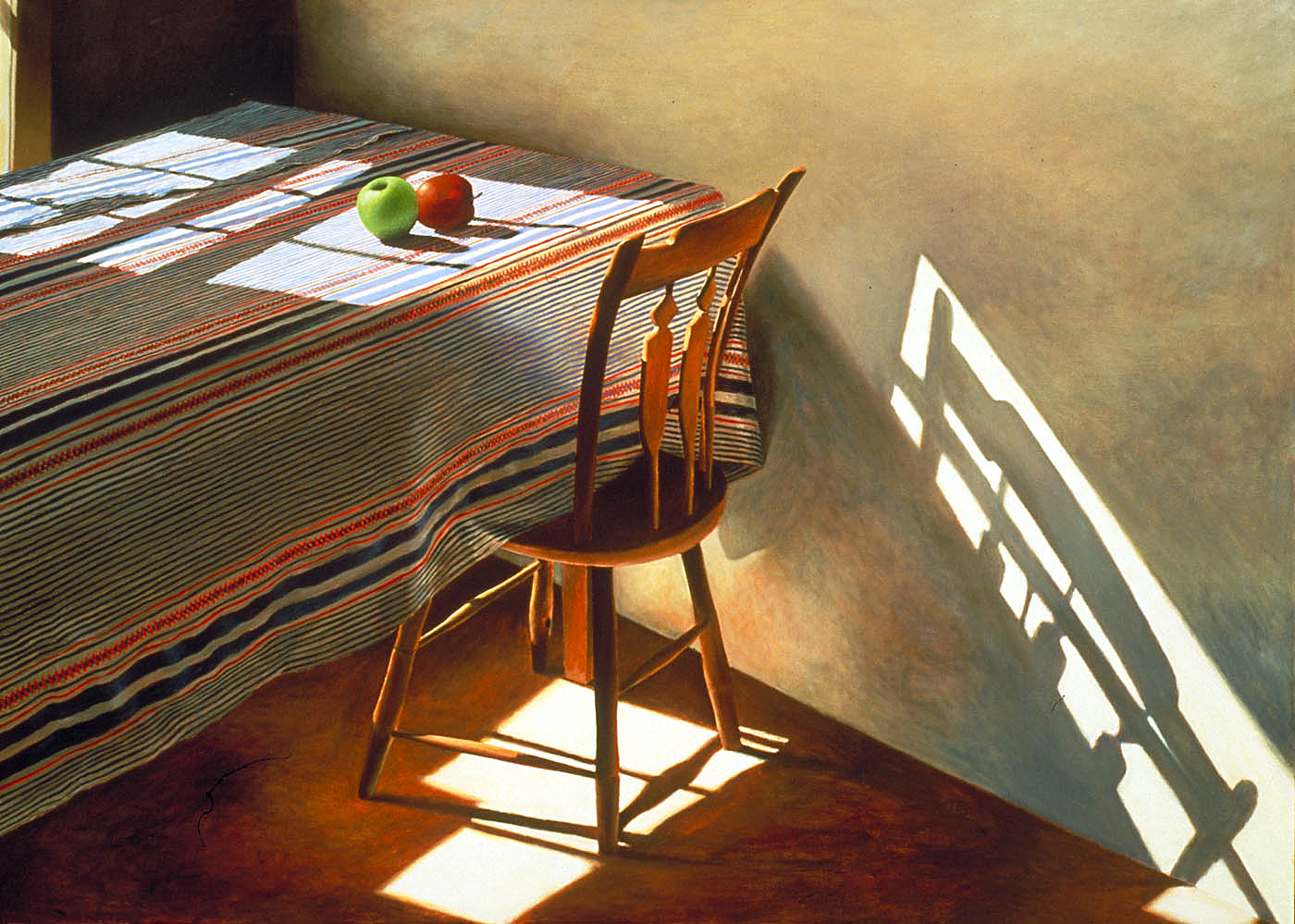
Leigh Palmer (American, 1943–), Striped Tablecloth with Two Apples, 1983. Oil on linen, 36 1/8 × 50 in. (91.8 × 127.1 cm). Smithsonian American Art Museum, Washington, DC.
It is a kind of love, is it not?
How the cup holds the tea,
How the chair stands sturdy and foursquare,
How the floor receives the bottoms of shoes
Or toes. How soles of feet know
Where they’re supposed to be.
I’ve been thinking about the patience
Of ordinary things, how clothes
Wait respectfully in closets
And soap dries quietly in the dish,
And towels drink the wet
From the skin of the back.
And the lovely repetition of stairs.
And what is more generous than a window?
This poem is from The Patience of Ordinary Things (Amherst Writers & Artists Press, 2003) and is compiled in Another River: New and Selected Poems (Amherst Writers & Artists Press, 2005).
Pat Schneider (1934–2020) was a poet, playwright, librettist, and leader of writing workshops who in 1981 founded the nonprofit organization Amherst Writers & Artists to help people discover their deepest stories through writing. The AWA grew out of a writing method Schneider developed, described in her book Writing Alone and with Others (Oxford University Press, 2003), which is used by an international network of workshop leaders. This is one of over a dozen books she’s published, which include six collections of poetry, a spiritual autobiography, and How the Light Gets In: Writing as a Spiritual Practice (Oxford University Press, 2013). She and her husband, Peter, a Methodist minister, devoted many years to community-based social justice ministry, fueled in part by Schneider’s having grown up in an impoverished single-parent home (and later orphanage). She had four children.
HYMN FOR THE FEAST OF THE VISITATION: “Somewhere I hear the church bells ringing” by Gracia Grindal: There are many church songs on the Magnificat, the canticle Mary sings in Luke 1:46–55 when she greets her cousin Elizabeth at Elizabeth’s home in the hills of Judea, but very few hymns, at least in Protestantism, that narrate the Visitation event that occasions it, including Elizabeth’s glad affirmations. Gracia Grindal’s “Somewhere I hear the church bells ringing” is one example of the latter—a four-stanza hymn she wrote in 2010 for the Feast of the Visitation, celebrated every year on May 31, with Elizabeth as the poetic speaker. The hymn captures the excitement of the Messiah coming into the world, and references an Alfred Lord Tennyson poem along the way.
On her blog Hymn for the Day, Grindal provides the lyrics and a reflection on this hymn, as well as sheet music that uses a melody Daniel Charles Damon wrote specifically for the text, which is also available in Damon’s collection Garden of Joy (Hope Publishing, 2011). For public-domain tune alternatives, Grindal suggests DISTRESS or KEDRON from William Walker’s Southern Harmony (1835), or the Renaissance tune by Thomas Tallis known as TALLIS’ CANON—all three of which are commonly used with Fred Pratt Green’s twentieth-century hymn “O Christ, the Healer, We Have Come.”
A professor emerita at Luther Seminary in St. Paul, Minnesota, Gracia Grindal is a prolific writer and translator with expertise in Scandinavian hymns. She has served on several hymn committees and boards and is the author of A Treasury of Faith, a three-volume series of over seven hundred hymn texts on the lessons of the Revised Common Lectionary (Wayne Leupold Editions, 2006–9); Preaching from Home: The Stories of Seven Lutheran Women Hymn Writers (Eerdmans, 2011); an English translation of Hallgrímur Pétursson’s Icelandic Passíusálmar (Hymns of the Passion) (Hallgrím Church, 2020); and Jesus the Harmony: Gospel Sonnets for 366 Days (Fortress, 2021), among many other books.
+++
SUBSTACK POSTS:
>> “The Slow Way: On Being ‘at Peace and in Place’” by Micha Boyett, The Slow Way: When her third child was born with Down syndrome, Micha Boyett, an emerging writer, knew she needed to release herself from the anxiety of producing and focus on parenting; she decided to slow down in order to be faithful to her son. Drawing on themes in her new book, Blessed Are the Rest of Us: How Limits and Longing Make Us Whole, Boyett reflects in this post on the slow, remarkable, intricate work God does when we “allow all that we are to nourish the place we find ourselves”; when we let go of plans and rest in the goodness of what God has for us at this moment. “Rest is something that nourishes our long-term lives. And rarely, if ever, does rest improve our influence, our finances, or our platforms,” she writes. “Rest is an invisible gift to ourselves that results in invisible growth, invisible peace, invisible relational wholeness.”
>> “Word Games with George Herbert” by Grace Hamman, Medievalish: This Herbert poem was new to me, and what a delight it is! It consists of five tercets, each with an end word that gradually diminishes through loss of a letter with each subsequent line—e.g., CHARM, HARM, ARM. Playing this word game, Herbert develops the conceit of himself as a tree in God’s enclosed garden-orchard.
“The Nuingetonn Peeche” from the Tradescants’ Orchard, 1620–29. Oxford, Bodleian Library MS. Ashmole 1461, fol. 105r.
I always enjoy the literary works, which are mostly medieval or early modern, that Dr. Grace Hamman explores through her newsletter and podcast—and the “Prayer from the Past” she curates for each newsletter sign-off, like the one in this edition, by Richard Brathwait (1588–1673).
+++
SONG: “Te Atua” (Dear Lord): I heard this popular New Zealand hīmene (hymn) in the Taika Waititi–directed movieBoy (2010) (such a great movie!). It’s a traditional Māori Christian text, set to the Appalachian folk tune NEW BRITAIN (best known for its pairing with “Amazing Grace”) and performed in 1997 by the St. Joseph’s Māori Girls’ College Choir, featuring soloist Maisey Rika. The arrangement is by the college’s principal, Georgina Kingi. Bearing echoes of Jesus’s parable of the sower, this song is particularly appropriate for the season of Ordinary Time that we’re now in, during which the seeds that were planted in us in the first half of the Christian year germinate, grow, and bear fruit.
E te Atua kua ruia nei
Ö purapura pai
Hömai e koe he ngákau hou
Kia tupu ake ai

E lhu kaua e tukua
Kia whakangaromia
Me whakatupu ake ia
Kia kitea ai ngá hua

A má te Wairua Tapu rá
Mátou e tiaki
Kei hoki ki te mahi hé
Ö mátou ngákau höu
Dear Lord, you have spread Your seeds of goodness Give us new hearts So that these seeds may grow
Dear Lord, do not allow These seeds to be lost But rather let them grow So that the results may be seen
May the Holy Spirit Guide us Lest our hearts should Return to our evil ways
>> Message Songs by the Porter’s Gate: For this album, the Porter’s Gate Worship Project partnered with the Eugene Peterson Center for Christian Imagination at Western Theological Seminary to set to music excerpts from Peterson’s best-selling translation of the Bible, The Message. Included are adaptations of Psalms 5, 16, 27, and 121, Matthew 11:28–30, Luke 15, and John 1—by a range of songwriters. The album release this month coincided with the publication of The Message Anniversary Edition, available from NavPress.
>> Volume 10 (Ordinary Time) of The Soil and The Seed Project: This double album—which is completely free!—features twenty-four songs by musicians of faith under the direction of Seth Thomas Crissman, a Mennonite pastor, educator, songwriter, and multi-instrumentalist from Harrisonburg, Virginia. Here’s one of the songs, “The Way Your Kingdom Comes” by Lindsey FitzGerald Stine, sung by her and her sister Rachel FitzGerald:
The music is one element of a larger project that also includes liturgies and newly commissioned artworks. Learn about the project’s free summer concert series on their Events page, which will feature contributors to the most recent album and other friends.
AVANT-GARDE CLASSICAL: Klang—Die 24 Stunden des Tages (Sound—The 24 Hours of the Day) is a cycle of chamber-music compositions by the avant-garde German composer Karlheinz Stockhausen, which he worked on from 2004 until his death in 2007. (The intention was for there to be twenty-four pieces, but the cycle was unfinished at twenty-one.) The first two pieces in the cycle, on the themes of Ascension and Pentecost, were commissioned for the interdisciplinary Pause festival at Milan Cathedral by artache, a Milan-based nonprofit committed to showcasing contemporary artworks in public places of worship. The artistic director of artache at the time was Don Luigi Garbini, a priest at the church of San Marco in Milan and cofounding director of the artache initiative the Laboratorio di Musica Contemporanea al Servizio della Liturgia (Laboratory for Contemporary Music in the Service of the Liturgy).
>> No. 81: “KLANG, 1st Hour: Himmelfahrt (Ascension)” by Karlheinz Stockhausen, for organ or synthesizer, soprano, and tenor, 2004–5: This thirty-seven-minute piece premiered at Milan Cathedral on Ascension Day, May 5, 2005. The two hands of the organist almost always play in different, independent tempos of a chromatic time scale, while the soloists sing words or phrases associated with “ascension,” particularly the Ascension of Christ. According to the composer, “Asking a performer to break the barrier of time by playing simultaneously in different tempi is like submitting a man to physical disruption, allowing him to go in spirit form towards another world” (source). For musical analysis by Ed Chang, see here. The performance below is from the North American premiere at the Schwartz Center for the Performing Arts at Emory University in Atlanta on October 11, 2005, featuring organist Randall Harlow, soprano Teresa Hopkin, and tenor John Bigham.
>> No. 82: “KLANG, 2nd Hour: Freude (Joy)” by Karlheinz Stockhausen, for two harps and voice, 2005: This forty-minute piece premiered at Milan Cathedral on July 6, 2006. The text is taken from the medieval Pentecost hymn “Veni Creator Spiritus” [previously], which the harpists sing in spurts, “in alternation or sometimes together . . . , while plucking, picking, caressing, stroking, pinching, rubbing, striping, striking, pinking, jubilating,” as Stockhausen put it. In program notes dated February 15, 2006, he writes, “There is something unique about the adventure to combine two harps which are normally tuned in diatonic scales and to synthesise them into one large chromatic harp. . . . Pentecost unites what has been separated. My work FREUDE too.” For musical analysis by Ed Chang, see here. The performance below is from the Stockhausen Memorial Concert in Kürten, Germany, on December 16, 2017, featuring Marianne Smit and Miriam Overlach.
NEW DOCTORAL COHORT:The Sacred Art of Reading: The Eugene Peterson Center for Christian Imagination at Western Theological Seminary in Holland, Michigan, is offering a new, mostly remote, three-year DMin track called “The Sacred Art of Reading,” which begins this October, taught by Professor Chris E.W. Green. The program is centered on the reading of scripture—the Old Testament narrative books (Year 1), Old Testament poetry and wisdom literature (Year 2), and the Gospels and Apocalypse (Year 3)—alongside a number of additional primary texts, whose titles you can view on the website; authors include, among others, Avivah Gottlieb Zornberg, Amy-Jill Levine, Daniel Berrigan, Robert Alter, Shusaku Endo, and of course Eugene Peterson! Participants get together in person for one week each semester (times six semesters) and are responsible for, in addition to the $17,280 tuition, travel and lodging costs. The application deadline is June 30, 2023. Applicants must hold an MDiv degree or its educational equivalent and have at least three years of ministry experience since completing the MDiv. Here’s a condensed program description:
The Sacred Art of Reading cohort will be dedicated to collaboration in “the forbidding discipline of spiritual reading,” confident that such an undertaking cultivates the loving attentiveness, prophetic discernment, and childlike openness to surprise that characterize what St. Paul calls the faith that works by love. . . . The cohort is designed to cultivate an alternative awareness, one shaped by the slow, painstaking work of collaborative interpretation. And to that end, the heart of the program is the reading of the Christian Scriptures. The aim will be both philosophical and devotional, critical and celebratory, mystical and pastoral. No one reading method will be stipulated, but students will be encouraged to find ways to honor the traditions of the communities in which they learned to argue, to muse, and to pray.
Besides Scripture, the cohort will engage a wide range of texts including poems, memoirs, essays, treatises, sermons, and stories old and new, familiar and strange, sacred and “worldly,” in part and in whole, not so much in order to “plunder the Egyptians” as to bear glad witness to the wonder that God is never left without a witness because all truth, truly received, trues.
This approach really wets my whistle! I don’t have a master’s degree, so I’m out, but I feel so energized by the reading list and wanted to share the opportunity with you all, as the program seems doable for those with full-time jobs. A virtual interest meeting is being held on June 1. Click here to view other doctor of ministry cohorts at Western.
+++
FUNDRAISING CAMPAIGN: The Soil and The Seed Project: I’ve mentioned this project several times on the blog before, as I’m a big fan. A ministry of VMMissions (Virginia Mennonite Missions), The Soil and The Seed Project releases original music, art, and liturgies throughout the Christian year, especially suitable for families with littles. They launched in December 2021 and since then have put out seven collections, with their latest and largest yet—Vol. 7 // Ordinary Time—dropping this week. (Request a free download through their website, or stream the music through your favorite service.) Coinciding with this release, they have also launched a campaign to raise $27,000 by June 18 to cover the costs of recording, mixing, pressing, printing, shipping, etc., for future collections. Learn more in the five-minute video below, which features the new songs “In the Little Moments,” “Teach Me, O LORD,” and “Because of Jesus.”
The Soil and The Seed Project offers all their content for free, including physical CDs (as stock permits), and are committed to keeping it that way—which is why they need the support of donors. Donate to their campaign, and you can opt to receive stickers, notecards, and/or a T-shirt as a thank-you. Also note: they’ll be giving a concert at 6:30 p.m. on Saturday, June 3, at the Brethren & Mennonite Heritage Center in Harrisonburg, Virginia.
+++
SONG: “Holy Spirit” by Victoria Williams: “Part front-porch soothsayer, part quirky bayou princess, and part eternal child, Victoria Williams writes songs of indescribable originality that embrace the earthly and the divine with wit, charm, and understated vision,” writes Josh Kun for Bomb magazine. The song “Holy Spirit” [read lyrics] is from her 1990 album Swing the Statue!. It opens with the familiar invocation from a Gullah spiritual: “Kum ba yah, my Lord” (which translates to “Come by here”). She seeks God’s presence and then, given a renewed sensitivity to it, identifies and celebrates its flow throughout her daily goings. She feels the Holy Spirit while building a raft with friends on the shores of Louisiana’s Lake Bistineau and riding a New York City subway beside a whistling stranger, as well as in graveyards and at bars and out under open night skies. The Spirit flows through all of life. I can’t find the song online anywhere other than in this YouTube fan video, which sets it to photos. [HT: Jonathan Evens]
+++
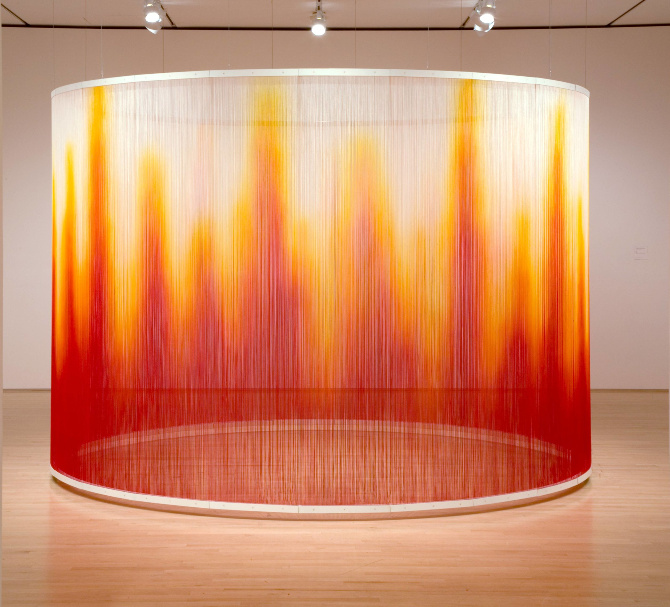
ARTWORK: Fire by Teresita Fernández: In the collection of SFMOMA, this ring of warm-colored silk yarn conveys something of the flickering quality of fire. At the link is a short video interview with the artist about the piece. Fernández says she is interested in the sensorial aspects of viewer engagement with art.
Teresita Fernández (American, 1968–), Fire, 2005. Silk yarn, steel armature, and epoxy, 243.8 × 365.8 cm. San Francisco Museum of Modern Art, California.
Fire was a highlight of the 2013 exhibition Beyond Belief: 100 Years of the Spiritual in Modern Art, jointly organized by SFMOMA and the Contemporary Jewish Museum. Here’s a video of the Lick Wilmerding High School Vocal Ensemble singing “Famine Song” by VIDA around the installation that year, a song inspired by the basket weavers of Sudan, who persist in their craft during times of hardship, their hands working natural fibers into beautiful, colorful vessels. “Weave, my mother; weave, my child; weave your baskets of rushes wild . . .”



 Art & Theology