Brett Canét-Gibson (Australian, 1965–), Anastasis, 2016. Photographic digital print, 90 × 60 cm.
Anastasis is the Greek word for “resurrection.” This image by the Australian photographer Brett Canét-Gibson shows the dead Christ covered in a translucent burial shroud, which appears pixelated, out of joint. Some kind of mysterious transformation is afoot. It’s as if Jesus is in the process of waking up, reconstituting, his form coming back into focus as death comes undone. The shimmying squares create a sense of motion and effervescence.
LISTEN: “The Communion Verse of Holy Saturday” | Traditional Orthodox liturgical hymn (in Tone 4), arr. Boris Ledkovsky, mid-20th century | Performed by the Holy Trinity Monastery and Seminary Choir of the Russian Orthodox Church Outside Russia, Jordanville, New York, on Let Us Sing of John, the Hierarch of Christ, 2011
This verse is sung at the end of the Vespers with Divine Liturgy service of the Orthodox Church on the morning of Great and Holy Saturday. Here is the Slavonic text, followed by a phonetic rendering and the English translation:
Воста яко спя Господь: и воскресе спасаяй нас. Аллилуиа.
Vosta yako spya Gospod, i voskrese spasayai nas. Aleluija.
The Lord awoke as one out of sleep, and he is risen to save us. Alleluia.
Even though Holy Saturday commemorates Jesus’s repose in the tomb, this hymn for the occasion anticipates his resurrection. The first half is taken from Psalm 78:65a: “Then the LORD awaked as one out of sleep.”
As we wait in the darkness of what looks like defeat, victorious new life is stirring, about to emerge.
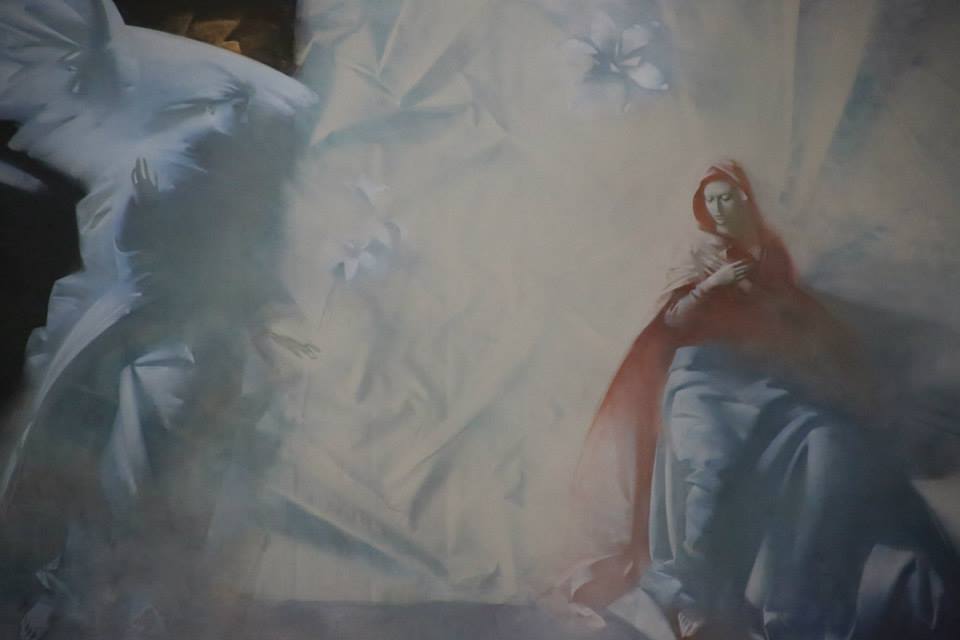
Alexander Blonsky (Ukrainian), The Annunciation, 2014. Oil on canvas, 82 7/10 × 129 9/10 in.
March 25, nine months before Christmas, is when the church celebrates the conception of Christ in the womb of Mary. The narrative of this event is known as the “Annunciation” because Gabriel comes from heaven to announce the good news to Mary that she has been chosen to give birth to and to mother the Son of the Most High God.
Because Luke 1:26–38 is such a familiar Bible passage, it helps to read it in less familiar translations so that it can land fresh in our ears. So here is Eugene Peterson’s translation from The Message:
In the sixth month of Elizabeth’s pregnancy, God sent the angel Gabriel to the Galilean village of Nazareth to a virgin engaged to be married to a man descended from David. His name was Joseph, and the virgin’s name, Mary. Upon entering, Gabriel greeted her:
Good morning!
You’re beautiful with God’s beauty,
Beautiful inside and out!
God be with you.
She was thoroughly shaken, wondering what was behind a greeting like that. But the angel assured her, “Mary, you have nothing to fear. God has a surprise for you: You will become pregnant and give birth to a son and call his name Jesus.
He will be great,
be called ‘Son of the Highest.’
The Lord God will give him
the throne of his father David;
He will rule Jacob’s house forever—
no end, ever, to his kingdom.”
Mary said to the angel, “But how? I’ve never slept with a man.”
The angel answered,
The Holy Spirit will come upon you,
the power of the Highest hover over you;
Therefore, the child you bring to birth
will be called Holy, Son of God.
“And did you know that your cousin Elizabeth conceived a son, old as she is? Everyone called her barren, and here she is six months pregnant! Nothing, you see, is impossible with God.”
And Mary said,
Yes, I see it all now:
I’m the Lord’s maid, ready to serve.
Let it be with me
just as you say.
This traditional Eastern Orthodox acclamation in Church Slavonic, based on Gabriel’s and Elizabeth’s words to Mary in Luke 1 (and better known by the closely related Latin Ave Maria from the West), has been set by various composers over the centuries, most famously by Sergei Rachmaninoff. His solemn interpretation is beautiful, but I’m partial to the celebratory setting by contemporary Estonian composer Arvo Pärt, commissioned by the King’s College Choir, Cambridge, for the festival of Nine Lessons and Carols on Christmas Eve 1990. It is for SATB a cappella choir.
Богородице Дево, радуйся,
благодатная Марие, Господь с тобою.
Благословена ты в женах,
и благословен плод чрева твоего,
яко Спаса родила еси душ наших.
Transliteration:
Bogoróditse Dyévo, ráduisya,
Blagodátnaya Maríye, Gospód s tobóyu.
Blagoslovyéna ty v zhenákh,
i blagoslovyén plod chryéva tvoyevó,
yáko Spása rodilá yesí dush náshikh.
English translation:
Rejoice, O Virgin Theotokos,
Mary full of grace, the Lord is with thee.
Blessed art thou among women,
and blessed is the fruit of thy womb,
for thou hast borne the Savior of our souls.
All but a small number of Pärt’s ninety-odd compositions since 1976 are settings of biblical texts or Christian prayers. For an excellent article on him, see “How Arvo Pärt speaks prayer into a secular world” by Peter C. Bouteneff, published in the Christian Century. “Why are people listening so avidly?” Bouteneff wonders. “The same audience that would instinctively tune out anything with a whiff of Christian sensibility, that would normally be repulsed by pious petitions to Jesus or Mary for the forgiveness of their wretched sins, is held rapt by these very prayers when Pärt speaks them through his compositions.” Beauty has a way of penetrating people’s defenses, it seems. And that’s one reason we so desperately need artists.
This post belongs to the weekly series Artful Devotion. If you can’t view the music player in your email or RSS reader, try opening the post in your browser.
To view all the Revised Common Lectionary scripture readings for the feast of the Annunciation, cycle A, click here.


 Art & Theology