Holy Week: Silent Before His Accusers

He was oppressed, and he was afflicted,
    yet he did not open his mouth;
like a lamb that is led to the slaughter
    and like a sheep that before its shearers is silent,
    so he did not open his mouth.

—Isaiah 53:7

As soon as it was morning, the chief priests held a consultation with the elders and scribes and the whole council. They bound Jesus, led him away, and handed him over to Pilate. Pilate asked him, “Are you the King of the Jews?” He answered him, “You say so.” Then the chief priests accused him of many things. Pilate asked him again, “Have you no answer? See how many charges they bring against you.” But Jesus made no further reply, so that Pilate was amazed.

—Mark 15:1–5

LOOK: Christ before the Judge by Cecil Collins

Collins, Cecil_Christ before the Judge
Cecil Collins (British, 1908–1989), Christ before the Judge, 1954–56. Oil on board, 47 1/2 × 35 1/2 in. (120 × 90 cm). Gardiner Chantry, Winchester Cathedral, England. Photo: Anne Baring.

I learned of this painting from the book The Image of Christ in Modern Art by Richard Harries. In the painting, Harries writes, Pilate is fierce, angular, aggressive, baring his teeth. “He represents the mechanism of law against Christ, now striated by the flagellation, and wearing a large crown of thorns. But Christ’s eyes are wide open, revealing a strong, serene and eternal order that remains untouched by the harshness.”

LISTEN: “Silencio,” movement 28 from La pasión según San Marcos (St. Mark’s Passion) by Osvaldo Golijov, 2000

The video below is the world premiere performance by the Orquesta La Pasión and the Schola Cantorum de Venezuela, conducted by María Guinand, on September 5, 2000, at the Beethovenhalle in Stuttgart, Germany. The “Silencio” movement is cued up for playback, but I recommend listening to the entire work!

Osvaldo Golijov (born 1960) is an Argentine composer born in La Plata to Ukrainian and Romanian Jewish parents. He left his native Argentina in 1983 to study for three years at the Rubin Academy of Music in Jerusalem, and then he settled in the United States. He lives in Massachusetts.

Golijov was one of four composers commissioned by the International Bach Academy of Stuttgart in 1996 to write a Passion oratorio to commemorate the 250th anniversary of J. S. Bach’s death in 2000. (I featured another, Tan Dun, in a recent roundup.) Golijov chose Mark’s Gospel as his basis, compiling the libretto from a Spanish translation of the Gospel and other Spanish-language sources, and for the music, drawing on a variety of Latin American styles and rhythms.

The “Silencio” movement of Golijov’s La pasión según San Marcos captures the moment at which Christ stands before Pontius Pilate, the governor of the Roman province of Judaea. He had already appeared before Caiaphas, the Jewish high priest; now he’s been handed over to another authority to stand trial yet again.

Much to everyone’s surprise, he does not defend himself against the charges of sedition, treason, and blasphemy—not because he was guilty, but because he knew it would do no good. He had already told the people who he was and what he was there to do—had demonstrated it with miracles—but most of those in power continued to disbelieve and resist him. And so he returns their accusations with a dignified silence. He has purposed to take his gospel all the way to the cross to further reveal the heart of God.

(Related post: “The ‘Nothing’ that won our salvation”)

“Silencio” (Silence), which comes between “Amanecer: Ante Pilato” (Dawn: Before Pilate) and “Sentencia” (Sentence), consists of clapping and stomping in the mode of flamenco, the texture thickening to convey ratcheting tension. “Spanish flamenco suggests the influence of the colonizing power, akin to ancient Rome in the Holy Land,” Thomas May writes, “and is thus suitable for Jesus’ betrayal and sentencing by the authorities – but also for the fatalistic aura of his impending death.”

There are no vocals in this movement, and the only instruments are the cajón and body percussion. The chorus creates rhythms with their hands and feet, representing the chief priests and scribes and the gathered crowds who wait anxiously for a word from the accused, but who are more anxious still for a verdict.
Roundup: Musical Passions beyond Bach; Angola inmates enact the Passion; and more

VIDEO: “Waiting with Christ: An Artful Meditation for Holy Week”: A collaboration between Duke Initiatives in Theology and the Arts in Durham, North Carolina, and City Church in Cleveland, Ohio, this half-hour video from 2021 presents a small collection of scripture readings, poems, visual art, and music for Holy Week, interspersed with reflections by theologian Jeremy Begbie. The artistic selections are a spoken word performance by Paul Turner, Malcolm Guite’s sonnet “Jesus Meets His Mother,” the Adagio movement of Schubert’s String Quintet in C Major, the painting Riven Tree by Bruce Herman, and Bifrost Arts’ “Our Song in the Night,” performed by Salina Turner, Allison Negus, and Joel Negus [previously].

+++

ARTICLE: “6 Musical ‘Passions’ Beyond Bach” by Josh Rodriguez: Composer, professor, and Deus Ex Musica cofounder Josh Rodriguez is an excellent classical music curator and guide. In this article he introduces us to six modern large-scale musical works about Jesus’s final week: The Passion of Yeshua by Richard Danielpour, La Pasión Según San Marcos by Osvaldo Golijov, The Passion of the Christ Symphony by John Debney, Johannes-Passion by Sofia Gubaidulina, Simeron by Ivan Moody, and the St. John Passion by James MacMillan. He interweaves composer biography, musical analysis, and meaning in concise ways, with nods to music history. Stylistic influences for these diverse selections range from Byzantine chant to salsa! Audio/video excerpts are provided, such as the cued-up “¿Por qué?” from Golijov’s Pasión (see below), a movement centering on the woman who anointed Jesus’s feet with perfume (Mark 14:3–9).

+++

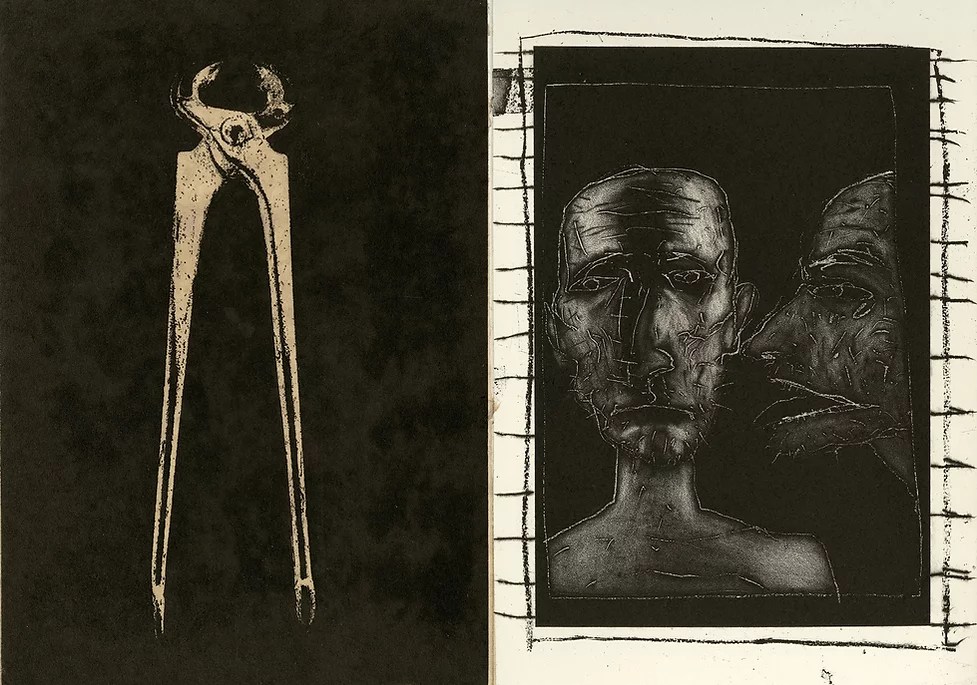
PRINT SERIES: The Passion and Its Objects (after Dürer) by Marcus Rees Roberts:The Passion and Its Objects (after Dürer) is a series of etchings and monotypes by Marcus Rees Roberts. The images derive from fragments from Albrecht Dürer’s series of woodcuts The Small Passion (1511). Images of the Passion – and of the crucifixion in particular – are so embedded in Western consciousness that we forget that it is a depiction of betrayal, prejudice, and torture. In this version of the Passion by Dürer, one of several he made, small, everyday objects lie scattered within the images – a jug, pliers, a hammer, a coil of rope. Even five hundred years later, we recognise these objects as our own; we can identify with them. But in so doing, we enter the depicted space, and we become complicit in the cruelty. This is one reason why Dürer’s Small Passion is both so powerful and so uncomfortable.”

Roberts, Marcus Rees_Passion I
Marcus Rees Roberts (British, 1951–), The Passion and Its Objects (after Dürer) I, 2019. Diptych etching and aquatint with chine collé printed on Somerset Satin soft white 300gsm, each plate 29.5 × 21 cm (overall 29.5 × 42 cm). Edition of 15.

+++

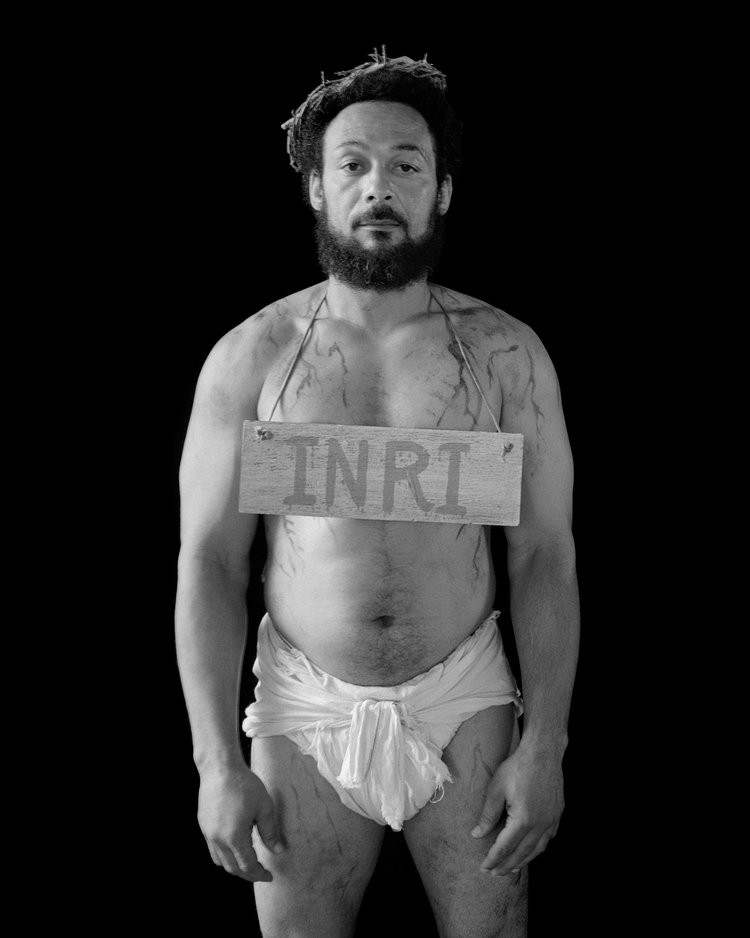
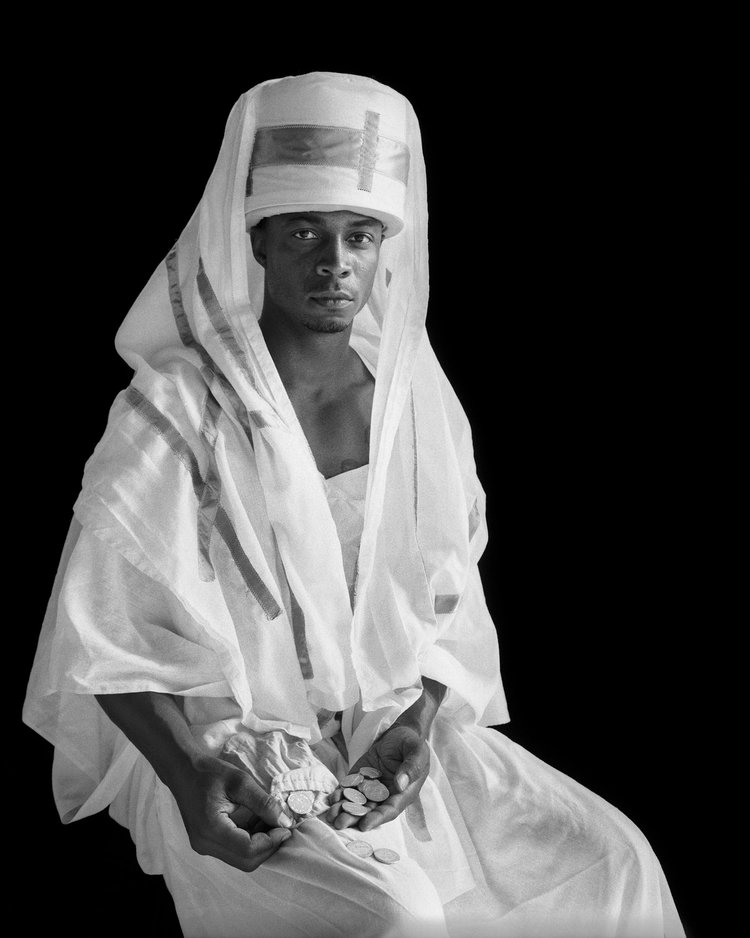
PHOTOGRAPHY SERIES: Passion Play by Deborah Luster: “There are more than 5,300 inmates at the Louisiana State Penitentiary at Angola. Nearly 4,000 of them are serving life without parole. In 2012 and 2013 the Angola Prison Drama Club staged a play unlike any other in the prison’s experience. The Life of Jesus Christ featured 70 inmates, men and women acting together for the first time—in costume, with a real camel, performing for the general public. For the untrained actors, this production held special meaning as they saw pieces of their own lives revealed in the characters they played.”

Luster, Deborah_Layla "Roach" Roberts (Inquisitor)
Layla “Roach” Roberts (Inquisitor), sentenced to LIFE, Angola Prison, Louisiana. Photograph by Deborah Luster, from the Passion Play series, 2013.

Luster, Deborah_Bobby Wallace (Jesus)
Bobby Wallace (Jesus), Angola Prison, Louisiana. Photograph by Deborah Luster, from the Passion Play series, 2013.

+++

SONGS:

>> “May I Go with You” by January Lim: This Maundy Thursday song was written in 2020 in the voice of Jesus in Gethsemane, speaking to God the Father. In the first stanza, it seems to me that Jesus is asking to be taken up to heaven, like Elijah—just whisked away back to glory, and spared tomorrow’s cruelties and pain. But in the second stanza that same request seems to shift in meaning as Jesus expresses a desire to go with God’s plan and asks for the strength to follow through. The song was released on the EP Gathered Sighs (2021), put out by Evergreen Baptist Church of Los Angeles, where Lim serves as worship arts pastor. [HT: Global Christian Worship]

>> “Calvary” (Traditional): In this excerpt from Washington National Cathedral’s 2020 Good Friday noon service, Imani-Grace Cooper performs Richard Smallwood’s arrangement of the African American spiritual “Calvary,” accompanied on piano by Victor Simonson. Wow. Chilling!

See also Cooper’s performance of “Lamb of God” by Twila Paris and “Were You There” from the same service, which I cued up at those time-stamped links.

Holy Week Playlist

There are hundreds of thousands of musical works, from a range of genres, inspired by Christ’s passion, especially his death on the cross, which, along with the resurrection, is the centerpiece of the Christian faith. I’ve curated just a sampling of these on Spotify, from across time periods and countries, to serve as an aural guide through the final week of Jesus’s life. The drama begins with Christ’s triumphal entry into Jerusalem on a donkey, where he’s hailed with hosannas, and then continues with a last supper shared with his disciples, an agonized prayer in Gethsemane followed by betrayal and arrest, then, all in one day, multiple trials (religious and civil), conviction by mob, a public execution, and burial. Many of the playlist selections are narrative in character, while some have a more theological bent. My hope is that these pieces aid you in observing this most holy of weeks, walking with Christ through the shadows, taking in how “he himself bore our sins in his body on the tree, that we might die to sin and live to righteousness. By his wounds [we] have been healed” (1 Pet. 2:24).

To add the playlist to your account, open the Art & Theology Holy Week Playlist link, then click on the More (…) icon and select “Save to Library.”

Art & Theology Holy Week playlist (art by Odilon Redon)

[Playlist cover art: Odilon Redon, Christ, ca. 1895, charcoal, chalk, pastel, and pencil on paper, Museum of Modern Art, New York]

The playlist is a mixture of classical and popular (indie-folk, gospel) music. In this post I want to provide a little context for some of the pieces, by which I mainly mean translations of all the non-English lyrics. Because of what you see here, you might get the wrong impression that the list is almost entirely classical; actually, it’s only about half.

The opening track, “Herr, unser Herrscher” (Lord, Our Ruler), is a unique arrangement of the opening chorus from Johann Sebastian Bach’s St. John Passion, a Good Friday oratorio in German.

Herr, unser Herrscher, dessen Ruhm
In allen Landen herrlich ist!
  Zeig uns durch deine Passion,
  Daß du, der wahre Gottessohn,
  Zu aller Zeit,
  Auch in der größten Niedrigkeit,
  Verherrlicht worden bist!
Lord, our ruler, whose fame
In every land is glorious!
  Show us, through your passion,
  That you, the true Son of God,
  Through all time,
  Even in the greatest humiliation,
  Have become transfigured! [source]

Unique, because the Baroque choir and orchestra are accompanied by an ensemble of Gabonese musicians who contribute their own rhythmic profile, along with solo percussionists Sami Ateba from Cameroon and Naná Vasconcelos from Brazil. The recording, rereleased on the compilation album Babel (2008), is originally from Lambarena: Bach to Africa (1995), a collaboration between French composer and producer Hughes de Courson and Gabonese composer and guitarist Pierre Akendengué, synthesizing two disparate sound worlds. (“Bombé / Ruht wohl, ruht wohl, ihr heiligen Gebeine” is another highlight from the album. For weeks I debated whether to include it on this playlist—adding it, taking it off, adding it back again—ultimately deciding to leave it off, the reason being that it overlays Bach’s choral rondo with music and invocations to the dead from a Bwiti religious ritual. Though sonically compelling and worth listening to, I felt that it might impede some Christians’ ability to engage this list in a devotional way; so I opted for a traditional Western classical recording instead.)

Other selections from Bach’s St. John Passion are:

>> “Christus, der uns selig macht”

Christus, der uns selig macht,
Kein Bös’ hat begangen,
Der ward für uns in der Nacht
Als ein Dieb gefangen,
Geführt für gottlose Leut
Und fälschlich verklaget,
Verlacht, verhöhnt und verspeit,
Wie denn die Schrift saget.
Christ, who makes us blessed,
committed no evil deed,
for us he was taken in the night
like a thief,
led before godless people
and falsely accused,
scorned, shamed, and spat upon,
as the scripture says. [source]

>> “Petrus, der nicht denkt zurück”

Petrus, der nicht denkt zurück,
Seinen Gott verneinet,
Der doch auf ein' ernsten Blick
Bitterlichen weinet.
Jesu, blicke mich auch an,
Wenn ich nicht will büßen;
Wenn ich Böses hab getan,
Rühre mein Gewissen!
Peter, who did not recollect,
denied his God,
who yet after a serious glance
wept bitterly.
Jesus, look upon me also,
when I will not repent;
when I have done evil,
stir my conscience! [source]

>> “O große Lieb”

O große Lieb, O Lieb ohn alle Maße,
Die dich gebracht auf diese Marterstraße!
Ich lebte mit der Welt in Lust und Freuden,
Und du mußt leiden.
O great love, O love beyond measure,
that brought you to this path of martyrdom!
I lived with the world in delight and joy,
and you had to suffer. [source]

>> “Ruht wohl, ihr heiligen Gebeine”

Ruht wohl, ihr heiligen Gebeine,
Die ich nun weiter nicht beweine,
Ruht wohl und bringt auch mich zur Ruh!
Das Grab, so euch bestimmet ist
Und ferner keine Not umschließt,
Macht mir den Himmel auf und schließt die Hölle zu.
Rest well, you blessed limbs;
now I will no longer mourn you.
Rest well and bring me also to peace!
The grave that is allotted to you
and encloses no further suffering
opens heaven for me and closes off hell. [source]

For Bach’s St. Matthew Passion—one of the most celebrated works of classical sacred music ever written, right up there with Handel’s Messiah—I’ve drawn from the abridged English version (rather than the original German), translated by the Rev. Dr. John Troutbeck and performed in 1962 by the New York Philharmonic and Collegiate Chorale under the direction of Leonard Bernstein. I chose just a few pieces from it, not wishing to replicate the whole thing; as you can see, I tend to favor chorales over arias.

Continue reading “Holy Week Playlist”