
Roundup: Epiphany Playlist, thread installation, and more

In the church calendar, the linked seasons of Advent, Christmas, and Epiphany are sometimes referred to as the “cycle of light.” “Since earliest times the Christian community has utilized light as a primary symbol to convey the meaning of the Christ-event,” writes Wendy M. Wright in The Vigil: Keeping Watch in the Season of Christ’s Coming. “The power of the symbol was not lost on most generations of believers who lived closer than we do to the truth that we are all ultimately dependent upon the light of the sun for warmth, vision, and life itself” (152). Light imagery permeates scripture and the writings of the church fathers.

The capstone of the cycle of light, celebrated each year on January 6, is Epiphany, which means “manifestation” or “appearance.” In the West, this feast commemorates the visit of the magi, to whom the divinity of Christ was revealed, and who brought back the light they received to their homelands, an early spreading of the gospel. Epiphany is exactly one month away, but I wanted to provide a few resources in advance. For those in the DC metro area: note that there are just two weeks left to see the Anne Lindberg exhibition!

+++

NEW PLAYLIST: Epiphany (Art & Theology): I put together a playlist of nearly a hundred Epiphany songs that celebrate Jesus as the light of the world and that mark the magi’s transformative encounter with him.

Besides the classic “We Three Kings,” it also includes a few versions of the ancient hymn “Phos Hilaron” (originally written in Koine Greek and translated into English as “Gladsome [or Gladdening] Light”), a Provençal carol popularized by Bizet, a shape-note hymn from Appalachia, aguinaldos from Puerto Rico, Arabic hymns from Syria and Lebanon, plainchant scripture settings, Renaissance motets, traditional and contemporary Black gospel songs, indie songs (including retuned hymns) from the past decade, and choral works from the UK, Jamaica, and Argentina. Some of the selections are quieter, more reflective, whereas others are very exuberant, like “Jesus Is the Light” by Hezekiah Walker and the Love Fellowship Crusade Choir:

And “Los Reyes Magos,” the fifth movement of Ariel Ramirez’s folk drama Navidad Nuestra (lyrics here); the song was written as a taquirari, a type of Bolivian folk song that has a syncopated rhythm and that is danced to, and features a charango (small guitar) and siku (Andean panpipe):

+++

ART COMMENTARIES: The VCS Advent Calendar 2023: Every Advent, the Visual Commentary on Scripture sends out a daily image from its online archives to its email list around a seasonal theme. This year’s theme is “light.” The images are keyed to particular scripture passages having to do with light and are accompanied by commentary from a range of contributors. So far the VCS has featured a Genesis 1–inspired Sistine Chapel fresco, John Piper and Patrick Reyntiens’s extraordinary Baptistery Window at Coventry Cathedral, a Trinitarian miniature from an English book of hours, a heliotropic landscape sculpture by David Wood, a light installation by Dan Flavin at a church in Milan, and Vincent van Gogh’s Starry Night.

Baptistery Window, Coventry
Baptistery Window, Coventry Cathedral. Designed by John Piper and made by Patrick Reyntiens, 1957–61. Stained glass, 85 × 56 ft.

+++

EXHIBITIONS:

>> What color is divine light? by Anne Lindberg, January 5–December 22, 2023, Textile Museum at George Washington University, Washington, DC: I saw this installation last month, and it is striking! About four thousand strands of complementary yellow and blue cotton thread (and some white and green), stretching across the gallery against a backdrop of lavender-painted walls, evoking light. The artist describes the work as a drawing made of textile material in the air. It was inspired by a 1971 essay of the same title by the art historian Patrik Reuterswärd (see The Visible and Invisible in Art: Essays in the History of Art), and it opened adjacent to an exhibition of prayer carpets, titled Prayer and Transcendence.
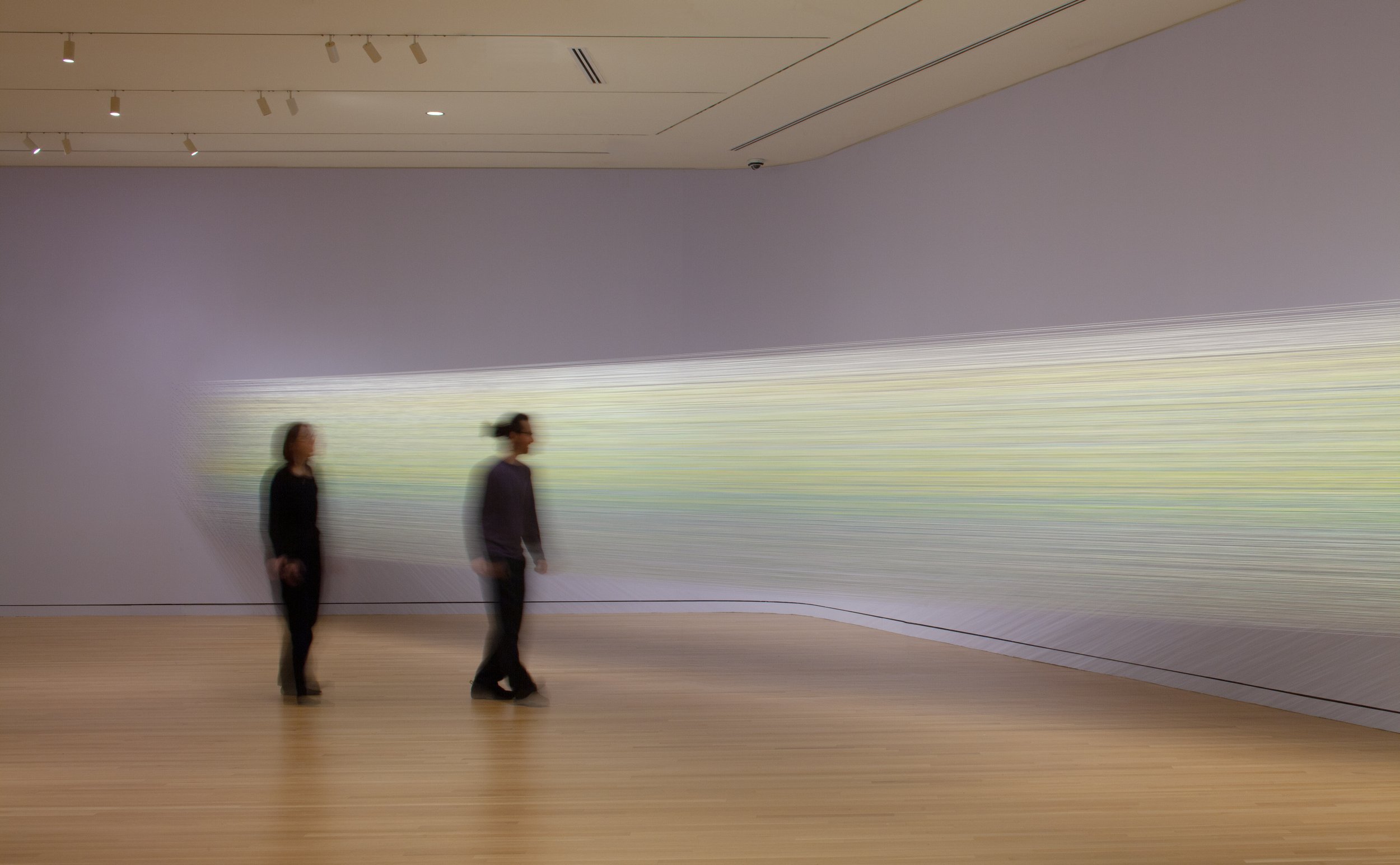
Lindberg, Anne_What color is divine light
Anne Lindberg (American, 1962–), What color is divine light?, 2023. Cotton thread, staples, 5 × 55 × 14 ft. Solo exhibition at the Textile Museum, George Washington University, Washington, DC. Photo: Derek Porter.

In addition to the video above, you can view gorgeous photos of the installation on Lindberg’s website.

>> Bubble Universe: Physical Light, Bubbles of Light, Wobbling Light, and Environmental Light by teamLab, opens early February 2024, Borderless (museum), Azabudai Hills, Tokyo: teamLab is an international collective of “ultra-technologists” consisting of artists, programmers, engineers, CG animators, mathematicians, and architects who collaborate on immersive art projects. One of their upcoming installations is a room with hundreds of glowing spheres, each containing unique changing lights that interact with guests and the environment itself. [HT: My Modern Met]

Bubble Universe
teamLab, Bubble Universe, 2023 (work in progress). Interactive installation, Borderless, Azabudai Hills, Tokyo.

+++

NEW ALBUMS:

>> The Light by Sarah Sparks: A four-song EP by a Christian singer-songwriter from Hawaii. Here’s the first track:

>> Morning Star: Music for Epiphany Down the Ages by the Gesualdo Six: Released November 3, this wonderful album comprises twenty-one choral pieces for Epiphany—a mix of plainchant propers for Mass, hymns, Renaissance motets, and twenty-first-century works. One of the contemporary works is a setting by Owain Park of Psalm 43:3: “O send out thy light and thy truth, that they may lead me; let them bring me unto thy holy hill, and to thy dwelling”:
“Te lucis ante terminum”: A bedtime prayer for all ages

When I was little, my bedtime routine involved me propping up my plush Precious Moments doll beside me on my bedside floor, her hands Velcroed together, so that she could accompany me in praying this prayer:

Now I lay me down to sleep
I pray the Lord my soul to keep
If I should die before I wake
I pray the Lord my soul to take

This rhyming quatrain from colonial New England,[1] simple though it is, cultivated in me a warm sense of God’s care and protection through the night.

Perhaps the latter half sounds morbid—but keep in mind that it comes from a time when child mortality rates were much higher, as, given the lack of advanced medicine and effective vaccines, illnesses were frequent and often fatal. A later variation of the prayer omits the reference to death, replacing the second couplet with the cutesier “Thy love guard me through the night, / And wake me with the morning light.”


I will both lie down and sleep in peace,
for you alone, O LORD, make me lie down in safety.

—Psalm 4:8

As an adult, I’ve encountered another evening prayer that reminds me of “Now I Lay Me Down to Sleep”—similar content, same meter, but likely dating all the way back to the fifth or sixth century, and originally written in Latin. It’s called Te lucis ante terminum (Before the Ending of the Day):

Te lucis ante terminum,
Rerum Creator poscimus,
Ut pro tua clementia
Sis præsul et custodia.

Procul recedant somnia,
Et noctium phantasmata;
Hostemque nostrum comprime,
Ne polluantur corpora.

Præsta, Pater piissime,
Patrique compar Unice,
Cum Spiritu Paraclito
Regnans per omne sæculum.
Before the ending of the day,
Creator of the world, we pray
That with Thy wonted favor Thou
Wouldst be our Guard and Keeper now.

From all ill dreams defend our eyes,
From nightly fears and fantasies;
Tread under foot our ghostly foe,
That no pollution we may know.

O Father, that we ask be done,
Through Jesus Christ, Thine only Son;
Who, with the Holy Ghost and Thee,
Doth live and reign eternally.

Trans. John Mason Neale

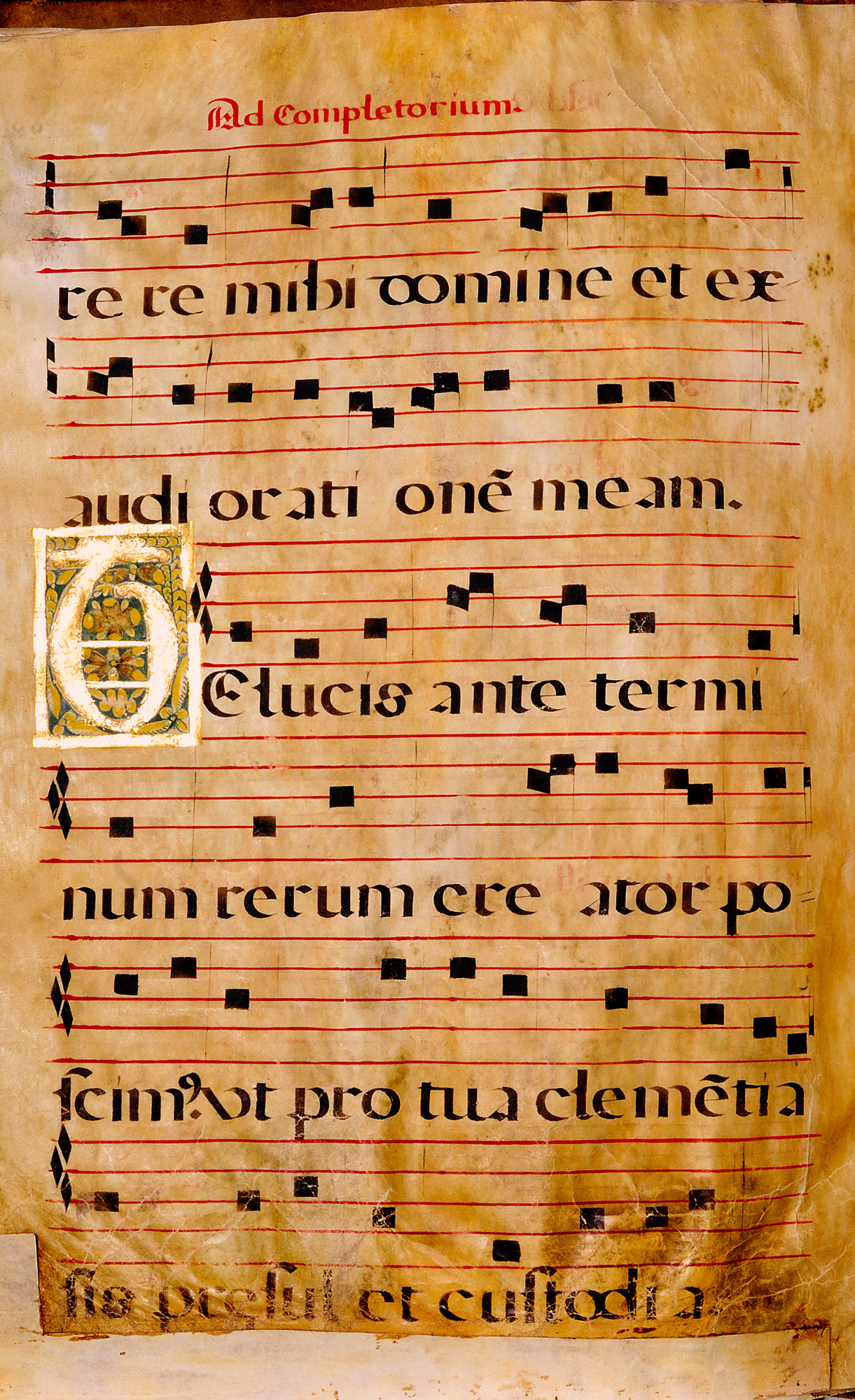
This prayer is sung liturgically as the office hymn at Compline in the Roman Rite. It was originally, and continues to be, sung to plainsong melodies from the Liber Usualis (Usual Book) and the Sarum Rite, such as this one:

Spanish Chant Manuscript Page 203
Te lucis ante terminum from an antiphonary, Spain, 1575–1625. Rare Books and Special Collections, University of British Columbia Library, Vancouver. [object record]

(To hear it chanted in English, see the album Lighten Our Darkness: Music for the Close of Day by the Cambridge Singers.)

The great English High Renaissance composer Thomas Tallis wrote two five-voice settings of the hymn in 1575, of which the ferial tone is performed here by The King’s Singers:

In 1998 J. Aaron McDermid of North Dakota composed a setting, performed by The Singers—Minnesota Choral Artists under the direction of Matthew Culloton:

McDermid writes,

Upon my first reading [of Te lucis] I was immediately struck by the color and imagination inherent in the language, particularly in the second stanza – where the deep calm of the previous verse is replaced by foreboding images of the shades of night. A beautiful symmetry is achieved by the addition of the eloquent Gloria Patri that brings the hymn to a close. Through the patient and fluid unfolding of the Latin, St. Ambrose[2] has imbued this hymn with a sense of comfort and warmth, offering hope for a light to illumine the dark hours to come.

The last setting I want to share is Owain Park’s from 2020, released under the title “Night Prayer.” His was inspired by ancient plainchant and was specially composed for virtual choirs during COVID-19. Listen to the premiere performance by his vocal consort, the Gesualdo Six (Park is the singer at bottom right):

The photographs by Ash Mills in this video, some of them long-exposure (gorgeous!), are of Salisbury Cathedral’s annual “From Darkness to Light” Advent procession, in which the medieval church is gradually filled with the light of over one thousand candles.

For an album recording of Park’s “Night Prayer,” available on Spotify and other streaming platforms, see When Sleep Comes: Evening Meditations for Voices and Saxophone from Tenebrae.

These are just a few of the many musical settings of Te lucis ante terminum that have been composed over the centuries. For a list of others, see https://www.cpdl.org/wiki/index.php/Te_lucis_ante_terminum.

The music gives the words a gravitas and a beauty that I think they lack on their own. Why not choose one of these as a bedtime track to play for your little one as they fall asleep! Or for your own anxious soul. The pronouns are first-person plural, indicating that this prayer is intended to be prayed in community. Make it a family listening event. And if you feel so inclined, you might even try chanting along with the choir of Yorkminster Park Baptist Church in Toronto!


NOTES

1. Although I’ve seen “As I Lay Me Down to Sleep” spuriously attributed as “Old English,” its earliest known appearance in print is in the 1737 edition of the New England Primer, a popular reading textbook used in the American colonies, published in Boston.

2. Abbot S.-G. Pimont, author of Les Hymnes du Bréviaire romaine (Paris, 1874), is the one who attributed the text of Te lucis to Ambrose of Milan (ca. 339–397), but this authorship claim was rejected by the Benedictine editors of The Catholic Encyclopedia (Robert Appleton, 1912) and by patristics scholar Luigi Biraghi and today is generally regarded as false.