Christmas, Day 9: “Today the Virgin cometh unto a cave . . .”

LOOK: Nativity icon from St. Catherine’s Monastery

Coptic Nativity icon (St Catherine's)
The Nativity of Christ, Egypt, 7th century(?). Encaustic on wood. Holy Monastery of St. Catherine, Sinai, Egypt. Photo courtesy of the Michigan-Princeton-Alexandria Expeditions to Mount Sinai.

This Coptic icon of the Nativity bears all the traditional elements of Nativity icons. It shows Mary reclining in a cave next to her newborn son, Jesus, who lies in a manger, being affectionately licked by an ox and ass. Why those two animals? Because the church fathers read Isaiah 1:3 into the scene, which says, “The ox knows its owner and the donkey its master’s crib.”

The starry semicircle at the top represents the heavens. A thick beam of light descends from it onto Christ, confirming his divine paternity. On either side, from behind the grassy hills, angels rejoice, bringing glad tidings of the birth.

From the right, three magi approach with their gifts (unusually, their horses are placed apart from them in the bottom left), and in the center, a shepherd plays a pipe while his flock frolics on the grass.

In the bottom left, Joseph sits dejectedly with his head in his hands. He is being assailed once again by doubt as to Jesus’s true paternity. Could Mary’s outrageous story really be true? Or was she sexually unfaithful? In some Nativity icons Satan appears to Joseph in the guise of an old man to tempt him to distrust Mary and to doubt Jesus’s divinity. Anyone would be a fool to believe it, he taunts. It’s possible that the man with the pointed red cap at the far right of this icon is meant to be the devil on his way to Joseph, but if so, it would be an odd compositional choice. Anyway, in Nativity icons, Joseph stands for all skeptics, for those who struggle to accept that which is beyond reason, especially the incarnation of God.

Next to Joseph, two midwives bathe Jesus in a basin. (Jesus appears twice in the composition. He’s identified by the cross-shape in his halo.)

Art historian Matthew J. Milliner, who specializes in the Byzantine era, describes the Orthodox iconography of the Nativity in a 2021 podcast episode of For the Life of the World [shared previously]:

There’s just something wonderful about the classic Nativity icon. When you look at this, you’ve got Joseph in the corner. . . . And then you have this dome that is overarching the scene. That is, speaking in Charles Taylor’s terms, that’s the “immanent frame”—that’s the cosmos as we know it. And it’s shattered! By what? By the light that comes from outside. In other words, the Kantian universe has been pierced and God has revealed himself and said, “This is how I choose to come into the world.”

And there you have the Virgin Mary, and she almost looks seed-like when you look at these icons. She’s on her side because, thank you very much, she just gave birth. And there’s Christ. And the donkey and the ox are there, symbolizing both Jew and Gentile. In other words, the book of Romans in one shot. Boom. Right there.

Then you’ve got the magi sometimes off in the distance, to symbolize all corners of the earth, to symbolize most in particular the Assyrian Church of the East, the expansion of Christianity all the way to the Pacific Ocean by like the fifth century, folks. Gotta remember that! These are the Christians whom we have lost contact with. The global reality of Christianity is communicated by these icons.

And then, of course, you’ve got the shepherds to symbolize, we might even say, all classes incorporated into this faith—not just across the globe, but across socioeconomic status. All of it is communicated just by meditating upon it.

And then you have this cavern—not some sweet little stable, but a cavern, a cave. And folks, it’s the cave of your own psyche as well. It’s a depth-psychology dimension of the Christian tradition. A Nativity icon is what God wants to do in your soul. This is intended to be a spiritual experience.

The dating of the particular icon pictured above has been debated. It is circulating in many places online with an attribution of “seventh century,” perhaps in part because of its use of encaustic (a common medium for earlier icons). But Father Akakios at St. Catherine’s Monastery at Mount Sinai, the institution that owns and houses the icon, told me that’s probably too early, that it’s more likely a later icon that incorporates earlier elements.

From the Sinai Digital Archive, it appears that Kurt Weitzmann, an art historian from Princeton University who had the icon photographed on one of his four research expeditions to Sinai in the late 1950s and early ’60s, proposes the sixteenth or seventeenth century as its likely time of creation. Cathy Pense Garcia, head of Visual Resources Collections at the University of Michigan (which manages the Sinai Digital Archive jointly with Princeton), was unable to confirm an approximate date and said that more scholarly research is needed.

It’s such a wonderful icon! I hope to see some academic writing about it in the future, as my research turned up next to nothing.

LISTEN: “Kontakion of the Nativity of Christ” by Romanos the Melodist, 6th century | Chanted by Fr. Apostolos Hill, 2016

Today the Virgin cometh unto a cave to give birth to the Word who was born before all ages, begotten in a manner that defies description. Rejoice, therefore, O universe, if thou should hear and glorify with the angels and the shepherds. Glorify him who by his own will has become a newborn babe and who is our God before all ages.

(Η Παρθένος σήμερον, τον προαιώνιον Λόγον, εν σπηλαίω έρχεται, αποτεκείν απορρήτως. Χόρευε, η οικουμένη ακουτισθείσα, δόξασον, μετά Αγγέλων και των ποιμένων, βουληθέντα εποφθήναι, Παιδίον νέον, τον προ αιώνων Θεόν.)

This is the prooimoion (prologue) to Romanos the Melodist’s kontakion on the Nativity of Christ; the other twenty-four stanzas can be read in a translation by Ephrem Lash in St. Romano, On the Life of Christ: Kontakia—Chanted Sermons by the Great Sixth-Century Poet and Singer (HarperCollins, 1995).


This post is part of a daily Christmas series that goes through January 6. View all the posts here, and the accompanying Spotify playlist here.

Four scenes from a medieval German altarpiece

When I was at the Museum Catharijneconvent in Utrecht, Netherlands, in 2019, one of the standout pieces I saw was an early fifteenth-century altarpiece from the Middle Rhine region of Germany. The central section, which I imagine would have been a sculpted Crucifixion scene, has been lost, and the surviving panels are arranged in a modern frame.

Middle Rhine Altarpiece (Catharijneconvent)
Altarpiece from the Middle Rhine, ca. 1410. Tempera on panels. Museum Catharijneconvent, Utrecht, Netherlands. Photo: Ruben de Heer.

Ten panels depicting eight scenes from the life of the Virgin Mary decorate what would have originally been the interior wings—that is, visible when the altarpiece was open.

  1. The Annunciation (2 panels)
  2. The Visitation
  3. The Nativity
  4. The Adoration of the Magi
  5. The Resurrection
  6. The Ascension (2 panels)
  7. The Descent of the Holy Spirit
  8. The Dormition

I’ll describe the first four, as they’re my favorites.

All photos in this post are from the museum’s website, which courteously provides them in high resolution under an open-access policy, promoting scholarship and digital engagement. The Annunciation image is a composite I made from two separate photos.

The Annunciation

Annunciation (Middle Rhine Altarpiece)

In the Annunciation, Mary sits in her bedroom beside a window in front of an open pink chest (her dowry chest?), quietly reading the scriptures, when the angel Gabriel slips in through an open door, holding a banderole that bears his greeting: Ave gratia plena d[omi]n[u]s tecum (“Hail, favored one, the Lord is with you,” Luke 1:28). He then goes on to tell her that she has been chosen to bear God’s Son into the world.

What will Mary say? Four little angels look on in eager anticipation from a tower in the panel above, while in the room two angels already start rolling out the royal treatment, holding up a gilt-brocaded velvet “cloth of honor” behind the young maiden in recognition of her high calling.

A thin column divides Gabriel’s space from Mary’s, creating a sense of threshold. It marks a boundary that is about to be crossed. The separation between God and humanity will be broken down by the Incarnation.

Mary ultimately responds to the surprise invitation with acceptance: Ecce ancilla d[omi]ni fiat michi s[e]c[un]d[u]m verbu[m] t[uu]m (“Behold the handmaid of the Lord, be it unto me according to thy word,” Luke 1:38).

Mary’s yes triggers the release of a thick stream of light—it looks to me like a golden conveyor belt!—from the heart of God the Father, who is peering down through an upper window. Riding that stream is a haloed dove (the Holy Spirit) followed by a tiny yet fully formed infant Christ who’s holding a cross and headed straight toward Mary’s womb.

Annunciation (Middle Rhine Altarpiece, detail)
“Weeee!!!”

The homunculus (“little human”) motif in Annunciation images, though relatively rare, always makes me chuckle. It’s one way artists came up with to visualize the unvisualizable mystery of Christ’s conception, one that includes the Second Person of the Trinity as an actor in the event and shows a very literal descent. Not long after the motif started appearing in the fourteenth century, it was disapproved of by theologians, such as Antoninus of Florence and Molanus, and it was finally banned in the eighteenth century by Pope Benedict XIV as being heretical, since it suggests that Jesus did not take his body from Mary.

For brief commentary on this particular scene by Msgr. Herman Woorts, a Dutch art historian and an auxiliary bishop in the Roman Catholic Church, see this video produced by Katholiekleven.nl:

(To translate the Dutch into your language, click the “CC” button on the player, then the cog icon, and select Subtitles→Auto-translate.)

The Visitation

Visitation (Middle Rhine Altarpiece)

In the Visitation panel, Jesus and John the Baptizer are visible in their mothers’ wombs, each encased in a mandorla (almond-shaped aureole). This visual device of showing the cousins in utero was not uncommon at the time, especially in the Low Countries; art historian Matthew J. Milliner amusingly calls it “ultrasound Jesus”! Here you can actually see little John kneeling before his cousin in adoration.

Elizabeth has emerged from a door at the right, whose frame is labeled “Civitas Juda,” City of Judah (and notice the dog in the doorway! a traditional symbol of faithfulness). As she and Mary embrace each other in celebration of their miraculous pregnancies and imminent salvation, scrolls unfurl with their words from the Gospel of Luke: Et unde michi hoc q[uo]d mater d[omi]ni mei venit ad me (“And why is this granted to me that the mother of my Lord should come to me?” Luke 1:43), at right, and at left, Magnificat a[n]i[m]a mea d[omi]n[u]m. Et exultavit sp[iritu]s meus i[n] deo salutalutari (sic) meo (“My soul magnifies the Lord, and my spirit rejoices in God my Savior,” Luke 1:46–47). The scrolls provide a delicate, wing-like framing around the two women.

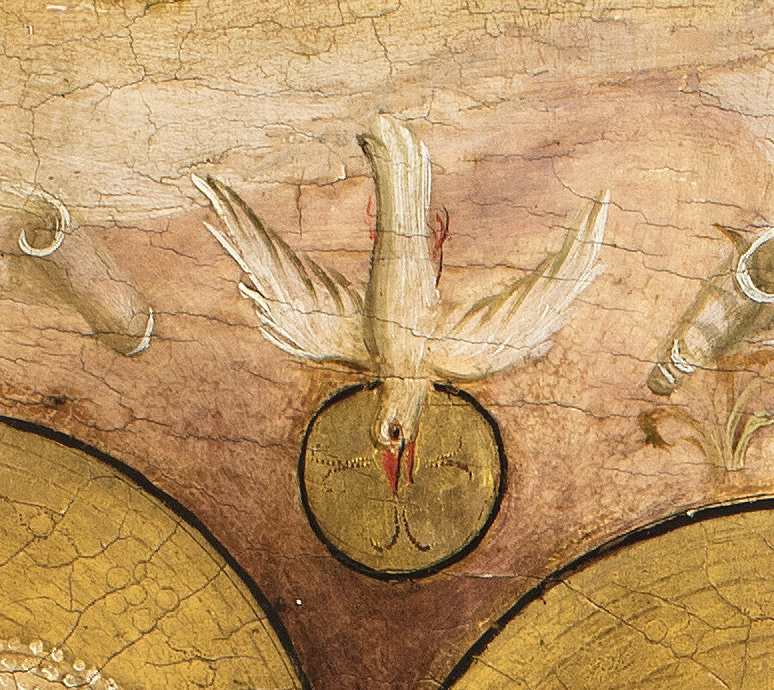
And at their head, in the center, an open-beaked dove descends, signifying the Holy Spirit—an extremely rare appearance in Visitation images. This is God breathing on his daughters, blessing their ministries, receiving their praise. Like the prophets of old, they are filled with God’s power and truth spills forth from their lips.

Visitation (Middle Rhine Altarpiece, detail)

At their feet flows a spring of water, a possible allusion to Isaiah 35:6b–7a: “waters shall break forth in the wilderness, / and streams in the desert; / the burning sand shall become a pool, / and the thirsty ground springs of water.” Not to mention the Living Water that is Christ (see John 4).

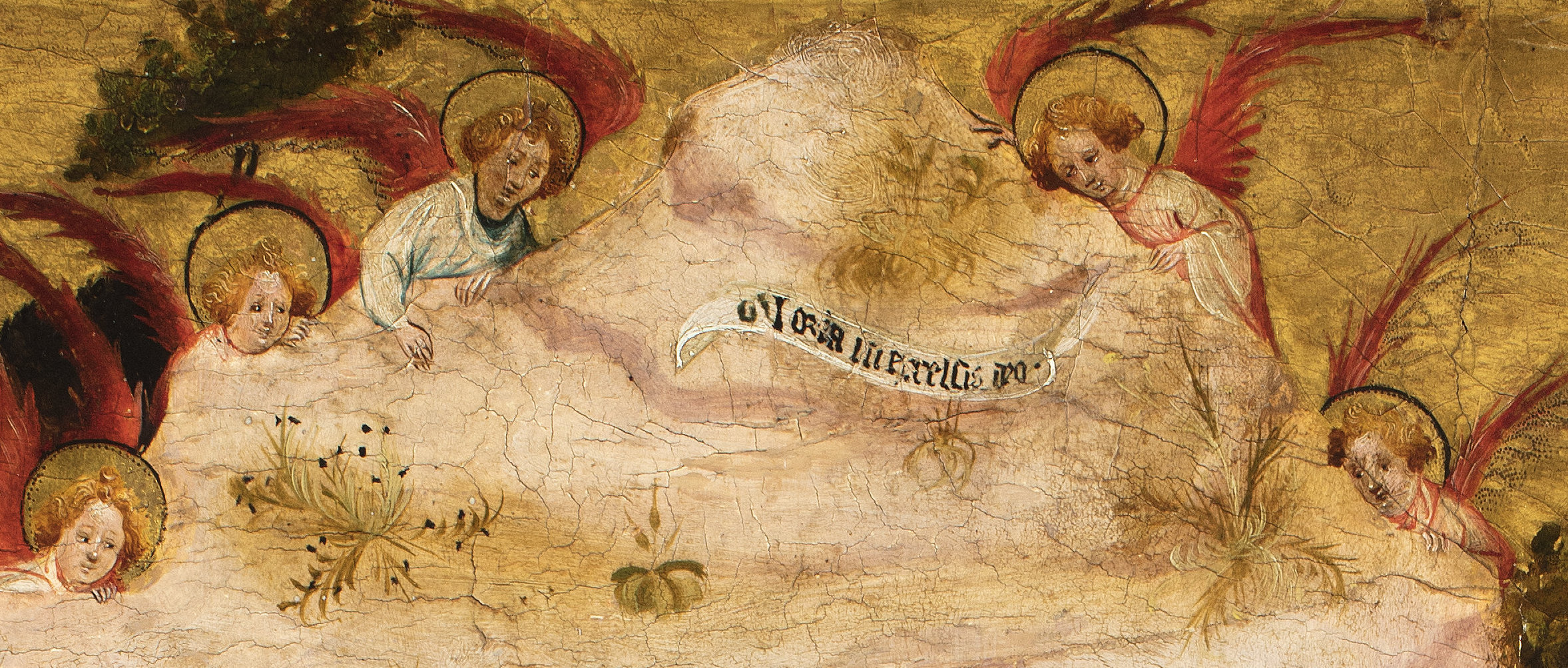
Another charming detail of this panel is the angels, with their wispy red wings, peeking in at this intimate moment from behind rocks. I’m reminded of the epistle of 1 Peter, whose author says that the mysteries of salvation are “things into which angels long to look!” (1:12). Here they seem to whisper their song that will be exclaimed at full blast on the night of Jesus’s birth: Gloria in exelsis deo (“Glory to God in the highest,” Luke 2:14).

The Nativity

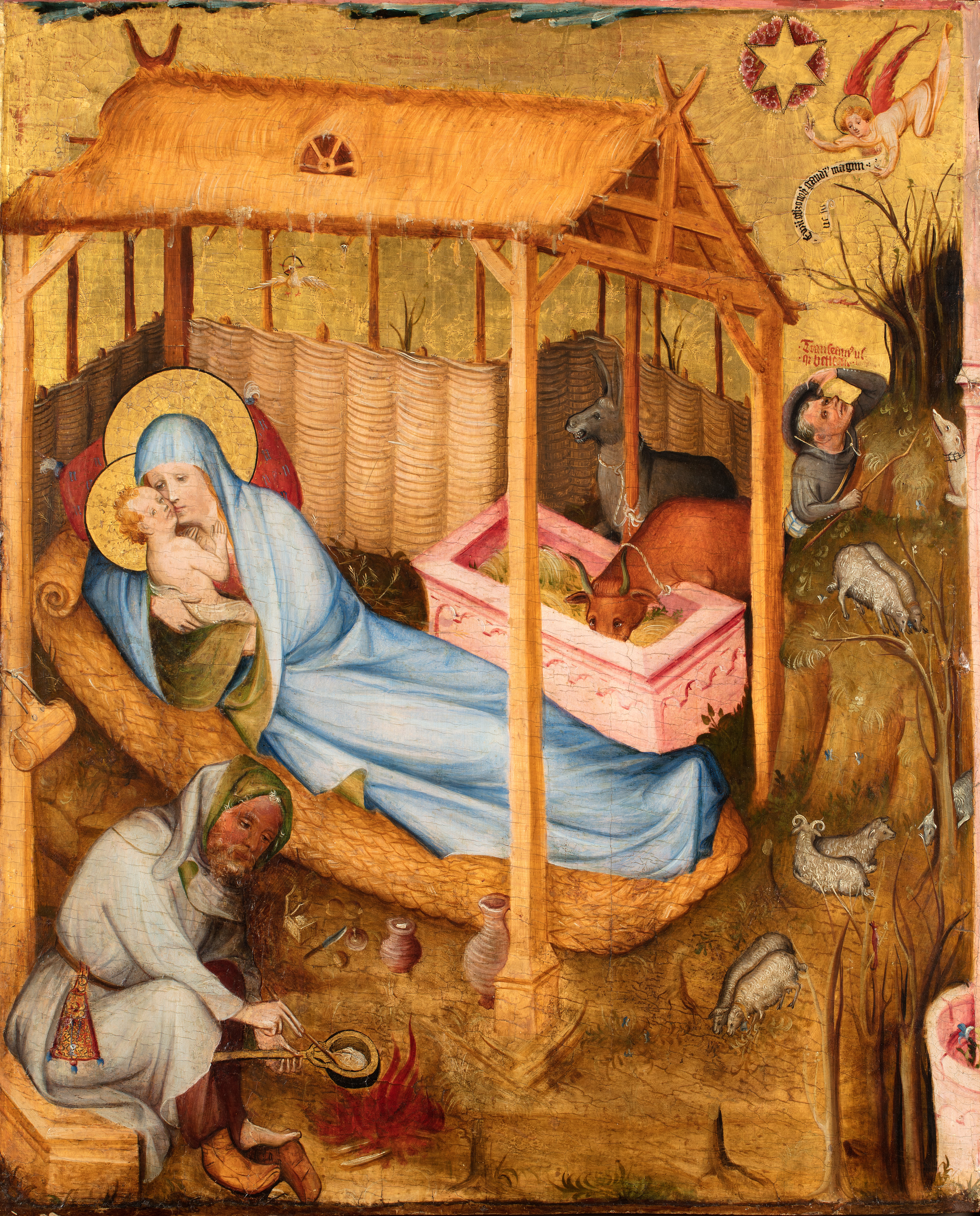
Poor Joseph is often overlooked as a player in the Christmas story, and yet he, too, faithfully responded to a (quite terrifying!) divine calling: to be the adoptive father of Jesus, raising him as his own. Though he initially had doubts about Mary’s story of supernatural conception—who wouldn’t?—an angel set him straight, and he ultimately acted in love and loyalty to Mary, and to God. He was an advocate and a provider for his family, looking out for their best interests all along the way.

Nativity (Middle Rhine Altarpiece)

I mention this because the Middle Rhine Altarpiece shows an actively caring and resourceful Joseph at the Nativity, cooking porridge over an open fire to nourish his hungry and tired wife, who reclines on a rollout mat with her newborn.

Also, notice that his left foot is bare. A legend of unknown origin says that Joseph removed his stockings (German hosen) following Jesus’s birth, cutting them into strips in order to swaddle the child. This narrative detail appealed to popular imagination and was referred to in stories, poems, songs, and the visual arts from the fourteenth through sixteenth centuries in the Netherlands and the Rhineland. At the time this altarpiece was made there was even a venerated relic at Aachen Cathedral purported to be the stockings-turned-swaddling bands.

As had become standard in images of the Nativity, this one includes an ox and an ass. The canonical Gospels don’t mention any animals at the birth—though the mention of a manger in Luke 2:7 implies an animal presence. The seventh-century Gospel of Pseudo-Matthew specifically names the ox and ass, citing their supposed adoration of the Christ child as a fulfillment of an Old Testament “prophecy”: “And on the third day after the birth of our Lord Jesus Christ, the most blessed Mary went forth out of the cave, and entering a stable, placed the child in the stall, and the ox and the ass adored Him. Then was fulfilled that which was said by Isaiah the prophet, saying: The ox knows his owner, and the ass his master’s crib (Isa. 1:3).” These two domestic animals are also mentioned in the Nativity account that appears in the Golden Legend, an immensely popular text from the thirteenth century.

Here the ox is nose-deep in straw, while the ass looks up with his mouth agape. Perhaps he’s excited at having just spotted the Spirit-dove under the rafters.  

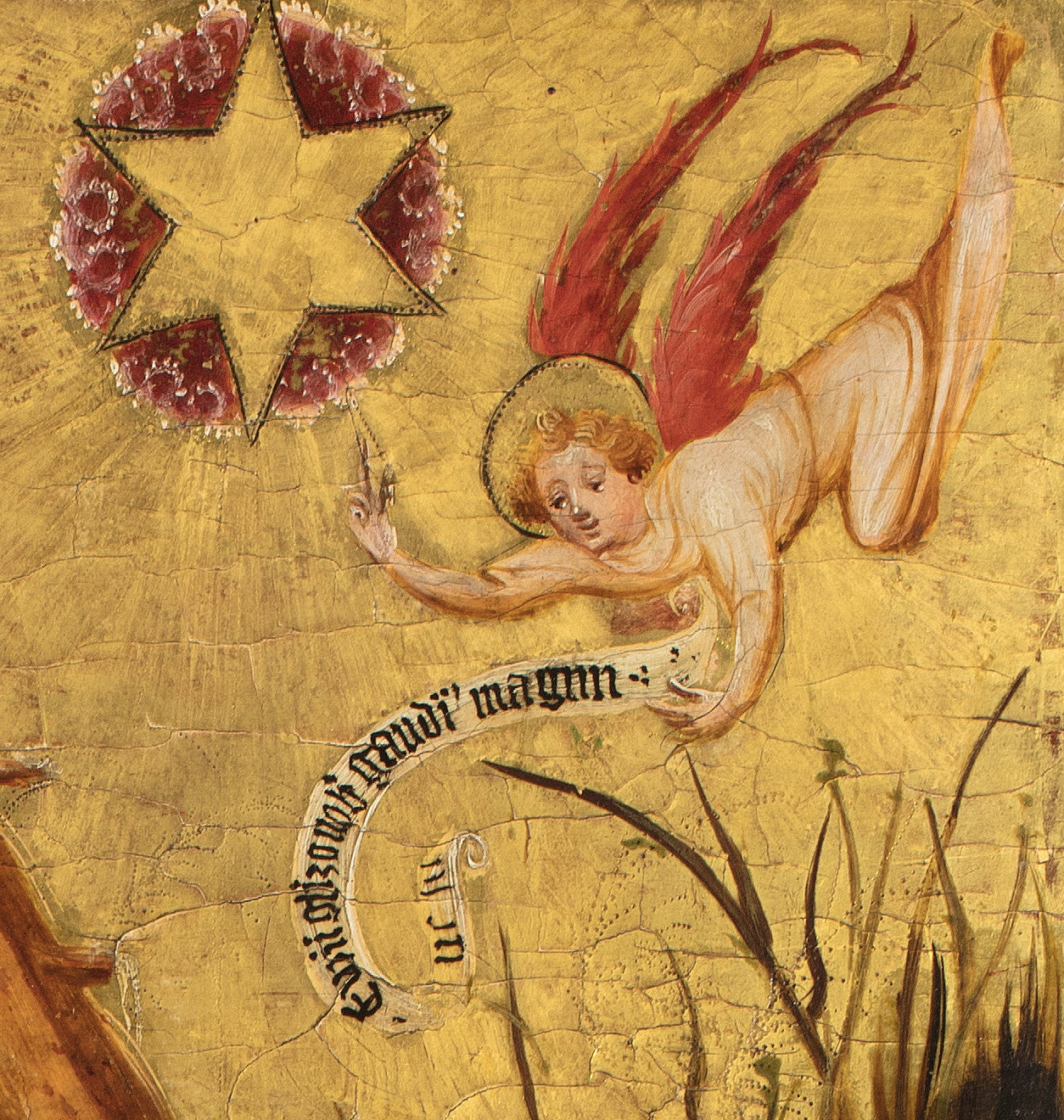
The shepherds are about to arrive at the stable, as in the right background the birth is announced to them. The scroll held by the angel reads, Evanglizo vob[is] gaudi[um] magnu[m] (“I proclaim great joy to you,” Luke 2:10), and above the shepherd is the inscription Transeamu[s] us[que] Betleem (“Let’s go to Bethlehem,” Luke 2:15).

The Adoration of the Magi

In the Adoration of the Magi panel, Mary holds the Christ child on her lap, who is nude save for a thin diaphanous drape, emphasizing his full humanity. She wears a crown, alluding to her identity (in Catholic tradition) as Queen of Heaven. As in the Annunciation, she’s backed by a cloth of honor, which Joseph pulls aside to see what new visitors have come calling. And again, the ever-present Holy Spirit hovers above!

The pointing angel at the top, with the aid of a star, has directed three magi, portrayed here as kings, from their far-off homelands to the Christ child. Ite in iudeam ubi / nascit rex iudeor[um] (“Go to Judea where the king of the Jews was born”), he says.

Having cast his crown at the child’s feet, one of the magi kneels down and kisses the hand of the King of kings. He presents a container of gold coins as tribute, which Jesus rifles through with curiosity (ooo, shiny!).

Two other magi stand behind with their gifts of frankincense and myrrh. One of them, whom tradition calls Balthazar, is African. In the eighth century the historian Bede described Balthazar as having a “black complexion,” and from around 1400 onward he came to be portrayed that way in art, reflecting the growing visibility of other races in Europe.

Exterior Panels

Just to give you a full picture of the altarpiece as a whole . . .

The exterior panels, which were visible when the altarpiece was closed, comprise ten scenes from Christ’s passion. Three, however, are missing, and several of the remaining ones are damaged.

  1. The Agony in the Garden
  2. The Arrest of Christ (lost)
  3. Christ before Pilate
  4. The Flagellation
  5. The Crowning with Thorns
  6. Christ Carrying His Cross
  7. The Deposition (lost)
  8. The Entombment
  9. Mary supported by John
  10. Longinus with the lance (lost)

So all together, the altarpiece would have told the gospel story from Christ’s conception and birth to the Crucifixion to the Resurrection and Ascension to Pentecost. And it would have served as the backdrop to the celebration of the Eucharist, spiritually forming parishioners week after week.

Art museums are full of such treasures as these. I encourage you to visit one of your local museums (or maybe take a weekend trip to one), find a piece of historical art that intrigues you, and sit with it for at least ten minutes. What do you notice? What is strange to you? What makes you smile? What was the object’s original context? What lineages is it a part of (e.g., what communities has it passed through, what iconographies or textual traditions does it draw from and develop, etc.)? What theological ideas, if any, does it express?

If you struggle to meaningfully engage with an artwork, I’m sure a docent would love to help you.

You might also take a photo of the artwork and share it on your social media. Ask your friends what stands out to them.