Roundup: One-word poems, “Go to Hell” musical setting, and more

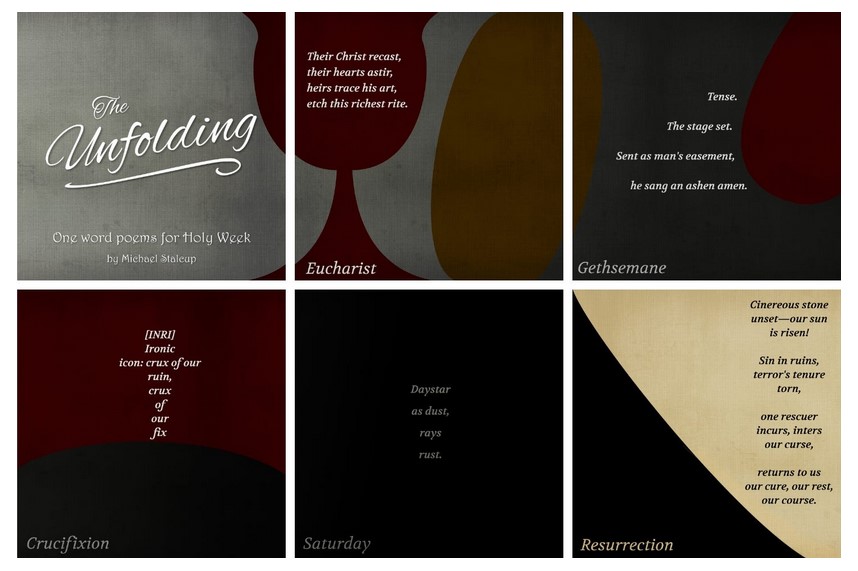
POEM SEQUENCE: “The Unfolding” by Michael Stalcup: Michael Stalcup has published a sequence of five short poems in Solum Journal that “tells the story of Jesus’ death and resurrection by unfolding five words that take us from Maundy Thursday through Easter Sunday,” he says. “I wrote these poems in a very unusual way, restricting myself to words that could be formed from the letters in each poem’s title. . . . This poetic form calls for creativity within intense limitations, which seems fitting for Holy Week—a time when Jesus crafted the most beautiful art this world has ever known within the constraints of his own suffering and death.” Stalcup has also presented them on Instagram (click on the image below).

The Unfolding by Michael Stalcup

+++

ARTICLE: “Don’t Rush Past Good Friday” by Brian Zahnd: Pastor and author Brian Zahnd cautions us not to shortchange the cross on the way to Easter, but rather to slow down and dwell there, beholding the crucified Christ.

+++

SONGS:

>> “Friday Morning” by Sydney Carter, performed by Timothy Renner: This Good Friday song by the English folk musician Sydney Bertram Carter (1915–2004) is difficult—one might even say blasphemous. That’s because it’s voiced from the perspective of the “bad” thief, who is spewing hatred and bitterness over his fate and blaming God for having created such a cruel world. But we’re aware of an irony in the refrain that the convicted man is not: “It’s God they ought to crucify / Instead of you and me, / I said to the carpenter / A-hanging on the tree.”

Read or listen to a reflection on “Friday Morning,” by Andrew Pratt, here.

>> “Go to Hell” by Nick Chambers: This song is a setting of a poem by Pádraig Ó Tuama from his collection Sorry for Your Troubles (Canterbury Press Norwich, 2013). The title is shocking, I know, but it’s derived from a line in the Apostles’ Creed, where we Christians profess that after Jesus died, he “descended into hell.” The singer-songwriter, Nick Chambers, writes in the YouTube video description: “In between Good Friday and Easter Sunday is possibly strangest day of the Christian year. On Holy Saturday, not only is Jesus, the God-Man, in the grave; traditions abound about his descent to the dead, his ‘harrowing of hell.’ What does it mean for the coming down of God-with-us not to end on earth but ‘under the earth,’ extending hope to the furthest regions of human pain and abandonment? Such a question deserves more poetry than explanation.”

“Go to hell” is a slang expression of scorn or rejection, to which Jesus was no stranger. As in the previous song, there’s an irony here, in telling Jesus to go to hell—because he did. Literally. Ó Tuama meditates on how Jesus shares in our vulnerabilities and yearnings and seeks to pull us out of the hells we’re in and redeem our stories.

Hear the poem read by the poet here, or at the end of the Stations of the Cross video below. “he is called to hell, this man / he is called to glory . . .”

+++

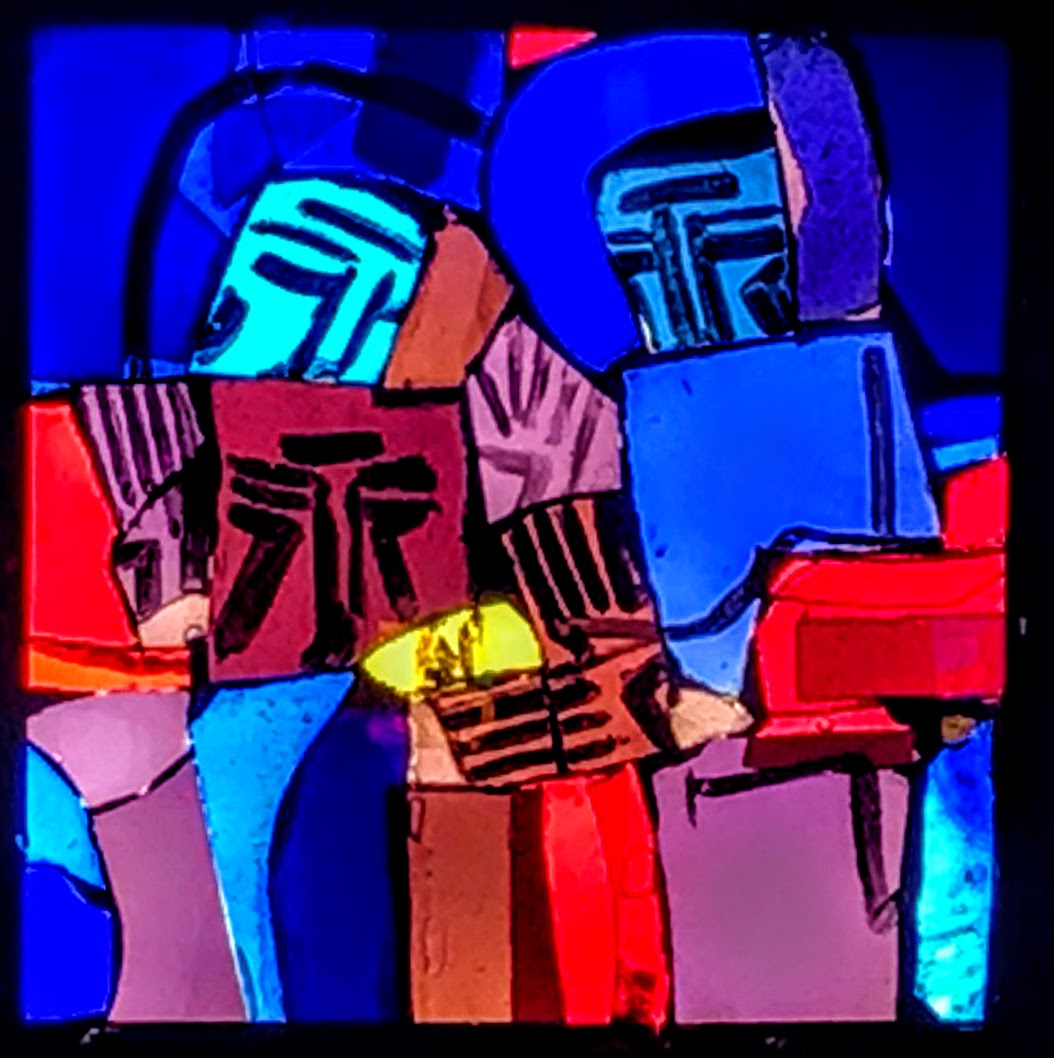
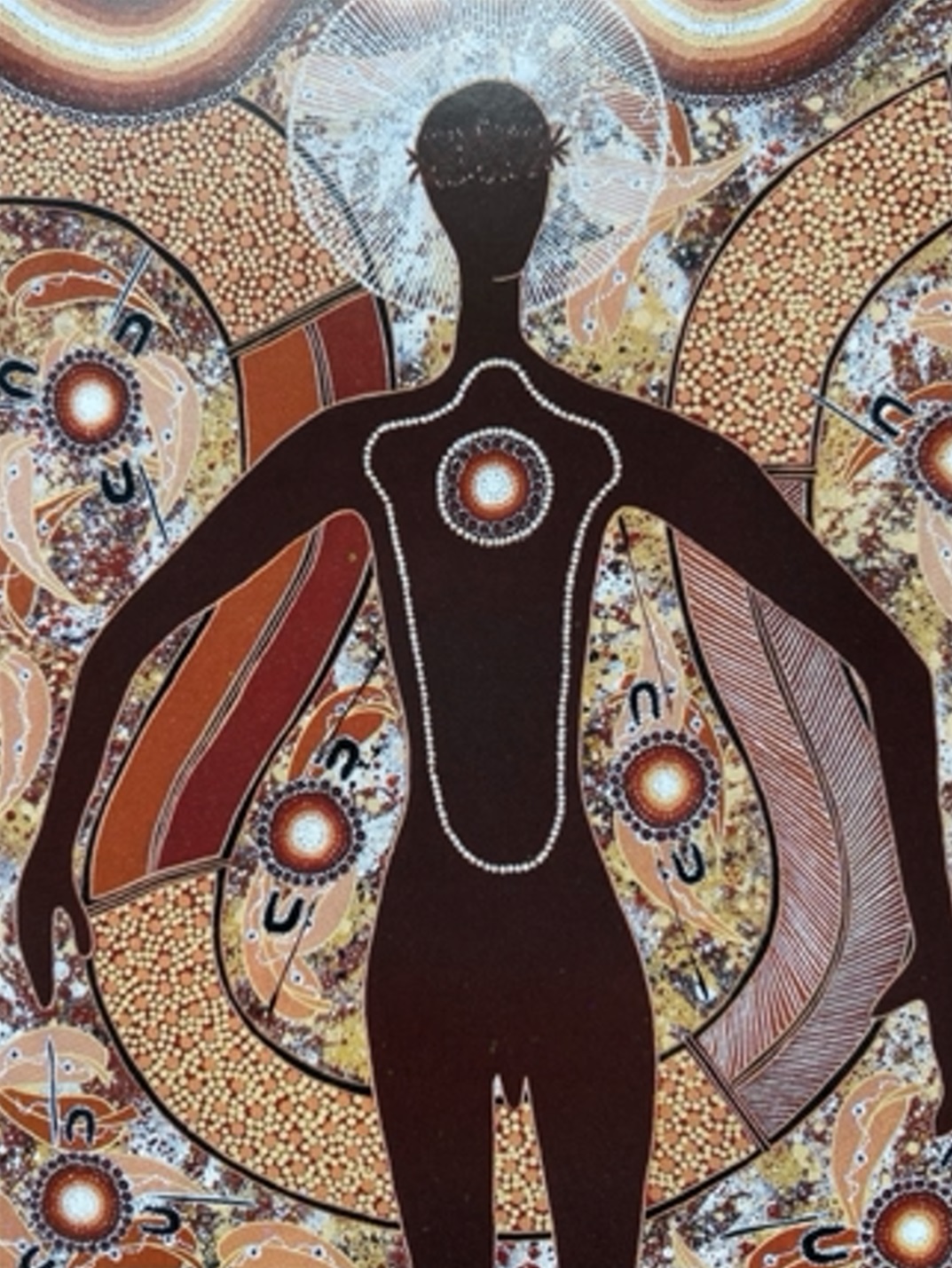
GUIDED MEDITATION: “Stations of the Cross, Good Friday, 2020” by Pádraig Ó Tuama: In 2020 the poet-theologian Pádraig Ó Tuama put together this twenty-minute video reflection for Good Friday structured around the Stations of the Cross, consisting of photos of art he’s taken and the praying of collects he’s written. (Several of the collects can be found in his book Daily Prayer with the Corrymeela Community from 2017.) The throughline is a set of stained-glass Stations by Sheila Corcoran at the Church of Our Lady Queen of Heaven at Dublin Airport; others are by Jong-Tae Choi, Gib Singleton, Sieger Köder, Richard P. Campbell, and Audrey Frank Anastasi.

Corcoran, Sheila_Veronica's Veil
Sheila Corcoran, Station 6: Veronica Wipes the Face of Jesus, ca. 1964. Stained glass, Church of Our Lady Queen of Heaven, Dublin Airport. Photo: Patrick Comerford.

Campbell, Richard_Stripped
Richard P. Campbell (Dunghutti/Gumbaynggirr, 1958–), Station 10: Jesus is stripped of his garments, 2001. Reconciliation Church, La Perouse, Sydney, Australia.

But before stepping onto Jesus’s Via Dolorosa, Ó Tuama considers Judas, sharing a stained glass panel by Harry Clarke that illustrates a medieval legend about the Irish monastic saint Brendan the Navigator. According to the Navigatio Sancti Brendani Abbatis, on one of his voyages St. Brendan encountered Judas at sea, tied to an iceberg. He learned that an angel had taken pity on Judas in hell and given him a reprieve of one hour to cool himself from the flames of judgment. Ó Tuama then prays for those who, like Judas, are tormented by guilt and see no way out.

He closes with a reading of his poem “Go to Hell” (set to music in the previous roundup item).

+++

SONG: “For the Songless Hearts” by Jon Guerra: “There’s a lot of hubbub around Easter weekend in churches. And for good reason,” says singer-songwriter Jon Guerra. “But our hearts can’t always cooperate with the prescribed mood of the Easter season: ‘Celebrate! Be happy! Sing!’ Sometimes the last thing we are able to do is sing. Thankfully, Good Friday and Easter are not about mustering a mood. Good Friday and Easter are about remembering that there is One who meets us in our life and meets us in our death. He sings for us—and over us—when we can’t.”

That’s what “For the Songless Hearts” is about—a single released in 2017, and which Guerra sings with his wife, Valerie. In a Mockingbird blog post about it, Guerra admonishes, “Remember that before the tomb was empty, it was full. ‘When he was laid in the tomb, he laid right next to you.’” Jesus knew the depths of sorrow and the sting of death. We are not alone in such experiences.

Roundup: Doubting Thomas, practicing stillness, living with grief, and more

SPOTIFY PLAYLIST: October 2023 (Art & Theology): Each month I compile a nonthematic mix of thirty faith-inflected songs from a range of sources. October’s playlist is now live. One track I’ll draw your attention to, with a live performance video below, is the soul-baring prayer “Doubting Thomas” by Chris Thile of Nickel Creek; read the lyrics, with annotations, here. (Also, Paul Demer has a nice cover of this song on YouTube.)

+++

MEDITATION EXERCISE: “Stillness—Richard Rohr’s Daily Meditations”: From the Center for Action and Contemplation comes this one-minute video that takes the most memorable line from Psalm 46, progressively paring it down and creating meditative space around each subtraction.

Be still and know that I am God
Be still and know that I am
Be still and know
Be still
Be

The Rev. Dr. Cynthia Bourgeault, an Episcopal priest, writer, and retreat leader, mentions this chant in her book Chanting the Psalms. “Each time the line is repeated,” she writes, “key words are taken away. The result is a funnel-like effect that leads straight down into silence. . . . Each phrase expresses its own unique meaning and understanding as the prayer moves toward utter simplicity” (185). Bourgeault recommends working with the recording “Be Still and Know” found on the album Songs of Presence: Contemplative Chants for the New Millennium from Praxis Publishing House; I couldn’t find the audio online, but I did find a song by The River’s Voice (Trish and Richard Bruxvoort Colligan) that’s also based on this exercise of Fr. Rohr’s: “Be (Still and Know That I Am God)”:

+++

PODCAST EPISODES: Here are two podcast episodes I caught up with recently and enjoyed. Both links include transcripts.

>> “Jan Richardson: Stubborn Hope,” Everything Happens with Kate Bowler, October 27, 2020: Kate Bowler, a historian and cancer survivor who has done much academic work on the prosperity gospel, talks with spiritual writer Jan Richardson [previously], whose husband died unexpectedly in 2013, about the hidden rooms of grief, being disciplined by hope, and how the concept of blessing in the Jewish and Christian traditions differs from the #blessed culture of social media. Don’t miss the three discussion questions in the show notes.

>> “Esau McCaulley: How Far to the Promised Land?,” No Small Endeavor, September 14, 2023: Lee C. Camp interviews public theologian Esau McCaulley, a professor of New Testament at Wheaton College and a New York Times opinion writer, about his new memoir, How Far to the Promised Land: One Black Family’s Story of Hope and Survival in the American South. I’ve heard rave reviews from multiple corners about this book, and this conversation has really whetted my appetite to read it!

+++

POEM COMMENTARY: “Learning about Constellations” by Saddiq Dzukogi, commentary by Pádraig Ó Tuama: On this episode of On Being’s Poetry Unbound podcast, host Pádraig Ó Tuama unpacks a poem written by Saddiq Dzukogi in the aftermath of his one-year-old daughter’s death. It’s from his 2021 collection Your Crib, My Qibla.

Roundup: Peter Howson retrospective, “Strange Stories of the Bible” with Pádraig Ó Tuama, and more

ART EXHIBITION: When the Apple Ripens: Peter Howson at 65, May 27–October 1, 2023, City Art Centre, Edinburgh: City Art Centre in Edinburgh is hosting a major retrospective of one of the UK’s leading figurative painters, Peter Howson, who first emerged during the mid-1980s as one of the New Glasgow Boys and whom the art critic Donald Kuspit dubbed the “Scottish Bosch.” Curated by David Patterson, the exhibition brings together some one hundred works spanning the artist’s career, many never seen before in Scotland, with subjects ranging from working-class Glasgow men to the Bosnian War (into which Howson was sent as official war artist) to biblical stories. His work deals with themes of aggression, struggle, and faith.

Artist and art educator Tessa Asquith-Lamb discusses five key works from the exhibition in this twenty-minute video:

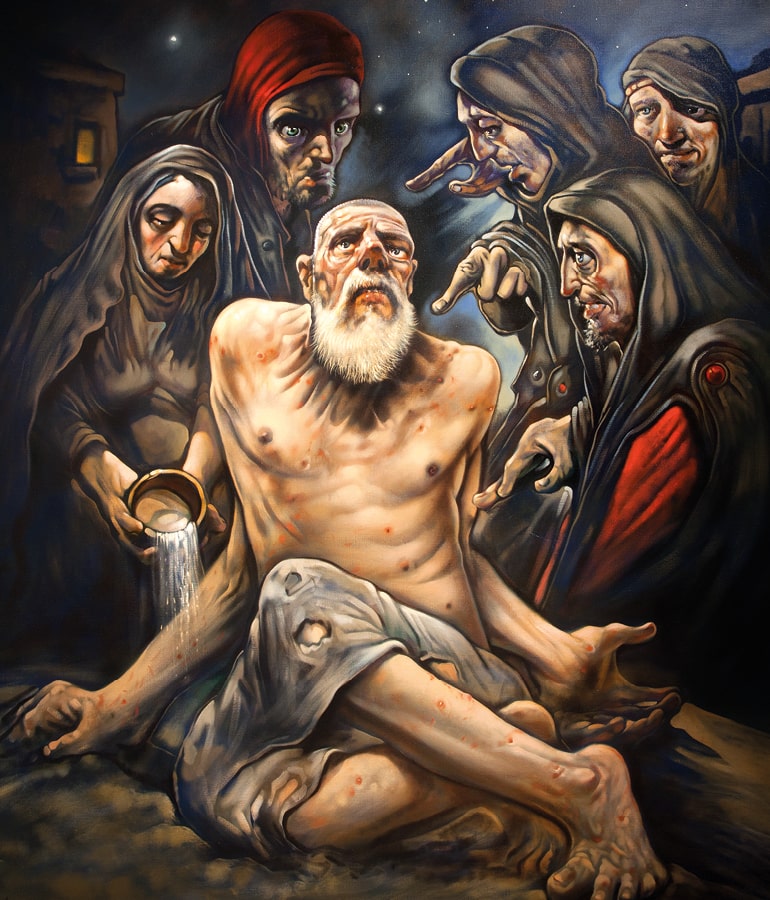
Howson, Peter_Job
Peter Howson (Scottish, 1958–), Job, 2011. Oil on canvas, 182 × 152 cm. Collection of Alan and Karen Turner.

“I like to bring the Bible into this world we live in today,” says Howson, who is a Christian. (He made headlines when he went public with the story of his religious conversion while undergoing treatment for alcohol and drug abuse in 2001.) Reflecting on the reception of and motivation behind his biblical works, he said in a recent video interview (30:31ff.):

There’s two camps of people. There’s the people that groan whenever they see a religious painting of mine, and they say, “Why can’t he stay away from religion?” It’s that kind of embarrassment about religion. They don’t like my religious art, but I continue to do it. . . . And then there’s the other people that actually are religious, but they don’t like it because it’s too frightening for their gentle, staid, normal religiousness. They don’t want anything nasty happening in their lives or anything that’s going to cause a stir. So to them it’s a big danger as well, the stuff I do, because it’s violent, it’s real. It’s like the consuming fire of God.

The Bible is an incredible book. It’s a book that’s got everything in it, really. It’s got so much tragedy, violence, disaster, despair. It’s also got incredible revelation in it. It’s got incredible acts of love and kindness. . . .

All I know is that . . . the work I do on the Bible and on the teachings of Jesus, or on the events in Jesus’s life—which have in fact fascinated artists for centuries—I don’t know why it shouldn’t continue with me. For me to paint these things, it’s made a big difference to a lot of people’s lives. It helps people. It’s a therapy that takes them through a door into a different universe altogether. It takes them into a new world, a new discovery. They realize they are not a person that’s just flesh and blood, an animal. It means that there’s a spiritual side that they’ve missed out on. And that’s the most important thing they can ever understand or realize. And it’s salvation, really, for them, for people to go through that door. That’s the door I want to lead them through.

In conjunction with the exhibition, on June 23 the City Art Centre hosted a panel with writer and art critic Susan Mansfield and other experts on the subject of religious art today, including what place it has in an increasingly secular world. Unfortunately there appears to be no recording of the event offered online. But there are still other related events coming up; learn more here. And you still have about a month and a half to see the exhibition!

+++

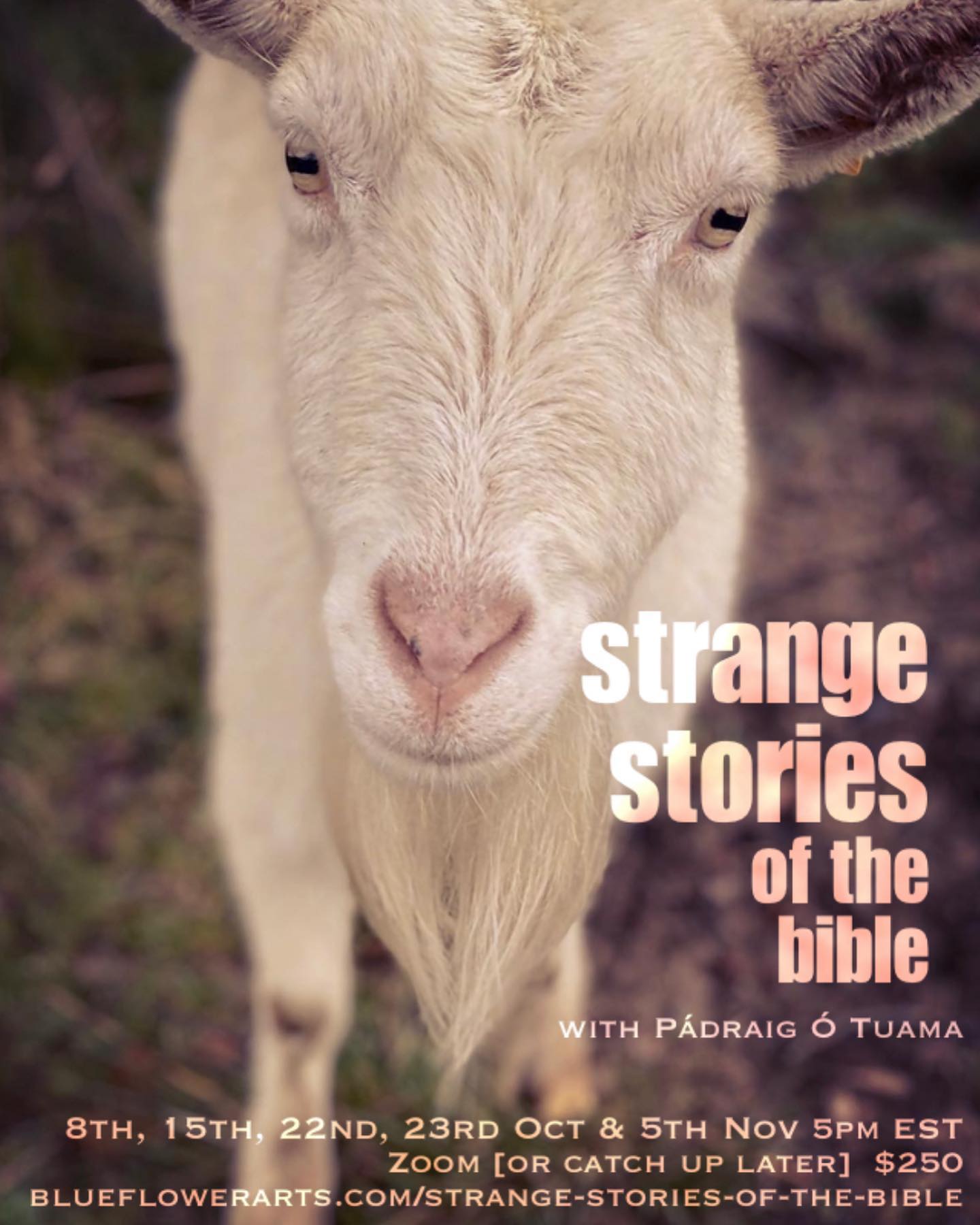
ONLINE COURSE: “Strange Stories of the Bible,” taught by Pádraig Ó Tuama, October 8–November 5, 2023: Over the course of five Zoom-mediated classes, poet-theologian Pádraig Ó Tuama will lead a literary exploration of peculiar stories from the extraordinary library of world stories that is the Bible, focusing on the lives of five figures: Noah, Isaac, Ruth, Mary of Bethlehem, and Judas. Their stories are not so foreign as one might think, as they “depict very familiar aspects of human behaviour: jealousies, rivalries, rages, desires, ambitions, schemes, travels, courage, challenges, archetypes, addictions, misunderstandings and machinations.” Each class will involve a close reading of a scripture text, bringing to bear literary analysis, contemporary poetry, and art, and will leave participants with questions for self-reflection. Cost: $250 USD.

+++

POETRY-WRITING RETREAT: “Ideas Everywhere! Inspirations for Poetry,” led by Marjorie Maddox, September 22–24, 2023 (update: the date has been rescheduled to October 2729, 2023), Bethany Retreat Center, Frenchville, PA: “The everyday, the eternal, and everything in between—ideas for poems are everywhere! During this retreat, we’ll focus on generating poems from both the mundane and the miraculous, using—as time permits—the arts (paintings, photographs, movies, music), sacred texts and rituals, nature, news, place, sports, and the medical as springboards. By drafting, revising, and discussing poems in a supportive community, we’ll consider how one poetic choice leads to another, each contributing to the work’s overall effect. Arrive ready to engage, experiment, write, laugh. Leave with new ideas and strategies for future poems.” Cost: $275 (includes meals and lodging).

I have a poem by Marjorie Maddox queued up to publish here next month. I really appreciate her work!

+++

CALL FOR POETRY: Presence: A Journal of Catholic Poetry is accepting poetry submissions through October 1, 2023, for its eighth annual issue, to be published in April 2024. “We publish poems on the basis of their artistic excellence, rather than on the basis of the author’s professed creed or because the subject matter is explicitly Catholic. The poems in this journal convey God’s presence in any number of ways—by exploring the intersection of matter and spirit, by depicting the struggle between belief and doubt, by questioning the faith, being surprised by it, taking joy in it, even finding humor in it.” Learn more at https://www.catholicpoetryjournal.com/poems.

Poets who have contributed to past issues include Marilyn Nelson, Julia Alvarez, Dana Gioia, Robert Cording, and Paul Mariani.

+++

PROGRAM: The Brehm Residency: The Brehm Center at Fuller Theological Seminary is looking for artists and Christian ministry leaders in the US to join their remote residency program for spring 2024. The cost to participate is $495. “How do artists experience the world? How do creative hearts respond to the story of God? We believe these questions matter. The mission of the Brehm Residency is to cultivate generative relationships between artists and ministry leaders who are mutually dedicated to the artistic renewal of our communities and their churches.” Registration deadline: October 31, 2023.

The program consists of (1) a curriculum of readings and resources that cover historical, theological, and psychological perspectives on the arts, and (2) ten biweekly, ninety-minute online gatherings from January through May 2024, which include guided discussions, fellowship, and periodic guest speakers. There is also an optional, seven-day in-person add-on.

+++

NEW WEBSITE + EVENTS + FUNDING CALL: The Leighton Ford Initiative in Theology, the Arts, and Gospel Witness at Gordon-Conwell Theological Seminary: Gordon-Conwell is a multidenominational, evangelical seminary based in Hamilton, Massachusetts, with other campuses in Boston; Charlotte, North Carolina; and Jacksonville, Florida. In 2022 under the direction of Dr. Wes Vander Lugt, the seminary launched the Leighton Ford Initiative in Theology, the Arts, and Gospel Witness, which “embraces and engages with God’s gift of artistry through impactful teaching, relevant scholarship, and catalytic events that form students, enrich the church, and propel participation in God’s mission to make all things new.” The initiative offers academic courses; pursues arts and theology research and publications; hosts symposia, gallery exhibitions, concerts, film screenings, conversations with writers and artists, and other events; and plans arts-integrated chapel services. I attended the excellent Georges Rouault symposium they organized last fall—which I publicized here. Here’s what’s upcoming on their calendar:

Once enough money is raised for an endowed chair, the initiative will become an official center within the Gordon-Conwell Institute and programming will expand. There are plans to offer a Certificate in Theology, the Arts, and Gospel Witness, host pilgrimages to sites of global arts influence, assist faculty in integrating the arts into their teaching, and host creative residencies.

Roundup: Kristin Asbjørnsen interprets the spirituals, photos from Skid Row, and more

SPOTIFY PLAYLIST: July 2023 (Art & Theology): This month’s Spotify mix that I put together for you all includes a Shona worship song from Zimbabwe; “Adonai Is for Me,” a song in Hebrew by Shai Sol; a Black gospel rendition of the children’s classic “Jesus Loves Me”; a new setting of the Lord’s Prayer by Jon Guerra; a composition for clarinet and piano by Jessie Montgomery, written in April 2020 to try to make peace with the sadness brought about by the pandemic-prompted quarantine orders; a country-style setting of Psalm 121 by Julie Lee; and a benediction by Bob Dylan that I heard Leslie Odom Jr. sing in concert recently—its refrain, “May you stay forever young,” is not an anti-aging wish but rather a call to childlike faith, wonder, and curiosity in perpetuity.

The playlist also includes the following two songs.

>> “Come Go with Me”: A lesser-known African American spiritual performed by the Norwegian jazz singer-songwriter Kristin Asbjørnsen, from her excellent album Wayfaring Stranger: A Spiritual Songbook. She describes the spirituals as “existential expressions of life: songs of longing, mourning, struggling, loneliness, hopefulness and joyful travelling.” This particular one is about walking that pilgrim path to heaven, a path on which Satan lays stones to obstruct our progress but which Jesus, our “bosom friend,” clears away.

>> “Love, More Love”: A short Shaker hymn that opens with a common Shaker greeting: “More love!” “Our parents above” refers, I believe, to the elders of the faith who have passed on. The hymn uses horticultural imagery to describe the qualities of communal love—something planted and grown, becoming stronger and fuller and more beautiful as it is nurtured.

Love, more love
A spirit of blessing I would be possessing
For this is the call of our parents above

We will plant it and sow it
And every day grow it
And thus we will build up an arbor of love

The Shakers are a Christian sect founded in 1747, but because celibacy is one of their tenets (and thus they cannot rely on procreation for the community’s continuation), there are only two Shakers left: Sister June and Brother Arnold, who live in Dwellinghouse, Maine. But there has long been a historical interest in Shaker religious culture and aesthetics—which is why, for example, the Enfield Shaker Singers was formed, to preserve the hymnody.

+++

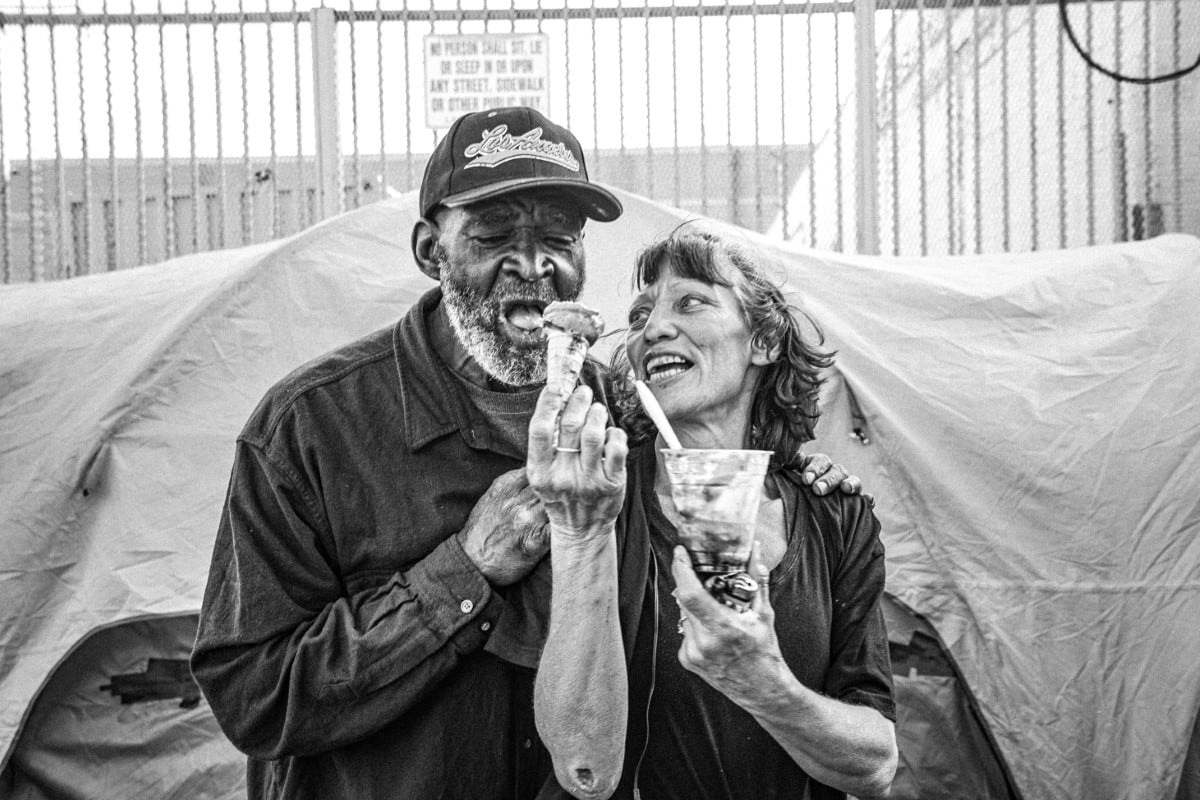
INTERVIEW + PHOTOS: “Photographer Shows the Raw, Unflinching Reality of Life on Skid Row”: For the past decade, anonymous street photographer Suitcase Joe has been spending time on Skid Row in downtown Los Angeles, a neighborhood inhabited by the largest unhoused community in America. He slowly developed trust and built relationships with the people in that community, learning more about their stories, and they granted him unprecedented access to their daily lives, allowing him to capture them on camera. Hear him talk about the experience, and about misconceptions people tend to have about those experiencing homelessness, in this interview, which also includes a sampling of photos. Even though the headline hawks “Raw!” and “Unflinching!,” I was more struck by how the photographs show experiences of joy and friendship.  

Photo by Suitcase Joe
Photograph by Suitcase Joe, Skid Row, Los Angeles

To find out ways to help meet the needs of those living on Skid Row, visit https://suitcasejoefoundation.org/.

+++

POEM WITH COMMENTARY: “The Rungs” by Benjamin Gucciardi, commentary by Pádraig Ó Tuama: Each week on the Poetry Unbound podcast, Ó Tuama reads and reflects on a different contemporary poem. In this episode’s featured poem, “a social worker holds a group for teenagers at a school. They only half pay attention to him. Then something happens, and they pay attention to each other.” The poem is from Gucciardi’s latest collection, West Portal.

+++

ARTICLE: Dool-Hoff: A Dutch Maze with New Jerusalem at its Centre (1705)”: The Public Domain Review is always uncovering unique, amusing prints and other artistic and literary curiosities from centuries past. Here they look at an early eighteenth-century religious maze published in Haarlem, Netherlands, whose pathways are filled with didactic verse, some leading to dead ends but others leading to heaven at the center.

Dool-Hoff (Dutch maze)
Dool-hoff (maze), signed by the Dutch Catholic printer Claes Braau, 1705. Photo courtesy of the Rijksmuseum, Amsterdam.

+++

SONG: “Home Inside” by Valerie June, performed by the Good Shepherd Collective: This Valerie June cover is sung so gorgeously by Sowmya Somanath with Kate Gungor, Bea Gungor, Jayne Sugg, Liz Vice, and Diana Gameros, and John Arndt accompanies on piano. It premiered in Good Shepherd New York’s March 12 digital service. The song is a prayer for belonging more fully to ourselves, to God, and to this earth; its speaker asks that she might be sensitive to the divine breath in all living things, and be soothed and refreshed by that great stream of water that flows from God’s heart. (Reminds me a bit of Universal Jones’s “River”!)

Here is the original recording by Valerie June.

Roundup: Paula Rego’s Life of the Virgin; corito medleys; more

EXHIBITION: Paula Rego: Secrets of Faith, Victoria Miro Venice, April 23–June 18, 2022: Portuguese-born British artist Paula Rego died last Wednesday, June 8, after a seven-decade career, and in the midst of four solo exhibitions of her work—including this one at Victoria Miro’s gallery in Venice, which explores her small but significant body of religious art. [HT: Jonathan Evens]

In 2002 Jorge Sampaio, then president of Portugal, commissioned Paula Rego to create eight pastel drawings based on episodes from the life of the Virgin Mary, to be installed permanently in the chapel of the presidential palace (Palácio de Belém) in Lisbon. Titled Nossa Senhora (Our Lady), the cycle comprises Annunciation; Nativity; Adoration; Purification at the Temple; Flight into Egypt; Lamentation; Pietà; and Assumption. Rego had such fun with the commission that she produced additional works on the subject, which she decided to keep for herself. It is these, along with her watercolor studies, that are currently on display in Venice. (The original eight pastels are not allowed to leave the chapel for which they were made.)

Rego, Paula_The Flight to Egypt
Paula Rego (Portuguese British, 1935–2022), The Flight to Egypt, 2002. Watercolor and ink on paper, 8 1/4 × 11 3/4 in. (21 × 29 cm).

Rego, Paula_Descent from the Cross
Paula Rego (Portuguese British, 1935–2022), Descent from the Cross, 2002. Pastel on paper mounted on aluminum, 29 1/2 × 28 3/8 in. (75 × 72 cm).

I learned about Rego’s Marian cycle a few years ago and became enthralled by it, though I’ve never seen it in person, and most of these supplemental works are new to me. It’s unique, in part because of Mary’s corporeality. In a 2003 interview with Richard Zimler, Rego said, “If there is anything new about these representations of the Virgin, it is the fact that they were done by a woman, which is very rare. . . . It always used to be men who painted the life of the Virgin, and now it is a woman. It offers a different point of view, because we identify more easily with her.”

While the president praised the cycle and Rego insisted that “these pictures were created with admiration and respect,” an open letter to Sampaio referred to it as an “outrage done to the vast majority of the Portuguese people,” an “outrage against their religious beliefs and an offence to the Virgin Mary.” In brief: “blasphemous and scandalous.” I can see why Rego’s larger oeuvre, with its often menacing and/or transgressive imagery (not least of which is her Abortion Series), would scandalize conservative viewers, but I am a bit confused by the outrage at Nossa Senhora, which to me seems very honoring. The objectors, it sounds like, are those who prefer Mary to be more ethereal and sedate; they don’t want to see her, for example, slouching or wincing or expressing astonishment, or awkwardly struggling to hold the weight of her son’s corpse. There will always be those who resist any kind of updating of religious art. If the scenes are restaged in an unfamiliar way or rendered in an unfamiliar style or introduce a new element or the figures don’t look like how we have always pictured them, then some will oppose them outright—which is a shame, because such art often invites us more deeply into the story, helping us to see it afresh.

Definitely check out the boldface link above to view more pieces from the exhibition, as well as a video that shows Nossa Senhora in situ. For further reading, see “Paula and the Madonna: Who’s That Girl?” by Maria Manuel Lisboa and the transcript from Zimler’s interview with Rego.

+++

PODCAST EPISODE: “Past Hymns for the Present Moment,” Tokens, May 26, 2022: “Hymns are often sentimentalized in the American church, cast aside as merely retired songs with dated language, bearing no real appeal or relevance. But of course it may be that our old hymnals have some crucial things to say to us in our current cultural moment. This is the challenge I [Lee C. Camp] posed to Odessa Settles, Phil Madeira, and Leslie Jordan: find and perform some old hymns which might be both indicting and encouraging to the modern church, and to the world at large. Beautiful conversation and moving performances, taped at Nashville’s Sound Emporium.”

+++

POETRY UNBOUND EPISODES:

In each episode of this podcast from On Being Studio, host Pádraig Ó Tuama unpacks a contemporary poem in fifteen minutes. Here are two from season 5 (which just came to an end) that I particularly liked.

>> “Looking for The Gulf Motel” by Richard Blanco: “What happens when we remember?” Ó Tuama asks. “Why do we remember? Is it sweet or sad? Is it both? If you particularly associate warm memories, romantic memories, nostalgic memories with a place, and then that place is changed, does that mean that all those memories are gone?” In this poem from a collection of the same title (which I checked out from my local library at Ó Tuama’s recommendation, and it’s excellent!), Cuban American poet Richard Blanco, at age thirty-eight, reminisces about a family beach vacation from his childhood. Read the poem here.

If I were writing this poem, it would be called “Looking for The Blockade Runner,” as that’s the name of the Wrightsville Beach hotel in North Carolina that my family and I used to stay at for four days or so each summer. My little brother and I should still be running around on the waterfront lawn as our parents watch us from inside the giant window of the dining room, finishing up their breakfast. My dad should still be riding in a wave on a boogie board, teaching me technique. My mom should still be lounging at the pool in her black one-piece with sunglasses and a Vanity Fair, I feeling so grown up beside her sipping my virgin piña colada. My brother should still be exhilarated by the live hermit crabs at Wings, and I by the dried starfish and sand dollars. We should all still be walking back from the Oceanic, our bellies filled with she-crab soup and hush puppies and catch-of-the-day, down the shore at dusk.

>> “The change room” by Andy Jackson: A poet who’s interested in difference and embodiment, here Andy Jackson, who has severe spinal curvature due to Marfan syndrome, “is looking at the attention that he gets in his body and is refocusing it, extending it wider, looking at the deeper question of, what does it mean for any of us to be in a body, and how do we in bodies relate to others in bodies?” Read the poem here, from the collection Human Looking.

+++

CORITO VIDEOS: A corito (literally “short song”) is a type of Latino Christian worship song. Coritos have “fairly simple tunes, often with repetitive words, that the people sing by heart,” writes Justo L. González in ¡Alabádle!: Hispanic Christian Worship. “Most of them are anonymous, and pass by word of mouth from one congregation to another. For that reason, the tune or the words of a particular corito may vary significantly from one place to another. They are often sung to the accompaniment of clapping hands, tambourines, and other instruments.” To learn more about this genre, see the Calvin Institute of Christian Worship interview with Rosa Cándida Ramírez and Analisse Reyes and the entry in the Encyclopedia of Christianity in the Global South, vol. 2.

>> Joseph Espinoza sings a corito medley consisting of “Cuando el pueblo del Señor” (When the People of the Lord), “No puede estar triste” (The Heart That Worships Christ Cannot Be Sad), “Ven, ven, Espiritu divino” (Come, Come, Holy Spirit), “Cantaré al Señor por siempre” (I Will Sing to the Lord Forever), and “El Poderoso de Israel” (The Mighty One of Israel). Aaron Barbosa is on keyboard, Fabian Chavez is on percussion, and Yosmel Montejo is on bass.

>> The video below was shared March 25, 2020, in the Multicultural Worship Leaders Network Facebook group that I belong to, and it’s pure joy! The performers string together three coritos: “Le canto aleluya” (I Sing Alleluia), “Hay victoria” (There’s Victory), and “Los que esperan en Jesus” (Those Who Wait in Jesus).

Federico Apecena provides the following translation. (The slashes indicate the number of times that line or passage is sung.)

//The heart that worships Jesus cannot be sad
The heart that worships God cannot be sad//

//That’s why I sing, I sing hallelujah
The heart that worships God cannot be sad//

//There’s victory, there’s victory, there’s victory in the blood of Jesus//
The enemy will not be able to defeat our souls
//Because there is victory, because there is victory, because there is victory in the blood of Jesus//

//That’s why I sing, I sing hallelujah
The heart that worships God cannot be sad//

///Those that wait, that wait in Jesus///
//Like eagles, like eagles, their wings will open//

They will walk and will not get tired, they will run and will not stop
//New life they will have, new life they will have, those that wait, that wait in Jesus//

//That’s why I sing, I sing hallelujah
The heart that worships God cannot be sad//

Roundup: Prayers for a violent world, sad church songs, Climate Vigil Songs, and more

PRAYER COMPILATION: “Prayers for a Violent World” by W. David O. Taylor: “How exactly do we pray in the aftermath of violence? What words should we put on our lips? What can the whole people of God say ‘amen’ to and what might only one of us be able to say amen to in good conscience? These questions are, of course, far from easy to answer, but over the past couple of years I have attempted to give language to such matters and I have included here a number of those prayers, in the hope that they might prove useful, and perhaps comforting, to people who face the terrors and traumas of violent activities on a regular basis.” Included are prayers After a Mass Shooting, Against Bloodthirstiness, For Loving a Hurting Neighbor, For Enemies, For Bitter Lament, For Peace in a Time of War, For Those Who Weary of Doing Justice, and more.

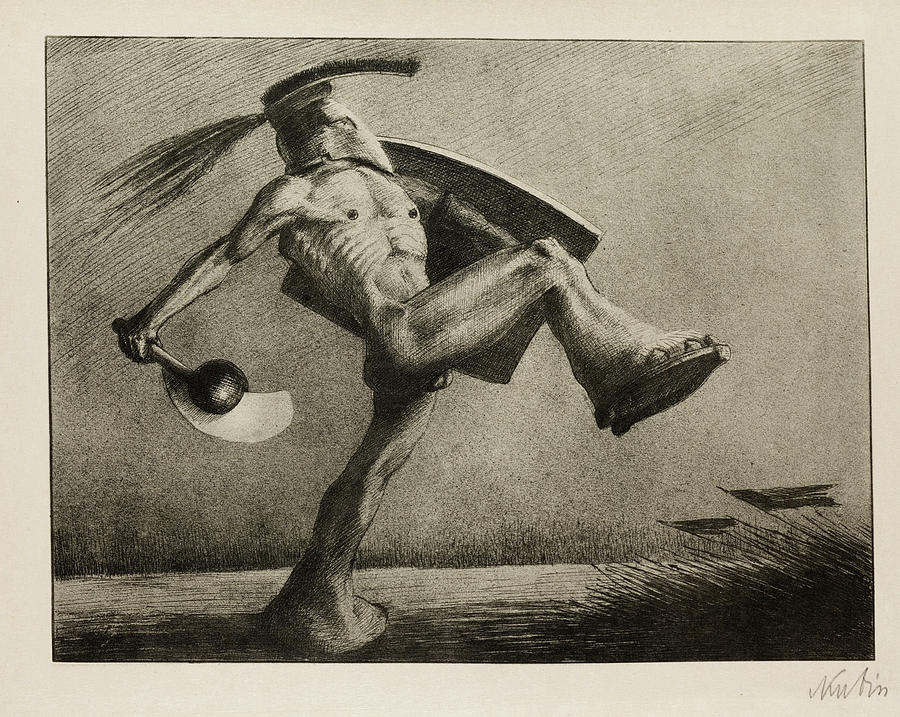
Kubin, Alfred_War
Alfred Kubin (Austrian, 1877–1959), War, 1903

Here’s Taylor’s Prayer of Allegiance to the Prince of Peace:

O Lord, you who deserve all our loyalties, we pledge allegiance this day to the Lamb of God and to the upside-down Kingdom for which he stands, one holy nation under God, the Servant King and the Prince of Peace, with liberty and justice for all without remainder. We pray this in the name of the Holy Trinity. Amen.

+++

NEW ALBUMS:

>> Sorrow’s Got a Hold on Me by Paul Zach: On May 20, singer-songwriter Paul Zach wrote on his Instagram, “My new album of thirteen sad church songs is out today! Many of these songs were written right after one of my weekly EMDR therapy sessions, as I have been working through the sorrow, trauma, and grief of the past few years. I’m learning to bring all of myself to God in prayer and songwriting, which includes my sorrow and anger. I’ve always heard that God shows up in a unique way in times of grief but that has not been my experience. These songs are an invitation for the ‘man of sorrows’ to join me in my grief.”

Below is a demo of the first verse of my favorite song on the album, “We Bring You All Our Sorrows,” followed by the album link from Spotify. It includes a newly revised version of one of my favorite songs by Zach, “When Your Kingdom Comes” [previously].

Zach often writes collaboratively (including as part of the Porter’s Gate! see below), and the cowriters on some of the songs here are Kate Bluett, Latifah Alattas (Page CXVI), Nick Chambers, Orlando Palmer (IAMSON), Jessica Fox, Alex Johnson, and Philip Zach. There are also a few guest vocalists.

>> Climate Vigil Songs by the Porter’s Gate: The Porter’s Gate is a collective of fifty-plus songwriters, musicians, scholars, pastors, and music industry professionals from a variety of Christian worship traditions and cultural backgrounds, making music for churches. This sixth album of theirs, made in partnership with the #ClimateVigil movement, is themed around environmental justice and creation care. Below are videos for “Brother Son (Giving Glory!)” and “Jubilee.”

Besides “Brother Sun,” my favorite tracks are “Satisfied,” a prayer that we would stop seeking to build our wealth (a motive that drives a lot of environmental injustices) and instead be grateful for God’s provision; “The Kingdom Is Coming,” a marchlike call-and-response song that rallies us to pray, wait, and work for an end to creation’s groaning; and “Water to Wine,” which wonders at the miraculous process of planting and growing grapes for harvest. There’s also “All Creatures Lament,” a minor-key arrangement of “All Creatures of Our God and King” with new lyrics that enjoin the animals to mourn habitat loss, air pollution, and other results of humans’ power abuses and irresponsible stewardship.

To learn more about the album, listen to this great interview with Porter’s Gate cofounder and producer Isaac Wardell; it’s from the RESOUNDworship Songwriting Podcast, hosted by Joel Payne. Wardell discusses the vision for Climate Vigil Songs, and especially the difficulty, with thematic albums, of avoiding the pitfalls of being too heavy-handed with the messaging on the one hand, and on the other, being so vague that people don’t see the connection. There’s also a need for tonal balance, and for songs that fill different functions.

We wanted to write for this album at least three different kinds of songs. One kind is essentially songs of lament—songs lamenting the state of creation because of human sin and the brokenness of the world. Secondly, we wanted to write hopeful, you might even call them eschatological, songs—songs that are joyful, that are about this is the world that God has made, this is God’s creative work, this is how God calls us into his creative work. . . . And lastly, we wanted to write mobilization songs—songs that have some kind of an ethical component of calling people to action in some way. . . . We want to make sure the record is not too much of a downer, like all lament songs; we want to make sure that it’s not too much of a happy-clappy “Isn’t creation beautiful!”; and we also don’t want to let it just delve into being a 100 percent political action record. . . . We want to balance those things.

Wardell also talks about the group’s collaborative songwriting approach (including all the theological and editorial work that’s put in), Te Fiti’s stolen (and later, restored) heart in Disney’s Moana, personified nature in the Psalms, creation as an experiencer of the fall and redemption, the role of provocation in church, and biblical imagery he wishes they could have included on the album but had to leave out for length.

+++

POEM + CHORAL SETTING: “when god decided to invent” by E. E. Cummings: “Here’s a brief powerhouse of a poem from E. E. Cummings, two stanzas that draw a sharp distinction between God’s inventive, joyful creativity on the one hand, and our too-frequent turn toward violence on the other. As the mass shootings in Buffalo, Uvalde, and elsewhere continue to reverberate, Cummings’ poem helps us feel and think about what’s at stake – and what the way forward looks like.”

SALT Project reproduces the poem, provides brief commentary, and links to a musical setting by Joshua Shank—a composition for SATB, soprano saxophone, and finger cymbals that premiered in 2005. Shank says the arc of his piece is creation-destruction-recreation. “This final chord is the creator taking control of the creation again.”

+++

RADIO EPISODE: “Belief in Poetry: John Donne”: John Donne (1572–1631) is one of my favorite poets, and looking back on the blog, I can’t believe I’ve not yet featured any of his poems! (I’ll have to rectify that . . .) In this BBC Radio 4 segment from March 13, poet and theologian Pádraig Ó Tuama considers Donne’s complex faith life through his poetry. He speaks with Julie Sanders, professor of English literature and drama at Newcastle University; Mark Oakley, writer and dean of St. John’s College, Cambridge; and Michael Symmons Roberts, poet and professor of poetry at Manchester Metropolitan University. Sir Simon Russell Beale reads the four featured Donne poems: “Death, be not proud” and “Batter my heart, three-person’d God” from his Holy Sonnets series, “Hymn to God, My God, in My Sickness,” and “A Hymn to God the Father.”

Here are two of the quotes that stood out to me:

  • “It’s easy to think of John Donne’s life falling neatly into two parts: the worldly man, and the spiritual seeker; the lover of women, and the lover of God; Catholic, then Protestant; before Anne, and after Anne; love poet, and religious poet. But life is rarely that clear. And rather, it’s the tension between these dynamics of him that gives birth to so much of his work.”—Pádraig Ó Tuama
  • “There’s an assumption that a poet working in this territory is sure of their ground and knows what they’re writing about. I don’t think that’s ever true, because why would you write the poems, if that were true? You’d just bathe in your certainty! The whole act of sitting down to write a poem is not to dress up something you already know in a way that makes it an enticing package for other people to be convinced by—and if you attempted that, it’s going to fall like the deadest thing on the page. Making a poem is an exploratory process. You don’t know where it’s going to end when you start it.”—Michael Symmons Roberts

Roundup: Facing up to our faults, “How Prayer Works,” and more

Sundays are not counted toward the forty days of Lent (as they are feast days, not fast days), so I’m taking a break from my usual Lenten format today and for the next four Sundays to offer some supplemental content, such as a roundup of video, article, podcast, and event links, or a poem. Tomorrow I’ll resume with “Day 5” of the music-art pairings.

+++

DANCE VIDEO: “Lord, Forgive Me,” choreographed by Keone Madrid: A short dance number to a penitential song by hip-hop/R&B artist Mali Music, choreographed by Keone Madrid. The dancers embody stumbling, floundering, aching, weakness, shame, and pleading, as well as openness, humility, surrender, and peace—various postures/feelings associated with the act of confession. Starting at 42 seconds in, a succession of individuals stand or kneel in relative stillness at the right side of the frame, as if receiving the forgiveness they seek, while their dancing form is visible in the mirror.  

Keone, the man in the maroon shirt in the opening shot of the video, is one-half of the choreo, dancing, and directing duo Keone and Mari [previously], whose other recent work includes choreographing the adorable (!) 2021 Disney animated short Us Again (see trailer). Storytelling is at the root of their work, with themes including marriage, family, faith, and struggle.

+++

NEW SONG: “No More Hiding” by Ben Thomas: For the past few years singer-songwriter and spiritual teacher Ben Thomas has been writing what he calls “Mantrasongs,” songs “infused with intention” that are meant to get stuck in our head and connect us more fully to ourselves, others, and the Divine. Inspired by Fr. Richard Rohr’s book Breathing Under Water: Spirituality and the Twelve Steps, this January Thomas started releasing a series of Mantrasongs on YouTube based on the Twelve Steps of Recovery, a tool developed in 1938 for Alcoholics Anonymous. “The 12 Steps of Recovery aren’t just for those addicted to substances,” Thomas writes. “They’re for all of us learning how to create lives of health and wholeness, free of the addictive patterns of thinking, seeing, and being that keep us living at a fraction of our capacity.”

“No More Hiding” is the fifth song in Thomas’s Twelve Steps series. It corresponds to step 5 of the twelve-step program: “Admit to God, to yourself, and to another human being the exact nature of your wrongs.” Christians would call this process “confessing our sins.” It can be a scary thing to do. It requires tremendous vulnerability and honesty. But oh, what freedom comes from confession! He sings here with Jenny Miller. The preceding songs in the series are:

  1. “A New Level of Let Go” (Admit that you are powerless over your addiction—that your life has become unmanageable.)
  2. “Make Me Whole Again” (Believe that a Power greater than yourself can restore you to sanity.)
  3. “To Know What Is” (Make a decision to turn your will and your life over to the care of God.)
  4. “Freedom in the Light” (Make a searching and fearless moral inventory of yourself.)

Look out for a new Mantrasong each week. You can receive free song downloads from Ben Thomas by becoming a Patreon supporter.

+++

VIRTUAL EVENT: “Writing on Music, Meaning, and the Ineffable,” March 24, 2022, 6 p.m. ET: It’s been said that writing about music (or visual art, for that matter) is as pointless and impossible as dancing about architecture. Music and art need only be experienced; studied analysis or explanation lessens their impact and is reductive. While I can see the reasoning behind this assertion, and I often debate whether to comment on specific pieces that I post here versus let the art do its work without my intervention, I do (obviously!) feel that there is value in writing about the arts, and music writer Joel Heng Hartse does too. In this virtual launch event for his new book Dancing about Architecture Is a Reasonable Thing to Do, Hartse will be joined in conversation with poet Mischa Willett and musician John Van Deusen about art, faith, and criticism. Organized by Image journal.

+++

POETRY UNBOUND PODCAST EPISODES:

Poet and theologian Pádraig Ó Tuama hosts these wonderful fifteen-minute immersive readings of contemporary poems selected from diverse sources. Here are two from last season that I particularly appreciated.

>> “How Prayer Works” by Kaveh Akbar: Kaveh Akbar is an Iranian American Muslim poet and scholar. In this narrative prose poem of his, two brothers, seven years apart, turn to face east in their small shared room when their prayer is interrupted by a surprising noise, setting off an eruption of laughter. “This poem holds the idea of prayer, which can often be an abstract one, with the physical sensation of what’s right in front of you, what’s happening, who’s right in front of you, how are you being with each other, what’s going on, how can you be drawn towards each other—and that that itself is the answer to prayer.”

>> “The Only Cab Service of Farmington, Maine” by Aria Abner: “This is a poem, really, that’s an exploration of place and all of the emotion and pain and beauty that can be gathered into memory of place,” Ó Tuama says. “A poem about conversation and about how you reach the edge of conversation.” Poet Aria Abner was born in Germany to Afghan parents but has lived in the United States since age eighteen. She writes about being picked up in a cab by a man who served in Afghanistan in the US Marines, and how he tries to connect with her through that geographic commonality but to little avail. “She is feeling estranged by the ways foreigners are speaking about a place that she’s from but hasn’t been able to grow up in.”

Roundup: Jonah disgorged, Watching TV Religiously, “My Mother’s Body,” and more

VISUAL MEDITATIONS (ARTWAY.EU)

Jonah Swallowed and Jonah Cast Up, commentary by Victoria Emily Jones: My latest visual meditation for ArtWay was published Sunday—it’s on two third-century Jonah sculptures from Asia Minor that likely decorated a family fountain. Early Christians read the story allegorically (at least on one level), as pointing forward to the death and resurrection of Christ. The “great fish” is portrayed as a ketos, a sea-monster of Greek myth.

Jonah Marbles
“Jonah Swallowed” and “Jonah Cast Up,” made in Asia Minor, probably Phrygia, 280–90 CE. Marble, 50.4 × 15.5 × 26.9 cm (left) and 41.5 × 36 × 18.5 cm (right). Cleveland Museum of Art, Ohio.

Run by Marleen Hengelaar-Rookmaaker, the faith-based website ArtWay has been publishing a new visual meditation every Sunday for years, as well as a lot of other content from a variety of contributors. To subscribe to the weekly email, click here. Here are just a few VMs published in the past year that I particularly enjoyed:

Manu-Kahu by Brett a’Court, commentary by Rod Pattenden: Pattenden begins, “This striking image of an airborne Christ is from New Zealand painter Brett a’Court. It is part of his investigations into a way of bringing together the spiritual insights of the indigenous culture of the Maori people and that of Christianity brought to New Zealand by British settlers. In cultural terms it is a hybrid image. This is something that occurs when two cultures are in a process of mutual re-assessment. That sort of conversation is full of conflict and critique but also allows for the potential for new forms to arise that express the best of both traditions. A Christ figure flying in the sky like a kite, is such a form. It is a new thing, a potential heresy or aberration, but one full of potential for new insight and spiritual refreshment.”

Manu-Kahu by Brett a'Court
Brett a’Court (New Zealand, 1968–), Manu-Kahu, 2007. Oil on canvas.

Knife Angel by Alfie Bradley, commentary by Rachel Wilkerson: This twenty-seven-foot-tall sculpture, welded from 100,000 knives collected in confiscations and amnesties around the UK, confronts the issue of knife violence. The artist cleaned and dulled the blade of each knife he received and engraved personal messages on all the wings’ “feathers,” messages sent by families affected by knife violence.

Bradley, Alfie_Knife Angel
Alfie Bradley (British, 1990–), Knife Angel, 2018. Mixed media sculpture, incl. 100,000 knives.

Cathedra by Barnett Newman, commentary by Grady van den Bosch: I saw this painting in Amsterdam last spring and was surprised by how it compelled me. (I don’t typically gravitate to abstract art.) After spending some time up close—I supposed this was a Newman, and Newman says his paintings need to be experienced up close—I looked at the label and saw that it has a religiously inflected title: Cathedra. The word is Latin for “seat,” and in Christianity it refers specifically to the bishop’s chair inside a church (churches that had a cathedra were called cathedrals). But Newman was of Jewish descent, and van den Bosch writes that Cathedra is meant to represent the throne of God. “And above the firmament that was over their heads was the likeness of a throne, as the appearance of a sapphire stone . . .” (Ezek. 1:26).

Newman, Barnett_Cathedra
Barnett Newman (American, 1905–1970), Cathedra, 1951. Oil and acrylic on canvas, 243 × 543 cm. Stedelijk Museum, Amsterdam, Netherlands. Photo: Victoria Emily Jones.

As someone who loves historical Christian art, including its many Christ Pantocrators, I must nevertheless admit that there is something so right about modern artists’ often apophatic approach to evoking the Divine. While I do believe God imaged Godself in the person of Jesus Christ and is therefore representable, I understand the argument some make that abstraction is a better visual language for spiritual subject matter or encounter. I accept both/and. Whether God is shown as a rich, blue expanse that invites and envelops, or a heroic nude emerging from the jaws of death, or a Man of Sorrows head with a harrier hawk’s body, I think we can learn a little something from the diversity of representations, which are not mutually exclusive. Not all representations need be embraced, but nor do unfamiliar, difficult, or even shocking ones need be automatically dismissed.

Click on the link for more on how to read Newman’s color field paintings, including his signature “zips.”

+++

FREE ONLINE COURSE: Watching TV Religiously: Through at least July 1, Fuller Theological Seminary is offering all its online Fuller Formation courses for free! I just finished taking Watching TV Religiously, taught by Kutter Callaway [previously], author of the book of the same title, and really enjoyed it. It’s a series of six self-paced lessons, which includes short video lectures by the professor, audio conversations with TV writer Dean Batali (Buffy the Vampire Slayer; That ’70s Show), TV watching assignments, reflection questions, and more.

The course aims to help Christians develop critical tools for watching television and a vocabulary that is as rich and thoughtful as the medium itself, so that we can engage it constructively. (It need not be mindless entertainment!) Callaway explores television as a technology, a narrative art form, a commodity, and a portal for our ritual lives. He’s interested in how stories are told in this episodic, audiovisual format, and what that means for the Story we tell. The course is not about what Christians should watch, but how Christians should watch, leaving ample room for individual viewers to set their own boundaries, ethical and otherwise. (Callaway acknowledges that TV can form as well as de-form us.) He discusses empathy building and access to other perspectives, knowing your sensibilities, how being offended can be useful, watching in community, seeing God in all places, being aware of how your desires and imagination are being shaped, Christians in Hollywood (and Christian characters on TV), and the culture shaping TV and TV shaping culture, among other things.

The course is fairly broad in its approach; it does not analyze particular shows or episodes, though some specific examples are mentioned in conversations, and students are encouraged to form discussion groups with friends or family members and apply what they’re learning to shows of their choice. I really appreciated the assigned PBS docuseries America in Primetime (somewhat outdated because made in 2011 but very good nonetheless), whose four episodes explore character types throughout the history of TV, from the fifties to today: “The Independent Woman,” “Man of the House,” “The Misfit,” and “The Crusader.” From taking this course I realized how many acclaimed TV shows I’ve never seen. I’ve got a lot of homework to do!

Other arts courses offered by Fuller Formation are

+++

POEM: “My Mother’s Body” by Marie Howe, read with commentary by Pádraig Ó Tuama: As Mother’s Day is Sunday, I thought I’d share this wonderful, sad-sweet, mother-themed episode of the new Poetry Unbound podcast from On Being Studios. Pádraig Ó Tuama introduces Marie Howe’s “My Mother’s Body,” in which a middle-age woman, caring for her dying mother, thinks back to the time when her mother was just a twenty-four-year-old girl giving birth to her. The speaker in the poem is Howe.

She imagines being in her mother’s womb, experiencing the rhythm of her mother’s heartbeat. (What an exercise, to imagine yourself as your mother’s baby!) Now decades later, her mother is dying—that heart is failing, and the kidneys too. The uterus has been removed. Toggling between the two time frames, the poem is both a celebration of the strength of women’s bodies and a lament for its vulnerabilities, especially in old age. Howe marvels at how her mother’s body was capable of such a wonder as giving and sustaining life, and now to see that once-vibrant form breaking down grieves her. In some sense their roles have switched as daughter mothers mother, combing her hair, changing her soiled bedsheets.

The poem opens with “Bless my mother’s body” and ends with “Bless this body she made . . .” In the progression of pronouns in the last two lines—my, her, our—is a recognition of how our mothers always remain a physical part of us. They are in our cells. “My Mother’s Body” is a thank-you and a letting go.

The poem is from Howe’s collection The Kingdom of the Ordinary—which I highly recommend.

+++

ARTICLE: “5 Contemporary Poets Christians Should Read” by Mischa Willett: There is so much good crop still being pulled from the fertile fields of theologically inflected verse,” writes poet Mischa Willett—so don’t stop short, content merely with Donne and Hopkins! This is an excellent short list of contemporary poets of faith, with summaries of key themes and recommendations for which volume(s) to start with. Willet was recently on The Ride Home with John and Kathy to discuss this topic, and he wrote a follow-up post on his blog.

+++

MUSIC VIDEO: “I Am a Poor Wayfaring Stranger”: One of the most poignant scenes in last year’s 1917 is when, after a harrowing journey across No Man’s Land, Lance Corporal William Schofield—exhausted, disoriented—reaches a wood and encounters a fellow British soldier singing the spiritual “Wayfaring Stranger” [previously] to a battalion that sits at somber attention, for they’re about to go into battle. This official music video from Sony splices together clips from the movie with studio footage of the actor and singer Jos Slovick.