
“Your free hearts said them never nay”: Christ blesses the merciful in a medieval mystery play

The following excerpt is from the fourteenth-century biblical drama The Last Judgement from the York cycle of mystery plays [previously], performed annually in York, England, on the feast of Corpus Christi until its suppression by Protestants in 1569. Based on Matthew 25, this final play in the cycle was produced by the city’s guild of mercers (dealers in textile fabrics) and so is sometimes referred to as the Mercers’ Play.

I’ve chosen to feature it at this time because almsgiving—that is, assisting those in need, especially through the giving of money or goods—is one of the three pillars of Lent, and according to Matthew 25:31–46, it’s the measure by which Christ eternally blesses or damns people. It’s what separates the sheep from the goats, those who truly know Christ from those who don’t. The list of six charitable deeds in this Gospel passage—feeding the hungry, giving drink to the thirsty, welcoming the stranger, clothing the naked, caring for the sick, visiting the imprisoned—are called, in church tradition, the corporal works of mercy. A seventh, burying the dead, was added based on the book of Tobit 1:17–19.

(Related posts: “The Seven Works of Mercy: How two Dutch artworks—one Renaissance, one contemporary—can help us recover an ethic of neighborly care”; “On the Swag” by R. A. K. Mason)
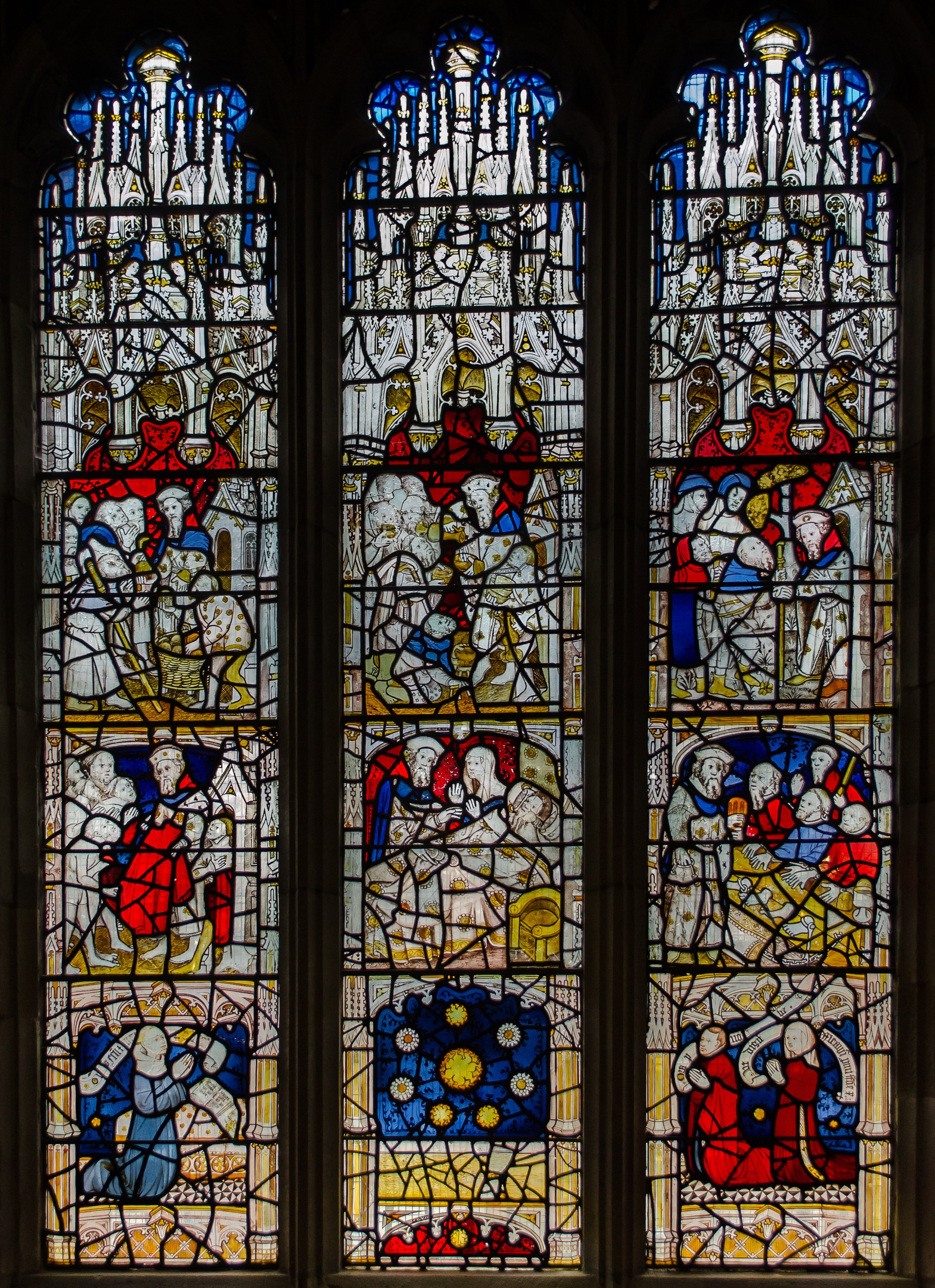
Works of Mercy (York stained glass)
Corporal Acts of Mercy, 1410. Stained glass window, All Saints Church, North Street, York, England. Photo: Julian P. Guffogg.

I’ve sourced the Middle English text below from the Oxford World Classics volume York Mystery Plays: A Selection in Modern Spelling, edited by Richard Beadle and Pamela M. King. The glosses are Beadle and King’s.

JESUS: My blessed children on my right hand,
Your doom this day ye thar not dread,   [thar = need]
For all your comfort is comand—   [command = coming]
Your life in liking shall ye lead.
Come to the kingdom ay-lastand   [ay-lastand = eternal]
That you is dight for your good deed;   [you is dight = is prepared for you]
Full blithe may ye be where ye stand,
For mickle in heaven shall be your meed.   [mickle = great; meed = reward]

When I was hungry, ye me fed;
To slake my thirst your heart was free;   [free = willing]
When I was clotheless, ye me clad,
Ye would no sorrow upon me see.
In hard press when I was stead,   [When I was placed in difficult circumstances]
Of my pains ye had pity;
Full sick when I was brought in bed,   [in = to]
Kindly ye came to comfort me.

When I was will and weariest   [will = distraught]
Ye harbored me full heartfully;
Full glad then were ye of your guest,
And plained my poverty piteously.   [plained = lamented]
Belive ye brought me of the best   [belive = quickly]
And made my bed full easily,   [easily = comfortably]
Therefore in heaven shall be your rest,
In joy and bliss to be me by.

1 GOOD SOUL: When had we, Lord that all has wrought,
Meat and drink thee with to feed,
Since we in earth had never nought
But through the grace of thy Godhead?

2 GOOD SOUL: When was’t that we thee clothes brought,
Or visited thee in any need,
Or in thy sickness we thee sought?
Lord, when did we thee this deed?

JESUS: My blessed children, I shall you say
What time this deed was to me done:
When any that need had, night or day,
Asked you help and had it soon.
Your free hearts said them never nay,
Early ne late, midday ne noon,
But as oft-sithes as they would pray,   [pray = ask]
Them thurt but bid, and have their boon.   [They only needed to ask, and their request was granted]

For a modern performance of The Last Judgement by Handmade Performance in Toronto, see here. (The above passage is at 16:43ff.) They use a modern translation by Chester N. Scoville and Kimberley M. Yates.

Roundup: Memento mori; works of mercy; ring shout; The Seventh Seal

Affiliate links: Art & Theology is now a participant in the Amazon Associates program, an affiliate marketing tool that enables me to potentially collect a little change by hosting Amazon links on my website. I already do that anyway—link to Amazon product pages when I mention books, movies, or less often, music (I try to drive sales directly to the artist’s website, if one exists)—so you will not notice any change in blog post appearance or the frequency of links. But now that I’m registered, if you were to click through one of those Amazon links (for example, Shout Because You’re Free or The Seventh Seal below) and make a purchase, any purchase, I would earn a referral fee of 2.5% to 5% of the purchase price. I have to generate at least three purchases every 180 days to stay in the program. As of now, this is the website’s sole income stream.

+++

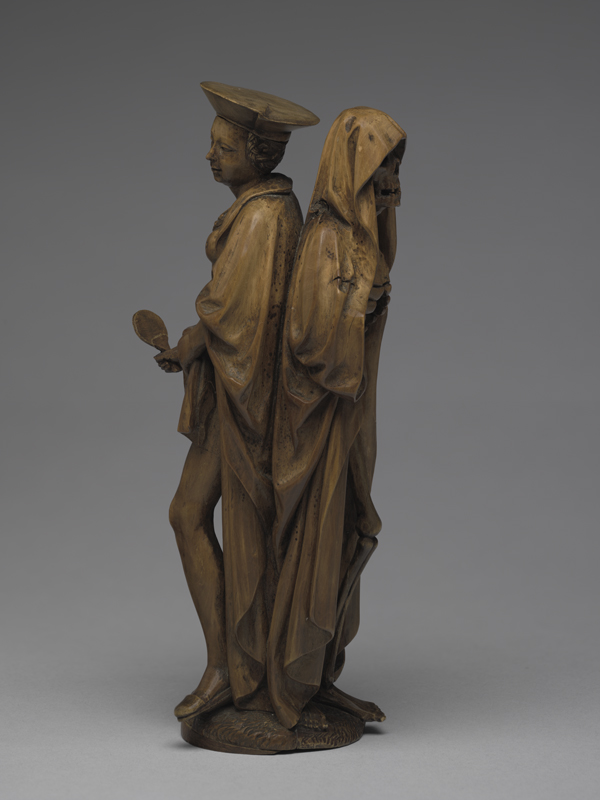
EXHIBITION: “The Ivory Mirror: The Art of Mortality in Renaissance Europe,” June 24–November 26, 2016, Bowdoin College Museum of Art, Brunswick, Maine: Skeletons, skulls, and other dark images of death from the fourteenth and fifteenth centuries were meant to remind their owners of life’s brevity and thereby prompt repentance. Some target specific sins, like clinging too tightly to one’s wealth or good looks. “This exhibition represents a significant contribution to our understanding of the rich visual culture of mortality in Renaissance Europe. The appeal of the memento mori, featuring macabre imagery urging us to ‘remember death,’ reached the apex of its popularity around 1500, when artists treated the theme in innovative and compelling ways. Exquisite artworks—from ivory prayer beads to gem-encrusted jewelry—evoke life’s preciousness and the tension between pleasure and responsibility, then and now.” A symposium, “Last Things: Luxury Goods and Memento Mori Culture in Europe, ca. 1400-1550,” will be held November 3–4. You can read a review of the exhibition at Hyperallergic.

Memento mori (prayer bead)
Ivory prayer bead, France or southern Netherlands, 1530. Victoria and Albert Museum, London. On one side of the carving is a man, on another a woman, and grinning sardonically between them is a skull, worms crawling through its bared teeth.

Vanitas (16th century)
Vanitas, Germany, ca. 1525. Boxwood. Harvard Art Museums/Busch-Reisinger Museum, Cambridge, Massachusetts.

+++

ART COMMENTARY: The Seven Works of Mercy by the Master of Alkmaar: The corporal works of mercy, seven in number, are a traditional Catholic practice of serving the physical needs of others. Derived from Matthew 25:31–46 (cf. Isaiah 58:6–10) and Tobit 1:16–22, they are to: (1) feed the hungry, (2) give water to the thirsty, (3) clothe the naked, (4) shelter the homeless, (5) care for the sick, (6) visit the imprisoned, and (7) bury the dead. Earlier this month Marleen Hengelaar-Rookmaaker wrote a two-part visual meditation on a Netherlandish polyptych (altarpiece with four or more panels) from the sixteenth century that treats this topic. In the background of each contemporary enactment of mercy stands a silently affirming Jesus. To view the panels in high resolution, visit the Rijksmuseum website.

Seven Works of Mercy
The Master of Alkmaar, The Seven Works of Mercy, 1504. Oil on seven panels, 120 × 472 cm. Rijksmuseum, Amsterdam.

+++

ALBUM: Spirituals and Shout Songs from the Georgia Coast by the McIntosh County Shouters: The McIntosh County Shouters from coastal Georgia are the last community in America to perform the traditional ring shout, a shuffle-step devotional movement, accompanied by singing, that is rooted in the ritual dances of West Africa and was forged by the Atlantic slave trade. Shouting differs from traditional black religious music in repertory, style, and execution, Art Rosenbaum writes in Shout Because You’re Free: The African American Ring Shout Tradition in Coastal Georgia. In 1980 two folklorists, astonished to find the form still in use, encouraged practitioners to take it public. The community thus assembled a small touring group, and in 1984, under the Smithsonian Folkways label, they released their first album. This year they released their second, with a mostly new selection of songs (all but three) and all-new performances. You can watch “Jubilee” below. (Thanks, Global Christian Worship, for the tip!)

+++

FILM: The Seventh Seal (1958): After receiving several recommendations, I finally watched this classic of world cinema, directed by Ingmar Bergman, and actually enjoyed it more than I expected. It follows the medieval knight Antonius Block as he returns, disillusioned and exhausted, from a decade-long Crusade, only to encounter Death, whom he challenges to a fateful game of chess. (This central image, Bergman said, was inspired by a church fresco, reproduced below.)

Death Playing Chess by Albertus Pictor
Albertus Pictor (Swedish, ca. 1440–ca. 1507), Death Playing Chess, 1480s. Fresco, Täby Church, Uppland, Sweden.

The movie’s title is taken from Revelation 8:1—“And when the Lamb opened the seventh seal, there was silence in heaven for about half an hour”—establishing the silence of God as a major theme. Antonius’s monologue in the chapel confessional evinces his struggle between doubt and belief:

I want to confess as best I can, but my heart is void. The void is a mirror. I see my face and feel loathing and horror. My indifference to men has shut me out. I live now in a world of ghosts, a prisoner in my dreams. . . .

Is it so hard to conceive God with one’s senses? Why must he hide in a mist of vague promises and invisible miracles? How are we to believe the believers when we don’t believe ourselves? What will become of us who want to believe but cannot? And what of those who neither will nor can believe? Why can I not kill God within me? Why does he go on living in a painful, humiliating way? I want to tear him out of my heart, but he remains a mocking reality which I cannot get rid of. . . .

I want knowledge. Not belief. Not surmise. But knowledge. I want God to put out his hand, show his face, speak to me. . . . I cry to him in the dark, but there seems to be no one there.

But along his way he ends up meeting a “holy family”—simple and with pure faith and hope—whose names, Mia and Jof, are diminutives of Mary and Joseph. Bergman presents their worldview as a contrast to the bitter skepticism of Antonius.

For reviews that trace themes of faith and doubt in The Seventh Seal, see David Nilsen and Steven D. Greydanus.