Roundup: Modern santero, flamenco-style Lord’s Prayer, the horror genre, and more

SPOTIFY PLAYLIST: October 2026 (Art & Theology)

+++

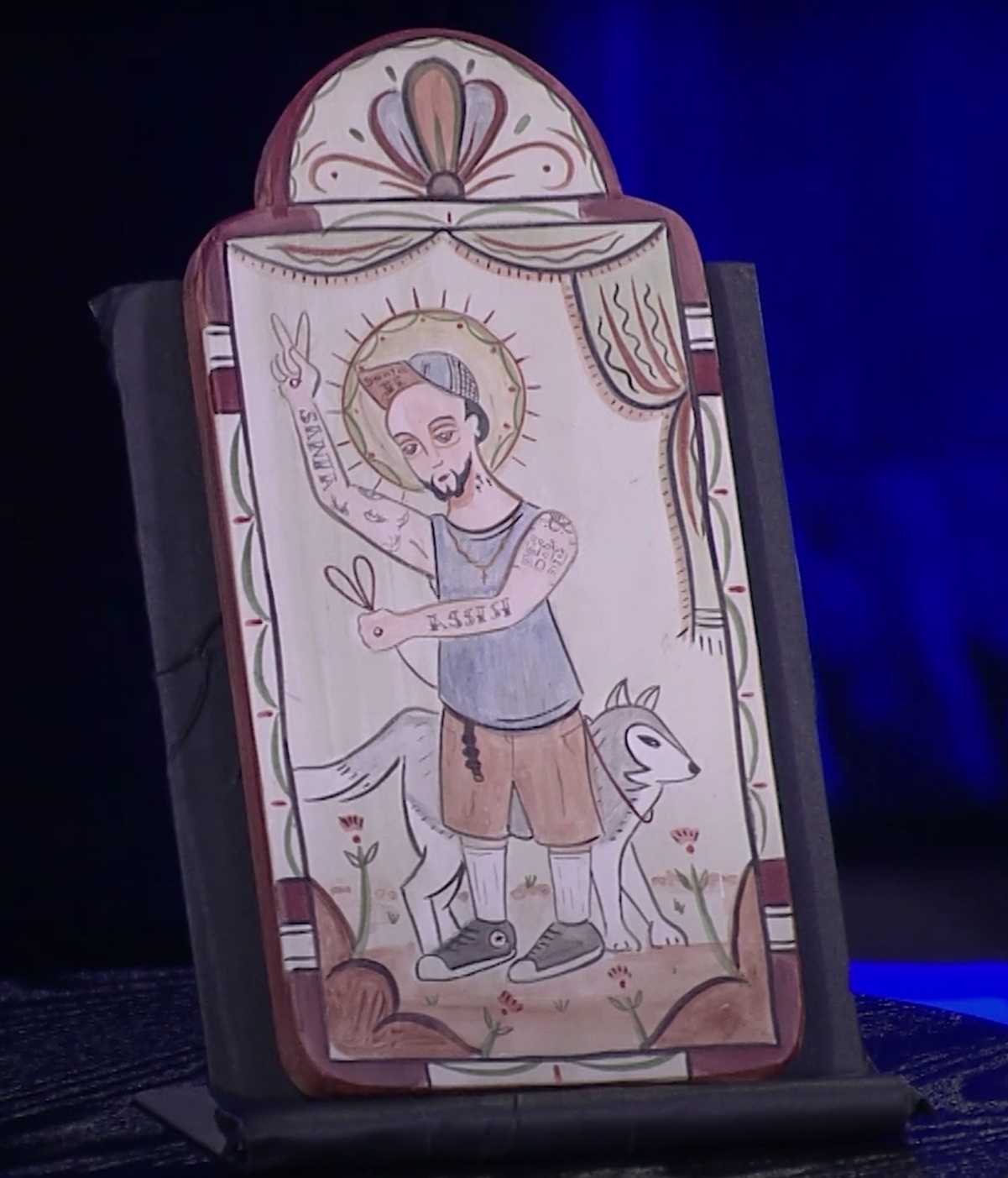
VIDEO: “Relatable Retablos, Vince Campos”: In this segment from ¡COLORES!, a production of New Mexico PBS, Faith Perez interviews santero Vince Campos (@santero_riteno), who paints retablos, a centuries-old Hispano-Catholic sacred art form, but in a contemporary idiom. Campos likes to relate the stories of the saints to those of people he encounters in his everyday life. Here he discusses his retablos of San Lorenzo (St. Lawrence), San Francisco (St. Francis), San Rafael (St. Raphael), and more.
Campos, Vince_Saint Francis of Assisi
Retablo by Vince Campos, showing St. Francis (the patron saint of Santa Fe, animals, and the impoverished) with the legendary wolf of Gubbio

+++

SONGS:

>> “Padre Nuestro” (Our Father) by Diana Navarro: Diana Narvarro is a singer-songwriter from Málaga, Spain. In this flamenco-style setting of the Lord’s Prayer, originally featured on her 2011 album Flamenco, she is accompanied by guitarist Juan Antonio Suárez “Cano.” [HT: Tamara Hill Murphy]

>> “Shaddai’s Shadow” by Joseph Henry Cortese: Joseph Henry Cortese is a pastor, musician, songwriter, and record producer from the Bronx. Last year he released his original song “Shaddai’s Shadow” as a single; it’s performed here at his church, Crossroads, with Amber Ojeda and Ashley Carbaugh on vocals, and he’s on drums. (See the YouTube video description for the full list of credits.) It’s inspired by Psalm 91, which opens, “You who live in the shelter of the Most High, who abide in the shadow of the Almighty, will say to the Lord, ‘My refuge and my fortress; my God, in whom I trust.’”

(Related post: “Psalm 91: Fifteen musical versions”)

I’m very grateful to Crossroads for financially supporting Art & Theology with an ongoing monthly contribution. Their validation of my ministry of curating, writing, and resourcing the church to engage the arts has been an immense encouragement. If you are a church and would like to set up a recurring donation to help me continue this work, please let me know by email! (Of course, individual contributions are welcome as well; see my Donation page.)

+++

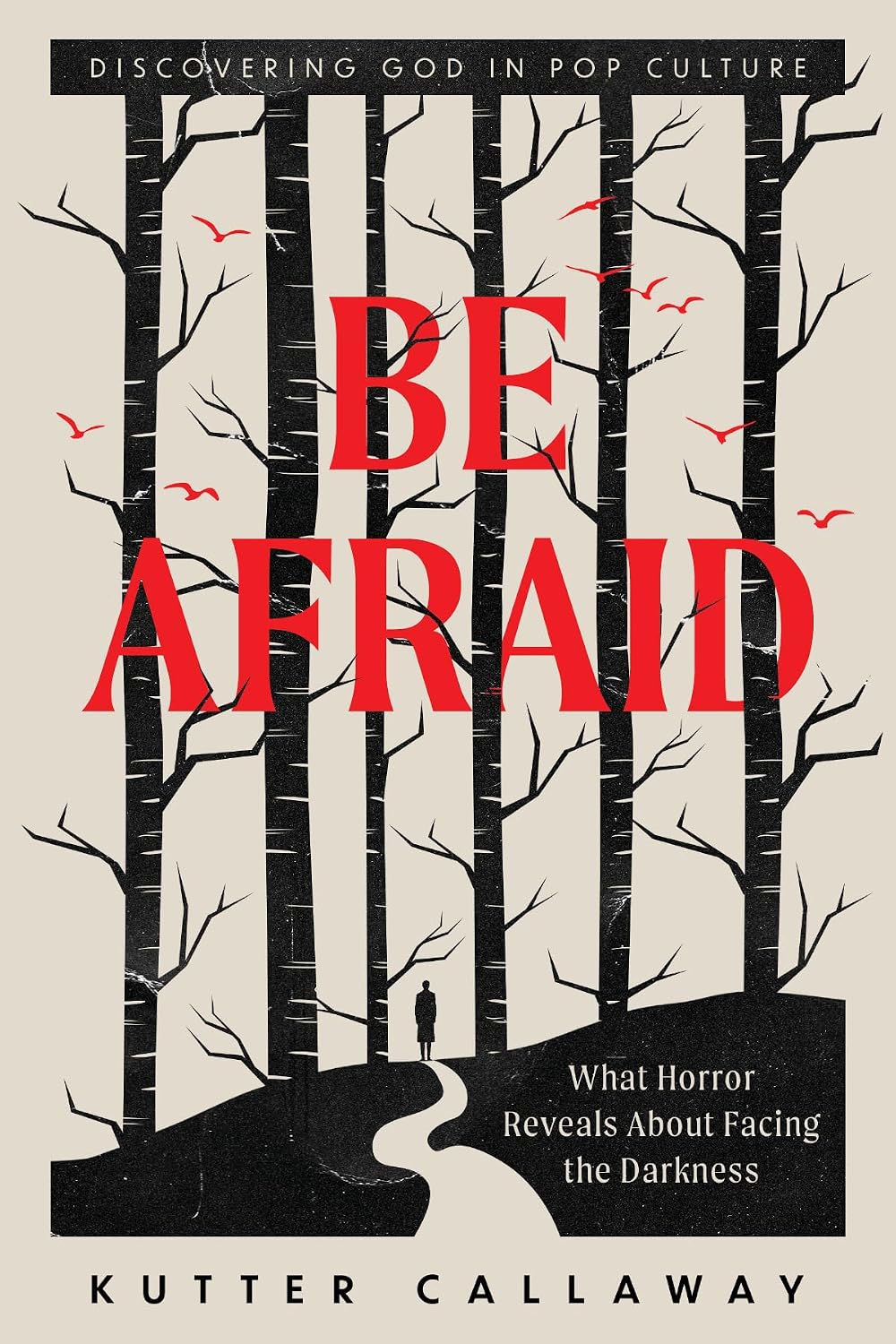
NEW BOOK: Be Afraid: What Horror Reveals About Facing the Darkness by Kutter Callaway: Publishers sometimes send me books to consider for review, and this is one of the recent standouts. Part of IVP Academic’s Discovering God in Pop Culture series, Be Afraid by theologian and psychological scientist Kutter Callaway “explores how our Christian faith is made better when we engage with the horror genre.” One of the book’s key assertions is, as filmmaker Wes Craven (A Nightmare on Elm Street; Scream) puts it, “Horror films don’t create fear. They release it.” “The power of horror,” Callaway expounds, “isn’t just in generating fear—it’s in giving us a space to express, externalize, and process the fears we already carry. It’s a kind of emotional purge” (25).
Be Afraid book cover

An intriguing argument, and one I enjoyed following throughout as the author wove together wisdom culled from his two fields with quotes from interviews he conducted with Hollywood filmmakers and others. He writes about The Babadook, The Exorcist, Monsters, Inc. (part of a whole chapter on horror tropes in Pixar films!), A Christmas Carol, and more.

Along the way, Callaway addresses the common Christian objection “Why dwell on so much darkness when the world is already overflowing with evil?”

+++

NEW EP: Turnaround by John Millea: On September 14, singer-songwriter John Millea from Oklahoma released four new songs “for the ones who feel like giving up, the ones who want to hang on, and the ones who are praying for a turnaround.” Here’s the first, “Good Earth,” inspired by the parable of the sower in Matthew 13:10–17:

Roundup: Hebrews album; flags in church; God the Plowman; digitized prayer book; lively praise hymns

Psallos: The Hebrews Album (Kickstarter): You have the opportunity to help finance a musical adaptation of the book of Hebrews for folk rock band and chamber orchestra. Cody Curtis, the composer behind Psallos, has already written the music; now he needs your help to pay for the recording and production. Curtis has already proven his skill at capturing the varied tones and trajectory of an epistle with his setting of Romans, released in 2012 (read my review here), and Thomas Griffith and Kelsie Edgren are returning to lend their beautiful vocal interpretations. I have full confidence that Psallos’s second epistle-based album will be nothing short of amazing! Besides a copy of the CD when it’s released, tiered reward options include the chance to sing on the CD as a choir member, the choice of any passage of scripture for Curtis to set to music, and a Psallos concert at your church. Also, the team is looking for a videographer and donated instruments, so get in touch with them if you’re able to help out in either of those areas.

+++

Should Patriotism Have a Place in Church? I really appreciate John Piper’s response to this question in last week’s Ask Pastor John podcast episodes. (Listen to part 2 here.) “I have been in several churches,” he says, “where on the Fourth of July the focus”—on each of the military branches and patriotic songs and flags and marches and decorations in red, white, and blue—“seemed to me uninformed, unshaped by the radical nature of the gospel, and out of proportion to the relationship between America and the kingdom of Christ.” He advises that American flags not be displayed in the sanctuary, and pledges of allegiance to the USA not be recited in a worship service, because church is where we acknowledge the absolute authority of Christ and no other.

As Christians, Piper says, we have “no unqualified allegiance to any political party, any nationality, any ethnicity, any tribal identity, or any branch of the armed service. It is all qualified. It is all secondary. It is all relative to the will of Christ. We should not say anything or do anything that looks as if that were not true. . . . The recitation of a pledge to a human authority”—and/or the display of a symbol of national identity—“in the setting of the worship of divine authority does not provide for the kind of Christian qualifications and nuances that are so necessary precisely in our day.”

+++

“Process” by Charles L. O’Donnell: I selected and wrote commentary on a short poem over at Literary Life on the theme of God as plowman of the heart. It begins,

The seed, Lord, falls on stony ground
Which sun and rain can never bless—
Until the soil is broken found—
With harvest fruitfulness.

Spring Ploughing by John Constable
John Constable (British, 1776–1837), Spring Ploughing, 1821. Oil on panel, 19 × 36.2 cm.

Run by Rick Wilcox, “Literary Life is a celebration of the Word. Leading with a discussion of modern and classic literature, we seek to tease out eternal truths which may be illumined by fiction, poetry, art and music.” The blog recently finished walking through Karen Swallow Prior’s memoir Booked: Literature in the Soul of Me; before that, it was Malcolm Guite’s The Word in the Wilderness: A Poem a Day for Lent and Easter. Each post is a treat!

+++

Mary of Guelders prayer book now online: In the early fifteenth century, while the Limbourg Brothers were hard at work on the Très Riches Heures de Duc de Berry, Duchess Mary of Guelders (John of Berry’s niece) commissioned an extraordinary 900-plus-page book that would become the high point of the late medieval book industry in the Northern Low Countries. Due to its condition, it has been stored away for the last few decades at the Staatsbibliothek zu Berlin, inaccessible even to most scholars. But a crowdfunded project led by Johan Oosterman is bringing the hidden treasure to light, allowing for extensive research, restoration, and (next October) public exhibition.

To keep the public informed of progress, a new website has been launched, with blog posts, videos, and tabs on “Mary’s World,” “The Prayers,” “The Decoration,” and more. And best of all, just last month a full digitization of the book was added to the site so that anyone with an Internet connection can browse through its hundreds of prayers and 106 miniatures. The miniature that stood out most to me is the one on verso page 132, illustrating the parable of Lazarus and the Rich Man. It shows Dives on his golden throne being swallowed by a hell-mouth, while from heaven Abraham denies his request for a drink of water.

Lazarus and the Rich Man (Mary of Guelders)
“Lazarus and the rich man from the mouth of hell,” from the prayer book of Mary of Guelders, ca. 1415. Fol. 132v. Staatsbibliothek zu Berlin-Preußischer Kulturbesitz.

+++

New arrangement of “Joyful, Joyful, We Adore Thee” and “Come, Thou Almighty King”: The music at last month’s General Assembly of the Presbyterian Church in America, convened in Greensboro, North Carolina, was fantastic. With permission, I’m posting a video excerpt from the evening worship service held on June 14, 2017. The first hymn, “Joyful, Joyful, We Adore Thee,” was written by Henry Van Dyke in 1907 to a tune from Beethoven’s Ninth Symphony; this version was arranged by Joel Littlepage (the musical director and keyboardist with the bowtie; assistant pastor of worship at Redeemer Presbyterian Church in Winston-Salem) and Michael Anderson (the pianist; composer-in-residence at Redeemer) and was orchestrated by Joel Littlepage. The first verse is sung very traditionally—in strict time to a chorded piano accompaniment—but then at 1:05, it gets real lively! The orchestra kicks into full gear, expressing the brightness of the hymn text.

Then just when you think it couldn’t get any more joyful, the praise team launches into a second hymn at 3:36 to ululation (celebratory cheer sounds), this one Caribbean-flavored. Composed by Felice de Giardini in the eighteenth century, “Come, Thou Almighty King” is a Trinitarian invocation: “Come, Thou Almighty King” (verse 1), “Come, Thou Incarnate Word” (verse 2), “Come, Holy Comforter” (verse 3). This particular arrangement is by Joel Littlepage, with orchestration by Michael Anderson. The musicians are as follows.

Vocal section (left to right): Kyle Dickerson; David Gill; Mary Higgins; Melissa Littlepage; Nikki Ellis, choir director
Rhythm section: Joel Littlepage, keyboard; Michael Anderson, piano; Daniel Faust, drums; Larry Carman, hand percussion; Kevin Beck, electric guitar
Horn section: Christian Orr, trumpet; Tim Plemmons, saxophone; Ben Nelson, trombone
String section: Heather Conine, violin; Violet Huang, viola; Adi Muralidharan, cello; Julie Money, harp
Wind section: Suzanne Kline and Lydia Wu, flute