
This is my sixth consecutive year of sharing my top twenty newly released films—see my favorites from 2024, 2023, 2022, 2021, and 2020. My criterion for qualifying as a 2025 release is the film had to have shown in commercial screenings in the US in that year; or if there was no theatrical release, it had to have become available through video on demand. I’ve seen over a hundred such films and will share with you the ones I like best, split across two posts.
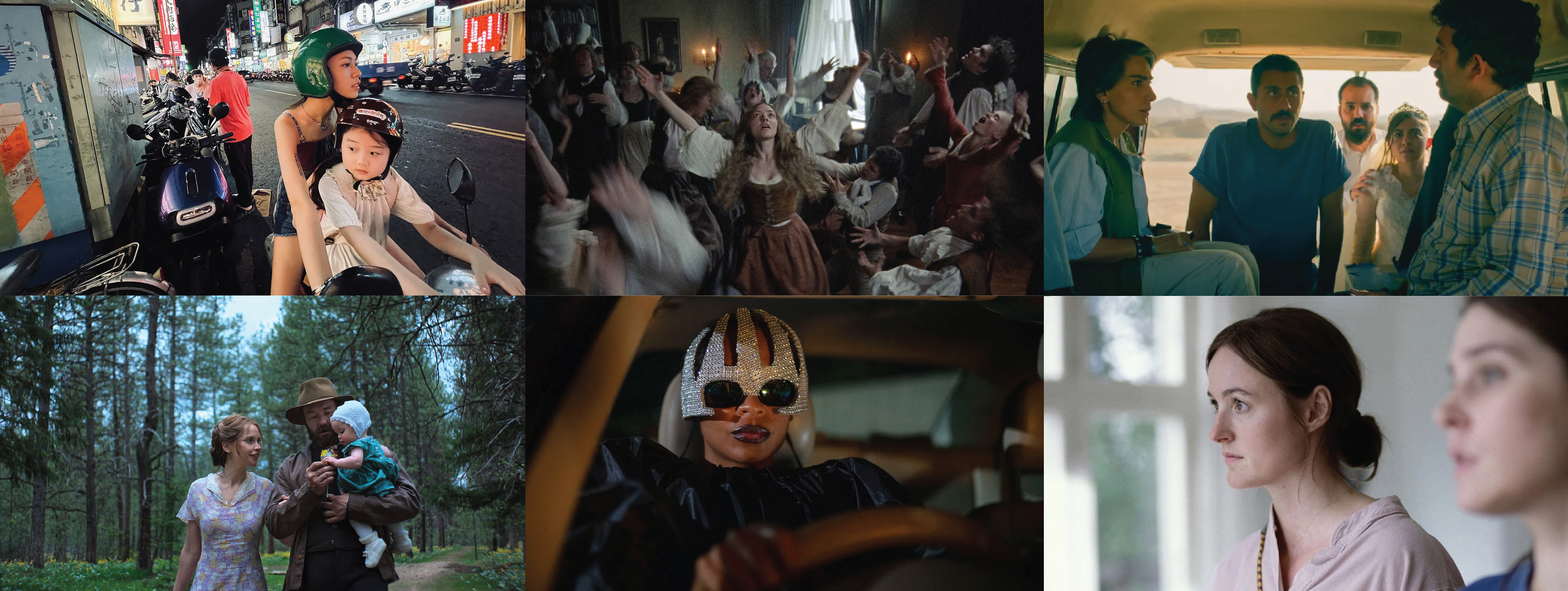
The first Shaker settlement in colonial New York, the forests of early twentieth-century Idaho, a juke joint in Jim Crow Mississippi, the political prisons of 1970s Brazil, a crumbling ranch during the Rhodesian Bush War, a night market in Taipei, the beaches of a remote Welsh island—these are some of the places where the stories unfold. They explore parent-child relational fracture; the grief of losing a child or a spouse; the experience of spiritual ecstasy; the beauty of building a life and a family; the pressures of unemployment; the struggles of settling into a new city, country, or living arrangement; the horrors of adolescence; the consuming urge for revenge against an oppressor, and what to do when you’re confronted with their humanity; art making in (virtual) community; and the complicated process of healing from the trauma of sexual assault; among other themes.
Viewer discretion advised: Please beware that about half of these films have R ratings and may contain content that some find offensive. I do not flag such content because I don’t keep track of it and I evaluate movies based on their merit as a whole, recognizing that “mature” content is often necessary to tell a particular story; my descriptions should give you a good sense of whether that story is one you’d like to engage. But of course, if your conscience proscribes you from viewing certain content, please consult a content guide beforehand to determine if the film will be safe for you.
1. Sentimental Value, dir. Joachim Trier. Nora (Renate Reinsve), a stage actress, and her father Gustav (Stellan Skarsgård), a filmmaker, have a broken relationship. When she was a child her dad drank a lot, cheated on her mom, and left Norway for long periods of time to focus on his career. Now in his old age, Gustav wants to reconcile, and the only way he knows how to affirm the hurt his daughter feels and apologize for it is to write a role for her in a movie inspired by his own childhood, in which she would play a version of his mother. Nora has no interest in the project. She thinks it’s only a publicity stunt, not realizing it’s her dad’s way of saying, “I see you.”
Sentimental Value is about the emotional communication we lack, but also art as a way of translating pain into something we can share. (Film has the power to say things without saying them, fostering understanding.) It’s about the wounds family members inflict on each other, about love and rage and regret.
We come to learn that depression has afflicted three generations of this family: Nora, her mother, and her paternal grandmother. One of the most poignant scenes is where, when Nora is incapacitated again from her mental illness, her sister Agnes (Inga Ibsdotter Lilleaas) comes to clean her apartment while she lies awake on the couch—a simple act of care. The sisters’ bond is, I think, the sweetest aspect of the film.
2. The Testament of Ann Lee, dir. Mona Fastvold. The Testament of Ann Lee is a musical biopic of the primary founder of the Shakers, a Christian sect that emerged in mid-eighteenth-century England and that was known for its ecstatic worship (“shaking”); under the visionary Ann Lee’s leadership, it would also come to be distinguished by its practice of communal living, celibacy, gender and racial equality, pacifism, and meticulous craftsmanship. Fleeing religious persecution, Lee (played by Amanda Seyfried) emigrated to America in 1774 with a small group of followers, building a community in upstate New York—but their loud, night-long worship services (which sparked rumors of witchcraft), their refusal to fight in the Revolutionary War (due to their commitment to nonviolence), and many men’s disapproval of sexual abstinence (women, including wives, flocked to the new movement) led to attacks in their new home country too.
Visceral and rousing and built largely on the rhythm of breaths and body slaps, Daniel Blumberg’s soundtrack is phenomenal; much of it consists of new arrangements of old Shaker hymns, including “Hunger and Thirst,” “All Is Summer,” and “Pretty Mother’s Home,” but he also composed a few original songs as well. Using historical documentation of Shaker dancing as fodder for the imagination, choreographer Celia Rowlson-Hall designed the ways in which the characters commune with God together through movement, bringing all their emotions to bear in their bodies.
As someone deeply interested in Christian history (even unorthodox offshoots) and early American hymnody, I was already inclined to like this movie. But I did not expect to be as transported as I was. The story, the acting, the music and dancing, the costumes, the set design, the cinematography—all contribute to an electric, devotional film that illuminates the life and legacy of a radical woman preacher from centuries past. I did not know that Lee had had four children and lost them all in infancy; this repeated trauma likely prompted her teaching, which she claimed to have received in a revelation from God, about the sinfulness of sex. In many ways, the film is about moving through grief.
3. Hamnet, dir. Chloé Zhao. We don’t know much about William Shakespeare, and still less about his wife Anne (aka Agnes, pronounced AHN-yes). One thing we do know is that the couple had three children, and their only son Hamnet—a name interchangeable with “Hamlet” in the loose orthography of the time—died at age eleven, likely of the bubonic plague. Based on a novel by Maggie O’Farrell, Chloé Zhao’s Hamnet traces Will (Paul Mescal) and Agnes’s (Jessie Buckley) relationship from courtship to marriage to childbearing and -rearing and then, in the second half, through the waves of grief that hit them in different ways after the sudden death of Hamnet (Jacobi Jupe). The film focuses especially on Agnes’s perspective, opening with her nestled in the exposed roots of a giant tree (establishing her deep connection to nature), developing her as a feral yet tender character at first radiant with the joys of motherhood and then ripped apart by loss, and climaxing with a transcendent moment she experiences in community at the premiere performance of Hamlet at the Globe Theatre in London.
Several Shakespeare biographers have speculated that his writing Hamlet was a means by which he processed his grief over the loss of his son, reconfiguring that grief into a work of art. Even though it’s about the death of a father, the play contains ghosts, mourning, madness, guilt, and contemplations of suicide that may have been at least partially colored by Will’s own personal tragedy. O’Farrell and Zhao, who cowrote the Hamnet screenplay, have given this theory a compelling narrative framework, a story of marital love that’s strained by grief but that survives it.
4. No Other Choice, dir. Park Chan-wook. Man-su (Lee Byung-Hun) is a hardworking, upper middle-class South Korean family man with a wife (Son Ye-jin) and two kids. He takes pride in his work as a manager at a paper mill, producing beautiful products. Then suddenly, after twenty-five years at the same company, he’s laid off due to an American buyout. After more than a year of unemployment, he grows desperate and decides to eliminate the three highest-qualified men in competition with him for a job in the paper industry.
Often in dark comedy thrillers, murder is treated lightly. Not so here. We see the humanity of Man-su’s targets, the shocking and unjust nature of his determined course of action, and the soul-hollowing cost of moral compromise. Despite the film’s premise, there’s actually no graphic violence, other than when Man-su extracts from his mouth a rotting tooth, symbolic of his pained conscience, with pliers (plus a disturbing image having to do with bonsai wiring). A satire of capitalism and the male ego, the film explores the lengths to which a man is willing to go to maintain an affluent lifestyle for himself and his family. And oh, what wonderfully composed shots! (Props to cinematographer Woo-hyung Kim.)
5. I’m Still Here, dir. Walter Salles. This Brazilian biographical drama is about the real-life Eunice Paiva (played by Fernanda Torres), a mother of five who fought for the truth after her politically dissident husband, Rubens Paiva (Selton Mello), was forcibly disappeared by the country’s military dictatorship in 1971. Suddenly thrown into the role of sole head of family, Eunice must hold everyone together and reinvent herself. She moves her family to São Paulo, earns a law degree, and becomes an activist at the center of campaigns to open archives on the victims of the military regime. She is indefatigable in demanding answers and pursuing justice. Her endurance is a form of resistance.
The director of I’m Still Here, Walter Salles, spent time with the Paivas during his adolescence—he was friends with one of Eunice’s boys and frequented their teeming, music-filled oceanfront home in Rio de Janeiro before Rubens went missing. The first half hour of the film activates those memories, while the film as a whole is based on a book by Eunice’s son Marcelo Rubens Paiva.
Streaming on Netflix.
6. On Becoming a Guinea Fowl, dir. Rungano Nyoni. Made and set in Zambia, this comedy-drama is in Bemba and English. Its title is a metaphor referring to how guinea fowl use their voice—a screech—to warn the flock of predators or other impending dangers. The film opens with Shula (Susan Chardy) driving home from a party one night—wearing a glittering helmet and a puffy black jumpsuit inspired by Missy Elliott’s “The Rain” video—when she finds her uncle Fred lying dead in the road. She doesn’t seem upset, and later, when gathered with her relatives, they press her. Where are your tears? She observes her family’s performative grief for a man she knew to be immoral and their mistreatment of Fred’s widow, and she wants no part of it.
It’s hard to talk about this film without giving away a key reveal. But I can say that it’s about the silence families keep to maintain the myth of a happy and well-functioning unit, the behavior of elders that families pretend not to notice for the sake of cohesion. Consider who gets mourned and who/what does not. A critique of patriarchal culture in Zambia, the film confronts generational differences, especially as relates to traditionalist versus progressive notions of accountability, agency, respect, and respectability.
Streaming on HBO.
7. Train Dreams, dir. Clint Bentley. Adapted from Denis Johnson’s 2011 novella of the same name, Train Dreams spans the 1890s through 1960s in and around Bonners Ferry, Idaho. Both grand and quiet, transcendent and personal, it chronicles the small, simple frontier life of Robert Grainier (Joel Edgerton)—all the beauty and pain it holds. Orphaned at age six, Robert meets Gladys (Felicity Jones) sometime in his twenties, and the two marry. They build a cabin together near a river, and have a daughter. The family enjoys ordinary pleasures, like supper by candlelight, naps on the front porch, chasing chickens in the yard.
Robert works first as a railroad bridge builder, then as a logger—which takes him away from home for months at a time—then as a hauler. He suffers incredible loss, but he keeps moving on, into old age, as the wild country all around him modernizes and marvels like airplanes, television, and space travel are introduced. The film is about dreams realized and unrealized, about grief and change, about the fleetingness and yet (paradoxically) substantiality of human life.
Streaming on Netflix.
8. It Was Just an Accident, dir. Jafar Panahi. Working one day in an auto shop in Tehran, Vahid (Vahid Mobasseri) is traumatized by the voice and gait of a first-time customer, whom he swears is Eghbal (Ebrahim Azizi), an Iranian government security officer who, years earlier, had blindfolded and tortured him when he was imprisoned for speaking out for workers’ rights. In a thirst for vengeance, Vahid kidnaps the man and is in the process of burying him alive in the desert when he starts to have doubts as to whether he’s the right person. He tracks down a few of his fellow ex-prisoners, including a wedding photographer (Mariam Afshari) and a young bride-to-be (Hadis Pakbaten), to provide identity confirmation—but they, too, have mixed degrees of certainty.
Equal parts retribution drama, moral thriller, and screwball road comedy, this film explores what happens when four victimized men and women turn the tables on their victimizer. It wrestles with justice and mercy—what they look like, which is more virtuous or more prudent in this situation, and what would distinguish the civilians’ act of killing from the murders committed by the regime they resist.
Writer-director Jafar Panahi has spent time in Iranian prisons under the charge of “propaganda against the Islamic Republic of Iran” and has been banned from filmmaking in that country, so he had to shoot It Was Just an Accident furtively. I was surprised by how effective the comedic elements are against the backdrop of brutality. (My description makes the film sound only harrowing, but it’s also funny; there were quite a few laughs in the audience during the screening I attended.) It’s a difficult tonal balance to pull off, but Panahi does.
9. Left-Handed Girl, Shih-Ching Tsou. Single mom Shu-Fen (Janel Tsai) and her daughters, college-age I-Ann (Shih-Yuan Ma) and five-year-old I-Jing (Nina Ye), have just moved from rural Taiwan back to the city of Taipei. Shu-Fen opens a noodle stand at a night market, I-Ann takes a job as a “betel nut beauty” (dressing seductively to sell a fruit chewed for its stimulant and mild narcotic effects), and I-Jing attends school and takes care of her pet meerkat. This family drama is about these three female protagonists adapting to their new environment, each navigating their own challenges, whether that be paying the rent and dealing with old-fashioned parents; finding a new social scene and a place to belong; or overcoming the shameful “curse” (as I-Jing’s grandpa keeps reminding her) of being left-handed. There’s a clichéd plot device used to amp up the drama that irks me, but other than that, I enjoyed this story of acclimation and survival.
Director Shih-Ching Tsou wrote the screenplay with Sean Baker—whose Florida Project, which Tsou co-produced, is one of my favorite all-time films. She shot Left-Handed Girl entirely on an iPhone 13.
Streaming on Netflix.
10. Sorry, Baby, dir. Eva Victor. Writer-director and lead actor Eva Victor’s feature film debut is a tragicomedy about healing after sexual assault. Her character, Agnes, is a literature professor at a college in small-town New England—the same college where, three years earlier, her graduate thesis adviser raped her. She works through her trauma with the support of her friend Lydie (Naomi Ackie); her adopted cat Olga, her neighbor Gavin (Lucas Hedges), and a stranger with a sandwich shop (John Carroll Lynch) also offer her their presence. Wit and empathy combine in this nonlinear, life-affirming story of a woman in the process of recovering her sense of self and security that were wrenched from her by a trusted other.
Streaming on HBO.

 Art & Theology