Easter, Day 4: Kriste aghdga

LOOK: Anastasis, Georgian Orthodox church fresco

Harrowing of Hell (Georgia)
Anastasis (Harrowing of Hell), ca. 1207. Fresco, St. Nicholas Church, Kintsvisi Monastery, Shida Kartli region, Georgia.

In this (partially damaged) icon of the Resurrection from the main church at Kintsvisi Monastery in the country of Georgia, Christ stands over the pit of hell, atop its broken gates. He has come to take back his own from this place of death. He heaves Adam up first, and Eve next. On the right stand Kings Solomon and David and John the Forerunner (aka John the Baptist). The deliverance they’ve been awaiting has come.

Fresh from the tomb, Christ holds aloft his cross as a victory staff. As is common in Orthodox icons, it has three horizontal beams: a short one on top, representing the titulus that read, “King of the Jews”; the main one, onto which Jesus’s hands were nailed; and a footrest at the bottom.

(Related post: “‘Done Is a Battle’ by William Dunbar”)

LISTEN: “Kriste aghdga” (Christ Is Risen), the Paschal troparion in a traditional Georgian setting from the Svaneti region | Performed by the Sheehan Family, 2020

Krist’e aghdga mk’vdretit
sik’vdilita sik’vdilisa
dam trgun velida saplavebis shinata
tskhovrebis mimnich’ebeli.

English translation:

Christ is risen from the dead,
trampling down death by death,
and upon those in the tombs bestowing life.

Frederica Mathewes-Green, an Eastern Orthodox author and speaker from Johnson City, Tennessee, wrote the following on her Facebook page last year:

The troparion [short hymn] for Pascha is this brief and punchy one, written by St. John of Damascus (d. 749):

Christ is risen from the dead,
trampling down death by death,
and upon those in the tombs bestowing life.

We sing it many, many times—surely hundreds of times—before Pascha concludes on the day of Pentecost. It is always sung a capella, without accompaniment (apart from the vigorous ringing of bells, in some congregations). It is set to many, many different melodies. Each ethnicity has a half-dozen favorite melodies, so the options are very broad. . . .

But when Orthodox of other nations hear it sung in a Georgian tone, they stop and listen.

Georgian church music is unique. It is always sung in three parts, honoring the Trinity; but what’s striking is the sound of it, unlike anything we have in the West. Someone who is trained in Georgian chant might be able to explain it, but I can’t. 

Let’s hear from Dr. John A. Graham, an American musicologist specializing in the history of Georgian liturgical music and who runs the website www.georgianchant.org:

“Kriste aghdga” (Christ is Risen) is an important Easter hymn in the Georgian Orthodox tradition. It is sung when the priest knocks on the doors of the church, symbolizing entrance to the tomb of Christ, just before entering the sanctuary space to commence the all-night liturgy service [on the Saturday before Easter].

Then it is repeated in groups of three throughout the All-Night vigil service (4-7 hours). It is also sung in every service after Easter until Pentecost.

The chant survives in many musical variants, as chanters in each village and region perfected their individual style.

The most popular variant, the one you heard above, is from Svaneti, a highland region in northwest Georgia. The style is influenced by Svan folk music. This variant begins with a solo sung by the middle voice. You can purchase the vocal score here, as sung by the Sheehan family, or see the free transcription that Graham provides.

Here’s the Orthodox Virtual Quarantine Choir, directed by Steve Jacobs, singing the chant in English, interspersed with a Paschal reading taken from Psalm 68:1–3 (“Let God rise up . . .”) and Psalm 118:24 (“This is the day . . .”):

In his article, Graham lists seven characteristics of traditional Georgian chant, among which are its three-part voicing, its close harmonies (“The dissonances are integral to the desired sound. The tension-release in the music is symbolic of our prayers and supplications to God.”), and an ending in unison. He posts videos of several other regional musical variants of the troparion in Georgian.

This song, as performed by the Capitol Hill Chorale, is on the Art & Theology Eastertide Playlist.

Easter Playlist

Easter Sunday is the most joyful day of the Christian year, kicking off a fifty-day season of feasting and celebration centered on the resurrection of Jesus Christ. While we celebrate the resurrection year-round (every Sunday is a “little Easter”), the liturgical calendar gives us this set-apart time to linger with and savor the mystery with particular focus and renewed fervor. Christ’s rising from the grave has far-reaching implications, which the church unpacks, most especially during Eastertide, through its liturgies, scripture readings, sermons—and music.

I compiled a Spotify playlist of songs and other musical pieces for this festal season—a mix of classical, gospel, choral, folk, and indie-pop, with some jazz and bluegrass. These selections span historical periods and geographic locales, ranging from early medieval hymns and liturgical refrains to newer releases, from Senegal, Tanzania, Chile, Tyendinaga Mohawk Territory (in Ontario), Serbia, Hungary, Germany, Ireland, France, the Middle East, and more.  

You’ll find plenty of classic texts and tunes, some retunes and new arrangements of the classics and other oldies, and some through-and-through originals. And lots of Alleluias!

Sung in Byzantine-rite churches, the Paschal troparion—“Christ is risen from the dead, trampling down death by death, and on those in the tombs bestowing life”—is represented here by a few different settings in a few different languages, including Georgian (“Krist’e Aghsdga”) and Greek (“Hristos Anesti”). Church of the Apostles does a version in English that works well with a contemporary worship band.

The medieval French melody known as NOEL NOUVELET is often paired with two different Easter hymn texts, both of which I’m very fond of: “Welcome, Happy Morning!” by Venantius Fortunatus, a sixth-century hymnographer in the Merovingian court and later bishop of Poitiers, and the early twentieth-century “Now the Green Blade Riseth” by J. M. C. Crum, which has this wonderfully poetic refrain: “Love is come again like wheat that springeth green.” Claire Holley [previously] recorded a subdued, guitar-picked rendition of the latter, and for the former, here’s Redeemer Knoxville’s [previously] super-fun arrangement, which includes mandolins, trumpets, and a raucous energy!

Christ’s death and resurrection initiated a new exodus, so to speak, so some of the songs, like “Carol of the Exodus” [previously] and “Mary, Don’t You Weep” [previously] use the language of Pharaoh’s armies (i.e., agents of death) being overthrown, and liberation.

Also included on the list is a Swahili praise song whose key phrase, “Yesu ni wangu, wa uzima wamilele,” translates to “Jesus is mine, he is (the God of) everlasting life.” Some English versions of the song translate it as “Jesus is mine, he’s alive and he’s eternal.”

Classical selections include the Sinfonia (instrumental opening) of Bach’s Easter Oratorio; “Dum transisset Sabbatum” (When the Sabbath Was Past), a Renaissance motet setting of Mark 16:1–2 by John Taverner; a movement from a piano sonata by modern Finnish composer Einojuhani Rautavaara inspired by the icon of the holy women at the tomb; and a movement from a violin sonata by Austrian Baroque composer Heinrich Ignaz Franz Biber.

The latter two are among the several allusive instrumental pieces on the list, which also include “Viriditas” on jazz guitar by Charlie Rauh (its title references Hildegard of Bingen’s concept of greening, freshness, new life) and “Phoenix” on oud by Egyptian Australian virtuoso Joseph Tawadros (the phoenix is a mythological bird that dies and rises again, which the medieval church embraced as a symbol of Christ).

Two gems I discovered while searching for Easter music are settings of Gerard Manley Hopkins’s poem “Easter”: one a Celtic-influenced choral setting by Steven C. Warner, the other an alt-rock version by Jon Green (JG Hymns):

A popular Easter song in Spanish-speaking churches throughout the world is “Resucitó” (He Is Risen) by Kiko Argüello:

There are a few songs here written for kids, like “Jesus Is Alive” by Rain for Roots and “Risen Today” by John Burland, but which I find enjoyable myself!

And there are a handful of songs by James Ward [previously], a gospel songwriter and pianist from New City Fellowship in Chattanooga, Tennessee—such as “Morning Sun,” which is included in the Trinity Hymnal:

For a closer, I chose “Love Divine, Victorious,” written by Karl Digerness and arranged by Minna Choi, musicians at City Church San Francisco [previously]. I love its blend of classical and folk-rock styles, with an orchestra interacting with a banjo and drum kit. (The album recording has a full orchestra and a choir; the video below is a pared-down version from last year, with string orchestra and two vocalists.) The song looks back in remembrance and forward in anticipation, quoting the traditional memorial acclamation “Christ has died, Christ is risen, Christ will come again.”

To listen to all 130-plus songs on Spotify, open the Art & Theology Eastertide Playlist link, then click on the More (…) icon and select “Save to Library.” Then the list will be easily accessible to you throughout the season and will reflect any new song additions I make.

Easter Playlist Cover

Playlist cover art: Edward Burra, Resurrection, ca. 1948–50

Roundup: Easter flash mob; Good Thief; Resurrection photo; Sistine Chapel frescoes in 3-D; etc.

FLASH MOB: On Easter 2011 at City Mall in Beirut, Lebanon, a flash mob broke out singing the Paschal troparion in Arabic: Christ is risen from the dead, trampling down death by death, and on those in the tombs bestowing life! [HT: Global Christian Worship]

+++

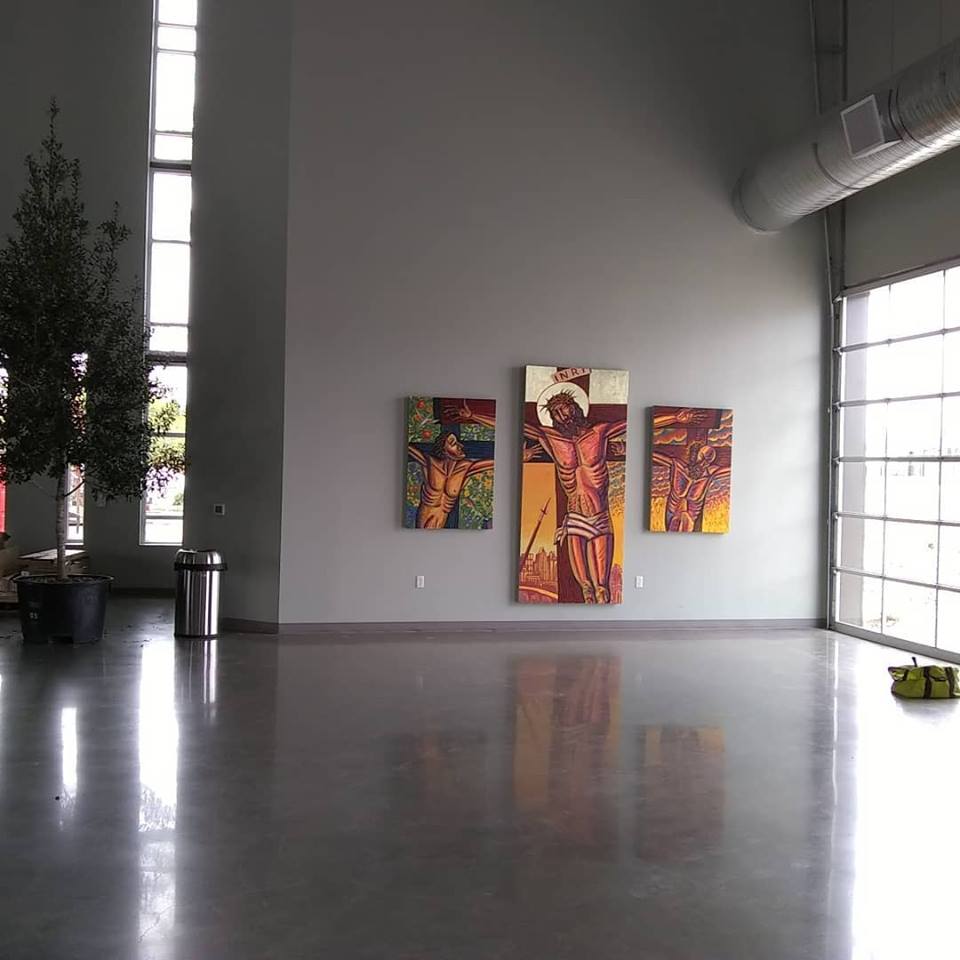
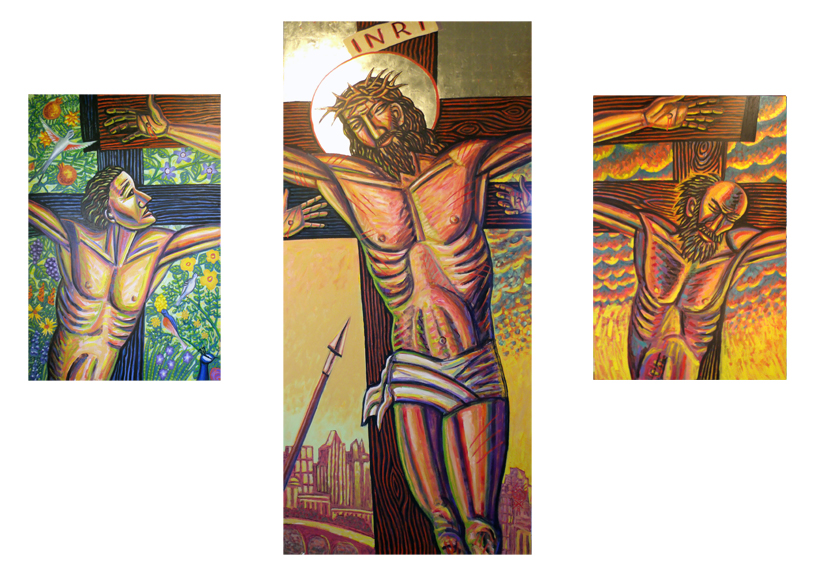
NEW PAINTING INSTALLED: James B. Janknegt is a Christian artist from Texas who is known for transposing biblical stories into contemporary American settings. He recently completed a large triptych for the new Unity Hall at Community First! Village in Austin, a planned community, developed by Mobile Loaves & Fishes, that provides affordable, permanent housing for the chronically homeless. (See the development and learn more about it in this short video, presented by MLF founder Alan Graham.) The painting shows Jesus in conversation with the “good thief” who, as he dies, acknowledges his crime and asks Jesus to “remember me when you come into your kingdom” (Luke 23:42). Behind him paradise flowers forth, indicating not only his new home but his inward regeneration. The other thief, by contrast, turns his head away in stubbornness. This episode demonstrates that repentance is always met by Christ with love, affirmation, and seeds of new life.

Good Thief by James B. Janknegt
James B. Janknegt (American, 1953–), Good Thief, 2018. Oil on three panels, 8 × 12 ft. Unity Hall, Community First! Village, Austin, Texas.

Good Thief by James B. Janknegt

+++

SHORT FILM: “Dance Dance” by French film director Thomas Blanchard evokes each of the four seasons through different elements acting on flowers, captured in either time lapse or slow motion. For fall, a rose is set on fire; for winter, foliage afloat in water becomes frozen in ice; for spring, lilies bloom; and for summer, colored inks hit the flowers and billow up in dusty clouds. Stunning images!

+++

CHAIYA ART AWARD FINALIST: The inaugural Chaiya Art Award competition ended last month, with the winner taking home £10,000 and being exhibited, along with forty-one other juried selections, at London’s gallery@oxo March 29–April 9. The theme was “Where Is God in Our Twenty-First-Century World?”

One entry I really love is finalist Sheona Beaumont’s Natal, a photographic work that shows a nude pregnant woman standing against a dark wall in profile, her hair blown wildly by a gust of wind, opposite a corpse. These are two different spaces set in juxtaposition—two photos stitched together. The black-and-white photo of the dead body, on the left, is Fred Holland Day’s The Entombment from 1898, in which he himself posed as Christ, laid out on a bier before a doorway, his crown of thorns and titulus crucis on the ground beside him. Beaumont rotated this horizontal image 90 degrees clockwise so that the Christ figure is propped upright. She then posed her female model to form a sort of mirror image, but one full of vitality; the woman’s belly, the site of new life about to be born, is brightly lit. This combination photograph makes a powerful Holy Saturday image, one that hints toward resurrection as the stillness gives way to stirrings. The photo is also an allusion to the new life believers have in Christ, and in fact it forms the first in a new series titled Born Again. Visit Beaumont’s website to view the artwork and to read a bit about her process and the meaning the work holds for her.

+++

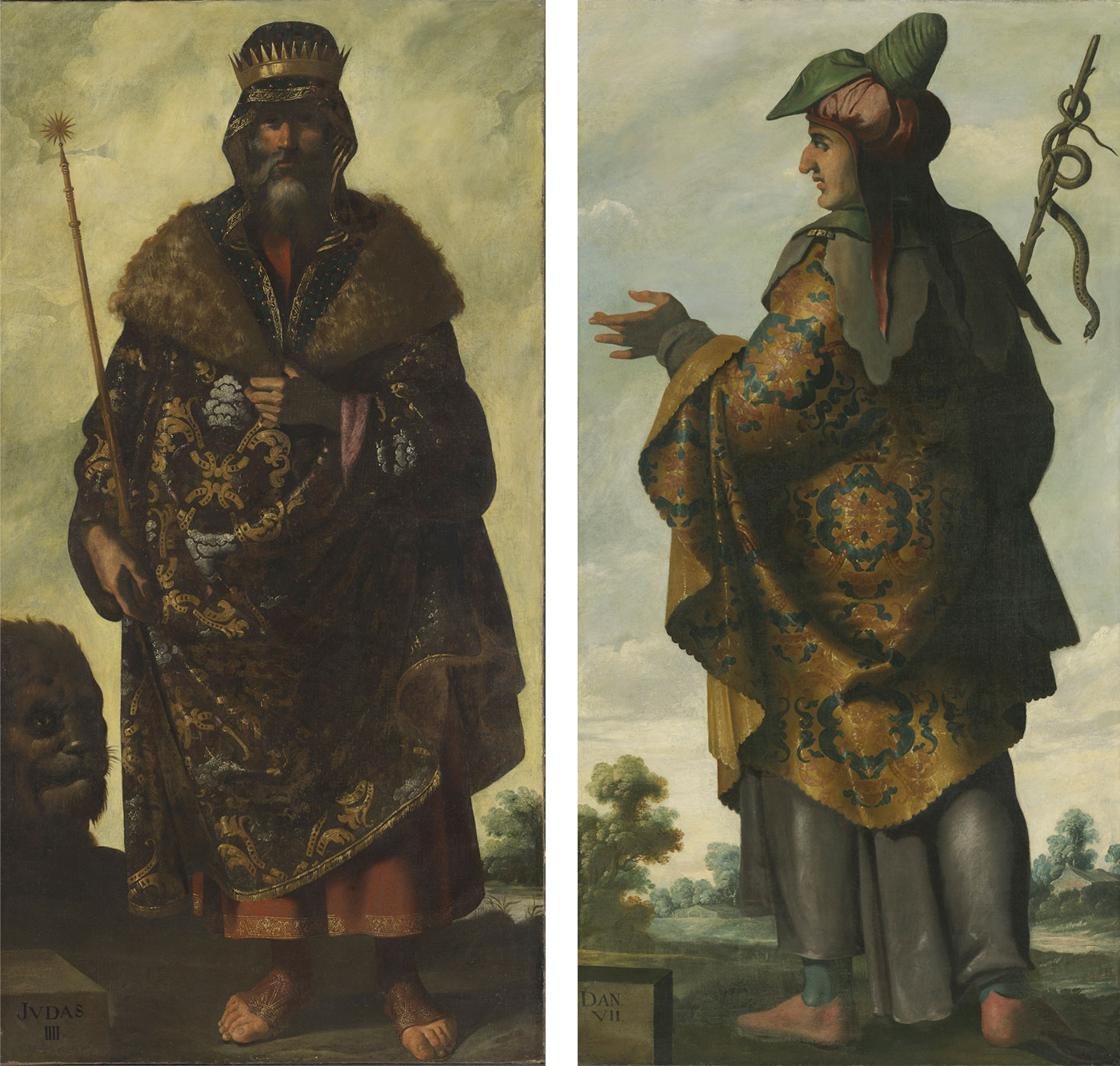
EXHIBITION: “Zurbarán’s Jacob and His Twelve Sons: Paintings from Auckland Castle”: Last fall, Spanish Golden Age artist Francisco de Zurbarán’s Jacob and His Twelve Sons made its North American debut at the Meadows Museum in Dallas, traveling for the first time in centuries, and now the exhibition is at the Frick Collection in New York City—but only through the end of this week! Twelve of the thirteen paintings in the set are from Auckland Castle in County Durham, England, the residence of the eighteenth-century Anglican bishop Richard Trevor, who acquired them in 1756 and had them displayed in his dining room, where they have remained ever since. Trevor was outbid on the painting of Benjamin, however, which is on loan from Grimsthorpe Castle in Lincolnshire, reuniting the set for the first time since the paintings’ 1756 sale.

Judah and Dan by Francisco de Zurbarán
Francisco de Zurbarán (Spanish, 1598–1664), Judah; Dan, 1640–44. Oil on canvas, 79 1/4 × 40 3/4 in. each. Photos: Robert LaPrelle.

The iconography of the paintings is derived from the prophecies Jacob utters over each of his sons on his deathbed, as described in Genesis 49. For example, Judah, from whom “the scepter shall not depart,” holds said scepter and is regally draped in a gold brocade robe and fur that hint at his descendants kings David and Solomon (Zurbarán was the son of a haberdasher, and gave great care to the depiction of textiles); Dan, on the other hand, holds up a serpent on a stick, alluding to his craftiness. To view all the paintings, click here.

+++

3-D SHOW: As of last month and through the end of July, Artainment Worldwide Shows, in cooperation with the Vatican Museums, presents “Giudizio universale: Michelangelo and the Secrets of the Sistine Chapel” by Marco Balich, an immersive 3-D show that brings to life Michelangelo’s Sistine Chapel frescoes inside the Rome Conciliation Auditorium. Half the room is covered, from the walls to the ceiling, with a 270-degree screen that projects extremely high-res photos of the paintings, dramatized through movement, music, lighting, sound effects, narration, live actors, and dance. Lasting sixty minutes, the show concludes with the thirteenth-century Latin hymn Dies irae (“Day of Wrath”), set to new music by Sting and arranged for chamber orchestra and choir by Rob Mathieson. Watch the trailer below, or click here to see some of the 3-D animation of the Last Judgment.