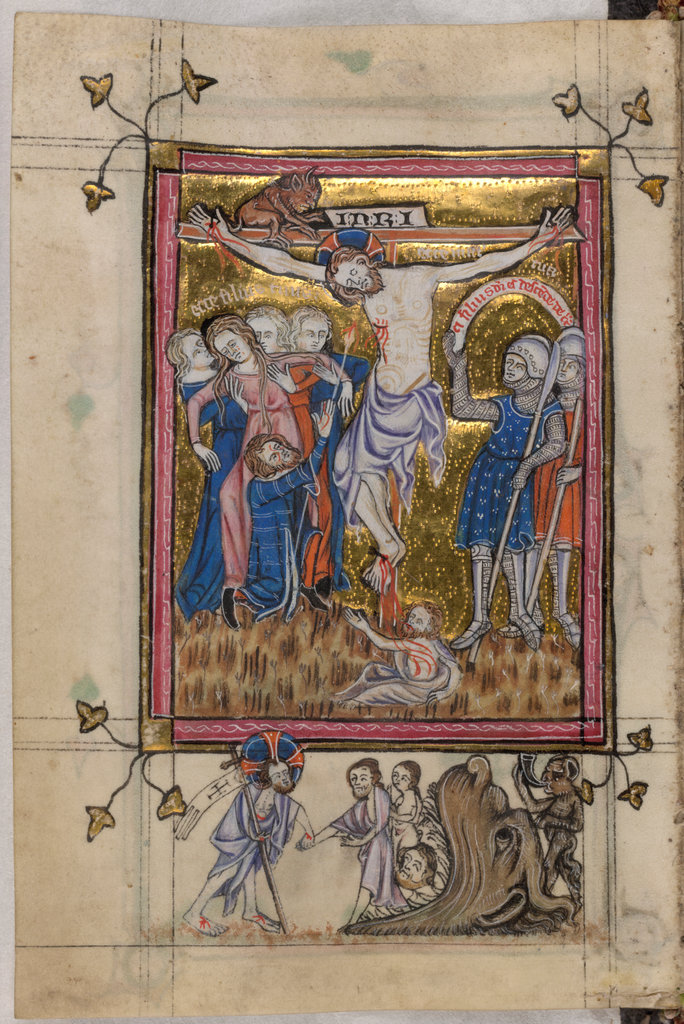
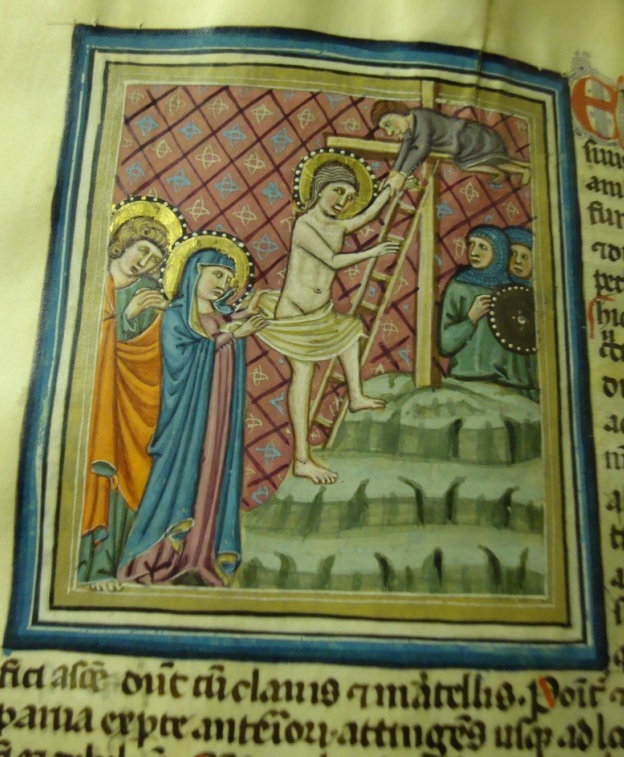
Crucifixion with bas-de-page scene of Christ leading figures from the mouth of Hell, from the Taymouth Hours, England, second quarter of 14th century. British Library, Yates Thompson 13, fol. 122v.
ORIGINAL MIDDLE ENGLISH:

Loue me brouthte,
& loue me wrouthte,
Man, to be þi fere.
Loue me fedde,
& loue me ledde,
& loue me lettet here.

Loue me slou,
& loue me drou,
& loue me leyde on bere.
Loue is my pes,
For loue i ches,
Man to byƷen dere.

Ne dred þe nouth,
I haue þe south,
Boþen day & nith,
To hauen þe,
Wel is me,
I haue þe wonnen in fith.
MODERN ENGLISH TRANSLATION:

Love me brought,
And love me wrought,
Man, to be thy fere. [companion]
Love me fed,
And love me led,
And love me fastens here.

Love me slew,
And love me drew,
And love me laid on bier.
Love’s my peace;
For love I chose
To buy back man so dear.

Now fear thee not;
I have thee sought
All the day and night.
To have thee
Is joy to me;
I won thee in the fight.

Trans. Victoria Emily Jones
This medieval passion lyric is from the Commonplace Book of John of Grimestone, compiled in Norfolk, England, in 1372 and owned by the National Library of Scotland in Edinburgh. It was transcribed by Carleton Brown in Religious Lyrics of the Fourteenth Century(Oxford: Clarendon Press, 1924), page 84.
Adv.MS.18.7.21, fol. 121r, with “Love Me Brought” poem highlighted. In this manuscript, the Franciscan friar John of Grimestone jotted down miscellaneous verses and quotes to use in his preaching.
In the poem, Christ addresses humankind from the cross, professing his great love for her. He was begotten in love by the Father, and it’s love that brought him to earth. Love nourished and guided him, and for love he stayed the difficult course, all the way to the end. Satan had stolen Christ’s beloved, and to win her back, Christ went into battle, to redeem her who was rightfully his. His decisive move: spreading out his arms across a wooden beam, so as to embrace the world, and submitting to being nailed there.
He died for love of his lady. Love is what drew him to and secured him to that cross, what kept him there when the physical and emotional agony begged he desist. And because of his persistence in seeking us, his courageous endurance as the enemy assailed, he attained ultimate victory. “Well is me!” (Blessed am I), he exclaims, “for you are mine and I am yours.” Let nothing stand between.
Katharine Blake, the founder and musical director of Mediæval Bæbes, wrote a setting of “Love Me Broughte,” in medieval style, for the group’s 1998 album Worldes Blysse. Sweet and vigorous, it features, besides voices, a zither, pipe, recorder, tambourine, and drums.
Did you enjoy this poem? For more like it, come on out on November 23 to “Christ Our Lover: Medieval Art and Poetry of Jesus the Bridegroom,” a lecture by Dr. Grace Hamman that I’ve organized for the Eliot Society in Annapolis. Learn some of the ways Christian preachers, poets, theologians, mystics, and artists in the late Middle Ages, both male and female, conceptualized Christ’s passionate love, drawing from the Song of Songs, courtly love poetry, and more—often in quite imaginative ways!
El Greco (Domenikos Theotocopoulos) (Spanish, 1541–1614), El Espolio (The Disrobing of Christ), 1577–79. Oil on panel, 55.7 × 34.7 cm. National Trust, Upton House, Warwickshire, England. Photo: National Trust Photo Library / John Hammond. [object record]
The carpenter is intent on the pressure of his hand
on the awl, and the trick of pinpointing his strength
through the awl to the wood, which is tough.
He has no effort to spare for despoilings
nor to worry if he’ll be cut in on the dice.
His skill is vital to the scene, and the safety of the state.
Anyone can perform the indignities; it is his hard arms
and craft that hold the eyes of the convict’s women.
There is the problem of getting the holes straight
(in the middle of this shoving crowd)
and deep enough to hold the spikes
after they’ve sunk through those soft feet
and wrists waiting behind him.

The carpenter isn’t aware that one of the hands
is held in a curious beseechment over him—
but what is besought, forgiveness or blessing?—
nor if he saw would he take the time to be puzzled.
Criminals come in all sorts, as anyone knows who makes crosses,
are as mad or sane as those who decide on their killings.
Our one at least has been quiet so far,
though they say he has talked himself into this trouble—
a carpenter’s son who got notions of preaching.
Well here’s a carpenter’s son who’ll have carpenter’s sons,
God willing, and build what’s wanted, temples or tables,
mangers or crosses, and shape them decently,
working alone in that firm and profound abstraction
which blots out the bawling of rag-snatchers.
To construct with hands, knee-weight, braced thigh,
keeps the back turned from death.
But it’s too late now for the other carpenter’s boy
to return to this peace before the nails are hammered.
Earle Birney (1904–1995) is regarded as one of Canada’s finest poets. He is the author of twenty-five poetry collections, including David and Other Poems (1942), Now Is Time (1945), and Near False Creek Mouth (1964). He taught English at the University of British Columbia, where he founded and directed the first Canadian creative writing program. He was also a novelist, essayist, literary critic, and radio playwright.
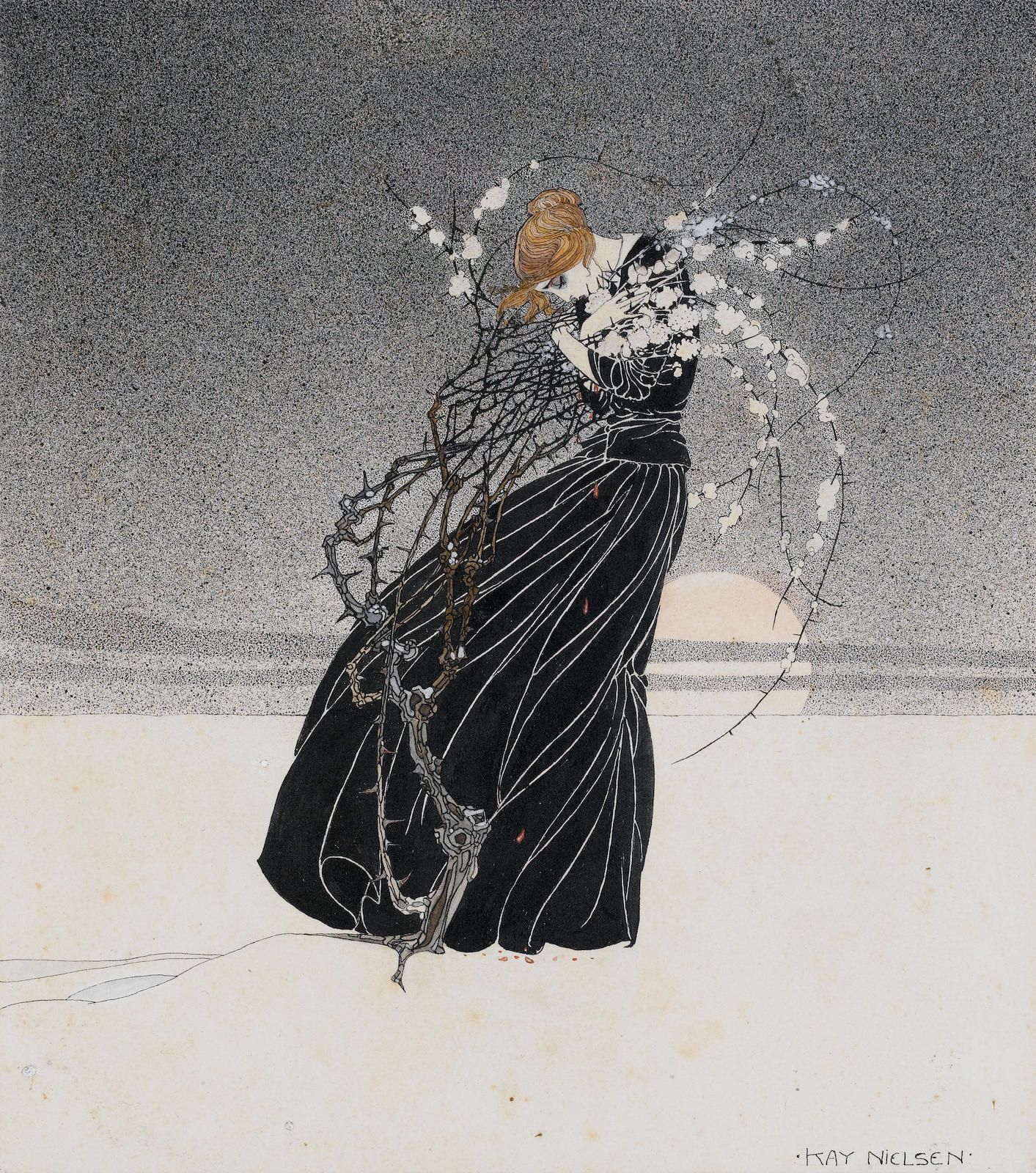
Kay Nielsen (Danish, 1886–1957), illustration for “The Story of a Mother,” ca. 1910. Pen and black ink and watercolor, heightened with bodycolor and gum arabic, 9 7/16 × 8 1/4 in. (24 × 21 cm).
When I saw this watercolor drawing of a woman embracing a thorny shrub till she drips blood come up in my Instagram feed, I immediately thought of Christ’s passion.
The caption reveals that it’s an illustration by Kay Nielsen for Hans Christian Andersen’s “The Story of a Mother,” a fairy tale written in 1848 and published around 1910 that shows the beauty and intensity of a mother’s love for her child.
The story is about a woman whose young son is gravely ill. One evening, old man Death enters her house and takes the child. Utterly distraught, she runs out after him, seeking to save the boy from Death’s clutches. As she crosses the snowy landscape in search of her son, she is stopped by various beings who request things of her in exchange for help. Night asks her for lullabies. The blackthorn bush asks for warmth. The lake asks for her eyes, clear as pearls, so “she wept till her eyes dropped down to the bottom of the lake.” An old woman who keeps Death’s greenhouse asks for her long black hair. (Oddly, she’s a redhead in Nielsen’s drawing!) Here is the exchange with the blackthorn bush, as translated from the Danish by Jean Hersholt:
At the crossroad grew a blackthorn bush, without leaf or flower, for it was wintertime and its branches were glazed with ice.
“Did you see Death go by with my little child?”
“Yes,” said the blackthorn bush. “But I shall not tell you which way he went unless you warm me against your heart. I am freezing to death. I am stiff with ice.”
She pressed the blackthorn bush against her heart to warm it, and the thorns stabbed so deep into her flesh that great drops of red blood flowed. So warm was the mother’s heart that the blackthorn bush blossomed and put forth green leaves on that dark winter’s night. And it told her the way to go.
The mother fulfills all the demands she encounters in her quest and finally meets Death, who explains that he merely carries out God’s will, which she ought not to disrupt. She ultimately resigns herself in humility to divine providence and lets the child go.
I’m not suggesting that this fairy tale is an allegory of God’s love. That wouldn’t quite make sense, as God is invoked at the end as a character in the story—and, à la the book of Job, as one who sometimes wills death (“The LORD gives and takes away,” Job 1:21).
But the mother’s love in the story is reflective, I find, of the fierce love of God, who is willing to go to any extreme to save his children from Death. He became incarnate and embraced the way of the cross. He took unto himself the crown of thorns, the nails, the humiliation. He sacrificed not just parts of himself but his whole self.
In Nielsen’s illustration, I see a picture of Christ our mother who willingly endured pain to rescue us, the warmth of whose love reverses the curse and brings life.
The English Crucifixion lyric “My Fearful Dream” (also known by the beginning of its first line, “To Calvary he bore his cross”) was written anonymously in the fifteenth century. It is preserved, with music by Gilbert Banastir (sometimes spelled Banaster or Banester) (ca. 1445–1487), on folios 77v–82r of the famous Tudor songbook BL Add. MS. 5465, intended for use at the court of King Henry VII. Compiled around the year 1500, this manuscript is commonly referred to as the Fayrfax Manuscript after Robert Fayrfax, the Tudor composer who was organist of St. Albans and a Gentleman of the Chapel Royal—that is, an adult male singer in the monarch’s household choir. It contains twelve sacred songs and thirty-seven secular songs, all in English—with, “beyond question, the finest music written to vernacular words which survives from pre-Reformation England,” writes John Stevens in Early Tudor Songs and Carols (xvi). It is unknown whether the text or the music was written first.
In 1982 “My Fearful Dream” was performed by Pro Cantione Antiqua under the direction of Mark Brown at the Church of St. John-at-Hackney in London. The recording of this performance was originally released in 1985 in vinyl format on A Gentill Jhesu: Music from the Fayrfax Ms. and Henry VIII’s Book (Hyperion A66152) and was later reissued by Regis Records in 2006 on the CD Tears & Lamentations: English Renaissance Polyphony (RRC 1259). Unfortunately, the CD is out of print, the choral group is inactive, and I can find no performances online. I thus provide the recording of “My Fearful Dream” (or “My Fearfull Dreme,” as the track list spells it) directly below for educational purposes. It is a song for three voices: alto, tenor, bass.
Below is the original text as transcribed by Richard Leighton Greene from the Fayrfax Manuscript in The Early English Carols (Oxford: Clarendon Press, 1935), page 124, followed by a version with modernized spellings and updates of a few antiquated words. The text also appears in John Stevens, Music and Poetry in the Early Tudor Court (London: Methuen, 1961), no. 56, and the music in John Stevens, ed., Early Tudor Songs and Carols (Musica Britannica 36) (London: Stainer and Bell, 1975), page 476.
Pro Cantione Antiqua does not sing the third stanza.
Rogier van der Weyden (Netherlandish, 1399/1400–1464), The Crucifixion, with the Virgin and Saint John the Evangelist Mourning, ca. 1460. Oil on panel, overall 71 × 73 in. (180.3 × 185 cm). Philadelphia Museum of Art.
Most people today use the word “carol” as synonymous with a cheerful Christmas song. But up until about 1550, the term was used for lyrics of a certain form rather than a certain subject or spirit. Greene defines the medieval or Renaissance carol as “a song on any subject, composed of uniform stanzas and provided with a burden . . . [that is,] an invariable line or group of lines which is to be sung before the first stanza and after all stanzas” (Early English Carols, xxxii–xxxiii). He distinguishes a burden from a refrain: “The refrain, as defined in this essay, is a repeated element which forms part of a stanza, in the carols usually the last line. The burden, on the other hand, is a repeated element which does not form any part of a stanza, but stands wholly outside the individual stanza-pattern” (clx).
That’s why “My Fearful Dream” can properly be called a carol. The two lines beginning “My fearful dream” open the song and repeat after each stanza.
My Feerfull Dreme
My feerfull dreme nevyr forgete can I:
Methought a maydynys childe causless shulde dye.

To Calvery he bare his cross with doulfull payne,
And theruppon straynyd he was in every vayne;
A crowne of thorne as nedill sharpe shyfft in his brayne;
His modir dere tendirly wept and cowde not refrayne.
          Myn hart can yerne and mylt
          When I sawe hym so spilt,
          Alas, for all my gilt,
Tho I wept and sore did complayne
     To se the sharpe swerde of sorow smert,
     Hough it thirlyd her thoroughoute the hart,
So ripe and endles was her payne.

My feerfull dreme . . .

His grevous deth and her morenyng grevid me sore;
With pale visage tremlyng she strode her child before,
Beholdyng ther his lymmys all to-rent and tore,
That with dispaire for feer and dred I was nere forlore.
          For myne offence, she said,
          Her Son was so betraide,
          With wondis sore araid,
Me unto grace for to restore:
     ‘Yet thou are unkynd, which sleith myn hert,’
     Wherewith she fell downe with paynys so smert;
Unneth on worde cowde she speke more.

My feerfull dreme . . .

Saynt Jhon than said, ‘Feere not, Mary; his paynys all
He willfully doth suffir for love speciall
He hath to man, to make hym fre that now is thrall.’
‘O frend,’ she said, ‘I am sure he is inmortall.’
          ‘Why than so depe morne ye?’
          ‘Of moderly pete
          I must nedis wofull be,
As a woman terrestriall
     Is by nature constraynyd to smert,
     And yet verely I know in myn hart
From deth to lyff he aryse shall.’

My feerfull dreme . . .

Unto the cross, handes and feete, nailid he was;
Full boistusly in the mortess he was downe cast;
His vaynys all and synowis to-raff and brast;
The erth quakyd, the son was dark, whos lyght was past,
          When he lamentable
          Cried, ‘Hely, hely, hely!’
          His moder rufully
Wepyng and wrang her handes fast.
     Uppon her he cast his dedly loke,
     Wherwith soddenly anon I awoke,
And of my dreme was sore agast.

My feerfull dreme . . .
My Fearful Dream (modernized)
My fearful dream never forget can I:
Methought a maiden’s child causeless should die.

To Calvary he bore his cross with doleful pain,
And thereupon strained he was in every vein;
A crown of thorns, sharp as needles, shoved in his brain.
His mother dear tenderly wept and could not refrain.
          My heart did yearn and melt
          When I saw him so spilt,
          Alas, for all my guilt,
And I wept and did sore complain
     To see the sharp sword of sorrow smart,
     How it pierced her straight through the heart,
So ripe and endless was her pain.

My fearful dream never forget can I:
Methought a maiden’s child causeless should die.

His grievous death and her mourning grieved me sore;
With pale visage, trembling, she strode before her child,
Beholding his limbs all rent and torn,
That with despair for fear and dread I was near forlorn.
          For my offense, she said,
          Her Son was so betrayed,
          With wounds sore arrayed,
Me unto grace for to restore:
     “Yet thou art unkind, which slayeth my heart,”
     Wherewith she fell down with pains so smart;
Hardly one word could she speak more.

My fearful dream never forget can I:
Methought a maiden’s child causeless should die.

Saint John then said, “Fear not, Mary; all his pains
He willfully suffers for the special love
He has to man, to make him free that’s now in thrall.”
“O friend,” she said, “I am sure he is immortal.”
          “Why, then, do you mourn so deeply?”
          “Of motherly pity
          I needs must woeful be,
As a terrestrial woman
     Is by nature constrained to smart,
     And yet verily I know in my heart
From death to life he shall arise.”

My fearful dream never forget can I:
Methought a maiden’s child causeless should die.

Unto the cross, hands and feet, he was nailed;
Violently into the mortise he was cast down;
His veins and sinews were all riven apart and burst;
The earth quaked, the sun was dark, whose light was past,
          When he, lamenting,
          Cried, “Eli, Eli, Eli!”
          His mother was ruefully
Weeping and wrung her hands fast.
     Upon her he cast his deathly look,
     Wherewith suddenly anon I awoke,
And of my dream was sore aghast.

My fearful dream never forget can I:
Methought a maiden’s child causeless should die.
The speaker of this carol has a dream—a nightmare—of Calvary, where he beholds the ignominious death of Jesus and the agonizing grief of Jesus’s mother and realizes that such suffering was undertaken for his sake, to save him from sin and its fatal consequences. The accusation that Mary hurls at the speaker in her hour of torment is biting: “You slay my heart!” My son is dead because of you. It’s such a humanizing passage, this expression of a mother’s anger at a death that didn’t have to be.
This is the Mater Dolorosa (Latin for “Sorrowful Mother”) of Christian tradition, who is sometimes depicted with a sword (or seven!) in her chest, literalizing Simeon’s prophecy to her as a teen and evoking the piercing sensation of losing a child. In Rogier van der Weyden’s Crucifixion diptych that I’ve reproduced here, created in roughly the same period as “My Fearful Dream” but in the Low Countries, there’s no sword, but Mary’s sorrow is evident in her tear-stained face, the wringing of her hands, and her literally collapsing under the unbearable weight of what she’s been asked to endure.
In the carol, the apostle John, present with Mary at the foot of the cross, catches her in her swoon and offers consolation, reassuring her that Jesus suffers willingly out of love. She responds that she knows it in her heart, and that she knows too that he will ultimately rise from death, but that that doesn’t diminish the sharpness of the pain she feels, deep in her body, watching her son shamed and wounded so.
The final image in the dream is of Jesus looking on his mother with a deathly pallor. With that, the speaker is jolted awake and sits with the horror.
On this side of the resurrection, it can be easy to breeze past Good Friday (“He didn’t stay dead!”) or to meditate on the Crucifixion only in a spiritual or theological sense. But this poem, this carol, sticks us in medias res, before the resurrection, into a physical human drama full of emotional intensity, so that we can feel what it might have been like to be present at the execution of the Son of God. Maybe you feel that the graphic details are gratuitous (the thorns shoved in his brain[!], his sinews riven apart, etc.), that sensory engagement with the scene is an exercise that fails to honor the bigger picture, and that it’s fruitless to generate pity for Christ or his mother, as the event is passed and what’s done is done. But centuries of faithful Christians have found otherwise: that meditating on Christ’s pain and that of his mother can help us better appreciate the real-life as opposed to merely mythic dimensions of the story and can cultivate in us a proper horror of sin and a deeper gratitude for Christ’s sacrifice.
The word “causeless” in the burden of the carol—the speaker sees a woman’s child dying without cause—does not imply that Jesus’s death served no purpose, but rather that he was put to death on wrongful charges. The Jewish tribunal charged him with blasphemy for calling himself the Son of God, and the Roman courts charged him with sedition, with inciting insurrection against the empire. But he was telling the truth about his identity and did so in ultimate reverence for God, not lack of it, and while the path he called his followers to would in some ways challenge the values of Rome and reorient ultimate loyalties, he never took up arms or encouraged his followers to do so (quite the contrary), and he never sought political power or overthrow.
Listen once more to Pro Cantione Antiqua’s performance of this carol as it would have been performed for the first Tudor monarch, Henry VII, presumably in private religious services for him and his family. May the depths to which God went to save God’s beloved world be something you never can forget.
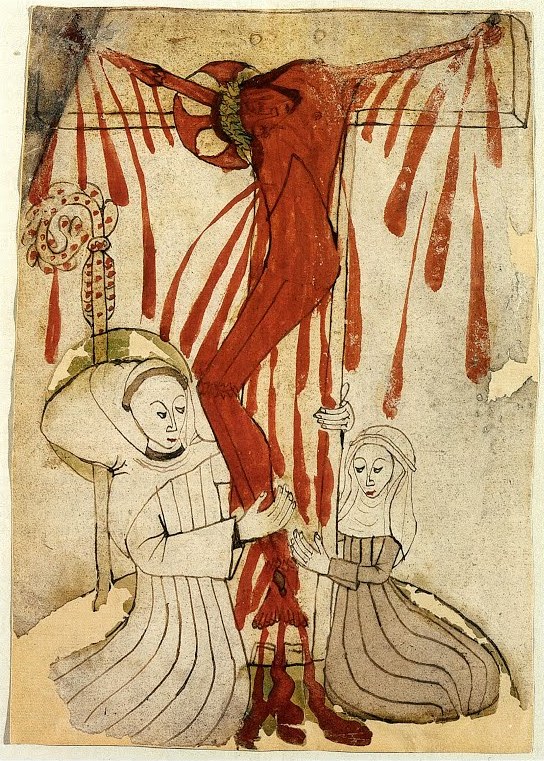
Vision of Saint Bernard (Blood Crucifix), by a nun from the Lower Rhine, 14th century. Ink and colored washes on paper, 25.5 × 18 cm. Museum Schnütgen, Cologne.
Jesu, no more! It is full tide;
From thy hands and from thy feet,
From thy head, and from thy side,
All the purple rivers meet.

What need thy fair head bear a part
In showers, as if thine eyes had none?
What need they help to drown thy heart,
That strives in torrents of its own?

Water’d by the showers they bring,
The thorns that thy blest brow encloses
(A cruel and a costly spring)
Conceive proud hopes of proving roses.

Thy restless feet now cannot go
For us and our eternal good,
As they were ever wont. What though?
They swim, alas! in their own flood.

Thy hand to give thou canst not lift,
Yet will thy hand still giving be.
It gives, but O, itself’s the gift,
It gives though bound, though bound ’tis free.

But, O thy side, thy deep-digg’d side,
That hath a double Nilus going:
Nor ever was the Pharian tide
Half so fruitful, half so flowing.

No hair so small, but pays his river
To this Red Sea of thy blood;
Their little channels can deliver
Something to the general flood.

But while I speak, whither are run
All the rivers named before?
I counted wrong: there is but one;
But O that one is one all o’er.

Rain-swol’n rivers may rise proud,
Bent all to drown and overflow;
But when indeed all’s overflow’d,
They themselves are drowned too.

This thy blood’s deluge (a dire chance,
Dear Lord, to thee) to us is found
A deluge of deliverance,
A deluge lest we should be drown’d.

Ne’er wast thou in a sense so sadly true,
The well of living waters, Lord, till now.
This poem was published in the second edition of Steps to the Temple: Sacred Poems, with Other Delights of the Muses (London, 1648) under the title “On the Bleeding Body of Our Crucified Lord”; an earlier version appeared in the book’s first edition in 1646 under the title “On the Bleeding Wounds of Our Crucified Lord.” I use the title by which it is most commonly known, “Upon the Bleeding Crucifix,” first assigned to it in Crashaw’s posthumously published collection Carmen Deo Nostro (Paris, 1652). I’ve modernized the spellings.
Richard Crashaw (1612–1649) was one of the major Metaphysical poets of seventeenth-century England, a movement marked by the use of elaborate figurative language, original conceits, paradoxes, and philosophical exploration. He was also a priest. Ordained in the Church of England in 1638, he was installed as curate of the Church of St Mary the Less in Cambridge, embracing the high-church reforms of Archbishop William Laud, for which he was persecuted. In 1643, during the English Civil War, Oliver Cromwell and his Puritan posse forced Crashaw into exile in France, where he converted to Roman Catholicism. Waiting for a papal retainer, he struggled with poverty and ill health. Pope Innocent X finally granted Crashaw a post at a seminary in Rome in 1647, and two years later he was given a cathedral benefice in Loreto, where he died of a fever at age thirty-six. He published two collections of poetry during his lifetime.
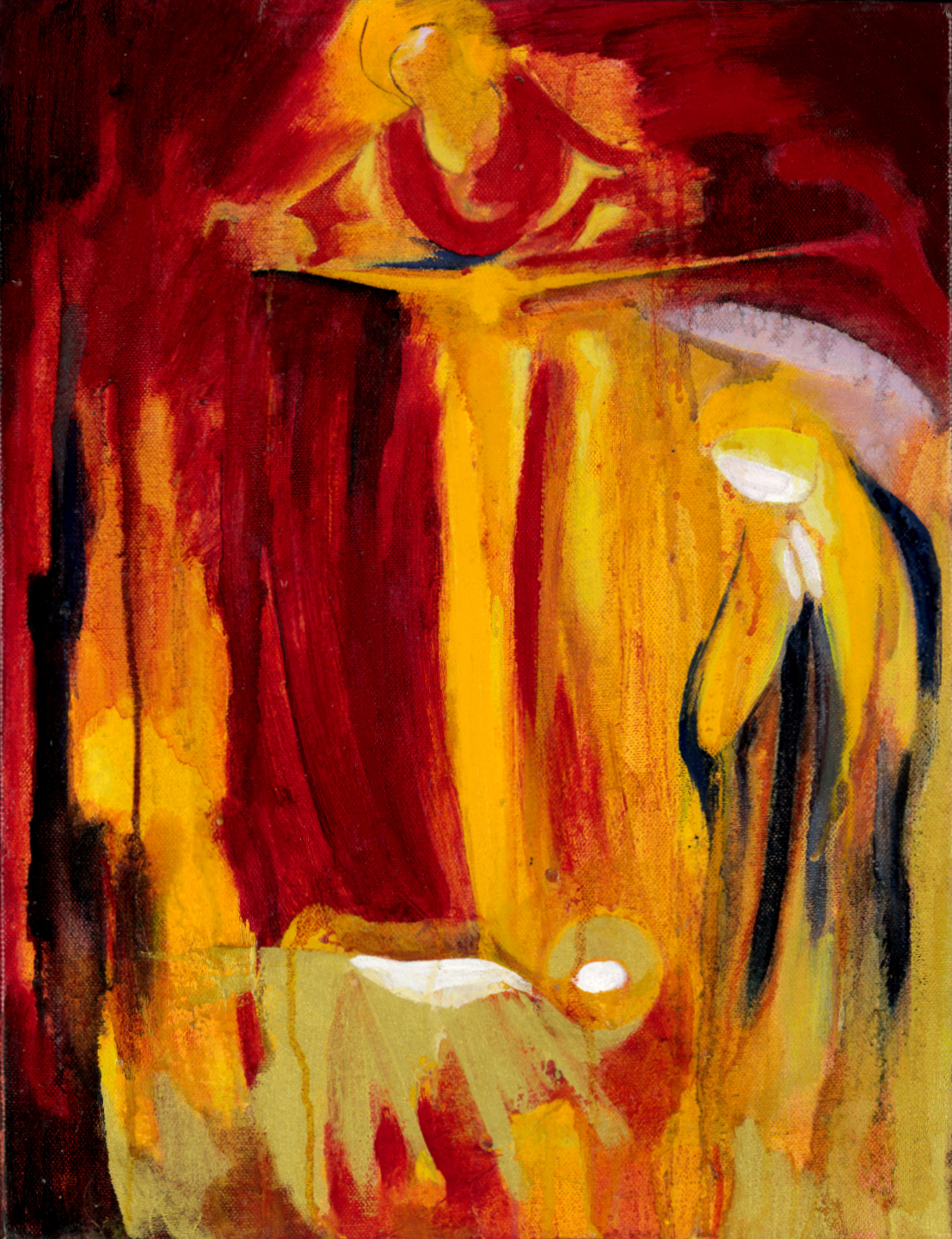
Judith Tutin (Irish, 1979–), Nativity, 2011. Oil on canvas, 60 × 40 cm. Private collection of Fr. Jim Doyle, Wexford, Ireland. Photo courtesy of the artist.
In this semiabstract Nativity painting by Judith Tutin, Mary and Joseph adore the newborn Christ child as God the Father looks down from above, holding in his arms a portent: the traces of a cross. One might also see, overlapping the intimation of a crossbar, the outstretched wings of the Holy Spirit as dove, hovering over the earthly scene below.
This central triad of Father, (crucified) Son, and Spirit evokes the Gnadenstuhl, or “Throne of Mercy,” an iconography of the Trinity that emerged in twelfth-century Europe. Tutin innovates on this type by showing, at the base of the cross, the Son in his infancy, thus drawing together the doctrines of the incarnation and the atonement.
Applied in broad, loose brushstrokes, the deep crimsons and golds further underscore the themes of blood and glory.
LISTEN: “A Stable Lamp Is Lighted” | Words by Richard Wilbur, 1958 | Music by Jennifer Wyatt, 2002 | Performed by Ardyth & Jennifer on WinterFire, 2002
A stable-lamp is lighted Whose glow shall wake the sky; The stars shall bend their voices, And every stone shall cry. And every stone shall cry, And straw like gold shall shine; A barn shall harbor heaven, A stall become a shrine.
This child through David’s city Shall ride in triumph by; The palm shall strew its branches, And every stone shall cry. And every stone shall cry, Though heavy, dull, and dumb, And lie within the roadway To pave his kingdom come.
Yet he shall be forsaken, And yielded up to die; The sky shall groan and darken, And every stone shall cry. And every stone shall cry For stony hearts of men: God’s blood upon the spear-head, God’s love refused again.
But now, as at the ending, The low is lifted high; The stars shall bend their voices, And every stone shall cry. And every stone shall cry, In praises of the Child By whose descent among us The worlds are reconciled.
Richard Wilbur (1921–2017) [previously] was a major American poet, serving as the nation’s second poet laureate and winning two Pulitzer Prizes and a National Medal of Arts. He was a champion of formalist poetry, working within the constraints of meter and rhyme.
He wrote this text to be sung at a December 7, 1958, candlelight service in the Memorial Chapel of Wesleyan University in Middletown, Connecticut, where he was a professor in the English Department. It premiered with a choral setting by Richard Winslow, director of the university’s choral society. Wilbur also sent out the text in his family Christmas cards that year.
A few years later, it was published in his collection Advice to a Prophet (1961) as “A Christmas Hymn,” with Luke 19:39–40 as an epigraph: “And some of the Pharisees from among the multitude said unto him, Master, rebuke thy disciples. And he answered and said unto them, I tell you that, if these should hold their peace, the stones would immediately cry out.” This passage takes place upon Jesus’s entry into Jerusalem the week of his death. People were lauding him as a king who came in the name of the Lord, which the Pharisees considered blasphemous. When they demand that Jesus repudiate such ridiculous claims, he instead validates them, replying that even the inanimate stones know his kingship and would shout, “Hosanna!” if human voices failed to.
The hymn stretches from Christmas to Palm Sunday to Good Friday, then circles back to Christmas, covering the span of Christ’s life.
“Not many other major poets in the past seventy years have written Christmas hymns, classic, straightforward Nativity celebrations with no irony to them, and which work beautifully in a traditional church service,” notes Bruce Michelson in Wilbur’s Poetry: Music in a Scattering Time. Wilbur is an example of a modern poet who was very accomplished at his craft and respected by the establishment as well as being a person of Christian faith.
“A Stable Lamp Is Lighted” appears in a few dozen hymnals. The standard tune for it is ANDÚJAR by David Hurd from 1983, but I prefer the one by Ardyth & Jennifer, Celtic harp and vocal duo Ardyth Robinson and Jennifer Wyatt, based in Shad Bay, Nova Scotia.
This post is part of a daily Christmas series that goes through January 6. View all the posts here, and the accompanying Spotify playlist here.
Solomia Kazanivska (Соломія Казанівська) (Ukrainian, 1996–), Mother of God, 2019. Acrylic and soil on wood, 60 × 40 cm.
I.
Here mothers move more than others
into Mary’s mourning, each chorus
a soul full of crosses, weighted
with her child dying
continuously in the contemplation
of our contrition.

II.
That once-upon-a-time angel’s voice
stretching anew her middle-aged womb,
she who once sang Magnify, O Magnify,
when all she screams for now
is mercy in her urgent rebirth
of sorrow.

III.
When he stumbles,
she cannot fix his fall,
cannot cradle the boyhood
scrapes and bruises bleeding
into crowd-sanctioned murder.
No cock crows; she hears his groans
as if the world’s bones
are splintering within her.

IV.
Besides the tree, he carries
the tears of the one who carried him
beneath her Eve ribs, lifted him
into a world he breathed as good,
gone now into this God-crucified-
as-her-son catastrophe
for salvation’s sake.

V.
Simon of Cyrene stands close.
Understanding too well the two sorrows—
mother and son helpless to comfort the other—
he heaves up and shoulders
the burdens of both,
his back the black tablet
of Moses’ commandments fulfilled
to the jot and tittle.

VI.
Veronica—eyes swollen
for the Madonna and Child
wrenched from their rightful honor—
lifts her veil to cool the Savior’s pain,
alleviate, however slightly, a mother’s anguish.

VII.
Thorns gouge the brow she stroked.
The sweat-caked man that came out of her
stumbles again. Already,
the sharp nails gnaw her own palms.

VIII.
Oh, daughters of Jerusalem,
your tears sweep the streets,
wet the weary soles of Mary.
Weep for your own children
forever dashing away from Yahweh.

IX.
Wretched stones that tip her sinless child,
dirt that drives down the innocent son.
His own earth hurts him more each tumble.
Three times he trips,
crashes to the dust we are,
mortal muscles turning their backs
on Man and his Mother.

X.
Threads twisted by her own fingers,
tugged carefully through cloth:
this is the tunic they rip from him,
fabric tattooed with red;
she remembers his baby body
blood-splattered and matted.

XI.
Her soul stabbed by the tree
that slays her son. Her heart nailed.
She swears his life spurts
from her barely breathing body.

XII.
Death is indigo and indelible,
the Roman sky collapsed and re-scribbled
on the shreds of her memories.
She cannot bear to look upon his face
when breath forgets its maker.

XIII.
Ten thousand stillborns better
than this: his torso in her arms,
icon of the inconsolable,
the flesh Pietà with its nails of pain,
pounding, pounding.

XIV.
The hewn tomb seals her grief.
She remembers his first words,
his final prayer. All else rots
within her. They swaddle him,
implant him quickly behind stone.
This poem is from Weeknights at the Cathedral (Cincinnati: WordTech Communications, 2006) and is anthologized in slightly revised form, as here, in Poems of Devotion: An Anthology of Recent Poets, ed. Luke Hankins (Eugene, OR: Wipf & Stock, 2012).Used by permission of the author.
Note: The Stations of the Cross are a form of Catholic devotion organized around the events of Christ’s passion, from his condemnation by Pilate to his crucifixion and burial.
Marjorie Maddox (born 1959) is the author of fourteen poetry collections, including Begin with a Question (Paraclete, 2022); Transplant, Transport, Transubstantiation from the Poiema Poetry Series (Wipf & Stock, 2018); and True, False, None of the Above (Wipf & Stock, 2016). She has also published a short story collection, four children’s and YA books, and 650-plus stories, essays, and poems in journals and anthologies. Living in Central Pennsylvania, she is a professor of English and creative writing at Lock Haven University and is the assistant editor of Presence: A Journal of Catholic Poetry.
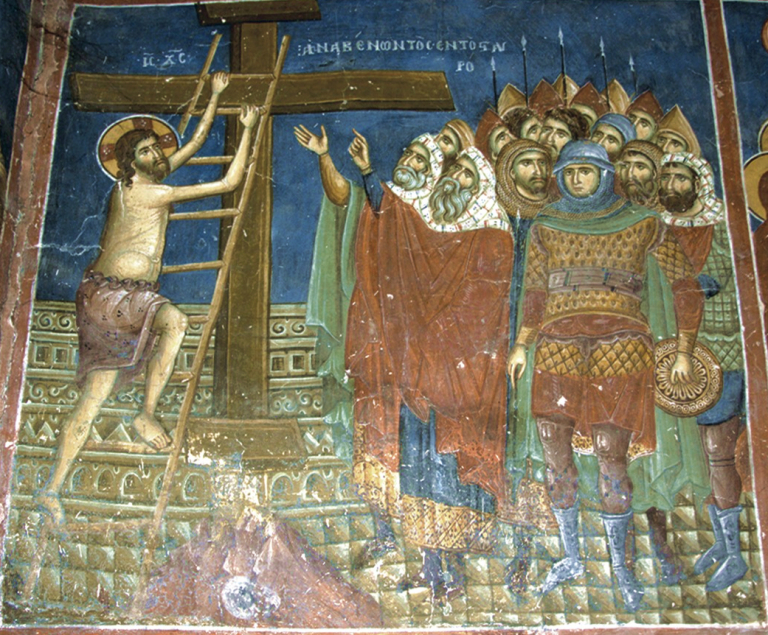
In the thirteenth century, a new subject emerged in painted Passion cycles in both East and West: Christ resolutely climbing a ladder to the cross. He ascends willingly, even enthusiastically, demonstrating a heroic acceptance of death. In taking those steps up onto the instrument of his martyrdom, he exercises agency. As he tells a gathered crowd in John 10:18, “No one takes [my life] from me, but I lay it down of my own accord. I have power to lay it down . . .” Out of love for the world, he gives himself as a sacrifice, bringing about reconciliation between God and humanity.
The iconography of the Ascent of the Cross (alternatively referred to as “Christ Mounts the Cross”) is of Byzantine origin and can be found in Macedonian and Serbian church frescoes.
Michael Astrapas and Eutychios, Ascent of the Cross (at right), 1295. Fresco, Church of the Holy Mother of God Peribleptos (aka Church of Saint Clement), Ohrid, North Macedonia. Photo: Vera Zavaritskaya.Ascent of the Cross, 1298. Fresco, Church of St. Nicholas, Prilep, North Macedonia. Photo: P. S. Pavlinov.Ascent of the Cross, 1317. Fresco, Church of St. George, Staro Nagoričane, North Macedonia.Ascent of the Cross, 1343–45. Fresco, Church of St. George, Pološko, North Macedonia.
In a fresco from the Church of St. George at Staro Nagoričane, a small Roman military detachment has just led Jesus to the site of his execution. A young enslaved Roman fixes the cross into the ground, instructed by an older slave who holds a basket of nails, while a third stands on the suppedaneum and waits to nail Jesus’s hands into place. Caiaphas, the Jewish chief priest, points to the cross, indicating to Christ to ascend it. Christ grabs hold of the rungs and climbs, while at the top left, from behind a rock, the Virgin Mary and John look on in grief.
Byzantine painting greatly influenced the Italian painters of the thirteenth and early fourteenth centuries. Many of them adopted Byzantine models, of which the Ascent of the Cross is one example.
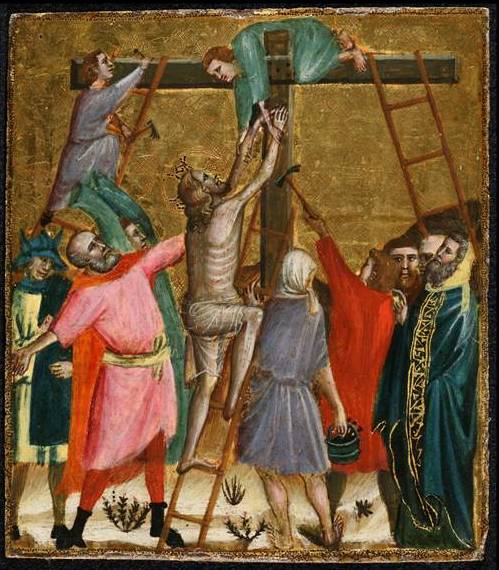
Pacino di Bonaguida (Italian, Florentine, 1280–1340), Ascent of the Cross, from the picture-book Scenes from the Life of Christ and the Life of the Blessed Gerard of Villamagna, ca. 1320. Tempera and gold leaf on parchment, 9 5/8 × 6 7/8 in. (24.5 × 17.6 cm). Pierpont Morgan Library, New York, M. 643, fol. 12r.
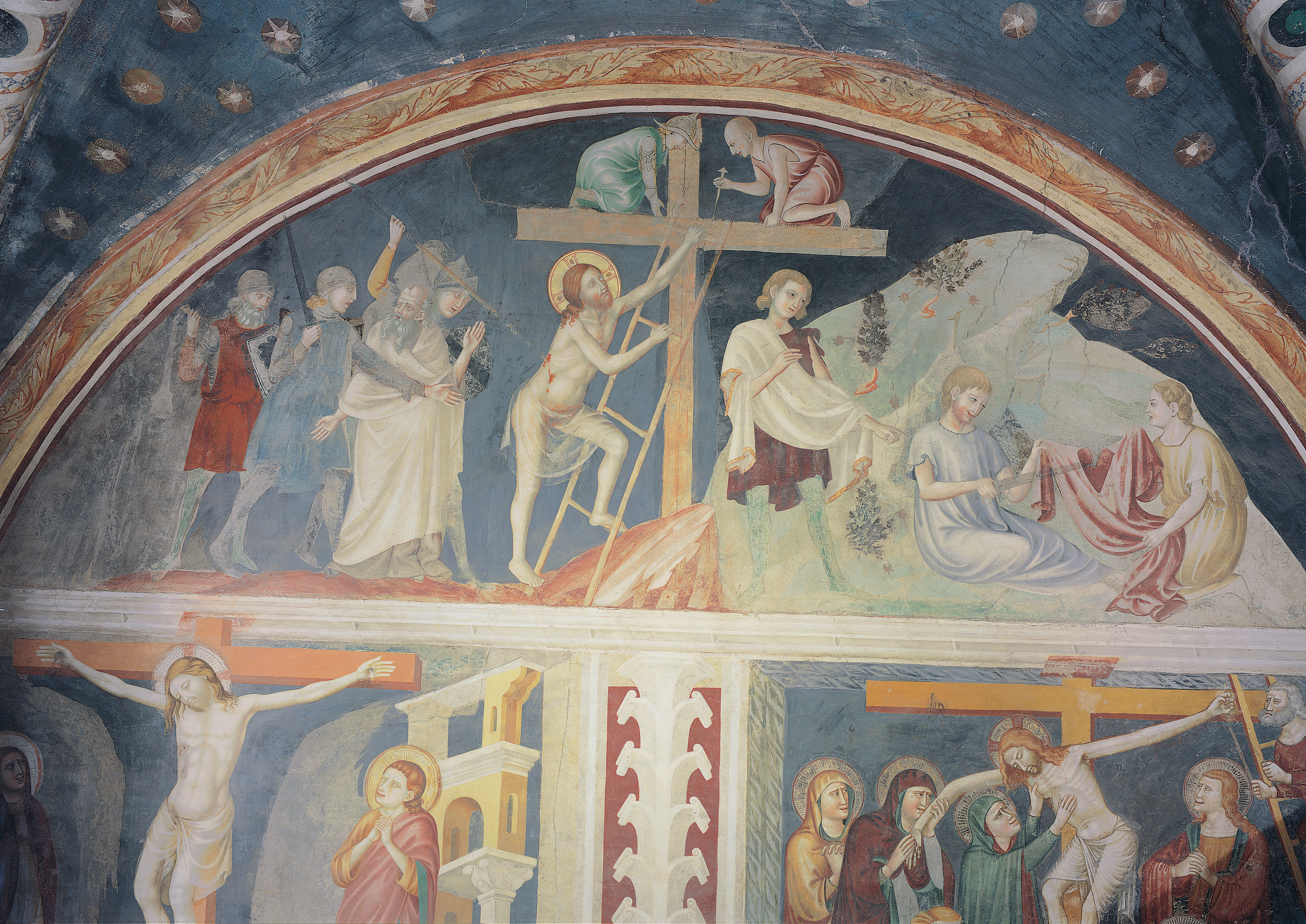
In a Ferrarese church lunette fresco in the Benedictine nuns’ monastic complex of Sant’Antonio in Polesine, two men kneel on the cross’s patibulum as Christ mounts the ladder propped against it. He wears a translucent loincloth, emphasizing his nakedness and humiliation. Knowing Christ’s innocence, an elderly Jewish man tries to intervene to prevent the brutality, but he is restrained by soldiers. On the right, a group of Romans argues over who will get to keep Christ’s cloak, a souvenir from this regional celebrity.
Christ Mounts the Cross on a Ladder, 14th century. Fresco, Monastery of Sant’Antonio in Polesine, Ferrara, Italy.
In some versions of the Ascent of the Cross, Jesus is pushed or pulled into position, or at least aided, by soldiers, with whom he readily cooperates. Such is the case in the earliest identified instance of the subject, from an eleventh-century Armenian Gospel-book. (Armenians were the largest non-Greek ethnicity in the Byzantine Empire.)
Ascent of the Cross, from the Vehapar Gospels, Armenia, early 11th century. Matenadaran, Yerevan, MS 10780, fol. 125v.
Art historian Thomas F. Mathews says that in the Armenian tradition, Golgotha is identified with the place where the Jewish patriarch Jacob had a vision of angels trafficking a ladder connecting heaven and earth. “How awesome is this place! This is none other than the house of God, and this is the gate of heaven,” Jacob exclaimed, dubbing it Bethel, Hebrew for “house of God” (Gen. 28:10–22). In Armenian manuscript illuminations, Mathews argues, the subject of Christ ascending the cross, very often followed by a depiction of Christ’s dead body descending from the cross, was thus interpreted as an extension of Jacob’s vision, as by climbing up and down the ladder of the cross, Christ opened heaven’s gate.[1]
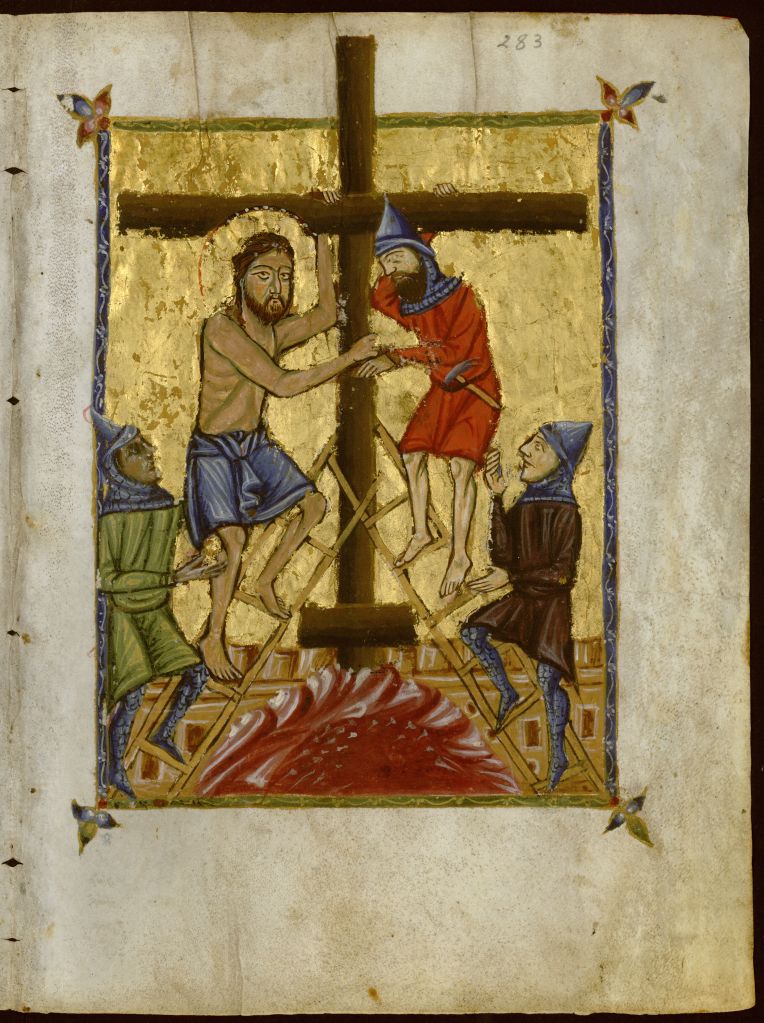
Another Armenian Gospel-book miniature of the subject, from the early fourteenth century, is particularly striking in how it shows Christ turning, mid-climb, toward the viewer, his direct gaze engaging our pity and love.
T‘oros Taronec‘i, Ascent of the Cross, from the Gladzor Gospels, Armenia, 1300–1307. UCLA Library Special Collections, Los Angeles, Armenian MS 1, p. 283.
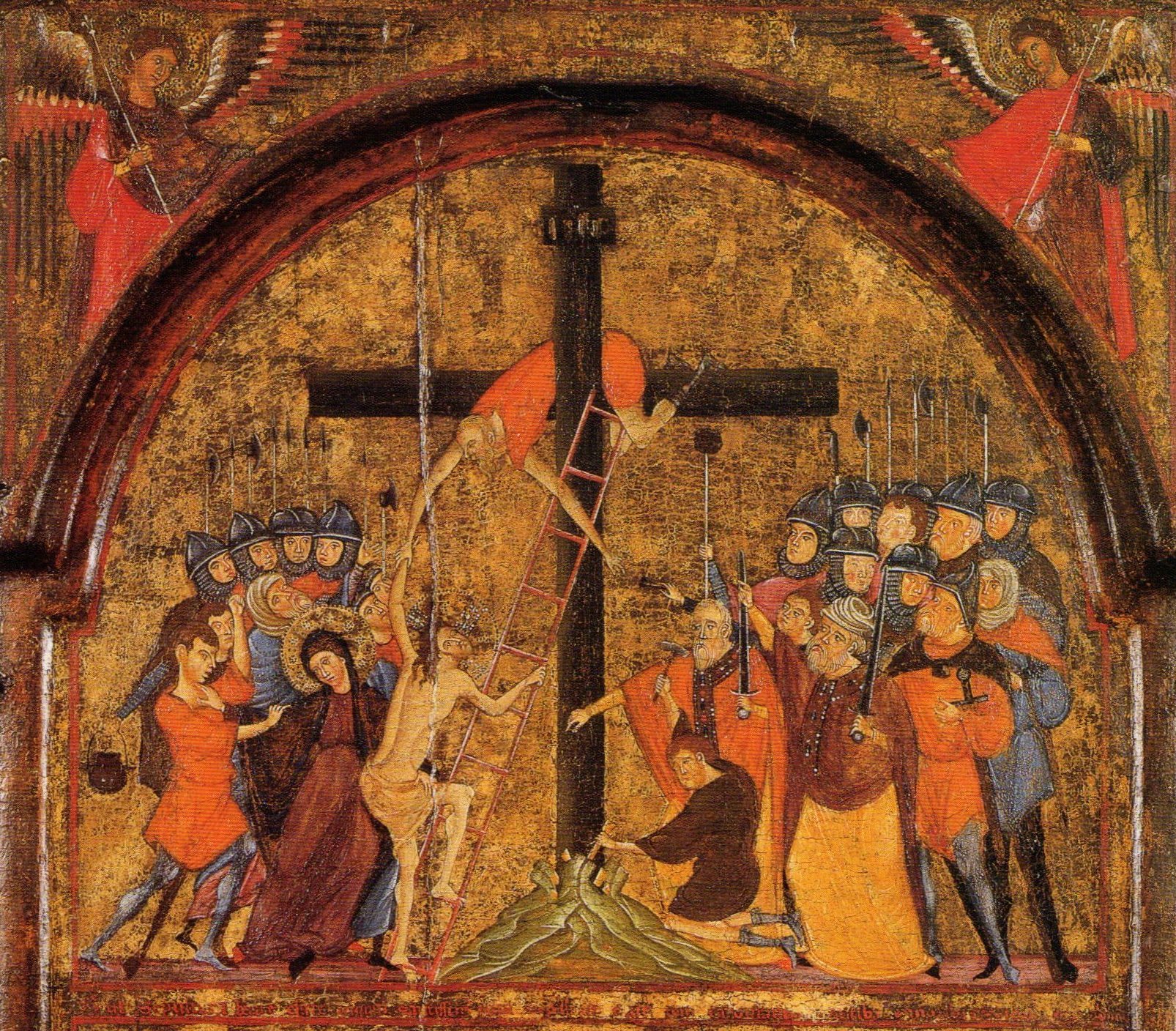
In some versions from Italy, Mary grabs her son around the waist, trying to prevent him from experiencing further torture. Take, for example, the panel painting by Guido da Siena that was originally part of the Madonna del Voto altarpiece in Siena’s cathedral. Her mama-bear instinct kicking in, Mary pushes away one of her son’s tormentors with one arm and with the other protectively encircles her son, unable to let him go.
Guido da Siena (Italian, Sienese, 1230–1290), Ascent of the Cross, ca. 1265–74. Tempera on poplar wood, 34.5 × 46 cm. Museum Catharijneconvent, Utrecht, Netherlands.
Some Christians are wary of suggesting that the Mother of God would seek to deter God’s plan, but let’s remember that, devout as she was, Mary was not superhuman. The death sentence passed against her son and the violence that followed naturally unleashed a flood of emotion in her and an impulse to resist. What mother wouldn’t do everything in her power to save her child from harm? No matter how much she believed in her son’s mission, what mother wouldn’t reach out for one last embrace, if only to delay the inevitable?
That said, Mary’s gesture here may be one of attempting not to impede his ascent but to cover his nakedness. In the widely influential Meditations on the Life of Christ, a text that originated in early fourteenth-century Tuscany and circulated in Latin and all the major European vernaculars,[2] Mary responds in agony to Jesus’s being shamefully stripped for all to see, and she intervenes with a small mercy:
Oh what anguish this was to his mother, to see her most sweet son naked like this, standing like a lamb among these wicked wolves!
Then the mother, full of sorrow, went up close to her most sweet son and took the veil from her head and wrapped it around Lord Jesus Christ with bitter sorrow. And I do not know how she did not fall dead to the earth.[3]
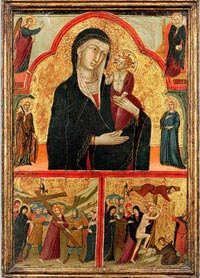
Closely related to the Guido panel is one by an anonymous artist from Umbria or Tuscany that was the central panel of a portable altarpiece with two wings, possibly painted for the Basilica of Santa Chiara in Assisi. It depicts the Ascent of the Cross—again, with the Virgin Mary interceding—above a scene of the Funeral of Saint Clare (d. 1253), a close follower of Saint Francis and the founder of the Poor Clares religious order.
Christ Mounting the Cross and the Funeral of Saint Clare (detail), Umbria or Tuscany, 1290s. Tempera and silver leaf on panel, overall 31 1/4 × 20 3/8 in. (79.4 × 51.8 cm). Davis Museum, Wellesley College, Wellesley, Massachusetts.
For the iconography of the Ascent of the Cross, art historian Anne Derbes identifies a possible literary source as Pseudo-Bede’s De meditatione passionis Christi: “Then, when the cross had been prepared, they [the people] cry: ‘Ascend, Jesus, ascend.’ O how freely He ascends, with what great love for us He bore everything, with what patience, what gentleness!”[4]
Terser references to this episode, Derbes points out, appear in Pseudo-Anselm’s Dialogus, which mentions that Christ “ascends the wood of the cross,”[5] and in Ambrose’s commentary on Luke, in which Ambrose remarks that “it was not his cross that Christ ascended, but ours,” and that Christ ascended the cross “as a victor ascends a triumphal chariot.”[6]
Derbes also notes the possible influence of the adoratio crucis (adoration of the cross) ritual, known in Jerusalem from the fourth century and in the West from the seventh or eighth, which states, “O Lord Jesus Christ, I adore you climbing onto the cross.”[7]
[In the tiled gallery below, click on the image to view the caption and source URL.]
The long Latin version of the Meditations, which, from the mid-fourteenth century, postdates most of the paintings shown here, also mentions the Ascent of the Cross, perhaps itself influenced by trecento visual culture:
Now diligently behold the process of Crucifixion. Two ladders are accustomed to be placed, one on the one side, the other on the other; upon these, wicked men go up, with nails and hammers; while another ladder is placed in front, reaching to that part of the Cross where the feet are to be nailed. Contemplate now each event Our Lord may have been compelled by means of this small ladder to ascend the Cross, for He does whatsoever they bid Him, humbly, without resistance or complaint. Having reached the top of the ladder, He turns Himself round, it may be, opens His arms, and extends His Hands—so royal and beautiful—and yields Himself up to His crucifiers.
. . . Some there are who think that this was not the method of Crucifixion, i.e. by making our Lord ascend a ladder before the nailing of His Body to the Cross; but that they fastened Him to the Cross when it was laid on the ground before it was raised.[8]
Interestingly, the writer, as he does elsewhere in the manuscript, allows for the possibility that the action may have occurred in one of two ways. Actually, probably neither of the two options he describes for how Christ was nailed to the cross is accurate. Ancient historians think it most likely that Jesus was nailed to the horizontal crossbeam while it lay on the ground, which was then lifted up, his body attached, and dropped into a notch in the permanently fixed vertical post.[9]
However, the Ascent of the Cross isn’t so much meant to be a literal portrayal of what happened historically as it is an expression of the theological truth that Christ went to his death voluntarily. He was not forced onto the cross against his will. The Ascent suggests divine initiative and purpose. Even in those images where Christ is being prodded by his executioners, he does not resist. Instead, he bounds onward and upward to his chosen end.
In medieval English literature, the freedom and strength of Christ in his death is often emphasized. In the Old English poem “The Dream of the Rood” from the eighth century, the cross says, “Then I saw mankind’s Lord / hasten with great zeal, as though he wanted to climb on me.”[10] In Middle English religious lyrics, which come down to us mainly through preaching manuscripts, Christ mounts the cross much like a knight does his steed, prepared for battle, but of a spiritual kind.[11]
One anomalous example of the Ascent of the Cross that I found comes from Reformation Germany. A copperplate engraving by Augustin Hirschvogel[12] shows a muscly Christ mounting the cross with three figures slung over his shoulder: a clawed, beaked, horned creature representing the devil; a skeleton representing death; and what looks like a bloated corpse, probably representing sin. The tone is triumphant, as Christ’s death defeats this formidable trio. They are nailed to the cross with him, but unlike him, never to rise.
Augustin Hirschvogel (German, 1503–1553), Christ Ascending the Cross with Sin, Death, and the Devil, 1547. Etching, 11.8 × 14.8 cm (image) / 15.1 × 14.8 cm (sheet). National Gallery of Art, Washington, DC.
Christ Ascending the Cross with Sin, Death, and the Devil is one of a group of over one hundred etchings of biblical scenes commissioned by the Hungarian aristocrat and politician Peter Perényi (1502–1548) for his Concordance of the Old and New Testaments, first published in Vienna by the printer Aegidius Adler in 1550. Perényi selected the scenes and wrote the letterpress captions beneath them. This one reads,
Noch mer Christus am creutz uberwand Desshalben von Gott war selb gesandt Und den teueffel Hell alles band Drumb er unser erlöser ist genannt. Luc. 23e. Corinth.5f.
On the cross, it says, Christ overcame hell and the devil, and that’s why we call him “Redeemer.” The biblical citations are to the Crucifixion account in Luke 23 and to 2 Corinthians 5:14–21, which begins, “For the love of Christ urges us on, because we are convinced that one has died for all; therefore all have died. And he died for all, so that those who live might live no longer for themselves but for the one who for their sake died and was raised” (NRSV).
A follower of Martin Luther and a friend of Philip Melanchthon, Perényi was an influential protector of Protestant preachers in the kingdom of Hungary. But his shifting political allegiances got him into trouble when in 1542 he was imprisoned by Ferdinand I, a Habsburg prince, for disloyalty. It was from a prison in Vienna that he worked on his concordance project.
All these artworks of Christ ascending the cross show his bravery, dignity, and poise in the face of persecution, his heroic self-giving that wins the world’s salvation. Despite his mother’s tearful entreaties, and despite the pain he knows is coming, he remains steadfast, his eyes fixed on the prize that will be attained on Easter morning.
As an independent scholar, I rely on your donations to keep publishing articles like this, as they require a large time investment, and in this case, a photo licensing fee (for the Ferrara fresco). If you appreciate having access to researched, illustrated articles on theological art, would you consider making a donation to support my work, either monetarily (via PayPal or the secure form below) or by buying me a book? Thank you!
1. Thomas F. Mathews and Avedis K. Sanjian, Armenian Gospel Iconography: The Tradition of the Glajor Gospel (Washington, DC: Dumbarton Oaks Research Library and Collection, 1990), 131–32.
2. This text is traditionally attributed to a Franciscan friar known as Pseudo-Bonaventure and believed to have originated in Latin (title: Meditationes de vitae Christi), but Sarah McNamer has persuasively argued that its originator was a woman, a Poor Clare from Pisa, who wrote it in Italian for her fellow nuns sometime between 1300 and 1325. Within the next decade and a half, McNamara proposes, a Franciscan friar expanded and altered it to make it more didactic, creating first another Italian version (the “testo minore”) and then translating this into Latin to “authorize” it and make it more disseminatable. The long Latin text has become canonical but is, McNamara argues, inferior to the base text, compromising its narrative pacing and emotional impact. See Sarah NcNamer, Meditations on the Life of Christ: The Short Italian Text (Notre Dame, IN: University of Notre Dame Press, 2018).
3. Translated by Sarah McNamer from Oxford, Bodeleian Library MS Canonici Italian 174 (the “testo breve”), in Meditations, 141.
4. “Deinde parata cruce dicunt ei, ascende, Jesu, ascende. O quam libenter ascendit, o quanto amore ista omnia pro nobis sustinuit, o quanta patientia, o quanta mansuetudo!”(PL 94:565). Translated by Anne Derbes in Picturing the Passion in Late Medieval Italy: Narrative Painting, Franciscan Ideologies, and the Levant (Cambridge, UK: Cambridge University Press, 1996), 154.
6. “Non enim suam, sed nostram crucem christus ascendit” (PL 15:1923); “currum suum triumphator ascendit” (PL 15:1924). Qtd. Derbes, 242n56.
7. “Domine Ihesu Christi, adoro te in cruce ascendentem,” qtd. Derbes, 242n56, from Karl Young, The Drama of the Medieval Church, vol. 1 (Oxford: Clarendon, 1933), 117–19.
8. S. Bonaventure, The Life of Christ, trans. and ed. Rev. W. H. Hutchings (London: Rivingtons, 1881), 267, xiii–xiv. Sarah McNamer says that while (what she argues is) the original Meditations text describes a crucifixion method known as jacente cruce—Christ nailed to the cross as it lies prone on the ground—the Italian recension and subsequent translations and versions that came soon after privilege the erecta cruce method, in which Christ ascends a ladder to an upright cross and thus is nailed from an elevated position (Meditations, 228n126).
9. Martin Hengel, Crucifixion in the Ancient World and the Folly of the Message of the Cross (Philadelphia: Fortress, 1977), 25; Robin Jensen, The Cross: History, Art, and Controversy (Cambridge, MA: Harvard University Press, 2017), 10.
10. “Geseah ic þā Frēan mancynnes / efstan elne micle, þæt hē mē wolde on gestīgan.”
11. The metaphor of Christ’s cross as a horse that he bravely mounts as if for battle occurs in MS Balliol 149 (cf. MSS Magdalen 93 and Trinity Dublin 277), Nicolas Bozon’s poem “Sa sele fu trop dure, et mout l’ad anguise,” MS Bodley 649, and MS Harley 2316. See Rosemary Woolf, Art and Doctrine: Essays on Medieval Literature (London: The Hambledon Press, 1986), 113–15.
12. Hirschvogel was trained as a stained-glass painter in the workshop of his father, but when his hometown of Nuremberg accepted Luther’s Protestant teachings, the workshop lost its church commissions. Hirschvogel thus pivoted to designing maps and fortification plans and, in his final decade, making landscape etchings as part of the Danube School. Richard Manly Adams Jr., “One Acquisition, Two Great Traditions at Pitts,” Reformation Notes no. 56 (Summer 2021): 5.
VIDEO: “Waiting with Christ: An Artful Meditation for Holy Week”: A collaboration between Duke Initiatives in Theology and the Arts in Durham, North Carolina, and City Church in Cleveland, Ohio, this half-hour video from 2021 presents a small collection of scripture readings, poems, visual art, and music for Holy Week, interspersed with reflections by theologian Jeremy Begbie. The artistic selections are a spoken word performance by Paul Turner, Malcolm Guite’s sonnet “Jesus Meets His Mother,” the Adagio movement of Schubert’s String Quintet in C Major, the painting Riven Tree by Bruce Herman, and Bifrost Arts’ “Our Song in the Night,” performed by Salina Turner, Allison Negus, and Joel Negus [previously].
+++
ARTICLE: “6 Musical ‘Passions’ Beyond Bach” by Josh Rodriguez: Composer, professor, and Deus Ex Musica cofounder Josh Rodriguez is an excellent classical music curator and guide. In this article he introduces us to six modern large-scale musical works about Jesus’s final week: The Passion of Yeshua by Richard Danielpour, La Pasión Según San Marcos by Osvaldo Golijov, The Passion of the Christ Symphony by John Debney, Johannes-Passion by Sofia Gubaidulina, Simeron by Ivan Moody, and the St. John Passion by James MacMillan. He interweaves composer biography, musical analysis, and meaning in concise ways, with nods to music history. Stylistic influences for these diverse selections range from Byzantine chant to salsa! Audio/video excerpts are provided, such as the cued-up “¿Por qué?” from Golijov’s Pasión (see below), a movement centering on the woman who anointed Jesus’s feet with perfume (Mark 14:3–9).
+++
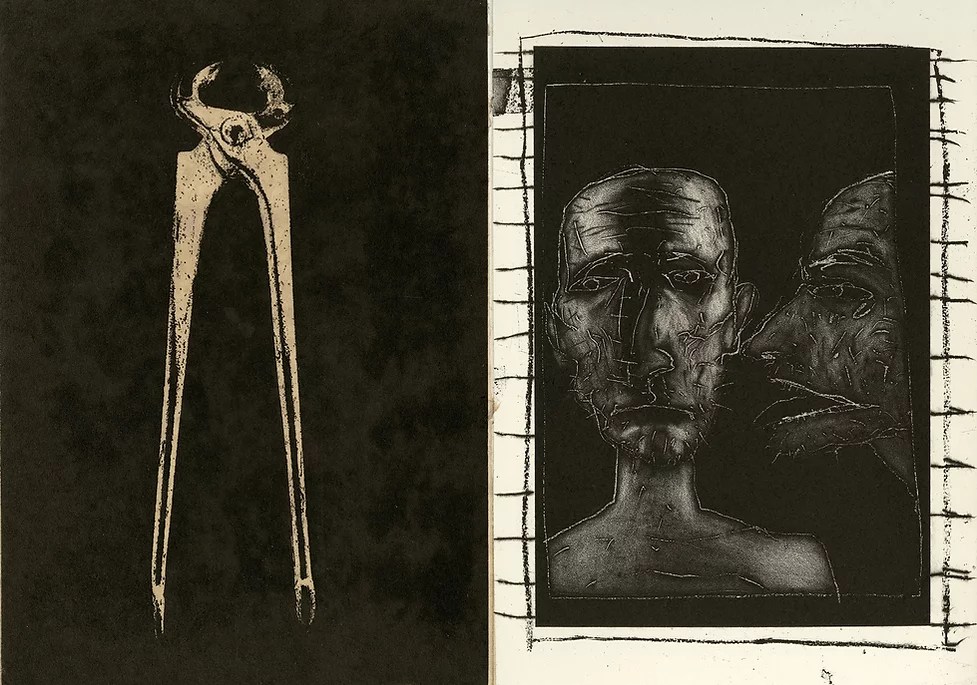
PRINT SERIES: The Passion and Its Objects (after Dürer) by Marcus Rees Roberts: “The Passion and Its Objects (after Dürer) is a series of etchings and monotypes by Marcus Rees Roberts. The images derive from fragments from Albrecht Dürer’s series of woodcuts The Small Passion (1511). Images of the Passion – and of the crucifixion in particular – are so embedded in Western consciousness that we forget that it is a depiction of betrayal, prejudice, and torture. In this version of the Passion by Dürer, one of several he made, small, everyday objects lie scattered within the images – a jug, pliers, a hammer, a coil of rope. Even five hundred years later, we recognise these objects as our own; we can identify with them. But in so doing, we enter the depicted space, and we become complicit in the cruelty. This is one reason why Dürer’s Small Passion is both so powerful and so uncomfortable.”
Marcus Rees Roberts (British, 1951–), The Passion and Its Objects (after Dürer) I, 2019. Diptych etching and aquatint with chine collé printed on Somerset Satin soft white 300gsm, each plate 29.5 × 21 cm (overall 29.5 × 42 cm). Edition of 15.
+++
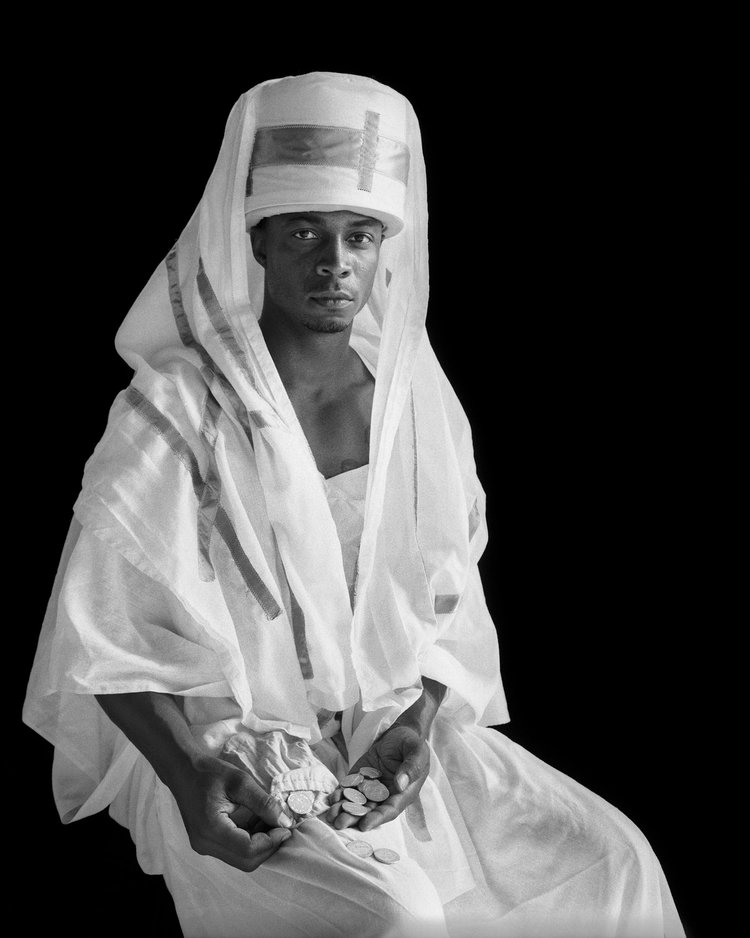
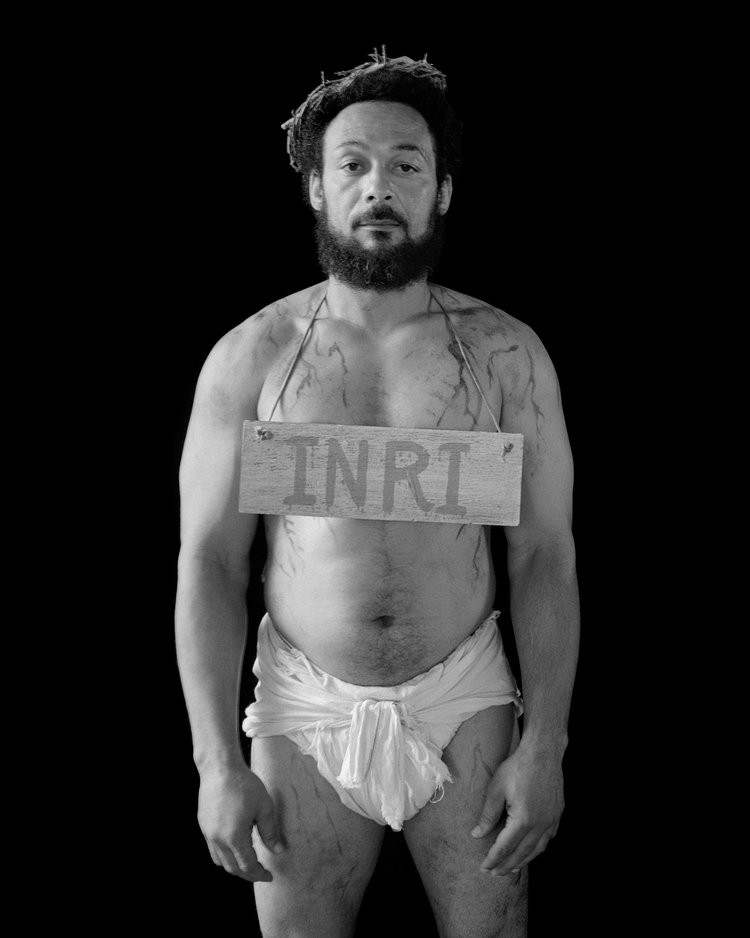
PHOTOGRAPHY SERIES: Passion Play by Deborah Luster: “There are more than 5,300 inmates at the Louisiana State Penitentiary at Angola. Nearly 4,000 of them are serving life without parole. In 2012 and 2013 the Angola Prison Drama Club staged a play unlike any other in the prison’s experience. The Life of Jesus Christ featured 70 inmates, men and women acting together for the first time—in costume, with a real camel, performing for the general public. For the untrained actors, this production held special meaning as they saw pieces of their own lives revealed in the characters they played.”
Layla “Roach” Roberts (Inquisitor), sentenced to LIFE, Angola Prison, Louisiana. Photograph by Deborah Luster, from the Passion Play series, 2013.Bobby Wallace (Jesus), Angola Prison, Louisiana. Photograph by Deborah Luster, from the Passion Play series, 2013.
+++
SONGS:
>>“May I Go with You” by January Lim: This Maundy Thursday song was written in 2020 in the voice of Jesus in Gethsemane, speaking to God the Father. In the first stanza, it seems to me that Jesus is asking to be taken up to heaven, like Elijah—just whisked away back to glory, and spared tomorrow’s cruelties and pain. But in the second stanza that same request seems to shift in meaning as Jesus expresses a desire to go with God’s plan and asks for the strength to follow through. The song was released on the EP Gathered Sighs (2021), put out by Evergreen Baptist Church of Los Angeles, where Lim serves as worship arts pastor. [HT: Global Christian Worship]
Sister Kim Ok-soon (김옥순 수녀), The Bread of Life from Heaven (하늘에서 내려온 생명의 빵), 2014
Stars sing, light-years deep in silent space.
In a bottle’s neck God’s Ghost sings
as the wine is poured.
Out on the edge of eternity, the Father
sees the Lamb slain ere the world is formed.
A soft cough splits the silence of this room
light-years below the wheeling stars.
A hollow prayer; give it breath, O Ghost,
let roar a wind like that which shook
the bones in Vision Vale.
For vision, God spills bread crumbs on the board.
His stars sing, light-years deep in silent space.
Here, emblems speak a mystery of brokenness:
the shattering of him by whom all things consist.
Keith Patman is an occasional poet whose primary vocation is Bible translation. Since 1982 he has worked for Wycliffe Bible Translators, assisting with the translation of scripture into the languages of West and Central Africa. He lived in Cameroon from 1987 to 1995, working on a Nugunu New Testament, and now serves from the US as part of an international team providing tools and training to African translators. He currently lives in Waynesboro, Virginia, with his wife, Jaci, who is a Presbyterian minister. They have two grown children and six grandchildren.

















 Art & Theology