
Advent, Day 14: Annunciation

LOOK: Ustyug Annunciation icon
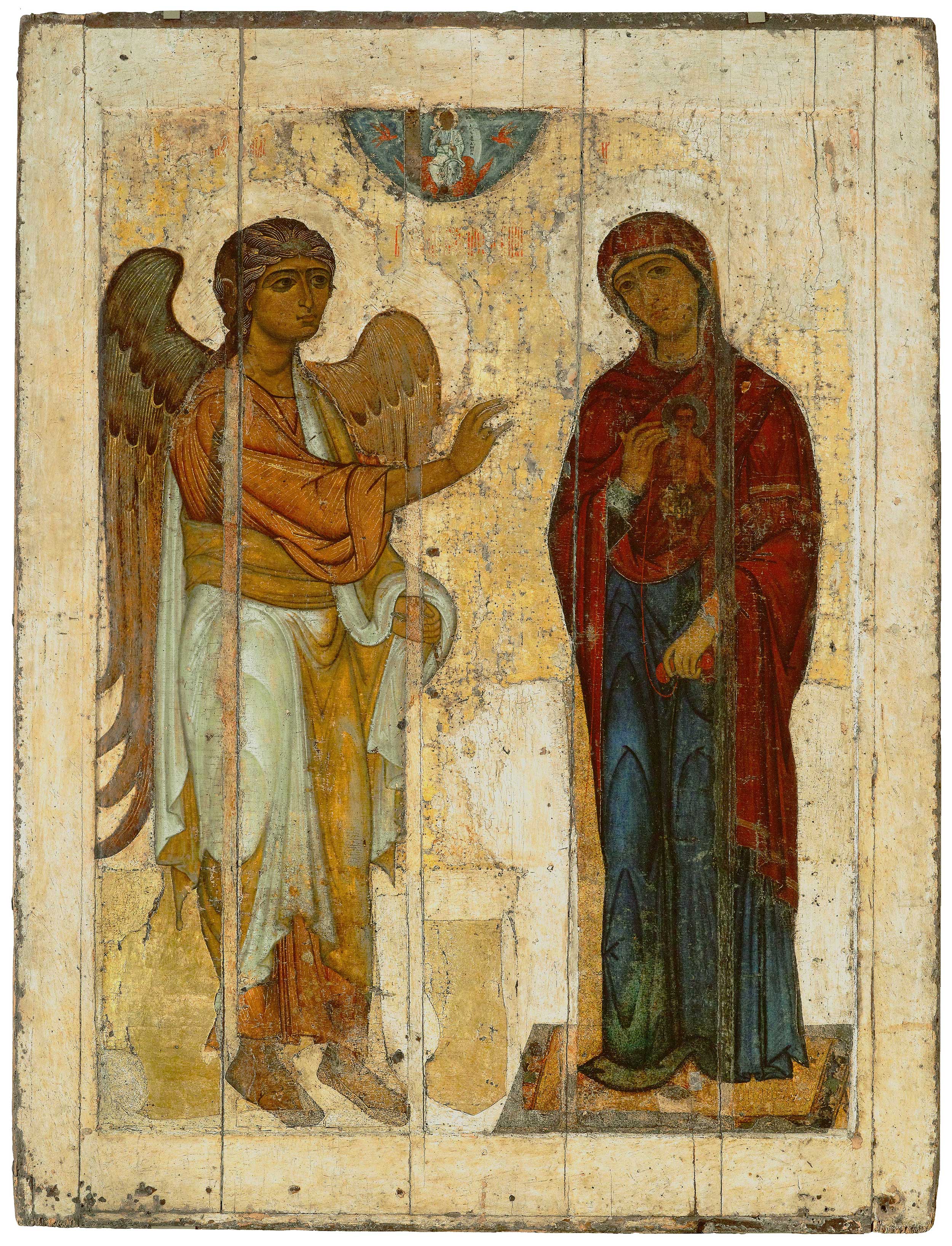
Ustyug Annunciation
Ustyug Annunciation, Novgorod, ca. 1120–30. Tempera on wood, 23.8 × 16.8 cm. State Tretyakov Gallery, Moscow.

This icon is among the oldest extant Russian icons, being one of the few to have survived the Mongol invasion of Russia in the thirteenth century. Even though it was produced in the Novgorod region, it is called “Ustyug” because of its association with that village in local histories and hagiographies.

The icon shows the angel Gabriel approaching Mary with the news that she has been chosen to bear the Son of God into the world. In Mary’s left hand she holds a skein of scarlet thread, as tradition says she was one of the women responsible for weaving the veil of the temple in Jerusalem. Following the thread upward to her right hand, we see a remarkable detail in her midsection: a shadowy figure of Christ Emmanuel, fully formed within her and gesturing blessing. The iconographer has compressed together the moments of announcement and conception, suggesting that Mary’s miraculous pregnancy has already been effected.
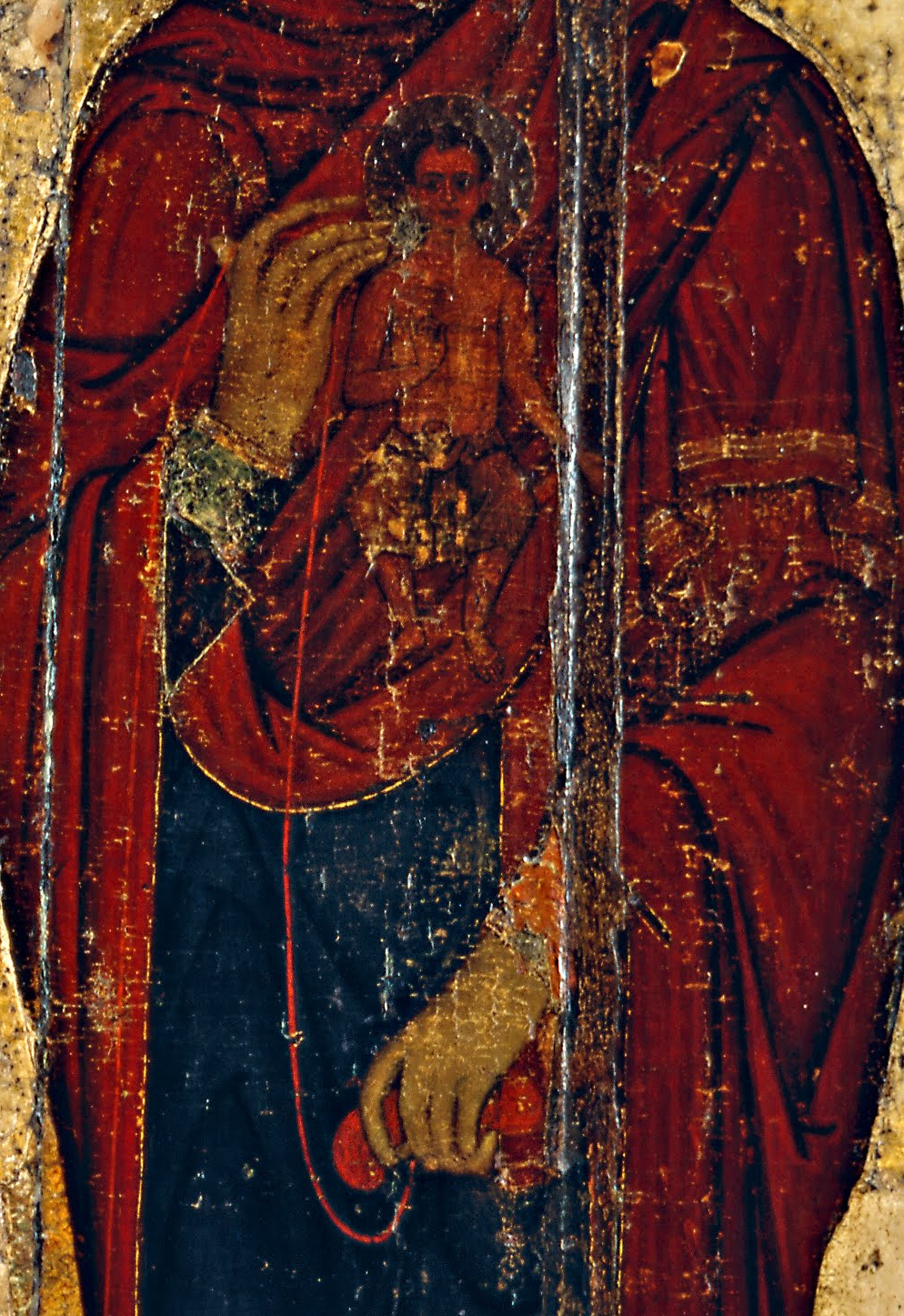
Ustyug Annunciation

At the top center, in a blue semicircle representing the heavens, sits the Ancient of Days, a symbolic depiction of God the Father. Fiery red cherubim and seraphim surround his throne. He holds a scroll in his right hand, while his left is raised in benediction. Earlier descriptions of the icon mention a ray of light emanating from God’s throne to Mary, traveled by the Holy Spirit in the form of a dove, but time has worn away this detail.

LISTEN: “Annunciation” piano quintet by Philip Glass, based on the Greek Orthodox communion hymn for the Feast of the Annunciation, 2018

>> Performed by Paul Barnes, Laurie Hamilton, Maria Newman, Scott Hosfeld, and David Geber at Symphony Space, New York, 2019:

>> Performed by Paul Barnes and Brooklyn Rider for Philip Glass: Annunciation, 2019:

Sharing a love of ancient chant traditions, pianist and Greek Orthodox chanter Paul Barnes [previously] and composer Philip Glass have engaged in collaborative projects ever since they first met on an airplane in March 1995. Most recently, Barnes facilitated the commission of a piano quintet by Glass—his first—based on the melody of the Greek Orthodox communion hymn for the Feast of the Annunciation, whose text is Psalm 132:13: “The Lord has chosen Zion, he has desired her for his dwelling place.” (Hear Barnes chant the hymn here.)

A piano quintet is a work of chamber music written for piano and four other instruments, usually a string quartet (two violins, one viola, one cello).

Glass’s “Annunciation” piano quintet premiered April 17, 2018, at the Lied Center for Performing Arts in Lincoln, Nebraska, with the Chiara String Quartet and Barnes on piano.

In the program notes for the piece, Barnes writes:

The work is in two parts. Part One opens with a meditative chromatic chord progression which eventually leads to the first entrance of the chant first stated in the piano. Glass develops this beautiful theme as it is shared by the various members of the quintet, culminating in an opulent neo-romantic closing section recapping the introductory chromatic chord progression. A partial restatement of the theme ends the movement with a brooding D minor coda.

Part Two is a poignant musical meditation on Part One revealing Glass’s innate ability to connect the transcendental ethos of the original chant with his own spacious approach to musical time. A particularly expressive section features the piano in soaring sparse octave melody over undulating eighth notes in the violin and cello. The work ends with an increasingly energetic and ecstatic 7/8 coda based on the opening chant transformed into scale passages that ascend and dissipate into a pianissimo chromatic flourish evocative of incense rising.

I studied Philip Glass’s experimental opera Einstein on the Beach in my Western music history survey course in college—Glass is one of the twentieth century’s most influential composers—and I was delighted to encounter this newer, religiously inspired work of his that Barnes planted the seeds for and is active in promoting and performing.


This post is part of a daily Advent series from December 2 to 24, 2023 (with Christmas to follow through January 6, 2024). View all the posts here, and the accompanying Spotify playlist here.
Lent, Day 39 (“Simeron Kremate”)

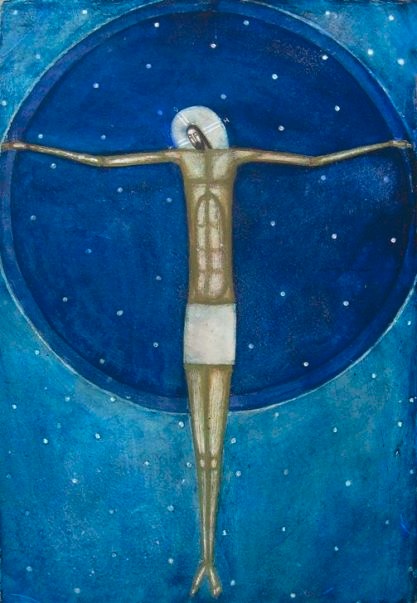
LOOK: Crucifixion by Natalya Rusetska

Rusetska, Natalya_Crucifixion
Natalya Rusetska (Ukrainian, 1984–), Crucifixion, 2013. Egg tempera on gessoed board, 20 × 13.5 cm.

LISTEN: “Σήμερον Κρεμάται” (Simeron Kremate), an antiphon for Great and Holy Friday, in plagal second mode, from the Greek Orthodox Church

>> Chanted in English by Vassilis Hadjinicolaou:

[Greek]
Σήμερον κρεμᾶται ἐπὶ ξύλου, ὁ ἐν ὕδασι τὴν γῆν κρεμάσας.
Στέφανον ἐξ ἀκανθῶν περιτίθεται, ὁ τῶν Ἀγγέλων Βασιλεύς.
Ψευδῆ πορφύραν περιβάλλεται, ὁ περιβάλλων τὸν οὐρανὸν ἐν νεφέλαις.
Ῥάπισμα κατεδέξατο, ὁ ἐν Ἰορδάνῃ ἐλευθερώσας τὸν Ἀδάμ.
Ἥλοις προσηλώθη, ὁ Νυμφίος τῆς Ἐκκλησίας.
Λόγχῃ ἐκεντήθη, ὁ Υἱὸς τῆς Παρθένου.
Προσκυνοῦμέν σου τὰ Πάθη Χριστέ.
Δεῖξον ἡμῖν, καὶ τὴν ἔνδοξόν σου Ἀνάστασιν.

[Transliterated Greek]
Símeron kremátai epí xýlou, o en ýdasi tín gín kremásas.
Stéfanon ex akanthón peritíthetai, o tón Angélon Vasiléfs.
Psevdí porfýran periválletai, o perivállon tón ouranón en nefélais.
Rápisma katedéxato, o en Iordáni eleftherósas tón Adám.
Ílois prosilóthi, o Nymfíos tís Ekklisías.
Lónchi ekentíthi, o Yiós tís Parthénou.
Proskynoúmén sou tá Páthi Christé.
Deíxon imín, kaí tín éndoxón sou Anástasin.

[English translation]
Today he who hung the earth upon the waters is hung on the tree.
The King of the angels is decked with a crown of thorns.
He who wraps the heavens in clouds is wrapped in the purple of mockery.
He who freed Adam in the Jordan is slapped on the face.
The Bridegroom of the church is affixed to the cross with nails.
The Son of the virgin is pierced by a spear.
We worship thy passion, O Christ.

We worship thy passion, O Christ.
Show us also thy glorious resurrection.

This is the fifteenth antiphon (short hymn) from the Matins service of Great and Holy Friday (as the day is called in the Orthodox tradition), celebrated on Thursday evening.

>> Arranged by Fr. Seraphim Dedes, chanted by Paul Barnes, 2019:

(An abbreviated version appears as “Byzantine Chant II: Simeron Kremate” on Barnes’s 2021 album Illumination; see my Holy Week Playlist.)

Paul Barnes is both a pianist and a Greek Orthodox chanter. Here he chants the “Simeron Kremate,” starting out in Greek and then using the following English translation:

Today he who suspended the earth on the waters is suspended on a cross. (×3)
The King of the angels wears a crown of thorns.
He who wraps the sky in clouds is wrapped in a fake purple robe.
He who freed Adam in the Jordan accepts to be slapped.
The Bridegroom of the church is fixed with nails to the cross.
The Son of the virgin is pierced with a spear.
We worship your passion, O Christ. (×3)
Show us also your glorious resurrection.

Seven of his piano majors from the Glenn Korff School of Music provide the ison (drone note).

>> Simeron Kremate, a solo keyboard work by Victoria Bond based on the Greek Orthodox chant, performed by Paul Barnes, 2019:

Paul Barnes and composer Victoria Bond are longtime collaborators. He introduced her to the “Simeron Kremate” chant, and she built a piano composition around its five-note melody. Struck by its similar melodic contour, she incorporated the Jewish Passover chant “Tal” (Dew), a prayer that life-sustaining dew would water the land. This prayer is traditionally chanted on the first morning of Passover (which is tomorrow; the festival begins this evening). Bond, who is Jewish, notes the thematic resonance between the two chants as well: (in my own words) the one a request for fruitfulness and refreshment, the other a lament for the death of the One whose death bears fruit and brings life. She describes the musical elements of the composition as follows:

The work opens with the traditional apichima of the plagal of the second mode which aurally establishes the musical atmosphere of the mode. Victoria follows this with a Jewish style cantillation (based on the cantillation of the great cantor Yosele Rosenblatt) which leads to the first statement of the “Simeron” chant. These opening notes are then developed in multiple ways before the intimate entry of the “Tal” melody. The work concludes with a ‘tranquillo’ passage of rare beauty ingeniously combining both themes. The work ends tentatively and unresolved as the opening notes of the chant dissipate into eternity.