
In a recent conversation, poet and novelist Joy Kogawa said, “We need to see each other’s eyes, and see each other through each other’s eyes.” Art, from all disciplines, can help us do that. Art can awaken our social conscience and breed empathy and understanding. It can serve as a vehicle for lament, a practice of voicing suffering before God. It can also widen our imaginations—that is, in part, our ability to think up creative solutions to problems both big and small. Here are just a few recent justice-oriented art projects that inspire me.
+++
CLASSIC SONG REVISED: Earlier this month Liz Vice, Paul Zach, and Orlando Palmer took Woody Guthrie’s folk classic “This Land Is Your Land” and, gathering at Trinity Church in Charlottesville, Virginia, revised the lyrics and tone to project lament over some of America’s more troubling legacies. The lyrical turn happens in the fourth line: where we would expect “To the New York islands,” we get “To the Texas border,” turning our mind from the country’s beauty to its broken systems that prevent us from sharing abundance with our southern neighbors fleeing violence. The song continues to plot a path through various places of historical and present-day suffering in the US, the three stanzas compactly addressing immigration; slavery, the “New Jim Crow,” and police brutality against black people; and the forcible expulsion of Native Americans from their ancestral territories, as well as massacres and other forms of colonialist violence.
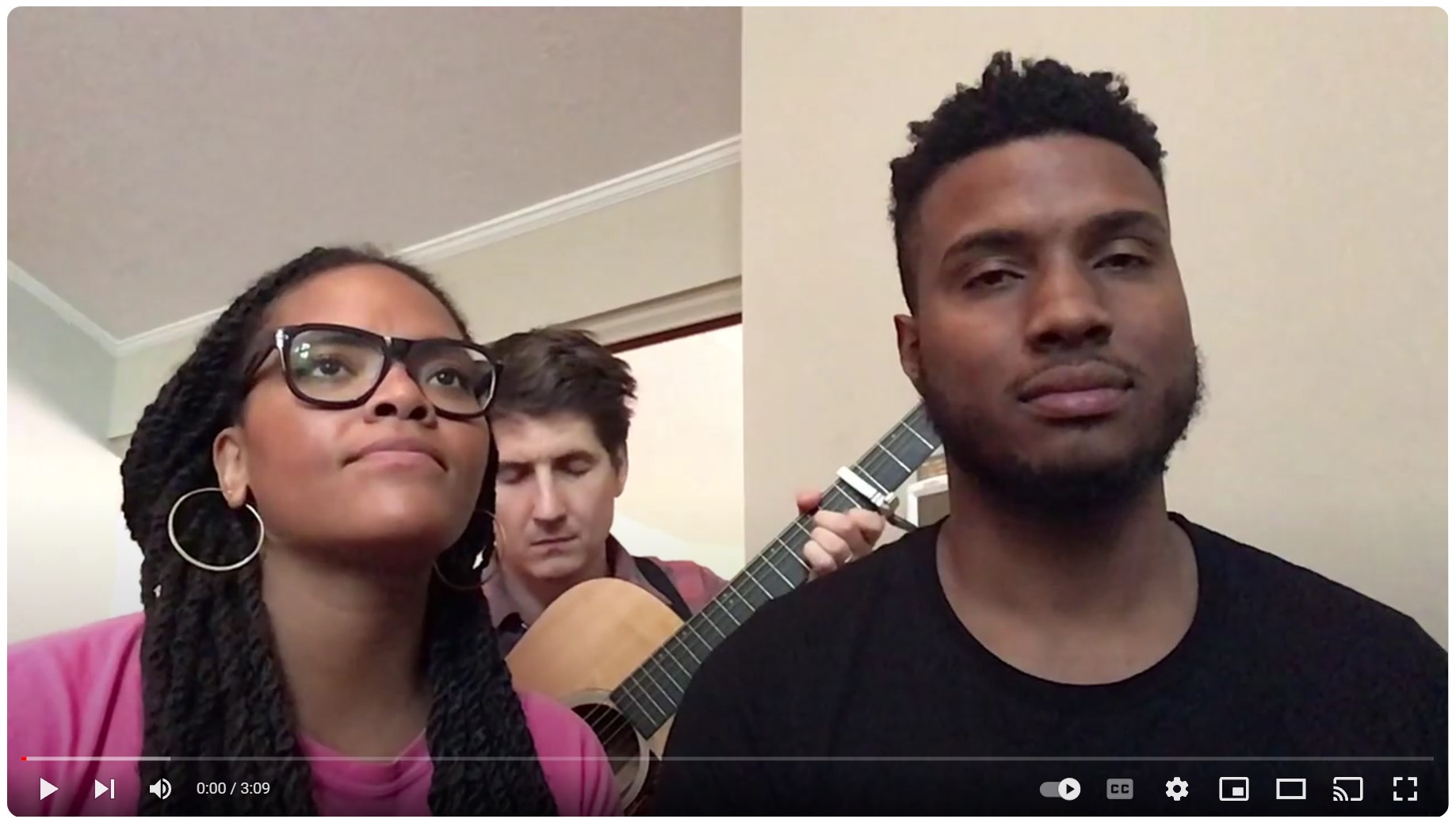
This land is your land
This land is my land
From California
To the Texas border
Through the Juarez mountains
With the migrant caravans
This land was made for you and meThis land is your land
This land is my land
From the piers of Charleston
To the fields of cotton
From the crowded prisons
To the streets of Ferguson
This land was made for you and meThis land is your land
This land is my land
From the Jamestown landing
To Lakota Badlands
From the Trail of Tears to
The reservations
This land was made for you and me
Most people don’t know it, but Guthrie actually wrote “This Land Is Your Land” as a protest against the vast income inequalities in the US. Two of its original verses, the radical ones, were nixed when it came time to record (it was the McCarthy era, after all); these referenced breadlines and tall walls with “No Trespassing” signs. In its original form, the song celebrated America as a place of natural abundance—forests and streams and wheat fields under “endless skyways”—while lamenting the scarcity that many Americans experience. The refrain, therefore, was more loaded. Learn more about the song’s history at https://www.npr.org/2000/07/03/1076186/this-land-is-your-land.
+++

SEESAWS AT THE BORDER: On July 27, Oakland-based creative duo Ronald Rael and Virginia San Fratello installed three bright pink teeter-totters through the slats of a section of the US-Mexico border wall that separates the neighboring communities of Sunland Park, New Mexico and Colonia Anapra, Mexico. Citizens on both sides were invited to ride this playground essential with a cross-border partner—a whimsical way to engage the other. As the creators said, it enabled people to literally feel the weight of humanity on the other side, using the wall as a fulcrum. The installation lasted forty minutes before it was dismantled (without incident).
I love this idea of play as protest—teeter-tottering as an act of creative defiance. What was enacted July 27 at the wall was a theater of the absurd, something that Rael, an architect, is especially drawn to in his practice. He actually conceived of Teeter-Totter Wall ten years ago, publishing a conceptual drawing in the book Borderwall as Architecture (University of California Press, 2009), along with other outlandish design possibilities for turning the wall into something that brings together rather than divides—these include its use as a massive xylophone played with weapons of mass percussion, a bookshelf feature inside a binational library, and more. Through these humorous proposals, Rael “reimagin[es] design as both an undermining and reparative measure,” as Dr. Marilyn Gates put it.
In his 2018 TED Talk, Rael discusses how the wall, meant to separate, has actually served to unite people in some instances. He mentions, for example, games of Wall y Ball, a variation on volleyball that was established at the wall in 1979, and binational yoga classes. I’ve heard of the Eucharist being celebrated jointly through the slats, and picnics hosted—such as the one organized in Tecate by the French artist JR on October 8, 2017: families passed plates of food between the bars, and musicians on both sides played the same songs.
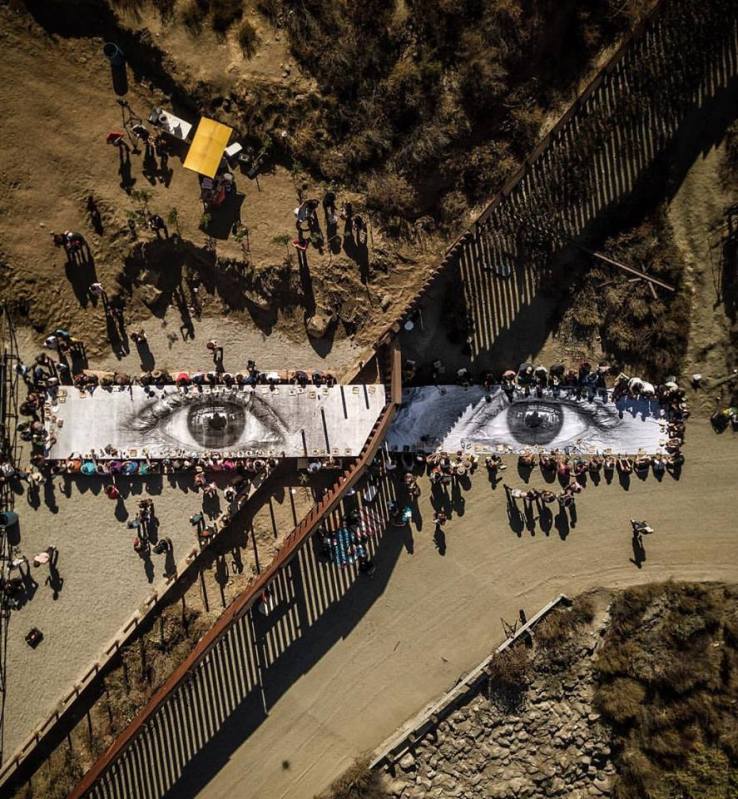
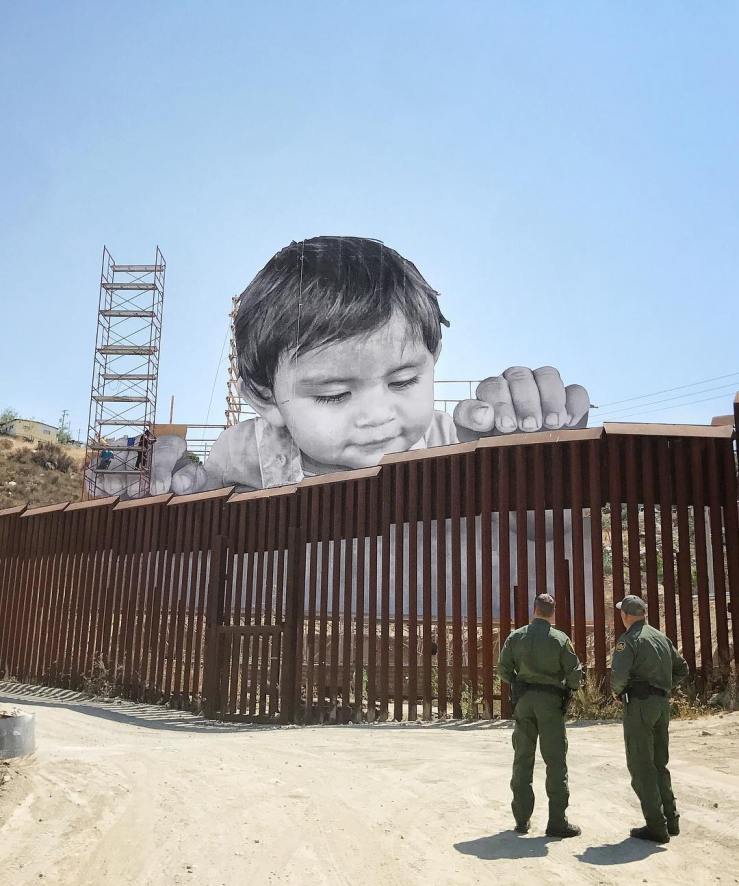
This picnic was the capstone of a month-long installation by JR featuring a monumental photograph of a Mexican toddler named Kikito, peering over the border wall into California from Tecate. (The photograph was held up with scaffolding.)
Shared play, shared food, shared music, shared sacrament—these are such breathtakingly beautiful countermeasures to separatism. The world needs more imaginative acts like these.
+++
POEM: Timothy E.G. Bartel has just published a new poem, “Status Check,” over at Curator. It’s only five lines, seven questions. A must-read. It’s not about immigration policy per se (it’s open-ended), but it took me back to another poem by Bartel that I featured back in 2017 as part of a blog post entitled “One sonnet vs. shouted prose: Lady Liberty, Emma Lazarus, and Trump.” Bartel has since published a freely downloadable chapbook (a compilation of Sapphic stanzas he wrote this year during National Poetry Month) and a traditionally published collection with Kelsay Books, Aflame but Unconsumed, which I just ordered and am excited about.
+++
VIRTUAL REALITY INSTALLATION: This was in DC last year and I missed it! A VR experience directed by the multi-Academy-Award-winning Alejandro G. Iñárritu, known for the films Birdman, The Revenant, Biutiful, and Babel, and shot by (also multiple-award-winning) cinematographer Emmanuel Lubezki. “Carne y Arena is a six-and-a-half-minute solo experience that employs state-of-the-art technology to create a multi-narrative space with human characters. . . . Based on true accounts from Central American and Mexican refugees, [it] blurs and binds together the superficial lines between subject and bystander, allowing individuals to walk in a vast space and live a fragment of a refugee’s personal journey.”
“It’s a way of understanding, which is another way to love somebody,” Iñárritu said in a video interview recorded against the backdrop of Jacob Lawrence’s Migration series.
+++
In terms of lectures, I highly recommend the three-part series “A Light unto Our Feet: How Does the Bible Orient Us Toward Immigration?” by Dr. M. Daniel Carroll R. (Rodas), delivered November 1–3, 2018, for the Diocese of Christ Our Hope. Dr. Carroll is the author of Christians at the Border: Immigration, the Church, and the Bible (Brazos Press, 2014).
 Art & Theology