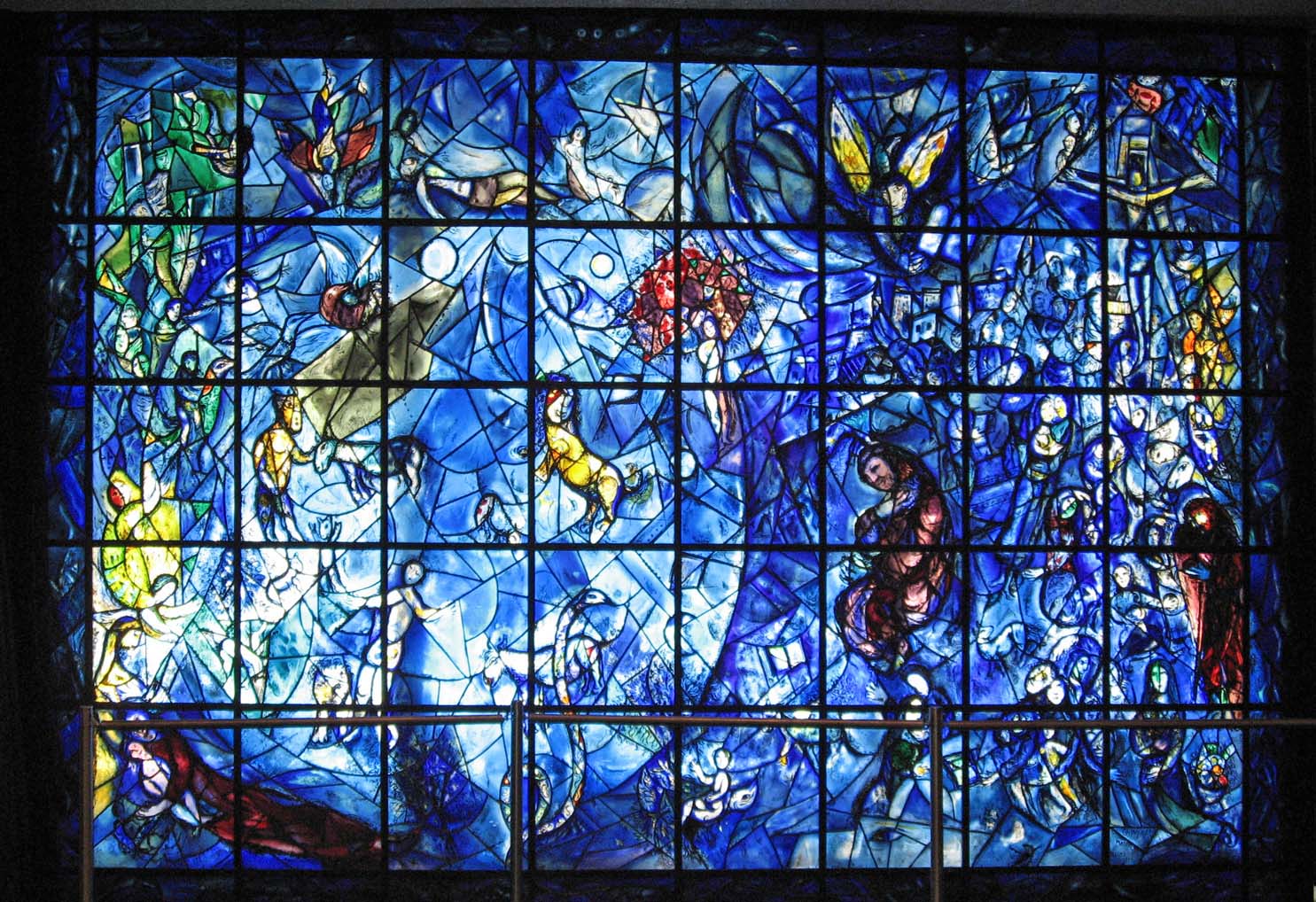
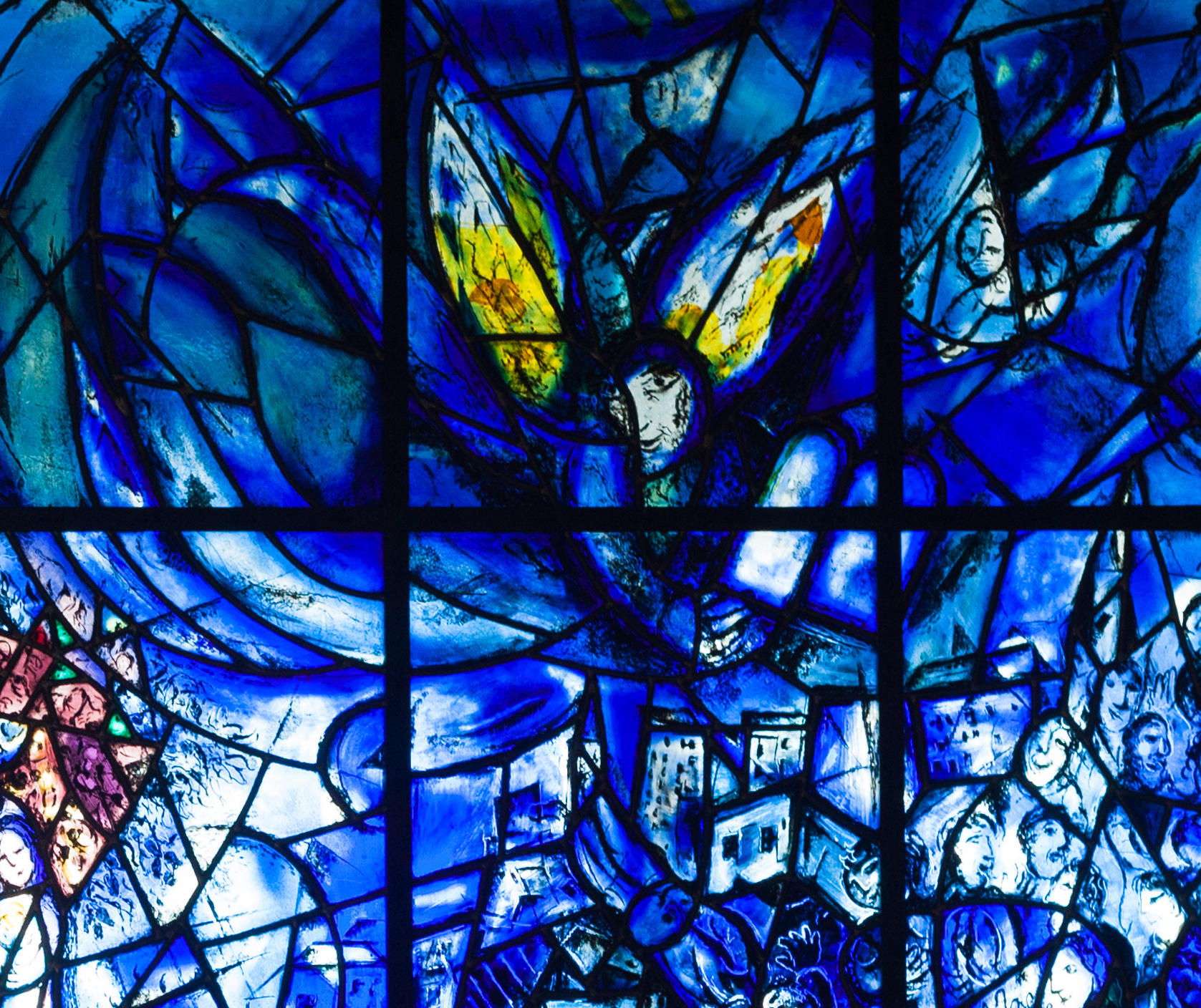
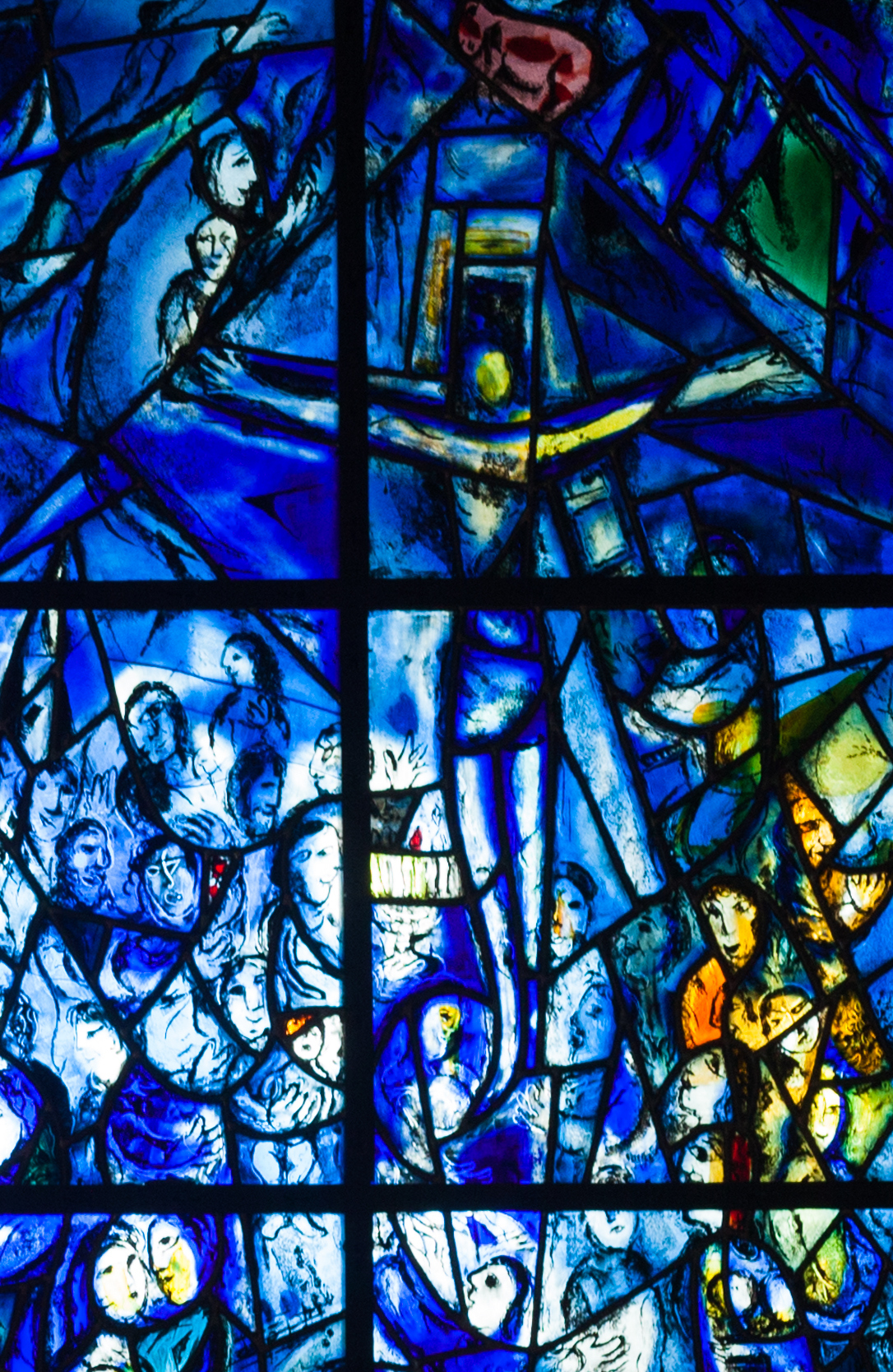
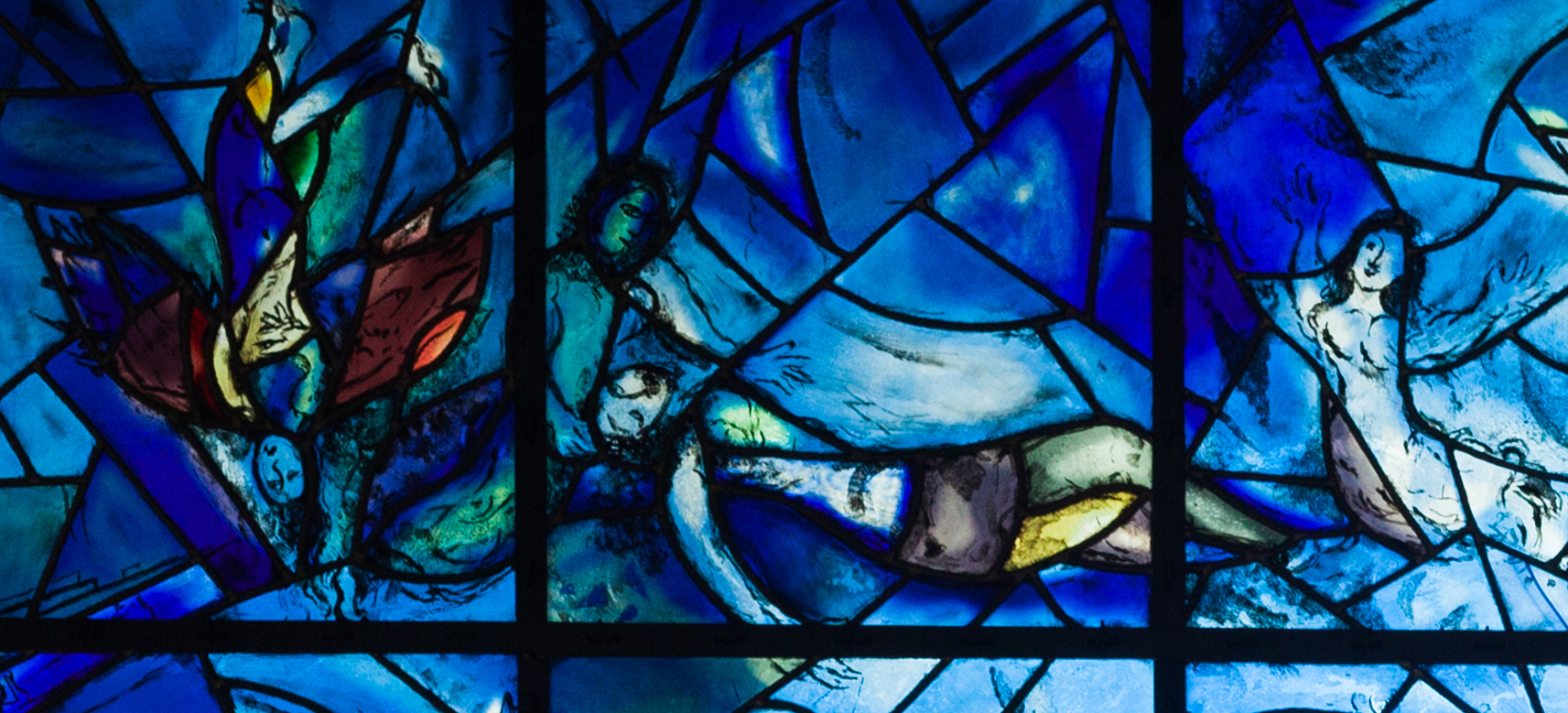
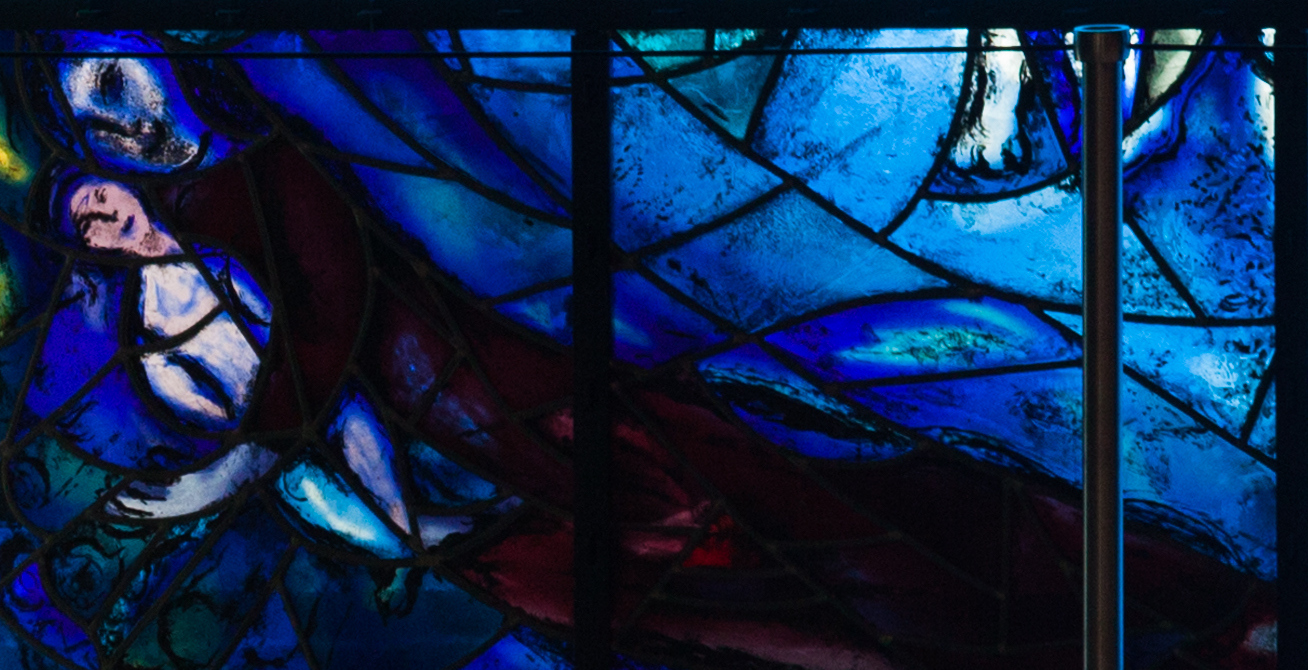
Marc Chagall (Russian/French, 1887–1985), Peace Window, 1964. Stained glass, 12 × 15 ft. Public lobby, General Assembly Building, United Nations Headquarters, New York. Manufactured by Brigitte Simon and Charles Marq.
This stained glass window by Marc Chagall was commissioned as a memorial for the Swedish diplomat Dag Hammarskjöld (1905–1961), who served as the second secretary-general of the United Nations, and for the fifteen other UN staff and peacekeepers who died with him when their plane crashed on the way to a peace negotiation for the Congo Crisis in Northern Rhodesia. The artist’s handwritten dedication reads, “A tous ceux qui ont servi les buts et principes de la Charte des Nations Unies et pour lesquels Dag Hammarskjöld a donné sa vie” (To all who served the purposes and principles of the United Nations Charter, for which Dag Hammarskjöld gave his life).
Chagall’s design was executed by master glassmakers Brigitte Simon and Charles Marq of Atelier Simon-Marq.
Chagall was born in 1887 into a Hasidic Jewish family in Vitebsk, Russia (now Belarus). He moved to Paris in 1910 to develop his art, becoming a French citizen in 1937. When Nazis took over the country, threatening Chagall’s safety, he was successfully extricated to the United States with the help of Alfred Barr, director of the Museum of Modern Art in New York. He returned to France for good in 1948. His impressive body of work, marked by a spiritual vivacity, includes—in addition to stained glass—paintings, drawings, book illustrations, stage sets, ceramics, and tapestries.
His 1964 Peace Window in New York City—not to be confused with his similar but much larger Peace Window of 1974 in the Chapel of the Cordeliers in Sarrebourg, France—is full of biblical allusions.
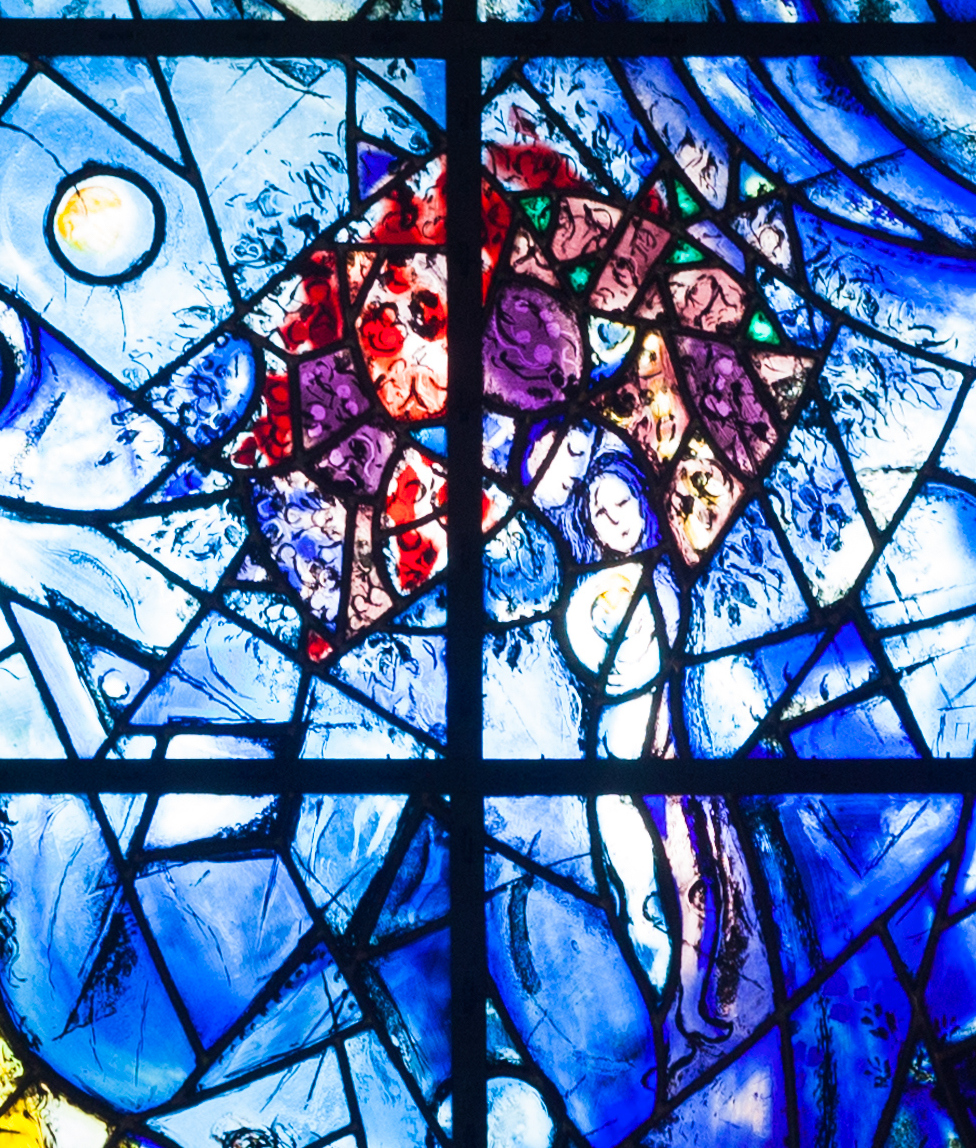
My eyes are drawn first to the red and purple bouquet in the center, under which stands an amorous couple. Who are they? What do they represent? I can think of several possibilities:
1. Adam and Eve. In the sketch Chagall made for the window, the woman is very clearly naked, though she’s less obviously so in the final window. That Eve, pre-fall, is traditionally portrayed unclothed, and that Chagall’s later Peace Window unequivocally portrays Adam and Eve within a red tree, lends credence to the interpretation of these figures as our primordial foreparents, in which case the flowering mass would stand for the tree of life in the garden of Eden (Gen. 2:9).
2. The Annunciation—the angel Gabriel coming to Mary to announce that she had been chosen to birth and mother God’s Son. The male head is bodiless, emerging from the crimson bloom (suggesting, perhaps, a supernatural entity), and there’s a yellow glow at the woman’s breast, perhaps signifying the conception of Christ. What’s more, the woman appears to be cradling something—her pregnant belly?
3. God and the human soul, or Christ and his church. One traditional Jewish interpretation of the poetic book of scripture known as the Song of Solomon is that it celebrates the love between humanity and the Divine. Medieval Christians, similarly, spoke of the book as an allegory of the future marriage of Christ and the church, his bride, drawing too on the New Testament book of Revelation, which culminates in a mystical union, a picture of cosmic harmony, heaven and earth inseparably joined.
4. The kiss of Justice and Peace. Psalm 85:8–11, a common Advent text, speaks of the divine attributes that coalesce to accomplish salvation (in the Christian reading, in the Incarnation):
Let me hear what God the LORD will speak, for he will speak peace to his people, to his faithful, to those who turn to him in their hearts. Surely his salvation is at hand for those who fear him, that his glory may dwell in our land.
Steadfast love and faithfulness will meet; righteousness and peace will kiss each other [emphasis mine]. Faithfulness will spring up from the ground, and righteousness will look down from the sky.
5. The kiss of Joy. Beethoven’s Ninth Symphony was a favorite of Dag Hammarskjöld’s, and its performance, at least the “Ode to Joy” chorus in its final movement, is a United Nations Day concert tradition. Hammarskjöld described the work as “a jubilant assertion of life,” championing universal peace and brotherhood. One of the lines from Friedrich Schiller’s text that Beethoven set exclaims that “Joy . . . kiss[es] . . . the whole world!”
I suspect some or all of these ideas were at play when Chagall designed the window. Or even just romantic love in general (with other types of love portrayed elsewhere in the composition), as he often painted himself and his wife Bella kissing or embracing.
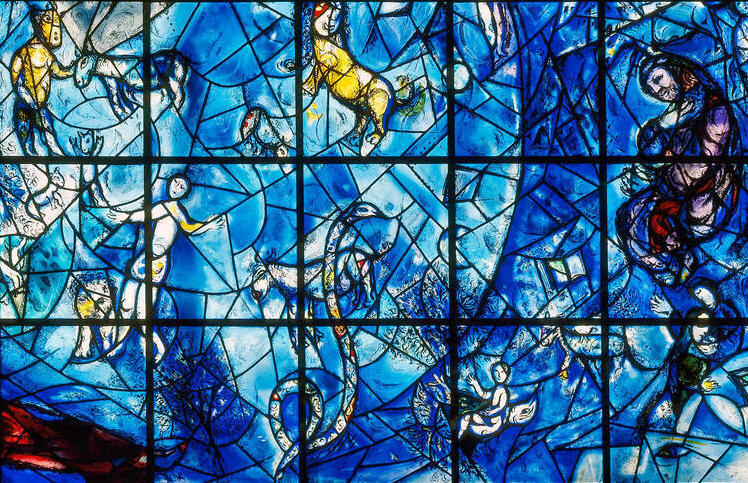
After this tableau, my eyes go to the large male figure cloaked in purple just right of center. I take him to be the prophet Isaiah, beholding a vision of wild animals and children cavorting together in harmony (see Isaiah 11). A boy, for example, reaches his hand out toward a viper and is not harmed.
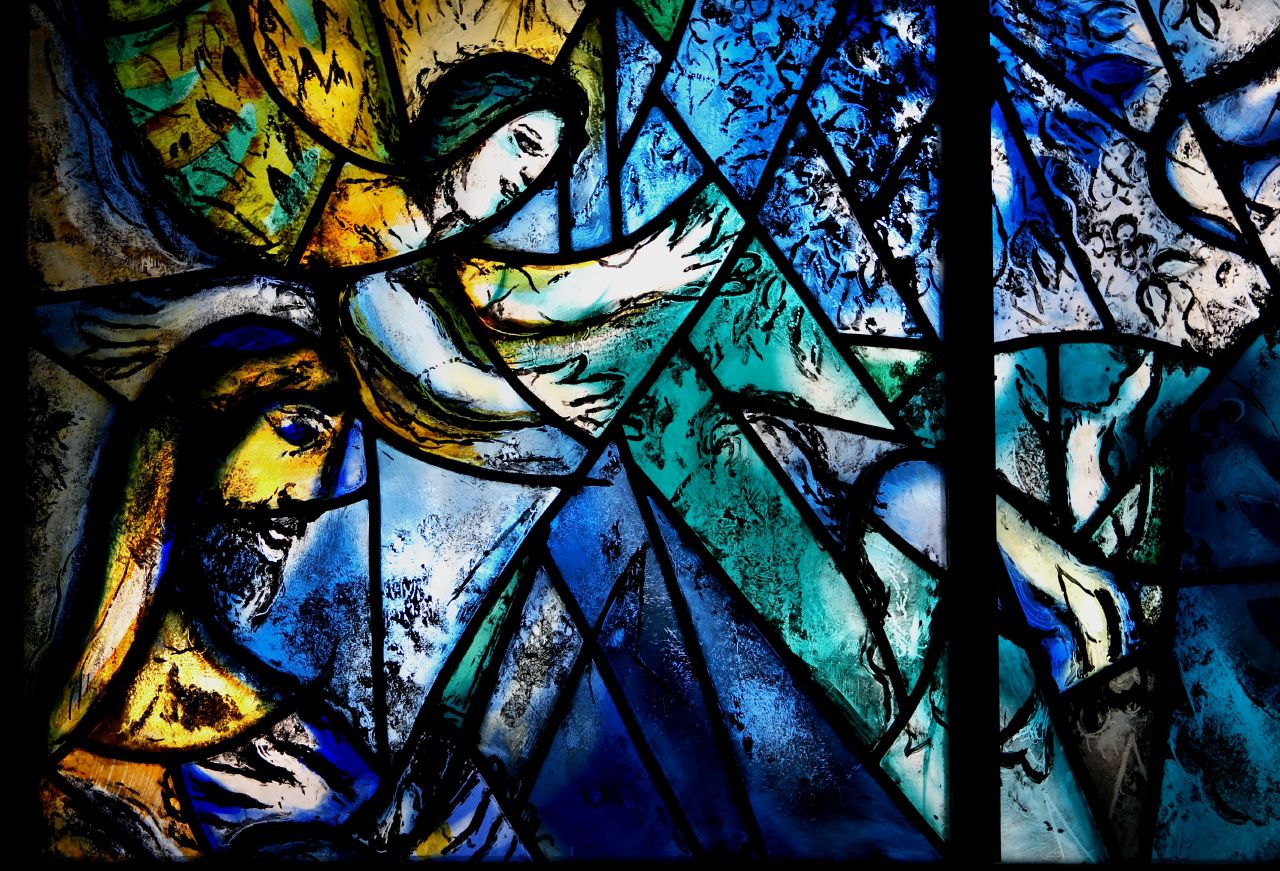
But it’s also possible that’s meant to be Isaiah at the bottom left of the window, his face illumined by the beauty spread out before him, which an angel gestures to, guiding the prophet’s imagination:
On the top right, another angel delivers the Ten Commandments to the people of God.
Next to this communication of God’s word is the death of God’s Word in the flesh, Jesus Christ, around whom the crowds have gathered. A man ascends a ladder propped against the cross, the ladder being a multivalent symbol harking back to Jacob’s dream at Bethel and evoking notions of descent and ascent.
Vignettes below include a couple embracing with an infant in hand, a woman being fed at a table (the Eucharist?), a family reading a book (probably the Bible), a woman making music, and another bearing flowers.
At the top left is a lamentation scene that evokes those of Christ deposed from the cross. A man in a loincloth lies dead or wounded on the ground, his head cradled by a loved one, while at his feet another mourner throws her arms up in grief. This is the cost of human violence.
By contrast, in the bottom left corner, a mother cradles her child, evoking scenes of the nativity of Christ—of Mary with her newborn son.
All these characters—human, animal, and divine—are sprawled across a warm azure background, playing out love, suffering, death, peace, joy, and reconciliation.
LISTEN: “Oracles” by Steve Bell, on Keening for the Dawn (2012)
O ancient seer, your vision told Of desert highways streaming home To the mountain of the Lord Where nations sound a righteous song forevermore
And on that mountain men will forge From cruel implements of war The tools to till and garden soil The rose will bloom and faces shine with gladdening oil
And it will surely come to pass Justice will reign on earth at last The wolf will lie down with the lamb No beast destroy, no serpent strike the child’s hand
And God himself will choose the sign A frightened woman in her time Will bear a son and name him well God with us! O come, O come, Emmanuel!
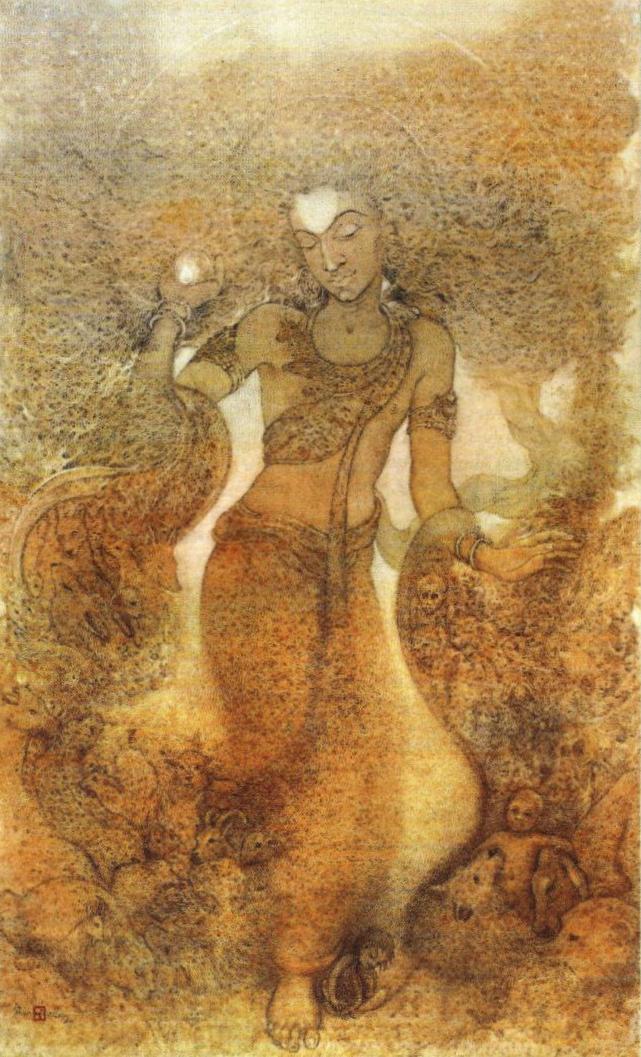
Frank Wesley (Indian, 1923–2002), The Promise of Peace, 1994. Watercolor, 50 × 30 cm.
Frank Wesley (1923–2002) [previously] is one of the twentieth century’s most celebrated Indian Christian artists. His watercolor The Promise of Peace appears on the cover of the March 1996 issue of Image: Christ and Art in Asia, the monthly magazine of the Asian Christian Art Association, which is where I sourced it from. Painted in warm brown earth tones and based on Isaiah 11:1–9, it shows an Indianized Jesus ushering in the peaceable kingdom of God. The ACAA provides the following commentary:
Christ is the shoot rising from the stump, and the Spirit of the Lord’s presence is shown in the white egg/flame/pearl in the upraised right hand and in the white heart shape centred on Jesus’ brow. A faint halo encircles his head, while a second halo sweeps from the right hand down to the left hand, under which the needy of the land shelter. The little child living at peace with many different animals is visible in the bottom right-hand corner, and the child playing unharmed with the viper is seated at the foot of Jesus. On the left-hand side of the painting a wide variety of creatures are playing happily together. The bracelet on Jesus’s left upper arm carries the symbol for Peter while that on the right upper arm signifies Paul. The symbols of the four gospel writers can be seen in the necklet.
LISTEN: “O Lord, May Your Kingdom Come” | Words by Greg Scheer, based on Isaiah 11:6–9, 2014 | Music by Eric Sarwar, based on the Raga Mishra Shivranjani, 2014 | Led by Eric Sarwar at the Calvin Symposium on Worship, 2019
Refrain: اے خدا تیری بادشاہی آئ (Transliteration: Aey Khuda, teri badshahi, aey) O Lord, may your kingdom come
Where the wolf and lamb Shall lie down as kin And a child shall lead them [Refrain]
Where the cow shall graze And its calves will play With the cubs of the lion [Refrain]
Where the babe in arms Shall fear no harm From the snake or the adder [Refrain]
May your kingdom come May your will be done On earth as in heaven [Refrain]
Born and raised in Pakistan, Rev. Dr. Eric Sarwar is a musician, global missiologist, and the pastor of Artesia City Church in Southern California, made up of Indian and Pakistani immigrants. He is also the founding president of the Tehillim School of Church Music and Worship in Karachi, which fosters the academic study of the ethnomusicology, missiology, and tradition of Christian worship in communities across Pakistan and the overseas diaspora. He plays the harmonium and is fluent in English, Hindi, Punjabi, and Urdu. He is the author of Psalms, Islam, and Shalom: A Common Heritage of Divine Songs for Muslim-Christian Friendship (Fortress Press, 2023) and is a frequent organizer of zabur (psalm) festivals.
In the video above, extracted from a Vespers service, Sarwar leads attendees of the 2019 Calvin Symposium on Worship in Grand Rapids, Michigan, in an anthem he wrote with Greg Scheer, joined on stage by other musicians from the symposium. The refrain is in Urdu and English.
This post is part of a daily Advent series from December 2 to 24, 2023 (with Christmas to follow through January 6, 2024). View all the posts here, and the accompanying Spotify playlist here. “O Lord, May Your Kingdom Come” is not on Spotify.
Following the popularity of last year’s “25 Poems for Christmas,” I’ve decided to publish a brand-new installment, and will perhaps make this a yearly tradition! All the selections can be read online—just follow the links.
Despite the pithy title of this post, not all the poems are “Christmas” poems, strictly speaking, but rather they encompass the season of Advent too, as well as Epiphany. Advent is a four-week season leading up to Christmas that is characterized by a mood of longing and expectation; it is oriented not only toward Jesus’s first coming but also toward his second. Christmas, of course, celebrates the birth of Jesus, the Word of God made flesh. And Epiphany, on January 6, commemorates the visit of the magi to the crib, representing God’s self-revelation to the wider world.
Each poem is accompanied by a micro-commentary or short descriptive blurb, which I suggest you read after reading the poem itself. There’s a benefit to first entering a poem without having any context—then after registering your initial impressions and questions, to consider another person’s framing or analysis or highlights, and reread. And then a third time! Each reading can potentially reveal new meaning.
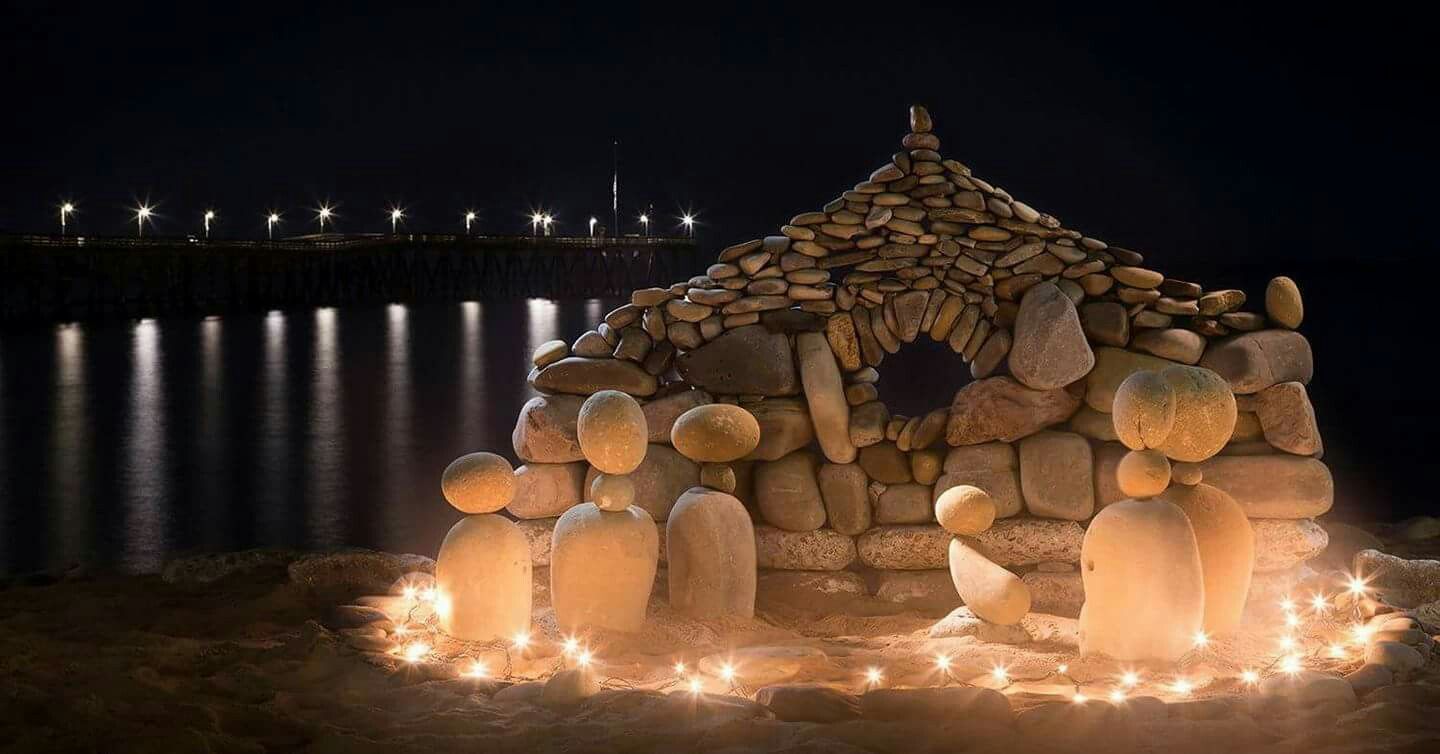
Stone Nativity by Juan Manuel Cisneros, Ventura, California, December 2016 [learn more]
1.“Haiku for an Advent Calendar” by Richard Bauckham: Church services during Advent tend to focus on messianic prophecies from the Hebrew Bible, rumblings of a coming savior. In this sequence of twenty-four haiku, Richard Bauckham pulls a detail from each book of the Jewish scriptures, finding anticipations of Christ. For example, Isaiah: “In the wilderness / a voice cries for centuries / seeking an echo.” Or Job: “God answered Job but / not his question. Maybe he / will do that again.”
2. “How Christ Shall Come” (anonymous): The cosmological Christ blew in from the four cardinal directions, coming as lover, knight, merchant, and pilgrim. So says this fourteenth-century Middle English lyric, rich in metaphor, compiled in a book of preaching aids and sermons by John Sheppey (d. 1360), bishop of Rochester. (It is unclear whether he is the author of the poem.) The great medieval literature scholar Carleton Brown gave it the title “How Christ Shall Come” in his landmark Religious Lyrics of the XIVth Century (1924), and Grace Hamman brought it to my attention recently in her wonderful monthly Substack, Medievalish, providing a modern English translation and commentary.
3.“Hawk Lies Down with Rabbit” by Seth Wieck: What would it look like for death to no longer have dominion in the animal world? Grappling with Isaiah’s end-time vision of a peaceable kingdom void of predation, this poem describes in graphic terms a bird of prey making its kill, feeding on flesh, and wonders how a hawk could still be itself with rewired impulses. Hear the author read and provide context for the poem on the Reformed Journal Podcast.
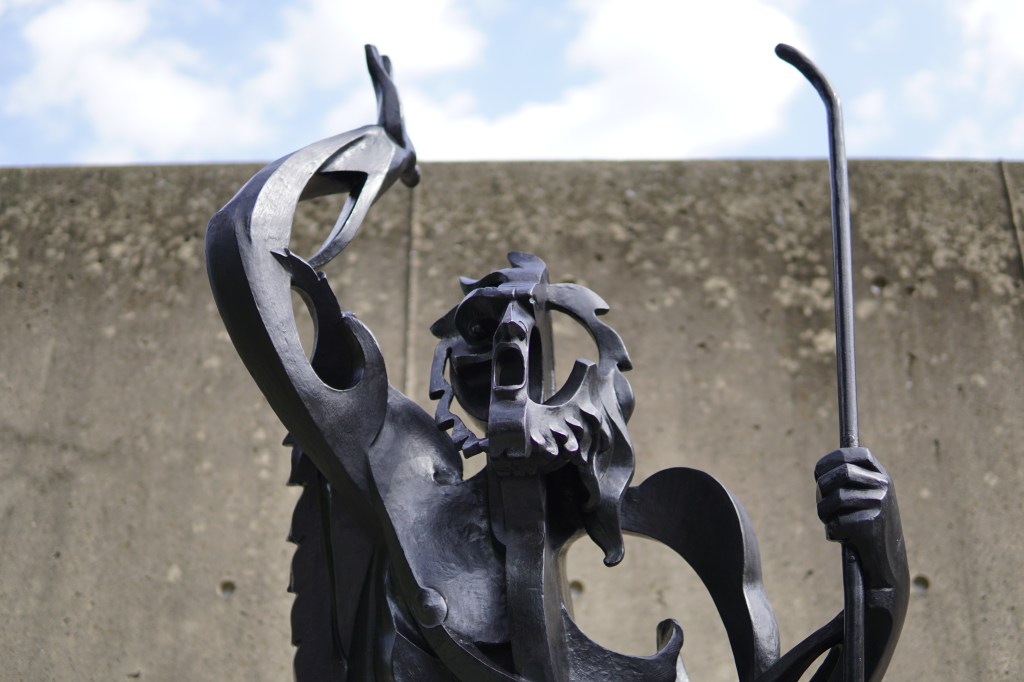
4.“john” by Lucille Clifton: Written in the voice of John the Baptist, this poem is part of an extraordinary sixteen-poem sequence titled “some jesus,” which features a range of biblical characters. In her retelling of his ministry as forerunner to the Messiah, Lucille Clifton casts John as a Black Baptist preacher, preparing his listeners to receive the one who “com[es] in blackness / like a star.” Clifton’s larger body of work would suggest that “blackness” here is multivalent, describing what Jesus comes into and as: the word suggests the darkness of the world that Christ entered, on the one hand, but also functions as a positive racial identifier. In Clifton’s revisioning, Christ comes as a Black man, wearing “a great bush / on his head”—which, again, could be read as an Afro, and/or as a mystical reference to the site at which God revealed himself to Moses in the Sinai desert. Luminous with truth, Christ comes, “calling the people brother.”
Pablo Gargallo (Spanish, 1881–1934), The Prophet (St. John the Baptist) (detail), 1933. Bronze, 91 3/4 × 29 1/2 × 19 in. Wurtzburger Sculpture Garden, Baltimore Museum of Art. Photo: Victoria Emily Jones.
5. “Christmas Mail” by Ted Kooser: Every December the story of an ancient birth comes alive again in couriers’ mailbags, in tin boxes at the ends of driveways, on mantels and fridges. This poem honors those postal workers who deliver good tidings in the form of Christmas cards, the magic spilling out the envelopes to make even the most tiresome routes sparkle a bit.
6. “December 25” by George MacDonald: Through the mid-nineteenth century, denominations influenced by the Reformed tradition, including the Church of Scotland in which George MacDonald was raised, typically did not observe Christmas, the rationale being that no one day should be thought of as holier than any other. But in his book-length dramatic poem Within and Without, MacDonald refers to December 25 as “this one day that blesses all the year”—and in this seven-liner from his Diary of an Old Soul, he describes Christmas as a gleaming blue sapphire, a structural center around which all the other jewels of the church calendar are oriented.
7. “On a Cardinal Climbing Down a Manhole to Restore Power to 400 Homeless People” by Michael Stalcup: On May 11, 2019, Cardinal Konrad Krajewski, the papal almoner (Pope Francis’s special appointee to distribute charity), crawled into a manhole and broke a police seal to personally restore power to a homeless shelter in Rome whose electricity had been shut off due to its failure to pay its bills. The shelter was occupied by some 450 people at the time, 100 of them children, who had been without electric light, hot water, and refrigeration for nearly a week. In this poem, which can be read Christologically, Michael Stalcup celebrates this defiant humanitarian act that brought light to a people living in darkness.
8. “Incarnation” by Amit Majmudar: “Inheart yourself, immensity. Immarrow, / Embone, enrib yourself.” So begins the five-poem sequence “Seventeens.” Musical and witty, this first poem is a plea to the great I AM to take on a body and “be all we are, and all we aren’t.”
9.“The Lord Is with Thee” by Micha Boyett: Written in 2010 as the third in a five-poem sequence commissioned by John Knox Presbyterian Church in Seattle, this poem centers on the Visitation episode described in Luke 1:39–58. It’s about Mary finding belonging in God’s story, especially through the companionship of her elder cousin Elizabeth, who has nurtured Mary’s faith since infancy and continues to do so in this her moment of crisis. “How easily she spoke of God, / as if he were a neighbor, a fish vendor on the street,” Mary admires. Elizabeth supports Mary physically, emotionally, and spiritually, holding her hair back as she vomits, protecting her from vicious rumors, affirming the work of God in her life, and accompanying her at the start of this wild path God has set them both on.
Odilon Redon (French, 1840–1916), Mystical Conversation, ca. 1896. Oil on canvas, 65 × 46 cm. Museum of Fine Arts, Gifu, Japan.
10.“Our Lady” by Mary Elizabeth Coleridge: The great-grandniece of the Romantic poet Samuel Taylor Coleridge, Mary Elizabeth Coleridge (1861–1907) grew up in a home visited by family friends Alfred Lord Tennyson, Anthony Trollope, John Ruskin, and Robert Browning, among others. In this poem she marvels at how God chose the common-born Mary for such a task as mothering the Christ, singing along with Mary’s Magnificat about how God raises up the lowly.
Source: Fancy’s Following (privately published, 1896). Public Domain.
11. “Traveling Man”by Marjorie Maddox: With his pregnant wife alongside, Joseph plods down south to Bethlehem, “convinced of the predestined / roll of dice chrismated with Miracle.” An epigraph from a Leonard Cohen song sets the tone.
12.“Sonnet in the Shape of a Potted Christmas Tree” by George Starbuck: This charming shape poem contrasts the extravagance of our popular celebrations of Christmas with the poverty of the first-century event it marks. The first half describes the furious wind of decorative activity that uproots evergreens from their natural habitats to bring them indoors and deck them with baubles and ribbon. I don’t know how to interpret “no scapegrace of a sect,” but “Daughter-in-Law Elect” refers to a duet from the Gilbert and Sullivan opera The Mikado. The turn comes with “a son born / now / now,” the latter two lines styled as the visible trunk of the tree; here the scene shifts to the simple stable of old, where Mary lies “spent” next to her newborn along with a cow and donkey, a sole “firework” guiding the magi and us all to the spot.
13.“Christmas (I and II)” by George Herbert: George Herbert (1593–1633) is one of the most celebrated poets of the English language. In part 1, a sonnet, of this two-part poem, he imagines himself a weary traveler who chances upon a humble inn where he unexpectedly finds his Lord, the infant Christ. It’s the inn of Bethlehem. Having then received rest from Christ his host, in the closing couplet he expresses his desire to reciprocate—to offer his own soul, lowly though it is, as a residence for Christ, praying that God first adorn it to make it hospitable. In the second part of the poem, Herbert uses a metaphysical conceit (extended metaphor) comparing his soul to a shepherd whose flock of thoughts, words, and deeds pastures on God’s word and who, like the shepherds of Bethlehem, sings glory to God. His shepherd-soul seeks eternal daylight, which he finds in the Son/sun, whose beams so intertwine with his song that the beams sing and his song shines.
14. “Descending Theology: The Nativity” by Mary Karr: The physicality of childbirth, from the contractions (which pierce the Virgin like a star, Karr writes) to the bodily fluids, is heavily featured in this poem. Jesus emerges from his mother “a sticky grub” with a “lolling head” and “sloppy mouth” that seeks out her breast for food. And as she feeds him physically, he feeds her spiritually. Then he falls asleep. His first nap, Karr writes, is a foretaste of the sleep of death he will eventually come to taste. But for now, he wakes up crying—as all babies do.
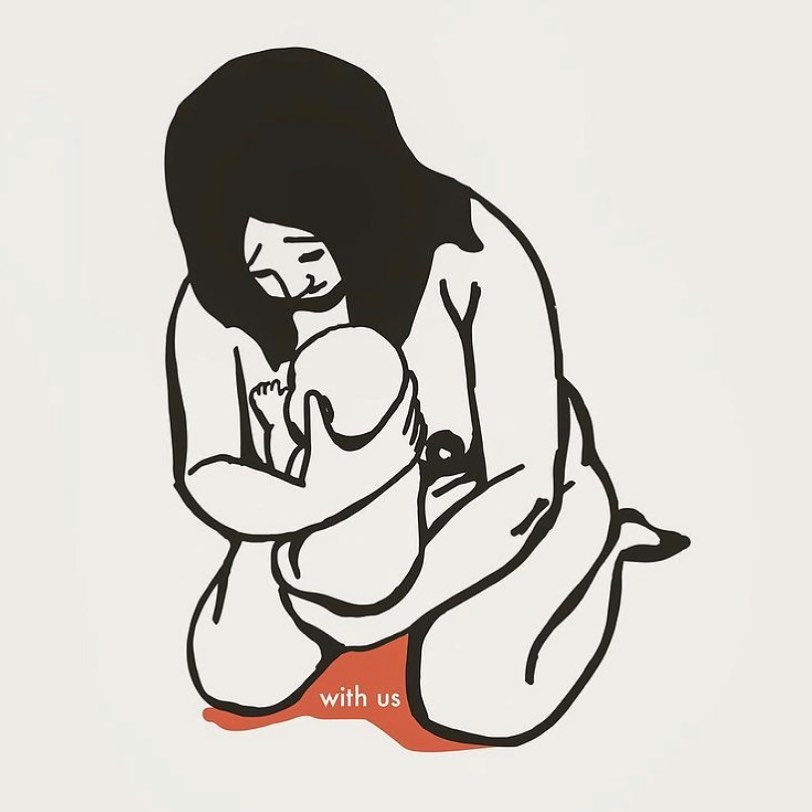
Scott Erickson (American, 1977–), With Us, Face to Face, 2016. Digital art. [available for purchase]
15.“from spiralling ecstatically this”by E. E. Cummings: What a fantastic opening line! The heavenly spheres whirling, twirling, down into the “proud nowhere”—Bethlehem—“of earth’s most prodigious night.” Heretofore living in mundanity, the domestic animals, hungry for miracle, for newness, are vouchsafed to be witnesses of this supernatural event, before which they kneel “humbly in their imagined bodies.” Overhead floats the “perhapsless mystery of paradise,” a phrase suggesting that heaven is beyond human understanding but not without certainty; it’s a declarative reality, not subjunctive, even if it can’t quite be put into words. Mary herself has no words—she silently, knowingly smiles, while the created world erupts in song around her. The “mind without soul” is a reference to Herod, who seeks to snuff out this new life, but to no avail.
The omission of spaces after punctuation marks (e.g., “a newborn babe:around him,eyes”) is not a mistake; that’s how E. E. Cummings liked it. Scholars say it’s to create a faster rhythm, but in this poem I don’t think that choice is as effective, as pauses and slow savoring seem more appropriate to its contemplative mood.
16.“How the Natal Star Was Born”by Violet Nesdoly: Narrated by the angel Gabriel, this poem imaginatively describes heaven’s nervously awaiting the birth of Jesus during the nine months following Gabriel’s dispatch to Mary, and then busting out in celebration when at last they hear his infant-cry. When his Son is born, instead of cigars, the Father passes out trumpets to his company of friends, who sound them all the way to Bethlehem’s fields, and pops open a bottle of champagne whose bubbles spray far and wide.
17. Sections 9–10 of “The Child” by Rabindranath Tagore: Hinduism was the religion of Rabindranath Tagore’s birth and upbringing, but he also held deep respect for Jesus Christ. (For more on the influence of Christianity on Tagore’s thought and writing, see chapter 4 of Rabindranath Tagore and Interfaith Dialogue by Manas Kumar Ghosh [DMin thesis, Charles Sturt University, 2010].) “The Child” is a free-verse poem that Tagore wrote in English in 1930 after seeing a passion play in Germany and then translated into Bengali in 1932 with the title “Sishutirtha” (Pilgrimage to Childhood). In it a “Man of faith” gathers people from all walks of life to join him on a “pilgrimage of fulfilment,” to “struggle [through the dark] into the Kingdom of living light.” Initially met with enthusiasm, the Man later becomes a target of the people’s anger and distrust, and they kill him. Disorientation ensues. But a man in the crowd is able to rally the others to repent and resume their quest, following the spirit of “the Victim.”
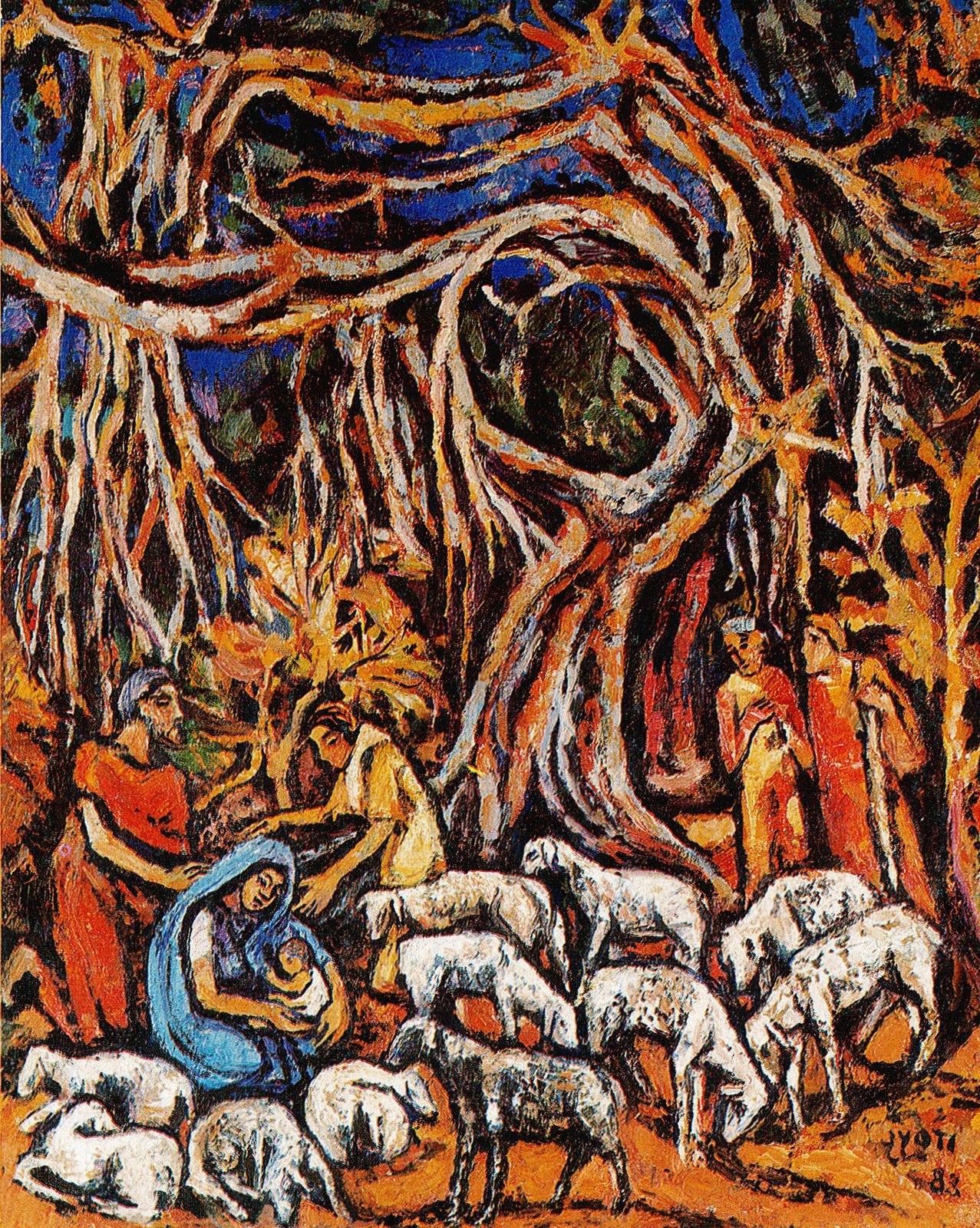
The final two sections, 9 and 10, are the selection I’ve chosen. (Scroll right to read the last.) At “the first flush of dawn,” when the time is ripe, the pilgrims arrive at a thatched hut in a palm grove, where they finally meet the eternal Light they’ve been seeking: “the mother . . . seated on a straw bed with the babe on her lap, / . . . the morning star.” Here is the Child of the title, humanity’s redeemer.
Source: The Child (London: George Allen and Unwin, 1931)
Jyoti Sahi (Indian, 1944–), Adoration of the Shepherds, 1983. Oil and acrylic on canvas.
18. “Love’s Bitten Tongue (11)”by Vassar Miller: This poem, “You, my God, lonesome man, Love’s bitten tongue,” is from a crown of twenty-two sonnets, a type of sequence in which the last line of each sonnet is repeated as the first line of the next, but each time with a new twist of syntax and sense. The crown as a whole expresses the poet-speaker’s struggle against her ego, and her desire for Christ (whom she gives such an evocative name in the title!). In this particular sonnet she describes waiting at the edge of her bed every Christmas Eve as a child in anticipation of both Santa’s arrival with gifts and the holy mystery of Christ’s birth, an admixture of sacred and profane longings that fill her still as an adult.
19. “Gloria in Profundis” by G. K. Chesterton: G. K. Chesterton’s poems are of variable quality, but this one is brilliant, emphasizing God’s descent from the rich heights of heaven into an obscure cave in a simple town. “Glory to God in the lowest!” it exclaims, a clever inversion of the angels’ song to the shepherds in Luke 2:14. The poem was originally published in a 1927 Christmas pamphlet with wood engravings by Eric Gill. The Latin title translates to “Glory in the Depths.”
Source: Gloria in Profundis by G. K. Chesterton (Ariel series pamphlet) (London: Faber and Gwyer, 1927); compiled in The Spirit of Christmas (New York: Dodd, Mead, 1985)
20.“Silent Night” by Bonnie Bowman Thurston: Rev. Dr. Bonnie Thurston invokes a tradition that says the night of Christ’s birth, there was a whole hour in which time stood still and all was silent. What a fascinating legend! Thurston told me its origin is northern European, said she remembers reading it in some scholarly Celtic studies; I wasn’t able to locate any such mentions, but the second-century Protoevangelium of James, chapter 18, probably written in Egypt or Syria, does describe everything momentarily freezing in place around Joseph as he steps out to find a midwife for Mary. Anyway, the poem ends with a striking metaphor! Word, flesh: fire. (Reminds me of this digital artwork by Scott Erickson.)
21. “After Luke 2:19” by Michelle Ortega: When the shepherds recounted to Mary what the angels had told them in the fields about Jesus being the promised Messiah, “Mary treasured all these words and pondered them in her heart,” Luke narrates in his Gospel. Poet Michelle Ortega expounds on this verse, emphasizing the relationship of Mary’s body to her son’s from conception to birth and now postpartum—an intimacy known well by mothers across the centuries. As wondrous as it was to be part of a cosmic story writ large in the skies, Ortega suggests that Mary treasured just as much as the grand pronouncements those small moments of being just an ordinary mama.
22. “Christmas: 1924”by Thomas Hardy: “We the civilized world have given Christianity a fair trial for nearly 2000 years, & it has not yet taught countries the rudimentary virtue of keeping peace,” lamented the British novelist and poet Thomas Hardy (1840–1928) in a letter to Florence Henniker dated February 25, 1900, during the Boer War. World War I only increased his cynicism, which is on display in this sour little epigram that opens with an ironic quotation of the angels’ proclamation to the shepherds the night of Jesus’s birth.
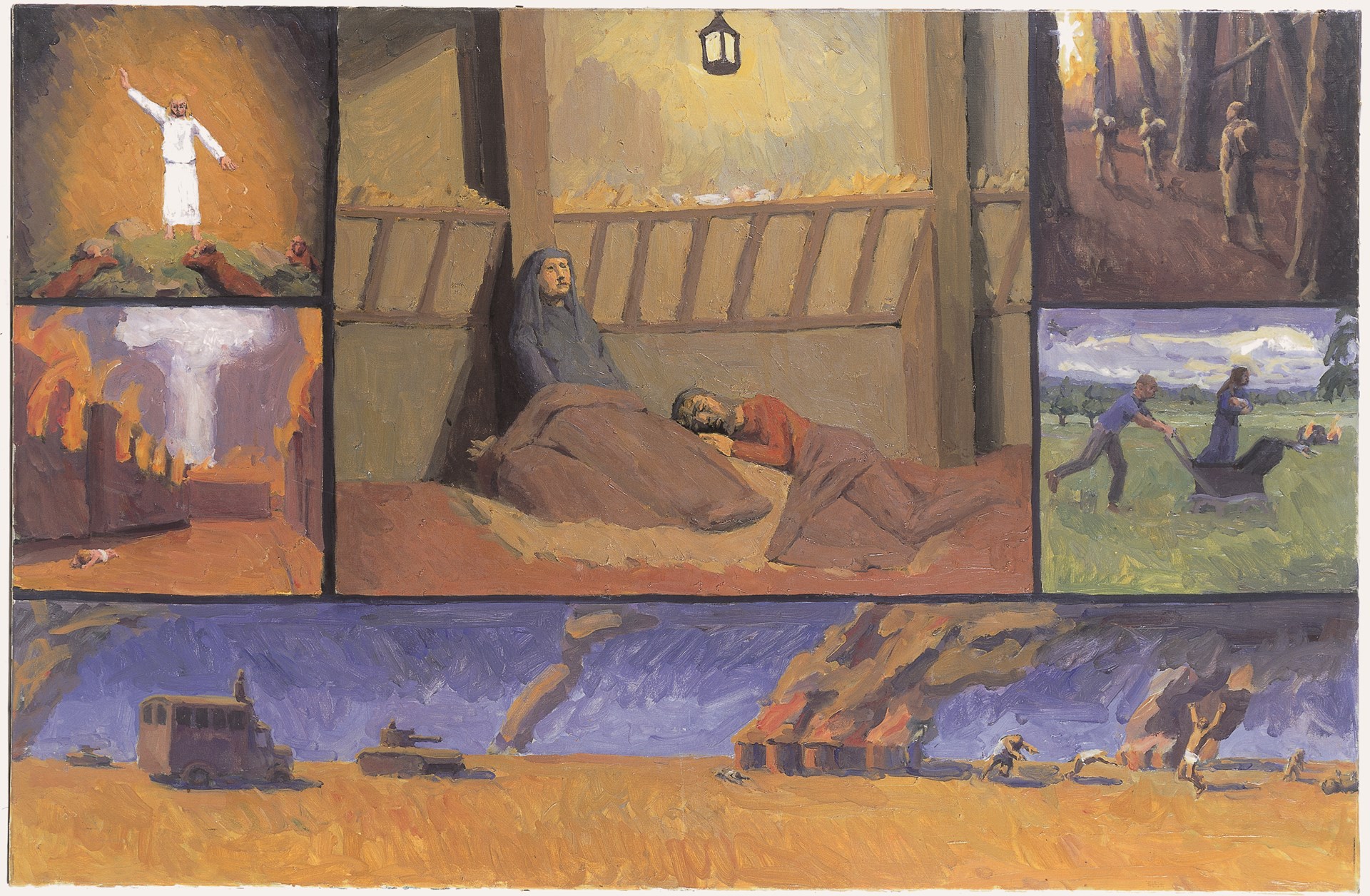
Francis Hoyland (British, 1930–), Nativity, 1961. Oil on canvas, 90 × 120 cm. Methodist Modern Art Collection, HOY/1963/1.
23. “Eating Baklava on New Year’s Eve” by Anya Krugovoy Silver: Poet Anya Silver (1968–2018) reads a spiritual benediction in her piece of baklava, layered and sweet and consumed on the eve of a new year.
Source: Second Bloom (Eugene, OR: Cascade Books, 2017)
24. “A Ballad of Wise Men”by George M. P. Baird: Jesus so often confounds the wisdom of the wise, starting with his birth. With gentle humor and in iambic rhythm and rhyme, this poem celebrates the simple access we all have to Christ.
Source: Rune and Rann (Pittsburgh: Aldine Press, 1916). Public Domain.
25. “Excrucielsis”by Hannah Main-van der Kamp: Originally published at ArtWay.eu as a response to the contemporary Romanian sculpture The Spring by Liviu Mocan, this poem alternates between the weary journeying toward truth of one of the biblical magi and that of a modern-day seeker similarly “longing for / the something more.” It can be a trudge, finding the Light—it involves risk, a willingness to follow the signs, and the tenacity to hold on to your “vision burden,” “clutch[ing] the weight” of it all the way over rough and varied terrain. But the epiphanic moment awaits, to sound like a trumpet blast. The title of the poem is a neologism combining the words “excruciating” and “excelsis” (Latin for “the heights”); “every excelsis contains something excruciating, that’s how we get to genuine excelsis,” the poet told me in an email. Read a related prose reflection by Main-van der Kamp here.
Source: The Slough at Albion (Victoria, BC: Ekstasis Editions, forthcoming)
Disclosure: This post contains Amazon affiliate links, meaning I earn a small commission from qualifying Amazon purchases originating from clicks on this site.
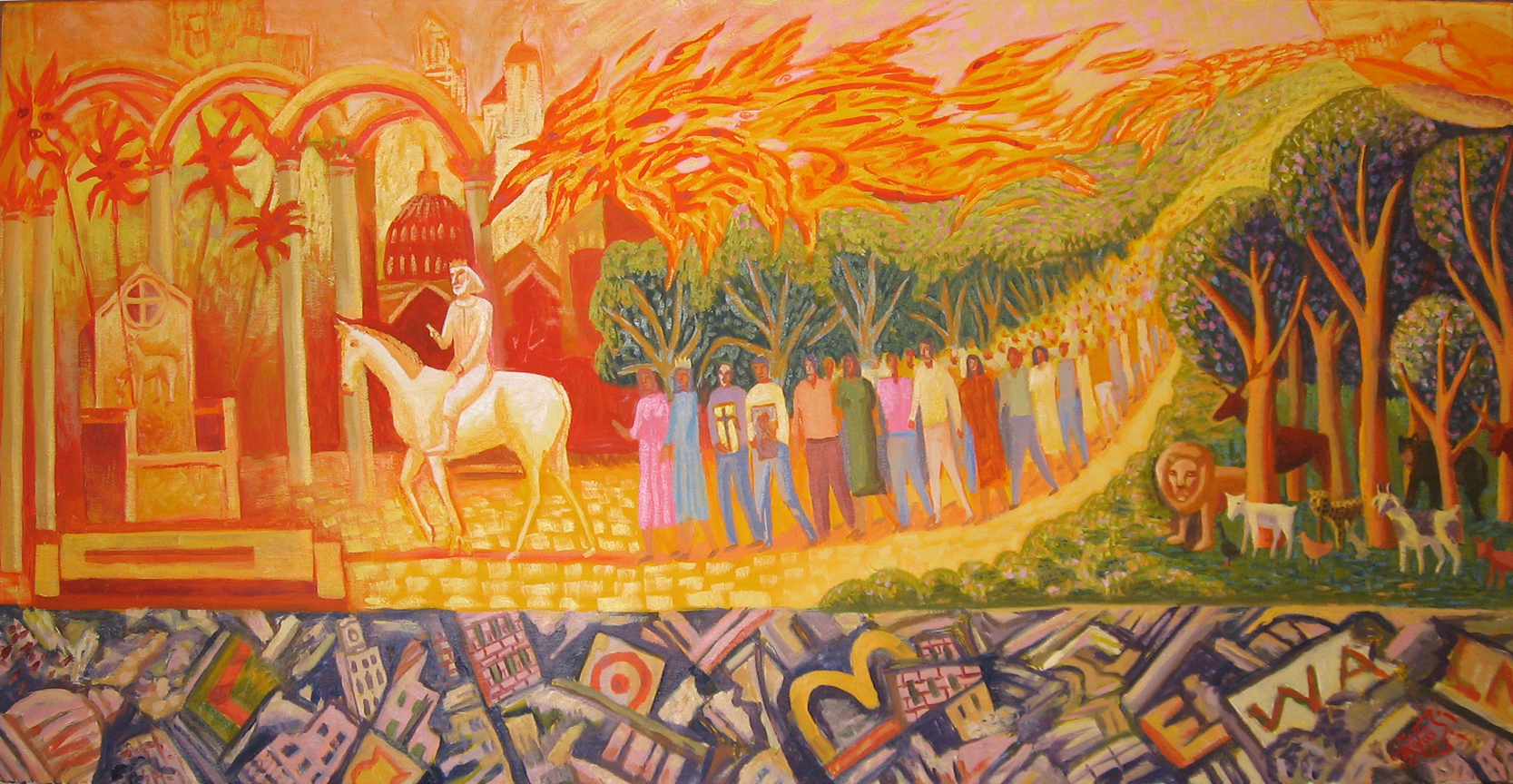
Jacques Richard Sassandra (French, 1932–), Le buisson ardent (The Burning Bush), late 1980s. Oil on canvas, 110 × 272 cm. Collection of the artist.
Last year when I was corresponding with the artist Sassandra about the New Jerusalem collage from his Apocalypse series, he sent me some photos of this painted triptych on the same subject. It’s called The Burning Bush. When open, it’s about nine feet across, and it shows Christ as the Good Shepherd standing in the river of life, which waters the roots of the tree of life, whose leafy branches extend all around. This is a depiction of the new heaven and new earth described in the book of Revelation, with angels posted at its twelve gates. (See Advent, Day 15.)
The image references other biblical passages as well. The lion and the lamb lying down together in peace—the lion having given up its carnivorous diet to eat straw instead of fellow creatures—is an allusion to the messianic kingdom prophesied in Isaiah 11. And the French inscription on the arch above Jesus and the bottom gatepost is the text of John 10:9: Je suis la porte. Si quelqu’un entre par moi il sera sauvé. (“I am the gate. If anyone enters by me, he will be saved.”) Jesus is the doorway through which we enter this glorious future.
Sassandra, Le buisson ardent (central panel)
It’s worth quoting the John passage in full, which rings loudly with the theme of sacrifice:
So again Jesus said to them, “Very truly, I tell you, I am the gate for the sheep. All who came before me are thieves and bandits, but the sheep did not listen to them. I am the gate. Whoever enters by me will be saved and will come in and go out and find pasture. The thief comes only to steal and kill and destroy. I came that they may have life and have it abundantly.
“I am the good shepherd. The good shepherd lays down his life for the sheep. The hired hand, who is not the shepherd and does not own the sheep, sees the wolf coming and leaves the sheep and runs away, and the wolf snatches them and scatters them. The hired hand runs away because a hired hand does not care for the sheep. I am the good shepherd. I know my own, and my own know me, just as the Father knows me, and I know the Father. And I lay down my life for the sheep. I have other sheep that do not belong to this fold. I must bring them also, and they will listen to my voice. So there will be one flock, one shepherd. For this reason the Father loves me, because I lay down my life in order to take it up again. No one takes it from me, but I lay it down of my own accord. I have power to lay it down, and I have power to take it up again. I have received this command from my Father.”
Two of the seven I AM statements that Jesus speaks in the Gospel of John are present here: “I AM the gate of the sheepfold,” “I AM the good shepherd.” The others are “I AM the bread of life,” “I AM the light of the world,” “I AM the resurrection and the life,” “I AM the way, the truth, and the life,” and “I AM the true vine.” Biblical scholars say that with these statements, Jesus was ascribing to himself the divine, if somewhat cryptic name that God disclosed to Moses in Exodus 3:14–15: I AM THAT I AM.
Sassandra, Le buisson ardent (closed)
Sassandra makes that connection in this triptych. When the wings are closed, the outer scene shows Moses before the burning bush, his shoes reverently removed, his arms raised in worship before the fiery Voice that calls him. Inscribed along the sides of these two exterior panels is Saint, saint, saint est le seigneur de l’univers! Toute la terre est pleine de sa gloire! (“Holy, holy, holy is the Lord of the universe! All the earth is full of his glory!”) (Isa. 6:3).
The artwork thus links Yahweh’s revelation to Moses as the great I AM with Christ’s apocalyptic appearing at the end of time. The wispy leaves on the tree of life on the interior panels appear as little flames, and Christ stands among them, the full revelation of God, who beckons us.
“Adonai” is one of the seven traditional O Antiphons, titles for Christ taken from the Old Testament and turned into short Advent refrains. It’s a Hebrew word that translates to “my Lord,” and it was used by the ancient Israelites to refer to God, as they regarded the divine name, I AM, as too sacred to be uttered. The “O Adonai” antiphon of Christian tradition recognizes that the God who spoke to Moses in the burning bush is the same God who speaks through Christ, and it entreats God to come deliver us from bondage, as he did the Israelites from Egypt:
O Adonai and ruler of the house of Israel, who appeared to Moses in the burning bush and gave him the Law on Sinai: come with an outstretched arm and redeem us.
Sassandra’s Burning Bush shows that deliverance—a landscape of liberation, where Christ, having given himself, holds us at rest in his arms and we are refreshed unceasingly by living water, and all creation sings God’s glory.
LISTEN: “All Glory Be to Christ” | Words by Dustin Kensrue, 2012 | Scottish folk melody, probably 17th century | Arranged and performed by The Petersens on Christmas with the Petersens, 2020
Should nothing of our efforts stand No legacy survive Unless the Lord does raise the house In vain its builders strive [Ps. 127:1] To you who boast tomorrow’s gain Tell me, what is your life? A mist that vanishes at dawn [James 4:13–14] All glory be to Christ!
Refrain: All glory be to Christ our king! All glory be to Christ! His rule and reign we’ll ever sing, All glory be to Christ!
His will be done, his kingdom come On earth as is above Who is himself our daily bread [Matt. 6:10–11] Praise him, the Lord of love Let living water satisfy The thirsty without price [Isa. 55:1; John 4:10; 7:37; Rev. 21:6] We’ll take a cup of kindness yet All glory be to Christ! [Refrain]
When on the day the great I Am [Exod. 3:14] The faithful and the true [Rev. 19:11] The Lamb who was for sinners slain [Rev. 5:6] Is making all things new [Rev. 21:5] Behold our God shall live with us And be our steadfast light [Rev. 22:5] And we shall e’er his people be All glory be to Christ! [Refrain]
This traditional folk melody from Scotland is one of the most recognizable in the world. It is most associated with Robert Burns’s Scots poem “Auld Lang Syne,” a staple of New Year’s Eve parties. As the old year passes, it’s common to pause and consider what passes away with it and what will last, and to cast a renewed vision for the new year.
In December 2011 the American singer-songwriter Dustin Kensrue [previously] was inspired to write new lyrics for the tune AULD LANG SYNE. “The idea is that—especially at the beginning of the new year—we would dedicate all our efforts to bringing glory to Jesus Christ,” he said, “to acknowledge that anything else would be of no value, and to celebrate our redemption in him.” Kensrue’s lyrics are full of biblical allusions, whose chapter-verse references I’ve cited in brackets above.
Kings Kaleidoscope recorded “All Glory Be to Christ,” sung by Chad Gardner, on their Christmas EP Joy Has Dawned (2012). The music video was filmed on a carousel at a fair, a metaphor for the passage of time. The years go round and round as our world revolves around the sun. When the ride stops, will we have ridden wisely and well?
Rather than feature the original recording, I’ve chosen to feature a more recent version by The Petersens, a family bluegrass band from Branson, Missouri, because I absolutely love how they have reharmonized it, including starting it in a minor key. Ellen Petersen Haygood sings lead, and harmonizing vocals are supplied by her siblings Matt Petersen and Katie Petersen and her mom, Karen Petersen.
For as the lightning comes from the east and flashes as far as the west, so will be the coming of the Son of Man.
—Matthew 24:27
Then I saw heaven opened, and there was a white horse! Its rider is called Faithful and True, and in righteousness he judges and makes war. His eyes are like a flame of fire, and on his head are many diadems; and he has a name inscribed that no one knows but himself. He is clothed in a robe dipped in blood, and his name is called The Word of God.
—Revelation 19:11–13
LOOK: Jesus Rides a White Horse by James B. Janknegt
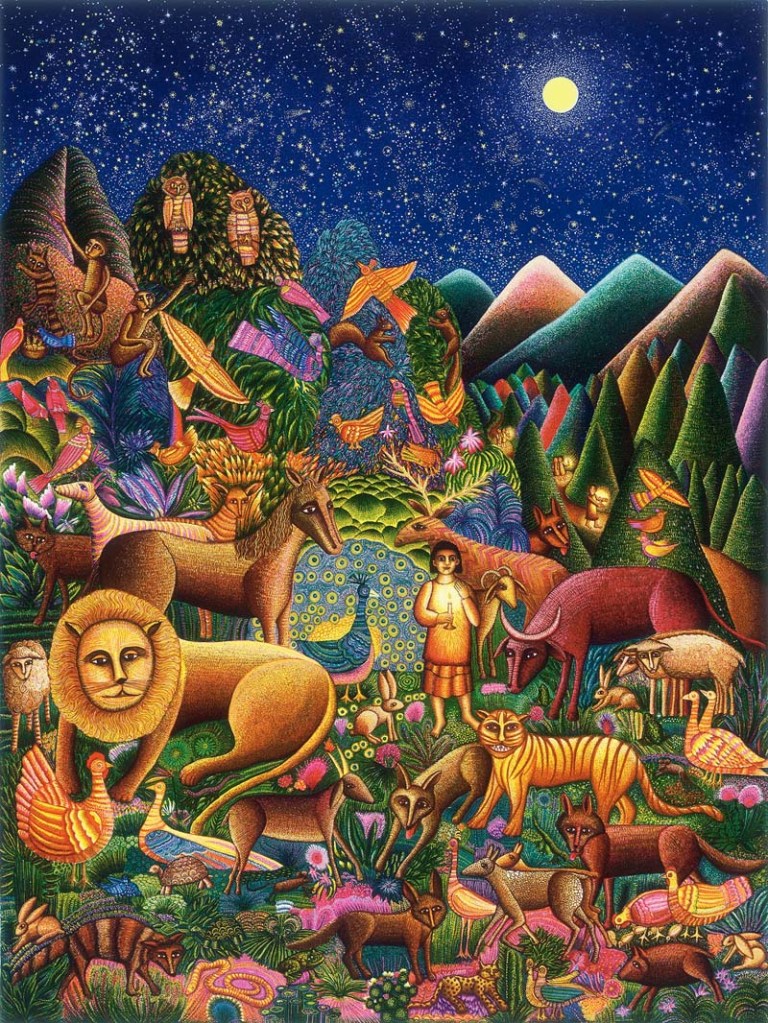
LOOK: John August Swanson (American, 1938–), Peaceable Kingdom, 1994. Serigraph, edition of 250, 30 × 22 1/2 in.
John August Swanson, a Los Angeles–based artist of Mexican and Swedish heritage, says his style is “influenced by the imagery of Islamic and medieval miniatures, Russian iconography, the color of Latin American folk art, and the tradition of Mexican muralists.” In this forty-seven-color serigraph (limited-edition screen print), monkeys, frogs and lizards, mice and rabbits, owls and peacocks, a pig and a turtle accompany the wolves, lambs, leopard, goat, lion, ox, and snake of Isaiah 11, a vision of creation restored and at peace.
O day of peace that dimly shines Through all our hopes and prayers and dreams Guide us to justice, truth, and love Delivered from our selfish schemes
May swords of hate fall from our hands Our hearts from envy find release Till by God’s grace our warring world Shall see Christ’s promised reign of peace
Then shall the wolf dwell with the lamb Nor shall the fierce devour the small As beast and cattle calmly graze A little Child shall lead them home
Then the meek shall learn to love All creatures find their true accord The hope of peace shall be fulfilled For all the earth shall know the Lord
Congrats to the three winners of the Wounded in Spirit book giveaway. Thank you all for entering. I will be giving away another free book, from Eerdmans, sometime in the next month or two, so stay tuned!
+++
A bear and a cow share a snack of grass, and a child pets a leopard without consequence, in this charming little detail from Edward Hicks’s 1834 Peaceable Kingdom in the National Gallery of Art.
ADVENT ART VIDEO:The Peaceable Kingdom by Edward Hicks: This year I was invited to make a guest contribution to art historian James Romaine’s annual Art for Advent video series on YouTube. For 2018, he is spotlighting paintings from the National Gallery of Art in Washington, DC, my neck of the woods. I chose to write about The Peaceable Kingdomby the nineteenth-century Quaker preacher-artist Edward Hicks, which visualizes the prophecy of Isaiah 11 about predators and prey lying down together in friendship, and a little child leading them. But Hicks’s image of “peace on earth” is not as simplistic as it may seem at first; there is tension. See the video below, and be sure to check back on the Seeing Art History YouTube channel next week for subsequent videos. For more on Hicks and this favorite subject of his, see this post of mine from 2016. Thank you to Rain for Roots for letting me use their wonderfully playful musical rendition of Isaiah 11 from their family Advent album Waiting Songs.
+++
PODCAST EPISODE: “Mary Poppins,”Technicolor Jesus, episode 49: “If you want a movie that really shows the foolishness of the gospel next to what the world thinks is wise and is turned on its head . . . if you want a movie about the great reversals that are present in the kingdom of God, you don’t need to look any further than MaryPoppins,” says Pastor Becca Messman. The oppressive orderliness booming over people’s lives “is contrasted with something unpredictable and joyful—the wind, dancing chimney sweeps, and this beautiful bird woman giving her crumbs away.” The movie is about what happens when both adults and kids relax into joy.
It’s also about charity. Last year Niles Reddick wrote an article about Mary Poppins as the first female Christ figure in American film, and “Feed the Birds” as a “song-parable” that serves as the linchpin of the movie. While the world would have us pile up our coins in a bank vault, Jesus calls us, against the world’s wisdom, to give them away.
I love this movie. My mom says that from a young age she would play it for me, and I would sit mesmerized for the entire 139 minutes. I remember trying to soothe my baby brother many a time by singing “Let’s Go Fly a Kite.” Once we were elementary school–age, we would eagerly await the “Step in Time” scene, at which point we would rush to grab brooms from the garage, using them as props as we danced along with Dick Van Dyke—which sometimes ended in injury . . . Now as an adult, I can appreciate some of the movie’s deeper themes, and pick up on its resonances with the upside-down nature of Christ’s kingdom. Can’t wait to see the new Mary Poppins Returns next month!
+++
WRITING CONTEST FOR UK TEENS:“Write on Art”: In an effort to get teenagers learning and writing about art, Art UK and the Paul Mellon Centre for Studies in British Art are co-sponsoring “Write on Art” for the second year in a row. Any kid between the ages of 15 and 18 who is enrolled in a UK school (Years 10–13) is eligible to enter to win up to £500 by submitting a short personal write-up (400–600 words) on any artwork in the UK’s national collection. “With a disturbing decline in the teaching of art and art history in schools, our Write on Art competition . . . is designed to highlight the importance of art as an academic discipline.” The website includes tips on how to write about art, including where to find relevant vocabulary and other resources. All entries must be submitted by January 31, 2019.
+++
BOOK REVIEW:On Reading Well: Finding the Good Life through Great Books by Karen Swallow Prior, reviewed by Nick Roark: In September, Brazos Press released Prior’s latest book on reading widely and well, which received a starred review and a Best Book of 2018 in Religion from Publishers Weekly. I’m a big fan of her previous Booked: Literature in the Soul of Me, so I’m really looking forward to this one. “Covering authors from Henry Fielding to Cormac McCarthy, Jane Austen to George Saunders, and Flannery O’Connor to F. Scott Fitzgerald, Prior explores some of the most compelling universal themes found in the pages of classic books, helping readers learn to love life, literature, and God through their encounters with great writing. In examining works by these authors and more, Prior shows why virtues such as prudence, temperance, humility, and patience are still necessary for human flourishing and civil society.”
Purchase the book between now and Christmas, and receive a piece of free downloadable art by Ned Bustard. Instructions are on her website, https://karenswallowprior.com/.
+++
NEW ADVENT/CHRISTMAS ALBUMS
Watches of the Night by Matt Searles: “Christian believers are like watchmen, longing to see the first rays of dawn. We long for the darkness of this world to be finally taken away, and the light of Christ to rise in all its splendour. This album is intended to help us as we wait; to lament the brokenness of this world, but to look to the riches of that which is to come. It is an album of longing, but also of profound hope. Light has dawned. Christ has been raised. But we await the full revelation of him in glory. We are still watchmen. Still waiting.
“This is not a loud album. It is one I hope you might be able to listen to if you lie awake unable to sleep, as I so often find the case. I pray it is an album that might help you – like David in Ps 63:6 – to meditate on God in the watches of the night. An album that will orient you to the future, and help you increasingly be someone whose mind is set on the city that is to come. Songs to help you fix your eyes on Christ, and long above all else for his return when we see him face to face.”
After the Longest Night: Songs for Advent, Christmas, and Epiphanyby Steve Thorngate: These fourteen songs are a mix of originals, including settings of the Lukan Canticles (the songs of Zechariah, Mary, and Simeon), and traditionals: “Creator of the Stars of Night,” “What Child Is This,” “Bright Morning Stars,” and “Let the Light of Your Lighthouse Shine on Me.” Best $7 I’ve spent in a while! (Purchase even includes lead sheets.)
Horace Pippin (American, 1888–1946), Holy Mountain III, 1945. Oil on canvas, 25 1/4 × 30 1/4 in. (64.6 × 76.8 cm). Hirshhorn Museum, Washington, DC. Photo: Victoria Emily Jones.
In honor of Martin Luther King Jr. Day, I’d like to highlight the work of one who shared Dr. King’s vision, but whose microphone was a canvas.
The painting Holy Mountain III by self-taught African American artist Horace Pippin depicts the peaceable kingdom that’s prophesied about in the biblical book of Isaiah, chapter 11. When the Messiah establishes his rule on earth, writes the prophet,
The wolf shall dwell with the lamb,
and the leopard shall lie down with the young goat,
and the calf and the lion and the fattened calf together;
and a little child shall lead them.
The cow and the bear shall graze;
their young shall lie down together;
and the lion shall eat straw like the ox.
The nursing child shall play over the hole of the cobra,
and the weaned child shall put his hand on the adder’s den.
They shall not hurt or destroy
in all my holy mountain;
for the earth shall be full of the knowledge of the Lord
as the waters cover the sea. (vv. 6–9)
In spring 2013, this painting was featured in the exhibition “Ashe to Amen: African Americans and Biblical Imagery,” curated by the now-defunct Museum of Biblical Art in New York City. A MOBIA commentator pointed out the shadows of violence in the forest: a lynched black man (left), planes dropping bombs above a graveyard of crosses (center), and two armed soldiers and a tank (right). Yet, the commentator writes, Pippin chose to foreground the Holy Mountain, demonstrating his hope that such a scene would one day be actualized: “Rather than turning a blind eye to the painful realities of a sad and violent world, Pippin presents a vision of mankind moving out of the shadows and into the brilliant light of a peaceful clearing.” Continue reading “MLK, Pippin, and the Holy Mountain”→
The wolf shall dwell with the lamb, and the leopard shall lie down with the young goat, and the calf and the lion and the fattened calf together; and a little child shall lead them. The cow and the bear shall graze; their young shall lie down together; and the lion shall eat straw like the ox. The nursing child shall play over the hole of the cobra, and the weaned child shall put his hand on the adder’s den. They shall not hurt or destroy in all my holy mountain; for the earth shall be full of the knowledge of the Lord as the waters cover the sea.
This passage describing the peaceable kingdom of the Messiah was, according to biblical scholar John F. A. Sawyer, popularized by the Quaker preacher-artist Edward Hicks, born in Bucks County, Pennsylvania, in 1780. He painted it sixty-two times during his career: predators and prey lying down together in harmony, and a little rosy-cheeked child—the Christ child—leading them.
Edward Hicks (American, 1780–1849), Peaceable Kingdom, 1834. Oil on canvas, 29 5/16 × 35 1/2 in. National Gallery of Art, Washington, DC.
When Edward was just eighteen months old, his mother died. His father was unable to support him financially, so he sent him to board with family friends David and Elizabeth Twining, who exposed him to Quakerism. From ages thirteen to twenty Edward lived with local coach maker William Tomlinson, for whom he worked as an apprentice, developing a talent for ornamental painting. When his apprenticeship ended in 1800, he went into business for himself, now painting with decorative motifs not only carriages but also signs, furniture, and household objects. Some of his signboard compositions would later prompt commissions for easel paintings.
During this time Edward was attending religious meetings with increasing regularity, becoming an official member of the Society of Friends in 1803. But he encountered criticism from many of his fellow Friends for his choice of vocation, which was at odds with the Quaker values of simplicity and utility. Painting is a worldly indulgence, they said. Taking their rebukes to heart, Edward gave up painting for a time and tried his hand at farming, but this venture was unsuccessful.
Edward struggled to reconcile his love of painting with his faith; he was passionate about both. In 1811, at age thirty-one, he set up a painting shop in Newtown, Pennsylvania, and also became a minister, which meant that he was often called away to other states to preach. Quaker ministers were not paid for their services, so it was necessary for Edward to maintain a source of income to support his wife and four (soon to be five) children.
“Of all the types of paintings Edward produced during his lifetime, none was repeated as often or with greater attention to change and refinement than the Kingdom pictures,” writes Carolyn J. Weekly in The Kingdoms of Edward Hicks, the catalog for the major exhibition she organized in 1999 for the Abby Aldrich Rockefeller Folk Art Museum in Williamsburg, Virginia. Edward pursued this subject not for commercial reasons (records suggest that he gave the Kingdom paintings as gifts to friends and family) but to express his yearning for unity and peace, especially in light of the 1827 Hicksite-Orthodox schism within the Society of Friends, the first in the denomination’s history. (Edward’s cousin Elias led the liberal faction that split from the mainstream.) His Kingdom paintings reference the schism through a blasted tree trunk, which doubles also as a reference to the “stump” of Jesse out of which Christ sprung up (Isaiah 11:1).
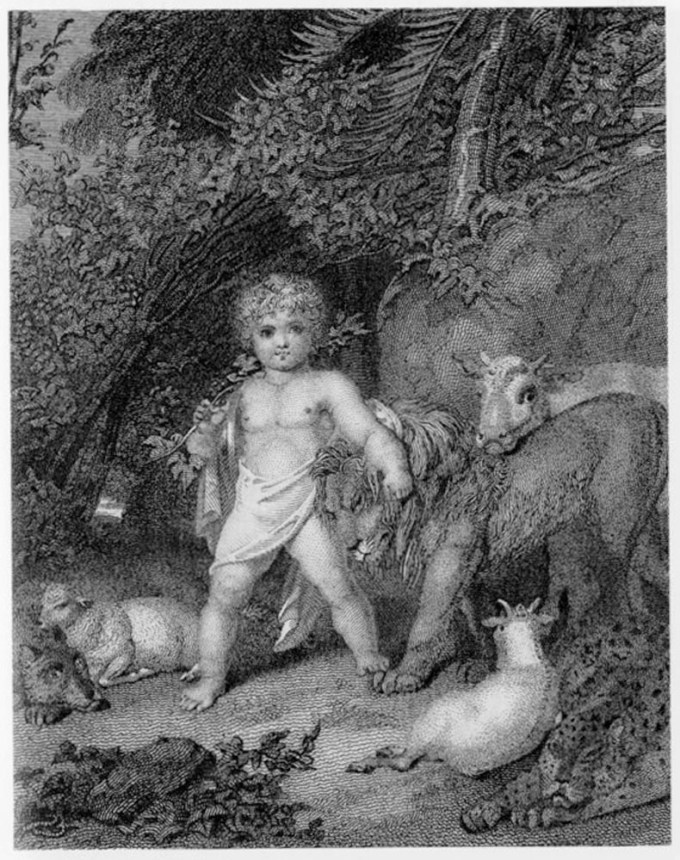
Only a few Peaceable Kingdom images before Hicks’s time have been documented worldwide, among them an early nineteenth-century engraving designed by Richard Westall. Hicks borrowed directly from Westall in his “Peaceable Kingdom of the Branch” compositions, replacing the Christ child’s loincloth with a little jumper suit fashionable among Friends at the time.
The Peaceable Kingdom of the Branch illustration by Richard Westall, from the collection of the Abby Aldrich Rockefeller Folk Art Center, Williamsburg, Virginia. Engraved by Charles Heath for The Holy Bible (London: White, Cochrane & Co., 1815).
Edward Hicks (American, 1780–1849), Peaceable Kingdom, 1822–25. Oil on canvas, 30 1/4 × 36 in. Mead Art Museum, Amherst College, Amherst, Massachusetts. The inscription on each of the corners reads, “INNOCENCE – MEEKNESS – LIBERTY.”
The Branch paintings are referred to as such because they show a child holding a grapevine, an allusion to both the fruit-bearing branch of the Tree of Jesse from Isaiah 11:1 and the blood of Christ that we partake of at the Lord’s Supper. Continue reading “The Peaceable Kingdoms of Edward Hicks”→







 Art & Theology