Bone chapel, anti-Nazi martyrs’ memorial, and contemporary stained glass at the Basilica of St. Ursula, Cologne

(All photos in this article are my own, taken either by me or my husband.)

I knew very little about the virgin martyr St. Ursula before visiting the basilica dedicated to her in Cologne, Germany, last month. She’s the patron saint of the city, where, according to hagiography, she was murdered sometime in the fourth century.

There’s no historical veracity to her story, which is why her name was removed from the Catholic calendar of saints when it was revised in 1969. But her feast day is still observed by many on October 21.
St. Ursula alabaster
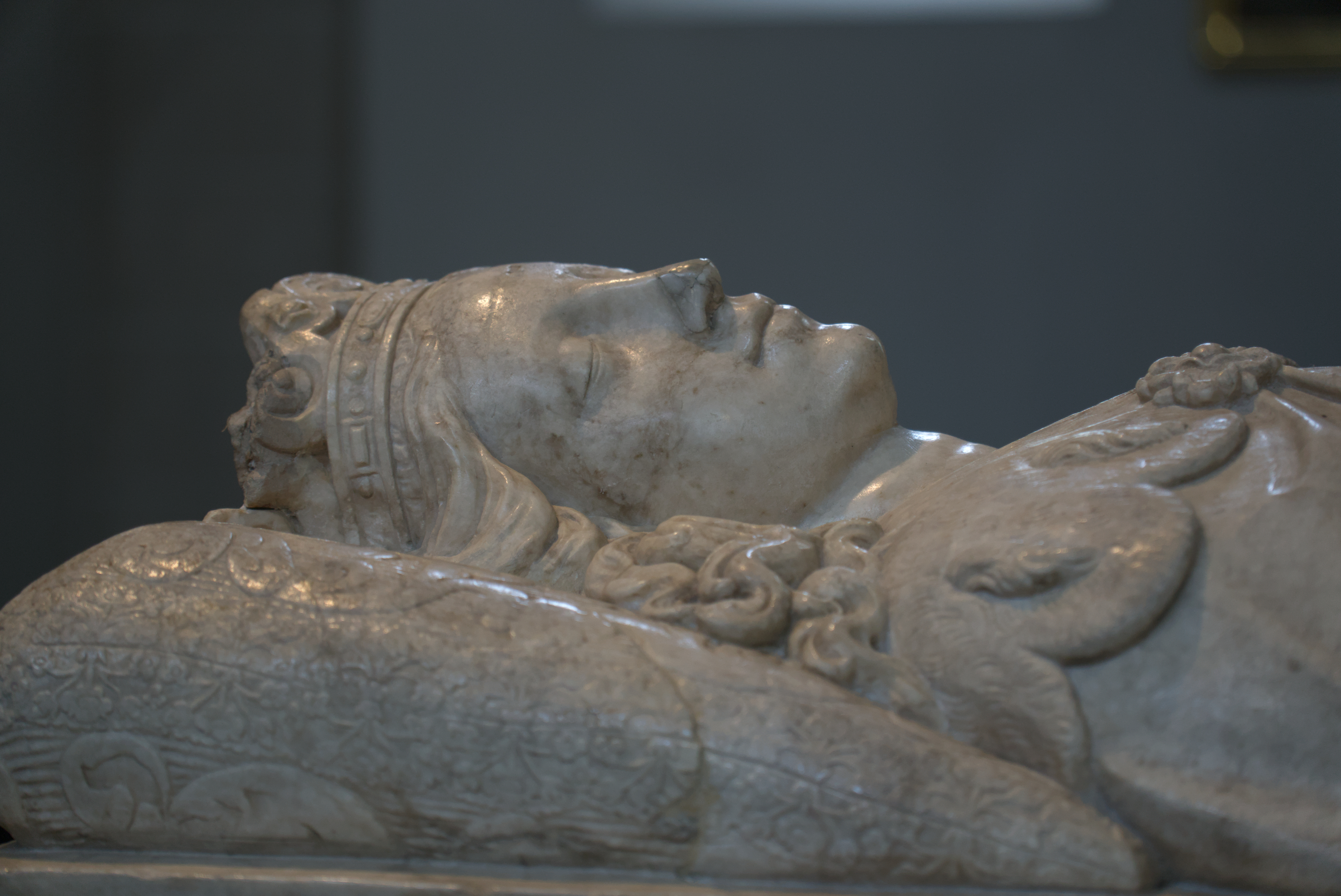
Johann T.W. Lentz, St. Ursula (detail), 1659. Alabaster. North transept, Basilica of St. Ursula, Cologne. This reclining figure of the saint lies over her Baroque tomb made of black marble.

As legend has it, Ursula was a Romano-British princess and a Christian. She was engaged to be married to a pagan prince. To delay the wedding, she successfully requested that she first be allowed to take a three-year pilgrimage to Rome, and that she be accompanied by eleven thousand virgins (a ridiculous number that was likely embellished from what was originally eleven). On their voyage, she converted all eleven thousand to the faith.

On their way back to Britain from Rome, they were traveling through Cologne when it was besieged by the Huns, a group of nomadic warriors from Central Asia. Ursula and her companions refused the soldiers’ sexual advances and were slaughtered as a result. One version of the legend says the women’s souls then formed a celestial army that drove out the Huns, saving Cologne.

The earliest possible reference to Ursula and company—though they are unnamed and unnumbered—is a stone plaque dated to 400. Now incorporated into the choir wall of the present Basilica of St. Ursula, it mentions a basilica restored on this site by the Roman senator Clematius to commemorate the “martyred virgins coming from the east, in fulfillment of a vow, . . . holy virgins [who] spilled their blood in the name of Christ.” This inscription not only provides the seed of what would become the Ursula legend; it’s also the earliest evidence of Christianity in Cologne, attesting to the presence of a church there in the fourth century.

It wasn’t until the tenth century that the name Ursula emerged, identified as the leader of the group of virgins, and that their number, which had previously ranged from two to thousands, became fixed at eleven thousand. The women were never officially canonized, but their veneration as saints grew immensely in the twelfth century after a large, late antique Roman cemetery was discovered in 1106 near the aforementioned Church of the Holy Virgins in Cologne during an excavation project to expand the city’s fortifications. The skeletal remains in the hundreds of graves were purported to be those of the martyred women (notwithstanding the presence of many men’s and children’s bones among them).

The discovery of these putative relics called for the rebuilding of the predecessor church to house them. Construction began in the second quarter of the twelfth century, and it’s that structure, with later renovations, refurbishments, additions, and (post–World War II) restorations and repairs, that stands today. The church was elevated to the status of minor basilica in 1920.
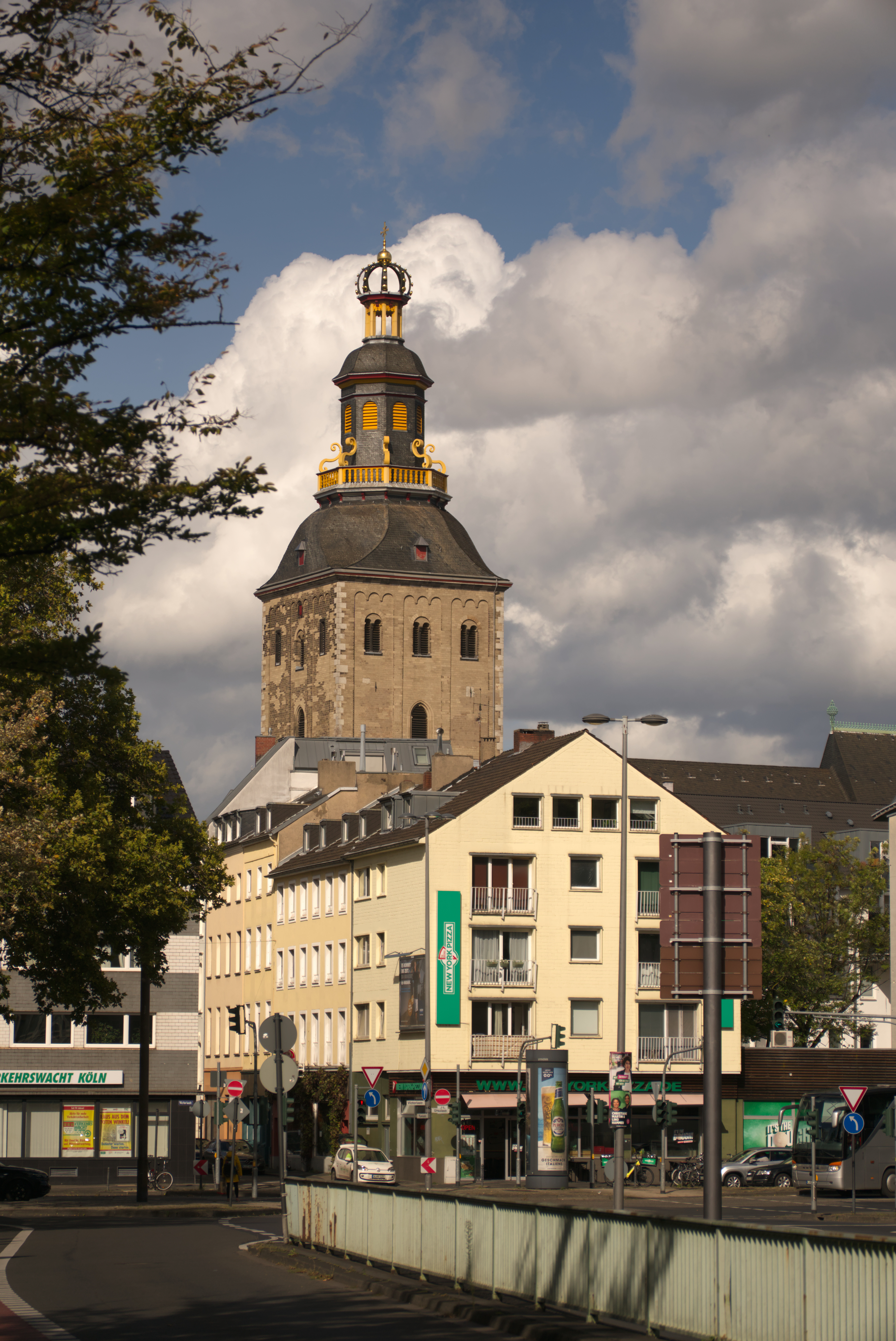
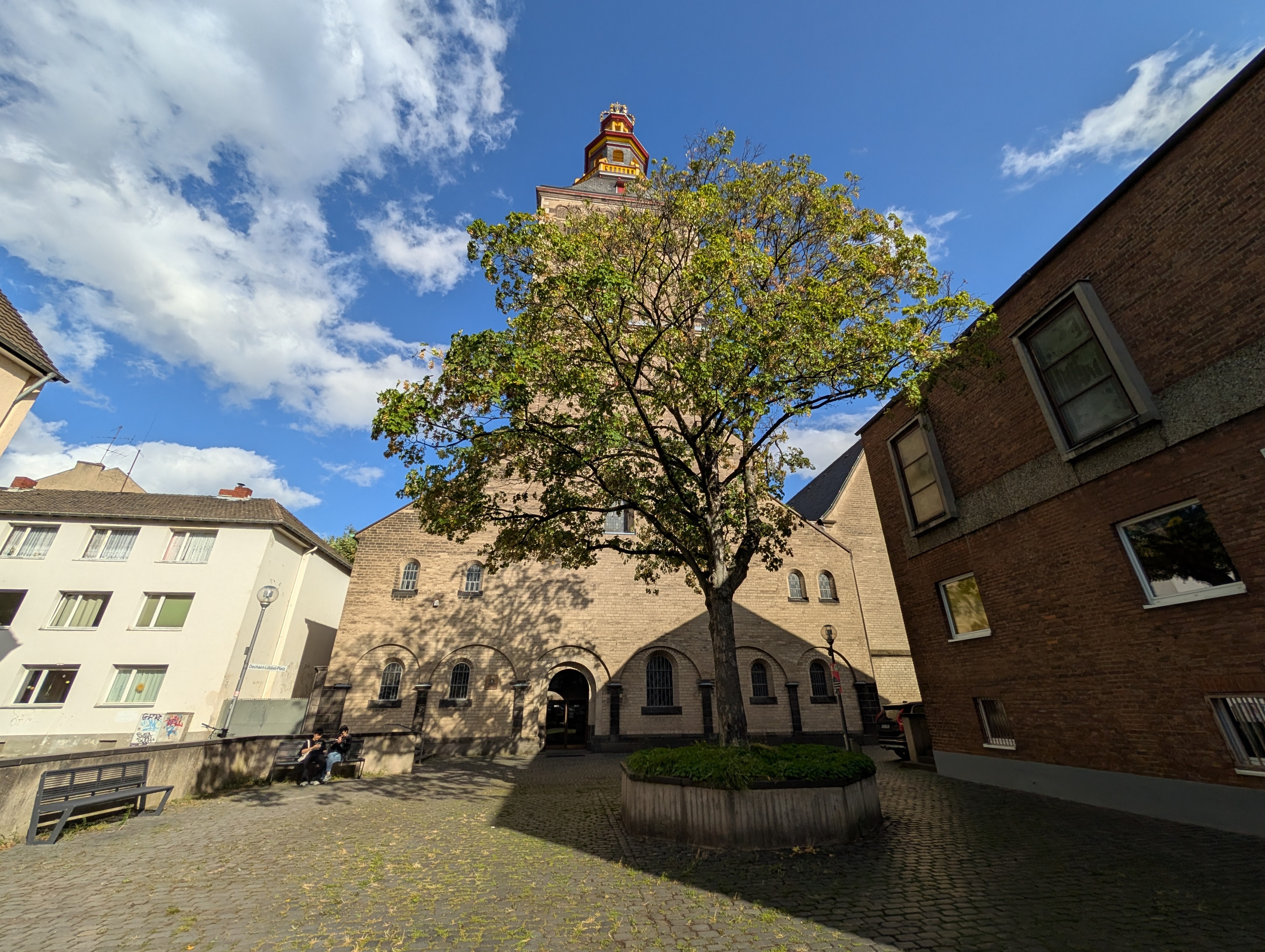
Basilica of St. Ursula, Cologne
West facade, where you enter

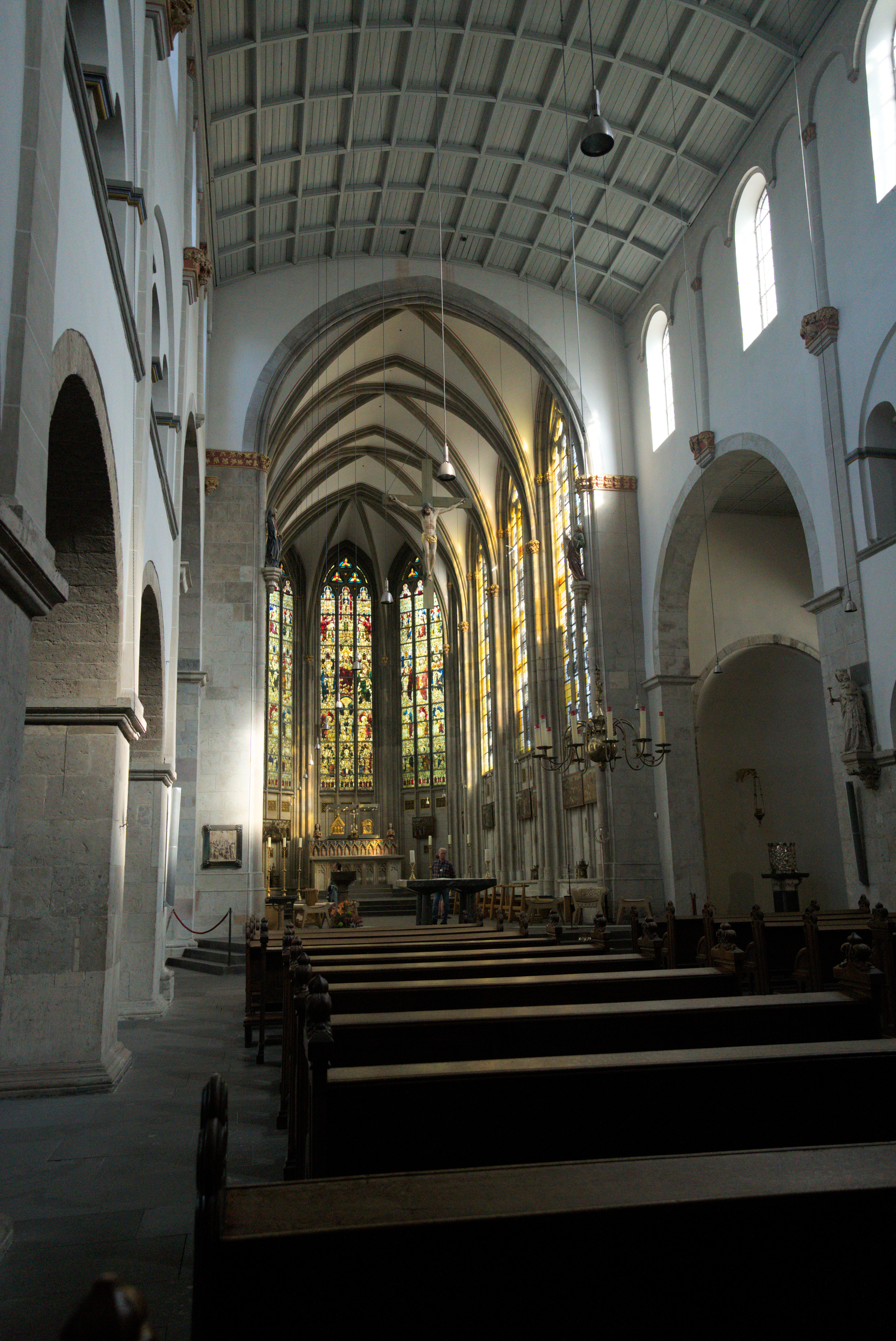
Basilica of St. Ursula
The nave and the main tower of the Basilica of St. Ursula are Romanesque, but the choir was rebuilt in the Gothic style.

Shrine altar
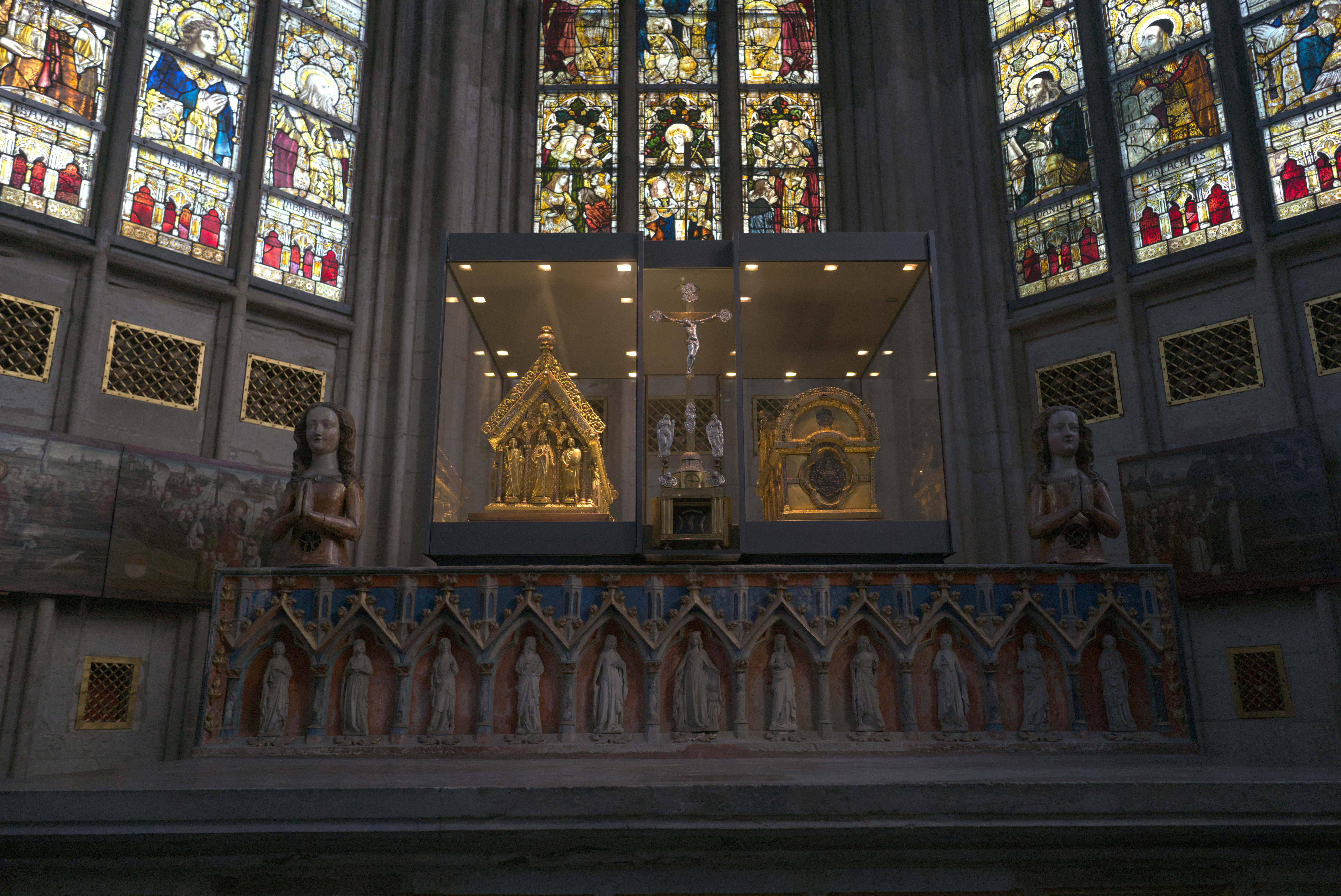
Shrine altar in the choir apse, containing the relics of Ursula, Etherius, and Hippolytus. Behind it are grilled reliquary niches and paintings of the Legend of St. Ursula from from the “long cycle” of 1456.

Chancel windows
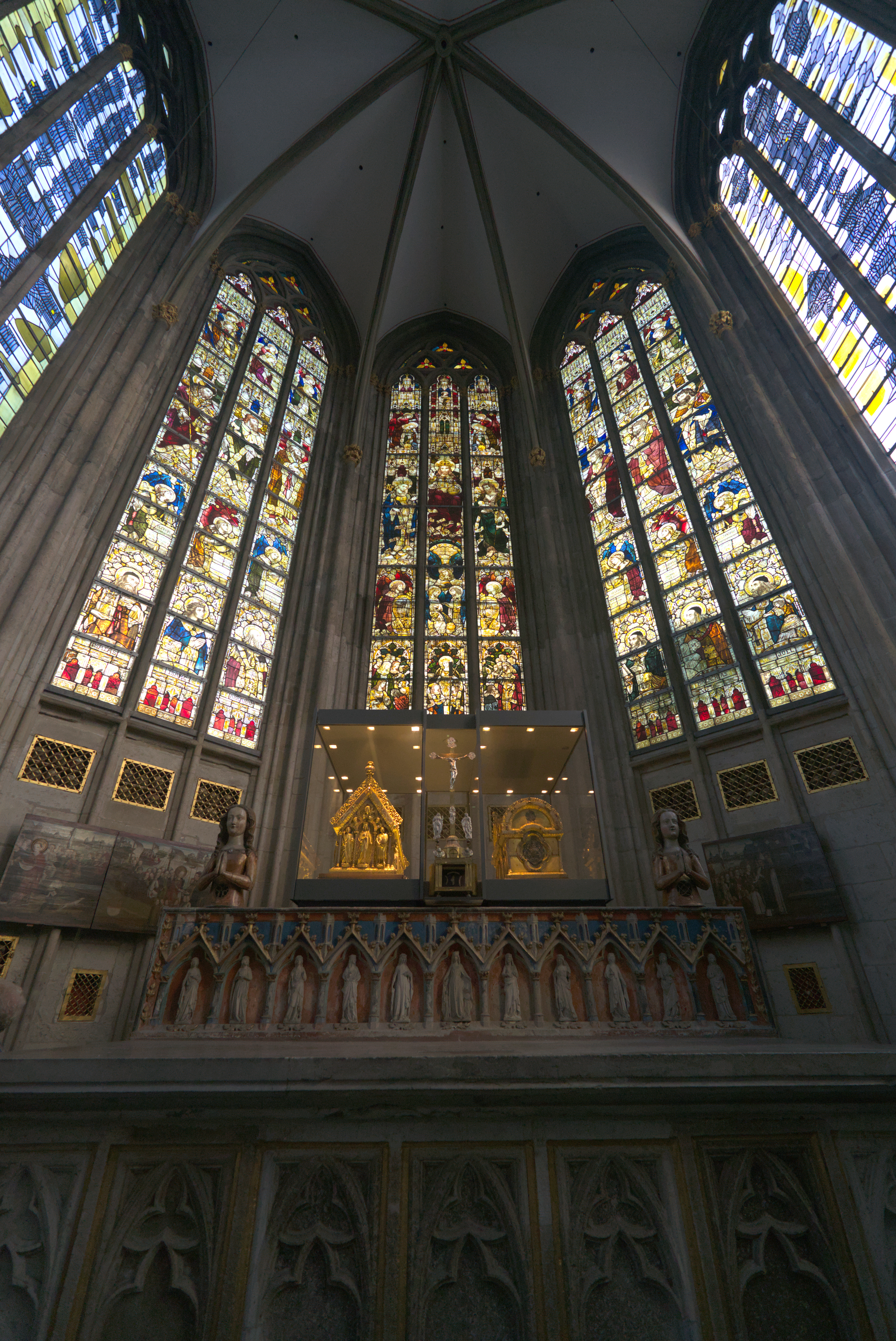
Chancel windows by Francis William Dixon, 1892. Left: St. James the Greater, St. Andrew, and St. Peter, accompanied by angels; lower register: Isaiah, Isaac, and Abraham. Center: Christ enthroned, with Mary and St. John the Baptist (Deesis) at his side; lower register: St. Ursula of Cologne with her companions. Right: St. James the Lesser, St. Matthew, and St. Thomas, accompanied by angels; lower register: Daniel, Malachi, and Joel.

The reason the Basilica of St. Ursula was on my list of stops was I wanted to see its so-called Golden Chamber.

The Golden Chamber

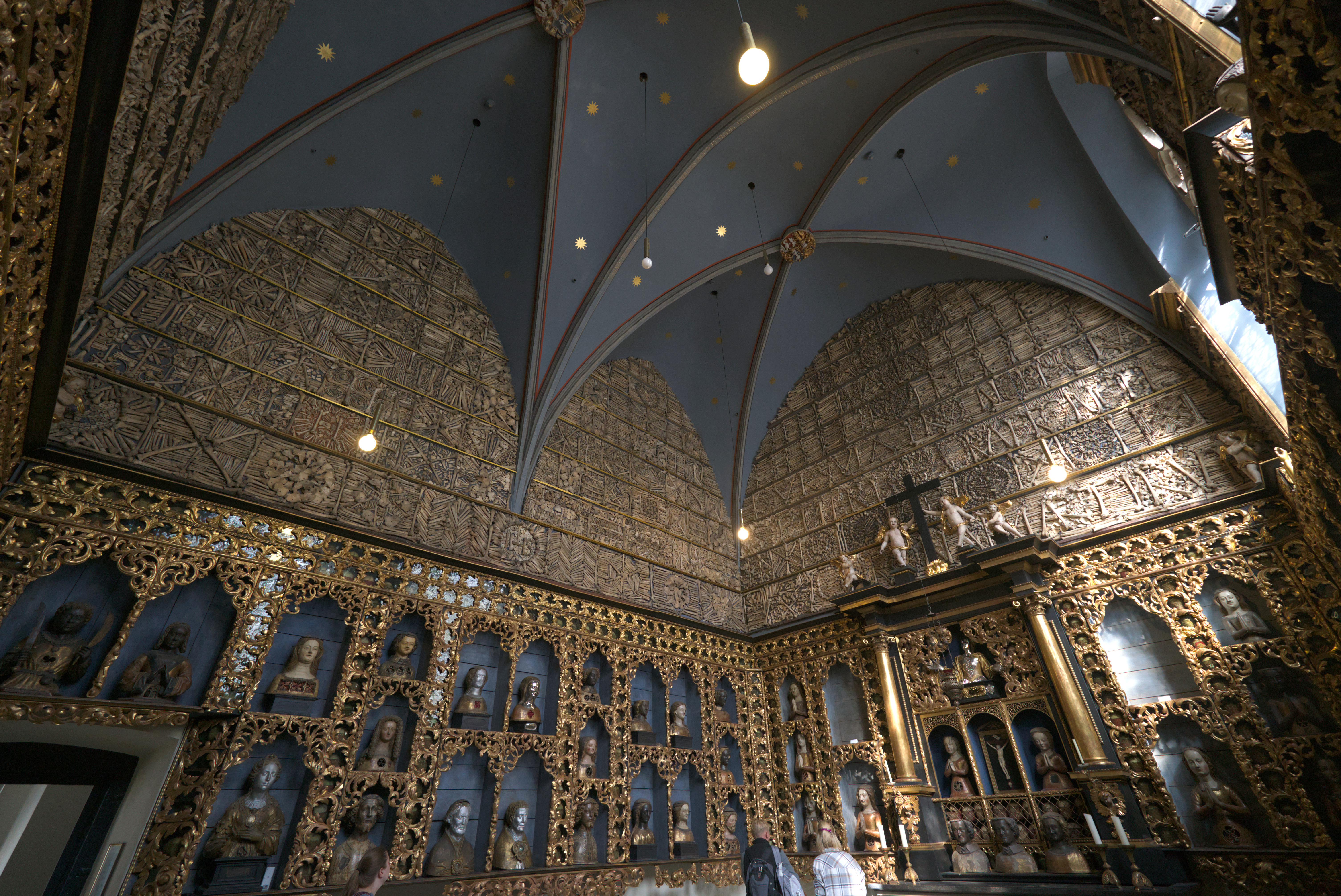
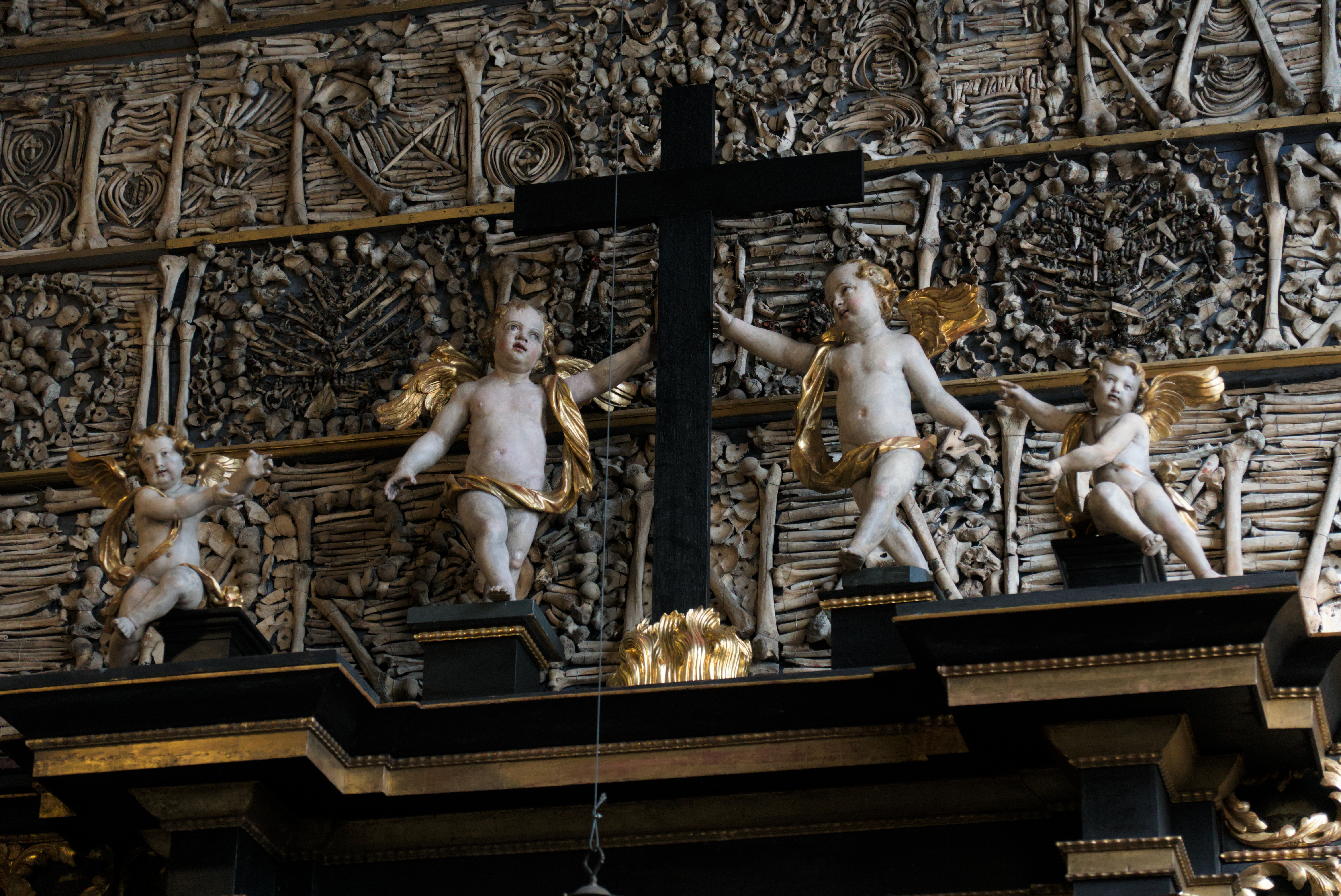
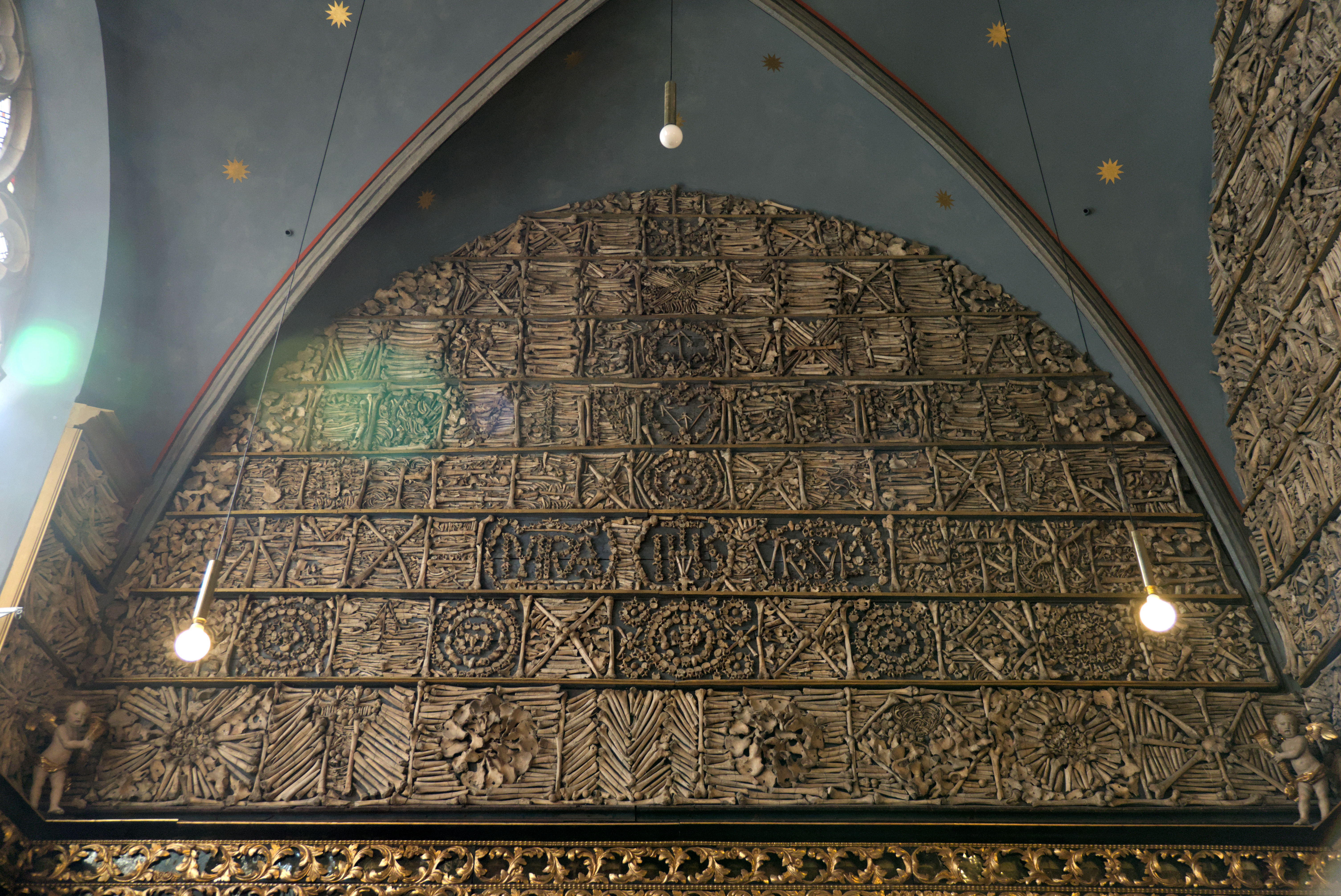
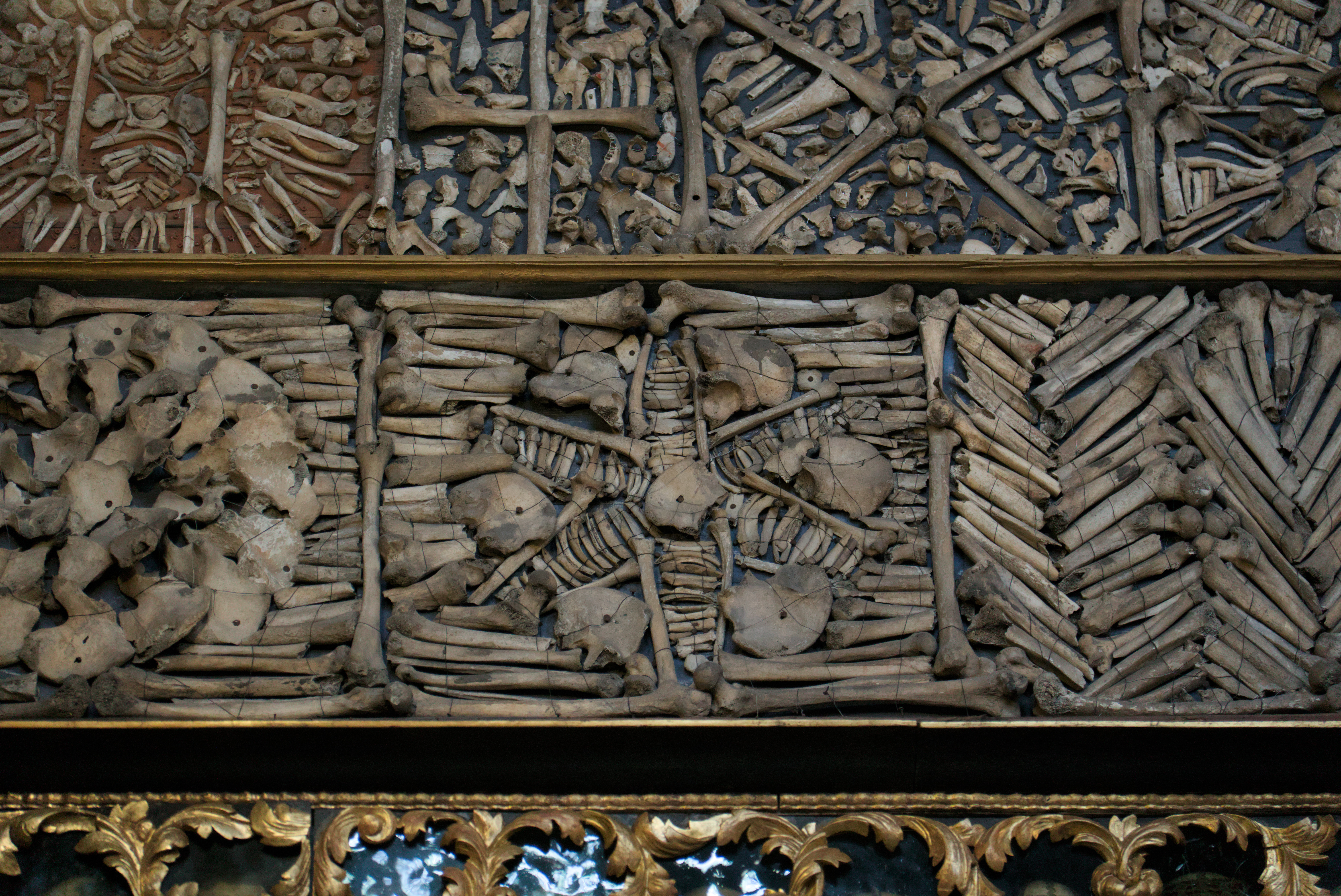
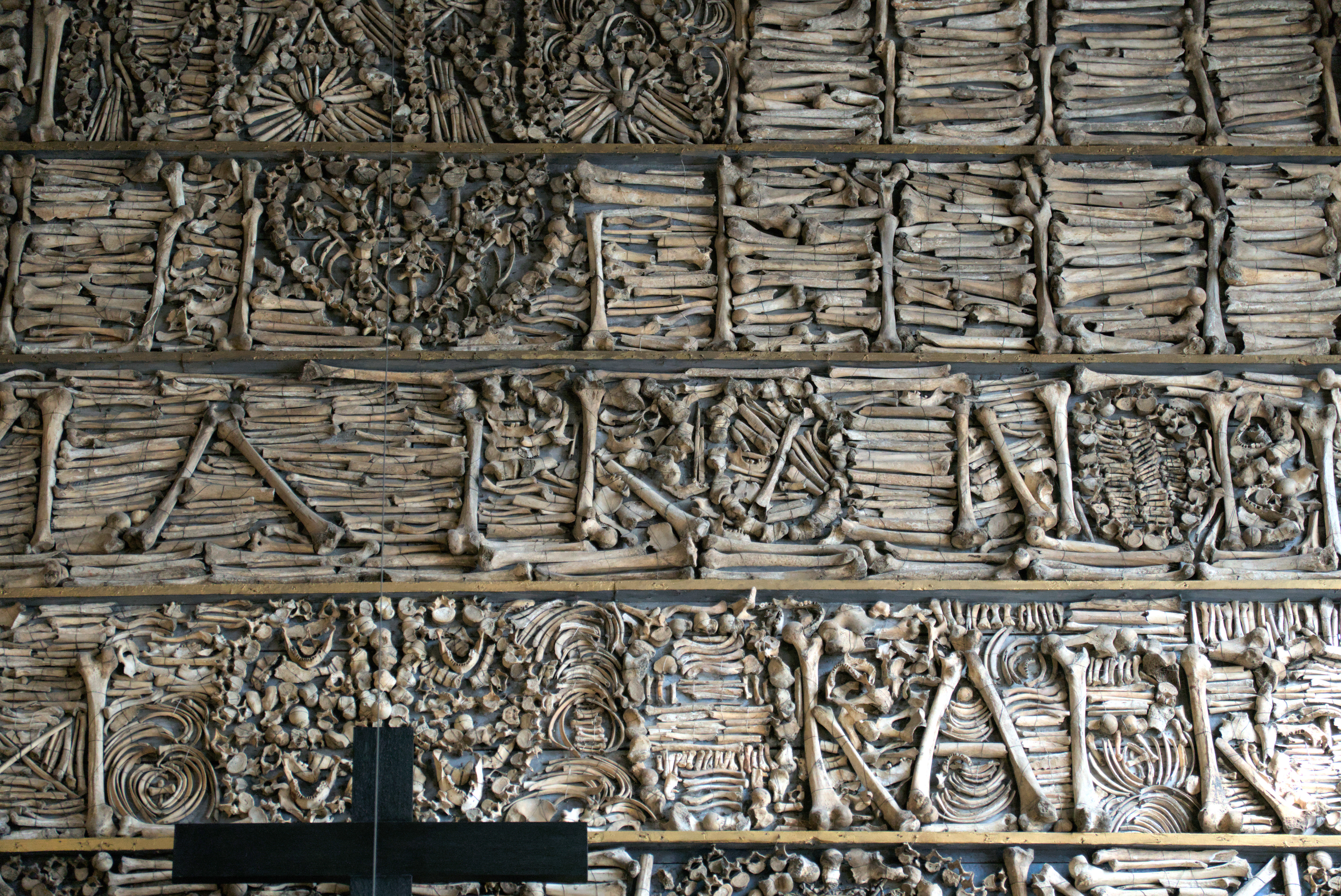
The largest ossuary north of the Alps, the Goldene Kammer (Golden Chamber) is decorated with the bones of, allegedly, St. Ursula and her eleven thousand travel mates, which are artfully arranged across the walls in geometric patterns, rosettes, and even words! Unlike most other relic displays I had seen before, where the relics are kept in some kind of encasement and usually only partially visible, this one puts many of the bones right out in the open, making the whole room a walk-in reliquary.
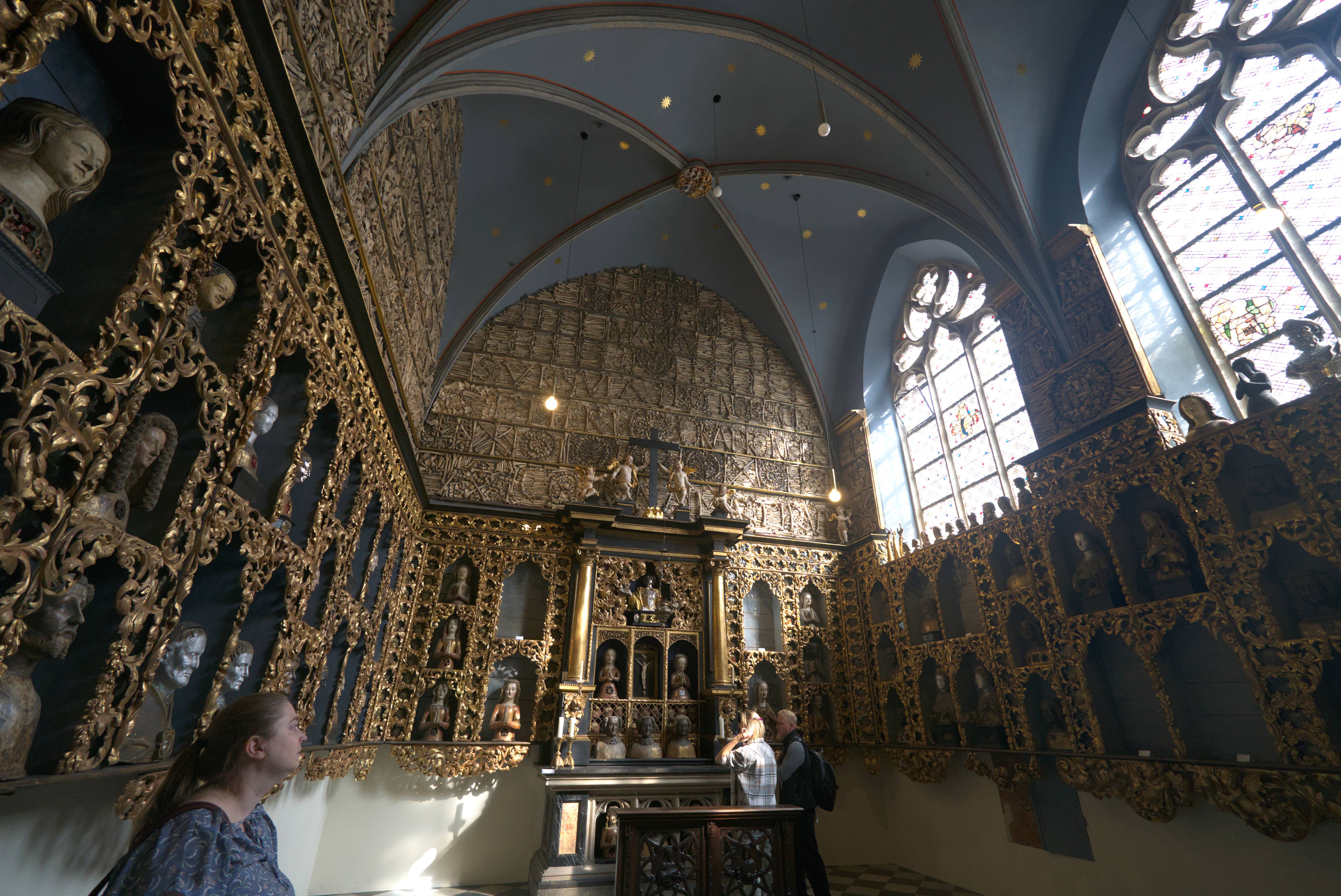
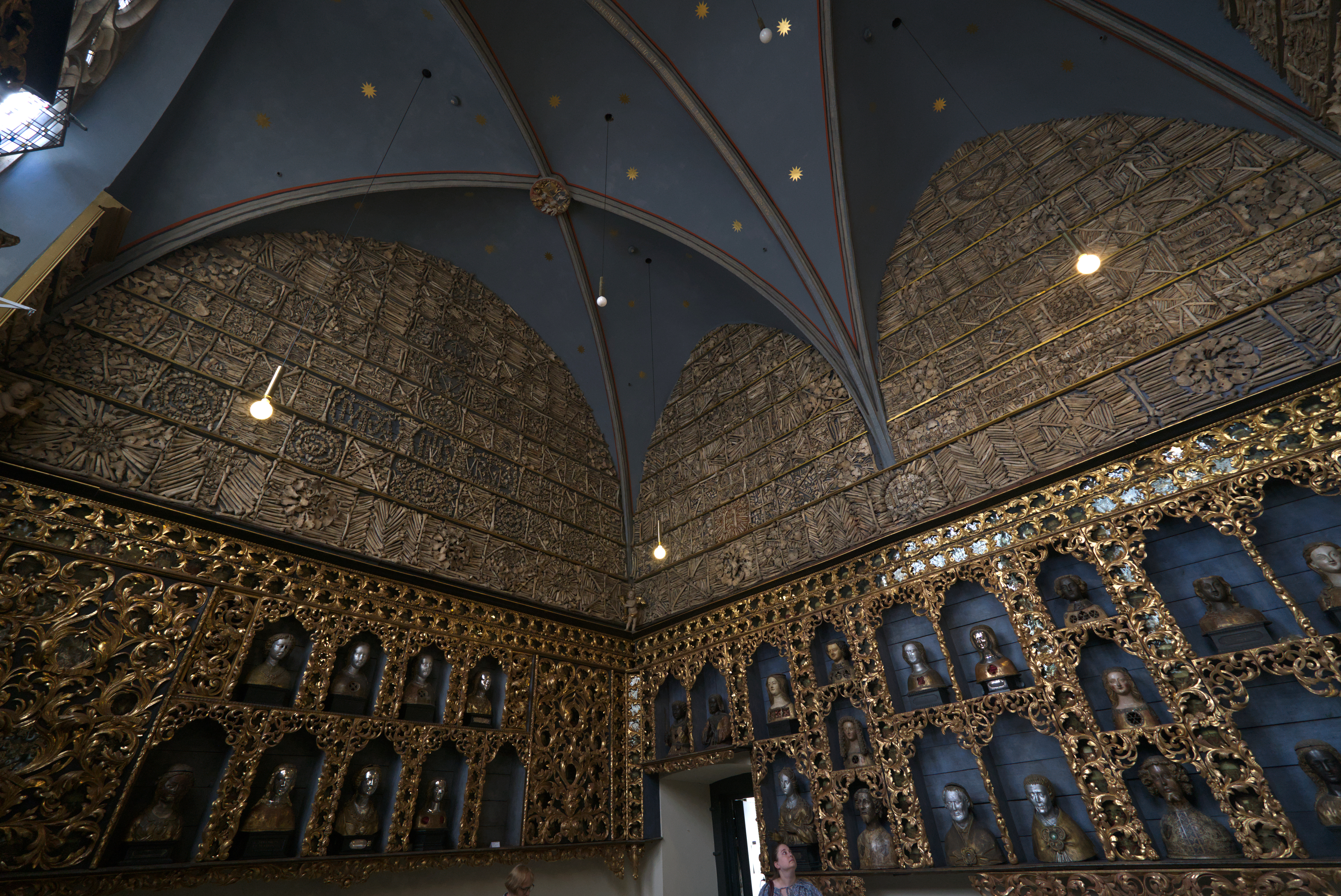
Golden Chamber
That’s me at the left, taking it in.

Golden Chamber
Golden Chamber
Golden Chamber

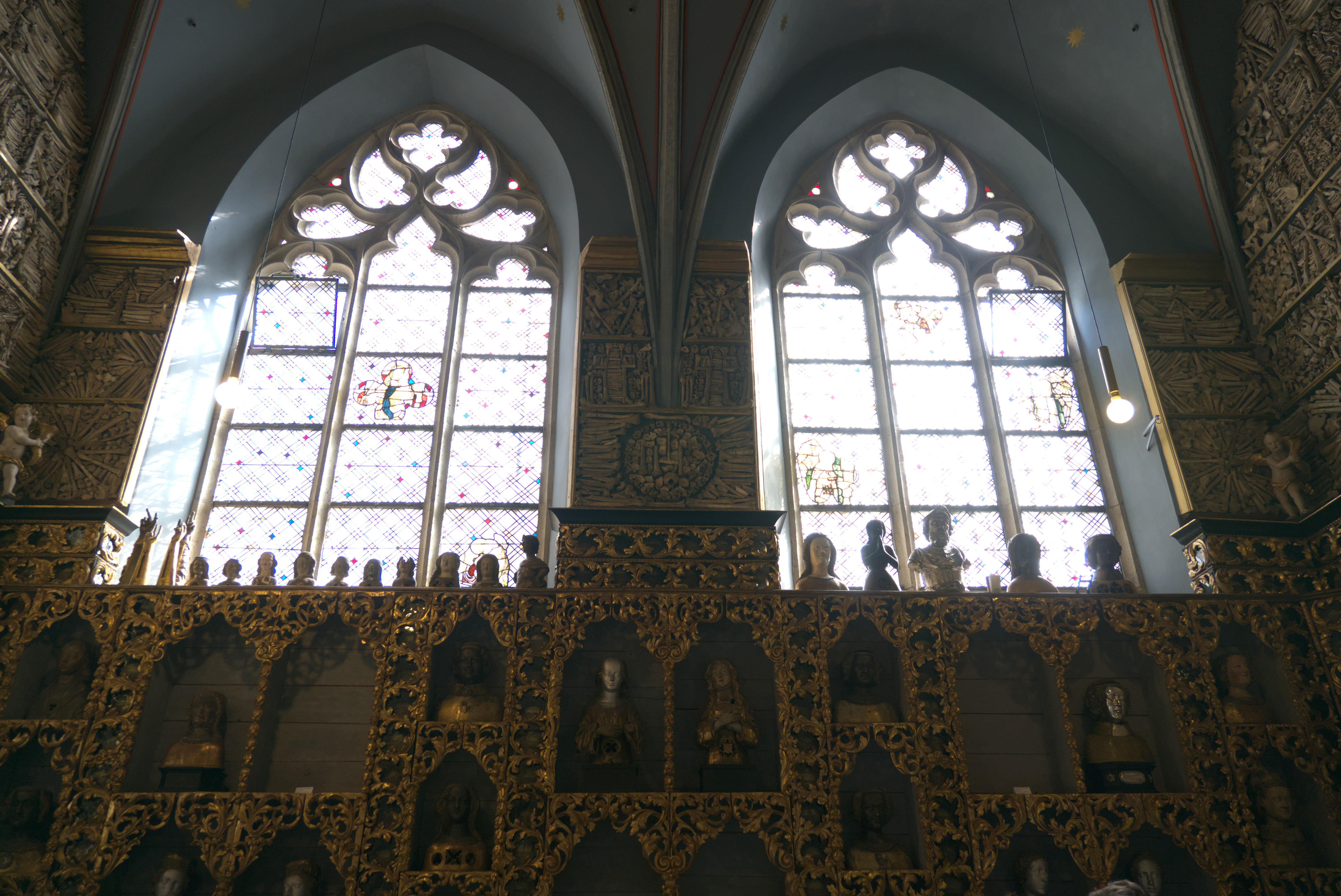
A Baroque marvel, the Golden Chamber was established on the south side of the church in 1643 through a donation by the imperial court councilor of the Holy Roman Empire Johann von Crane and his wife, Verena Hegemihler. It replaced a smaller medieval camera aurea (treasury and relic chamber), where the bones had previously been displayed. Crane and Hegemihler oversaw the design and construction of the space, with its ribbed, star-studded, sky-blue vault, and the arrangement of the bones into their present form.
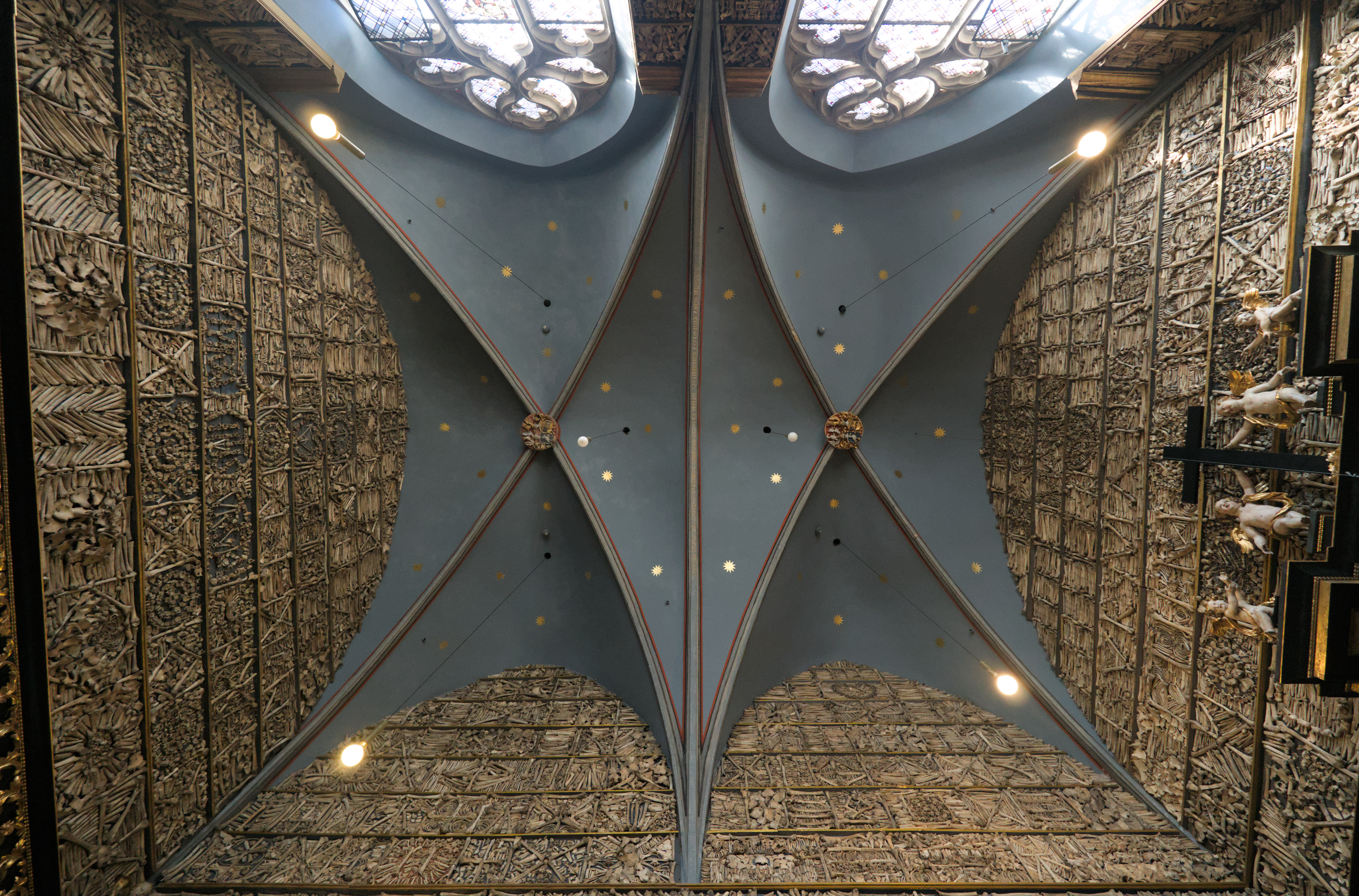
Golden Chamber

Above the altar, tibias, fibulas, femurs, humeri, and other bones spell out “Sancta Ursula Ora Pro Nobis” (Saint Ursula, pray for us). Also rendered in bones are the name Etherius—Ursula’s fiancé, who converted to Christianity at her insistence and met her in Cologne to die with her—and a mention of the holy virgins.
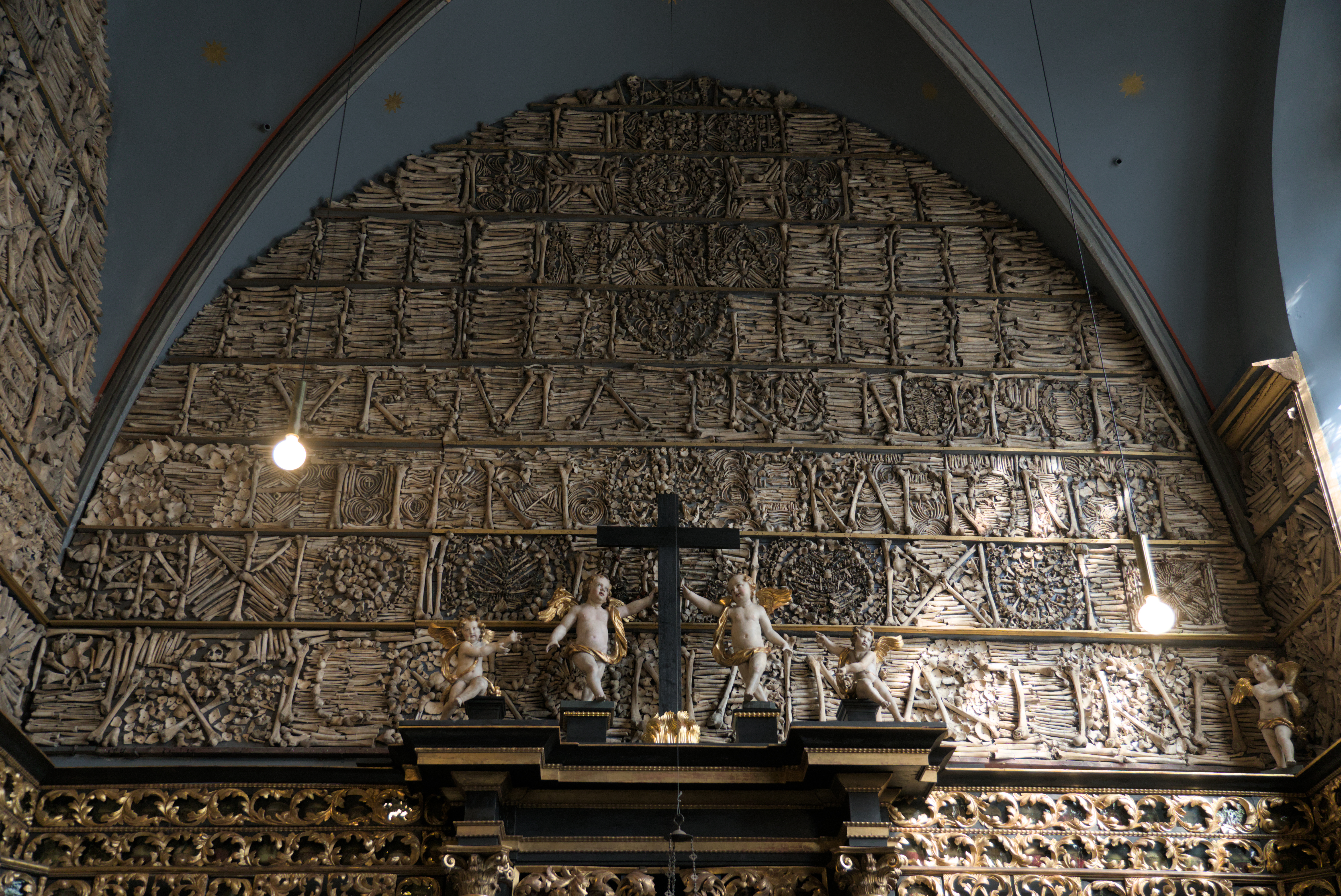
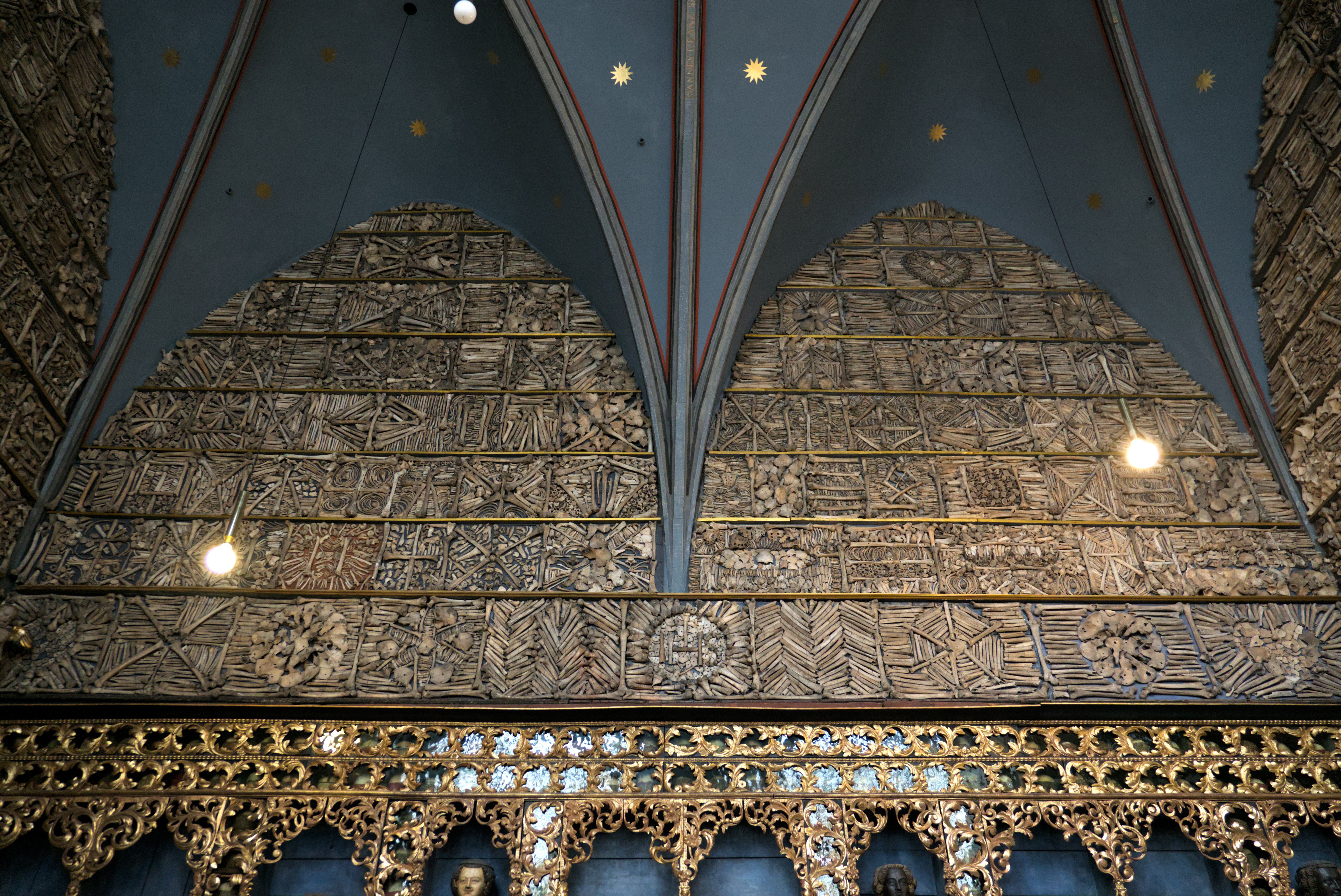
Golden Chamber
Golden Chamber
Golden Chamber

Other sections of the wall use vertebrae, pelvic bones, ribs, shoulder blades, and so on to create ornamental designs like hearts, spirals, webs, flowers, and crosses.
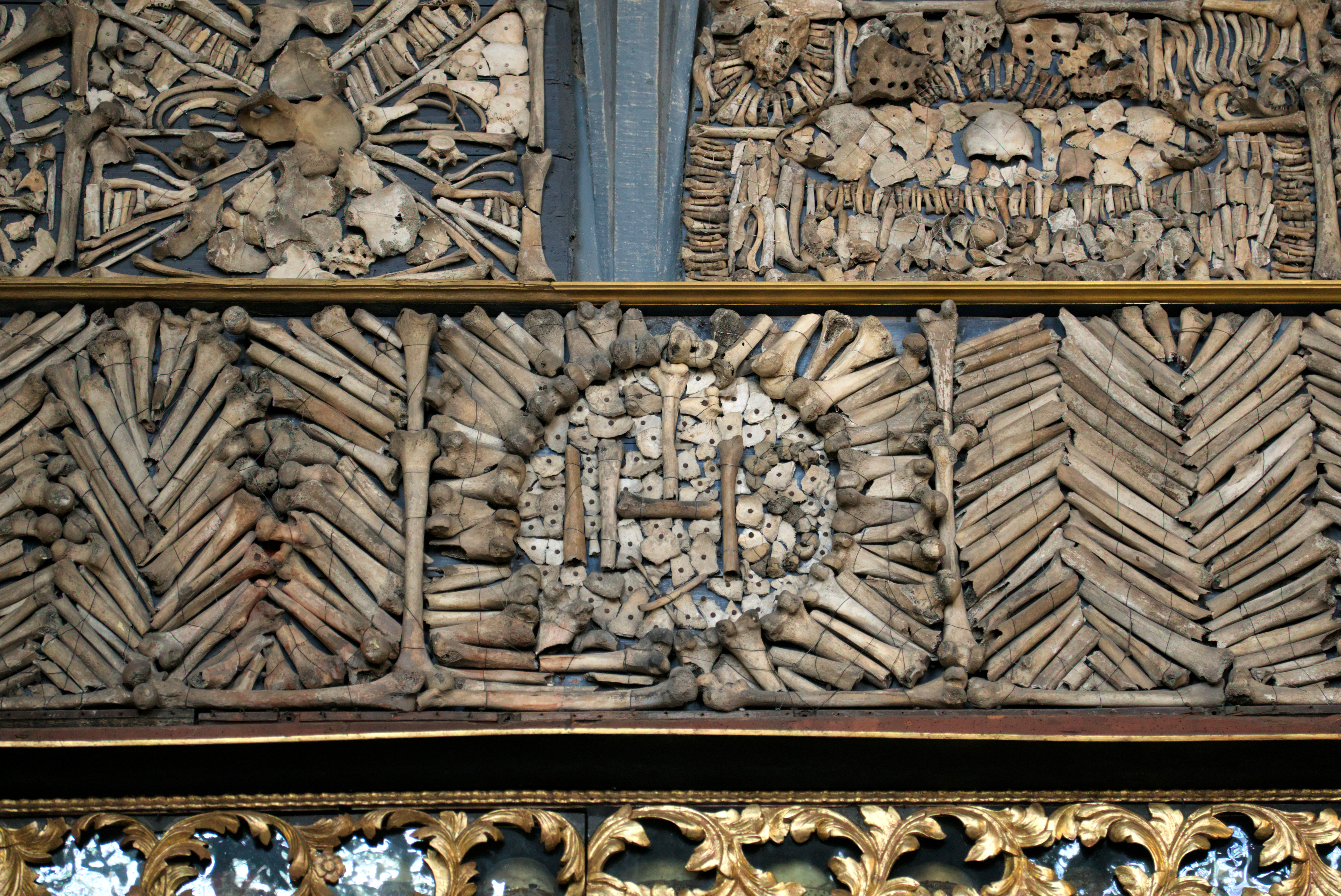
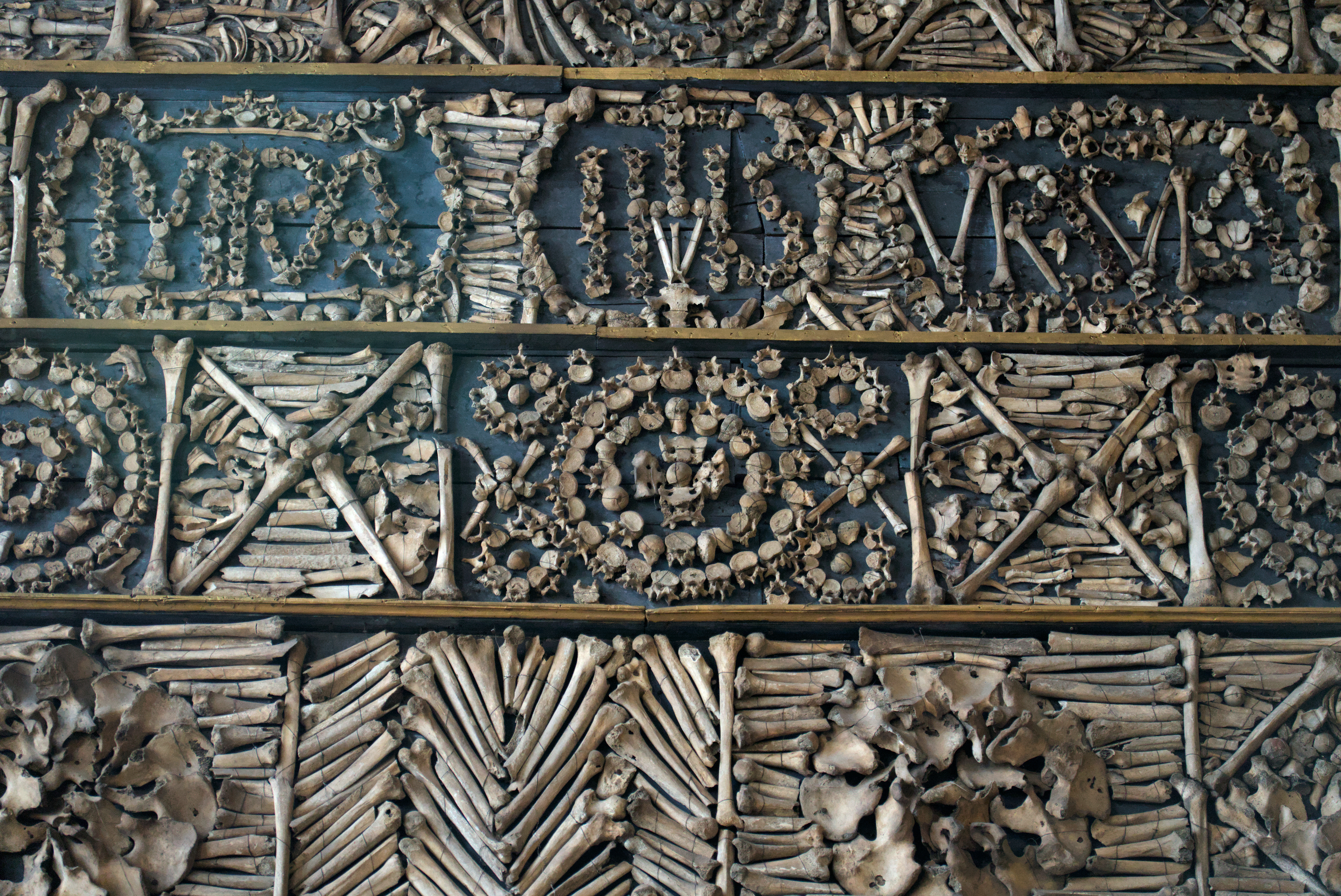
Golden Chamber
“IHS” is a popular Latin acronym for “Iesus Hominum Salvator” (Jesus, Savior of Humankind).

Golden Chamber
Golden Chamber
Golden Chamber

Similar visual displays of bones in charnel houses, writes art historian Jackie Mann, had become increasingly common in Europe by the late fourteenth century.

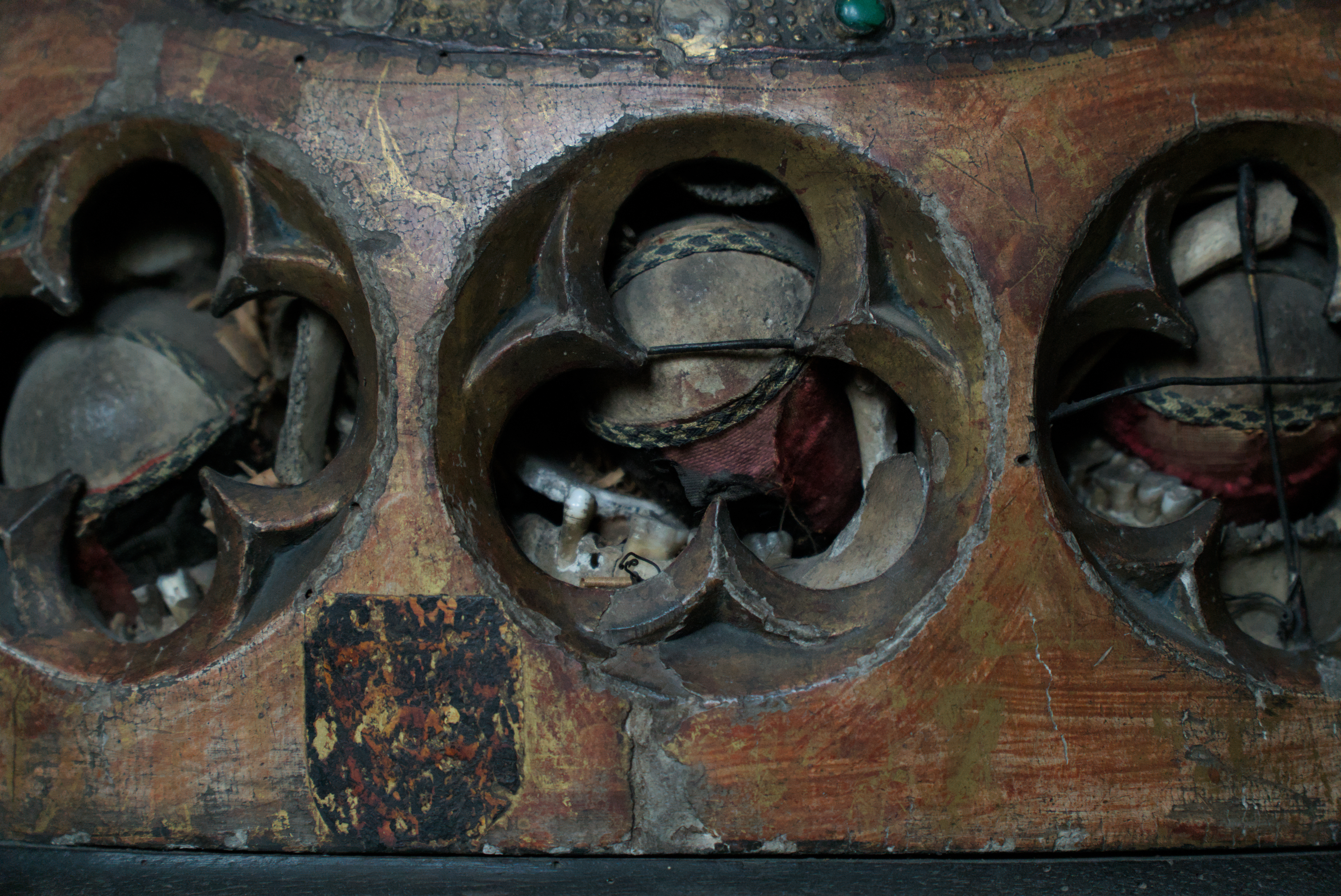
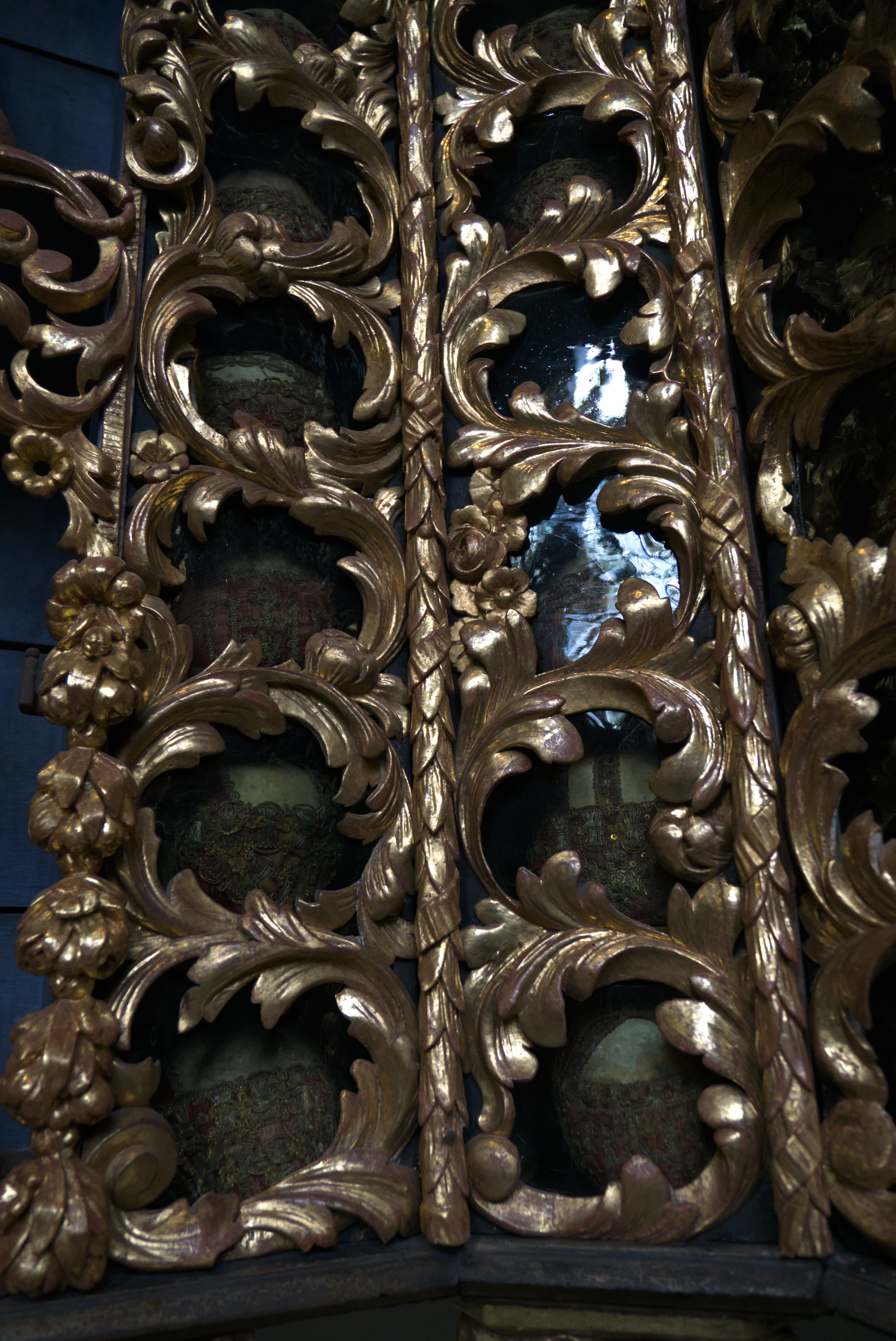
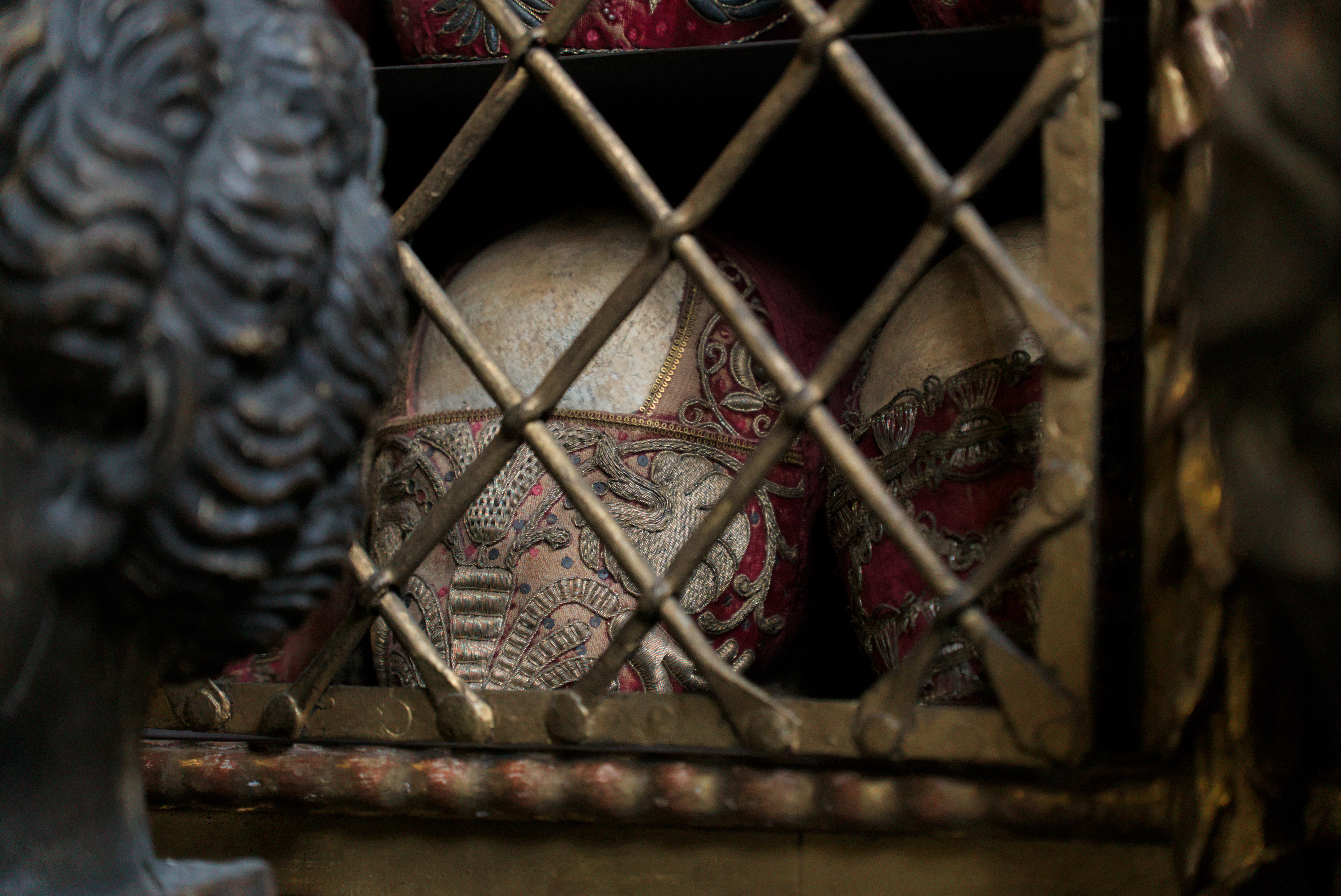
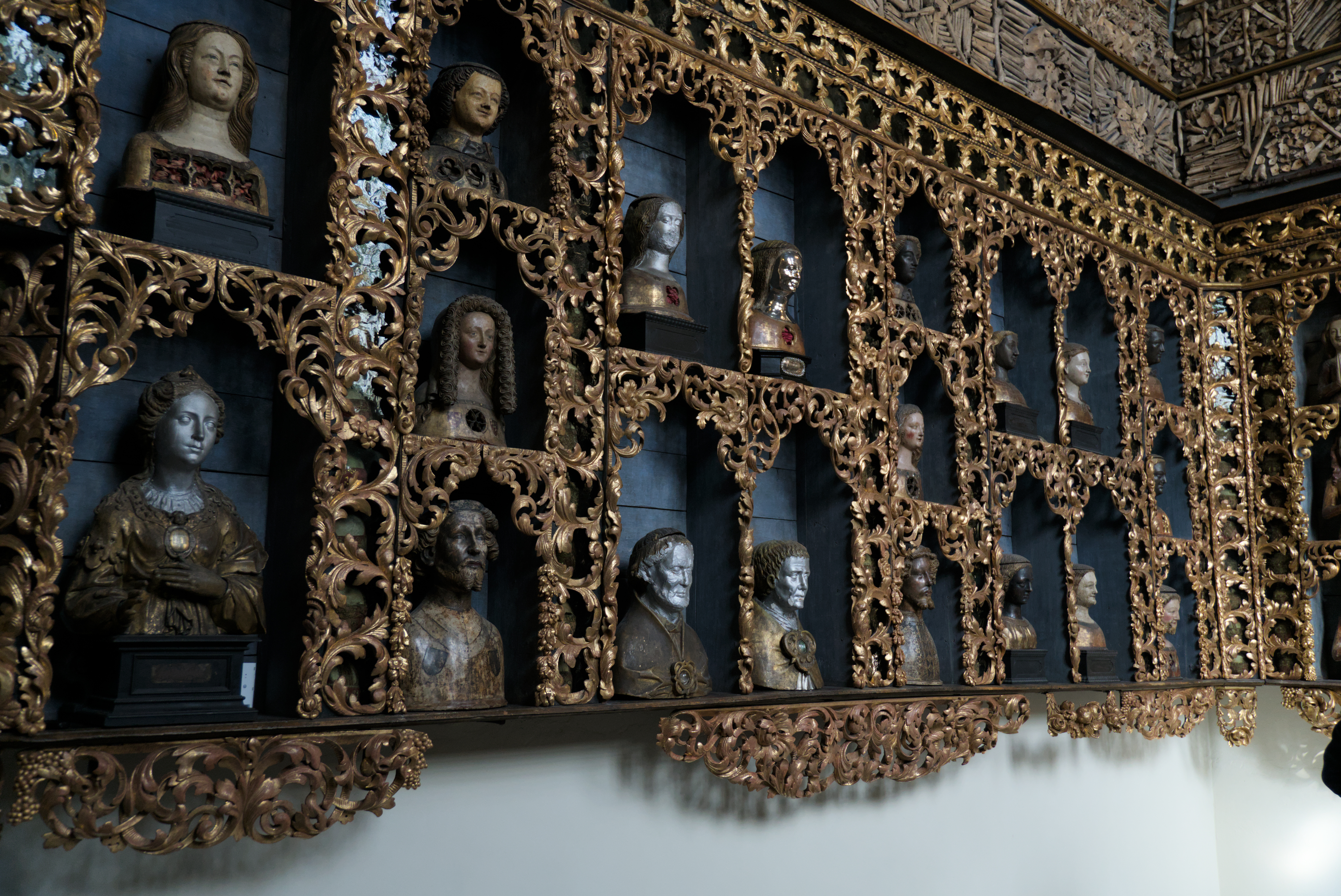
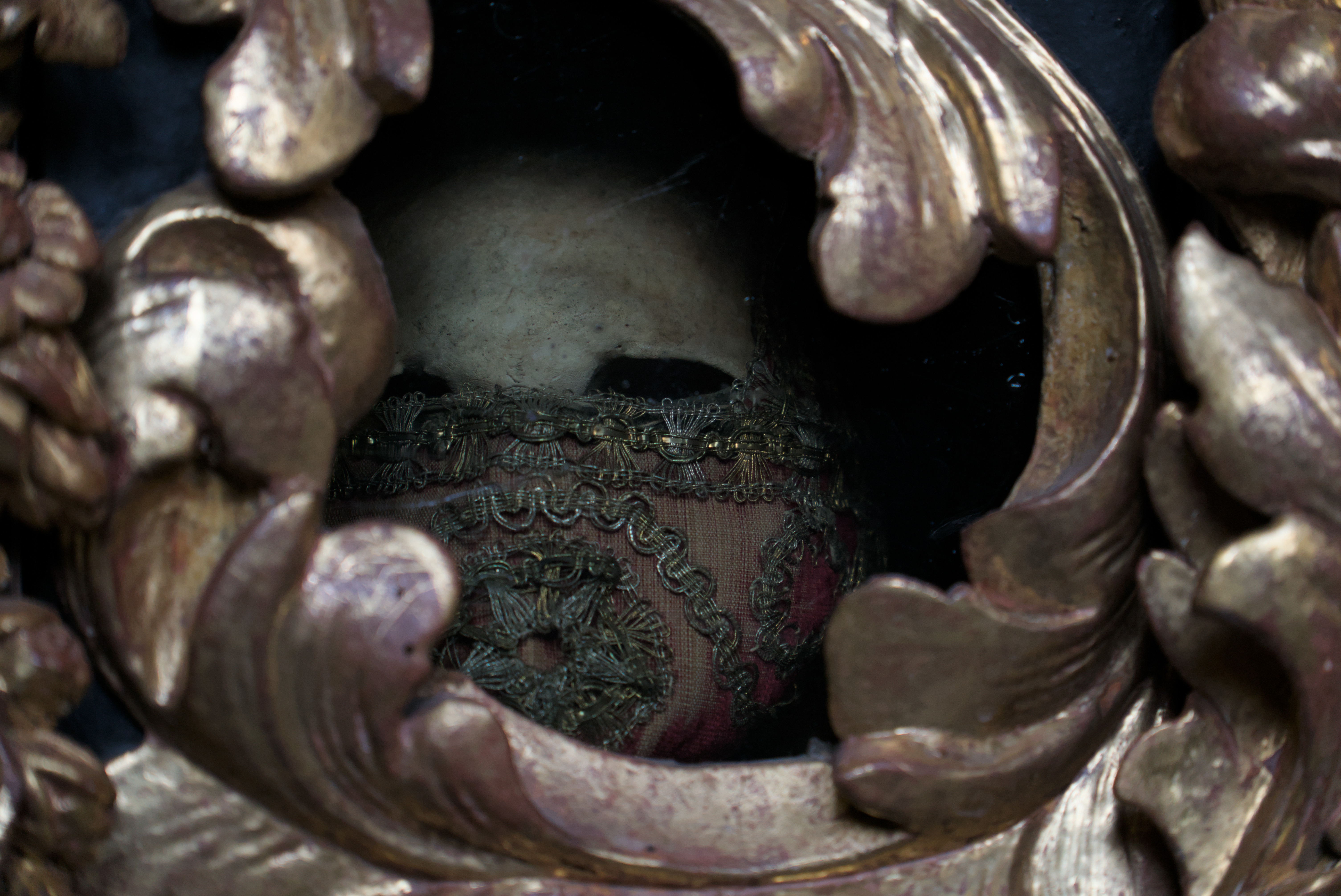
The shelving cabinets below the bone decor belong to the second phase of furnishings around 1700. They contain niches that house 112 reliquary busts (most of them produced between 1260 and 1400 and made of polychromed wood), as well as gilded acanthus tendrils that encompass some 600 skulls. Out of reverence, many of the skulls are at least partially wrapped in red velvet with gold and silver embroidery made by the nuns of the nearby Ursuline convent.
Golden Chamber
Golden Chamber
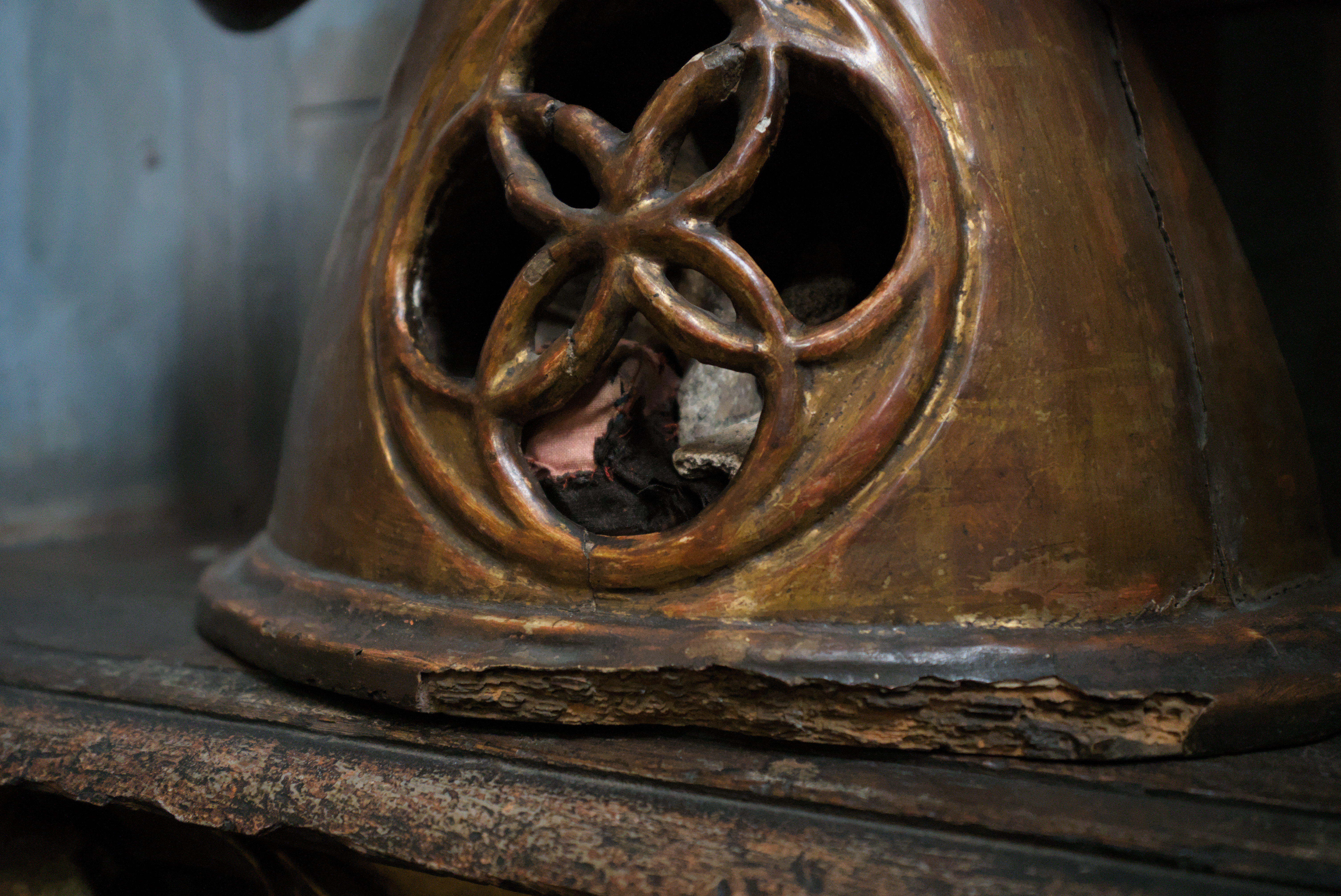
Inside a reliquary bust
Skulls
Skulls

Occasionally, where the wrapping has slipped, you’ll see an eye hole staring back at you.
Skulls

To account for the presence of men’s bones in the ancient Roman churchyard, the legend of St. Ursula was adapted in the twelfth century to include male martyrs—namely, Etherius and his retinue. That’s why the Golden Chamber contains several male busts alongside the female.
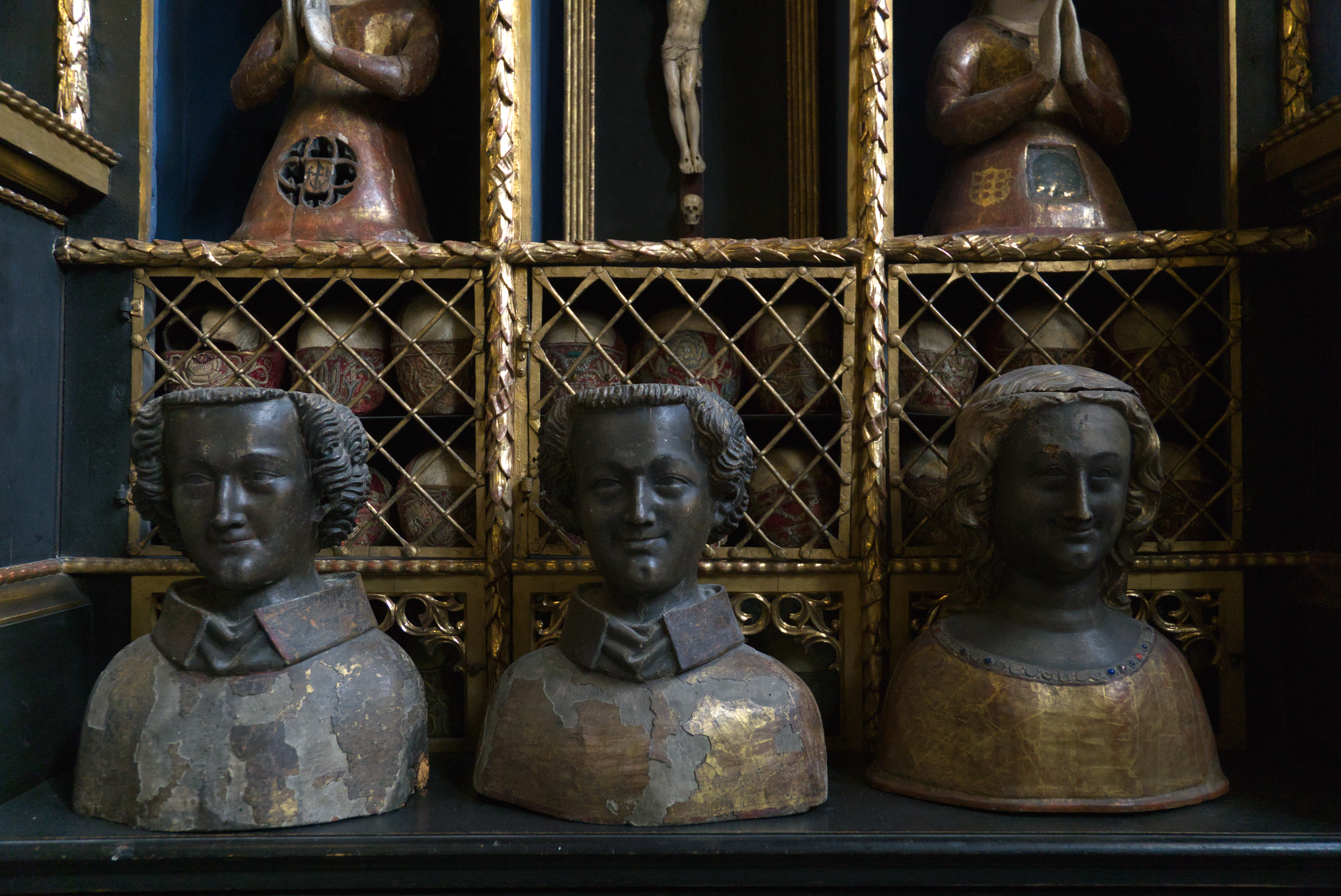
Golden Chamber

To the average person, the Golden Chamber is a weird, macabre spectacle. But for Catholics, displaying human bones is not meant to be creepy or horror-inducing. Rather, by bringing remnants of the dead into spaces of the living, we are reminded of: (1) our own mortality, (2) the community of saints that transcends time, and (3) the promise of universal, bodily resurrection (dem bones gonna rise again!).

Memento mori (“remember you will die”) was a common trope in seventeenth-century art and devotion, meant to increase one’s awareness of the fleetingness of life and to encourage one to live in light of heaven. Mann calls the Golden Chamber an “immersive memento mori.” Again, the traditional Christian summons to remember our mortality is not meant to frighten. It’s meant to inspire us to live whole and holy lives.

While death is an ending in one sense, it’s also an entry into life immortal. The Golden Chamber gathers together the fragments of local saints that had been scattered in ancient burial ruins, preserving them for the saints of later generations as a witness that our bodies will never be finally lost; they will be raised and renewed by God on the last day and reunited with our souls. Christians treat the remains of the deceased with honor in recognition that our bodies—including the framework of bones that support our soft tissues, protect our organs, enable our movement, store minerals for our use, and produce our blood cells—are not just temporary shells encasing who we really are, but rather are a part of who we are. Hence why we proclaim, in the Apostles’ Creed, that “we believe . . . in the resurrection of the body.”

Memorial for the Martyrs of Today

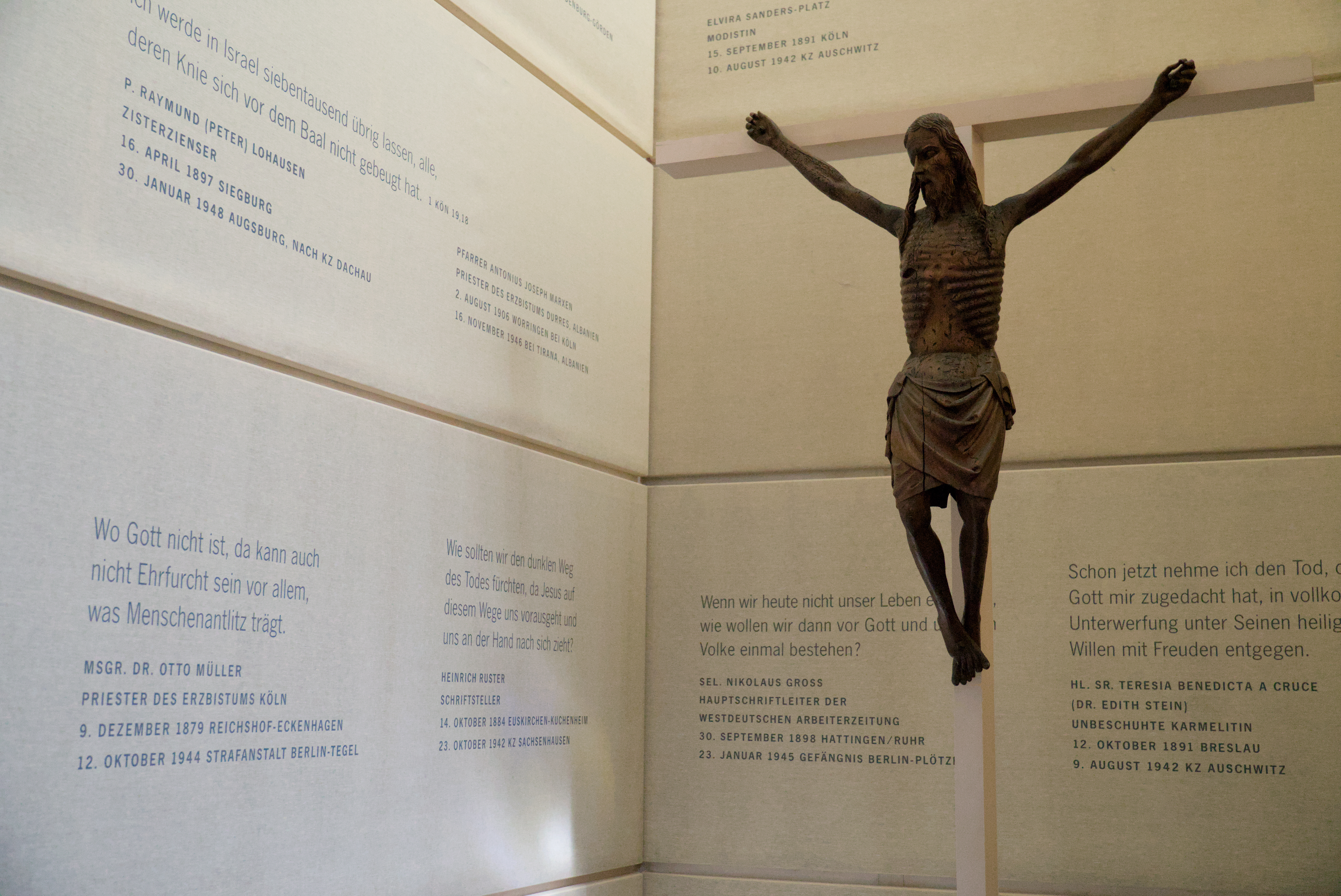
While the Golden Chamber is the primary draw for visitors to the Basilica of St. Ursula, there are other sights in the church worth spending time with, ones I was not expecting. One of them is the Gedenkstätte für die Märtyrer der Gegenwart (Memorial for the Martyrs of Today), a chapel in the south transept that commemorates the Christians in Cologne, both religious and lay, who were killed for resisting the Nazi regime—or, in the case of Sr. Teresa Benedicta of the Cross (Edith Stein) and Elvira Sanders-Platz, for being ethnically Jewish.
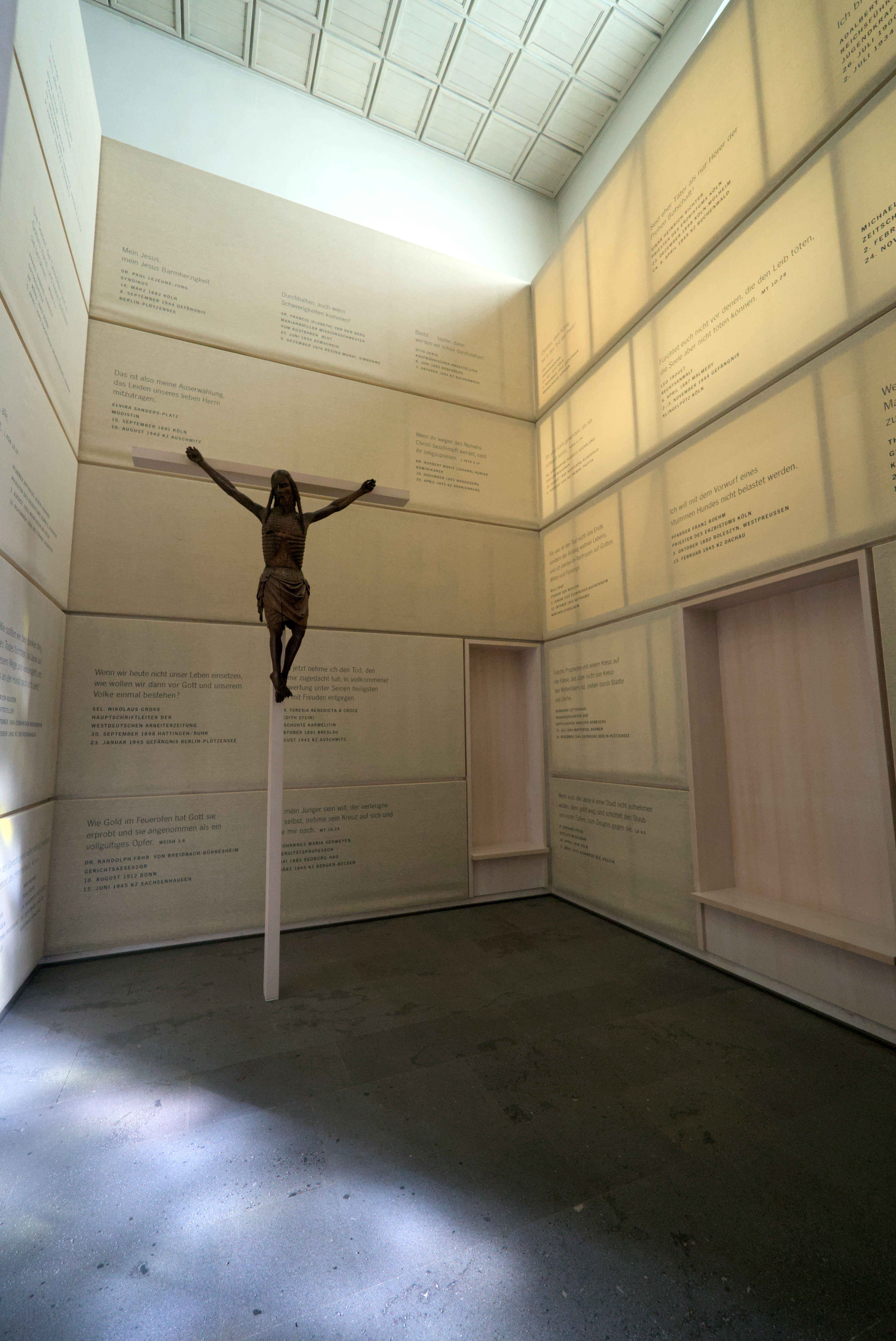
Memorial for the Martyrs of Today
Gedenkstätte für die Märtyrer der Gegenwart (Memorial for the Martyrs of Today), designed and built by the firm Kister Scheithauer Gross, 2003–5. South transept, Basilica of St. Ursula, Cologne.

Memorial for the Martyrs of Today

Made by the architectural and design firm Kister Scheithauer Gross, the chapel consists of a double-shelled, slightly transparent canvas construction printed on the inside with the names and dates of the martyrs, as well as quotes they gave before their deaths. Sunlight enters from the window to the right of the chapel, causing the space to glow. There’s a small bench on each of the three sides, for people to sit and pray or reflect.

In the center is a life-size wood crucifix. The gaunt Christ figure is pierced all over and bears a deep wound in his side where the centurion’s spear went through. Like those whose names surround him, Jesus preached and pursued love and justice, ultimately laying down his life—a loss that God turned to gain in the Resurrection and in the redemption of the world.

A language barrier prevented me from effectively asking the staff person, or understanding the answer, whether the crucifix was carved in the early 2000s specifically for the chapel, or if it’s medieval. There’s no info inside the church about this chapel.
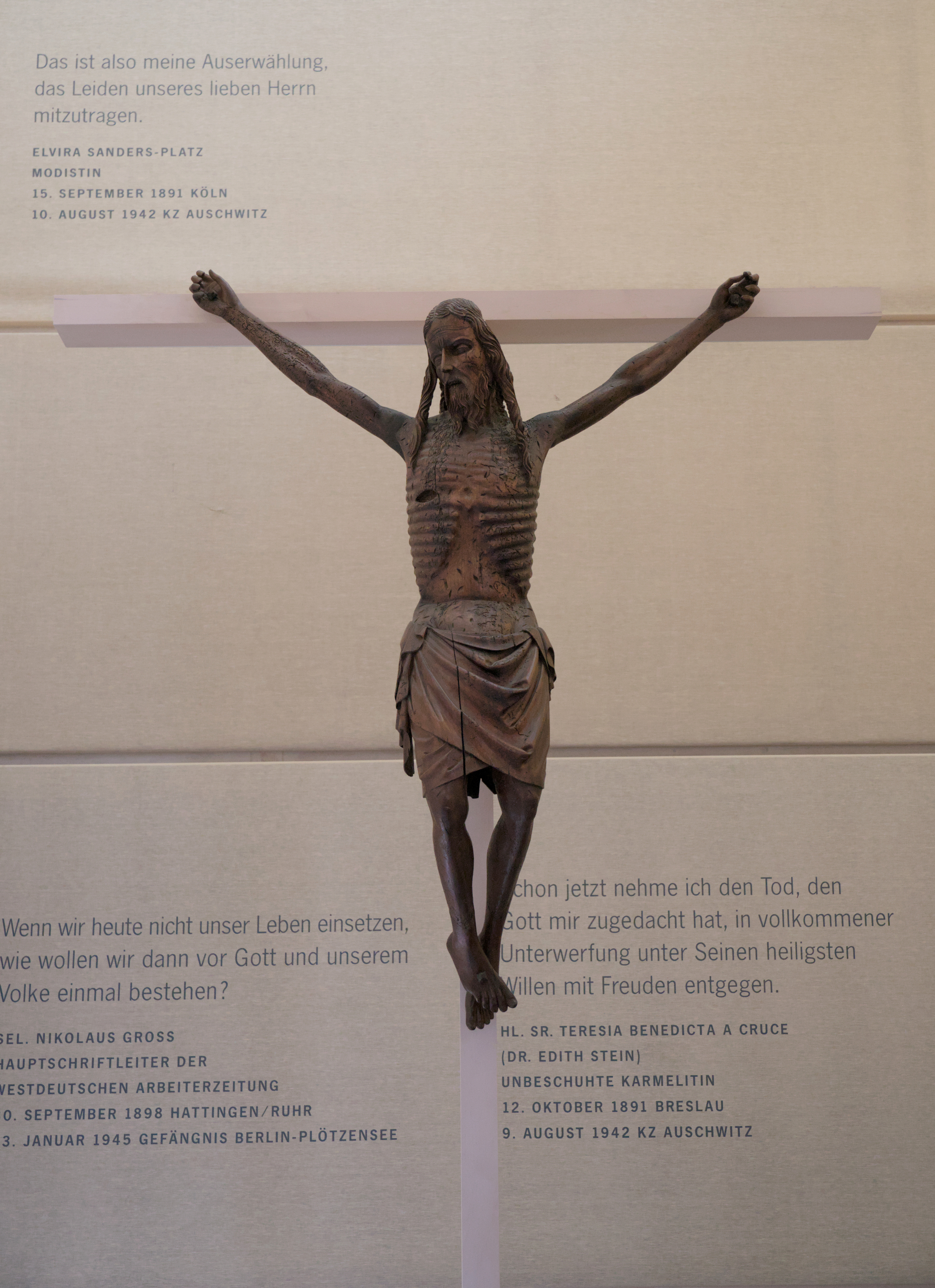
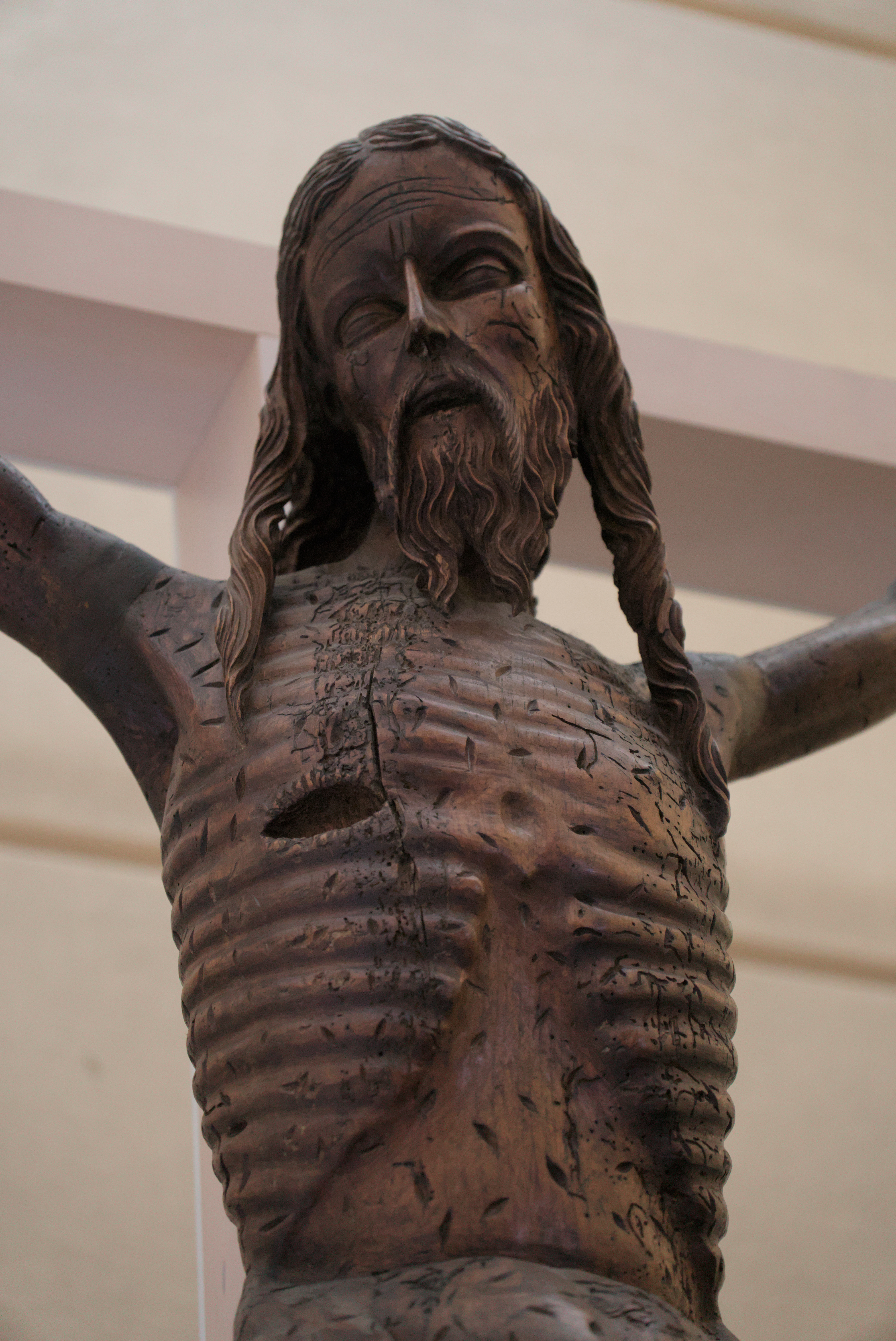
Crucifix
Crucifix

The Memorial for the Martyrs of Today is an example of what Christian martyrdom looked like in Cologne in the twentieth century. Fr. Otto Müller, Br. Norbert Maria Kubiak, writer Heinrich Ruster, medical student Willi Graf, Catholic Youth leader Adalbert Probst . . . The stories of the many individuals who were executed for subverting Hitler, for calling out his evils, in the name of Christ are far more compelling to me than the fabulous and convoluted story of an ancient princess killed in a land invasion and then heroized—for her virginity?

Contemporary Stained Glass

I also liked the contemporary stained glass in the church. In the choir, there’s a set of eight windows by Wilhelm Buschulte—abstract compositions in yellow, white, and gray.
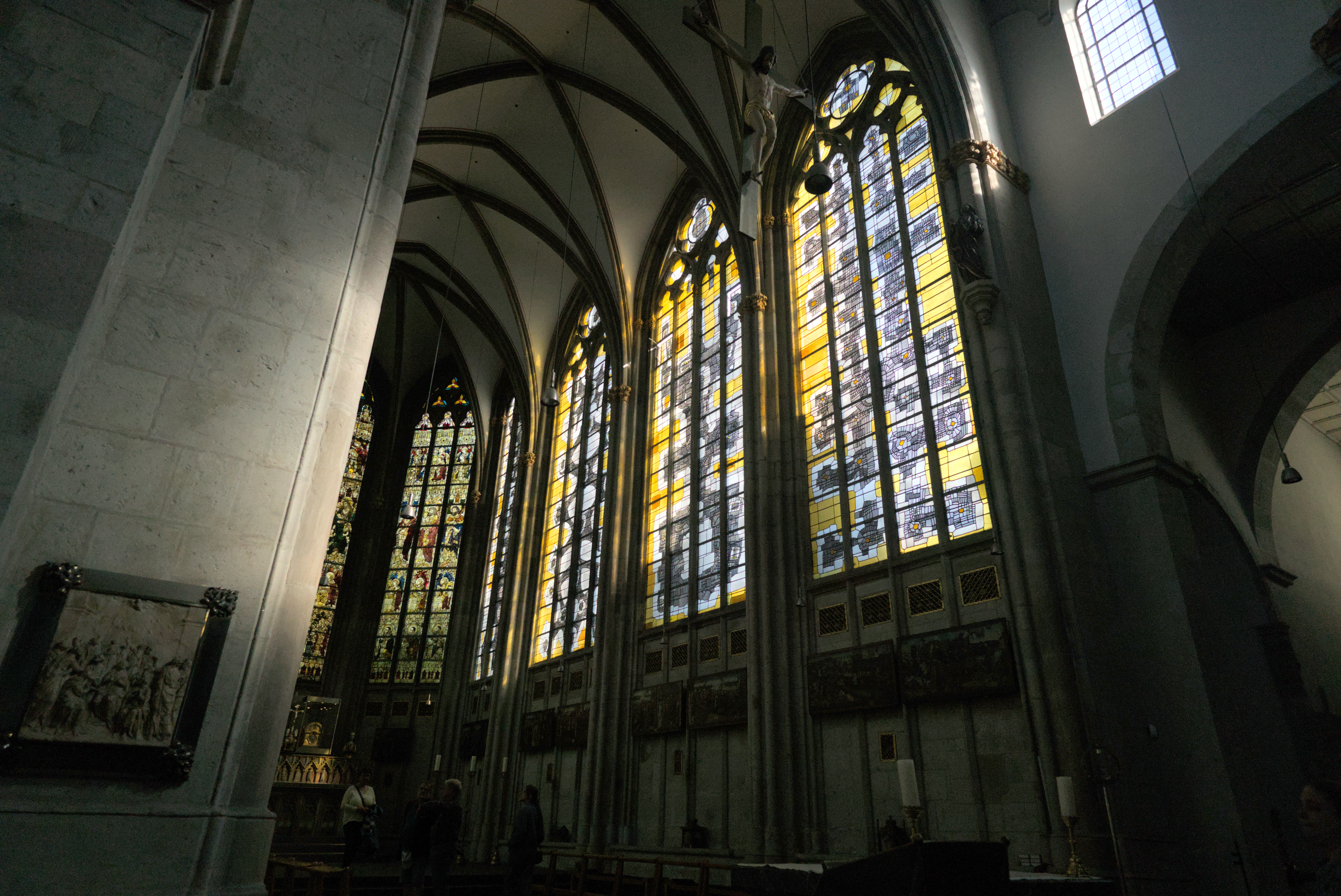
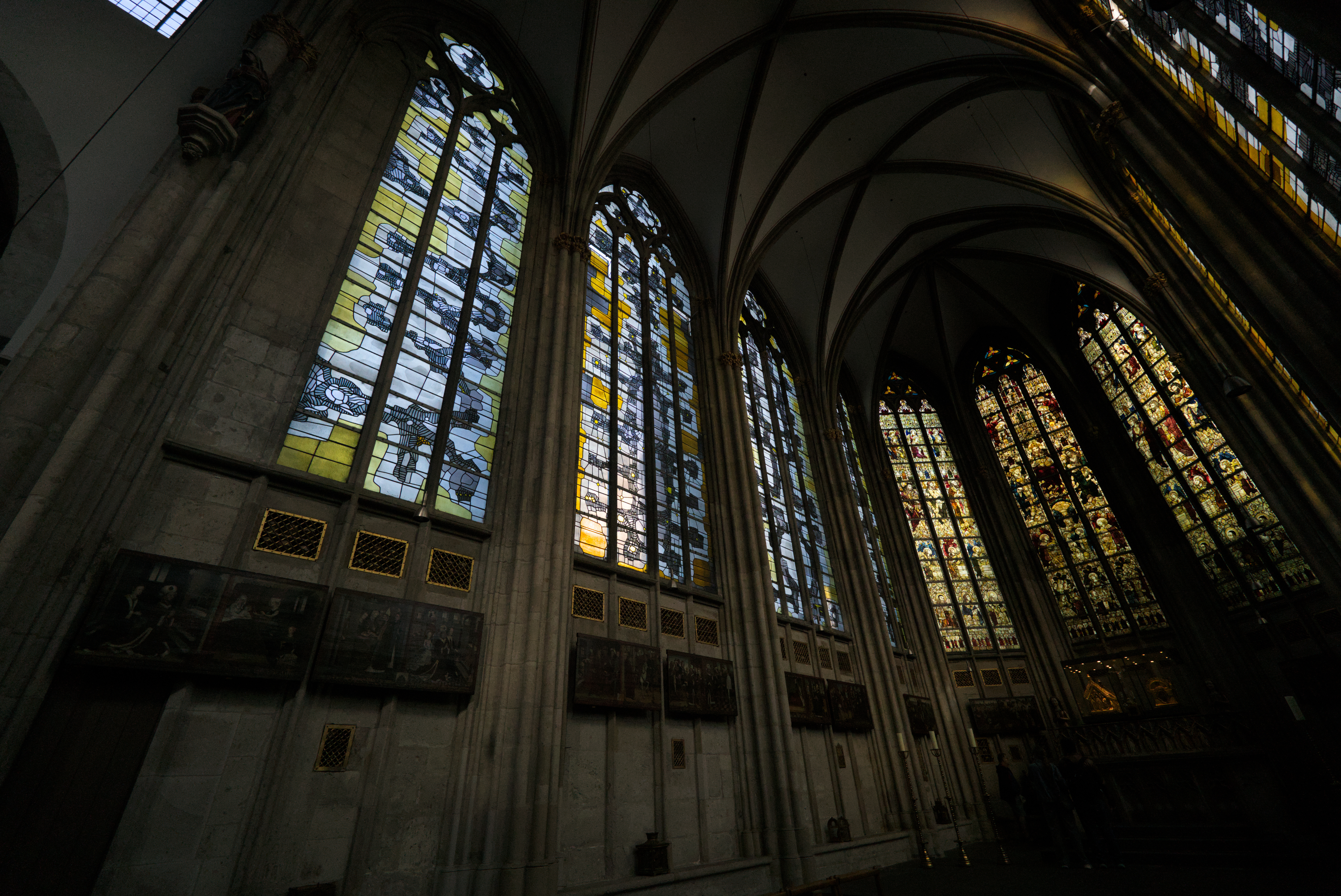
Wilhelm Buschulte
Stained glass windows by Wilhelm Buschulte (German, 1923–2013), 1962, choir, Basilica of St. Ursula, Cologne

Wilhelm Buschulte

In the south aisle are two round-arched windows by Will Thonett, also abstract: a grid of blues, grays, and lavender, with yellow circles and thin vertical bands.
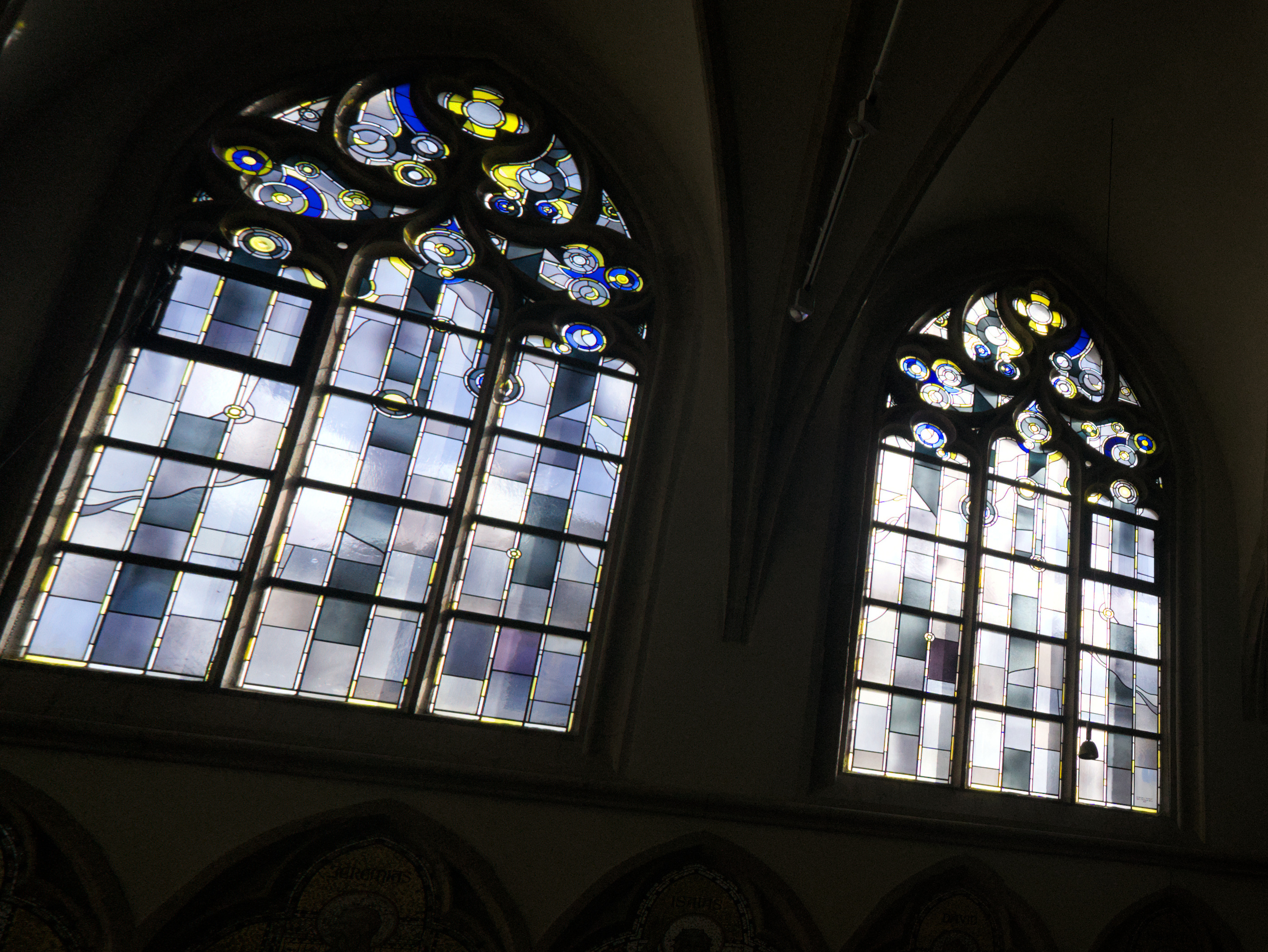
Will Thonett
Stained glass windows by Will Thonett (1931–1973), 1967, south aisle, Basilica of St. Ursula, Cologne

To the right of these are three Mary-themed windows by Hermann Gottfried. The primary scene of the first one is the Annunciation. A giant red rose appears in the background, probably a reference to Mary as the Rosa Mystica. Below this scene, to the left, is the Creation of Adam and Eve, and to the right, the Expulsion from Paradise; these contextualize Christ’s conception in the greater narrative of scripture. The peripheral scenes in the middle register show the magi following the star to Bethlehem.
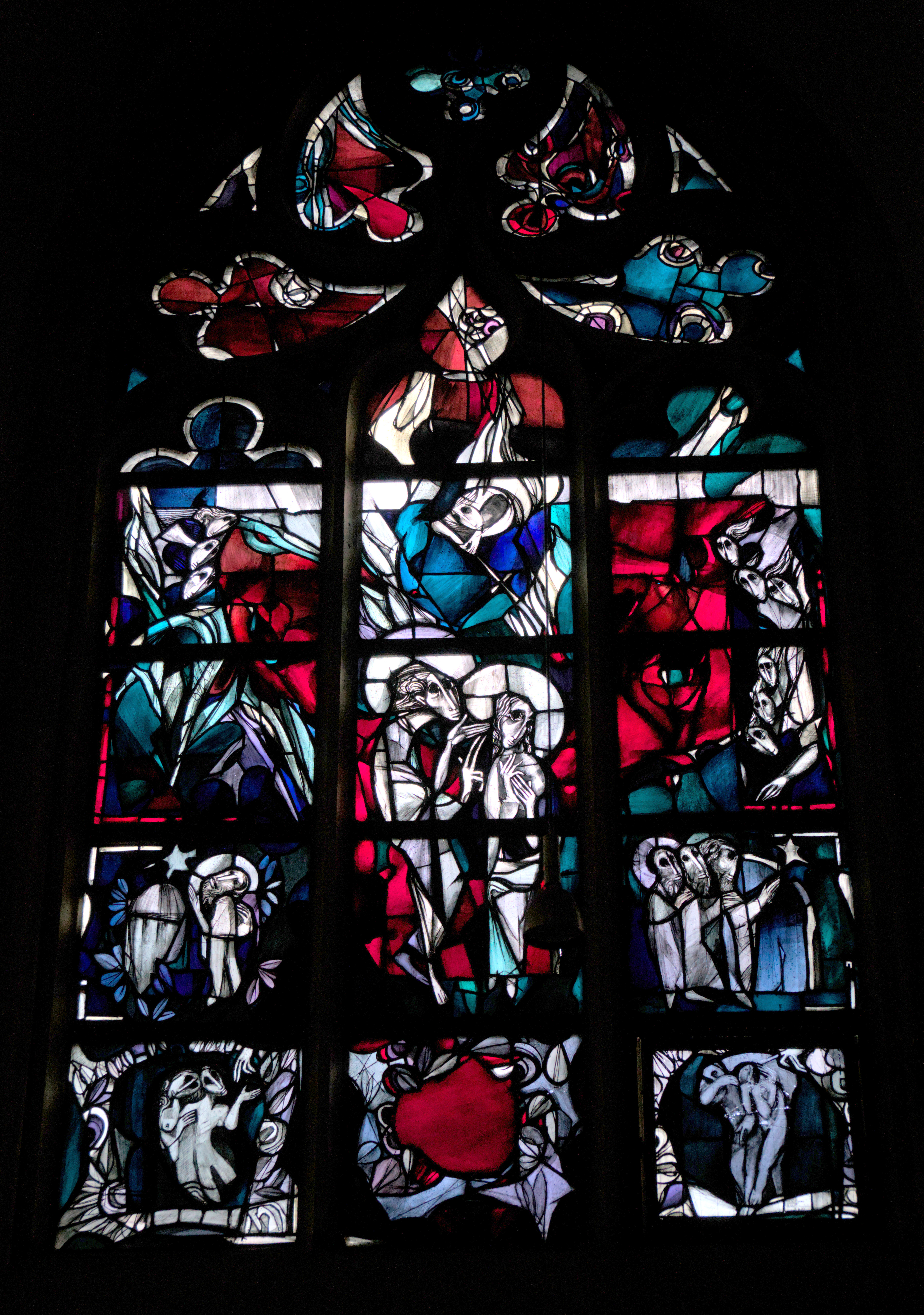
Hermann Gottfried_Annunciation
Stained glass window by Hermann Gottfried (German, 1929–), 1984, south aisle, Basilica of St. Ursula, Cologne

The central window portrays the Coronation of Mary. I believe both figures in the left lancet are Christ—crowning his mother as Queen of Heaven, and at the bottom, crushing the serpent, as the protoevangelium in Genesis 3:15 prophesied. Beneath the enthroned Mary on the right is a smaller vignette, which I think may be Mary again, also stepping on the serpent’s head, since by her cooperation with God’s plan, she shares in the victory over Satan. This imagery is also related to Woman of the Apocalypse described in Revelation 12, whom Catholics interpret as Mary. The hand of God dispenses blessing from above.
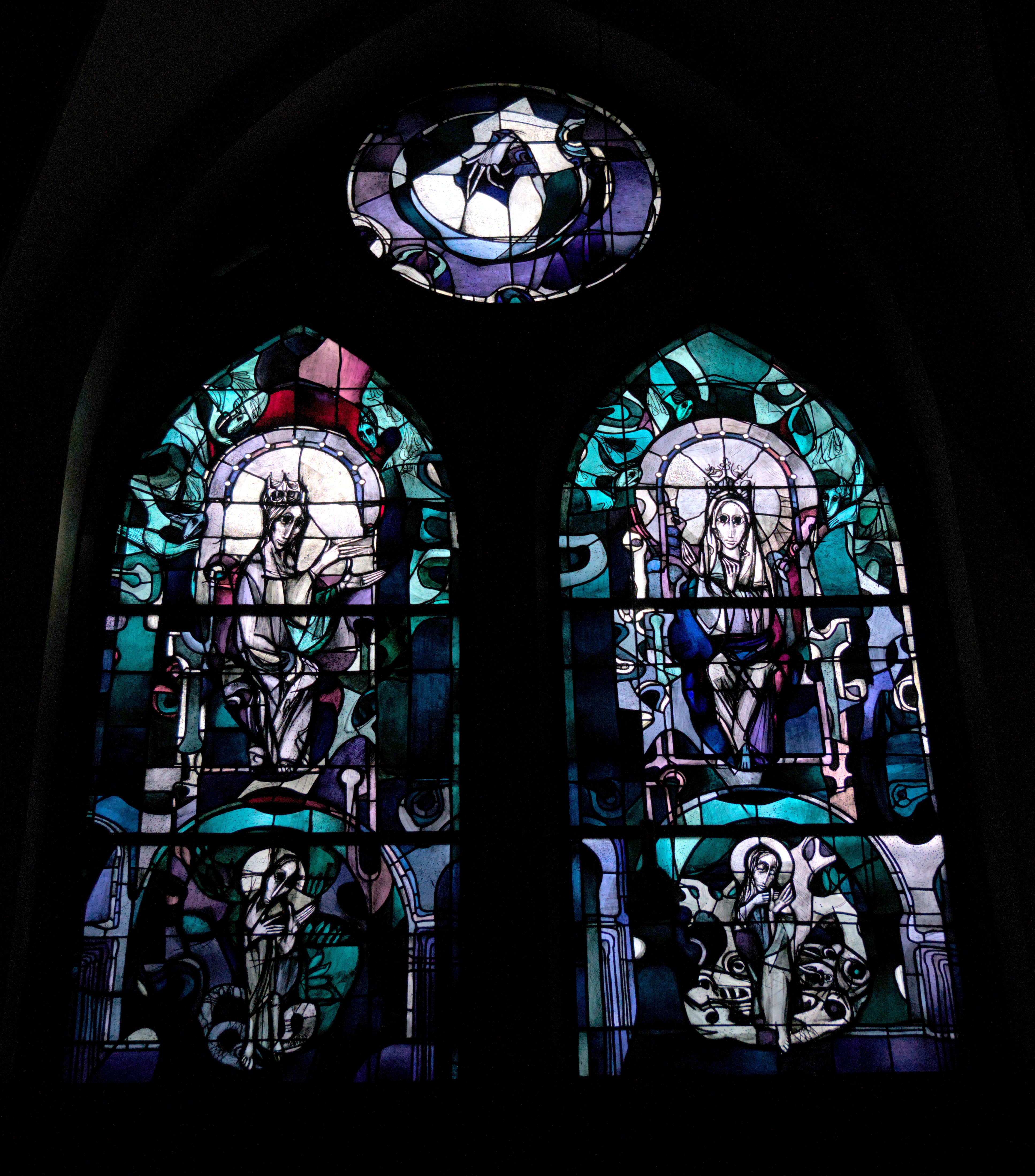
Hermann Gottfried_Coronation of the Virgin
Stained glass window by Hermann Gottfried (German, 1929–), 1984, south aisle, Basilica of St. Ursula, Cologne

The final window in this trio portrays the Descent of the Holy Spirit at Pentecost. The two quadrants at the bottom right show Moses before the burning bush, in which Mary appears; Catholic teaching compares Mary to the burning bush of Exodus because for nine months she held the fire of divinity within her womb (God incarnate) and was not consumed. On the left Moses is receiving the tablets of the law on Mount Sinai, an event often read in parallel with the story of Pentecost in Acts 2, where God writes his word not on stone but on people’s hearts by giving his Spirit to dwell within them.
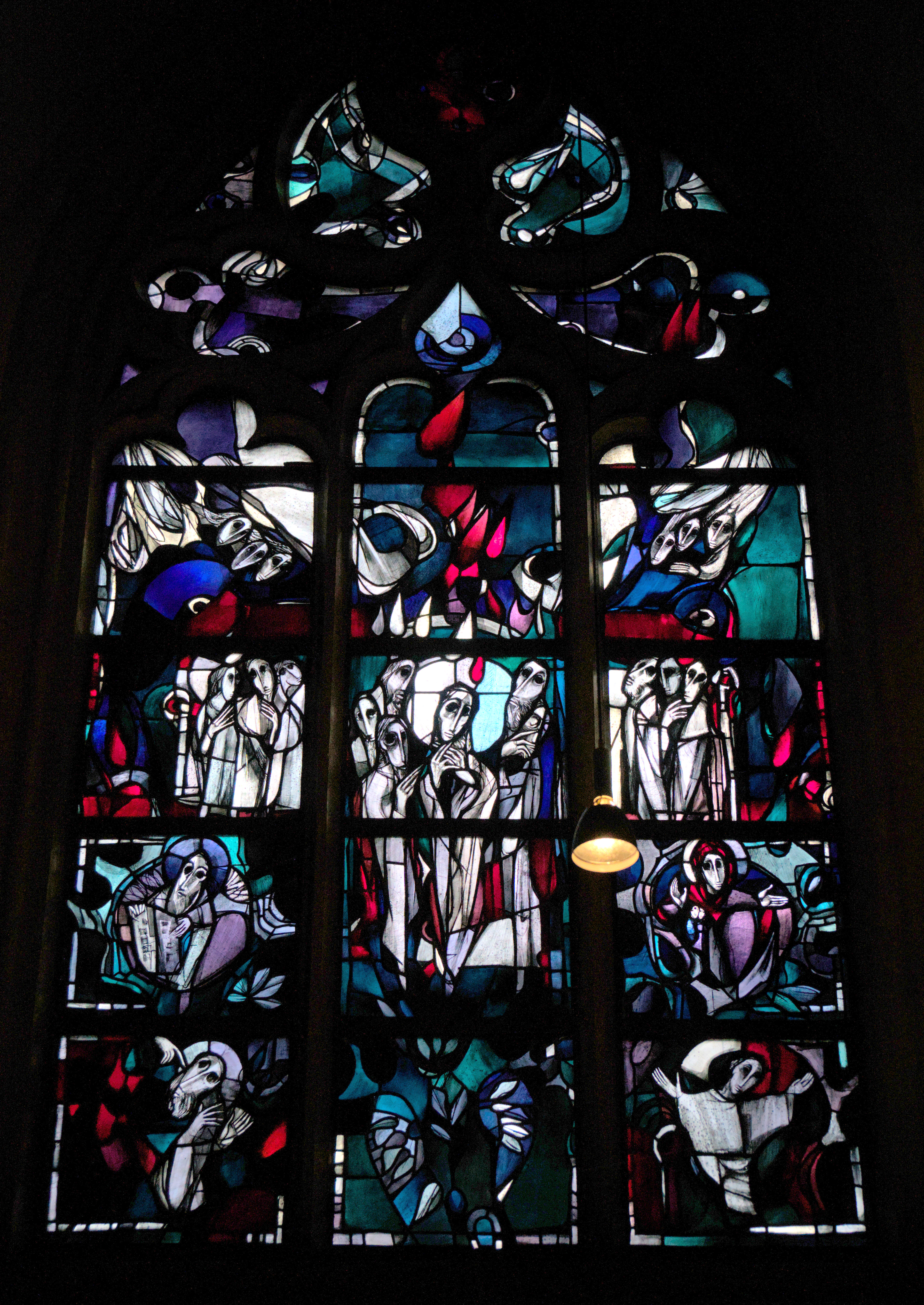
Hermann Gottfried_Pentecost
Stained glass window by Hermann Gottfried (German, 1929–), 1984, south aisle, Basilica of St. Ursula, Cologne


If you’re ever in Cologne, I encourage you to include the Basilica of St. Ursula on your itinerary. Entry to the church is free, but the Golden Chamber costs €2 (only cash is accepted, I believe). There are six large standing posters in the narthex that provide a timeline, in German, of the church’s history, and when I was there, there were two attendants who were available to answer questions, one of whom spoke some English.

For more comprehensive photos of the church’s art and architecture, see https://www.sakrale-bauten.de/kirche_koeln_st_ursula.html and https://www.winckelmann-akademie.de/wp-content/uploads/Koeln_St._Ursula.pdf.

Pentecost roundup: Invocations; Holy Spirit as “lodes-mon”; organ improv; tongues of fire in a flower patch

SONGS:

Here are three sung invocations of the Holy Spirit, seeking his power, liberation, comfort, light, and renewal.

>> “Holy Spirit, Come with Power”: This hymn was written by Anne Neufeld Rupp in 1970, who set it to a Sacred Harp tune from 1844 attributed to B. F. White. It’s performed here by the Bel Canto Singers from Hesston College in Kansas, featuring Gretchen Priest-May on fiddle and Tim May on acoustic guitar.

I was introduced to this hymn through the Voices Together Mennonite hymnal, where it appears in both English and Spanish as no. 57.

>> “Mweya Mutsvene” (Holy Spirit, Take Your Place) by Joshua Mtima and The Unveiled: The Unveiled is a collective of Christian musicians from Harare, Zimbabwe, founded by Joshua Mtima in 2020. Here they sing one of their songs in Shona. An English translation is provided onscreen. [HT: Global Christian Worship]

>> “Ven Espíritu Divino (Secuencia de Pentecostés)” (Come, Spirit Divine) by Pablo Coloma, performed by Chiara Bellucci: The Spanish lyrics of this contemporary Christian song from the Latin American Catholic tradition are in the YouTube video description. They ask the Holy Spirit, “sweet guest of our souls,” to come bringing healing, regeneration, growth, joy, and charisms.

+++

SUBSTACK POST: “Veni Creator Spiritus: A Lush Middle English Hymn” by Grace Hamman, Medievalish: Dr. Grace Hamman shares Friar William Herebert’s (ca. 1270–ca. 1333) Middle English translation of the classic Latin Pentecost hymn attributed to Rabanus Maurus (ca. 780–856), “Veni Creator Spiritus” [previously]. Herebert uses words like vor-speker (for-speaker; i.e., intercessor), lodes-mon (lodesman; i.e., journeyman or navigator), and shuppere (shaper) as titles for the Holy Spirit.

+++

ORGAN WORK: “Improvisation on Veni Creator Spiritus” by Alfred V. Fedak: “Your congregation will hear the rushing of the Holy Spirit in this improvisatory prelude (taken from Fedak’s and Carl P. Daw’s oratorio The Glories of God’s Grace),” writes Selah Publishing. “Fedak effectively uses sweeping whole-tone scale passages and arpeggios to indicate the Spirit’s presence, while the pedal plays phrases of the hymn tune,” a medieval plainchant. The publisher has posted the following performance of the piece (audio only), by the composer himself, along with a selection of Pentecost art from the thirteenth to eighteenth centuries. [HT: Global Christian Worship]

There are many other works on organ (fantasias, partitas, fugues) based on the “Veni Creator Spiritus” tune; view a select list on Wikipedia.

+++

POEM: “Book of Hours” by Kimberly Johnson: “A pentecost of bloom: all the furred tongues / awag in the iris patch, windrush through the fireflower.” So opens the poem “Book of Hours” by Kimberly Johnson [previously], from her collection Uncommon Prayer (Persea, 2014). A book of hours is a genre of medieval prayer-book used by laypeople, which arranges prayers, scripture, and other devotional texts for reading at prescribed times of the day. Johnson’s “Book of Hours” draws on the fields of codicology (the study of manuscripts as physical objects) and botany to consider how God’s Spirit moves through and enlivens the material world, be it the irises, fire lilies, alyssum, and paperwhite narcissus in her garden, or the ink and natural pigments on calfskin—green verdigris, red cochineal, yellow curcumin—in the rare manuscripts library where she examines a book of hours whose embellished Latin text she can’t quite make out but whose beauty enraptures her nonetheless. These are but two untranslatable experiences of sensual, embodied communion with God that Johnson narrates in the collection, the paint flakes on her lips and the pollen on her wrist a chrism and a prayer.

Four site-specific art installations in churches for Pentecost

I’m always intrigued by how artists respond creatively to sacred Christian spaces when invited to do so by the owning ecclesial bodies. Such invitations tend to appeal to artists, even those of different or no faith backgrounds, because of the chance to work with a (often) grand architectural space already charged with meaning and to make something that will live with a community over time, either temporarily or permanently, likely forming them in some way.

Because the feast of Pentecost is coming up on June 8, in which the church celebrates its “birthday,” effectuated by the descent of the Holy Spirit after Jesus’s ascension (see Acts 2), here are four striking artistic interventions in active or former churches that reference that spectacular event of wind and fire. Only the first was commissioned specially for Pentecost, but the other three bear Pentecostal resonances.

1. Tongues of Fire by Nancy Chinn, Grace Cathedral, San Francisco

Chinn, Nancy_Pentecost
Nancy Chinn (American, 1940–), Tongues of Fire, 1988. Fifty painted nylon-net strips, 18 in. × 10–50 ft. (dimensions variable). Temporary installation at Grace Cathedral, San Francisco.

Nancy Chinn is a liturgical artist and lay feminist theologian living in California, working in fibers and mixed media. Her Tongues of Fire was originally installed in Grace (Episcopal) Cathedral in San Francisco for Pentecost 1988, and she has since reprised it in a handful of other churches throughout her career.

It consists of fifty strips of nylon netting, painted in red, orange, and gold and suspended along the expansive neo-Gothic nave. She chose that number based on the etymology of the word “Pentecost,” which means “fiftieth” in Koine Greek; it was the name Hellenistic Jews used to refer to the Jewish festival of Shavuot, celebrated fifty days after Passover, but it also became a Christian festival in the first century CE when, fifty days after Jesus rose from the dead, his Spirit descended to empower his nascent community of followers.

Draped in a mighty sweeping movement and overlapping one another, the streamers respond to air flow in the space, furthering the sense of dynamism.

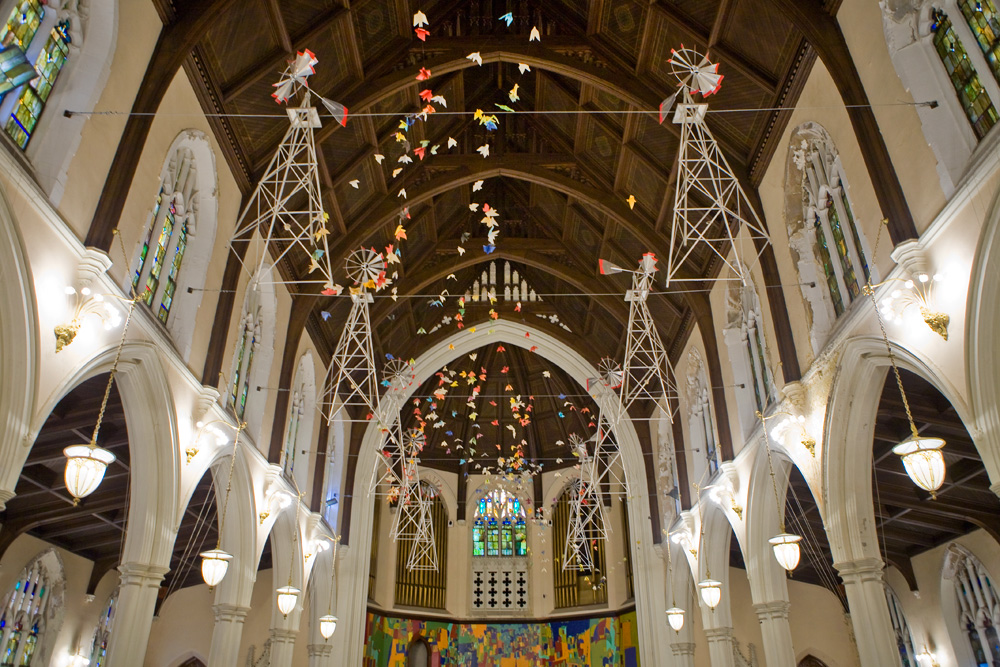
2. Tilting at Giants by Dayton Castleman and Fall to Flight by Alison Dilworth, Broad Street Love, Philadelphia

Castleman, Dayton_Tilting at Giants
Dayton Castleman (American, 1975–), Tilting at Giants, 2006. Aluminum, steel, votive candles, glass votive holders, braided fishing line, steel cable, and rigging hardware. Permanent site-specific sculpture, Broad Street Love, Philadelphia.

Tilting at Giants was commissioned by Broad Street Ministry (renamed Broad Street Love in 2024), a nonprofit organization in downtown Philadelphia providing stabilizing services to individuals experiencing deep poverty. It’s housed inside the former Chambers-Wylie Memorial Presbyterian Church, a historic turn-of-the-century Gothic Revival church that closed its doors in 1999 due to dwindling membership and the death of its pastor. The Presbytery of Philadelphia (PCUSA) leased the building for a few years to the University of the Arts, who used it for classes and events.

Then in May 2005, Rev. Bill Golderer rejuvenated the dormant church by opening Broad Street Ministry, billed as “an innovative Christian faith community that emphasizes the Gospel imperatives of extending generous hospitality, demonstrating justice and compassion, and providing a ground for artistic expression.” He removed the pews and set communal dining tables in their place, inviting in guests off the streets to enjoy chef-prepared meals all week long. The organization also provides legal help, fresh clothes, medical assistance, and a mailbox for those who lack a permanent address.

In its first year, Golderer issued an open call for proposals for a site-specific art installation that would be funded by the city’s Percent for Art program. Multidisciplinary artist Dayton Castleman, who lived in Philly at the time but who is now based in Northwest Arkansas, was awarded the commission.

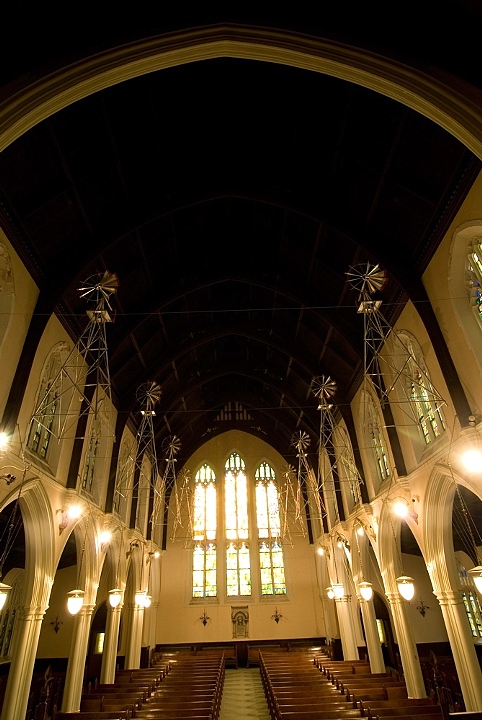
His project comprises twelve large windmills that hover in the air, six in a line down each side of the vault—“unexpected, anachronistic, misplaced . . . [and] completely still,” Castleman says. He elaborates:

This stillness infuses the atmosphere with a sense of uneasy expectation. The brilliant towers, tall and clean, flash against the dark, vaulting canopy above. Like sentinels keeping watch, the sun-burst fans are poised, brimming with potential energy, waiting for a mysterious, transcendent wind to fill the space and make it sacred. Cradled within each tower, nearly lost in the spectacle, hover votive candles, glowing, unflickering, in prayer. This sanctuary is a living prayer—an aching, tense, expectant prayer—and a hair pulled taut, waiting to snap. . . .

The air is rich with suggestions and intimations of the invisible.

His artist’s statement also mentions Pentecost. On that seminal day two millennia ago, the disciples were gathered in Jerusalem with anticipation, as Jesus had told them, just before returning to the Father, to remain in the city until they received their new baptism, “for John baptized with water, but you will be baptized with the Holy Spirit not many days from now” (Acts 1:5).

Broad Street Love
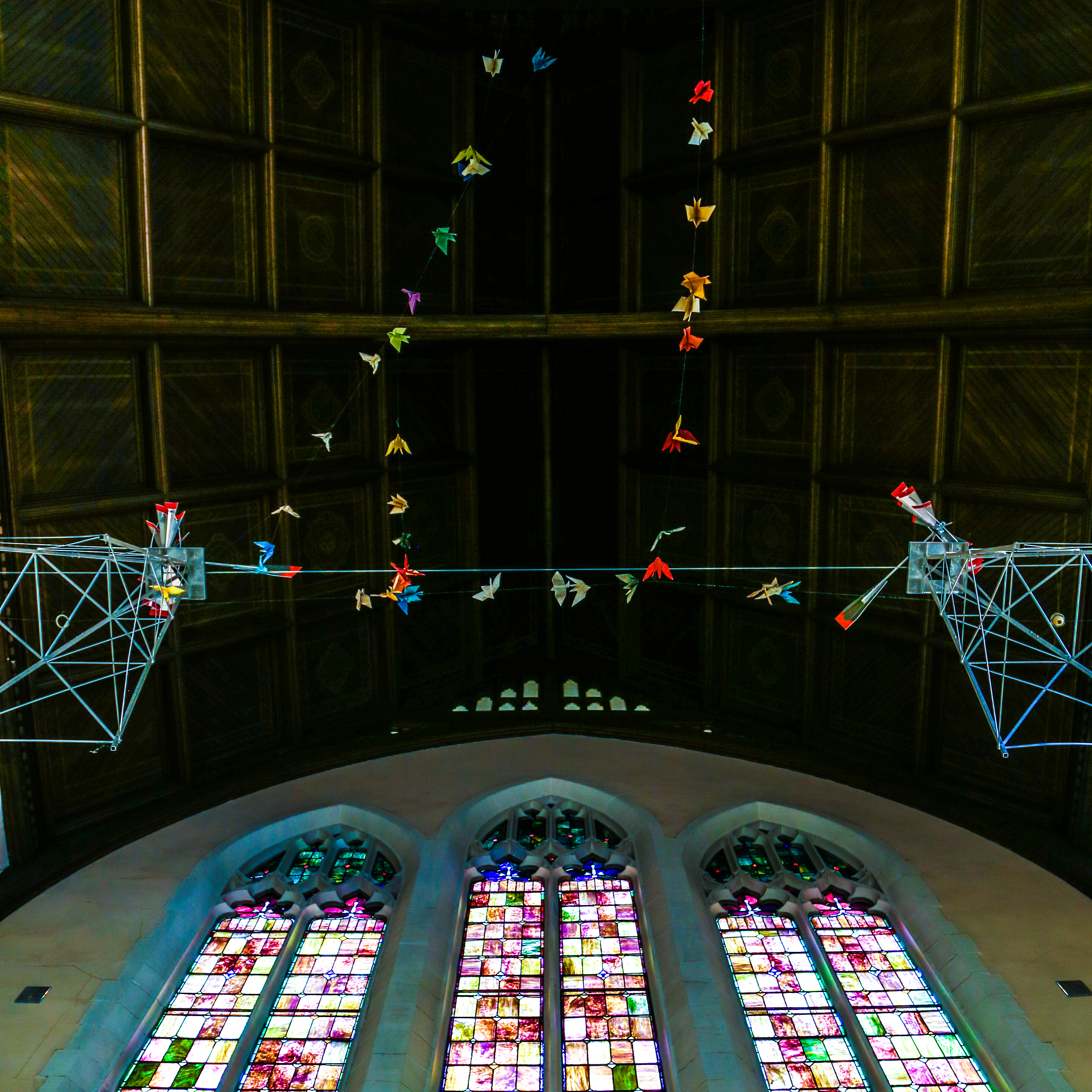
Broad Street Love in Philadelphia, with art installations by Dayton Castleman (windmills) and Alison Dilworth (swallows). Photo: Bradley Maule.

Broad Street Love (upward view)

Shortly after Castleman’s Tilting at Giants was installed, it was joined by Fall to Flight, a flock of approximately six hundred origami swallows suspended from the ceiling, containing written prayers of the community. Created by Philadelphia-based artist Alison Dilworth, the multicolored birds winging overhead evoke the unleashed joy of the Holy Spirit, who is sometimes compared in scripture to a dove, but also Jesus’s encouragement in the Sermon on the Mount that God will provide for the needs of his children, just as he provides for our avian friends who neither sow nor reap nor gather.

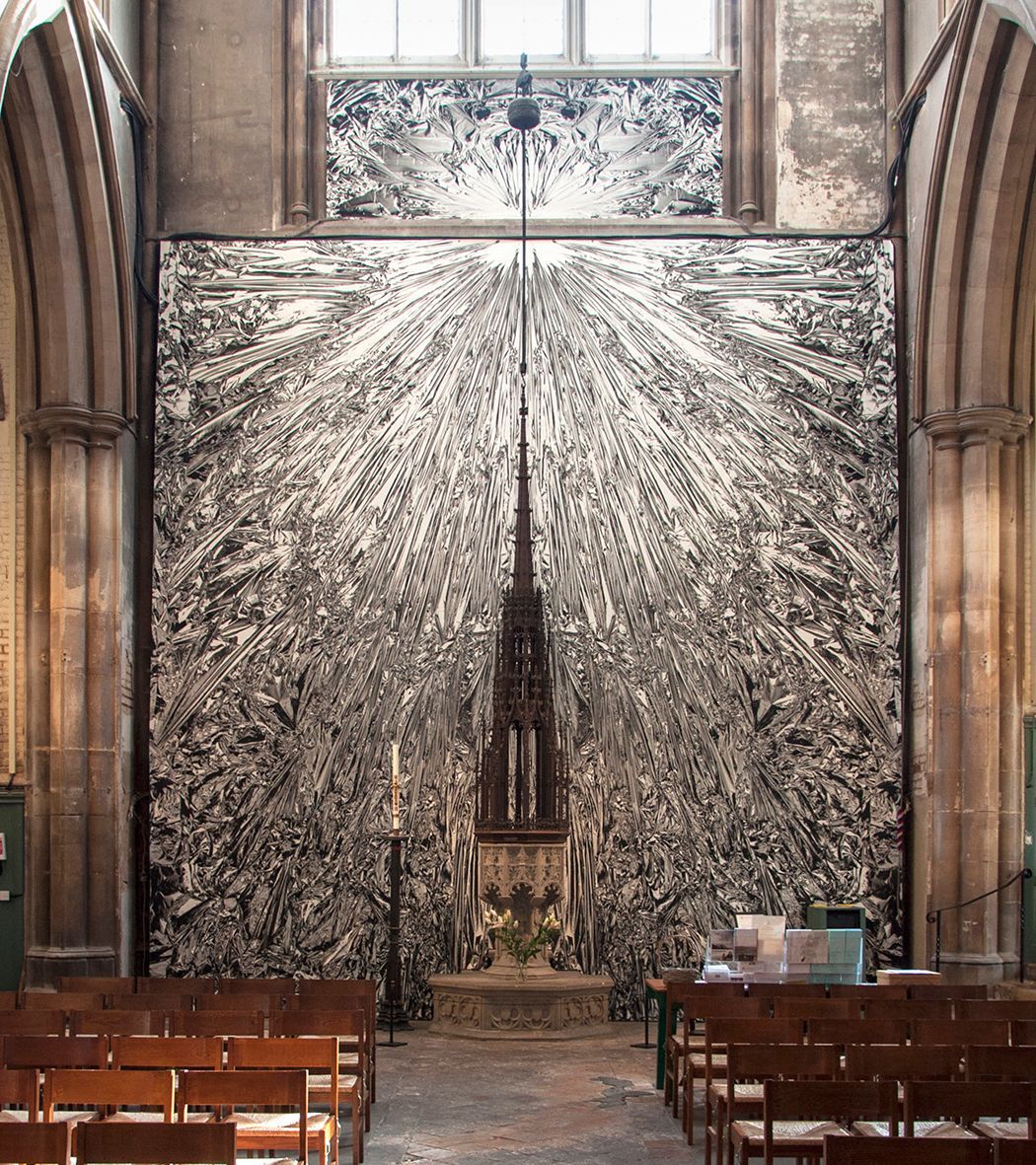
3. HS by Maciej Urbanek, St. Michael’s Church, Camden Town, London

Urbanek, Maciej_HS
Maciej Urbanek (British, 1979–), HS, 2014. Digital photographic print, 10 × 7.5 m. St. Michael’s Church, Camden Town, London.

HS by the Polish-born British artist Maciej Urbanek is a monumental composite digital print installed on the west wall of St. Michael’s (Anglican) Church in Camden Town, London, covering up damaged plasterwork in need of restoration. What appears to be an explosion of silvery light is an effect produced with black plastic trash bags, which the artist crumpled up, lit, photographed, digitally reworked, and inkjet-printed on a large scale. Winner of the 2015 Art+Christianity Award for Art in a Religious Context, the work brings a baroque aesthetic to the Victorian interior.

“I am interested in elevating the banal and prosaic elements of life and turning them into powerful and rich visual statements,” Urbanek has said. A sign at the church says that Urbanek’s use of an everyday material to make something so beautifully radiant is “a metaphor for God’s work in taking ordinary human lives and making them extraordinary.”

Commissioned by Father Philip North (then the team rector of the parish of Old St Pancras) and privately funded by John Booth, HS was intended to be a temporary installation, but it was so well received by the parish that it has become a permanent fixture. According to the church’s X account, it “represent[s] the Holy Spirit breaking in from the outside world.”

The artwork’s location just behind the church’s baptismal font creates a linkage between the sacrament of baptism—in the Church of England, marking the beginning of a journey with God and the baptizand’s membership in the community of faith—and the work of the Spirit, who came at Pentecost with great power to set ablaze and send out. Indeed, HS can be read as that dramatic moment of the Spirit’s outpouring, and that parishioners walk past it when they exit the sanctuary is a reminder that they leave empowered by the Spirit to live and proclaim Christ’s gospel.

Thank you to Sheona Beaumont for introducing me to this work in her book The Bible in Photography: Index, Icon, Tableau, Vision. It is also the subject of a 2021 essay by Jonathan A. Anderson, “Bin bag visions: Theological horizons in Maciej Urbanek’s HS,” which I don’t have access to.

From “On Pentecost” by Romanos the Melodist (poem)

Pentecost (Ottonian)
The Descent of the Holy Spirit, from a benedictional made in Regensburg, Germany, ca. 1030–40. Tempera colors, gold leaf, and ink on parchment, 9 1/8 × 6 5/16 in. (23.2 × 16 cm). J. Paul Getty Museum, Los Angeles, Ms. Ludwig VII 1 (83.MI.90), fol. 47v. As is traditional in artistic depictions of this subject, the apostle Paul (with brown beard) is seated in a prominent position opposite Peter, receiving the Spirit like the other eleven apostles. Paul was not present at the event, but he was later mystically joined to it.

. . .

Peter, speaking like this to the apostles, roused them to prayer,
And standing in their midst, he spoke as follows:
“On bended knee let us beg and pray
That we shall make this chamber a church, for so it is and has become.
Let us be eager to cry unto God,
‘Send us thy good spirit
So that it may lead all of us to correct knowledge
Which thou hast prepared for those who worship and praise
The All-Holy Spirit.’”

When they heard this, those who had been called with him gathered together
As lambs in the presence of the shepherd, charmed by his speech;
And silently they specified what they desired,
And they held up to the Pantokrator the prayers which pressed for these things:
“To the Lord of angels and the King,
To the Ruler of humankind and the Maker of the world,
To the One who holds sway with his nod over those in heaven and earth,
Thy friends and servants cry to thee: ‘Quickly send us
The All-Holy Spirit.’”

Immediately after completing their prayers, they wrote their names under them,
And sealing them in faith, they sent them on high—
Prayers which the Master recognized and he said:
“Comforter, descend as thou dost wish, of thy own initiative, and without being summoned;
The disciples expect thee; they are the ones
Whom I gather together for thee and the Father,
The ones whom I educated when I said: ‘Teach the nations,
Extolling the Father, and worshiping the Son, and praising
The All-Holy Spirit.’”

God heard their wants, and his Comforter
Descended on those who were praying.
The Ineffable One was not removed from one place to the other,
Nor was there alteration, nor accommodation, nor did he endure diminution,
For he was above, and below, and everywhere;
For the divine nature is ineffable and not to be touched;
It is not seen by the eyes, but it is apprehended through faith;
It is not grasped in the hands; but it is felt in hearts of faith—
The All-Holy Spirit.

When the divine Pentecost was complete, the eleven chosen ones set up a din.
As they persevered in their prayers,
And as the passage read from Acts says,
When the sound of the powerful wind of the spirit suddenly came resounding from heaven,
The whole chamber was filled with fire.
Indeed, it amazed the beloved disciples rather too much.
When they saw the dwelling tossed like a boat, they cried:
“O Master, check the storm and send
The All-Holy Spirit.”

When the disciples recognized that the whole upper room was shaken as by an earthquake from the wind,
They all lowered their eyes in fear;
And lo! Another trembling still more to be shuddered at,
And one upon another marvel brought a second trembling in addition to the first fear,
For fiery tongues touched them anew
And began to appear on the heads of the chosen group.
Indeed, the fiery tongues did not burn their hair but lighted up their hearts
And sent them forth cleansed and purified—
The All-Holy Spirit.

Peter, seeing all the things which were happening, cried out: “Brothers,
Let us hold in reverence what we see, and let us not examine it.
Does anyone say what it is that has been done?
For what has been accomplished transcends belief and defies thought.
Spirit and fire are united—a true miracle;
Air and flame are joined together—awesome sight!
Along with winds, torches; along with dew, sparks of fire.
Who has seen, who has heard of this? Who is able to speak of what is produced by
The All-Holy Spirit?

“Do you, then, dearly beloved, stand and simply observe the fire
Which the One who is in heaven has sent from on high;
Do not fear, for the coals do not burn;
Do not be amazed that the fire does not burn, but as prudent men remember
How long ago the fire received kindly the three children,
How their bodies were not burned, nor their hair,
How the furnace revealed the three as four,
For it gave back those whom it received with interest, since it feared
The All-Holy Spirit.

“Then, brothers, let the One descended upon us cast out fear from our minds,
And make a show of love to the Ascended One.
Since he loved those whom he called,
Since all the things which he prophesied, he has fulfilled, and since he has done as he said,
Why, then, should we be afraid of a flame which does not burn?
Let us consider the fire as roses, which indeed it is.
It has been placed upon our heads like flowers,
And on our heads it has formed a crown, an ornament, and illumined us,
This All-Holy Spirit.”

. . .

This passage constitutes strophes 4–12 of a sixth-century Pentecost kontakion (poetic homily) by Romanos the Melodist, translated by Marjorie Carpenter in Kontakia of Romanos, Byzantine Melodist; I: The Person of Christ (Columbia: University of Missouri Press, 1970). For the original Greek, see #33 in the critical edition edited by Paul Maas and Constantine Athanasius Trypanis, Sancti Romani Melodi Cantica Genuina (Oxford: Clarendon Press, 1963).

Three details stand out to me: the prayers of the apostles for the Spirit being sent up like signed, sealed letters to the heavens, eliciting God’s affirmative response; the paradoxical mingling of dew and fire (two seemingly incompatible elements) in the Spirit’s descent, both refreshing and enflaming; and the image of the Pentecostal flames as roses that crown the apostles’ heads!

Romanos is known for his kontakia, a form of hymn in the Byzantine liturgical tradition that Romanos is believed to have introduced. The kontakion is basically a poetic sermon that was sung, containing highly dramatic features, including dialogue, but it was not staged. At its inception in the early sixth century and through the seventh, a kontakion consisted of a prologue (the prooimoion or koukoulion) followed by eighteen to thirty metrically identical strophes (oikoi or ikoi, i.e., stanzas; sing. oikos or ikos) linked by a refrain. (In the example above, the refrain is “The All-Holy Spirit.”) The first letter of each of the strophes often forms an acrostic.

Kontakia were written to be sung at the Daily Office, not Mass, on feast days. Unfortunately, none of the music Romanos wrote for his survives.

By the eighth century, the kontakion had become shortened, and it lost its homiletic character and its dialogue.


Romanos the Melodist (fl. 536–556 CE) was a preeminent Byzantine hymnographer and composer who is said to have written, in Greek, nearly a thousand kontakia, of which fifty-nine (text only) survive, his best known being on the Nativity of Christ. He was born in the late fifth century to a Jewish family in Emesa (modern-day Homs), Syria, but was baptized into Christianity as a young boy. He later moved to Berytus (Beirut) and was ordained a deacon of the Church of the Resurrection there. During the reign of Emperor Anastasius I (r. 491–518) Romanos moved to Constantinople and served as sacristan at Hagia Sophia, residing in that capital city until his death. He was sainted by the Greek Orthodox Church, which celebrates his feast on October 1. The famous Akathist Hymn to the Theotokos is attributed to him.

Pentecost roundup: “All Flesh” by Steve Thorngate, animated fabrics, and more

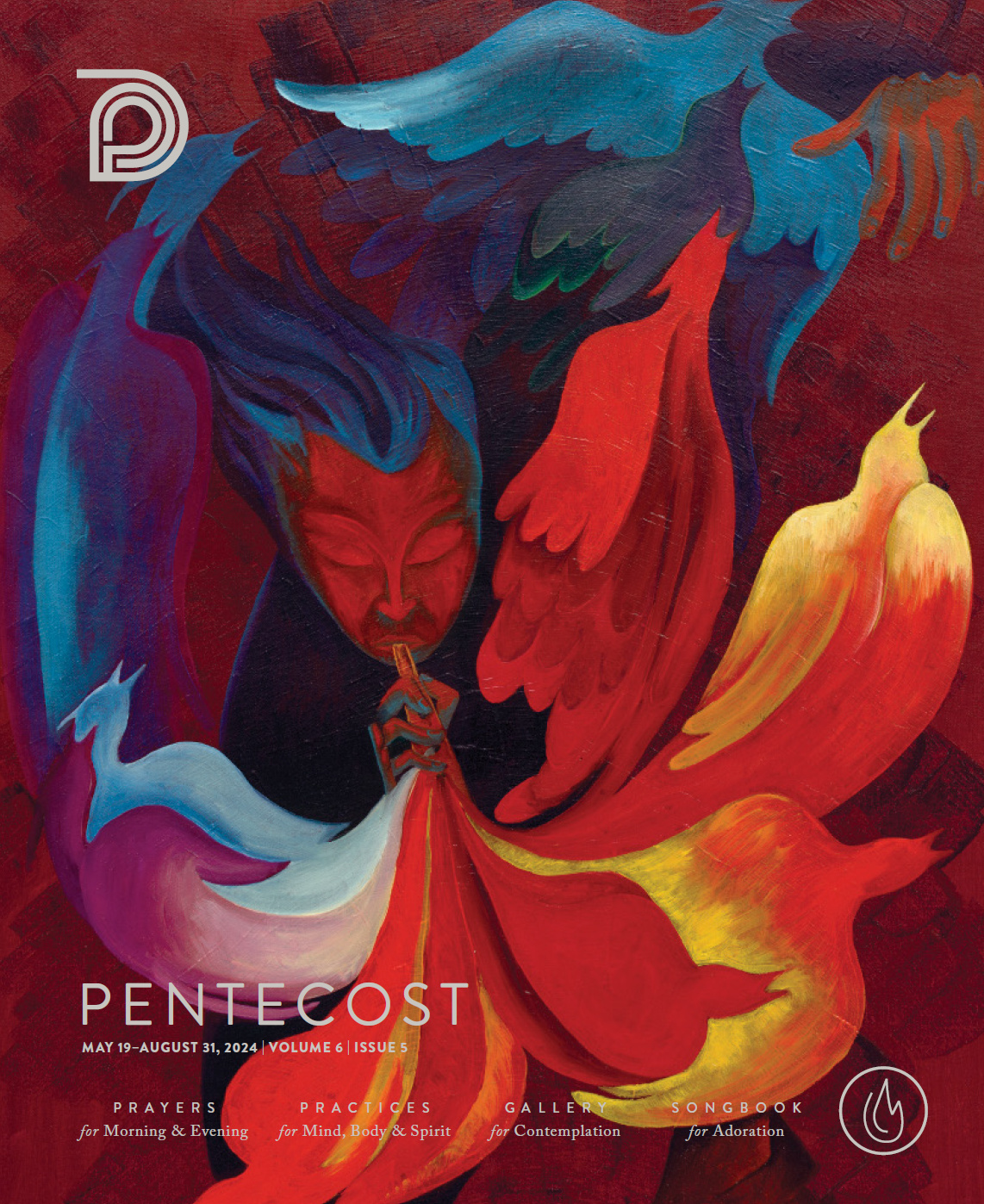
LIVING PRAYER PERIODICAL: Pentecost 2024: The latest edition of the Daily Prayer Project’s Living Prayer Periodical is available for purchase! Pentecost is this Sunday, May 19, so grab your copy soon. The booklet provides a distinct liturgy of scripture and prayer for each day of the week, through August 31, as well as art with accompanying reflections, songs, spiritual practice essays, and, new this issue, a poem! I curate the art and poetry for the DPP. The cover image is cropped from a painting by the Guatemalan artist Juan Francisco Guzmán (it’s reproduced in full in the interior). And the poem we feature, which I wrote a short commentary for to help readers engage it more meaningfully, is “Not Like a Dove” by Mary F.C. Pratt; I’m grateful to the directors for taking a risk with this unusual, even difficult, poem, which rewards those willing to sit with its imagery over time.

Pentecost LPP 2024

+++

SERMON (text only): “When the Spirit Comes” by N. T. Wright: Preached May 23, 2010, at Durham Cathedral, where he was bishop at the time, this Pentecost sermon by the esteemed N. T. Wright is a rousing call to stand, like Jesus, at the place where heaven and earth collide: in the Spirit. Here are two excerpts:

  • “The point about Pentecost is that it’s the point at which two worlds collide and look like they are now going to be together for keeps. The two worlds are of course heaven and earth. . . .
              The whole point of heaven and earth in Jewish thought is that they are meant to meet and merge. And the point of the gospel story as Luke has told it in his first volume is that Jesus had come to bring the life of heaven and earth together. That is the meaning of the ‘kingdom of God’. Thy kingdom come, he taught us to pray, on earth as in heaven. The disciples, we may presume, had been praying that prayer, among others, in the fifty days since Easter. And now the prayer is answered.”
  • “When the Spirit comes, the Spirit will prove the world wrong [in how things are run] . . . which is not a comfortable message, and it’s not meant to be. But if we can at least recognise that discomfort, and see it as the thing you should expect when the two worlds collide, we can put our shoulders back, take a deep breath – in other words, breathe in God’s breath – and get on with the task to which the New Testament commits us but in which . . . we feel a strange reluctance.
              Of course we can get it wrong, and of course we will find it awkward. But how much more wrong would it be not to try! How much more awkward, when God finally brings heaven and earth fully together, will it be to discover that we had continued to live in the split-level world when we were invited, by Ascension and Pentecost together, to dare and to risk the possibility of bringing them together in our own lives and in our own witness! Because of course none of this is in the last analysis ‘about’ us. If we are embarrassed at the heaven-and-earth conjunction, we are forgetting that we are not, after all, the centre of attention in all this. Jesus went on to say that the Spirit would glorify him, not us: he will take what belongs to Jesus and declare it to us and through us to the world.”

+++

MUSIC:

>> “All Flesh” by Steve Thorngate: This playfully serious song is rooted in Joel 2:28–29, which Peter quotes in his sermon at Pentecost: “I will pour out my spirit on all flesh; your sons and your daughters shall prophesy, your old men shall dream dreams, and your young men shall see visions. Even on the male and female slaves, in those days I will pour out my spirit.” Thorngate wrote it several years ago, but this recording, new this year, is the first he’s released, and it’s available only on Bandcamp for now.

>> “Ruach” by Delvyn Case, performed by the Mivos Quartet: Inspired by the story of Pentecost in Acts 2, this sacred concert work for string quartet, writes composer Delvyn Case, “bring[s] to our awareness many different ways ‘breath’ and ‘spirit’ can become sonically and dramatic present. Throughout the piece the performers are asked to make various kinds of breath sounds with their instruments and their own voices, blurring the line between music and sound. Overall, the piece emphasizes idea of the spirit as a powerful force that is surprising, shocking, and fundamentally resistant to control.”

>> “Sweet, Sweet Spirit” by Doris Akers, performed by Ruah Worship: Consisting of siblings Joshua Mine, Julia Mine, Erika Grace Izawa, and Marian Mine, Ruah Worship from Japan performs original worship songs as well as covers. I especially love their a cappella arrangements of Black gospel songs. Here they sing a song by Gospel Music Hall of Famer Doris Akers (1923–1995), about the sweetness of the Holy Spirit, who revives communities and fills them with love.

+++

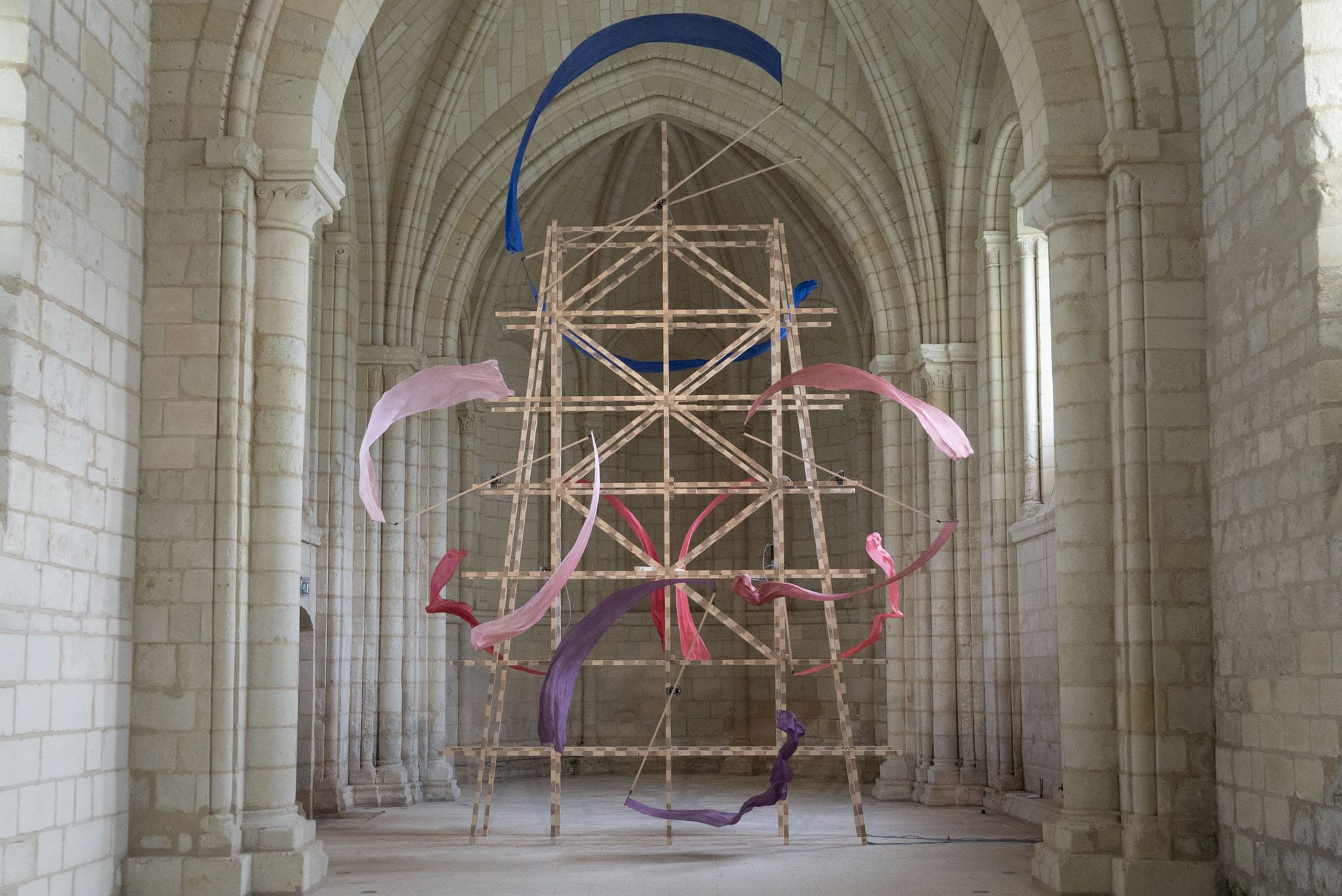
ART INSTALLATION: Fanions et Carillons by Pinaffo & Pluvinage: I learned of this kinetic sculpture by the French artist duo Marion Pinaffo (b. 1987) and Raphaël Pluvinage (b. 1986) in a Colossal article in February and thought of the movement of the Holy Spirit. Fanions et Carillons, French for “Pennants and Chimes,” was commissioned by Fontevraud Abbey and was on display earlier this year in one of the abbey’s twelfth-century chapels. Inspired by the historical striking clocks of churches, the automaton comes to life every half hour, sending fourteen pennants of blue, red, pink, and purple swinging and swirling.

Fanions et Carillons
Marion Pinaffo and Raphaël Pluvinage (aka Pinaffo & Pluvinage), Fanions et Carillons, 2023. Painted wood, motor, silk, electronic, 4 × 2 × 7 m. Temporary installation at the Chapelle St-Benoît, Abbaye Royale de Fontevraud, Anjou, Maine-et-Loire, France.

On their website, Pinaffo & Pluvinage write of the piece, “Although its mechanics are simple and rudimentary, using rotational or pendulum movements, it doesn’t produce the sound of bells, but rather animates fabrics. A set of 14 inert pennants awaken in turn to create ephemeral forms that mutate, respond and compose. Like a harmony of chimes creating a melody, this ensemble creates a choreography lasting a few minutes at regular intervals.” Whereas one might associate a certain rigidness and predictability with clocks, in this piece there’s a freedom, with the pennants moving at different rates and occasionally reversing direction.

+++

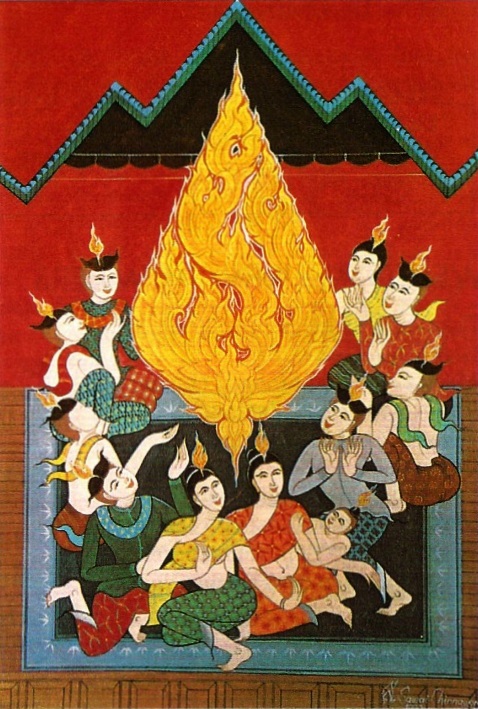
ARTICLE: “Painting Pentecost: Painter Sawai Chinnawong saturates the outpouring of the Spirit with the colors Thai art traditionally associates with the holy” by Amos Yong and Jonathan A. Anderson, Christian Century: Adapted from the book Renewing Christian Theology: Systematics for a Global Christianity (Baylor University Press, 2014), this article explores one of the Pentecost paintings of Thai Christian artist Sawai Chinnawong, who adopts and adapts a Thai Buddhist visual vernacular in terms of color choices, design elements, and the gestures and postures of figures. I’m appreciative of how the painting shows both men and women, and even a child, present at Pentecost and being recipients of the gift of the Spirit, as they surely were.

Chinnawong, Sawai_Pentecost
Sawai Chinnawong (Thai, 1959–), Pentecost, 1997. Acrylic on canvas.

(Related post: “Pentecost art from Asia”)

Some Christians are uncomfortable with art that transposes biblical events into other cultural contexts. But I think it’s a beautiful picture of the global character of the gospel, which has taken root in countries all over the world. As the authors write, in addition to celebrating a historic event, Chinnawong’s Pentecost “prompts us to see this as another event altogether: the outpouring of the Spirit in a room in 21st-century Bangkok rather than first-century Jerusalem. Chinnawong sets the scene here not out of disregard for the historical particularity of the original event but as a means of imagining and visually praying for the Spirit’s presence in his own historical moment. For Chinnawong, the Holy Spirit’s filling is not isolated to a single event, a particular moment, or one place but may be repeated at any time and place and for any people. Thus the circle of believers being filled with the Spirit is repeatedly repopulated and renewed.”

Roundup: Biber’s Mystery Sonatas, icons by Maxim Sheshukov, “Mercy at the Movies,” and more

SPOTIFY PLAYLIST: March 2024 (Art & Theology): My new monthly playlist of thirty songs is up a day early and, as usual, includes both recent releases and older favorites. Let me also point you to the longer, thematically distinct playlists I made for Lent, Holy Week, and Eastertide.

+++

CONCERT: Phantasia performs Biber’s Mystery Sonatas, St Hubert’s Church, Corfe Mullen, England, February 17, March 23, and April 13, 2024: The Mysteries of the Rosary are a set of fifteen meditations on episodes in the lives of Jesus and his mother, Mary. They are divided into three groups: the Joyful Mysteries (the Annunciation, the Visitation, the Nativity, the Presentation of the Infant Jesus in the Temple, the Twelve-Year-Old Jesus), the Sorrowful Mysteries (Christ on the Mount of Olives, the Scourging at the Pillar, the Crown of Thorns, Jesus Carries the Cross, and the Crucifixion), and the Glorious Mysteries (the Resurrection, the Ascension, Pentecost, the Assumption of the Virgin, and the Beatification of the Virgin).

Around 1676, the Bohemian Austrian composer Heinrich Ignaz Franz von Biber (1644–1704) wrote fifteen short sonatas for violin and continuo based on these mysteries. In a free three-part event sponsored by Deus Ex Musica, the newly formed period-instrument ensemble Phantasia will be performing Biber’s Mystery Sonatas at St Hubert’s Church, Corfe Mullen, on the south coast of England, accompanied by commentary by musician and educator Dr. Delvyn Case, who will provide thoughts about the ways each sonata reflects its “mystery,” linking specific elements of the musical structure to themes or ideas in the biblical scene. The performance of the first cycle of the work has already passed, but the remaining two are still upcoming: the Sorrowful Mysteries on March 23 (the Saturday just before the start of Holy Week), and the Glorious Mysteries on April 13.

Case tells me that Deus Ex Musica hopes to eventually provide video excerpts from the performances on their YouTube channel. In the meantime, here’s a little teaser, a snippet from the “Presentation in the Temple” movement, performed by Phantasia musicians Emma-Marie Kabanova on Baroque violin and Chris Hirst on German theorbo (long-necked lute).

+++

ARTICLES:

>> “Mercy at the Movies: Ten Films That Flip the Script” by Meaghan Ritchey, Mockingbird: “Spanning almost a century of cinema, this list of films maps a world—real and imagined—devoid of the mercy for which we all have need, as well as a world animated by unexpected and unearned mercies, flipping the script and leaving the plot forever changed.” What a great list! Number 7 is one of my all-time favorite films.

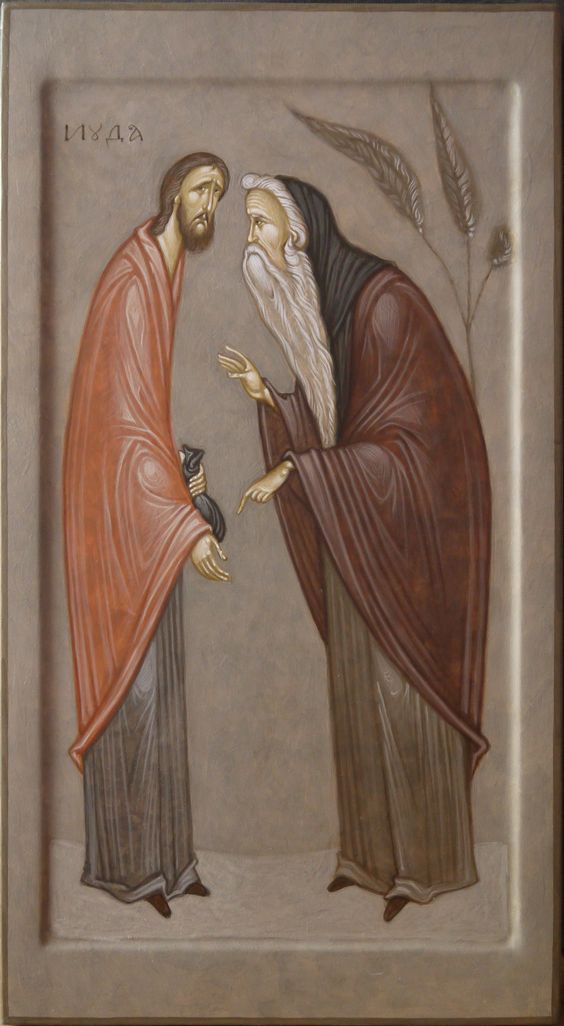
>> “As If Through a Child’s Inner Eye: The Contemporary Icons of Maxim Sheshukov” by Fr. Silouan Justiniano, Orthodox Arts Journal: In this article from 2016, Fr. Silouan Justiniano, a monk at the Monastery of Saint Dionysios the Areopagite on Long Island, explores the work of contemporary iconographer Maxim Sheshukov (Максим Шешуков) of Pskov, Russia, finding it “exemplary of the diversity and flexibility possible within our ever-renewing and living Tradition.”

Sheshukov, Maxim_Zacchaeus
Maxim Sheshukov, Zacchaeus, 2015. Egg tempera on gessoed wood.

Sheshukov, Maxim_Judas
Maxim Sheshukov, Judas, 2020. Egg tempera on gessoed wood.

+++

NEW ALBUMS:

>> Volume 9 (Lent-Easter-Pentecost) of The Soil and The Seed Project: This is the latest release in an ongoing series of music for the church year by musicians of faith from the Shenandoah Valley. Some of my favorite tracks are “I Will Sing to the LORD” (a setting of Psalm 104:33) and “Hosanna, Loud Hosanna” (a newly retuned but old-timey-sounding hymn for Palm Sunday). I also really like “Gentle Shepherd,” a lullaby written for the children of Salford Mennonite Church to sing in worship in 2018 and performed in this music video by the sister folk duo Spectator Bird:

>> Life and Death and Life: Songs for Lent, Holy Week, and Easter by Steve Thorngate: Chicago-based church musician and songwriter Steve Thorngate has followed up his excellent album After the Longest Night: Songs for Advent, Christmas, and Epiphany with an album for the next two seasons of the church year, including the Day of Pentecost! In addition to twelve original songs, it includes two African American spirituals, a Charles Tindley hymn, and, perhaps my favorite, a cover of (new-to-me) Brett Larson’s poetic country song “Rolling Away,” about barriers to sight and wholeness being removed and a fresh new clarity, a freedom, a path opening up:

>> JOY JOY JOY JOY JOY by Paul Zach: The ever prolific Paul Zach of Virginia’s latest release is an effusively joyous ten-track album celebrating God’s love, salvation, and sustenance. He collaborated with other musicians on the project, including Jon Guerra, Tristen Stuart-Davenport, and IAMSON. Here’s a snippet of the opening song, “Nothing,” based on Romans 8 (listen to the full track here):

Roundup: Pentecost-inspired harp duet, the Sacred Art of Reading, and more

AVANT-GARDE CLASSICAL: Klang—Die 24 Stunden des Tages (Sound—The 24 Hours of the Day) is a cycle of chamber-music compositions by the avant-garde German composer Karlheinz Stockhausen, which he worked on from 2004 until his death in 2007. (The intention was for there to be twenty-four pieces, but the cycle was unfinished at twenty-one.) The first two pieces in the cycle, on the themes of Ascension and Pentecost, were commissioned for the interdisciplinary Pause festival at Milan Cathedral by artache, a Milan-based nonprofit committed to showcasing contemporary artworks in public places of worship. The artistic director of artache at the time was Don Luigi Garbini, a priest at the church of San Marco in Milan and cofounding director of the artache initiative the Laboratorio di Musica Contemporanea al Servizio della Liturgia (Laboratory for Contemporary Music in the Service of the Liturgy).

>> No. 81: “KLANG, 1st Hour: Himmelfahrt (Ascension)” by Karlheinz Stockhausen, for organ or synthesizer, soprano, and tenor, 2004–5: This thirty-seven-minute piece premiered at Milan Cathedral on Ascension Day, May 5, 2005. The two hands of the organist almost always play in different, independent tempos of a chromatic time scale, while the soloists sing words or phrases associated with “ascension,” particularly the Ascension of Christ. According to the composer, “Asking a performer to break the barrier of time by playing simultaneously in different tempi is like submitting a man to physical disruption, allowing him to go in spirit form towards another world” (source). For musical analysis by Ed Chang, see here. The performance below is from the North American premiere at the Schwartz Center for the Performing Arts at Emory University in Atlanta on October 11, 2005, featuring organist Randall Harlow, soprano Teresa Hopkin, and tenor John Bigham.

>> No. 82: “KLANG, 2nd Hour: Freude (Joy)” by Karlheinz Stockhausen, for two harps and voice, 2005: This forty-minute piece premiered at Milan Cathedral on July 6, 2006. The text is taken from the medieval Pentecost hymn “Veni Creator Spiritus” [previously], which the harpists sing in spurts, “in alternation or sometimes together . . . , while plucking, picking, caressing, stroking, pinching, rubbing, striping, striking, pinking, jubilating,” as Stockhausen put it. In program notes dated February 15, 2006, he writes, “There is something unique about the adventure to combine two harps which are normally tuned in diatonic scales and to synthesise them into one large chromatic harp. . . . Pentecost unites what has been separated. My work FREUDE too.” For musical analysis by Ed Chang, see here. The performance below is from the Stockhausen Memorial Concert in Kürten, Germany, on December 16, 2017, featuring Marianne Smit and Miriam Overlach.

(As an interesting side note: The Beatles included Stockhausen’s face on the cover of Sgt. Pepper’s Lonely Hearts Club Band. Their “A Day in the Life” and “Revolution 9” were influenced by his electronic music.)

+++

NEW DOCTORAL COHORT: The Sacred Art of Reading: The Eugene Peterson Center for Christian Imagination at Western Theological Seminary in Holland, Michigan, is offering a new, mostly remote, three-year DMin track called “The Sacred Art of Reading,” which begins this October, taught by Professor Chris E.W. Green. The program is centered on the reading of scripture—the Old Testament narrative books (Year 1), Old Testament poetry and wisdom literature (Year 2), and the Gospels and Apocalypse (Year 3)—alongside a number of additional primary texts, whose titles you can view on the website; authors include, among others, Avivah Gottlieb Zornberg, Amy-Jill Levine, Daniel Berrigan, Robert Alter, Shusaku Endo, and of course Eugene Peterson! Participants get together in person for one week each semester (times six semesters) and are responsible for, in addition to the $17,280 tuition, travel and lodging costs. The application deadline is June 30, 2023. Applicants must hold an MDiv degree or its educational equivalent and have at least three years of ministry experience since completing the MDiv. Here’s a condensed program description:

The Sacred Art of Reading cohort will be dedicated to collaboration in “the forbidding discipline of spiritual reading,” confident that such an undertaking cultivates the loving attentiveness, prophetic discernment, and childlike openness to surprise that characterize what St. Paul calls the faith that works by love. . . . The cohort is designed to cultivate an alternative awareness, one shaped by the slow, painstaking work of collaborative interpretation. And to that end, the heart of the program is the reading of the Christian Scriptures. The aim will be both philosophical and devotional, critical and celebratory, mystical and pastoral. No one reading method will be stipulated, but students will be encouraged to find ways to honor the traditions of the communities in which they learned to argue, to muse, and to pray.

Besides Scripture, the cohort will engage a wide range of texts including poems, memoirs, essays, treatises, sermons, and stories old and new, familiar and strange, sacred and “worldly,” in part and in whole, not so much in order to “plunder the Egyptians” as to bear glad witness to the wonder that God is never left without a witness because all truth, truly received, trues.

This approach really wets my whistle! I don’t have a master’s degree, so I’m out, but I feel so energized by the reading list and wanted to share the opportunity with you all, as the program seems doable for those with full-time jobs. A virtual interest meeting is being held on June 1. Click here to view other doctor of ministry cohorts at Western.

+++

FUNDRAISING CAMPAIGN: The Soil and The Seed Project: I’ve mentioned this project several times on the blog before, as I’m a big fan. A ministry of VMMissions (Virginia Mennonite Missions), The Soil and The Seed Project releases original music, art, and liturgies throughout the Christian year, especially suitable for families with littles. They launched in December 2021 and since then have put out seven collections, with their latest and largest yet—Vol. 7 // Ordinary Time—dropping this week. (Request a free download through their website, or stream the music through your favorite service.) Coinciding with this release, they have also launched a campaign to raise $27,000 by June 18 to cover the costs of recording, mixing, pressing, printing, shipping, etc., for future collections. Learn more in the five-minute video below, which features the new songs “In the Little Moments,” “Teach Me, O LORD,” and “Because of Jesus.”

The Soil and The Seed Project offers all their content for free, including physical CDs (as stock permits), and are committed to keeping it that way—which is why they need the support of donors. Donate to their campaign, and you can opt to receive stickers, notecards, and/or a T-shirt as a thank-you. Also note: they’ll be giving a concert at 6:30 p.m. on Saturday, June 3, at the Brethren & Mennonite Heritage Center in Harrisonburg, Virginia.

+++

SONG: “Holy Spirit” by Victoria Williams: “Part front-porch soothsayer, part quirky bayou princess, and part eternal child, Victoria Williams writes songs of indescribable originality that embrace the earthly and the divine with wit, charm, and understated vision,” writes Josh Kun for Bomb magazine. The song “Holy Spirit” [read lyrics] is from her 1990 album Swing the Statue!. It opens with the familiar invocation from a Gullah spiritual: “Kum ba yah, my Lord” (which translates to “Come by here”). She seeks God’s presence and then, given a renewed sensitivity to it, identifies and celebrates its flow throughout her daily goings. She feels the Holy Spirit while building a raft with friends on the shores of Louisiana’s Lake Bistineau and riding a New York City subway beside a whistling stranger, as well as in graveyards and at bars and out under open night skies. The Spirit flows through all of life. I can’t find the song online anywhere other than in this YouTube fan video, which sets it to photos. [HT: Jonathan Evens]

+++

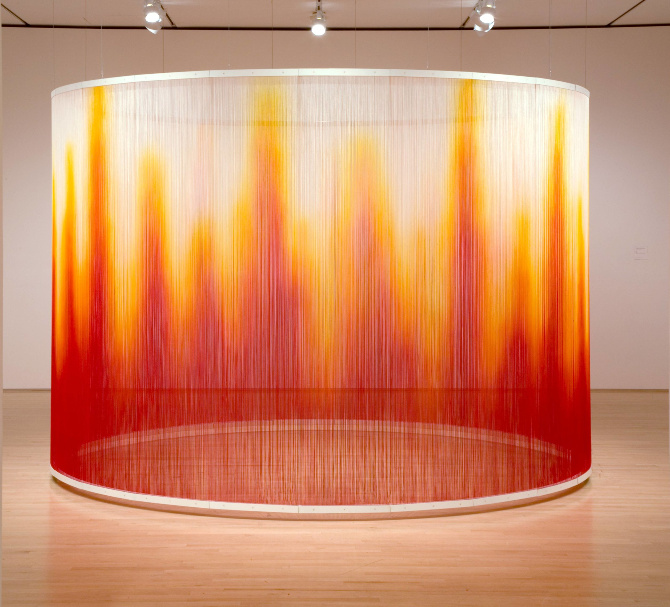
ARTWORK: Fire by Teresita Fernández: In the collection of SFMOMA, this ring of warm-colored silk yarn conveys something of the flickering quality of fire. At the link is a short video interview with the artist about the piece. Fernández says she is interested in the sensorial aspects of viewer engagement with art.

Fernandez, Teresita_Fire
Teresita Fernández (American, 1968–), Fire, 2005. Silk yarn, steel armature, and epoxy, 243.8 × 365.8 cm. San Francisco Museum of Modern Art, California.

Fire was a highlight of the 2013 exhibition Beyond Belief: 100 Years of the Spiritual in Modern Art, jointly organized by SFMOMA and the Contemporary Jewish Museum. Here’s a video of the Lick Wilmerding High School Vocal Ensemble singing “Famine Song” by VIDA around the installation that year, a song inspired by the basket weavers of Sudan, who persist in their craft during times of hardship, their hands working natural fibers into beautiful, colorful vessels. “Weave, my mother; weave, my child; weave your baskets of rushes wild . . .”

“Spiritus” by Steve Turner (poem)

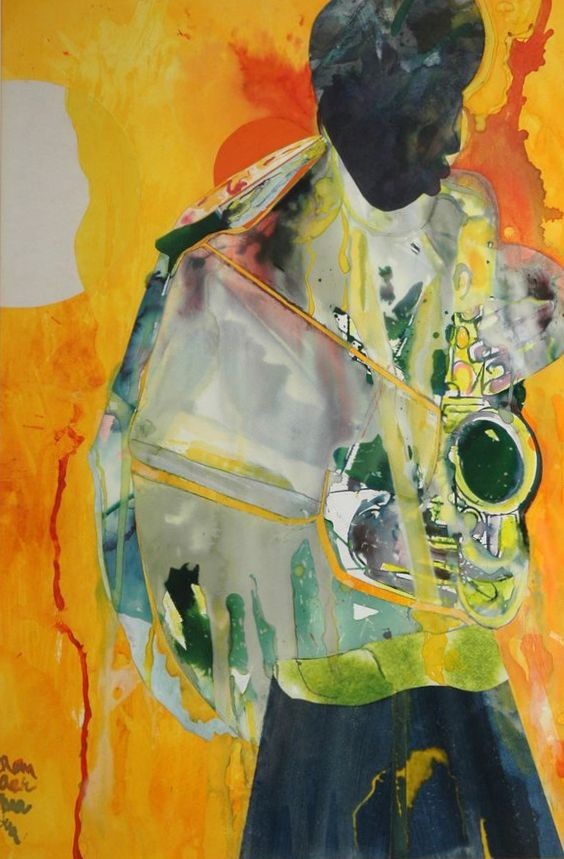
Bearden, Romare_All the Things You Are
Romare Bearden (American, 1912–1988), All the Things You Are, 1987. Collage, color dyes, and watercolor on board, 36 × 24 in. (91.4 × 61 cm).

I used to think of you
as a symphony
neatly structured,
full of no surprises.
Now I see you as
a saxophone solo
blowing wildly
into the night,
a tongue of fire,
flicking in unrepeated
	patterns.

From Poems by Steve Turner, compiled by Rebecca Winter (Oxford: Lion Publishing, 2002)

Steve Turner is a music journalist, biographer, and poet from the UK who has spent his career chronicling and interviewing people from the worlds of music, film, television, fashion, art, and literature. He has contributed to newspapers such as The Mail on Sunday and The Times, and among his many books is the influential Imagine: A Vision for Christians in the Arts. He lives in London.

Pentecost Playlist

Celebrated fifty days after Easter, Pentecost is one of the great feasts of the Christian year. It commemorates the descent of the Holy Spirit on Jesus’s apostles when they were gathered in Jerusalem for the Feast of Weeks ten days after Jesus ascended to heaven, marking the birth of the church. Acts 2 describes the Spirit’s coming as accompanied by a “rushing mighty wind” and “tongues of fire”—quite the dramatic entry! The Spirit filled the apostles with the miraculous ability to preach in speech that was comprehensible to all the many Jewish pilgrims, from various language groups, who were gathered in the city, resulting in the conversion that day of three thousand to the Jesus Way.

I’ve compiled a Spotify playlist of one hundred-plus Pentecost songs that celebrate God’s Spirit poured out over the face of the earth, bringing life and power. The indie folk genre is heavily represented, but there’s also an Appalachian fiddle tune, a Renaissance motet, a Native American dance song, a Russian Orthodox kontakion, Sacred Harp hymns, modern classical, Pentecostal gospel, blues, jazz, pop, lo-fi, and more. I hope to capture something of the Spirit’s dynamism with these selections.

The Holy Spirit ministers in a handful of ways. He renews, purifies, transforms. He gifts and empowers. He guides and illumines and comforts. He dwells within, a constant friendly presence. He intercedes for us with wordless groans. He unites believers across lines of difference, making us one. He enables us to bear fruit—love, joy, peace, etc.—for God’s glory and the world’s good.

So many songs centered on the Holy Spirit have an individualistic focus and a gentle, subdued tone. The Spirit does of course minister to the individual, and can be gentle and soothing (Jesus refers to him as the Comforter, after all!), and we often invoke him in our weariness. But the Spirit is also wild and uncontainable. And the life he brings is not merely of an inward spiritual kind; his impact manifests itself in tangible deeds out in the community, as those whom he fills go forth to serve their neighbors after the example of Christ.

Urban Doxology’s “Spirit, Send Your Fire” is a good example of a Holy Spirit song with an outward, communal focus, and it’s full of anticipatory excitement:

In terms of energy, consider the vigor with which Bach ornaments the final line of the Gloria, “Cum Sancto Spiritu in gloria Dei Patris” ([You, Jesus Christ, alone are the Most High] with the Holy Ghost in the glory of God the Father), in his B minor Mass. And for wildness: the loud clashing of the piano chords in Daniel Glover’s “The Descent of the Holy Spirit” from Misteria, evoking a sense of the disorientation that must have been felt on that historic day when the Spirit came suddenly sweeping in and the apostles started speaking multiple languages at once. (Some observers thought they were drunk!)

“Let the Waters” is another high-octane Pentecost song—this one in a rock style—which Michael Gungor wrote in 2014 when he was part of the Liturgists. In 2020 he revisited it with the Good Shepherd Collective, adding as a tag the African American spiritual “Wade in the Water” [previously]. In this context the spiritual references both the Spirit’s tendency to disrupt and the ancient Jewish folk belief that an angel would periodically come down to stir the waters of a certain pool in Bethesda, activating its healing properties (see John 5:4). The GSC released this new arrangement later in 2020 under the title “Pentecost,” featuring on vocals Gungor, Liz Vice, and Charles Jones.

Let the waters cool ya
Let the Spirit move ya
Feel the fire on your lips and sing your hallelujah
Sing your hallelujah

O my soul, sing hallelujah

Wade in the water
Wade in the water, children
Wade in the water
God’s gonna trouble the water

Led by Betty Pamptopee of Isabella Reservation, Michigan, “Methodist Hymn” is the first verse of “O for a Thousand Tongues to Sing” in Ojibwe (but to the tune of “Alas, and Did My Savior Bleed”). Even though “tongues” in the song’s titular first line is probably referring not to languages but to the individual’s desire to maximize God’s praise—as in “Oh, that I had more tongues to praise you with!”—I love the implications for Pentecost, when the gospel went out in many tongues, the beginning of the “proclaim[ing] and spread[ing] through all the earth abroad / the honors of [Jesus’s] name.” I think there’s massive potential for a multilingual choral arrangement of this hymn. (I’m thinking, for example, of Laurel MacDonald’s “Qui habitat,” featured here.)

Several of the songs on the playlist highlight the Spirit’s creativity, such as verse 1 of “Come, Holy Spirit” (alt title: “Holy Spirit, Groaning”) by David Benjamin Blower. Genesis 1 says that in the beginning, the Spirit hovered over the waters of chaos—implying that he was active in creation. And he is still a creative force, bringing forth new life.

Hildegard of Bingen [previously], a twelfth-century nun and polymath from Germany, wrote several beautiful Latin antiphons to the Holy Spirit, both words and music, which together convey a sense of mystery and awe. One of them is “Spiritus sanctus vivificans,” from her Symphony of the Harmony of Celestial Revelations, sung here by soprano Anna Sandström:

Here are two English translations; I can’t decide which I like best, so I proffer them both:

Holy Spirit, 
giving life to all life,
moving all creatures,
root of all things,
washing them clean,
wiping out their mistakes,
healing their wounds,
you are our true life,
luminous, wonderful, 
awakening the heart
from its ancient sleep.

Trans. Stephen Mitchell
The Spirit of God
is a life that bestows life,
root of the world-tree
and wind in its boughs.

Scrubbing out sins,
she rubs oil into wounds.

She is glistening life
alluring all praise,
all-awakening,
all-resurrecting.

Trans. Barbara Newman

Most songs take the form of calling on the Spirit to descend once more with the breath or fire of revival, such as many of the old hymns: by Ambrose (retuned by Bradford Loomis and Beth Whitney), Rabanus Maurus, Bianco da Siena (retuned by Seth Thomas Crissman, and another version by Luke Brodine), Martin Luther (retuned by Paula Best and Tara Ward), Heinrich Held (retuned by Joshua Bennetch), Isaac Watts (retuned by Jon Green), Joseph Hart (retuned by Stephen Gordon), Charles Wesley (retuned by Jered McKenna), Benjamin Beddome, and Samuel Longfellow (retuned by Seth Thomas Crissman, and another version by Greg Yoder, both of The Soil and The Seed Project).

For example, we might ask the Spirit to increase our love for God and others. In Watts’s “Come, Holy Spirit, heav’nly dove,” we beseech him to come “with all Thy quick’ning pow’rs; come, shed abroad a Savior’s love, and that shall kindle ours.” Or elsewhere, similarly, to “light up our mortal frame” with love, “till others catch the living flame” (Ambrose). The Spirit also kindles belief and trust. “Revive our drooping faith,” prays Hart.

(Related post: “Pentecost roundup”)

Further, the Spirit knits together diverse peoples into a brand-new family whose head is Christ. Fr. Peter Raymond Scholtes, a Catholic priest living on the south side of Chicago, penned the post–Vatican II hymn “One in the Spirit” (aka “They’ll Know We Are Christians by Our Love”) against the backdrop of the civil rights movement. It proclaims that Christians are united by their share in, as the apostle Paul puts it, “one body and one Spirit . . . one hope . . . one Lord, one faith, one baptism, one God and Father of all . . .” (Eph. 4:2–5), and prays “that all unity [across all humankind] will one day be restored.” It also emphasizes the importance of the church’s public witness through acts of love. As Jesus says in John 13:35, “By this everyone will know that you are my disciples, if you have love for one another.” Love is the primary fruit of the Spirit that Paul lists in Galatians 5:22–23. Here’s a jazz arrangement of the hymn performed by Ruth Naomi Floyd:

Unity is also the theme of one of four featured hymns from the Orthodox liturgy for Pentecost, the text of which translates to: “When the Most High descended and confused tongues [at the Tower of Babel], he scattered the people; but when he distributed the tongues of fire, he called all to unity. Therefore, with one voice, let us praise the most Holy Spirit.” Pentecost is often referred to as a reverse Babel.

There are several musical settings of scripture on the playlist, including:

  • “Psalm 104: Lord, Send Out Your Spirit” by Roderick Bell and Rawn Harbor, a setting of Psalm 104:1, 24, 29–30, 31, 34, with an adapted verse 30 serving as the refrain: “When you send forth your spirit, they are created, and you renew the face of the ground.”
  • “O Children of Zion” by Seth Thomas Crissman (The Soil and The Seed Project), a setting of Joel 2:23a, 28: “O children of Zion, be glad and rejoice in the LORD your God. . . . I will pour out my spirit on all flesh; your sons and your daughters shall prophesy, your old men shall dream dreams, and your young men shall see visions.”
  • “If Ye Love Me” by Thomas Tallis, a setting of John 14:15–17: Jesus says, “If you love me, you will keep my commandments. And I will ask the Father, and he will give you another Advocate [/Helper/Comforter; Gr. parakletos, Paraclete], to be with you forever. This is the Spirit of truth, whom the world cannot receive because it neither sees him nor knows him. You know him because he abides with you, and he will be in you.”
  • “The Spirit of Life” by Cody Curtis (Psallos), a setting of Romans 8:1–17, about living not according to the flesh but according to the Spirit, who is “life and peace” and who abides in us, enabling us to resist sin and bearing witness that we are children of God and therefore join heirs with Christ
  • “God Is Love” by Ri-An, a setting of 1 John 4:7–21, about how we abide in God, and God in us, through the Spirit, who is love

There are also a few songs that reference the story of Ezekiel in the valley of dry bones [previously], in which God brings his prophet to a desolate landscape littered with human bones. But then: “Thus says the Lord GOD to these bones: I will cause breath to enter you, and you shall live. . . . Come from the four winds, O breath, and breathe upon these slain, that they may live” (Ezek. 37:5, 9). And the bones reassembled, took on flesh, and became animated once again—a picture of the regenerative power of God’s Spirit. (The Hebrew word for “spirit” is ruach, which can also be translated “breath”; same with the Greek pneuma.) Here’s Caroline Cobb’s “Dry Bones”:

Several of the playlist songs I’ve featured before on the blog: “Wind” by Joseph, “Abbeville” (Come, Holy Spirit, Come), “The Elements: Fire” by Hiromi and Edmar Castaneda, “Untitled” by Seryn, “If Ye Love Me” by Thomas Tallis, “The Earth Shall Know” by the Porter’s Gate, “Blessed Be the Tie That Binds,” “Make of Our Hearts” by Hiram Ring, “Your Peace Will Make Us One” by Audrey Assad, and “This Little Light of Mine.”

I hope the Art & Theology Pentecost Playlist helps you to more fully exult in the myriad workings of the Spirit, who came in a blaze some two thousand years ago and burns still, all over the globe, where Christ’s kingdom has taken root.

Roundup: Religion and Contemporary Art

WEBSITE LAUNCH: The Foundation for Spirituality and the Arts: From a September 20 press release: “The Foundation for Spirituality and the Arts is pleased to announce the debut of our new website, fsa.art. Complementing in-person programming in Charleston and New York City, fsa.art functions as FSA’s online curatorial wing. It hosts both commissioned and curated content as well as a selection of features spotlighting significant artists, scholars, exhibitions, and publications from recent decades. We hope this site will be a valuable and inspiring resource that fosters dialogue, community, and innovation in the field of spirituality and the arts.”

FSA is “devoted to nurturing connections between spirituality and contemporary art. . . . By encouraging a mutual flow of creativity and faith from both artists and scholars, we hope to initiate fresh channels of spiritual enrichment from new depths of artistic expression. Nurturing innovative and experimental collaborations between a wide range of communities, we aspire to integrate estranged voices together in a spirit of harmony, openness, and inquisitiveness.”

At the heart of their programming is their annual series of residencies, open to visual artists, performers, composers, choreographers, curators, writers, and theologians. Visit their website to find out more, and follow them on Instagram @foundation.spirituality.arts. Below are four artworks I’ve encountered through their social media postings.

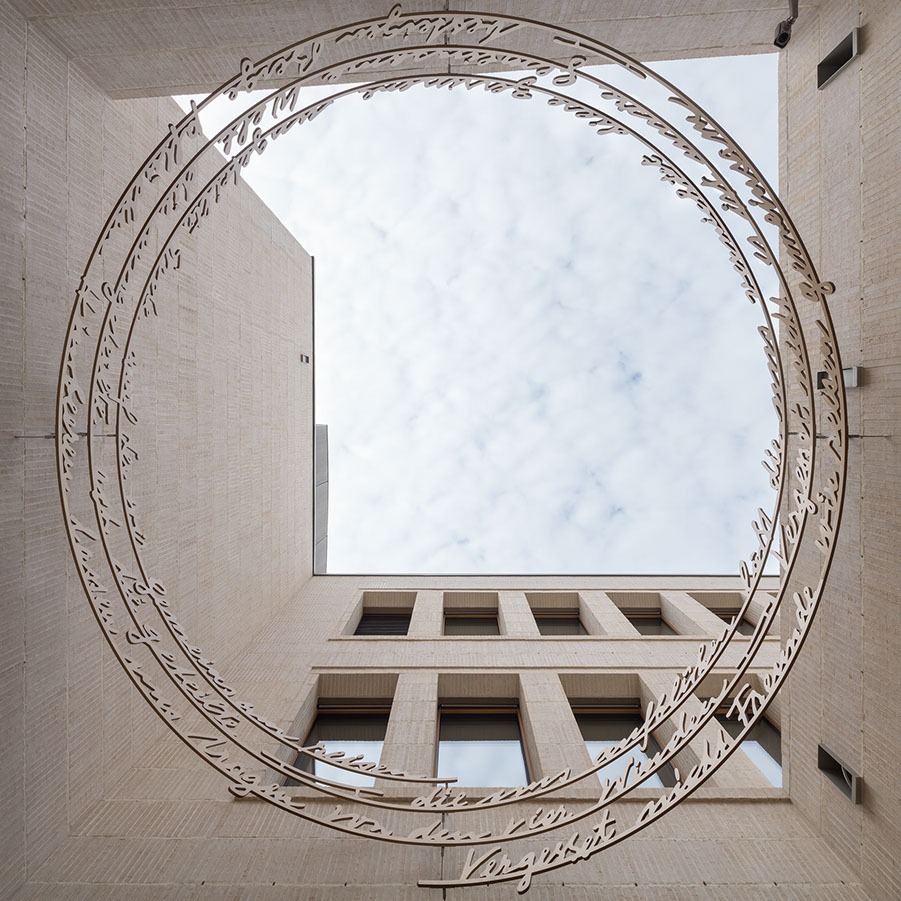
Kristen, Tom_Gemeinsam
Tom Kristen (German, 1968–), Gemeinsam (Together), 2019. Jewish Synagogue and Community Center, Regensburg, Bavaria. Photo: Marcus Eben. Floating above the center’s atrium, this gilded bronze spiral text is taken from Rose Ausländer’s poem “Gemeinsam”: “Vergesst nicht, Freunde, wir reisen gemeinsam. . . . Es ist unsre gemeinsame Welt.” (“Don’t forget, friends: we travel together. . . . It is our common world.”)

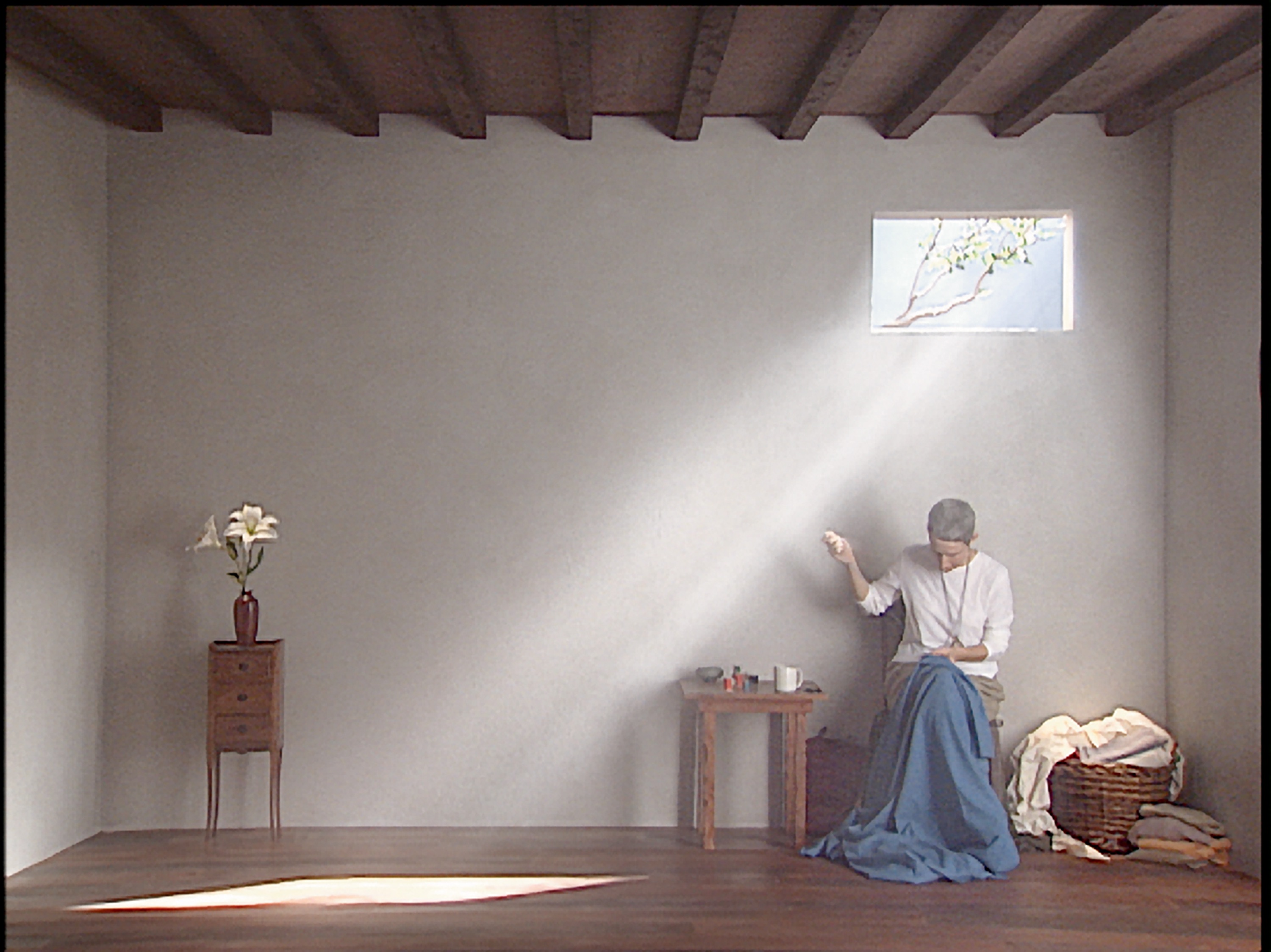
Viola, Bill_Catherine's Room (still)
Bill Viola (American, 1951–), Still from Catherine’s Room, 2001. Color video polyptych on five flat panel displays, 18:39 minutes, performer: Weba Garretson. Photo: Kira Perov, courtesy Bill Viola Studio.

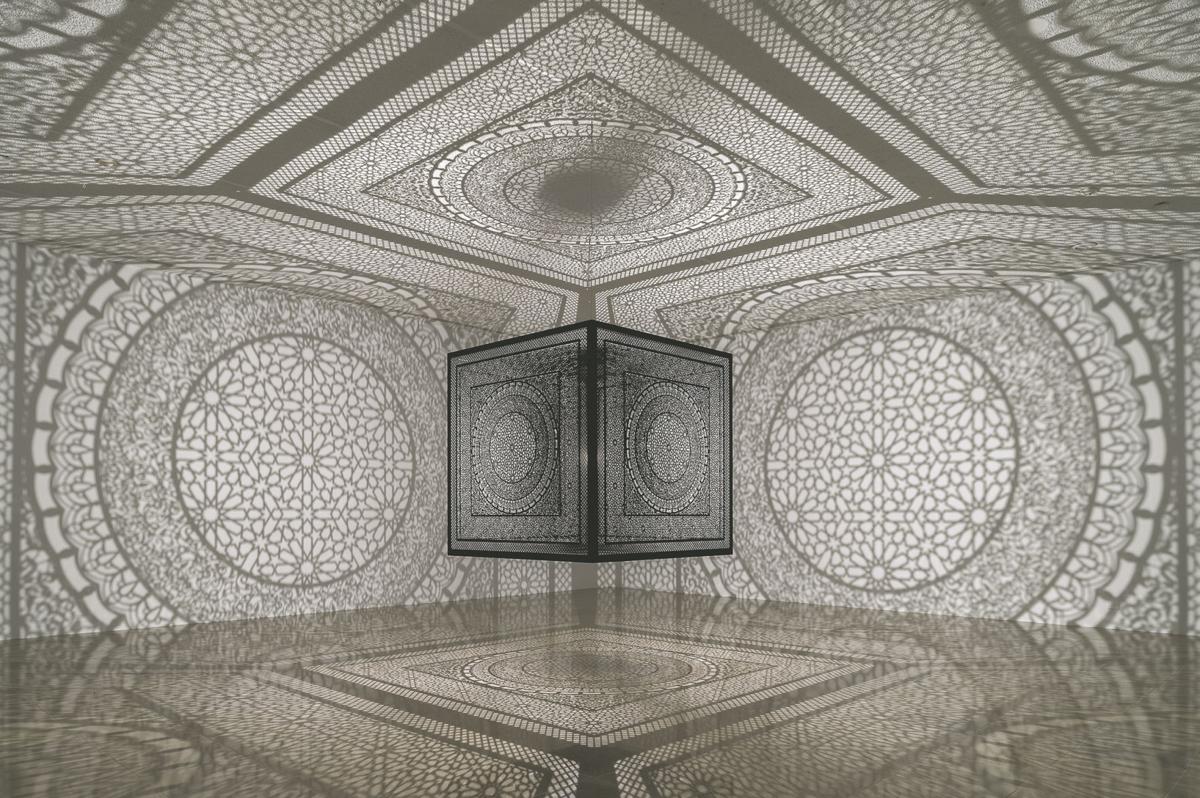
Agha, Anila Quayyum_Intersections
Anila Quayyum Agha (Pakistani American, 1965–), Intersections, 2013. Lacquered wood and halogen bulb, 78 × 78 × 78 in. (cast shadows: 43.5 × 43.5 × 16 ft.). Installation view at Rice Gallery, Houston, Texas, 2015.

Mingwei, Lee_Our Labyrinth
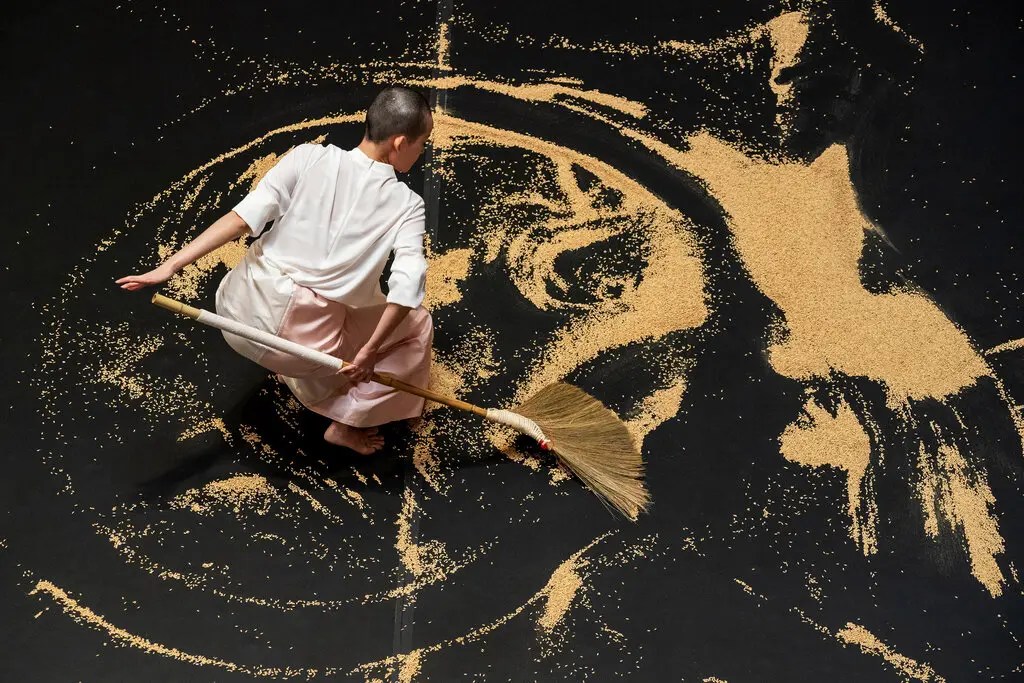
Lee Mingwei (Taiwanese American, 1964–), Our Labyrinth, 2015–present. Photo: Stephanie Berger. In this performance work, single dancers, dressed in floor-length sarongs and wearing ankle bells, take turns sweeping a mound of rice in patterns on the floor in a designated gallery space. This iteration from 2020 at the Metropolitan Museum of Art was a collaboration with choreographer Bill T. Jones, and the performer in the photo is I-Ling Liu. [Watch on YouTube]

+++

LECTURE: “The New Visibility of Religion in Contemporary Art” by Jonathan A. Anderson: Religion is becoming more visible in contemporary art and more discussable, says artist, art critic, and theologian Jonathan Anderson in his September 17 talk sponsored by Bridge Projects in Los Angeles. Danh Vo, Kris Martin, Andrea Büttner, Deana Lawson, Arthur Jafa, Genesis Tramaine, Hossein Valamanesh, Theaster Gates, Zarah Hussain, Francis Alÿs, Louise Bourgeois, Sol LeWitt, Sean Kelly, Gerhard Richter, James Turrell—these are just some of the many contemporary artists who have engaged substantively with religion in their work, either through form or content or through the ways in which they frame the work’s central questions. Curators and art historians are recognizing this more and more, and it’s being reflected in exhibitions and scholarship. Anderson highlights several such instances from the past two decades, celebrating religion’s increased visibility but also pointing out where there’s room for improvement. The talk starts at 6:36:

At 28:58, Anderson outlines four interpretive horizons, or fundamental hermeneutics, within which religion is becoming visible, intelligible, and meaningful in contemporary art: anthropological (31:00), political (37:43), spiritual (42:51), and theological (48:42). He discusses the problems and possibilities of each—ways in which it has been productive or insightful, and ways in which it’s limiting. The fourth horizon, the theological, is the least developed in the art world and the most contested, he says.

He concludes,

A more concentrated and well-developed mode of theological inquiry has much to contribute to the history, theory, and criticism of contemporary art without being reductive, but instead opening much of what’s going on in contemporary art. And so going forward, I do envision a mode of study that keeps all these horizons in view, and a mode of discourse that keeps all these horizons in view, while especially developing the potential for the modes of critical writing capable of addressing theological conceptualities, genealogies, and implications that are in play in so much of the art being made today. And that involves thinking better from both directions, developing concepts and capacities—skills, really—where art criticism might operate with a more agile, historically sensitive understanding of religion and theology (a richer theological intelligence), and theology might operate with a more agile, historically sensitive understanding of art and criticism (a richer art historical intelligence, or visual intelligence).

The last half hour is Q&A. What he says at 1:03:59 is fascinating! If you enjoyed this talk, check out, too, the one he gave ten years ago, “The (In)visibility of Theology in Contemporary Art Criticism,” which I published detailed notes on and which became a chapter in the book Christian Scholarship in the Twenty-First Century: Prospects and Perils, edited by Thomas M. Crisp, Steve L. Porter, and Gregg A. Ten Elshof.

As a side note, Anderson teaches two courses at Duke Divinity School, where he is a postdoctoral associate in the DITA program: “Contemporary Art and Theology” and “Visual Art as Theology.” The latter looks at the history of primarily Christian art as a domain of primary theological reasoning and biblical commentary, done in visual-spatial terms rather than in verbal-written terms. His hope is that divinity students—future biblical scholars, theologians, pastors, etc.—will become more literate in the visual-spatial forms of theology. I mention this because it’s what I’m about too!

+++

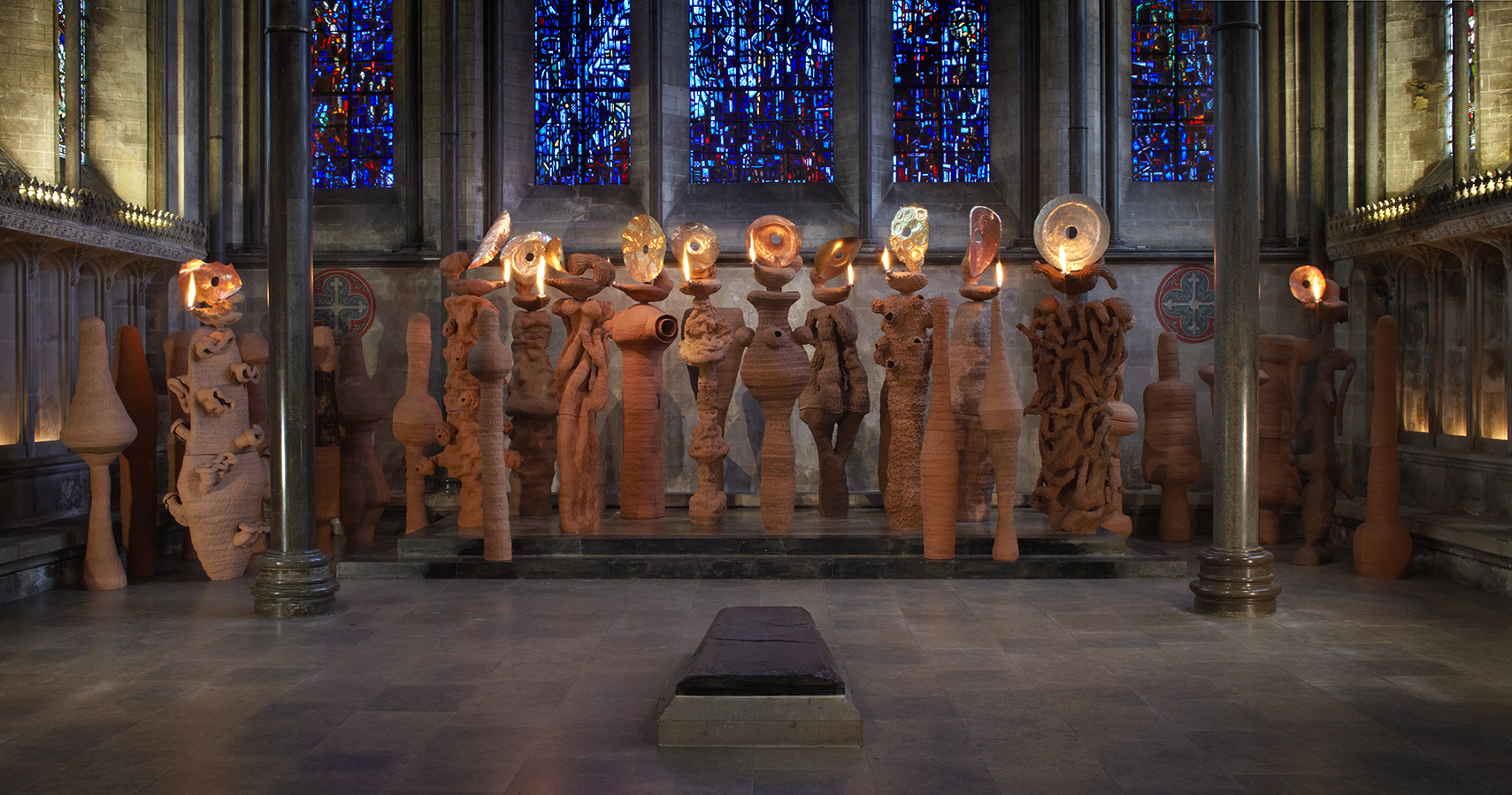
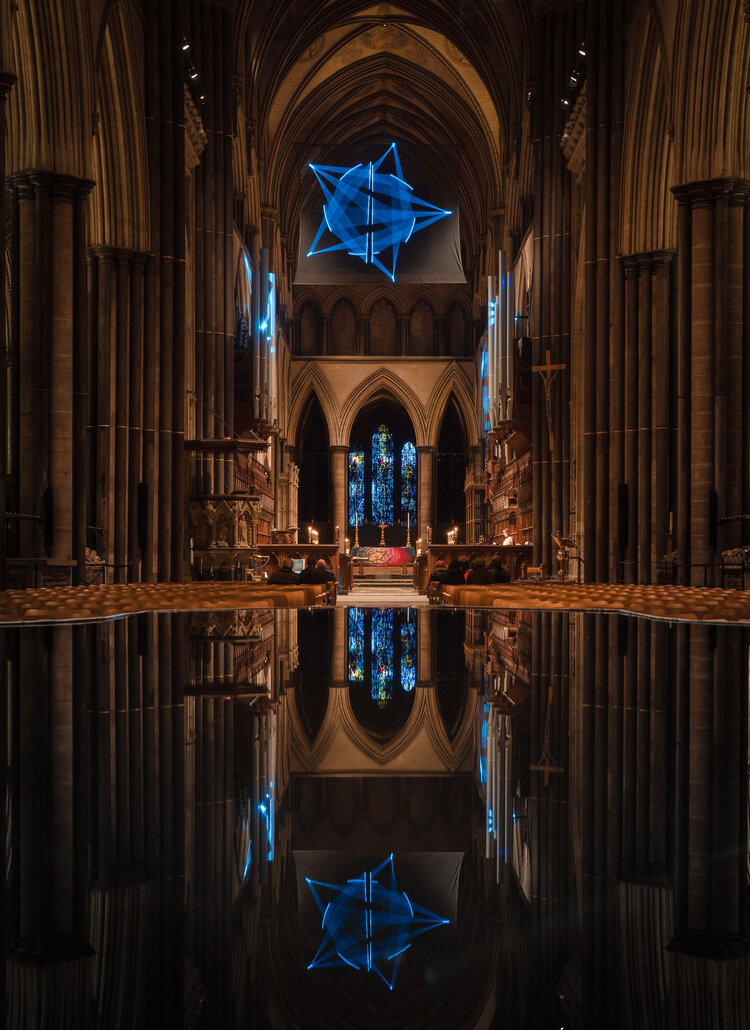
PODCAST EPISODE: “Jacquiline Creswell: Curating in Sacred Spaces,” Exhibiting Faith: Hosted by critic and art historian David Trigg, this is the first episode of a brand-new podcast about the intersection of art and faith, featuring a range of guests for whom those two elements have played a significant role. First up is Jacquiline Creswell, a visual arts adviser and curator who has, since 2009, organized more than forty-five exhibitions in sacred spaces. She has been central to the development of the visual arts programs at Salisbury, Ely, and Chichester Cathedrals. She discusses some of the projects she has worked on and how they’ve been received by the congregation and the wider public, how the setting of an artwork can alter its meaning and the way people engage with it, the logistical challenges of placing art in historic churches, and more.

I was interested to learn that she is from a Jewish background, even though most of her jobs have been with Christian institutions. Check out the eight objectives she lists on her website, which have guided her curatorial work and which I find exciting; the first is “To present artwork which is engaging, that encourages a spiritual response and may at times challenge conventional perceptions.”

Pope, Nicholas_Apostles Speaking in Tongues
Nicholas Pope (British, 1949–), The Apostles Speaking in Tongues Lit By Their Own Lamps, 1996, installed 2014. Thirty-three figures in terracotta, metal, wick, paraffin, and flame. Trinity Chapel, Salisbury Cathedral. Photo: FXP, London.

Haebich, Jayson_Star of Bethlehem
Jayson Haebich (born in Australia, living in Hong Kong and London), Star of Bethlehem, 2016. Interactive laser installation at Salisbury Cathedral, England.

New episodes of Exhibiting Faith are released once a month. The second (and latest) episode is an interview with Dubai-born, Birmingham-based textile artist Farwa Moledina, whose Women of Paradise (2022) scrutinizes the portrayal of Muslim women in the canon of Western art. Moledina also discusses her experience of Ramadan during lockdown and how it resulted in By Your Coming We Are Healed (2020), two sufras (floor mats for communal dining) made up of photographs of plated dishes submitted to her by participants in the virtual iftars she hosted, arranged according to Islamic design principles of symmetry, abstraction, and recurrence.

+++

SHORT FILM SERIES: At the Threshold: Theology on Film, dir. Sean Dimond: At the Threshold is the latest project from UNTAMED, a documentary film studio in Seattle that “pursue[s] stories of spiritual and narrative depth, with a bias for hope, risk, and redemption.” Filmed in Belgium, Germany, and the UK, it profiles six Christian theologians from Europe, each one humble, open-hearted, and reflective.

  1. “The Open Narrative of Love” with Lieven Boeve, Leuven, Belgium: Boeve reflects on how God interrupts people’s self-enclosed stories. Christianity, he says, is itself an open narrative, not a closed one, and it leads us not away from the world but right into it. One of the filming locations in this short is a rural landscape in Borgloon where Pieterjan Gijs and Arnout van Vaerenbergh built Reading between the Lines, an open-air chapel created to imagine a church inseparable from the world around it.
  2. “The Greater Part” with David Brown, St Andrews, Scotland: Brown talks about prayer, the Bible as part of a living tradition, the church’s call to be creatively other, and the only time he ever saw his father cry. He also cites some of the poets, novelists, and composers/singer-songwriters he admires.
  3. “The Radiance” with Perry Schmidt-Leukel, Muenster, Germany: “The fractcal structure of religious diversity” is of deep interest to Schmidt-Leukel, a Christian who draws insights from Buddhism and who was criticized by Cardinal Joseph Ratzinger for doing so.
  4. “Danseuse” with Ann Loades, Durham, England: A feminist theologian, Loades is one of only two people ever to be awarded a CBE for services to theology. The Christian tradition is responsible for the devaluation of women, she says, but that tradition also contains resources for its own transformation. She also discusses dance as prefiguring the resurrection body.
  5. “To Imagine That” with Garrick Allen, Glasgow, Scotland: Allen sees the book of Revelation as being about how to live in a system that is unjust. “This is John’s response to an oppressive system, and it gives us space to rethink what a just system would look like in our world—to begin to imagine that.”
  6. “Begin with the End” with Judith Wolfe, St Andrews, Scotland: “We have to take seriously the claim that we do not yet live in the world as it will be, and as we will be, and that we have to live towards an eschaton, a presence of God in the world, which is not only not yet apparent, but is not even comprehensible to us. So how do we live authentically in this life?”

From the studio: “Theology offers a home for the vast and the intimate. No question is foreclosed. Visually immersive, poetic, and global in scale, these narrative and theological short films invite viewers into a conversation about life and its limits which is as vibrant as it is challenging. This series isn’t about promoting theological ideas we necessarily agree with, but rather we are exploring the connections between vulnerable life, big questions, and the diversity of theological work being done today. It’s not that we are on the threshold of discovering God, but that perhaps God is already on the threshold of our lives, knocking to enter through our wounds, deepest desires, and questions.”