
Not only are humans tired and stressed and in need of deliverance; so is the environment. Today’s two featured works function as a call to care for the earth—the one a performative enactment of said care, tender and consoling, and the other an urgent lament by choir.
The gospel is for more than just humanity; it’s for all the earth—animals and insects, plants and soil, skies and oceans. All creation groans for redemption, Paul says in his letter to the early church in Rome. And in the final book of the Bible, John the Revelator’s vision is of the whole world renewed.
LOOK: Earth Rite by Holly Slingsby
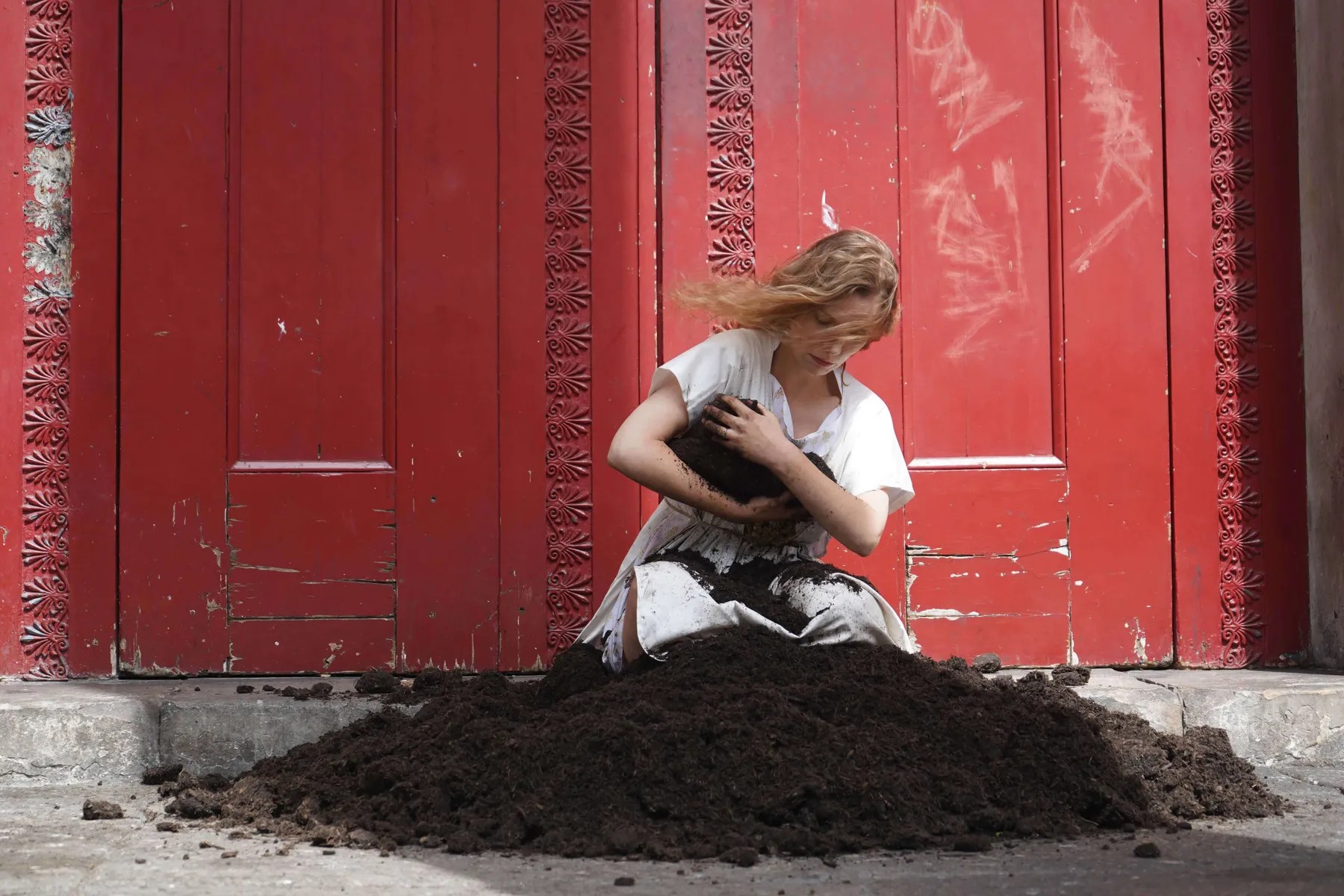
Artist Holly Slingsby’s Earth Rite premiered at the Ritual/Bodies live performance event that took place at St Pancras Church in London on July 6, 2024, organized by Dr. Kate Pickering. It was one of eight performance works by eight different artists (one work was by two performers; two works were by one) that collectively spanned some three hours, followed by a ninety-minute panel discussion.
In Earth Rite, “a solo performer sits atop a mound of earth, cradling it in her arms. The earth slips away only to be regathered, in a continuous act of generating, losing, and regenerating.” Charles Pickstone, an Anglican priest, reviewed the work in the Autumn 2024 issue of Art + Christianity journal, writing:
Holly Slingsby, in a loose white dress, sat on the church steps on a mound of rich soil, arms folded in embrace. Where one might have expected a baby, the artist was embracing armfuls of soil, constantly replenishing her burden as the soil slipped away from her. Part earth mother, part mourner, on the edge of the busy and noisy Euston Road, the artist made what could have been rather a moralistic revisiting of a well-known theme (compare William-Adolphe Bouguereau’s Charity, perhaps an influence on this work) into a courageous and compelling glimpse of the earth’s abused and vulnerable soil.
Slingsby reprised the performance on September 27, 2025, at the International Forum of Performance Art in Drama, Greece.
LISTEN: “Kasar mie la Gaji” (The Earth Is Tired) by Alberto Grau, 1987 | Performed by Stellenbosch University Choir, dir. André van der Merwe, 2024
“Kasar mie la gaji” is a Hausa saying from the Sahel region of Africa that means roughly “The earth is tired.” In 1987 leading contemporary Venezuelan composer Alberto Grau (b. 1937) set it to music, creating a magnetic choral composition for, in his words, “an international mobilization to save THE EARTH.”
In their performance notes, the Stellenbosch University Choir from South Africa writes: “The composition is designed on hypnotic repetition, with a steady reiteration of the text. Plaintive glissandos and layered ostinato patterns create a compelling chant, begging for justice and rebirth.”
Kathy Romey, the director of choral activities at the University of Minnesota, offers further description:
The work is broken into three distinct sections, of which the first and third incorporate short melodic motives combined with rhythms from traditional South American dance music intensified by clapping and stomping. The middle section is a slow lament and utilizes various special effects for a cappella chorus, including glissandi, whispering, talking, and hissing.
Why is the earth tired? Because we are depleting her resources. We are disrupting her ecosystems. The carbon emissions from our burning of fossil fuels for energy and transportation are trapping heat in her atmosphere and causing extreme weather.
Lord, have mercy. Please help us restore our planet to health and treat her with respect, recognizing that she, as part of your creation, is precious to you.


 Art & Theology