
LOOK: Adoration of the Magi by Rogier van der Weyden
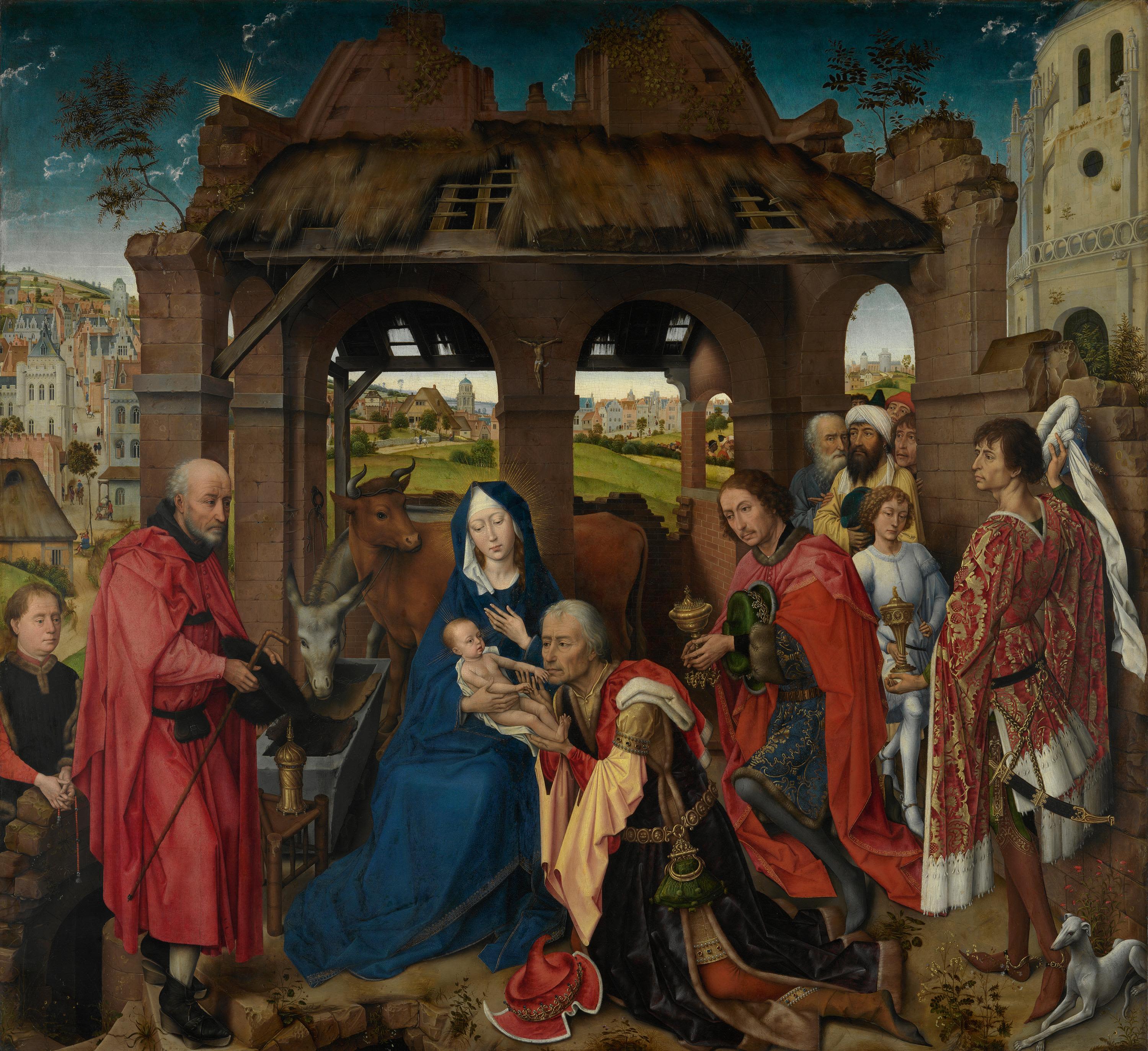
This remarkable painting by the early Northern Renaissance master Rogier van der Weyden shows three kings arriving from afar to worship the Christ child. All the splendor of foreign courts comes to the dilapidated stable of Jesus’s birth, which is relocated to the Low Countries of the fifteenth century. (Notice the contemporary cityscape in the background.)
The most senior king greets the child first, humbly removing his hat and crown and kneeling on the ground, his fur-lined velvet robe rubbing the dirt. He supports the child’s feet with one hand and with the other gently lifts the child’s hand to kiss. Two fellow sovereigns stand behind him, followed by their entourage and various locals.
Standing on the left, in red, is Joseph, hat and staff in hand. He looks reflectively on the visitors, taking it all in. Leaning against the stone wall behind Joseph, a rosary between his fingers, is the painting’s donor. While it’s true that sometimes the practice of painting donors into biblical scenes was done for flattery or, if a condition of the commission, out of arrogance, more often the motivation or purpose was to imaginatively place yourself into the sacred scene as a witness, making yourself present to an event that was in time and yet that also transcends time, in that its impact is ongoing. Seeing oneself as a participant in Christ’s story, a devotee alongside those who walked with him in the flesh, can aid in spiritual contemplation.
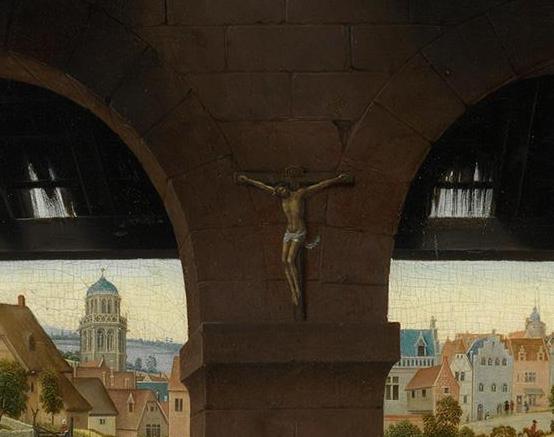
Another anachronism—or rather, a collapsing of chronos and kairos—is the crucifix hung on the central pillar of the stable! This of course alludes to the cruel death Christ would face some thirty years later.
This painting is the centerpiece of a triptych originally made for St. Mary’s Chapel in the church of St. Columba in Cologne. The wings depict the Annunciation and the Presentation of Christ in the Temple.

LISTEN: “Die Könige” (The Kings) from Weihnachtslieder (Christmas Songs), Op. 8, by Peter Cornelius, 1870 | Arranged for a cappella choir by Ivor Atkins, 1957 | Performed by VOCES8, the VOCES8 Scholars, the VOCES8 Foundation Choir, and Apollo5, dir. Barnaby Smith, feat. Jonathan Pacey, 2023
Drei Könige wandern aus Morgenland;
Ein Sternlein führt sie zum Jordanstrand.
In Juda fragen und forschen die drei,
Wo der neugeborene König sei?
Sie wollen Weihrauch, Myrrhen und Gold
Dem Kinde spenden zum Opfersold.Und hell erglänzet des Sternes Schein:
Zum Stalle gehen die Kön’ge ein;
Das Knäblein schaun sie wonniglich,
Anbetend neigen die Könige sich;
Sie bringen Weihrauch, Myrrhen und Gold
Zum Opfer dar dem Knäblein hold.O Menschenkind! halte treulich Schritt!
Die Kön’ge wandern, o wandre mit!
Der Stern der Liebe, der Gnade Stern
Erhelle dein Ziel, so du suchst den Herrn,
Und fehlen Weihrauch, Myrrhen und Gold,
Schenke dein Herz dem Knäblein hold!English translation:
Three kings journey from the East;
A little star leads them to Jordan’s banks.
In Judaea the three of them seek and inquire
Where the newborn king might be.
They wish to make offerings to the child:
Gold, frankincense, and myrrh.And brightly shines the light of the star.
The three kings enter the stable;
They gaze in rapture at the child,
Bowing low in adoration.
Gold, frankincense, and myrrh
They bring to the child as offering.O child of man! Follow them faithfully.
The kings are journeying; oh, journey too!
Let the star of love, the star of grace,
Light your way as you seek the Lord,
And if you lack gold, frankincense, and myrrh,
Give your heart to that sweet child.
The German composer and poet Peter Cornelius (1824–1874) was a friend of Franz Liszt’s and Richard Wagner’s. “Die Könige” (The Kings) is the third, and most popular, song in a Christmas cycle he wrote for voice and piano, the others being “Christbaum” (Christmas Tree), “Die Hirten” (The Shepherds), “Simeon,” “Christus der Kinderfreund” (Christ the Friend of Children), and “Christkind” (Christ Child). Cornelius began writing his Weihnachtslieder cycle—both text and music—in 1856, and it underwent several rounds of revision, incorporating input from others, before being published in 1870.
From VOCES8’s Live From London Christmas 2022 broadcast, the performance of “Die Könige” above features as the baritone soloist Jonathan Pacey, who sang bass for VOCES8 from 2015 to 2022. He chose this song as the encore in his final concert. Pacey’s voice is absolutely gorgeous!
This post concludes our journey through the cycle of light, Advent-Christmas-Epiphany. Thanks for walking the road with me! I encourage you to keep journeying, keep following the light, throughout the rest of the church year. May love and grace, as “Die Könige” says, light your way as you seek the Lord.
If you’d like to leave a donation to help offset the costs of running Art & Theology, which I’d really appreciate, you may do so through PayPal or this secure Stripe form. You can expect many more new posts in 2024! Just not at a daily frequency.
 Art & Theology