Advent, Day 2: To All Who Are in Darkness

LOOK: Untitled photograph by Franco Fafasuli
War in Ukraine
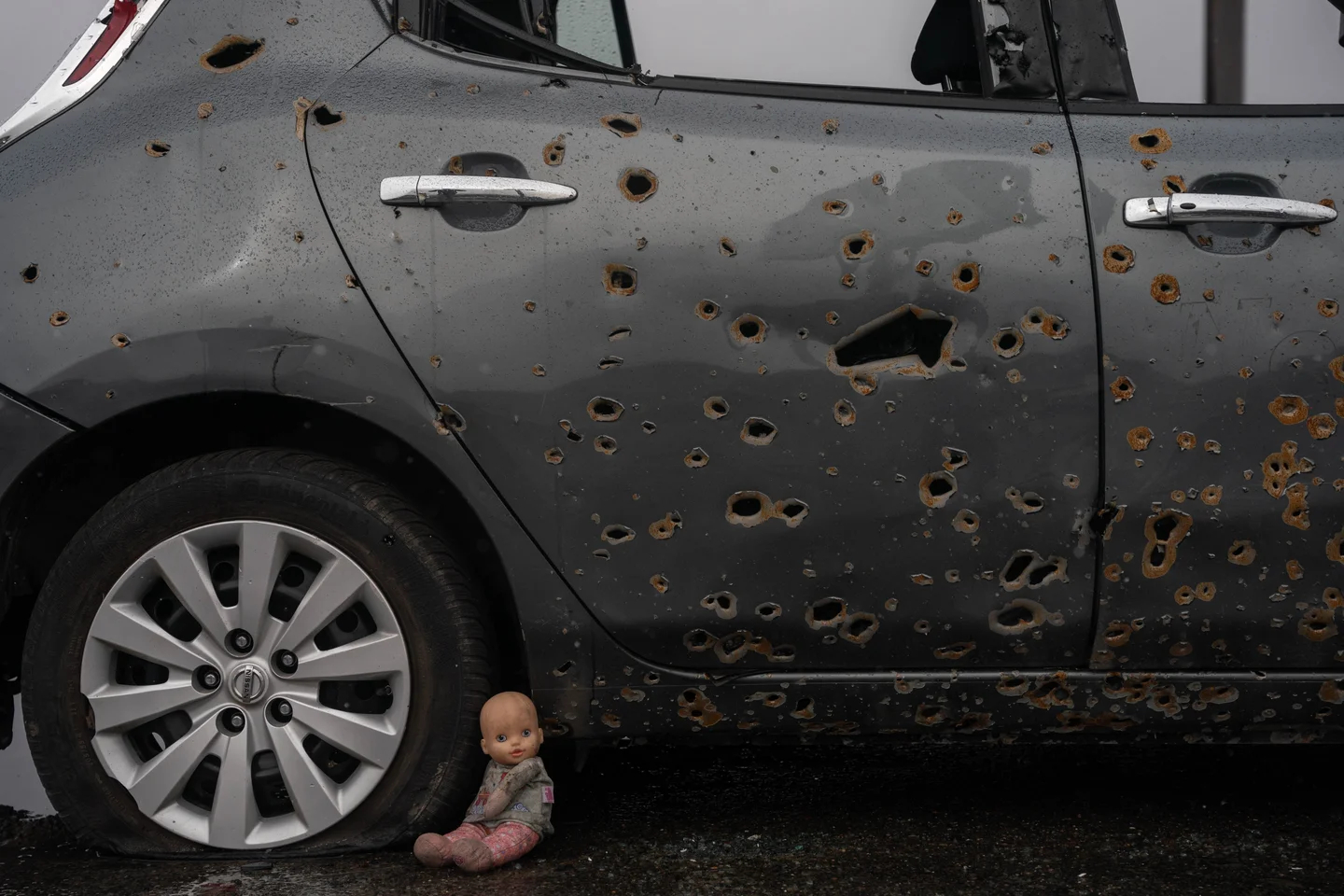
Withdrawing from Kyiv on April 2, 2022, after a lost battle, Russian troops left destruction in their wake. A bullet-riddled car with a flat tire sits abandoned, along with a doll, on the bridge crossing into Irpin, Ukraine. Photo: Franco Fafasuli.

The Russo-Ukrainian war is now in its twelfth year, and it’s been almost four years since Russia’s full-scale military invasion of Ukraine. The devastation is staggering. I can’t even imagine what it must be like to live in a war zone, with bombs, missiles, and gunfire an ever-present threat, part of the everyday background noise. While many photographs have documented the wider destruction and human losses in Ukraine, I was struck by this one by the young Argentine journalist Franco Fafasuli, which focuses not on leveled buildings or intimate griefs but on possessions left behind in the chaos of war: a car, now dotted with dozens of bullet holes, and a plastic-headed baby doll, now covered in grime.

As I reflect on Christ’s coming this Advent season, I think of how he came as a vulnerable child, into a world where people deliberately hurt and kill other people. Then, it was with swords, daggers, spears, arrows, and stones; now we’ve added all manner of firearms and large explosives to our arsenal. That innocent, bald little babe sitting by a deflated tire, suggesting a family with child having suddenly fled their hometown—it looks at me with the eyes of Christ, wondering why we continue to harm each other, but smiling, too, a smile of divine grace. He’s here to show us another way.

(Related post: https://artandtheology.org/2023/12/04/advent-day-2-from-the-ruins/)

LISTEN: “О, Зійди” (Oh, Come Down) by Room for More, 2022

Вся земля cхилилася
Втомлена від боротьби
Зітхаємо у марноті
Бо втратили ми Твій дотик

Заспів:
О, зійди!
Спасе відроди.
Зійди!

Небеса далекі нам
Власний шлях обрали ми
Вся земля чекає на
Спасителя, на мир і спокій

Заспів:
О, прийди!
Царю милості, прийди!
Освіти!
Всім хто в темноті, світи

Небеса схиляються
Являють нам святе Дитя
Земле вся, заспівай
Правдивий Цар, Бог наш з нами

Заспів:
О, радій!
Спас Месія нам родивсь!
О, вклонись!
Царю всіх царів, вклонись!

Бридж:
Підіймай опущені руки
Потішай тих хто відчаєм скуті
Відкриває Син нову
Надію, силу й повноту

Заспів: 
О, радій!
Спас Месія нам родивсь!
О, прийми!
Це рятунок твій, прийми!
The whole earth bows down
Weary of the struggle
We sigh in vain
For we have lost your touch

Refrain:
Oh, come down!
Savior, revive
Come down!

The heavens are far from us
We have chosen our own path
The whole earth awaits
The Savior, peace and tranquility

Refrain:
Oh, come!
King of mercy, come!
Enlighten!
Onto all who are in darkness, shine

The heavens bow down
Show us the holy Child
All the earth, sing
The true King, our God is with us

Refrain:
Oh, rejoice!
The Messiah is born to us!
Oh, bow down!
He’s the King of all kings, bow down!

Bridge:
Lift up your hands that hang down
Comfort those who are bound by despair
The Son reveals a new
Hope, strength, and fullness

Refrain:
Oh, rejoice!
The Messiah is born to us!
Oh, accept!
This is your salvation, accept!

The lead singer on “О, Зійди” (Oh, Come Down) is Yaryna Vyslotska. The song was written by Jonathan (Jon) Markey, an American-born minister and musician who grew up as a missionary kid in Ukraine and since 2008 has been a pastor at Calvary Chapel in Ternopil. In 2017 he and his wife Stephanie (Steffie) founded the Ukrainian Christian music collective Room for More.
New book: Parallel Universes of Children by Uğur Gallenkuş

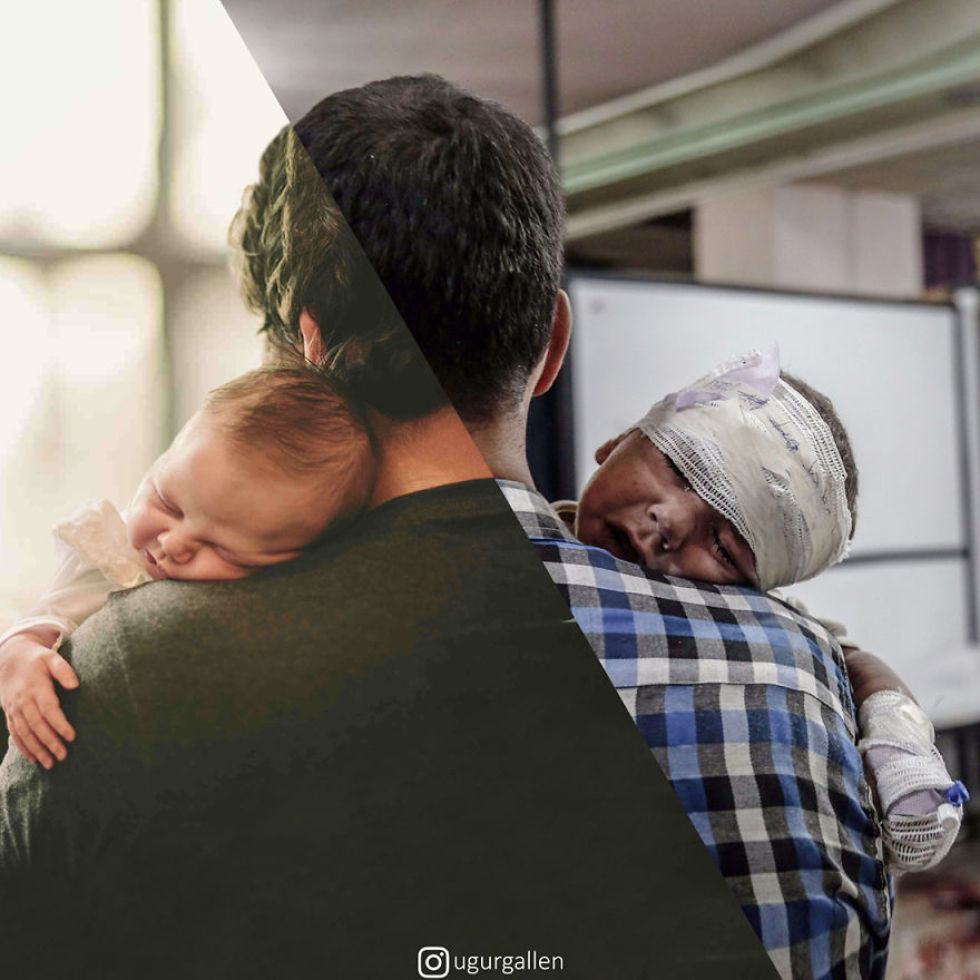
Warning: This post contains distressing photographs, including one of an emaciated child and one of a wounded (but bandaged) infant.

Uğur Gallenkuş (Turkish, 1990–) is an Istanbul-based artist whose digital photomontages address the widening global divide between the privileged and the oppressed. By combining photojournalistic images and stock photos with similar compositional elements, he juxtaposes the relative safety, stability, comfort, and flourishing experienced by middle- and upper-class Westerners with the violence, terror, trauma, and hardship experienced by victims of poverty, war, and displacement. Because Gallenkuş lives in the Middle East, he focuses on that geographic region.

Releasing November 20 in honor of World Children’s Day, Parallel Universes of Children brings together fifty of Gallenkuş’s sobering mash-ups, integrating facts of children’s lived realities around the world. It is $60 plus shipping, available only through the artist’s website. (For US buyers, there’s stock warehoused in New Jersey, so you won’t be paying to ship it from Turkey.)

“I aim to create awareness and inspire action to remember and to ask ourselves every day what we have done to safeguard children’s rights, both near home and across the globe,” Gallenkuş says. He wants not only to alert the well-off to the suffering they often shield themselves from, shaking them out of their complacency, but also to remind those in underdeveloped countries that they deserve better government and education, the right to thrive.

I’ve linked each image to its source on Instagram, where you can find out more information about it—when and where the photograph was taken and by whom (Gallenkuş does not take the photos himself), context, stats, etc. Some of the links will take you to a revised (updated) form of the image; in those instances, the originals I found at Juxtapoze.

Ugur Gallenkus mash-up

The stark contrast between the two component photos of each montage is jolting, intentionally so. Reflecting socioeconomic and political disparities, they tell drastically different stories about childhood. My existence must look like a fairy tale to those who have grown up in war zones or refugee camps.

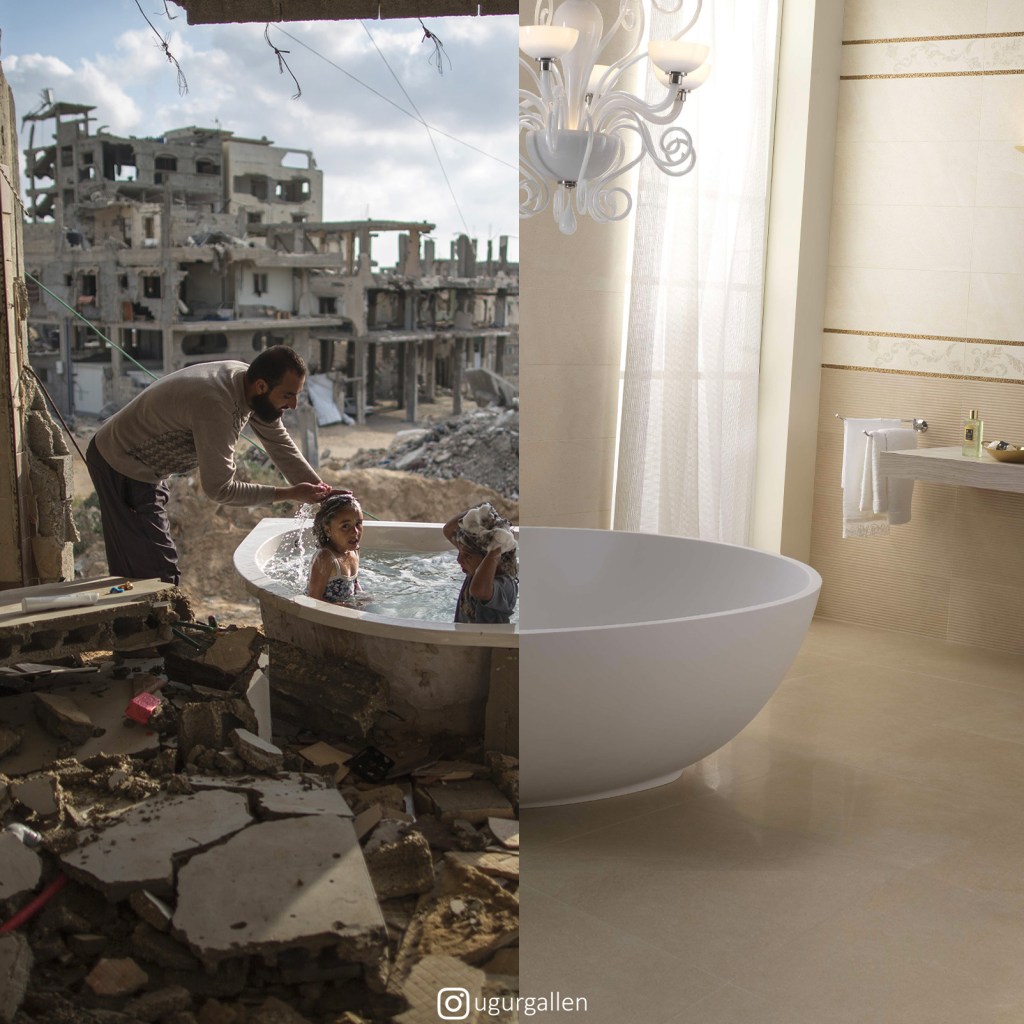
One of Gallenkuş’s montages shows a lavish bathroom with a chandelier, pristine tiles, and freshly pressed towels next to the remnants of a bathroom whose walls were blown out by an Israeli airstrike, where a father bathes his daughter and niece.

Ugur Gallenkus mash-up

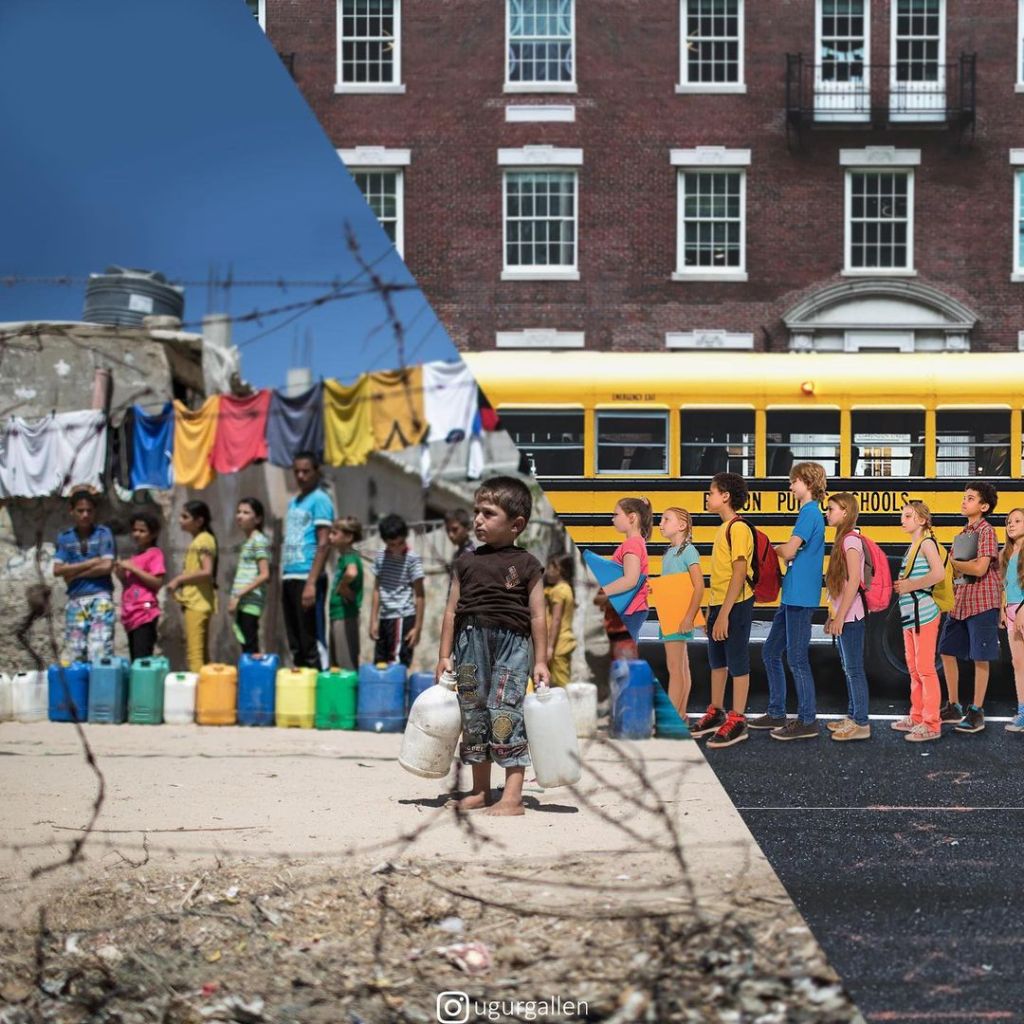
Another one shows a line of American schoolchildren waiting to board a bus, which transforms into a line of Palestinian children waiting to fill jerrycans and bottles with drinking water from public taps at the Deir al-Balah refugee camp in central Gaza Strip. (Many fall sick from the water, whose source is polluted with human waste.)

Ugur Gallenkus mash-up

Consider, too, the differences in play. A child at an IDP camp plays with a toy grenade launcher, while his counterpart plays doctor. A Syrian boy has fun balancing on the barrel of a tank in a pile of wreckage, while opposite him, in a green park, a boy rides a harmless seesaw. The imaginations of children are shaped by what surrounds them, whether that be violence or possibility.

Continue reading “New book: Parallel Universes of Children by Uğur Gallenkuş”