
Mother-child artworks by Elizabeth Catlett

Last month I saw the exhibition Elizabeth Catlett: A Black Revolutionary Artist at the National Gallery of Art in Washington, DC, an impactful display of over two hundred prints and sculptures from throughout Catlett’s illustrious seven-decade career. Organized in partnership with the Brooklyn Museum of Art, where it first opened last year, the show focuses on Catlett’s advocacy, through her art and her on-the-ground activism, against poverty, racism, war, and gender oppression—her promotion of human dignity and freedom for all. Her work especially celebrates the beauty and strength of African American working-class women.

The exhibition title comes from a speech Catlett delivered in May 1970 by phone from Mexico to attendees at the Conference on the Functional Aspects of Black Art at Northwestern University outside Chicago, which she could not attend in person because the United States refused her entry to the country on the grounds of her allegedly dangerous politics: “I have been, and am currently, and always hope to be a Black revolutionary artist, and all that it implies,” Catlett stated.

Born in 1915 in Washington, DC, and raised there, Catlett witnessed class inequality, racial discrimination, and US imperialism firsthand, which formed her consciousness and influenced the direction her art would go. After graduating from Howard University, she spent time teaching in Durham (North Carolina), New Orleans, and Harlem and studying art in Iowa and Chicago before permanently settling in Mexico in 1946, becoming a Mexican citizen in 1962. She married the Mexican printmaker and muralist Francisco Mora in 1947, and they had three children together, all sons.

Black motherhood is a recurring subject in Catlett’s work, starting with her MFA thesis project in 1941 at the University of Iowa, a limestone sculpture of a mother and child that won first prize at the America Negro Exposition in Chicago that year but that is now lost. “Black women have been cast in the role of carrying on the survival of Black people through their position as mothers and wives, protecting and educating and stimulating children and Black men,” Catlett said. “We can learn from Black women. They have had to struggle for centuries.”

The social justice framework of the current retrospective exhibition leaves plenty of room for Catlett’s depictions of mothers with their children. What follows are photos I took of some such works.
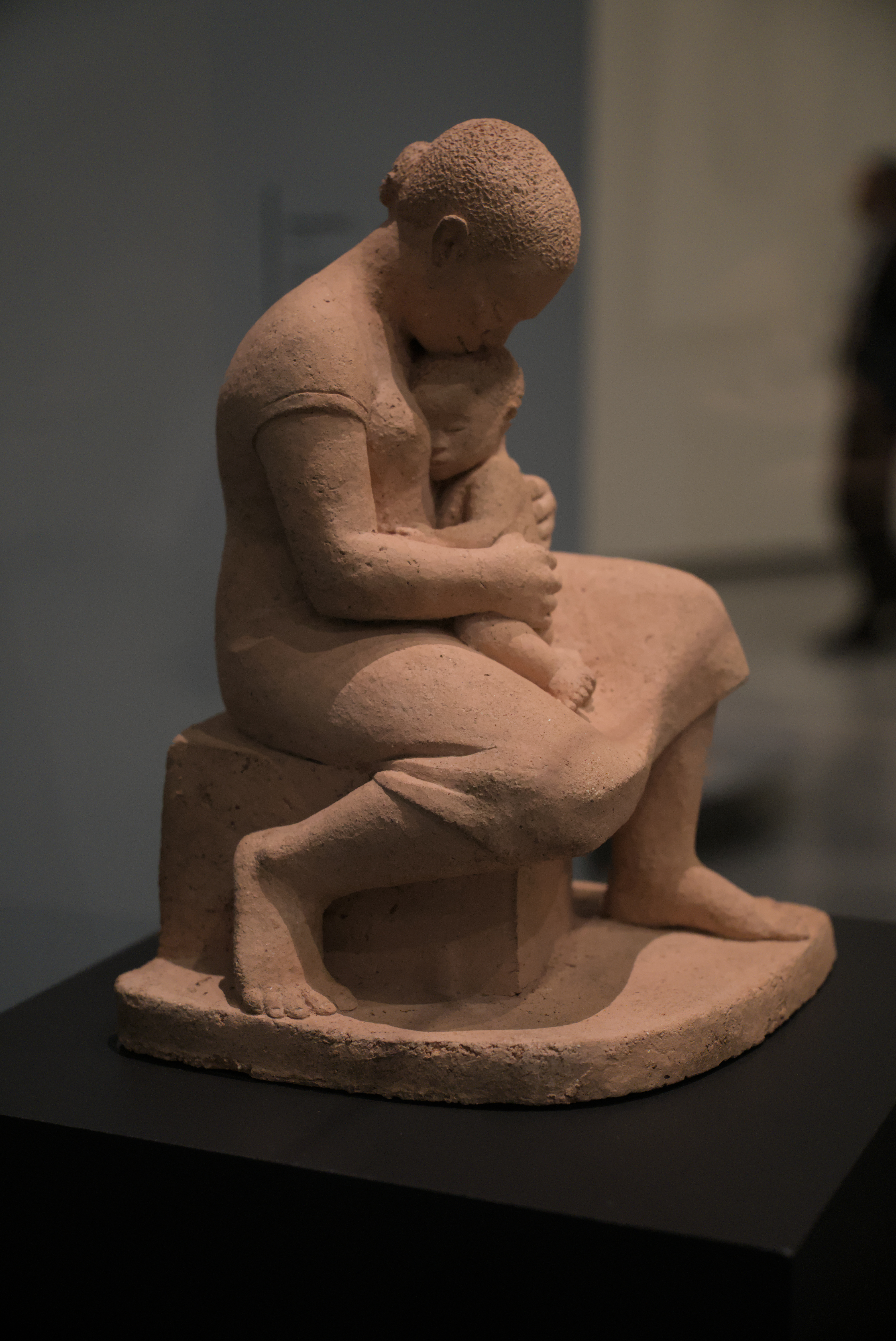
Catlett, Elizabeth_Mother and Child
Elizabeth Catlett (American, active in Mexico, 1915–2012), Mother and Child, 1956. Terracotta, 28.6 × 17.8 × 17.8 cm (11 1/4 × 7 × 7 in.). Museum of Modern Art, New York.

My favorite is a terracotta sculpture made just a year after the lynching of fourteen-year-old Emmett Till, whose mother Mamie Till’s response was an important catalyst of the civil rights movement. It brings two bodies—that of mother and infant son—into one volume. Art historian Leah Dickerman remarks on

the uncanny way that it seems both intimate and monumental at once. Intimacy lies in the way the weight of the child’s face presses against the mother’s breast, the mother’s right leg pushed back to stabilize her balance and her head nestled against the child’s scalp, breathing in that smell. Tenderness, both affectionate and shielding, is conveyed so keenly it almost aches. . . . Catlett seems to capture, somehow, the idea of remembering something fleeting, the sculpture a tiny memorial to loving protection that cannot be maintained.

Catlett, Elizabeth_Mother and Child (detail)

Platformed across from this sculpture is another, in mahogany, this one modernist, abstracted:

Catlett, Elizabeth_Mother and Child
Elizabeth Catlett (American, active in Mexico, 1915–2012), Mother and Child, 1970. Mahogany, 49.5 × 33 × 21 cm (19 1/2 × 13 × 8 1/4 in.). Currier Museum of Art, Manchester, New Hampshire.

It shows a mother holding her baby in a swaddle, his or her head gleefully poking out from the folds. While the baby seems happy, the mother seems stressed, as she turns her head away and grabs her head with her hand, which I interpret as her taking a deep breath to compose herself for several more hours of caregiving before bedtime.

Another mahogany sculpture is borrowed from the New Orleans Museum of Art:
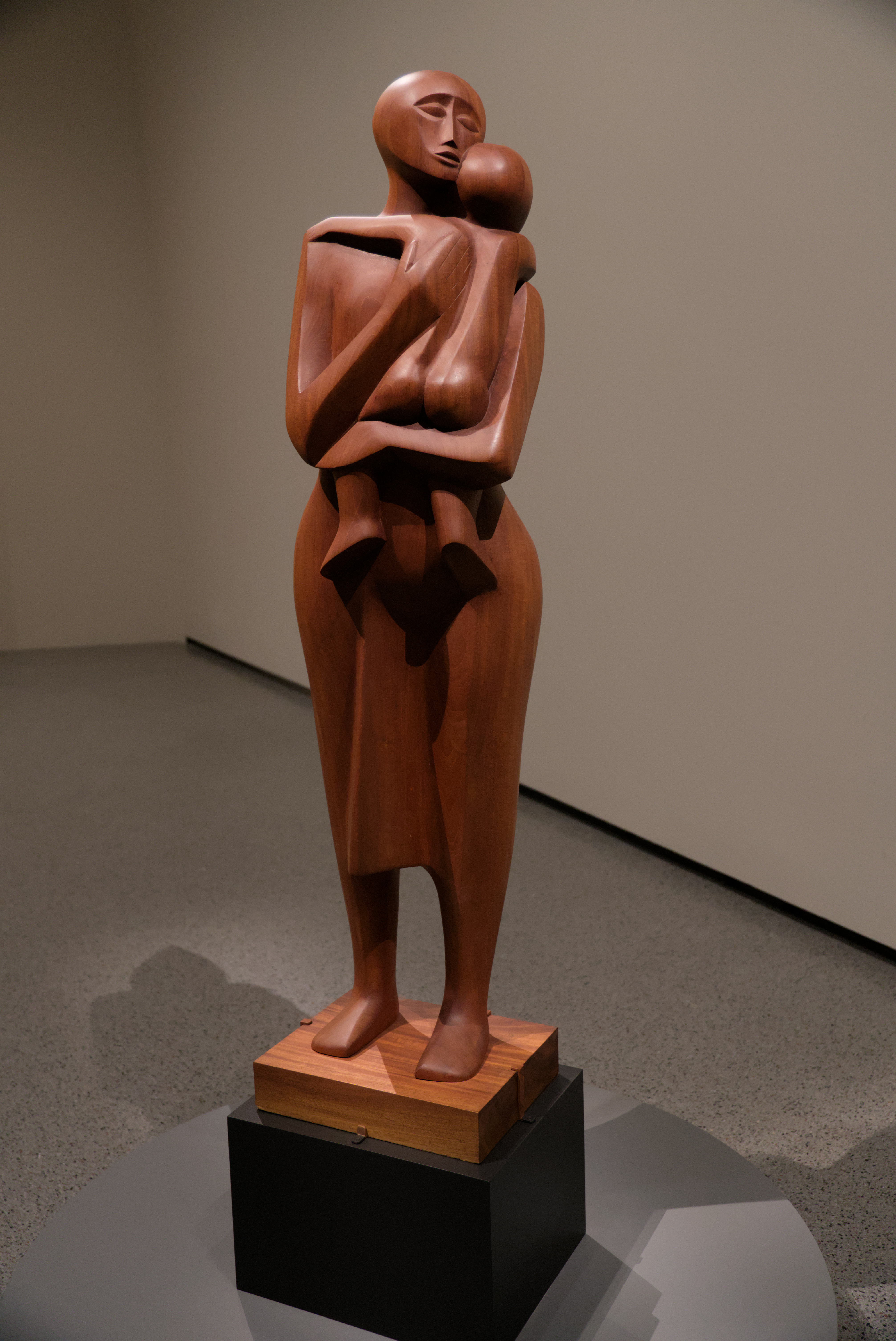
Catlett, Elizabeth_Mother and Child
Elizabeth Catlett (American, active in Mexico, 1915–2012), Mother and Child, 1983. Mahogany, 134.6 × 33 × 33 cm (53 × 13 × 13 in.). New Orleans Museum of Art, Louisiana.

The adjacent wall text quotes art historian Melanie Anne Herzog, author of Elizabeth Catlett: An American Artist in Mexico:

Becoming a mother, Catlett told me, was her most creative endeavor. She returned to the theme of maternity throughout her career in sculptures that illuminate the intimate physical bond between mother and child, a child’s comfort in its mother’s embrace, and the anguish of mothers who know they cannot protect their children from future harm. Catlett’s boldly corporeal rendering of maternity centers Black and Brown women in her depiction of this universal theme. I feel the fierce tenderness of this stately standing figure cradling her child, its body melded with hers. Her pensive expression and resolute stance call us to reflect on what she has endured and what her child, too, will encounter in the world that awaits.

One of Catlett’s earliest prints of the mother-child subject is a lithograph from 1944:
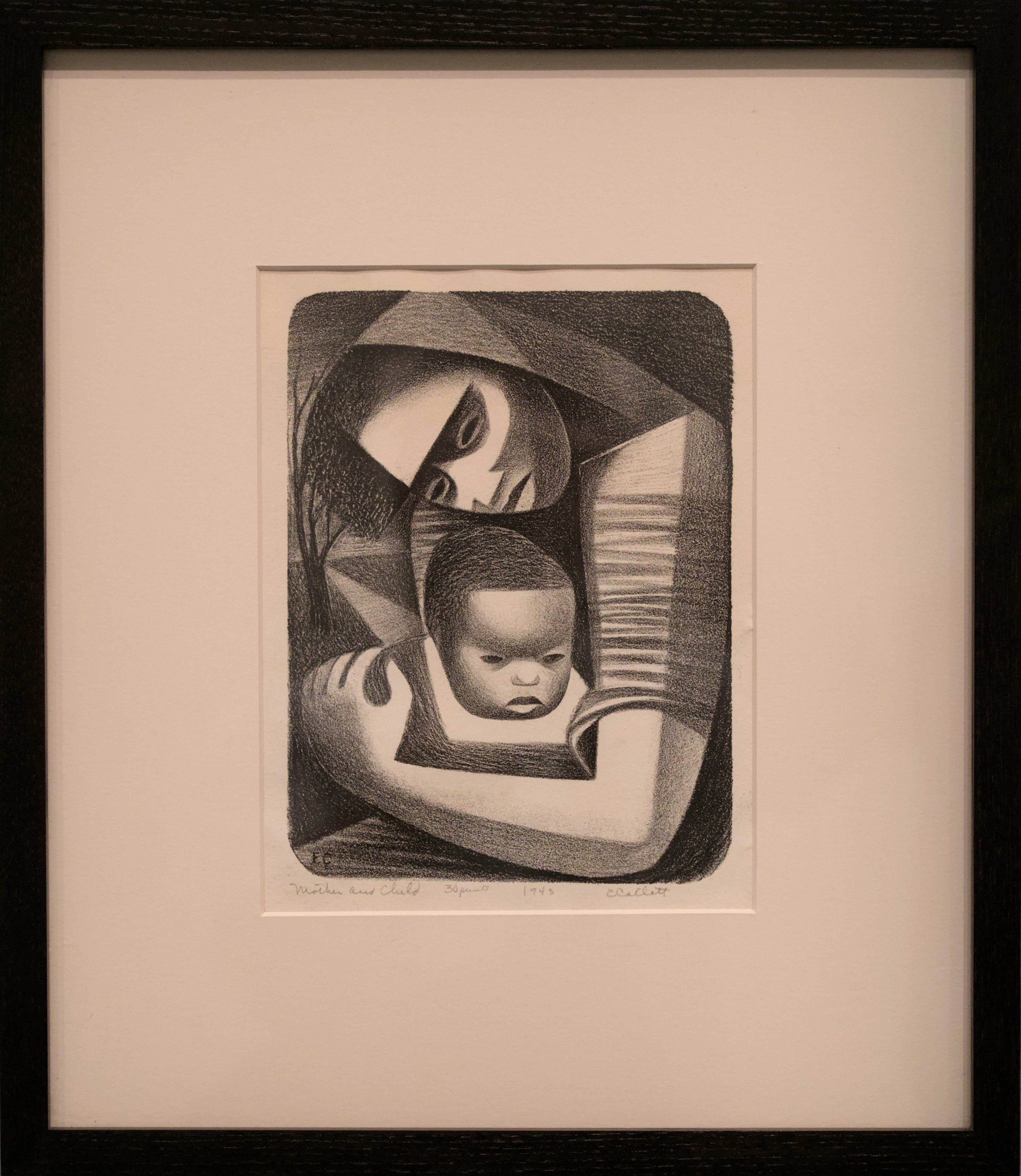
Catlett, Elizabeth_Mother and Child
Elizabeth Catlett (American, active in Mexico, 1915–2012), Mother and Child, 1944, printed 1945. Lithograph, image: 19.7 × 14.3 cm (7 3/4 × 5 5/8 in.); sheet: 31.4 × 23.8 cm (12 3/8 × 9 3/8 in.). Canton Museum of Art, Canton, Ohio.

The label notes how it “recasts Christian Madonna and Child iconography in the context of a racially segregated United States. A leafless tree in the background and the mother’s protective clutch hint at the brutal history of lynching and violence against Black people.”

Even after her move to Mexico, Catlett remained connected to the Black liberation struggle in the US. Her Torture of Mothers from 1970 is based on the photograph by Bud Lee published on the cover of Life magazine’s July 28, 1967, issue, showing a twelve-year-old Black boy lying in a pool of his own blood in the middle of a street in Newark, New Jersey, having been shot by two stray police bullets. The police were trying to suppress the riots that had erupted in protest of the beating of a Black cab driver in Newark by two white police officers, and while Joe Bass Jr. was outside playing with his friends, he got caught in the crossfire.
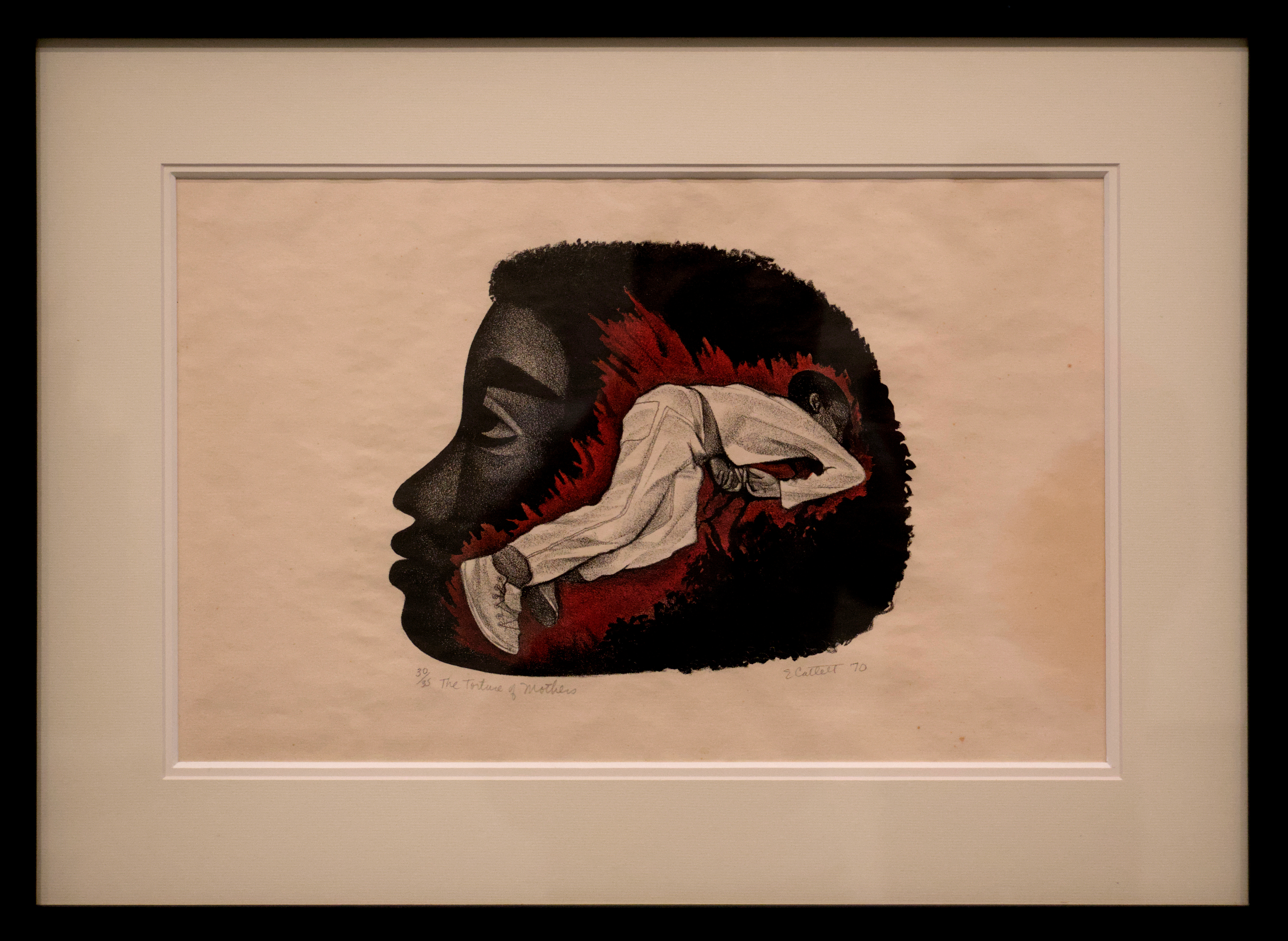
Catlett, Elizabeth_Torture of Mothers
Elizabeth Catlett (American, active in Mexico, 1915–2012), Torture of Mothers, 1970. Hand-colored lithograph, sheet: 38.1 × 56.5 cm (15 × 22 1/4 in.); framed: 48.3 × 66 cm (19 × 26 in.). Collection of Juanita and Melvin Hardy.

“Catlett’s composition visualizes the emotional toll such events have on Black mothers and women of color more broadly,” the gallery label reads—mothers whose minds are continually haunted by the racial violence, sometimes even state-authorized, that threatens the safety of their boys. “While Catlett was tracking police brutality in the US, she was also aware of similar state violence against Mexican youth, including the mass shooting of student protestors in 1968 by police at the Universidad Nacional Autónoma de México where Catlett taught.”

Several of the mothers in Catlett’s art are posed in a protective embrace that seeks to shield their children from harm. The arms of her 1982 Madonna, for example, wrap around a son and a daughter, though her averted eyes look worried:

Catlett, Elizabeth_Madonna
Elizabeth Catlett (American, active in Mexico, 1915–2012), Madonna, 1982. Lithograph, sheet: 76.2 × 56.5 cm (30 × 22 1/4 in.). Stanley Museum of Art, University of Iowa, Iowa City.

In African American families, children are often raised by their grandmothers. Reflecting adaptability and support, such kinship care is memorialized in These Two Generations, which shows in profile a young boy and the primary maternal figure and caregiver in his life: his grandma.

Catlett, Elizabeth_These Two Generations
Elizabeth Catlett (American, active in Mexico, 1915–2012), These Two Generations, 1979, printed 1987. Lithograph, image: 48.3 x 55.7 cm (19 x 21 15/16 in.); sheet: 56.7 x 76.2 cm (22 5/16 x 30 in.); framed: 69.9 x 80 cm (27 1/2 x 31 1/2 in.). Collection of Otis and Harryette Robertson.

Skipping ahead to this millennium, the exhibition includes Danys y Liethis, a portrait of the artist’s niece and great-niece:
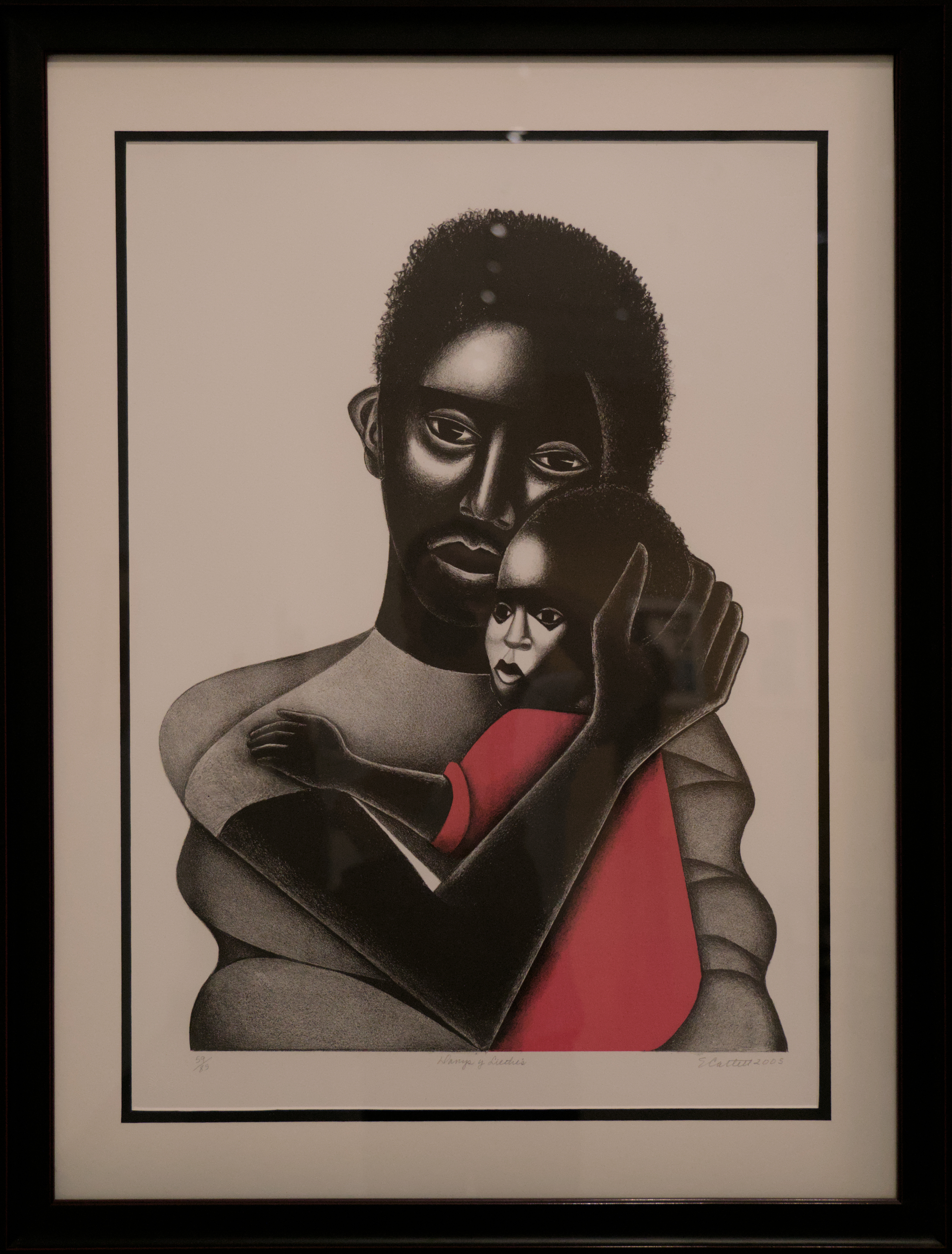
Catlett, Elizabeth_Danys y Liethis
Elizabeth Catlett (American, active in Mexico, 1915–2012), Danys y Liethis, 2005. Offset lithograph, sheet: 71 × 50.8 cm (27 15/16 × 20 in.); framed: 91.4 × 71.1 cm (36 × 28 in.). Collection of Barbara J. Luke.

Lastly, suspended from the ceiling at the exhibition’s entrance/exit, is Catlett’s most unique mother-child sculpture, Floating Family:

Catlett, Elizabeth_Floating Family
Elizabeth Catlett (American, active in Mexico, 1915–2012), Floating Family, 1995. Mexican primavera wood, overall length: 304.8 cm (120 in.). Collection of the Chicago Public Library.

It’s striking! Art historian Elissa Yukiko Weichbrodt writes beautifully about it on her Substack, whose words I’ll close with:

In many of her depictions of motherhood, Catlett unifies the mother and child into a single form, emphasizing their intimacy. But I’ve been thinking about her large-scale sculpture Floating Family, which usually hangs above the circulation desk at the Legler Branch of the Chicago Public Library. Here, mother and daughter are still tethered together, but instead of standing upright they are now perfectly horizontal. Are they maple seed pods, spinning and falling to the earth to plant something new? Or a rotor, lifting upwards, leaving gravity behind? Despite the seeming precarity of the moment, the mother’s face is calm and set, and the daughter looks up at her, trusting.

I imagine that it does something different in the context of a library than as the closing object in a museum retrospective. For me in October, after seeing so many sculptures of mothers cuddling their children close, this work evoked the particular terror and thrill of parenting adolescents. Now, it suggests more than that: the labor and love we give not only our children but our communities and the way that hope can sometimes feel like a free fall.


Elizabeth Catlett: A Black Revolutionary Artist will continue through July 6, 2025, at the National Gallery of Art before traveling to the Art Institute of Chicago for its final leg from August 30, 2025, to January 4, 2026. You can purchase the exhibition catalog here and view some of my other photos on Instagram.
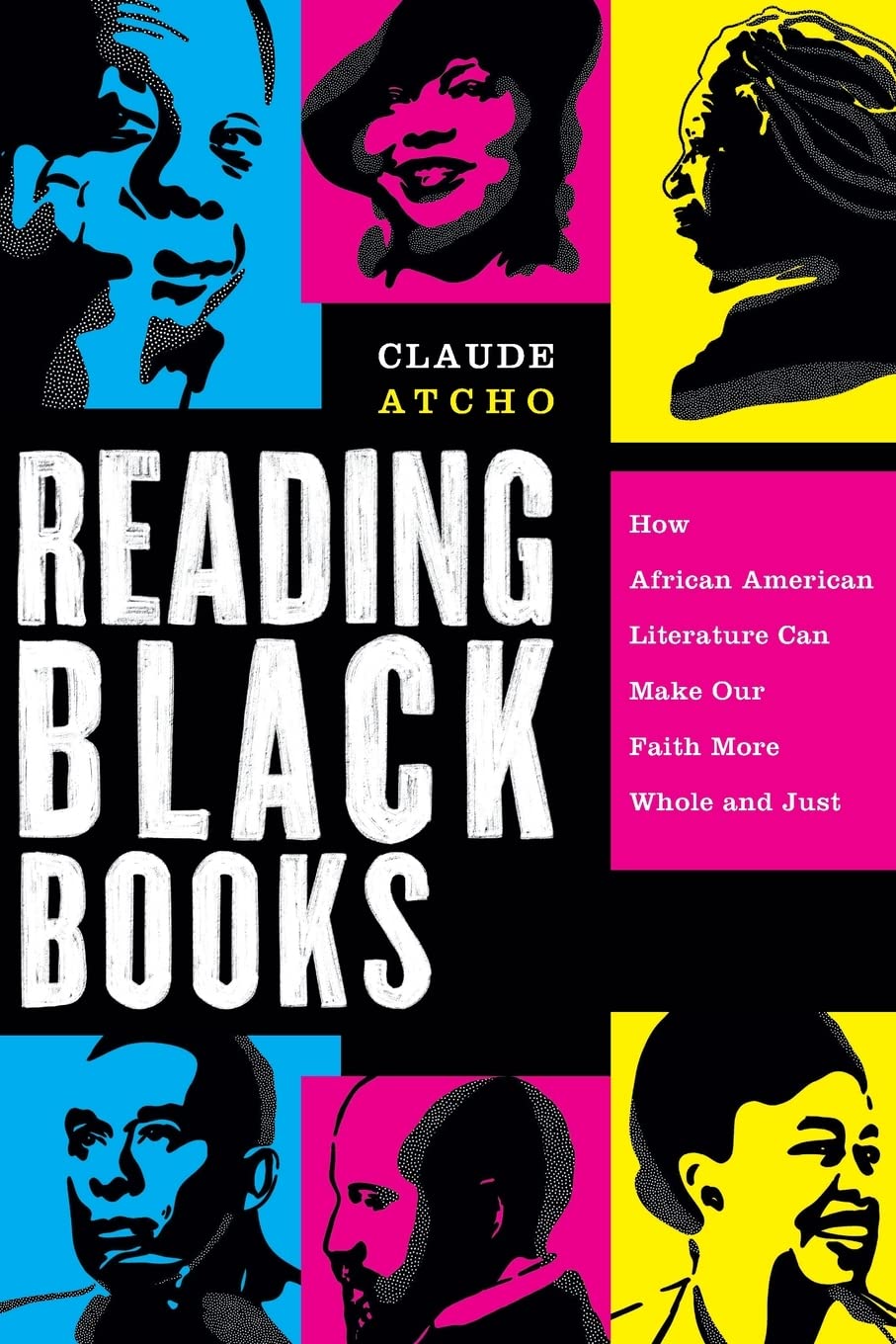
Book Review: Reading Black Books: How African American Literature Can Make Our Faith More Whole and Just by Claude Atcho

“One of the best ways to listen to Black voices is to attend to Black stories, specifically the enduring ones captured in classic African American literature,” writes pastor-theologian and former English professor Claude Atcho in the opening paragraph of Reading Black Books: How African American Literature Can Make Our Faith More Whole and Just.

Such great cover art and design by Octavia Ink!

Published last month by Brazos Press, the book consists of ten chapters, each one built around a theologically charged word or concept (such as “sin,” “image of God,” or “lament”) and a twentieth-century novel or poem(s) by a Black author that is then engaged through that lens. A potential danger with this approach is that the interpretations in either direction could be forced to fit into a box, but this turned out not to be the case at all. Reading Black Books is a two-way, mutually enriching exchange between theology and literature, one that is expansive rather than limiting and that takes each discipline seriously on its own terms.

Combining literary analysis and theological reflection, Atcho shows how “God’s truth addresses Black experience and how Black experience, as shown in the literature of our great writers, can prod readers from all backgrounds toward sharper theological thinking and more faithful living” (1). We are invited to inhabit the experiences of various characters and poetic voices and to be transformed as a result. As a middle-class white woman living in a Maryland suburb, I acknowledge that I move about the world with a very different set of experiences than those of people of color. With pastoral sensitivity but also directness, Atcho helps me enter into America’s racial narrative—and the narrative of the gospel!—from a different vantage point. This book is for Christians of any race who desire to be enlarged by story and to live more fully into the liberative arc of scripture.

Atcho provides enough context for each book—introducing us to characters, rehearsing relevant plot points, and highlighting specific scenes, often including quoted excerpts—that you don’t have to have read the work previously to benefit from his commentary. The book does contain spoilers, as all serious literary criticism almost inevitably will. But literature is way more than plot, and readers are encouraged to then engage with the primary texts in full on their own, equipped with frames for thinking about them and open to surprises.


I have attempted to come to this book about books as a guide who integrates my affections: my love for these stories, my love for what they say about Black experience in both trials and triumphs, and my love for Jesus and his kingdom.

Claude Atcho, p. 7

Chapter 1 examines the question “What does it mean to live as an image bearer when other image bearers try to limit your existence?” The protagonist of Ralph Ellison’s Invisible Man (not to be confused with H. G. Wells’s sci-fi novel The Invisible Man) is not physically invisible; rather, he is rendered invisible by others’ refusal to see him. Atcho discusses the need for white sight—our warped “inner eyes”—to be redeemed.

Chapter 2 explores how systemic sin exacerbates personal sin through the controversial character of Bigger Thomas in Richard Wright’s Native Son, a Black man from 1930s Chicago who kills two people (the first one accidentally). Is Bigger a victim or a perpetrator? The question is too simplistic. Bigger is both trapped by Sin and an agent of Sin, Atcho says. Atcho’s explication of Sin with a capital S and sin, little s, is sophisticated and illuminates for me broader discussions going on in contemporary culture. Sin is not just personally experienced and personally enacted; it is also a dominating force that’s been set loose in our world and that has become embedded in systems.

The focus of chapter 3 is James Baldwin’s semiautobiographical debut novel Go Tell It on the Mountain, “a critical generational portrait of the toxic Christian practice that emerges from belief in a loveless God” (40). Baldwin gestures toward true religion through negation—by presenting the character of Gabriel, the protagonist’s minister stepfather, as a promiscuous and abusive binge drinker with a lust for power.  

Chapter 4 visits “Christ Recrucified” and the nine-hundred-line “The Black Christ” (read the first stanza here) by Harlem Renaissance poet Countee Cullen, unpacking the picture they paint of a Jesus who suffers for, like, and with us. Published in the 1920s, both poems compare the crucified Christ to a lynched Black man.

In chapter 5 Zora Neale Hurston’s Moses, Man of the Mountain, a folkloric retelling of the book of Exodus, opens up a quest into the doctrine of salvation. Atcho discusses salvation from and to, which story and script forms us most (the old empire or the coming kingdom?), the significance of the promised land, and Christian social concern as a biblical imperative.

The deliverance of the exodus elides the false dichotomy of a truncated salvation. Hurston’s Moses points in the same direction—toward imagining a fully orbed salvation, as did our enslaved ancestors: revelation and liberation.

Is it our attention, then, to be fixed on the sin of slavery or our slavery to sin? Personal piety in the power of the Spirit or social change in Jesus’s name? Liberation or revelation? In the exodus, the Lord frees his people so that they might exist in freedom for him. It is liberation through revelation and atonement. God’s revelation (Exod. 9:4, 16, 29; 10:1–2; 11:7; 14:4), the necessity of atonement (13:13, 15), the urgency of liberation (2:23–25), and the subsequent call to holiness (31:13; Lev. 20:8) cannot be isolated. In the exodus, each motif exists in relation, forming the full melody of salvation. The song of salvation is not played in only one key. The contextual pressures of human experience can force us, understandably at times, to prize piety or liberation when truly salvation expands and contains both—and more. (84–85)

Nella Larsen’s Passing—which was adapted into an acclaimed film last year—is the subject of chapter 6, on racism. The novella delves into the psyches of two light-skinned Black women in 1920s Harlem, one of whom passes for white in all settings as a means of survival, and the other of whom does so only when convenient. Atcho talks about the need to combat colorism with affirmation (e.g., “Black is beautiful”), with denial, and through the flesh of Christ.

Chapter 7 spotlights Beloved, a gothic novel by Toni Morrison that combines the historical and the supernatural to tell the story of a devoted mother named Sethe who is seeking freedom from enslavement. At one point she escapes with her children, but when the authorities find them she kills her two-year-old daughter (who is unnamed in the novel and referred to as “Beloved,” the sole word on her tombstone) rather than relinquish her to a life of slavery. Sethe is ultimately able to get away to an Ohio farmhouse, which becomes haunted by Beloved’s ghost.

Atcho discusses the traumas of enslavement that continue to compound and haunt the body, mind, and soul even after one becomes “free”; the need for righteous rage; enfleshment and bodily liturgy; chattel slavery’s theft of the mother-child relationship; memory as a muscle that needs to be exercised transparently, communally, and redemptively; new creation and anticreation; and exorcism, rescue.

One of the most compelling characters in the novel is Sethe’s mother-in-law, Baby Suggs. A shepherdess of bodies and souls, she creates a new space in the woods near the farmhouse where she enacts weekly liturgies of healing. She directs her people, in Atcho’s words, “to move and be in the sacred humanity that they are and that has so viciously been attacked by those who enslaved and debased them” (117). A key passage in Beloved describes this communal gathering:

After situating herself on a huge flat-sided rock, Baby Suggs bowed her head and prayed silently. The company watched her from the trees. They knew she was ready when she put her stick down. Then she shouted, “Let the children come!” and they ran from the trees toward her.

“Let your mothers hear you laugh,” she told them, and the woods rang. The adults looked on and could not help smiling.

Then “Let the grown men come,” she shouted. They stepped out one by one from among the ringing trees.

“Let your wives and your children see you dance,” she told them, and groundlife shuddered under their feet.

Finally she called the women to her. “Cry,” she told them. “For the living and the dead. Just cry.” And without covering their eyes the women let loose.

It started that way: laughing children, dancing men, crying women and then it got mixed up. Women stopped crying and danced; men sat down and cried; children danced, women laughed, children cried until, exhausted and riven, all and each lay about the Clearing damp and gasping for breath. In the silence that followed, Baby Suggs, holy, offered up to them her great big heart. . . .

“Here,” she said, “in this here place, we flesh; flesh that weeps, laughs; flesh that dances on bare feet in grass. Love it. Love it hard. Yonder they do not love your flesh . . .”

Baby Suggs then goes on to list various parts of the body—eyes, skin, hands, mouth, neck, liver, heart—contrasting what “yonder” men do to those parts (gouge, flay, chop, beat, hang, expose and feed to hogs) with each part’s innate belovedness. Atcho’s comments on this passage—a passage that has stuck with me ever since I first read the novel some fifteen years ago—are among the best in the book.

Chapter 8 is on the theme of lament, and it considers that biblical practice in relation to the poem “A Litany of Atlanta” by W. E. B. Du Bois while also looking at the Psalms and the cross. “There is . . . power in lament that names injustice for what it is,” Atcho writes. “By naming it as such and placing it before God as counter to his moral will, lament teaches us to make no peace with injustice or oppression” (137). Bearing true witness against evil, the poem was written in response to the three-day reign of racial terror that white men unleashed on a Black community in Atlanta in September 1906, killing, maiming, and destroying homes and businesses. It opens, “O Silent God, Thou whose voice afar in mist and mystery hath left our ears an-hungered in these fearful days— / Hear us, good Lord!

Chapter 9 takes a look at another novel by Richard Wright, The Man Who Lived Underground, published for the first time last year, sixty-one years after the author’s death. (Publishers rejected it during Wright’s lifetime.) It follows Fred Daniels, a Black man who, after being picked up by police and relentlessly tortured, confesses to a double murder that he did not commit, then flees into the city’s sewer system. “The underground” confers on him a new knowledge of the world’s foundations of falsehood and injustice. At the end, he meets his demise.


To imagine a more just world, one must reckon with the world that is.

Claude Atcho, p. 145

Even though the novel promotes a worldview that is bleak and fatalistic, reading it can still be constructive, Atcho says; as Christians, we carry our hope to bleak texts. What would it look like to see this senseless world reconfigured into wholeness and justice? Atcho calls us to action, away from discrimination, violence, and power abuse and toward the pursuit of justice for all people on earth as it is in heaven.  

It’s fitting that the last chapter centers on hope, particularly as expressed through Margaret Walker’s poem “For My People.” Atcho describes the poem as “a living history, an ode, an exhortation, a lament, a prayer” that “embodies the fiery passion of a communal hope, a bond of persons and destiny” (160, 166). While the majority of the poem addresses Walker’s Black kin, at the end she expands “my people” to embrace all of humanity, “all the adams and eves.”

+++

Throughout Atcho’s book we see the legacies of racial oppression in America—how it manifests today. Though the most recent of the featured literary works is from 1989, they all speak into our current moment. I appreciate how Atcho defines terms that show up a lot in public discourse, such as liberation and justice, comparing cultural definitions with biblical ones. But he leads with story. While in the public square our tendency is often to arm ourselves with arguments to bolster our views and defend against attacks, story has a way of disarming us. Abstract concepts become incarnate in the lives of characters. Literature can teach us the discipline of listening and can develop our empathy and understanding. It may prompt us to assess our own prejudices or complicities and impel us to repentance and real change.

Reading Black Books demonstrates the power of great literature to form us spiritually, regardless of the faith commitments of its author. Atcho presumes no theological agenda on the part of the writers, but rather chooses to read these works theologically—which can unlock more nuanced interpretations or deepened meaning. Applying a theological framework, Atcho draws out themes from the works that cannot be addressed quite as well, I’d say, without theological language. He connects our collective human story to God’s story.

The back matter includes discussion questions for each chapter.

Though I had previously read and studied all four poems Atcho discusses, I’ve read only one of the seven novels—and this despite my having been an English major in college! This book makes me want to read more for sure. I’ve already stocked up my library accordingly. I’m grateful to Atcho for reactivating my interest in fiction and for extending it in the direction of these seminal African American novels.

You can buy Reading Black Books on Amazon (at the time of writing, Amazon is offering three for the price of two!), from Baker Publishing, or from your retailer of choice.