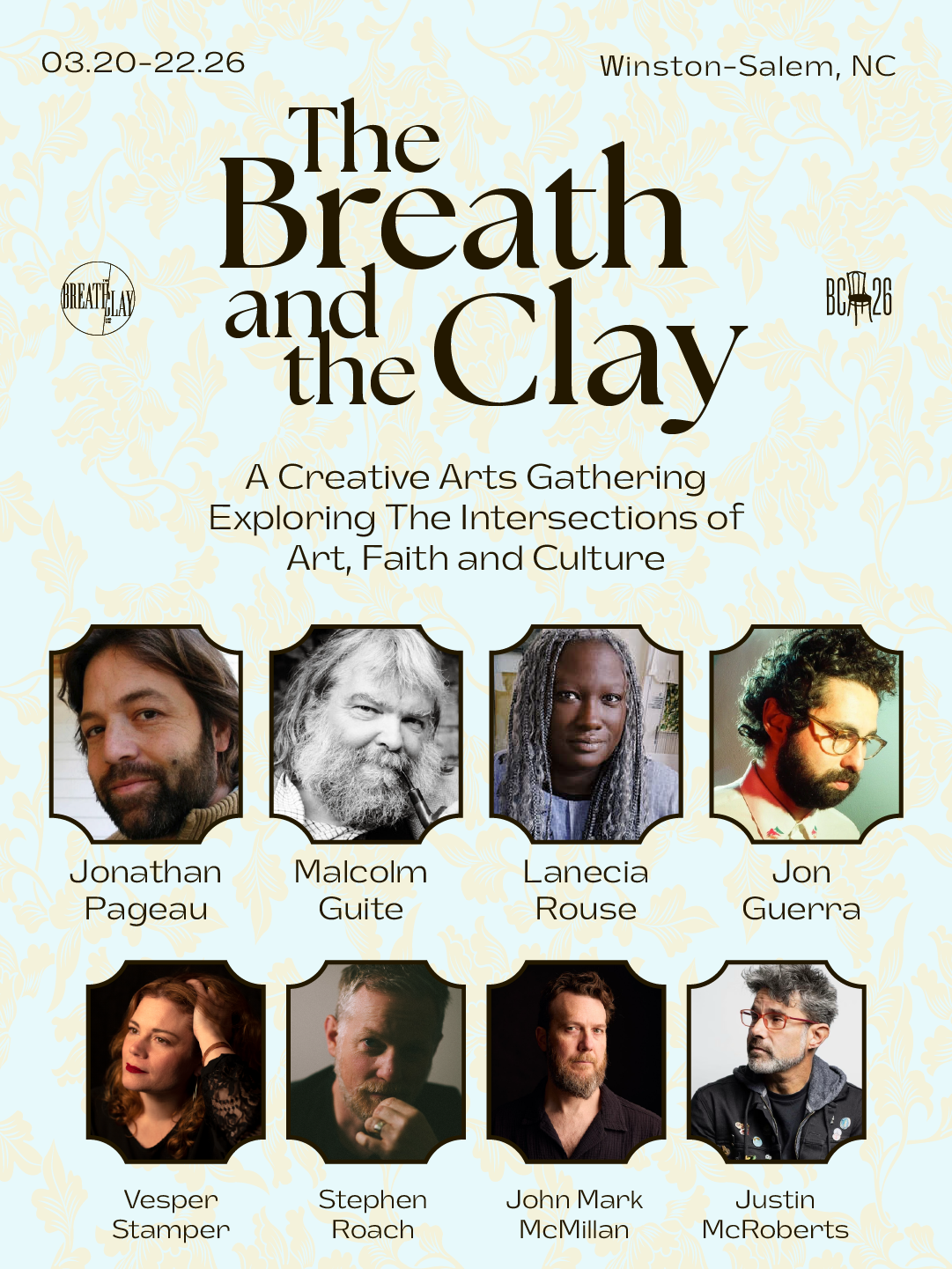
CONFERENCE: The Breath and the Clay: Exploring the Intersections of Art, Faith, and Culture, Winston-Salem, North Carolina, March 20–22, 2026: “Before the first word is spoken, before the brush touches the canvas or the note strikes the air, there is silence. Creation begins with a clearing, making space for new worlds to exist. An empty chair waits in welcome, an empty forest beckons us to come aside. Even absence itself becomes an opening for presence.
“At The Breath & The Clay 2026, we are exploring what it means to make space—for rest, for renewal, for art, for one another, and for the Presence that meets us in the emptiness. Together, we will practice making room: for the unfinished, and the unfurnished, for the overlooked, for voices not our own. In this space, we will make art—our response to the silence that precedes creation, our offering to the mystery and miracle that ever calls us onward.”
This annual gathering features presenters from across the disciplines of poetry, music, visual art, theater, film, dance, creativity coaching, and real estate development. General admission is $299.
>> “How Long (A Christian Lament)” by IAMSON: This week the Richmond, Virginia–based singer-songwriter IAMSON (the artist name of Orlando Palmer) wrote his pain into a song and shared it on social media. “I challenge all Christian artists to write about what’s really going on,” he says, likely referring to the two murders committed this month by US federal agents from Immigration and Customs Enforcement (ICE) and Customs and Border Protection (CBP) and, more broadly, the agencies’ hypermilitarized tactics, indiscriminate raids, illegal detainments, and terrorizing of communities in deference to President Trump’s mass deportation initiative.
>> “Psalm 10” by Poor Bishop Hooper: Poor Bishop Hooper (Leah and Jesse Roberts) have set all 150 psalms of the Bible to music. Psalm 10 is one I had not ever heard a musical interpretation of. Belonging to the genre of lament, it opens:
Why, O LORD, do you stand far off? Why do you hide yourself in times of trouble? In arrogance the wicked persecute the poor— let them be caught in the schemes they have devised.
>> “Micah 6:8” by Monroe Crossing:Monroe Crossing [previously] is a Minnesota bluegrass band whose members are Lisa Fuglie (fiddle), David Robinson (banjo), Derek Johnson (guitar), Matt Thompson (mandolin), and Mark Anderson (bass). This is a song Fuglie and Anderson wrote in 2011 inspired by Micah 6:8, one of this coming Sunday’s lectionary readings: “He has told you, O mortal, what is good, and what does the LORD require of you but to do justice and to love kindness and to walk humbly with your God?” Many Christians hold on to this as a “life verse,” a summation of God’s values that serves as a guiding principle.
FREE DIGITAL POETRY BOOKLET: Inkwell Poetry for the New Year (2026): Last week Inkwell (formerly Ekstasis), a publication of Christianity Today, released a collection of twenty poems curated by guest editor J. C. Scharl, and it’s excellent! “A storytelling community seeking transcendence,” Inkwell is in a period of refining their identity, and this offering is a sort of stopgap until they reintroduce poetry features into their editorial flow. (Right now they’re focusing on creative nonfiction.)
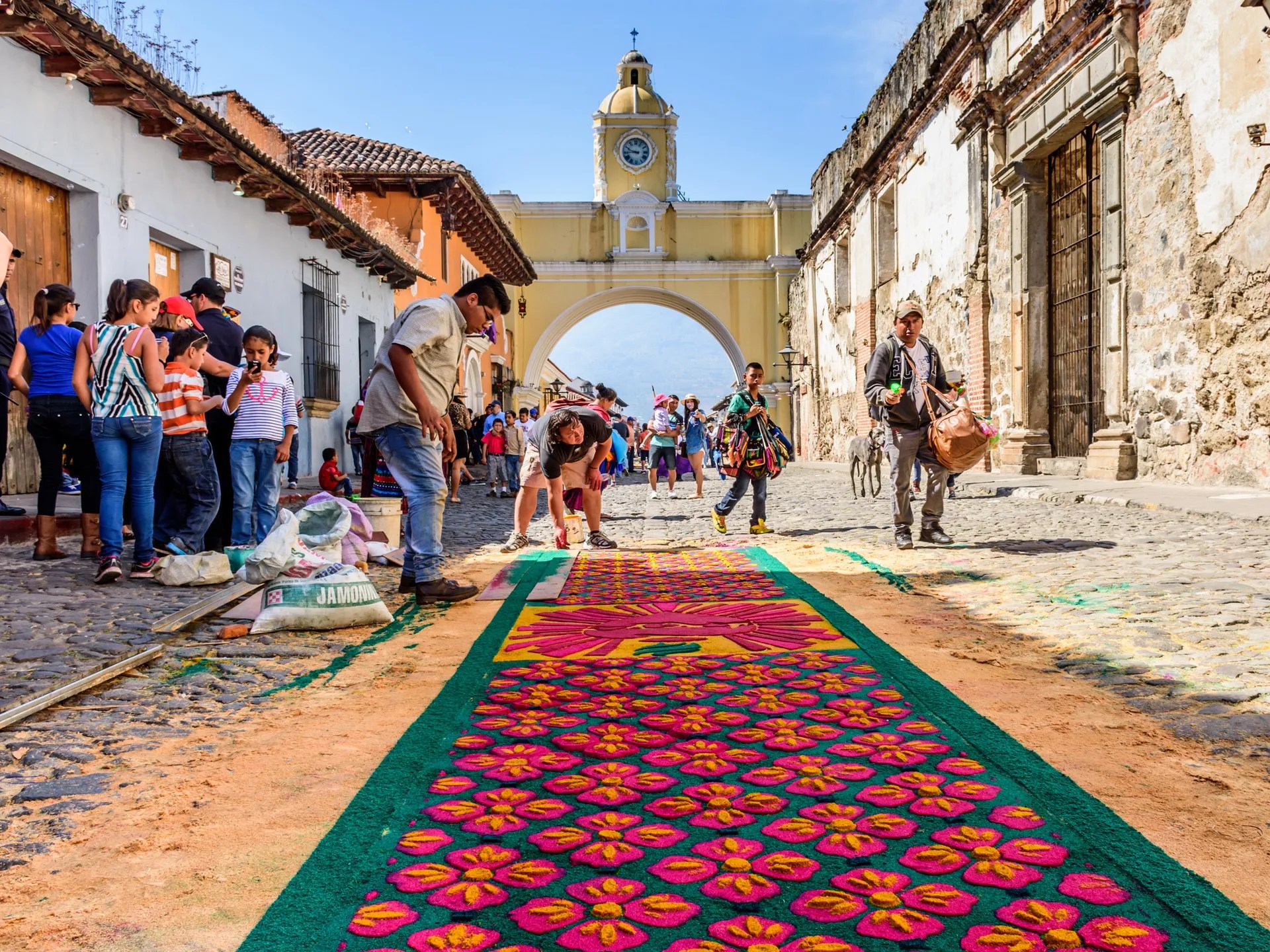
HOLY WEEK TRADITION: Antigua, Guatemala, is renowned for its annual Good Friday observance, which involves the laying out of alfombras (carpets) of multicolored sawdust through the city’s cobblestone streets, hundreds of feet long. On Maundy Thursday, the city closes so that families and businesses can spend the day constructing the carpets, applying the sawdust to planned designs using stencils and strainers and adding pine needles, flowers, fruits, and other natural materials as well.
People watch while locals make an alfombra (carpet) of dyed sawdust for Antigua’s Good Friday processions, the most famous in Latin America. Photo: Lucy Brown, 2016.
At 4 a.m. on Good Friday, the processions begin, with people carrying floats that bear statues of Christ carrying his cross, followed by marching bands playing solemn music. (This is a remembrance of Jesus’s walk to Calvary.) As their feet pass over the alfombras, the dust scatters. Locals and visitors gather along the streets dressed in black for mourning, and at 11 p.m. a figure of Jesus is laid to rest in the church.
Here are two resources for exploring this tradition further:
>> VIDEO: “Alfombras de Semana Santa en Guatemala,” dir.Federica Dominguez: This short film (in Spanish, with English subtitles) interviews Rolando Ortiz, an alfombrero who is also a shoemaker. He explains that the carpets hark back to Jesus’s triumphal entry into Jerusalem, when the crowds strewed his path with palm branches (giving him the red carpet treatment, so to speak). Even though the alfombras last only a brief time, locals spare no expense in bringing them to fruition each year—“for Jesus,” Ortiz says. “It is an act of gratitude above all.” An offering of beauty and praise.
+++
NEW ALBUM: As Foretold, Part 3 by Poor Bishop Hooper: Released today, this is the final album in a trilogy based on the prophetic fulfillment passages in the Gospel of Matthew. It centers on Jesus’s passion and concludes with a resurrection epilogue. As with all their music, the duo graciously offers it for free download from their website.
+++
SONGS performed by Emorja Roberson: Emorja Roberson [previously] is a singer, gospel choir conductor, and assistant professor of music and African American studies at Oxford College of Emory University in Georgia. I enjoy following his YouTube channel. Here are two songs that are especially fitting for Holy Week.
>> “I Know It Was the Blood”: Roberson sings three verses of this beloved African American spiritual: the title verse, “They whipped him all night long,” and “He never said a mumblin’ word.” The song is more typically sung in a major key, and its full lyrics span Christ’s passion, resurrection, ascension, and second coming. But Roberson slows down the tempo and sings in a minor key, homing in on the sorrow of Good Friday.
>> “He Decided to Die” by Margaret Pleasant Douroux: Roberson, on keys, sings a gospel classic with friends Marcus Morton and Cameron Scott, a song that emphasizes Christ’s resoluteness on the cross, his endurance for love.
+++
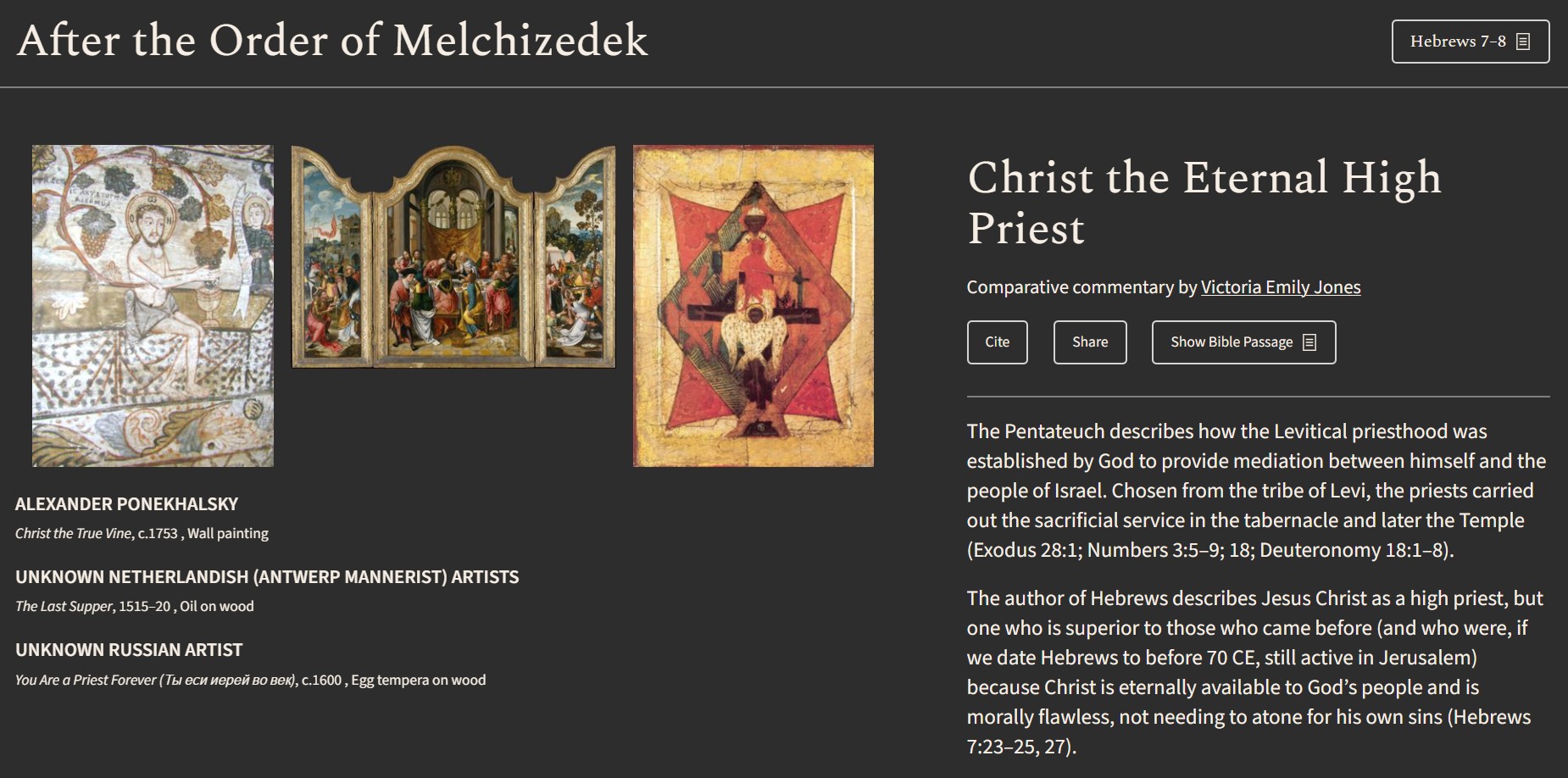
VISUAL COMMENTARIES: “After the Order of Melchizedek” by Victoria Emily Jones: My latest contribution to the Visual Commentary on Scripture, a project based out of King’s College London, was published earlier this month. Tasked with choosing and commenting on three artworks that dialogue with Hebrews 7–8, I landed on a “You Are a Priest Forever” icon from Russia (very strange!), an Antwerp Mannerist triptych that centers the Last Supper, and (my favorite) a wall painting of Christ the Grapevine from a Romanian church. I was interested to explore the idea of how Jesus, in giving his body and blood, is both the offerer and the offered, both priest and sacrifice.
+++
POEM: “The Death of Christ” by Emperor Kangxi: Emperor Kangxi (1654–1722) ruled in China for sixty-one years during the Qing Dynasty. In 1692 he issued the Edict of Toleration, which barred attacks on churches and legalized the practice of Christianity among Chinese people. Curious about and respectful of other faiths, he penned this short poem on the Crucifixion using the classical qi-yen-she form.
+++
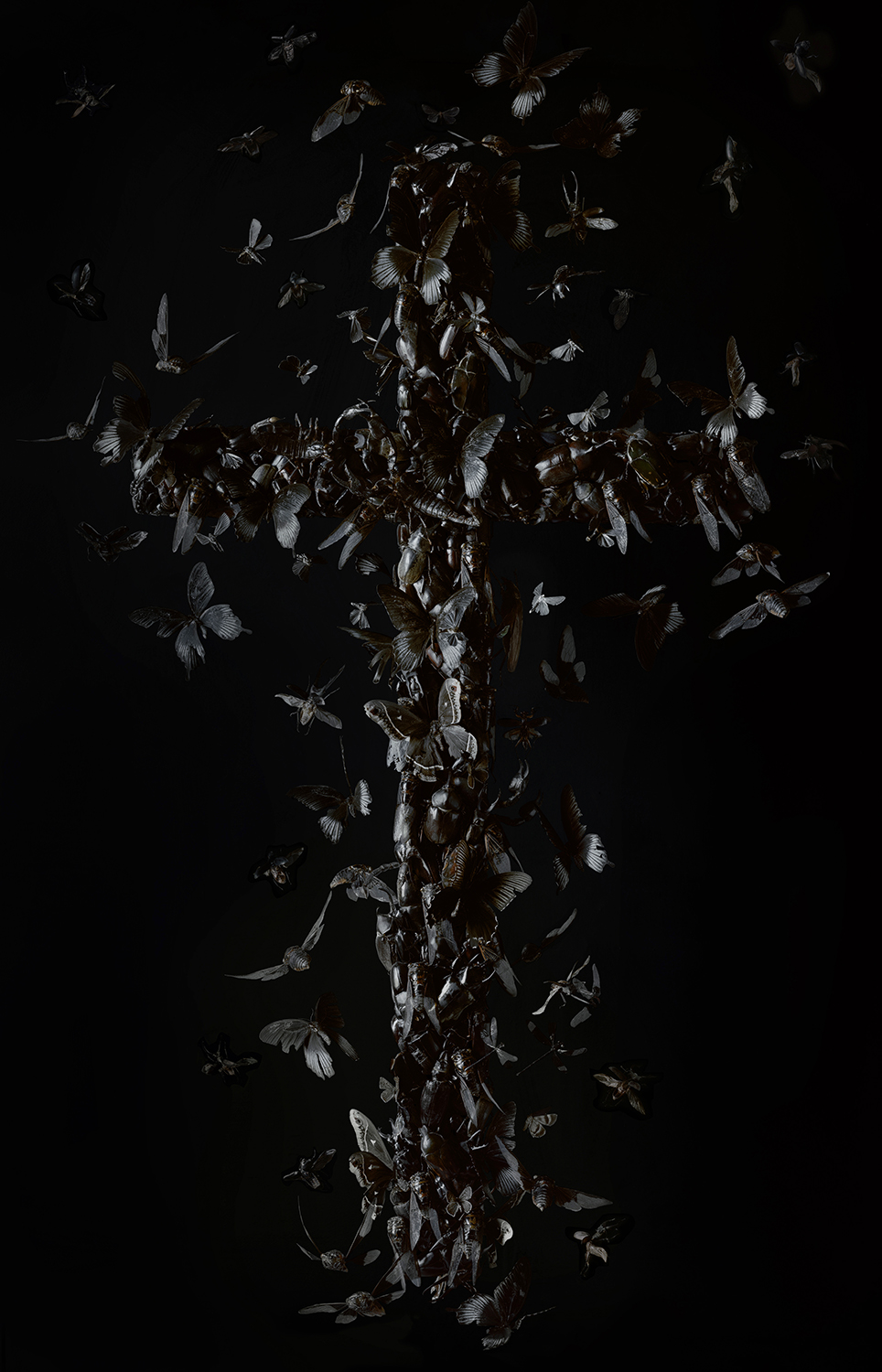
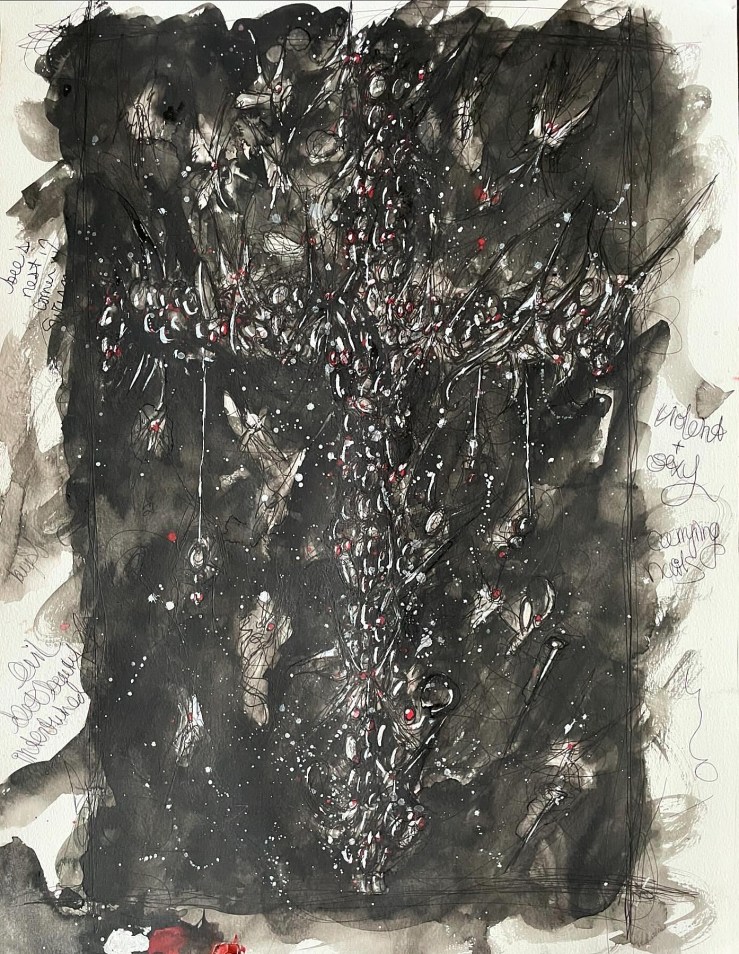
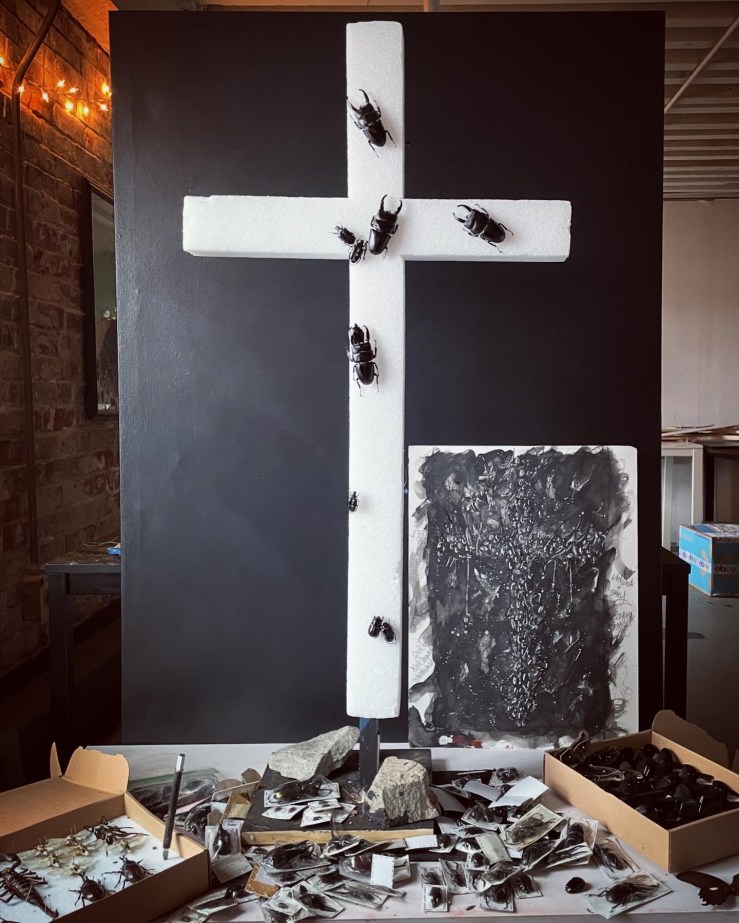
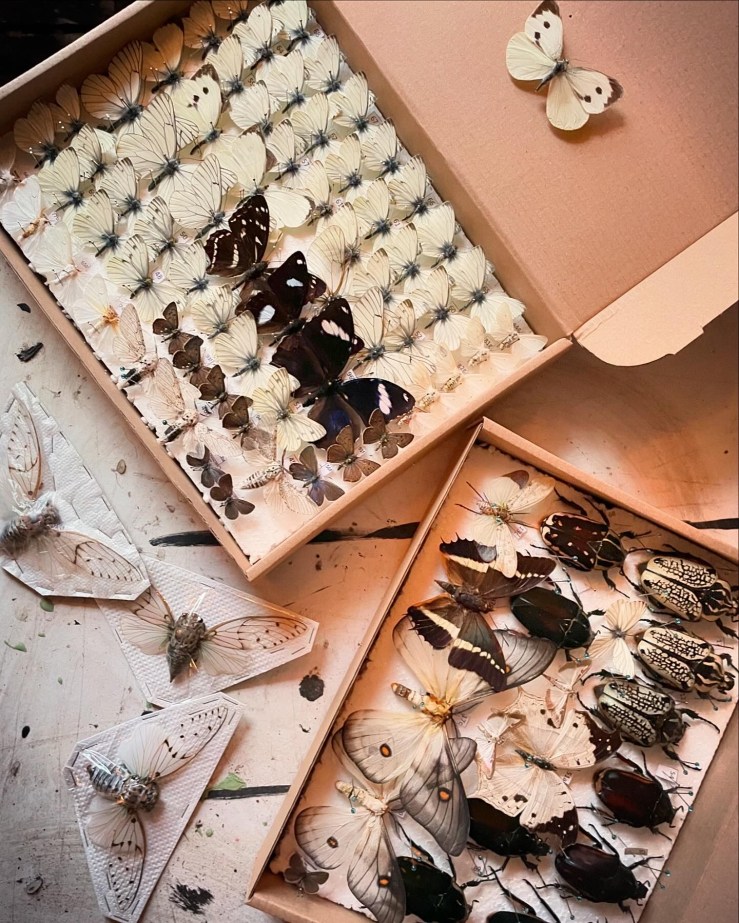
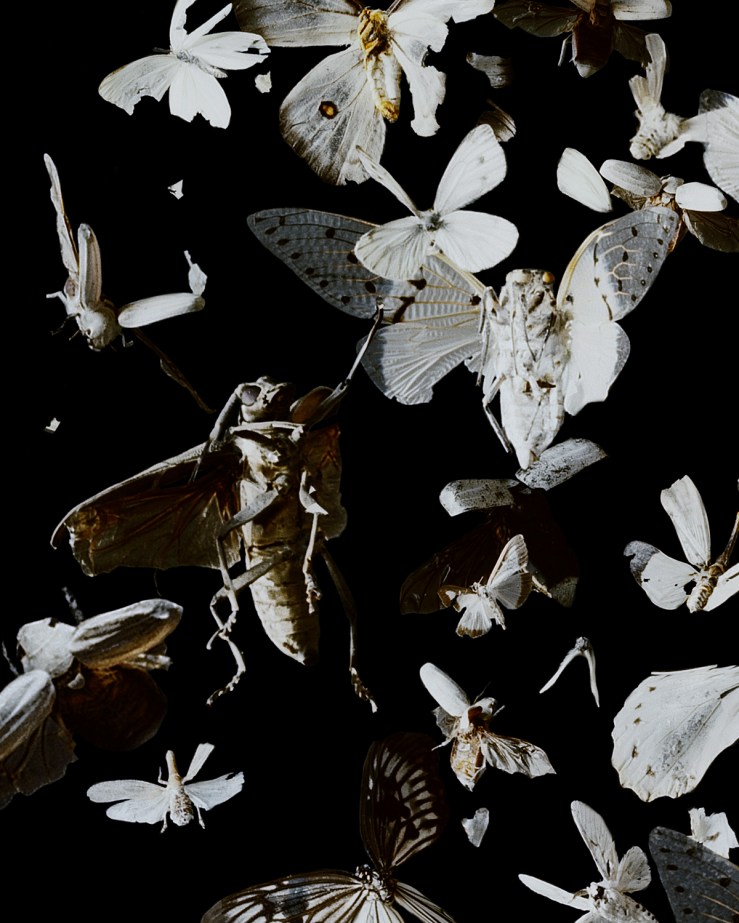
EXHIBITION: Tara Sellios: Ask Now the Beasts, Fitchburg Art Museum, January 18, 2025–January 18, 2026:Tara Sellios is a multidisciplinary artist from South Boston working mainly in large-format photography. Delighting in detail and complex symbolism, she often uses insects, dried fauna, bone, and other organic matter to create elaborate still lifes that she then photographs under dramatic lighting. She is inspired by art historical representations of the end of the world, especially the bizarre paintings of Hieronymus Bosch and Albrecht Dürer’s Apocalypse woodcuts, and by seventeenth-century Dutch vanitas paintings.
The photographs in her current solo show, Ask Now the Beasts at Fitchburg Art Museum in Massachusetts, are “contemporary allegories of suffering and transcendence.” The exhibition’s title comes from Job 12:7.
Two of the works on display are a pair of crosses: Umbra (Latin for “darkness” or “shadow”) and Dilucesco (“to begin to grow light, to dawn”), which together suggest a movement from death to resurrection. Constructed with a throng of black beetles and other black insects, the Umbra cross evokes the detail from the Synoptic Gospels’ Crucifixion accounts that at noon, “darkness came over the whole land until three in the afternoon, while the sun’s light failed” (Luke 23:44–45; cf. Matt. 27:45; Mark 15:33). Dilucesco, on the other hand, shows the cross seemingly exploding into light, as white moths and other winged insects break out of their cruciform shape. View these two photographic artworks, plus a few process photos and sketches the artist sent me, below. See, too, www.tarasellios.com.
Tara Sellios (American, 1987–), Umbra, 2024, from the series Ask Now the Beasts. Inkjet print from 8 × 10 negative, 55 × 35 in. Courtesy of the artist.Tara Sellios (American, 1987–), Dilucesco, 2024, from the series Ask Now the Beasts. Inkjet print from 8 × 10 negative, 55 × 35 in. Courtesy of the artist.
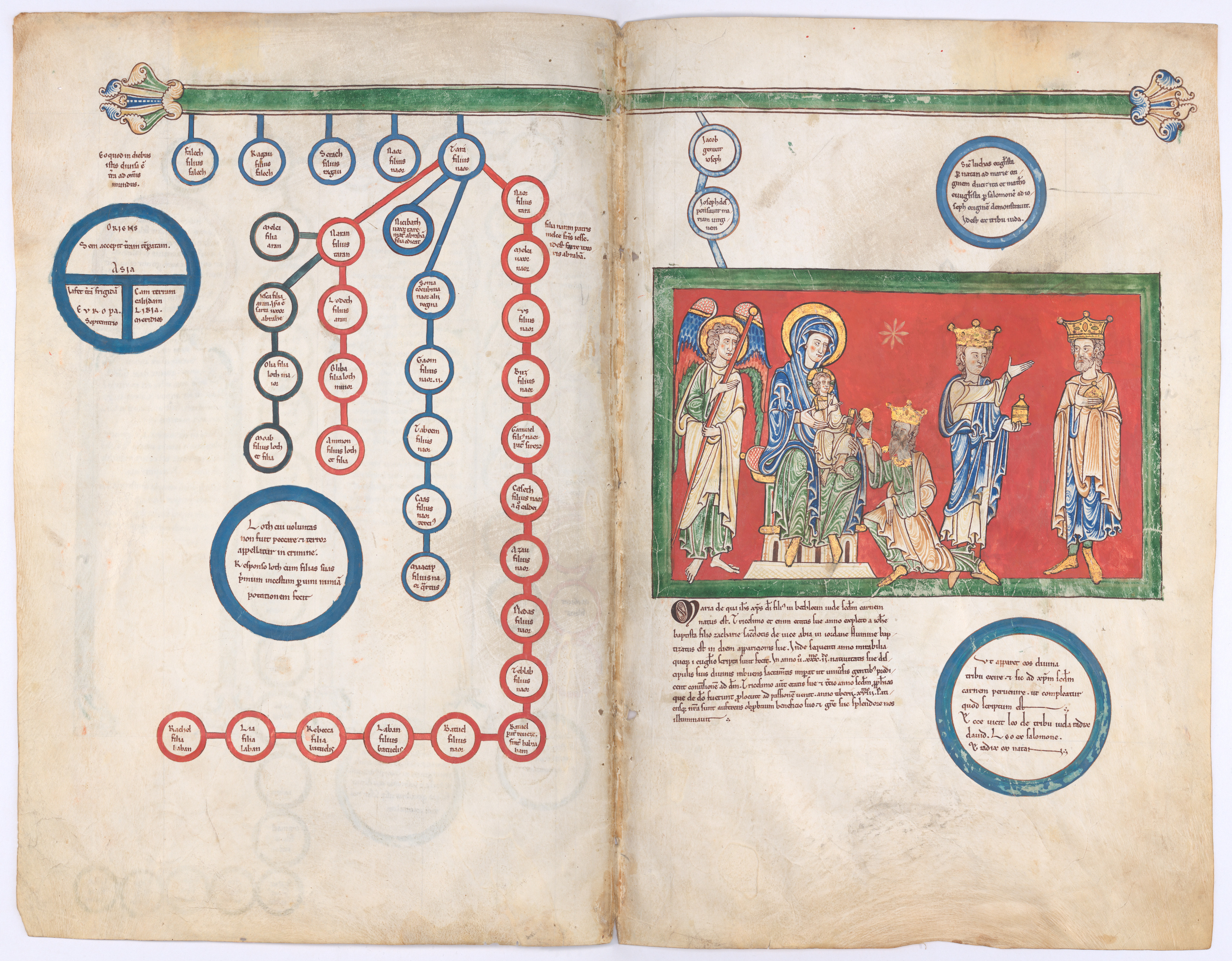
LOOK: Genealogy of Christ and the Adoration of the Magi, from a Beatus manuscript
Bifolium with part of the Genealogy of Christ and the Adoration of the Magi, from a Beatus manuscript, Spain, ca. 1180. Tempera, gold, and ink on parchment, each folio 17 1/2 × 11 13/16 in. (44.4 × 30 cm). Metropolitan Museum of Art, New York.
LISTEN: “Christ” by Poor Bishop Hooper, on Firstborn (2018)
Abraham fathered Isaac Isaac fathered Jacob Then Jacob fathered Judah and his brothers Judah, he fathered Perez Who fathered Hezron, who fathered Aram Aram fathered Amminadab Who fathered Nahshon, who fathered Salmon
Salmon fathered Boaz by Rahab Boaz fathered Obed by Ruth And Obed fathered Jesse, and Jesse was the father of King David Then David fathered Solomon by Uriah’s own wife
Solomon, he was the father of Rehoboam, who fathered Abijah Who fathered Asa and then Jehoshaphat Jehoram fathered Uzziah Who fathered Jotham Jotham, he fathered Ahaz, who was the father of Hezekiah
Manasseh, he fathered Amon (who fathered Josiah) And Jeconiah (and his brothers) amidst the exile Shealtiel fathered Zerubbabel (who fathered Abihud) Who fathered Eliakim (who fathered Azor), who fathered Zadok Zadok fathered Achim (who fathered Eliud), who fathered Eleazar (Who fathered Matthan) Who fathered Jacob
And Jacob was the father of Joseph And Joseph took a virgin for his wife And Mary was the one who gave birth to the Son of God (Mary was the one who gave birth to the Son of God) Mary was the one who gave birth to the Son of God (Mary was the one who gave birth)
And his name is Jesus And his name is Jesus And his name is Jesus And his name is Jesus Who is called the Christ (Jesus) Wonderful Counselor (And his name is Jesus) Almighty God, the everlasting Father (And his name is Jesus) Prince of Peace, Almighty God (And his name is Jesus) Who is called the Christ
Who knew a sung genealogy could be so captivating? Jesse and Leah Roberts are a married couple from Missouri who write, sing, and record songs together as Poor Bishop Hooper. The lyrics of “Christ”—a list of Jesus’s ancestors—come straight from Matthew 1. This recording from their home studio premiered at the virtual Songs for Hope: A TGC Advent Concert on December 6, 2020.
The third Sunday of Advent is traditionally known as Gaudete (Joy) Sunday, a day of celebrating the joyful reality that God is near. Advent is characterized by our waiting and yearning for Christ, which can feel heavy, especially as we look around and within and see so much brokenness. But on this day we are reminded to embrace a spirit of joy as we wait and as we yearn—much like a child waits with eager anticipation to unwrap a gift, or lovers to be reunited after a time of separation.
The following ten songs help us to inhabit the gladsome aspects of the Advent season, paving the way to Christmas.
1. “First Song of Isaiah” by Jack Noble White (1976) | Arranged and performed by Advent Birmingham, feat. Annie Lee, on Canticles (2020): Here’s an upbeat rendition, with xylophone and ukelele, of Jack Noble White’s choral setting of Isaiah 12:2–6. “You shall draw water with rejoicing from the springs of salvation. . . . Cry aloud, inhabitants of Zion, ring out your joy!” In the Book of Common Prayer this text appears in the section “Morning Prayer, Rite 2,” where it is labeled Canticle 9, “The First Song of Isaiah: Ecce, Deus.”
2. “Rejoice Greatly, O Daughter of Zion” from Messiah by George Frideric Handel (1741) | Performed by Regula Mühlemann (2019): A setting of Zechariah 9:9–10, this aria from Handel’s most famous oratorio features coloratura in the vocals—that is, elaborate, fast-paced ornamentation, trills, runs, and wide leaps—that accentuates the prophecy’s joyful message of a coming king. It’s sung by the Swiss soprano Regula Mühlemann, accompanied by the Sächsische Staatskapelle Dresden under the direction of Alondra de la Parra. For a Broadway-style arrangement of this piece, see here.
3. “Joy (Elizabeth)” by Poor Bishop Hooper, on Firstborn (2018): This song by Jesse and Leah Roberts voices Elizabeth’s awe upon visiting with her younger relative Mary, who is newly pregnant with the Son of God. Elizabeth radiates such joy in the Messiah that her preborn son, John, catches it too, leaping in her womb.
4.“Joy” by Kirk Franklin and Donald Malloy| Performed bythe Georgia Mass Choir, feat. Dorothy Anderson and Kirk Franklin, on I Sing Because I’m Happy (1992): Sweet, beautiful, soul-saving joy! That’s what Jesus gives. The Georgia Mass Choir testifies with vigor, led by the Grammy-winning artist Kirk Franklin. In 1996 this song was adapted for Whitney Houston for the film The Preacher’s Wife, with Christmas-specific lyrics, but I really dig Dorothy Anderson’s solo work in this original recording.
5. “Rejoice” by Victory Boyd, on Glory Hour (2023): This anthem by singer-songwriter Victory Boyd is based on Nehemiah 8:10: “Do not be grieved, for the joy of the LORD is your strength.” Victory often incorporates scripture recitations into her songs, and here she speaks Psalm 27:1–6 as a bridge, which has thematic crossovers with the Nehemiah verse. In this live performance from the February 4, 2024, episode of the Hour of Power television program, she is accompanied by the Hour of Power Orchestra, conducted by Marc Riley.
6. “Joy” by Shakti, on Shakti with John McLaughlin (1976):Shakti is an acoustic fusion band that combines Indian music with elements of jazz; they were active in the 1970s and re-formed in 2020. Recorded at the Montreux Jazz Festival in 1976, this instrumental improvisation features John McLaughlin on guitar, L. Shankar on violin, Zakir Hussain on tabla (hand drums), and T. H. “Vikku” Vinayakram on ghatam (clay pot).
7. “There Will Be Joy” by Paul Zach and Kate Bluett (2022): “Sorrow has an ending / Something new is coming / Oh, there will be joy!”
8. “Come That Day” by Ken Wettig, on Behold and Become (2019): Ken Wettig served for eight years as pastor of Early Church, a Mennonite congregation in Harrisonburg, Virginia, before becoming a community minister at Coracle. This song he wrote is one that Early Church sings in its worship services. It celebrates the coming day of the Lord, when death will be no more and Christ will bring about total restoration. On that day, all chaos will be stilled, swords will be beaten into plowshares, the poor will be filled, and loved ones taken too soon will embrace one another once again. The song is an invocation: it beseeches Christ to come, to bring the promised consummation of his kingdom.
Wettig has given me permission to post the lead sheet for “Come That Day,” which he freely offers for noncommercial use. Click the link to download a PDF.
9. “Peace and Joy,” Shaker hymn (1893) | Performed by the Rose Ensemble, feat. Kim Sueoka, on And Glory Shone Around (2014): One of the less recognized roots of bluegrass and old-time music is the Shaker tradition. This hymn, performed here by the Rose Ensemble, hails from the late nineteenth-century Shaker community in Mount Lebanon, Columbia County, New York. It beckons us “Awake!” and hear the angels whispering forth the blessings of Christ. “Happy are they who gather these gifts” of peace and joy ushered in by the Incarnation. The fabulous soprano soloist is Kim Sueoka.
10. “Carol of the Bells” – Music by Mykola Leontovych (1914), based on a traditional Ukrainian folk chant | Words by Peter Wilhousky (1936) | Arranged by Isaac Cates and performed by Ordained on Carol of the Bells(2014): The composer, conductor, and pianist Isaac Cates plays piano accompaniment for his choir, Ordained, in this original arrangement of a Christmas classic. Dramatic and haunting, energizing too, “Carol of the Bells” is one of my favorite choral songs of the season—I never tire of hearing it! I love the build in volume and the interplay of voices in imitation of church bells.
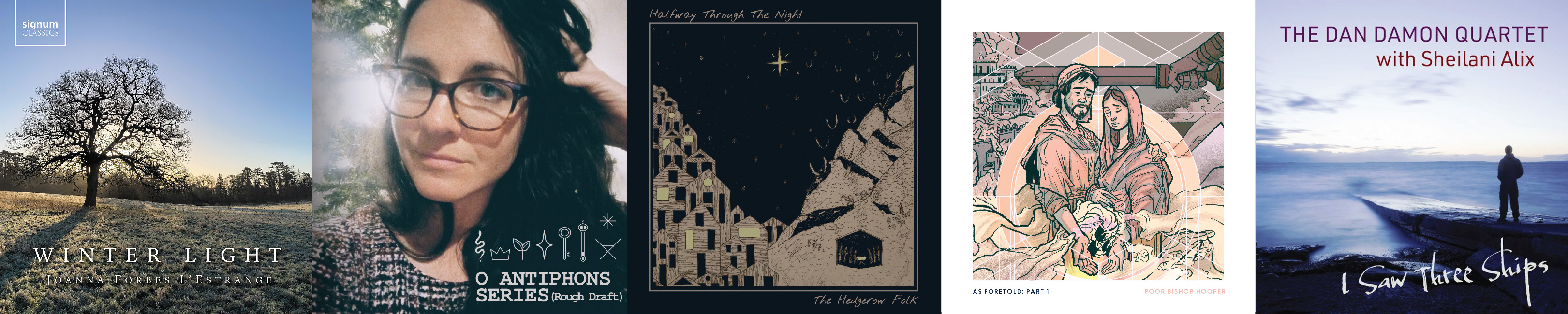
Every fall a number of new holiday albums hit the market. Here are five from this year that I’ve been enjoying. I’ve included one or two sample tracks from each.
A smorgasbord of choral works by the British composer Joanna Forbes L’Estrange, plus a few written or cowritten by her husband, Alexander, and one by her son Harry, all performed by Ben Parry’s London Voices. I learned about this album from Angier Brock, who wrote the anthem text for the title track. One of my favorite pieces is the “Advent ‘O’ Carol,” which I’ll be featuring in a devotional post on December 17. Below is a retune of “In the Bleak Midwinter” (risky, since Holst’s beautiful tune is so iconic, but I love what L’Estrange does with Rossetti’s poem), followed by an original jazzy carol about “The Three Wise Women” of Christmas—Mary, Elizabeth, and Anna.
Elise Massa is a singer-songwriter and music minister currently living in Durham, England, where she works for United Adoration, a global nonprofit that seeks to empower local artists to create music and art rooted in Christ and meaningful to their particular context, culture, and language. This quiet, understated album consists of seven original songs based on the O Antiphons, refrains sung during evening prayer on the seven last days of Advent preceding Christmas Eve. Here’s the first one, “O Wisdom (O Sapientia)”:
Named after a phrase from a C. S. Lewis poem, The Hedgerow Folk is an Alabama-based acoustic Americana trio: Jon Myles, Amanda Hammett, and Bryant Hains. “Halfway through the night” is a through line that weaves through this their first Christmas album as a declaration of hope. My two favorite tracks: their reharmonized rendition of “Lo, How a Rose E’er Blooming,” and their bluegrass arrangement of “Oh Come, Divine Messiah” (which I knew previously only from an a cappella choir of nuns). Also available on vinyl.
As Foretold is a trilogy of albums that takes its subject matter from the prophetic fulfillment passages in Matthew’s Gospel. Part 1, released this week, covers the first two chapters of the book—Jesus’s birth, his flight to Egypt, Herod’s slaughter of innocents, and Jesus’s return to Nazareth. Three of the tracks deal with Joseph’s three dreams—a rarity in music! In his first dream, an angel appears to tell him that Mary is telling the truth, that the son inside her was indeed conceived by the Holy Spirit. In the second dream, treated in the “Out of Egypt” song below, the angel tells Joseph to take his family and flee Bethlehem to Egypt to escape Herod’s wrath, and in the third, the angel informs him it’s safe to return to their homeland.
Poor Bishop Hooper is offering the album for free download from their website! Parts 2 and 3 will release in early 2025.
Daniel Charles Damon is a jazz pianist, hymn writer, and retired Methodist pastor from San Francisco, who also works as associate editor of hymnody at Hope Publishing Company. His latest jazz Christmas album features a combination of classics and originals, including two hymns he wrote both the words and music for (“Like a Child” and “Winter’s Child”); “Hunger Carol” by Shirley Erena Murray (words) and Saya Ojiri (tune), which Damon has freshly arranged; and “Peace Child,” another Murray hymn, for which Damon wrote a tune.
It’s difficult to choose a favorite track, as I love this album through and through! I’ll highlight first the nineties hymn “Peace Child,” a pensive reflection on how Christ comes to us “in the silence of stars, in the violence of wars,” “through the hate and the hurt, through the hunger and dirt.” Second, a lively medieval carol whose Latin refrain, “Id-e-o-o-o, id-e-o-o-o, id-e-o, gloria in excelsis Deo!,” translates to “Therefore, glory to God in the highest!”
The vocalist on the album is the award-winning Sheilani Alix. She is accompanied by Damon on piano, Kurt Ribak on acoustic bass, Carrie Jahde on drums, and Lincoln Adler on tenor saxophone and soprano sax.
If you like this album, be sure to also check out Damon’s 2022 Christmas album, No Obvious Angels.
Psalm 91 (Psalm 90 in the Vulgate) is a psalm of protection, commonly invoked in times of hardship or before embarking on a journey. It conveys the sheltering presence of God, using the metaphor, tender and intimate, of a mother bird who cares for her fledglings, shading them under her wings and lifting them up out of danger. This image recurs throughout the Psalter and the Bible at large (see Pss. 17:8; 36:7; 57:1; 63:7; Exod. 19:4; Deut. 32:11).
Agnes Pelton (American, 1881–1961), The Primal Wing, 1933. Oil on canvas, 25 × 24 in. San Diego Museum of Art, California. Source: Agnes Pelton: Desert Transcendentalist, p. 113.
Let me quote the psalm in full, using the King James Version, whose poetic quality cannot be beat:
1 He that dwelleth in the secret place of the most High shall abide under the shadow of the Almighty.
2 I will say of the Lord, He is my refuge and my fortress: my God; in him will I trust.
3 Surely he shall deliver thee from the snare of the fowler, and from the noisome pestilence.
4 He shall cover thee with his feathers, and under his wings shalt thou trust: his truth shall be thy shield and buckler.
5 Thou shalt not be afraid for the terror by night; nor for the arrow that flieth by day;
6 Nor for the pestilence that walketh in darkness; nor for the destruction that wasteth at noonday.
7 A thousand shall fall at thy side, and ten thousand at thy right hand; but it shall not come nigh thee.
8 Only with thine eyes shalt thou behold and see the reward of the wicked.
9 Because thou hast made the Lord, which is my refuge, even the most High, thy habitation;
10 There shall no evil befall thee, neither shall any plague come nigh thy dwelling.
11 For he shall give his angels charge over thee, to keep thee in all thy ways.
12 They shall bear thee up in their hands, lest thou dash thy foot against a stone.
13 Thou shalt tread upon the lion and adder: the young lion and the dragon shalt thou trample under feet.
14 Because he hath set his love upon me, therefore will I deliver him: I will set him on high, because he hath known my name.
15 He shall call upon me, and I will answer him: I will be with him in trouble; I will deliver him, and honour him.
16 With long life will I satisfy him, and shew him my salvation.
The righteous will be protected, sings the psalmist, from sickness and attack, whether by arrow or by wild animal. Because of the psalm’s specific mention of plagues, or “deadly disease,” it became especially popular during the COVID-19 pandemic.
Now, we know from experience that some of these statements cannot be taken at face value. Physical harm does befall those who love God. Believers were among the “ten thousand” (and more) felled by the most recent raging pestilence. It’s wrong to conclude that this was a result of their lack of faith.
Biblical scholar J. Alec Motyer clarifies that “the promise [in Psalm 91] is not security from but security in.” That God looks after us is an absolute principle, but the Bible makes clear that no one is immune from suffering. Still, we can trust in God’s grace and strength and ultimate deliverance, and entreat him for specific protections. Bodily salvation won’t come in full until the new heavens and the new earth are ushered in, but we are kept spiritually in the shelter of our loving God.
That doesn’t mean Psalm 91 is a lie; it is poetry, and poetic language is often not meant to be literal. The assurances are still worth praying. God does often intervene on our behalf.
The ancient Jewish community at Qumran near the Dead Sea, through whom the oldest manuscript fragments of the Hebrew Bible come to us, referred to Psalm 91 as a “psalm against demons,” and it is thought to have been used by that community in exorcisms. Jewish midrash interprets many of the listed threats as veiled language for demons, and there is Christian precedent for that interpretation as well. In Luke 10:17, Jesus’s followers marvel that “Lord, in your name even the demons submit to us!,” to which Jesus affirms that yes, “I have given you authority to tread on snakes and scorpions and over all the power of the enemy, and nothing will hurt you”—language very similar to that in Psalm 91.
In the Late Antique era, both Jews and Christians wore the words of Psalm 91 on amulets, to attain or simply feel God’s guarding power. In the church it is traditionally sung or recited during Compline services and on the first Sunday of Lent (in Matthew 4:6 the devil manipulatively quotes verse 11 in his temptation of Christ in the desert).
This psalm has also influenced popular culture, as from it comes the concept of guardian angels (vv. 11–12).
Below I have selected fifteen musical settings or adaptations of Psalm 91 from diverse sources, including homophonic and polyphonic choral works, songs in indie folk and soul styles, a Puerto Rican hymn, a Nepali bhajan, and more.
For each I have embedded either a YouTube video or Bandcamp track, and if a Spotify link exists, I’ve included it at the end of the description. If you cannot see these music players in your email client or RSS feed reader, open the post in your browser.
This is a curation, not a collation, meaning that I’ve intentionally picked these songs from among hundreds of options, for both excellence and variety. I tried to limit the list to ten and just couldn’t, but I thought twenty would be too overwhelming, so I compromised by choosing fifteen with five honorable mentions. I’ve added almost all twenty to a YouTube playlist (the Sister Sinjin song isn’t available on that platform), if you prefer to listen that way.
1. Gregorian chant performed by Harpa Dei: Born in Germany and raised in Ecuador, siblings Nikolai, Lucía, Marie-Elisée, and Mirjana Gerstner form the sacred vocal quartet Harpa Dei. Here they sing Psalm 91 in Latin in the medieval plainchant tradition. Subtitles are provided in Spanish and English.
For a plainchant in English, albeit of verses 4–5 only, see here.
2. “Psalm 91” by Victory Boyd: This is probably my favorite of all the selections. Victory Boyd is one of seven musical siblings, and before she started her solo career, she was a member of the vocal-harmony sibling act Infinity Song. Her voice is gorgeous, as is this simple musical setting she wrote, conveying both the vulnerability and confidence present in the psalm.
3. “Psalm 91” by Poor Bishop Hooper: Every Wednesday since January 1, 2020, married couple Jesse and Leah Roberts, who record music under the alias Poor Bishop Hooper, have been releasing a new psalm-based song for free download as part of their EveryPsalm project. Handling them consecutively, they have just eight left to go! They made a live video for “Psalm 91,” which shows them playing their own piano four hands accompaniment. [Spotify]
4. “Qui habitat in adjutorio altissimi” (He who dwells in the shelter of the Most High)by Josquin des Prez, adapted by Laurel MacDonald: Josquin des Prez (pronounced “joss-can day pray”) was a highly influential Franco-Flemish composer of the High Renaissance. In 1542 he wrote a setting of Psalm 91[90]:1–8 in Latin for twenty-four voices (SATB ×6)—that is, six distinct soprano parts, six distinct alto parts, etc.
Inspired by this choral motet, in 2007 composer and video artist Laurel MacDonald worked with longtime associate John Oswald to create qui, a sound installation of twenty-nine voices singing an adaptation of des Prez’s “Qui habitat” in twenty-nine languages over twenty-nine speakers, for the Royal Ontario Museum in Toronto. MacDonald revisited the project in 2010, creating the short video “XXIX” (below) with twenty-one of the original qui singers, each singing in the language of his or her personal heritage. They weave a complex tapestry with interlocking threads of Krio, Spanish, Korean, Hungarian, Hindi, Greek, Finnish, English, French, Italian, Latin, Zulu, Xhosa, Sesotho, Georgian, Russian, English, Tamil, Hebrew, Swahili, Japanese, and Arabic—a multilingual declaration of God’s protective power.
To hear Josquin des Prez’s motet as originally conceived, click here.
5. “Your Wings” by Lauren Daigle: Lauren Daigle is one of the most popular CCM (contemporary Christian music) artists of the past decade. Two-time-Grammy-winning and with two platinum records, she is often compared to Adele in terms of her vocal style—soulful, rich, in a husky register. In April 2020 she released on YouTube a stripped-down, “social distancing” version of her Psalm 91–based song (written with Jason Ingram and Paul Mabury) from Look Up Child, with just her and a piano. You can get a sense of her strong stage presence from the video; here she hits the melody with both her voice and her body—bouncy on the verses, smooth on the refrain! [Spotify (studio version)]
6. “Whomsoever Dwells” by Sinéad O’Connor: “Whomsoever Dwells,” written with Ron Tomlinson, is one of nine Hebrew Bible–based songs that appears on Sinéad O’Connor’s stellar 2007 double album, Theology. (Thanks to Art & Theology reader Koen Desmecht for introducing me to this!) The acoustic performance below—from November 8, 2006, at The Sugar Club in Dublin—was released on disc one, subtitled “The Dublin Sessions,” and features guitars, fiddle, harp, and low whistle; the same song, arranged for a pop-rock band and recorded in a London studio, is on disc two. (I much prefer the acoustic version.)
“Theology is an attempt to create a place of peace in a time of war and to provoke thought,” O’Connor said. It is very “personal” and “emotional.”
7. “El que habita al abrigo de Dios” (Those Who Dwell in the Shelter of God) by Luz Ester Ríos de Cunaand Rafael Cuna: This 1943 hymn from Puerto Rico is a versification of Psalm 91 in Spanish by Luz Ester Ríos de Cuna, with music by her husband, Rafael Cuna (1907–1995). I learned of it from the bilingual hymnal Santo Santo Santo: Cantos para el pueblo de Dios (Holy, Holy, Holy: Songs for the People of God). Here it’s performed by musicians from Iglesia Central del Movimiento Misionero Mundial en el Perú (Central Church of the World Missionary Movement in Peru) in Lima. Their names are not given.
8. “Denn er hat seinen Engeln befohlen” (For he shall give his angels charge),MWV B 53by Felix Mendelssohn: Early Romantic composer Felix Mendelssohn, a Reformed Christian with Jewish ancestry, wrote this setting of Psalm 91:11–12 in German in 1844 for Berlin Cathedral, where he was serving as Generalmusikdirektor (royal composer of church music). It is for an unaccompanied eight-part choir, but he later reused it with orchestral accompaniment as movement 7 of his oratorio Elijah.
9. “No Harm Befall You (Psalm 91)” by Sister Sinjin: Released on the 2022 compilation album Joy to the World (Psalms 90–106) from Cardiphonia Music, “No Harm Befall You” was written by Elizabeth Duffy and is sung by her and Kaitlyn Ferry, who make up the Indianapolis folk duo Sister Sinjin. Their harmonies are a hallmark of their music.
10. “Psalm 91” by Sharyn:Sharyn (pronounced “sha-REEN”) is a Ugandan-born, London-based gospel/R&B singer-songwriter “whose mission is to spread the gospel through adventurous, original, and engaging music,” she says. She wrote “Psalm 91” during the height of the coronavirus, as that scripture passage is one she would read again and again as a source of comfort amid the uncertainty. “This song is an affirmation and a reminder of who God is, what He can do, will do and has done,” she says. “Never forget that God is faithful and his promises are the greatest form of protection we can ever have. His promises are your armor and shield.” The recording features Calibleubird on backing vocals. [Spotify]
11. “Shelter Me” by Buddy Miller: In a 2010 episode of PBS’s Soundstage, country-rock artist Buddy Miller performed a set with other Americana greats Emmylou Harris, Shawn Colvin, and Patty Griffin, including this original song (written with Julie Miller) from his 2004 album Universal United House of Prayer. “Shelter Me” is about not being scared in the face of disaster or war, for God is our hiding place. The song could apply to Psalm 57 just as well, which addresses the same themes as Psalm 91 and even uses the same language of sheltering under the wings of the Almighty. [Spotify (studio version)]
12. “Underneath the Shadow” by Tom Wuest: This is one of twelve quiet, sparsely instrumented songs that Tom Wuest recorded with his wife, Karen, which were written as their two young sons fell asleep. They all “draw their lyrics from the psalms and from our family’s joy in and meditation upon the good creation of God,” he says. Fitting indeed for meditation, “Underneath the Shadow” comprises just three simple lines: “Underneath the shadow of Your wings / We dwell underneath the shadow of Your wings / Hidden close to Thee, we find rest.” [Spotify]
13. “Mero Saransthaan (My Shelter)” by Suraj Khadka: A Nepali adaptation of Psalm 91, this bhajan (devotional song) from 2021 features traditional instruments from the Indian subcontinent: sarangi (vertical fiddle), bansuri (bamboo flute), and dholak, madal, and tabla (drums). Thanks to Dr. Paul Neeley at Global Christian Worship for alerting me to this one.
14. “Lang en gelukkig (Psalm 91)” (Long and Happy) by Psalmen voor Nu: Founded in 2002, Psalmen voor Nu (Psalms for Now) was a project in the Netherlands to set all 149 psalms (they combined Psalms 42 and 43) in Dutch to music, a task they completed in 2014 with the release of their eleventh album. Seeking “to introduce as many people as possible to the beauty and power of the psalms,” the team comprised some twenty theologians, poets, and composers, plus a band. They wanted the texts to be understandable and the melodies modern and singable. This particular song from the project was written by Liesbeth Goedbloed (words) and Roeland Smith (music) and released in 2013. It has a smoky nightclub vibe. I’ve copied the lyrics below. [Spotify]
[1] Als je bij de Allerhoogste woont, mag je in zijn schaduw slapen. Als je zegt: ‘De Hoogste is mijn huis. mijn God, ik kan op u vertrouwen’, dan mag je in zijn schaduw slapen.
[2] Het is God die jou bevrijdt van de dood, de zwarte dood. Hij dekt je met zijn vleugels toe. Ga maar slapen. Je bent moe. Zijn trouw zal jou beschermen. Dan kun je slapen, dan kun je slapen. God waakt over jou. Dan kun je slapen.
[3] Voor de angst die elke avond komt, hoef je niet meer bang te wezen, ook al spookt de zwarte dood weer rond, al sloopt een ziekte alle mensen, jij hoeft niet meer bang te wezen.
[4] Ook al komt de dood dichtbij, vallen duizend mensen om, toch zul jij altijd veilig zijn wat de rest ook overkomt en slechte mensen krijgen, durf je te kijken, durf je te kijken? hun verdiende loon. Durf je te kijken?
[5] Jij zei ooit: ‘Mijn God, u bent mijn huis. Geen ziekte komt de drempel over.’ Die ellende gaat je deur voorbij, sinds je dicht bij God ging wonen. Geen ziekte komt je drempel over.
[6] Zijn engelen staan klaar. Ze dragen je op handen. God stuurt ze met je mee. Je stoot je nergens aan. De leeuw, de draak, de adder jij loopt over ze heen.
[7] Want je houdt van mij, zegt God, en die liefde maakt je vrij. Ik dek je met mijn vleugels toe, omdat jij weet wie ik ben. Je kent mijn naam en roept me. Ik kom je redden, ik kom je redden. En ik antwoord jou: ik kom je redden.
[8] In de zwartste nacht blijft ik bij jou. Ik red je en ik geef je leven. Deze keer is alle eer voor jou. Ik zeg: Ik ben voor jou een zegen! Voor jou een lang gelukkig leven!
[Outro] Lang en gelukkig, lang zul je leven, lang zul je leven, lang en gelukkig, lang zul je le ven! [source]
15. “In Him I Will Trust” by Sherri Youngward: Covering Psalm 91:1–5, this is one of sixteen psalm-passage settings by Bay Area singer-songwriter Sherri Youngward. For more, see her two Scripture Songs albums.
If you appreciated this post and would like to see more like it in the future, please consider donating to my work. If you do, leave a note telling me which psalm you’d like me to do next!
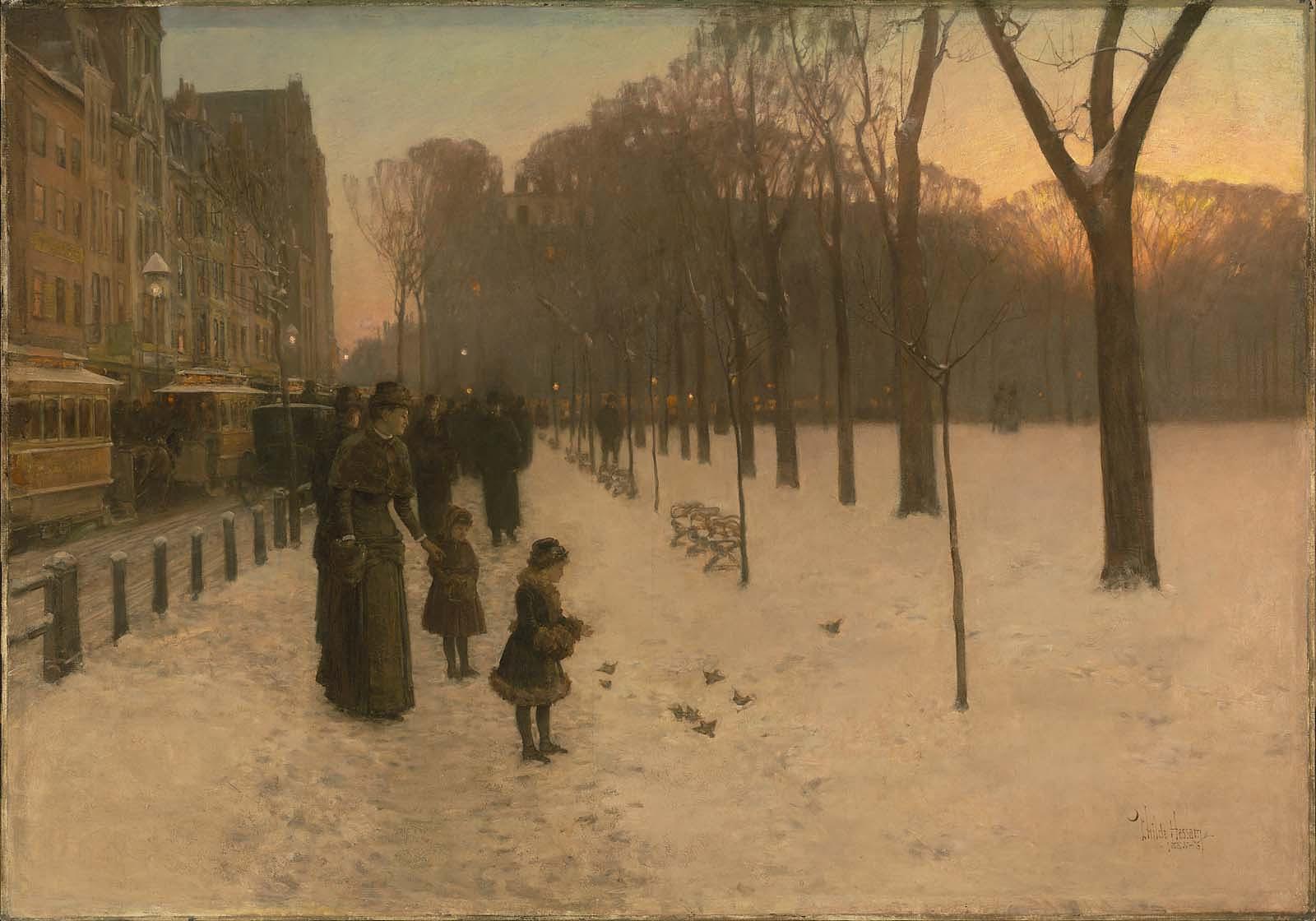
LOOK: At Dusk (Boston Common at Twilight) by Childe Hassam
Childe Hassam (American, 1859–1935), At Dusk (Boston Common at Twilight), 1885–86. Oil on canvas, 42 × 60 in. (106.9 × 152.4 cm). Museum of Fine Arts, Boston.
LISTEN: “Psalm 25” by Poor Bishop Hooper, 2020 [free download]
Nobody who waits for you will see disgrace Teach me all your righteous paths Make known your ways to me, Lord
Lead me by your truth, my God And teach me now I’ll wait for you the whole day long You are the God of my salvation
You’ve shown your love from ages past It existed from antiquity through history Forgotten of my sinful youth For your goodness, God My eyes are always on you
Jesse and Leah Roberts, whose musical alias is Poor Bishop Hooper, adapted Psalm 25:3–7, 15 last year as part of their EveryPsalm project, an initiative to release one original psalm-based song every Wednesday. They are currently up to Psalm 100.
I’ve paired the song with a painting by turn-of-the-century American Impressionist Childe Hassam, of a rosy dusk on the outskirts of the central park in downtown Boston. The sun is descending behind the elm trees, the gaslights have been lit, and the ground is blanketed in snow. On Tremont Street on the left, trolley cars and carriages wheel busily past, while on the adjacent walkway a mother and her two young daughters have stopped to feed the birds.
Moodwise, the painting and song complement each other, the twinkling of Roberts’s piano corresponding to the play of pink light on Hassam’s canvas—and both bespeaking God’s goodness. I present the image here as an invitation to, like this family, find moments of quiet enjoyment and reflection amid the bustle of December.
The scene evokes warm memories for me, as my husband and I, then newlyweds, walked this path every Sunday to church for the five years we lived in Boston. Ten minutes from Park Street Station to the hotel where our congregation met, crunching through the snow in our insulated boots in wintertime, the natural sights and sounds of the Common preparing us for worship.
NEW PLAYLIST: October 2021 (Art & Theology): This month’s playlist includes a benediction from the book of Jude; a percussion-driven setting of Francis of Assisi’s “Canticle of the Sun” by the Camaldolese monk Cyprian Consiglio; an Exodus-inspired song in Yorta Yorta, an indigenous Australian language, from the feature film The Sapphires; “Prodigal Son,” a little-known hymn by John Newton, from The Sacred Harp; a sixties gospel song by Shirley Ann Lee (famously covered by Liz Vice on her debut album); and closing out, in anticipation of All Saints’ Day on November 1, the jazz standard “When the Saints Go Marching In.” To save the playlist to your Spotify account, click the ellipsis and select “Add to Your Library.”
+++
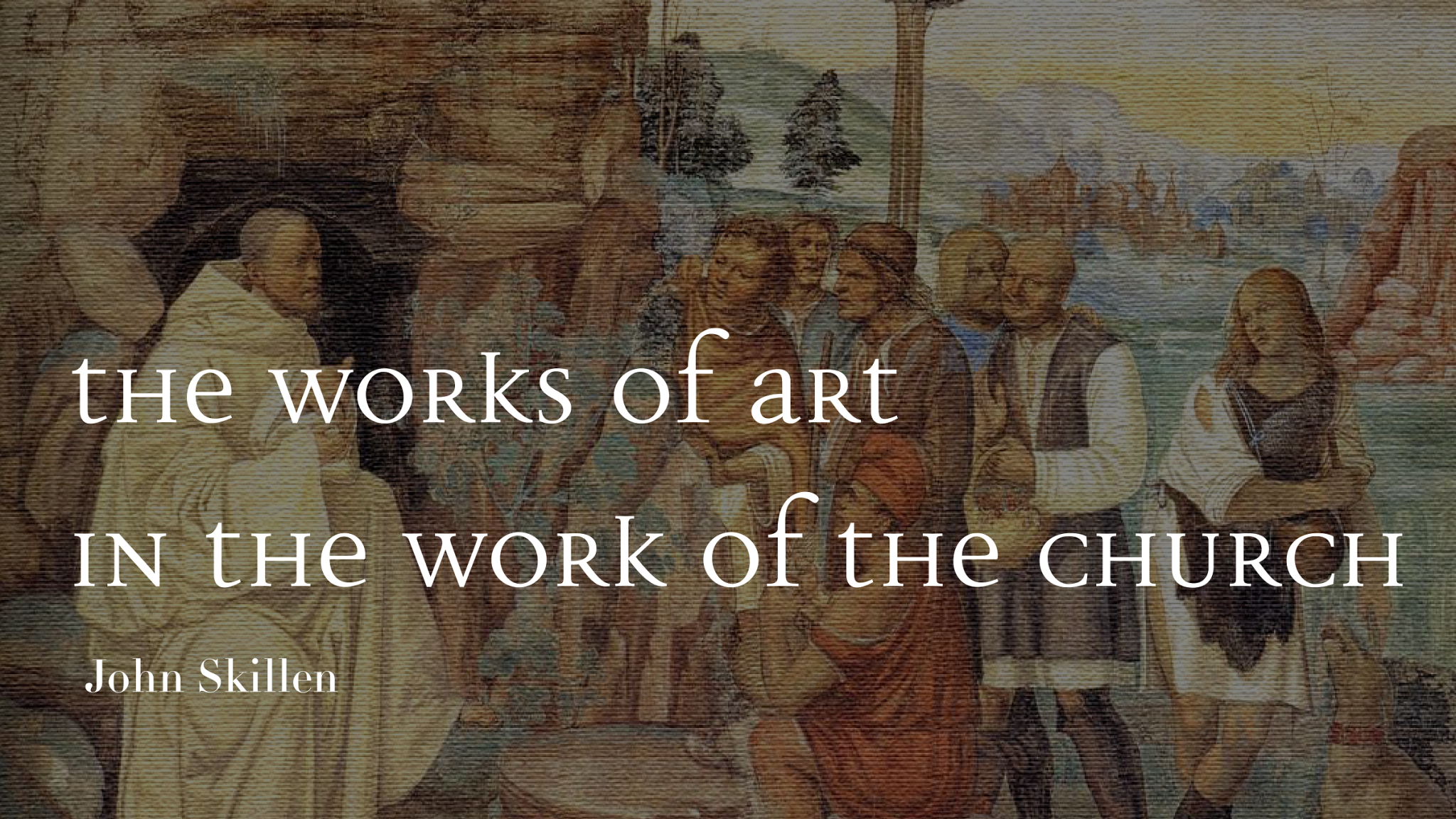
IN-PERSON LECTURE: “The Works of Art in the Work of the Church” by John Skillen, October 16, 2021, Crownsville, MD: The Eliot Society, an organization I work for, is hosting our first event in over a year and a half! It’s an art talk by Dr. John Skillen [previously], director of the Studio for Art, Faith & History in Orvieto, Italy. It will be at the home of two of our board members, so if you’re in the Washington–Baltimore metropolitan area two weekends from now, consider coming by! The event starts with hors d’oeuvres at 6:30 p.m., and an RSVP is requested.
In recent decades, a growing number of Christians—even those from church traditions formerly suspicious of the arts—are warming up to the idea that artworks can serve in the various practices of the life of faith, and not only in iconographic form as images of Jesus in worship. Scripturally sound and aesthetically sophisticated works of art can guide our prayer, help catechize our children, and shape the environments of our missional work. Many of us will welcome some pointers for putting art back in its place in the settings where we live and work.
To help us imagine possibilities, John Skillen will offer examples from a long period of Christian history when the arts were put to work in the collective life of the church in more places and in more ways than most of us nowadays can imagine. Not only churches but also hospitals, orphanages, the meeting rooms of parachurch organizations, baptisteries and bell towers, dining halls and cloisters in monasteries, town halls and civic fountains and public squares—all were places of serious decoration and design expected to be compatible with Christian faith.
No sphere of religious and civic life was off-limits for imagery able to instruct, to prompt memory, and to inspire emotion and action—the three functions of art most commonly cited during the Middle Ages to defend its value.
+++
UPCOMING ONLINE CONVERSATIONS:
Marc Padeu (Cameroonian, 1990–), Le souper a Penja, 2019. Acrylic on canvas, 82 7/10 × 106 3/10 in. (210 × 270 cm).
>> “Caravaggio in Cameroon: Marc Padeu and Jennifer Sliwka in Conversation,” October 14, 2021,11 a.m. EST (4 p.m. BST): I spoke about Padeu’s Le souper a Penja at a recent seminar on “Picturing Jesus,” so I’m looking forward to hearing the artist himself discuss it along with the larger body of work it’s a part of. Hosted by the National Gallery in London.
Artist Marc Padeu lives and works in Cameroon. Intriguingly, his monumental paintings – exploring tender and complex relationships between family, friends, lovers and working communities – often draw on Italian Baroque compositions and especially those of Caravaggio.
Marc Padeu joins Dr Jennifer Sliwka, specialist in Italian Renaissance and Baroque art. Her research explores how 17th-century painters developed innovative approaches to religious painting, imbuing their works with an immediacy, power, and dynamism.
Together, the speakers will take Padeu’s Le Souper a Penja and its relationship to Caravaggio’s Supper at Emmaus as a jumping-off point for conversation, exploring Padeu’s wider interest and understanding of historical works, his adoption and adaptation of the visual language of the Baroque and how these inform his evocations of contemporary life in Cameroon.
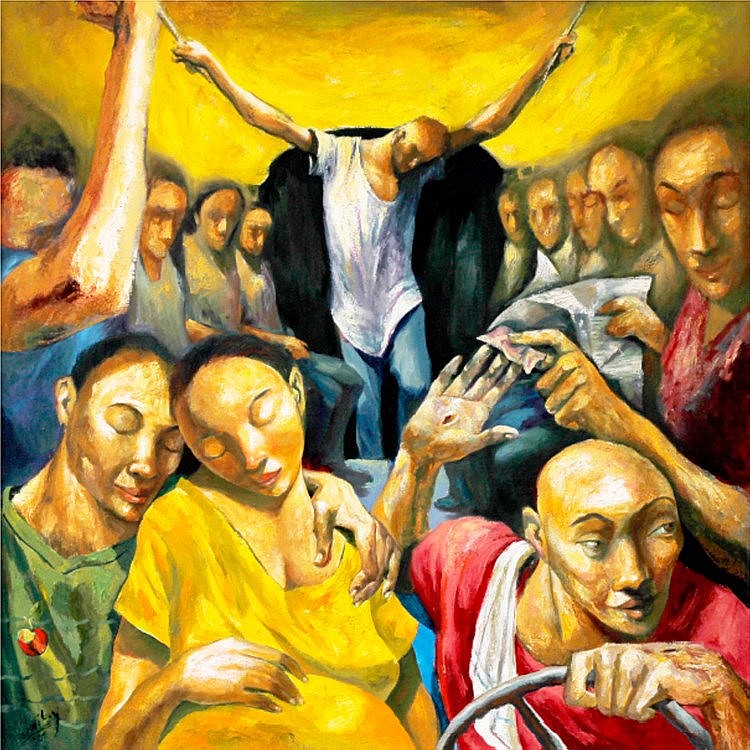
>> “In the Studio with Emmanuel Garibay,” November 11, 2021, 8:30 a.m. EST: The Overseas Ministries Study Center at Princeton Theological Seminary is hosting a conversation with Filipino artist Emmanuel “Manny” Garibay, a social realist painter who served as the 2010–2011 OMSC artist in residence. “It is the richness of the poor that I am drawn to and which I am a part of, that I want to impart,” he says. His paintings often portray Jesus among the marginalized and dispossessed and critique the church’s “compliance with greed, corruption, and social inequality.” Garibay’s children Alee, Nina, and Bam, who are also accomplished artists, will be present for the conversation as well. For more on Garibay, see this Q&A from the OMSC and the Image journal essay “Recognizing the Stranger: The Art of Emmanuel Garibay” by Rod Pattenden.
Emmanuel Garibay (Filipino, 1962–), Kaganapan, 2006. Oil on canvas, 48 × 48 in. (122 × 122 cm).
>> “Psalm 91” by Poor Bishop Hooper, released as part of the EveryPsalm project, through which the duo offers original weekly Psalm-based songs for free download:
EVERYPSALM: Over the next three years, indie-folk duo Poor Bishop Hooper (whom I blurbed here) will be writing and releasing one biblical psalm setting per week, sequentially from Psalm 1 to Psalm 150. And they are very graciously making all these songs available to download for free! They’ve already released the first three, and I’ve been thoroughly enjoying them. To sign up to receive a weekly download link in your inbox, visit https://www.everypsalm.com/. You may also want to consider giving to the project.
+++
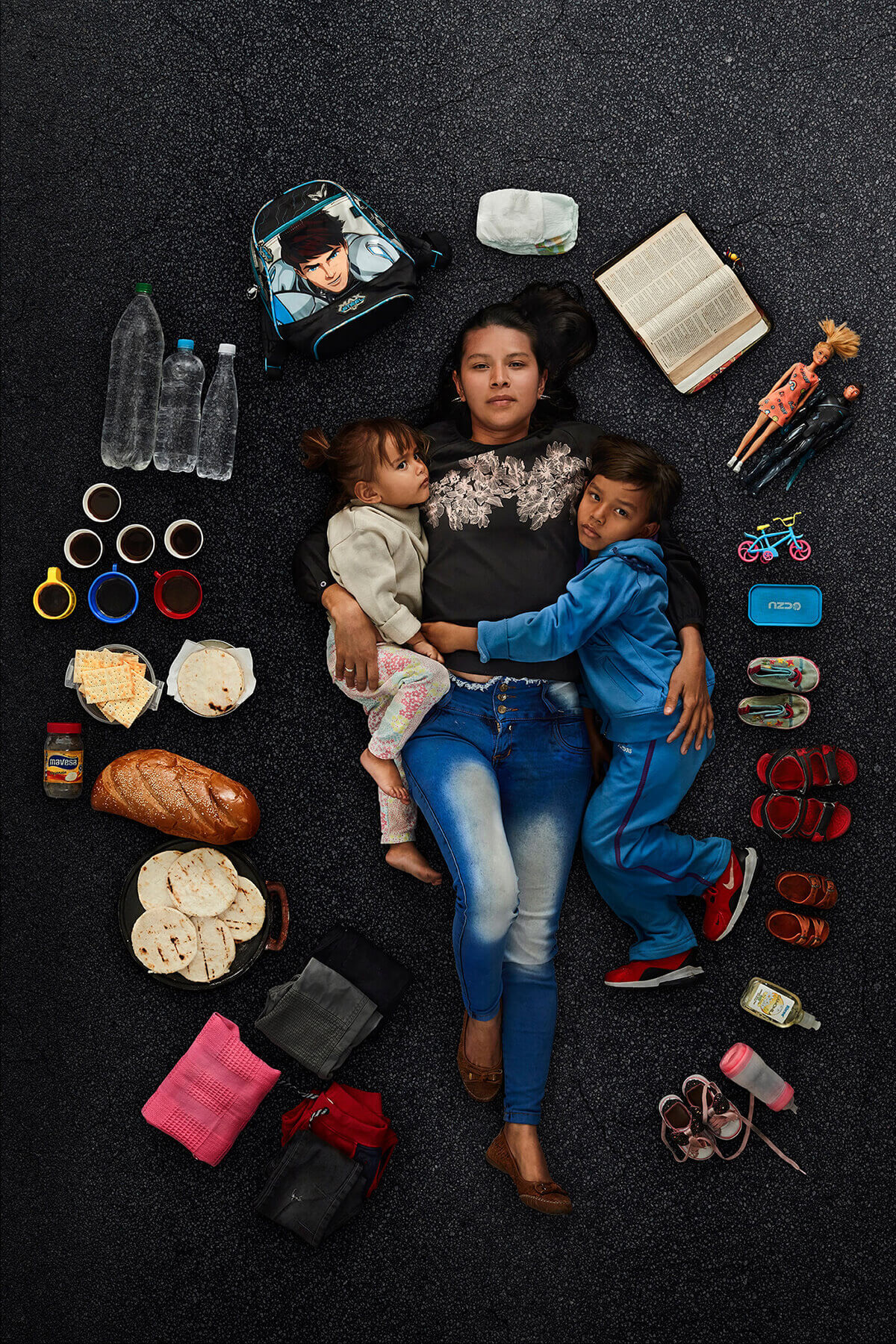
PHOTO SERIES: Un-Daily Bread by Gregg Segal: For his latest project, US-based photographer Gregg Segal has been photographing Venezuelan immigrants with the entirety of their belongings lying around them. According to the United Nations High Commissioner for Refugees (UNHCR), an organization that Segal is collaborating with, the number of people in Venezuela forced to leave their homes due to violence, insecurity, threats, and/or lack of essential services keeps increasing, with more than 4.6 million refugees and migrants from the country living around the world, mostly in South America. In the photograph below, you can see a young mother and her two children surrounded by a few changes of clothes, a doll, a baby bottle, medicine, diapers, arepas, and a Bible. The three traveled over six hundred miles from Maracaibo to Bogotá, hitching rides and catching buses.
Alesia, Arianny, and Lucas, Colombia, 2019. Photo by Gregg Segal, from his Un-Daily Bread series.
Un-Daily Bread it is an offshoot of Segal’s Daily Bread series, in which he photographed images of kids from around the world surrounded by what they eat each day.
+++
LITURGY: Impelled by the various antagonisms that have been on the rise both domestically and abroad, Aaron Niequist has written and compiled a ten-page Liturgy for Peacemakers, which includes a call to worship, two songs, a confession of sin and assurance of pardon, scripture readings, and prayers, including one minute of holy space each to pray for a global enemy, a local enemy, and a personal enemy. The liturgy, which focuses on shaping us to be instruments of God’s peace in the world, is free for you to use in your living rooms and/or churches, and to adapt in any way you wish.
+++
EXHIBITION: Andy Warhol: Revelation, October 20, 2019–February 16, 2020, Andy Warhol Museum, Pittsburgh: Ever since reading Jane Daggett Dillenberger’s illuminating book The Religious Art of Andy Warhol(1998), I’ve been interested to explore more deeply the Byzantine Catholicism of Andy Warhol and how it influenced his art. (I was surprised to learn, for example, that although he had a complicated relationship with Christianity, Warhol regularly attended Mass, wore a cross around his neck, carried a pocket missal and rosary, and prayed daily with his mother in Old Slavonic over the forty years he lived with her.) A pioneer of the pop art movement best known for his silkscreen prints of Marilyn Monroe and Campbell’s soup cans, Warhol also made giant cross paintings as well as screen prints of famous Renaissance religious paintings in full or in detail (by Piero della Francesca, Raphael, and Leonardo da Vinci)—especially The Last Supper, his last and largest series. Jesus is surely a part of American pop culture, so Warhol’s use of such imagery is not all that unusual in light of his larger oeuvre. But is there anything more to this choice of subject?
Andy Warhol (American, 1928–1987), The Last Supper, 1986. Acrylic and silkscreen ink on linen, 78 × 306 in. (198.1 × 777.2 cm). Andy Warhol Museum, Pittsburgh.
Andy Warhol (American, 1928–1987), Cross (Red), 1982. Synthetic polymer paint and silkscreen on canvas, 90 × 70 in. (228.6 × 177.8 cm). Andy Warhol Museum, Pittsburgh.
I’ll be driving to Pittsburgh next weekend, where Warhol grew up, to see an exhibition of his religious works curated by José Carlos Diaz from the Andy Warhol Museum’s permanent collection. I’ll also be attending a lecture at the museum given by Jonathan A. Anderson, titled “Religion in an Age of Mass Media: Andy Warhol’s Catholicism.” (It’s January 25 at 6 p.m. Update: Watch the lecture on YouTube.) In and around Pittsburgh is also where Fred Rogers (of Mister Rogers’ Neighborhood fame) spent most of his life, so I’ll be visiting a few key spots related to him as well!
+++
EXHIBITION: Scott Avett: INVISIBLE, October 12, 2019–February 2, 2020, North Carolina Museum of Art, Raleigh: “Internationally recognized as co-founder of the band The Avett Brothers, Scott Avett has been a working artist, focusing on painting and printmaking, since he earned a BFA in studio art from East Carolina University in 2000. But until now this art-making part of his life has been a secret and a more solitary creative pursuit in comparison to his life as a musician, singer, and songwriter. This solo exhibition features Avett’s large-scale oil paintings. These are psychologically charged and emotionally intense portraits focused on his family and himself—often intimate, vulnerable, and sometimes uncomfortably truthful portrayals. Like his songs, Avett’s paintings speak to universal issues of spirituality and struggle, love and loss, heartache and joy, as well as more personal stories of career, family, and living in the South.”
As an Avett Brothers fan, I made it a point to see this exhibition in December when I was visiting family for Christmas, and actually, it exceeded my expectations. It was endearing to see portraits of Avett’s three children tumbling around, swinging, engaged in deep thought at the dinner table, playacting as monsters, wailing—and he and his wife in the middle of it all, experiencing both the joys and stresses of parenting. My favorite pieces were probably the companion paintings Motherhood and Fatherhood, which show the messiness of those callings.
Scott Avett (American, 1976–): Motherhood (2012); Fatherhood (2013). Oil on canvas, 106 × 65 in. each. Photo: Victoria Emily Jones.
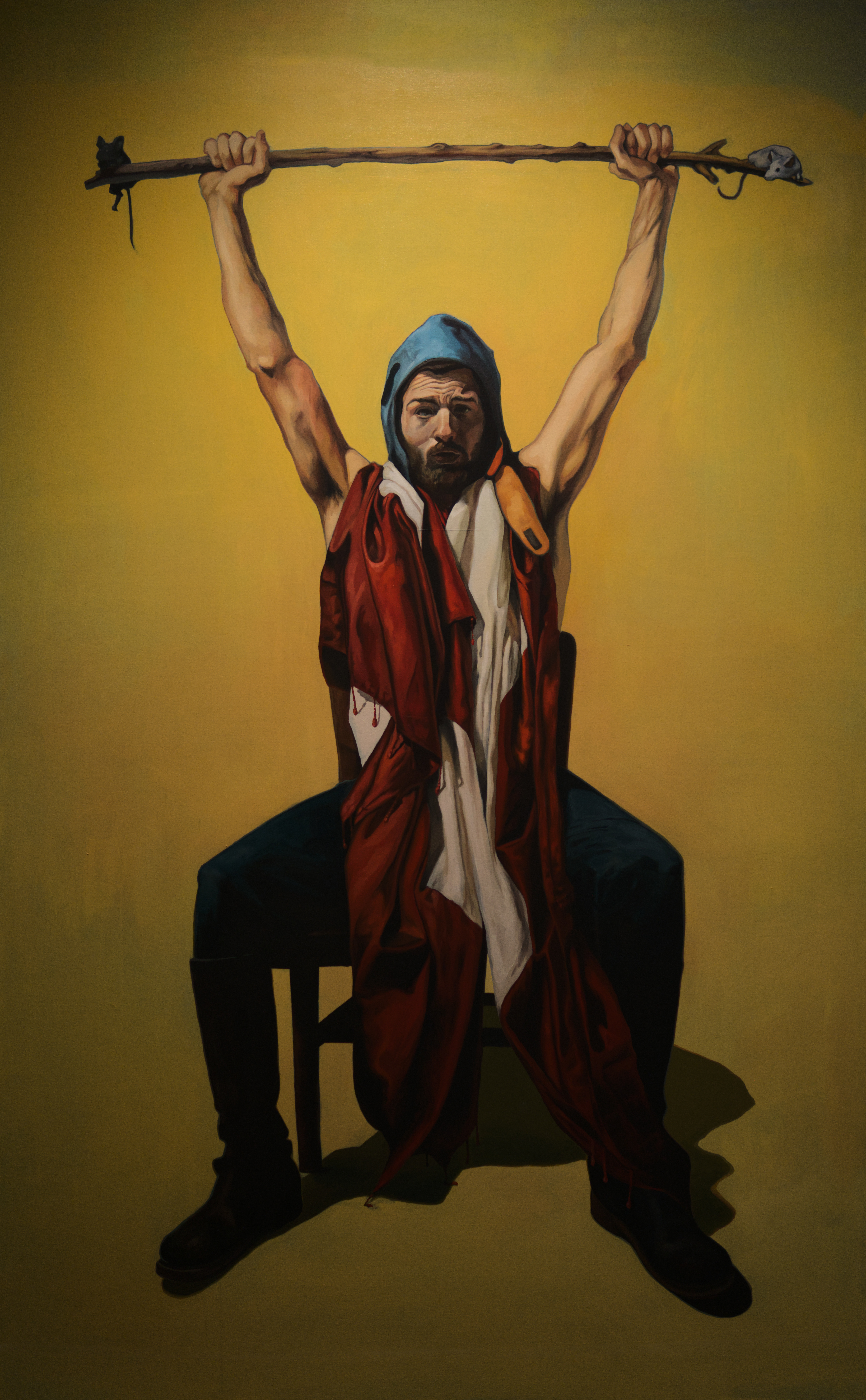
Fatherhood is one of several self-portraits in the show. The one that’s most prominently displayed, right at the entrance, is Black Mouse, White Mouse, which references Leo Tolstoy’s personal essay “A Confession,” about an existential crisis. In it Tolstoy recounts a fable of a man who falls into a well with a dragon at the bottom. On his way down he grabs hold of a branch growing out of the wall, but it’s being nibbled by two mice, and his fall to death is imminent. This scenario is representative of where we all find ourselves: finite beings in an infinite world, dangling over the abyss. There are four possible ways to respond, says Tolstoy: ignorance, epicureanism, suicide, or hanging on to life. He thinks suicide the most logical but says he lacks the nerve to carry it out.
Tolstoy then launches into metaphysical musings, grappling with the question of God’s existence, when suddenly, he has an epiphany that “God is Life,” and that “I live, really live, only when I feel Him and seek Him.” He continues, “I returned to the belief in that Will which produced me and desires something of me. I returned to the belief that the chief and only aim of my life is to be better, i.e. to live in accord with that Will. And I returned . . . to a belief in God . . .”
Scott Avett (American, 1976–), Black Mouse, White Mouse, 2010. Oil on canvas, 106 × 65 in. Photo: Victoria Emily Jones.
Avett’s spirituality isn’t overt in any of the paintings, but it’s been interesting to hear him open up more about that aspect of himself in artist talks and interviews. In an October talk, for example, he said, “I’m a true believer that every single one of us is a beloved son or daughter of God, period. I know that for certain. And because of that, this [pointing to himself] isn’t the only bright shining person in this room. It’s insane how true that is. . . . I’ve just always lived like that—like someone was watching. It was God the whole time; he was right there with me and in me, the whole time. When I was younger it was so much easier to access that. And now growing older, it’s about opening up to access that again.”
SONG: “Offertory” by John Ness Beck, performed by Future:Past: Micah 6:8 has, for me, functioned as what some would call a “life verse”: a guiding principle that I return to again and again to reorient myself to the divine will. I long to be the kind of person the verse describes: one who does justice, loves mercy, and walks humbly with God. Thanks to Paul Neeley at Global Christian Worship, I’ve just been made aware of a beautiful musical setting of this passage, which happens to be one of the Revised Common Lectionary readings for February 2 this year.
“With what shall I come before the LORD,
and bow myself before God on high?
Shall I come before him with burnt offerings,
with calves a year old?
Will the LORD be pleased with thousands of rams,
with ten thousands of rivers of oil?
Shall I give my firstborn for my transgression,
the fruit of my body for the sin of my soul?”
He has told you, O man, what is good;
and what does the LORD require of you but to do justice, and to love kindness, and to walk humbly with your God?
—Micah 6:6–8
The music was composed in the second half of the twentieth century by John Ness Beck and was adapted for TTBB (tenor-tenor-bass-bass) by Craig Courtney—performed here a cappella by Josh Adams, Davis Gibson, Jon Kok, and Matthew Reiskytl of the Christian music and media ministry Future:Past. To purchase sheet music for “Offertory” (available in SATB, SSA, and TTBB voicings, with keyboard and optional string quartet), click here.
ADVENT RESOURCES: Advent is just over a month away, and once again, SALT Project [previously] has produced some wonderful new devotional resources: (1) a customizable “Say Yes!” video for churches (see below), (2) a set of five unique “Say Yes” placements in three different color schemes, including black-and-white to be colored in by you and/or your family (note: these are sold as a digital download, so you will have to print and laminate them yourself), and (3) “Advent and Hygge: The Art of Coziness,” five devotional table tents, one for each week of Advent and a fifth for Christmas Eve/Day (promo video below).
“The Porter’s Gate is a sacred ecumenical arts collective reimagining and recreating worship that welcomes, reflects and impacts both the community and the church. The group was founded in 2017 by Isaac and Megan Wardell with a mission to be a ‘porter’ for the Christian church—one who looks beyond church doors for guests to welcome. It started as a group of 50-plus songwriters, musicians, scholars, pastors and music industry professionals from a variety of worship traditions and cultural backgrounds who gathered to discuss challenges in the church and write songs in response.”
+++
ARTICLE: “The Best Christian Albums of the 2010s”: Three of my choices for top Christian albums of the decade were selected for this Gospel Coalition article—and I got to write about them! Liz Vice (whom I saw in concert this year), Psallos, and Poor Bishop Hooper are creating excellent, exciting, soul-nourishing music that every Christian should know about; these albums of theirs that I’ve blurbed make a good entryway into their fuller body of work.
+++
POETRY COLUMN: “Poetry Rx,”The Paris Review: Launched in March 2018, “Poetry Rx” is a column in which “readers write in with a specific emotion, and our resident poets—Sarah Kay, Kaveh Akbar, and Claire Schwartz—take turns prescribing the perfect poems to match.” Some letter writers need hope or forgiveness; others, self-motivation or courage. Others want to feel love, or want to know how to express immense gratitude, or joy. Schwartz writes, “When I sit down to answer these letters, I often find myself reflecting on the purpose of my response. What should the poem offer? Challenge? Company? Direction? Language for an old feeling? A way toward new possibility?”
I’ve so appreciated not only the prescribed poetry but also the vulnerability of the letter writers, who present complex cocktails of feelings that show the multifariousness of being human. For example, the September 5 write-ins were: someone who is terrified of forgetting little pieces of a loved one who has died; a college student experiencing a growing apart from her childhood BFF and who is therefore lamenting the loss of “the magic that is young female friendship”; and a novelist who is hurt that her boyfriend and mother are not interested in reading her latest book (“I am destroyed that those who urged me to chase my dreams now cannot be bothered to witness them. . . . Do you have a poem for me that can ease the loneliness of being a writer? Of creating a world that those you love will not step into?”). How to be optimistic for your partner, how to work through feelings of restlessness, how to deal with a loved one’s addiction, how to manage the inevitable losses inherent to the medical profession, how to navigate the disorientation following a loss of faith, how to make last an ecstatic moment in nature, how to persevere as a schoolteacher who is pouring all her intellectual passion into a seeming void (bored students)—these are all situations for which poetic wisdom or solace is sought.
One woman wrote in looking for a poem “for a mother’s love.” (“My love for my daughter sometimes feels terrible and desperate and weighty with responsibility. But also sweet and tender and silly.”) Kay prescribed “Saying Our Names” by Marianne Murphy Zarzana, which begins,
Notice how just one syllable—
say Jack—can expand and become
the world, round and whole,
when it is a child’s name
being formed by a mother’s mouth.
For someone who is “unfamiliar with the geography of joy” and wants to learn how to navigate that space, Akbar recommends “So Much Happiness” by Naomi Shihab Nye, which begins,
It is difficult to know what to do with so much happiness.
With sadness there is something to rub against,
a wound to tend with lotion and cloth.
When the world falls in around you, you have pieces to pick up,
something to hold in your hands, like ticket stubs or change.
i pledge allegiance to my
homies to my mother’s
small & cool palms to
the gap between my brother’s
two front teeth & to
my grandmother’s good brown
hands good strong brown
hands gathering my bare feet
in her lap
Introducing the column, the “doctors” wrote,
No, I don’t think that poetry will save us. And yet, and yet . . . The “and yet” is what this column is for. And yet, maybe we can find poems that vibrate at the same frequency that your heart is humming. And yet, maybe we can find a poem you can escape inside of for a few minutes. And yet, maybe you just needed an excuse to share the vulnerable parts of yourself, and what better way to honor that courage than to offer you the poems that carry us through our own vulnerable times.
If you’re feeling something that you want to see reflected back to you in poetry or through which you want poetry to guide you, write in!
+++
TV SERIES: Civilizations: Released last year and available on Netflix, Civilizations is a global art history series in nine episodes that “examine[s] the formative role of art and the creative imagination in the forging of humanity.” It expands on Kenneth Clark’s 1969 landmark series, Civilisation, which was criticized for covering only Western art history. Its three presenters are Simon Schama, Mary Beard, and David Olusoga.
As with any project of this scope, criticisms are bound to arise (several are mentioned, for example, in the mixed review from Hyperallergic), especially in how cultural interaction and exchange are discussed. But this focus on said interactions is, in my opinion, a hallmark of the series, and I think it was handled well overall. Rather than showing cultural production happening all over the globe in isolated pockets, it shows a mutual influencing in various directions. Episode 4, “Encounters,” is particularly dedicated to this theme, though it recurs throughout. Narrator Liev Schreiber opens that episode:
From the moment they meet, civilizations begin to influence one another’s art. During the 15th century, European sailors embarked on a new age of exploration. Cultures that previously were vast oceans apart now met for the first time. But before this became a story of conquest, plunder, and empire, there was a forgotten era of discovery. And for many, this was a golden age, when curiosity, mutual respect, and the exchange of goods and ideas were recorded in the art of countless human encounters.
So yes, you can see from this quote that the series does tend toward Westocentrism—but given that it was produced by Nutopia for PBS and BBC, I’d say that was unavoidable. This episode highlights, among many other artworks, Benin bronzes from what is today Nigeria (whose artists acquired their raw materials from Muslim merchants crossing the Sahara and, later, the Portuguese); namban screens from feudal Japan; the folk art associated with Day of the Dead in Mexico (a fusion of Aztec beliefs and Catholicism), as well as the Aztec influence on the gory religious art of the Spanish Baroque; and zoological and botanical illustrations, including Dürer’s famous rhinoceros woodcut (based on a written description of a rhino that was sent to Lisbon as a diplomatic gift from India) and the revolutionary drawings of naturalist Maria Sibylla Merian, a woman from seventeenth-century Holland who traveled unaccompanied to Surinam in South America to document the plants and insects there.
In episode 5, “Renaissances,” I learned that at the same time Michelangelo was building St. Peter’s dome in Rome, the famous Turkish architect Mimar Sinan was building Süleymaniye Mosque in Istanbul, both men vying for world’s biggest dome, to eclipse the Hagia Sophia. Michelangelo was aware of Sinan’s building projects through diplomatic and commercial reports. The East was also aware of the West—the Ottoman sultans invited Michelangelo and Leonardo in the early 1500s to build bridges in Istanbul.
Religion, of course, is a major through line, and there’s a whole episode (number 3), “God and Art,” devoted to it.
I also really enjoyed episode 6, “Paradise on Earth,” about landscape art from around the world. It covers, among others, Chinese ink brush paintings, carpet weaving in Pakistan and Morocco, Jacob van Ruisdael and other Dutch landscape painters, J. M. W. Turner and Romanticism in England, the Hudson River School in America, Anselm Adams, and Hubble Space Telescope photography.
The whole series is beautifully shot and presented, and I recommend it. It enlarged my vision of the beauty of other cultures.








 Art & Theology