Charles White (American, 1918–1979), Mother Courage II, 1974. Oil on canvas, 49 3/4 × 39 7/8 in. National Academy of Design, New York.
She lay, skin down in the moist dirt, the canebrake rustling with the whispers of leaves, and loud longing of hounds and the ransack of hunters crackling the near branches.
She muttered, lifting her head a nod toward freedom, I shall not, I shall not be moved.
She gathered her babies, their tears slick as oil on black faces, their young eyes canvassing mornings of madness. Momma, is Master going to sell you from us tomorrow?
Yes. Unless you keep walking more and talking less. Yes. Unless the keeper of our lives releases me from all commandments. Yes. And your lives, never mine to live, will be executed upon the killing floor of innocents. Unless you match my heart and words, saying with me,
I shall not be moved.
In Virginia tobacco fields, leaning into the curve of Steinway pianos, along Arkansas roads, in the red hills of Georgia, into the palms of her chained hands, she cried against calamity, You have tried to destroy me and though I perish daily,
I shall not be moved.
Her universe, often summarized into one black body falling finally from the tree to her feet, made her cry each time into a new voice. All my past hastens to defeat, and strangers claim the glory of my love, Iniquity has bound me to his bed,
yet, I must not be moved.
She heard the names, swirling ribbons in the wind of history: nigger, nigger bitch, heifer, mammy, property, creature, ape, baboon, whore, hot tail, thing, it. She said, But my description cannot fit your tongue, for I have a certain way of being in this world,
and I shall not, I shall not be moved.
No angel stretched protecting wings above the heads of her children, fluttering and urging the winds of reason into the confusions of their lives. They sprouted like young weeds, but she could not shield their growth from the grinding blades of ignorance, nor shape them into symbolic topiaries. She sent them away, underground, overland, in coaches and shoeless. When you learn, teach. When you get, give. As for me,
I shall not be moved.
She stood in midocean, seeking dry land. She searched God’s face. Assured, she placed her fire of service on the altar, and though clothed in the finery of faith, when she appeared at the temple door, no sign welcomed Black Grandmother. Enter here.
Into the crashing sound, into wickedness, she cried, No one, no, nor no one million ones dare deny me God, I go forth along, and stand as ten thousand. The Divine upon my right impels me to pull forever at the latch on Freedom’s gate.
The Holy Spirit upon my left leads my feet without ceasing into the camp of the righteous and into the tents of the free.
These momma faces, lemon-yellow, plum-purple, honey-brown, have grimaced and twisted down a pyramid of years. She is Sheba and Sojourner, Harriet and Zora, Mary Bethune and Angela, Annie to Zenobia.
She stands before the abortion clinic, confounded by the lack of choices. In the Welfare line, reduced to the pity of handouts. Ordained in the pulpit, shielded by the mysteries. In the operating room, husbanding life. In the choir loft, holding God in her throat. On lonely street corners, hawking her body. In the classroom, loving the children to understanding.
Centered on the world’s stage, she sings to her loves and beloveds, to her foes and detractors: However I am perceived and deceived, however my ignorance and conceits, lay aside your fears that I will be undone,
Maya Angelou (1928–2014) was an African American poet, storyteller, civil rights activist, and lecturer, most famous for her autobiography I Know Why the Caged Bird Sings (1969). She began her career as a singer, dancer, and actress but started writing in the late 1950s, often combining personal narrative with advocacy for racial and gender equality. In 1960 she worked as the northern coordinator for Martin Luther King Jr.’s Southern Christian Leadership Conference, before moving to Egypt and then Ghana with her son. She returned to the US in 1965 to help Malcolm X build the Organization of Afro-American Unity.
In addition to seven autobiographies and multiple poetry collections, Angelou also wrote children’s books, cookbooks, essays, short stories, stage plays, screenplays, documentaries, and music (including film scores). She was a recipient of three Grammys for her spoken-word albums, an Emmy nomination for her portrayal of Kunta Kinte’s grandmother in the miniseries Roots (1977), the National Medal of Arts (2000), the Presidential Medal of Freedom (2010), the Literarian Award (2013), and many other honors. Recurring themes in her literary works include hardship and loss, love, social justice, Black beauty, the strength of women, and the human spirit.
I often wonder what would happen if I could come face to face with a grandparent, a great-great-great-grandparent. Suppose you did? Just imagine. What would happen? Not a specter, a real person, 200 years old, who said, “So . . . You’re the reason I took the lash, you’re it, huh? So you’re the reason I took the auction block, and stayed alive . . . you’re it, are you? How is it with you? How are you doing with the gifts I gave you?”
She went on to describe how her grandmother and mother used to sing the African American spiritual “I Shall Not Be Moved” around the house. Its lyrics are based on Jeremiah 17:7–8: “Blessed are those who trust in the LORD, whose trust is the LORD. They shall be like a tree planted by water, sending out its roots by the stream. It shall not fear when heat comes, and its leaves shall stay green; in the year of drought it is not anxious, and it does not cease to bear fruit” (cf. Ps. 1:3; 62:6).
Angelou then talked about the importance of “being flexible so one can bend, resilient so that one can stand erect after being knocked down,” before proceeding to read her poem “Our Grandmothers.”
The poem celebrates the strong Black women who have gone before, that great cloud of witnesses, the ancestors, who stood firm in the face of all kinds of adversity, giving life to succeeding generations. The queen of Sheba (who gifted gold, spices, and jewels to King Solomon of Israel, as 1 Kings 10 relates, and who the ancient historian Josephus said ruled over Ethiopia and Egypt), abolitionist Harriet Tubman, writer Zora Neale Hurston, and educator and philanthropist Mary Bethune are among the women named. Self-assertive, tenacious, filled with holy desire, steadfast in the pursuit of freedom and justice.
Angelou is one of the most banned authors in the United States, particularly in high schools, where some districts deem her books inappropriate for their use of racial epithets and frank depictions of violence, including sexual assault. “Our Grandmothers” is mild by comparison to her first autobiography, but it does allude to lynching and rape and contains a litany of vulgar, demeaning names. She does not want to sugarcoat these realities, this history.
While acknowledging the suffering endured by Angelou’s female forebears, the poem is triumphant in tone. It’s that refusal to despair, that holding on to faith, that Angelou so admires and that impels her to join in that old refrain, composed in chains and having carried her people through countless trials and acts of resistance: “Like a tree planted by the water, I shall not be moved.”
Jacob Riis (Danish American, 1849–1914), In the Home of an Italian Rag-Picker, Jersey Street, ca. 1890. Photograph, 7 15/16 × 9 3/4 in. (20.2 × 24.7 cm).
My soul magnifies the poor
the sore
the raw
and my spirit rejoices in God
my downcast
my outcast
my twig-bone wrong caste
for He regards the low estate
the no-go estate
the empty plate
and squats there with those generations.

For at Whose Name the cosmos shakes
and canyons quake
sought sanctuary within a womb
a young girl’s chaste, unopened room
a sparse, unblemished catacomb
and holy is He amongst the lame.

His mercy is on those who fear Him
hear Him
those near Him
in desert flapping bivouac or dehydrated barrio.

The night sky rolled out by His arm,
the preening proud ignore His balm
and slink towards the warlock charm
of their small ambitions;
and those on thrones end up alone
replaced by fly-pecked innocents.

He only eats with the hungry,
and if they don’t, He too refrains;
and as for the rich –
a table cannot be found for them.

My soul magnifies the poor
the sore
the raw
and my spirit rejoices in God
my outcast.
Stewart Henderson is a poet, song lyricist, and broadcaster. His children’s poems, taken from his three best-selling children’s collections (Poetry Emotion, All Things Weird and Wonderful, and Who Left Grandad at the Chip Shop?), are included in the UK’s national education curriculum. As a song lyricist, the music magazines Q and Mojo place his lyrics alongside those of Randy Newman and Radiohead. And as an award-winning presenter and producer of many documentaries for BBC network radio, he continues in the grand tradition, established by the likes of Dylan Thomas, Louis MacNeice, Cecil Day-Lewis, and others, of leading poets being commissioned to make primetime programs for Britain’s national broadcaster. Liverpool-born but long since residing on the southwest fringes of London, Henderson has been a regular participant, since its inception in 1974, in the Greenbelt Festival, an annual summer event in England dedicated to the arts, faith, and justice, for which Henderson served as a board director for twelve years.
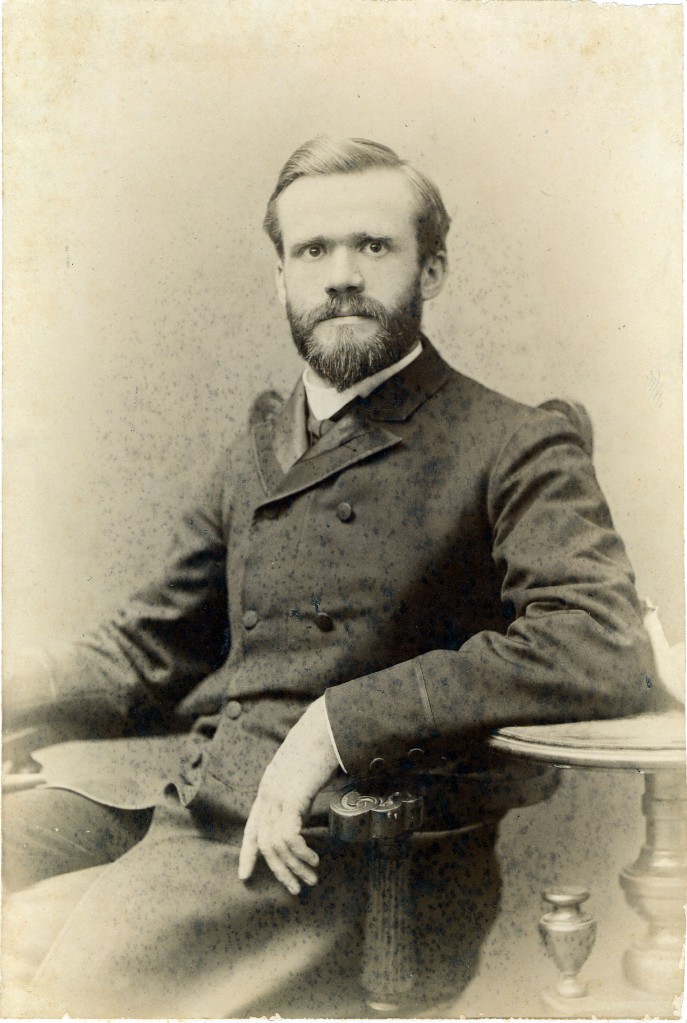
Walter Rauschenbusch (1861–1918) was a Baptist minister, theology professor, and pioneer of the Social Gospel movement, which dominated American Protestant thought in the late nineteenth and early twentieth centuries. This movement sought to apply the ethical principles Jesus taught and the theological vision he espoused to pressing social concerns, such as poverty, pollution, alcoholism, unjust wages, unregulated factories, child labor, inadequate schools, women’s suffrage, racism, and violence. The son of German immigrants, Rauschenbusch pastored a congregation in the congested and impoverished neighborhood of Hell’s Kitchen in New York City from 1886 to 1897, where he witnessed firsthand, in the lives of his congregants, the misery of exploited workers. Adults and children alike worked ten- to twelve-hour days, six days a week, and lived in unsafe and unsanitary tenements.
This pastorate was deeply formative for him as he went on to teach in academic settings and to write. From 1897 until his death he taught courses in church history and Christian ethics at Rochester Theological Seminary and published a handful of books: Christianity and the Social Crisis (1907), Prayers of theSocial Awakening (1910), Christianizing the Social Order (1912), Dare We Be Christians? (1914), The Social Principles of Jesus (1916), and A Theology for the Social Gospel (1917). Christianity Revolutionary, which he wrote in 1891, was published posthumously as The Righteousness of the Kingdom in 1968.
In some Christian circles, “social gospel” is a dirty word, as some think it overemphasizes material concerns and detracts from what they see as Jesus’s core message of the salvation of souls. The sermons and writings of Social Gospelers did swing that way, focusing on the this-worldly social implications of the good news of Jesus and not as much on the spiritual, but that’s because at the turn of the century there was a relative dearth in preaching and writing about social issues from an informed Protestant theological perspective that they sought to rectify. Christians were already well versed in the narrative of personal sin and redemption. But the notion of societal sin and societal redemption was underdeveloped territory, so Rauschenberg, Josiah Strong, Washington Gladden, Richard T. Ely, and others moved in to articulate this neglected aspect of the gospel.
The Social Gospel movement makes the kingdom of God its central doctrine. Adherents believe the mission of the church is to propagate God’s kingdom, aka the kingdom of heaven, on earth. It’s a mischaracterization that the movement is concerned only with fixing society and not people. People make up society, and change starts with them—with personal repentance. Social Gospelers would say that as people turn to Christ and are spiritually transformed by him into new creations, those transformed people, in the power of the Holy Spirit, can then, and indeed are called to, “renew the face of the earth” (Ps. 104:30).
Rauschenbusch calls out the passivity of those Christians who say they are waiting for Christ to return to set all things right but don’t participate in the Christ-spirited renewal, the setting right, that is already underway. Of course he still believed in Christ’s second coming; he just also believed it a Christian duty to anticipate that coming with acts of charity and justice. Addressing the complaint that humans are powerless to solve the world’s overwhelming social problems and can never achieve the kind of sweeping regeneration Christ will bring, he wrote in Christianity and the Social Crisis:
We know well that there is no perfection for man in this life: there is only growth toward perfection. . . . We shall never have a perfect social life, yet we must seek it with faith. We shall never abolish suffering. . . . At best there is always but an approximation to a perfect social order. The kingdom of God is always but coming.
But every approximation to it is worthwhile. . . . Everlasting pilgrimage toward the kingdom of God is better than contented stability in the tents of wickedness.
He highlights the horizontal dimension of Christ’s mission and the apostle Paul’s institution of it, claiming that “the essential purpose of Christianity was to transform human society into the kingdom of God by regenerating all human relations and reconstituting them in accordance with the will of God.” He sees the Lord’s Prayer as key, in which we pray for God’s will to be done on earth as it is in heaven. “There is no request here that we be saved from earthliness and go to heaven, which has been the great object of churchly religion,” he writes. “We pray here that heaven may be duplicated on earth through the moral and spiritual transformation of humanity, both in its personal and its corporate life.” God’s salvation is not a salvation from this world but a salvation in and for this world.
The 1892 statement of the Brotherhood of the Kingdom, drafted by Rauschenbusch, Nathaniel Schmidt, and Leighton Williams, comments on the all-too-common truncated view of the gospel:
Because the individualist conception of personal salvation has pushed out of sight the collective idea of a Kingdom of God on earth, Christian men seek for the salvation of individuals and are comparatively indifferent to the spread of the spirit of Christ in the political, industrial, social scientific, and artistic life of humanity, and have left these as the undisturbed possessions of the spirit of the world. Because the Kingdom of God has been understood as a state to be inherited in a future life rather than as something to be realized here and now, therefore Christians have been contented with a low plane of life here and have postponed holiness to the future.
While I wouldn’t say I’m part of the Social Gospel movement, I’ve definitely been positively influenced by it—I’m not in the bandwagon of denigrators—even as I try to integrate and balance its wisdom with Jesus’s other proclamations.
Martin Luther King Jr. was an appreciator too. He wrote in Stride toward Freedom (1958),
Rauschenbusch had done a great service for the Christian church by insisting the gospel deals with the whole man, not only his soul but his body; not only his spiritual well-being but his material well-being. It has been my conviction ever since reading Rauschenbusch that any religion which professes to be concerned about the soul of men and is not concerned about the social and economic conditions that scar that soul, is a spiritually moribund religion waiting for the day to be buried.
(King was killed, remember, at a workers’ rights rally.)
The Social Gospel movement advocated social change, seeking the betterment of industrialized society through the application of biblical principles. It contributed to the New Deal and other progressive governmental programs in the US and Canada in the 1930s and ’40s and prefigured elements of liberation theology, which emerged in Latin America in the late 1960s.
My entrée to Rauschenbusch’s thought was through his published prayers. I had been conditioned to treat as suspect any products of the Social Gospel movement, so I was not expecting to be as moved as I was by his petitions and thanksgivings to God, which convey his deep and wide concern for the world, and which I’ve found meaningful to lift up in my own prayer time.
His collection includes prayers for employers, homeless children, immigrants, consumers, judges, legislators, artists, doctors and nurses, journalists, the environment, and so on, as well as prayers for morning, evening, and mealtime.
The following is a selection of prayers from Walter Rauschenbusch, Prayers of the Social Awakening (Boston and Chicago: The Pilgrim Press, 1910), which is in the public domain. I have lightly edited them, mainly for gender inclusivity. All headings, save for the fourth one (which I updated the language of), are Rauschenbusch’s.
Grace before Meat
“Our Father, thou art the final source of all our comforts, and to thee we render thanks for this food. But we also remember in gratitude the many men and women whose labor was necessary to produce it, and who gathered it from the land and afar from the sea for our sustenance. Grant that they too may enjoy the fruit of their labor without want, and may be bound up with us in a fellowship of thankful hearts.”
Prayer for This World
“O God, we thank thee for this universe, our great home; for its vastness and its riches, and for the manifoldness of the life which teems upon it and of which we are part. We praise thee for the arching sky and the blessed winds, for the driving clouds and the constellations on high. We praise thee for the salt sea and the running water, for the everlasting hills, for the trees, and for the grass under our feet. We thank thee for our senses by which we can see the splendor of the morning, and hear the jubilant songs of love, and smell the breath of the springtime. Grant us, we pray thee, a heart wide open to all this joy and beauty, and save our souls from being so steeped in care or so darkened by passion that we pass heedless and unseeing when even the thornbush by the wayside is aflame with the glory of God. Enlarge within us the sense of fellowship with all the living things, our kin, to whom thou hast given this earth as their home in common with us. We remember with shame that in the past we have exercised dominion with ruthless cruelty, so that the voice of the earth, which should have gone up to thee in song, has been a groan of travail. May we realize that they live not for us alone but for themselves and for thee, and that they love the sweetness of life even as we, and serve thee in their place better than we in ours. When our use of this world is over and we make room for others, may we not leave anything ravished by our greed or spoiled by our ignorance, but may we hand on our common heritage fairer and sweeter through our use of it, undiminished in fertility and joy, that so our bodies may return in peace to the great mother who nourished them and our spirits may round the circle of a perfect life in thee.”
Prayer for Employers
“We invoke thy grace and wisdom, O Lord, upon all people of goodwill who employ and control the labor of others. Amid the numberless irritations and anxieties of their position, help them to keep a quiet and patient temper, and to rule firmly and wisely, without harshness and anger. Since they hold power over the bread, the safety, and the hopes of the workers, may they wield their powers justly and with love, as older siblings and leaders in the great fellowship of labor. Suffer not the heavenly light of compassion for the weak and the old to be quenched in their hearts. When they are tempted to follow the ruthless ways of others, and to sacrifice human health and life for profit, do thou strengthen their will in the hour of need, and bring to naught the counsels of the heartless. Save them from repressing their workers into sullen submission and helpless fear. May they not sin against the Christ by using people’s bodies and souls as mere tools to make things, forgetting the human hearts and longings of these their brothers and sisters.”
Prayer for the Unemployed
“O God, we remember with pain and pity the thousands of our brothers and sisters who seek honest work and seek in vain. For though unsatisfied wants are many, and though our land is wide and calls for labor, yet these thy sons and daughters have no place to labor, and are turned away in humiliation and despair when they seek it. O righteous God, we acknowledge our common guilt for the disorder of our industry which thrusts even willing workers into the degradation of idleness and want, and teaches some to love the sloth which once they feared and hated. We remember also with sorrow and compassion the idle rich, who have vigor of body and mind and yet produce no useful thing. Forgive them for loading the burden of their support on the bent shoulders of the working world. Forgive them for wasting in refined excess what would feed the pale children of the poor. Forgive them for setting their poisoned splendor before the thirsty hearts of the young, luring them to theft or shame by the lust of eye and flesh. Forgive them for taking pride in their workless lives and despising those by whose toil they live. Forgive them for appeasing their better self by pretended duties and injurious charities. We beseech thee to awaken them by the new voice of thy Spirit that they may look up unto the stern eyes of thy Christ and may be smitten with the blessed pangs of repentance. Grant them strength of soul to rise from their silken shame and to give their brothers and sisters a just return of labor for the bread they eat. And to our whole nation do thou grant wisdom to create a world in which none shall be forced to idle in want, and none shall be able to idle in luxury, but in which all shall know the health of wholesome work and the sweetness of well-earned rest.”
Prayer for Artists and Musicians
“O thou who art the all-pervading glory of the world, we bless thee for the power of beauty to gladden our hearts. We praise thee that even the least of us may feel a thrill of thy creative joy when we give form and substance to our thoughts and, beholding our handiwork, find it good and fair. We praise thee for our brothers and sisters, the masters of form and color and sound, who have power to unlock for us the vaster spaces of emotion and to lead us by their hand into the reaches of nobler passions. We rejoice in their gifts and pray thee to save them from the temptations which beset their powers. Save them from selfish ambition and the vanity that feeds on cheap applause, and from the dark phantoms that haunt the listening soul. Let them not satisfy their hunger for beauty with mere tricks of skill, devoid of spirit. Teach them that they are but servants of their fellow beings, and that the promise of their gifts can fulfill itself only in the service of love. Give them faith in the inspiring power of a great purpose and courage to follow to the end the visions of their youth. Kindle in their hearts a compassion for the joyless lives of the people, and make them rejoice if they are found worthy to hold the cup of beauty to lips that are athirst. Make them reverent interpreters of you, they who see thy face and hear thy voice in all things, so that they may unveil for us the beauties of nature which we have passed unseeing, and the sadness and sweetness of humanity to which our selfishness has made us oblivious.”
Prayer for Lawyers and Legislators
“O Lord, thou art the eternal order of the universe. Our human laws at best are but an approximation to thine immutable law, and if our institutions are to stand, they must rest on justice, for only justice can endure. We beseech thee for the men and women who are set to make and interpret the laws of our nation. Grant to all lawyers a deep consciousness that they are called of God to see justice done, and that they prostitute a holy duty if ever they connive in its defeat. Fill them with a high determination to make the courts of our land a strong fortress of defense for the poor and weak, and never a castle of oppression for the hard and cunning. Save them from surrendering the dear-bought safeguards of the people for which our foreparents fought and suffered. Revive in them the spirit of the great liberators of the past that they may cleanse our law of the inherited wrongs that still cling to it. Suffer not the web of outgrown precedents to veil their moral vision, but grant them a penetrating eye for the rights and wrongs of today and a quick human sympathy with the life and sufferings of the people. May they not perpetuate the tangles of the law for the profit of their profession. Aid them to make its course so simple, and its justice so swift and sure, that the humblest may safely trust it and the strongest fear it. Grant them wisdom so to refashion all law that it may become the true expression of the fairer ideals of freedom and brotherhood which are now seeking their incarnation in a new age. Make these our brothers and sisters the wise interpreters of thine eternal law, the brave spokespersons of thy will, and in reward bestow upon them the joy of conscious fellowship with thy Christ in saving people from the bondage of ancient wrong.”
Prayer against War
“O Lord, since first the blood of Abel cried to thee from the ground that drank it, this earth of thine has been defiled with human blood shed by the hand of siblings, and the centuries sob with the ceaseless horror of war. Ever the pride of kings and the covetousness of the strong have driven peaceful nations to slaughter. Ever the songs of the past and the pomp of armies have been used to inflame the passions of the people. Our spirit cries out to thee in revolt against it, and we know that our righteous anger is answered by thy holy wrath. Break thou the spell of the enchantments that make the nations drunk with the lust of battle and draw them on as willing tools of death. Grant us a quiet and steadfast mind when our own nation clamors for vengeance or aggression. Strengthen our sense of justice and regard for the equal worth of other peoples and races. Grant to the rulers of nations faith in the possibility of peace through justice, and grant to the common people a new and stern enthusiasm for the cause of peace. Bless our soldiers and sailors for their swift obedience and their willingness to answer to the call of duty, but inspire them nonetheless with a hatred of war, and may they never for love of private glory or advancement provoke its coming. May our young men and women still rejoice to die for their country with the valor of their parents, but teach our age nobler methods of matching our strength and more effective ways of giving our life for the flag. O thou strong Father of all nations, draw all thy great family together with an increasing sense of our common blood and destiny, that peace may come on earth at last, and thy sun may shed its light rejoicing on a holy kinship of peoples.”
Prayer for Conferences and Conventions
“We praise thee, O God, for our friends and fellow workers, for the touch of their hands and the brightness of their faces, for the cheer of their words and the outflow of goodwill that refreshes us. Grant us the insight of love that we may see them as thou seest, not as frail mortals, but as radiant children of God who have wrought patience out of tribulation and who bear in earthen vessels the treasures of thy grace. May nought mar the joy of our fellowship here. May none remain lonely and hungry of heart among us. Let none go hence without the joy of new friendships. Give us more capacity for love and a richer consciousness of being loved. Overcome our coldness and reserve that we may throw ajar the gates of our heart and keep open house this day. Lift our human friendships to the level of spiritual companionship. May we realize thee as the eternal bond of our unity. Shine upon us from the faces of thy servants, thou all-pervading beauty, that in loving them we may be praising thee. Through Christ, our Lord.”
Evening Prayers
“O Lord, we praise thee for our sister, Night, who folds all the tired folk of the earth in her comfortable robe of darkness and gives them sleep. Release now the strained limbs of toil and smooth the brow of care. Grant us the refreshing draught of restfulness that we may rise in the morning with a smile on our face. Comfort and ease those who toss wakeful on a bed of pain, or whose aching nerves crave sleep and find it not. Save them from evil or despondent thoughts in the long darkness, and teach them so to lean on thy all-pervading life and love, that their souls may grow tranquil and their bodies, too, may rest. And now through thee we send Good Night to all our brothers and sisters near and far, and pray for peace upon all the earth.”
“Our Father, as we turn to the comfort of our rest, we remember those who must wake that we may sleep. Bless the guardians of peace who protect us against those of evil will, the watchers who save us from the terrors of fire, and all the many who carry on through the hours of the night the restless commerce we require on sea and land. We thank thee for their faithfulness and sense of duty. We pray for thy pardon if our covetousness or luxury makes their nightly toil necessary. Grant that we may realize how dependent the safety of our loved ones and the comforts of our life are on these our brothers and sisters, that so we may think of them with love and gratitude and help to make their burden lighter.”
“Accept the work of this day, O Lord, as we lay it at thy feet. Thou knowest its imperfections, and we know. Of the brave purposes of the morning only a few have found their fulfillment. We bless thee that thou art no hard taskmaster, watching grimly the stint of work we bring, but the father and teacher of people who rejoices with us as we learn to work. We have naught to boast before thee, but we do not fear thy face. Thou knowest all things and thou art love. Accept every right intention however brokenly fulfilled, but grant that ere our life is done we may under thy tuition become true master workers, who know the art of a just and valiant life.”
“Our Master, as this day closes and passes from our control, the sense of our shortcomings is quick within us and we seek thy pardon. But since we daily crave thy mercy on our weakness, help us now to show mercy to those who have this day grieved or angered us and to forgive them utterly. Suffer us not to cherish dark thoughts of resentment or revenge. So fill us with thy abounding love and peace that no ill will may be left in our hearts as we turn to our rest. And if we remember that any brother or sister justly hath aught against us through this day’s work, fix in us this moment the firm resolve to make good the wrong and to win again the love of our sibling. Suffer us not to darken thy world by lovelessness, but give us the power of the children of God to bring in the reign of love among people.”
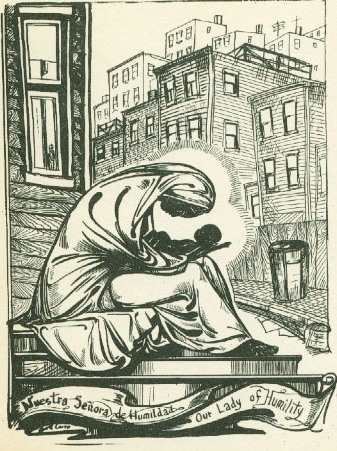
Nuestra Señora de Humildad / Our Lady of Humility by Allan Rohan Crite
Allan Rohan Crite (1910–2007) was a Boston-based African American artist best known for his religious paintings and drawings, many of which place holy personages among everyday people in Boston’s South End. He was Episcopalian.
On using Black figures to narrate biblical stories, Crite said:
I used the black figure in a telling of the story of the Lord, the story of the suffering of the Cross and the whole story of the Redemption of Man by the Lord, but . . . my use of the black figure was not in a limited racial sense, even though I am black, but rather I was telling the story of all mankind through this black figure. (quoted in Julie Levin Caro, Allan Rohan Crite: Artist-Reporter of the African American Community, p. 20)
The image above, which I found years ago at the now defunct brushesandpigments.com with very little captioning info, sets the Nativity in an urban neighborhood. Sitting on a stoop, Mary bends her head down to look lovingly at her son Jesus, cradled in her lap. The banderole at the bottom reads, “Nuestra Señora de Humildad / Our Lady of Humility.”
As indicated by the inscription, this pen and ink drawing belongs to a type of iconography especially popular in the fifteenth century, showing Mary sitting on the ground or on a low cushion, usually holding the Christ child in her lap. The word “humility” derives from the Latin humus, meaning “earth” or “ground.”
I’m not sure why Crite uses Spanish here—whether he spoke it as a second language, or had Spanish-speaking neighbors, or was working on commission—but I do know he visited Mexico and Puerto Rico.
LISTEN: “Poor Little Jesus” (aka “Oh, Po’ Little Jesus”), African American spiritual
Oh, Po’ Little Jesus. Dis world gonna break your heart. Dere’ll be no place to lay your head, my Lord. Oh, Po’ Little Jesus. (Hum)
Oh, Mary, she de mother. Oh, Mary, she bow down an’ cry. For dere’s no place to lay his head, my Lord. Oh, Po’ Little Jesus.
Come down, all you holy angels, Sing round him wid your golden harps, For someday he will die to save dis worl’. Oh, Po’ Little Jesus. (Hum)
I find this spiritual so moving. The five-part harmonies—or even just the two parts in Rev Simpkins’s version—are lush and carry such pathos.
From his humble beginnings in a Bethlehem stable to his ignominious death on a Roman cross, Jesus was no stranger to want and sorrow. He wasn’t impoverished, but he wasn’t wealthy; he had a simple upbringing in the small town of Nazareth. His mother probably longed to give him more than she could. She understood in part the hardship of his calling, knew the rejection he would face—and so she sings, “This world’s gonna break your heart.”
Jesus spent three determinative years of his adult life as an itinerant preacher, traveling from place to place and reliant on the support of others; as he told a scribe who aspired to follow him: “Foxes have holes, and birds of the air have nests, but the Son of Man has nowhere to lay his head” (Matt. 8:19). That ministry culminated in false charges, abandonment, and a public execution.
The Incarnation required vulnerability on the part of God. God chose to make himself susceptible to hurt by entering fully into the life of human struggle. But out of the hurt and struggle that Christ endured came salvation.
“Poor Little Jesus” seeks to stir up pity for Jesus’s plight. Underlying that pity is a thank-you: thank you, Jesus, for taking on our flesh and dealing with our sin, so that we might be free.
The spiritual is not to be confused with another spiritual of the same name (recorded, for example, by Odetta) that goes, “It was poor little Jesus . . . didn’t have no cradle . . . wasn’t that a pity and a shame?”
This post is part of a daily Christmas series that goes through January 6. View all the posts here, and the accompanying Spotify playlist here.
Andrew Gadd (British, 1968–), Bus Stop Nativity, 2008. Oil on canvas, 188 × 122 cm.
Painted by Royal Academy gold medal winner Andrew Gadd, Bus Stop Nativity depicts the Holy Family huddled together at night under a bus shelter, trying to stay warm. Some passersby look on with curiosity—two even kneel down on the snowy sidewalk—while others go about their business with total indifference.
This painting was commissioned by the Church Advertising Network in the UK, now ChurchAds.net, and displayed on posters at over one thousand bus stops in December 2008, printed with the text “Be Part of the Action. Church, 25-12.” (A gentle provocation to attend a Christmas service on December 25.)
Francis Goodwin, the chair of the Church Advertising Network, said, “We are very used to the Renaissance image of the Nativity. But what would it look like if it happened today? Where would it take place? We want to challenge people to make them reassess what the birth of Jesus means to them.”
Bus Stop Nativity identifies Jesus with today’s urban poor. He was born not in a comfortable palace with fine clothes and other material wealth and security, but in vulnerability and need, to working-class parents who were inconveniently out of town at the time of delivery, forced to make do with less-than-ideal accommodations. When it came time for Mary to present a purification offering in the temple forty days after giving birth, she couldn’t afford the requisite lamb, so she brought two turtledoves instead (a provision made in Lev. 12:8). Not only was Jesus not monied; he also spent his early years as a refugee in Egypt, a flight prompted by Herod’s direct threat on his life. With limited resources, his parents had to make a home for him away from home, not knowing for some time when it would be safe to return to Galilee.
That this was Jesus’s family background and experience—that he lived on the margins of society, not at its center—has always been a significant facet of the Incarnation, because it means that God knows bodily what it is to feel want and uncertainty and to be overlooked. When in his adulthood Jesus preached “Blessed are the poor,” he was affirming that God is with those of lower socioeconomic means. He is one of them.
LISTEN: “Hush Child (Get You Through This Silent Night)” from the movie Black Nativity(2013) | Written by Taura Latrice Stinson, Kasi Lemmons, and Taylor Gordon | Performed by Jennifer Hudson, Jacob Latimore, Luke James, and Grace Gibson
Silent night Holy night Poverty on the rise Wealthy reverend in designer clothes Homeless children with frostbitten toes Sleeping in the street Sleeping in the street
I ain’t tryna be philosophical But it’s not logical Some folks out here freezing, others chilling like it’s tropical
The indifference is mad crazy Like poverty’s contagious My hands are dirty, but I’m still worthy Step in my shoes and walk in some mercy
They say this is your punishment for such poor judgment But you must’ve lost your mind How you gon’ feed it when you barely eating? Get ready for the welfare line I ain’t tryna hear it You make the bed, lay in it But I’m way too strong for you to break my spirit
Is it me? Am I the cause of all my mother’s misery? This cloud of secrecy on my paternity Did my very birth destroy my whole family?
I’m just a sinner, I know who I am Just a beginner, I’m not yet a man Send me a signal, I’ll follow your light Just help me through this silent night
Hush child, it’ll be alright I’ll get you through this silent night Hush child, it’ll be alright I’ll get you through this silent night
This ain’t living I got a mouth to feed But I can’t make these ends meet Got an eviction notice But my Lord don’t hear my prayers I never been this scared The silence is too loud for me Life just ain’t fair
Is anyone out there? Does anyone care? Is anyone listening? Is anyone there? Just let me know that I’m a part of your plan That you’re watching over and know who I am
From where we are now How do we find our way? Alone in the darkness, scared With no place to stay
Hush child, it’ll be alright I’ll get you through this silent night Hush child, it’ll be alright I’ll get you through this silent night
Hush child, it’ll be alright We’ll do this together
Sleep in heavenly peace Sleep in heavenly peace
This song is a dream sequence from the 2013 film Black Nativity, directed by Kasi Lemmons (good soundtrack, cheesy movie). The two characters who initiate the song are Maria (Grace Gibson) and Jo-Jo (Luke James), a homeless couple in New York City expecting their first child, who are caroling door-to-door. Fifteen-year-old Langston (Jacob Latimore), who has been sent to live temporarily with his estranged grandfather while his mom, Naima (Jennifer Hudson), figures out how to make ends meet for the two of them back in Baltimore, interjects with a rap expressing his frustration with economic inequality and the struggle he has seen and lived.
The pregnant couple sings the refrain, “Hush child . . . ,” to each other and to their unborn child, and Naima sings it to Langston. But in between, all four address God in lament: God, are you there? God, why don’t you fix these inequities? I’m exhausted. Tired of being a have-not and always having to hustle, to no avail. When are you going to provide like you said you would? The night is “silent” because God is not answering, it seems. Still, the characters continue to pray their pain and grasp after hope.
Though Lemmons’s Black Nativity was marketed as being based on Langston Hughes’s 1961 musical of the same name, its only resemblance is that it is a Christmas-themed drama with Black sacred music (only two songs are held in common; most in the movie are contemporary gospel or original hip-hop/R&B). To listen to the original Broadway cast recording of *Hughes’s* Black Nativity on Spotify, click here.
Frank Kunert (German, 1963–), Geschlossene Gesellschaft (Closed Society), 2011. C-print, 40 × 30 cm. Edition of 50 + 3 ap.
LISTEN: “The Ditchling Carol” (Roud 3216) | Words by William Robert Spencer, 1811 | Music by Peter Parsons, before 1901 | Performed by Waterson:Carthy on Broken Ground (1999; reissued 2013)
Be merry all, be merry all With holly dress the festive hall Prepare the song, the feast of all To welcome Merry Christmas
And all remember, gentles gay For you who bask in fortune’s ray The year is all a holiday The poor have only Christmas
When you with velvets mantled o’er Defy December’s tempest’s roar Oh spare one garment from your store To clothe the poor at Christmas
And all remember, gentles gay For you who bask in fortune’s ray The year is all a holiday The poor have only Christmas
When you the costly banquet deal To guests who never famine feel Oh spare one morsel from your meal To feed the poor at Christmas
And all remember, gentles gay For you who bask in fortune’s ray The year is all a holiday The poor have only Christmas
From blazing logs of fuel awhile Your homes are within summer’s smile Oh spare one log from off the pile To warm the poor at Christmas
And all remember, gentles gay For you who bask in fortune’s ray The year is all a holiday The poor have only Christmas
So shall each note of mirth appear More sweet to heaven than praise or prayer And angels in their carols there Shall bless the poor at Christmas
And all remember, gentles gay For you who bask in fortune’s ray The year is all a holiday The poor have only Christmas
This carol from Ditchling in East Sussex has a very Dickensian feel to it. More sobering than the usual Christmas fare, it contrasts the lavish holiday feasts of the well-off with the poverty that exists outside their doors. Think Lazarus and the rich man. The poor rely on the feelings of goodwill and generosity that Christmas engenders, but as this song acknowledges, the needs persist year-round. Those whom God has blessed with good fortune would do well to share it—not just with family and friends of like socioeconomic status but with neighbors of all classes, and not just during the “season of giving” but on a continuing basis.
Peter Parsons (1825–1901), a Ditchling shoemaker and leader of the village glee club, found the poem above on a broadside ballad sheet from the early nineteenth century and was moved to write a tune for it. I encountered the carol through a nineties recording by Norma Waterson, her husband Martin Carthy, and their daughter Eliza Carthy, who have been at the forefront of the English folk music scene for decades.
I would go even further than the lyrics do and say, don’t just give the poor a morsel or a log; invite them in! What might radical hospitality look like for you this Christmas? How might your merriment expand to embrace those who are typically excluded?
Warning: This post contains distressing photographs, including one of an emaciated child and one of a wounded (but bandaged) infant.
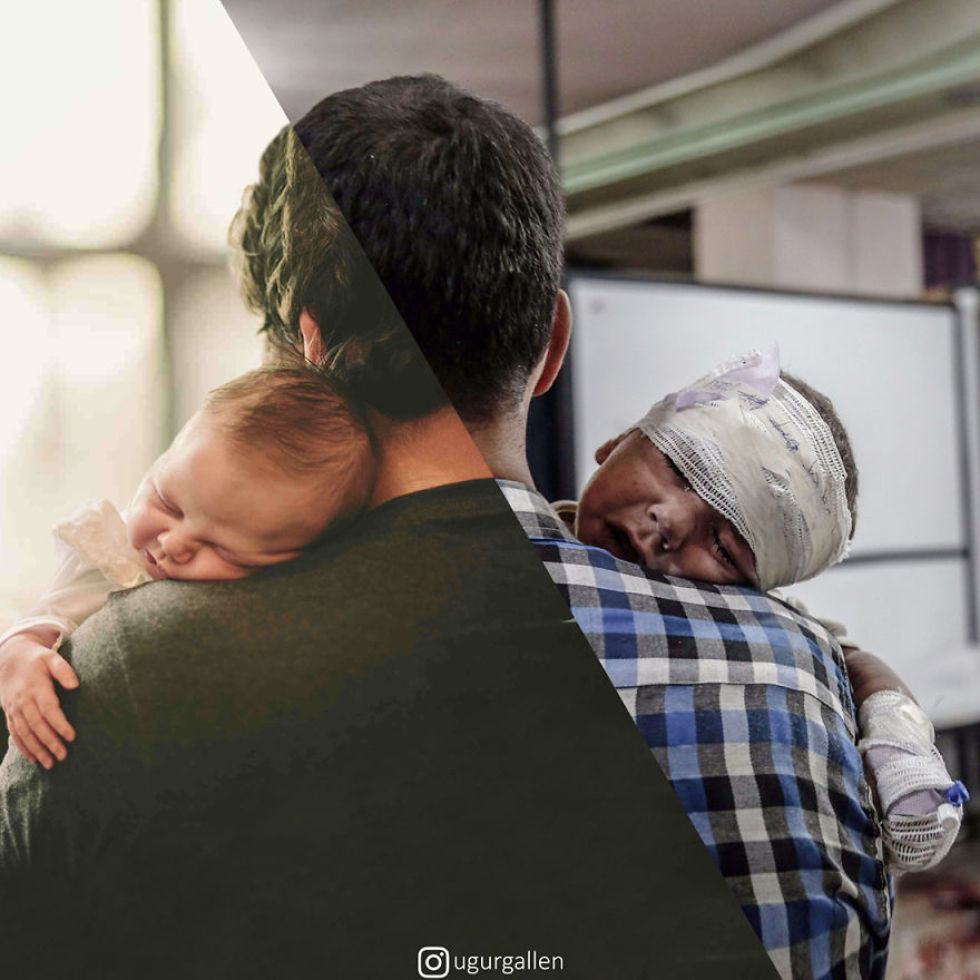
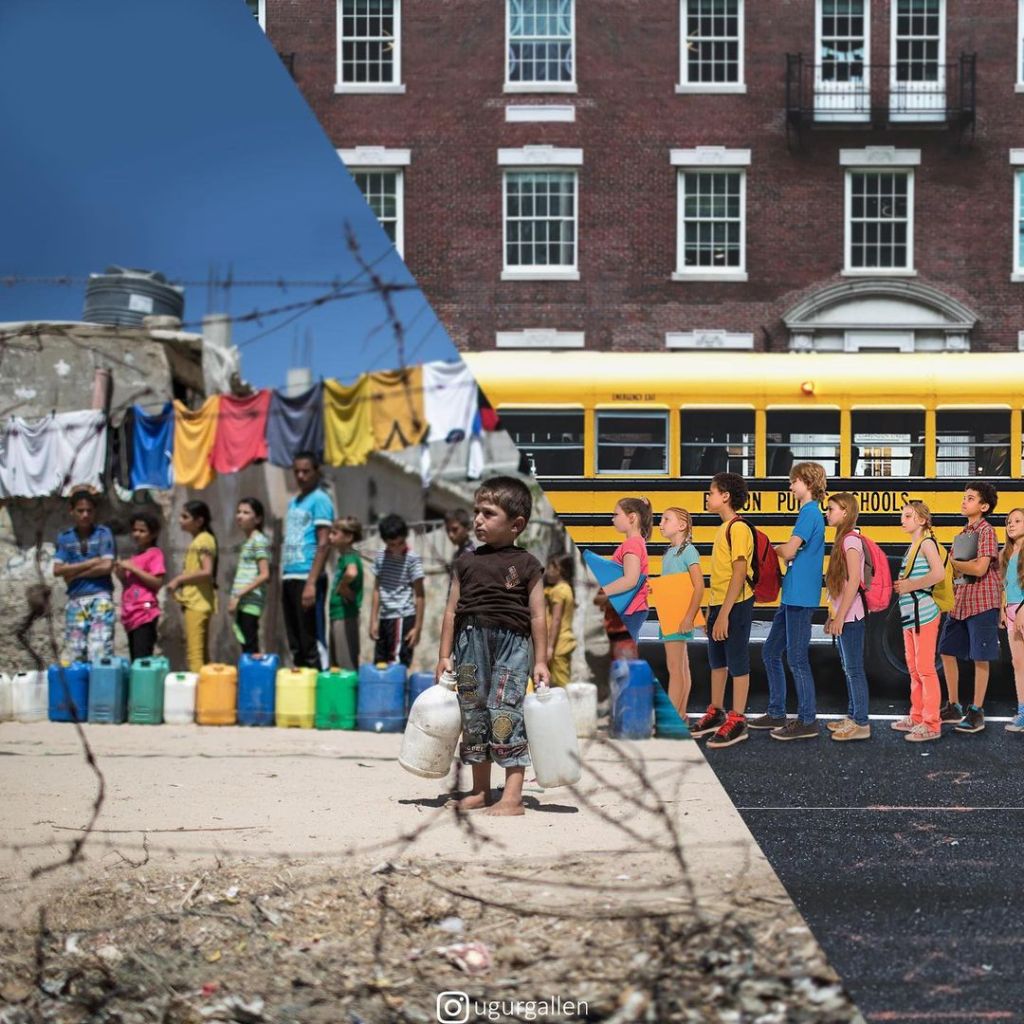
Uğur Gallenkuş (Turkish, 1990–) is an Istanbul-based artist whose digital photomontages address the widening global divide between the privileged and the oppressed. By combining photojournalistic images and stock photos with similar compositional elements, he juxtaposes the relative safety, stability, comfort, and flourishing experienced by middle- and upper-class Westerners with the violence, terror, trauma, and hardship experienced by victims of poverty, war, and displacement. Because Gallenkuş lives in the Middle East, he focuses on that geographic region.
Releasing November 20 in honor of World Children’s Day, Parallel Universes of Children brings together fifty of Gallenkuş’s sobering mash-ups, integrating facts of children’s lived realities around the world. It is $60 plus shipping, available only through the artist’s website. (For US buyers, there’s stock warehoused in New Jersey, so you won’t be paying to ship it from Turkey.)
“I aim to create awareness and inspire action to remember and to ask ourselves every day what we have done to safeguard children’s rights, both near home and across the globe,” Gallenkuş says. He wants not only to alert the well-off to the suffering they often shield themselves from, shaking them out of their complacency, but also to remind those in underdeveloped countries that they deserve better government and education, the right to thrive.
I’ve linked each image to its source on Instagram, where you can find out more information about it—when and where the photograph was taken and by whom (Gallenkuş does not take the photos himself), context, stats, etc. Some of the links will take you to a revised (updated) form of the image; in those instances, the originals I found at Juxtapoze.
The stark contrast between the two component photos of each montage is jolting, intentionally so. Reflecting socioeconomic and political disparities, they tell drastically different stories about childhood. My existence must look like a fairy tale to those who have grown up in war zones or refugee camps.
One of Gallenkuş’s montages shows a lavish bathroom with a chandelier, pristine tiles, and freshly pressed towels next to the remnants of a bathroom whose walls were blown out by an Israeli airstrike, where a father bathes his daughter and niece.
Another one shows a line of American schoolchildren waiting to board a bus, which transforms into a line of Palestinian children waiting to fill jerrycans and bottles with drinking water from public taps at the Deir al-Balah refugee camp in central Gaza Strip. (Many fall sick from the water, whose source is polluted with human waste.)
Consider, too, the differences in play. A child at an IDP camp plays with a toy grenade launcher, while his counterpart plays doctor. A Syrian boy has fun balancing on the barrel of a tank in a pile of wreckage, while opposite him, in a green park, a boy rides a harmless seesaw. The imaginations of children are shaped by what surrounds them, whether that be violence or possibility.
Last summer when participating in a two-week Calvin College seminar, I was providentially assigned to room with Margaret (Peggy) Adams Parker, a sculptor and printmaker who lives, as it so happens, just an hour south of me! Peggy’s enthusiasm—for God, for life, for art—is infectious. She possesses such deep joy, and yet she feels so deeply the hurts of the world. She is attentive, as all good artists must be. “I feel called as an artist to bear witness to the world I see around me and also to the ways I understand that world,” Peggy wrote in an ArtWay feature. “This yields not only images of beauty and tenderness, but also images of suffering and terror.” She regards her art as a means of prayer.
By way of further introduction, here is an essay Peggy wrote ten years ago for the book Heaven, ed. Roger Ferlo (New York: Seabury Books, 2007), pp. 158–66. It is reproduced by kind permission of the publisher.
“Where Sorrow and Pain Are No More”
by Margaret Adams Parker
To be honest, I’ve never thought much about heaven, at least in any systematic fashion. I was interested enough to pick up, at some point, The Great Divorce, C. S. Lewis’s allegory of heaven and hell. And I’ve been known to joke about my expectations that heaven had better have a comprehensively stocked art studio, as well as a fabulous bookstore.
But in looking back though many years of making art and also teaching about art at a Christian seminary, I’ve unearthed a great deal about heaven, although not in the expected places. I haven’t glimpsed heaven among the many imagined depictions, ranging from medieval woodcuts to the visual speculations of twentieth-century outsider artists. I’m simply not drawn to “visionary” images. These are not the kinds of images I make. Instead, my image of heaven is distinctly negative (theologians would call it apophatic). I have no vision of what heaven is like. But I have seen, and I have also made, pictures of what heaven is not.
I am a concrete thinker, and so my art is earthbound, far from visionary. I’ve always understood the incarnational nature of Christianity as a charge to take seriously life in this world. What’s more, my two great artistic mentors—Rembrandt and Käthe Kollwitz—were rarely given to visions. Rather, their work was grounded in the physical, spiritual, and social realities of life. Such symbols as they used (most notably Kollwitz’s use of the skeleton to represent death) served to underscore their understanding of human existence as it is. They recorded moments as small as a child learning to walk and as momentous as war or revolution. Even when picturing the incarnation, that most heavenly of earthly events, both artists showed the miracle taking place in a tangible human setting.
Consider some of these two artists’ characteristic images. Rembrandt’s drawings testify powerfully to his all-encompassing interest in the life around him. He depicted everyone he saw—beggars and merchants, rabbis and serving girls—with the same probing yet sympathetic scrutiny. His drawings of his wife Saskia constitute a particularly poignant record: we watch as she endures four pregnancies, suffers the deaths of three infants, and finally dies at thirty, a short nine years after their betrothal. We glimpse her first in a silverpoint drawing (1633), made the week of their engagement. In this love poem in line, Rembrandt shows us a winsome young woman, resting her cheek lightly against her hand, dangling in her other hand one of the flowers that also adorn her straw hat. In a pen and ink drawing made four years later (1637), Saskia lies in bed, supporting her head heavily on her hand, staring out with a weary and resigned expression. And in the image that Rembrandt sketched on a tiny etching plate the year Saskia died (1642), she has become an old woman, worn, gaunt, and desperately ill.
Rembrandt van Rijn (Dutch, 1606–1669), Portrait of Saskia as a Bride, 1633. Silverpoint on parchment, 18.5 × 10.7 cm (7 3/10 × 4 1/5 in.). Staatliche Museen Preussischer Kulturbesitz, Kupferstichkabinett, Berlin. Inscription (trans.): “This was portrayed after my wife when she was 21 years old, the third day after we were married. June 8, 1633.”
Rembrandt van Rijn (Dutch, 1606–1669), Saskia in Bed, ca. 1637. Pen and brown ink, 8.4 × 10.4 cm (8 3/10 × 10 1/10). British Museum, London.
Rembrandt van Rijn (Dutch, 1606–1669), Sick Woman with a Large White Headdress (Saskia), ca. 1642. Etching with touches of drypoint, 6 × 5.1 cm (2 3/8 × 2 in.).
Käthe Kollwitz’s imagery is more politically engaged. The daughter of a trained lawyer who chose to work as a builder rather than practice within the Prussian legal system, she spent her life depicting the plight of the poor and protesting the ravages of war. In her first great print series, A Weavers’ Rebellion (1897–98), she chronicled the causes, progression, and bloody aftermath of the 1844 revolt of Silesian home weavers against their employers. The series begins with Poverty (1894), where a family of weavers gathers around the deathbed of an infant, and concludes with The End (1897), where the bodies of slain revolutionaries are being laid out on the floor of a weaver’s cabin. In both of these dimly lit interiors, the looms and other apparatus of the weavers’ trade stand as ominous reminders of the weavers’ plight. Continue reading “ESSAY: “Where Sorrow and Pain Are No More” by Margaret Adams Parker”→








 Art & Theology