LISTEN: “Advent ‘O’ Carol” by Joanna Forbes L’Estrange, 2018 | Performed by London Voices, dir. Ben Parry, on Winter Light, 2024
Refrain: O, O, O, O, O, O, O O, O, O, O, O, O, O
We long for your coming, O Wisdom; we long for your coming, O Lord. Come and teach us the way of understanding; you are the living Word. [Refrain]
We long for you, O Lord and Ruler; we long for your coming, O Lord. Come and stretch out your arms and redeem us; you are the living Word. [Refrain]
We long for you, O Root of Jesse; we long for your coming, O Lord. Come to deliver us and do not tarry; you are the living Word. [Refrain]
We long for you, O Key of David; we long for your coming, O Lord. Come and bring forth the captive from his prison, who sits in the shadow of death. [Refrain]
Dawn of the East, we long for your coming, O Lord. Come and lighten those who sit in darkness and in the shadow of death. [Refrain]
We long for you, O King of the Gentiles; we long for your coming, O Lord. Come and deliver man, whom you formed out of the dust of the earth. [Refrain]
O Emmanuel! When will you come? Come to save us, O Lord our God. [Refrain]
Tomorrow I will come.
Revealing different titles of the Messiah based on Isaiah’s prophecies, the seven so-called O Antiphons have been sung, one each from December 17 to 23, since at least as far back as the eighth century. For Christians outside the Roman Catholic Church, these antiphons are probably most familiar as the basis of the Advent hymn “O Come, O Come, Emmanuel.”
The British composer Joanna Forbes L’Estrange has lightly adapted them and set them to music for unaccompanied SATB choir. She offers the following note:
“Advent ‘O’ Carol” is inspired by the text and chants of the seven “O” Antiphons which traditionally would have been sung in the days immediately preceding Christmas (known as the Greater Ferias). The “O” refrain, which opens the piece and reoccurs between each of the seven verses, is based on the opening melodic chant of the Medieval antiphons, its 7/8 time signature reinforcing the piece’s connection to the number seven.
Ignoring the “O,” the first letter of each verse forms an acrostic which, when reversed, spells ERO CRAS, Latin for “I shall be (with you) tomorrow.” I have reworded this as “Tomorrow I will come” for the final resolution of the piece.
>> “Jack’s Bookshelf: Julian of Norwich” with Dr. Grace Hamman, Pints with Jack: The “Jack’s Bookshelf” podcast series explores the authors and books that influenced the life and writings of C. S. Lewis. Hosted by David Bates, this episode covers Julian of Norwich (ca. 1343–after 1416), an English anchorite and mystic who authored what editors call Revelations of Divine Love or The Showings, the first English-language book by a woman. The most famous quote from this work is “Sin is behoovely, but all shall be well, and all shall be well, and all manner of thing shall be well.” Medieval scholar Grace Hamman [previously] unpacks the quote and discusses other key passages and themes from Julian, as well as what little we know of her biography. An excellent introduction!
>> “Ben Myers—The Divine Comedy,”Life with God: One of the many gifts my parents have given me over the years was a four-month study-abroad stay in Florence during my junior year of college, where one of my courses was devoted to reading and studying—in its original Italian and in the author Dante Alighieri’s hometown!—the masterful trilogy of narrative poems known as La Divina Commedia, or The Divine Comedy in English. Moving through hell, purgatory, and heaven, it is an allegory of the soul’s journey toward God. I enjoyed hearing Dr. Benjamin Myers [previously], director of the Great Books Honors Program at Oklahoma Baptist University, discuss this deeply influential work from the early fourteenth century, and sharing one of his own poems, “Listening to Reggae at the Nashville Airport.”
+++
VIRTUAL TOURS OF CATHEDRALS:
Cathedrals are, among other things, repositories of sacred art. I’m so appreciative of digitization initiatives that seek to make some of those treasures available to global publics online. Here are two admirable examples.
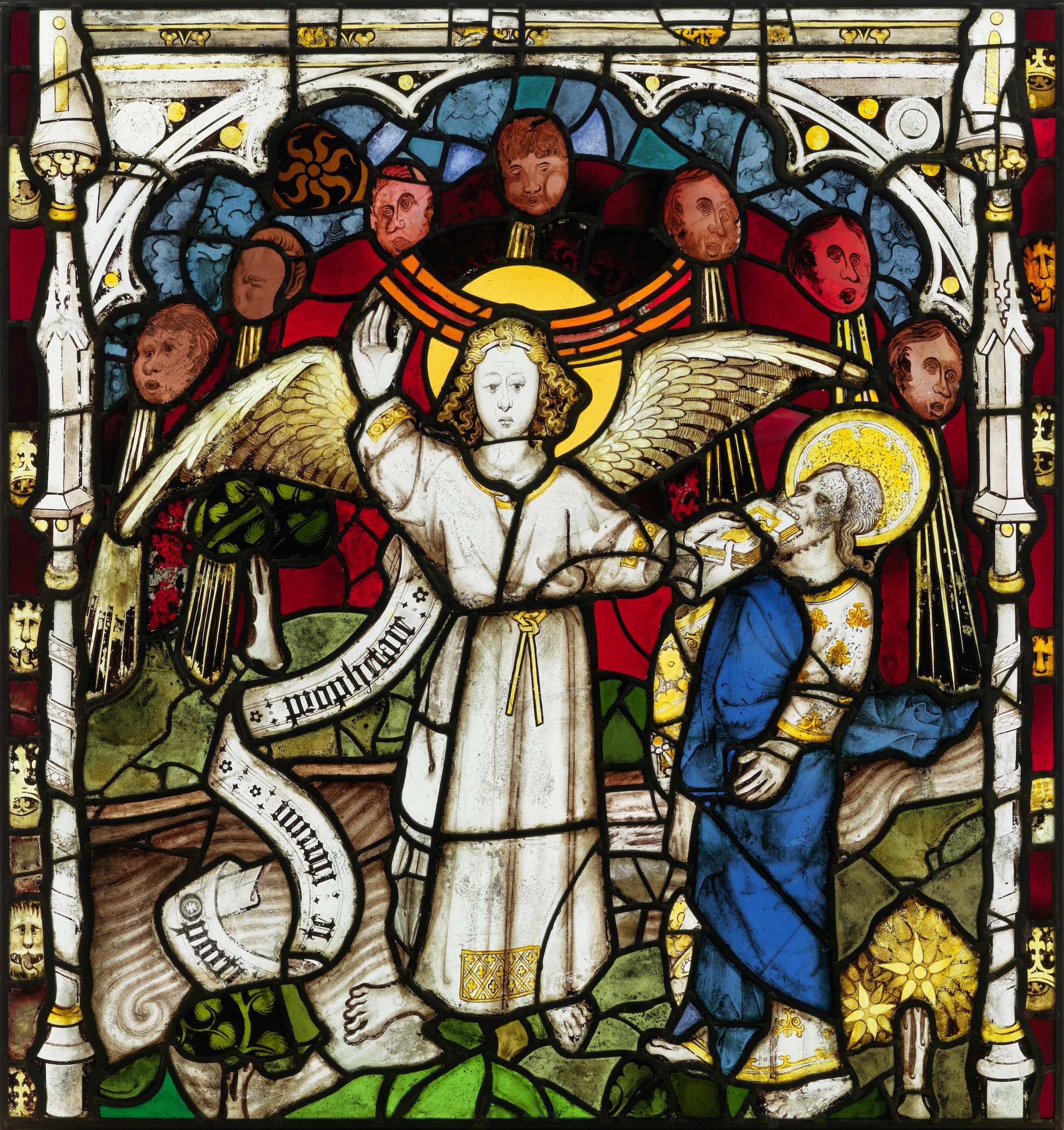
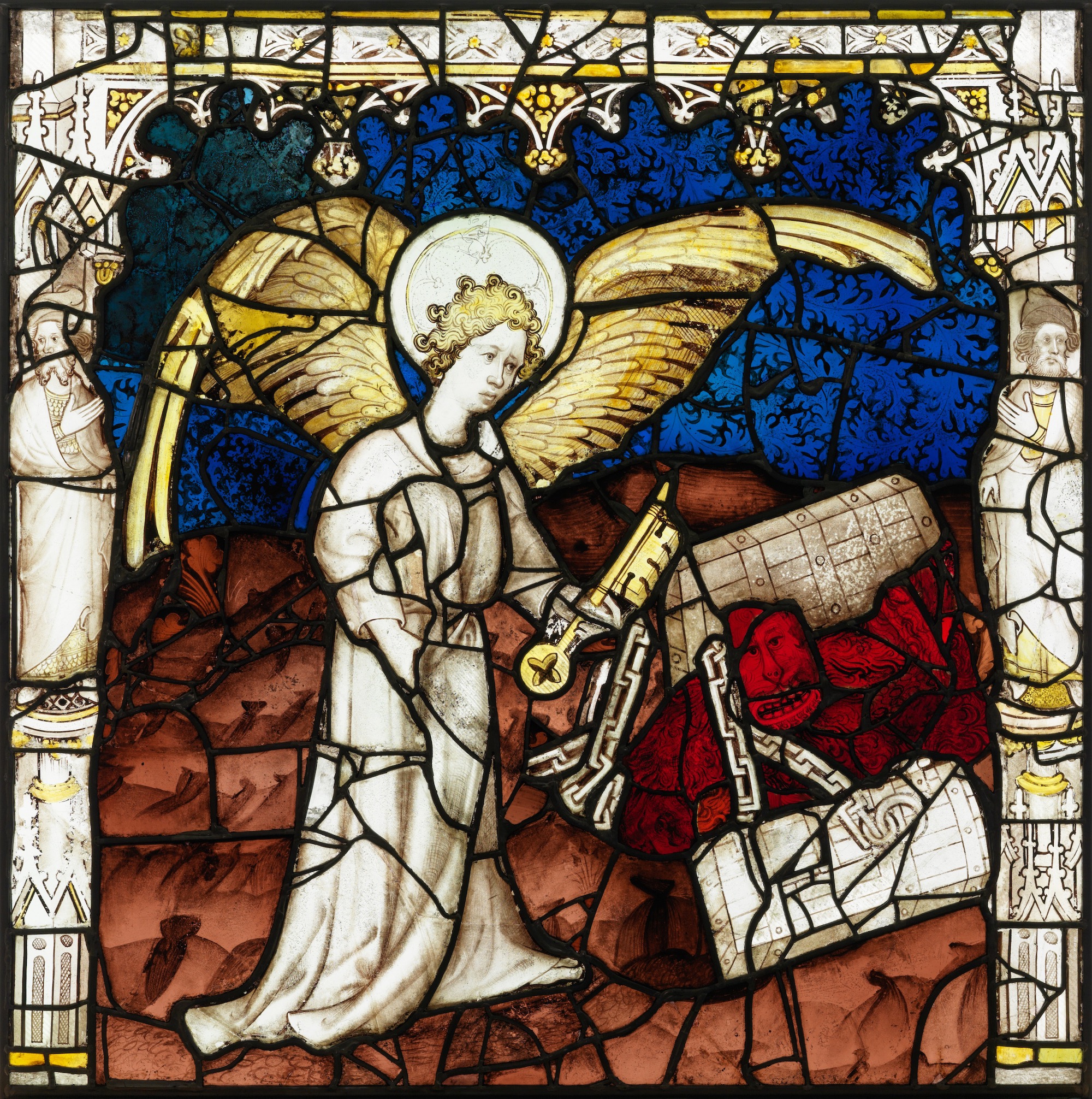
>> The York Minster Stained Glass Navigator:York Minster in northeastern England has the largest collection of medieval stained glass in the UK, with the earliest pieces dating from the late twelfth century. On behalf of the Chapter of York, the York Glaziers Trust is undertaking to photograph it all. These photos are available for viewing online through the cathedral’s “Stained Glass Navigator,” which enables you to hover over panels to identify the scenes, zoom in for higher resolution, and see where each panel in situated in the context of the window’s larger narrative.
I especially recommend exploring the extraordinary Great East Window, which depicts the beginning and the end of all things. The top section opens with the seven days of creation, followed by other select scenes from the Old Testament, but the bulk of the window—and my favorite sequence—consists of scenes from the book of Revelation. The bottom row depicts historical and legendary figures associated with the history of York Minster.
John Thornton of Coventry (British, fl. 1405–1433), St. John Takes the Book from the Angel (Rev. 10:8–11), 1405–8. Stained glass panel from the Great East Window, York Minster, York, England. Photo courtesy of the York Glaziers Trust.John Thornton of Coventry (British, fl. 1405–1433), The Dragon Gives Power to the Beast (Rev. 13:1–3), 1405–8. Stained glass panel from the Great East Window, York Minster, York, England. Photo courtesy of the York Glaziers Trust.John Thornton of Coventry (British, fl. 1405–1433), Satan Chained in the Bottomless Pit (Rev. 20:1–3), 1405–8. Stained glass panel from the Great East Window, York Minster, York, England. Photo courtesy of the York Glaziers Trust.
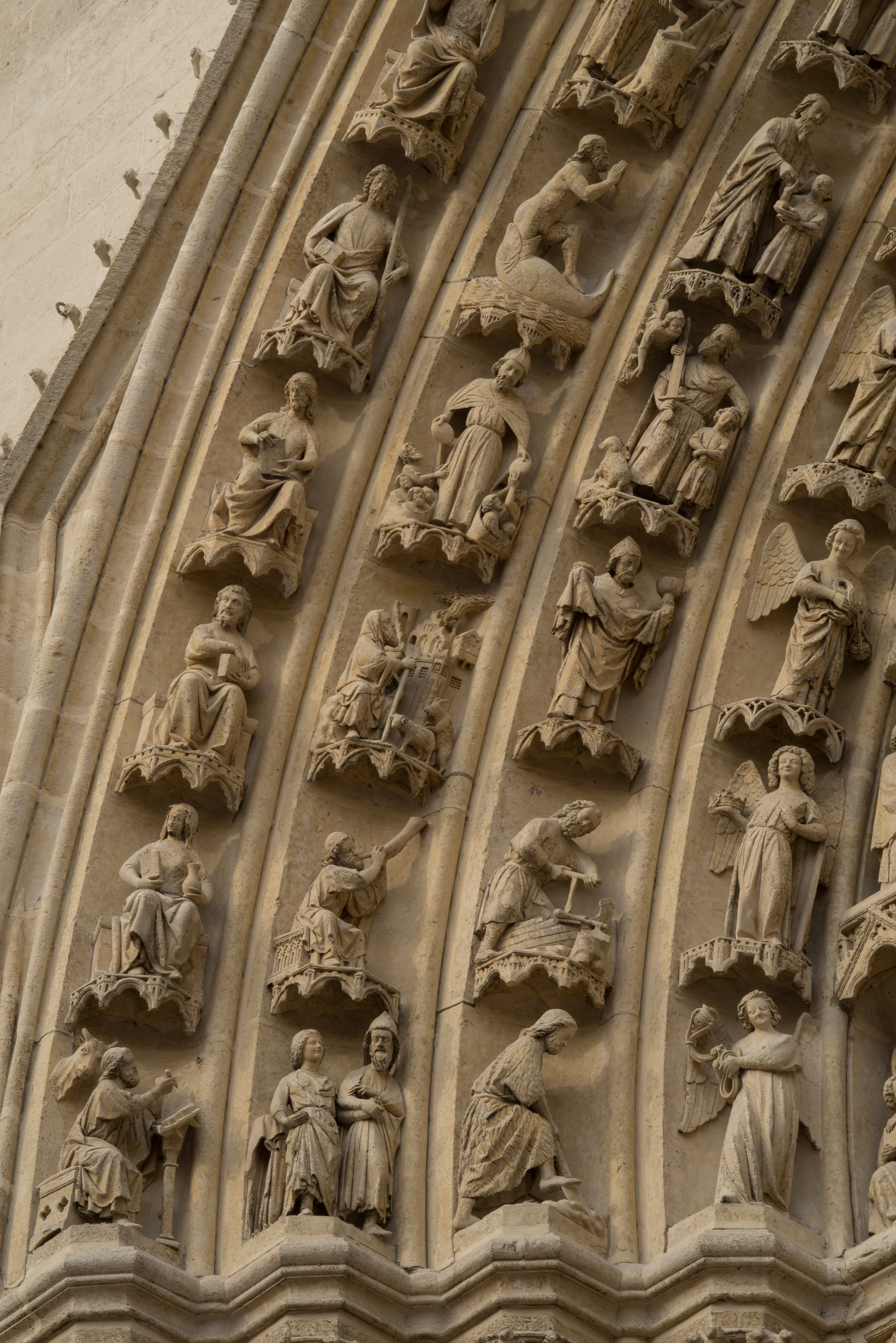
>> Life of a Cathedral: Notre-Dame of Amiens: Located in the heart of Picardy in northern France, Amiens Cathedral is one of the largest Gothic churches of the thirteenth century, renowned for the beauty of its three-tier interior elevation, its prodigious sculpted decoration, and its stained glass. This website put together by Columbia University’s Media Center for Art History offers a detailed virtual tour of the cathedral, drawing attention to its architectural features and artworks, from the many stone relief sculptures over its four portals (my favorite) to the octagonal labyrinth that adorns the marble floor in the nave to the early sixteenth-century misericords in the choir stall.
Detail of voussoirs from the south transept portal of St. Honoré at Amiens Cathedral, ca. 1240, featuring Adam working the ground, Noah building the ark, Jonah being disgorged from the fish, Hosea marrying Gomer, and other biblical figures and vignettes
+++
SONG: “Adon Olam,” performed by the Maqamat Masters, feat. Nissim Lugas: The well-loved text of this traditional Hebrew prayer in five stanzas probably originated in medieval Spain, having been first found in a thirteenth-century siddur (Jewish prayer book) from Andalusia. Drawn from the language of the Psalms, it praises God for both his transcendence and his immanence. He is incomparably great, the ruler over all, and yet he’s also a personal God, a refuge for those who call on him. The prayer’s title and opening phrase translates to “Master of the Universe” or “Eternal Lord.”
Various tunes have been used for the singing of this prayer over the centuries. The Maqamat Masters perform it here with a melody based on the traditional Armenian folk tune NUBAR NUBAR, arranged by Elad Levi and Ariel Berli. They also add to the prayer a few lines from the ghazals of the Persian Sufi poet Saadi (1210–ca. 1292), about the burning fire of God’s love; Lugas sings this Farsi passage from 3:06 to 4:08.
“Maqamat Masters is a unique group of musicians that coalesced around their work together teaching at the Maqamat School of Eastern Music in Safed, Israel,” 12 Tribes Music writes. “Each of the musicians is a master in a different traditional musical genre from the Middle East, and they bring their personal voices and decades of explorations together, to create a magical, new and innovative sound.”
+++
VIRTUAL EXHIBITION: The Faras Gallery: Treasures from the Flooded Desert: In 1960, Faras, a small town in Sudan near the Egyptian border, was one of the archaeological sites designated for flooding by the waters of the Nile to create Lake Nasser. Responding to an international call by UNESCO to preserve the area’s cultural heritage before it would be buried beneath the new reservoir, a Polish team led by Professor Kazimierz Michałowski proceeded with salvage excavations in 1961–64. Their efforts uncovered the wonderfully preserved ruins of a medieval cathedral, active from the eighth to fourteenth centuries (it was built on the remains of an early seventh-century church) and containing over 150 religious paintings, a trove of Nubian Christian art. By agreement with Sudan, half of the findings went to Poland’s National Museum in Warsaw, while the other half are kept in Sudan’s National Museum in Khartoum.
Wall Painting with Bishop Marianos under the protection of Christ and the Mother of God, early 11th century, excavated from Faras Cathedral in modern-day Sudan. Secco tempera on plaster, 247 × 155.5 cm. National Museum, Warsaw.
Curated by Paweł Dąbrowski and Magdalena Majchrzak and hosted by Google Arts & Culture, this virtual exhibition spotlights the wall paintings and artifacts from Faras that are housed in Warsaw. It discusses the importance of the discovery of the cathedral and the technical challenges of detaching the paintings (tempera on dry mud plaster) from the walls. It also includes digital reconstructions of the cathedral’s interior and exterior in 3D stereoscopy, as well as video elements. Here is one of the four videos from the exhibition:
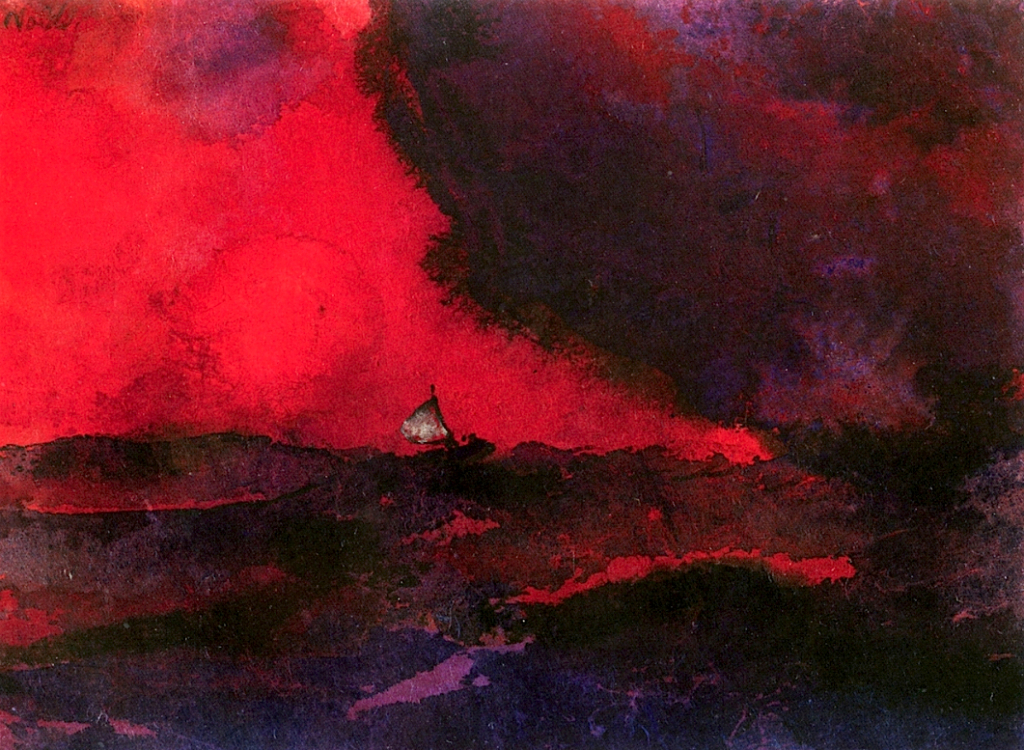
Emil Nolde (German, 1867–1956), Dark Red Sea, ca. 1938. Watercolor. Nolde Museum, Seebüll, Germany.
Mon Dieu, protégez-moi, mon navire est si petit et votre mer si grande!
Lord, help me . . . Because my boat is so small, And your sea is so immense.
This anonymous prayer collected from a Breton sailor—or fisherman, as some anthologies cite—is found in Émile Souvestre, Les derniers Bretons (The Last Bretons), vol. 1 (Paris: Charpentier, 1836), page 121. The English translation is by Robert Bly and is from the anthology The Soul Is Here for Its Own Joy: Sacred Poems from Many Cultures (New York: Ecco, 1995), which Bly edited. He identifies the prayer as “French medieval” but doesn’t provide a source. The prayer also appears as #422 in The Oxford Book of Prayer and on page 80 of 2000 Years of Prayer; the latter places it in the “Celtic Christianity” section, as Bretons are descendants of the Celts who emigrated from the British Isles to Armorica, the northwestern extremity of Gaul (now called Brittany, part of France), after the Anglo-Saxon invasions.
Though “boat” and “sea” were likely meant first and foremost literally, there is a long tradition of boats being used as metaphors for our fragile selves, afloat the vicissitudes of life, or carried about by the divine will. Living outside a maritime context, I pray this prayer in that metaphoric sense.
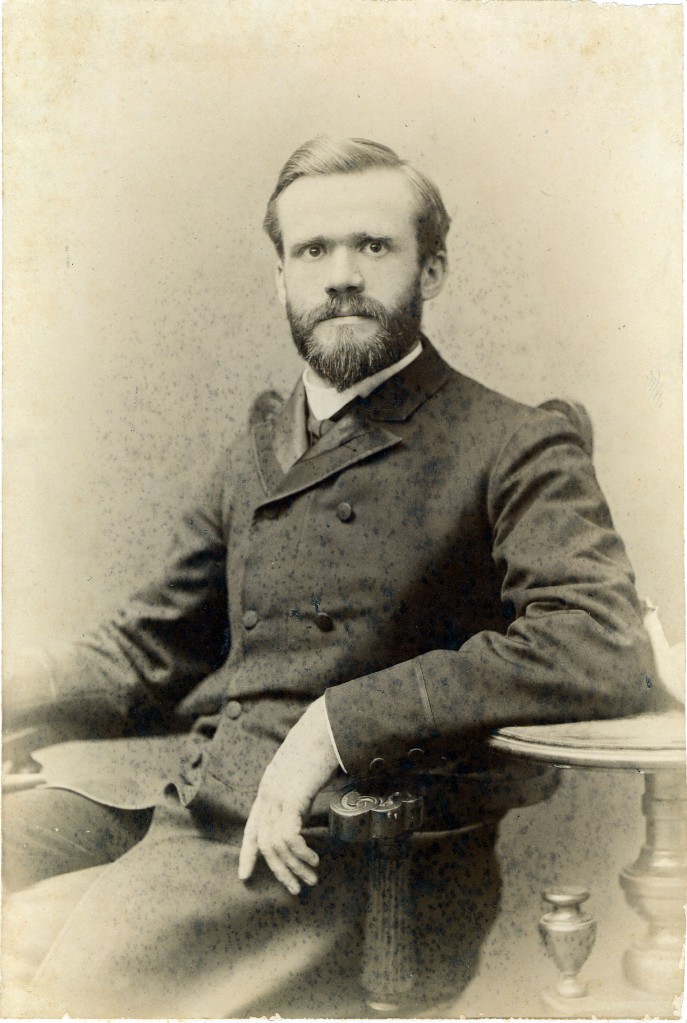
Walter Rauschenbusch (1861–1918) was a Baptist minister, theology professor, and pioneer of the Social Gospel movement, which dominated American Protestant thought in the late nineteenth and early twentieth centuries. This movement sought to apply the ethical principles Jesus taught and the theological vision he espoused to pressing social concerns, such as poverty, pollution, alcoholism, unjust wages, unregulated factories, child labor, inadequate schools, women’s suffrage, racism, and violence. The son of German immigrants, Rauschenbusch pastored a congregation in the congested and impoverished neighborhood of Hell’s Kitchen in New York City from 1886 to 1897, where he witnessed firsthand, in the lives of his congregants, the misery of exploited workers. Adults and children alike worked ten- to twelve-hour days, six days a week, and lived in unsafe and unsanitary tenements.
This pastorate was deeply formative for him as he went on to teach in academic settings and to write. From 1897 until his death he taught courses in church history and Christian ethics at Rochester Theological Seminary and published a handful of books: Christianity and the Social Crisis (1907), Prayers of theSocial Awakening (1910), Christianizing the Social Order (1912), Dare We Be Christians? (1914), The Social Principles of Jesus (1916), and A Theology for the Social Gospel (1917). Christianity Revolutionary, which he wrote in 1891, was published posthumously as The Righteousness of the Kingdom in 1968.
In some Christian circles, “social gospel” is a dirty word, as some think it overemphasizes material concerns and detracts from what they see as Jesus’s core message of the salvation of souls. The sermons and writings of Social Gospelers did swing that way, focusing on the this-worldly social implications of the good news of Jesus and not as much on the spiritual, but that’s because at the turn of the century there was a relative dearth in preaching and writing about social issues from an informed Protestant theological perspective that they sought to rectify. Christians were already well versed in the narrative of personal sin and redemption. But the notion of societal sin and societal redemption was underdeveloped territory, so Rauschenberg, Josiah Strong, Washington Gladden, Richard T. Ely, and others moved in to articulate this neglected aspect of the gospel.
The Social Gospel movement makes the kingdom of God its central doctrine. Adherents believe the mission of the church is to propagate God’s kingdom, aka the kingdom of heaven, on earth. It’s a mischaracterization that the movement is concerned only with fixing society and not people. People make up society, and change starts with them—with personal repentance. Social Gospelers would say that as people turn to Christ and are spiritually transformed by him into new creations, those transformed people, in the power of the Holy Spirit, can then, and indeed are called to, “renew the face of the earth” (Ps. 104:30).
Rauschenbusch calls out the passivity of those Christians who say they are waiting for Christ to return to set all things right but don’t participate in the Christ-spirited renewal, the setting right, that is already underway. Of course he still believed in Christ’s second coming; he just also believed it a Christian duty to anticipate that coming with acts of charity and justice. Addressing the complaint that humans are powerless to solve the world’s overwhelming social problems and can never achieve the kind of sweeping regeneration Christ will bring, he wrote in Christianity and the Social Crisis:
We know well that there is no perfection for man in this life: there is only growth toward perfection. . . . We shall never have a perfect social life, yet we must seek it with faith. We shall never abolish suffering. . . . At best there is always but an approximation to a perfect social order. The kingdom of God is always but coming.
But every approximation to it is worthwhile. . . . Everlasting pilgrimage toward the kingdom of God is better than contented stability in the tents of wickedness.
He highlights the horizontal dimension of Christ’s mission and the apostle Paul’s institution of it, claiming that “the essential purpose of Christianity was to transform human society into the kingdom of God by regenerating all human relations and reconstituting them in accordance with the will of God.” He sees the Lord’s Prayer as key, in which we pray for God’s will to be done on earth as it is in heaven. “There is no request here that we be saved from earthliness and go to heaven, which has been the great object of churchly religion,” he writes. “We pray here that heaven may be duplicated on earth through the moral and spiritual transformation of humanity, both in its personal and its corporate life.” God’s salvation is not a salvation from this world but a salvation in and for this world.
The 1892 statement of the Brotherhood of the Kingdom, drafted by Rauschenbusch, Nathaniel Schmidt, and Leighton Williams, comments on the all-too-common truncated view of the gospel:
Because the individualist conception of personal salvation has pushed out of sight the collective idea of a Kingdom of God on earth, Christian men seek for the salvation of individuals and are comparatively indifferent to the spread of the spirit of Christ in the political, industrial, social scientific, and artistic life of humanity, and have left these as the undisturbed possessions of the spirit of the world. Because the Kingdom of God has been understood as a state to be inherited in a future life rather than as something to be realized here and now, therefore Christians have been contented with a low plane of life here and have postponed holiness to the future.
While I wouldn’t say I’m part of the Social Gospel movement, I’ve definitely been positively influenced by it—I’m not in the bandwagon of denigrators—even as I try to integrate and balance its wisdom with Jesus’s other proclamations.
Martin Luther King Jr. was an appreciator too. He wrote in Stride toward Freedom (1958),
Rauschenbusch had done a great service for the Christian church by insisting the gospel deals with the whole man, not only his soul but his body; not only his spiritual well-being but his material well-being. It has been my conviction ever since reading Rauschenbusch that any religion which professes to be concerned about the soul of men and is not concerned about the social and economic conditions that scar that soul, is a spiritually moribund religion waiting for the day to be buried.
(King was killed, remember, at a workers’ rights rally.)
The Social Gospel movement advocated social change, seeking the betterment of industrialized society through the application of biblical principles. It contributed to the New Deal and other progressive governmental programs in the US and Canada in the 1930s and ’40s and prefigured elements of liberation theology, which emerged in Latin America in the late 1960s.
My entrée to Rauschenbusch’s thought was through his published prayers. I had been conditioned to treat as suspect any products of the Social Gospel movement, so I was not expecting to be as moved as I was by his petitions and thanksgivings to God, which convey his deep and wide concern for the world, and which I’ve found meaningful to lift up in my own prayer time.
His collection includes prayers for employers, homeless children, immigrants, consumers, judges, legislators, artists, doctors and nurses, journalists, the environment, and so on, as well as prayers for morning, evening, and mealtime.
The following is a selection of prayers from Walter Rauschenbusch, Prayers of the Social Awakening (Boston and Chicago: The Pilgrim Press, 1910), which is in the public domain. I have lightly edited them, mainly for gender inclusivity. All headings, save for the fourth one (which I updated the language of), are Rauschenbusch’s.
Grace before Meat
“Our Father, thou art the final source of all our comforts, and to thee we render thanks for this food. But we also remember in gratitude the many men and women whose labor was necessary to produce it, and who gathered it from the land and afar from the sea for our sustenance. Grant that they too may enjoy the fruit of their labor without want, and may be bound up with us in a fellowship of thankful hearts.”
Prayer for This World
“O God, we thank thee for this universe, our great home; for its vastness and its riches, and for the manifoldness of the life which teems upon it and of which we are part. We praise thee for the arching sky and the blessed winds, for the driving clouds and the constellations on high. We praise thee for the salt sea and the running water, for the everlasting hills, for the trees, and for the grass under our feet. We thank thee for our senses by which we can see the splendor of the morning, and hear the jubilant songs of love, and smell the breath of the springtime. Grant us, we pray thee, a heart wide open to all this joy and beauty, and save our souls from being so steeped in care or so darkened by passion that we pass heedless and unseeing when even the thornbush by the wayside is aflame with the glory of God. Enlarge within us the sense of fellowship with all the living things, our kin, to whom thou hast given this earth as their home in common with us. We remember with shame that in the past we have exercised dominion with ruthless cruelty, so that the voice of the earth, which should have gone up to thee in song, has been a groan of travail. May we realize that they live not for us alone but for themselves and for thee, and that they love the sweetness of life even as we, and serve thee in their place better than we in ours. When our use of this world is over and we make room for others, may we not leave anything ravished by our greed or spoiled by our ignorance, but may we hand on our common heritage fairer and sweeter through our use of it, undiminished in fertility and joy, that so our bodies may return in peace to the great mother who nourished them and our spirits may round the circle of a perfect life in thee.”
Prayer for Employers
“We invoke thy grace and wisdom, O Lord, upon all people of goodwill who employ and control the labor of others. Amid the numberless irritations and anxieties of their position, help them to keep a quiet and patient temper, and to rule firmly and wisely, without harshness and anger. Since they hold power over the bread, the safety, and the hopes of the workers, may they wield their powers justly and with love, as older siblings and leaders in the great fellowship of labor. Suffer not the heavenly light of compassion for the weak and the old to be quenched in their hearts. When they are tempted to follow the ruthless ways of others, and to sacrifice human health and life for profit, do thou strengthen their will in the hour of need, and bring to naught the counsels of the heartless. Save them from repressing their workers into sullen submission and helpless fear. May they not sin against the Christ by using people’s bodies and souls as mere tools to make things, forgetting the human hearts and longings of these their brothers and sisters.”
Prayer for the Unemployed
“O God, we remember with pain and pity the thousands of our brothers and sisters who seek honest work and seek in vain. For though unsatisfied wants are many, and though our land is wide and calls for labor, yet these thy sons and daughters have no place to labor, and are turned away in humiliation and despair when they seek it. O righteous God, we acknowledge our common guilt for the disorder of our industry which thrusts even willing workers into the degradation of idleness and want, and teaches some to love the sloth which once they feared and hated. We remember also with sorrow and compassion the idle rich, who have vigor of body and mind and yet produce no useful thing. Forgive them for loading the burden of their support on the bent shoulders of the working world. Forgive them for wasting in refined excess what would feed the pale children of the poor. Forgive them for setting their poisoned splendor before the thirsty hearts of the young, luring them to theft or shame by the lust of eye and flesh. Forgive them for taking pride in their workless lives and despising those by whose toil they live. Forgive them for appeasing their better self by pretended duties and injurious charities. We beseech thee to awaken them by the new voice of thy Spirit that they may look up unto the stern eyes of thy Christ and may be smitten with the blessed pangs of repentance. Grant them strength of soul to rise from their silken shame and to give their brothers and sisters a just return of labor for the bread they eat. And to our whole nation do thou grant wisdom to create a world in which none shall be forced to idle in want, and none shall be able to idle in luxury, but in which all shall know the health of wholesome work and the sweetness of well-earned rest.”
Prayer for Artists and Musicians
“O thou who art the all-pervading glory of the world, we bless thee for the power of beauty to gladden our hearts. We praise thee that even the least of us may feel a thrill of thy creative joy when we give form and substance to our thoughts and, beholding our handiwork, find it good and fair. We praise thee for our brothers and sisters, the masters of form and color and sound, who have power to unlock for us the vaster spaces of emotion and to lead us by their hand into the reaches of nobler passions. We rejoice in their gifts and pray thee to save them from the temptations which beset their powers. Save them from selfish ambition and the vanity that feeds on cheap applause, and from the dark phantoms that haunt the listening soul. Let them not satisfy their hunger for beauty with mere tricks of skill, devoid of spirit. Teach them that they are but servants of their fellow beings, and that the promise of their gifts can fulfill itself only in the service of love. Give them faith in the inspiring power of a great purpose and courage to follow to the end the visions of their youth. Kindle in their hearts a compassion for the joyless lives of the people, and make them rejoice if they are found worthy to hold the cup of beauty to lips that are athirst. Make them reverent interpreters of you, they who see thy face and hear thy voice in all things, so that they may unveil for us the beauties of nature which we have passed unseeing, and the sadness and sweetness of humanity to which our selfishness has made us oblivious.”
Prayer for Lawyers and Legislators
“O Lord, thou art the eternal order of the universe. Our human laws at best are but an approximation to thine immutable law, and if our institutions are to stand, they must rest on justice, for only justice can endure. We beseech thee for the men and women who are set to make and interpret the laws of our nation. Grant to all lawyers a deep consciousness that they are called of God to see justice done, and that they prostitute a holy duty if ever they connive in its defeat. Fill them with a high determination to make the courts of our land a strong fortress of defense for the poor and weak, and never a castle of oppression for the hard and cunning. Save them from surrendering the dear-bought safeguards of the people for which our foreparents fought and suffered. Revive in them the spirit of the great liberators of the past that they may cleanse our law of the inherited wrongs that still cling to it. Suffer not the web of outgrown precedents to veil their moral vision, but grant them a penetrating eye for the rights and wrongs of today and a quick human sympathy with the life and sufferings of the people. May they not perpetuate the tangles of the law for the profit of their profession. Aid them to make its course so simple, and its justice so swift and sure, that the humblest may safely trust it and the strongest fear it. Grant them wisdom so to refashion all law that it may become the true expression of the fairer ideals of freedom and brotherhood which are now seeking their incarnation in a new age. Make these our brothers and sisters the wise interpreters of thine eternal law, the brave spokespersons of thy will, and in reward bestow upon them the joy of conscious fellowship with thy Christ in saving people from the bondage of ancient wrong.”
Prayer against War
“O Lord, since first the blood of Abel cried to thee from the ground that drank it, this earth of thine has been defiled with human blood shed by the hand of siblings, and the centuries sob with the ceaseless horror of war. Ever the pride of kings and the covetousness of the strong have driven peaceful nations to slaughter. Ever the songs of the past and the pomp of armies have been used to inflame the passions of the people. Our spirit cries out to thee in revolt against it, and we know that our righteous anger is answered by thy holy wrath. Break thou the spell of the enchantments that make the nations drunk with the lust of battle and draw them on as willing tools of death. Grant us a quiet and steadfast mind when our own nation clamors for vengeance or aggression. Strengthen our sense of justice and regard for the equal worth of other peoples and races. Grant to the rulers of nations faith in the possibility of peace through justice, and grant to the common people a new and stern enthusiasm for the cause of peace. Bless our soldiers and sailors for their swift obedience and their willingness to answer to the call of duty, but inspire them nonetheless with a hatred of war, and may they never for love of private glory or advancement provoke its coming. May our young men and women still rejoice to die for their country with the valor of their parents, but teach our age nobler methods of matching our strength and more effective ways of giving our life for the flag. O thou strong Father of all nations, draw all thy great family together with an increasing sense of our common blood and destiny, that peace may come on earth at last, and thy sun may shed its light rejoicing on a holy kinship of peoples.”
Prayer for Conferences and Conventions
“We praise thee, O God, for our friends and fellow workers, for the touch of their hands and the brightness of their faces, for the cheer of their words and the outflow of goodwill that refreshes us. Grant us the insight of love that we may see them as thou seest, not as frail mortals, but as radiant children of God who have wrought patience out of tribulation and who bear in earthen vessels the treasures of thy grace. May nought mar the joy of our fellowship here. May none remain lonely and hungry of heart among us. Let none go hence without the joy of new friendships. Give us more capacity for love and a richer consciousness of being loved. Overcome our coldness and reserve that we may throw ajar the gates of our heart and keep open house this day. Lift our human friendships to the level of spiritual companionship. May we realize thee as the eternal bond of our unity. Shine upon us from the faces of thy servants, thou all-pervading beauty, that in loving them we may be praising thee. Through Christ, our Lord.”
Evening Prayers
“O Lord, we praise thee for our sister, Night, who folds all the tired folk of the earth in her comfortable robe of darkness and gives them sleep. Release now the strained limbs of toil and smooth the brow of care. Grant us the refreshing draught of restfulness that we may rise in the morning with a smile on our face. Comfort and ease those who toss wakeful on a bed of pain, or whose aching nerves crave sleep and find it not. Save them from evil or despondent thoughts in the long darkness, and teach them so to lean on thy all-pervading life and love, that their souls may grow tranquil and their bodies, too, may rest. And now through thee we send Good Night to all our brothers and sisters near and far, and pray for peace upon all the earth.”
“Our Father, as we turn to the comfort of our rest, we remember those who must wake that we may sleep. Bless the guardians of peace who protect us against those of evil will, the watchers who save us from the terrors of fire, and all the many who carry on through the hours of the night the restless commerce we require on sea and land. We thank thee for their faithfulness and sense of duty. We pray for thy pardon if our covetousness or luxury makes their nightly toil necessary. Grant that we may realize how dependent the safety of our loved ones and the comforts of our life are on these our brothers and sisters, that so we may think of them with love and gratitude and help to make their burden lighter.”
“Accept the work of this day, O Lord, as we lay it at thy feet. Thou knowest its imperfections, and we know. Of the brave purposes of the morning only a few have found their fulfillment. We bless thee that thou art no hard taskmaster, watching grimly the stint of work we bring, but the father and teacher of people who rejoices with us as we learn to work. We have naught to boast before thee, but we do not fear thy face. Thou knowest all things and thou art love. Accept every right intention however brokenly fulfilled, but grant that ere our life is done we may under thy tuition become true master workers, who know the art of a just and valiant life.”
“Our Master, as this day closes and passes from our control, the sense of our shortcomings is quick within us and we seek thy pardon. But since we daily crave thy mercy on our weakness, help us now to show mercy to those who have this day grieved or angered us and to forgive them utterly. Suffer us not to cherish dark thoughts of resentment or revenge. So fill us with thy abounding love and peace that no ill will may be left in our hearts as we turn to our rest. And if we remember that any brother or sister justly hath aught against us through this day’s work, fix in us this moment the firm resolve to make good the wrong and to win again the love of our sibling. Suffer us not to darken thy world by lovelessness, but give us the power of the children of God to bring in the reign of love among people.”
O Lord, in whose countenance is the morning of all things made new, shine upon us that we may illumine with peace the world-home thou hast given us. Remove from us pride of might and arrogance of possession. Stretch our thoughts, O Divine Mind, that we may see the whole earth as our country, and the inhabitants thereof as our neighbors. Fill our hearts with love that changes discord to trust.
Temper to our good the weariness and the broken hopes we cannot escape. Pour into us the strength of all valiant spirits. Put into our hands constructive tasks of peace. Let not our striving end with condemnation of folly and stupidity in high places.
Quicken in us the will to resist the hysteria that they who take the sword raise to turn us aside from thy commandments. Give us power to the depth, breadth, and height of our souls to prevent the destructions we have lived to weep. Out of the embers of fires that have scorched and blackened thy kingdom on earth, help us create a new order in which we will no more become savages through fear. Unite us, millions strong, against the darkness of hate, as unnumbered sunbeams streaming one way sweeten the sod unto green ecstasy and fruitfulness.
—Helen Keller, “Prayer for Peace,” delivered April 5, 1936, at the “East of Suez” bazaar at the New History Society’s Caravan Hall, New York City [HT]
In February I shared a few of the Vespers services offered at this year’s Calvin Symposium on Worship at Calvin University in Grand Rapids, Michigan, which I was privileged to attend. Here are two of the full-fledged services that give you a sense of what the larger corporate gatherings are like. (The theme was Ezekiel.) I love the cross-cultural sharing that goes on, learning new songs alongside others, getting refreshed by prayer and formed by liturgy, sitting under the teaching of wise ministers of God from various backgrounds, and taking Communion with friends new and old.
>> “God’s Glory Departs from Israel,” February 8, 2024 (with bilingual Korean-English music and liturgy): This worship service was led in Korean and English by the Woodlawn Christian Reformed Church Choir, directed by Chan Gyu Jang; the Living Water Church Worship Team, directed by Yohan Lee; and members of the Calvin University and Calvin Theological Seminary Korean communities. Rev. Dr. Anne Zaki from Evangelical Presbyterian Seminary in Cairo, Egypt, preached on Ezekiel 10–11.
This is an example of bilingual worship done really well! (I’ve seen it done poorly: with lack of communication of intention, one-sided involvement in the design or execution, inadequate pronunciation coaching for non-native speakers at the mic, unclear instructions that create confusion as to who is supposed to say or sing what, unintelligibility, etc.) I’m so grateful for all the creativity and thoughtfulness that went into creating this service—with a special shout-out to the bulletin designers and livestream technicians.
The bulletin provides this note on bilingual worship:
Two languages are intertwined together in this bilingual service. At times, words are spoken in one language, and their translation—unspoken—is provided on the righthand column; at times, the leaders demonstrate to the congregation how to sing or speak the words through transliteration; and at other times, the leaders and congregation converse in both languages, providing meaning to each other, so that no word sung or spoken is left unintelligible. We seek understanding and order in the sharing of our gifts.
In our pursuit, however, we practice patience and hospitality. In this service, we are called not only to speak and sing, but also to listen, to take turns. By listening, we create a room—a shelter—for travelers and strangers in this land, since language and music have power to transport one’s soul homeward. By taking turns, we practice the pace and posture of dialogue, even monolingual dialogue.
Beautiful! Here are three songs I’ll call out for special attention:
9:14: “Joo-yeo, Come, O Lord” by Sunlac Noh: This song, which is particularly well suited for Advent, originated in the Anglican Church of Korea and was translated into English last year by Martin Tel (see podcast interview below). The version we sang at the symposium preserves two of the Korean titles for Jesus.
23:36: “우리에게향하신” (Woo-ri-e-ge Hyang-ha-shin) (Never-Ending Is God’s Love) by Jin-ho Kim, based on Psalm 117:2: Sung entirely in Korean, this was used as a refrain during the Assurance of Pardon and the Prayers of the People. A simple, repeated line, either sung or spoken, is a good way to involve non-native speakers of a given language.
1:14:37: “주님다시오실때까지 / Rise, My Soul, Till Jesus Comes Again” by Hyeong-won Koh: The closing song is a charge to continue in the way of Jesus, all the way Home. The vocalists on stage sang the song themselves in its original Korean the first time through, and then we all joined in in English for the second time.
All the song credits are provided in full in the YouTube video description.
I want to especially draw your attention to 23:31, where Floyd premieres an extraordinary new song of hers, “God Breathed.” It opens and closes with a flute, and in between are her powerful jazz vocals, singing an original poetic text based on Ezekiel 37, accompanied by James Weidman on piano. (Update: Here’s a standalone video of the song.)
+++
PODCAST EPISODE: “Fighting Back Against the Storms of Life with Martin Tel,”Psalms for the Spirit: Host Kiran Young Wimberly interviews Martin Tel, director of music at Princeton Theological Seminary and senior editor of Psalms for All Seasons: A Complete Psalter for Worship (2012), about the Psalms—the importance of psalm singing in his Dutch Reformed upbringing; the Psalms as a form of resistance and protest; the Psalms as a means of praying our own prayers and those of others; our need to overhear some psalms as being prayed against us (that is, have you considered that you might be someone else’s oppressor?); and ideas for framing a psalm with a refrain, such as these:
Combine the Charles Albert Tindley gospel song “The Storm Is Passing Over” with Psalm 57 (“In the shadow of your wings I will take refuge, until the destroying storms pass by . . .”). Sing into the storm.
Choose a Gospel passage of someone in deep lament (e.g., the ten lepers in Luke 17:11–19), surround it with Psalm 88, and have the congregation sing “Kum Ba Yah” (Gullah for “Come by Here”) in minor mode as a refrain (“Someone’s crying, Lord . . .”). A choir can hum the spiritual while the reader(s) read the scriptures.
Intersperse the verses of Psalm 14 (“Fools say in their heart, ‘There is no God.’ . . . They have all gone astray . . .”) with the refrain “Prone to wander, Lord, I feel it . . .” to help the congregation members see their own foolishness instead of assuming it’s someone else who’s the fool.
+++
ARTICLE: “The Mysteries of Liturgical Sincerity” by John Witvliet, Worship (reprinted Pray Tell), May 2018: Some Protestants accuse the more liturgically inclined Christians, like me, of not valuing sincerity in worship because we value prewritten prayers and other set forms. But just because something is scripted or done habitually does not make it “rote” or “empty.”
“Among my mostly Protestant students, no theme is more contested, misunderstood, or cherished” than sincerity, writes John D. Witvliet, director of the Calvin Institute of Christian Worship and professor of worship, theology, and congregational and ministry studies at Calvin University and Calvin Theological Seminary. In this article he explores several different definitions of sincerity, which vary widely across cultures, centuries, philosophical frameworks, and Christian traditions, and then offers six “corrective lenses” to common astigmatisms in the free-church Protestant way of viewing the world: outside-in sincerity, vicarious sincerity, trait sincerity, symbiotic sincerity, sincerity as gift, and aspirational sincerity.
This article is SO GOOD. I have been greatly influenced over the years by Dr. Witvliet’s teachings on liturgical formation, and I strongly encourage you all to read this piece.
+++
EKPHRASTIC POEMS:
An ekphrastic poem is a poem written in response to a work of visual art. Here are two examples I like from the past two years:
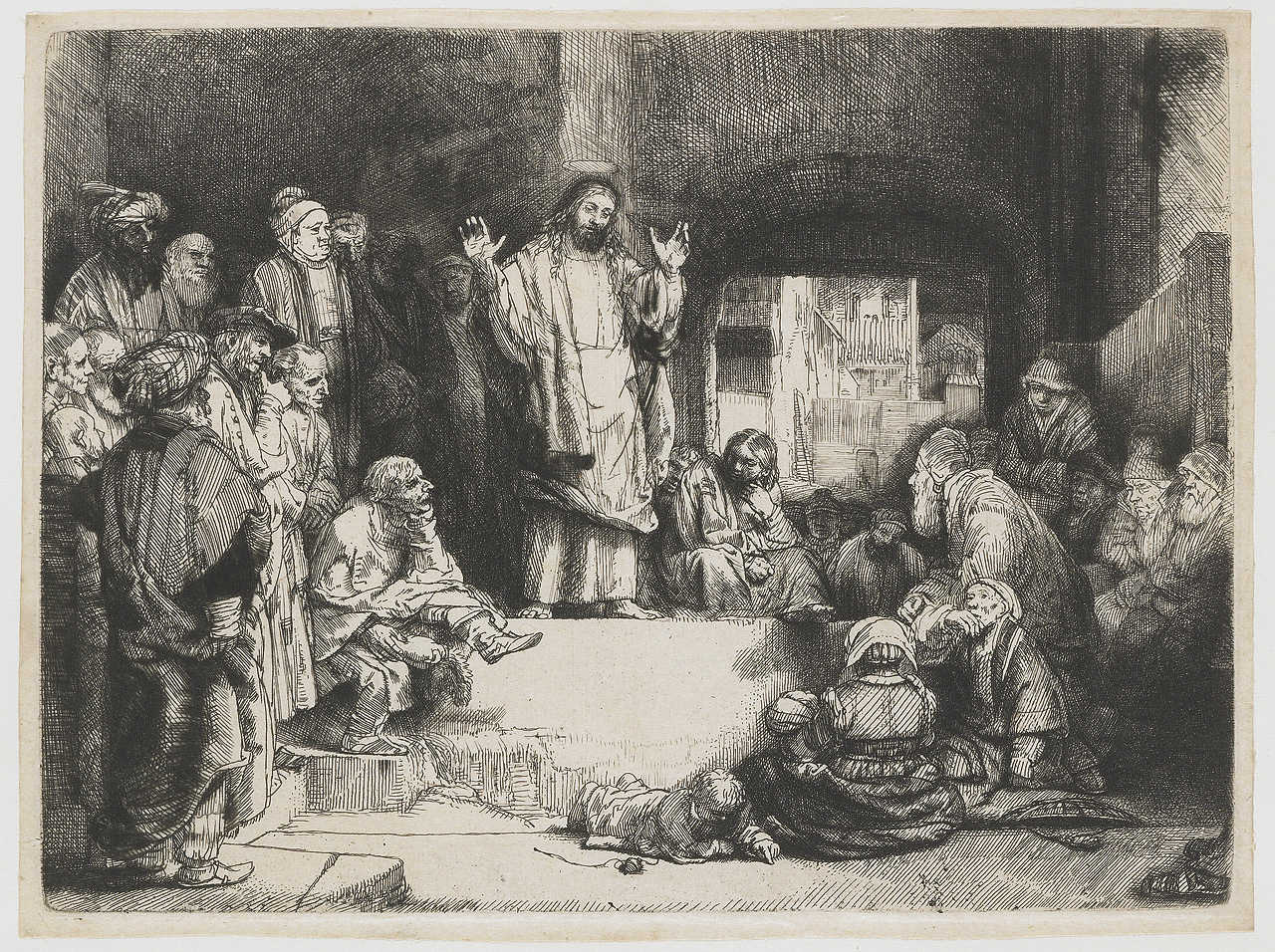
>> “Christ Preaching”by Keene Carter, Image: “I forgive the absent boy,” begins this poem based on a Rembrandt etching, directing our attention to the young child in the foreground who has turned away, disinterested, from Jesus’s sermon, drawing on the ground instead. Jesus gives grace to those in the crowd with averted gazes or who are distracted, simply continuing to preach on on the virtue of empathy—of seeing yourself in others—and on true life.
Rembrandt van Rijn (Dutch, 1606–1669), Christ Preaching (La Petite Tombe), ca. 1652. Etching, engraving, and drypoint on paper, 6 1/4 x 8 5/16 in. (15.9 × 21.1 cm). National Gallery of Art, Washington, DC.
>> “L’Angélus”by Seth Wieck, Grand Little Things:The Angelus is a traditional Christian prayer whose name comes from its opening words in Latin, “Angelus Domini” (The angel of the Lord). For centuries it was prayed by the faithful three times a day—at 6 a.m., noon, and 6 p.m.—the times announced by the ringing of bells from church towers. In the nineteenth century Millet famously painted two peasant farmers at dusk pausing from their labor in the fields to bow their heads and pray the Angelus. Seth Wieck interprets the painting through poetry, homing in on the part of the prayer that says, “Let it be done to me according to thy word,” expressing an attitude of surrender to God’s will. Wieck imagines the hard life of the man and woman shown pulling up potatoes from the earth—the same earth in which, shortly hence, they’ll bury a child, lost to sickness. The poem becomes a meditation on death, harvest, and acceptance.
Jean-Franҫois Millet (French, 1814–1875), The Angelus, 1857–59. Oil on canvas, 55.5 × 66 cm. Musée d’Orsay, Paris.
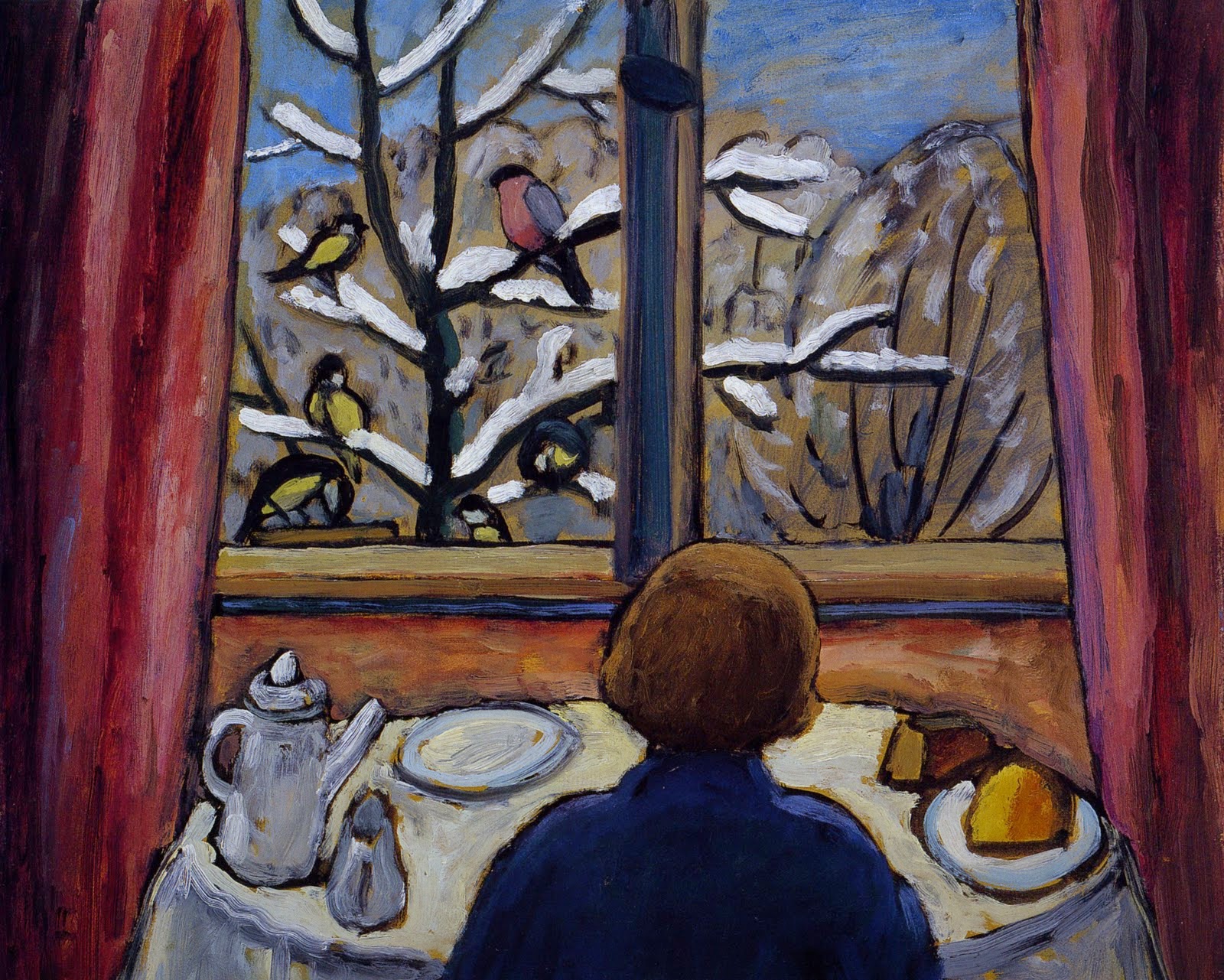
Gabriele Münter (German, 1877–1962), Breakfast of the Birds, 1934. Oil on board, 18 × 21 3/4 in. National Museum of Women in the Arts, Washington, DC.
I love to rise ere gleams the tardy light,
Winter’s pale dawn; and as warm fires illume,
And cheerful tapers shine around the room,
Through misty windows bend my musing sight,
Where, round the dusky lawn, the mansions white,
With shutters closed, peer faintly through the gloom
That slow recedes; while yon gray spires assume,
Rising from their dark pile, an added height
By indistinctness given—then to decree
The grateful thoughts to God, ere they unfold
To friendship, or the Muse, or seek with glee
Wisdom’s rich page. O hours more worth than gold,
By whose blest use we lengthen life, and, free
From drear decays of age, outlive the old!
Anna Seward (1747–1809), nicknamed the Swan of Lichfield, was a British Romantic poet who wrote elegies, odes, ballads, sonnets, and the well-received verse-novel Louisa (1784). Active in Lichfield’s literary community, she benefitted from her clergyman father’s progressive views on female education. She was a prodigious correspondent and was seen as an authority on English literature by contemporaries such as Samuel Johnson, Robert Southey, and Sir Walter Scott, the latter of whom edited her posthumously published Poetical Works in three volumes (1810).
When I was little, my bedtime routine involved me propping up my plush Precious Moments doll beside me on my bedside floor, her hands Velcroed together, so that she could accompany me in praying this prayer:
Now I lay me down to sleep I pray the Lord my soul to keep If I should die before I wake I pray the Lord my soul to take
This rhyming quatrain from colonial New England,[1] simple though it is, cultivated in me a warm sense of God’s care and protection through the night.
Perhaps the latter half sounds morbid—but keep in mind that it comes from a time when child mortality rates were much higher, as, given the lack of advanced medicine and effective vaccines, illnesses were frequent and often fatal. A later variation of the prayer omits the reference to death, replacing the second couplet with the cutesier “Thy love guard me through the night, / And wake me with the morning light.”
I will both lie down and sleep in peace, for you alone, O LORD, make me lie down in safety.
—Psalm 4:8
As an adult, I’ve encountered another evening prayer that reminds me of “Now I Lay Me Down to Sleep”—similar content, same meter, but likely dating all the way back to the fifth or sixth century, and originally written in Latin. It’s called Te lucis ante terminum (Before the Ending of the Day):
Te lucis ante terminum,
Rerum Creator poscimus,
Ut pro tua clementia
Sis præsul et custodia.

Procul recedant somnia,
Et noctium phantasmata;
Hostemque nostrum comprime,
Ne polluantur corpora.

Præsta, Pater piissime,
Patrique compar Unice,
Cum Spiritu Paraclito
Regnans per omne sæculum.
Before the ending of the day,
Creator of the world, we pray
That with Thy wonted favor Thou
Wouldst be our Guard and Keeper now.

From all ill dreams defend our eyes,
From nightly fears and fantasies;
Tread under foot our ghostly foe,
That no pollution we may know.

O Father, that we ask be done,
Through Jesus Christ, Thine only Son;
Who, with the Holy Ghost and Thee,
Doth live and reign eternally.

Trans. John Mason Neale
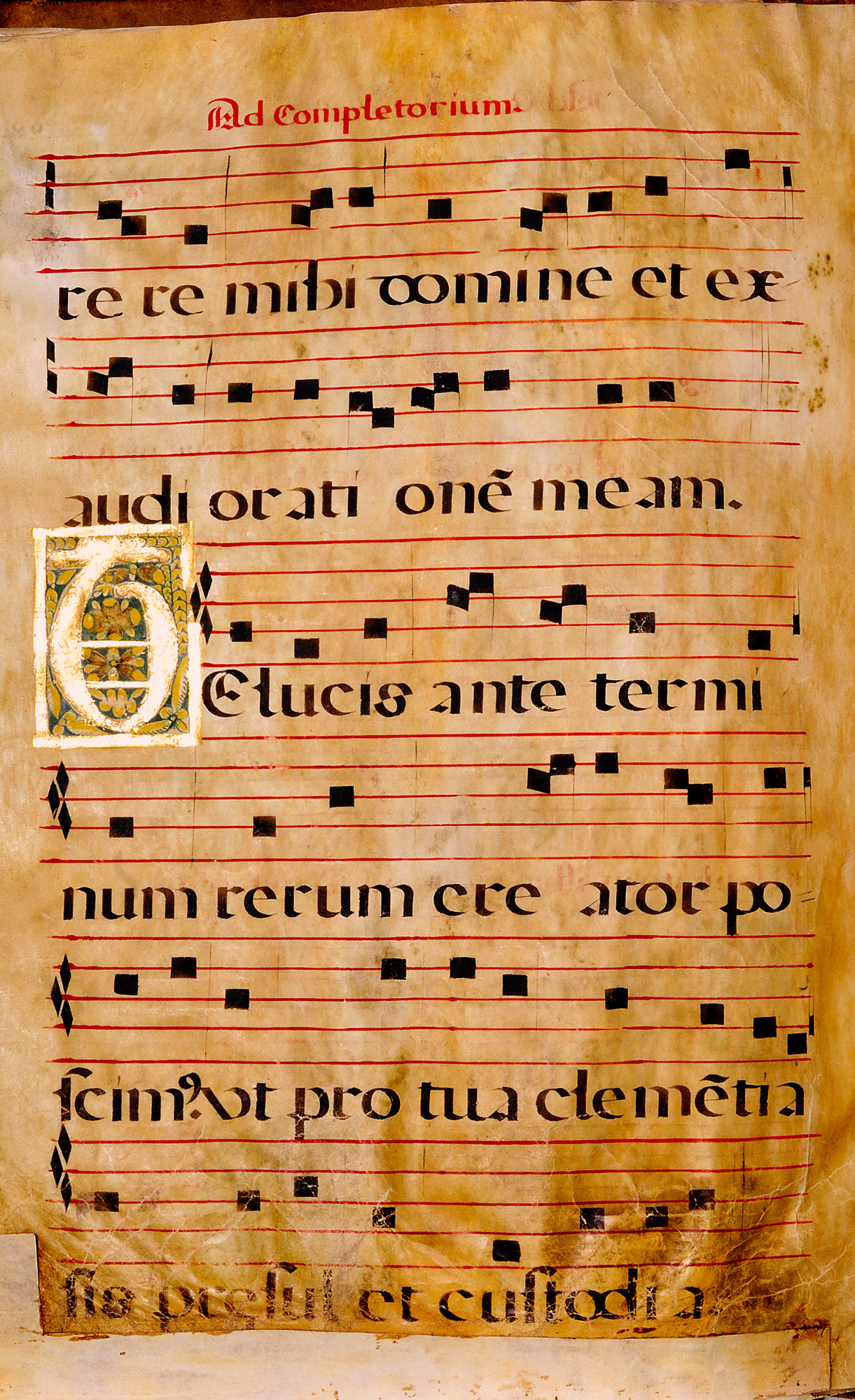
This prayer is sung liturgically as the office hymn at Compline in the Roman Rite. It was originally, and continues to be, sung to plainsong melodies from the Liber Usualis (Usual Book) and the Sarum Rite, such as this one:
Te lucis ante terminum from an antiphonary, Spain, 1575–1625. Rare Books and Special Collections, University of British Columbia Library, Vancouver. [object record]
The great English High Renaissance composer Thomas Tallis wrote two five-voice settings of the hymn in 1575, of which the ferial tone is performed here by The King’s Singers:
Upon my first reading [of Te lucis] I was immediately struck by the color and imagination inherent in the language, particularly in the second stanza – where the deep calm of the previous verse is replaced by foreboding images of the shades of night. A beautiful symmetry is achieved by the addition of the eloquent Gloria Patri that brings the hymn to a close. Through the patient and fluid unfolding of the Latin, St. Ambrose[2] has imbued this hymn with a sense of comfort and warmth, offering hope for a light to illumine the dark hours to come.
The last setting I want to share is Owain Park’s from 2020, released under the title “Night Prayer.” His was inspired by ancient plainchant and was specially composed for virtual choirs during COVID-19. Listen to the premiere performance by his vocal consort, the Gesualdo Six (Park is the singer at bottom right):
The photographs by Ash Mills in this video, some of them long-exposure (gorgeous!), are of Salisbury Cathedral’s annual “From Darkness to Light” Advent procession, in which the medieval church is gradually filled with the light of over one thousand candles.
The music gives the words a gravitas and a beauty that I think they lack on their own. Why not choose one of these as a bedtime track to play for your little one as they fall asleep! Or for your own anxious soul. The pronouns are first-person plural, indicating that this prayer is intended to be prayed in community. Make it a family listening event. And if you feel so inclined, you might even try chanting along with the choir of Yorkminster Park Baptist Church in Toronto!
NOTES
1. Although I’ve seen “As I Lay Me Down to Sleep” spuriously attributed as “Old English,” its earliest known appearance in print is in the 1737 edition of the New England Primer, a popular reading textbook used in the American colonies, published in Boston.
2. Abbot S.-G. Pimont, author of Les Hymnes du Bréviaire romaine (Paris, 1874), is the one who attributed the text of Te lucis to Ambrose of Milan (ca. 339–397), but this authorship claim was rejected by the Benedictine editors of The Catholic Encyclopedia (Robert Appleton, 1912) and by patristics scholar Luigi Biraghi and today is generally regarded as false.
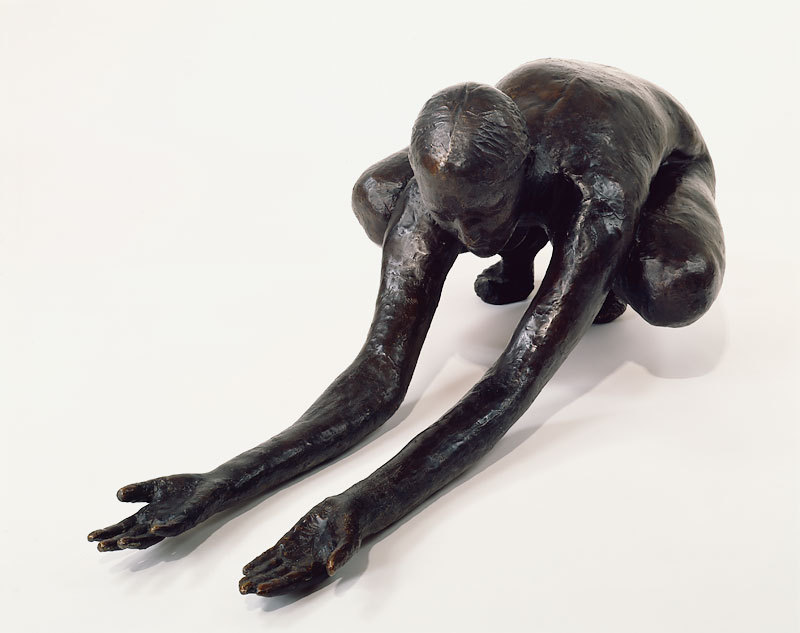
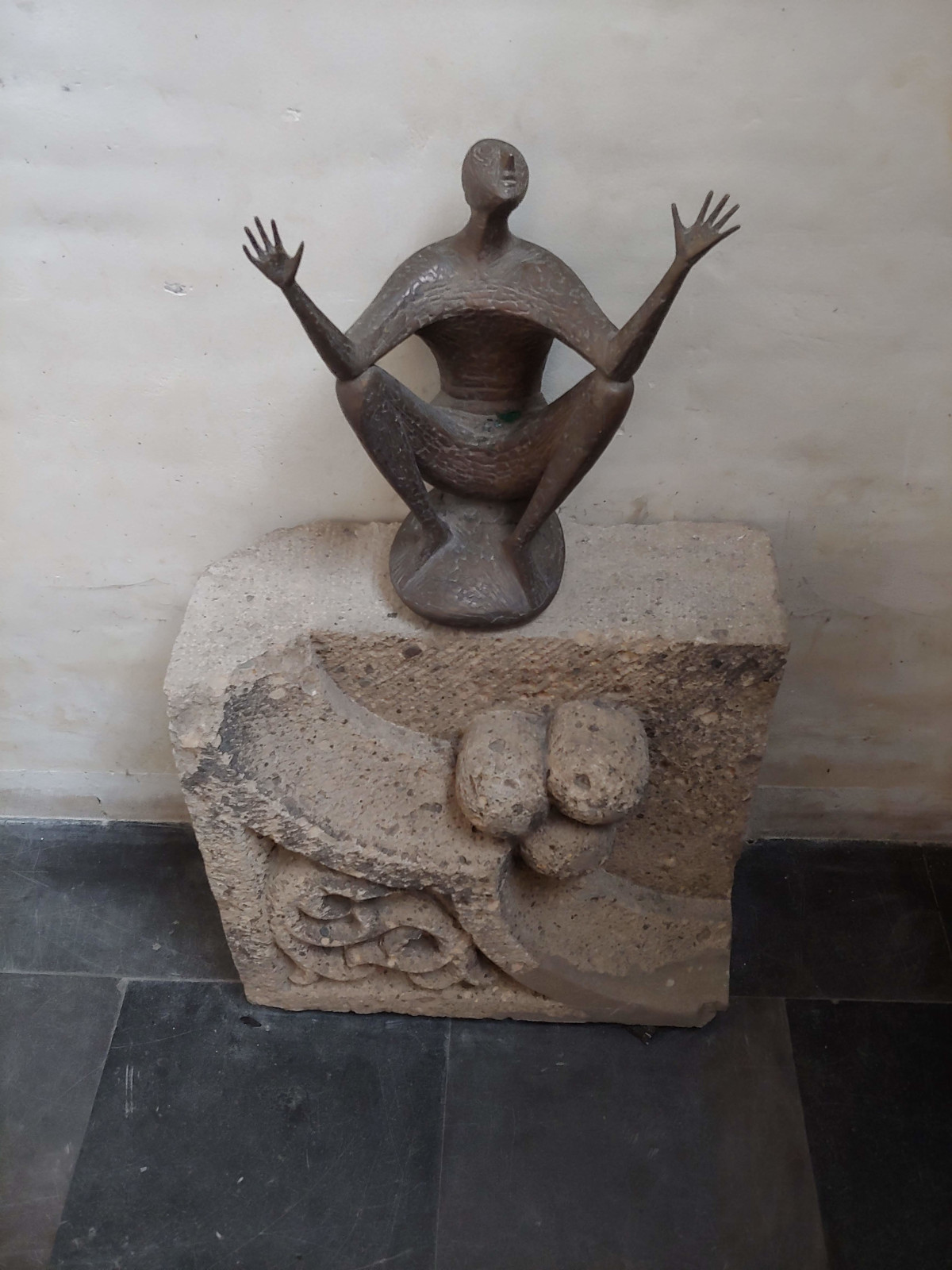
Unidentified sculpture at the Grote of Sint-Laurenskerk (Church of Saint Lawrence), Rotterdam, Netherlands. Photo: Victoria Emily Jones.
Would God I knew there were a God to thank
     When thanks rise in me, certain that my cries
Do not like blind men’s arrows pierce the skies
     Only to fall short of my quarry’s flank.
Why do I thirst, a desperate castaway
     Quaffing salt water, powerless to stop,
Sick lark locked in a cellar far from day,
     Lone climber of a peak that has no top?

To praise God is to bellow down a well
     From which rebounds one’s own dull booming voice,
          Yet the least leaf points to some One to thank.
The whorl embodied in the slightest shell,
     The firefly’s glimmer signify Rejoice!
          Though overhead, clouds cruise a sullen blank.
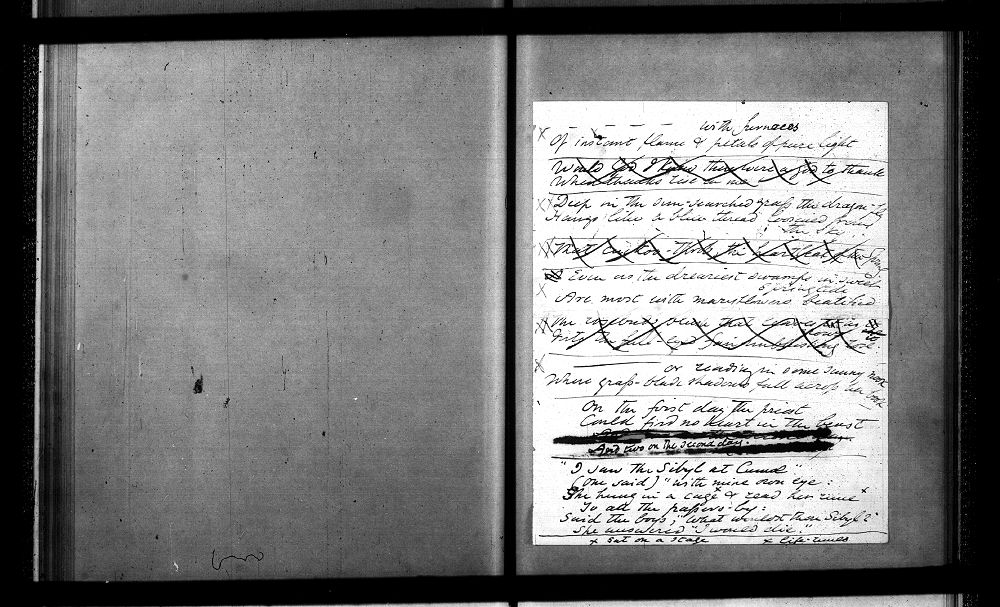
The first line and a half of this sonnet are a crossed-out fragment from one of the notebooks of the British poet and artist Dante Gabriel Rossetti (1828–1882), which he used to work out poetic ideas. This one never went anywhere. But Rossetti’s brother, William Michael Rossetti, saw something in it worthy of preservation; he salvaged it and other select scraps from his brother’s papers, publishing them posthumously in a “Versicles and Fragments” section of Rossetti’s collected works in 1901.
Page 16 of Sonnets and Fragments by Dante Gabriel Rossetti (Princeton/Troxell bound manuscript volume), 1848–81. The first deletion, by Rossetti’s hand, is “Would God I knew there were a god to thank / When thanks rise in me.” [object record]
The modern American poet X. J. Kennedy developed Rossetti’s fragment into a full poem that grapples with the silence of God and, despite such, the impulse to praise. The speaker is confounded by the contradiction that the world seems infused with God’s presence—the natural world points to a Creator—and yet God is unresponsive when the speaker initiates contact. The prayers he launches toward heaven like arrows appear not to reach their target. He’s experiencing spiritual aridity. He feels like a thirsty castaway whose only drink is salt water (why doesn’t God satiate as promised?); a bird trapped in a dark cellar; a mountain climber endlessly climbing, never catching sight of the vista.
The poem tugs back and forth between despondency and awe, between clench-fisted frustration and open-handed surrender. Each glorious tree leaf, the intricate design of conch shells, the whimsy of lightning bugs—these are gifts, but where’s the giver? Gratitude must be directed to someone, but whom does one thank for the wonders and small joys experienced in nature? Who or what is their source? Oh, how I wish I knew there were a God out there to thank, when thanks well up in me. The speaker wants to place his thanks somewhere, but when he places them in God, he receives no confirmation of receipt. There’s a disconnect between what nature testifies and what the speaker has suffered: the “sullen blank” of heaven.
Dante Gabriel Rossetti’s brother, William, wrote in 1895 that, unlike their devout sister Christina [previously], Dante was “a decided sceptic. He was never confirmed, professed no religious faith, and practised no regular religious observances; but he had sufficient sympathy with the abstract ideas and the venerable forms of Christianity to go occasionally to an Anglican church—very occasionally, and only as the inclination ruled him.” Starting in mid-adolescence, he rejected organized religion.
Kennedy, similarly, was raised in a religious household: his father was Catholic, his mother Methodist. And yet in his adulthood he has come to question and reject some of the tenets of orthodox Christianity. But still, he searches for God. “There is a clash in his poems between his skepticism or uneasy agnosticism and his unresolved longing for faith in God,” reads his bio on the Harvard Square Library website. Kennedy’s desire to believe but his inability to do so is expressed recurringly in his work—as in this poem, in which he, taking the baton from Rossetti, is very likely the speaker.
X. J. Kennedy (born 1929) is an American poet, translator, editor, and author of children’s literature and textbooks on English literature and poetry. Born Joseph Charles Kennedy in Dover, New Jersey, he adopted the nom de plume X. J. Kennedy in 1957 to avoid being mistaken for the better-known Joseph Kennedy, then US ambassador to England and father of future president John F. Kennedy. His award-winning poetry collections include Nude Descending a Staircase (1961) and Cross Ties (1985). He lives in Lexington, Massachusetts.
I came upon it stretched against the starlight,
a black lace
of stone. What need to enter and kneel down?
It said my prayers for me,

lifted in a sculptured moment of imploring
God in granite,
rock knees rooted in depths where all men
ferment their dreams in secret.

Teach marble prayers to us who know no longer
what to pray,
like the dumb worship’s lovely gesture carven
from midnight’s sweated dews.
This poem was originally published in Onions and Roses (Middletown, CT: Wesleyan University Press, 1968) and is compiled inIf I Had Wheels or Love: Collected Poems of Vassar Miller(Dallas: Southern Methodist University Press, 1991).Used by permission of Wesleyan University Press.
Vassar Miller (1924–1998) was a poet and creative writing instructor from Houston who lived with cerebral palsy. Over a literary career that spanned almost forty years, she published ten volumes of poetry, of which Wage War on Silence (1960) was nominated for a Pulitzer Prize, and she was twice named poet laureate of Texas. Her poems explore religious faith, social isolation, and physical disability. When asked to describe the meaning of her life, she said, “To write. And to serve God.”




#/media/File:JEAN-FRAN%C3%87OIS_MILLET_-_El_%C3%81ngelus_(Museo_de_Orsay,_1857-1859._%C3%93leo_sobre_lienzo,_55.5_x_66_cm).jpg)
 Art & Theology