Standing at the threshold of another Advent, we hear the invitation of Christ: ‘Come away to a deserted place and rest a while.’ And so we begin our season of growth and expectation—a time to secret ourselves with Mary, to join our hearts with hers, and to grow pregnant with God together. God invites us to a quiet place of reflection and bounty. This Advent, choose some time for silence. Make space within yourself to grow large with the abundance of God’s favor. Make this a time to fill your lungs deeply with God so that you can breathe Christ into the world.
Waiting does not diminish us, any more than waiting diminishes a pregnant mother. We are enlarged in the waiting. We, of course, don’t see what is enlarging us. But the longer we wait, the larger we become, and the more joyful our expectancy.
In anticipation of the Feast of the Nativity of John the Baptist on June 24, I offer this tender poem by Sister Maura Eichner in which the elderly Elizabeth speaks to her son, John, while he’s still in utero. She senses his life will end early and wishes to keep him safe forever, away from the burdens and perils of a prophetic vocation, away from Herod’s order of imprisonment, away from the lethal spite of Herodias and her daughter-pawn, Salome, whose dancing trophy of choice is John’s head on a platter.
Elizabeth is faithful to God and God’s will—just yesterday, in the company of her also-pregnant cousin Mary, she praised God for the coming Messiah whom even the fetal John recognized, leaping. But as great an honor as it is that her son has been chosen to herald the Messiah, her maternal instinct is to shield and protect him. In the dark of midnight, while her husband, Zechariah, is asleep, she whispers her fears rolled up in a charge, instructing John to savor the shelter of her womb while he still can, as soon he will enter the world’s wilderness and eventually preach himself to a martyr’s death.
For scripture texts that inform Sister Maura’s “Dialogue at Midnight,” see Luke 1 and Matthew 14:1–12.
Sister Maura Eichner, SSND (1915–2009), was a Catholic nun, poet, and professor of literature and creative writing. Born Catherine Alice Eichner in Brooklyn, New York, she took vows with the School Sisters of Notre Dame in 1933 at age eighteen. In 1943 she was assigned to teach in the English Department at the College of Notre Dame of Maryland (now Notre Dame of Maryland University) in Baltimore, where she continued until 1992, serving also as department chair. She published ten books of poetry during her lifetime, including The Word Is Love (1958) and Hope Is a Blind Bard (1989), and maintained correspondence with such writers as Flannery O’Connor, Richard Wilbur, Katherine Anne Porter, and Eudora Welty. She experimented with a diversity of poetic forms and subject matter and disliked religious poetry that is redolent of “thin piety” and “decoratively sweet nosegays,” she told The New York Times in a 1959 interview.
The law of growth is rest. We must be content in winter to wait patiently through the long bleak season in which we experience nothing whatever of the sweetness or realization of the Divine Presence, believing the truth, that these seasons which seem to be the most empty are the most pregnant with life. It is in them that the Christ-life is growing in us, laying hold of our soil with strong roots and thrust deeper and deeper, drawing down the blessed rain of mercy and the sun of Eternal Love through our darkness and heaviness and hardness, to irrigate and warm those roots. . . .
The seed must rest in the earth. We must allow the Christ-life to grow in us in rest. Our whole being must fold upon Christ’s rest in us, as the earth folds upon the seed.
>> “Picturing Pregnancy in Early Modern Europe” by Rebecca Whiteley, Public Domain Review: Adapted from the book Birth Figures: Early Modern Prints and the Pregnant Body by Dr. Rebecca Whiteley (University of Chicago Press, 2023), this article explores how the womb and fetuses were depicted in medical book illustrations in Europe during the sixteenth and seventeenth centuries. Pregnancy is such a potent image for Advent, as we await the birth of Jesus—who, fully God and fully human, dwelled for nine months in his mother Mary’s uterus before emerging from her birth canal!
Woodcut illustration of a baby in the womb from De conceptu et generatione hominis (Zurich, 1554), the first Latin edition of a midwifery handbook by Jacob RueffWoodcut illustration of an open uterus from La commare o raccoglitrice . . . (Verona, 1642), a manual about pregnancy and childbirth by Girolamo Mercurio
>> “Rupy C. Tut’s Landscapes of Belonging” by Bridget Quinn, Hyperallergic: Bridget Quinn reviews Rupy C. Tut’s solo exhibition Out of Place that’s running at the Institute of Contemporary Art San Francisco through January 7. I love, love, love her art! It’s inspired by traditional Indian miniature painting and “is an effort to belong, to feel in place,” Tut says. Tut is a first-generation immigrant from India’s Punjab region who settled in California with her Sikh family at age twelve. Her Searching for Ancestors reminds me, visually but not thematically, of Jyoti Sahi’s Incarnation within the Anthill, and her Portrait of a Woman gives me some serious Marian vibes—as it did too the reviewer, who refers to this pregnant woman as “a kind of cross-cultural Madonna, reminiscent of the central mother figure, mandorla, and sun rays of Our Lady of Guadalupe so familiar across California via Mexico.”
Rupy C. Tut (Indian American, 1985–), Portrait of a Woman, 2023. Handmade pigments and shell gold on hemp paper, 57 × 37 in.
+++
INSTAGRAM POST: “Birthing // Love” by Elissa Yukiko Weichbrodt: Last Advent, art historian and educator Elissa Yukiko Weichbrodt (@elissabrodt) reflected on Janine Antoni’s Hearth ceramics, part of the artist’s Pelvic Vessels series, and on the biological reality that during the act of childbirth, both the mother’s and baby’s bodies are changed by one another. What might this mean for Advent?
Janine Antoni (Bahamian American, 1964–), Hearth, 2014. Set of three pit-fired ceramic vessels, 4 3/4 × 6 1/2 in., 4 3/4 × 7 7/8 in., 5 1/8 × 8 in.
+++
DEVOTIONAL COLUMN: “Jesus’ Bloody Birth” by Lauren F. Winner, Christian Century: “Jesus . . . is bloody in many senses,” writes Rev. Dr. Lauren Winner [previously]. One of those senses is that he came into this world covered in his mother’s blood. Something is lost in the Christmas story when we evade the details of childbirth, Winner says. I was alerted to this short reflection of hers from 2015 by its inclusion in the new book A Radiant Birth: Advent Readings for a Bright Season.
+++
PODCAST EPISODE: “The Incarnation and Health Care as Ministry” with Denise Hess, Hear Me Now Podcast, December 24, 2020: “There is a long tradition of faith-based healthcare. On this Christmas episode—filled with music, poetry, and conversation—we ask: How has the belief that God became human in the flesh inspire care for people and their bodies? Rev. Denise Hess [MDiv, BCC-PCHAC] of the Supportive Care Coalition (now part of the Catholic Health Association) joins host Seán Collins in a reflection on the Christian doctrine of the Incarnation and the ways it has inspired centuries of healthcare. They talk about the example of Jesus-as-healer, the crucial role women have served in promoting healthcare ministries, and the place suffering plays in our understanding of caring for the whole person.”
The conversation is interspersed with poetry readings and performances of carols by a violin-guitar-bass trio. Hess mentions this wonderfully shocking sentence from Chris Abani’s poem “The New Religion”: “what was Christ if not God’s desire / to smell his own armpit?” She also shares Brian Wren’s beautiful hymn text “Good Is the Flesh.” The podcast is a production of the Providence Institute for Human Caring.
Andrea Mantegna (Italian, 1431–1506), Madonna with Sleeping Child, ca. 1465. Tempera on canvas, 16 1/2 × 12 1/2 in. (42 × 32 cm). Gemäldegalerie, Berlin.
She took it all in: the shepherds and the royal and learned
men with their prophecies and proclamations. Resting among
common beasts, nipples sore and womb-ached, she smiled at
their praise—but her awe had begun with the angel’s decree.
At the mysterious life-pulse deep inside her. When flicker-
kicks strengthened to rolls and turns, elbows and heels in her
ribs. As buttocks bounced on her bladder.

The brightest star above them—a wondrous sign, but no
more miraculous than when, far from her mother and the
other village women, the flesh of her depth awakened and she
willed the baby from contentment into a harsh night. His cry
pierced the darkness, then quieted as, pressed to her breast,
he found her heartbeat again.
“After Luke 2:19” by Michelle Ortega, reproduced here by the author’s permission, was written for the 2021–22 exhibition Mary, Mary: Contemporary Poets and Artists Consider Mary at St. Michael’s Episcopal Church in Arlington, Virginia. Ortega is the author of the chapbooks Don’t Ask Why (Seven Kitchens Press, 2020) and Tissue Memory (Porkbelly Press, forthcoming).
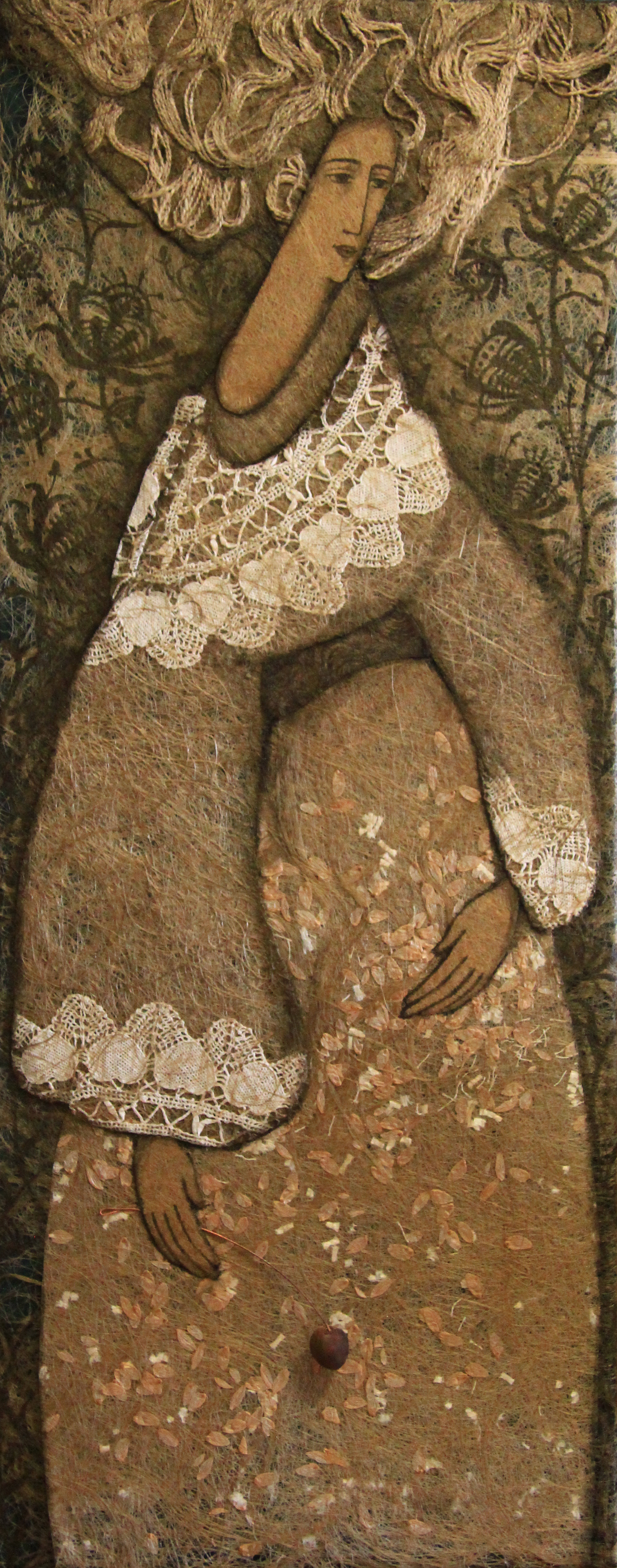
Yaroslava Tkachuk (Ukrainian, 1981–), Expectant, 2014. Linen, silk, seeds, copper, and acrylic, 100 × 40 cm. Photo courtesy of the artist. [Original for sale; click photo for more info]
Therefore the Lord himself will give you a sign. Behold, the virgin shall conceive and bear a son, and shall call his name Immanuel.
—Isaiah 7:14
+++
SONG: “Maria” by David Maloney, on A Christmas Album by Reilly & Maloney (1984, reissued 2012)
Christmas Day, it’s coming fast
Bringing joy to the world at last
Joy to the world
Maria . . .
This post belongs to the weekly series Artful Devotion. If you can’t view the music player in your email or RSS reader, try opening the post in your browser.
To view all the Revised Common Lectionary scripture readings for the Fourth Sunday of Advent, cycle A, click here.
FLASH MOB: On Easter 2011 at City Mall in Beirut, Lebanon, a flash mob broke out singing the Paschal troparion in Arabic: Christ is risen from the dead, trampling down death by death, and on those in the tombs bestowing life! [HT: Global Christian Worship]
+++
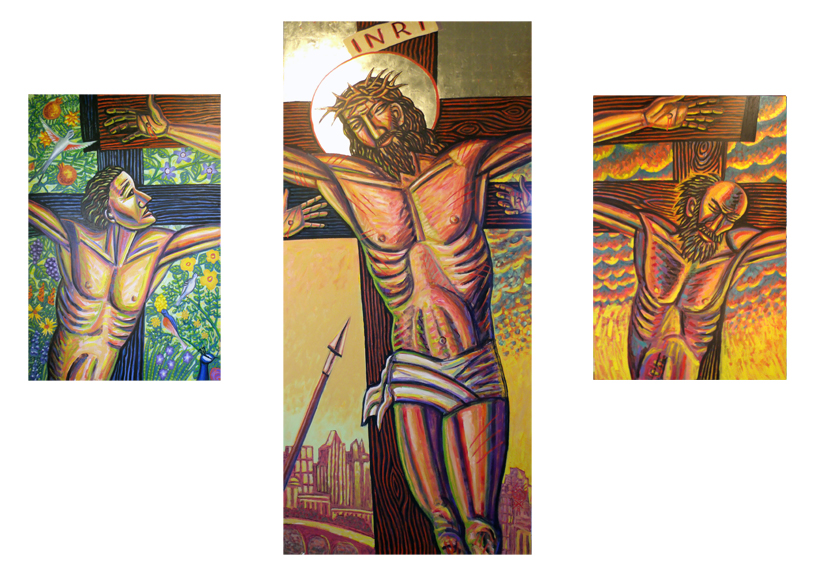
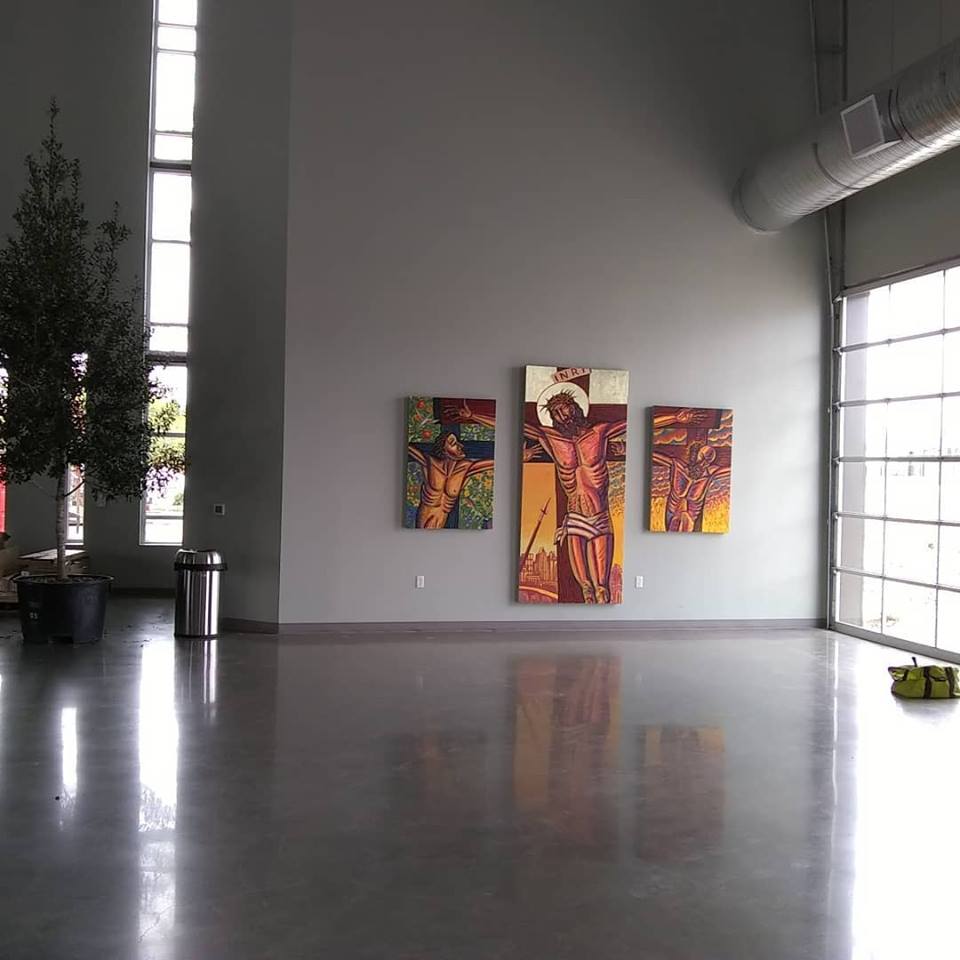
NEW PAINTING INSTALLED: James B. Janknegt is a Christian artist from Texas who is known for transposing biblical stories into contemporary American settings. He recently completed a large triptych for the new Unity Hall at Community First! Village in Austin, a planned community, developed by Mobile Loaves & Fishes, that provides affordable, permanent housing for the chronically homeless. (See the development and learn more about it in this short video, presented by MLF founder Alan Graham.) The painting shows Jesus in conversation with the “good thief” who, as he dies, acknowledges his crime and asks Jesus to “remember me when you come into your kingdom” (Luke 23:42). Behind him paradise flowers forth, indicating not only his new home but his inward regeneration. The other thief, by contrast, turns his head away in stubbornness. This episode demonstrates that repentance is always met by Christ with love, affirmation, and seeds of new life.
James B. Janknegt (American, 1953–), Good Thief, 2018. Oil on three panels, 8 × 12 ft. Unity Hall, Community First! Village, Austin, Texas.
+++
SHORT FILM: “Dance Dance” by French film director Thomas Blanchardevokes each of the four seasons through different elements acting on flowers, captured in either time lapse or slow motion. For fall, a rose is set on fire; for winter, foliage afloat in water becomes frozen in ice; for spring, lilies bloom; and for summer, colored inks hit the flowers and billow up in dusty clouds. Stunning images!
+++
CHAIYA ART AWARD FINALIST: The inaugural Chaiya Art Award competition ended last month, with the winner taking home £10,000 and being exhibited, along with forty-one other juried selections, at London’s gallery@oxo March 29–April 9. The theme was “Where Is God in Our Twenty-First-Century World?”
One entry I really love is finalist Sheona Beaumont’s Natal, a photographic work that shows a nude pregnant woman standing against a dark wall in profile, her hair blown wildly by a gust of wind, opposite a corpse. These are two different spaces set in juxtaposition—two photos stitched together. The black-and-white photo of the dead body, on the left, is Fred Holland Day’s The Entombment from 1898, in which he himself posed as Christ, laid out on a bier before a doorway, his crown of thorns and titulus crucis on the ground beside him. Beaumont rotated this horizontal image 90 degrees clockwise so that the Christ figure is propped upright. She then posed her female model to form a sort of mirror image, but one full of vitality; the woman’s belly, the site of new life about to be born, is brightly lit. This combination photograph makes a powerful Holy Saturday image, one that hints toward resurrection as the stillness gives way to stirrings. The photo is also an allusion to the new life believers have in Christ, and in fact it forms the first in a new series titled Born Again. Visit Beaumont’s website to view the artwork and to read a bit about her process and the meaning the work holds for her.
+++
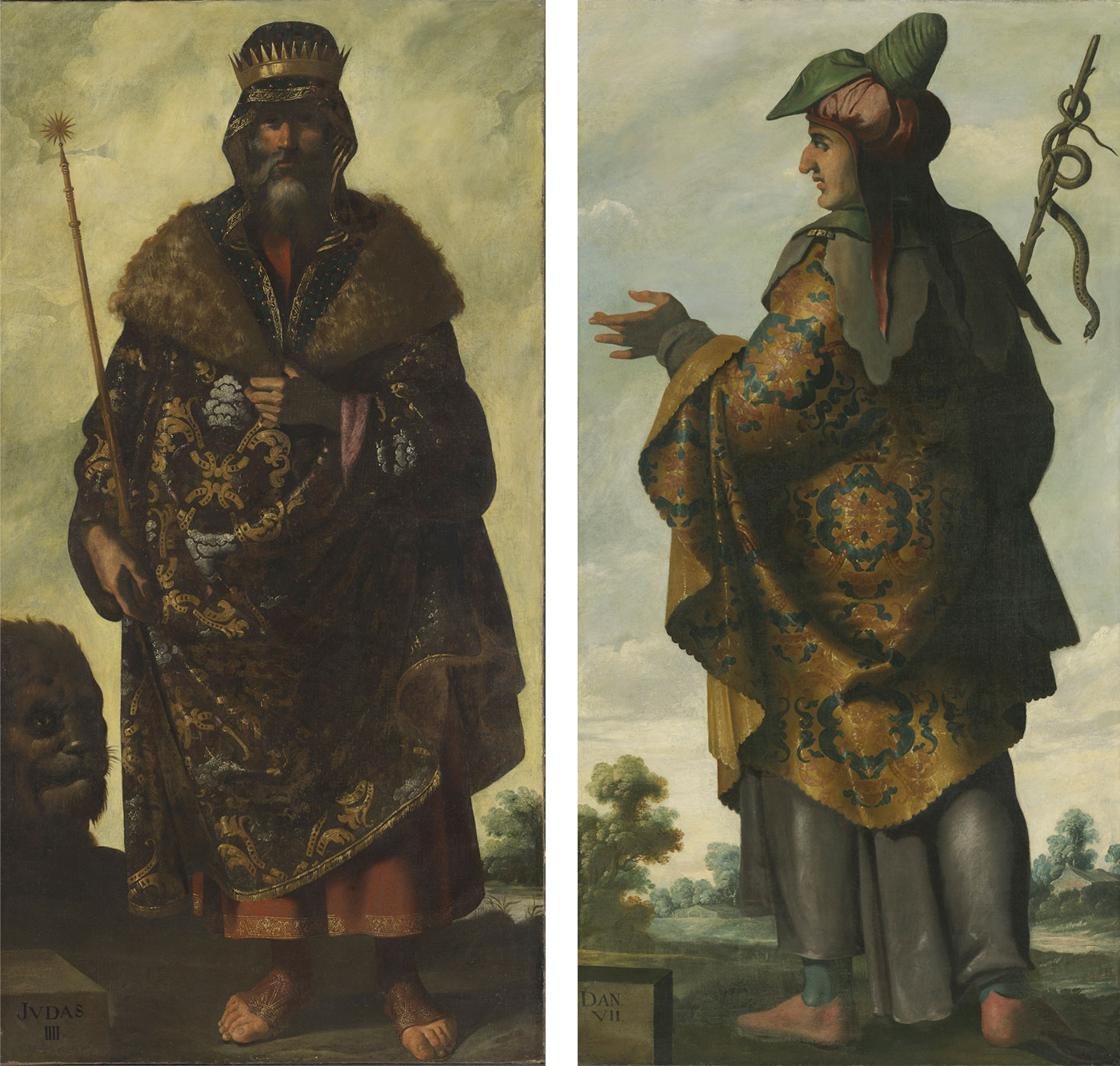
EXHIBITION: “Zurbarán’s Jacob and His Twelve Sons: Paintings from Auckland Castle”: Last fall, Spanish Golden Age artist Francisco de Zurbarán’s Jacob and His Twelve Sons made its North American debut at the Meadows Museum in Dallas, traveling for the first time in centuries, and now the exhibition is at the Frick Collection in New York City—but only through the end of this week! Twelve of the thirteen paintings in the set are from Auckland Castle in County Durham, England, the residence of the eighteenth-century Anglican bishop Richard Trevor, who acquired them in 1756 and had them displayed in his dining room, where they have remained ever since. Trevor was outbid on the painting of Benjamin, however, which is on loan from Grimsthorpe Castle in Lincolnshire, reuniting the set for the first time since the paintings’ 1756 sale.
Francisco de Zurbarán (Spanish, 1598–1664), Judah; Dan, 1640–44. Oil on canvas, 79 1/4 × 40 3/4 in. each. Photos: Robert LaPrelle.
The iconography of the paintings is derived from the prophecies Jacob utters over each of his sons on his deathbed, as described in Genesis 49. For example, Judah, from whom “the scepter shall not depart,” holds said scepter and is regally draped in a gold brocade robe and fur that hint at his descendants kings David and Solomon (Zurbarán was the son of a haberdasher, and gave great care to the depiction of textiles); Dan, on the other hand, holds up a serpent on a stick, alluding to his craftiness. To view all the paintings, click here.
+++
3-D SHOW: As of last month and through the end of July, Artainment Worldwide Shows, in cooperation with the Vatican Museums, presents “Giudizio universale: Michelangelo and the Secrets of the Sistine Chapel”by Marco Balich, an immersive 3-D show that brings to life Michelangelo’s Sistine Chapel frescoes inside the Rome Conciliation Auditorium. Half the room is covered, from the walls to the ceiling, with a 270-degree screen that projects extremely high-res photos of the paintings, dramatized through movement, music, lighting, sound effects, narration, live actors, and dance. Lasting sixty minutes, the show concludes with the thirteenth-century Latin hymn Dies irae (“Day of Wrath”), set to new music by Sting and arranged for chamber orchestra and choir by Rob Mathieson. Watch the trailer below, or click here to see some of the 3-D animation of the Last Judgment.



#/media/File:Andrea_Mantegna_108.jpg)
 Art & Theology