
LOOK: Pyxis with the Annunciation
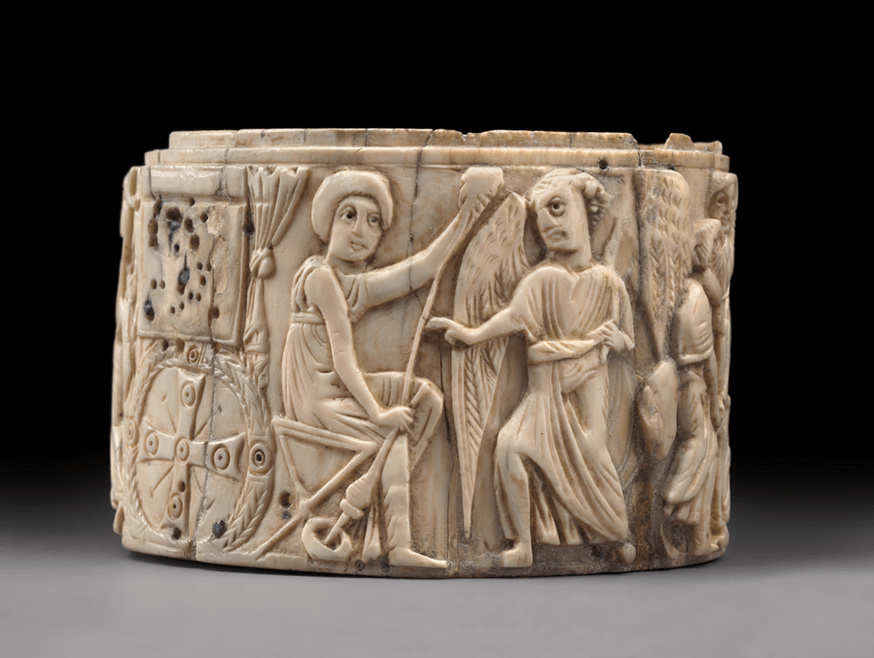
According to the Protoevangelium of James, an apocryphal infancy gospel from the second century, the Virgin Mary was raised in the Jerusalem temple from age three and was tasked with weaving the purple and scarlet thread of the veil that shrouded the holy of holies, the temple’s innermost sanctuary. One day while taking a break from this sacred labor to collect water from a well, the angel Gabriel approached her with a greeting: “Hail, favored one. The Lord is with you.” She looked around and saw no one, so she returned to her work indoors.
As she was engaged in her spinning, Gabriel reappeared and delivered the message he had been sent with: that Mary was chosen to bear the Son of God.
This account of the Annunciation gained special traction in the East, where the Virgin Annunciate is almost always shown with a spindle of scarlet thread in her hand, or less frequently, standing at a well—unlike in Western depictions, where she is typically shown holding a book.
The Byzantine art object pictured above is an ivory-carved pyxis (pl. pyxides), a cylindrical container used to store small items, such as jewelry or cosmetics. The Annunciation is one of three scenes represented, the other two being the Journey to Bethlehem and the Nativity (including Salome with her withered hand; see Prot. 19–20). The square to Mary’s left is where the lock case was originally mounted.
In the early fifth century, the prominent Byzantine theologian Proclus of Constantinople (ca. 390–446) developed Mary’s weaving into an extended theological metaphor of the Incarnation. He preached on Mary’s womb as a “workshop” containing the “awesome loom of the divine economy” on which the flesh of God was woven together, providing the bodiless divinity with form and texture. [1] “In the workshop of Mary’s womb, the vertical warp thread of divinity was bound to a weft of virgin flesh,” writes Fr. Maximos Constas (b. 1961), paraphrasing Proclus. [2]
Jesus’s flesh is a kind of clothing—the same we wear—made during Mary’s nine months of pregnancy:
The one who redeemed us was not a mere man. May this never be! But neither was he God denuded of humanity, for he had a body. And if he had not clothed himself with me, he could not have saved me, but in the womb of a virgin the one who pronounced the sentence against Adam clothed himself with me, who stood condemned, and there in her womb was transacted that awesome exchange, for taking my flesh, he gave me his spirit. [3]
Notes:
- Nicholas Constas, “The Purple Thread and the Veil of Flesh: Symbols of Weaving in the Sermons of Proclus,” chap. 6 of Proclus of Constantinople and the Cult of the Virgin in Late Antiquity (Leiden and Boston: Brill, 2003), 317. The quotations are from Proclus’s Homily 1.I.21–25.
- Constas, 357.
- Proclus of Constantinople, Homily 1.VIII.122–27, qtd. Constas, 354.
LISTEN: “The Virgin, Spinning” by Katy Wehr, on And All the Marys (2018)
I’m spinning the scarlet and purple—woman’s work
But God is spinning the gold, I see
Weaving a tiny thread like me
Into the grand design to be
The saving of the worldChosen as the roving fiber—clean and combed
Then dropped and spun and quickly wound
Upon the spindle tightly bound
To serve the One I’m wound around:
The Savior of the worldRefrain:
Son of the Most High, let it be, let it be
Son of God, let it be, let it be to meIn the hands of the Master, I marvel at his ways
He brings me into his weaving room
My heart is stretched upon the loom
The God-man knitted within my womb
The Savior of the world [Refrain]Bridge:
First to hear, first to hear and believe
First to love, first to love and receive
The Son of GodWill they believe me? I wonder, who can say?
But I will always answer yes
Though a sword may pierce my breast
The Father of my son knows best
The Savior of the world [Refrain]
In “The Virgin, Spinning,” singer-songwriter Katy Wehr takes the weaving metaphor in a different direction than Proclus. Voiced by Mary, the song reflects on how God is weaving a grand tapestry of salvation, in which Mary is a thread.
 Art & Theology