
Roundup: Kyries for Lent, refugee-themed art exhibition at Portsmouth Cathedral, “Forevergreen,” and more

NEW BOOK: Bread and Wine: Readings for Lent and Easter, Second Edition: Plough is the publishing house of the Bruderhof, an international Anabaptist communal movement. This year they released a revised and expanded edition of their popular Lent and Easter devotional, increasing the original seventy-two entries to ninety-six to cover the full fifty days of Easter—although the last section is themed around Pentecost. The selections are all from previously published material, but what a treasure-house has been curated here from across denominations, countries, and eras, from early church fathers to medieval mystics to modern saints. Clement of Rome, Julian of Norwich, Kahlil Gibran, Watchman Nee, Gonzalo Báez Camargo, Thomas Merton, Simone Veil, Howard Thurman, Toyohiko Kagawa, Barbara Brown Taylor, Jürgen Moltmann, Tish Harrison Warren—these are some of the many voices included here that reflect on and expound the beautiful truths of the Lent and Easter seasons. Each reading is just a few pages long, so it’s easy to pick up with your morning coffee or just before bed.
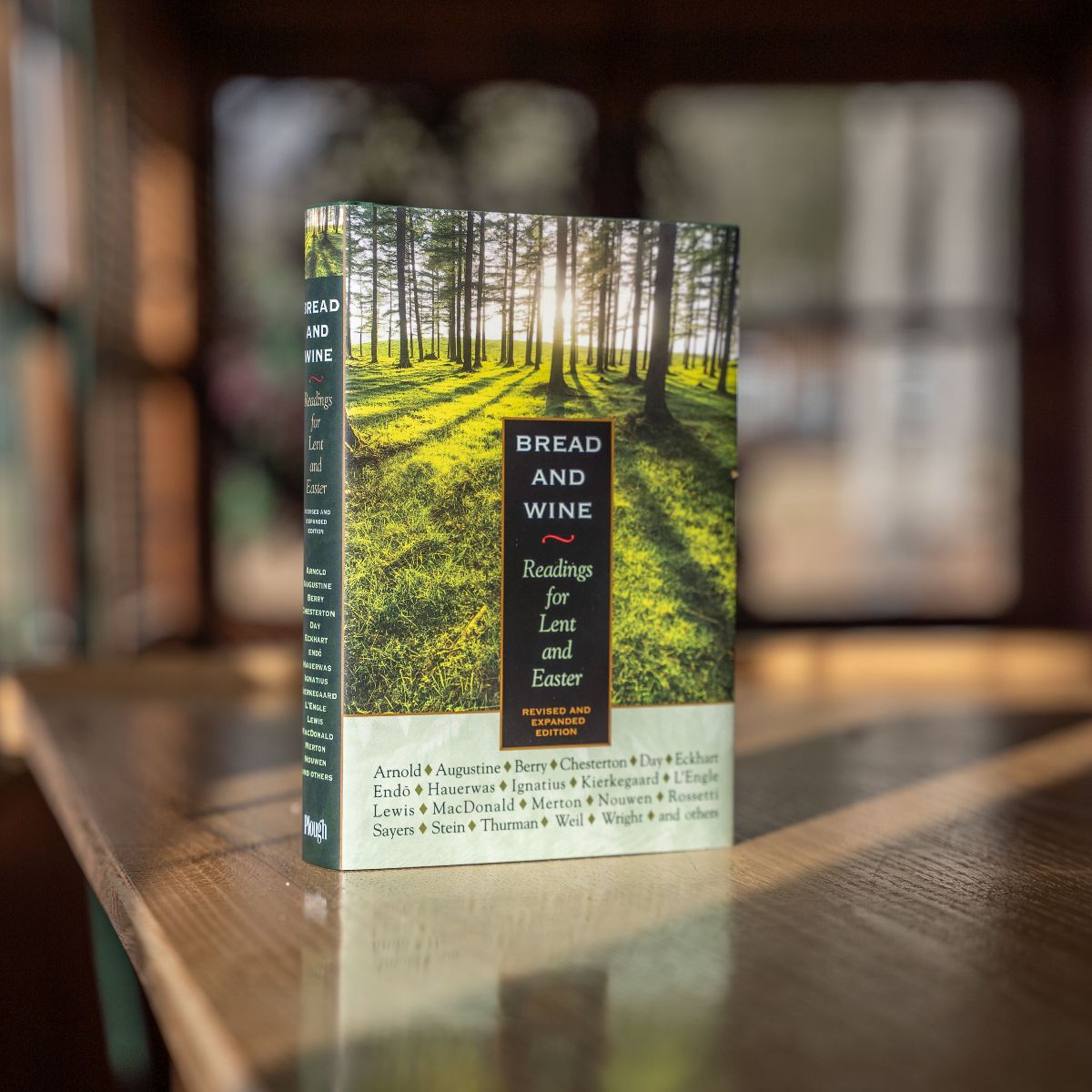
Bread and Wine book cover

Besides the expansion, other changes I’ve noticed in this edition are:

  • Thinner pages, which, despite the additional content, reduce the overall thickness of the book
  • The epigraph at the beginning of each reading was removed, as these were not the authors’.
  • Thirteen of the original readings were replaced, possibly due to permissions costs, but maybe also just to get in some fresh voices or content, and in one case, to remove an accused sex abuser.
  • A misattribution in the original to Mother Teresa was corrected to Joseph Langford, who founded the Missionaries of Charity Fathers with her.
  • There is a slight reordering of readings so that pertinent meditations appear during Holy Week.

I’ve provided a link to the Plough book page above, but you can also purchase through Amazon or your retailer of choice.

+++

SONGS:

I grew up in an independent Baptist church, ignorant of most of the historic prayers of the church at large. The first time I ever heard the phrase “Kyrie eleison” [previously] was on track 5 of the Christian recording artist Mark Schultz’s 2001 album Song Cinema, which is a cover of an eighties rock song by Mr. Mister. I was in middle school, and I had to look up what it meant. Derived from a prayer found in multiple places in the Psalms and the Gospels, “Kyrie eleison” (pronounced KEER-ee-ay eh-LAY-ee-sohn) is Greek for “Lord, have mercy,” and it’s traditionally followed by “Christe eleison”—Christ, have mercy. An inheritance from early Eastern Christian liturgies, it has been part of the Ordinary of the Catholic Mass since the fifth century, which means it’s recited or sung in every eucharistic service regardless of the liturgical season, and it’s used in many other Christian traditions as well. I’ve never been part of a church that sings the Kyrie, but I occasionally sing it in my personal devotions. It’s been set to music by hundreds of composers, for choirs, contemporary bands, and more. Here are two settings that I’ve recently come across and enjoy, followed by a song that entreats (God’s?) mercy on father, brother, church, country, and every living thing.

>> “Kyrie (Lord, Have Mercy)” by Robert Alan Rife: This song was written by Robert Alan Rife [previously], a minister with the Evangelical Covenant Church, serving in Edinburgh. It’s performed here by worship musicians at Great Road Church (formerly Highrock Covenant Church) in Acton, Massachusetts. The lead vocalist is Caelyn Jarrett Poetz; she’s accompanied on guitar by her dad, Travis Jarrett, the church’s music pastor, and Hannah Moulton provides backing vocals. Rife tells me you can purchase the sheet music here, and that other songs of his can be streamed on Spotify, Apple Music, etc.; he has not yet recorded this one, but it’s in the works.

>> “Kyrie” by Paul Smith: This peaceful, resonant setting of the Kyrie was composed by Paul Smith, cofounder of the Grammy-nominated British vocal ensemble VOCES8, who perform it here. The song appears on Smith’s 2025 album Revelations.

>> “Mercy Now” by Mary Gauthier: In this video from the 2010 Americana Music Festival in Nashville, folk singer-songwriter Mary Gauthier (last name pronounced go-SHAY) performs her most famous song, “Mercy Now,” originally released on her 2005 album of the same title. It doesn’t directly invoke God, but it feels like a prayer, asking for mercy (forgiveness, relief, compassion, lovingkindness) first for two family members—her father on his deathbed, and her drug-addicted brother—and then for the institutions of church and state, both in need of repair, and then for everyone: “We all could use a little mercy now / I know we don’t deserve it / But we need it anyhow,” and “only the hand of grace” can give it, can intervene to save us from our self-destructive ways. In response to the song’s being listed as “one of the saddest 40 country songs of all time” by Rolling Stone in 2014, Gauthier said, “It is not a sad song. It is about hope.”

+++

EXHIBITION: Sanctuary by Nicholas Mynheer, February 18–April 12, 2026, Portsmouth Cathedral, UK: One of my favorite artists, Nicholas Mynheer, has a show that opened on Ash Wednesday at Portsmouth Cathedral, aka the Cathedral of the Sea, and that will continue for the duration of Lent plus some. “The exhibition features paintings and sculptures that explore the experiences of refugees, both ancient and contemporary. The story of Jesus, Mary and Joseph fleeing to Egypt sits alongside the realities faced by people crossing the English Channel today. Mynheer’s work doesn’t offer easy answers – instead, it asks questions. What would we do if our home were no longer safe? How do we respond to those seeking refuge? What does it mean to hope for a better life when the risks are so great?”

Mynheer, Nicholas_The Holy Family Cross the English Channel
Nicholas Mynheer (British, 1958–), The Holy Family Cross the English Channel, 2025. Oil on canvas, 30 × 30 cm.

View artworks from the exhibition on the artist’s website at https://www.mynheer-art.co.uk/gallery/sanctuary-exhibition.html. Follow him on Instagram @mynheer_art. Mynheer writes:

As an artist, one of the themes that I’ve been drawn to repeatedly is that of the Holy Family on the Flight to Egypt. The fact that even Jesus, Mary and Joseph became refugees to escape the wrath of Herod reminds us that it could happen to any one of us.

Over the past years we have become increasingly aware of the plight of refugees; from Syria, Afghanistan, Ukraine, Somalia, along with daily reports of refugees attempting to cross the English Channel. Whether they flee from war, persecution, famine, political instability or for economic reasons, the risks are the same; all driven by hope, the hope of a better life.

I often wonder what I would do if I lived in a country ravaged by war? What would I do if I was persecuted for my faith, my colour or my culture? What would I do if scrolling on my phone, others’ lives seemed easier, happier, and all I had to do was get there?

It is my hope that these meditations in paint and stone might draw us in to question how we might respond if we, like Jesus, Mary and Joseph, were forced to seek refuge; to be refugees . . . to search for Sanctuary.

Starting February 25, Portsmouth Cathedral is offering a free four-week Lent course (classes are in person on Wednesday evenings) inspired by the exhibition. The first class will be a talk by Mynheer himself, and the other three will be led by clergy, exploring biblical themes of journey, rescue, and redemption through the art on display.

+++

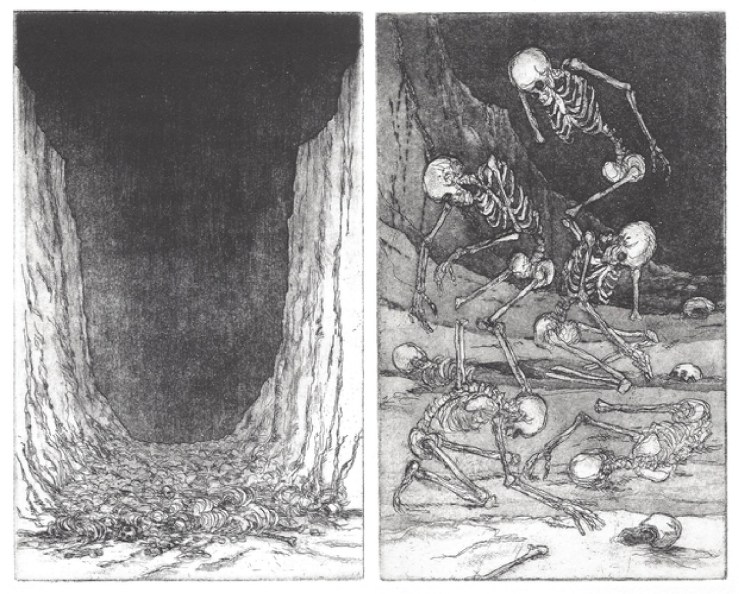
CALL FOR ART: The Valley of Dry Bones, Museum of the Bible, Washington, DC:The Valley of Dry Bones art invitational seeks to inspire the creation of new artwork based on Ezekiel 37:1–14, the biblical vision in which God brings life, renewal, and restoration to a valley of dry bones. Museum of the Bible invites Christian and Jewish artists residing in the continental United States to create original pieces in a variety of media that show their personal and spiritual reflections on this powerful theme. The goal is to show how the Bible can shape modern art and give visitors a meaningful way to connect with biblical themes through creativity. Museum of the Bible will choose 15 artists through a national call and design a professional exhibition to showcase their art from May 7–November 7, 2027. The museum will also help promote the artists and their work through talks, social media, and special events. Each artist chosen will be paid a stipend of $3,000 to cover the costs of creation, travel, and shipping.” Entry deadline: April 24, 2026.

Here’s a double print on the subject by my friend Margaret Adams Parker, aka Peggy:
Parker, Margaret Adams_Ezekiel 37
Margaret Adams Parker (American, 1948–), Ezekiel 37, from The Vigil Etchings, 2013–14. Etching with roulette and aquatint on Somerset velvet white paper, each 8 1/2 × 5 1/2 in. Edition of 15.

+++

SHORT FILM: Forevergreen (2025), dir. Nathan Engelhardt and Jeremy Spears: With the announcement of the 2025 Academy Award nominations last month, I learned that Forevergreen is one of five nominees for Best Animated Short Film! Written and directed by two Christians in the animation industry (employed by Disney but working independently here) and executed by a team of over a hundred, Forevergreen is a thirteen-minute gospel-oriented film in which “an orphaned bear cub finds a home with a fatherly evergreen tree, until his hunger for trash leads him to danger.” I found out about it last November through the music artists who wrote the soundtrack, Josh Garrels and Isaac Wardell, and am delighted to see it recognized in such a huge way. I really dig its unique animation style, which uses whittled wood figures. The movie is currently streaming for free on YouTube (see embed below), but if you want to see it on a big screen, check your local theater listings.

Lent, Day 22

LOOK: The Prodigal Son by Samuel Songo

Songo, Samuel_Prodigal Son
Samuel Songo (Rhodesian, 1929–ca. 1977), The Prodigal Son, 1954. Soapstone, h. 26 cm. Source: Christliche Kunst in Afrika, p. 254.

Samuel Songo was a Shona artist who lived and work in what is today Zimbabwe. He used a wheelchair and had only partial use of his right hand, so he worked mainly with his left, executing stone carvings, wood reliefs, and paintings on both religious and secular subjects. He was associated with the Cyrene Mission School, where he began as a student and then became an instructor. He played a significant role in advancing modern art in Zimbabwe.

To learn more about the context out of which Songo came to prominence, see “Missionaries’ Impact on the Formation of Modern Art in Zimbabwe: A Case Study of Cyrene and Serima Art Workshops” by Grace Zhou and “Ned Paterson and the Cyrene Mission Tradition” by Elizabeth Morton.

[Related post: “Down the Road” (Artful Devotion)]

LISTEN: “When I Was Distant” by Matt Moore and Matte Cassidy of City Church Music, 2018 | Performed by Salina Turner, Allison Negus, and Joel Negus, 2020

When I was distant from my Lord
Opposing his plans and ignoring his word
My stubborn desire left me at war
When I was distant from my Lord

When I was reckless on my own
Avoiding the ruin my choices had sown
A prodigal lost and far from home
When I was reckless on my own

There in the shadow of my sin
Unable to dwell with my Maker again
Ashamed and afraid and wearing thin
There in the shadow of my sin

Then came my loving Savior’s plea:
“Lay down your burdens; find rest in me;
All faint and all weary, come and see.”
Then came my loving Savior’s plea

When I was distant, God came near
Enduring the evil, the torment and fear
That beauty and wonder could appear
When I was distant, God came near

This song was part of the Digital Vespers service for Good Friday 2020 at City Church in Cleveland Heights, Ohio. To view the full service, click here.

Down the Road (Artful Devotion)

Two Sons by James B. Janknegt
James B. Janknegt (American, 1953–), Two Sons, 2002. Oil on canvas, 24 × 84 in.

Once there was this man who had two sons. One day the younger son came to his father and said, “Father, eventually I’m going to inherit my share of your estate. Rather than waiting until you die, I want you to give me my share now.” And so the father liquidated assets and divided them. A few days passed and this younger son gathered all his wealth and set off on a journey to a distant land. Once there he wasted everything he owned on wild living. He was broke, a terrible famine struck that land, and he felt desperately hungry and in need. He got a job with one of the locals, who sent him into the fields to feed the pigs. The young man felt so miserably hungry that he wished he could eat the slop the pigs were eating. Nobody gave him anything.

So he had this moment of self-reflection: “What am I doing here? Back home, my father’s hired servants have plenty of food. Why am I here starving to death?I’ll get up and return to my father, and I’ll say, ‘Father, I have done wrong—wrong against God and against you.I have forfeited any right to be treated like your son, but I’m wondering if you’d treat me as one of your hired servants?’”So he got up and returned to his father. The father looked off in the distance and saw the young man returning. He felt compassion for his son and ran out to him, enfolded him in an embrace, and kissed him.

The son said, “Father, I have done a terrible wrong in God’s sight and in your sight too. I have forfeited any right to be treated as your son.”

But the father turned to his servants and said, “Quick! Bring the best robe we have and put it on him. Put a ring on his finger and shoes on his feet.Go get the fattest calf and butcher it. Let’s have a feast and celebrate because my son was dead and is alive again. He was lost and has been found.” So they had this huge party.

Now the man’s older son was still out in the fields working. He came home at the end of the day and heard music and dancing. He called one of the servants and asked what was going on. The servant said, “Your brother has returned, and your father has butchered the fattest calf to celebrate his safe return.”

The older brother got really angry and refused to come inside, so his father came out and pleaded with him to join the celebration. But he argued back, “Listen, all these years I’ve worked hard for you. I’ve never disobeyed one of your orders. But how many times have you even given me a little goat to roast for a party with my friends? Not once! This is not fair! So this son of yours comes, this wasteful delinquent who has spent your hard-earned wealth on loose women, and what do you do? You butcher the fattest calf from our herd!”

The father replied, “My son, you are always with me, and all I have is yours. Isn’t it right to join in the celebration and be happy? This is your brother we’re talking about. He was dead and is alive again; he was lost and is found again!”

—Luke 15:11–32 (The Voice)

+++

SONG: “Prodigal Son” by Robert Wilkins, on Reverend Robert Wilkins—Memphis Gospel Singer (1964); re-released on Prodigal Son (2014)

Robert Timothy Wilkins (1896–1987) was a gospel blues guitarist and vocalist and a minister of the Church of God in Christ. Part African American, part Cherokee, he was born in Mississippi but spent his entire adult life in Memphis, where he became fairly well known for his music. In 1929 he wrote and recorded the predecessor to “Prodigal Son”: same melody and guitar lines, but with lyrics that bemoan cheating women, and he called it “That’s No Way to Get Along.” After he “got religion” (that is, converted to Christianity) in 1936, he gave up singing secular songs. He’d still play them on his guitar for private audiences—it was only the words he deemed sinful—and he even reworked several by replacing his original lyrics with religious ones, as was the case with “That’s No Way to Get Along,” which he retitled “Prodigal Son” and transformed into a retelling of the biblical parable. [Read the lyrics]

We probably would have never heard these gospel songs from Wilkins’s later years if it weren’t for American folk musicologist Dick Spottswood, who in the 1960s combed the South looking for blues singers whose decades-old 78s he had encountered, seeking to record new performances. Wilkins was in his seventies, but he agreed to perform for a recording (and subsequently, for the Newport Folk Festival in Rhode Island), insisting that he would do only gospel. The resultant album, released in 1964 by Piedmont Records, was Reverend Robert Wilkins—Memphis Gospel Singer, on which “Prodigal Son” first appears. The song was remastered, restored, and re-released in 2014 on a compilation album of Wilkins material, Prodigal Son, which adds four uncollected gospel songs to the original album’s track list.

Aaron Frazer at Black Grooves writes,

The song [“Prodigal Son”] did not appear in Wilkins’ church services, as it was deemed not exciting enough for his congregants. Instead, the piece was reserved as a late-night solo, played for small audiences in the comfort of his living room. The quiet picking, repetitious bass note run and Wilkins contemplative drawl make for a hypnotic mix and the quickest 10-minute song I’ve ever encountered. The open tuning allows for a richer low end and frees Wilkins’ left hand to speak easily with his slide.

Wilkins recorded “Prodigal Son” in 1964, but it wasn’t until 1968, when the Rolling Stones covered it on Beggars Banquet, that it gained a wide audience. They condensed the ten-minute song to just under three minutes, and I think they do quite a fine job with it. Royalties generated by sales of Beggars Banquet created a solid supplemental income for Wilkins until his death in 1987.

The Rolling Stones are heavily influenced by blues music (their name comes from a Muddy Waters song) and have done much to keep it alive and expand its popularity. Keith Richards says, “If you don’t know the blues . . . there’s no point in picking up the guitar and playing rock and roll or any other form of popular music.”

+++

The parable of the prodigal son—or, perhaps more accurately, the parable of the two sons—is a familiar one, and artist James B. Janknegt (previously) interprets it visually for the present day, localizing it to his native Texas.

After insulting his father and taking his money, the younger son flies off to pursue fleeting pleasures—strip clubs and all that. But those pleasures don’t satisfy. He ends up working at McDonald’s and, having squandered his wealth, is reduced to eating his meals from a dumpster. He feels cheap, trashy, and spiritually dry, as indicated by the cactus in the adjacent panel.

Janknegt, James B._Two Sons-001

Hungry for more, he decides to return home, so he hops on a bus, and when the bus can take him no farther, he hitchhikes, catching one, two, three rides, then walks the rest of the way until his shoes wear out. Finally he reaches the front-yard footpath of his father’s house, the dry ground he treads giving way to green grass that becomes increasingly lush the nearer he gets. Anticipating his return, the father comes running out to welcome him home with full forgiveness.

Janknegt, James B._Two Sons-002

But his big brother isn’t nearly as happy at this turn of events. Quite the contrary, he’s confused, upset: Why would Dad not punish little brother for his flagrant disrespect and waywardness? Why is he being thrown a party? In a fit of anger, he breaks the neck of his guitar across his thigh. Instead of joining the musical celebration, he stews in his own bitterness. His heart is as dead as the cattle skull at his feet.

Janknegt, James B._Two Sons-003

Still, the father looks on him lovingly, just as he does his other son, waiting patiently for him to experience a similar metanoia—a turning toward the light, a coming to the party.

Two Sons is one of forty of James B. Janknegt’s modernized parable paintings that appear in the book Lenten Meditations, which you can purchase from Jim’s website.


This post belongs to the weekly series Artful Devotion. If you can’t view the music player in your email or RSS reader, try opening the post in your browser.

To view all the Revised Common Lectionary scripture readings for the Fourth Sunday in Lent, cycle C, click here.

Roundup: RIP Edwin Hawkins; why Christians should read poetry (and who to read); new Reconciliation Window; global song in white churches

Grammy-winning gospel pioneer Edwin Hawkins dies at 74: African American gospel musician, pianist, choir master, composer, and arranger Edwin Hawkins passed away on January 15. He’s best known for his 1967 R&B arrangement of the eighteenth-century hymn “Oh Happy Day,” which became an unexpected international hit and Grammy winner and is now a gospel standard. [HT: Global Christian Worship]

“Oh Happy Day” was one of eight arrangements Hawkins put together for his Northern California State Youth Choir, made up of forty-six singers ages 17 to 25, to record, planning to sell the album to finance a trip to a church youth conference in Washington, DC. They recorded the songs live at Hawkins’s church, the Ephesian Church of God in Christ in Berkeley, California, on a primitive two-track recorder. After hearing the self-published record, Buddah Records signed the group, helping to launch “Oh Happy Day” to the top of the pop charts in the US, UK, France, Germany, and the Netherlands and bringing attention to lead vocalist Dorothy Combs Morrison, 22. At the time, denomination officials did not approve of Christian singers crossing over into secular markets, and they refused to let Hawkins use the name of the choir on the Buddah reissue—hence the “Edwin Hawkins Singers” were born.

Check out the Christianity Today article “How ‘Oh Happy Day’ Gave Gospel a New Beat,” and this clip of the show-stopping performance of the song in the movie Sister Act 2, featuring a young Ryan Toby.

+++

“Ten poets every pastor should know” by Kolby Kerr (+ Part 2): “Preachers need poetry if for no other reason than to be reminded of the palpable weight of language,” writes Kolby Kerr for LeaderWorks, whose vision is “to provide the tools, training, and support to strengthen the church and its leaders to fulfill their God-given mission.” I love this ten-poet “mixtape” Kerr has put together as an entry point for those who have told him they want to “get into poetry.” An ordained minister with a BA in English and an MFA in creative writing, he offers a wise disclaimer: “I point you toward these poets so that you would read them, not strip mine their work for a quick sermon illustration. Before any of this shows up in your preaching, heed Thomas Cranmer: read, mark, learn, and inwardly digest.” [HT: David Taylor]

I recently wrote about one of Kerr’s recommendations, Richard Wilbur, here.

+++

“The Splash of Words: Believing in Poetry” by Mark Oakley: “Poetry is what we reach for when we are falling in love, when we are grieving and when we search the great mysteries. It’s easy to think the language of faith is in creeds, sermons and certainties, but Mark Oakley says that it is poetry that is the person of faith’s native language. In this talk he will invite us on an adventure into poetry’s power to startle, challenge and reframe our vision: like throwing a pebble into water, the words of a poem cause a splash whose ripples can, if we let them, transform the way we see the world, ourselves, and God.”

I mentioned Mark Oakley in a previous roundup. This lecture, given at St. Paul’s Cathedral in London in November 2016, is based on Oakley’s latest book The Splash of Words, which he says he wrote as a way of celebrating the truth that God is in this world. The first half of the video comprises his talk; the second half, Q&A. I was so enthralled by what he had to say that I immediately bought a copy of the book. It contains a twenty-two-page introduction on the value of poetry, but its bulk consists of twenty-nine poems, carefully selected, with commentary. Love it!

+++

New stained-glass window by Thomas Denny: My friend Paul Neeley tipped me off to this new Reconciliation Window by contemporary stained-glass artist Tom Denny, whose distinctive style, characterized by blazing color, is achieved by acid etching and silver staining. Installed at St. John’s Church in Tralee, County Kerry, Ireland, in October 2017, the window depicts, in its central light, the Return of the Prodigal Son. The right panel shows Jesus reading from the book of Isaiah, and the left panel shows John the Baptist, the church’s patron saint. Throughout are names and vignettes from Traelee’s history and landscape. Bloggers Finola Finlay and Robert Harris have just visited St. John’s and have taken many beautiful detail shots of the window; have a look! For more on Denny, see the recently published book Glory, Azure and Gold: The Stained-Glass Windows of Thomas Denny or the article “Walking Man: The Art of Thomas Denny” from issue 86 of Image journal.

Reconciliation Window by Thomas Denny
Thomas Denny (British, 1956–), Reconciliation Window, 2017. Stained glass, 5 × 3 m. St. John’s Church, Tralee, County Kerry, Ireland.

+++

“Appropriation or Activism? Reflections on ‘Global Song’” by Marissa Glynias Moore: This article was posted this week in the Multicultural Worship Leaders Network Facebook group I’m a part of, addressing a question I’ve pondered a lot. A doctoral candidate in ethnomusicology at Yale University, Moore is wrapping up her dissertation on the use of “global songs” in the worship services of white, North American mainline Protestant congregations. She recounts her initial skepticism:

Within my first weeks at Battell [the University Church in Yale], I began to notice a shift in congregational repertoire compared to that of my college church. We rarely sang the hymns that had become dear to me; instead, we were more likely to be singing an Alleluia from Peru or a South African anti-apartheid “freedom song.” While I was curious about this unfamiliar genre of congregational music, the practice itself made me decidedly uncomfortable as I looked around the space: why were we, a bunch of predominantly white American college and graduate students, singing world music? Did we have the right to sing this music? Hadn’t my training as an ethnomusicologist prepared me to vehemently critique such a practice as a manifestation of appropriation?

But as her research developed she has been led to see that singing global song can actually be a gesture of hospitality and solidarity. (Update, 9/4/18: Listen to Moore on episode 24 of Sarah Bereza’s Music and the Church podcast, “Global Song and the Universal Church.”)