For waters shall break forth in the wilderness, and streams in the desert; the burning sand shall become a pool, and the thirsty ground springs of water . . .
—Isaiah 35:6b–7a
I will open rivers on the bare heights, and fountains in the midst of the valleys; I will make the wilderness a pool of water, and the dry land springs of water.
—Isaiah 41:18
I am about to do a new thing; now it springs forth, do you not perceive it? I will make a way in the wilderness and rivers in the desert.
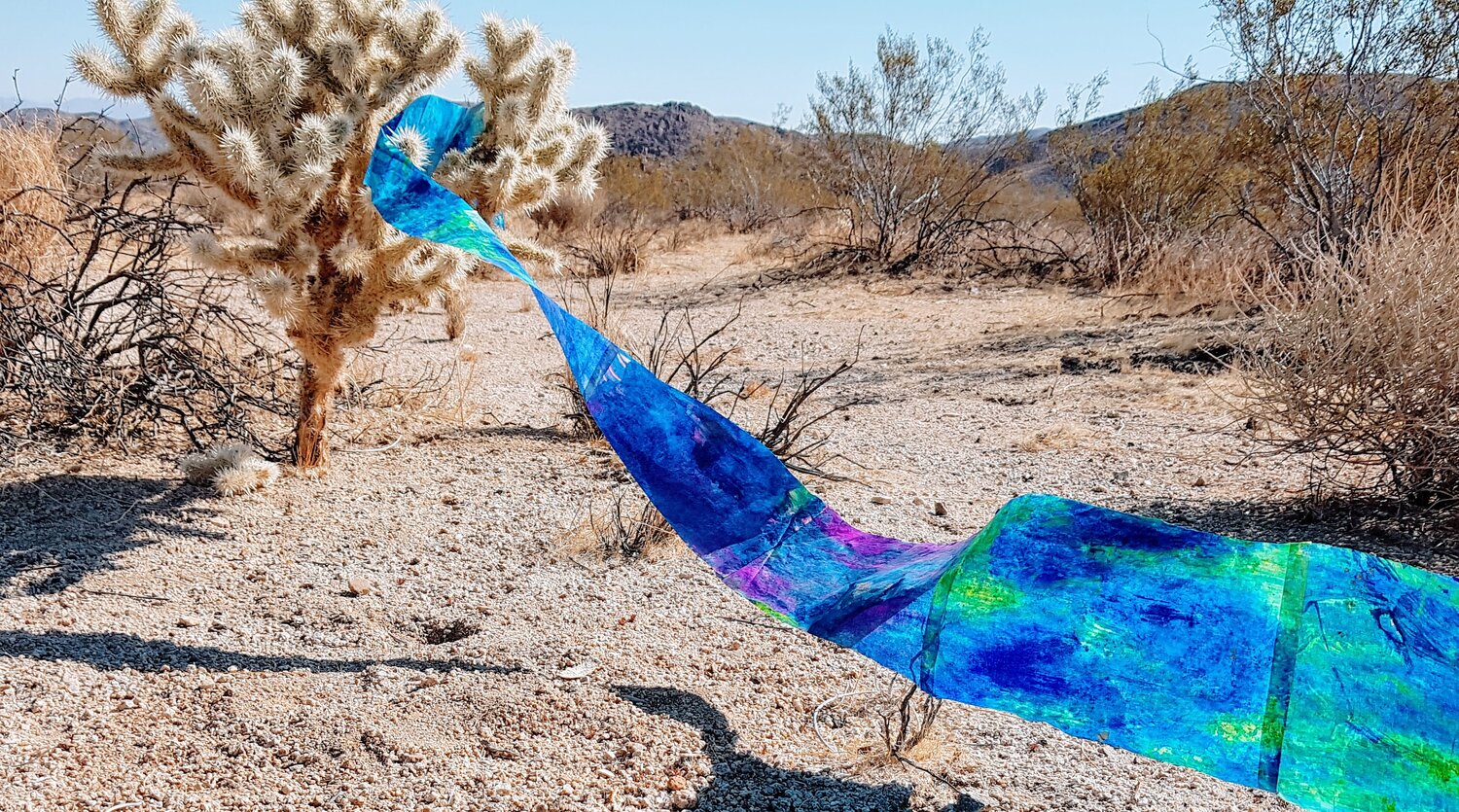
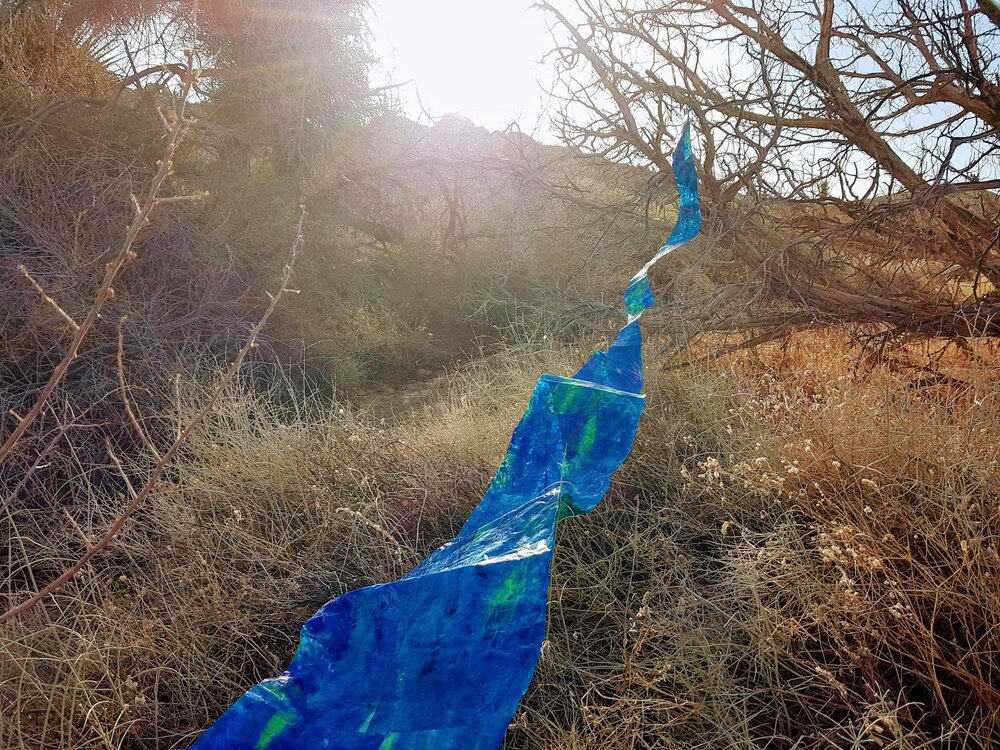
LOOK: Paper River Flow in the Desert by Young-Ly Hong Chandra
Young-Ly Hong Chandra (Korean, 1970–), Paper River Flow in the Desert, Joshua Tree National Park, Southern California, 2021. Traditional Korean mulberry paper with acrylic, watercolor, ink, and gel.
Born and raised in Seoul and currently living in Pasadena, Young-Ly Hong Chandra is an artist who works primarily with paper, fabric, and found objects and in a range of sizes, from small collages to large-scale installations. From October 2020 to June 2021 she was an artist in residence at the Brehm Center at Fuller Theological Seminary, and she is now a facilitator in the program. She is also an artist in residence with Inbreak.co.
One of the main materials Hong Chandra uses is hanji, traditional handmade paper from Korea made from the inner bark of the paper mulberry tree. She cuts the paper and paints it on both sides with acrylic, watercolor, and ink, then she applies a thin coat of transparent gel to make it more durable and waterproof. “Paper stained glass” is what she calls these creations.
For her Paper River Flow series, she attaches together numerous pieces of this paper stained glass to form long blue rolls that can be rolled up or folded and packed in a bag so that when she travels nationally or internationally, or when she moves about her home city, she can carry them with her and create installations as the mood strikes her. “I am a small river bearer,” she says, “who’s conveying the big vision of the river flow to give life to many and will reflect the glory of God clear as crystal.”
The river is a symbol of healing and renewal, she says. In our dryness, in our barrenness, God springs up, offering life and nourishment. The image of the river is used many times in the prophetic book of Isaiah—I’ve cited just a few examples above—and also appears in the final book of the New Testament, where it flows down from the throne of God, watering the new creation (Rev. 22:1–2). Hong Chandra says,
The image of river for me is from Revelation 22 . . . the river flowing in the holy city, reflecting the glory of the Lamb of God sitting on the throne. And what I’m doing is still far from reflecting that glory. But I want this piece to be an invitation to others to come and taste the living water that was given so freely.
KOREAN 하나님께서 당신을 통해 메마른 땅에 샘물나게 하시기를 가난한 영혼 목마른 영혼 당신을통해 주 사랑 알기 원하네
[Phonetic] Ha na neem geh suh Dang shin eul tong heh Meh malun ttang eh Sehm mul nag geh ha shi gee lul Ga nan han young hone Mohk mal luhn young hone Dang shin eul tong heh Joo sarang ahl gee wun ha neh
SPANISH Agua viva Fluye del Señor A través de ti A esta tierra seca Al que tiene sed Dale de beber Que el amor de Dios Sea mostrado en ti siempre
ENGLISH May the love of God Spring up in your soul Like a healing stream In the wilderness flowing And may the love of God Quench the thirsty soul Feed the hungry heart May the love of God flow through you
I’ve compiled a playlist of songs of thanks to God for life, beauty, family, salvation, fruitful harvests, and countless other blessings, and for God’s very self. To make a list on this theme is difficult, as every praise song, of which there are millions, is essentially a song of thanksgiving. So many songs and other musical pieces, including those from outside the Judeo-Christian tradition, testify to experiences of goodness. Perhaps I’m being too literal, but I focus (though not exclusively) on songs that explicitly say “Thanks.” I also want to make clear that God deserves thanks not just for what he’s done but for who he is.
To save the playlist to your Spotify account, click the ellipsis and select “Add to Your Library.”
The list is bookended by the seventeenth-century Trinitarian doxology written by Thomas Ken (“Praise God from whom all blessings flow . . .”), which many churches sing weekly to the tune of OLD 100TH. While the first on the list is in English, the last is in Hawaiian.
Several of the songs are settings of the biblical psalms. The Abayudaya community of Jews in eastern Uganda, for example, sings the call-and-response Psalm 136 in Luganda; led by J. J. Keki, the congregation responds after each line with “His steadfast love endures forever!” Banjoist Béla Fleck [previously] and mandolinist Chris Thile use this melody from Abayudaya as the basis of their “Psalm 136” duet, which appears on Fleck’s new album, Bluegrass Heart.
There’s also Psalm 92 (“It is good to give thanks to the Lord . . .”) from Poor Bishop Hooper’s EveryPsalm project, Wendell Kimbrough’s Psalm 107, and a classical guitar rendition of Jewish singer-songwriter Debbie Friedman’s “Hodu” [previously], a setting of Psalm 118:1–4. Rebekah Osborn also sets Psalm 118, in English.
“We Thank You” is by Broken Walls, a musical group comprising followers of the Jesus Way who seek to build bridges between the church and the First Nations people of North America. Founded by Jonathan Maracle, a Mohawk from Tyendinaga Territory in Ontario, Canada, the band uses indigenous instruments and sounds to share the Creator’s love.
Across the Atlantic, the monks of Keur Moussa Abbey [previously] in Senegal sing “Nous Te Louons, Père Invisible” (“We Praise You, Invisible Father”), accompanied by balafon (a gourd-resonated xylophone). The French lyrics translate as follows:
Lord of immortality We praise you, invisible Father You are the source of life We praise you, invisible Father The source of all light We praise you, invisible Father You are the source of grace We praise you, invisible Father Friend of mankind, friend of the poor, you draw everything unto yourself through the coming of your beloved Son! We praise you, invisible Father
I’ve also included a dedicatory instrumental piece played on kora and oboe for the inauguration and consecration of the abbey.
Praise be to God, too, for natural wonders large and small. You’ll want to be sure to check out Alanna Boudreau’s setting of “Pied Beauty” by the poet-priest Gerard Manley Hopkins. (For you Hopkins lovers, Boudreau also set “My own heart let me more have pity on” and “God’s Grandeur,” the latter appearing on Spotify as “Wb / Bw.”) There are also classics like “This Is My Father’s World” and, retuned and retitled by Ben Thomas, “I Sing the Mighty Power of God” [previously].
“For the Beauty of the Earth,” which opens with gratitude for creation and then expands into other areas of thanks, is one of my all-time favorite hymns. Andrew Laparra’s straightforward rendition is so lovely, even though it does omit two of the verses—on the wonders of the human body (“. . . the mystic harmony linking sense and sound to sight”) and “the joy of human love . . .”
For the provision of food, there’s a delightful little song that Kim Gannon and Walter Kent wrote for the 1948 Disney short The Legend of Johnny Appleseed, the American nurseryman, conservationist, and folk hero. The song became popular in primary schools and children’s camps and at grace before meals, and in 2003 Mary Thienes Schünemann included an adaptation in the songbook and accompanying album This Is the Way We Wash-a-Day, which is what I’ve put on the list.
For another prayer appropriate for mealtime, see “Multilingual Grace” by Jaewoo Kim, Grace Funderburgh, Abraham Deng, and Josh Davis of Proskuneo Ministries [previously]. “Here in our community, we eat together a lot . . . and that means Koreans, Latinos, Americans, Burmese, and Sudanese and more coming together around the table,” Davis writes on the Proskuneo blog. “We wanted something we could sing to thank God together. And so we wrote this.” The chorus says “Thank you” in Arabic, Korean, Spanish, and Swahili:
Relishing simply being alive is a common theme that comes across especially in songs like “So Glad I’m Here” by Bessie Jones, covered by Dan Zanes [previously] and Elizabeth Mitchell [previously], and “It’s Such a Good Feeling” by the Mister Rogers(!), charmingly jazzified by Holly Yarbrough.
Michael and Lisa Gungor sing of the gift of their second daughter, Lucette, in their song “Light.” Lucie, as they call her, whose name means “light,” was born in 2014 with Down syndrome and heart complications. Seven years and multiple heart surgeries later, she continues to fill the Gungors’ lives, and others’, with brightness.
Gratitude in all circumstances is another theme that comes up, in such songs as “Hallelujah” by the Sons of Rainer, “Sing” by Jon Batiste, and the traditional hymn “How Can I Keep from Singing.” And India Arie’s gorgeous “Give Thanks,” which expresses an attitude of welcome and embrace for all that life brings. In the refrain “Give thanks for all that is,” “Give thanks” is substituted in repeats with the words “Selah” (an untranslatable Hebrew word from the Psalms that probably indicates a reflective pause in the music), “Hallelujah” (Hebrew for “Praise the Lord”), “Namaste” (Sanskrit for “I bow to you”), and “Ashé” (a multivalent concept in Yoruba religion that carries the meaning, in one sense, of “So be it,” similar to “Amen” in Christianity).
Recited daily upon waking up, “Modeh Ani” by Nefesh Mountain is a Jewish prayer of thanks that translates to “I give thanks before you, King living and eternal, for You have returned within me my soul with compassion; abundant is Your faithfulness!” It’s based on the belief that every morning, God renews every person as a new creation.
There are also gospel songs aplenty by artists including Shirley Ann Lee, Mahalia Jackson, Beyoncé [previously], Regina Belle, Roberta Martin, Janice Gaines (covering Andraé Crouch), and others from the Black church tradition.
Bob Marley’s “Thank You, Lord” from 1967 isn’t on Spotify, but an admirable cover by his fellow Jamaican reggae artist Max Romeo is. Sam Cooke’s recording of “I Thank God” by Jack Hoffman, Elliott Lewis, and Bebe Blake is also missing from the streaming service, but I love what the Avett Brothers do with the song, so I’ve featured them instead.
Our gratitude for God’s love and hospitality should overflow into our relationships with other people, animals, and the earth, and our trust in God’s goodness means we should receive with openness what comes from his hand, even if it’s not what we asked for. In the playlist’s penultimate song, “The Welcome,” David Benjamin Blower sings, “Just as Love has welcomed you, my friends / Welcome one another and all things.”
+++
This blog site and the thematic playlists that accompany it take an enormous amount of time to put together. If you have been blessed by either this year, please consider making a financial contribution to support me so that I can continue doing this work. And thank you, all, for engaging with and sharing the content!
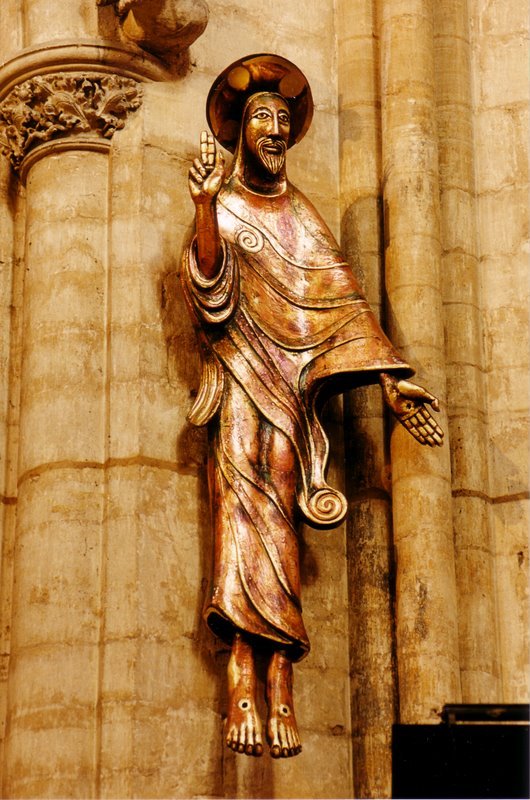
Peter Eugene Ball (British, 1943–), Christus Rex, 1999. Wood sculpture covered in copper and embellished with silver and gold leaf. Ely Cathedral, Cambridgeshire, England.
The final Sunday in the 2016–17 lectionary year, November 26 is designated in the Western church as the feast of Christ the King, known formally as the Solemnity of Our Lord Jesus Christ, King of the Universe. One of the scripture readings for the conclusion of cycle A is as follows:
I pray that the God of our Lord Jesus Christ, the Father of glory, may give you the Spirit of wisdom and of revelation in the knowledge of him, having the eyes of your hearts enlightened, that you may know what is the hope to which he has called you, what are the riches of his glorious inheritance in the saints, and what is the immeasurable greatness of his power toward us who believe, according to the working of his great might that he worked in Christ when he raised him from the dead and seated him at his right hand in the heavenly places, far above all rule and authority and power and dominion, and above every name that is named, not only in this age but also in the one to come. And he put all things under his feet and gave him as head over all things to the church, which is his body, the fullness of him who fills all in all.
If to Christ our Lord is given all power in heaven and on earth; if all people, purchased by his precious blood, are by a new right subjected to his dominion; if this power embraces all people, it must be clear that not one of our faculties is exempt from his empire. He must reign in our minds, which should assent with perfect submission and firm belief to revealed truths and to the doctrines of Christ. He must reign in our wills, which should obey the laws and precepts of God. He must reign in our hearts, which should spurn natural desires and love God above all things, and cleave to him alone. He must reign in our bodies and in our members, which should serve as instruments for the interior sanctification of our souls, or to use the words of the Apostle Paul, as instruments of justice unto God.
This post belongs to the weekly series Artful Devotion. If you can’t view the music player in your email or RSS reader, try opening the post in your browser.
To view all the Revised Common Lectionary scripture readings for Proper 29, cycle A, click here.

 Art & Theology