“Song of the Agitators”: 1852 poem set to music

Reclaiming the Monument
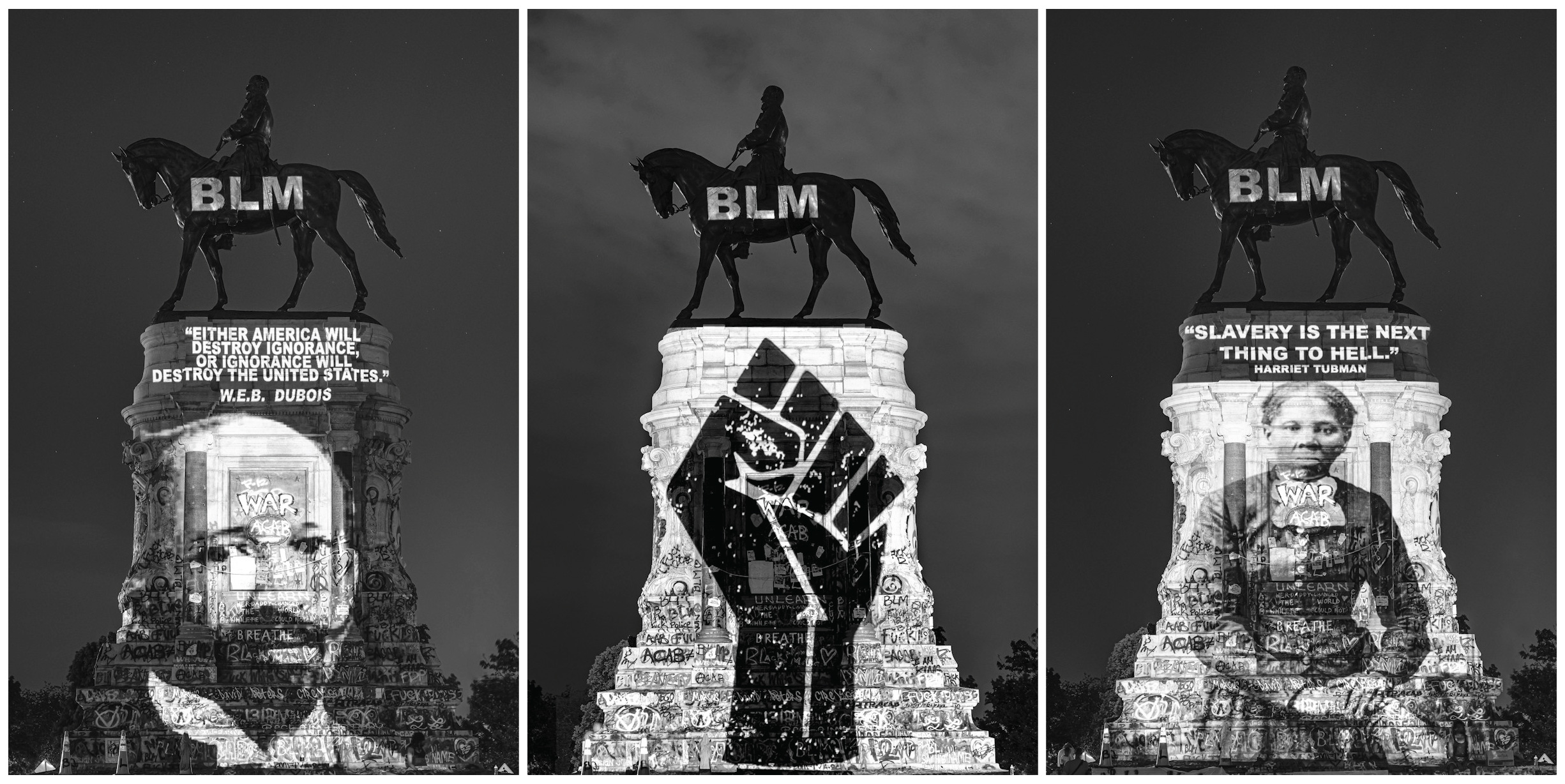
In summer 2020, artists Dustin Klein and Alex Criqui projected images of Black lament and empowerment onto the Robert E. Lee Monument at Marcus-David Peters Circle in Richmond, Virginia, part of their Reclaiming the Monument project. Read more at bottom of post.

Song of the Agitators

“Cease to agitate!” we will,
When the slave whip’s sound is still;
When no more on guiltless limb
Fetters print their circlet grim;
When no hound athirst for blood
Scours the thorny Georgian wood;
When no mother’s pleading prayer,
On the sultry Southern air,
Quivereth out in accents wild,
“Master, give me back my child!”
   In the day when men shall be
   Brethren, equal-born, and free—
   Day for which we work and wait—
   We will “cease to agitate”!

When our statute books proclaim
To the world no more our shame,
And a freeman’s rights shall hold
Dearer than the Judas gold;
When the Polar Star shall give
Light to the last fugitive;
When our border lakes shall rise
On the last lone bondman’s eyes,
And their waves for him no more
Haste to clasp the Northern shore;
   In the day when men shall be
   Brethren, equal-born, and free—
   Day for which we work and wait—
   We will “cease to agitate”!

Written by an anonymous abolitionist during the days of race-based chattel slavery in the United States, this poem was originally published in the Ohio Star (Ravenna, OH) in 1852 and was reprinted shortly after in the Anti-Slavery Bugle (Oct. 9, 1852) (Lisbon, OH), the Liberator (Nov. 19, 1852) (Boston), and the Voice of the Fugitive (Dec. 16, 1852) (Windsor, Ontario).

The poem addresses those who, with the status quo working in their favor, would tell the enslaved to stop complaining about the injustices being perpetuated against them, stop ruffling feathers and demanding change, and instead just sit back and be content with the way things are.

The speaker of the poem responds with a defiant no; they and their fellow activists will stop agitating only when their cause is won. When the enslaver’s whip ceases to crack the air, and shackles no longer imprint themselves on ankles and wrists. When bloodhounds are no longer unleashed on freedom seekers, and children are no longer forcibly separated from their parents. When the country’s founding documents are scrubbed of their racism, and its legislation protects the rights of all Americans in equal measure. When the North Star guides home and the Great Lakes give passage to every last person out of bondage into liberation.

Those who work for justice today still often encounter the demand, “Cease to agitate!” “Stop stirring up trouble.” “Don’t be such a downer.” “Why are you so angry?” “Why can’t you just be grateful for the progress we’ve made?” “When will you ever be satisfied?”

Struck by its contemporary relevance, Detroit-born, Vancouver-based musical artist Khari Wendell McClelland adapted the above poem and set it to music. “I sing this song for all those who are living under tyranny, escaping tyranny, and searching for peace,” he wrote in a 2015 Facebook post sharing a demo video.

McClelland’s “Song of the Agitator” appears on his 2018 album, Freedom Singer. The album is dedicated to his great-great-great-grandmother Kizzy, who fled US slavery through the Underground Railroad to Windsor, Ontario, settling in Detroit after slavery was abolished.

Here’s a video of McClelland performing the song with Noah Walker for the Tiny Lights InSight Series in 2020:

While the first stanza he sings almost verbatim from the nineteenth-century source material, the second stanza he reworks to highlight present-day grievances:  

Now here we are today
Still pushing for equal pay
And these treaty rights don’t hold
They’re shiny like the Judas gold
The stain of blood remains
A mother’s only son slain
Our kids are crying out for more
Continually being ignored

And here’s how he’s adapted the refrain:

On that day we will be
Family, equal-born, and free
Dawn will come, night will cease
We’ll rejoice, mind at ease
For that day we’ll work and wait
That’s when we’ll cease to agitate

In a Geopoetics podcast interview that aired February 25, 2023, McClelland said, “For some of us, it’s been hundreds of years of incredible terror. And, you know, it’s a great luxury to feel in this moment like something’s wrong.” He continues, “It’s good to be agitated—to want to make things be different. When we start to become a little too comfortable with things being out of sort, being unjust, that’s where . . . it’s a problem. . . . Agitation is actually . . . good fuel.”

About the images above:

The Robert E. Lee Monument in Richmond, Virginia, was erected in 1890 during the Jim Crow era to glorify the Confederate general (who fought against the Union to preserve slavery). A bronze equestrian statue atop a giant plinth in the center of one of the historic city’s traffic circles, it had been controversial from the beginning, with many of Richmond’s Black residents regarding it as an oppressive and traumatic presence.  

After the murder of George Floyd, the monument became an epicenter of Black Lives Matter protests as well as a site of vandalism, and Virginia governor Ralph Northam announced on June 4, 2020, that it would be removed. While the legality of that intent was being litigated, light projection artist and Richmonder Dustin Klein, later joined by collaborator Alex Criqui, cast nightly image projections onto the statue—first of Black victims of police violence, and then of Black activists, writers, theologians, artists, and politicians and associated quotes. In October 2020, the graffiti-covered, image-lit Robert E. Lee Monument was declared the most influential American protest artwork since World War II by the New York Times.

On September 2, 2021, the Virginia Supreme Court upheld Northam’s decision, and the statue was removed shortly after.

To view more photos and learn more about Klein and Criqui’s Reclaiming the Monument project, see www.reclaimingthemonument.com.

Juneteenth Playlist: Songs of Black joy, liberation, and faith

Juneteenth (June 19) is a federal holiday in the United States celebrating the liberation of enslaved African Americans in Texas in 1865. Abraham Lincoln had issued the Emancipation Proclamation on January 1, 1863, but it was not implemented in places still under Confederate control, and because Texas, being on the westernmost edge of the Confederacy, was farthest from the military action of the Civil War, Texans could conveniently continue to enslave, as there were no soldiers there to enforce the executive decree. But when Union troops, both white and Black, arrived in Galveston Bay on June 19, 1865, two months after the official end of the war, they saw to it by threat of force that the 250,000-plus enslaved Black people in the state were freed.

Also known as Emancipation Day or Jubilee Day (after the year of release mandated by ancient Israelite law), Juneteenth has been celebrated by African American communities in Texas ever since the first anniversary of the freeing event. Historically, the church has been at the center of these celebrations, as the formerly enslaved attributed their liberation to God, to whom they gave effusive thanks and praise. In the twentieth century, Juneteenth expanded into other states but still remained very niche, until 2021, when, after decades of lobbying by Black activists, President Joe Biden signed into law the Juneteenth National Independence Day Act, moving the holiday into the mainstream.

Juneteenth marks not only that one historic day but also, more broadly, freedom as an ongoing struggle. It’s not as if the illegalizing of chattel slavery, or even the passage of the Civil Rights Act of 1964, ended racial oppression or prejudices, which manifest today in, for example, the racial wealth gap, voter suppression, and disparities in policing. We have made important progress as a country, for sure, but there’s still a ways to go until everyone breathes free.

Bishop T. D. Jakes of The Potter’s House in Dallas says that Juneteenth must involve a reckoning with our nation’s sordid past and a commitment to identifying and rooting out whatever sordidness persists. “It’s vital we all must remember when liberty and justice is delayed or denied, it causes traumatic ripples throughout future generations. . . . As we collectively stop to acknowledge and learn from the delayed liberties of our nation’s ancestors, we must not allow those same systems to repeat injustices.”

In recognition of Juneteenth, I’ve compiled on Spotify 118 songs of Black joy, liberation, and faith. From Beyoncé to Duke Ellington, Adolphus Hailstork to Rhiannon Giddens, Mary Lou Williams to Richard Smallwood, these artists jubilate, extol, lament, protest, revel, testify, and hope.

I acknowledge the complications of me, a white person, offering this playlist. I have grappled with how to appropriately celebrate Juneteenth and how to balance its predominant tone of joy (am I allowed to feel joy?) with an honest accounting of past and present evils that mark the Black experience in America, especially slavery and its legacy. One basic piece of advice I’ve heard is to center Black voices. Listen to and lift up Black historians, Black theologians, Black novelists, Black songwriters, etc.  

The Art & Theology Juneteenth Playlist combines sacred and so-called secular music written and/or performed by Black artists and exhibiting a spirit of defiant joy. It emphasizes the beauty, power, creativity, and divine belovedness of Black people.

Honoring the religious roots of Juneteenth and the faithful ongoing witness of the Black church, I have incorporated many Christian songs, especially those that speak to the imago Dei and to God’s faithfulness, guidance, and deliverance. The Bible is full of divine deliverance tales: the Israelites from slavery in Egypt; Daniel from the lions’ den; the three Hebrew boys from the fiery furnace; Jonah from the belly of the whale; Paul and Silas from prison. “Didn’t my Lord deliver Daniel? Then why not every man?” sings one spiritual. Another, “Go Down, Moses,” confronts Pharaoh, a stand-in for white Southern enslavers, with the demand “Let my people go,” while yet another exults in the toppling of Pharaoh’s power—“Pharaoh’s army got drownded.” The spiritual “Satan, We’re Gonna Tear Your Kingdom Down” addresses the Enemy directly, expressing resolve to overthrow demonic systems and ideologies, such as white supremacy.

There are also plenty of feel-good vibes on the playlist, lighter songs like Lee Dorsey’s “Occapella,” Count Basie’s “Jumpin’ at the Woodside,” and Jon Batiste’s “Freedom” (with its stylish, smile-inducing music video that I can’t get enough of!):

There’s also the gospel song “This Joy” by Shirley Caesar, sung by the Resistance Revival Chorus:

Its first verse is: “This joy that I have—the world didn’t give it to me. . . . The world didn’t give it, and the world can’t take it away.” “This strength,” “this love,” and “this peace” follow in subsequent verses—otherworldly qualities given to us by God, as Caesar makes explicit in the original, and which no one can ever steal from us. No matter what harm people may do to us, we still possess these inner gifts, which help us face whatever comes.

Composed in the antebellum South, “No More Slavery Chains for Me” (aka “Many Thousands Gone” or “No More Auction Block”) holds together proclamation and grief. The speaker boldly asserts her freedom: “No more slavery chains,” “no more auction block,” “no more peck of corn,” “no more driver’s lash,” “no more mistress’ call,” “no more children stole from me.” It could be spoken by someone who is still enslaved but who refuses to tolerate that condition any longer, or it could be spoken by someone recently freed, rejoicing in what she has escaped. But the solemn refrain, “Many thousands gone,” remembers the multitudes whom slavery has killed. Here’s a performance by mezzo-soprano Shirley Verrett, an international opera star active from the late 1950s through 1990s:

Often words fail to capture the emotional intensity one might feel. “Triptych: Prayer / Protest / Peace” by Max Roach, from his 1960 avant-garde jazz album We Insist!: Freedom Now Suite, featuring Abbey Lincoln, consists almost entirely of wordless vocal expressions, screaming, and sighing, along with drumming by Roach. It’s mournful and alarming. The only words are at the beginning of part 3: “I need peace.” Cued up here (starting at 5:50) is Lincoln and Roach’s performance of the first two parts of “Triptych” for a Belgian TV station that aired January 10, 1964. (The earlier song in the video is “Tears for Johannesburg,” from the same suite.)

In the liner notes for We Insist!, Nat Hentoff writes that “Triptych” is a “final, uncontrollable unleashing of rage and anger that have been compressed in fear for so long that the only catharsis can be the extremely painful tearing out of all the accumulating fury.”

From the same era and genre is “They Say I Look Like God” from The Real Ambassadors, a jazz musical by Dave Brubeck and Iola Brubeck that never made it to the stage but that was recorded in the studio in 1961 and released a year later. Sung by Louis Armstrong, the song opens with these humorous lines, which Armstrong delivers with chilling earnestness:

They say I look like God
Could God be black? My God
If all are made in the image of Thee
Could Thou perchance a zebra be?

This is one-half of the first of four verses, all of which are interspersed with lines of scripture from Genesis 1 and 1 John 4 intoned, like a liturgical chant, by the trio Lambert, Hendricks & Ross, affirming the inherent goodness of Black folks, bearers of the divine breath. Verses 2 and 3 are addressed to God, pleading that he would show “that our creation was meant to be.” The final verse expresses longing for the day

When God tells man he’s really free
Really free
Really free
Really free

The creation narrative of Genesis 1 is also where Sho Baraka’s “Black as Heaven” opens—with beautiful Blackness, sacred humanity. Historically the color white has been used to symbolize goodness, purity, and heaven, but Baraka turns that symbol inside out and declares that he is “black as heaven.” If God created all humans in his image and many of those humans have black skin, then Blackness is a reflection of God. The Creator loves what he created, and we should too.

Heaven is full of Black saints and will continue to fill with such. The song lists many from across the fields of politics, music, history, education, theology and homiletics, agricultural science, and the culinary arts: Dr. Martin Luther King Jr., King Ezana of Aksum, King Lalibela of the Zagwe dynasty, Mahalia Jackson, Athanasius, Mary McLeod Bethune, George Washington Carver, David Walker, Edna Lewis, Carter G. Woodson, Bishop G. E. Patterson, Sister Rosetta Tharpe. These men and women are all “black as gold,” not in the sense that they are commodities or currencies, but rather are holy, luminous; and black as life-giving soil.

This is one of the songs commissioned for the 2022 documentary Juneteenth: Faith and Freedom [previously], and it includes a rap by Mag44 of Zambia. There’s so much richness in it, and I encourage you to follow along and sit with the lyrics, investigating any unfamiliar references and, depending on your background, humbly receiving the critiques or gladly receiving the affirmations.

In addition to hip-hop and jazz, the playlist is full of songs from the civil rights movement, such as “Woke Up This Morning with My Mind.” This old gospel song was recorded by Roosevelt and Uaroy Graves in 1936 and adapted in 1961 by the Rev. Robert Wesby, a Baptist minister from Aurora, Illinois. Wesby first sang it while spending time in jail in Hinds County, Mississippi, as a Freedom Rider, replacing the repeated word “Jesus” with one of Jesus’s key platform goals, “freedom”: “Woke up this morning with my mind stayed on freedom.”

This song became an important one in civil rights marches, and is led in the above recording by the famous activist Fannie Lou Hamer. For subsequent verses, she sings “Walkin’ and talkin’ with my mind . . . ,” “Singin’ and prayin’ with my mind . . . ,” “Ain’t no harm to keep your mind . . .” Stayed on freedom.

“Ain’t No Grave” is another traditional gospel song, first recorded by Bozie Sturdivant in 1942 and then by Sister Rosetta Tharpe in 1946–47. It’s about the general resurrection, when the saints will be called up out of their graves, but it’s also about indestructibility, the refusal to be or stay buried. I chose a more recent arrangement performed by jazz vocalist Tiffany Austin [previously], from her 2018 album Unbroken:

Hers starts off with the percussive sounds of a ring shout, a style borrowed from the Gullah Geeche of South Carolina’s Sea Bird Islands, and then goes on to incorporate scat singing. It’s full of enthusiastic energy!

One of the most powerful songs on the playlist is “Make It Home” by Tobe Nwigwe, written after the murder of George Floyd in May 2020. The song is “for the nappy heads in heaven, with a nappy-head Christ by they side”—for Blacks who have died.

It’s also a prayer and a blessing for Blacks who are living. “I pray you catch a wave that doesn’t subside. . . . May your streets be paved with gold. Hope my whole hood make it home.” He prays that his friends, family, and neighbors are able to make it safely back to their homes each night and are not killed in the streets. But “home” operates on other levels as well. To be at home with yourself, for example, is to feel whole, confident, secure in your body. Home also implies belonging. And of course “home” can also mean heaven, that place of ultimate freedom and rest. Are we creating the necessary conditions for freedom and rest here on earth as it is in heaven?

I learned about this song from Dr. Mary McCampbell (see the February 17, 2022, installment of her newsletter, The Empathetic Imagination), who teaches the music video in her humanities class at a Christian university.

Collectively, the songs on this playlist reflect the multifaceted spirit of Juneteenth, which encapsulates exultation, passion, power, praise, irrepressibility, resistance, sorrow, anger, and hope and trust. Like Juneteenth itself, the playlist is a looking back and a looking forward. We Americans are a people “on our way.” The work of emancipation is unfinished. These Black artists invite us to join the work.

I invite you, as a way of commemorating the holiday, to:

1. Choose one of the songs and pray from it.

2. Choose one of the artists and explore more of their oeuvre.

3. Choose one of the older songs and explore its origin and history, learning more about the context from which it arose and how it has been received over the decades. Listen to other renditions to see the different ways it’s been interpreted.

The image on the playlist cover is cropped from a photo I took a few years ago at Duke University Chapel of the linocut Ain’t No Grave by Steve A. Prince (2019), which shows a dancing winged figure emerging from the head of Carlotta Walls LaNier, the youngest of the Little Rock Nine, as she integrates the city’s high school in 1957. It is an embodiment of LaNier’s mighty spirit, and that of other Black “agents of God,” to use Prince’s term, who pursue freedom for themselves and others.

Songs of Lament and Justice by The Porter’s Gate

Though I grew up in the church, for a long time I was ignorant of the vibrant threads of lament and justice that run throughout scripture. I imbibed the message that good Christians never complain or get angry or question God or call him to account, that “rejoicing always” means always putting on a happy face (dwelling in sadness was tantamount to distrust), and that social justice is a “liberal agenda” and a distraction from the gospel. As my faith has matured and my engagement with the scriptures has deepened, my eyes have been opened to the embeddedness of justice in the biblical narrative, and how any lack of justice is cause for lament.

Tim Keller’s book Generous Justice: How God’s Grace Makes Us Just (2012) was instrumental in helping me see how social justice is an expression of God’s own heart and an important part of the church’s mission, not tangential to the gospel but an extension of it. My earlier conception of the gospel, the good news of Jesus Christ, was so impoverished, as I had reduced it down to nothing more than a private transaction between me and God regarding the eternal destination of my soul. As I began to see, through reading scripture, that God cares about this world, and he cares about people’s souls and bodies, I came to realize how expansive the gospel really is, with real implications for the here and now. We may be in right relationship with God, or think we are, but are we in right relationship with our neighbors and, I would add, with the rest of God’s creation? That is, do we live justly, as God commands, which includes supporting policies that promote, as best as possible, the flourishing of all, not just ourselves or others like us?

Keller shows how the Christianese terms “sin” and “righteousness” have to do not only with personal morality but also with systems, and how “justice” is more multifaceted than merely “punishment.” Punishing wrongdoers and reestablishing rights is one type of justice, called rectifying (or retributive) justice, or mishpat in Hebrew. But primary justice (aka distributive justice) is making sure goods and opportunities are more equitably distributed in society. It’s proactive. “Primary justice, or tzadeqah, is behavior that, if it was prevalent in the world, would render rectifying justice unnecessary, because everyone would be living in right relationship to everyone else” (11). Keller says that when these two Hebrew words appear together in the Bible, the best translation of the compound is “social justice.” So, for example, when Psalm 33:5 says, “He loveth righteousness [tzadeqah] and judgment [mishpat],” perhaps a better modern translation would be “The LORD loves social justice.”

The truncated “ticket to heaven,” “me and Jesus” understanding of salvation shows up in countless Christian worship songs, which form, or malform, our imaginations. I’m not at all dismissing the need for personal salvation (that is a critical component of the gospel!), or suggesting that we ought not to be looking toward eternity. What I am saying is that our relationship with Jesus, including our transformative experience of his love and grace, should have a profound impact on how we relate to and advocate for our neighbors, and our conception of heaven should be as huge and as glorious as the Bible alludes to (the entire world renewed and in harmony under the headship of Christ)—and we should start living into that vision NOW, even as we await Christ’s return. I often wonder whether, if there had been more biblical justice–oriented songs circulating and in church use during my upbringing, my deep hurt over the brokenness of the world and thus my sense of social responsibility as a Christian would have developed sooner.

Enter The Porter’s Gate Worship Project.

Founded in 2017 by Isaac and Megan Wardell, The Porter’s Gate is a music collective whose mission is to be a “porter” for the Christian church—one who looks beyond church doors for guests to welcome. Their first album, Work Songs (2017), explores the concept of vocation in both the public and private spheres. That was followed up by Neighbor Songs (2019), centered on the communal aspect of Christian living and of God’s future, and the embodied love at the heart of the gospel.

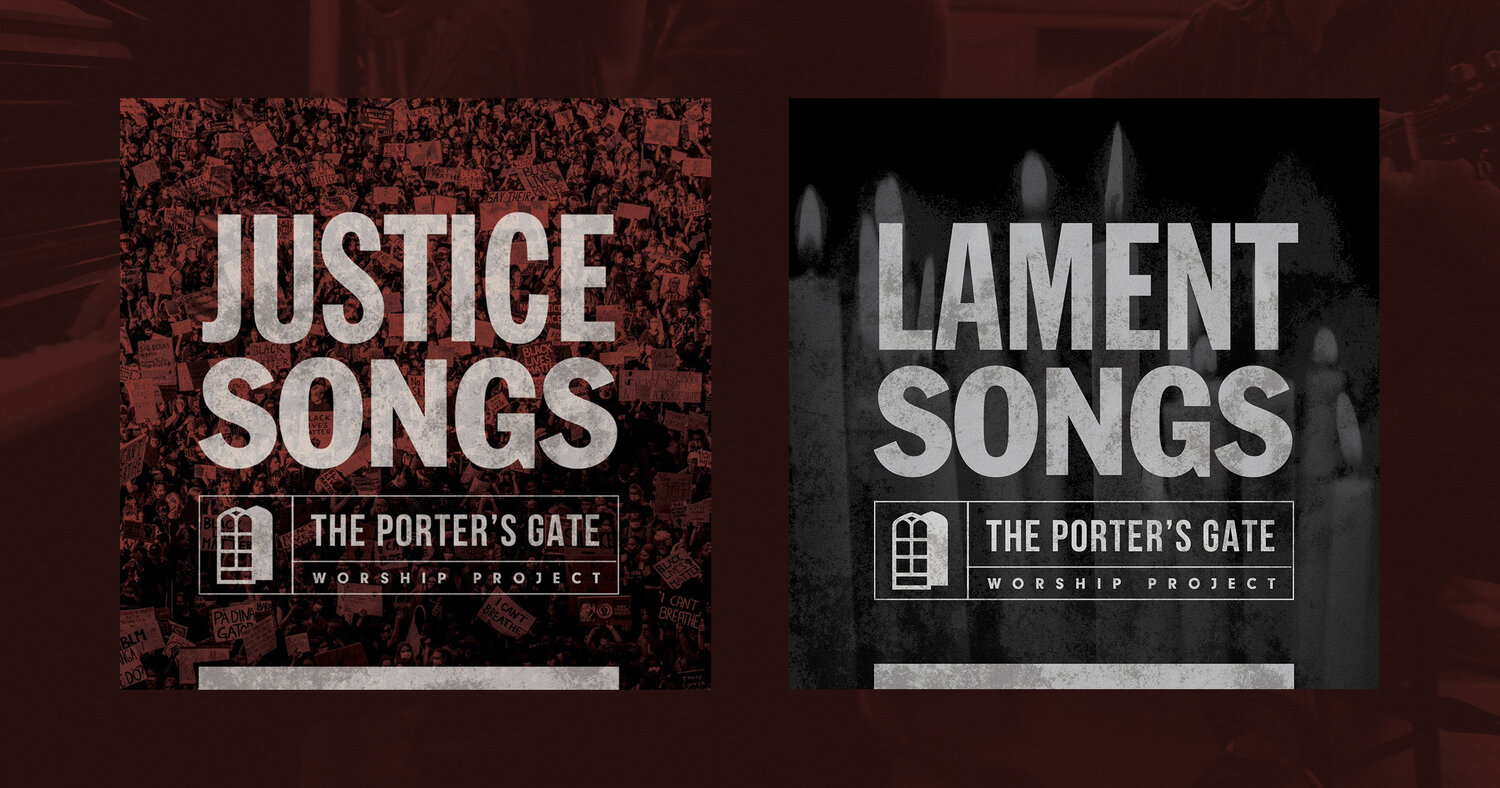
And now, released this month, are two companion albums: Lament Songs and Justice Songs. Recorded by a diverse group of musicians in July 2020 on a farm in Virginia, the albums interweave fragments from the Psalms with biblical prophecies and apocalypses, blessings, Gospel stories, and protest chants, crafting a robust kingdom theology that promotes constructive engagement with contemporary issues and a looking toward the reconciliation of all things in Christ. “We fight for the victories we know You will win” (a lyric from “Justicia”) is a good encapsulation.

Political corruption, police brutality, racism, mass incarceration, sexual violence, economic exploitation, and war are all referenced, either implicitly or explicitly, as forms of oppression that need to be toppled, as they are an affront to God, marring his image.

Full of heartbreak and hope, the songs are shepherding me out of my tendency toward cynicism and helping me recapture the beauty of God’s vision for the world. They’re saturated in biblical language. An antidote to the all-too-common escapism theology present in some Christian music, they catalyze the church to weep with those who are weeping (Rom. 12:15), to bear the burdens of others (Gal. 6:2), and to participate in God’s work of renewal in the world. God has not redeemed us to wait idly by while sin tightens its grip on society. No, he calls us to sow the seeds of his kingdom in anticipation of a bountiful harvest. To walk in the power of the Spirit, into dark corners, bringing light.

The Porter’s Gate seeks to provide songs for corporate worship, and all these would (potentially) be appropriate in that setting; for churches that aren’t used to the practice of lament or to engaging justice issues, some advance education and pastoral guidance will be in order. Some songs will naturally land better in some churches than in others. Some are challenging—and that’s a good thing, as challenge tends to grow us.

As one would expect, God is supplicated throughout the songs. Entreaties include

  • Come, Jesus, come
  • Be our light
  • Drive out the darkness
  • End all the violence
  • Do not be silent
  • Be near!
  • Illuminate the shadows
  • Take pity!
  • Keep the enemy back
  • Comfort
  • Be our refuge
  • Break oppression
  • Make me an instrument
  • Help me restore

And God is abundantly praised, and his promises laid claim to.

The songwriters on the two albums are Isaac Wardell, Latifah Alattas, Kate Bluett, Jessica Fox, Jon Guerra, Casey J, Wendell Kimbrough, Leslie Jordan, Dan Marotta, Orlando Palmer, John Swinton, Gregory Thompson, Liz Vice, Keith Watts, Tina Colón Williams, and Paul Zach.

As the writers would acknowledge, the general content and ethos of the songs are not “new” or alien to Christianity. If you cringe at the thought of bringing current events into worship or singing a confession of corporate sin or expressing sadness or outrage to God, just know that faithful Christians have been doing it since the beginning, and your discomfort may be because you haven’t been exposed to church traditions outside your own. Ecumenicism is an important aspect of The Porter’s Gate’s identity, says Isaac Wardell—an ecumenicism that says, “I come with gifts of the Spirit of my tradition, but I come also with the poverty of my tradition, looking for the charisms and the gifts of your tradition.” And I love that about the project.

Because I’m eager for others to see the biblical groundedness of the songs (which will be obvious to many upon first listening, but maybe not to those who are more selectivist in their Bible reading), and because I’m a musical worship leader who approaches worship music with great discernment of the theology it espouses, I’m going to point out just some of the scriptural connections in the songs.

+++

Listen to Lament Songs.

Acknowledging that the world is not right, and mourning specific instances of that unrighteousness, is the first step in justice work. It’s called lament. Lament cries out, “Why, God?” and “How long?” Honest expressions of woe are not irreverent. The Bible is full of such language. The fact that lament is addressed to God means that faith has not been abandoned; on the contrary, lament leads to a renewed confidence in God.

The first song on Lament Songs, “Wake Up, Jesus” (feat. Liz Vice), takes as its conceit the story of Jesus’s calming the storm after being woken up by his scared disciples, but it is sung in medias res, from the vantage point of one who is caught in a storm that is still raging. “Jesus, when you gonna wake up? . . . Won’t you rise up?” Again, maybe you’ve always assumed this kind of forthrightness is forbidden in prayer, but it’s in perfect sync with the way the biblical psalmists, for example, relate to God; take Psalm 44: “Awake, Lord! Why do you sleep? / Rouse yourself! Do not reject us forever. / Why do you hide your face / and forget our misery and oppression?” (vv. 23–24). (See more biblical examples of this demand at https://artandtheology.org/2019/07/09/rise-up-artful-devotion/.)

When the instrumental intro to the second song begins, we recognize the famous passion chorale tune by Hassler, and we ready ourselves to sing “O Sacred Head . . .”—but instead we get “O Sacred Neck.” The word change is jarring. Why are we talking about Jesus’s neck? Then with the next phrase, “pressed down by blows and knees,” it becomes clear that the reference is to black victims of police violence, like George Floyd, who died in May after an officer, arresting him for trying to make a purchase with a counterfeit twenty-dollar bill, knelt on his neck for nearly eight minutes while he pled for his life and then died. (Two other officers assisted in restraining him, and another prevented onlookers from intervening.)

Continue reading “Songs of Lament and Justice by The Porter’s Gate”