
Christmas, Day 4: The Innocents

We remember today, O God, the slaughter of the holy innocents of Bethlehem by King Herod. Receive, we pray, into the arms of your mercy all innocent victims; and by your great might frustrate the designs of evil tyrants and establish your rule of justice, love, and peace; through Jesus Christ our Lord, who lives and reigns with you, in the unity of the Holy Spirit, one God, for ever and ever. Amen.

—Collect from the Book of Common Prayer

Western church calendars mark December 28 as the Feast of the Holy Innocents, or Childermas, a day set aside to remember the slaughter of male Bethlehemites aged two and under by Herod the Great, king of Judea, as recounted in Matthew 2:16–18. Historians estimate there were probably ten to twenty children of that age in Bethlehem at the time.

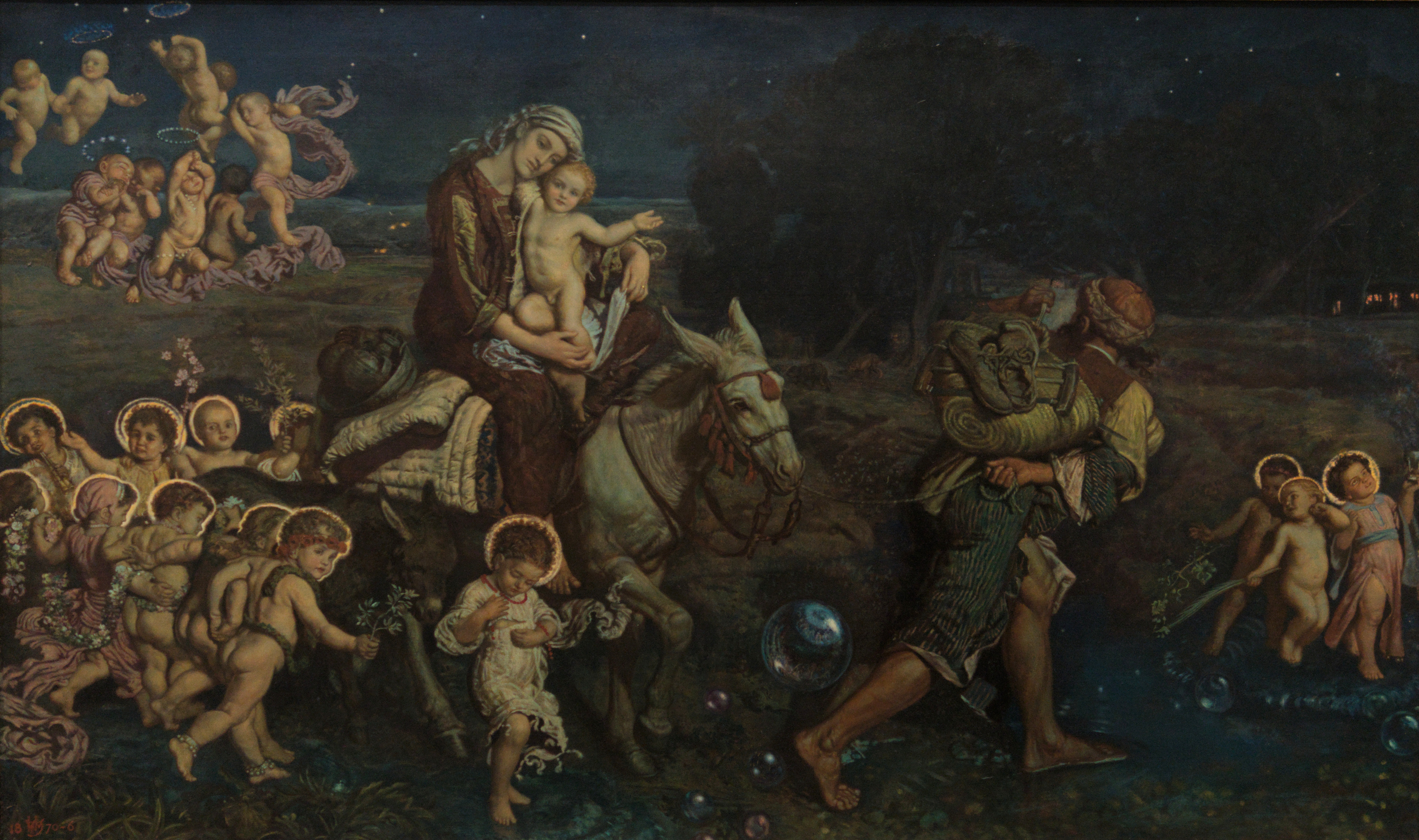
LOOK: The Triumph of the Innocents by William Holman Hunt
Hunt, William Holman_The Triumph of the Innocents
William Holman Hunt (British, 1827–1910), The Triumph of the Innocents, 1870–1903. Oil on canvas, 75.3 × 126 cm. Harvard Art Museums, Cambridge, Massachusetts. Photo: Victoria Emily Jones. [object record]

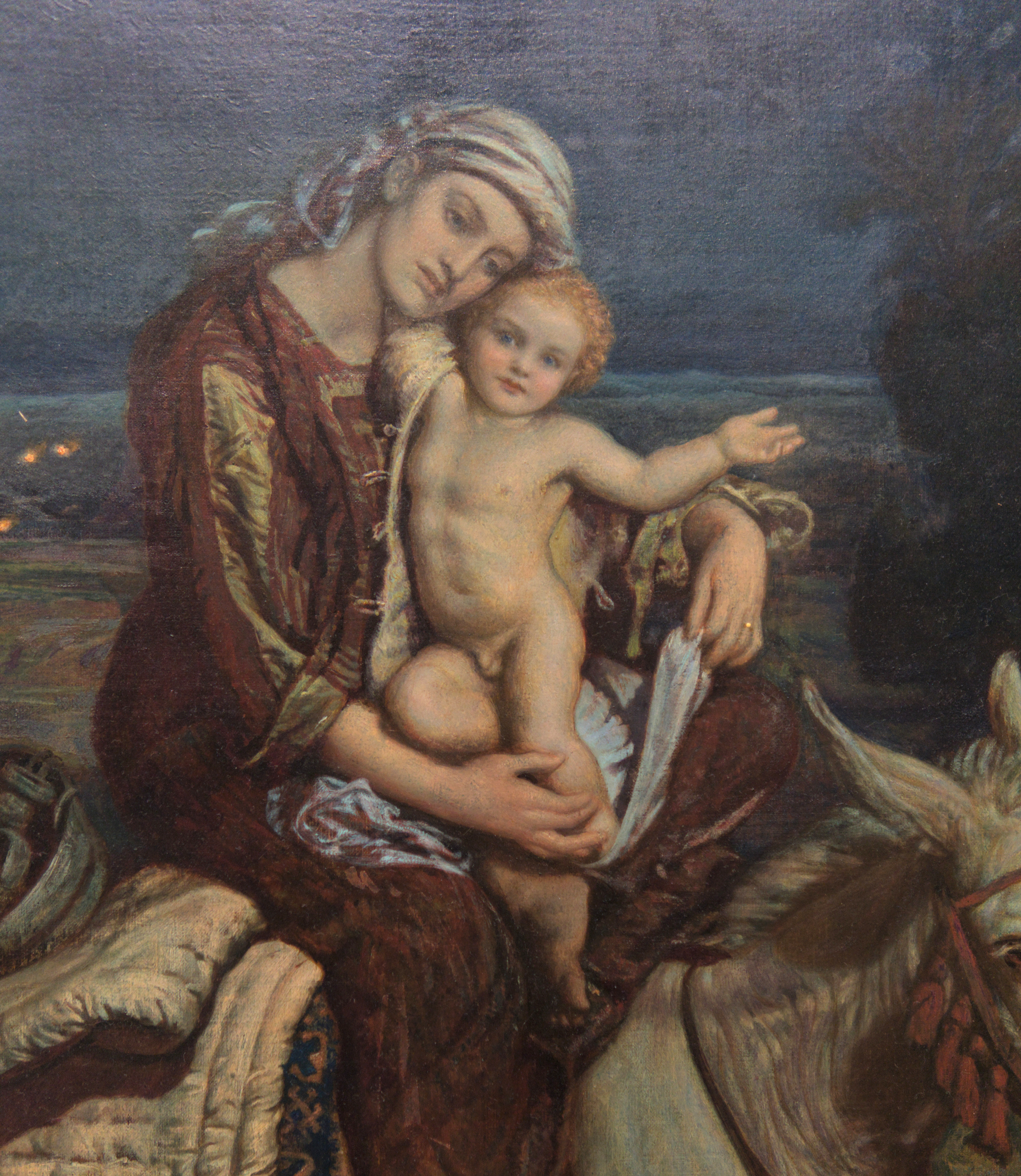
This visionary realist painting by the Pre-Raphaelite artist William Holman Hunt is a unique interpretation of the Flight to Egypt. It shows, surrounding the Holy Family on the run, the embodied spirits of all the little boys in Bethlehem—the “innocents”—who were slain at Herod’s behest. It’s the first of three versions Hunt painted of the subject, mostly completed by 1876, but with some of the background left unfinished until 1903. The other two versions are in the Tate Britain in London and the Walker Art Gallery in Liverpool.

The early church understood these boys as the first Christian martyrs. Though they were not conscious witnesses for Christ, they were killed because of him, casualties of a persecuting tyrant’s brooking no rival. Their death prefigures that of future Christian martyrs, starting with Stephen, as well as Christ’s own death.

Despite the solemnity of this episode, Hunt casts it in a triumphant light. Instead of showing the infants dismembered or impaled in a bloodbath with their mothers wailing in helpless grief, as artists have historically done, Hunt shows them in the light of glory, carrying palms and other branches and wearing floral crowns and garlands. They are, in the words of John Powell Lenox, the “first of that glorious company whose shining ranks are nearest the throne of the Slain One.”

Floating in air, those at the upper left are just waking up to their new spiritual life—they open their eyes and stretch.
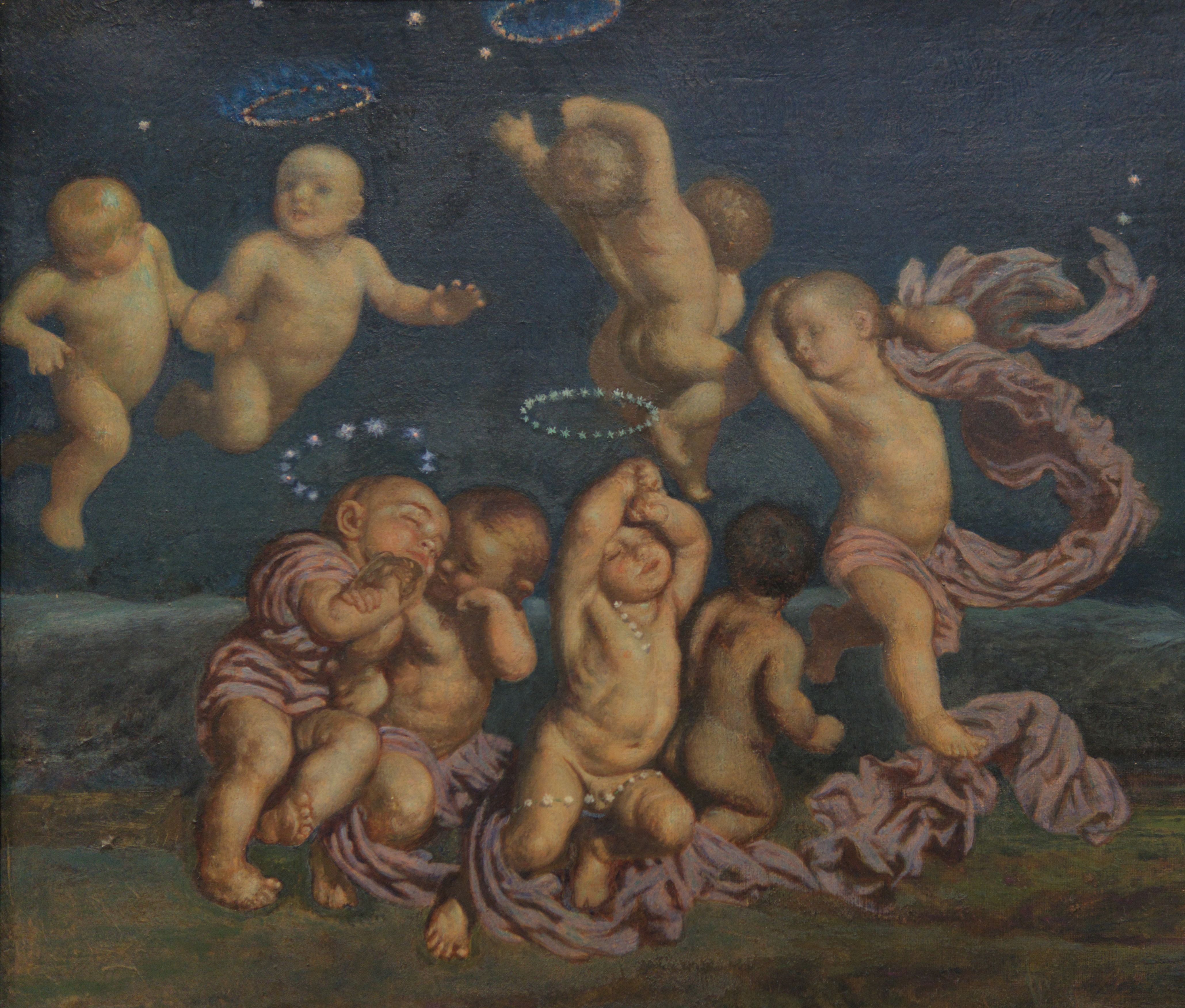
Triumph of the Innocents (detail)

Those on the ground lock arms in solidarity and play, surrounding a little foal. One curly-locked lad wears a red necklace, the beads spilling from the chain reminiscent of blood drops. But the fatal chest wound that one of Herod’s soldiers had inflicted by sword is no more, as he looks down with wonder to discover through a tear in his tunic. Healed flesh!
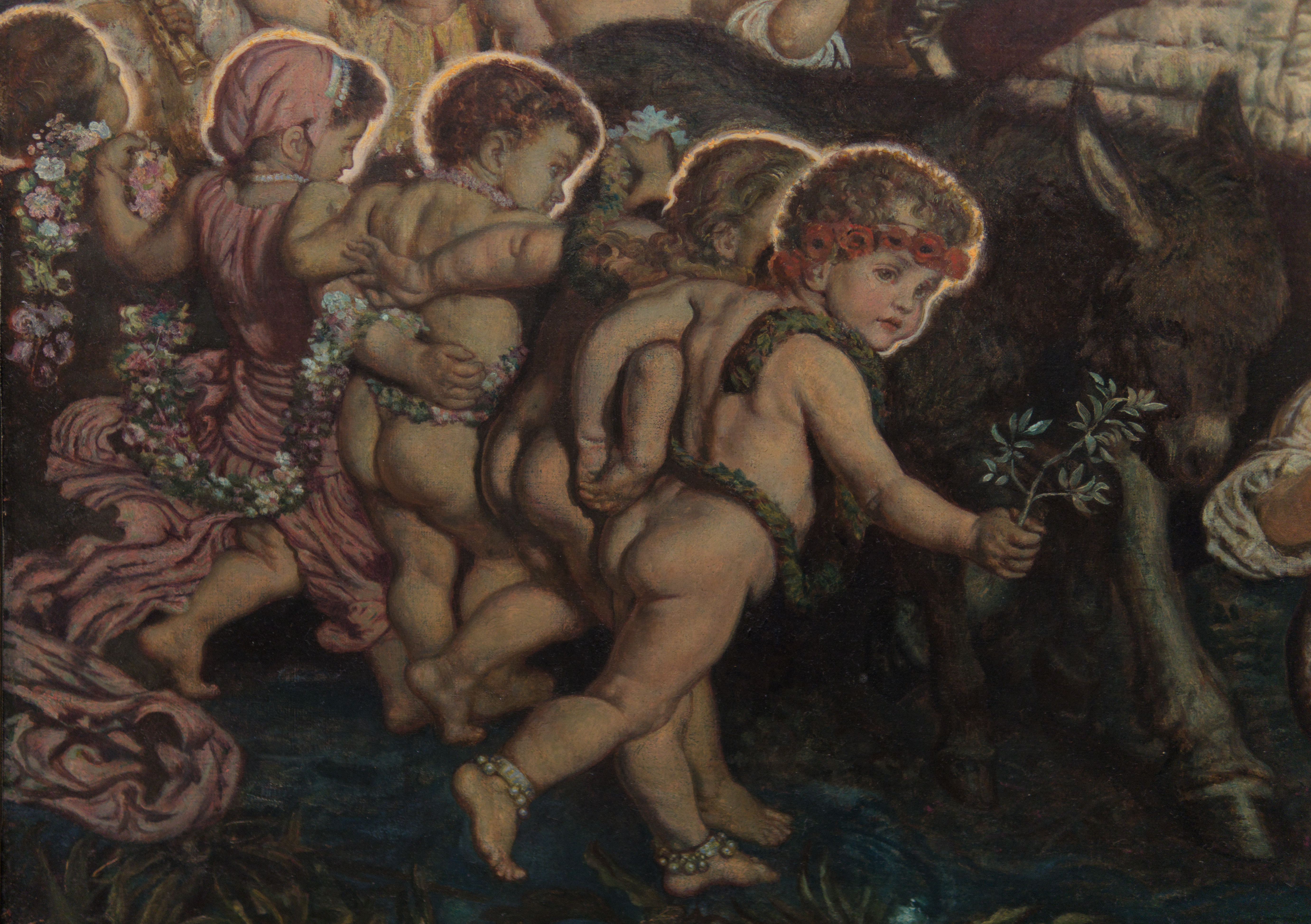
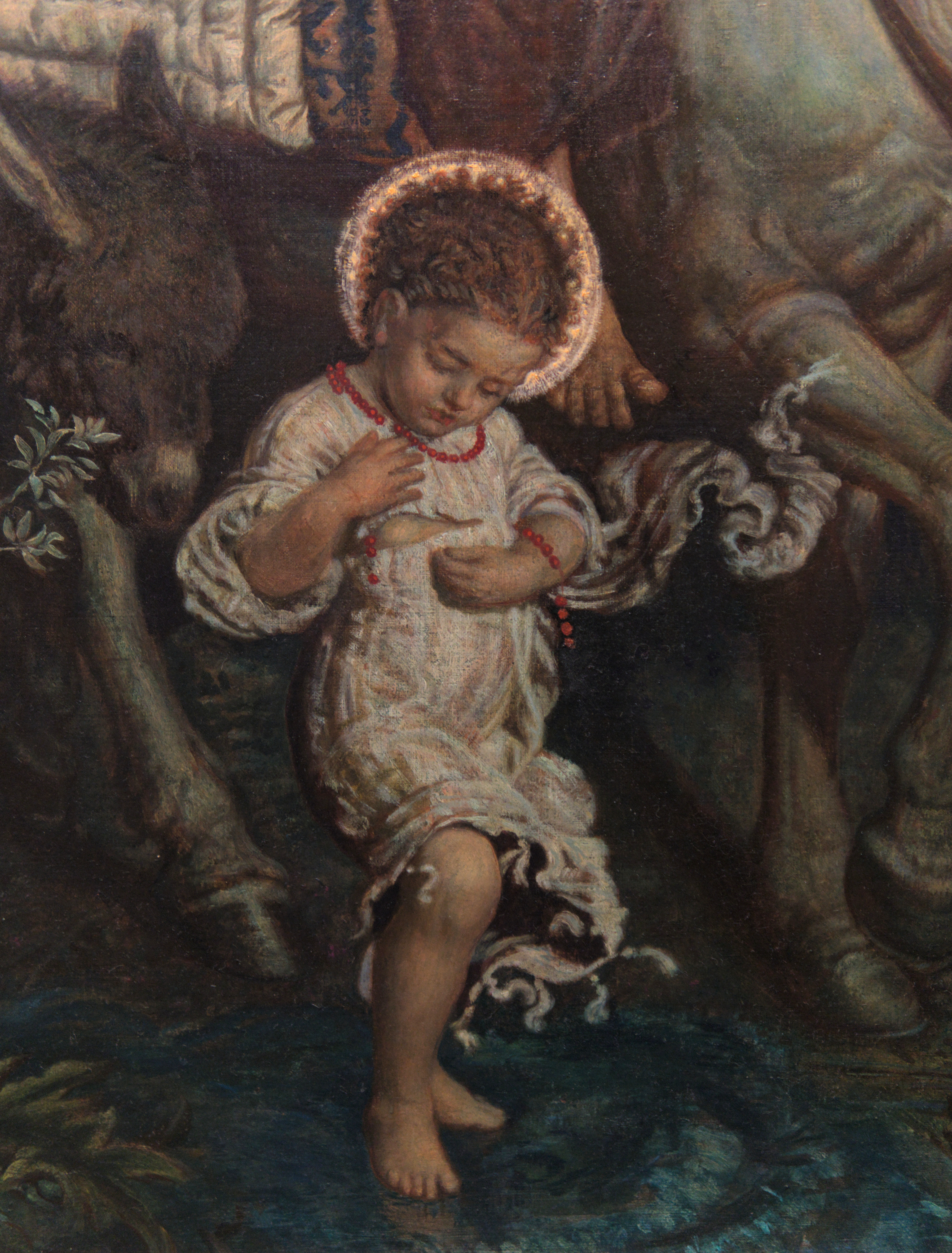
Triumph of the Innocents (detail)

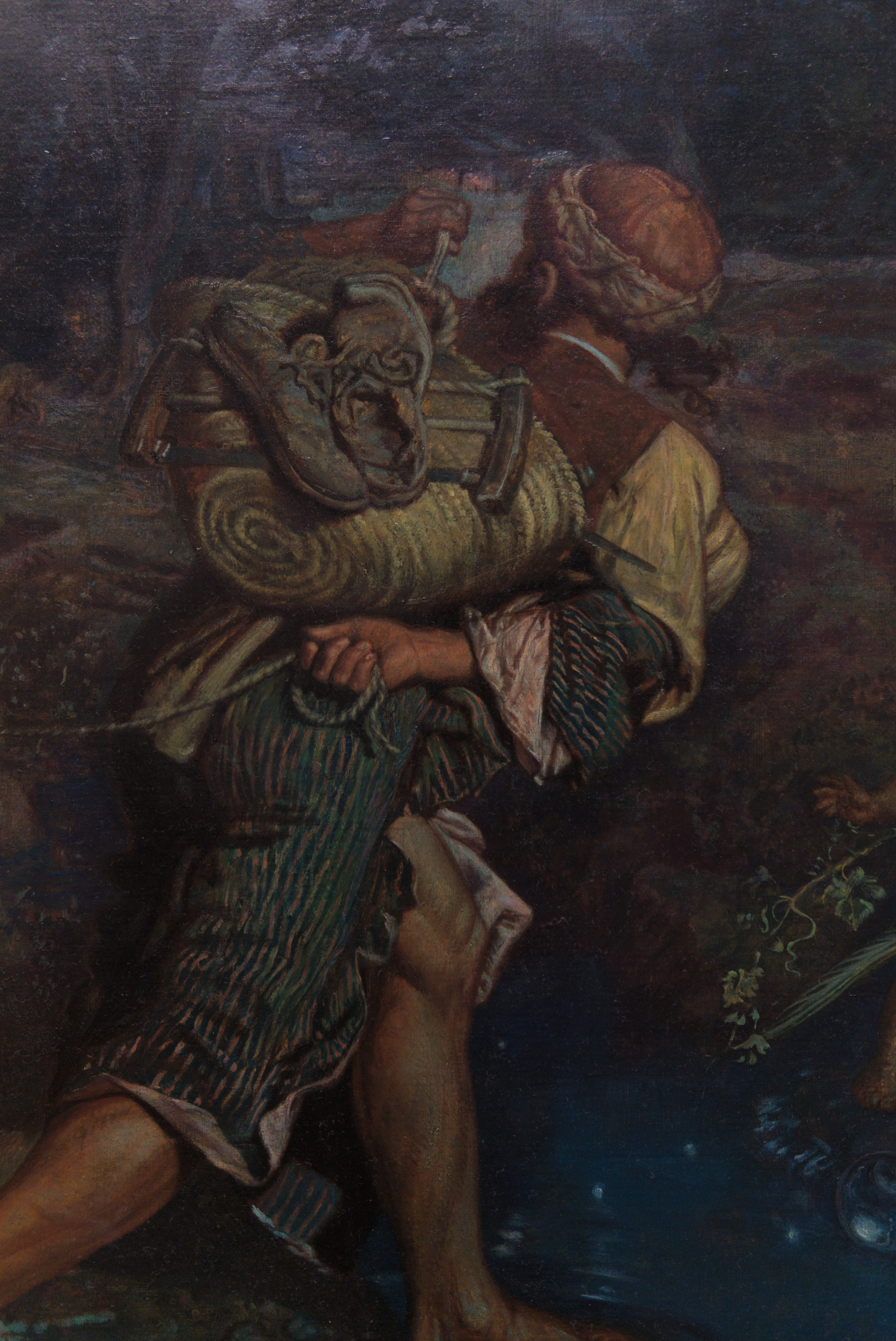
In the center Mary rides a mule, holding Jesus, who greets his playmates with a wave and a smile. He’s the only one who’s aware of them, these mystic brothers accompanying him into exile. Joseph leads the way forward, staying alert to potential threats. His tool basket is slung over his shoulder, which he’ll use to make a living for his family in Egypt.
Triumph of the Innocents (detail)

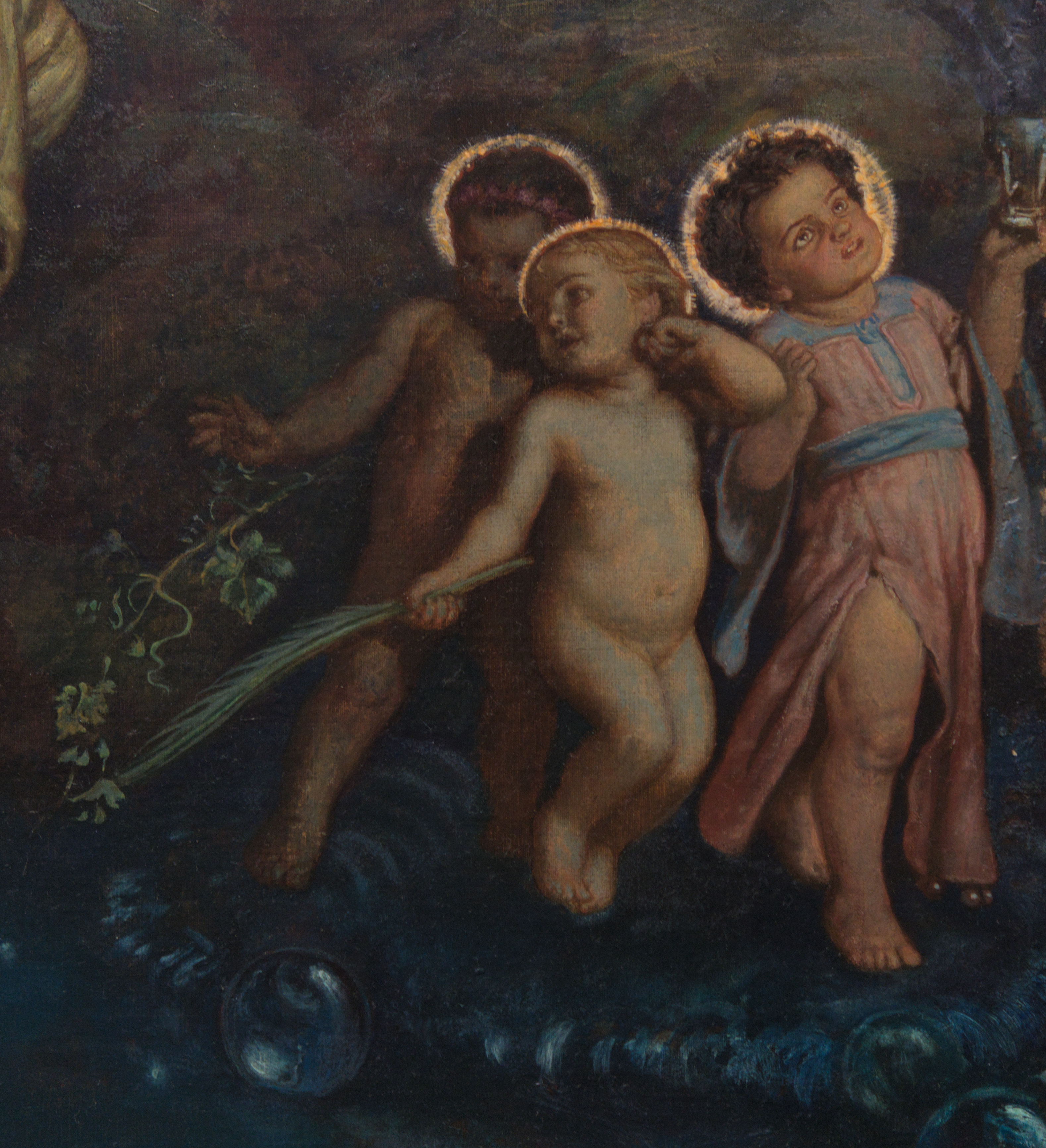
At the far right one of the child-martyrs, “in priestly office” and holding a censer, leads the celestial band, while his two companions “cast down their tokens of martyrdom in the path of their recognised Lord,” as Hunt wrote in the catalog for the 1885 exhibition of the Tate version by the Fine Art Society in London.
Triumph of the Innocents (detail)

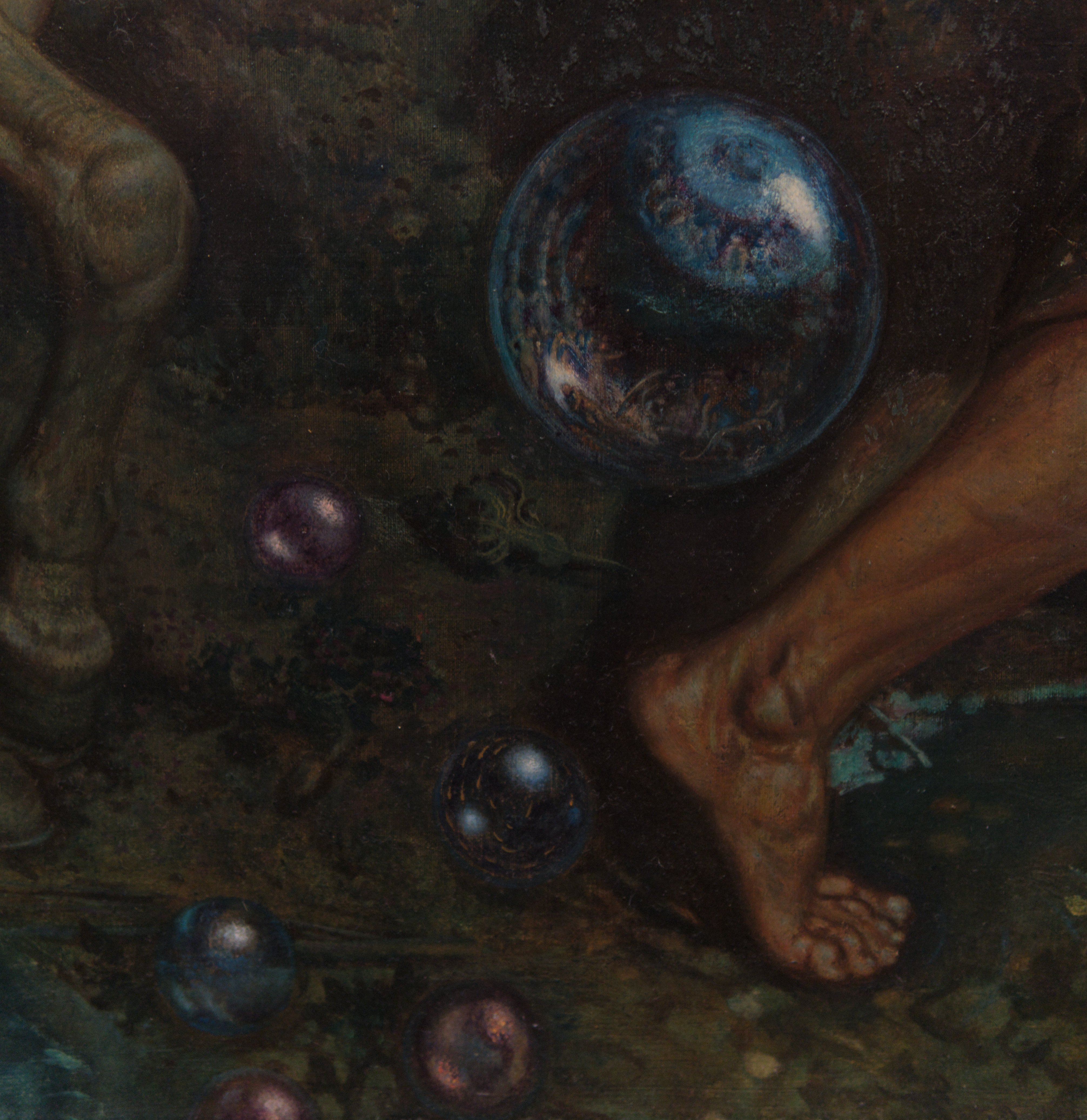
The children tread through “the living fountains of water, the streams of eternal life . . . ever rolling onward and breaking—where it might if real water be dissipated in vapour—into magnified globes which image the thoughts rife in that age in the minds of pious Jews . . . of the millennium which was to be the mature outcome of the advent of the Messiah.” The large bubble above Joseph’s right calf reveals Jacob’s dream at Bethel, which “first clearly speaks of the union of Earth and Heaven” that Christ will one day make total and permanent.
Triumph of the Innocents (detail)

To read the artist’s thirteen-page statement about the painting, see here.

LISTEN: “Salvete Flores Martyrum” (Hail, Martyr Flowers) | Words by Aurelius C. Prudentius, early fifth century | Music by Claudio Dall’Albero, 2022 | Performed by the Choir of Sidney Sussex College, Cambridge, dir. David Skinner, on Vespertina Hymnodia: Sacred Music by Claudio Dall’Albero, 2022

Salvete flores Martyrum
Quo lucis ipso in limine
Christi in secutur sustulit
Ceu turbo nascentes rosas.

Vos prima Christi victima
Grex immolatorum tener
Aram ante ipsam simplices
Palma et coronatis luditis.

Jesu tibi sit Gloria
Qui natus es de Virgine
Cum Patre et almo Spiritu
In sempiterna saecula
All hail, ye little Martyr flowers,
Sweet rosebuds cut in dawning hours!
When Herod sought the Christ to find,
Ye fell as bloom before the wind.

First victims of the Martyr bands,
With crowns and palms in tender hands,
Around the very altar, gay
And innocent, ye seem to play.

All honor, laud, and glory be,
O Jesu, Virgin-born, to Thee;
All glory, as is ever meet,
To Father and to Paraclete.

Trans. Athelstan Riley

“Salvete flores martyrum” is the office hymn for Lauds on the Feast of the Holy Innocents. It is a cento from the 208-line Epiphany poem in the Cathemerinon by the ancient Latin Christian poet Prudentius, first assembled in the 1568 Breviary of Pope Pius V.

This text has been set to music by many composers ever since the Renaissance. My favorite setting is probably by the contemporary Italian composer Claudio Dall’Albero, from his cycle Five Hymns for Vespers, shared above.

Other notable settings include those by Tomás Luis de Victoria and Michael Haydn (Joseph Hadyn’s brother).

Athelstan Riley’s is one of several metrical English translations, but here’s a prose translation provided by John Carden in his compilation A Procession of Prayers:

God keep you, O finest flowers of martyrs, who, at the dawn of life, were crushed by the persecutor of Christ and flung like petals before a furious wind.

You, the first to die for Christ, tender flocks of martyrs, now dance before the altar, now laugh candidly with your palms and gardens.

Christmas, Day 9: Begotten ere the worlds began

LOOK: The Word Made Flesh by Julius Shumpert

Shumpert, Julius_The Word Made Flesh
Julius Shumpert (American, 1997–), The Word Made Flesh, 2017. Digital artwork.

This digital artwork by Julius Shumpert shows a silhouette of Christ Pantocrator that’s filled in with stars and planets, emphasizing his eternal preexistence. This is the cosmic Christ. With his left hand he holds a Gospel-book, and with his right he gestures blessing. His halo bears the roman letters A and O for “Alpha” and “Omega” (Rev. 1:8; 21:6; 22:13), as well as the Greek letter X, chi, which is the first letter in ΧΡΙΣΤΟΣ (Christos) and thus ancient shorthand for Jesus the Messiah.

Shumpert writes,

This icon means a lot to me. During Christmas 2016, I dove into the true meaning of Christmas. Past all of the traditional “baby Jesus” storytelling to the bare symbolism of what happened. God, who created everything, and is bigger than infinity, the expanding universe, and all that there is to be, saw us struggling along and squeezed down into the form of precious ordinary baby just to be with us. . . . This icon presents who Jesus is: simply the Word made flesh.

Follow the artist on Instagram @saintjuliusart.

LISTEN: “Of the Father’s Love Begotten” | Original Latin words by Aurelius C. Prudentius, late 4th century; trans. John M. Neale, 1851, and Henry W. Baker, 1861 | Plainchant melody, 13th century | Arranged and performed by Sam P. Bush and Kathryn Caine on A Very Love and Mercy Christmas by Christ Episcopal Church, Charlottesville, Virginia, 2014

I’ve provided the full nine stanzas from the 1861 English version of the hymn by Henry Baker. Christ Episcopal Church sings his stanzas 1, 2, 5, and 9 (in boldface)—wise to omit 7 and 8, as these translations are icky (Roby Furley Davis’s are better), but I quite like the others!

Of the Father’s love begotten
Ere the worlds began to be,
He is Alpha and Omega;
He the source, the ending He,
Of the things that are, that have been,
And that future years shall see
Evermore and evermore!

O that birth forever blessèd,
When the Virgin, full of grace,
By the Holy Ghost conceiving,
Bore the Savior of our race;
And the Babe, the world’s Redeemer,
First revealed his sacred face,
Evermore and evermore!

At His word the worlds were framèd;
He commanded; it was done:
Heav’n and earth and depths of ocean
In their threefold order one;
All that grows beneath the shining
Of the moon and burning sun,
Evermore and evermore!

He is found in human fashion,
Death and sorrow here to know,
That the race of Adam’s children,
Doomed by law to endless woe,
May not henceforth die and perish
In the dreadful gulf below,
Evermore and evermore!

O ye heights of heaven, adore Him,
Angel hosts, His praises sing,
Pow’rs, dominions, bow before Him,
And extol our God and King;
Let no tongue on earth be silent,
Ev’ry voice in concert ring
Evermore and evermore!

This is He whom seers in old time
Chanted of with one accord;
Whom the voices of the prophets
Promised in their faithful word;
Now He shines, the long expected,
Let creation praise its Lord,
Evermore and evermore!

Righteous Judge of souls departed,
Righteous King of them that live,
On the Father’s throne exalted
None in might with Thee may strive,
Who at last in vengeance coming
Sinners from Thy face shalt drive,
Evermore and evermore!

Thee let old men, Thee let young men,
Thee let boys in chorus sing;
Matrons, virgins, little maidens,
With glad voices answering:
Let their guileless songs re-echo,
And the heart its music bring,
Evermore and evermore!

Christ, to Thee with God the Father
And, O Holy Ghost, to Thee,
Hymn and chant and high thanksgiving
And unwearied praises be:
Honor, glory, and dominion,
And eternal victory
Evermore and evermore!

“Of the Father’s Love Begotten” (Lat. Corde natus ex parentis) is one of the oldest Christmas hymns, and it has gone through many translations, additions, revisions, fusions, arrangements, and abridgements to reach the form that’s in our hymnals today.

Its source is a thirty-eight-stanza Latin poem by Prudentius titled “Hymnus Omnis Horae” (Hymn for All Hours), published around 405 CE in his Liber Cathemerinon (Book of Daily Hymns) but written earlier. The poem traces Christ’s ministry from birth to death to resurrection and ascension, with a heavy focus on his miracles. It’s a remarkable poem, and worthy of study, especially as an example of early Christian theology. You can read the original Latin, presented beside a fine English translation by Roby Furley Davis from 1905, here.

Aurelius Clemens Prudentius (ca. 348–ca. 413) was a Roman Christian poet born in what is today northern Spain. After spending decades in law and government, he retired from public life to dedicate himself fully to God’s service, mainly through writing. He was the most significant hymn-writer of the early church.

Prudentius continued to be highly read throughout the Middle Ages, and “Hymnus Omnis Horae” circulated throughout Europe in multiple manuscripts. An eleventh-century manuscript added the refrain “saeculorum saeculi” (evermore and evermore) and a doxology, the Trinitarian final stanza.

The abbreviated form of the hymn (“Corde natus ex parentis,” etc.) entered English hymnody through the six-stanza translation by John Mason Neale, first published in the 1851 edition of Hymnal Noted; Neale renders the first line “Of the Father sole begotten.” Music editor Thomas Helmore presented Neale’s text with the thirteenth-century plainchant melody DIVINUM MYSTERIUM, which he sourced from the 1582 Finnish songbook Piae Cantiones. The pairing has since proven inseparable. Here’s Helmore’s arrangement from the 1852 edition of Hymnal Noted:

An extensive revision of Neale’s translation by Henry W. Baker, which includes three additional, newly translated stanzas, was published in the best-selling Hymns Ancient and Modern in 1861 under the title “Of the Father’s Love Begotten.” This is the version reproduced above, and that has had the most staying power.

The hymn is a praise-filled meditation on how Christ, the second person of the Godhead, who is before all things, entered human time in the person of Jesus. It’s a fairly difficult hymn to sing congregationally—the meter is a bear—but here’s a modern arrangement that I think works well: https://gracemusic.us/sheet_music/of-the-fathers-love-begotten/.

For more about the history, content, meter, transmission, and significance of “Hymnus Omnis Horae,” see the scholarly article by Chris Fenner from the Hymnology Archive: https://www.hymnologyarchive.com/hymnus-omnis-horae.