SPOTIFY PLAYLIST:November 2023 (Art & Theology): In this month’s playlist I nod, in part, to All Saints’ Day (November 1), Christ the King Sunday (November 26), and world events. It includes “Ad Ana” (How Long), a setting of Psalm 13 in its original Hebrew by Miqedem (a Tel Aviv–based band made up of Shai Sol [previously] and three other musical artists from a mix of Jewish and Christian backgrounds), and “Touba” (Blessed), a sung recitation of the Beatitudes in Arabic by the Sakhnini Brothers [previously], Arab Christians from Nazareth, with oud and keyboard accompaniment.
As American Thanksgiving is November 23, you may also want to check out my Thanksgiving Playlist, comprising songs of gratitude. Originally created in 2021, each year I add to and remix the list as I encounter new recordings. One of the newer additions is “He Has Made Me Glad” by Leona Von Brethorst, based on Psalm 100, as arranged and performed on organ by the amazing Cory Henry.
The Christian life consists of both praise and lament, both tears and laughter—which is why in any given worship service or Art & Theology playlist or blog post, as in the biblical psalter, you can find songs that express joy and others, heaviness. They don’t negate one another but rather give fuller expression to the breadth of religious experience.
+++
NEW ALBUM: Some Mississippi Sunday Morning by Parchman Prison Prayer: After a bureaucratic process that took over three years, music producer Ian Brennan was finally granted permission in February to record a Sunday worship service at the Mississippi State Penitentiary, aka Parchman Farm, a notorious prison with a rich musical history. The prison chaplains convened a unique service of inmate singers from various Christian denominations ranging in age from twenties to seventies, who were given turns at the mic and even collaborated on a few tracks. Brennan said he wanted to give the men a platform for their voices to be heard. All profits from the album benefit the Mississippi Department of Corrections Chaplain Services.
“You can hear the way Sunday services are particularly restorative for someone incarcerated – not simply because of the promise of redemption, but the solace of not being alone,” writes Sheldon Pearce for the Guardian. “Some Mississippi Sunday Morning feels like these men reaching out for the things such a barbaric system tries to deny them: compassion, intimacy, and mercy. The songs are not just purges of anxieties accrued on the inside or calls for the Lord’s embrace, but also pleas to be acknowledged as a person and not an ID number.”
(Thanks to Art & Theology reader Ted Olsen for alerting me to this! He compared the album to Angola Prison Spirituals, recorded in the 1950s.)
+++
PODCAST EPISODE: “Sarah Clarkson: The Gift of Beauty,”Life with God: A Renovaré Podcast, October 20, 2023:Sarah Clarkson, author of This Beautiful Truth: How God’s Goodness Breaks into Our Darkness, speaks with Renovaré community life director Nathan Foster about her struggle with OCD and, amid the great suffering wrought by that illness, how God’s goodness has been mediated to her by beauty—in nature, poetry, music, story, tea, ritual, and so on. Responding to the idea that beauty is a luxury for the affluent, she says, “Well, [it is] if beauty is about having a perfect house. But beauty is healing those who have been hurt in a war zone. It’s creating shelters where children can have refuge. It’s rebuilding what has been destroyed. . . . Beauty is a defiance of the forces of evil and disorder and destruction because it is [their] opposite: where evil tears down, beauty creates; where there is absence, beauty fills.”
+++
PRESS RELEASE: “Toledo Museum of Art Adds Armenian Gospel Manuscript with 46 Paintings to the Collection”: After centuries passing through private collections, in June the Pozzi Gospels, a sixteenth-century illuminated manuscript from Armenia, entered the collection of the Toledo Museum of Art, which will make it more accessible to the public. (I’m not sure when the book will go on display. And it doesn’t have an object page on the museum’s website yet.) The artist and scribe of this extraordinary, sumptuous manuscript was Hakob Jughayets’i. His forty-six full-page miniatures and marginal decorations combine Christian iconography with Byzantine, Islamic, and Buddhist design elements.
The Sam Fogg gallery, which exhibited the manuscript last year as part of The Medieval Body, created this short video about it, narrated by art historian Jack Hartnell:
Hakob Jughayets’i (Armenian, ca. 1550–1613), The Pozzi Gospels, 1586. Paper with blind-stamped brown leather binding, 403 folios with 46 full-page illuminations and numerous marginal miniatures, 7 3/4 × 5 3/4 in. (19.8 × 14.5 cm). This spread shows the Creation of Eve and the Temptation of Eve.
VIRTUAL MUSIC COLLECTION: Armenian Spiritual Music Special Vol. 1: NTS Radio in London has curated ninety minutes of traditional Armenian Christian music. (They’ve done the same for Byzantine chant, Welsh hymns, Hildegard von Bingen, and numerous other categories.) I wish the lyrics and translations were provided, but regardless of my understanding of the words, what beauty. [HT: ImageUpdate]
VIDEO TALK: “The Breath of Life: Why Art Matters in a Pandemic” by James K.A. Smith: In this half-hour Zoom talk released June 2, Image journal editor in chief Jamie Smith [previously] discusses the ability of the arts to stimulate our cultural imagination in much-needed ways. “The arts matter in a pandemic,” he says, “because they shape us for the work of reshaping and rebuilding society. In other words, we all need artists to continue creating for us so the rest of us can cultivate the imagination we need to re-create our common life, our social bonds.” And again: “The arts train our imagination so that we relearn to see what we need to see. . . . It’s art as imagination therapy, it’s art as an ophthalmology of the soul that we need in order to build and sustain and restore the institutions of a healthy, flourishing society. . . . If we’re going to imagine the world otherwise, we need imaginations that are trained in subtlety, that have been humbled by mystery, and that are infused with infinity.”
At 14:44 Smith introduces three ways in which art matters during and after a pandemic: art helps us (1) attend, (2) transcend, and (3) mend. That is, art helps us attend more carefully to the world and our neighbors, calling sometimes for gratitude, sometimes for grief, often both; art helps us transcend despair, attesting to the “something more” we long for (“the arts enable us to transcend the tragic when they invite us into a joy that forgets nothing”); and art helps us mend our tattered social fabric by helping us to better understand one another and to imagine possibilities. For each of these functions he provides a few concrete examples, including the current Home Alone Together exhibition.
Photo by Yola Monakhov Stockton, May 17, 2020, for the “Home Alone Together” exhibition
+++
Along these same lines . . . at the end of the Makers & Mystics podcast episode “Art as Healing,” recorded live last year at The Farm House in Charlottesville, Virginia, and released June 5, 2020, host Stephen Roach reads an excerpt from a book he’s writing:
In our present day, it can be easy to conclude from the various crises taking place around the world, all the injustice and political unrest, the rampant poverty and environmental threats, persecution and killings, diseases and displacements, that art and beauty are mere luxury. It could even make some feel that to focus on art and beauty is insensitive or shortsighted. However, I want to suggest that it’s precisely because of these desperate situations that the artist is called upon to beautify the world with art and engage these issues from a vantage point of hope.
The desperate situation in our world calls for the artist to emerge as a prophetic voice for change and to offer heaven’s alternatives. I’m reminded of the example of Iraqi cellist Karim Wasfi, who countered the tragedy of war by playing music at the sites of car-bomb explosions, with smoldering buildings in the background of his concertos. Wasfi said, “The other side chose to turn every element, every aspect of life in Iraq into a battle and into a war zone. I chose to turn every corner of Iraq into a spot for civility, beauty, and compassion.”
This is the call of the artist in collaboration with God: we are called to be the architects of hope and to counter the destruction of life with the opposite spirit in beauty and creativity.
Here’s a video of Wasfi playing an original cello composition in the destroyed buildings of Al Shifa Hospital in Mosul, Iraq, in September 2018, where some two thousand explosive hazards were removed by UNMAS (United Nations Mine Action Service):
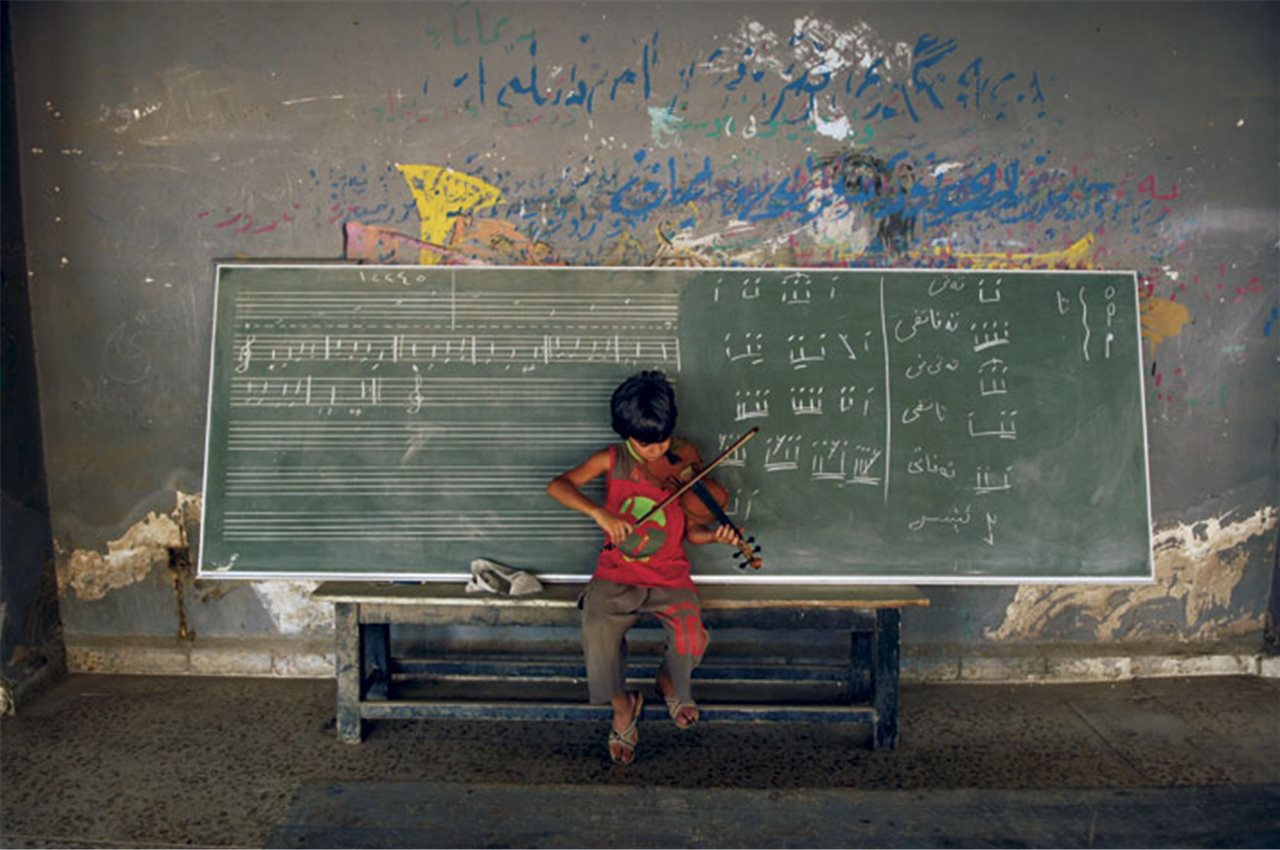
It reminds me of a photograph by Julie Adnan that I saw in National Geographic a decade ago and that, of all the extraordinary photos published in that magazine, has stuck with me the most. Its caption reads, “Some 160 miles northeast of Baghdad, in a Sulaymaniyah music hall ravaged by war, looting, and neglect, a violin-playing boy sounds a note of hope. His teacher, Azad Maaruf, lives there, instructing scores of students.”
Photo by Julie Adnan, taken in Sulaymaniyah, Iraq, published in the February 2010 issue of National Geographic
The expression “fiddling while Rome burns,” which legend says the emperor Nero did in 64 CE, is used deprecatingly to refer to the doing of something trivial and irresponsible during a crisis. But beauty is not trivial, and its pursuit during times of crisis does not indicate apathy. I love that this little boy wants to play music while bombs sound out around him. Making art can be a daring act of resistance, an assertion of and call to common humanity, a better way. It’s life-affirming. As artist Laura Bon says: “Artists need to create on the same scale that society has the capacity to destroy.”
+++
NEW SONG: “The Medicine” by Dee Wilson: Dee Wilson of Common Hymnal premiered this song on his YouTube channel on May 27, and then Good Shepherd New York and friends put together a beautiful arrangement for the church’s June 7 virtual worship service. It’s a prayer that God would save us from the virus of racism, which harms and divides. The chorus goes: “We don’t know what to do, so we turn our eyes to you. We’ve run out of words to say. But if you come and have your way, you can save us from ourselves before our wounds hurt someone else. We need you now.” The video features Wilson on lead vocals, Liz Vice on background vocals, Orlando Palmer and Charles Jones on keyboard, Franklin Rankin on guitar, Michael Decena on bass, and Terence F. Clark on drums.
Every Sunday since March 15, Good Shepherd New York (“an interdenominational church helping New Yorkers embody the love of Christ for the good of our neighbors”) has been releasing a worship service video with liturgy, prayer, sermon, open communion—and phenomenal music led by associate pastor David Gungor, which engages current events. The whole services are worth watching/participating in, but here are a few musical highlights I’ve queued up. I especially like the medleys, which blend together excerpts from a range of songs:
May 10: MEDLEY: “My Brother, My Sister” by David Gungor / “Higher Love” by Steve Winwood
March 22: MEDLEY: “All Who Are Thirsty” by Brenton Brown and Glenn Roberts / “Take Me to the River” by Leon Bridges / “Amazing Grace” (with traditional English folk tune RISING SUN)
“Way Maker”– Written by Sinach (Osinachi Kalu) – Performed by Zanbeni and Benny Prasad – This husband-wife duo [previously] brings a fusion of R&B, jazz, and Indian classical music to this 2015 gospel song.
+++
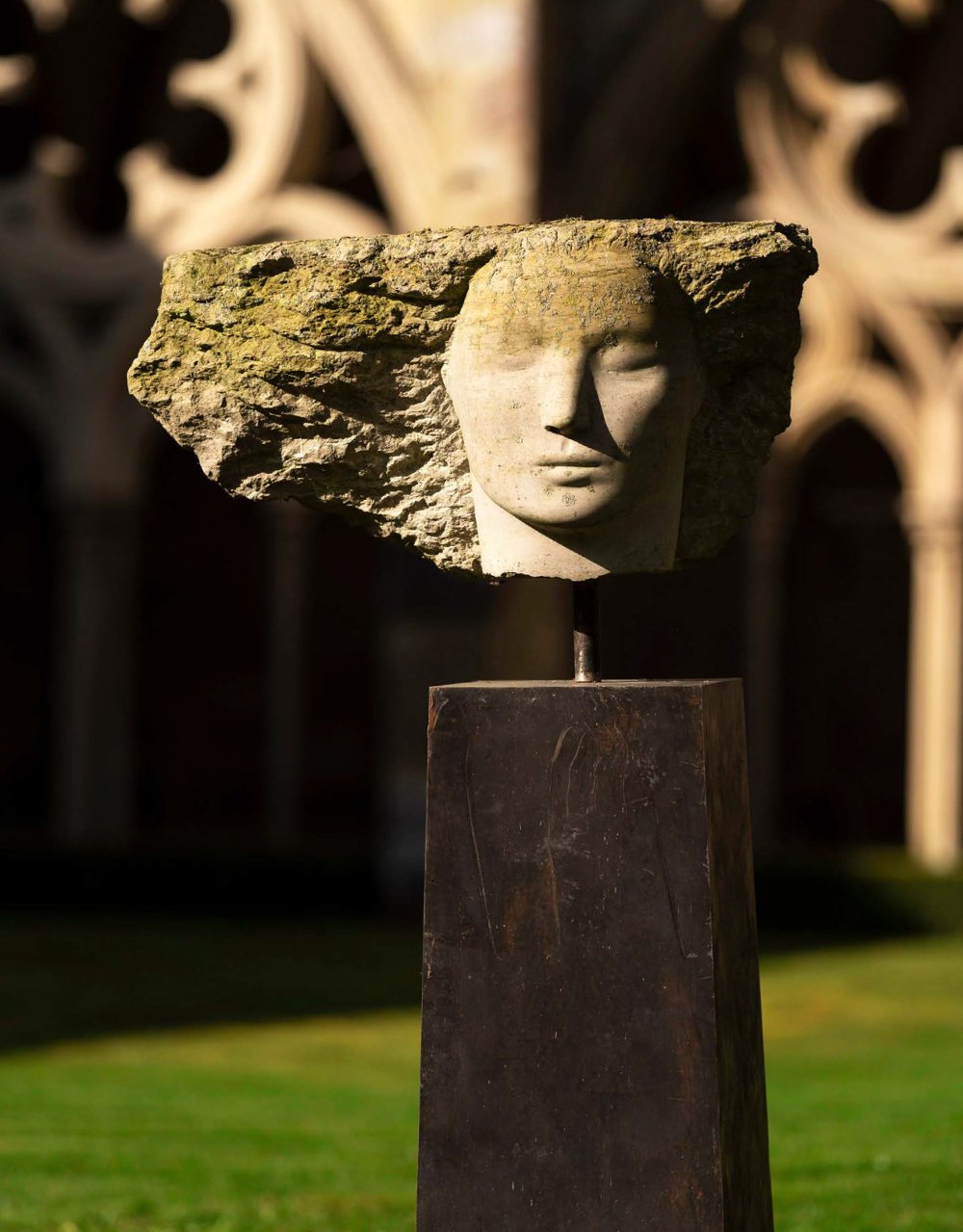
EXHIBITION / VIRTUAL ART TOUR: Celebrating 800 Years of Spirit and Endeavour: To celebrate the eight hundredth anniversary of the laying of its first foundation stone, Salisbury Cathedral organized a major exhibition this year, which was three years in the making. After the art was sited and installed both inside the building and outside on the lawns, COVID-19 hit, and the cathedral was forced to close. But the planning team adapted to the setback, developing a virtual tour that uses panorama technology to enable the viewer to enter the cathedral virtually, watch a video introduction, and navigate around the exhibition space by clicking on thumbnail images of the works and links to the corresponding catalog pages.
Curated by Jacquiline Creswell, who has led the cathedral’s visual arts program for the past eleven years, the exhibition features twenty-nine works of art by significant artists of the modern and contemporary eras, including Henry Moore, Elisabeth Frink, Antony Gormley, Mark Wallinger, Shirazeh Houshiary, and Subodh Gupta. Nine of the works are from the cathedral’s permanent collection, while the other twenty were specially brought in, of which two were newly commissioned: the abstract, solar-powered mobile in the nave by Daniel Chadwick, and the light installation in the north porch by Bruce Munro.
The beautifully photographed, ninety-page exhibition catalog is available for free download from the Spirit and Endeavour page of the cathedral website. Besides providing commentary on all the artworks, it also includes an essay by Sandy Nairne that discusses significant art commissions by British churches in the twentieth and twenty-first centuries and the difference between viewing art in a cathedral versus a museum gallery. Another available resource is a guide for kids with questions and activities. While I do hope the interior portion of the exhibition is able to open to visitors soon, I’m grateful that the online resources enable me to “visit” from my living room in the US.
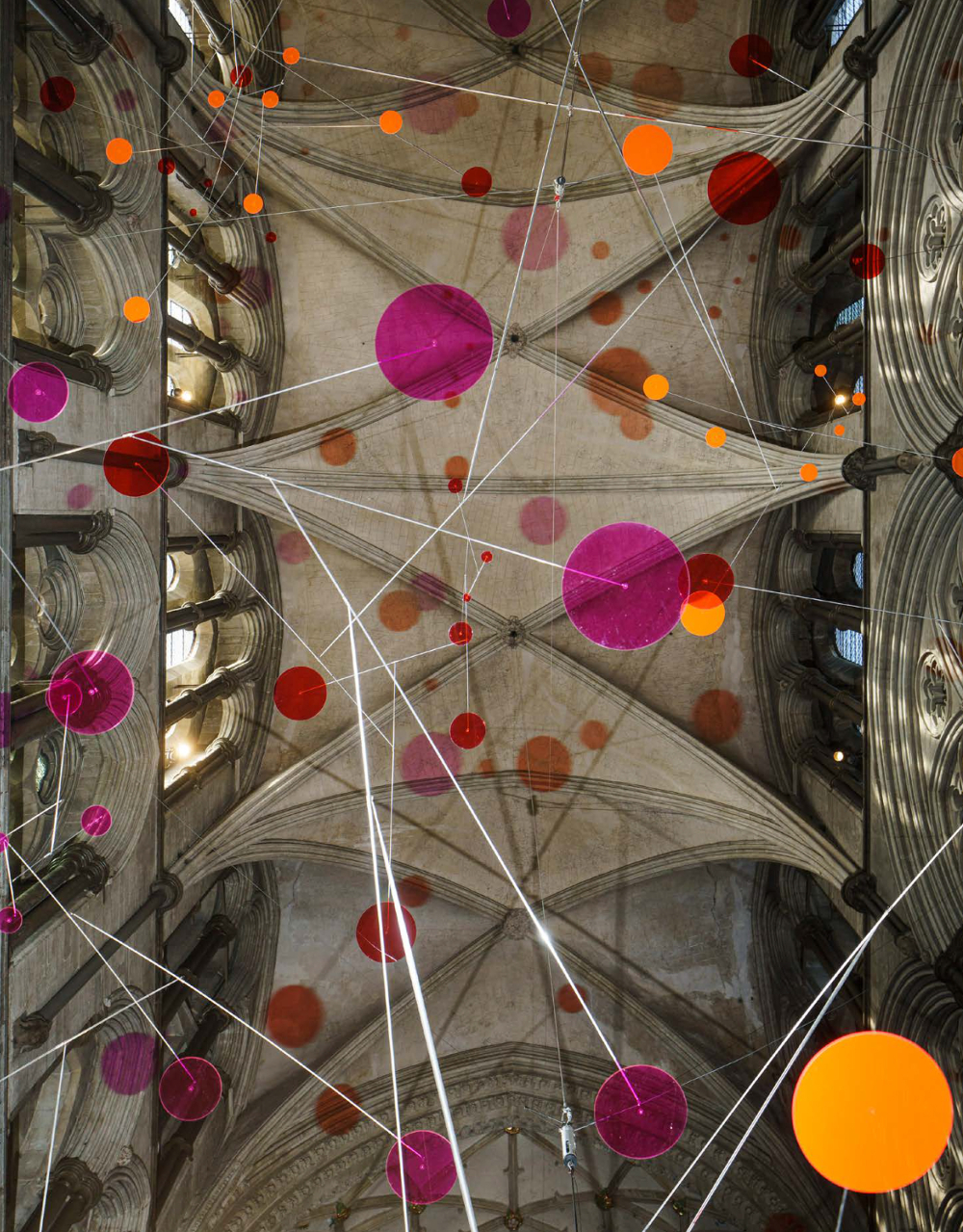
Daniel Chadwick (British, 1965–), Somewhere in The Universe, 2019–20. Acrylic sheet, stainless steel, solar-powered motor, 1,000 × 1,000 cm. Temporary installation at Salisbury Cathedral. Photo: Ash Mills.
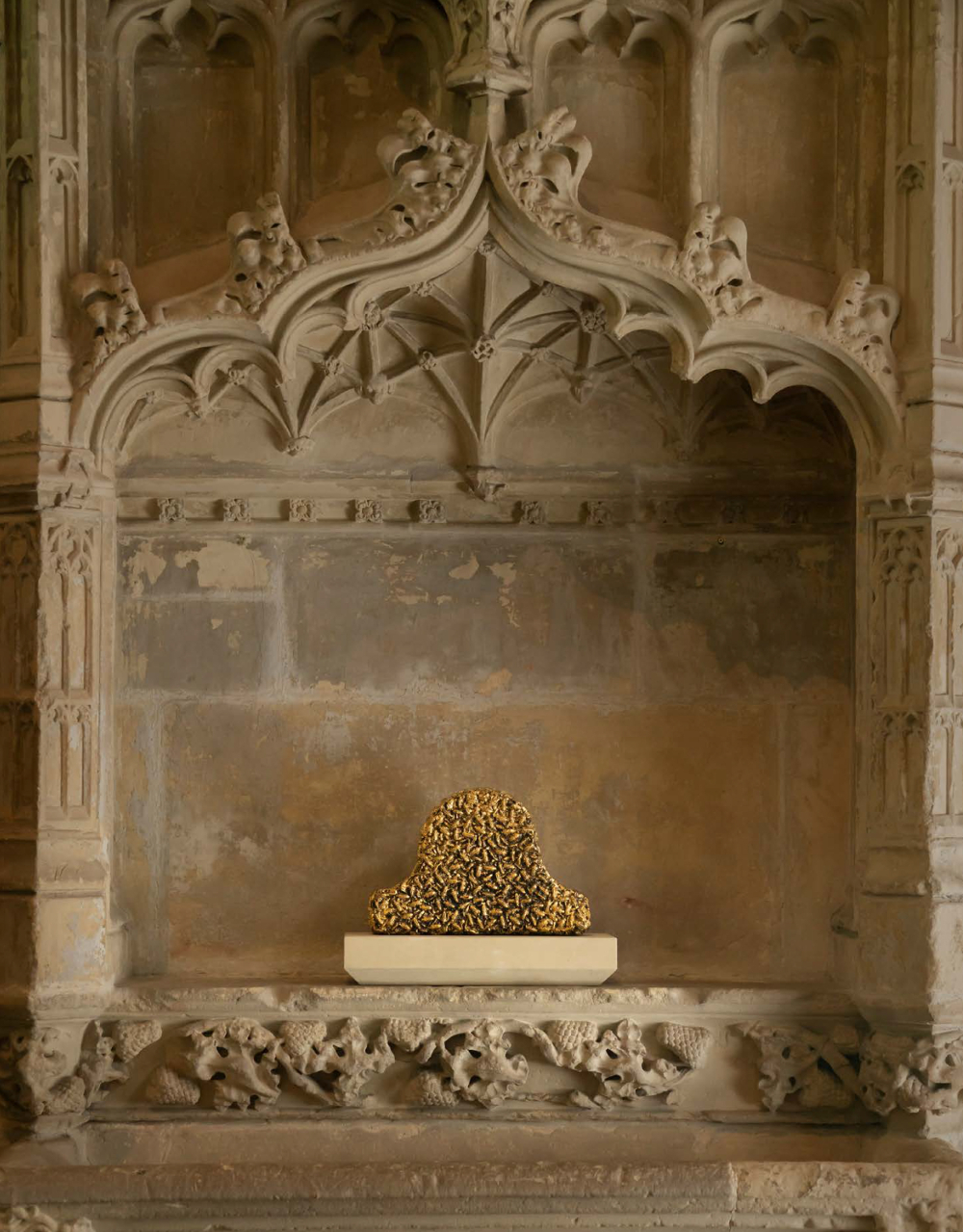
Bill Woodrow (British, 1948–), Clockswarm, 2001. Bronze, 25 × 35 × 11 cm. Photo: Ash Mills.
Emily Young (British, 1951–), Angel Gabriel, 2008. Purbeck stone, 90 cm. Collection of Salisbury Cathedral. Photo: Ash Mills.
PSALM 13 SETTINGS FROM INDIA: In November 2015 a group of musicians from Poona Faith Community Church in Pune, India, composed and recorded worship songs in several of the country’s languages. Because Psalm 13 is assigned in today’s lectionary, here are three settings of that lament, in Marathi, Hindi, and Nepali. [HT: Global Christian Worship]
How long, O LORD? Will you forget me forever?
How long will you hide your face from me?
How long must I take counsel in my soul
and have sorrow in my heart all the day?
How long shall my enemy be exalted over me?
Consider and answer me, O LORD my God;
light up my eyes, lest I sleep the sleep of death,
lest my enemy say, “I have prevailed over him,”
lest my foes rejoice because I am shaken.
But I have trusted in your steadfast love;
my heart shall rejoice in your salvation.
I will sing to the LORD,
because he has dealt bountifully with me.
(This psalm has also been impactfully adapted by Isaac Wardell, as “How Long,” on Bifrost Arts’ 2016 Lamentations album.)


 Art & Theology