Christ as Sun, Bridegroom, and Runner: Psalm 19, Revelation 12, and Advent

“Glory Glory / Psalm 19” by Daniel Berrigan

The heavens bespeak the glory of God.
The firmament ablaze, a text of his works.
Dawn whispers to sunset.
Dark to dark the word passes: glory glory.

All in a great silence,
no tongue’s clamor—
yet the web of the world trembles
conscious, as of great winds passing.

The bridegroom’s tent is raised,
a cry goes up: He comes! a radiant sun
rejoicing, presiding, his wedding day.
From end to end of the universe his progress.
No creature, no least being but catches fire from him.

This paraphrase of Psalm 19:1–6 by Daniel Berrigan is from Uncommon Prayer: A Book of Psalms (University of Michigan Press, 1978; Orbis, 1998). Used by permission of the Daniel Berrigan Literary Trust. www.danielberrigan.org


The first section of Psalm 19 is about how the natural world declares the glories of its Maker. The night sky, the psalmist describes, is like a tent that spreads its cover over the sun, parting open every morning to release it on the world. The sun is compared to a bright-eyed, handsome, and happy bridegroom emerging from his chamber, and to a vigorous runner who tracks a massive course.

I like to read Psalm 19:1–6 for Advent, especially the poet-priest Fr. Daniel Berrigan’s paraphrase of it, as his use of he/him/his pronouns instead of it/its draws out a Christological connection I hadn’t seen before in this text, made even more pronounced by the apocalyptic tone Berrigan adopts and the sense of excitement he conveys. The poem can, of course, be read as simply the glorious waking of a day, as the psalmist intended. But there’s another layer I want to explore: signs in the heavens, and the coming of Christ.

In the Christian tradition, Jesus is compared to both a sun and a bridegroom, and he, too, like the skies, “bespeak[s] the glory of God.” “Oriens”—Dawn or Dayspring—is one of the traditional titles of Christ, typically invoked in liturgies on December 21 as part of the O Antiphons cycle. From the Church of England’s Common Worship: “O Morning Star, splendor of light eternal and sun of righteousness: come and enlighten those who dwell in darkness and the shadow of death” (cf. Luke 1:78–79; John 8:12; Mal. 4:2). The coming of Jesus—in Bethlehem, in human hearts, and on the last day—illuminates and sets ablaze, revealing who God is and who we ourselves most truly are and exciting the world, flinging abroad the divine light.

As for the bridegroom, Jesus uses this metaphor for himself in his parable of the ten bridesmaids (Matt. 25), as God does in Isaiah 62:5, and indeed one of the major motifs in the book of Revelation is a wedding between Christ and his people. Christ will return to us, scripture suggests, like a husband coming to bring home his new bride.

One of the antiphons for First Vespers of Christmas, I’ve just learned, sung the evening of December 24, connects the bridegroom of Psalm 19 with Jesus. Cum ortus fuerit sol de caelo, the church chants, videbitis Regem regum procedentem a Patre, tanquam sponsum de thalamo suo. (“When the sun shall have risen in the heavens, ye shall see the King of kings coming from the Father, as a Bridegroom from his bride-chamber.”)

Butler, Tanja_Woman Clothed with the Sun
Tanja Butler (American, 1955–), Woman Clothed with the Sun, 2008. Acrylic paint, collaged painted paper, and cotton fabric on gessoed acid-free paper, 14 × 5 in. Collection of Victoria Emily Jones.

Artist Tanja Butler further extends Psalm 19’s fittingness for Advent by drawing the passage into conversation with Revelation 12:1–6. This section of John’s Apocalypse introduces us to “a woman clothed with the sun, with the moon under her feet, and on her head a crown of twelve stars”; she gives birth to a baby boy “who is to rule all the nations” but whom a great dragon seeks to devour. In most Christian interpretations, this Woman of the Apocalypse is associated with the Virgin Mary, and there’s a robust iconographic tradition in this vein.

Butler innovates on that tradition with her mixed-media work Woman Clothed with the Sun by showing the infant Jesus busting out of his mother’s womb like the strong athlete of Psalm 19:5. (Ready. Set. Go!) He has a race to run, a mission to fulfill. He is also shown as the sun that clothes his mother and that emerges from a dark (uterine) tent. He is the source and center point of the explosive rays of colorful light in the painting.

In an ArtWay profile, Butler describes her piece as follows:

Mary is represented with the unborn Christ, Light of the World, ready to “come forth from his pavilion, like a champion rejoicing to run his course” (Psalm 19:5). She holds a ladder, referencing both Jacob’s vision and the cross, the ladder of ascent between earth and heaven.

This is a cosmic birth necessitated by a cosmic struggle that will resolve in a cosmic victory: the reunion of God and humanity.


Daniel Joseph Berrigan, SJ, (1921–2016) was an American Jesuit priest, peace activist, award-winning poet, and professor of theology and biblical studies. Through his writings and public witness, he endorsed a consistent life ethic, opposing war, nuclear armament, abortion, capital punishment, and the causes of poverty in the name of Jesus Christ and his holy gospel. Fr. Berrigan, along with his brother Philip, was one of the Catonsville Nine, imprisoned in 1968 for destroying draft files in a protest against the Vietnam War. Later, he spent much of the eighties ministering to AIDS patients in New York City. He is the author of some fifty books.

Tanja Butler (born 1955) is a painter and liturgical artist based in the Albany, New York, area. Her subjects are devotional in character, and her sources of inspiration include Byzantine icons, medieval art, and folk art. Her work is included in the collections of the Vatican Museums, the Hammer Museum in Los Angeles, the Portland Museum of Art in Maine, and the Boston Public Library. “My aim is to develop imagery that has the simplicity and clarity of a child-like vision,” she says, “required, we’re told, if we are to see the kingdom of God.”
Roundup: Feast of Mary Magdalene; holiness of people and place; black squares

Richardson, Jan_The Hours of Mary Magdalene
The Hours of Mary Magdalene by Jan L. Richardson

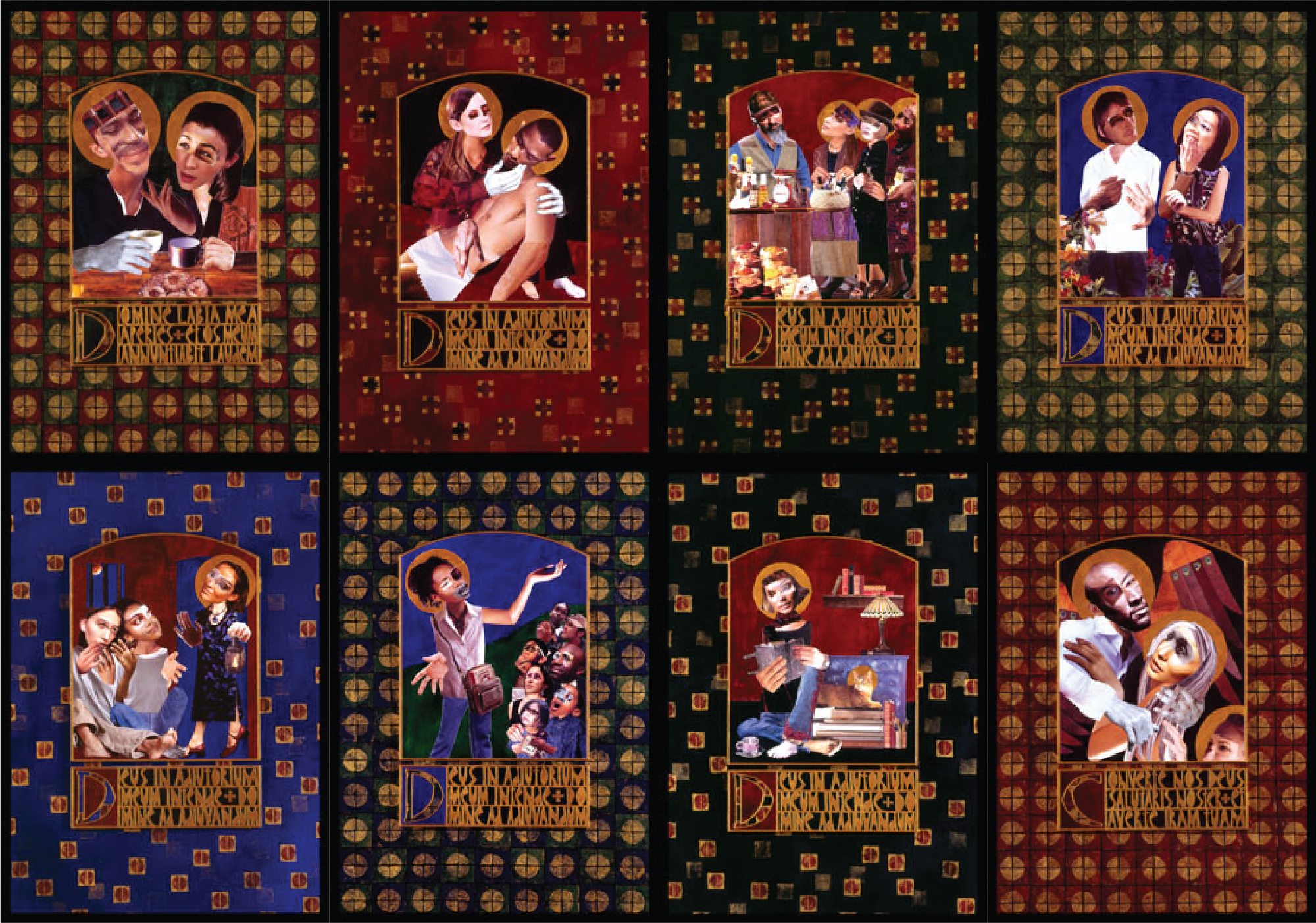
ART CYCLE: The Hours of Mary Magdalene by Jan L. Richardson: July 22 is the feast day of Mary Magdalene, one of Jesus’s closest disciples and the first witness and preacher of the Resurrection. American artist, writer, and minister Jan L. Richardson created a sequence of collages picturing events from her life, drawing on both the biblical narratives and medieval legends. The structure and presentation (decorative borders, Latin script) were inspired by medieval books of hours, used for the praying of the Divine Office. The text below each image reads, Deus, in adiutorium meum intende; Domine, ad adiuvandum me festina (“O God, come to my assistance; O Lord, make haste to help me”), the first verse of Psalm 70, which is prayed at the start of each of the canonical hours.

According to legend, after Jesus’s ascension Mary Magdalene moved to southern France, where she preached the gospel and performed miracles. The last thirty years of her life she lived as a hermit in a cave. Each time she prayed the hours, she was lifted up to heaven by angels, then brought back down at the end of her devotions.

Richardson put together a delightful little video showcasing the art cycle as well as the song “Mary Magdalena” by her late husband, Garrison Doles.

You can purchase these images as digital downloads from Richardson’s website:

  1. Matins: The Blessing Cups: Mary Magdalene and Jesus at Tea
  2. Lauds: After the Cross: The Magdalene’s Farewell
  3. Prime: Shopping for Spices: The Three Marys on Holy Saturday
  4. Terce: Touch Me Not: Resurrection Morning
  5. Sext: Release: Mary Magdalene Freeing Prisoners
  6. None: L’Evangeliste: Mary Magdalene Preaching in France
  7. Vespers: At Her Prayers: Mary Magdalene with a Book of Hours
  8. Compline: Magdalene Ascending: The Divine Hours

+++

DANCE: “Holy, Holy, Holy”: Choreographed by Betsey Beckman to a song by Karen Drucker, this dance number affirms the sacredness of every human being. It was filmed inside St. Gregory of Nyssa Episcopal Church in San Francisco, a church that “invites people to see God’s image in all humankind, to sing and dance to Jesus’ lead, and to become God’s friends.” Beckman dances with Dawon Davis and Corey Action throughout the worship space, which comprises a rectangular room where the Liturgy of the Word is celebrated and an octagonal rotunda for the Liturgy of the Table. The Dancing Saints icon that covers the walls is by Mark Doox. [HT: Global Christian Worship]

+++

MUSIC:

>> “Locus iste” by Anton Bruckner, performed by VOCES8: The British vocal ensemble VOCES8 performs Anton Bruckner’s sacred motet “Locus iste” (This Place) at Les Dominicains de Haute-Alsace in Guebwiller, France. Bruckner composed it in 1869 for the dedication of the Votivkapelle (votive chapel) at the New Cathedral in Linz, Austria, where he had been a cathedral organist. The text—a Latin gradual for church dedications and their anniversaries—is informed by Jacob’s saying, after his dream of the ladder uniting heaven and earth, that “surely the Lord is in this place; and I knew it not” (Gen. 28:16), and by the story of the burning bush where Moses is told to “put off thy shoes from off thy feet, for the place whereon thou standest is holy ground” (Exod. 3:5).

Locus iste a Deo factus est,
inaestimabile sacramentum;
irreprehensibilis est.

This place is made by God,
a priceless sacrament;
it is without reproach.

(Or, alternatively:)
This dwelling is God’s handiwork;
a mystery beyond all price,
that cannot be spoken against.

>> “Tabernacle” by Josh Rodriguez, performed by Mary Vanhoozer: A modernist piano composition inspired by Psalm 19, dedicated to the composer’s father-in-law, the theologian Kevin Vanhoozer.

Tabernacle is a musical triptych shaped by the drama of Psalm 19. While this word, tabernacle, is loaded with religious affection within both Jewish and Christian traditions, some modern readers may not be familiar with its implications. Merriam-Webster offers three related definitions: “a house of worship, a receptacle for the consecrated elements of the Eucharist, or a tent sanctuary used by the Israelites during the Exodus.” By extension, it has come to represent a “dwelling place” or a “temporary shelter.” In short, this is no ordinary space, rather it is a place that is set apart, made holy for a terrifying transformative encounter with the Divine.

Fragments of a prayerful hymn-like melody appear underneath this canopy of sounds. Shifting metric changes, polyrhythms, and percussive primal-sounding harmonies climax in a loud, noisy quote from the 16th-century Genevan Psalter.

More extensive program notes can be found in the YouTube video description.

+++

ESSAY: “Precedents of the Unprecedented: Black Squares Before Malevich” by Andrew Spira, Public Domain Review: Considered one of the seminal works of modern art, Kazimir Malevich’s Black Square (1915) has been cast as a total break from all that came before it. Yet searching across more than five hundred years of images related to cosmology, religious devotion, mourning, humor, politics, and philosophy, art historian Andrew Spira uncovers a slew of unlikely foreshadows to Malevich’s radical abstraction.

Et sic in infinitum
Robert Fludd’s black square representing the nothingness that was prior to the universe, from his Utriusque Cosmi (1617). On each side of the square is written “Et sic in infinitum…” (“And so on to infinity…”).

Blood of Christ
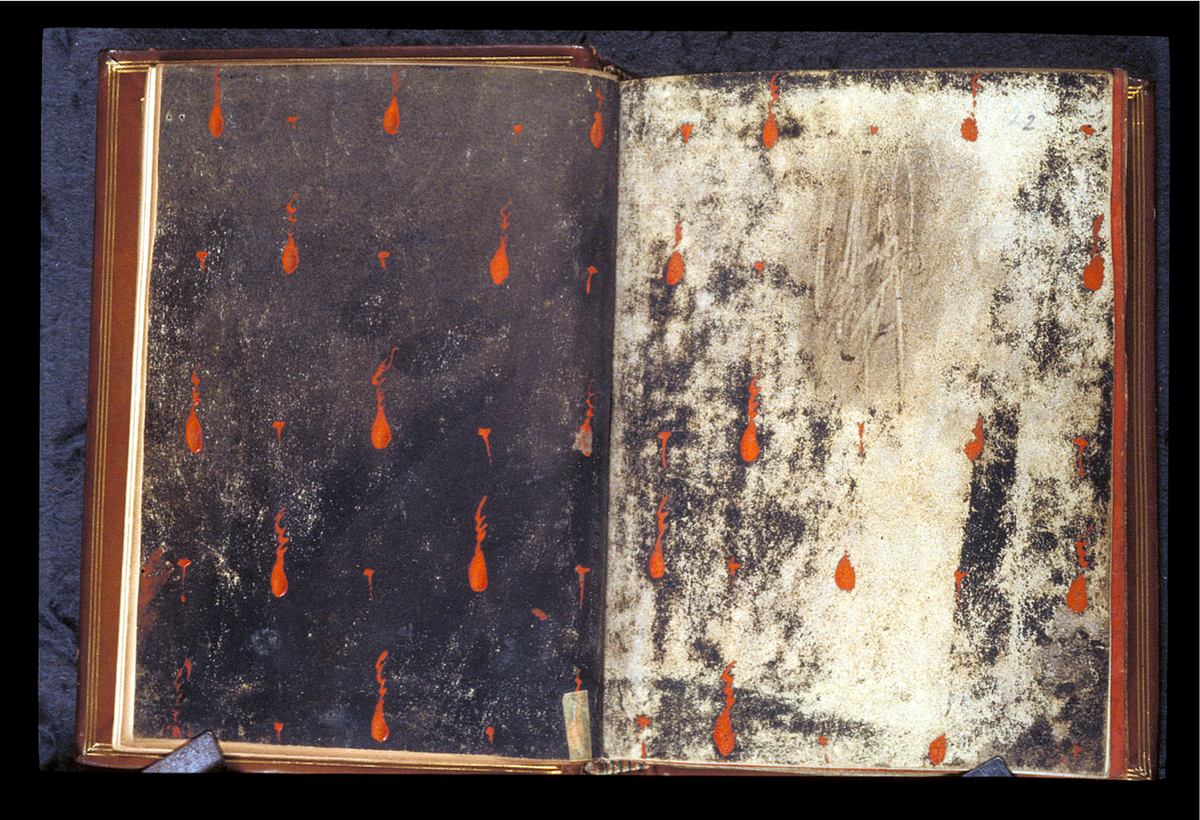
Black pages with red drops of blood, signifying the wounds of Christ, from a psalter and rosary of the Virgin, ca. 1500. The recto is worn from devotional engagement, damaged through kissing and rubbing, perhaps.

For a much more extensive treatment of the topic, see Spira’s Foreshadowed: Malevich’s “Black Square” and Its Precursors, published this month. And for a faith-positive (non-nihilistic) reading of Malevich’s Black Square that honors the artist’s own views, see pages 209–25 of Jonathan A. Anderson and William A. Dyrness’s Modern Art and the Life of a Culture, where they discuss the work in relation to the Russian icons tradition and “apophatic or ‘negative’ theology—a mode of theology that meditates on the absolute Fullness and Otherness of God by way of negating the verbal, visual and conceptual forms used to signify (and to ‘grasp’) God” (220).