Roundup: Jazz Vespers with Ruth Naomi Floyd, Psalm 90 set to Celtic tune, and more

ARTWORK:

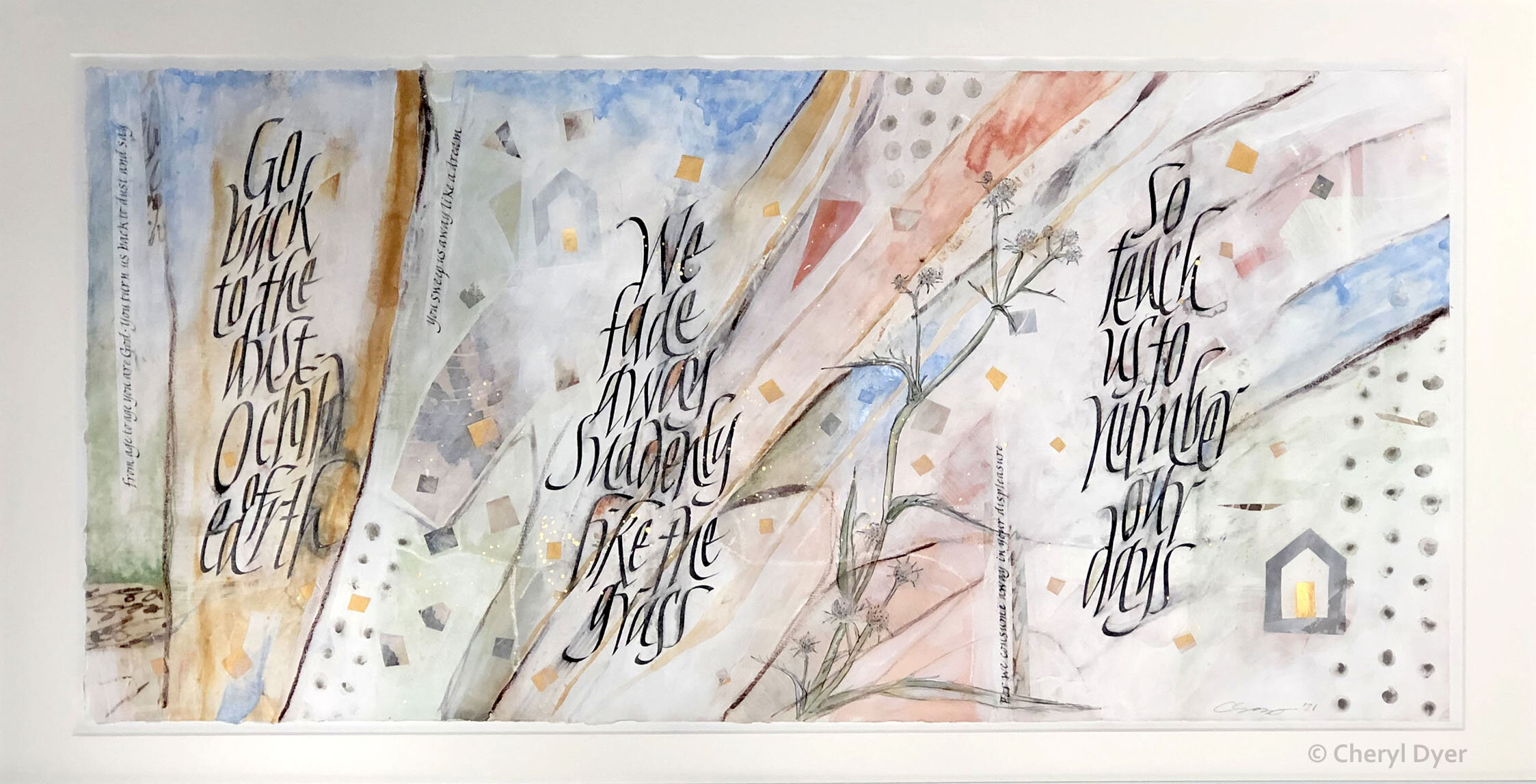
Dyer, Cheryl_Rattlesnake Master
Cheryl Dyer, Rattlesnake Master, 2021. Collage / mixed media, 34 × 18 in.

In this piece, lettering artist and calligrapher Cheryl Dyer of Omaha takes Psalm 90 (traditionally read on Ash Wednesday) as her subject, embellishing excerpts with watercolor and other media. Rattlesnake master is a perennial herb of the parsley family native to the tallgrass prairies of central and eastern North America.

+++

ARTICLE: “The Vindication and Blessing of Lent” by Rev. Dr. Michael Farley, Modern Reformation: I also sometimes receive pushback from others in my Reformed Christian circles for my observance of Lent. I appreciate Farley’s response to such concerns, explaining why he finds Lent—and the liturgical calendar as a whole—biblically, theologically, and practically compelling.

Note: If you’d like a new devotional booklet to work through this Lent that is broadly Reformed and that combines scripture readings, prayers, songs, art, and other elements, I recommend the Daily Prayer Project’s Living Prayer Periodical, which, full disclosure, I had a hand in producing. New for this year’s Lent edition, we’ve added a special page spread for each day of the Triduum: Maundy Thursday, Good Friday, and Holy Saturday. The cover image is of a thirteenth-century Armenian khachkar from the Monastery of Gosh and is one of eight featured artworks inside (three accompanied by written reflections, three by visio divina prompts). If you want to receive a copy by the start of Lent on Wednesday, order the digital version; otherwise, expect a few business days for shipping.
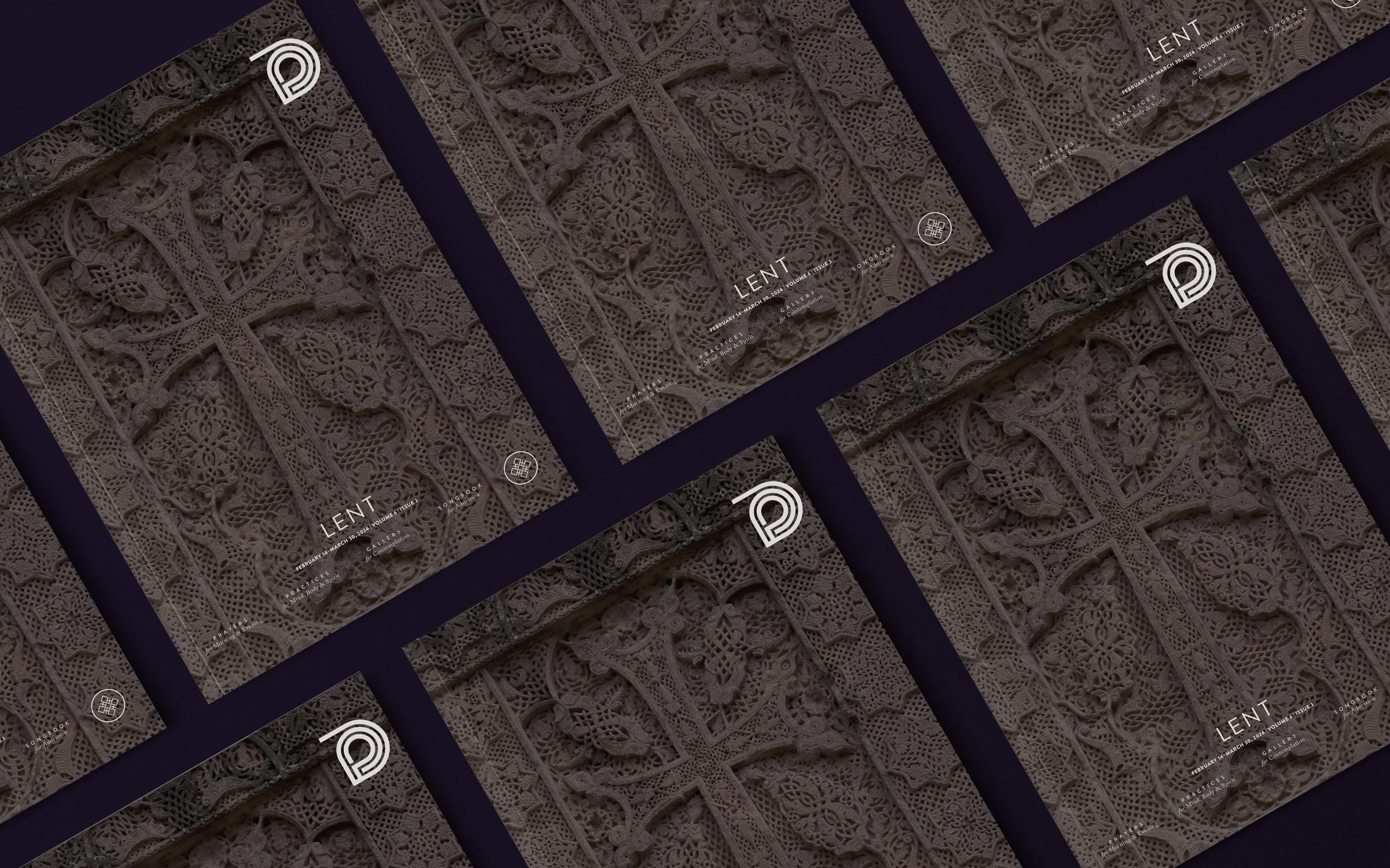
Lent LPP

+++

SERMON: “Seasons of the Heart: Preparing for Lent” by James K. A. Smith: Last February, Jamie Smith preached on Ecclesiastes 3:1–8 and John 16:12–15 at his home church, Sherman Street Christian Reformed Church in Grand Rapids, Michigan. He talks about seasonality—how we creatures experience time in seasons, both personally and collectively—and encourages us to ask, “When am I?” Along the way he references Gustavo Gutiérrez, Rita Felski, and Bruce Springsteen. Below is a transcription of 23:42 onward, which I find so resonant. To receive the full force of this conclusion, listen to the whole sermon.

God has more to say to us in his word that we haven’t yet got. There is something in us, for us, in the word that we hear over and over and over again, and the way that we will get to the place of receiving it is precisely by giving ourselves over to the seasons in our lives and letting God do the work in us so that we get new ears, because we have new hearts. This is one of the reasons why . . . repetition is at the heart of the spiritual life. It’s exactly why we keep repeating the liturgical seasons over and over again. Why? Because every single one of us is a different person every time Advent arrives. Every single one of us has undergone something every single time Lent rolls around again.

And so as we’re preparing for Lent—this season of repentance, this season of encountering our mortality—again, I want to encourage us to ask: When am I? When are we? What am I going through? What season am I in? And then from that place, come to Lent with expectation. What does God want to say to me in the now that I find myself? What are you newly ready for because of what you’ve come through? What can Jesus say to you this year that he couldn’t tell you last year?

So many of you are mourning. And the journey of Lent is really a journey of yearning for resurrection. But it passes through the valley of the shadow of death. Unapologetically. And the psalmists’ cries that you’re going to hear in Lent, maybe this year they’re going to give voice to a cry of your own that you didn’t have before. The experience of being bereft on Holy Saturday is going to hit some of you in a way it never has before this year. But maybe that also means that Easter dawns for you in a way it never has before.

Friends, maybe some of you feel, to go back to Ecclesiastes, that it’s a time to build and plant. Because you’ve come through the season of tearing down and uprooting. Maybe this Lent you feel like you’re finally in a place where you can be vulnerable to a God that you finally learned is compassionate, who loves you all the way down. This is a season to build, to plant.

Friends, maybe some of you feel like it’s the time of giving up and throwing away. There is a time for everything, the Teacher tells us. There’s a time to give up, there’s a time to throw away. But maybe it’s precisely what you need to let go of that has been blocking your ability to experience God’s incessant, steadfast, always love.

Whenever you are, whatever season you find yourself in, God has good news to share with you. That’s what we can rely on. No matter what season you’re in, the God who is eternal—the same yesterday, today, and forever—has always a word of good news, because he is always the God with us. He is always Emmanuel. And so this Lent and Eastertide, maybe this is the year you finally get God’s song. You finally hear the song of new life. And friends, I hope you hear that God is singing to you.

+++

VESPERS SERVICES AT CALVIN UNIVERSITY:

I’ve just returned from another inspiring Calvin Symposium on Worship, so grateful for all the gifts and wisdom that were shared. There’s much I could say, but one thing I discovered was how much I loved participating in Vespers, a short evening worship service consisting of scripture readings, prayers, and song (vesper in Latin simply means “evening”). It’s not something that’s regularly offered in my (Presbyterian) tradition, at least not near me. Here are three of the Vespers services that took place this week at Calvin, the latter two at which I was present:

>> Celtic Vespers: “Psalms of Healing and Hope for a Troubled World,” led by Kiran Young Wimberly and The McGraths: This service of psalms set to Celtic melodies was led by Kiran Young Wimberly and The McGraths (a Northern Ireland–based group that performs and records together), Mary Beth Mardis-LeCroy (violin), and Brian Hehn (piano). Since Ash Wednesday is this coming week, I’ll draw your attention especially to “From Dust We Came (Psalm 90)” (see timestamp 15:28), which uses the eighteenth-century Irish tune CASADH AN T’SÚGÁIN. Plus, another highlight for me: “Love and Mercy (Psalm 85),” set to the eighteenth-century Scottish tune LOVELY MOLLY (39:55)—I’ve added this to my Advent Playlist! For more info about the musicians and their work, see https://www.celticpsalms.com/.

>> Jazz Vespers: “Lament as Worship,” led by Ruth Naomi Floyd and her jazz quartet: Ruth Naomi Floyd is a phenomenal jazz vocalist, composer, and fine-art photographer. This liturgy that she crafted and presented is so moving. In her thoughtful selection of readings, Floyd brings a James Baldwin poem into conversation with Psalm 42:7–11 and even includes an amusing proverb from Chinua Achebe’s novel Arrow of God. She also adds a visual element: black-and-white photographic portraits she shot, which were displayed on slides during each segment (not all of them are featured in the video recording).

The musical performance, I hardly have words for. All I can say is, it was utterly engrossing. The expressiveness of Floyd’s voice is unmatched, carrying such pathos. I couldn’t pick a favorite song, but the opening spiritual, “Trouble So Hard” (11:37), hit me forcefully. The first verse talks about a mountaintop experience of spiritual ecstasy (“getting happy” refers to being filled with the Spirit), and that’s contrasted in the second verse with a descent into the valley of deep suffering and grief. The refrain asserts to God, seeking divine consolation, “Oh Lord, trouble so hard,” and then testifies that only God truly knows our troubles. Also take note of the concluding song, “Press On” (34:31), an original Floyd composition whose text is taken from the writings of Frederick Douglass, part of a larger body of work that has been recorded and will most likely be released by the end of this year, Floyd told me; see https://frederickdouglassjazzworks.com/.

The amazing instrumentalists are James Weidman (piano), Keith Loftis (saxophone), Matthew Parrish (bass), and Mark Prince (drums).

>> Choral Vespers: “Christ, Holy Vine, Christ, Living Tree,” led by David M. Cherwien and The Choral Scholars: Led by the West Michigan chamber ensemble The Choral Scholars and organist/pianist David Cherwien, this service centers on botanical imagery of Christ and his people—such a generative idea! I enjoyed singing Gerald Cartford’s responsorial setting of Psalm 141:1–4a and 8 (see timestamp 12:48); the refrain is “Let my prayer rise before you as incense; and the lifting of my hands as the evening sacrifice” (the plant connection is that incense is derived from fragrant gum resins, i.e., tree sap). Also, this was my first time hearing Elizabeth Poston’s “Jesus Christ, the Apple Tree” performed live (20:48), and the first time its words truly registered with me.

+++

PRAYER-POEM: “Marked by Ashes” by Walter Brueggemann: “. . . On this Wednesday, we submit our ashen way to you—you Easter parade of newness. Before the sun sets, take our Wednesday and Easter us, Easter us to joy and energy and courage and freedom . . .” This prayer by the Old Testament scholar and theologian Walter Brueggemann, from his book Prayers for a Privileged People (2008), is ostensibly for any ol’ Wednesday in the church year, but it could be used, with one small elision, for Ash Wednesday itself. I love how it reads Easter backward into Lent, recognizing that the fruits of Christ’s resurrection are borne all year round.

P.S. This year, Ash Wednesday falls on February 14, Valentine’s Day. It did too in 2018; read the poem by Luci Shaw that I published for that occasion.
Roundup: Literary Lent, Psalm 90 virtual art exhibition, and more

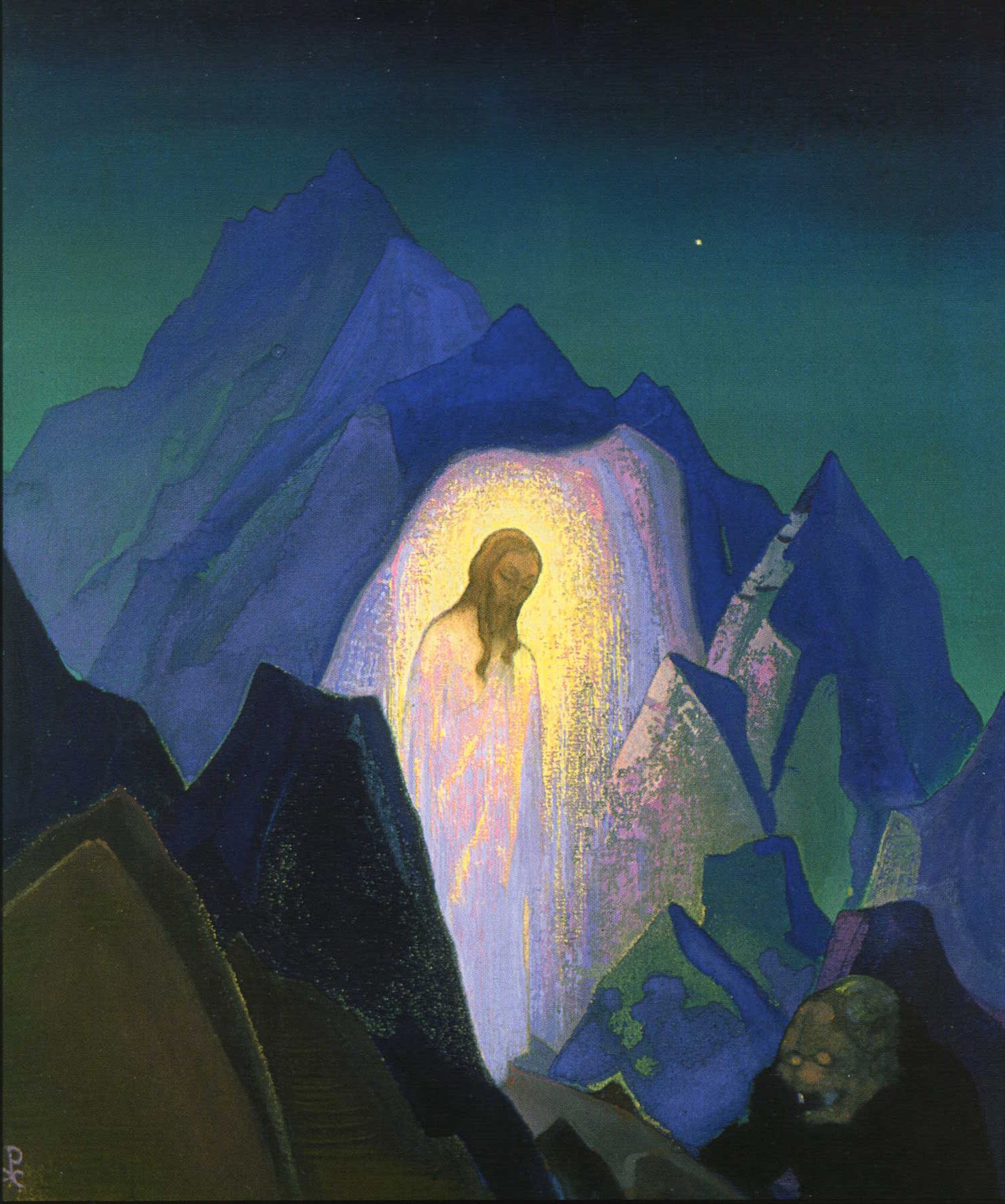
Roerich, Nicholas_Christ in the Desert
Nicholas Roerich (Russian, 1874–1947), Christ in the Desert, 1933. Tempera on canvas, 60 × 50.9 cm. Nicholas Roerich Museum, Moscow.

QUOTE:

The tradition of Lent means many different things to many different people. I honour the traditions and wisdom of the ages—and I’m interested in discerning what these practices mean [today].

At [my church], Lent is about learning from Jesus, particularly Jesus’ path through the real-life wilderness experiences we all face. We are interested in emulating and discovering a Jesus-shaped life in the hard things, the growing things, and the uncomfortable things. We believe not in an idealized plane of existence no one can quite attain; instead we believe in knowing and living out a Jesus way in the grey areas, the dirt and dust of our earthly lives here and now. . . .

Together and for you, this is our prayer (by Ann Siddall): “May this Lenten journey, with its stories about the hard places of Jesus’ experience, give strength and courage to all whose journey is far from easy. And may it inspire us to risk Christ’s Way of love as we share the journey with other travelers. We make this prayer in his name. Amen.”

—Rielly McLaren, pastor, Windsor Mennonite Fellowship, Windsor, Ontario [source]

+++

ARTICLES:

>> “Ash Wednesday and the Practice of Truth-Telling” by Christine Valters Paintner: In this introduction to the season of Lent, spiritual writer and retreat leader Christine Valters Paintner discusses lament as a Lenten practice—lament as truth-telling, resistance, solidarity, and the release of God’s power. We need to touch those places of grief that we carry, and open ourselves in compassion to the grief of others. Paintner also unpacks the word “repentance,” visiting its Hebrew and Greek root words to further illuminate its meaning.

>> “Forty for 40: A Literary Reader for Lent” by Nick Ripatrazone: Nick Ripatrazone, the culture editor for Image journal and columnist at The Millions, offers suggestions and blurbs for forty stories, poems, essays, and books appropriate for Lent. Some pieces are inspired by feast days and Gospel readings, while others capture the discernment of the season. From Flaubert’s The Temptation of Saint Anthony and Hemingway’s one-act play Today Is Friday to Love & Salt: A Spiritual Friendship Shared in Letters and Karr’s “Disgraceland,” the selections are varied and intriguing. The dates are off because this was published in 2017, but the list is still valid, and many of the poems can be read online.

+++

LIVING ROOM EVENT: “Poetry of Lent”: On March 4, under the aegis of the local arts nonprofit the Eliot Society, I’m moderating an evening of crowdsourced Lenten poetry at a friend’s home in Crownsville, Maryland. If you’re in the Baltimore-Washington metro area, I’d love to see you there! The themes of this season are so expansive, and I’m looking forward to hearing what people share. Of course, I will have many poems in my back pocket as well. Some words I’ve been thinking of in preparation: pilgrimage; hunger; emptying; grace; greening; solitude; beloved; blood.

+++

SONGS:

>> “Circles” by Tow’rs: Tow’rs, an indie-folk band out of Flagstaff, Arizona, is made up of Gretta and Kyle Miller, drummer Dan Bagle, guitarist Kyle Keller, and cellist Emma Riebe. This song of theirs is about how God lovingly pursues us and clothes our shame.

>> “Parce Domini” by Jacob Obrecht: The Gesualdo Six perform a motet by the Flemish composer Jacob Obrecht (1457/58–1505), which sets a traditional Latin liturgical text based on Joel 2:17, 13.

Parce Domine, parce populo tuo quia pius es et misericors. Exaudi nos in aeternum, Domine.

Spare, O Lord, spare thy people, for Thou art gracious and merciful. Hear us for ever, O Lord.

+++

VISUAL COMMENTARY: “Handling Our Fragility, Seeking a Wise Heart” by Rachel Muers: As part of the Visual Commentary on Scripture project, theologian Rachel Muers has selected and comments on three artworks that resonate with Psalm 90 [previously], a song that combines communal lament with a meditation on wisdom. The psalm ends with the cry “Prosper for us the work of our hands—O prosper the work of our hands!”—which guided Muer in her curation. She gives us nine-thousand-year-old handprints on an Argentinian cave wall, a hospital drawing by Barbara Hepworth, and a cat’s-cradle sculpture by Mitzi Cunliffe. This mini-exhibition is a great way to enter into and engage with this typically Lenten psalm.

Cave of Hands
Cueva de las Manos (Cave of Hands), began ca. 7,000 BCE. Mural, UNESCO World Heritage Site, Santa Cruz, Argentina.

On a related note: For this Lent, the VCS is dipping into its archives to bring you “Lent Stations: Repentance and Forgiveness,” fourteen artworks with commentary (two per week) that relate to the stated theme. Follow the link to sign up.

Lent, Day 1 (Ash Wednesday)

. . . you are dust, and to dust you shall return.

—Genesis 3:19 (cf. Ecclesiastes 3:20)

Lord, you have been our dwelling place
    in all generations.
Before the mountains were brought forth,
    or ever you had formed the earth and the world,
    from everlasting to everlasting you are God.

You turn us back to dust,
    and say, “Turn back, you mortals.”
For a thousand years in your sight
    are like yesterday when it is past,
    or like a watch in the night.

You sweep them away; they are like a dream,
    like grass that is renewed in the morning;
in the morning it flourishes and is renewed;
    in the evening it fades and withers.

For we are consumed by your anger;
    by your wrath we are overwhelmed.
You have set our iniquities before you,
    our secret sins in the light of your countenance.

For all our days pass away under your wrath;
    our years come to an end like a sigh.
The days of our life are seventy years,
    or perhaps eighty, if we are strong;
even then their span is only toil and trouble;
    they are soon gone, and we fly away.

Who considers the power of your anger?
    Your wrath is as great as the fear that is due you.
So teach us to count our days
    that we may gain a wise heart.

Turn, O LORD! How long?
    Have compassion on your servants!
Satisfy us in the morning with your steadfast love,
    so that we may rejoice and be glad all our days.
Make us glad as many days as you have afflicted us,
    and as many years as we have seen evil.
Let your work be manifest to your servants,
    and your glorious power to their children.
Let the favor of the Lord our God be upon us,
    and prosper for us the work of our hands—
    O prosper the work of our hands!

—Psalm 90

God’s eternity and human frailty. These are the central themes of Psalm 90, commonly read on Ash Wednesday, the first day of Lent. Today many Christians will be receiving the sign of the cross in ash on their foreheads—a symbol of death and repentance. “Remember that you are dust, and to dust you shall return. Repent and believe the gospel,” the pastor pronounces as he or she smears the ash (made from burnt palm fronds from last year’s Palm Sunday) on young and old alike.

For a Protestant defense of Ash Wednesday, see “To Ash or Not to Ash” by Rev. Dr. Timothy R. LeCroy. He explores the biblical symbolism of the ritual, its history, and its importance for Christian formation.

LOOK: We Shake with Joy, We Shake with Grief by Meena Matocha

Matocha, Meena_We Shake with Joy, We Shake with Grief
Meena Matocha (American, 1977–), We Shake with Joy, We Shake with Grief, 2019. Charcoal, ashes, soil, acrylic, and cold wax on panel, 12 × 12 in.

Austin-based artist Meena Matocha uses charcoal, ashes, soil, and wax to create figurative paintings that explore the tensions between joy and grief, life and death, and the eternal and temporal. The title of this featured painting of hers comes from the poem “We Shake with Joy” by Mary Oliver, reproduced here in full:

We shake with joy, we shake with grief.
What a time they have, these two
housed as they are in the same body. [source]

The exhibition Meena Matocha: Into the Bright Sadness opens this Friday, March 4, at Christ Church of Austin with a reception and gallery talk and will run through April 15. “Bright sadness” is how the Orthodox priest Alexander Schmemann, in his influential book Great Lent: Journey to Pascha (1969), translates the concept of charmolypê that John Climacus develops in his Ladder of Divine Ascent in relation to “holy compunction.” “Bright sadness . . . is the true message and gift of Lent,” Schmemann writes. “The sadness of my exile, of the waste I have made of my life; the brightness of God’s presence and forgiveness, the joy of the recovered desire for God, the peace of the recovered home.” Alternative translations of this compound noun that permeates the Lenten season are “bitter joy,” “joyful mourning,” “joy-making mourning,” or, as Archimandrite Lazarus Moore has it, “blessed joy-grief.”

In their mood and materiality, Matocha’s paintings capture well the themes of Ash Wednesday and the season it inaugurates. Follow her on Instagram @meenamatochaart and on Facebook.

LISTEN: “From the Dust” by Paul Zach and Kate Bluett, 2021 | Released as a single February 25, 2022

Singer-songwriter Paul Zach video-recorded a minimalist demo of this original song last year, and just last Friday he released a fuller version with backing vocals by The Sing Team and a forty-piece orchestral accompaniment. The string arrangement is by Brian Eichelberger. Zach gave me permission to publicly post this Dropbox link, where you can download an audio file of the song, a lead sheet, and the string parts: https://www.dropbox.com/sh/t56w2lyi3hsoerm/AADPnKbPDveZh825uUdBU4JEa?dl=0.

From the dust we came
To the dust we shall return
God everlasting, age unto age the same
We are a moment, then like a breath we fade

From the dust we came
To the dust we shall return
God everlasting, we are cut down as grass
Seeds in the morning, and by the night we pass

O Lord, have mercy
O Lord, have mercy
O Lord, have mercy

Based on Genesis 3:19 and Psalm 90:2–6, “From the Dust” is a sober acknowledgment of the mortality that unites us all, and a plea that God would be merciful to us, forgiving our foolish ways and setting us back on the path of wisdom.

This song appears on the Art & Theology Lent Playlist.

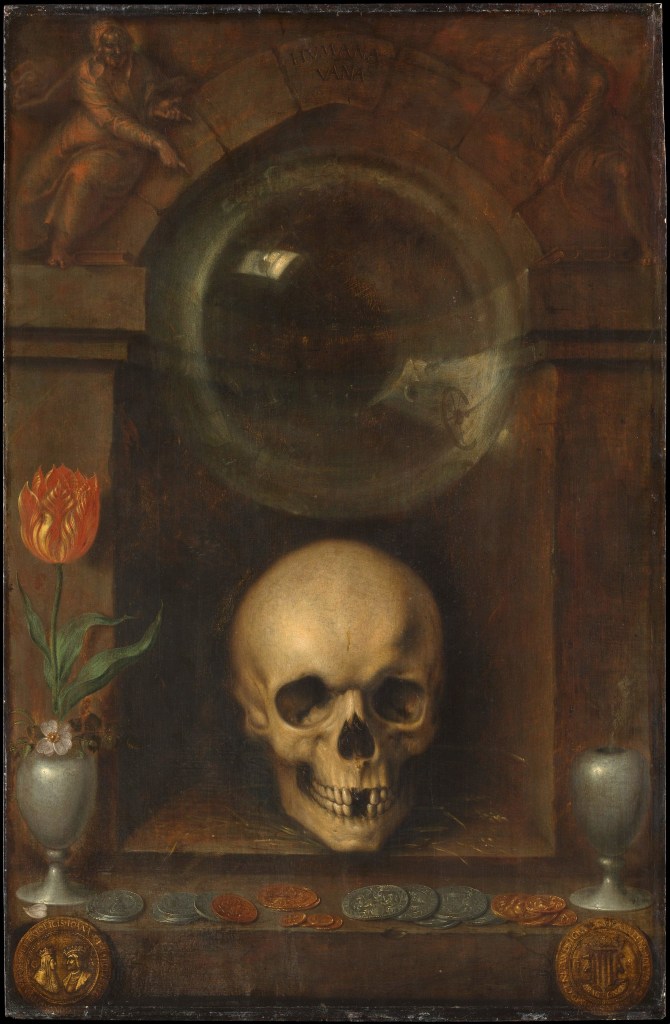
Teach Us to Number Our Days (Artful Devotion)

Jacques de Gheyn II (Netherlandish, 1565–1629), Vanitas Still Life, 1603. Oil on wood, 32 1/2 × 21 1/4 in. (82.6 × 54 cm). Metropolitan Museum of Art, New York.

Lord, you have been our dwelling place
in all generations.
Before the mountains were brought forth,
or ever you had formed the earth and the world,
from everlasting to everlasting you are God.

You return man to dust
and say, “Return, O children of man!”
For a thousand years in your sight
are but as yesterday when it is past,
or as a watch in the night.

You sweep them away as with a flood; they are like a dream,
like grass that is renewed in the morning:
in the morning it flourishes and is renewed;
in the evening it fades and withers.

. . .

The years of our life are seventy,
or even by reason of strength eighty;
yet their span is but toil and trouble;
they are soon gone, and we fly away.

. . .

So teach us to number our days
that we may get a heart of wisdom.

—Psalm 90:1–6, 10, 12

+++

MUSIC: Élégie in E-flat Minor, op. 3, no. 1, by Sergei Rachmaninoff, 1892 | Performed by Sheku Kanneh-Mason, with Isata Kanneh-Mason, 2017

I’ve mentioned these stellar sibling musicians on the blog before, when I shared Sheku’s arrangement of “In the Bleak Midwinter.” In fact, all seven Kanneh-Mason siblings, ranging in age from eleven to twenty-four, are musical—and of an exceptionally high standard! Their debut album as a family, Carnival, dropped November 6; it is a collaboration with Oscar-winning actor Olivia Colman and children’s author Michael Morpurgo.

Sheku Kanneh-Mason released Rachmaninoff’s Élégie, from Morceaux de fantaisie, as a single in 2017. He has two solo records: Elgar (2020) and Inspiration (2018).

Isata Kanneh-Mason has also recorded as a solo artist: see Romance: The Piano Music of Clara Schumann (2019).

+++

Vanitas (from the Latin vanus, “empty”) is a subgenre of still life painting, especially common in the Low Countries in the seventeenth century, that shows, through symbolism, the brevity of life and the transience of earthly pleasures.

Art historian Ingvar Bergström discusses Vanitas Still Life by Jacques de Gheyn II (Jacob de Gheyn) at length in the 1970 journal article “De Gheyn as a ‘Vanitas’ Painter.” The commentary that follows is derived from that.

In de Gheyn’s painting, a skull sits inside a stone niche on a bed of dry grass, a reminder that “all flesh is grass, and all the goodliness thereof is as the flower of the field: the grass withereth, the flower fadeth . . .” (Isaiah 40:6–7; cf. 1 Peter 1:24). Sitting on the left side of the ledge, the tulip and the wild rose with the fallen petal symbolize how man “cometh forth like a flower, and is cut down” (Job 14:2). The smoking urn on the other side references Psalm 102:3: “my days are consumed like smoke.” Between these two are a spill of Spanish coins and a Dutch military medal, and propped up against the ledge on each side is a gold ten-ducat coin showing, on the obverse, Joanna and Charles as sovereigns of Aragon. The message is that beauty, riches, and worldly power and honors all come to an end.

Lest this message somehow be missed, HUMANA VANA (“human vanity”) is carved into the top of the arch. The inscription is flanked by fictive sculptures of Heraclitus and Democritus, the weeping and laughing philosophers of Greek antiquity. Both figures point to a soap bubble (“Man is but a bubble” is a classical aphorism), which, if read in light of the traditional iconography of the two philosophers, doubles as a globe.

de Gheyn II, Jacques_Vanitas Still Life (bubble detail)

The bubble mirrors a number of disparate objects, which are difficult to make out. Bergström identifies a trophy group along the middle axis of the bubble: a crown in the center with various weapons converging upon it. At the top is an upturned moneybag with coins streaming out. Most discernible is the wheel of torture at the bottom right, and above that is a leper’s rattle, which lepers in some areas were required to shake to alert others to their proximity; these are symbols of human frailty. Also reflected “are a caduceus (probably signifying commerce) and a pair of bellows (signifying luxury?). Playing cards, backgammon with dice, and drinking vessels allude to vain pleasures and pastimes. The highlight of the sphere mirrors a burning heart, pierced by an arrow—an image of earthly love, of luxury” (153).

Though the painting doesn’t explicitly reference our lectionary reading from Psalm 90, it does complement the psalmist’s reflection on how short and precarious life is—it’s like a wilting flower, a burning candle, a fragile bubble. Here today, gone tomorrow. Which is why it’s so important to live wisely while we still can.

+++

To access another Artful Devotion for AProp28, on 1 Thessalonians 5:1–11, click here.


This post belongs to the weekly series Artful Devotion. If you can’t view the music player in your email or RSS reader, try opening the post in your browser.

To view all the Revised Common Lectionary scripture readings for Proper 28, cycle A, click here.