CONFERENCE: The Breath and the Clay: Exploring the Intersections of Art, Faith, and Culture, Winston-Salem, North Carolina, March 20–22, 2026: “Before the first word is spoken, before the brush touches the canvas or the note strikes the air, there is silence. Creation begins with a clearing, making space for new worlds to exist. An empty chair waits in welcome, an empty forest beckons us to come aside. Even absence itself becomes an opening for presence.
“At The Breath & The Clay 2026, we are exploring what it means to make space—for rest, for renewal, for art, for one another, and for the Presence that meets us in the emptiness. Together, we will practice making room: for the unfinished, and the unfurnished, for the overlooked, for voices not our own. In this space, we will make art—our response to the silence that precedes creation, our offering to the mystery and miracle that ever calls us onward.”
This annual gathering features presenters from across the disciplines of poetry, music, visual art, theater, film, dance, creativity coaching, and real estate development. General admission is $299.
>> “How Long (A Christian Lament)” by IAMSON: This week the Richmond, Virginia–based singer-songwriter IAMSON (the artist name of Orlando Palmer) wrote his pain into a song and shared it on social media. “I challenge all Christian artists to write about what’s really going on,” he says, likely referring to the two murders committed this month by US federal agents from Immigration and Customs Enforcement (ICE) and Customs and Border Protection (CBP) and, more broadly, the agencies’ hypermilitarized tactics, indiscriminate raids, illegal detainments, and terrorizing of communities in deference to President Trump’s mass deportation initiative.
>> “Psalm 10” by Poor Bishop Hooper: Poor Bishop Hooper (Leah and Jesse Roberts) have set all 150 psalms of the Bible to music. Psalm 10 is one I had not ever heard a musical interpretation of. Belonging to the genre of lament, it opens:
Why, O LORD, do you stand far off? Why do you hide yourself in times of trouble? In arrogance the wicked persecute the poor— let them be caught in the schemes they have devised.
>> “Micah 6:8” by Monroe Crossing:Monroe Crossing [previously] is a Minnesota bluegrass band whose members are Lisa Fuglie (fiddle), David Robinson (banjo), Derek Johnson (guitar), Matt Thompson (mandolin), and Mark Anderson (bass). This is a song Fuglie and Anderson wrote in 2011 inspired by Micah 6:8, one of this coming Sunday’s lectionary readings: “He has told you, O mortal, what is good, and what does the LORD require of you but to do justice and to love kindness and to walk humbly with your God?” Many Christians hold on to this as a “life verse,” a summation of God’s values that serves as a guiding principle.
FREE DIGITAL POETRY BOOKLET: Inkwell Poetry for the New Year (2026): Last week Inkwell (formerly Ekstasis), a publication of Christianity Today, released a collection of twenty poems curated by guest editor J. C. Scharl, and it’s excellent! “A storytelling community seeking transcendence,” Inkwell is in a period of refining their identity, and this offering is a sort of stopgap until they reintroduce poetry features into their editorial flow. (Right now they’re focusing on creative nonfiction.)
In the beginning was the Word, and the Word was with God, and the Word was God. He was in the beginning with God. All things came into being through him, and without him not one thing came into being. . . .
And the Word became flesh and lived among us, and we have seen his glory, the glory as of a father’s only son, full of grace and truth. . . . No one has ever seen God. It is the only Son, himself God, who is close to the Father’s heart, who has made him known.
—John 1:1–3, 14, 18 (NRSV)
He is the reflection of God’s glory and the exact imprint of God’s very being.
—Hebrews 1:3 (NRSV)
His birth is twofold: one, of God before time began; the other, of the Virgin in the fullness of time.
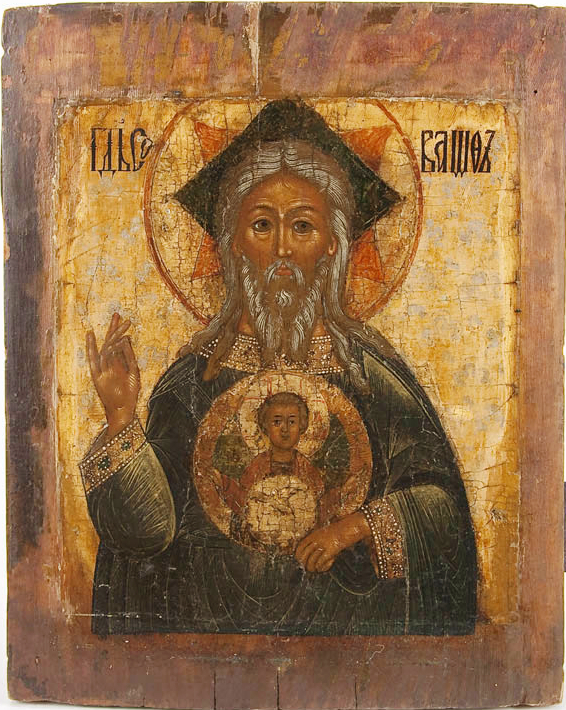
The Otechestvo—“Fatherhood” or “Paternity”—icon shows God the Father (Lord Sabaoth, as he is titled in Russian Orthodoxy) as an old man with Christ Emmanuel (Jesus in child form) seated on his lap or encircled by his “womb,” and the Holy Spirit in the form of a dove hovering before his chest. The eight-pointed slava (“glory”) behind the Father’s head signifies his eternal nature, shared by all three persons. His right hand forms the Greek letters IC XC, abbreviating “Jesus Christ.”
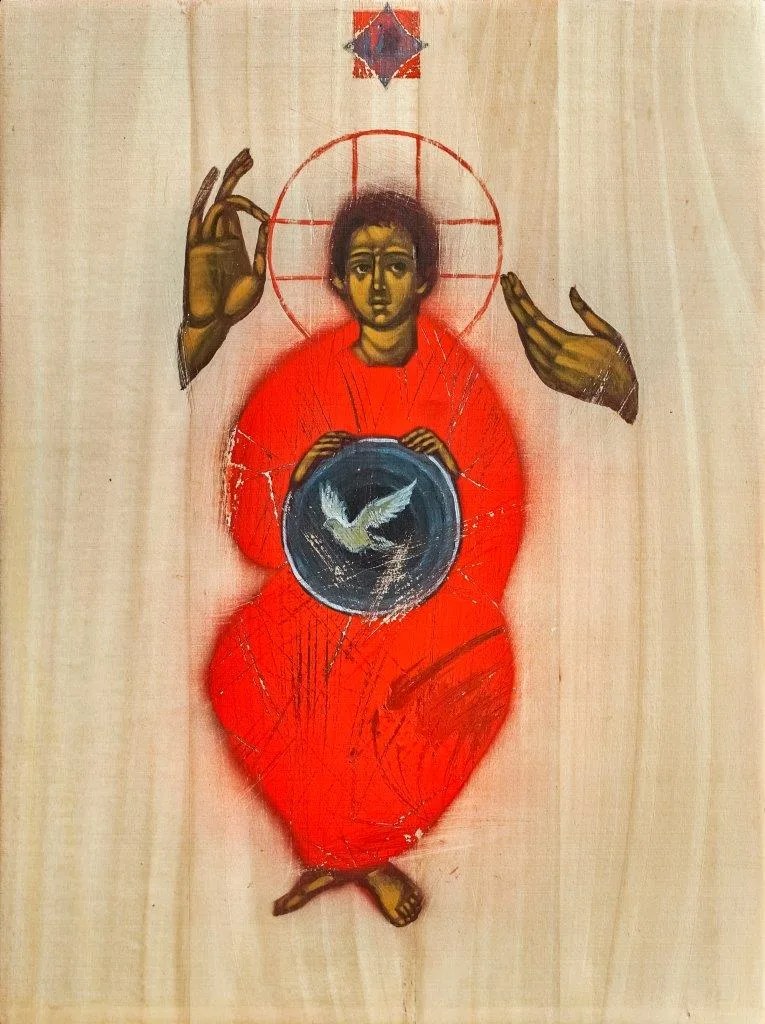
Here are two examples of this Trinitarian image—one from the eighteenth century, and one from just two years ago, which I encountered through the OKSSa [previously] exhibition The Father’s Love.
Otechestvo (Paternity) icon, Russia, 18th century. Tempera on wood, 33 × 27 cm. Sold by Jackson’s International Auctioneers and Appraisers, May 18, 2010.Sylwia Perczak (Polish, 1977–), “Boga nikt nigdy nie widział, Jednorodzony Bóg, który jest w łonie Ojca, o Nim pouczył” (J 1,18), 2023. Acrylic on wood, 40 × 30 cm.
The Polish artist Sylwia Perczak (IG @perczaksylwia) titles her icon after John 1:18: “No one has ever seen God. It is the only Son, himself God, who is close to the Father’s heart, who has made him known” (NRSV). The King James Version contains the lovely phrasing “the only begotten Son . . . is in the bosom of the Father.”
Perczak chooses to keep God the Father, who is incorporeal, out of frame, with the exception of his hands, which gesture to the Son, who holds the Spirit.
Thank you to David Coomler and his Russian Icons blog for introducing me to this icon type.
LISTEN: “In splendoribus sanctorum” by James MacMillan, 2005 | Performed by the Gesualdo Six, dir. Owain Park, feat. Matilda Lloyd, 2020; released on Radiant Dawn, 2025
In splendoribus sanctorum, ex utero, ante luciferum, genui te. [Psalm 109:3 Vulgate]
English translation:
In the brightness of the saints: from the womb before the day star I begot you. [Psalm 109:3 Douay–Rheims Bible]
Written for the Strathclyde University Chamber Choir, the Strathclyde Motets are a collection of fourteen Communion motets for SATB choir by the Scottish composer James MacMillan. “In splendoribus sanctorum” (In the Brightness of the Saints / Amid the Splendors of the Heavenly Sanctuary) is for Midnight Mass on Christmas Eve and includes a trumpet obbligato.
The Latin text is from Psalm 109 in the Vulgate (numbered Psalm 110 in Jewish and Protestant Bibles), a royal psalm that looks forward to the Messiah. The verse is interpreted by Christians as referring to how Christ existed before the dawn of creation, in eternity, and was begotten by the Father; he is the Son of God.
The verse didn’t ring a bell from my many readings of the Psalms over the years—and that’s because it’s from a different manuscript tradition than the Bible translations I typically use (KJV, NRSV, NIV, ESV).
See, the Vulgate, from the late fourth century, is based on the Septuagint, a Greek translation of the Hebrew scriptures produced in Alexandria in the third through first centuries BCE; so is the major Catholic translation of the Bible into English from 1610, the Douay–Rheims. But Protestant and ecumenical translations are based on the Masoretic Text, the authoritative Hebrew and Aramaic text of the twenty-four books of the Jewish canon. The Septuagint and the Masoretic Text contain some textual variants, and this verse is one of them. (Learn more on the Catholic Bible Talk blog.)
Here’s how the verse reads in the New Revised Standard Version:
Your people will offer themselves willingly on the day you lead your forces on the holy mountains.
From the womb of the morning, like dew, your youth will come to you.
The meaning of the Hebrew is obscure, but the phrase “womb of the morning” probably refers to dawn, and “your youth” to the soldiers at the Messiah’s command.
Anyway, I felt I had to explain why if you look up the verse, you might have trouble finding it, depending on which Bible you use.
The Catholic and Orthodox Churches have chosen the “from the womb before the day star I begot you” variant in their liturgies. I love its poetic theology! They use the verse to support the doctrine, taught by all three branches of Christianity, of the eternal generation of the Son—who is “God from God, Light from Light, true God from true God, begotten, not made,” as the Nicene Creed puts it.
By including this verse in its first liturgy of Christmastide, celebrated the night of Christmas Eve, the Catholic Church underscores that Jesus is of the same essence as God the Father. Mary, crucially, gives birth to Jesus, flesh of her flesh—but the Son is generated by the Father before all ages.
To hear “In splendoribus sanctorum” in Old Roman chant from the sixth century, click here.
I remain confident of this: I will see the goodness of the LORD in the land of the living. Wait for the LORD; be strong and take heart and wait for the LORD.
—Psalm 27:13–14 (NIV)
LOOK: The Waiting by Charlotte Mann Lee
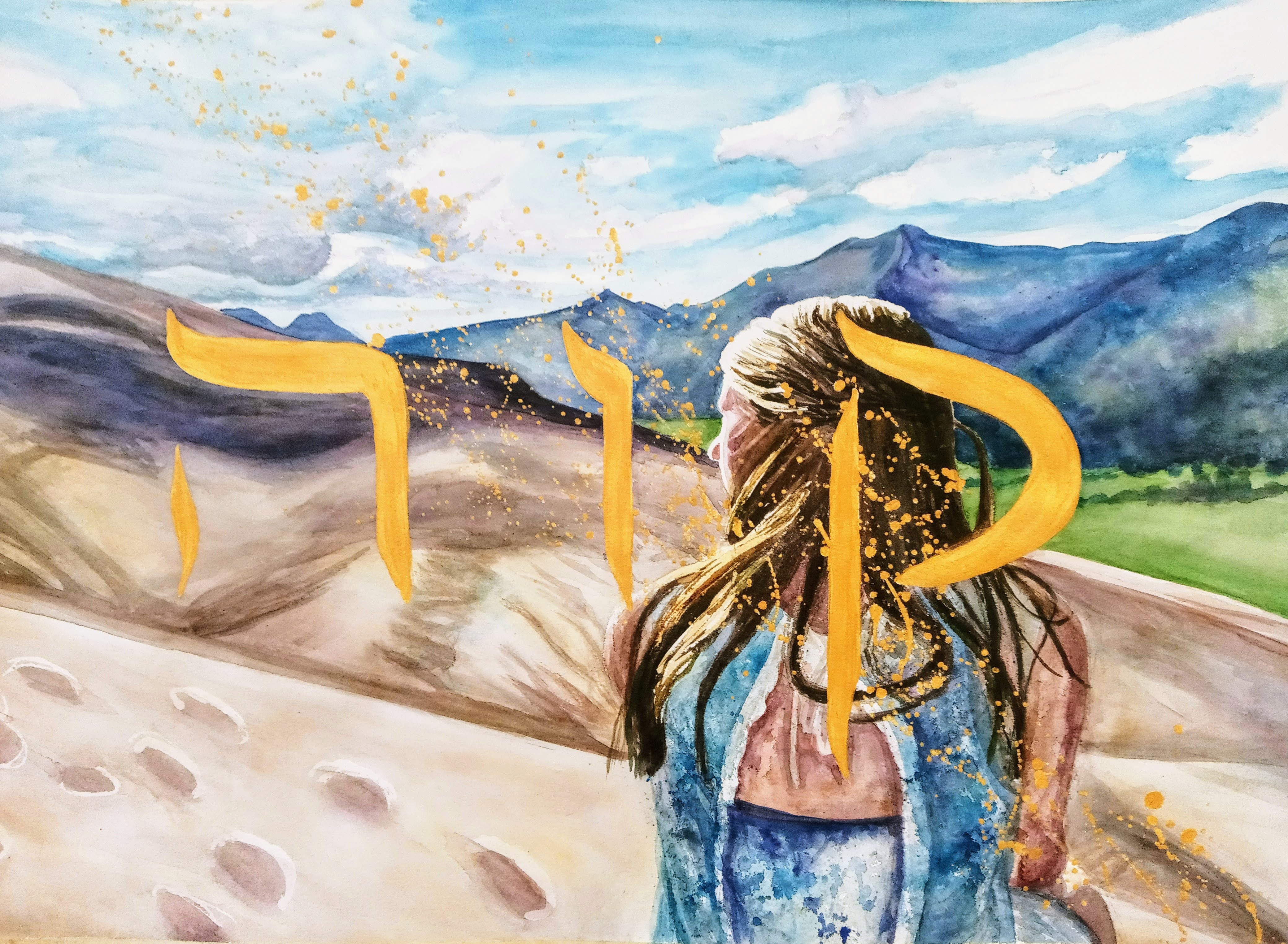
Charlotte Mann Lee (American, 1996–), The Waiting, 2021, from the Desert series. Watercolor and gold pigment on paper, 18 × 24 in. (45.7 × 61 cm).
Artist Charlotte Mann Lee is a friend of mine from Maryland. Her watercolor The Waiting, a self-portrait at Great Sand Dunes National Park in Colorado, is inspired by the final verse of Psalm 27 (quoted above). The Hebrew verb קָוָה (qavah), meaning “to wait for, or to look expectantly,” stretches across the scene, a breeze scattering its gold flecks to the sky. A majestic vista lies just over the sand.
“In the desert times of life, when the soul is dry and weary, the barren landscape seemingly endless before us, waiting is difficult,” Lee writes. “What we know to be true may be in conflict with our current experience. There is an ongoing tension between what we see and feel currently in our suffering, and what God promises in His Word.” It’s that tension she seeks to convey here, as well as “the hope that anchors [the Christian] amidst trials and struggles in the desert”: God in Christ.
LISTEN: “Psalm 27” by Psalm Project Africa, on Sing Psalms, vol. 1 (2013)
Of this I’m sure I’ll see God’s goodness My soul will rest in The land of the living Be strong in the Lord
Refrain: The Lord is my light And my salvation Whom shall I fear Shall I be afraid The Lord is my light And my salvation Whom shall I fear Shall I be afraid The Lord is my life
One thing I need One thing I ask you To dwell in your house Each day of my life Delighting in you [Refrain]
In troubled times He keeps me secure He covers me He lifts my head Above the storm [Refrain]
A program of the Reformed Student Organisation in Kampala, Uganda, Psalm Project Africa was a collective of songwriters and musicians who led workshops at African churches and colleges, encouraging Christians to sing the Psalms in African styles. It appears they were active from 2013 to 2017, releasing three albums of psalm settings within that period.
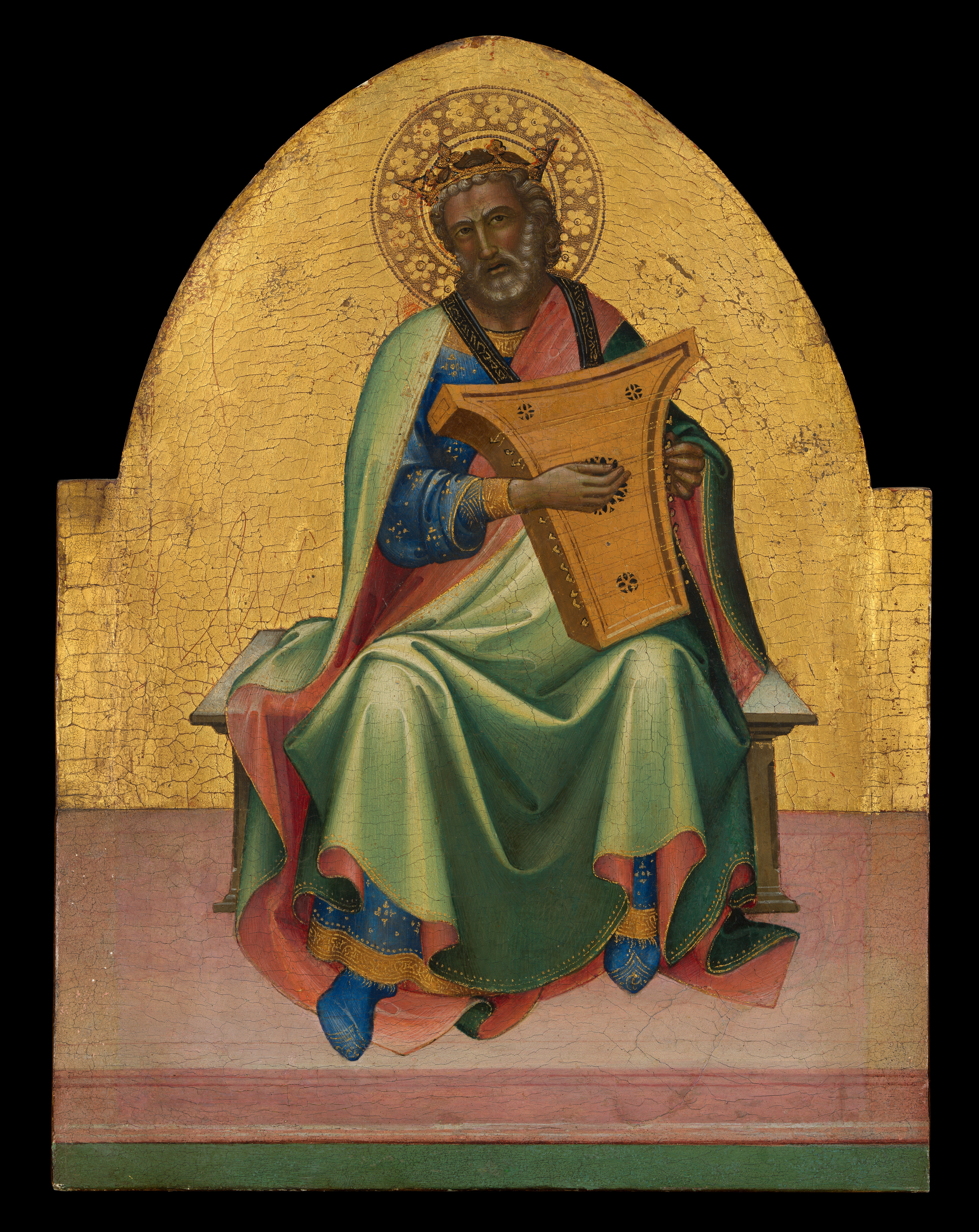
EXHIBITION: Sing a New Song: The Psalms in Medieval Art and Life, Morgan Library and Museum, New York, September 12, 2025–January 4, 2026:Sing a New Song traces the impact of the Psalms on people in medieval Europe from the sixth to sixteenth centuries, showing how this poetic book of the Bible suffused daily life, church liturgies, and art. The exhibition features, of course, numerous illuminated Psalters, as well as other art objects influenced by the Psalms, culled from the Morgan’s own collection and some two dozen institutions around the world.
Lorenzo Monaco (Italian, ca. 1370–ca. 1425), David, ca. 1408–10. Tempera on wood, gold ground, 22 3/8 × 17 in. (56.8 × 43.2 cm). Metropolitan Museum of Art, New York.
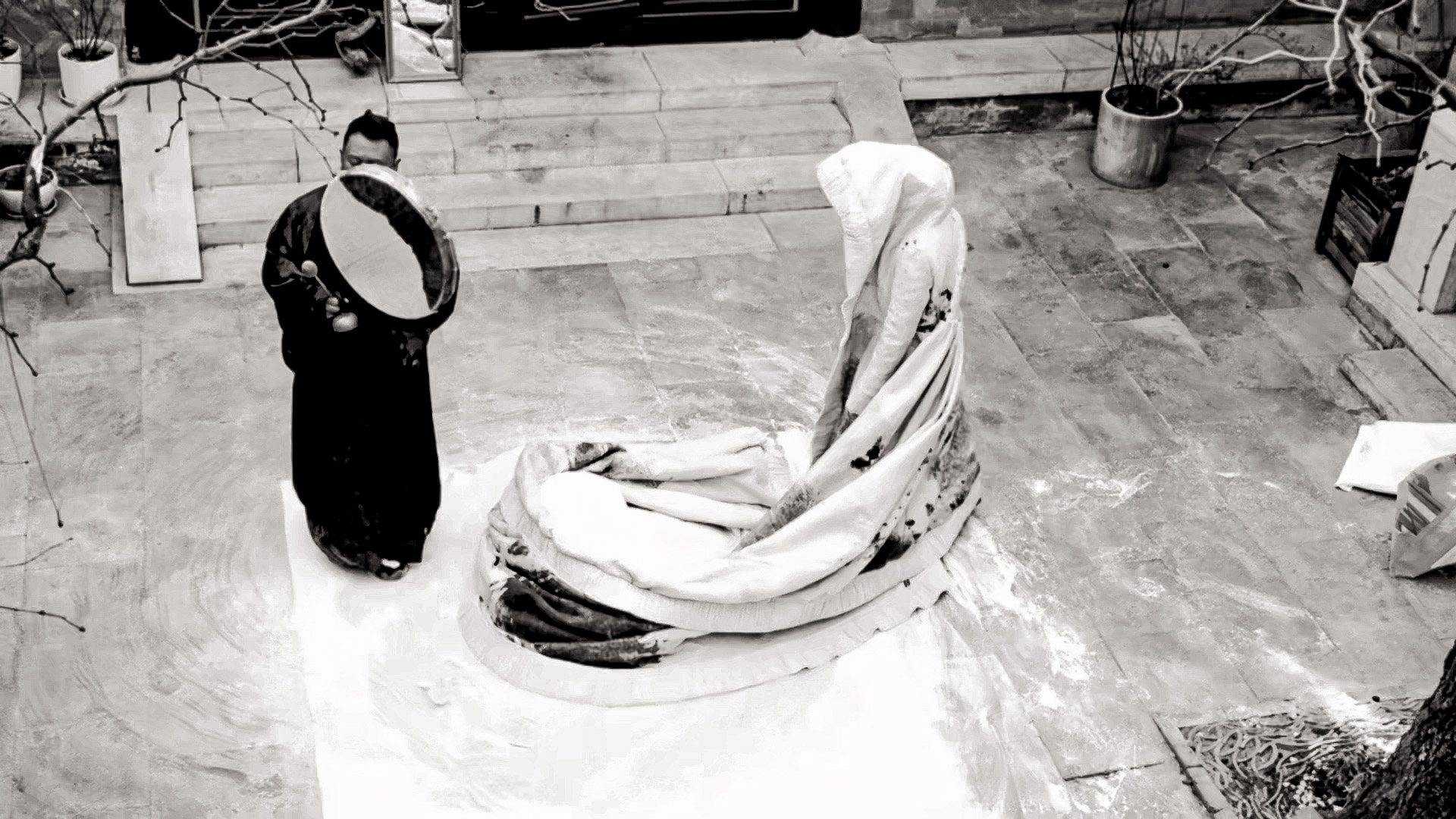
To coincide with the exhibition, on October 10 at 2 p.m. and 3 p.m., the Beijing-based artist Bingyi will be premiering a site-specific performance work in the Morgan’s garden (free with museum admission), made possible in part by the Foundation for Spirituality and the Arts. Titled Heaven and Earth: The Garden of Cosmos, the processional performance is “inspired by Psalm 104 and its reverence for creation, divine order, and cosmic harmony that transcend cultural boundaries.” Drawing on her longstanding engagement with both Abrahamic scriptures and Chinese philosophical traditions, Bingyi will be clad in a flowing, ink-painted garment and be joined by the Tibetan ritual master Nanmei and the Yi singer Aluo.
Rehearsal for Heaven and Earth: The Garden of the Cosmos by Bingyi, to premiere October 10, 2025, at the Morgan Library and Museum in New York City
+++
ONLINE FILM SEMINAR:Dreaming the World: Looking at the World through the Eyes of the Other with Gareth Higgins, September 30–November 11, 2025: “We live in anxious times, with our vision often limited to suspicion of others, concern about the future, and withdrawing into enclaves of the familiar. It can become a self-fulling prophecy, a vicious cycle which does not nurture the security, never mind the happiness we seek. It’s becoming clearer by the day that we need to be dislodged from the narrow circles of self-oriented, tribal thinking. There is a more expansive universe, characterized by connection, sharing, and taking responsibility for co-creating the next good day.”
Sponsored by Image journal and The Porch, Dreaming the World is a seven-week course in which participants will watch seven movies—one from each continent—and learn a more global way of thinking. Leader Gareth Higgins [previously] will share a short video introduction and written essay for each film, and registrants are invited to join a members’ Facebook page for conversation, as well as a weekly video call to discuss the movie and its implications for how we might live better. Those video calls will take place on Tuesdays from 7:00 to 8:15 p.m. ET on September 30, October 7, October 14, October 21, October 28, November 4, and November 11, 2025, but will also be recorded for asynchronous viewing.
The seminar is valued at $195, but the organizer is generously allowing registrants to pay what they can. I will be participating. Join me?
+++
CALLS FOR PAPERS:
>> From the Association of Scholars of Christianity in the History of Art:“‘And Who is My Neighbor?’: Refuge, Sanctuary, and Representation”: “The parable of the Good Samaritan (Luke 10:25–37) endures as a powerful meditation on compassion, hospitality, and the boundaries of moral responsibility. In an age marked by geopolitical instability, mass displacement, and deepening social divides, the question ‘And who is my neighbor?’ acquires renewed urgency. We welcome proposals that consider the ways in which visual culture has interpreted, challenged, or reimagined the ideals of refuge and hospitality within religious and intercultural frameworks. How have artistic practices responded to religious calls to welcome the stranger? In what ways do images negotiate the tensions between inclusion and exclusion, faith and politics, identity and alterity? How do modern and contemporary artworks embody, resist, or reinterpret Christian and other religious conceptions of community, care, and obligation? Proposals that engage Catholic visual cultures or interpretive frameworks, perspectives from the Global South, or comparative interreligious approaches are especially encouraged.” To be presented February 17, 2026, at ASCHA’s day-long symposium at DePaul University Chicago, or February 18–21 2026, at the 114th annual CAA Conference. Proposal submission deadline: October 15, 2025.
>>From theRaclin Murphy Museum of Art at the University of Notre Dame: “The Art of Encounter: Exploring Spiritual Engagement with Art Objects”: This museum is seeking papers exploring the relationship between art, spirituality, and museum spaces, to be presented April 24, 2026, at the museum’s spring symposium. Proposals that investigate how encounters with art can shape spiritual understanding, foster theological insight, or deepen contemplative practice are all welcome. Proposal submission deadline: November 3, 2025.
+++
SONGS:
September 15 through October 15 is Hispanic Heritage Month. One of the many ways Latinos have contributed to Christian artistic culture has been through the writing and singing of coritos: short, rhythmic, Spanish-language choruses used in worship. Here are two examples, the first one traditional and the second one new.
>> “Montaña” (Mountain), led by Josue Avila: Recorded live on November 29, 2020, from Calvary Orlando’s Unity Sunday Service, this corito is based on Matthew 17:20. The lyrics translate to: “If you have faith like a mustard seed, thus says the Lord: you can tell the mountain, ‘Move, move,’ and that mountain will move!”
>> “Sal 22 / Te Amo” (Psalm 22 / I Love You) by Israel and New Breed with Aaron Moses: These two coritos, which released this summer as a single track, were written by Israel Houghton, Meleasa Houghton, Ricardo Sanchez, Aaron Lindsey, Rene Sotomayor, and Aaron Moses. The first is based on Psalm 22:3, which says that God is enthroned on the praises of his people, and is sung by Moses on lead; Houghton sings lead on the second.
Aaron Moses, of Dominican and Ecuadorian descent, is best known for his work with Maverick City Música.
Israel Houghton is not himself Latino (his mother is white, his biological father Black), but he was significantly influenced by his upbringing in a Hispanic neighborhood and church, a culture reflected in his musical output and that he remains connected to, not least through his wife, Adrienne Bailon (whom I know from The Cheetah Girls!).
+++
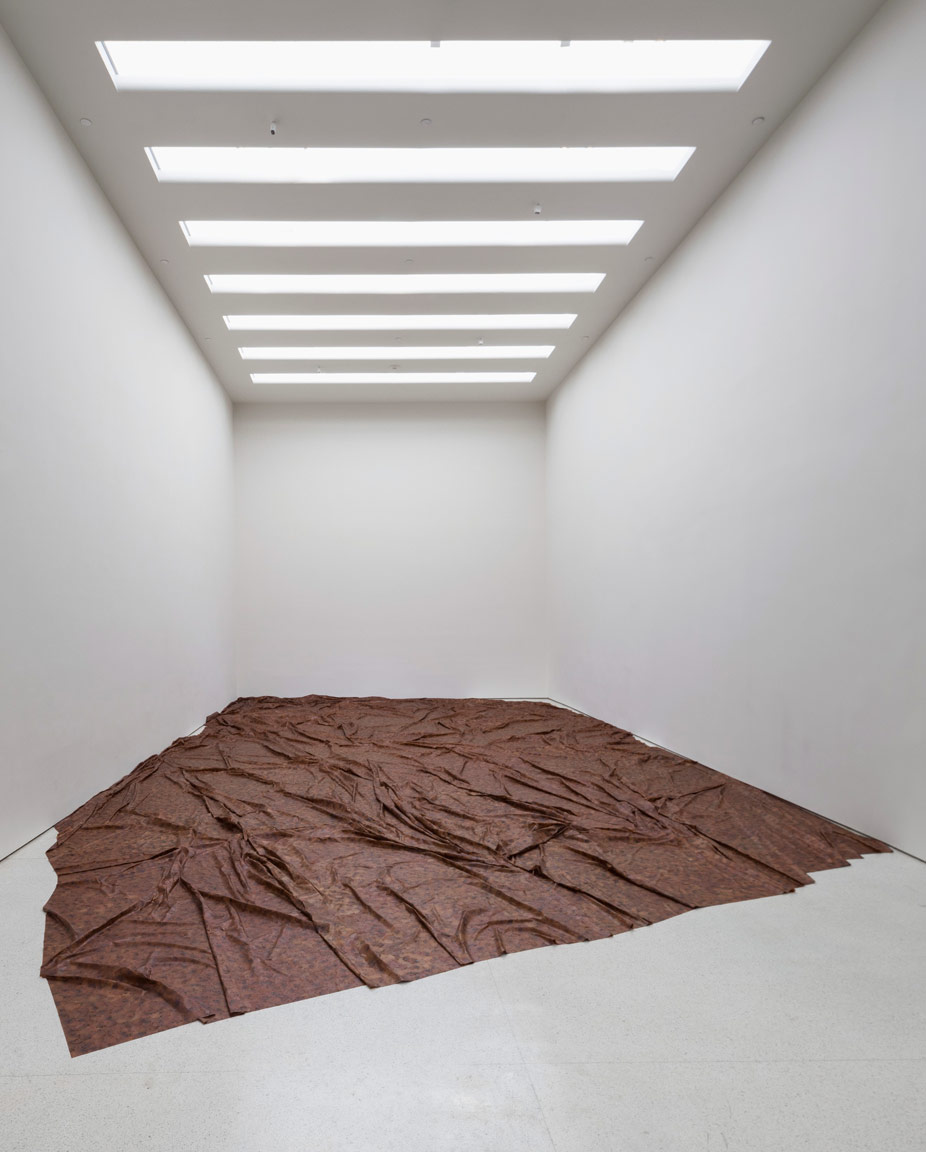
VIDEO: “In the Studio: Doris Salcedo making ‘A Flor de Piel’”: Produced by White Cube, this fourteen-minute documentary charts the collaborative, scientifically informed, labor-intensive process of making Doris Salcedo’s A Flor de Piel, an enormous shroud made of real rose petals as a memorial for a nurse who was brutally captured and murdered in Colombia. (“The title,” explains Lauren Hinkson, “is a Spanish idiomatic expression used to describe an overt display of emotions.”) The film includes footage from Salcedo’s Bogotá studio as well as interviews with the team of people who produced the work. I found this peek into the technical aspects of the piece fascinating.
However, the video doesn’t venture into the inspiration behind or meaning of the work. For a bit of that, see this audio clip from the Guggenheim (where A Flor de Piel was exhibited in 2015), and also Jonathan A. Anderson, The Invisibility of Religion in Contemporary Art, pages 123–24.
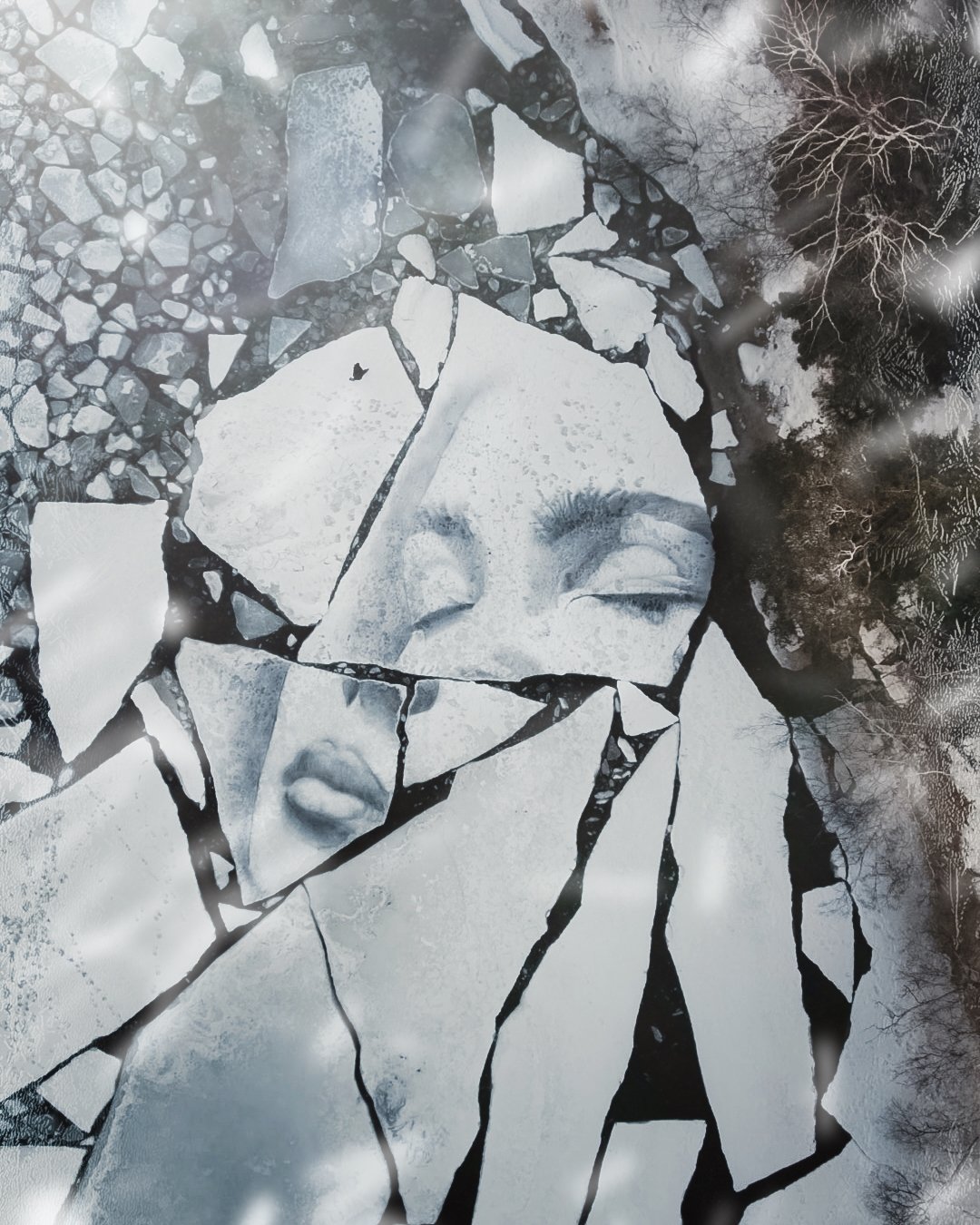
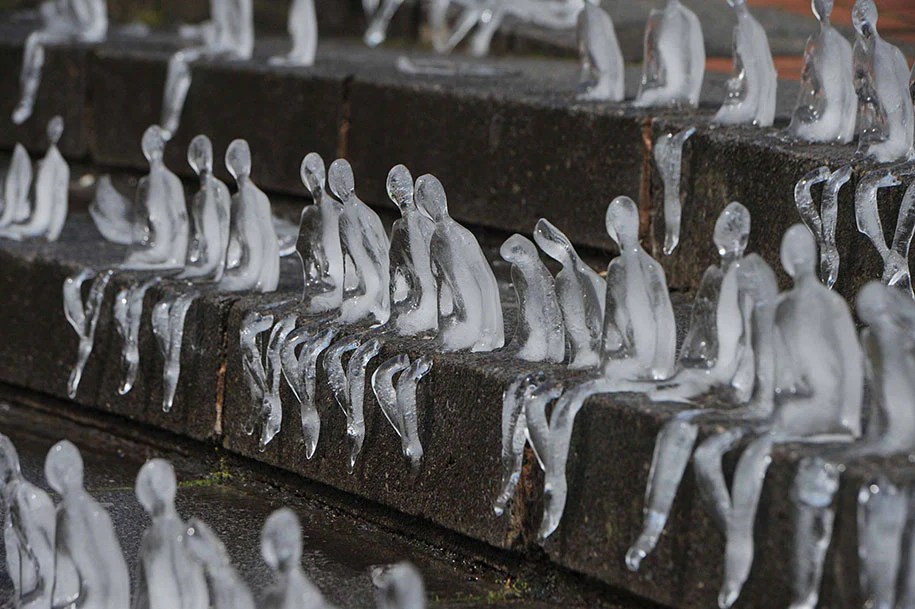
ART PROJECT: Fractured by David Popa: “Fractured is a project located on various ice floes in southern Finland. By use of only earth, charcoal and the source water, a series of portraits were created on fractured ice floes that remained for only a brief time. The pieces were documented via aerial drone video, photography and photogrammetry and hold a tactile form as limited-edition prints as well as in digital form through 1/1 NFTs. The project evolved as a response to the ongoing conflict in Ukraine, which has only further highlighted the fractured state of the world in which we live. During the project, the ice fractured completely unexpectedly at unpredictable times, leaving the artist at odds as to whether continuing the work was even worthwhile. From the ground, one would never be able to decipher any silver linings within the chaos; however, from above, the fragments hold a harmony and beauty that is imperceptible from any other perspective. The work offers a means to point the viewer not to despair and chaos, but rather questions where we must look to mend the broken fragments of our lived reality and perhaps how the fragments can be used to create an entirely new mosaic from the scattered vestiges.”
David Popa (American, 1997–), from the Fractured series, 2023. Iron oxide black earth pigment and charcoal on floating ice.
Explore more of the artist’s work at www.davidpopaart.com. For a printed interview with Popa (featuring many of his amazing photos of his amazing land art), see www.yatzer.com/david-popa.
+++
POEMS: Seven Reimagined Psalms from the Darkling Psalter by Andy Patton:The Darkling Psalter is a project by Andy Patton (MA, Trinity Evangelical Divinity School) to write new creative renditions of the Bible’s 150 psalms. The Rabbit Room recently featured seven of these: Psalms 5, 10, 12, 14, 25, 27, 30.
+++
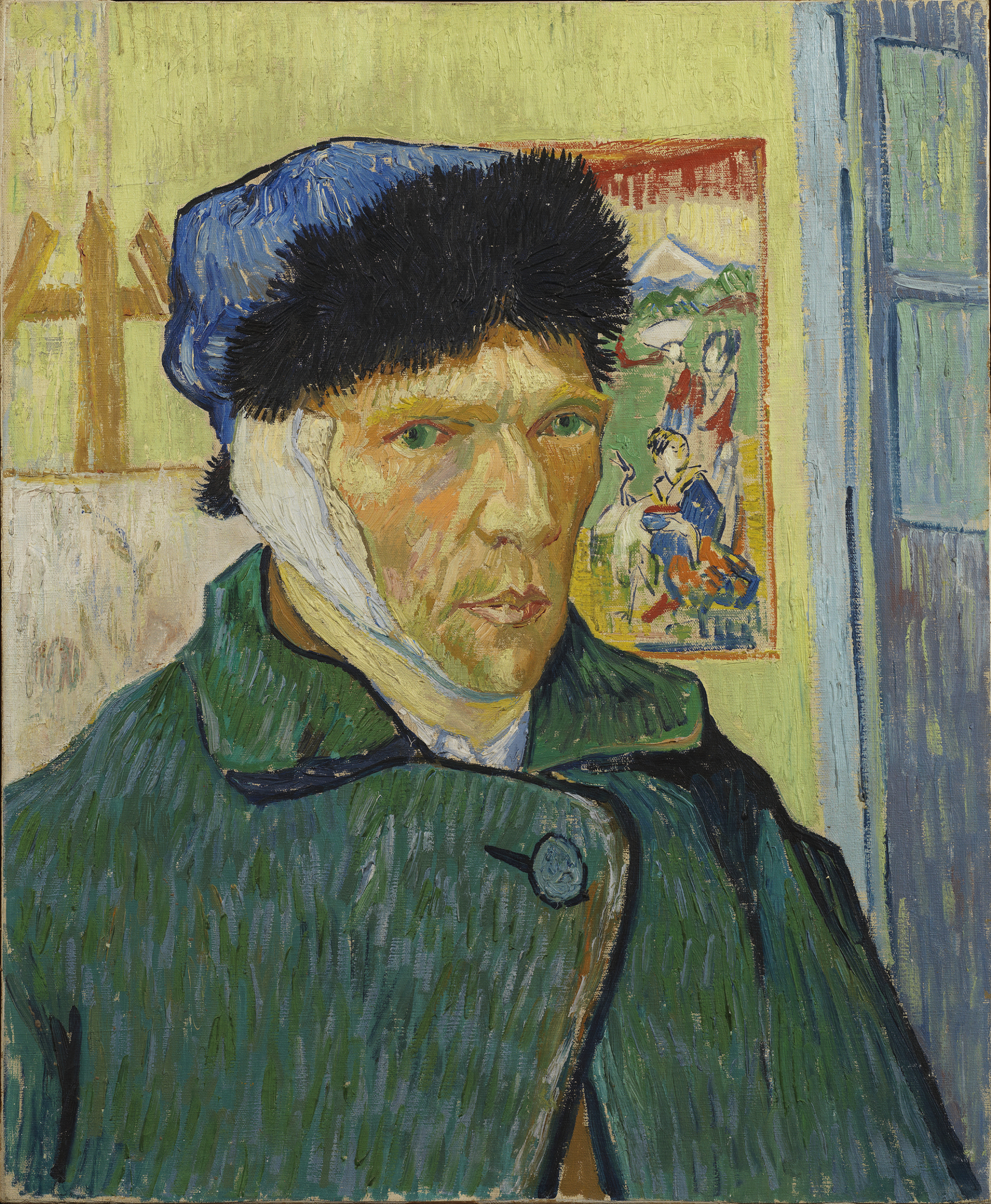
PODCAST INTERVIEW: “Van Gogh Has a Broken Heart, with Russ Ramsey,”Makers & Mystics: I appreciated this recent conversation in which pastor, writer, and arts enthusiast Russ Ramsey discusses his latest book, exploring the struggles and sorrows of a handful of historical artists and how they are reflected in their art.
Vincent van Gogh (Dutch, 1853–1890), Self-Portrait with Bandaged Ear, 1889. Oil on canvas, 60 × 49 cm. Courtauld Gallery, London.
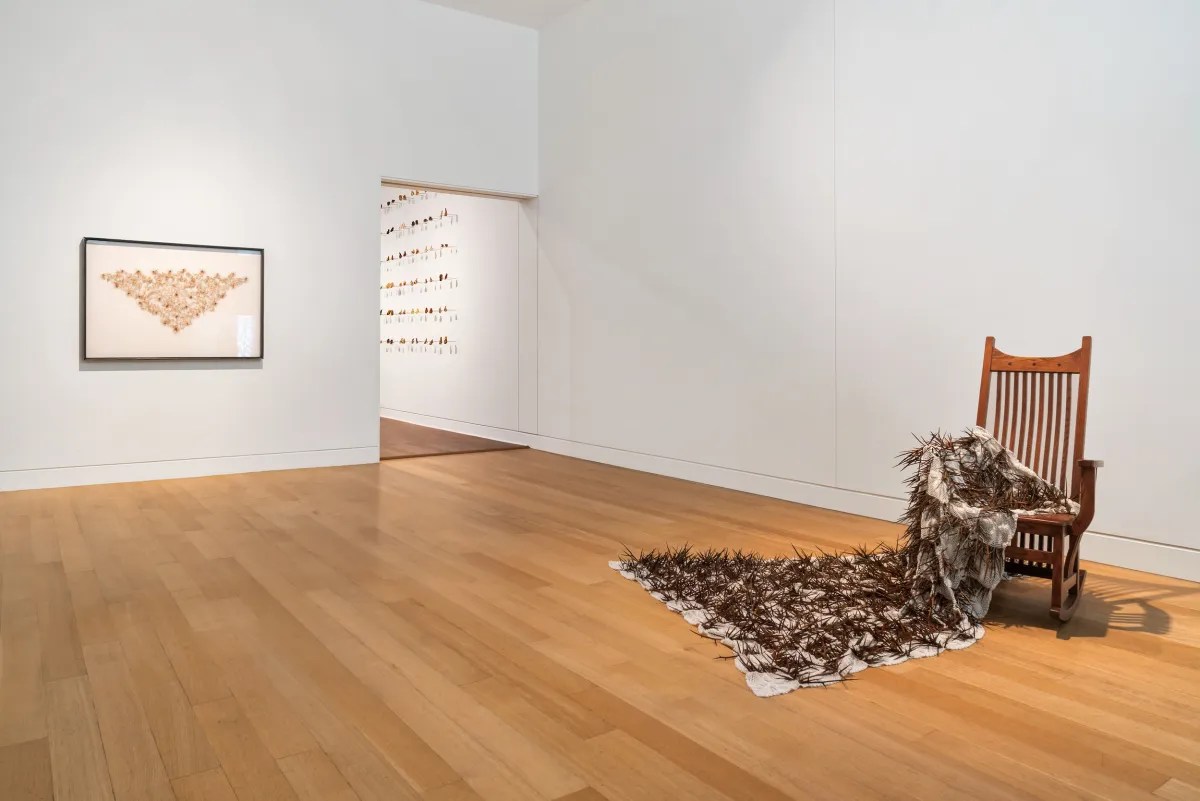
EXHIBITION REVIEW: “Selva Aparicio’s Memorials to Loss and Renewal” by Lori Waxman, Hyperallergic: Mounted last year by the DePaul Art Museum in Chicago, the first solo show of the Barcelona-born artist Selva Aparicio featured works that “offer a merciful focal point for grief.” Aparicio, Waxman writes, “treats unwanted things with extreme sensitivity, personally gathering and storing them over many years, eventually renewing them with remarkable vision.” She reproduced the twice-destroyed rose window of the Basilica de Santa Maria del Pi using lettuce leaves discarded by her neighborhood market; she filled the interior of an upright piano with wasp nests; she constructed over two dozen pairs of decorative ears out of moss, shells, seed pods, animal hair, and other materials for her late cat, Momo, whose ears were removed due to illness; using strands of hair from herself, her mother, and her niece, she sewed a mourning veil, the kind traditionally worn by widows, out of 1,365 cicada wings.
Exhibition view: Selva Aparicio: In Memory Of, DePaul Art Museum, Chicago, 2024. Left: Velo de luto (Mourning Veil) (2020), formed from 1,365 Magicicada wings; right: Solace (2023–24), crochet cotton blanket woven through with honey locust thorns.
I didn’t get to see this exhibition in person, but I’m compelled by what I saw and read of it online—how it deals so tenderly with suffering, death, remembrance, and hope.
+++
SONGS:
>> “Parce mihi Domine” (Spare Me, O Lord): A musical setting of the Latin translation of Job 7:16b–21, this motet by the Spanish Renaissance composer Cristòbal de Morales “captures the sense of desolation and abandonment that is expressed by Job, a dark condition akin to the forsakenness that our Lord experienced on the cross,” writes church music director Ken Myers. In 1994 the Hilliard Ensemble recorded the piece in collaboration with the Norwegian saxophonist Jan Garbarek for their album Officium, a jazz-classical fusion that became one of ECM’s most successful releases, selling over 1.5 million copies.
The video below features a different set of musicians paying tribute to this “unexpected . . . alliance of austere vocal music and wandering saxophone” (Elodie Olson-Coons). Filmed December 18, 2015, at the Chiesa di Sant’Anna (Church of St. Anne) in Cagliari, Italy, the performance is by the vocal ensemble Cantar Lontano (under the direction of Marco Mencoboni) and saxophonist Gavino Murgia. [HT: Global Christian Worship]
After losing his health, wealth, and children, the Old Testament character Job laments openly before God. “I will not restrain my mouth,” he says. “I will speak in the anguish of my spirit; I will complain in the bitterness of my soul” (Job 7:11). He views God as his tormentor and begs God to leave him alone (“spare me”). Adopting Job’s voice, the four singers of the Morales piece sing the following biblical passage:
Parce mihi Domine, nihil enim sunt dies mei. Quid est homo, quia magnificas eum? Aut quid apponis erga eum cor tuum? Visitas cum diluculo, et subito probas illum. Usquequo non parcis michi, nec dimittas me, ut glutiam salivam meam? Peccavi. Quid faciam tibi, o custos hominum? Quare posuisti me contrarium tibi, et factus sum michimet ipsi gravis? Cur non tollis peccatum meum, et quare non aufers iniquitatem meam? Ecce nunc in pulvere dormio; et si mane me quesieris, non subsistam.
English translation (NRSVUE):
Let me alone, for my days are a breath. What are humans, that you make so much of them, that you set your mind on them, visit them every morning, test them every moment? Will you not look away from me for a while, let me alone until I swallow my spittle? If I sin, what do I do to you, you watcher of humanity? Why have you made me your target? Why have I become a burden to you? Why do you not pardon my transgression and take away my iniquity? For now I shall lie in the earth; you will seek me, but I shall not be.
>> “Lamb of God” by The Many: From the EP Have Mercy (2021) by The Many [previously], “an uncommon, intentionally diverse collective making music for people to sing together about peace and justice and a world where all belong.” This song is an adaptation of the ancient Christian liturgical prayer known as the Agnus Dei. The music is by Gary Rand, and the lyrics are by Gary Rand and his daughter, Lenora Rand. Click here to purchase an individual MP3 recording or sheet music, or visit the group’s Bandcamp page.
Lamb of God, with love poured out you suffer with the world. Have mercy. Have mercy. Lamb of God who suffers with the world, grant us peace, grant us peace.
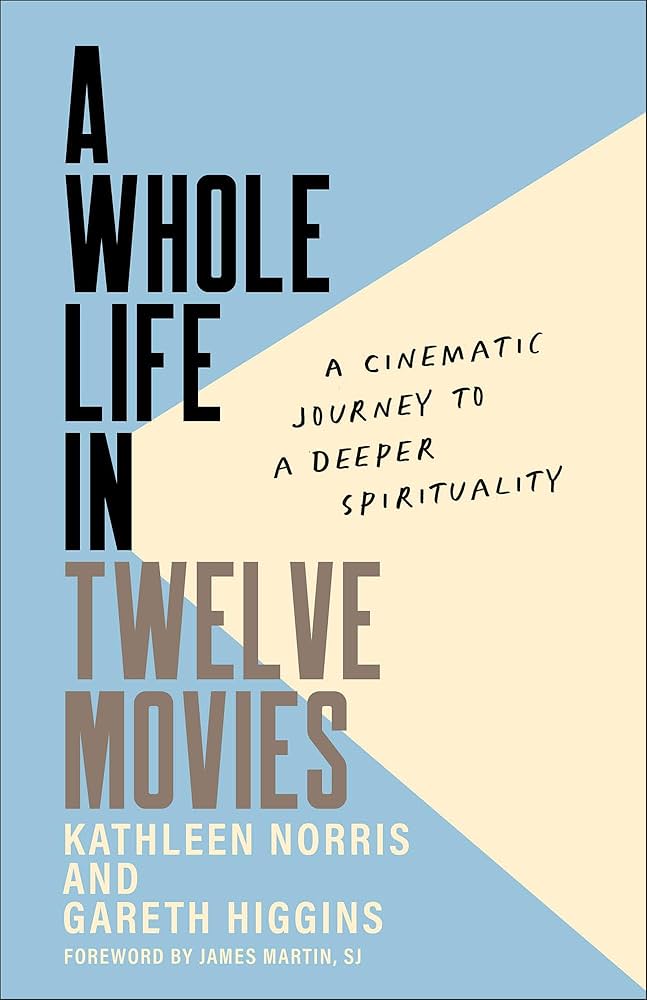
NEW BOOK: A Whole Life in Twelve Movies: A Cinematic Journey to a Deeper Spirituality by Kathleen Norris and Gareth Higgins: Published last October by Brazos Press, this excellent book comprises twelve chapters reflecting on fourteen movies (two chapters feature a complementary pair), drawing out story, insights, and meaning. It’s authored by the award-winning American spiritual memoirist and poet Kathleen Norris (Acedia and Me; The Cloister Walk; Dakota: A Spiritual Geography) and the Irish writer, peace activist, retreat leader, and festival organizer Gareth Higgins. Each chapter contains two mini-essays—one by each author, the second responding to the first, sometimes disagreeing on points—and a section of “Questions and Conversation,” which make the book especially fitting for a film/reading club. There’s also a “For Further Viewing” section in the back, with many more recommendations, several of which are new to me and which I’ve been watching (e.g., Le Havre, Love Is Strange, Patti Cake$) and really enjoying!
I so appreciate the variety of films featured in the book—which come from different eras, cultures, and genres and address different themes—and I like that the writers don’t overdetermine the films’ meanings to try to make them fit a Christian agenda, which is sometimes a trap that people writing on Christianity and film fall into (influenced partly, I’m sure, by publishers’ demands, to make the marketing easier). Norris and Higgins are simply two Christians writing about their shared love of cinema, and I had so much fun listening in on their conversations.
You may also want to check out the Substack that Norris and Higgins write together, Soul Telegram: Movies & Meaning, whose purpose is “to help people find the most life-giving movies, and to write about them as a way of reflecting on the meaning of our lives.” See also the recent Habit podcast episode “Kathleen Norris watches movies,” where Norris discusses Paterson, Babette’s Feast, After Life, and more.
>> “Sawubona”(I See You) by Jane Ramseyer Miller, 2012: The most common greeting used by Zulu people is “Sawubona,” literally meaning “I see you,” with the implication of “My whole attention is with you. I value you.” The word conveys a deep witnessing and presence, acknowledgment and connection. A standard reply is “Ngikhona,” “I am here.” This humanity-honoring exchange that occurs regularly in South Africa was set to music by the American choral director Jane Ramseyer Miller and is performed in the video below by the Justice Choir, a grassroots movement that encourages more community singing for social and environmental justice.
The song is authorized for free noncommercial use, and sheet music is available from the Justice Choir Songbook.
In this recent podcast interview, he talks about his most amazing teaching experience to date; helping Protestants like himself recover a sacramental ontology of the world; asking questions verbally versus aesthetically; death and mortality; what conceptual art is, and why it’s “real art”; what the esteemed Roger Scruton got wrong in his documentary Why Beauty Matters; the “Art of Attention” study he conducted with a psychophysiology colleague in the modern wing of the Art Institute of Chicago (which I participated in! here’s one of the three pieces I was tasked with looking at for five straight minutes while hooked up to a heart-rate monitor); and why artists inspire him.
VIDEO INTERVIEW: “VCS Creative Conversations: Ben Quash with Steve Reich”: “This film continues our series of ‘Creative Conversations’. In these conversations, living artists working in a variety of different artistic media discuss how the Bible and its legacies of visual and theological interpretation operate as a vital resource for their own creativity. In this film, VCS [Visual Commentary on Scripture] Director Ben Quash interviews the legendary American contemporary composer Steve Reich. They discuss the profound role of the Bible in transforming both the subject matter and the style of Reich’s music, reflecting especially on his settings of the Abraham story, the episode of Jacob’s ladder, and texts from the Psalms.”
SUBSTACK POST: “Read something medieval this year” by Grace Hamman: One of the most frequently asked questions that medievalist Grace Hamman receives is: “What books should I read from the past?” She gives recommendations for the following six scenarios (including specific translations/editions!).
I have never read anything medieval before! Where do I start?
I have not read any medieval literature, but I did read Confessions in college. How about something a little later, a little more “medieval”?
I want to read some medieval theology.
I’ve read Bernard. Give me a theology deep cut!
No thanks on the monastic theology. Give me poetry! Give me drama and beauty and weirdness!
I’m a stubborn cuss / good millennial hipster / professional troublemaker. I want to read what no one else is reading casually. Make it super hard and dialectical and confusing (but awesome).
+++
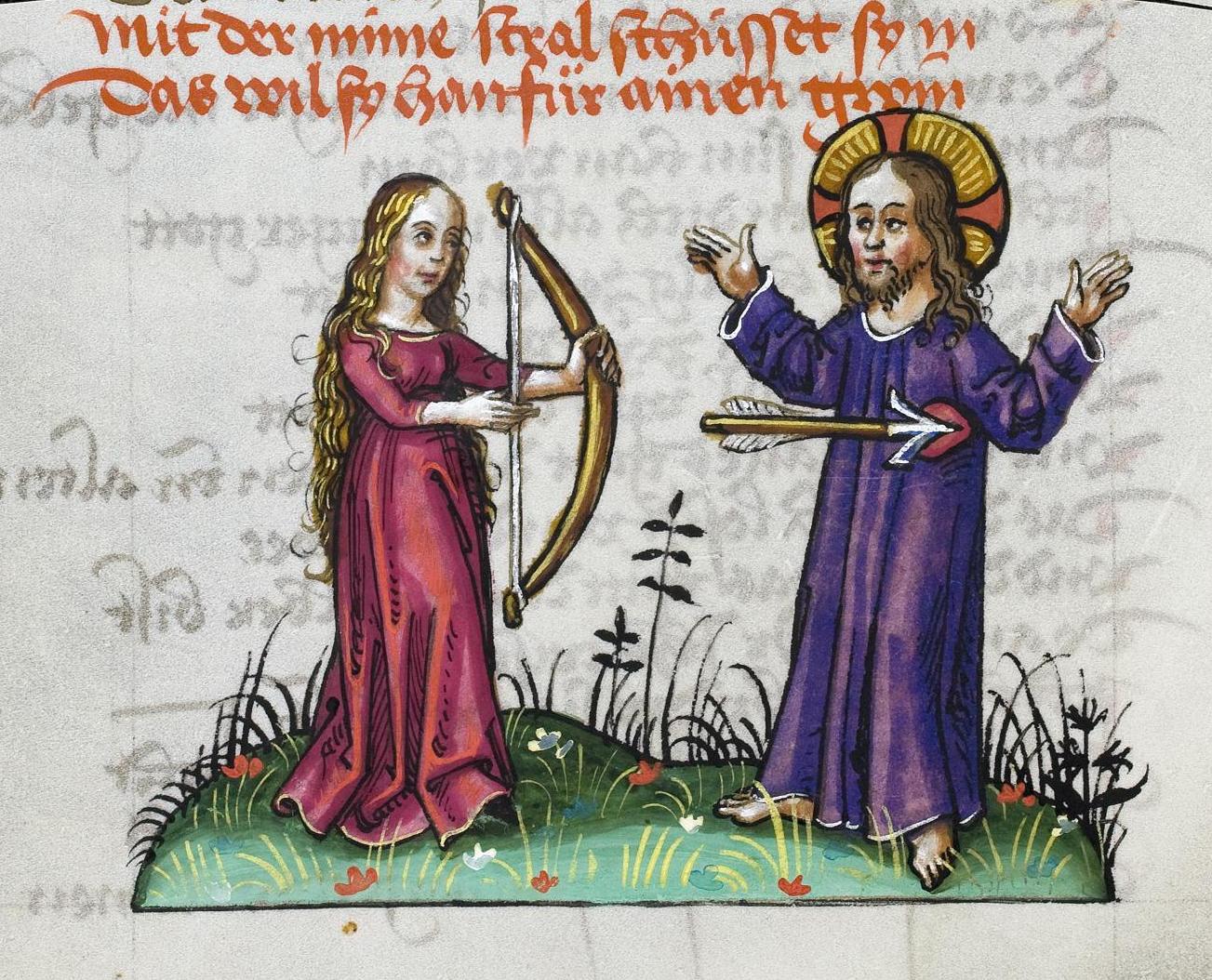
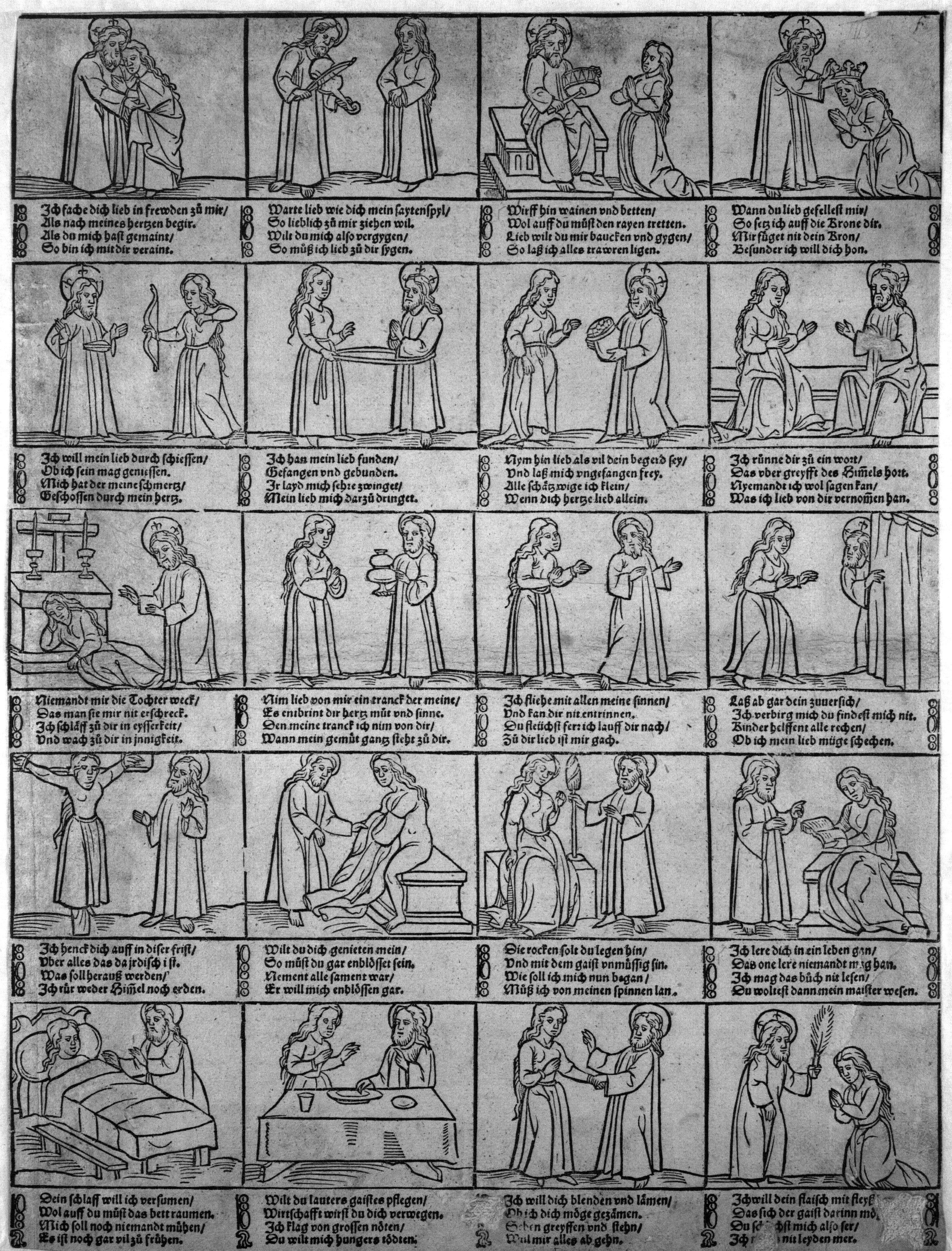
LECTURE: “Christ Our Lover: Medieval Art and Poetry of Jesus the Bridegroom” by Grace Hamman: Last fall I had the pleasure of inviting Dr. Grace Hamman (see previous roundup item) to my neck of the woods to speak for the Eliot Society, a Maryland nonprofit I serve on the board of. She gave this wonderful lecture on one of the popular medieval metaphors for Christ in theology and the arts, which was Jesus as bridegroom, or lover. For medieval people, “the union between God and the human soul was . . . a marriage made in mutual desire, joy, and even mutual submission,” she says. Hamman explores a few different pieces belonging to this tradition, including the fourteenth-century poem “Quia Amore Langueo” (Because I Languish for Love) and the fascinating fifteenth-century verse and image sequence Christus und die minnende Seele (Christ and the Loving Soul).
Illustration by Rudolf Stahel (ca. 1448–1528) from a copy of Christus und die minnende Seele, Constance, Germany, ca. 1495. Karlsruhe, Badische Landesbibliothek, Cod. Donaueschingen 106, fol. 26v. Amber L. Griffioen provides this caption: “The Soul takes up her bow, draws her minne stral (or ‘arrow of love’), and goes on the hunt. She shoots and wounds Christ in the side, capturing him as her prize in order to ‘enjoy him’ forever.”Christus und die minnende Seele, from the printing house of Matthäus Franck in Augsburg, Germany, 1559–68. Woodcut, 35.5 × 27 cm. Munich, Bayerische Staatsbibliothek, Einblatt III, 52f.
+++
SONGS:
Inspired by Hamman’s talk, I’d like to turn your attention to the following two songs: one Jewish, the other Christian.
>> “Et Dodim Kala (Time for Lovers)”: The Hebrew text of this song, drawn from the biblical book the Song of Songs, is traditional Jewish (the video attributes it to Rabbi Haim Ben Sahl of the tenth century), and the music is a traditional gnawa melody (gnawa is a genre of Moroccan religious music marked by repetition). The performance is led by Lala Tamar on vocals and guembri (three-stringed bass plucked lute), and she’s joined by Ella Greenbaum and Imanouelle Harel on background vocals and krakebs (hand cymbals) and Tal Avraham on trumpet.
Tamar is an Israeli musician of Moroccan and Brazilian descent who performs Moroccan Jewish liturgical poems as well as contemporary music in Moroccan Arabic and Ladino.
Turn on closed captioning (CC) in the above video for the lyrics and their English translation, which is basically, “A time for lovers, my bride: / The vine has blossomed, / The pomegranates have budded.” The song is also available on Spotify.
>> “The Heavenly Courtier”: The anonymous words of this hymn were first published in 1694, and the tune is from The Christian Harmony (1805), a shape-note hymnal compiled by Jeremiah Ingalls. The song speaks of “Christ the glorious lover” who comes to earth “to woo himself a bride, resolving for to win her.” At first she’s resistant to his romantic entreaties, preferring instead the company of other lovers. But when she sees him for who he truly is—receives “one glimpse of [his] love and power”—she is overcome with ecstasy and accepts his proposal. The song ends with a wedding feast and mutual embrace. Read the full lyrics here, and listen to the Boston Camerata, directed by Joel Cohen, perform the piece on their album An American Christmas (1993); the vocalist is Joel Frederiksen.
I wouldn’t commend this hymn for a worship service, at least not without adaptation: while I’m on board with most of it, its Christ is in parts coercive, threatening violence, and there’s an overemphasis on the bride’s wretchedness and shame, with Christ the wooer breaking her down by revealing how “filthy” and unworthy she is. The Boston Camerata removes two of the more problematic verses, but I still think further tweaking needs to be done, more nuancing around the doctrines of sin and salvation (literarily, of course, preserving the extended metaphor!), to faithfully communicate the gospel through this song.
Regardless, I find it interesting as an artifact of early American Christian worship (it was sung congregationally in New England) and as an elaboration of the biblical picture of Christ the Bridegroom, not to mention poetically and musically charming. As I gathered from Grace Hamman’s lecture posted above, we can still appreciate creative works from the past and be moved or instructed by aspects of them without embracing them wholesale. It’s important for us Christians to be able to step outside our own cultural, historical, and denominational contexts with humble curiosity.
+++
2025 CALVIN SYMPOSIUM ON WORSHIP:
Calvin University’s annual Symposium on Worship was held last week. I wasn’t able to go this year, but I enjoyed tuning in virtually to the services that were livestreamed, now archived on the “Live” tab of the Calvin Institute of Christian Worship YouTube page. Here are two examples.
>> “Vesper: I Will Lift Mine Eyes,” led by Kate Williams and Tony Alonso: “Inspired by ancient and modern contemplative texts, this Vespers service is an invitation to come into the quiet and discover the eternal beauty of God’s consoling presence.” View the song credits in the YouTube video description.
>> “Worship Service: The Rich Man and Lazarus”: The Calvin University Gospel Choir, under the direction of Nate Glasper and with some songs guest-conducted by Raymond Wise, leads the musical portion of this service, and Rev. Dr. Dennis R. Edwards preaches on Luke 16:19–31, Jesus’s parable of the rich man and Lazarus. I especially enjoyed Wise’s original gospel song “Make a Joyful Noise” at 16:30, based on Psalm 100:1, and, also new to me, “Poor Man Lazarus” at 36:46, a traditional African American spiritual arranged by Jester Hairston. See additional song credits in the YouTube video description.
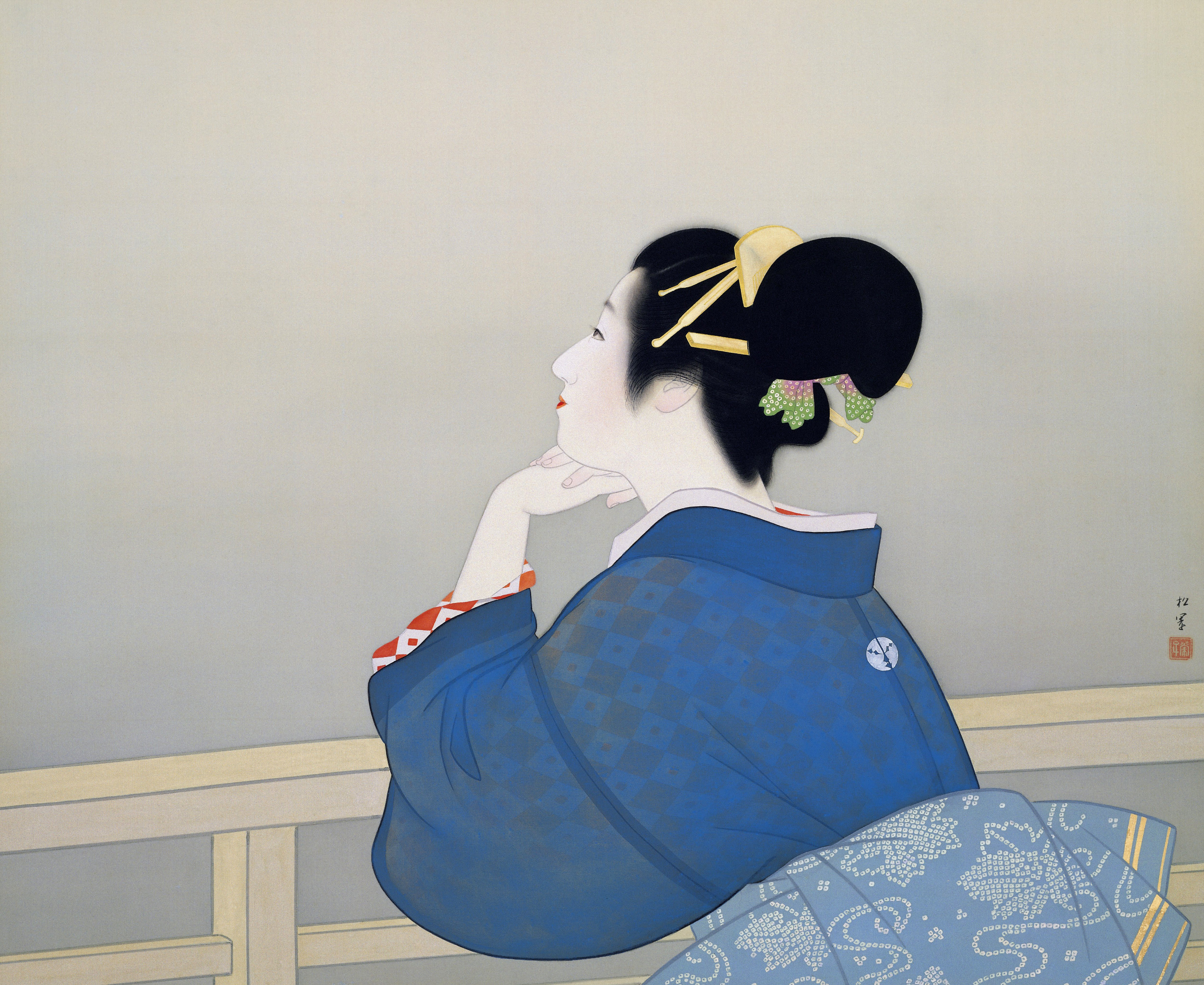
LOOK: Woman Waiting for the Moon to Rise by Uemura Shōen
Uemura Shōen (Japanese, 1875–1949), Woman Waiting for the Moon to Rise, 1944. Nihonga watercolor on silk, 73 × 86 cm. Adachi Museum of Art, Yasugi, Japan.
Uemura Shōen, the pseudonym of Uemura Tsune (1875–1949), was a Japanese artist active in the first half of the twentieth century, known primarily for her bijin-ga paintings of beautiful women in the nihonga style. A mold-breaking artist of exceptional skill, “she won international awards and accolades, defied social norms as a single mother of two, and dived into the world of professional painting at a time when women weren’t welcome.” In 1948 she became the first woman to be awarded Japan’s prestigious Order of Culture.
Uemura painted Woman Waiting for the Moon to Rise during World War II, showing a young woman leaning against a bridge railing on a foggy evening, her chin resting on her folded hands and her face looking ahead wistfully. Though the title tells us she’s waiting for the moon to rise, perhaps she’s also waiting for the war to end, for peace to be restored.
LISTEN: “Wait for the Lord” by Jacques Berthier of the Taizé Community, on Alleluia (1988)
Wait for the Lord, whose day is near. Wait for the Lord: be strong, take heart!
The text of this simple chant comes mainly from Psalm 27:14: “Wait for the LORD; be strong, and let your heart take courage; wait for the LORD!” The chant was written as a responsorial refrain to the reading of another psalm, Psalm 37. As the hymnal Lift Up Your Hearts (2013) instructs congregations: sing the Taizé refrain; read Psalm 37:1–5, sing; read Psalm 37:6–9, sing; read Psalm 37:10–11, 39–40, sing. Like this:
Wait for the Lord, whose day is near. Wait for the Lord: be strong, take heart!
Do not fret because of the wicked; do not be envious of wrongdoers, for they will soon fade like the grass, and wither like the green herb.
Trust in the LORD, and do good; so you will live in the land, and enjoy security. Take delight in the LORD, and he will give you the desires of your heart.
Commit your way to the LORD; trust in him, and he will act.
Wait for the Lord, whose day is near. Wait for the Lord: be strong, take heart!
He will make your vindication shine like the light, and the justice of your cause like the noonday.
Be still before the LORD, and wait patiently for him; do not fret over those who prosper in their way, over those who carry out evil devices.
Refrain from anger, and forsake wrath. Do not fret—it leads only to evil. For the wicked shall be cut off, but those who wait for the LORD shall inherit the land.
Wait for the Lord, whose day is near. Wait for the Lord: be strong, take heart!
Yet a little while, and the wicked will be no more; though you look diligently for their place, they will not be there. But the meek shall inherit the land, and delight themselves in abundant prosperity.
The salvation of the righteous is from the LORD; he is their refuge in the time of trouble. The LORD helps them and rescues them; he rescues them from the wicked, and saves them, because they take refuge in him.
Wait for the Lord, whose day is near. Wait for the Lord: be strong, take heart!
Psalm 37 encourages trust and patience in God, who will one day vindicate the righteous and put wickedness to bed.
In February I shared a few of the Vespers services offered at this year’s Calvin Symposium on Worship at Calvin University in Grand Rapids, Michigan, which I was privileged to attend. Here are two of the full-fledged services that give you a sense of what the larger corporate gatherings are like. (The theme was Ezekiel.) I love the cross-cultural sharing that goes on, learning new songs alongside others, getting refreshed by prayer and formed by liturgy, sitting under the teaching of wise ministers of God from various backgrounds, and taking Communion with friends new and old.
>> “God’s Glory Departs from Israel,” February 8, 2024 (with bilingual Korean-English music and liturgy): This worship service was led in Korean and English by the Woodlawn Christian Reformed Church Choir, directed by Chan Gyu Jang; the Living Water Church Worship Team, directed by Yohan Lee; and members of the Calvin University and Calvin Theological Seminary Korean communities. Rev. Dr. Anne Zaki from Evangelical Presbyterian Seminary in Cairo, Egypt, preached on Ezekiel 10–11.
This is an example of bilingual worship done really well! (I’ve seen it done poorly: with lack of communication of intention, one-sided involvement in the design or execution, inadequate pronunciation coaching for non-native speakers at the mic, unclear instructions that create confusion as to who is supposed to say or sing what, unintelligibility, etc.) I’m so grateful for all the creativity and thoughtfulness that went into creating this service—with a special shout-out to the bulletin designers and livestream technicians.
The bulletin provides this note on bilingual worship:
Two languages are intertwined together in this bilingual service. At times, words are spoken in one language, and their translation—unspoken—is provided on the righthand column; at times, the leaders demonstrate to the congregation how to sing or speak the words through transliteration; and at other times, the leaders and congregation converse in both languages, providing meaning to each other, so that no word sung or spoken is left unintelligible. We seek understanding and order in the sharing of our gifts.
In our pursuit, however, we practice patience and hospitality. In this service, we are called not only to speak and sing, but also to listen, to take turns. By listening, we create a room—a shelter—for travelers and strangers in this land, since language and music have power to transport one’s soul homeward. By taking turns, we practice the pace and posture of dialogue, even monolingual dialogue.
Beautiful! Here are three songs I’ll call out for special attention:
9:14: “Joo-yeo, Come, O Lord” by Sunlac Noh: This song, which is particularly well suited for Advent, originated in the Anglican Church of Korea and was translated into English last year by Martin Tel (see podcast interview below). The version we sang at the symposium preserves two of the Korean titles for Jesus.
23:36: “우리에게향하신” (Woo-ri-e-ge Hyang-ha-shin) (Never-Ending Is God’s Love) by Jin-ho Kim, based on Psalm 117:2: Sung entirely in Korean, this was used as a refrain during the Assurance of Pardon and the Prayers of the People. A simple, repeated line, either sung or spoken, is a good way to involve non-native speakers of a given language.
1:14:37: “주님다시오실때까지 / Rise, My Soul, Till Jesus Comes Again” by Hyeong-won Koh: The closing song is a charge to continue in the way of Jesus, all the way Home. The vocalists on stage sang the song themselves in its original Korean the first time through, and then we all joined in in English for the second time.
All the song credits are provided in full in the YouTube video description.
I want to especially draw your attention to 23:31, where Floyd premieres an extraordinary new song of hers, “God Breathed.” It opens and closes with a flute, and in between are her powerful jazz vocals, singing an original poetic text based on Ezekiel 37, accompanied by James Weidman on piano. (Update: Here’s a standalone video of the song.)
+++
PODCAST EPISODE: “Fighting Back Against the Storms of Life with Martin Tel,”Psalms for the Spirit: Host Kiran Young Wimberly interviews Martin Tel, director of music at Princeton Theological Seminary and senior editor of Psalms for All Seasons: A Complete Psalter for Worship (2012), about the Psalms—the importance of psalm singing in his Dutch Reformed upbringing; the Psalms as a form of resistance and protest; the Psalms as a means of praying our own prayers and those of others; our need to overhear some psalms as being prayed against us (that is, have you considered that you might be someone else’s oppressor?); and ideas for framing a psalm with a refrain, such as these:
Combine the Charles Albert Tindley gospel song “The Storm Is Passing Over” with Psalm 57 (“In the shadow of your wings I will take refuge, until the destroying storms pass by . . .”). Sing into the storm.
Choose a Gospel passage of someone in deep lament (e.g., the ten lepers in Luke 17:11–19), surround it with Psalm 88, and have the congregation sing “Kum Ba Yah” (Gullah for “Come by Here”) in minor mode as a refrain (“Someone’s crying, Lord . . .”). A choir can hum the spiritual while the reader(s) read the scriptures.
Intersperse the verses of Psalm 14 (“Fools say in their heart, ‘There is no God.’ . . . They have all gone astray . . .”) with the refrain “Prone to wander, Lord, I feel it . . .” to help the congregation members see their own foolishness instead of assuming it’s someone else who’s the fool.
+++
ARTICLE: “The Mysteries of Liturgical Sincerity” by John Witvliet, Worship (reprinted Pray Tell), May 2018: Some Protestants accuse the more liturgically inclined Christians, like me, of not valuing sincerity in worship because we value prewritten prayers and other set forms. But just because something is scripted or done habitually does not make it “rote” or “empty.”
“Among my mostly Protestant students, no theme is more contested, misunderstood, or cherished” than sincerity, writes John D. Witvliet, director of the Calvin Institute of Christian Worship and professor of worship, theology, and congregational and ministry studies at Calvin University and Calvin Theological Seminary. In this article he explores several different definitions of sincerity, which vary widely across cultures, centuries, philosophical frameworks, and Christian traditions, and then offers six “corrective lenses” to common astigmatisms in the free-church Protestant way of viewing the world: outside-in sincerity, vicarious sincerity, trait sincerity, symbiotic sincerity, sincerity as gift, and aspirational sincerity.
This article is SO GOOD. I have been greatly influenced over the years by Dr. Witvliet’s teachings on liturgical formation, and I strongly encourage you all to read this piece.
+++
EKPHRASTIC POEMS:
An ekphrastic poem is a poem written in response to a work of visual art. Here are two examples I like from the past two years:
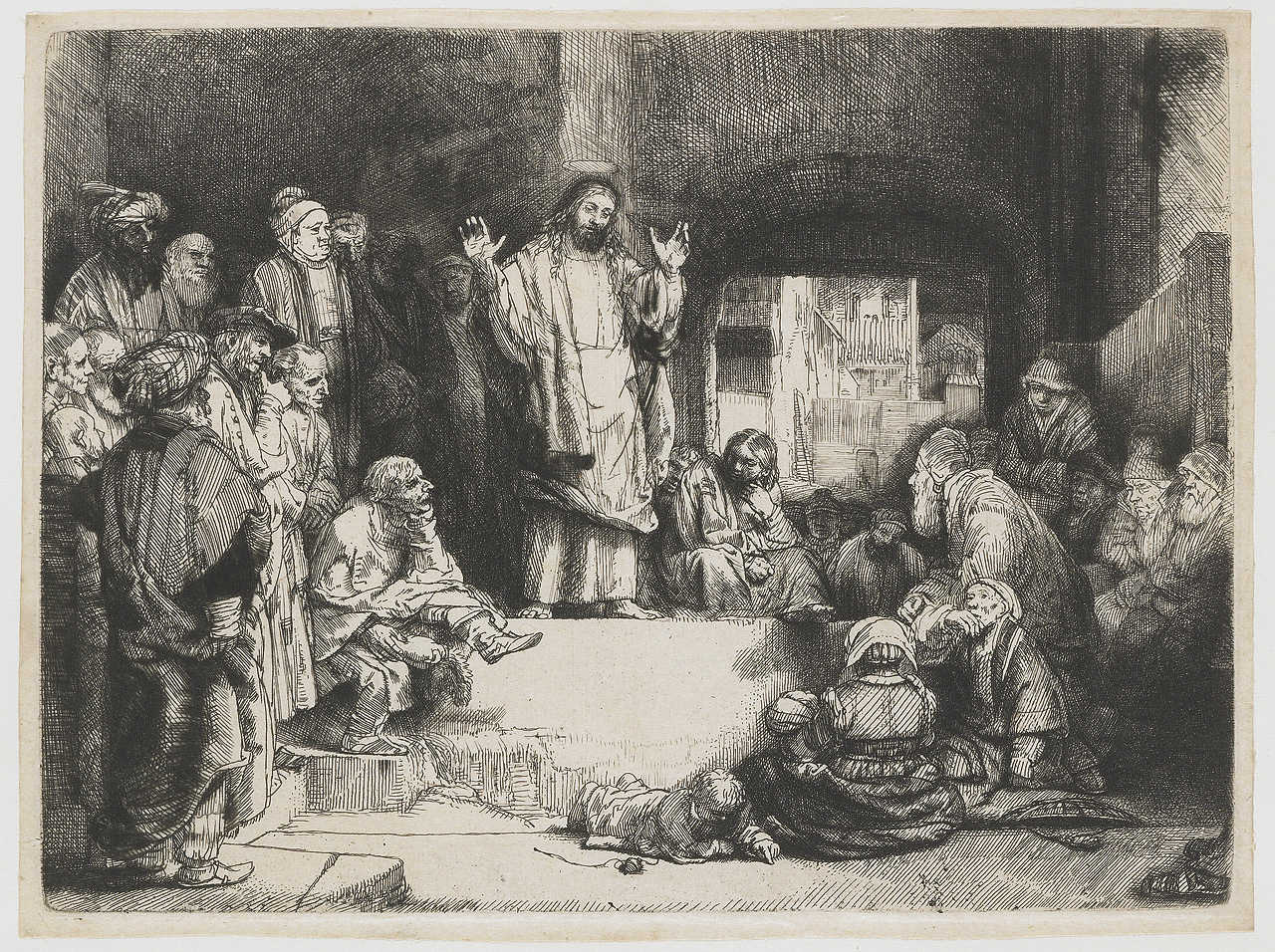
>> “Christ Preaching”by Keene Carter, Image: “I forgive the absent boy,” begins this poem based on a Rembrandt etching, directing our attention to the young child in the foreground who has turned away, disinterested, from Jesus’s sermon, drawing on the ground instead. Jesus gives grace to those in the crowd with averted gazes or who are distracted, simply continuing to preach on on the virtue of empathy—of seeing yourself in others—and on true life.
Rembrandt van Rijn (Dutch, 1606–1669), Christ Preaching (La Petite Tombe), ca. 1652. Etching, engraving, and drypoint on paper, 6 1/4 x 8 5/16 in. (15.9 × 21.1 cm). National Gallery of Art, Washington, DC.
>> “L’Angélus”by Seth Wieck, Grand Little Things:The Angelus is a traditional Christian prayer whose name comes from its opening words in Latin, “Angelus Domini” (The angel of the Lord). For centuries it was prayed by the faithful three times a day—at 6 a.m., noon, and 6 p.m.—the times announced by the ringing of bells from church towers. In the nineteenth century Millet famously painted two peasant farmers at dusk pausing from their labor in the fields to bow their heads and pray the Angelus. Seth Wieck interprets the painting through poetry, homing in on the part of the prayer that says, “Let it be done to me according to thy word,” expressing an attitude of surrender to God’s will. Wieck imagines the hard life of the man and woman shown pulling up potatoes from the earth—the same earth in which, shortly hence, they’ll bury a child, lost to sickness. The poem becomes a meditation on death, harvest, and acceptance.
Jean-Franҫois Millet (French, 1814–1875), The Angelus, 1857–59. Oil on canvas, 55.5 × 66 cm. Musée d’Orsay, Paris.
Lift up your heads, O gates! and be lifted up, O ancient doors, that the King of glory may come in! Who is the King of glory? The LORD, strong and mighty, the LORD, mighty in battle. Lift up your heads, O gates! and be lifted up, O ancient doors, that the King of glory may come in! Who is this King of glory? The LORD of hosts, he is the King of glory. Selah
—Psalm 24:7–10
LOOK: Christ’s Descent into Hell from the Stuttgart Psalter [HT]
Christ’s Descent into Hell, from the Stuttgart Psalter, made at the scriptorium at St. Germain-des-Prés in Paris, ca. 820–30. Cod.bib.lat.fol.23, fol. 29v, Württembergische Landesbibliothek, Stuttgart, Germany. Click on image to see full page and explore further.
The above psalm passage is read at several times during the church year, depending on your tradition: during Advent, in relation to Christ’s coming into the world (see, e.g., here); on Palm Sunday, where the gates are those of Jerusalem; and on Ascension Day, when Christ (re)enters heaven. But in some illuminated psalters—such as the Stuttgart Psalter from ninth-century France—it is connected with Jesus’s descent into hell between his death and resurrection.
On the Psalm 24 page of the Stuttgart Psalter, the manuscript’s anonymous artist has depicted Christ storming the gates of hell, which are guarded by two winged, fire-spitting demons. Satan or Hades (Death) cowers in the bottom left corner, licked by flames and fearful of his imminent end. Encompassed in a green mandorla and accompanied by an angel, Christ breaches enemy territory, using a long slender cross to break down the doors behind which Satan has kept souls imprisoned. He is here to strike Death dead and gain back his beloveds in an awesome display of glory, power, and love.
LISTEN: “Lift Up Your Heads”| Text: Psalm 24:7–10 | Music by Joseph M. Martin and Jon Paige, 1996 | Performed by CMS College Choir Kottayam, dir. Vimal Kurian, 2015
Lift up your heads, you everlasting doors; open up and let the King of glory come in. Let the King of glory come in. (Repeat)
Who is the King of glory? Who is the King of glory? The Lord of hosts! He is the King of glory. The Lord of hosts! He is the King of glory.
Lift up your heads, you everlasting doors; open up and let the King of glory come in. Let the King of glory come in.
Alleluia, let us sing To the one eternal King; Alleluia evermore To the King and Lord of lords.
Who is the King of glory? Who is the King of glory? The Lord of hosts! He is the King of glory. The Lord of hosts! He is the King of glory.
Lift up your heads, you everlasting doors; open up and let the King of glory come in. Let the King of glory come in. (Repeat)


#/media/File:JEAN-FRAN%C3%87OIS_MILLET_-_El_%C3%81ngelus_(Museo_de_Orsay,_1857-1859._%C3%93leo_sobre_lienzo,_55.5_x_66_cm).jpg)

 Art & Theology