Roundup: Holocaust survival embroideries, transforming brokenness into beauty, and more

SPOTIFY PLAYLIST: August 2026 (Art & Theology)

+++

POEM: “Last Words (Death Row, Texas)” by Eileen Talone: This poem from Image journal’s Winter 2020 issue made me cry. “Formally, it is a villanelle composed of found language from the transcripts of executions in Texas,” writes James K. A. Smith. “It is a poem of last words that the poet has braided together as an elegy, a song of both lament and yearning.”

+++

PODCAST EPISODE: “Pádraig Ó Tuama: Poetry, and Making Peace, Bearing Witness and Being Human – Poetry Against the Dark,” No Small Endeavor with Lee C. Camp, November 3, 2025: “‘Legitimate target has sixteen letters—and one long abominable space between two dehumanizing words.’ In this episode, poet and peacebuilder Pádraig Ó Tuama offers a sobering yet luminous reflection on language, theology, and the long road of reconciliation. From exorcisms and conversion therapy to moments of silence, soup, and starlight, his stories remind us that even in a burning world, there is still room for awe, for courage, and for a better kind of human flourishing.”

+++

EXHIBITION (+ BOOK + VIDEO TOUR): Esther and the Dream of One Loving Human Family, American Visionary Art Museum, Baltimore, February 23, 2019–December 2030: I recently saw this affecting exhibition at AVAM (the same museum that’s currently showing Mary Proctor), spending a whole afternoon taking in the visual and textual testimony of Esther Nisenthal Krinitz (1927–2001) regarding her survival of the Holocaust. Krinitz was twelve when the Nazis occupied the Polish hamlet of Mniszek, where she lived on a farm with her family. She was able to flee three years later, in 1942, with one of her younger sisters, but she never saw her parents, brother, or other sister again. She emigrated to the United States in 1949, working as a seamstress in Brooklyn and then in Frederick, Maryland, where she spent the remainder of her life.
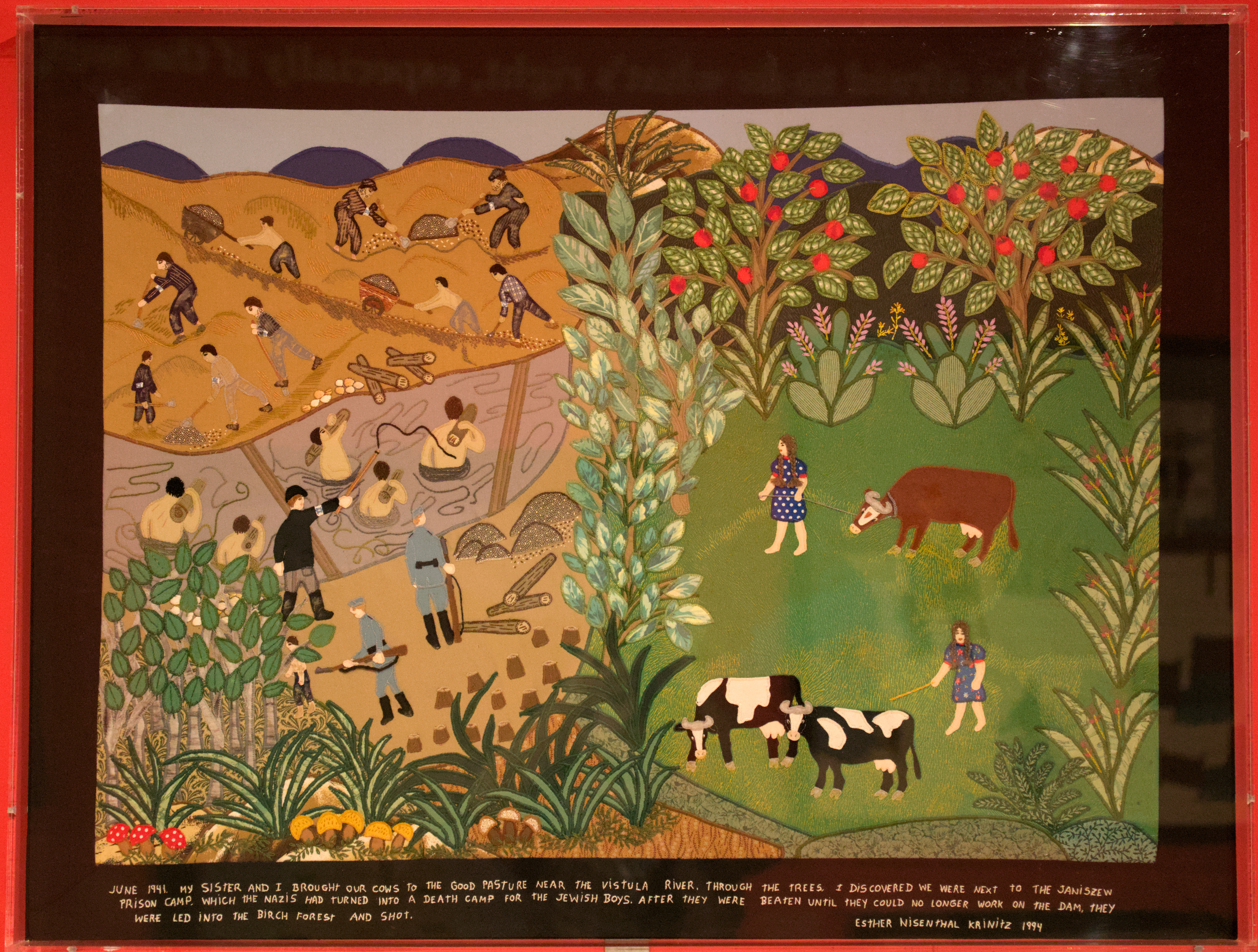
Krinitz, Esther Nisenthal_Janiszew Prison Camp
Esther Nisenthal Krinitz (Polish American, 1927–2001), Janiszew Prison Camp, 1994. Embroidery and fabric collage, 30 1/2 × 40 1/8 in. Photo: Victoria Emily Jones. © Bernice Steinhardt and Helene McQuade.

In 1977, at age fifty, Krinitz embroidered an approximately four-by-four-foot panel of her childhood home, her carrying pails of water up the footpath. She wanted to share her memories with her two daughters, Bernice Steinhardt and Helene McQuade. This became the first piece in a series of thirty-six, covering her bucolic childhood—tending geese, swimming in the river, walking through wheat fields on stilts, watching her mom make Passover matzos—and then its sudden disruption by German forces during the war. Her embroidered pictures show such cruelties as a soldier ripping off her father’s prayer shawl and cutting off her grandfather’s beard, and her whole family being pulled out of their beds at dawn and taunted with guns. They show children forced to dig trenches, a family friend’s betrayal, Krinitz hiding out in the woods, death marches, shootings, cabbages growing on human ashes at Maidanek concentration camp, and Nazi corpses hanging from trees after the liberation. Krinitz didn’t finish embroidering her whole life story, but the final image she completed shows her arriving, after living for several years in a refugee camp in Germany, in New York Harbor with her husband and newborn.

To view all the images, visit the Art and Remembrance website, which includes image files as well as a video tour narrated by Steinhardt. I also heartily recommend the beautifully produced book Memories of Survival, which reproduces the full series and provides an introduction, transcriptions of Krinitz’s hand-stitched descriptions, and commentary by Steinhardt.

Krinitz’s art is the primary component and anchor point of the current exhibition in Baltimore—but the exhibition also includes a dozen or so works by other artists that lament atrocities and advocate for an end to violence. “The show pays tribute to humanity’s unjust persecution of innocents and the dream of a world at peace.”

+++

TED TALK: “How Art Transforms Brokenness into Beauty” by Lily Yeh, April 19, 2024: Chinese American artist Lily Yeh travels the world, building community through the arts and bringing beauty to public spaces often seen as “broken.” In this TED Talk, she describes three of her collaborative projects: establishing an art park in North Philadelphia, which involved the making of murals, sculptures, and mosaics with neighborhood children and adults (a project that evolved into the nonprofit The Village of Arts and Humanities); working with survivors of the Rwandan genocide to create a memorial in Rugerero atop a mass grave (“Where there’s beauty, we see hope,” one survivor told her); and “turning dilapidation into color and abundance” at a middle school for migrant children in rural China.

Yeh is the subject of the 2014 documentary The Barefoot Artist: Healing Communities Through Art, streaming for free on Kanopy and available for rental through other platforms.

I learned about her through the Esther and the Dream of One Loving Human Family exhibition at AVAM (see previous roundup item), where three of her paintingsVillage Life in Rwanda Before the 1994 Genocide, Escaping into the Forest, and The 1994 Rwandan Genocide—are on display.
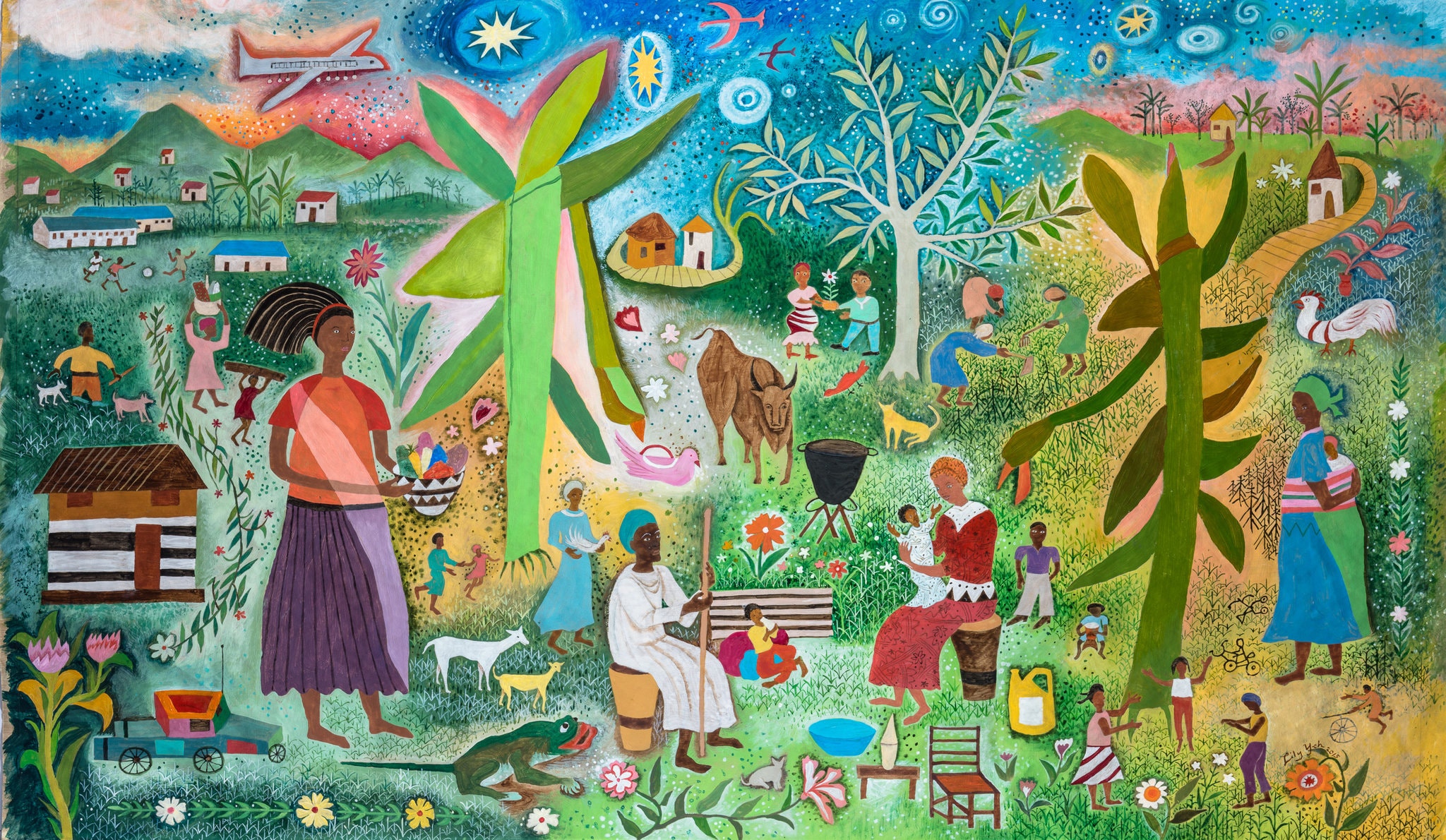
Yeh, Lily_Village Life in Rwanda Before the 1994 Genocide
Lily Yeh (Chinese American, 1941–), Village Life in Rwanda Before the 1994 Genocide, 2015. Acrylic on brown paper. Courtesy of the artist.

+++

SONGS:

>> “The Law of God Is Love” by Kester Limner: Kester Limner wrote this song in June 2020 for a virtual contemplative worship service at St. Andrew’s Episcopal Church in Seattle, influenced by the simple, slow, repetitive style of Taizé chant. She shares it under a Creative Commons Attribution (CC BY) license, which enables reusers to distribute, remix, adapt, and build on the material in any medium or format, even commercially, as long as attribution is given to the creator.

Love, love, the law of God is love
And to break every chain of oppression
So we work, and we pray, O God, Your kingdom come
May we see the dawn of Your justice

>> “Prayers for Freedom” by MaMuse: “Wholeheartedly fed by the folk and gospel traditions, MaMuse (Sarah Nutting and Karisha Longaker) create uplifting music to inspire the world into thriving.” “This video,” they write, “was inspired by our love and reverence for water, for friendship cherished and laughter forever praised.” I’ve previously featured the duo here and here.
Roundup: “Sing Hallelujah,” giant Advent calendar, snow drawings, and more

SONGS by Ordinary Time:

>> “Every Ditch, Every Valley,” on Until He Comes (2008). Based on Isaiah 40:3–9.

>> “Sing Hallelujah,” on Ordinary Time’s forthcoming album, and released last Friday as a single. Based on Isaiah 8:12–13; 9:1–7; and 60:1–2.

+++

EXHIBITIONS:

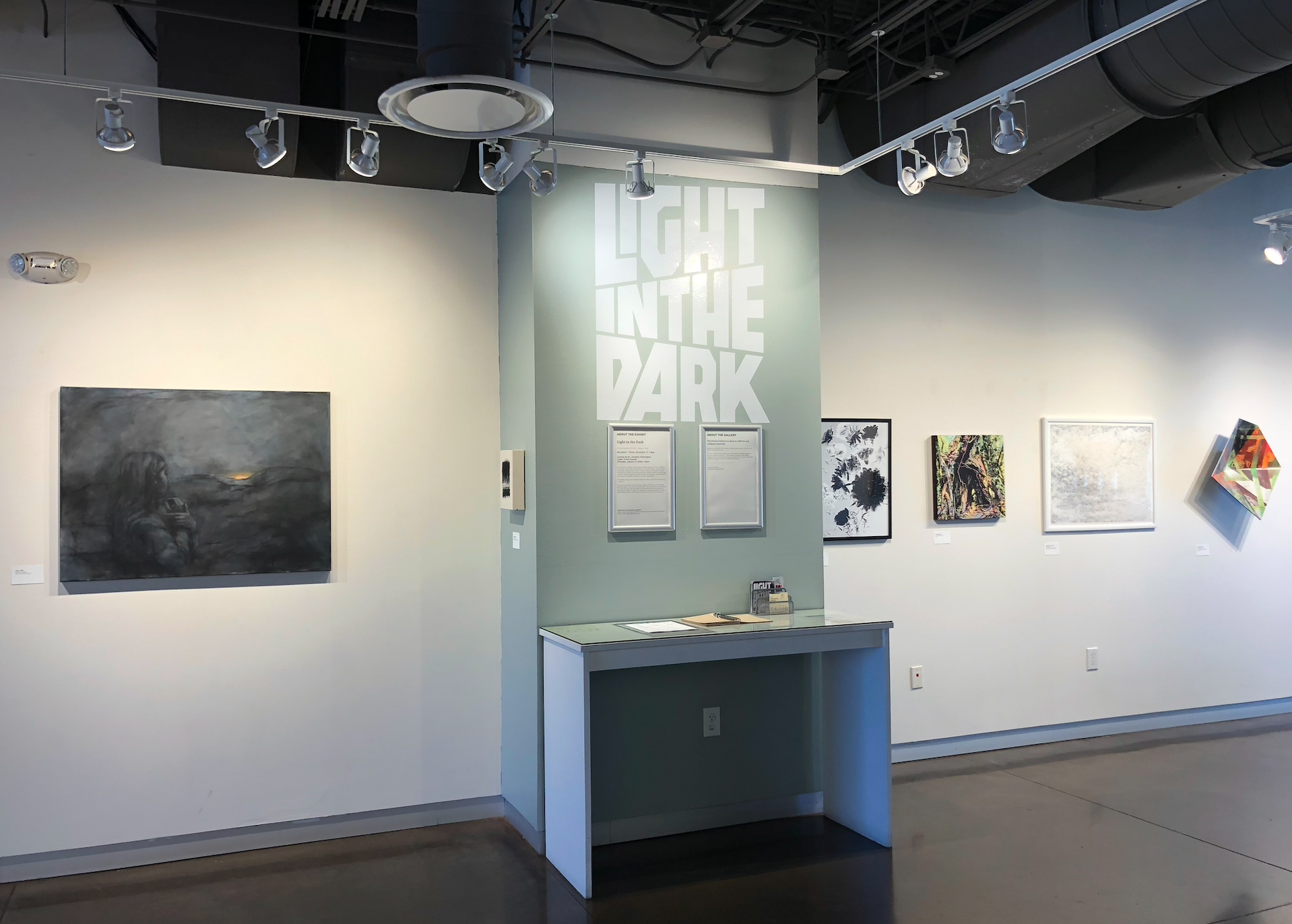
>> Light in the Dark, Sojourn Church Midtown, Louisville, Kentucky, November 17, 2023–January 7, 2024: Organized by Sojourn Arts, this juried exhibition features work by twenty-four artists from throughout the United States. It explores contrasts between light and dark, a powerful artistic as well as biblical theme with strong connections to the Christmas story. A complementary lecture on “Light in the Gospels” by Dr. Jonathan Pennington will take place on January 11, 2024.

Light in the Dark exhibition view
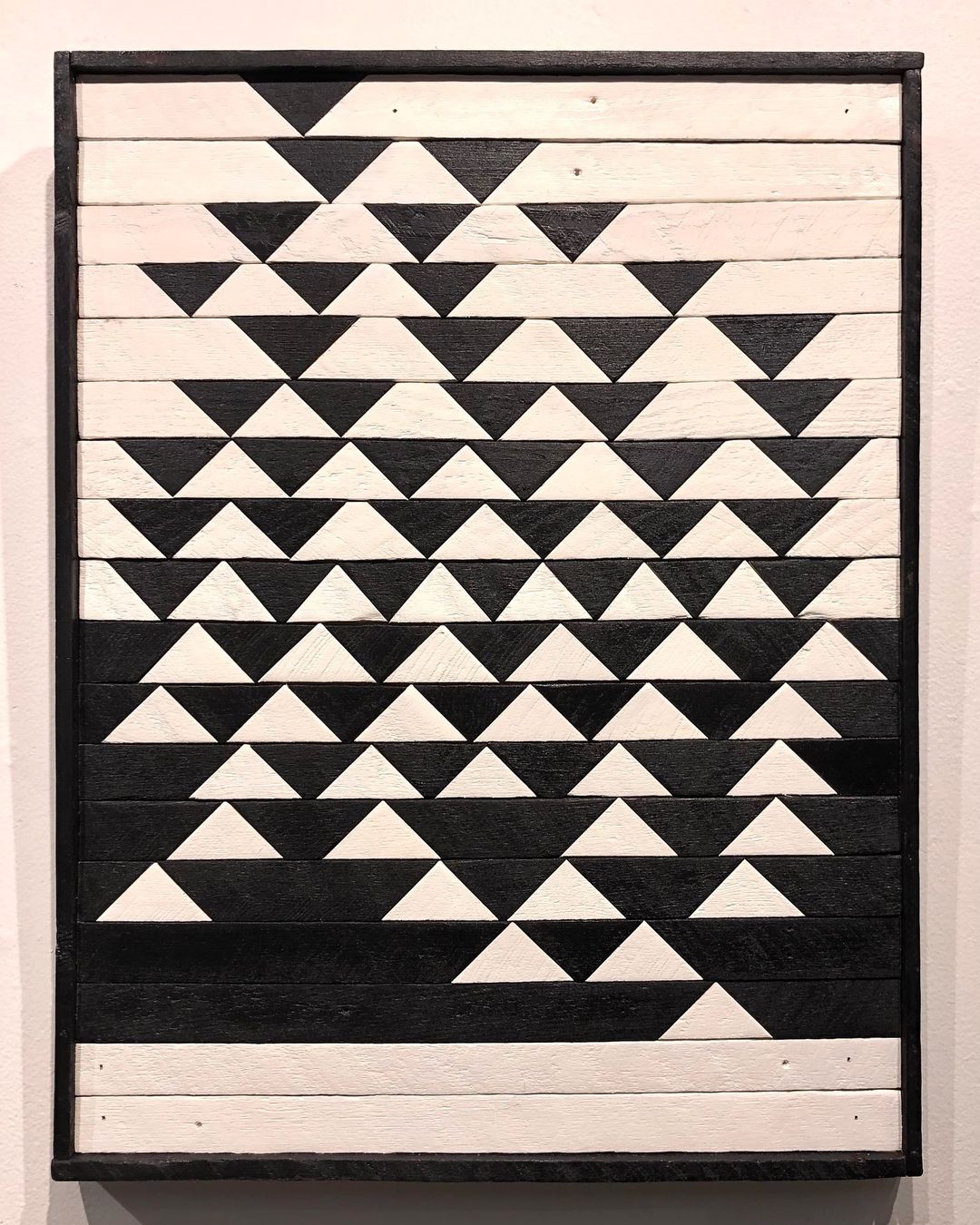
Hochhalter, Brandon_The Incredible Power of Light
Brandon Hochhalter, The Incredible Power of Light, 2023. Reclaimed lath wood from homes in Old Louisville, 18 × 24 × 1 in. [artist’s website]

>> Wilson Abbey Advent Windows, 935 W. Wilson Ave., Chicago, December 1, 2023–January 6, 2024: A business under the umbrella of Jesus People USA, Wilson Abbey in uptown Chicago is a neighborhood gathering place for coffee, art shows, workshops, theater, dance, film screenings, and live music. Every December since 2016, they have installed a three-story-tall Advent calendar in their windows to be enjoyed from the streets, with one new artwork revealed each day from December 1 to 24. Directed by the building manager, Karl Sullivan, the project commissions local artists to contribute a painting, photograph, or other graphic work, and this year there are twenty-three participating artists. It will be a brand-new series of images, all on the theme “The Soul Felt Its Worth”—which, Sullivan told me, will “explore the idea of the Christ child coming to earth as a promise of justice and care for those who are seen by God, showcasing people groups who may not be seen, or whom we may not want to see because their problems are bigger than us.”

Wilson Abbey Windows 2022
Wilson Abbey Advent Windows, December 2022 [see nighttime view]

Below are two of the paintings from a previous iteration of the project, which together form an Annunciation scene. The drone video that follows was shot in 2020 by Mike Angelo Rivera.

Bertsche, Sarah_Annunciation
Sarah Bertsche, Gabriel and Mary, 2020. Painted for the Wilson Abbey Advent Windows. [artist’s website]

Stop by 935 West Wilson Avenue in Chicago to see the progressively illuminated windows throughout the month of December (the full display will be up from December 24 to January 6), or follow along on Facebook or Instagram @wilsonabbeywindows. What a unique gift to the city! A fun way to engage the community.

+++

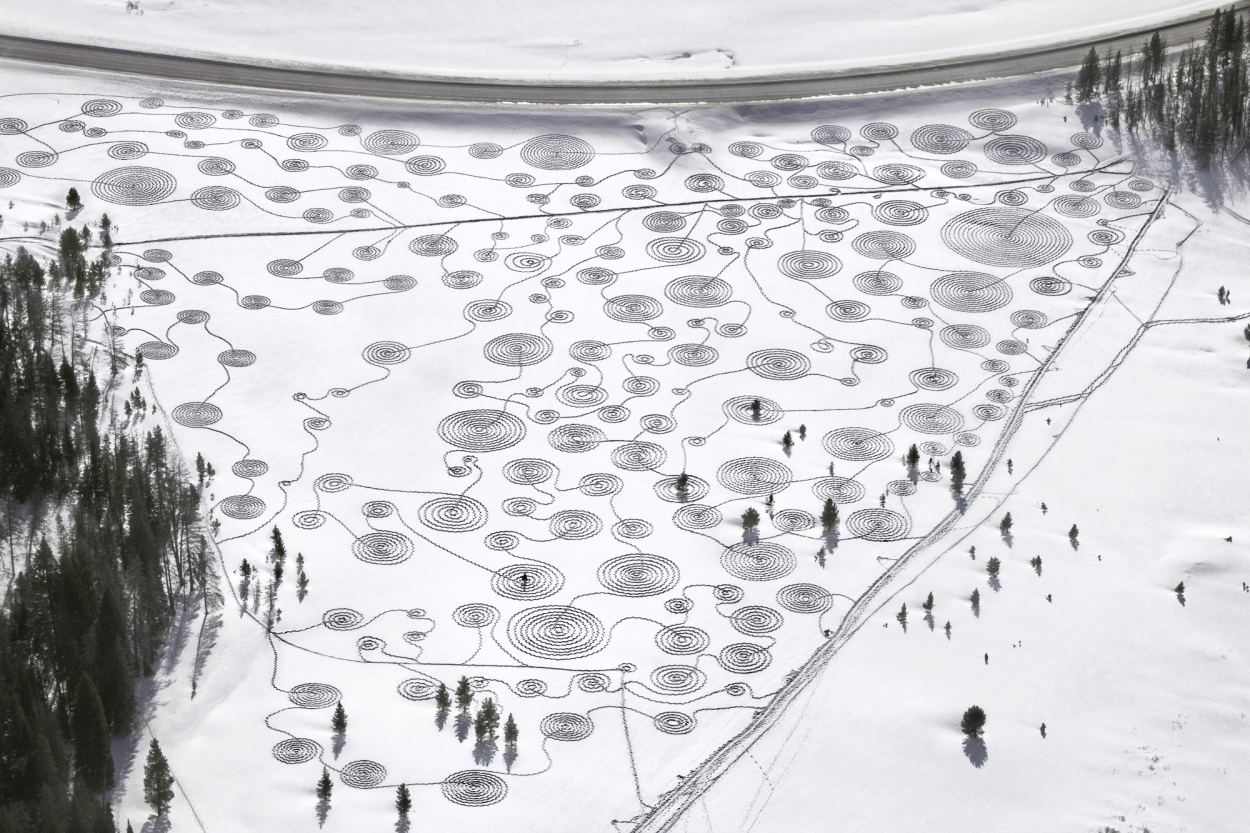
LAND ART: Snow Drawings by Sonja Hinrichsen: German-born, San Francisco–based artist Sonja Hinrichsen creates large-scale, ephemeral “snow drawings” in wintry locations around the world with the help of local volunteers who don snowshoes and track through the snow in patterns. She then photographs the land art from a helicopter or ski lift. These are amazing! Here’s a video by Cedar Beauregard of a drawing in progress at Rabbit Ears Pass, Colorado:

Hinrichsen, Sonja_Snow Drawings
Snow Drawing by Sonja Hinrichsen, Rabbit Ears Pass, Colorado, 2012

Roundup: New books and conferences; refugee memorial removed; icon against animal cruelty

PUBLIC ART CONTROVERSY: Olu Oguibe’s Monument to Strangers and Refugees, commissioned for last year’s major quinquennial art exhibition Documenta, was removed on October 3 by order of the Kassel City Council after, it is presumed, mounting pressure from Germany’s anti-immigrant Alternative for Germany (AfD) party. Designed as a site-specific work for Königsplatz (King’s Square), a pedestrian zone in the city center, where it had stood since June 2017, the fifty-three-foot concrete obelisk prominently features an excerpt of Jesus’s words from Matthew 25:35—“I was a stranger and you took me in”—inscribed in gold letters in German, English, Arabic, and Turkish. This quote reflects Jesus’s revolutionary ethic of love at the expense of personal comfort, of disadvantaging the self for others, so it’s no surprise that even today, it still offends. (Later in the passage, Jesus issues a sobering warning for those who fail to heed his command to welcome strangers.)

Monument to Strangers and Refugees by Olu Oguibe
Olu Oguibe (Nigerian American, 1964–), Monument to Strangers and Refugees, 2017. Concrete, about 53 ft. tall (3 × 3 × 16.3 m). Installation in King’s Square, Kassel, Germany.

Immigrant memorial removed
Olu Oguibe’s Monument to Strangers and Refugees was dismantled early on October 3 following orders by the city of Kassel. Photo: Regina Oesterling.

Germany has become increasingly polarized since 2015, when Chancellor Angela Merkel initiated an open-door immigration policy, leading to an influx of over one million refugees and asylum seekers at the height of the European refugee crisis. The city council had raised funds to purchase Oguibe’s monument for permanent display, and negotiations with the artist were in motion, but on September 24 they changed course, voting to remove the monument instead. According to Councilman Thomas Materner, a member of the AfD party, the obelisk is “ideologically polarizing, disfigured art.”

[Update, 10/12/18: The city and the artist have agreed on a new public location for the monument: Treppenstrasse, a nearby pedestrian area (via). 4/18/19: The monument was installed today at its new location (via).]

+++

CONFERENCES

“The Saddleback Visual Arts / CreativeChurch Arts Conference is a unique, full three-day conference and retreat October 18–20, 2018 at the beautiful Saddleback Rancho Capistrano Retreat Center. Creative leaders, arts ministry practitioners, and renowned artists will share visionary ideas and practical applications during sessions, workshops, creative and interactive performances and experiences. Attendees will explore applications for the arts and creativity in the local church, discover creative inspiration, experience refreshing and empowering ministry, connect with their creative tribe, and have the opportunity for personal or team retreat time in a beautiful setting. . . . For more information, and to register, please visit the CreativeChurch Arts website, here.”

[Update, 10/26/18: Below is a short video debrief of the conference.]

Another conference taking place that same weekend, October 19–20, 2018, is “Visual Theology I: Transformative Looking Between the Visual Arts and Christian Doctrine (1850–Now).” The inaugural conference of the Visual Theology Symposia, it’s being held in Chichester, England, and it may sound familiar to you, since I publicized the call for papers back in April. One of my favorite writers and thinkers in the field, Jonathan A. Anderson, will be speaking there, along with others. The focus will be scholarly, whereas Saddleback’s conference will be more practical, hands-on, and ministry-focused.

+++

LECTURE: “Cathedrals from the Outside: Questions of Art, Engagement, Commemoration and Celebration” by Sandy Nairne: At the National Cathedrals Conference in Manchester last month, Nairne, who served as director of London’s National Portrait Gallery from 2002 to 2015, spoke on the spiritual in art—in public spaces, galleries, and cathedrals. His starting questions: “How does contemporary art function in museums in ways that are of interest to cathedrals? And are there new ways in which art is playing a part in cathedrals that is important to the cultural world as a whole?” Click on the link to read the transcript.

The White Doves by Michael Pendry
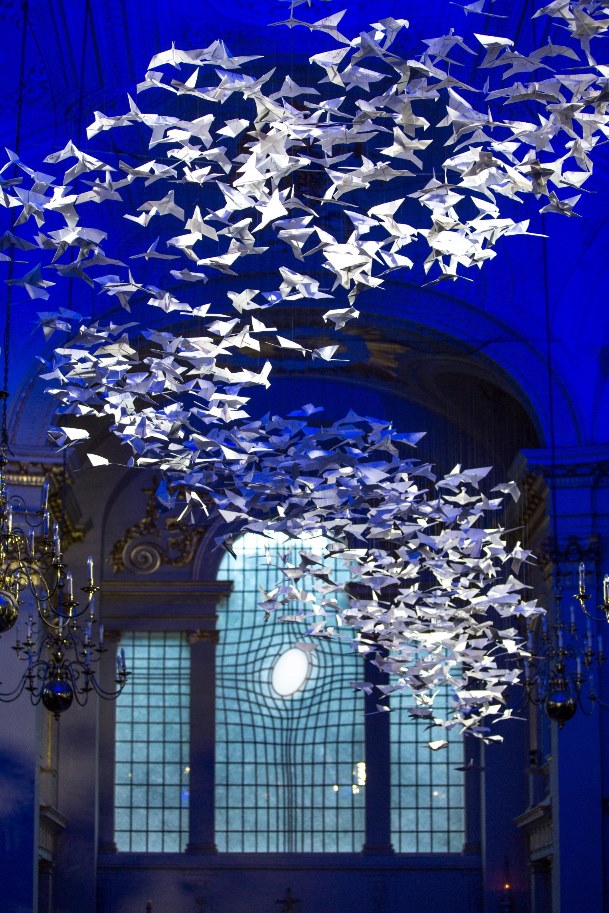
Michael Pendry (German, 1974–), Les Colombes – The White Doves, 2017. 2,000 white paper doves, 49 ft. (15 m). Pentecost installation at St. Martin-in-the-Fields, London. (Shirazeh Houshiary’s East Window is in the background.) Photo: Marc Gascoigne.

+++

NEW ICON: Christ Breaking the Bonds of Animal Suffering: Iconographer Aidan Hart writes, “Sometimes I am commissioned to paint an icon of a saint for whom nothing yet exists, or at least no satisfactory icon. This is usually a pre-schism Western saint. But more rarely, the subject is a new theme, a new emphasis or combination. This was the case when Dr Christine Nellist approached me to create an icon that embodied some of the Orthodox Church’s teaching about our relationship with animals. The icon was to be used as flagship for her newly founded organisation Pan-Orthodox Concern for Animals and to illustrate her pending book on the subject. This article tells the story of its genesis and explains its design.” Fascinating!

Breaking the Bonds of Animal Suffering by Aidan Hart
Aidan Hart (British, 1957–), Breaking the Bonds of Animal Suffering, 2018. Tempera on wood.

+++

BOOK REVIEWS

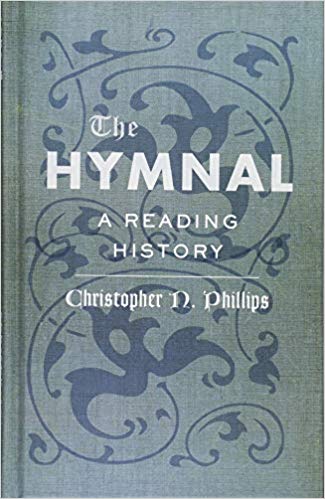
The Hymnal: A Reading History by Christopher N. Phillips, reviewed by Leland Ryken: Who knew hymnals didn’t take the form of a songbook until the 1870s! Before then, says Phillips, they were essentially volumes of poetry, used in family and private devotions. “The focus [of this book] . . . is an exploration of the hymnbooks that preceded our familiar hymnal. These were books containing the texts of the hymns without accompanying music. . . . [The author] doesn’t deal with the history of hymn-singing in church services but with the private reading of hymns as poems. I can’t imagine a more original approach to hymns for our generation.” Definitely adding this one to my to-read list.

The Hymnal: A Reading History

Everything Tells Us about God by Katherine Bolger Hyde, with illustrations by Livia Coloji, reviewed by Amanda McGill: This children’s book from Ancient Faith Publishing begins, “The world is like a giant puzzle God made to tell us about Himself—the Father, the Son, and the Holy Spirit. Every piece whispers one of His secrets—all we need to do is listen.” “I love the message of the book,” writes McGill: “finding God in the ordinary elements of creation. I think it affirms what children already suspect: that the world is meaningful, personal and infused with specialness. One of the first things I was thankful for was the inclusion of baptism and the Eucharist at the beginning of the book. It situates the sacraments within the normal experiences of life.”

Everything Tells Us about God