
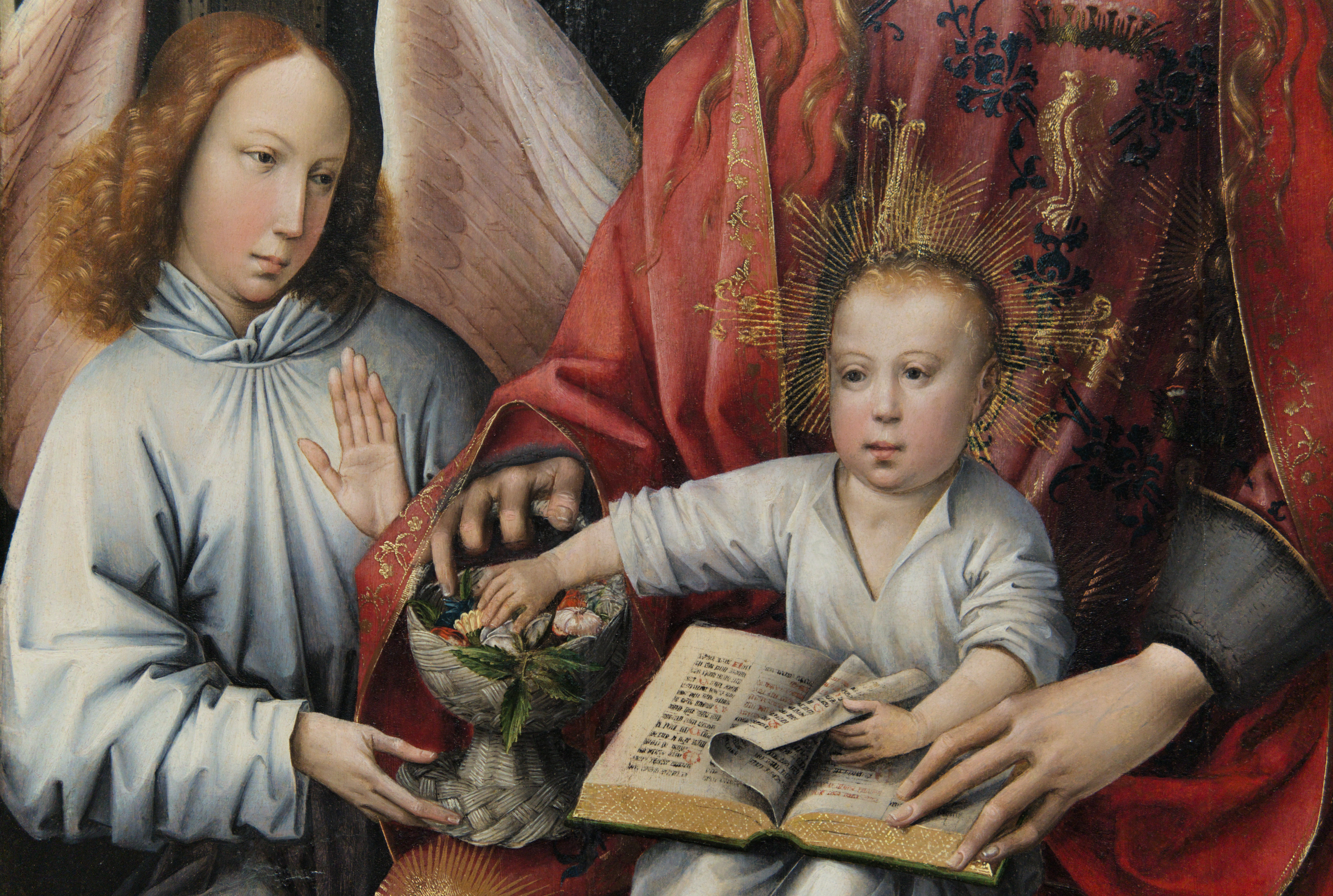
Isn’t this such a charming detail?—the infant Christ sticking his chubby little hand into a footed wicker bowl of flowers (potpourri?). I suppose the angel who holds it out to him wishes him to delight in the fragrance, this wee one whose senses are still so new. But what is its symbolic significance? Northern Renaissance painters often imbued ordinary objects with religious meaning. Perhaps it simply gestures to the aroma of Christ himself, his sweet, invigorating nature? At first I thought of myrrh, one of the gifts of the magi, traditionally interpreted as a foreshadowing of Christ’s death, as it was used to anoint his body in burial (John 19:39)—but myrrh is a yellow sap-like resin, and the bowl’s contents are neither that nor extracted oils. I don’t know; what do you think?
Compare this to the painting known as The Holy Family of Francis I (after the name of its original owner) by Raphael of Italy, which shows an angel providing a scented cover of flowers over the young mother and child.

The larger context of the Netherlandish painting is Christ sitting on his mother’s lap in a contemporary bourgeois interior as she is being crowned Queen of Heaven, royal by association with the newborn king. (The embroidered inscription on the hem of her mantle reads, “ORA PRO NOBIS / AVE REGINA / CELOR[U]M MATER REGIS ANG[E]LORUM,” which translates to, “Pray for us. Hail, queen of heaven, mother of the king of angels.”) He’s reading the scriptures—so devout!—but seems momentarily distracted by something out of frame. His expression is serene. (Sidebar: Is it just me who’s anxious by how sloppily he’s turning that page? Not the creases! I mean, I know he’s just a baby, but . . .)
I believe the text is pseudo-Hebrew—both here, and in the scroll on the floor. European Christian artists sometimes imitated Hebrew script in their paintings to reference Jesus’s Jewishness; they were not learned in the language and had no direct textual models in front of them, so the best they could do was make marks that evoke that linguistic heritage.

It’s possible that the scroll is meant to represent Mary’s Magnificat, but it’s hard to say. It lies unrolled beside a neck-handled pewter vase filled with three blue lilies and bearing bosses of what look to me like a Virgin and Child and the prophets.
And look at the golden embroidery of the two turtledoves perched in one of the folds of Mary’s garment! (It recurs in a few places.) This is a reference to the animal offering she brought to the temple for her postpartum purification, a ritual prescribed by ancient Jewish ceremonial law (Luke 2:22–24; cf. Lev. 12:1–8).
The textures in this painting are fabulous. The realistic, detailed rendering of surface textures—of fur, feathers, hair, paper, foodstuffs, metals, jewels, wood, wool, velvet—is one of the hallmarks of Northern Renaissance art—that is, art from fifteenth- and sixteenth-century Holland and Flanders, regions north of Italy. This greater illusionism was made possible by the use of oil paint, which also enabled richer, denser color than its precursor, egg tempera.
Northern Renaissance art is what made me fall in love with art history as a late teen. I had never encountered this painting before in my studies, so it was such a joy to stumble upon it earlier this year on a visit to the Art Institute of Chicago.
 Art & Theology